Erdogan at Home: Yes to Oppression, No to Rights
By Doha Shams | Al-Akhbar | June 18, 2013
Since the start of the protests and ensuing unrest in Turkey, a peculiar tradition has emerged in Istanbul. As the soon as the clock strikes 9 pm, a chorus of percussion – banging pots and pans – emanates from open windows in “pro-opposition” buildings. The cacophony lasts for about half an hour, sometimes more, depending on the day’s events. Its purpose: to show solidarity with the protesters in Taksim Square.
Istanbul – Aznur returned from the dentist disappointed and worried. She had an appointment, but the clinic was closed. She was not sure if this had something to do with the general strike called by Turkey’s trade unions.
The young woman, in her twenties, stood bemused, her face still swollen from yesterday’s tear gas. She then mumbled, “Maybe he is still detained. He was protesting with us last night.”
Though Aznur’s English is broken, this is nonetheless a “great achievement” in Turkey, where few people go on to master any foreign languages. In truth, the language barrier has made on-location coverage difficult for those who want to understand events beyond the news agencies.
Five Turkish trade unions declared the strike following the brutal police crackdown on protesters, which has claimed the lives of four activists and injured thousands since the protests began. Yesterday alone, 600 protesters were detained throughout Turkey, according to a source in the Turkish Bar Association who declined to be named.
The trade unions’ move also signals their rejection of the policies of Turkish Prime Minister Recep Tayyip Erdogan. Such policies have started to infringe alarmingly on individual freedoms, as many young men and women have told us.
Serttaş, a 30-year-old physical therapist, said, “Does Erdogan think Turkey is Gaza? The municipality of Ankara prohibited men and women from holding hands in public places and public transportation! Who does he think he is? All that is left for him to do is come with me to the bathroom! And why would he ban the sale of alcohol after 10 pm? I don’t understand.”
“We are here defending our way of life,” he added.
Yesterday was a momentous day. The repression of unarmed, peaceful protesters was unparalleled for a country not at war. Perhaps the explanation for Erdogan’s ham-fisted approach lies in his fear of catching the “Arab Spring” bug.
In its crackdown on the protesters, the government used a new type of tear gas, which could be a misnomer since the gas is blinding, as we were told by medical sources who said that 17 people have lost their sight because of the gas. The government has also shut down all communications, Internet access, and public transport like the subway and taxis. On top of it all, he has cut off power from Taksim Square to deter protesters from coming to the site.
These measures paralyzed the touristic capital. Thousands of tourists were stranded. We were able to spot some lost in the streets, unable to find their way back to their hotels.
We saw a Japanese tourist standing in front of a clerk at the bus station in Findikli Station on the Bosphorus. “I have a question,” she tried to tell the clerk. He looked at her said, “Yok yok” – Turkish for “there isn’t,” as in there isn’t anything operating. The tourist asked again, “Bus? Tram?”
“Bus yok, metro yok,” the clerk replied, making hand gestures to mimic someone walking. The girl, not quite sure what to do, followed his advice.
I, too, was stranded after witnessing the dispersal of a protest near Taksim using tear gas, water cannons, and batons. I ran away from the terrible smell in the direction of the waterfront along with some protesters. There, I encountered staggering traffic along the Bosphorus.
I learned afterwards that the legendary traffic was caused by Erdogan’s supporters, who came in from the Turkish provinces to meet his call to rally in the neighborhood of Zeytinburnu, where Erdogan delivered his speech.
“Most people left before Erdogan finished half of his speech,” a man in his fifties told us from where was he standing, in front of his café. I glanced at the Turkish television inside that was broadcasting Erdogan’s speech, and I saw the flag of the Syrian opposition.
During my long wait at the waterfront, I saw many large buses packed with women wearing the headscarf, and crammed taxis. Traffic was at a standstill. We asked one taxi after another, “Osmanbey?” to which the unanimous answer was “Kapali, kapali,” meaning “it’s closed.” The police reinforcements had closed it down.
Nearly an hour later, when Erdogan’s speech was over, traffic suddenly started rolling. In a matter of minutes, the street was completely empty, as though someone had blocked it at a faraway spot. I heard chants in the distance, and soon thereafter, a few-hundred-strong protest arrived in the area. Clearly, they came to protest against what Erdogan said during his speech.
Most of the protesters are young and middle class. There even are claims that most of the protesters are taking to the streets for the first time. Almost everyone was wearing a gas mask or goggles.
They looked at the choppers flying overhead and waved their fists at them in a challenging gesture. Passing boats in the Bosphorus sounded their horns, and people banged pots on balconies or applauded.
Şenol, a 40-year-old man who took part in the protests, said, “I do not blame the poor for backing Erdogan. They do not know their rights. They think that the handouts of the Justice and Development Party are something good. They don’t understand that his economic policies impoverish them.”
He continued, “Erdogan fools them with religious slogans while he sells public property, and expands the circle of cronies of businessmen and the nouveau riche. One day, they will understand. We too voted for him thinking he would rid us of the military, but he is worse than them.”
The time is nearly 8 pm. The sky is overcast. I tried to contact friends, but the phone lines are broken. Smartphones weren’t so smart either, because the Internet had been shut down.
Istanbul was nearly choking because of the fires and toxic gases that poisoned the air. Scores of hotel reservations and trips have been cancelled, much to the chagrin of workers who depend on tourism to make a living.
The clashes in Taksim and neighboring quarters continued throughout Saturday and Sunday. Street battles near the Osmanbey metro station led to a major confrontation on Sunday shortly after 4 pm.
It rained heavily, flash-flooding Istanbul’s streets. The rain washed away the toxic air, and forced some police officers to retreat. The protesters also took advantage of the rain to flee to their homes and wait for the next round of protests tomorrow.
Related articles
- Turkey will consider protesters staying at Taksim terrorists, official says (alethonews.wordpress.com)
- Turkish Unions Protest Erdogan Crackdown, Announce Strike (alethonews.wordpress.com)
Brazil sees largest protests in decades as unrest hits second week
RT | June 17, 2013
Mass protests continued throughout Brazil on Monday, with hundreds of thousands of demonstrators converging in Sao Paulo, Rio de Janeiro, Belo Horizonte, the capital of Brasilia and other cities.
Protests initially began last week following a government announcement of an increase in public transportation costs, which brought out students and young workers and led to more than 250 arrests.
According to reports by Brazilian media such as Jornal do Dia, the initially peaceful demonstrations last week became heated, and led to clashes with Brazil’s riot police that left at least 100 injured in the major cities of Brasilia, Sao Paulo, Rio de Janeiro and Belo Horizonte.
Though the protests initially began following the announcement of bus fare increases, they have evolved to include a wide range of groups that have grown dissatisfied over everything from government corruption and income inequality, as well as to outrage over the police’s harsh response to protesters last week.
In a sign that public dissatisfaction was still simmering, soccer fans booed president Dilma Rousseff on Monday during the opening of a two-week tournament at a stadium in the capital Brasilia. The heckling only intensified when the president of the global soccer body, FIFA, reprimanded the crowed for failing to show the president “respect.”
Though Rousseff was able to ride on her predecessor’s popularity, Brazil’s economic growth has slowed considerably since she took over from Luiz Inacio Lula da Silva, who is widely credited with lifting 40 million Brazilians out of poverty. Brazil’s economy has posted its worst two-year performance in over a decade, and inflation rose to 6.5 per cent in May.
At least 20,000 Brazilians were expected to demonstrate in Sao Paulo on Monday, with organizers placing the figure closer to 30,000.
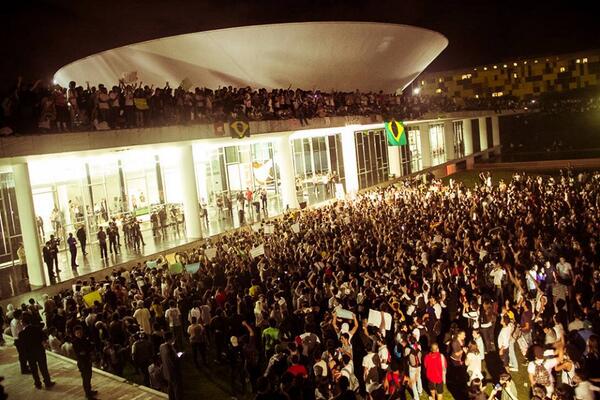
Protesters climb atop the capitol building in Brazil. #ChangeBrazil pic.twitter.com/Tb6CblQ5T0
Related articles
Brazilian police clash with Confederations Cup protesters
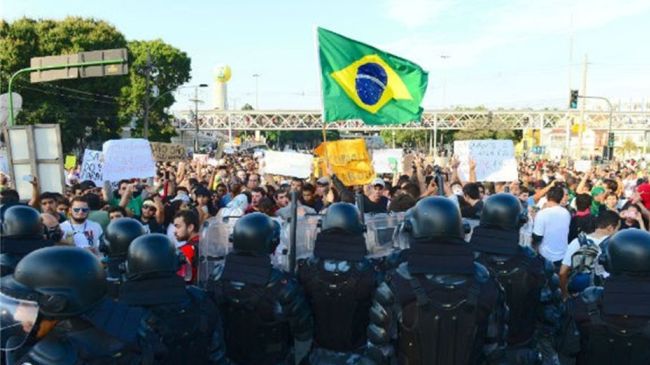
Brazilian police block protesters from entering Maracana soccer stadium in Rio on June 16, 2013
Press TV – June 17, 2013
Brazilian police have fired tear gas and rubber bullets to disperse a crowd of about 3,000 people protesting outside Rio de Janeiro’s Maracana stadium before a Confederation Cup soccer game.
The rally took place on Sunday in protest against the vast sums of public money spent on the organization of the tournament.
The protesters also opposed the huge cost of preparations to host next year’s World Cup, which is expected to reach USD 15 billion (about 11 billion euros).
“I don’t care about the World Cup – I want health and education!” shouted the protesters.
Initially, police stood in line as a barricade outside of the stadium.
However, as the crowd of protesters tried to pass the blockade riot police charged towards the group.
On June 15, police clashed with protesters in a similar demonstration during the opening of the Confederations Cup in the capital, Brasilia.
The clashes ended with 39 people injured after police fired tear gas and rubber bullets to disperse the crowd.
Related articles
Land Grabs, the Latest Form of Genocide in Guatemala

By Leonor Hurtado – Americas Program – 12/06/2013
In a historic decision this May, Guatemala’s Supreme Court of Justice sentenced former dictator General Ríos Montt to 80 years in prison for the genocidal massacres of indigenous people in the 1980s. Many Guatemalans hoped that the judicial process against the top criminals of the country’s “dirty war” would finally bring justice—but ten days after the decision, the Constitutional Court reversed the judgment.
While the Guatemalan people protest this violation of the rule of law, the processes of genocide initiated 30 years ago by Ríos Montt’s massacres continue today by other means.
In the last decade, the expansion of oil palm plantations and sugarcane production for ethanol in northern Guatemala has displaced hundreds of Maya-Q´eqchi´ peasant families, increasing poverty, hunger, unemployment and landlessness in the region, according to a new Food First report by Alberto Alfonso-Fradejas, “Sons and Daughters of the Earth: Indigenous Communities and Land Grabs in Guatemala.”
There is a major contradiction here: at the same time that the former General Ríos Montt is convicted for genocide, the Guatemalan government allows the oligarchy, allied with extractive industries, to displace entire populations without concern for the human cost. In many cases, these land grabs result in the murder and imprisonment of rural people who resist the assault.
Genocide against the indigenous peasant population in Guatemala no longer has the face of a military dictatorship supported by the United States. Now it is the corporations, the oligarchy and the World Bank who push peasants off their lands.
In today’s Guatemala, land and resource control is increasingly in the hands of a small oligarchy of powerful families allied with agri-food companies. At the center of this power are fourteen families who control the country’s sugarcane-producing companies (AZAZGUA); five companies controlling the national production of ethanol; eight families that control the production of palm oil (GREPALMA); and members of the Coordinating Committee of Agricultural, Commercial, Industrial, and Financial Associations (CACIF).
Together these powerbrokers are accumulating land and wealth with the support of investment from international institutions such as the World Bank, the Inter-American Development Bank (IDB) and the Central American Bank for Economic Integration (BCIE). The convergence of multiple global crises—finance, energy, food and environment—has directed corporate investment into land-based resources such as agrofuels, minerals, pasture and food. The situation in Guatemala is extremely violent, part of a global trend where agrarian, financial and industrial interests are grabbing control of peasant lands and resources.
Can land grabs be considered genocide? In many ways, land grabbing is a new form of genocide. Ricardo Falla’s study “What Do You Mean There Was No Genocide?” analyzes the definition of genocide and its characteristics. According to Falla, of the five acts that define genocide, two were most prominent in Guatemala: “the massacre of the members of a group,” and “the intentional subjection of a group to living conditions which will lead to their total or partial physical destruction.”
The first genocide was against the Ixil peoples during the reign of Ríos Montt. The second genocide is enacted today through the privation of the Q´eqchi´ peoples’ means of survival through land grabs. Hundreds of families have been displaced. They do not have land on which to produce food or live, and they are denied their cultural and community identity. These conditions undermine their ability to survive, and lead to their displacement, and in many cases death.
The historic genocide trial this May came about through the peoples’ long struggle to defend their rights. The Ríos Montt conviction is a condemnation of impunity. The oligarchy did everything possible to impede the trial while continuing to displace the indigenous peasant population with the support of international investment and a legal system that favors land grabbing to the detriment of the people.
On May 20, the Constitutional Court overturned the conviction, with two of the five judges opposing the decision. Pablo de Greiff, UN Special Rapporteur for the Promotion of Truth, Justice, Reparation and Guarantees of Non-Recurrence stated, “No legal decision is inconsequential, even if it is revoked.” The Inter-American Court of Justice issued a statement criticizing the verdict for violating international obligations assumed by the state and preventing the people from seeking justice. Multiple organizations and authorities have spoken out against the court’s decision, arguing that it overstepped its bounds, violated legal provisions, and endorsed the corrupt mechanisms upon which impunity is built in Guatemala. The decision bolsters evidence that Guatemala’s top court lacks political independence and is tied to the country’s economic and ruling elite.
On May 24, thousands of people demonstrated and delivered a letter with more than a thousand signatures to the Court demanding that the decision be reversed. In Argentina, Chile, Honduras, Mexico, Nicaragua and Peru, thousands more marched in solidarity to the Guatemala embassy demanding justice.
If we fail to judge and condemn the massacres committed thirty years ago, what hope is there for the Mayan Q’eqchi’, Xinka, Mam, Kaqchikel and other indigenous peoples currently being displaced and massacred by extractive corporations with the support of the state and international institutions? The people continue to courageously resist and defend their lives, lands and identities. How shall we express our solidarity?
Leonor Hurtado is a fellow at Food First/Institute for Food and Development Policy. A native of Guatemala, she has spent decades defending human rights and indigenous rights, and supporting indigenous resistance to the expansion of extractive industries.
Photo: Caracol Producciones
Related articles
- Survivors Reluctant to Testify in New Genocide Trial (ipsnews.net)
- Guatemalans protest annulment of dictator’s genocide conviction (workers.org)
- Israel’s Hand in Guatemala’s Genocide (phantomreport.com)
Russia ranked world leader in shale oil reserves
RT | June 12, 2013
Russian shale oil reserves are estimated at 75 billion barrels, which puts the country on top of the global standings, followed by the US and China.
According to the report by the US Energy Information Administration (EIA), the estimated American shale gas resources equal 58 billion barrels, with third-place China having 32 billion barrels.
But it’s the Chinese, who hold the leadership in shale gas reserves, with 1,115 trillion cubic feet. 802 trillion cubic feet puts Argentina in second, with Algeria not far behind on 707 trillion cubic feet.
The US is fourth when it comes to shale gas (665 trillion cubic feet), while Russia is ninth with 285 trillion cubic feet.
The EIA’s report indicates that the worldwide resources of oil and gas from shale formations are greater than was previously thought.
The global shale oil resources are estimated at 345 billion barrels and shale gas – at 7,299 trillion cubic feet, which is a 10 per cent increase in comparison with the 2011 data.
According to EIA’s administrator, Adam Sieminski, the report shows “a significant potential for international shale oil and shale gas.”
The increase in estimates is explained by more countries joining the efforts to search for deposits, following the ‘Shale Revolution’ in the US.
“As shale oil and shale gas production has grown in the United States to become 30 percent of oil and 40 percent of natural gas total production, interest in the oil and natural gas resource potential of shale formations outside the United States has grown,” Adam Sieminski explained in a statement.
Also on Wednesday, British oil giants BP have Russia’s natural gas reserves estimate at 32.9 trillion cubic meters from 44.6 trillion in last year.
According to the company’s benchmark Statistical Review of World Energy, it’s Iran, who climbed to the top of the global standings, with the proven reserves of 33.6 trillion cubic meters.
BP said that this year they decided to adjust its estimates for the former Soviet Union states, including Russia, where data on reserves remains classified.
“Traditionally countries of the former Soviet Union had different criteria than used elsewhere. So we used a conversion factor to convert that from those countries where we don’t get direct data,” Christof Ruhl, BP’s chief economist, is cited as saying by Reuters. “In some countries, reserves are still a state secret, so we have to rely on these data.”
But Russia remains a much larger gas producer than Iran as the international sanctions prevent the Islamic Republic from exploiting its natural resources in full.
The estimate of gas reserves in the US where the energy industry has been transformed by shale oil and gas, due to lower prices and reduced drilling.
The American gas reserves ended 2012 at 8.5 trillion cubic meters, down 0.3 trillion from indications of 2011.
BP cut proven global gas reserves by nearly 21 trillion cubic meters from 208.4 trillion cubic last year to 187.3 trillion cubic meters as of end of 2012.
Related article
Nicaragua: New Plans to Build Canal are Announced
By Kari Paul | The Argentina Independent | June 6, 2013
Rene Nuñez, president of Nicaragua’s national assembly, announced today that a Chinese investment firm will fund construction of a channel through Nicaragua, an alternative trade route to the Panama Canal.
The new channel will link the Pacific Ocean with the Caribbean Sea, and will be built by a “consortium of investors combined into one firm,” Nuñez, who declined to give more information on the group, said.
The government of Nicaragua’s President Daniel Ortega has introduced two bills to streamline the environmental impact study on the new works, so that the channel can be constructed as soon as possible.
“This is a project that is very important to the country, so we are pursuing it with urgency,” Nuñez said.
President Ortega said that the channel will serve as an alternative to the overcrowded Panama Canal, which is currently undergoing a US$5.2bn expansion project. He also stressed that the Nicaragua Canal will bring jobs to the impoverished in Nicaragua and other Central American countries.
Others oppose the canal, saying the government is pursuing it recklessly.
“I don’t know what is the rush, especially with such a sensitive topic,” said congressman Luis Callejas. “There should be a full consultation with the people, I do not understand why they are rushing the decision.”
Originally the channel was planned to go through the San Juan River, but now Ortega announced it would be built further north, through the waters of Lake Nicaragua.
“Lake Nicaragua should be a source of drinking water for Nicaragua and South America,” argued Environmental Affairs Chair Jaime Incer. He said the lake is currently protected as a “potable water reserve” by a law that Ortega himself passed.
The Nicaraguan National Assembly will debate the two bills on the project, taking into account the environmental impact, on Friday.
Argentina to Nationalize Cargo and Passenger Trains
By Sabrina Hummel | The Argentina Independent | June 4, 2013
Minister of the Interior and Transport, Florencio Randazzo, is set to announce changes in the railway sector – most importantly the nationalisation of passenger and cargo trains.
The Brazilian company América Latina Logística (A.L.L) will see its concession revoked and the historic Tren de la Costa will return to state hands. A.L.L had already received a warning from the Auditor General’s Office for anomalies in its provision of services.
From 1990 up to 2012, the company amassed a debt of over $237m to the government, 866% in excess of its contract compliance. Payments over the last six months have stalled, allowing the government to rescind its concession.
Tren de la Costa, built at the end of the 20th century, served as a vital link between the neighbourhood of Belgrano and the port of Tigre. Following various changes in ownership, it converted to electric power in 1931.
It covers 15.5km and runs alongside the scenic Río de la Plata serving four provincial municipalities. It has a total of 11 stations with a standard fare of just $16m or $10 for those with a DNI.
A.L.L meanwhile operates two of the most important freight railway networks in all of the country: A.L.L Central (line San Martín) and A.L.L Mesopotámica (line Urquiza). A.L.L Central runs through the centre of Argentina, beginning in the province of Cuyo and passes through San Luis, Córdoba, Rosario, Santa Fe, and finally Buenos Aires. A.L.L Mesopotámica in turn runs through the provinces of Misiones, Corrientes, and Entre Ríos, linking them to Paraguay, Uruguay, and its own network in Brazil.
A.L.L is the largest operator of rail logistics in Latin America. A.L.L Argentina is the biggest rail operator in the country, spanning 8000km. It is also the second largest in terms of cargo volume, transporting more than 5m tonnes each year.
Randazzo was recently quoted saying, “in terms of policy and management decisions, the State is more competitive than the private sector”.
Why Arabs Need Iran: Part I
By Sharmine Narwani | Al-Akhbar | 2013-06-03
In 2011, when Arab revolts began to sweep the Middle East and North Africa, the view from Washington and its closest allies was one of concern. How would the removal of mostly pro-Western dictatorships affect the balance of power in the region? More importantly – how to prevent these events from boosting Iran’s influence?
Two years on, the regional competition for influence is in full throttle. In its sights – among many other developments – are recent efforts by Iran and Egypt to upgrade their relationship.
The spoilers will have none of it. Said Steven A. Cook last week on the website of that most prestigious of US institutions, the Council on Foreign Relations (CFR): “Other than some quick cash and subsidized energy, there is nothing that Tehran can offer Cairo that will, in the long run, be to Egypt’s benefit.”
He has it entirely wrong. “Quick cash and subsidized energy” can only be used to describe the superficial offerings of countries like Saudi Arabia and Qatar, both vying for influence in this new Egypt.
There is no contest whatsoever between that kind of assistance and what Iran can bring to the table. Iran has achieved its economic independence the hardest way imaginable – through a devastating eight-year war with Iraq and decades of potentially-debilitating sanctions. It has shrugged off the yoke of imperialism, built infrastructure, social services and industry from scratch, harnessed its own resources toward establishing domestic self-sufficiencies, created a dynamic – if imperfect – indigenous political system of representative government, and managed to maintain the security of its oft-threatened borders through military innovation and soft power.
In short, with similar-sized populations (Iran’s 78 million to Egypt’s 82 million) and the experience of tackling monumental state-building challenges with varying degrees of success, there is simply no country better situated to provide developmental guidance to Egypt – and other economically vulnerable Arab states – than the Islamic Republic of Iran.
Seeing is Believing
Other than a frustratingly brief trip some years ago to attend a Tehran conference where I had little opportunity to get around, I had not visited Iran in eight years. In the latter part of 2012, I made three trips to the country – in large part to discover how Iran continues to thrive despite the “biting sanctions” we keep hearing about.
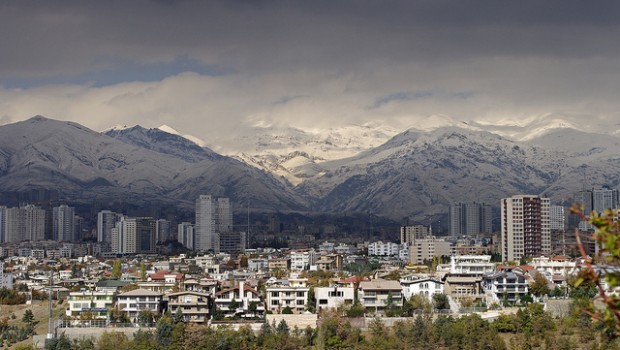
And thrive it does. Visitors land at the brand new Imam Khomeini international airport as a first step in experiencing an utterly revamped Tehran. You drive into the city on new highways, lit up almost excessively by closely aligned lampposts and the Iranian penchant for colorful lighting at major intersections. Streets are lined with trees, shrubs and flowers planted and nurtured by a succession of rather remarkable mayors that Tehran residents like to boast about.
Those are the city planners who develop well-manicured parks and children’s playgrounds to break up the urban monotony, build women’s sports facilities to encourage good health, spearhead campaigns on AIDS awareness, and pass out free condoms and hypodermic needles to prevent infection among drug users.
Tehran feels new and fresh – like it has had a facelift. New buildings abound, each more luxurious than the last, although sales have slowed dramatically in recent years, much like in other capitals hit by economic slowdown and ridiculously expensive housing. I cannot believe the greenery – this is a dry climate and I cannot seem to recall the city ever overflowing with late summer foliage like this.
New restaurants, cafés, and boutiques dot the boulevards; the bazaars are well-stocked and cleaner than I recall. Nothing seems to be in shortage – and Iranians are producing more of the food products on their supermarket shelves than ever before. In 2011, Iran ranked 11th globally in agricultural output, just behind Japan, Russia, Turkey, and Australia – and is ranked first and second worldwide in the production of a variety of fruits, vegetables, spices, and nuts ranging from apricots, cucumbers and walnuts to pistachios, saffron, and watermelon.
This is a country hell-bent on achieving self-sufficiency, after all. Under threat of increasingly punitive US-sponsored economic sanctions, Iran’s Supreme Leader Ayatollah Ali Khamenei last year promised the development of a “Resistance Economy” that will aim to stop all dependence on oil revenues and switch to knowledge-based industries and vital commodities instead.
After eight years away from the country, none of Tehran’s significant advances impressed me as much as the pollution-solution. Surrounded by the Alborz mountain range that traps pollutants, the capital has struggled for decades to lessen air pollution, much of which stemmed from aging vehicles that service a city of more than 12 million residents.
During past trips to Tehran, the stench of petrol from cars was omnipresent in congested areas – you’d have to clean blackened particles from your nose every day. In 2012, I experienced none of these things. The city still has high alerts on dangerous pollution days, but has come a long way from the days when the municipality enforced alternative driving days for cars with even and odd license plate numbers.
For starters, during my eight-year absence, Tehran has launched around 80 subway stations servicing more than 2.5 million passengers daily, and inaugurated a 60-station rapid transit bus system with just under two million daily users.
More impressive yet is the Islamic Republic’s nationwide effort to convert public transportation and privately owned vehicles from petrol engines to ones that run on Compressed Natural Gas (CNG).
Pay attention now. Iran’s experiment to switch to alternative fuel-based vehicles is the kind of super-efficient central government initiative that the country now frequently launches – with varying degrees of success. It is one of many zero-to-a-hundred projects initiated in recent years that seeks to diversify the economy, create jobs, generate revenues or solve a problem. To Iran’s credit, at least they think big and make the effort – few other governments engage in these kinds of expansive nation-building activities anymore.
Partly to help stem air pollution, and mostly to reduce the country’s dependence on imported gasoline – and therefore mitigate the effect of US-backed sanctions against companies that sold refined petroleum to Iran – the Islamic Republic embarked on an ambitious program to adopt Natural Gas Vehicles (NGV) based on alternative fuels.
In just a few years, Iran has established a fleet of around 3 million NGV, the largest in the world (by contrast, the US has just over 200,000) and now has the capacity to domestically manufacture 1.5 million CNG cylinders per year at extremely competitive costs.
Big Thinkers Build Nations
In writing this series of articles based on my Iran trips, I am constantly reminded of an MSNBC promotional ad featuring Rachel Maddow, where she stands in front of the Hoover Dam in a blue hardhat and gets sentimental about big-projects-that-build-nations:
“When you are this close to Hoover Dam, it makes you realize how small a human is in relation to this as a human project. You can’t be the guy who builds this, you can’t be the town who builds this, you can’t even be the state who builds this, you’ve got to be the country that builds something like this. This is a national project – this is a project of national significance. We’ve got those projects on the menu right now and we’ve got to figure out whether or not we are still a country that can think this big.”
The current mayor of Tehran Mohammad Bagher Ghalibaf – a former commander in the Revolutionary Guard and national police chief who is widely admired for his big thinking and ability to get the job done – happens to be one of eight candidates running for president in the June elections.
Tehran residents are attached to their mayors, and in a city of between 12 to 14 million, are able to propel them to the presidency (current Iranian President Mahmoud Ahmadinejad was the previous mayor). And after eight years in this role, you would be hard pressed to find a Tehrani who doesn’t praise Ghalibaf for his role in developing their capital. If he emerges as a national frontrunner, Tehran will push him over the line.
Among the other eight 2013 presidential contenders is Dr. Gholam-Ali Haddad-Adel, a former speaker of parliament (majlis) who holds one of Tehran’s 30 majlis seats and a close adviser to Iran’s Supreme Leader Ayatollah Ali Khamenei, to whom he is related through marriage.
I met with Haddad-Adel during one of my trips to Iran last year – not to discuss regional or domestic politics – but to learn about four “academies” set up by the Iranian government two decades ago. These academies are meant to drive “big thinking,” establish best practices, and initiate macro planning for national projects in the areas of Sciences, Medical Sciences, Arts, and the Farsi language.
The Farsi language as a big national project? As it happens, that’s the academy headed up by Haddad-Adel, who holds a PhD in philosophy and has translated Immanuel Kant’s books into the Persian language.
What could be so urgent and critical about the national language that would move a country under prohibitive international sanctions to direct resources toward it?
“Farsi is as old as Iranian civilization – they are inseparable,” explains Haddad-Adel. “We Iranians are proud of our national language and literature. We regard our Persian literature as one of the most important elements of our national identity. And we have to support this language against the dangers that threaten it – new words, idioms and terms entering the language through science, technology and culture – mostly through the English language.”
Under Haddad-Adel’s tenure, one of the 15 departments dedicated to the task of preserving the Persian language has created a nine-volume dictionary converting over 40,000 foreign words into Persian equivalents. A quick glimpse through the final volume shows that a lot of the terminology being replaced are technological, medical and scientific words (laparascopy, intra-muscular injection, binary pulsar, supramolecular). But also covered are subjects like political sciences (interdependence, deconstructionism, national security), music (chord, grand-barre, capo d’astro) and sport (play-offs, kayak, surfboard).
Seventy different university groups and more than 150 people are involved in this task. The academy has developed complicated software for finding Persian equivalents for English terms.
“Language is not something that can be improved by command though,” says Haddad-Adel. “The velocity of development is so rapid, it is not possible for the public to follow it. We try to disseminate it through cultural ways.”
Another project of the academy: a Persian-to-Persian dictionary covering at least 1,000 years of the language – and tracking words like “khasteh” which means “tired” in modern Farsi and “injured” in old Persian through its exportation to the Ottoman Empire and current usage in modern Turkey as “hastehan” which means “hospital.”
Yet another department is developing a six-volume encyclopedia containing the “whole history of Persian language and literature in the Indian subcontinent.” Explains Haddad-Adel: “Persian was welcomed by Indians. It was a language of culture and has been for more than 800 years the official language of the old Indian courts and intellectuals. British colonialism ended this.”
There is more to this than the preservation of language – cultural revivalism, national security, identity politics, nationalism are woven into the fabric of the academy’s work. The Iran of Haddad-Adel isn’t a nation in decline – it appears to be getting geared up to lead a renaissance.
Mississippi Calls on Iran for Help
I next visited the director of the Medical Sciences academy Dr. Alireza Marandi, a pediatrician by training, two-time minister of health, university professor and a current member of the Majlis from Tehran.
In 2009, I had read an article in the UK-based Sunday Times (reproduced on this blog) that told the remarkable story of Iran’s provincial health houses. The post-revolution initiative to rapidly deliver basic medical care to under-served rural areas was able, in a short time, to reduce child mortality rates by 69 percent and maternal mortality in rural areas from 300 per 100,000 births to 30.
So astounding were these results that the US state of Mississippi – which, according to the Sunday Times article, has “some of the worst health statistics in the country, including infant mortality rates for non-whites at Third World levels” – turned to Iran for advice, assistance and training on how to achieve these results back home.
Dr. Marandi was Iran’s minister of health around the time the first health houses (khaneh behdasht) were established in post-revolutionary Iran. He recalls the difficulties in getting funding back in the early 1980s:
“During the Iran-Iraq war we had very little oil to export – we were limited to about one million barrels per day. The price of oil had come down to about $7-8 per barrel. The country was under bombardment. Yet during this time, the country still focused on developing a primary healthcare system.”
That wasn’t even the hard part. When majlis-approved funding finally came in to run one pilot program in each of Iran’s provinces, the planners had a difficult time finding local men and women with the required five years of elementary education to staff the health houses – especially the girls. Today, with literacy rates among Iran’s youth (ages 15-24) at 98 percent according to the World Bank, all health house workers have at least a high school education.
The women are trained for basic healthcare procedures – monthly check-ups for mothers, vaccines for children, schedules and checklists, breastfeeding guidance, preventive care. The men are largely responsible for environmental health issues like water and sanitation – they check village water supplies, add chlorine where necessary, teach locals personal hygiene, how to disinfect things, install basic toilets, and lay water pipes.
Today, says Marandi, Iran has some 20,000 health houses in 65-70,000 villages around the country and has established a primary healthcare “network” connecting health houses to larger health centers in larger towns, which in turn plug into hospitals and specialized medical facilities in urban areas. Although challenges still exist in this system, Iran has solved a vital social service and healthcare challenge that continues to plague most developing nations.
Despite a lack of funds, Marandi’s ministry of health tackled many more major health problems in those early days. In 1983, the highest rate of immunization in Iran was 25 percent. A few years later, that rate skyrocketed to 95 percent throughout the country. Iranians desperately needed more physicians (only 12,000) and a more diversified medical worker base, so the ministry of health under Marandi pushed through a bill that took all health-related schools (midwifery, dentistry, nursing, etc) away from the ministry of education. By streamlining and adding to existing resources, in that first year 1,200 students were increased to 6,000, students were directed into undermanned specialties where jobs awaited, and new schools of medicine were built – at least one for each province.
Today, there are 120,000 physicians in Iran. The country is self-sufficient in the production of medical experts and support staff, and has diversified into specialties like fertility treatments, heart, cornea, and kidney transplants that Iranians were forced to seek outside the country a few decades ago. Iranian expertise and relatively low-costs now even draw medical tourism from near (Iraq) and far (Canada).
“We now have every sub-specialty you can think of,” says Marandi, who received an award for his accomplishments from the World Health Organization (WHO) in 2000.
While Iran has the benefit of considerable oil resources to cushion its economy, throughout the 1980s the country was broke. Economically, Iran was in not much better a position than Egypt or Jordan are today, both countries just months away from bankruptcy. There is a missionary zeal that permeates the higher echelons of government and their immediate ranks below. Many decision makers I interviewed are driven by both religious faith and geopolitics – determined to satisfy public needs and focused on discovering efficiencies that will thwart the negative effects of sanctions. Despite frequent accusations of corruption and mismanagement, clearly a lot is getting done in the country – and with a real spirit of innovation.
In the next installments, I will write about my interviews with leaders in technological and scientific fields including Iran’s controversial nuclear energy program, huge achievements in nanotechnology, political insights on what top Iranian politicians think about a Muslim Brotherhood-led Egypt, and US-sponsored sanctions…and the unexpected fact that Iran has cloned sheep.
Sharmine Narwani is a commentary writer and political analyst covering the Middle East. You can follow Sharmine on twitter @snarwani.
Featured Video

Can the U.S. Afford to Annihilate Iran?
or go to
Aletho News Archives – Video-Images
From the Archives
Sanctions, War and the Policy of Dual Containment
By SASAN FAYAZMANESH | March 17, 2008
It is now nearly three decades since the Unites States adopted the policy of dual containment of Iran and Iraq. While much has been written about the containment of Iraq, there has been very little in-depth analysis of this policy when it comes to Iran. In a book that is going to be released on March 31, 2008, entitled The United States and Iran: Sanctions, Wars and the Policy of Dual Containment (Routledge), I attempt to address this shortcoming by investigating when and why the US policy of containment of Iran came about, how it evolved, and where it stands today.[1] To the extent that Israel has been involved in US policy making, the study will also include the role that Israel has played in the containment of Iran. Also, since the fate of Iran has been inextricably linked to that of Iraq, occasionally the investigation will overlap with the containment of Iraq.
The policy of dual containment of Iran and Iraq originated during the Carter Administration, but it was not until the Clinton Administration that the expression “dual containment” became popular. … continue
Blog Roll
 Aletho News
- Can the U.S. Afford to Annihilate Iran? /Seyed M. Marandi
- Elmo Sold mRNA Jabs to Your Toddler. Now They Are “Off-Label.”
- British state targets Palestine Action with yet another crooked trial
- Americans are paying the price to preserve Israel’s nuclear hegemony
- Resistance factions are necessary to ensure a permanent US Iraq withdrawal
- How Israel destabilizes the Middle East: Denying sovereignty and the right to exist
- Europe’s Establishment Is Embracing War – and Losing Voters
- NATO chief advocates war of aggression
- No Vote, No Representation, No State: Democracy, Israeli Style
- Zionist Bought Senate Blocks Information About American Citizens Killed By Israel
- If Americans Knew
- Israeli Soldiers Abduct At Least 22 Across Occupied West Bank
- Eight Palestinians Killed in Israeli Attacks on Gaza
- Israeli former leaders and security chiefs threaten legal action over ‘Jewish terrorism’
- Israel map in LA Times ad includes all land from the river to the sea
- Inside Lebanon’s 200-page dossier on Israeli war crimes
- Flydubai, genocide, settler violence, Trump abuse of power to deport – Daily Update
- Counting Antisemitic Incidents: What the ADL Audit Reveals — and Obscures
- Mamdani releases plan to combat antisemitism and hate crimes in New York City
- Iran’s Revolutionary Guards Publish Letter to the American People
- DMFI launches $1 million ad campaign supporting Virginia’s Elaine Luria
- No Tricks Zone
- Green Energy Debacle: German Expert Professor Fritz Vahrenholt Warns Of Severe Economic And Social Consequences
- Two More Paleo Reconstructions Affirm Meters-Higher Sea Levels Across Ireland, Brazil 7000-6000 Years Ago
- New Study: Earth And Venus Surface Warmth Largely Explained By Convection And Lapse Rate, Not CO2 Or Radiation
- 2025 Nature Paper Claiming Worsening Global Drought Gets RETRACTED …Heavily Flawed
- New Study: ‘Global Drought Shows No Detectable Recent Acceleration Under Climate Warming’
- Economic Masterminds: German Socialists Suggest Taxing Productivity Gains Stemming From Using AI
- The South China Sea Has Not Been Cooperating With The Climate Change Narrative
- Energy Crisis: Germany Enters Heating Season With Historically Low Gas Reserve Fill Levels
- New Study: The Antarctic Ice Sheet Gained Mass From 2020-2024 Due To Staggering Snow And Ice Accumulation
- Study: Ocean Heating Rates From Thousands Of Years Ago ‘Dwarf’ Modern Ocean Heating Rates

