Iran-Iraq-Syria Gas Pipeline Project Agreement Finalized
Fars News Agency | February 20, 2013
TEHRAN – Implementation of the Friendship Gas Pipeline project which is due to take Iran’s rich gas reserves to Iraq and Syria was agreed by the Iraqi government, an Iraqi cabinet statement announced.
A Tuesday Iraqi cabinet statement said that Iraq’s Minister for Petroleum Abdel Kareem Luaibi had been authorized to sign the “framework of the agreement” on setting up the strategic pipeline that would also prepare the ground for exporting Iranian gas to Europe through Syria in the future.
The statement added that Luaibi had recently held talks with his Iranian counterpart Rostam Qassemi and Managing Director of the National Iranian Oil Company (NIOC) Ahmad Qalebani in Tehran regarding the issue.
Late in January, Iranian Oil Ministry Spokesman Alireza Nikzad Rahbar said the country will start exporting natural gas to Baghdad by next summer via an under-construction pipeline between the two countries.
He said that the “friendship” pipeline project between Iran, Iraq and Syria is the most important project currently pursued by the ministry.
The official said if the project is carried out according to schedule, the gas pipeline between Iran and Iraq will be completed next summer, adding that tripartite talks are underway to extend the pipeline to Syria.
He noted that the pipeline would be designed in such a way that it would be able to deliver gas to other Muslim countries like Jordan and Lebanon in the future.
The oil ministers of Iraq, Iran and Syria had signed a preliminary agreement for a $10 billion natural-gas-pipeline deal on July 25, 2011, in Assalouyeh industrial region located in the Southern province of Bushehr.
Iranian oil officials then said Syria would purchase between 20 million to 25 million cubic meters a day of Iranian gas while Iraq had also already signed a deal with Tehran to purchase up to 25 million cubic meters a day to feed its power stations.
The main project, 1,500 km length of piping Assalouyeh gas to Damascus requires $10 billion investment.
The pipeline will transfer a capacity of 110 million cubic meters of natural gas a day to Damascus.
The gas will be produced from the Iranian South Pars gas field in the Persian Gulf, which Iran shares with Qatar, and holds estimated reserves of 16 trillion cubic meters of recoverable gas.
Iranian officials have said that Tehran also aims to extend the pipeline to Lebanon and the Mediterranean to supply gas to Europe.
Related article
What the One-Percent Heard at the State of the Union
By SHAMUS COOKE | CounterPunch | February 19, 2013
When President Obama speaks, most Americans hear what he wants them to hear: lofty rhetoric and a “progressive” vision. But just below the surface the president has a subtly-delivered message for the 1%, whose ears prick up when their buzzwords are mentioned.
Obama’s state of the union address was such a speech – a pro-corporate agenda packaged with chocolate covered rhetoric for the masses; easy to swallow, but deadly poisonous.
Much of Obama’s speech was pleasant to the ears, but there were key moments where he was speaking exclusively to the 1%. Exposing these hidden agenda points in the speech requires that we ignore the fluff and use English the way the 1% does. Every time Obama says the words “reform” or “savings,” insert the word “cuts.”
Here are some of the more nefarious moments of Obama’s state for the union speech:
“And those of us who care deeply about programs like Medicare must embrace the need for modest reforms [cuts]…”
“On Medicare, I’m prepared to enact reforms [cuts] that will achieve the same amount of health care savings [cuts] by the beginning of the next decade as the reforms [cuts] proposed by the bipartisan Simpson-Bowles commission.”
This ultra-vague sentence was meant exclusively for the 1%. What are some of the recommendations from the right-wing Simpson-Bowles commission? Obama doesn’t say. Talking Points Memo explains:
-Force more low-income individuals into Medicaid managed care.
-Increase Medicaid co-pays.
-Accelerate already-planned cuts to Medicare Advantage and home health care programs.
-Create a cap for Medicaid/Medicare growth that will force Congress and the president to increase premiums or co-pays or raise the Medicare eligibility age (among other options) if the system encounters cost overruns over the course of 5 years.
There were many other subtly-delivered attacks on Medicare in Obama’s speech, all ignored by most labor and progressive groups, who clung tightly to the “progressive” smoke Obama blew in their face.
Obama’s speech also included a frightening vision of a national privatization scheme to previously publicly owned resources. But it was phrased so inspirationally that only the 1% seemed to notice:
“I’m also proposing a Partnership to Rebuild America that attracts private capital [wealthy investors] to upgrade what our businesses need most: modern ports to move our goods; modern pipelines to withstand a storm; modern schools worthy of our children…we’ll reward schools that develop new partnerships with colleges and employers [corporations]…”
Obama’s proposal plans to “rebuild America” in the image of the wealthy and corporations, who only put forth their “private capital” when it results in a profitable investment; resources that previously functioned for the public good will now be channeled into the pockets of the rich, to the detriment of everyone else.
Allowing the rich to privatize and profit from public education and publicly owned infrastructure (ports and pipelines, etc.) has been a right-wing dream for years. This will result in massive user fees for the rest of us, while further dismembering public education, which Obama’s ill-named Race to the Top education reform is already successfully accomplishing.
Obama’s speech also put forth two massive pro-corporate international free trade deals, which would further drive down wages in the United States:
“We intend to complete negotiations on a Trans-Pacific Partnership [a massive free trade deal focused mainly on Asian nations]. And tonight, I am announcing that we will launch talks on a comprehensive Transatlantic Trade and Investment Partnership [free trade deal] with the European Union – because trade that is free and fair across the Atlantic supports millions of good-paying American jobs.”
While praising free trade Obama disarmed labor and progressive groups by throwing in the meaningless word “fair.”
Lastly, Obama’s drone assassination policy was further enshrined in his speech. Drone assassinations are obvious war crimes — see the Geneva Convention — while also ignoring that pesky due process clause — innocent until proven guilty — of the constitution.
But Obama said that these programs will be “legal” and “transparent,” apparently good enough to keep most progressive groups quiet on the issue.
There were plenty of other examples of sugar-coated poison in Obama’s speech. It outlined a thoroughly right-wing agenda with no plan to address the jobs crisis — sprinkled with pretty words and “inspiring” catchphrases.
Some labor leaders and “progressive” groups seem dazzled by the speech. President of the union federation, AFL-CIO, Richard Trumka, praised Obama’s anti-worker speech:
“Tonight President Obama sent a clear message to the world that he will stand and fight for working America’s values and priorities. And with the foundation he laid, working families will fight by his side to build an economy that works for all.”
And here is the real problem; as President Obama follows in the footsteps of President Bush, labor and progressive groups have found their independent voice stifled. The close ties between these groups and the Democratic Party have become heavy chains for working people, who find themselves under assault with no leadership willing to educate them about the truth, let alone organize a national fightback to win a massive jobs-creation program, prevent cuts to social programs, and fully fund public education. Obama’s second term will teach millions these lessons via experience.
Shamus Cooke is a social service worker, trade unionist, and writer for Workers Action (www.workerscompass.org) He can be reached at shamuscooke@gmail.com
Related article
- Obama’s State of the Corporate Union (alethonews.wordpress.com)
Turkey to consider gas deal with Iraqi Kurds
US claims to oppose deal
Press TV – February 19, 2013
Turkey has reportedly struck a massive oil and gas agreement with Iraq’s Kurdistan Regional Government, a move that would strain Ankara’s ties with the US and the central government in Baghdad.
According to a Monday report by The New York Times the Kurds in Iraq have agreed to supply Turkey with at least 10 billion cubic meters of gas every year through a natural gas pipeline whose construction is part of the deal.
Turkey has not officially confirmed the deal, which represents a fifth of the country’s current gas consumption.
The agreement is a major bone of contention between Turkey and the US, which believes such a measure would put Iraq’s integration in jeopardy by pushing the Kurds in the oil-rich country into the hands of Turks, the report says.
“Economic success can help pull Iraq together,” US Ambassador to Turkey Francis Ricciardone said earlier this month.
But “if Turkey and Iraq fail to optimize their economic relations … there could be more violent conflict in Iraq and the forces of disintegration within Iraq could be emboldened,” he warned.
The US envoy added that at the end of the day, the measure would harm the interests of Turkey, the US and the regional countries.
Turkey had previously shied away from engagement with Iraqi Kurds fearing their probable efforts for independence on Iraqi soil would embolden the Kurds in Turkey to intensify their three-decade battle for autonomy. But Ankara’s recent attempts at ironing out issues with Kurds to put an end to the long hostility may have convinced them to build up courage and get closer to Iraqi Kurds.
The recent deal is also a thorn in the side of Iraq’s central government which tries to block Turkey’s efforts at boosting leverage by planning to become an energy hub in the region.
In November, Baghdad prevented Turkish national energy firm TPAO from bidding for an oil exploration contract.
And in December, Baghdad barred a plane carrying Turkish Energy Minister Taner Yildiz from landing in Arbil as he was reportedly on his way to seal the much-speculated energy deal.
Economic Growth with More Equality: Learning From Bolivia
By Emily Achtenberg | Rebel Currents | February 15, 2013
Until recently, conventional economic wisdom held that sustained economic growth in any society could only be achieved at the expense of income equality. Today, even free market disciples like The Economist recognize that these goals are not contradictory—and that growing inequality, in fact, is an impediment to economic prosperity.
Recent data on economic growth and inequality for the United States and Bolivia reveal two starkly contrasting portraits.
The United States, after four decades of widening inequality, is experiencing the greatest economic downturn since the Depression. In 2011, while the economy grew by only 1.7% (down from 3% in 2010), income inequality increased by almost as much—the biggest single year increase in two decades. Over the past 30 years, the share of income held by the top 1% has more than doubled, increasing from 8% to 17%, while the share held by the bottom 20% has fallen from 7% to 5%. Currently, the United States has the highest level of income inequality of any developed country.
Poverty rates in the United States have risen 23% since 2006, now leveling off at 15.1%. Today, more Americans are living in poverty than at any time in the half-century since the census started publishing these estimates. Due to declining incomes, the U.S. “middle class” is eroding, dropping from 61% of adults 40 years ago to a bare majority now.
As Nobel prize-winning economist Joseph Stiglitz has noted, the United States’ declining middle class is too weak to support the consumer spending that has historically fueled our economic growth. Thus, inequality is “squelching our recovery”—but U.S. political leaders have been slow to act on this lesson.
In contrast, despite the worldwide economic crisis, Bolivia’s economy is on track to increase by at least 5% in 2013, as it did last year. This is among the highest growth rates in Latin America, exceeded only by Chile, Panama, Peru, and Venezuela. Since the start of Evo Morales’s presidency in 2006, Bolivia’s GDP has tripled, and GDP per capita has more than doubled.
At the same time, according to data recently presented by Morales to the Legislative Assembly, income inequality in Bolivia has significantly decreased. In 2011, the richest 10% of the population had 36 times more income than the poorest 10%, down from 96 times more in 1997. “Bolivia is one of the few countries that has reduced inequality,” notes Alicia Bárcena, head of the UN Economic Commission for Latin America and the Caribbean (ECLAC). “The gap between rich and poor has been hugely narrowed.”
Between 2005 and 2011, Bolivia’s poverty rate declined by 26% (from 61% to 45%). The extreme poverty rate fell even more, by 45%. An estimated 1 million people joined the ranks of the “middle class.” The World Bank has officially recognized Bolivia as a lower-middle income country, a ranking that affords more favorable credit terms.
Between 2006 and 2011, Bolivian workers’ purchasing power increased by 41%, as compared to 17% between 1999 and 2005. The minimum wage has risen 127% since 2005, far exceeding the rate of inflation. In contrast, U.S. workers’ real wages have stagnated or fallen, with inflation-adjusted incomes now at their lowest point since 1997. Since 1972, the average hourly wage has risen only 4%.
In Bolivia (unlike the United States), domestic demand fueled by rising incomes and narrowing inequality is a driving force behind the country’s economic prosperity. Local evidence of increased domestic consumption and consumer purchasing power can be seen in places like El Alto, the sprawling indigenous city overlooking La Paz, where banks and fast food outlets are sprouting up and the first supermarkets, shopping centers, and cinemas are being planned. In 2012, there were 8.9 million mobile phones in Bolivia (with a population of around 10.4 million). Construction activity has outpaced the capacity of the domestic producers, with cement now being imported from Peru.
Rating agency Standard and Poor’s gave Bolivia high marks for economic resiliency last October, in underwriting a successful $500 million bond sale—the country’s first venture into the international credit markets since the 1920s.
Behind these positive indicators is Bolivia’s state-led economic policy, including the re-nationalization of strategic sectors divested by past neoliberal governments (such as hydrocarbons, telecommunications, electricity, and some mines). Around 34% of the national economy is now under state control—although private investment (on Bolivia’s terms) is encouraged and has continued, in hydrocarbons and other key sectors.
The vast increase in hydrocarbons and mining revenues under Morales has funded a major expansion of social welfare programs, including highly popular cash transfers targeted to the elderly, pregnant mothers, and school children. It has also supported major infrastructure improvements, a significant increase in the coverage of basic services (such as water, electricity, and domestic gas), and a major expansion of public healthcare and education programs—all boosting the living standards of average Bolivians. … Full article
Related articles
Bolivia: President Evo Morales Nationalises Airports
By Sabrina Hummel | The Argentina Independent | February 18, 2013
Earlier today, Bolivian president Evo Morales announced plans to nationalise the country’s three largest airports. The airport operator Bolivian Airports Service Company (SABSA), a subsidiary of the Spanish firm Abertis y Aena, is accused of not carrying out agreed investments towards updating its facilities.
The decision to nationalise SABSA was taken after executives refused to increase their initial investment of US$36m, required to maintain and develop the country’s principal airports. The military is set to take control of airport terminals in El Alto (La Paz), Viru-Viru (Santa Cruz), and Wilsterman (Cochabamba). In Bolivia, it is common practice for troops to be dispatched to recently nationalised companies.
SABSA is the third Spanish company to be nationalised in less than a year in what began with the expropriation of Red Eléctrica in May 2012, followed by two electricity distribution companies owned by Spanish utility Iberdrola in December of the same year.
The nationalisation of SABSA reflects attempts by the Bolivian government to reclaim control of the country’s strategic resources, including natural gas, minerals, and public services. It is a move which aims to promote and indeed facilitate state-led development of the country without direct foreign interference. Morales issued the statement from the main city of Cochabamba, accompanied by vice-president Álvaro García Linera and the minister for public works, Vladimir Sánchez.
Reporting Ahead of Ecuadorean Elections Fits a Familiar Narrative
By Dan Beeton | CEPR Americas Blog | February 17, 2013
International media reporting ahead of Ecuador’s elections today has sounded familiar themes, understating the achievements of the Rafael Correa government and attributing Ecuador’s recent economic and social progress to “luck” or happenstance, and high oil prices. Correa is depicted as an enemy of press freedom, despite the fact that Ecuadorean media is uncensored and the majority of it opposes the government; and despite his granting of political asylum to Julian Assange. He is also depicted as a member of Latin America’s “bad left” who has ambitions of regional leadership should “bad left” leader Hugo Chávez succumb to illness or otherwise be unable to continue in office.
A common theme in press accounts is that the Correa administration’s social programs are “funded by the country’s oil proceeds.” While some reporting has gone deeper and noted that “Correa has taken on big business and media groups, imposing new contracts on oil companies and renegotiating the country’s debt while touting his poverty reduction efforts,” others have not. “High prices for oil exports resulted in higher revenues which the government invested in social programs and public infrastructure,” the Christian Science Monitor reported in a Friday article. The New York Times’ William Neuman presented a contradictory picture of the economic importance of Ecuador’s petroleum sector, writing that “Ecuador is the smallest oil producer in the Organization of the Petroleum Exporting Countries, yet oil sales account for about half of the country’s income from exports and about a third of all tax revenues, according to the United States Energy Information Administration,” just before stating in the next paragraph that “Mr. Correa has taken advantage of high oil prices to put money into social programs, earning him immense popularity, especially among the country’s poor.”
Petroleum exports have been important to Ecuador’s economy for a long time; this did not suddenly come about with Correa. While Correa was favored by high oil prices during most of his six years in office, the collapse of oil prices in 2008 was a major blow to the economy. Also, an important change during Correa’s first term has been the Ecuadorean government’s relationship with foreign oil companies. Correa notably has driven a much harder bargain than his predecessors, “imposing a windfall profits tax for concessions made to companies for the exploitation of domestic natural resources” that “raised over $500 million for the government in 2010,” as our latest paper notes. A raft of financial and regulatory reforms have also put a considerable amount of revenue in the government’s coffers, contributing to the increase from 27 percent of GDP in 2006 to more than 40 percent in 2012. Stimulus spending – 5 percent of GDP in 2009 – boosted the economy and allowed Ecuador to get through the global recession with minimal damage, losing only about 1.3 percent of GDP during three quarters of recession, despite being one of the hardest hit countries in the hemisphere by external shocks. Non-petroleum sectors such as construction, commerce and services have also been important drivers of growth in recent years, including in 2011, when Ecuador had some of the highest real GDP growth in the region at 7.8 percent, second only to Argentina in South America.
As we have pointed out, this additional revenue has in turn allowed the Correa government to ramp up social spending in ways that are significantly improving Ecuadoreans’ living standards. While much news coverage has reported that state spending has boosted Correa’s popularity and may explain his huge lead (some 20 – 50 percentage points, according to polls) over his opponents coming into the election, some reporting has characterized this – as with last year’s election coverage of Venezuela’s state spending– as a form of vote-buying. “Public policies and subsidies are needed to temporarily keep certain sectors content,” the Christian Science Monitor quotes an analyst as saying. “[T]hey also give him votes.” The Associated Press described this as state “largesse,” a term that Merriam-Webster’s dictionary defines as “liberal giving (as of money) to or as if to an inferior; also: something so given.” The media seems at times to forget that the purpose of economic development is to raise peoples’ living standards.
The New York Times presented Ecuador’s recent economic progress by using a passive voice: “[Correa] has governed during a period of relative prosperity,” which not only understates the impact of the Correa administration’s policies but also the challenges presented over the past several years – most notably the global recession, which collapsed not only oil prices but remittances, on which Ecuador was also heavily dependent.
Some reporting has understated some of the ways in which the government’s policies have impacted Ecuadoreans’ lives. For example, the Associated Press reported that “The bulk of [Correa’s] backers are poor and lower-middle class Ecuadoreans who in 2010 represented 37 and 40 percent, respectively, of the country’s population according to the World Bank.” Bloomberg’s Nathan Gill, meanwhile, wrote:
As the head of a nation where about one in three of its 15.4 million citizens live in poverty, Correa defaulted on $3.2 billion of bonds in 2008 and pushed through laws nationalizing the country’s oil reserves during his first two terms in office. While the moves provided short-term gains, the 49-year-old Correa, an ally of Venezuela’s Hugo Chavez, is now paying the cost with stagnant crude output and declines in private investment needed to boost slumping growth.
In fact, as we noted in our new paper, “The national poverty rate fell to 27.3 percent as of December 2012, 27 percent below its level in 2006,” (before Correa came to office). (The New York Times’ Neuman noted this accomplishment: “In a country of 14.6 million people, about 28 percent lived in poverty in 2011, down from 37 percent in 2006, the year before Mr. Correa took office, according to World Bank data.”)
Nor are Ecuador’s recent gains “short term,” as Gill described them. The data shows sustained progress on reducing unemployment and poverty, for example.
Other common themes include that Correa has clamped down on freedom of press. Such statements are often ironically followed by mention of Correa’s granting of political asylum to Wikileaks founder Julian Assange, such as in the Christian Science Monitor sub-header “President Correa has been criticized internationally for limiting press freedoms and granting Julian Assange asylum in Ecuador’s London embassy.” Readers of AFP might be led to believe Assange was granted asylum in order to “irritat[e] the United States …after the anti-privacy group released tens of thousands of secret US military and diplomatic reports.”
Press coverage has emphasized that Correa is “an ally of Venezuela’s Hugo Chavez,” rather than a friend or “ally” of Brazilian President Dilma Rousseff, for example. This meme positions Correa as “part of a group of leftist presidents in the region that include Mr. Chávez in Venezuela and Evo Morales in Bolivia,” also known as the “bad left” in Washington policy circles and among media commentators. (Brazil has always been considered part of the “good left,” despite the Brazilian government’s longstanding support for Chávez, Morales and other “bad left” leaders and opposition to various U.S. government projects and policies.)
Another theme has been whether Correa seeks to be – or has the potential to be – a “successor” to the “ailing” Hugo Chávez in a “regional leadership role.” The New York Times’ Neuman wrote on Friday that “[A new four-year term] may also give Mr. Correa a chance to raise his international profile. With the ailing president of Venezuela, Hugo Chávez, sidelined by cancer, Mr. Correa is arguably the most vocal leftist leader in the region.” No evidence for Correa’s supposed regional leadership ambitions is presented, other than that “He made international headlines last year when he defied Britain by granting asylum to Julian Assange, the founder of WikiLeaks.”
Related article
- Ecuador’s Correa breezes to 2nd re-election (businessweek.com)
Correa wins re-election by a landslide
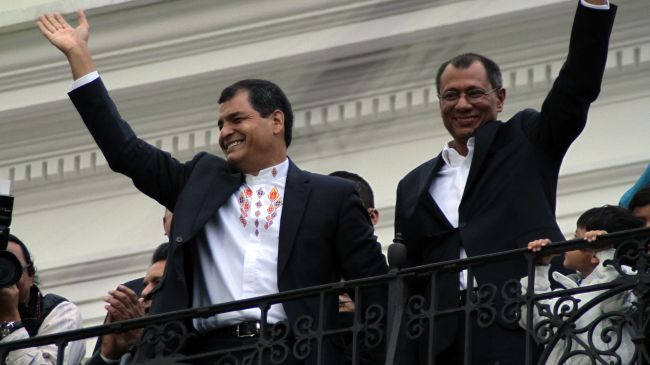
MercoPress | February 18, 2013
President Rafael Correa swept to a re-election victory on Sunday promising to strengthen state control over Ecuador’s economy and continue using booming oil revenues to build roads, hospitals and schools in rural areas and shanty towns.
Correa won 58% of the votes compared with 24% for runner-up Guillermo Lasso, according to preliminary results released by the electoral authority based on almost 40% of the votes counted. Correa was so confident of his victory that he appeared on state TV less than an hour after polls closed.
“Nobody can stop this revolution,” a jubilant Correa told supporters from the balcony of the Carondelet presidential palace, after claiming victory. He added “we are making history; we are building our own homeland which is Ecuador and the great homeland which is Latin America.“
The populist US-trained economist took power in 2007 and has won strong support among the majority of the population of the country which is poor.
Correa, 49, may now be in line to become Latin America’s main anti-American voice and de facto leader of the ALBA bloc of populist governments as Venezuelan President Hugo Chavez has been silenced during his battle with cancer. Correa said he dedicated his victory to Chavez.
The principal challenge in Correa’s new four-year term will be wooing investors needed to boost stagnant oil production and spur the mining industry. A 3.2 billion dollars debt default in 2008 and aggressive oil contract negotiations scared many off.
Critics view Correa as an authoritarian leader who has curbed media freedom and appointed aides to top posts in the judiciary.
But the fractured opposition failed to make a consolidated challenge. It fielded seven candidates, making it easy for Correa, and he is now on track for a decade in office.
That is rare stability in a country where three presidents were pushed from office by coups or street protests in the decade before Correa took power in 2007. He is already the longest-serving president in Ecuador since the return to democracy in the 1970s following a military dictatorship.
Correa’s success has hinged in part on high oil prices that allowed for liberal state spending, including boosting cash handouts to 2 million people, and spurred solid economic growth.
He has promised to diversify the economy away from its dependence on oil, in part by bringing in new investment for the mining sector. Despite promising reserves of gold and copper, mining operations have barely gotten off the ground.
In a news conference on Sunday after polls closed, Correa played down the need for more foreign investment. He insisted the ultimate goal was to ensure economic growth rather than ”mortgaging“ the country to bring in cash from abroad.
”We welcome foreign investment, and we’re already getting plenty of it,“ Correa said. ”Ecuador is one of the most successful economies in Latin America.”
Ecuadorans also chose a new Congress on Sunday.
The ruling Alianza Pais party was expected to win a majority in the legislature, which would let Correa push ahead with controversial reforms, including a media law and changes to mining legislation, without having to negotiate with rivals.
The results of the vote for Congress are not expected to be known for several days.
Related articles
Venezuelan arms maker to continue Iran trade despite US bans
Press TV – February 17, 2013
Venezuelan officials say the state-owned weapons manufacturer, CAVIM, will keep on trading with Iran in defiance of the US sanctions imposed on the company, Press TV reports.
“We think that it is logical for Venezuela to have trade and economic relations with all countries in the world. We are exercising our sovereignty,” Venezuelan Envoy to international rights bodies German Saltron said.
“We feel it is an abuse of power that the United States’ government is trying to block Iran from trading with other countries,” he added.
On February 11, the US State Department imposed sanctions on CAVIM allegedly for violating the so-called Iran Nonproliferation Act of 2000, which aims to prevent Tehran from acquiring weapons of mass destruction.
According to the US State Department website, sanctions on the Venezuelan weapons manufacturer will be in place until February 2015.
The US, the Israeli regime and some of their allies have repeatedly accused Iran of seeking to produce an atomic bomb under the cover of its nuclear energy program, a claim Iran has categorically rejected.
In 2011, Washington imposed sanctions on Venezuela’s state-owned giant oil company, PDVSA, for having oil deals with Iran’s energy industry and as part of its campaign to tighten sanctions on the Islamic Republic over its nuclear energy program.
Under the sanctions, PDVSA is denied US government contracts and banned from Washington’s export financing.
The administration of President Barack Obama is alleging that Iran is using its close economic relationship with Socialist President Hugo Chavez’s government to establish a military presence in Latin America.
In December 2012, the US president enacted a law “aimed at countering Tehran’s alleged influence in Latin America.”
Strategically dubbed as ‘Countering Iran in the Western Hemisphere Act of 2012’, the act calls for the State Department to develop a plan within 180 days to “address Iran’s growing hostile presence and activity.”
However, Iran and Venezuela have continued to expand their trade ties despite these sanctions.
More than 100 bilateral agreements have been signed between the two countries over the past decade, while last year Iranian firms signed a USD2.5 billion contract to build 17,000 houses for underprivileged people in Venezuela.
The Islamic Republic has been seeking to expand relations with Latin American countries over the past years, describing the endeavor as one of its major foreign policy strategies.
Iran’s growing popularity in Latin America has raised major concerns in Washington, which regards the region as its strategic backyard and traditional sphere of influence.
Related articles
- Venezuela wants best of relations with the US based on ‘mutual absolute respect’ (alethonews.wordpress.com)
- US probes Swiss medicine giant for trade with Iran (alethonews.wordpress.com)
Obama Administration Asks Banks to Regulate Their Own Foreclosure Abuses
By Noel Brinkerhoff and David Wallechinsky | AllGov | February 15, 2013
Having bungled the so-called independent review of foreclosure mistakes, the Obama administration has now decided that the best way to help homeowners is to have the banks—which were responsible for the foreclosure errors—examine the case files and decide how best to fix the situation.
In January, the Office of the Comptroller of the Currency (OCC) shut down the foreclosure review by independent consultants—which had already cost about $2 billion— after it was revealed that the banks had selected said consultants. The process also proved to be taking too long to resolve homeowner grievances, so the administration decided to reach a $3.6 billion settlement with the banks.
But before the money can be distributed to individuals wronged during the foreclosure crisis, more than four million cases need to be reviewed. Instead of federal regulators doing the work, they are trusting the financial institutions, including Bank of America and Wells Fargo, to do it properly this time.
Housing advocates, not surprisingly, are worried the banks will shortchange homeowners while they scrutinize their earlier mistakes. “The whole process has been a slap in the face to homeowners and a slap on the wrist to banks,” Isaac Simon Hodes, an organizer with Massachusetts-based Lynn United for Change, told The New York Times. “The latest development shows how there has been no accountability.”
The OCC has promised to check the bank’s work to ensure things go right this time.
Related articles
- Big Banks Slither out of Mortgage Fraud Review with Minor Costs (alethonews.wordpress.com)
- Big Banks Put In Charge of (Their Own) Foreclosure Settlement Payout (reason.com)
Ecuador’s Financial Reforms Help Explain Why Voters Likely to Re-Elect Correa
By Alex Main | CEPR Americas Blog | February 14, 2013
On Sunday Ecuadorians will head to the polls to vote for a president and vice president, members of the National Assembly, mayors, and other elected officials. As we’ve done ahead of other elections in Latin America, CEPR has published a report offering some economic context to help understand the choices that voters are likely to make.
The report, entitled Ecuador’s New Deal: Reforming and Regulating the Financial Sector, focuses on the innovative financial reforms that have been implemented since President Rafael Correa took office in 2007. The report explains how these measures helped Ecuador recover from some of the hemisphere’s worst shocks during the world recession. It also shows how the reforms contributed to a substantial increase in government revenue much of which has been channeled toward health, education, housing and other social spending. Given these advances, it is not surprising that the latest polls put Correa at 50 percentage points ahead of his closest opponent.
Earlier today, CEPR issued the following press release outlining the contents of the paper:
A new paper from the Center for Economic and Policy Research (CEPR) examines the financial reforms carried out by the Rafael Correa administration, reforms which the paper concludes are in large part responsible for the economic success Ecuador has experienced over the past several years, including its successful counter-cyclical policies during the global recession after 2008. The paper, “Ecuador’s New Deal: Reforming and Regulating the Financial Sector,” examines the Correa government’s taking control of the Central Bank, implementation of capital controls, increased taxation of the financial sector, and other regulatory reforms. It concludes that these played a major role in bringing about Ecuador’s strong economic growth, increased government revenue, a substantial decline in poverty and unemployment, and other improvements in economic and social indicators.
Ecuador will hold presidential elections on Sunday, February 17. Correa is almost certain to be re-elected; Reuters reports that he “has a lead of as much as 50 percentage points over the nearest of his seven rivals in opinion polls.”
“Ecuador has gone against the conventional wisdom and shown that there are alternatives,” CEPR Co-Director Mark Weisbrot and lead author of the paper said. “By pursuing policies that have prioritized economic development, employment, and poverty reduction over financial and foreign interests, Ecuador has surmounted some of the problems that had previously held it back, and that have hampered progress in other countries.”
The paper notes that by the last quarter of 2012, unemployment had fallen to 4.1 percent, its lowest level on record (for at least 25 years), while the national poverty rate fell to 27.3 percent as of December 2012, 27 percent below its level in 2006.
The paper finds that financial reforms contributed significantly to an unprecedented rise in government revenue under Correa, from 27 percent of GDP in 2006 to more than 40 percent in 2012. This not only allowed for vitally important expansionary fiscal policy, but also a large increase in social spending. The biggest increase was in housing, but there were also significant increases in health care spending and other social spending. The government’s most important cash-transfer program (the Bono de Desarollo Humano) increased by one-fourth, and education funding more than doubled, as a percent of GDP, from 2006-2009.
The paper concludes that “What is most remarkable is that many of these reforms were unorthodox or against the prevailing wisdom of what governments are supposed to do in order to promote economic progress. Taking executive control over the central bank, defaulting on one-third of the foreign debt, increasing regulation and taxation of the financial sector, increasing restrictions on international capital flows, greatly expanding the size and role of government – these are measures that are supposed to lead to economic ruin. The conventional wisdom is also that it is most important to please investors, including foreign creditors, which this government clearly did not do.”
“While not all of Ecuador’s reforms went against orthodox policy advice,” Weisbrot said, “many of them did – and they succeeded. It should be no surprise that Correa is such a popular candidate heading into this Sunday’s elections.”
The paper notes that “Ecuador’s success shows that a government committed to reform of the financial system, can – with popular support – confront an alliance of powerful, entrenched financial, political, and media interests and win. The government also took on powerful international interests as well, in its foreign debt default, its renegotiation of oil contracts, and its refusal to renew the concession for one of the United States’ few remaining military bases in South America.” It notes that this success indicates that developing countries may have more and better policy options than is commonly believed to be the case.
Featured Video

Can the U.S. Afford to Annihilate Iran?
or go to
Aletho News Archives – Video-Images
Book Review
The Genetic Deception — now in paperback (Second Edition)
Lies are Unbekoming | October 2, 2026
The genes the field promised were never there.
The genetic story of disease is a cover story.
The twenty-first century runs on it. Paediatric clinics. Cancer centres. Forensic laboratories. Family-planning counsel. It is used to explain illness, to assign blame, to foreclose questions. It protects the industries whose products and practices are what actually caused the harm.
It isn’t true.
In 2010, Jonathan Latham and Allison Wilson looked at over seven hundred genome-wide association studies covering some eighty common diseases. The genes the field had promised were not there. The field invented a term, “missing heritability”, to explain the absence, and has quietly worked to bury the finding ever since.
The Genetic Deception is a book about what Latham and Wilson found. What the field did with it. And what the public was told instead. … continue
Blog Roll
 Aletho News
- G7 caves to US blackmail, announces ‘massive’ release of diesel reserves
- Reporting of the RAF Fairford arrests blows the idea of a ‘free press’ out of the water
- US increasing Middle East military buildup – AP
- Flydubai scenario: Netanyahu’s plot to drag US to war with Iran, stay in power
- The Genetic Deception — now in paperback (Second Edition)
- Can the U.S. Afford to Annihilate Iran? /Seyed M. Marandi
- Elmo Sold mRNA Jabs to Your Toddler. Now They Are “Off-Label.”
- British state targets Palestine Action with yet another crooked trial
- Americans are paying the price to preserve Israel’s nuclear hegemony
- Resistance factions are necessary to ensure a permanent US Iraq withdrawal
- If Americans Knew
- New Google Maps images reveal massive scale of devastation in Gaza
- Jewish supremacy, anti-Palestinian bigotry on display in Israel – Daily Update
- Israeli Soldiers Abduct At Least 22 Across Occupied West Bank
- Eight Palestinians Killed in Israeli Attacks on Gaza
- Israeli former leaders and security chiefs threaten legal action over ‘Jewish terrorism’
- Israel map in LA Times ad includes all land from the river to the sea
- Inside Lebanon’s 200-page dossier on Israeli war crimes
- Flydubai, genocide, settler violence, Trump abuse of power to deport – Daily Update
- Counting Antisemitic Incidents: What the ADL Audit Reveals — and Obscures
- Mamdani releases plan to combat antisemitism and hate crimes in New York City
- No Tricks Zone
- Green Energy Debacle: German Expert Professor Fritz Vahrenholt Warns Of Severe Economic And Social Consequences
- Two More Paleo Reconstructions Affirm Meters-Higher Sea Levels Across Ireland, Brazil 7000-6000 Years Ago
- New Study: Earth And Venus Surface Warmth Largely Explained By Convection And Lapse Rate, Not CO2 Or Radiation
- 2025 Nature Paper Claiming Worsening Global Drought Gets RETRACTED …Heavily Flawed
- New Study: ‘Global Drought Shows No Detectable Recent Acceleration Under Climate Warming’
- Economic Masterminds: German Socialists Suggest Taxing Productivity Gains Stemming From Using AI
- The South China Sea Has Not Been Cooperating With The Climate Change Narrative
- Energy Crisis: Germany Enters Heating Season With Historically Low Gas Reserve Fill Levels
- New Study: The Antarctic Ice Sheet Gained Mass From 2020-2024 Due To Staggering Snow And Ice Accumulation
- Study: Ocean Heating Rates From Thousands Of Years Ago ‘Dwarf’ Modern Ocean Heating Rates

