Egypt and Argentina: The Right-Left alliance
By Prof. James Petras | The People’s Voice | December 10, 2012
Once again world public opinion faces a most bizarre political event: an alliance between political forces on the extreme Right and the Left, including collaboration between NATO regimes and Marxist sects. The apparent ‘unity of opposites’ is a response to alleged policy and institutional changes made by center-left and center-right regimes, which adversely affect both economic and political elites as well as the popular sectors.
The circumstances, under which this unholy alliance takes place, vary according to the type of regime, its policies and the class orientation of the opposition. The best way to analyze the left-right alliance is to examine the cases of Egypt and Argentina.
Egypt: The Alliance between Mubarak-Appointed Judges, Secular Liberals, Leftist Intellectuals and Disenchanted Workers
To understand the alliance between the corrupt remnants of the Mubarak state apparatus and their former political victims from the center-left and secular-right, it is essential to examine the political context, which has evolved since the overthrow of the Mubarak dictatorship in February 2011.
While Islamist and secular democratic forces played a major role in mobilizing millions of Egyptians in ousting the hated US-Israeli client, Hosni Mubarak, it was the Muslim Brotherhood (MB) and their fundamentalist rivals, the Salafis, who won the majority of votes in the subsequent elections and formed the first democratically-elected government in Egypt.[i] In the beginning, the Muslim Brotherhood was forced to share power with the ‘transitional military junta’, which had seized power immediately after the ouster of Mubarak. Subsequently President Mohamed Morsi, from the Muslim Brotherhood, convoked elections to a constituent assembly and nominated a commission to write a new constitution. This was backed by a majority of the newly-elected Egyptian parliament. Reflecting the Muslim Brotherhood’s electoral victory, the constitutional commission was dominated by its supporters. Many secular liberals and leftists rejected their minority status in the process.
Aside from his work on the constitutional front, Morsi negotiated a financial loan package of $4.5 billion with the IMF, $5 billion from the EU and an additional one billion dollars in US aid. These aid agreements were conditional on President Morsi implementing ‘free market’ policies, including an ‘open-door’ to foreign investment, ending food and fuel price subsidies to the poor and maintaining the humiliating Mubarak-era treaty with Israel, which included Egypt’s participation in the brutal blockade of Gaza.
While the despised US-Israel-backed dictator Hosni Mubarak may have been ousted from power and a new democratically-elected legislature had taken office (temporarily) along with President Morsi, Mubarak supporters continued to dominate key positions in the ministries, the entire judiciary, military and police. Thus powerfully ensconced, the Mubarak elite strove in every way to undermine emerging democratic institutions and processes. The Minister of Defense, Mohamed Hussein Tantawi, shielded the police officials and paramilitary forces responsible for the jailing, torture and murder of thousands of pro-democracy demonstrators. Mubarak-appointed judges arbitrarily disqualified legislative and presidential candidates, invalidated democratic elections and even ordered the closing of parliament. They then moved to outlaw the elected constituent assembly and the commission set-up to draft the new Egyptian constitution.
In other words, Mubarakites, embedded in the state apparatus, were engaged in an institutional coup d’etat to retain power, destabilize and paralyze the democratically-elected Morsi regime and create political disorder, propitious for a return to their dictatorial rule.
It was the Mubarak-appointed judges’ power-grab that eliminated the separation of powers by imposing arbitrary judicial decisions and powers over and above the hard-won electoral rights of Egyptian citizens and their elected legislature. The judges’ self-proclaimed assumption of legislative and executive supremacy was a direct assault on the integrity of the emerging democratic process.
When President Morsi finally moved to counter the Mubarak-allied judges’ dismissal of legitimately-elected bodies by assuming temporary emergency powers, these judges and their cheerleaders in the Western media accused him of subverting democracy and violating the ‘independence’ of the judiciary. The Western ‘liberal’ outcry at Morsi’s so-called ‘power grab’ is laughable given the fact that they ignored the naked ‘power grab’ of the judges when they dismissed Egypt’s parliament, its free elections and the writing of its new constitution under the leadership of Egypt’s new president. These cries of ‘democracy’ ring hollow from a judiciary, which had shamelessly legalized countless murders, tortures and dictatorial acts committed by Mubarak for over 30 years.
The judges’ democratic posturing and cries of injustice were accompanied by theatrical walkouts and protests aimed at mobilizing public opinion. Apart from a few thousand die-hard Mubarak holdovers, these judges managed to attract very little support, until secular liberals, leftists, trade unionists and sectors of the unemployed decided to intervene and try to win in the streets what they lost at the ballot box.
The popular protests, in contrast to the judges’ defense of Mubarak-era privilege and their blatant power grab, was based on Morsi’s failure to tackle the problems of growing unemployment and plummeting income, as well as his acceptance of IMF demands to end public subsidies for the poor. The secular-liberals joined forces with Mubarak-era judges in their clamor against ‘authoritarianism’ and pushed their own secular agenda against the Islamist tendencies in the regime and in the drawing up of the constitution. Pro-democracy youth sought to exploit the legislative vacuum created when the right-wing judges dismissed the parliament and put forward a vague notion of ‘alternative democracy’ … presumably one which would exclude the votes of the Islamist majority. The trade unions, which had led numerous strikes after the fall of Mubarak and remain a force among factory workers, joined the protests against Morsi, rejecting his embrace of the corporate elite. Even some Islamist groups, disgusted with Morsi’s accommodation with Israel and the US, also joined and took to the streets.
The US and the EU took advantage of the judges’ protest to step in and warn Morsi to abide to a ‘power sharing’ agreement with the Mubarak officials and the military or lose financial aid.
Washington has been playing a clever ‘two track policy’: They support Morsi when he implements a neo-liberal ‘free market’ domestic agenda using the Muslim Brotherhood networks to contain and limit popular protest among Egypt’s poor while threatening US aid if he vacillates on Mubarak-era agreements with Israel to starve Gaza. The White House insists that Morsi continue supplying cheap gas to Tel Aviv, as well as backing ongoing and future NATO wars against Syria and Iran. But the US and EU also want to keep the old reliable Mubarak power centers in place as a check and veto on Morsi in case a powerful anti-Zionist, populist urban movement pressures his regime to backtrack on the IMF program and the hated treaty with Israel.
The constitution, presented by the commission, is a compromise between Islamists, neo-liberals and democratic electoralists. This constitution undermines the judges’ power grab and allows the Morsi government to prosecute or fire the corrupt Mubarak-era officials; it guarantees the primacy of private, including foreign, property; it privileges Islamic law and provides ‘space’ and possibilities for Islamist leaders to restrict the rights of Egyptian women and religious minorities, notably the Coptic Christians.
A democratic vote on the constitutional referendum will test the strength of the pro and anti-government forces. A boycott by secular, liberal and populist-democratic forces will only demonstrate their weakness and strengthen the reactionary coup-makers embedded among the Mubarak-era officials in judiciary, police, military and civilian bureaucracy.
The Left and democratic-secular movements and leaders have formed an opportunistic, de-facto alliance with the Mubarak elite: a marriage of ‘the police club’ with its former victims, ‘the clubbed democrats’ of the recent past. The progressives overlook the danger of the judges’ creeping coup, in their blind effort to undermine the Muslim Brotherhood and the Morsi regime: It’s one thing to oppose Morsi’s reactionary agenda and the anti-popular votes of a reactionary legislature; it’s something totally different to promote the ouster of a democratically-elected legislature by hold-over judges pushing for the return of despotism. Undermining the democratic process will not only adversely affect President Morsi and the Muslim Brotherhood but also the democratic opposition. The prime beneficiaries will be the right-wing forces encrusted in the State.
The anti-Muslim Brotherhood demonstrators, who are the clear losers in democratic elections and a minority in the country, burned and trashed the offices and meeting places of the Brotherhood and assaulted their supporters in the worst traditions of the Mubarak era. The self-styled ‘pro-democracy’ activists’ assaults on the Presidential palace and their rejection of Morsi’s call for dialogue has opened the way for the return of military rule. The military command’s thinly veiled threat was evident in their pronouncement that they would intervene with force to maintain order and protect the public if violence continues. The coincidence of prolonged street disorder and assaults on electoral politics with military overtures to take power have a distinct smell of a barnyard confabulation. The right-left alliance makes it difficult to decipher whether the violence is a staged provocation to bring the military back to power or an expression of leftist rage at their electoral impotence.
For strategic, pragmatic and principled reasons, the Left should have denounced the Mubarak-appointed judges the moment they outlawed the elected legislature. The Left should have demanded the ouster of these judges and military leaders and combined their demands with a campaign against Morsi’s ties with the imperial West and Israel and a repudiation of the IMF program. By backing these corrupt judges, progressives gained the short-term support of the Western media and governments while strengthening their strategic enemy.
Argentina: The Right-Left Alliance
President Cristina Fernandez is representative of the center-left regimes, which predominate in Latin America today. Her recent resounding electoral victory[ii] is a product of the popular uprisings (2001-2003), the social reforms and independent foreign policy pursued by her predecessor (and husband) Nestor Kirchner (2003-2007) and several popular reforms implemented under her Presidency.
But like all center-left regimes, President Fernandez (2008-2012) has combined conservative, neo-liberal and populist progressive policies. On the one hand, Fernandez has encouraged foreign mining companies to exploit the Argentina’s great mineral resources, charging very low royalty payments and imposing very few environmental restraints, while, on the other hand, she nationalized the abusive Spanish multinational oil company, Repsol, for non-compliance with its contract.
The government has substantially increased the minimum wage, including for farm workers, while opening up the country to overseas land speculators and investors to buy millions of acres of farmland. The government has allowed highly toxic-chemicals to be sprayed on fields next to rural communities while increasing corporate taxes and controls over agro-export earnings. The government passed legislation to restrict monopoly ownership of the mass media promising to expand media licensing to local communities and diverse social groups, while doing little to limit the power of big agro-export firms. President Fernandez has supported Latin American integration (excluding the US) and welcomed radical President Chavez as a valuable partner in trade and investment and diversified markets. At the same time Argentina has grown increasingly dependent on a narrow range of agro-mineral (‘primary goods’) exports to the detriment of domestic manufacturing. Presidents Fernandez and Kirchner encouraged trade union activity and, until recently, supported hefty increases in wage, pension and medical benefits, drastically reducing poverty levels – but they did so while maintaining the wealth, land, profits and dividends of the capitalist class.
The Argentine President was able to support both the economic elites and the working class as long as commodity prices and international demand remained high. However, with the economic slowdown in Asia and decline in commodity prices and therefore state revenue, the President is being squeezed from both sides. By the end of the first decade of the 21st century, the elite attacked the government more ferociously, led by the big and medium-size landowners and exporters. They demanded the government revoke its increase in export taxes and currency controls. The upper-middle and the affluent middle class of Buenos Aires, backed by supporters of the previous military dictatorship, organized mass marches and demonstrations to protest a medley of government policies, including limits on dollar purchases, inflation and inaction amidst rising crime rates.
Around the same time, conservative and radical leftist trade unionists organized a general strike – ostensibly because wage increases had failed to keep up with ‘real’ rates of inflation (double the ‘official rate’ – so they claimed). The major media monopoly, Clarin, organized a virulent systematic propaganda campaign trumpeting the demands of the economic elite, fabricating stories of government corruption and refusing to comply with the new government legislation in hopes of staving off the dismantling of its huge media monopoly.
The US and EU increased pressure on Argentina by excluding it from international capital markets, questioning its credibility, downgrading its ratings and promoting a virulently hostile anti-Fernandez mass media campaign in the financial press.
The destabilization campaign has been orchestrated by the same economic elites who supported the brutal seven-year military dictatorship during which an estimated 30,000 Argentines were murdered by the juntas. Elite opposition is rooted in reactionary social and economic demands, i.e. lower taxes on exports, deregulation of the dollar market, their monopoly of the mass media and a reversal of popular social legislation.
The ‘left opposition’ includes a variety of movements including Marxist grouplets and trade unions who demand salary increases commensurate with ‘real inflation’ as well as environmentalists demanding tighter controls over agro-chemical pollution, GM seeds and destructive mining operations. Many of these demands have legitimacy, however some of the Marxist and leftist groups have been participating in protests and strikes convoked by the right-wing parties and economic elites designed to destabilize and overthrow the government. Few if any have joined with the government to denounce the blatant US-EU credit squeeze and imperial offensive against Fernandez.
This de-facto Right-Left alliance on the streets is led by the most rancid, authoritarian and neo-liberal elites who ultimately will be the prime beneficiary if the Fernandez regime is destabilized and toppled. By joining general strikes organized by the far-Right, the left claims to be ‘furthering the interests of the workers’ and ‘acting independently’ of the economic elite. However, their activities take place at the same time and same location as the hordes of wealthy upper middle class protestors clamoring for the ouster of the democratically elected center-left regime. The left grouplets maintain that they are in favor of building a ‘workers state’ as they march abreast with the rich and militarists. Objectively, their capacity to catalyze a revolution is nil and the real outcome of their ‘opportunism’ will be a victory for the agro-export elite – mass media monopolies – US-EU alliance. The ‘leftist’ workers protest is mere window dressing for the destabilization of a social-liberal democracy and will help return a far-right regime to power!
The majority of the workers, pensioners and trade unionists reject any participation in the bosses’ general strikes – even as they voice their legitimate demands for better pay and the indexing of wage rates to the real inflation rate. However they join with the government in rejecting the international creditor demands and US judicial rulings favoring Wall Street speculators over Argentina’s social interests. Nevertheless, the left-right protest resonates with many rank and file employees, especially when export revenues decline and the Fernandez regime lacks the funds to maintain the social spending of the past decade.
The political challenge for the consequential Left is to defend democracy against this opportunist ‘Left’-Right onslaught while defending workers’ interests in the face of a decaying center-left regime bent on pursuing its contradictory program.
Conclusion: The Dilemmas of Capitalist Democracies
The capitalist democracies of Egypt and Argentina face similar Left-Right alliances, even though they differ sharply in their socio-economic trajectory and social bases of support. Both Argentina and Egypt have emerged from brutal dictatorships in recent years: Argentine democracy is nearly 30 years old while Egyptian democracy is less than a year old. Argentine democracy, like Egypt’s, has been confronting powerful authoritarian institutions leftover from the dictatorial period. These are entrenched especially in three areas: the military and police, the judiciary and among sectors of the capitalist class. They all benefited from the special privileges granted by the dictators.
In Argentina, over the past decade, Presidents Kirchner and Fernandez succeeded in purging the state apparatus of criminals, murderers and torturers among the military, police and judiciary. In Egypt, the Morsi regime, in its short time in office, hesitated at first, but then moved forward replacing some Mubarak military commanders and promising to investigate and prosecute those Mubarak-appointed officials involved in the killing and torture of pro-democracy demonstrators. The Egyptian reactionaries struck back: Mubarak-appointed judges denied the legality of the democratically elected legislature and constituent assembly. In Argentina, powerful agrarian interests and the right-wing mass media conglomerate, which had backed the dictatorships, struck back as the government moved to end the corporate media monopoly and tax concessions to the agro-export elite. The conflict between the dictatorial right and the democratic center-left in Argentina and the conflict between the Mubarak judiciary and the Islamist neo-liberal elected regime is partially obscured by the active involvement of leftists, secular liberals and other ostensibly ‘pro-democracy’ forces on the side of the Right.
Why has ‘the left’ crossed the line, joining forces with the anti-democratic right?
Their opportunism arises primarily from the fact that they did so poorly in the elections and do not see any role for themselves as an electoral opposition. By joining with the right-wing protests, the left and secular liberals mistakenly imagine they can revive their faltering support.
Secondly, the Left senses the economic and social vulnerability of the elected regimes because of the global and local crises, exacerbated by declining export revenues. They hope to attach their political demands to those of the upper and middle class protestors who have been mobilized by the Far Right.
Thirdly, by joining forces with the Right, allied with the US and EU, the leftist protestors hope to gain international (imperial) support, recognition, respectability and legitimacy … temporarily. Of course if the Right succeeds, the Left will be marginalized and discarded as ‘useful idiots’.
The imperial threats to cut off credits, loans and markets to both regimes should logically have led to a united front – a tactical alliance – between the Left and the embattled regime, especially in the case of Argentina. In the case of Egypt, secular liberals and leftists should have joined with the Morsi regime to oust the remnants of the brutal Mubarak regime. They should have supported the elected legislature, even while challenging Morsi’s pacts with the IMF, the US, EU and Israel. Instead, secular liberals appear to agree with the regime in its reactionary socio-economic policies. Worse, by joining with the reactionary judges in totally rejecting the referendum vote on the new constitution, the Left missed an opportunity to mobilize and challenge the regime and educate the public about its specific reactionary clauses.
By opposing the progressive democratic process as well as the regime, the Left has opened the door for the Right to return. By forcing incumbent presidents to ‘make a deal’ or compromise with the elite, the left is further isolating themselves. Both Morsi and Fernandez are vulnerable to leftist pressure and, over time, popular and class-based movements could find themselves in a position to pose a real alternative…. if they clearly and honestly reject the authoritarian and imperialist right. By joining in opportunist alliances to score some small victories today, they foreclose any possible role in the near future of forming progressive democratic leftist governments. By burning government offices and destroying the electoral offices of the Muslim Brotherhood, the self-styled ‘democrats’ are creating the basis for the seizure of state power by the military.
Notes
[i] In the parliamentary elections the two major Islamist parties polled over 27 million votes (18 million for the Muslim Brotherhood and Morsi), the liberal-left opposition received approximately 7.5 million votes and the Mubarac-era parties got 2 million. The Islamist parties totaled about two-thirds of the electorate, which translated into the same proportion of elected legislators (358 out of 508). The liberal-left parties received slightly over 26% of the vote and the Mubarak parties got about 8%. The anti-Morsi rioters are a clear and decisive minority and their violent assault on the governing regime is, by any measure, an attempt to impose minority rule, denying and marginalizing the nearly 18 million voters who elected the Morsi Government and Muslim Brotherhood-dominated Congress.
[ii] Cristina Fernandez was first elected in October 2007 with 45.3% of the vote, a 22% lead over her nearest rival. In the most recent elections in October 2011, she was re-elected with 54.1% of the vote, a 37.3% margin over her nearest competitor.
-###-
James Petras is a Bartle Professor (Emeritus) of Sociology at Binghamton University, New York. He is the author of 64 books published in 29 languages, and over 560 articles in professional journals, including the American Sociological Review, British Journal of Sociology, Social Research, Journal of Contemporary Asia, and Journal of Peasant Studies. He has published over 2000 articles in nonprofessional journals such as the New York Times, the Guardian, the Nation, Christian Science Monitor, Foreign Policy, New Left Review, Partisan Review, Temps Moderne, Le Monde Diplomatique, and his commentary is widely carried on the internet. His most recent books are: The Arab Revolt and the Imperialist Counterattack
Bolivia signs Mercosur incorporation protocol and becomes sixth member
MercoPress | December 8th 2012
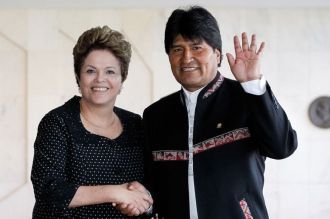 Bolivian president Evo Morales subscribed on Friday the Mercosur incorporation protocol which makes it the sixth member of the regional group. The event took place in Brasilia during the Mercosur summit hosted by Brazilian president Dilma Rousseff.
At the summit which also included associate members, President Morales and his peers signed the document. “With the signing of the protocol, Bolivia becomes the six member state of Mercosur”, announced officially the spokesperson for the Brazilian Executive.
“The protocol defines the different stages and commitment to reach the full incorporation of Bolivia to Mercosur”, added the spokesperson. “The full membership will take place once the Legislatives of the other full members ratify the protocol”.
“Evo, you are most welcome” said president Rousseff before the signing of the document. “This has been good news for the summit. We have skipped years of negotiations with the Bolivian decision to sign the adhesion protocol”.
At the summit President Rousseff as chair of Mercosur stamped her signature to the definitive incorporation of Venezuela as full member which was decided in an extraordinary meeting last July in Rio do Janeiro.
At the summit also, Brazil handed the rotating chair of Mercosur to Uruguay in the hands of President Jose Mujica, for the next six months, thus skipping Paraguay, temporarily suspended and which according to alphabetical order was to have such responsibility.
Related articles
- Brazil calls for better integrated trading bloc (vancouverdesi.com)
US exempts 9 countries from sanctions on Iranian oil industry
Press TV – December 8, 2012
Nine countries have been granted extended waivers of the illegal US sanctions on Iran due to their reductions of purchases of Iranian crude oil.
On Friday, US Secretary of State Hillary Clinton added China, India, South Korea, Malaysia, Singapore, South Africa, Sri Lanka, Turkey, and Taiwan to the list of countries exempt from the sanctions for another six months, the Associated Press reported.
On September 14, the United States exempted Belgium, Britain, the Czech Republic, France, Germany, Greece, Italy, the Netherlands, Poland, Spain, and Japan from complying with the sanctions on Iran’s oil industry for another 180 days.
At the beginning of 2012, the US and the European Union imposed new sanctions on Iran’s oil and financial sectors with the goal of preventing other countries from purchasing Iranian oil and conducting transactions with the Central Bank of Iran.
The illegal US-engineered sanctions were imposed based on the unfounded accusation that Iran is pursuing non-civilian objectives in its nuclear energy program.
Iran rejects the allegations, arguing that as a committed signatory to the nuclear Non-Proliferation Treaty (NPT) and a member of the International Atomic Energy Agency (IAEA), it has the right to use nuclear technology for peaceful purposes.
In addition, the IAEA has conducted numerous inspections of Iran’s nuclear facilities but has never found any evidence showing that Iran’s civilian nuclear program has been diverted to nuclear weapons production.
Double Your Trouble With Nuclear Power
By JOSEPH MANGANO and Dr. JANETTE SHERMAN, MD | CounterPunch | December 5, 2012
Industry leaders will have no problem closing nuclear reactors that don’t generate expected profits. Exelon, the Chicago-based company that owns 17 of the 104 U.S. reactors, recently saw its stock price drop below $30 a share, the same level as mid-2003, and a whopping 70% below its peak of over $92 a share in mid-2008.
The standard explanation for this reversal is cost. In particular, electricity from growing natural gas and wind sources costs less to produce than that from nuclear reactors. The famous 1954 promise by Atomic Energy Commission head Lewis Strauss that the atom would create energy “too cheap to meter” has failed miserably. But while cost is the reason why utilities will be closing reactors, most reports fail to look beneath the surface and understand WHY nukes are so expensive.
The answer is that nuclear power poses great danger to safety and health. This danger means that reactors must comply with numerous safety regulations; must be built with many safety features; and must be manned by a large and highly trained work force – each a high-ticket item. In addition, the fleet of 104 U.S. reactors in operation is aging – most over 30 years old – requiring that corroding parts be replaced, pushing costs even higher.
Another element in the high cost of nukes won’t be faced until they are decommissioned (after closing). Decommissioning costs run hundreds of millions of dollars per reactor. Utilities are forced by federal law to keep a large decommissioning fund while operating reactors, to prevent them from simply closing reactors, not securing them, and sticking taxpayers with the bill.
Even with all these extensive and expensive efforts to protect the public, nukes still aren’t safe. The chance of a meltdown exists every day, from human error, natural disaster, or terrorist act. The disasters at Chernobyl in 1986 and at Fukushima last year remind us that catastrophic meltdowns that affect thousands to millions are a sobering reality. In addition to meltdowns, there is the matter of routine emissions from reactors and elevated cancer rates near reactors, demonstrated in many studies. Finally, the U. S. and other nations still have no long-term plans to store the massive amounts of hazardous nuclear waste.
Dominion Nuclear recently announced that the Kewaunee reactor in Wisconsin will permanently shut down in the spring. This action is a milestone. Not only will this be the first U.S. reactor closed since 1998, but it will likely be followed by numerous other shutdowns. An October 23 New York Times article was headlined “Reactors Face Mothballs.”
Kewaunee’s closing also represents a turning point. For over a decade, nuclear leaders steadily proclaimed an era of a revival, after years of no growth. But the word “renaissance” has vanished, and nuclear power is now in full retreat.
So which reactors will join Kewaunee and be the next to close? Nobody knows for sure, but there are a number of reactors that are faring poorly, and are candidates for shutdown:
– Crystal River (Florida), closed for over three years, needs considerable funds to replace defective parts
– San Onofre (California, two reactors), closed for nearly one year due to faulty steam generators, will require millions to repair.
– Oyster Creek (New Jersey), which must shut down by 2019, may close sooner according to Exelon executives who cite costs and market forces
– Vermont Yankee (Vermont), up for sale (and like Kewaunee with no buyers), along with stiff opposition from local citizens and elected officials
– Clinton (Illinois), another Exelon reactor, has been hit hard by cheaper alternatives
– Indian Point (New York, two reactors), faced considerable citizen and political opposition ever since a plane hijacked by terrorists on 9/11 flew directly over it on its way to the World Trade Center.
This autumn has been the worst period for U.S. nuclear reactors in a long time. Hurricane Sandy caused six reactors to close temporarily, while others were shut to change fuel, and others closed due to mechanical problems. From mid-October to late November, U.S. reactors operated at just 70-75% of capacity, down sharply from the 90% figure of the past decade.
Shrinking nuclear power is even more pronounced overseas. In Japan, nearly two years after Fukushima, only 2 of 54 reactors are operating, and the majority of Japanese are fiercely opposed to restarting any reactors. Soon after Fukushima, governments in Germany, Belgium, and Switzerland announced plans to phase out nuclear power, and Germany has already closed half a dozen reactors.
The business troubles facing reactors are nothing new – historical construction costs far exceeded original estimates, and Wall Street executives stopped lending money for new reactors in the 1970s. Fewer reactors will mean reduced threats to health but also reduced costs – proving what’s good for the environment is also good for business.
Joseph Mangano, MPH MBA, is an epidemiologist, and Executive Director of the Radiation and Public Health Project (www.radiation.org).
Janette Sherman, MD is an internist and toxicologist. (www.janettesherman.com).
Related articles
- ‘A huge setback for, if not the end of, the American nuclear renaissance’ (alethonews)
- EDF Falls in Paris on Rising Costs for Normandy Nuclear Reactor – Bloomberg (bloomberg.com)
- Even France can’t build a nuclear reactor economically, and in the planned time (nuclear-news.net)
- South Korea Shuts Down 2 Nuclear Reactors (blogs.voanews.com)
Mexico strikes largest on land light oil deposit in a decade
MercoPress | December 4, 2012
Mexico’s government oil and gas giant Pemex confirmed the discovery of a crude reserve which could hold over 500 million barrels, and described as the largest on land strike in the last decade.
“Navegante 1” is located in the southern state of Tabasco, 20 kilometres from the state capital of Villahermosa and was drilled to 6.800 metres. The 3P reserves test (proven, possible, probable) of the well is estimated in over 500 million barrels, although other exploratory wells in the basin could take that figure to a billion barrels.
Pemex said that the drilling showed the existence of a column of 315 metres of light crude covering an area of 87 square kilometres, which makes it the largest discovery on land in the last decade in the country.
“The assessment of the oil potential of the field which covers 87 square kilometres indicates a 3P reserve estimate of over 500 million barrels of oil equivalent” said Pemex anticipating that further wells to establish the delimitation of the deposit are to be drilled.
The ‘Navegante 1’ on land adds to several discoveries offshore in the Gulf of Mexico which ensures Pemex can recover its level of reserves that have been falling for years. The discovery was also excellent news for the recently sworn in President Enrique Peña Nieto. Oil is a major export of the country and a strong contributor to the national budget.
FARC has ‘always wanted peace’ in Columbia – RT exclusive
RT | December 4, 2012
 Colombian rebel militants FARC seek dialogue and peace with the country’s government, FARC negotiator Tanja Nijmeijer told RT in an exclusive interview. But despite renewed peace talks, government forces killed at least 20 rebels in a recent attack.
Dutch militant Tanja Nijmeijer – who left the Netherlands 10 years ago to join the Revolutionary Armed Forces of Colombia (FARC) and fight for what she calls social justice – spoke with RT, saying that the rebel organization wants to end the country’s 50-year conflict.
“We as an armed organization have always wanted a dialogue, we’ve always wanted peace, we have always asked for peace,” she said.
“We have not taken the arms because we wanted so. We have taken the arms because the Colombian State and the United States imperialism have obliged us to do so,” Nijmeijer said.
Talks between the Colombian government and FARC over fragile peace negotiations are set to resume in Havana, Cuba, on December 7.
At least 20 left-wing rebels were killed in Colombia on Sunday after airstrikes against their camp near the Ecuadorian border, the army said. The attack came after FARC announced a ceasefire until January 1, 2013, for the negotiations.
“People who are in Colombia want to fight for ideas different from neoliberal are killed,” Nijmeijer told RT. “So how is it possible to participate in politics if people who have other ideas are killed. And that’s the reason of arm struggle in Colombia. That’s the reason why we are still fighting.”
Colombian President Juan Manuel Santos has set a deadline of November 2013 for an agreement to be reached in the peace talks with FARC. “This has to be a process of months, rather than years. In other words, this should not last any longer than November next year at the latest,” Santos said.
The president’s statement followed an acknowledgement by FARC that it was holding “prisoners of war” – reportedly soldiers or police captured during combat. FARC stated that the prisoners would be freed in exchange for the release of rebels held by the government.
The Colombian government currently detains around 700 rebel prisoners, according to Sandra Ramirez, one of FARC’s representatives.
The US has been criticized for its role in helping the Colombian government kill members of FARC; Washington’s military assistance to Columbia has been directed primarily towards killing FARC militants.
In nearly a half-century of conflict in Columbia, an estimated 600,000 people have died and another 15,000 gone missing. Some 4 million people have also been internally displaced.
Find out more about FARC and the peace process from RT’s full exclusive interview with Tanja Nijmeijer, airing Wednesday at 18:45 GMT.
Mexico: Peña Nieto Takes Office as Youths Riot
Weekly News Update on the Americas | December 3, 2012
Protests against Mexican president Enrique Peña Nieto during his inauguration on Dec. 1 quickly turned into violent confrontations between police and demonstrators that disrupted much of downtown Mexico City. The protests were called by the National Convention Against the Imposition, a coalition of groups holding that Peña Nieto’s election last July was manipulated, and #YoSoy132 (“I’m number 132”), a student movement that arose in the spring in response to the election campaign [see Update #1130]. But masked youths, many of them wearing black t-shirts with anarchist symbols, quickly became the center of attention at the Dec. 1 demonstration.
The confrontations began around 7 am near the San Lázaro subway and bus stations at the heavily guarded and barricaded Chamber of Deputies, where the inauguration was to take place about three hours later. Determined to break through the metal barriers, the masked youths threw rocks, metal pipes and Molotov cocktails at the federal police, who responded with exceptional violence, using tear gas, pepper spray and water cannons. The media reported that the agents also used rubber bullets; police spokespeople denied the reports. Many #YoSoy132 supporters moved away from the masked youths, as did the famously militant teachers from the southern state of Oaxaca, although both groups organized brigades to assist protesters who were wounded or were overwhelmed by the tear gas.
Dozens of protesters were injured. At around 10 am #YoSoy132 reported that a youth named Carlos Yahir Valdés had been killed by a tear gas canister or a rubber bullet; Adrián Ramírez, president of the Mexican League for the Defense of Human Rights (LIMEDDH), said the victim was named Carlos Valdivia and had been seriously wounded but not killed.
Eventually the youths in black moved west towards the Zócalo plaza and then on to the Palacio de Bellas Artes cultural center and the Alameda park. Along the way they smashed windows, streetlights, phone booths and ATMs; looted stores and gas stations; and battled the Mexico City police. At times passers-by supplied the protesters with bricks to throw at the police, while smiling tourists took pictures. At least one private car was destroyed and one motorcycle was set on fire. (La Jornada (Mexico) 12/2/12)
During his first day in office, President Peña Nieto announced “13 specific decisions” to improve the situation in Mexico, including a universal social security system, life insurance for heads of households, educational reforms, and revival of passenger railroads. He also promised to maintain a zero deficit in the budget while carrying out his programs. (LJ 12/2/12)
Outgoing president Felipe Calderón Hinojosa (2006-2012)–whose militarized fight against drug trafficking set off the violence in which 50,000 Mexicans died, according to critics—is planning to leave Mexico, at least temporarily. On Nov. 28 Harvard University’s John F. Kennedy School of Government in Cambridge, Massachusetts, announced that Calderón will hold a one-year fellowship at the school starting in January. “This fellowship will be a tremendous opportunity for me to reflect upon my six years in office,” Calderón said in a statement.
Calderón received a master’s degree from the Kennedy school in 2000. The Reuters wire service noted that other recent students at the school include Bo Guagua, son of ousted Chinese politician Bo Xilai, and Paula Broadwell, co-author of a book about former US Central Intelligence Agency (CIA) director Gen. David Petraeus, who resigned after acknowledging that he’d had an affair with her. (Reuters 11/28/12) Another former student was the late Guatemalan general Héctor Alejandro Gramajo Morales. At his graduation in June 1991 human rights activists served Gramajo with court papers for a federal civil suit under the Alien Tort Claims Act; nine Guatemalans charged him with acts of torture, abduction and murder during counterinsurgency operations in western Guatemala in 1982, when he was army chief of staff. Gramajo lost that and another human rights suit later in the year by default [see Update #737].
Related articles
- Photos: Protests as Mexico’s President Enrique Pena Nieto takes office (photos.denverpost.com)
Peña’s Promises
By Laura Carlsen – Americas Program – 03/12/2012
Against the sharply contrasting backdrop of violent conflicts in the streets and carefully staged official events, Enrique Peña Nieto took office yesterday. The general outlines of the plan for his six-year term, although still not detailed, reveal proposed changes not unlike the new president–mostly cosmetic and devoted to appearances on the surface.
After taking the oath of office in the Chamber of Deputies at San Lazaro and swearing in his cabinet, the newly inaugurated president appeared before guests at the National Palace in the central plaza to deliver his first speech as Chief Executive.
Peña Nieto began his speech with a rapid pass through Mexican history, citing pre-hispanic and Spanish culture, the liberal and revolutionary currents and “the recent past”. Without mentioning the PRI, he emphasized the orderly change of power since 1934 and “accelerating democracy”, ironically dating from 1968–the year his party massacred hundreds of students in Tlatelolco.
He concluded with what would be the tonic of the speech-that Mexico is “ready to take off” and “everyone agrees that we have an historic opportunity.” His speech centered on the “Mexican Moment”, the idea of a turning point when Mexico would finally enter into a period of peace, prosperity and global recognition.
He did mention the challenges along the way, stating that Mexico is a nation that “grows at two speeds, one of progress and development and the other in backwardness and poverty” and citing the lack of employment and educational opportunities. His speech included a number of specific if not detailed measures that provide fodder for analysis.
Peña Nieto began with the “five strategic points” of his new government:
1. Mexico at peace: Peña offered to “put the citizen at the center of security policy.” He referred to this as a “change in paradigm”, without mentioning the drug war by name or the 60 to 80,000 killed under this model during the Calderon administration. He promised greater coordination between agencies and an effort to combat impunity and concluded, “There can be no security as long as there is no justice.”
2. An inclusive Mexico: Peña Nieto promoted to build an “inclusive” Mexico and close the gap of inequality so all mothers and fathers can support their families. He said Mexico should become a fair, middle-class society.
3. Quality education for all: that educates students to be responsible and committed to their communities.
4. Economic growth: through greater competitiveness, more credit, more investment in infrastructure, strengthening the domestic market and expanding the global market so Mexico can take its place as an emerging economy.
5. Mexico as a responsible global actor: Participation in the world through modern diplomacy, so Mexico becomes a factor of stability in the world and a voice that defends liberty. He also used this point to thank the leaders from abroad present.
Behind the promises
The five points are formulated in vague terms, as is usually the case with presidential promises. However, we can use what was said to anticipate the challenges and possible contradictions they pose, and gauge the political will to carry them out over the next six years.
Security policy. Peña Nieto explicitly referred to “a change in paradigm”. This is notable, since it is what the peace movement and critical analysts (CIP Americas Program among them) have been calling for for years. But there is very little in the strategic point or the “13 decisions” listed afterward to back it up.
A real change in paradigm would require two measures that the Peña government has said it will not take: withdrawing the armed forces from counternarcotics efforts and renegotiating security cooperation with the U.S. government. Peña has proposed a “gendarmery”, which is a militarized police force, or a military force charged with police duties among civilian populations. This is what Mexico already has, as the lines between police and military have been blurred precisely by the drug war. Without a plan for reducing militarization, promises to “rethink” the drug war pale.
The U.S. government has actively promoted and supported the drug war model of enforcement and interdiction through the Merida Initiative and spearheaded the massive expansion of U.S. counternarcotics activities in the country. Although both the US and Mexican governments have privately (in Wikileaks cables) and publicly admitted that the strategy has not worked — they insist it’s just a matter of time–the response is to continue with no major adjustments or real evaluations.
U.S. defense, intelligence and security companies depend on the Mexican drug war to obtain multi-million dollar government contracts. The Pentagon and other U.S. agencies have achieved unprecedented freedom to act and even direct actions on Mexican soil as a result of the Merida Initiative. The hawks in government and the war industry will not give that up easily. Peña Nieto knows that and he also knows that his nation’s economy is highly dependent on its northern neighbor. U.S. politicians worried aloud that his government would attempt to negotiate deals with drug cartels, an option which is practically impossible now due to the changes in structures of organized crime. Peña Nieto has reassured the U.S. that his administration will continue the drug war. That means continued deaths, disappearances and social upheaval. There is no mention of redefining security or human security, although the concept of putting the citizen in the center, rather the state, could be construed as coming closer to that concept.
Referring to the need for justice and eliminating impunity is a politically correct but unsubstantiated move. Impunity underlies government institutions and the corruption of the justice system historically is a PRI construct. Impunity has to be attacked from above, because it has been condoned and even promoted from above for so long. The examples of what has happened to former PRI governors accused of serious crimes against the population such as Ulises Ruiz in Oaxaca and Mario Marín in Puebla and even Peña Nieto himself for his role in the murders and rapes in the community of Atenco are illustrative. Nothing at all has happened to them. The teflon coating of PRI politicians has been carefully preserved, with a few notable exceptions such as ex-governors Tomas Yarrington (charged and on the run) and Mario Villanueva (extradited to the U.S.), who have been prosecuted for drug war crimes at the behest of U.S. authorities.
Economic policy:Making Mexico truly “inclusive” would require some structural changes in economic policy that are not likely to come about in a Peña government. The goal of this strategy is largely contradicted by the formula for economic growth indicated in the fourth point and in other statements by the new president.
He has committed to deepening rather than fixing NAFTA, meaning the countryside will continue to be decimated by unfair competition with subsidized U.S. agricultural imports and the state is barred from basic measures such as favoring national industries in purchases and contracting or protecting vulnerable sectors from oblivion. Strengthening the internal market while expanding the global market sounds great, very balanced, but in reality they require different, and often contradictory, policies.
For example, building a strong domestic market requires supporting national production, which is logical and needed but prohibited under neoliberal trade rules, where Mexico is a world leader in signing draconian free trade agreements. It also requires having a population with purchasing power, while emphasizing foreign investment and being competitive on a global market rigged against workers requires suppressing salaries–something Mexican governments have been doing over the past three decades of PRI and PAN governments.
The laudable goal of investment in infrastructure begs the question of ‘investment for who?’ and leaves open how the administration will deal with controversial infrastructure projects that violate indigenous and human rights. More credit would be a good idea, but up to now what little has been available has gone overwhelmingly to large and powerful producers, further skewing the distribution of income.
Improving education: This requires two major moves–devoting more public resources to education and taking on the entrenched leadership of the corrupt teachers’ union. Several analysts have stated that the appointment of Emilio Chauyfett as Secretary of Education is a blow to Elba Esther Gordillo, the life-long leader of the teachers’ union (SNTE). I am not convinced.
Gordillo is a political operator who climbed to the top by wielding the power of an enormous machine for generating votes and political clientele. This machine was created and sustained by the PRI. Her capacity to exchange favors allows her to call the shots in the nation’s education system. To change that would require democratizing the union. The principle forces to democratize do, and must, come from below. The CNTE, organized to crack open the patronage and corruption of the union, is largely anti-PRI and opposed Peña Nieto. His administration is unlikely to do anything that would strengthen the grassroots union democracy (his party blocked the transparency in union matters part of the labor reform) or permanently alienate the SNTE leadership.
Global affairs: So little of substance was said here that it’s hard to know what the Peña administration will change. The written version speaks of restoring Mexico’s rightful place in the concert of nations” as a “country supportive and committed to the best causes of humanity”. It’s anyone’s guess what that refers to. Peña Nieto told Wolf Blitzer of CNN, who pointedly asked what relations with Castro and Hugo Chavez would be like, that he would be building relations in the south and north. This is a recognition that the PAN governments were early exclusively oriented northward to the U.S. and hostile to center-left governments of the South.

Mexico has at times acted as a U.S. proxy in the region, causing other countries to view it with certain suspicion. The U.S. government has actively used the Mexican government in this sense. As the Obama administration pushes divisions in the region with the Pathways to Prosperity program that allies only nations that agreed to sign free trade agreements with the US and increasing military presence of allied countries under the drug war strategy, it will not be easy for Peña Nieto to trace a neutral or balanced foreign policy within the hemisphere, if that is indeed the objective.
Opposition organizations have vowed to shift their efforts from challenges to the elections to challenges to policies they believe are harmful to the country. The center-left leader and former candidate Andrés Manuel López Obrador refused to recognize the new president and is building a new party. The youth movement now is stunned and angered by the violent response of the police while also calling on its members to reject violent confrontation.
The most commonly heard phrase from analysts following Peña Nieto’s inaugural speech, is “the devil’s in the details”. Although Peña Nieto followed up on these five strategic points with 13 decisions that included more specific actions, he still left much room to speculate.
Political promises are often, if not usually, set aside when the real task of governing begins, and one is left to wonder if they were sincere and not practical, or designed to build an image, not a government. The PRI is well-practiced in the art of simulation, of developing a public discourse and a backroom practice.
In any case, the country and the rest of the world now have more clues as to what the return of the PRI will mean for Mexico, for the United States and for the region.
Laura Carlsen is Director of the CIP Americas Program in Mexico City http://www.cipamericas.org.
Unasur Creates Electoral Council, Moves toward Greater Economic Cooperation
By Ewan Robertson – Venezuelanalysis – December 3rd 2012
Mérida – The Union of South American nations (Unasur) has created an electoral council, as well as moving forward on initiatives for greater economic integration.
At a meeting yesterday between Unasur nations in Quito, Ecuador, the regional bloc’s newest council was formally inaugurated. The twelve Unasur member countries now cooperate through nine different councils, including defence, energy and health.
According to the Unasur electoral council’s pro-tempore president, Francisco Tavara of Peru, the council’s aim will be “to strengthen the role of Unasur observation and electoral accompaniment missions in regional electoral processes”.
He added that, “The [electoral observation] missions will be a substantial contribution to the creation of a climate of confidence and transparency for the peoples of South America”.
The electoral council was created after the experience of Unasur’s electoral mission to the Venezuelan presidential elections earlier this year. The council’s first official mission will be to the Ecuadorian presidential election in February 2013, when Rafael Correa will seek re-election.
The Unasur electoral council will have a rotating presidency and representatives from a variety of electoral organisations, and can only send an observation mission in response to a member state’s request.
Lenin Housse, the international relations director of the Ecuadorian National Electoral Council, claimed that Unasur electoral observation missions would be different from those of the Organisation of American States (OAS) or the European Union (EU), because they will be “attached to South America’s reality,” with the principle “of establishing mechanisms of accompaniment, information, and joint assessment”.
The electoral council is expected to emit a joint declaration of principles today, which will include “inclusive democracy”, “transparency of electoral processes”, and “promoting citizen democracy”.
New Court, New Bank
The Unasur is also expected to establish South America’s own forum for the settlement of investment disputes, to replace the Washington-based International Centre for the Settlement of Investment Disputes (ICSID).
“The issue is very advanced, practically all [Unasur] countries agree with this. It was proposed to finish the analysis and begin operating next year,” said Ecuadorian foreign minister, Ricardo Patiño, after a meeting between Unasur heads of state in Lima, Peru, last weekend.
Accusing bodies such as the ICSID of having a “colonialist vision and structure”, he said it would be “good for Unasur to have its own organisation for the resolution of disputes, not to have to go to the ICSID or others so that they tell us how to develop our own systems of arbitration”.
In January this year Venezuela announced its withdrawal from the ICSID, citing the court’s bias against Venezuela in its decisions, and the need “to protect the right of the Venezuelan people to decide the strategic orientation of the social and economic life of the nation”. Fellow leftist governments Bolivia and Ecuador left the ICSID in 2007 and 2009 respectively.
Patiño also confirmed that the Bank of the South, which will fund joint projects and promote regional development, should be functioning by April 2013.
“This is one of Latin America’s most important hopes. It’s about regional growth,” he said in an interview with Venezuelan current affairs program Dossier on Friday.
He reported that the bank currently has two-thirds of the necessary capital to begin activities, and that once launched, could support a range of projects, such as regional rail and food storage networks, joint production of generic pharmaceuticals and greater energy integration.
Related articles
- Unasur praise for the reliability and transparency of Venezuelan electoral system (alethonews.wordpress.com)
- Unasur summit rejects Falklands’ referendum and wants to limit ‘vulture funds’ (en.mercopress.com)
- Unasur adds 30 infrastructure investment projects (nzweek.com)
Ending UK nukes ends housing problems: Campaign for Nuclear Disarmament
Press TV – November 29, 2012
British anti-nukes campaigners are pressuring the government to change course on replacing its Trident nuclear weapons system at an annual cost of £3 billion and rather spend the money on housing.
Campaign for Nuclear Disarmament (CND) said £3 billion is enough to build 30,000 homes in Britain every year that would fully eliminate the country’s need to build extra homes for social housing while creating 60,000 new jobs each year.
“Around 30,000 extra homes need to be built in the UK every year to meet the need for social housing. This would cost about £3 billion annually. £3 billion is what this country is currently spending every year on nuclear weapons,” the campaign group said.
“It’s a straight swap, homes or bombs. That’s why we’re calling on the government to get rid of Trident and build homes instead,” it added.
The CND has also launched a letter-writing campaign to British Chancellor George Osborne ahead of the December 5 parliamentary announcement on the way forward for the economy to pressure him to change policy on Trident.
This comes as Britain is pushing full steam ahead with a Trident replacement plan that the CND earlier estimated to cost the country more than £100 billion.
British Defense Secretary Philip Hammond has announced a multi-million pound contract worth £350 million for a new generation of nuclear missile submarines.
The £350 million contract is part of the £3 billion awarded last year to giant arms producer BAE Systems to pursue work on a new Trident fleet.
The British coalition government’s junior partners in the Liberal Democrat camp are also opposed to the Conservative-led plan for a like-for-like replacement for Trident.
Lib Dems argue that the justifications for keeping an equal to the submarine-launched Trident nukes are now lacking as the system was designed to counter the threats from the Soviet Union, which has ceased to exist for over two decades.
Trident, which is based in Clyde, Scotland, also faces another challenge from the Scottish National Party (SNP) that says it does not want the nukes on Scotland’s soil if they can secure independence in the coming years.
Related articles
- UK to announce new Trident nukes contract (alethonews.wordpress.com)
- Our best chance to get rid of nukes (morningstaronline.co.uk)
- Nicola Sturgeon accuses UK government of ‘dumping’ WMDs on the Clyde (scotsman.com)
- Con-Dems put extra £350m into Trident (morningstaronline.co.uk)
- Politics News: Protestors gather outside Senedd to voice nuclear concerns (walesonline.co.uk)
Featured Video

Can the U.S. Afford to Annihilate Iran?
or go to
Aletho News Archives – Video-Images
Book Review
The Genetic Deception — now in paperback (Second Edition)
Lies are Unbekoming | October 2, 2026
The genes the field promised were never there.
The genetic story of disease is a cover story.
The twenty-first century runs on it. Paediatric clinics. Cancer centres. Forensic laboratories. Family-planning counsel. It is used to explain illness, to assign blame, to foreclose questions. It protects the industries whose products and practices are what actually caused the harm.
It isn’t true.
In 2010, Jonathan Latham and Allison Wilson looked at over seven hundred genome-wide association studies covering some eighty common diseases. The genes the field had promised were not there. The field invented a term, “missing heritability”, to explain the absence, and has quietly worked to bury the finding ever since.
The Genetic Deception is a book about what Latham and Wilson found. What the field did with it. And what the public was told instead. … continue
Blog Roll
 Aletho News
- Are Europe’s Smallest Nations Dragging the Continent into War?
- EU draws up contingency plans for possible Merz exit
- G7 caves to US blackmail, announces ‘massive’ release of diesel reserves
- Reporting of the RAF Fairford arrests blows the idea of a ‘free press’ out of the water
- US increasing Middle East military buildup – AP
- Flydubai scenario: Netanyahu’s plot to drag US to war with Iran, stay in power
- The Genetic Deception — now in paperback (Second Edition)
- Can the U.S. Afford to Annihilate Iran? /Seyed M. Marandi
- Elmo Sold mRNA Jabs to Your Toddler. Now They Are “Off-Label.”
- British state targets Palestine Action with yet another crooked trial
- If Americans Knew
- The Israeli Right Portrays Islam as Murderous. It Serves a Political Purpose
- Jordan Has Had Enough: King Abdullah’s Scathing Warning to Israel
- Israeli Colonizers (i.e. Settlers) Kill Palestinian Man Near Salfit
- New Google Maps images reveal massive scale of devastation in Gaza
- Jewish supremacy, anti-Palestinian bigotry on display in Israel – Daily Update
- Israeli Soldiers Abduct At Least 22 Across Occupied West Bank
- Eight Palestinians Killed in Israeli Attacks on Gaza
- Israeli former leaders and security chiefs threaten legal action over ‘Jewish terrorism’
- Israel map in LA Times ad includes all land from the river to the sea
- Inside Lebanon’s 200-page dossier on Israeli war crimes
- No Tricks Zone
- Green Energy Debacle: German Expert Professor Fritz Vahrenholt Warns Of Severe Economic And Social Consequences
- Two More Paleo Reconstructions Affirm Meters-Higher Sea Levels Across Ireland, Brazil 7000-6000 Years Ago
- New Study: Earth And Venus Surface Warmth Largely Explained By Convection And Lapse Rate, Not CO2 Or Radiation
- 2025 Nature Paper Claiming Worsening Global Drought Gets RETRACTED …Heavily Flawed
- New Study: ‘Global Drought Shows No Detectable Recent Acceleration Under Climate Warming’
- Economic Masterminds: German Socialists Suggest Taxing Productivity Gains Stemming From Using AI
- The South China Sea Has Not Been Cooperating With The Climate Change Narrative
- Energy Crisis: Germany Enters Heating Season With Historically Low Gas Reserve Fill Levels
- New Study: The Antarctic Ice Sheet Gained Mass From 2020-2024 Due To Staggering Snow And Ice Accumulation
- Study: Ocean Heating Rates From Thousands Of Years Ago ‘Dwarf’ Modern Ocean Heating Rates

