Venezuela formally joins Mercosur trading bloc
Press TV – July 31, 2012
Venezuela has become a full member of the Mercosur regional trading bloc following a six-year-long delay.
Venezuela’s President Hugo Chavez is now set to take part in a ceremony in Brasilia, which celebrates Caracas’ membership in the South American trade bloc.
The visit to Brasilia will be Chavez’s first official trip abroad in a year after his being diagnosed with cancer in June 2011 and his treatment process in Cuba.
Mercosur is an economic union and political agreement between Argentina, Brazil, Paraguay, and Uruguay founded in 1991. Its purpose is to promote free trade and the fluid movement of goods, people, and currency.
The bloc’s combined market encompasses more than 250 million people and accounts for more than three-quarters of the economic activity on the continent, or a combined GDP of USD 1.1 trillion.
Although the governments of Argentina, Brazil, Paraguay, and Uruguay had approved Venezuela’s admission into the bloc in 2006, the accession was delayed pending ratification by the Paraguayan congress.
This is while Paraguay has recently been suspended from the group over the controversial dismissal of President Fernando Lugo.
The lower house of the Paraguayan congress impeached Lugo on June 21. The senate opened his trial a day later and quickly reached a guilty verdict, ousting the president.
Mercosur’s leaders did not impose economic sanctions on Paraguay, but banned Paraguayan officials from participating in the bloc’s meetings.
Paraguay’s suspension created an opportunity for Venezuela to be incorporated into the bloc since the opposition in the Paraguayan congress was the only obstacle to Caracas’ membership.
Related articles
- Venezuela to join Mercosur on July 31 (alethonews.wordpress.com)
Private contractors to look after Britain’s nukes
Press TV – July 29, 2012
An alliance of private contractors will take over the role of looking after UK’s nuclear weapons in Scotland, local media report.
The Ministry of Defence (MoD) announced the agreements, saying that a 15-year contract has been clinched with ABL Alliance to look after the Trident weapons system at HM Naval Base Clyde.
Almost 190 jobs in the civilian and military sectors will be transferred to the alliance as part of the contract, the Daily Telegraph reported.
ABL Alliance will provide support to the Trident Strategic Weapon System at the Royal Naval Armament Depot (RNAD) Coulport and the Strategic Weapon Support Building (SWSB) Faslane.
“HM Naval Base Clyde has an excellent safety record and we are determined to maintain the highest standards of safety”, the MoD said.
“The MoD will continue to own the Naval Base sites, including Coulport, and Naval Base Commander Clyde will retain overall responsibility for security and for the activities carried out at Coulport and the SWSB.
“The site will also continue to be a MoD nuclear authorised site, so will be subject to regulation by the Defence Nuclear Safety Regulator, the Office of Nuclear Regulation and other regulatory bodies”, it added.
Related articles
- Scotland against London’s plan to upgrade nuclear weapons (alethonews.wordpress.com)
- Nuclear weapon safety hindered by cuts, says MoD report (guardian.co.uk)
- Scottish independence: Dilemma over future of Faslane (scotsman.com)
- SNP anger over ‘obscenity’ of new £1bn nuclear submarine order (scotsman.com)
- Plan to privatise equipment agency could endanger troops, report warns (guardian.co.uk)
Obama signs $70 million Israel military aid bill
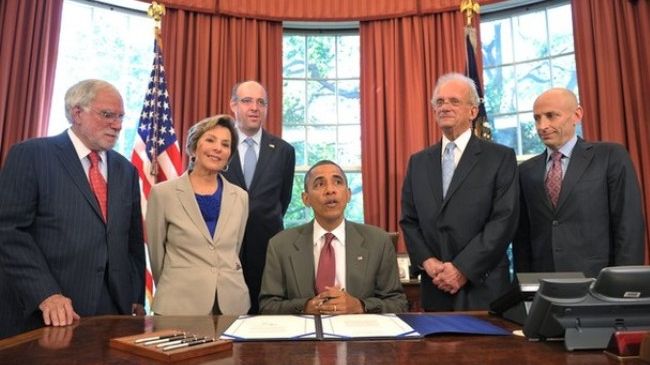
US President Barack Obama signs the US-Israel Enhanced Security Cooperation Act in the Oval Office on July 27, 2012.
Press TV – July 28, 2012
US President Barack Obama has signed a piece of legislation ratified by Congress that gives Israel another $70 million in military assistance, on top of the $3 billion the United States had already pledged to provide to the Israeli military this year.
On Friday, Obama signed the United States-Israel Enhanced Security Cooperation Act of 2012, which provides more US taxpayer dollars to help Israel expand its Iron Dome short-range rocket defense system, Xinhua reported.
The Iron Dome is a short-range rocket defense system designed to intercept rockets and artillery shells fired from a range of between four and 70 kilometers.
Representatives of the pro-Israeli lobby, the American Israel Public Affairs Committee (AIPAC), and Israeli journalists were invited to the signing ceremony, which was held at the White House.
“I have made it a top priority for my administration to deepen cooperation with Israel across the whole spectrum of security issues — intelligence, military, technology,” Obama said before signing the bill in the Oval Office.
“And, in many ways, what this legislation does is bring together all the outstanding cooperation that we have seen, really, at an unprecedented level between our two countries that underscores our unshakeable commitment to Israel security,” he added.
According to a White House fact sheet published on Friday, Obama said that “despite tough fiscal times” he “fought for and secured full funding for Israel” in fiscal year 2012, including $3 billion in Foreign Military Financing.
The fact sheet also said that Obama secured an additional $205 million in 2011 to set up the Iron Dome system.
Related articles
- US Gives Israel an Immediate $70 million for “Iron Dome” Systems (alethonews.wordpress.com)
- Israel Lobby Always Believes More Is Better (alethonews.wordpress.com)
Unemployed autoworkers real losers in Peugeot-Iran row: Analyst
Press TV – July 27, 2012
France’s largest car maker PSA Peugeot Citroen made a “disastrous” choice to sever ties with Iran, given Europe’s economic crisis and failing car markets, an expert says.
In February, the automaker decided to end relations with the Islamic Republic, losing the half-million vehicle sales Iran would have provided in 2012.
“Such a move, amid the European sovereign debt crisis and plummeting auto sales across the continent, seems like it could only be a disastrous business decision. And it is,” Ramin Mazaheri wrote in an article published on Press TV website.
Unable to replace the lucrative market, Peugeot was later forced to jettison 8,000 jobs to compensate for billions of euros it lost as a result, he noted.
Mazaheri dismissed the “strengthening of sanctions” against Iran and banking difficulties as the reasons behind the company’s decision.
“In exchange for selling seven percent of the company’s shares to General Motors, owned by the American government, the US insisted that Peugeot should stop selling cars to Iran,” he explained.
The analyst further referred to Iran’s policy of “economic protectionism,” which has helped the country to produce more cars than Italy or the UK and become the world’s 12th largest auto manufacturer.
Peugeot’s pullout will not affect the Iranian car industry as Iran will now continue to partner with other auto companies and to “improve the quality of Iranian vehicles by importing car kits to be assembled in Iranian factories,” according to Mazaheri.
“The 8,000 now-unemployed auto workers, as well as those who worked at the thousands of secondary jobs associated with the Peugeot plants” are the real victims of the company’s decision, he concluded.
Related articles
- Sanctions on Iran force French auto job losses (alethonews.wordpress.com)
- Iran Khodro says coping with Peugeot exit (alethonews.wordpress.com)
- Peugeot First-Half Profit Plunges on Europe Sales Decline – Bloomberg (bloomberg.com)
- Hollande’s Pledge to Block Firings Defied by Peugeot’s Reality – Bloomberg (bloomberg.com)
Don’t Expand NAFTA
The United States is leading the way to another corporate-friendly free-trade agreement, and it’s bringing its NAFTA partners along for the ride.
By Manuel Perez-Rocha and Stuart Trew · IPS · July 26, 2012
The United States recently announced that Canada and Mexico will join negotiations for the Trans-Pacific Partnership (TPP)—a secretive U.S.-led multinational trade and investment agreement currently being negotiated with eight other countries in the Pacific Rim region.On the other side of the Pacific, Japanese legislators are defecting in droves to try to stop the country’s entry into the negotiations. But the situation is much different in Canada and Mexico, which were admitted to the table with much fanfare during the G20 summit in June. The Japanese response is justifiable, and a recent statement of solidarity against the TPP by North American unions offers a good building block for resisting an agreement that for Mexicans and Canadians amounts to a neoliberal expansion of NAFTA on U.S. President Barack Obama’s terms.Mexico and Canada had been trying to secure a spot at the TPP table for months prior to the G20, and it became a leading story in both countries. Their anxiety played nicely into Obama’s hands, allowing the U.S. trade representative to put humiliating entry conditions on both countries — essentially giving these NAFTA neighbors a second-rate status, or what in Spanish is called convidados de palo (to be invited but without a say). Neither Canada nor Mexico will be able to see any TPP text until they finally join the negotiations in December, following the required 90-day U.S. congressional approval process. Once at the table, they will not be able to make any changes to the finished text or propose any new text in the finished chapters. There is a very real possibility that the existing TPP countries, the United States in particular, will use the following months to fashion a trap for the TPP latecomers.
North American Labor Solidarity
While most media outlets welcomed the NAFTA partners to the TPP table, national labor federations from the United States, Mexico, and Canada were cautious for very good reasons, and it wasn’t just the obviously imbalanced negotiating dynamic. On July 11, the AFL-CIO, the Canadian Labour Congress, and the National Union of Workers (UNT) of Mexico outlined some of those reasons in an important statement of solidarity, which included a vision of what they believe a 21st-centry trade agreement should look like.
The labor unions state that although they “would welcome a TPP that creates good jobs, strengthens protection for fundamental labor rights—such as freedom of association and authentic collective bargaining—protects the environment, and boosts global economic growth and development for all, American, Canadian, and Mexican workers cannot afford another corporate-directed trade agreement.” The joint statement explains that to have any positive effect on the region, “the TPP must break from NAFTA, which imposed a destructive economic model that expands the rights and privileges of multinational corporations at the expense of working families, communities, and the environment.”
The unions conclude that if “the TPP follows the neoliberal model and substitutes corporate interests for national interests, workers in all three countries will continue to pay a high price in the form of suppressed wages, a more difficult organizing environment, and general regulatory erosion, even as large corporations will continue to benefit.” Unfortunately, by all accounts, including leaked TPP chapters and statements from the U.S. trade representative, this is exactly what the Obama administration hopes to achieve through these negotiations.
Expanding Investor Rights
Instead of breaking with NAFTA, the TPP expands it in almost every chapter, from intellectual property rights to “regulatory coherence,” and from rules for increased “competition” in state-owned enterprises to opening government purchases to foreign bidders.
Particularly worrying to Canadians and Mexicans, and not mentioned in the joint statement from North American unions, are the extreme investors’ rights foreseen in the TPP. Under NAFTA, Mexico and Canada continue to be pummeled by investor-state lawsuits from U.S. and Canadian companies, or international firms using their U.S. registration to challenge government measures that can be shown to interfere with profits, even if that interference is not intended. These investment disputes, launched under NAFTA’s Chapter 11 protections, have resulted in hundreds of millions of dollars in fines or settlements to be paid out from public funds. Two recent cases against Mexico and Canada help describe the problem.
In 2009, two separate NAFTA investment panels established through the International Center for Settlement of Investment Disputes (ICSID) ruled in favour of U.S. companies Cargill and Corn Products International in their nearly identical cases against a Mexican tax on drinks containing high fructose corn syrup (HFCS), a sugar alternative. The tax was a means of levelling the playing field for Mexican cane sugar producers, who were having no luck accessing the U.S. market on equal terms to U.S. sugar producers despite NAFTA’s promises of open borders.
Cargill and CPI argued in part that the Mexican tax made soft drinks sweetened with HFCS less competitive on the Mexican market, depriving them of their national treatment rights in NAFTA. The ICSID panels did not agree that the HFCS tax amounted to a form of regulatory expropriation or performance requirement as the firms had also argued, but did agree on the national treatment claim. Cargill was awarded more than $77 million and CPI more than $58 million in damages. In the CPI case, the ICSID panel deprived Mexico of any countermeasures to defend against a one-way inflow of cheap sugar supplements from the United States.
Canada also just lost an important investor-state dispute with Exxon Mobil, which could cost the Canadian government as much as $65 million. At issue were measures requiring offshore oil and gas producers in the province of Newfoundland and Labrador to turn over a portion of their profits to research and development or education and training programs. A NAFTA investment panel ruled in favor of the company, which claimed that the measures were an illegal performance requirement on the firm. Three Canadian courts had previously upheld the legality of the measures, and the Canadian government had excluded the legislation enforcing the measures from national treatment and other investment protections in NAFTA, making the investment panel ruling extremely perplexing. The frustration is worsened by the fact that Exxon Mobil was the richest company in the world in 2011. Under NAFTA and the TPP, investors have rights but no enforceable responsibilities to the countries in which they are operating.
These are just two local cases amid a myriad of investor lawsuits against countries all over the world. Though the Obama administration recently released a new model Bilateral Investment Treaty, it is almost identical to NAFTA, with only modest safeguards for regulation in the public interest — safeguards that closed-door tribunals are under little obligation to take into account. In fact, the trend globally is for these secret tribunals to rule expansively in the interest of corporations, perhaps as a means of perpetuating the system by making it more attractive to investors. There is simply no justification for reproducing the investor-state dispute regime in the TPP. In fact, NAFTA should be renegotiated to remove investor-state dispute settlement from Chapter 11.
This outcome—removing extreme investment protections from the TPP—is not out of the question. In June of this year, before a negotiating round in San Diego, California, 130 state legislators from all 50 states and Puerto Rico signed a letter to President Obama’s senior trade official warning that they will oppose the deal unless the administration alters its current approach. In the letter they say that “Our experience with NAFTA and other trade deals shows that investor-state dispute settlement is used by large corporations to undermine state and federal laws they don’t like – laws that are fully constitutional, that do not discriminate, and that are needed to protect public health and safety.”
There is also the question of Australia, the one TPP partner refusing to abide by these investment rules. In April 2011, the Australian government released a new trade policy that discontinues the inclusion of investor-state dispute settlement in bilateral or regional trade agreements. Despite their second-rate status at the TPP table, Canada and Mexico could eventually help the United States put pressure on Australia and others who doubt the value of these extreme corporate rights. But public pressure might prove strong enough to foil these efforts, as it did when the Multilateral Agreement on Investment was ditched in 1999, followed by the Free Trade Area of the Americas (FTAA) in 2005.
A New FTAA, A New Struggle
With Canada and Mexico joining the TPP, the agreement is looking more and more like a substitute for the FTAA. So it is not surprising that opposition to the TPP is growing as quickly as it did against that former attempt to expand the neoliberal model throughout the Western hemisphere.
The intense secrecy of the TPP negotiations is not helping the Obama administration make its case.In their statement, North American unions “call on our governments to work with us to include in the TPP provisions to ensure strong worker protections, a healthy environment, safe food and products, and the ability to regulate financial and other markets to avoid future global economic crises.” But the truth is that only big business is partaking in consultations, with 600 lobbyists having exclusive passwords to online versions of the negotiating text.
A majority of Democratic representatives (132 out of 191) have expressed that they are “troubled that important policy decisions are being made without full input from Congress.” They have written to U.S. Trade Representative Ron Kirk to urge him and his staff to “engage in broader and deeper consultations with members of the full range of committees of Congress whose jurisdiction touches on the wide-ranging issues involved, and to ensure there is ample opportunity for Congress to have input on critical policies that will have broad ramifications for years to come.” In their letter, the representatives also challenge “the lack of transparency of the treaty negotiation process, and the failure of negotiators to meaningfully consult with states on the far-reaching impact of trade agreements on state and local laws, even when binding on our states, is of grave concern to us.”U.S. Senators, for their part, have also sent a letter complaining of the lack of congressional access to the negotiations. What openness and transparency can we in Canada and Mexico expect when the decision to join the TPP, under humiliating conditions, was made without any public consultation?
NAFTA turns 20 years old in 2014. Instead of expanding it through the TPP we must learn from NAFTA’s shortcomings, starting with the historic lack of consultation with unions and producers in the three member countries. It is necessary to correct the imbalances in NAFTA, which as the North American union statement explains enhanced corporate power at the expense of workers and the environment. In particular, we need to categorically reject the investor-state dispute settlement process that has proven so costly, in real terms and with respect to our democratic options in Canada and Mexico. The unions’ statement of solidarity provides a strong foundation for the growing trinational opposition to the TPP in Leesburg, Virginia, and beyond.
Related articles
- TPP plus NAFTA plus SOPA=Big Trouble (intrepidreport.com)
Iran Khodro says coping with Peugeot exit
Tehran Times | July 25, 2012
Iran’s main automobile company, Iran Khodro, says it is coping with a decision early this year by troubled French car maker Peugeot to halt exports of vehicle kits for assembly, according to reports on Wednesday.
“Iran Khodro has managed to become self-sufficient in producing 90 percent of the parts for the (popular Peugeot model) 206, and an effort is being made to use local suppliers for parts that were previously imported,” Hossein Najari, Deputy CEO for production was quoted as saying.
Peugeot’s parent company PSA Peugeot Citroen in February suspended its sales of car assembly kits to Iran, which had been its top export market in terms of trade volume up to then.
The decision appeared to be tied to Peugeot’s alliance with U.S. group General Motors, and U.S. sanctions pressure on Iran.
PSA Peugeot Citroen on Wednesday announced it will seek to cut 1.5 billion euros ($1.8 billion dollars) in costs over the next three years after declaring a 819-million-euro ($989-million) loss for the first half of 2012.
Its exports to Iran, where locally assembled versions of its 405 and 206 models are prevalent on the roads, represented up to 800 million euros in revenue per year before they were suspended, according to figures given in Tehran.
The maker of two-thirds of France’s cars is in a tailspin as a deepening recession in many markets in Europe takes its toll on its business — Europe is Peugeot’s main market. The company’s share price has more than halved since March.
The first-half loss contrasts starkly with a profit of €805 million in the same period last year and came on the back of a 5.1 percent fall in revenue to €29.6 billion.
The company doesn’t expect Europe to pick up anytime soon, saying Wednesday that it expects its European market to contract by 8 percent this year.
In response, Peugeot announced earlier this month that it would close a major factory in France and cut 8,000 jobs — part of a plan to save €2.5 billion by 2015. Those savings will also come from efficiencies gained by an alliance with General Motors. About half — €1 billion — of those savings will come this year alone.
“The group is facing a difficult time,” Chairman Philippe Varin said. “The depth and persistence of the crisis impacting our business in Europe requires the launch of the reorganization of our French production and a reduction in our structural costs.”
But the company’s cost-cutting plans have run afoul of President Francois Hollande’s Socialist administration, which has said the restructuring is unacceptable and that it will force Peugeot to save some of the jobs it wants to eliminate.
On Wednesday, the government will unveil a plan to support the auto industry — part of its carrot-and-stick strategy with Peugeot. It’s expected to give incentives to French consumers to buy French cars and to support the clean-energy vehicles that the company excels at.
But much of Peugeot’s problems stem from an over-supplied European car market, and it’s unclear how much the government can do for the company. France’s car industry was already given a bailout under former President Nicolas Sarkozy.
(Source: agencies)
Related articles
- Sanctions on Iran force French auto job losses (alethonews.wordpress.com)
- Peugeot First-Half Profit Plunges on Europe Sales Decline – Bloomberg (bloomberg.com)
Disconnect: Public Wants Cuts in Defense Spending; Democratic and Republican Leaders Don’t
By Matt Bewig | AllGov | July 23, 2012
Americans want a Peace Dividend, but their leaders won’t give it to them. Despite multiple polls showing broad support for cuts in U.S. defense spending, a sort of anti-democratic bipartisanship has emerged in Washington, where both Republicans and Democrats oppose such cuts, often vocally.
The most recent polling data on the issue, released last week by the Program for Public Consultation (PPC), in conjunction with the Center for Public Integrity and the Stimson Center, shows that Americans believe defense spending should shrink next year by a fifth to a sixth of its present size. Other polls released during 2012, including surveys by Gallup, Roper, and others, have been similar, although variations have occurred.
The issue has arisen this summer because, under a budget compromise reached last year between Democrats and Republicans, 10% across the board cuts are set to kick in at the beginning of 2013, which would give the Department of Defense a budget next year of $470 billion—an amount it got by on during the George W. Bush administration while the U.S. was fully engaged in both the Iraq and Afghanistan wars. Nevertheless, both Republicans and some Democrats in Congress oppose these spending reductions, and former Vice President Dick Cheney recently emerged to lobby Congress against them, joined by representatives of Lockheed Martin Corp., who warned of thousands of layoffs if the cuts occur.
Lockheed Martin, the largest arms merchant in the world, is eager to keep filling up from the taxpayers’ money spigot. With annual revenues of about $45 billion, it invests its profits in influence, especially in Washington, where since 1989 Lockheed has donated $23 million to political campaigns, spent $125 million on lobbying; received $20 million in earmarks; received 31 grants and 15,358 contracts from the federal government; and placed 257 of their people on 135 government advisory committees.
The economic impact of defense cuts, especially on jobs, is one of the main reasons otherwise moderate or liberal Democrats oppose defense cuts, reasoning that the recession-ravaged economy cannot sustain a significant spending cut. Yet according to the PPC poll the public, even when provided information about the possible economic consequences of defense spending reductions, still opts for them over cuts to domestic programs like Social Security, health care, or education. Further, people in congressional districts with high defense spending supported defense cuts as readily as those in other districts, although Democrats generally supported larger cuts than Republicans.
“The idea that Americans would want to keep total defense spending up so as to preserve local jobs is not supported by the data,” said PPC director Steven Kull. On average, Democrats supported a Pentagon cut of 22%, while Republicans wanted a cut of 12%.
Related articles
- Poll: 76% of Americans favor cutting military spending (alethonews.wordpress.com)
- Survey Finds Large Majorities In GOP Districts Support Reducing Military Spending (thinkprogress.org)
- House exceeds budget cap with huge defense spending bill (rawstory.com)
Raising the Minimum Wage Is Cheap and Easy
By Dean Baker | opednews.com | July 24, 2012
There are some policies that are pretty much no-brainers. We all agree that the Food and Drug Administration should keep dangerous drugs off the market. We all agree that the government should provide police and fire protection. And, we pretty much all agree that workers should be able to count on at least some minimal pay for a day’s work.
The minimum wage is non-controversial. The vast majority of people across the political spectrum support the minimum wage. In fact, one of the big accomplishments of the Gingrich Congress in 1996 was a 22 percent increase in the minimum wage. The only real issue is how high it should be. There are good reasons for believing that the minimum wage should be considerably higher than it is today.
At the current rate of $7.25 an hour, a full-time year-round worker would have gross pay of less than $15,000 a year. This is less than half of what the average Fortune 500 CEO makes in a day. It would be hard enough for a single person to survive on this income, imagine trying to support a child or even two on this money. And, close to 40 percent of the workers who would be benefited by a minimum wage increase have kids.
The counter-argument against raising the minimum wage is that it would actually hurt the people we are trying to help by reducing employment. There is little basis for this claim. The impact of the minimum wage on employment is one of the most heavily researched topics in economics.
Most recent research finds that it has no impact on employment. Even the research that finds job loss shows that the effect is small, suggesting that a 20 percent increase in the minimum wage may reduce employment of young people by around 2 to 3 percent.
While it’s not desirable to see anyone lose their job, it is important to remember the character of these jobs. They tend to be high turnover jobs that people leave after working relatively short periods of time. Job loss in this context is not likely to mean people being fired, rather it means that firms might be somewhat slower to hire. This would cause a typical low-wage worker to spend somewhat longer between jobs.
The dollars and cents might mean, for example, that a typical low wage worker ends up working 2 percent fewer hours in a year, but they take home 20 percent more pay for each hour that they work. This nets out to an increase in pay of 18 percent, a deal that most workers would likely consider pretty good.
In terms of whether we can afford a higher minimum wage, it is worth remembering that the minimum wage in 1968 would be almost $9.22 an hour in today’s dollars. In spite of the high minimum wage in the late 1960s, the job creators of that period pushed the unemployment rate down to 3.0 percent.
And, the country has not gotten poorer in the last four and a half decades. We have policy wonks running around Washington who seem to think that cell phones, computers, the Internet, and all other innovations of the past four decades that we now take for granted have reduced our standard of living.
This is of course nonsense. Productivity has increased by more than 120 percent since the late 1960s. If the minimum wage had kept step with productivity growth and inflation it would be over $20 an hour today.
The real problem in our economy today is not a lack of productivity. The problem is that the gains from productivity growth have not been broadly shared. The wealthy have used their power to rig the deck so that most of the benefits of growth have gone those at the top. They have used their control of trade policy, the Federal Reserve Board, and more recently the Wall Street bailout, to ensure that those at the top have gained at the expense of everyone else.
A higher minimum wage is an important step toward reversing this rigging. It should not be too much to expect that workers today should get at least as much as they did 45 years ago, and perhaps some dividend to allow them to share in the benefits of economic growth over this period. A minimum wage of $10 an hour would be a big step in the right direction.
Dr. Dean Baker is a macroeconomist and Co-Director of the Center for Economic and Policy Research in Washington, D.C.
Related articles
- Want a Real Recovery? Raise the Minimum Wage (bilerico.com)
- Large, Profitable Companies Employ Most Minimum-Wage Earners (thenation.com)
Featured Video

10K More U.S. Troops Deploy as Trump Weighs New Iran Strikes
or go to
Aletho News Archives – Video-Images
From the Archives
Genetic baloney in thick slices
MAYBE COULD BE INC.
By Jon Rappoport | No More Fake News | July 8, 2021
Gene research companies tend to come and go. They start out banging and popping like fireworks in the sky, and then they fade out—selling themselves to larger outfits who’ve hired better liars…
Once upon a time, it sounded easy. Start with a disease, find the gene responsible for the disease, and correct the problem.
Then, researchers wondered, was disease the result of one gene or a group of genes acting together?
Either way, the proof would be in devising cures for diseases using gene therapy. “Not yet, but soon…”
And regardless, the major need was: money. Lots and lots of money.
This need required good PR people. “We have to pump up the idea that we’re on the edge of tremendous breakthroughs. We’re always on that edge…”
This hype also needed to obscure the fact that there wasn’t (and isn’t) ANY gene cure for ANY disease. … continue
Blog Roll
 Aletho News
- UK Government Body Kept Files on People Criticizing Prevent Program
- US military withdrawal from Iraq and the collapse of US-Israeli hegemonic project in West Asia
- What does Europe want – a war with Russia?
- She Followed the Actual Data on COVID Vaccines and Masks — Her Career Took a Huge Hit
- Florida AG Sues Pfizer, Bourla Over Deceptive Marketing of COVID Vaccines
- Von der Leyen gifts her spin doctor a job for life
- 10K More U.S. Troops Deploy as Trump Weighs New Iran Strikes /Suliaman Ahmed
- Iranian crew declared Dena training vessel ‘unarmed’ to US warship before deadly torpedo strike: Report
- Iran’s NPT debate moves beyond parliament
- Houthis condemn Saudi claims of attack on Medina
- If Americans Knew
- Israel is squeezing the life out of Palestinians – Daily Update
- The Israeli Right Portrays Islam as Murderous. It Serves a Political Purpose
- Jordan Has Had Enough: King Abdullah’s Scathing Warning to Israel
- Israeli Colonizers (i.e. Settlers) Kill Palestinian Man Near Salfit
- New Google Maps images reveal massive scale of devastation in Gaza
- Jewish supremacy, anti-Palestinian bigotry on display in Israel – Daily Update
- Israeli Soldiers Abduct At Least 22 Across Occupied West Bank
- Eight Palestinians Killed in Israeli Attacks on Gaza
- Israeli former leaders and security chiefs threaten legal action over ‘Jewish terrorism’
- Israel map in LA Times ad includes all land from the river to the sea
- No Tricks Zone
- Green Energy Debacle: German Expert Professor Fritz Vahrenholt Warns Of Severe Economic And Social Consequences
- Two More Paleo Reconstructions Affirm Meters-Higher Sea Levels Across Ireland, Brazil 7000-6000 Years Ago
- New Study: Earth And Venus Surface Warmth Largely Explained By Convection And Lapse Rate, Not CO2 Or Radiation
- 2025 Nature Paper Claiming Worsening Global Drought Gets RETRACTED …Heavily Flawed
- New Study: ‘Global Drought Shows No Detectable Recent Acceleration Under Climate Warming’
- Economic Masterminds: German Socialists Suggest Taxing Productivity Gains Stemming From Using AI
- The South China Sea Has Not Been Cooperating With The Climate Change Narrative
- Energy Crisis: Germany Enters Heating Season With Historically Low Gas Reserve Fill Levels
- New Study: The Antarctic Ice Sheet Gained Mass From 2020-2024 Due To Staggering Snow And Ice Accumulation
- Study: Ocean Heating Rates From Thousands Of Years Ago ‘Dwarf’ Modern Ocean Heating Rates

