India joins Japan to resume shipping of Iranian oil
MEHRNEWS | August 15, 2012
India has joined Japan in offering government-backed insurance for ships carrying Iranian crude in order to bypass European sanctions, the Washington Post reported.
The first Indian ship to carry oil from Iran with Indian insurance is scheduled to load up in Iran on Wednesday, a shipping company executive said. This is a breakthrough for the Indian government, which has scrambled to maintain vital Iranian oil imports after European sanctions blocked third-party insurance in July.
The MT Omvati Prem — a tanker contracted to carry 85,000 metric tons of crude oil from Iran for Indian state refiner Mangalore Refinery and Petrochemicals Ltd. — is scheduled to arrive in India by Aug. 25, said Kowshik Kuchroo, president of shipping for Mercator Ltd., an Indian shipping company.
“This being a government of India cargo, it has a different sense of importance. We’re not doing it just for business,” Kuchroo said Monday. “India is in definite need of the crude. At a short notice, we can’t just snap the supply.”
Mercator is insuring the ship with $50 million in hull and machinery insurance, which covers physical damage to the ship, from state-owned New India Assurance Co. It’s insuring the vessel with another $50 million in protection and indemnity insurance, which covers a broad range of liabilities, including environmental pollution and cargo damage, from government-backed United India Insurance.
Related articles
- South Korea resumes Iranian oil supplies (alethonews.wordpress.com)
‘Unilateral sanctions against Iran could damage Russian-US ties’ – Foreign Ministry
RT | August 13, 2012
The Foreign Ministry has warned of a possible blow to Russian-American relations if the US pursues unilateral sanctions against Iran that affect Russian economic interests there.
“Washington should understand that our bilateral relations will suffer considerably if the American restrictions affect Russian economic entities cooperating with partners in the Islamic Republic of Iran in strict compliance with our legislation and UN Security Council resolutions,” the ministry said on its website on Monday.
Late Friday, US President Barack Obama signed into law new sanctions against Iran which aims to penalize those parties aiding Iran’s insurance, financial, petroleum, petrochemical and shipping sectors.
Moscow considers US sanctions against Iran unacceptable, Foreign Ministry spokeswoman Mariya Zakharova said on Monday.
“Russia is fully committed to the restrictions on cooperation with Iran that were established by the UN Security Council,” the spokeswoman said. “However, we do not recognize the unilateral sanctions that were imposed by Washington on the plea of serious concern about Iran’s nuclear program and run counter to international law.”
Zakharova called US efforts to punish countries that do business with Tehran “blackmail.”
“We refute methods of undisguised blackmail,” she said, “which is used by the US towards banks and companies of other countries.”
Earlier, the US passed legislation that targets any party doing business with Iran’s central bank.
Russia has cooperated with Iran in economic projects in the past, including in the Bushehr nuclear plant, which started adding energy to Iran’s electricity grid in September, 2011.
The United States is one of several countries, including Israel, that is concerned that Iran may be trying to develop a nuclear weapon under the cover of a civilian energy program.
Tehran has strongly rejected the accusations, saying it is pursuing nuclear energy for civilian purposes only.
Related articles
- China Hits back at New US Sanctions over Iran (alethonews.wordpress.com)
Iraqi ambassador to Iran calls for closer economic ties
Press TV – August 12, 2012
Iraqi Ambassador to Iran Mohammad Majid al-Sheikh says there is a huge capacity for development of financial transactions between the two countries.
“Given the friendly and brotherly relations between the two neighboring countries and hundreds of kilometers of shared borders, there are many potentials for boosting bilateral trade ties,” he told IRNA on Sunday.
He noted that Iran-Iraq trade transactions amounted to $7 billion in 2011, and hoped that the number would rise to $10 billion in the near future.
He said that a high-ranking Iraqi delegation is to visit Tehran this Tuesday in order to further commercial relations.
Headed by Deputy Prime Minister Rozhi Nouri Shawis, the delegation will include Finance Minister Rafe al-Essawi, Trade Minister Khairullah Hassan Babakr, Industries and Mines Minister Ahmad Nasser Deli, and Governor of the Central Bank Sinan Al-Shabibi, the ambassador stated.
Al-Sheikh added that setting up an Iraqi bank in Iran will be on the delegation’s agenda.
“Establishing an Iraqi bank [in Iran] can greatly help enhance bilateral economic and commercial relations,” he underlined.
Resolving the Budget and Debt Crises
By Ron Forthofer | Dissident Voice | August 10th, 2012
There is a looming double whammy threatening the economy beginning in 2013. These two threats are: 1) the expiration of the Bush tax cuts; and 2) implementation of $1.2 trillion in automatic spending cuts over a ten-year period, an outcome of the 2011 debt ceiling debacle.
These threats raise the specter of driving the U.S. back into recession or depression. Many people might question the phrase ‘back into recession’ since they feel we are still in the Great Recession.
Unsurprisingly, in most of these negotiations over the deficit and long-term debt, corporate-funded pundits and politicians focused on the need for more budget cuts. However, some strong special interests are now raising concerns about the agreed upon cuts. In particular, the Congressional-military-industrial (CMI) complex strongly opposes the additional $600 billion in cuts to the military budget that are mandated over a ten-year period. Given that the U.S. spends as much on its military as most of the rest of the world combined, these cuts certainly seem justifiable. The CMI complex now wants more cuts to programs benefiting the public instead of cutting unnecessary weapons programs or closing many of the hundreds of unnecessary military bases spread worldwide.
Instead of the politicians’ focus on budget cutting, numerous polls of Americans support raising revenue by increasing taxes on the wealthy. Despite our clear wishes, increasing the federal revenue has received relatively little attention from the pundits and politicians. However, at least the White House is pushing for elimination of the Bush tax cuts for those making over $250,000. The elimination of this cut would be a start along a path that could eliminate the deficit and shrink the debt.
Most Americans don’t realize how changes in the tax code affected our nation’s fiscal health. For example, the corporate share of federal taxes went from an average of roughly 28% in the 1950s to an average of about 10% over the 2001 to 2010 period. In addition, the top marginal individual tax rate dropped from 91% in 1954 to 35% today. Cuts in the top capital gains taxes for long-term gains from 28% to 15% also primarily benefited those at the top of the income ladder.
These huge cuts pushed by the extremely wealthy have done immense damage to our nation’s financial outlook as well as greatly increasing inequality. For example, the top 1% now hold about 35% of the nation’s wealth compared to the bottom 50% holding about 1.1%.
Some steps that would go a long way towards restoring our nation’s fiscal health and reducing our shameful inequality are the following:
- implementing a small tax on the wealth of the top 1%;
- adding a small fee on financial speculation;
- creating a highly progressive income tax with many categories and a top marginal rate of at least 70% on incomes over $1,000,000;
- restoring the estate tax with estates under $3.5 million exempted;
- removing loopholes in the corporate tax code that allow many large global corporations either to get refunds, to pay no taxes, or to pay effective tax rates far lower than the official rate of 35%;
- eliminating corporate welfare at the federal and state levels that basically benefit large global corporations at the expense of small businesses and the public;
- removing the cap on wages taxed for Social Security and also subjecting unearned income to taxes for Social Security;
- enacting Medicare for all;
- stopping illegal aggression against other nations;
- withdrawing from Afghanistan in a timely manner;
- ending the harmful, costly and failed war on drugs; and
- cutting military spending, particularly for weapons programs, unnecessary military bases and the costly privatization of many tasks.
Some may view these steps as class warfare against the wealthy. However, if you examine these proposals, you can see that the wealthy have already been engaged in class warfare against the rest of us for well over thirty years. According to the media though, it is not class warfare if the wealthy do it. Warren Buffet addressed this idea a few years ago: “There’s class warfare, all right, but it’s my class, the rich class, that’s making war, and we’re winning.”
The Congressional Progressive Caucus has also proposed a less daring plan, “The Peoples’ Budget”, as another way of eliminating the budget deficit. For related information, read the just published The Betrayal of the American Dream by Donald Barlett and James Steele.
~
Ron Forthofer is a retired professor of biostatistics from the University of Texas School of Public Health in Houston and was a Green Party candidate for Congress and also for governor of Colorado.
Judge Begrudgingly OKs Morgan Stanley Derivatives Price-Fixing Settlement
By Noel Brinkerhoff | AllGov | August 09, 2012
Morgan Stanley got off easy, according to consumer advocates, when a federal judge reluctantly approved a $4.8 million settlement involving price fixing in the electricity market.
The agreement resolved accusations that Morgan Stanley had gotten into a complex swap arrangement with KeySpan Corp. through which it gained a stake in the profits of its competitor Astoria Generating Company Acquisitions. The scheme allowed KeySpan to bump up the cost of electricity in New York, taking approximately $300 million out of consumers’ pockets.
Other than paying just under $5 million, which represented less than a quarter of its earnings from the scheme, Morgan Stanley did not have to admit any wrongdoing.
Judge William H. Pauley III said he had “misgivings” about the size of the penalty, saying, “$4.8 million is a relatively mild sanction.”
“There is a risk that a large financial services firm like Morgan Stanley could view such a modest penalty as merely the cost of doing business,” Pauley added.
Peter Vallone, a councilman who represents the Queens district that hosts KeySpan’s facilities, was irate over news of the settlement. “Here, they’re allowed to keep what they stole,” Vallone told Courthouse News. “That is ridiculous…. This is pocket change for them.”
The AARP and New York’s Public Service Commission objected to the settlement. They said Morgan Stanley should have been forced to admit what they did was wrong and pay $21.6 million, the amount it made off the deal with KeySpan Corp.
Related articles
- On Wall Street Crime Pays – A 350% IRR To Be Exact (zerohedge.com)
- Morgan Stanley Derivative Accord Wins Approval in First Case – Bloomberg (bloomberg.com)
Adam Davidson’s Journalistic Corruption: NPR Host Boosts for Wall Street, While Taking Undisclosed Banking Money
By Yasha Levine and Mark Ames • S.H.A.M.E. • August 8, 2012
“I feel like the voice of business journalism is sort of, it’s an authoritative voice of God.”
—Adam Davidson
Adam Davidson is the co-creator and host of the popular economic news radio program Planet Money. On air, Davidson plays the role of an earnest, brainy reporter who’s doing his best to make sense of the complicated, jargon-filled world of finance to report business news in a way that NPR listeners can understand. However, behind the dweeby, faux-naive facade Adam Davidson presents to his listeners, is a shrewd propagandist with a long, consistent history of shilling for powerful and destructive interests—and failing to disclose his financial ties to the companies and industries he reports on.
Over the years, Davidson has boosted for the Iraq War and whitewashed the occupation of Iraq, praised sweatshop labor and “experimenting on the poor,” attacked the idea of regulating Wall Street, parroted libertarian propaganda about the government’s inability to directly create jobs, argued for “squeezing the middle class,” and shamelessly fawned over Wall Street for allegedly blessing Americans with “just about anything that makes you happy.” (Read Adam Davidson’s full S.H.A.M.E. profile.)
While Adam Davidson has recently come under increasing scrutiny for using his NPR platform to promote the narrow interests of the super-wealthy in this country, little attention has thus far been given to Davidson’s corruption—his numerous financial conflicts of interest that seriously undermine his claims to being a journalist, and instead reveal Davidson as a glorified product spokesman for his Wall Street sponsors.

Adam Davidson gained national media recognition as an on-air personality in 2008, after co-producing an episode for This American Life called “The Giant Pool of Money” about the implosion of subprime lending. Although Davidson’s segment was praised for making the murky world of finance easier to understand, his framing of the subprime housing debacle served another purpose: It let Wall Street off the hook for its role in rampant criminal mortgage fraud and predatory lending.
“This was a crisis that was caused by willing participation of every single person. Nobody was coerced,” said Davidson’s co-producer and partner in Planet Money, Alex Blumberg. “And there was fraud. But that was not what caused the crisis. What caused the crisis was something bigger and more systemic that required the involvement of everybody at every step.”
This evasion-by-exaggerating-the-complexity strategy is one that Davidson and Planet Money have deployed often to whitewash and deflect the role of criminality in the housing crisis. Among the show’s fans was Treasury Secretary and former New York Federal Reserve Bank chief Timothy Geithner: “Yeah, they did a good job.”
As a piece of journalism, Davidson’s report on the subprime fraud was a failure bordering on journalistic malpractice. By absolving the role of rampant predatory criminality and spreading blame in a grand false equivalency, Davidson provided a narrative frame that comforted the American Establishment at a time when it badly needed comforting, and was duly rewarded for his services. The mainstream media joined Timothy Geithner in lavishing praise on Davidson’s subprime fraud whitewash, and awarded him and his partner with the prestigious “Peabody Award” while New York University’s Journalism Institute named the segment one of the “Top Ten Works of Journalism of the Decade.”
Thanks to this broad acceptance and praise of Davidson’s whitewash, he was given his own show, which launched just as the entire financial system began to meltdown.
The new show, called Planet Money, was a partnership between NPR and Chicago Public Media’s This American Life, and was molded on Davidson’s successful subprime episode. Not surprisingly, Planet Money was compromised almost from the very start.
In early 2009, just a few months after Planet Money was launched, NPR announced it had secured Ally Bank (formerly GMAC) as the show’s exclusive sponsor. It was an unusual setup for NPR, and unusual (and highly dubious) for anything that called itself journalism, because it meant that a major, troubled financial institution was the only source of money for a news program about finance. At the time that the unusual agreement was signed, Planet Money was the only NPR program underwritten by a single exclusive sponsor. The arrangement raised eyebrows and would have been unthinkable before the crisis—but even by post-crisis funding arrangements, Planet Money’s deal with Ally Bank stood out as such an obvious violation of basic journalism standards that even Ad Age, the advertising industry’s trade publication, was taken aback by the “close alignment of message and news program.”
To understand why Davidson’s arrangement with Ally Bank is so odious, a little background is needed. Ally Bank is a subsidiary of Ally Financial, a giant financial services company formerly known as GMAC. There’s a good reason why GMAC would have wanted to change its name to “Ally Financial” after the financial collapse: The bank is one of the biggest mortgage servicers in the country, and has been one of the very worst offenders in foreclosure fraud and in the very same subprime fraud that Davidson whitewashed as a “blameless” phenomenon. GMAC deserves far more blame—and jail time—than any of the subprime borrowers it fleeced and ruined. Since GMAC collapsed in late 2008, it has received more than $17 billion of taxpayer bailout funds in a series of bailouts. As of August 1, 2012, 74% of Ally Financial was still owned by the U.S. Government. [ 1 ]
At the time Ally signed its sponsorship agreement with Planet Money, the bank was being investigated across the country for foreclosure fraud, robo-signing fraud, and student loan fraud. Even as bad bailed-out banks go, GMAC/Ally is considered one of the worst, most tainted of them all.
GMAC goes from thief to Ally…
Planet Money‘s relationship with Ally is a textbook example of “conflict of interest” of the sort every journalist is taught to shun. The bank had a clear and demonstrable interest in Planet Money‘s coverage of the financial industry, especially issues that affected the bank’s bottom line. As Planet Money‘s sole sponsor at a time when NPR funds were falling, Ally obviously wielded considerable power.
After Davidson sprang a vicious and bizarre smear-attack on Elizabeth Warren in 2009, some NPR listeners started to get wise to Planet Money‘s corruption problem, and made their concerns known. Following months of complaints from readers pointing to the conflict-of-interest and the way Planet Money‘s segments dovetailed with the banking lobby’s own propaganda—and with Ally’s interests—NPR’s Ombudsman was forced to issue a public statement on the Ally-Planet Money relationship. Perhaps not surprisingly, the NPR Ombudsman decided that listeners’ concerns over the conflict-of-interest were “cynical”—as if the problem lay in listeners’ psychology, rather than in Planet Money’s violation of basic journalism ethics. The NPR Ombudsman went further, arguing essentially that if listeners who complained about corruption weren’t cynical, then they were ignorant.
Despite Davidson’s long experience in sales and underwriting for public radio, he claimed he was out of the loop when it came to the deal his own show, Planet Money, cut with its sole sponsor, Ally Bank: “I have nothing to do with the underwriting stuff. We don’t pay any attention to the fact that they are a sponsor. We wouldn’t for a second give them any special treatment — positive or negative.”
And yet, the actual record proves that NPR readers were right to suspect and criticize the arrangement, and that Davidson was wrong in claiming that Planet Money has not consistently pushed a narrative so in synch with Ally Bank and the financial industry that it boggles the mind how he has gotten away with it. Planet Money coverage hasn’t just been friendly to banks and the finance industry in general—some of it has been suspiciously lined up and in synch with specific policy priorities of its exclusive sponsor, Ally Bank.
One example: In 2009, just as Planet Money inked its exclusive sponsorship deal with Ally Bank, Davidson began broadcasting a number of segments critical of the proposed Financial Consumer Protection Agency Act of 2009, questioning the need to regulate consumer financial products like mortgages and credit cards in order to protect people against bank fraud. “Will it work at all?” Davidson asked in one of his fake “gee-whiz” questions. “Is this just one more layer of regulation in a regulatory system that fundamentally broke down?”
In May 2009, in the heat of the banking industry’s massive pushback, Davidson essentially mugged Elizabeth Warren, the chief architect of the financial consumer protection bill, in an interview that took a sharp and bizarre hostile turn early on. Davidson surprised Warren and his own listeners with uncharacteristic personal smears, trying to portray her as a clueless, power-hungry ideologue. Davidson’s attack on Warren was so out-of-line and uncharacteristically hostile that it sparked a torrent of criticism from NPR listeners who couldn’t understand why Davidson or NPR would do such a thing. Keep in mind, this was in the spring of 2009, when unemployment was still shooting through the roof, the future of the economy was in doubt, and talk of a 1930s style Great Depression-2 was still front-and-center.
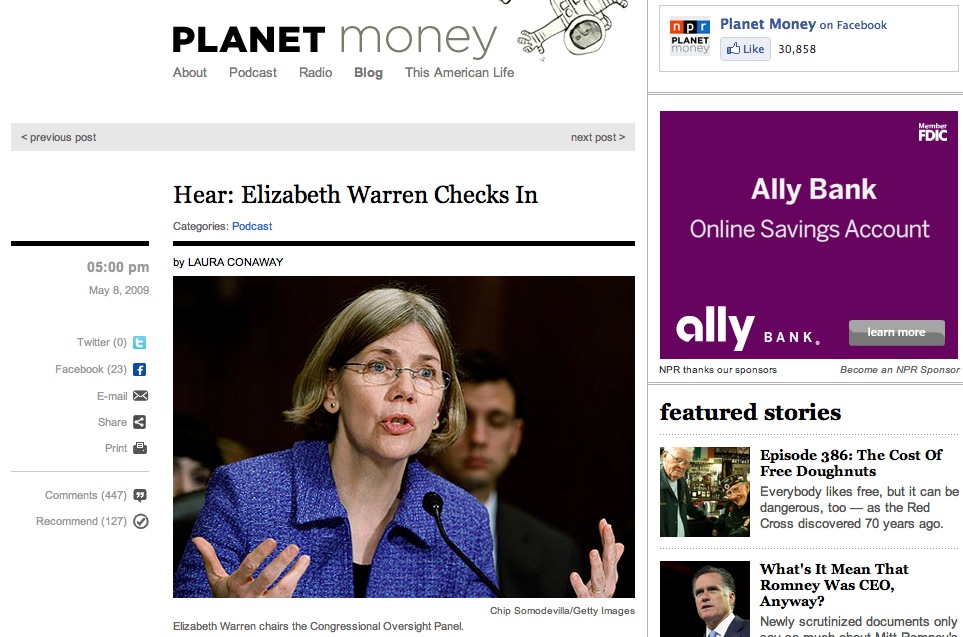
It’s worth going back and listening to the interview to get a sense of just how malevolent Davidson really was, and is. Here’s an excerpt, courtesy of Corrente:
ADAM DAVIDSON: What it feels to me is what you are missing is that — I think we put aside your pet issues. We put them aside. We put them aside until this crisis is over.
ELIZABETH WARREN: The cr– What you’re saying makes no sense. Now come on. [interpolate Davidson sputtering and attempting to interrupt throughout.] It makes no sense. On an emergency basis, on one day, one week, one month, there’s no doubt in my mind we’ve got to step in, we’ve got to make sure we have a functioning banking system. I think I’ve said that like nine times now. Of course we’ve got to have a functioning banking system.
DAVIDSON: Wait a minute. I want to make you go farther. I want to make you madder before I —
ELIZABETH WARREN: No no no. [Davidson snickers] We’re now at what — we’re now seven, eight months into this. And it’s the second part of what you said. We can’t do anything about the American family until this crisis is over? This crisis will not be over until the American family begins to recover. [More Davidson sputtering.] This crisis does not exist independently —
DAVIDSON: That’s your crisis.
ELIZABETH WARREN: No it is not my crisis! That is America’s crisis! If people cannnot pay their credit card bills [Davidson tries to interrupt] if they cannot pay their mortgages —
DAVIDSON: But you are not in the mainstream of views on this issue. You are not —
ELIZABETH WARREN: What, if they can’t pay their credit card bills the banks are gonna do fine? Who are you looking at?
DAVIDSON: The [sputters]–
ELIZABETH WARREN: Who says a bank a bank is going to survive — Who is not worried about the fact that the Bank of America’s default rate has now bumped over 10%? That’s at least the latest data I saw. So the idea that we’re going to somehow fix the banks and then next year or next decade we’re going to start worrying about the American family just doesn’t [Davidson talking over] make any sense.
DAVIDSON: The American families are not — These issues of crucial, the essential need for credit intermediation are as close to accepted principles among every serious thinker on this topic. The view that the American family, that you hold very powerfully, is fully under assault and that there is — and we can get into that — that is not accepted broad wisdom. I talk to a lot a lot a lot of left, right, center, neutral economists [and] you are the only person I’ve talked to in a year of covering this crisis who has a view that we have two equally acute crises: a financial crisis and a household debt crisis that is equally acute in the same kind of way. I literally don’t know who else I can talk to support that view. I literally don’t know anyone other than you who has that view, and you are the person [snicker] who went to Congress to oversee it and you are presenting a very, very narrow view to the American people.
The Columbia Journalism Review described the Planet Money interview as a “disaster” and “really cringeworthy stuff from Davidson,” who was so rude and unprofessional that NPR’s Ombudsman was forced to issue a public apology for his behavior. Davidson’s excuse: he had been traveling for a NPR fundraiser and was “very, very tired.”
What Adam Davidson did not disclose to the public was that at the same time he was smearing Elizabeth Warren and attacking legislation that would protect consumers against the sort of bank fraud that has devastated millions of Americans, Ally Bank, the sole sponsor underwriting Davidson’s Planet Money show and his salary, was simultaneously spending hundreds of thousands lobbying against the Financial the Consumer Protection Agency Act of 2009.
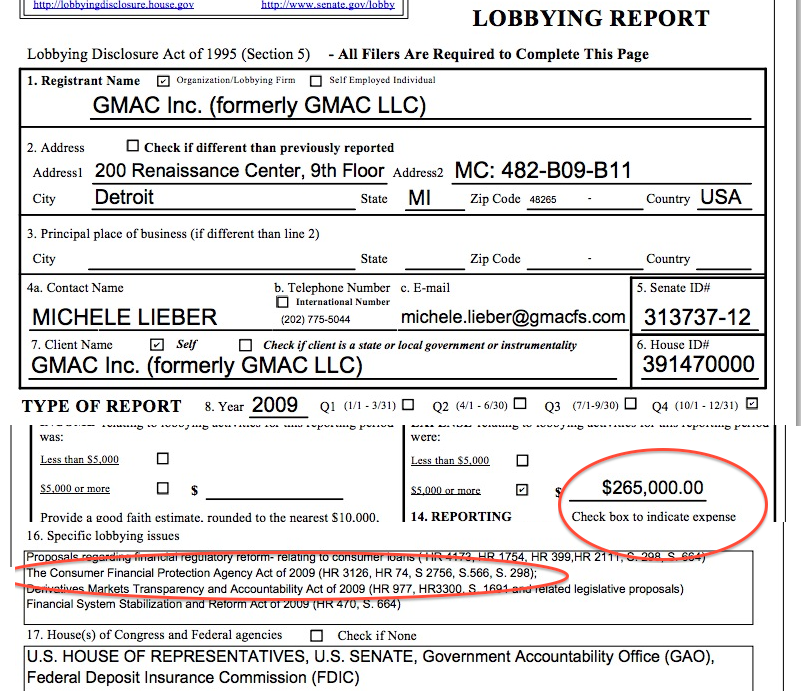
Evidence: Here’s just one of GMAC’s lobbying disclosure forms mentioning the Consumer Financial Protection Agency Act of 2009
Ally Bank is not the only financial company funding Adam Davidson’s career, and filling up his bank accounts.
On top of Ally Bank’s exclusive sponsorship of Planet Money, Davidson earns lucrative speaking fees from banks and financial companies, including J.P. Morgan, Well Fargo, Bank of America and Goldman Sachs—the same companies he covers as a journalist. Davidson is frequently the only journalist/reporter booked to speak at these events; other speakers usually work in finance.
Davidson has yet to disclose his corporate clients and how much they pay him, but here is a partial list of Davidson’s speaking gigs from the last two years compiled from various publicly available sources:
- In April 2011, Davidson was the headlining speaker at the 9th Annual “Women’s World Banking” Microfinance and the Capital Markets Conference. The conference was hosted by J.P. Morgan, but the organization itself is funded by the world’s biggest banks and corporations, including BP, Morgan Stanley, Pfizer, Barclays Capital, VISA, ExxonMobil—just to name a few.
- In 2011, Davidson spoke at another microfinance conference, this once was also funded by Morgan Stanley, Citi, Bank of America, Deutsche Bank and CapitalOne.
- In 2012, Davidson spoke at the 27th Annual Conference for the Treasury & Finance Professional. Sponsors of the event included Bank of America, BlackRock, BNY Mellon, Bloomberg, Citibank, Findelity Investments, Goldman Sachs, J.P. Morgan, Morgan Stanley, Well Fargo and about a dozen of the most powerful financial the largest financial companies in the world.
These speaking fees are a huge unaddressed problem in news media and academia. As explained by Charles Ferguson, director of Inside Job and author of Predator Nation, the problem with speaking fees is that they are “sometimes used to launder or disguise payments . . . for lobbying and policy advocacy.” That is why, for example, Obama’s former economy czar Larry Summers was roundly criticized for taking hundreds of thousands of dollars in speaking fees in 2008 from the same banks he was bailing out in 2009.
Chicago Public Media, which co-owns “Planet Money” through its ownership of “This American Life”, explicitly bars conflicts-of-interest: “WBEZ journalists must uphold the trust of the public by not overlapping individual interests with professional responsibilities. WBEZ journalists may not accept any form of compensation from the individuals, institutions or organizations they cover.”
Neither NPR nor This American Life would comment on S.H.A.M.E.’s investigation into Adam Davidson’s conflicts of interest. We will be seeking to get comment from Davidson’s other employer, The New York Times, about their policy on journalists having conflicts-of-interest.
Notes
See Naked Capitalism’s coverage of GMAC/Ally’s mortgage fraud.
South Korea resumes Iranian oil supplies
RT | August 8, 2012
South Korea, the fourth largest importer of Iranian crude, plans to resume purchases after a two-month pause due to a European Union embargo.
South Korean refiners and the National Iranian Tanker Company (NITC) are negotiating the details of a deal, which would allow supplies to restart from September, Reuters reported citing government sources. Tehran offered to deliver crude in its own tankers and provide up to $1 billion shipment insurance cover.
SK Energy and Hyundai Oilbank – the only two South Korean refiners that import Iranian crude, have confirmed that they are involved in negotiations with NITC. Though it’s unclear whether Iran had offered South Korea a discount for crude.
South Korea, India, Japan and China are the biggest importers of Iranian crude, accounting for more than half of its oil exports. In May, Seoul announced it would halt crude import from the Islamic Republic, becoming the first major importer of Iranian oil to give up supplies due to the EU sanctions.
EU sanctions banning Iranian oil as well as insurance affect Asian customers as they rely on EU companies to insure their shipments. Nearly 90% of the world’s tanker fleets are covered by 13 international P&I clubs from the EU.
Meanwhile Japan approved providing $7.6 billion insurance coverage for Iranian tankers, while China offered to use its own vessels for delivery. India has given permission to its state-run refiners to import Iranian oil on condition Tehran arranges insurance.
Related articles
- Iran Sets up Consortium to Provide Insurance Cover for Oil Tankers (shippingtribune.com)
- Iran Oil Shipping to Resume as Insurers Step In: Corporate India (bloomberg.com)
- China and Japan secure Iran oil supply, bypassing EU sanctions (rt.com)
Sudan, South Sudan agree on oil deal
Al Akhbar | August 4, 2012
Sudan and South Sudan have hammered out a deal on how to share their oil wealth, one of a series of disputes that brought the rivals to the brink of all-out war earlier this year, it was announced on Saturday.
“The parties have agreed on all of the financial arrangements regarding oil, so that’s done,” African Union (AU) mediator Thabo Mbeki said early on Saturday after talks in the Ethiopian capital.
The two countries had faced an August 2 deadline set by the United Nations to resolve their differences on oil and borders, and Mbeki said they would meet next month to try to find a compromise on the disputed region of Abyei, whose status was the most sensitive issue left unresolved before South Sudan’s independence.
The former South African leader said a timetable would now be drawn up for the resumption of oil production and exports, which are vital to the economies of both deeply impoverished countries.
“What will remain, given that there is an agreement, is to then discuss the next steps as to when the oil companies should be asked to prepare for resumption of production and export,” he said.
The AU has been mediating long-running talks to try to resolve a series of disputes that have flared since South Sudan became independent in July 2011 following a 2005 peace deal that ended one of Africa’s longest civil wars.
Landlocked South Sudan took with it three-quarters of the oil held by the previously united nation, but the pipelines and processing facilities remained in Sudan.
And the two sides were unable to agree on how much Juba should pay to export its crude through a northern pipeline and port, leading the South to shut down production in January after Khartoum began seizing the oil in lieu of payment.
Oil generates about 98 percent of South Sudan’s revenue and the move crippled the economies of both countries.
Ahead of the agreement announced by Mbeki, Sudan had lowered its demand for oil fees from South Sudan. Sudan had been seeking up to $36 a barrel in fees, but in a position paper released on Thursday said it was proposing $22.20 a barrel, compared with $7.61 offered by South Sudan.
Despite the oil agreement, South Sudan’s chief negotiator Pagan Amum accused Khartoum of violating a peace plan drawn up by the African Union in April urging both sides to reach a comprehensive deal on all outstanding issues.
“The government of Sudan continues to violate the road map and continues to bomb South Sudan,” Amum told reporters.
“The (AU) peace and security council in its road map and resolution decided that they would impose sanctions on Sudan if they fail to comply, Sudan has failed to comply,” he said.
Mbeki’s announcement came hours after US Secretary of State Hillary Clinton called on the two Sudans to strike an urgent compromise on outstanding issues such as oil revenue sharing, security, citizenship and border demarcation, saying the countries “remain inextricably linked”.
Clinton’s comments came after a meeting with South Sudan’s President Salva Kiir in Juba as part of her tour of Africa.
Sudan accuses South Sudan of supporting insurgents on its territory, a charge that analysts believe despite denials by Juba, which in turn accuses Khartoum of backing rebels south of the border.
The two countries fought along their undemarcated frontier in March and April, sparking fears of wider war and leading to a UN Security Council resolution that ordered a ceasefire.
Mbeki said an agreement had also been reached between Sudan, the United Nations, the AU and the Arab League to allow for humanitarian access in the conflict-wracked Blue Nile and South Kordofan states.
Prolonged clashes between Sudanese forces and rebel groups in the two disputed territories have left thousands in a “desperate state” and in need of emergency aid, according to the United Nations.
(AFP, Al-Akhbar)
Related articles
- Sudan, South Sudan reach oil deal (english.ruvr.ru)
The Employment Rate In The United States Is Lower Than It Was During The Last Recession
By Michael Snyder | BlackListedNews | August 4, 2012
Did you know that a smaller percentage of Americans are working today than when the last recession supposedly ended? But you won’t hear about this on the mainstream news. Instead, the mainstream media obsesses over the highly politicized and highly manipulated “unemployment rate”. The media is buzzing about how “163,000 new jobs” were added in July but the unemployment rate went up to “8.254%.” Sadly, those numbers are quite misleading. According to the Bureau of Labor Statistics, in June 142,415,000 people had jobs in the United States. In July, that number declined to 142,220,000. That means that 195,000 fewer Americans were working in July than in June. But somehow that works out to “163,000 new jobs” in July. I am not exactly sure how they get that math to add up. Perhaps someone out there can explain it to me. Personally, I find that the “employment rate” gives a much clearer picture of what is actually going on in the economy. The employment to population ratio is a measure of the percentage of working age Americans that actually have jobs. When it goes up that is good. When it goes down, that is bad. In July, the employment to population ratio dropped from 58.6 percent to 58.4 percent. Overall, the percentage of working age Americans that have jobs has now been under 59 percent for 35 months in a row.
The following is a chart of the employment to population ratio in the United States over the past 10 years:

The gray shaded bar in the chart represents the last recession as defined by the Federal Reserve. As you can see, the percentage of working age Americans with a job dropped sharply from nearly 63 percent at the start of 2008 to a little above 59 percent when the recession ended.
But the “employment rate” kept on dropping even further.
It finally bottomed out at 58.2 percent in December of 2009.
Since that time, it has stayed very steady. It has not fallen below 58 percent and it has not risen back above 59 percent.
This is very odd, because after ever other recession since World War II this number has always bounced back strongly.
But this has not happened this time.
In essence, it is starting to look like 4 percent of the working age population of the United States has been removed from the workforce permanently.
The good news in all of this is that things have at least not been getting any worse over the last couple of years. Even though things have been bad, at least we have had a period of relative stability.
The bad news is that the employment rate has not rebounded despite unprecedented borrowing and spending by the federal government and despite reckless money printing by the Federal Reserve.
Considering how desperately the federal government and the Federal Reserve have been trying to stimulate the economy, I truly did expect to see the employment rate bounce back at least a little bit by now.
Unfortunately it has not and now the U.S. economy is rapidly heading for another recession.
But Barack Obama is going to prance around over the next few days and talk about how wonderful it is that the economy created “163,000 new jobs” in July. … Full article
Related articles
- We’re Still 12 Million Jobs Away From Normal – Bloomberg (bloomberg.com)
- July Jobs Report Is Clear As Mud – Bloomberg (bloomberg.com)
British vessels prohibited from docking in Buenos Aires province
Press TV – August 4, 2012
Argentina has prohibited all ships sailing under the British flag from docking at any of the ports in the Buenos Aires province, Press TV reports.
The measure was adopted on Friday in a bill passed by the legislature of the province of Buenos Aires, the country’s largest province.
“We can’t have a colonial enclave affecting the region with NATO’s presence in our Malvinas Islands. We have to actively protest against those who explore and exploit our natural resources and violate our sovereignty,” said Remo Carlotto, an MP from the ruling party.
The bill prohibits vessels involved in “natural resources exploration and exploitation activities” in waters surrounding the Malvinas Islands, banning them from “mooring, loading or developing logistical operations” in the area”.
The move comes after months of political dialogue over the disputed archipelago between Argentina and Britain has failed to bear fruit.
“We have to keep moving forward using all the tools we have to defend our country’s sovereignty in the [Malvinas] islands. Argentina has taken significant steps. It has stood up and recovered its political and economic sovereignty,” said Martin Sabbatella, another lawmaker from the ruling party.
Earlier this year, Argentina took legal action against five British oil companies.
Argentina and Britain fought a 74-day war in 1982 over the islands.
Related articles
- OAS backs Argentina on Falklands (morningstaronline.co.uk)
With Venezuela Mercosur has become “a new pole of world power”

MercoPress | July 31, 2012
Argentine President Cristina Fernández said on Tuesday during a press conference held at the Mercosur extraordinary summit in Brasilia, that Venezuela’s entry to the bloc “strengthens the entire region” and creates a “new pole of power” at world level.
Argentina, Brazil and Uruguay made the incorporation act official at the special summit held in Brasilia with the attendance of the four leaders: Cristina Fernandez, Venezuela’s Hugo Chavez, Uruguay’s Jose Mujica and the host Dilma Rousseff.
The event started Tuesday morning in the Planalto Palace when the four presidents met and later had the family picture taken. This was followed by a press conference and a special lunch at the Brazilian Itamaraty chancery in honour of the presidents.
“This is a historic day that fills me with joy”, said the Argentine president adding that the inclusion of Venezuela “calls for the creation of the institutions for this new pole of power”.
Venezuela incorporation to Mercosur was decided at the mid year presidential summit in Mendoza, Argentina at the end of June when the other full member Paraguay was suspended because of the removal of Fernando Lugo from the presidency.
Following the three presidents agreed the inclusion of Venezuela as full member of the block, which had been pending because of the refusal of the Paraguayan Senate to have Hugo Chavez in the trade block. Chavez’ original request dates from 2006.
Venezuela’s swearing into the bloc makes it the first country to join the bloc since it was founded in 1991.
“I still remember the small minded sponsors who were against the inclusion of Venezuela”, and who argued that “it was not convenient to be part of Mercosur because Brazil would gobble us” given its size.
Cristina Fernandez then turned to Chavez and said that “your solitude was not personal or government solitude, it was political and cultural solitude from our region in South America” and immediately recalled that “Nestor Kirchner and Lula da Silva always dreamt of this happening”.
The Argentine president then criticized “developed countries” blaming them for the current global “financial insecurity”.
“I’ve read that the idea of capping the price of our commodities has resurfaced as if we were endangering global food security. Let us tell them to be at ease that we can provide food security because the world is in this condition not because of the soybeans, or because of wheat or corn, but rather because of the financial insecurity which those same developed countries generated”, said Cristina Fernandez.
She added that “we are going to produce more and better food, but what we are demanding is financial security, an end to fiscal havens, and end to double speech”.
With Venezuela Mercosur “closes the equation” in the regional block “because it is energy, food, minerals, knowledge, aggregate value, industrialization, know-how that we are now going to share”.
President Chavez said that with the incorporation of Venezuela “the new period of the accelerated history we are building has been opened”, which will mean “historic changes” for the region.
“We are where we should have always been, Venezuela’s inclusion in Mercosur was long overdue, but everything that is to happen has its moment”, said Chavez.
“We have come to Mercosur with all our wishes for a full integration” and to make this block “a mechanism of integration which goes beyond trade, which means social integration”, he added.
Finally Chavez said that Mercosur must be seen as “the largest locomotive to preserve our independence and to guarantee our integral development”.
“As of today Venezuela belongs to one of the most powerful blocks in the world which concentrates 300 million people and a GDP of over 3tn dollars,” rich in resources, energy and know-how.
Related articles
- Venezuela to join Mercosur on July 31 (alethonews.wordpress.com)
- China seeks free trade deal with Mercosur (alethonews.wordpress.com)
China Hits back at New US Sanctions over Iran
Al-Manar | August 1, 2012
Beijing reacted furiously Wednesday to new US sanctions imposed on a Chinese bank over transactions with Iran, urging Washington to revoke them and saying it would lodge an official protest.China, US flags
China’s Foreign Ministry urged the United States to lift the sanctions on the Bank of Kunlun and stop “damaging China’s interests and Sino-US relations.”
US President Barack Obama on Tuesday imposed new economic sanctions on Iran’s oil export sector and on a pair of Chinese and Iraqi banks accused of doing business with Tehran.
Obama said the new measures underlined the United States’ determination to force Tehran “to meet its international obligations” in nuclear negotiations, according to a statement released by the White House.
The US president accused the Bank of Kunlun and the Elaf Islamic Bank in Iraq of arranging transactions worth millions of dollars with Iranian banks already under sanctions because of alleged links to Tehran’s weapons program.
In a brief statement, China’s foreign ministry expressed “strong dissatisfaction and firm opposition” to the US move and said it would officially protest the decision.
“China has regular relations with Iran in the energy and trade fields, which have no connection with Iran’s nuclear plans,” the statement said.
Source: AFP
Related articles
- US Congress OKs new Iran sanctions (english.ruvr.ru)
Featured Video
10K More U.S. Troops Deploy as Trump Weighs New Iran Strikes
or go to
Aletho News Archives – Video-Images
From the Archives
Genetic baloney in thick slices
MAYBE COULD BE INC.
By Jon Rappoport | No More Fake News | July 8, 2021
Gene research companies tend to come and go. They start out banging and popping like fireworks in the sky, and then they fade out—selling themselves to larger outfits who’ve hired better liars…
Once upon a time, it sounded easy. Start with a disease, find the gene responsible for the disease, and correct the problem.
Then, researchers wondered, was disease the result of one gene or a group of genes acting together?
Either way, the proof would be in devising cures for diseases using gene therapy. “Not yet, but soon…”
And regardless, the major need was: money. Lots and lots of money.
This need required good PR people. “We have to pump up the idea that we’re on the edge of tremendous breakthroughs. We’re always on that edge…”
This hype also needed to obscure the fact that there wasn’t (and isn’t) ANY gene cure for ANY disease. … continue
Blog Roll
 Aletho News
- UK Government Body Kept Files on People Criticizing Prevent Program
- US military withdrawal from Iraq and the collapse of US-Israeli hegemonic project in West Asia
- What does Europe want – a war with Russia?
- She Followed the Actual Data on COVID Vaccines and Masks — Her Career Took a Huge Hit
- Florida AG Sues Pfizer, Bourla Over Deceptive Marketing of COVID Vaccines
- Von der Leyen gifts her spin doctor a job for life
- 10K More U.S. Troops Deploy as Trump Weighs New Iran Strikes /Suliaman Ahmed
- Iranian crew declared Dena training vessel ‘unarmed’ to US warship before deadly torpedo strike: Report
- Iran’s NPT debate moves beyond parliament
- Houthis condemn Saudi claims of attack on Medina
- If Americans Knew
- Israel is squeezing the life out of Palestinians – Daily Update
- The Israeli Right Portrays Islam as Murderous. It Serves a Political Purpose
- Jordan Has Had Enough: King Abdullah’s Scathing Warning to Israel
- Israeli Colonizers (i.e. Settlers) Kill Palestinian Man Near Salfit
- New Google Maps images reveal massive scale of devastation in Gaza
- Jewish supremacy, anti-Palestinian bigotry on display in Israel – Daily Update
- Israeli Soldiers Abduct At Least 22 Across Occupied West Bank
- Eight Palestinians Killed in Israeli Attacks on Gaza
- Israeli former leaders and security chiefs threaten legal action over ‘Jewish terrorism’
- Israel map in LA Times ad includes all land from the river to the sea
- No Tricks Zone
- Green Energy Debacle: German Expert Professor Fritz Vahrenholt Warns Of Severe Economic And Social Consequences
- Two More Paleo Reconstructions Affirm Meters-Higher Sea Levels Across Ireland, Brazil 7000-6000 Years Ago
- New Study: Earth And Venus Surface Warmth Largely Explained By Convection And Lapse Rate, Not CO2 Or Radiation
- 2025 Nature Paper Claiming Worsening Global Drought Gets RETRACTED …Heavily Flawed
- New Study: ‘Global Drought Shows No Detectable Recent Acceleration Under Climate Warming’
- Economic Masterminds: German Socialists Suggest Taxing Productivity Gains Stemming From Using AI
- The South China Sea Has Not Been Cooperating With The Climate Change Narrative
- Energy Crisis: Germany Enters Heating Season With Historically Low Gas Reserve Fill Levels
- New Study: The Antarctic Ice Sheet Gained Mass From 2020-2024 Due To Staggering Snow And Ice Accumulation
- Study: Ocean Heating Rates From Thousands Of Years Ago ‘Dwarf’ Modern Ocean Heating Rates

