UK changes position on IMF loan for Morsi’s Egypt
British officials refrain from giving full backing to Egypt’s $4.8 billion loan request, having previously supported such funding under military rule
By Amer Sultan | Ahram Online | August 25, 2012
London – The United Kingdom has refrained from backing Egypt’s request of a $4.8 billion loan from the International Monetary Fund (IMF).
“We prefer to wait and see the results of the negotiations between Egypt and the IMF,” a UK Foreign Office spokesperson told Ahram Online.
During her recent visit to Cairo, the IMF’s managing director, Christine Lagarde, received a formal request from Egypt for a $4.8 billion loan.
“The UK thinks that this is a good opportunity for dialogue between the two parties,” the spokesperson added.
Asked whether the UK would back the Egyptian request if the IMF board decides in its favour, the spokesperson replied: “We do not have anything to say for the time being.”
The UK’s caution seems to mark a significant change in its attitude towards Egypt’s calls for international assistance to overcome its economic difficulties.
The UK provides 5 per cent of the IMF budget, making it the fourth biggest contributor, with equivalent voting power. It follows the US (18 per cent), Germany (6 per cent) and Japan (6 per cent).
Early this year, the UK government was enthusiastic about an IMF offer of a $3.2 billion loan at a 1.5 per cent interest during Egypt’s period of direct military rule.
A high level UK diplomat then told Ahram Online that the offer was “an amazingly good deal” with “virtually no conditionality.”
UK support at the time followed a meeting of British representatives with the Supreme Council for Armed Force (SCAF), which until July 2012 had veto power on all political decisions.
The diplomat explained that his government felt the deal the IMF put to Egypt was very favourable.
Speaking this week, the Foreign Office spokesperson insisted there was no change in the UK positions on the IMF loan after President Morsi took the reins of power from SCAF.
During her visit to Egypt last Wednesday, Lagarde met Morsi and his prime minister Hesham Kandil, and praised the Egyptian vision for reform.
“We are impressed by the strategy that President Morsi and Prime Minister Kandil have proposed during our meetings today,” she said at a joint press conference with Kandil.
An IMF technical team is due to arrive in Cairo in early September to begin work on arrangements for the mooted loan.
“We prefer foreign borrowing at this stage given the low interest rate of the IMF loan compared to much higher rates when borrowing domestically,” said Kandil, on the matter.
He added that borrowing domestically would crowd out the private sector and the IMF loan would help ease liquidity problems.
The IMF said in a statement it had maintained close dialogue on economic policy with Egyptian authorities since the start of the transition period in February 2011. It said it has also provided considerable technical assistance upon request from the government.
Related articles
- Egypt requests $4.8bn IMF loan (alethonews.wordpress.com)
- IMF hopes to sink claws into Egypt (morningstaronline.co.uk)
- Egypt to get IMF technical team in September, says Managing Director Christine Lagarde (bikyamasr.com)
Iceland’s recovery continues, declared ‘impressive’
Ice News | August 22, 2012
Experts continue to praise Iceland’s recovery success after the country’s bank bailouts of 2008.
Unlike the US and several countries in the eurozone, Iceland allowed its banking system to fail in the global economic downturn and put the burden on the industry’s creditors rather than taxpayers.
In the following years, the Icelandic government made drastic cuts that reduced the fiscal deficit from 14 percent of GDP to just two percent. At the same time, unemployment in Iceland has shrunk to less than five percent, while analysts predict the North Atlantic economy to grow some 2.8 percent by the end of 2012, according to recent reports.
The rebound continues to wow officials, including International Monetary Fund chief Christine Lagarde, who recently referred to the Icelandic recovery as “impressive”. And experts continue to reiterate that European officials should look to Iceland for lessons regarding austerity measures and similar issues.
The Financial Times outlined a number of important points for countries in the eurozone to consider in an article published on Monday. These include Iceland’s tactic of pursing “politics of social and economic inclusion”. This includes heavier taxes on the higher brackets while cutting welfare schemes less than other areas of the budget to retain the purchasing power of lower income groups.
Related articles
- IMF Says Bailouts Iceland-Style Hold Lessons in Crisis Times (businessweek.com)
- Iceland Was Right..We Were Wrong: The IMF (seeker401.wordpress.com)
Israel: South Africa labeling decision ‘discrimination’
Ma’an – 23/08/2012
BETHLEHEM – Israel on Wednesday denounced South Africa’s cabinet decision to label goods from illegal Israeli settlements as produced in the occupied Palestinian territories.
In a statement, the Israeli foreign ministry said the decision “is without precedent, as no such measure has ever been adopted in South Africa or in any other country. It constitutes therefore a blatant discrimination based on national and political distinction.”
The statement added: “Israel and South Africa have political differences, and that is legitimate. What is totally unacceptable is the use of tools which, by essence, discriminate and single out, fostering a general boycott. Such exclusion and discrimination bring to mind ideas of racist nature which the government of South Africa, more than any other, should have wholly rejected.”
The ministry said South Africa’s ambassador would be summoned Thursday.
What is wrong with the Trans-Pacific Partnership (TPP)
By Carolina Rossini and Maira Sutton | EFF | August 21, 2012
EFF has been fighting against the Trans-Pacific Partnership (TPP) intellectual property chapter for several years. This agreement poses a great risk to users’ freedoms and access to information on a global scale.
We have created this infographic to capture the most problematic aspects of TPP, and to help users, advocates and innovators from around the world spread the word about how this agreement will impact them and their societies. Right-click and save the image for the PNG file, or you can download the PDF version below.
We thank Lumin Consulting for working with us on this project.

 Attached Documents

Related articles
- New Obama Scandal: The Trans-Pacific Partnership (constitutionclub.org)
- Australia, New Zealand an Canada Green parties concerned over Trans-Pacific Partnership (bikyamasr.com)
- Lori Wallach – Trans-Pacific Partnership: Under Cover of Darkness, a Corporate Coup Is Underway (prn.fm)
- Internet Users Again Shut Out of Secret TPP Negotiations (eff.org)
- NZ stands ground on Trans Pacific Partnership (computerworld.co.nz)
- Malaysia Rejecting TPP as Agreement Causes Political Turmoil in Australia (zeropaid.com)
South Africa’s Unfinished Revolution and the Massacre at Marikana
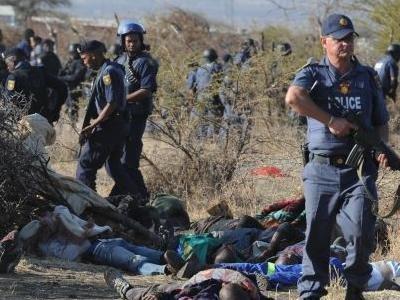
A Black Agenda Radio commentary by Glen Ford | August 22, 2012
When thousands of miners went on strike at South Africa’s largest platinum mine, in Marikana, they were confronting not only the London-based owners, but the South African state, which since 1994 has been dominated by the African National Congress (ANC); COSATU, the Congress of South African Trade Unions; and the South African Communist Party. This week, the full weight of the state was brought down on the Black miners, 34 of whom were massacred by police gunfire. Many of the survivors face charges of murder in the earlier deaths of two policemen and eight other miners.
The National Union of Mineworkers, whose representation the strikers rejected, and the Communist Party head in the region claim the strikers are at fault, that they have committed the sin of choosing an alternative union to argue their case for higher wages and, therefore, deserve severe punishment. They are “anarchists,” say these two allies of the South African state, and guilty of fomenting “dual unionism” – which is now, apparently, a capital crime. With a straight face, the Communist Party had the gall to call on all South African workers to “remain united in the fight against exploitation under capitalism.”
That is precisely what the Marikana miners were doing – the struggle they gave their lives for. However, since the peaceful transition to state power to the ANC and its very junior partners, the COSATU unions and the Communist Party, in 1994, the South African state has had different priorities. The “revolution” was put on indefinite hold, so that a new Black capitalist class could be created, largely from the ranks of well-connected members of the ruling party and even union leaders. It is only logical that, if the priority of the state is to nurture Black capitalists, then it must maintain and defend capitalism. This is the central contradiction of the South African arrangement, and the massacre at Marikana is its inevitable result.
The 1994 agreement between Nelson Mandela’s ANC and the white South African regime was a pact with the devil, which could only be tolerated by the masses of the country’s poor because it was seen as averting a bloodbath, and because it was assumed to be temporary. But, 18 years later, the arrangement has calcified into a bizarre protectorate for foreign white capital and the small class of Blacks that have attached themselves to the global rich. Apologists for the African National Congress regime will prattle on about the “complexity” of the issue, but the central truth is that South Africa did not complete its revolution.
The fundamental contradictions of the rule of the many by the few, remain in place – only now, another layer of repression has been added: a Black aristocracy that has soaked itself in the blood of the miners of Marikana.
South Africa remains the continent’s best hope for a fundamental break with colonialism in its new forms. But, as in all anti-colonial struggles, the biggest casualties will occur in the clash between those who truly desire liberation, and those who are intent on an accommodation with the old master.
BAR executive editor Glen Ford can be contacted at Glen.Ford@BlackAgendaReport.com.
Related articles
- Echoes of the Past: Marikana, Cheap Labour and the 1946 Miners Strike (alethonews.wordpress.com)
- South African miners’ families back Julius Malema’s call for nationalisation (guardian.co.uk)
Egypt requests $4.8bn IMF loan
Al Akhbar | August 22, 2012
Egypt has formally requested a $4.8 billion loan from the International Monetary Fund, a spokesman for its president said on Wednesday during a visit to Cairo by IMF chief Christine Lagarde to discuss support for the country’s ailing economy.
Egypt’s finance minister said last week Cairo would discuss the possibility of the bigger-than-expected loan from the fund. Egypt’s previous government had requested a $3.2 billion package but the deal was not finalized.
Lagarde’s presence was requested by Egypt and could signal a fresh determination on both sides to iron out a loan after President Mohammed Mursi, who took office on June 30, appointed his first government last month.
“We have officially requested a $4.8 billion loan from the IMF and talks are currently going on inside about the request,” spokesman Yasser Ali told Reuters as Lagarde held discussions with Mursi. He said any details would be announced later.
An IMF official also confirmed the request had been made.
During 18 months of political turmoil since the overthrow of autocratic leader Hosni Mubarak, successive Egyptian governments negotiated with the IMF to secure emergency funding.
The Muslim Brotherhood was originally skeptical of the IMF loan, which it feared would undermine Egypt’s sovereignty by keeping it indebted to the IMF.
The IMF has a track record of failed policies in a number of developing countries, including Argentina and a number of African countries.
Sections of Egypt’s political and economic elite fear IMF involvement in resuscitating Egypt’s economy might in fact worsen the situation even further, as previously seen throughout Africa.
But Egypt’s fiscal and balance of payment problems have worsened, prompting the Muslim Brotherhood to surrender its opposition to the deal.
An exodus of foreign investors in the wake of the turmoil left local banks shouldering much of the short-term and other lending to the state. The government has also borrowed directly from the central bank.
Foreign reserves have fallen to well under half levels seen before last year’s popular uprising against Mubarak and investors’ reluctance to return is born partly of fears that a sharp currency devaluation could wipe out any returns.
(Al-Akhbar, Reuters)
Related articles
- IMF chief in Egypt for loan talks (oddonion.com)
- Egypt seeks up to $4.8bln IMF loan (rt.com)
- Qatar loans Egypt $2 billion for struggling economy (bikyamasr.com)
Echoes of the Past: Marikana, Cheap Labour and the 1946 Miners Strike
By Chris Webb | The Bullet | August 21, 2012
On August 4, 1946 over one thousand miners assembled in Market Square in Johannesburg, South Africa. No hall in the town was big enough to hold them, and no one would have rented one to them anyway. The miners were members of the African Mine Worker’s Union (AMWU), a non-European union which was formed five years earlier in order to address the 12 to 1 pay differential between white and black mineworkers. The gathering carried forward just one unanimous resolution: African miners would demand a minimum wage of ten shillings (about 1 Rand) per day. If the Transvaal Chamber of Mines did not meet this demand, all African mine workers would embark on a general strike immediately. Workers mounted the platform one after the other to testify: “When I think of how we left our homes in the reserves, our children naked and starving, we have nothing more to say. Every man must agree to strike on 12 August. It is better to die than go back with empty hands.” The progressive Guardian newspaper reported an old miner getting to his feet and addressing his comrades: “We on the mines are dead men already!”[1]

Mike Constable union-art.com

The massacre of 45 people, including 34 miners, at Marikana in the North West province is an inevitable outcome of a system of production and exploitation that has historically treated human life as cheap and disposable. If there is a central core – a stem in relation to which so many other events are branches – that runs through South African history, it is the demand for cheap labour for South Africa’s mines. “There is no industry of the size and prosperity of this that has managed its cheap labour policy so successfully,” wrote Ruth First in reference to the Chamber of Mines ability to pressure the government for policies that displaced Africans from their land and put them under the boot of mining bosses.[2]
Masters and Servants
Mechanisms such as poll and hut taxes, pass laws, Masters and Servants Acts and grinding rural poverty were all integral in ensuring a cheap and uninterrupted supply of labour for the mines. Pass laws were created in order to forge a society in which farm work or mining were the only viable employment options for the black population. And yet the low wages and dangerous work conditions kept many within the country away, forcing the Chamber of Mines to recruit labour from as far afield as Malawi and China throughout the nineteenth and twentieth centuries. Sordid deals between Portuguese East Africa and Apartheid South Africa ensured forced labour to be recruited for the mines and by 1929 there were 115,000 Mozambicans working underground. “It has been said,” wrote First in her study of migrant Mozambican miners, “that the wealth of Reef gold mines lies not in the richness of the strike but in the low costs of production kept down by cheap labour.”[3]
When AMWU was formed in 1941 black miners earned 70 Rand a year while white workers received 848 Rand. White miners had been organized for many years, but there was little solidarity between the two groups as evidenced by the 1922 Rand Rebellion led by the whites-only Mine Workers Union. White miners went on strike against management’s attempt at weakening the colour bar in order to facilitate the entry of cheaper black labour into skilled positions. Supported by the Communist Party of South Africa under the banner of “Unite and Fight for a White South Africa!” the rebellion was viciously crushed by the state leaving over 200 dead. The growth of non-European unions in the 1940s was dramatic and for the very first time the interests of African mineworkers were on the table. Their demands threatened the very foundations of the cheap labour system, and so in 1944 Prime Minister Jan Smuts tabled the War Measure 1425 preventing a gathering of 20 or more on mine property. Despite these difficulties the union pressed on and in 1946 they approached the Chamber of Mines with their demand for wage increases. A letter calling for last minute negotiations with the Chamber of Mines was, as usual, ignored.
By August 12th tens-of-thousands of black miners were on strike from the East to the West Rand. The state showed the utmost brutality, chasing workers down mineshafts with live ammunition and cracking down on potential sympathy strikes in the city of Johannesburg. By August 16th the state had bludgeoned 100,000 miners back to work and nine lay dead. Throughout the four-day strike hundreds of trade union leaders were arrested, with the central committee of the Communist Party and local ANC leaders arrested and tried for treason and sedition. The violence came on the cusp of the 1948 elections, which would see further repression and the beginning of the country’s anti-communist hysteria.

National Union of Mineworkers Poster on Fortieth Anniversary of 1946 Strike
While it did not succeed in its immediate aims, the strike was a watershed moment in South African politics and would forever change the consciousness of the labour movement. Thirty years later Monty Naicker, one of the leading figures in the South African Indian Congress, argued that the strike “transformed African politics overnight. It spelt the end of the compromising, concession-begging tendencies that dominated African politics. The timid opportunism and begging for favours disappeared.”[4] The Native Representative Council, formed by the state in 1937 to address the age old ‘native question,’ disbanded on August 15th and ANC president Dr. A.B. Xuma reiterated the demand for “recognition of African trade unions and adequate wages for African workers including mineworkers.”[5]
The 1946 mineworkers strike was the spark that ignited the anti-apartheid movement. The ANC Youth League’s 1949 Program of Action owes much to the militancy of these workers as does the Defiance Campaign of the 1950s and the emergence of the ANC’s armed wing Umkhonto we Sizwe (Spear of the Nation) in the 1960s. It is too early to say what sort of impact the current Lonmin strike will have on South African politics, but it seems unlikely that it will be as transformative as those of the past. The National Union of Mineworkers (NUM), arguably the heirs to the 1946 strike are currently engaged in a series of territorial disputes with the breakaway Association of Mineworkers and Construction Union (AMCU). Meanwhile COSATU’s muted response has echoed the ANC’s line of equal-culpability and half-mast public mourning. The increasingly incoherent South African Communist Party has called for the arrest of AMCU leaders with some of its so-called cadres defending the police action. Former ANC Youth League leader Julius Malema’s plea for miners to hold the line and form a more militant union reek of political opportunism.
Still Dependent on Cheap and Flexible Labour
What no one has dared to say, aside from the miners themselves, is that the mining industry remains dependent on cheap and flexible labour, much of it continuing to come from neighbouring countries. This has historically been the source of most miner’s grievances. A recent Bench Marks Foundation study of platinum mines in the North West province uncovered a number of factors linked to rising worker discontent in the region. Lonmin was singled out as a mine with high levels of fatalities, very poor living conditions for workers and unfulfilled community demands for employment. Perhaps most significant is the fact that almost a third of Lonmin’s workforce is employed through third party contractors.[6] This form of employment is not new in the mining industry. In fact, since minerals were discovered in the 19th century labour recruiters have scoured the southern half of the continent for workers. The continued presence of these ‘labour brokers’ on the mines and the ANC’s unwillingness to ban them – opting instead for a system of increasing regulation – is the bloody truth of South Africa’s so-called ‘regulated flexibility.’
There are a number other findings from the Bench Marks study that are worth mentioning as they illuminate some of the real grievances that have been lost amid photos of waving pangas. The number of fatalities at Lonmin has doubled since January 2011, and the company has consistently ignored community calls for employment, favouring contractors and migrant workers. A visit by the Bench Marks Foundation research team to Marikana revealed:
“A proliferation of shacks and informal settlements, the rapid deterioration of formal infra-structure and housing in Marikana itself, and the fact that a section of the township constructed by Lonmin did not have electricity for more than a month during the time of our last visit. At the RDP Township we found broken down drainage systems spilling directly into the river at three different points.”[7]
In fact, the study predicted further violent protests at Marikana in the coming year. The mass dismissal of 9,000 workers in May last year inflamed already tense relations between the community and the mine as dismissed workers lost their homes in the company’s housing scheme.
Once again, these facts are hardly new in the world of South African mining. Behind the squalid settlements that surround the mine shafts there are immense profits to be made. In recent years the platinum mining industry has prospered like no other thanks to the increased popularity of platinum jewellery and the use of the metal in vehicle exhaust systems in the United State and European countries. Production increased by 60 per cent between 1980 and 1994, while the price soared almost fivefold. The value of sales, almost all exported, thus increased to almost 12 per cent of total sales by the mining industry. The price rose so dramatically throughout the 1990s that it is on par with gold as the country’s leading mineral export.[8] South Africa’s platinum industry is the largest in the world and in 2011 reported total revenues of $13.3-billion, which is expected to increase by 15.8% over the next five years. Lonmin itself is one of the largest producers of platinum in the world, and the bulk of its tonnage comes from the Marikana mine. The company recorded revenues of $1.9-billion in 2011, an increase of 25.7%, the majority of which would come from the Marikana shafts.[9]
For risking mutilation and death underground workers at Marikana made only 4000 Rand, or $480 a month. As one miner told South Africa’s Mail and Guardian newspaper that, “It’s better to die than to work for that shit … I am not going to stop striking. We are going to protest until we get what we want. They have said nothing to us. Police can try and kill us but we won’t move.” These expressions of frustration and anger could be from 1922, 1946 or today. They are scathing indictments of an industry that continues to treat its workers as disposable and a state that upholds apartheid’s cheap labour policies.
Endnotes:
1. Monty Naicker, “The African Miners Strike of 1946,” 1976.
2. Ruth First, “The Gold of Migrant Labour,” Spearhead, 1962.
3. Ruth First, “The Gold of Migrant Labour,” Spearhead, 1962.
4. Monty Naicker, “The African Miners Strike of 1946,” 1976.
5. Dr. A.B. Xuma quoted in Monty Naicker, “The African Miners Strike of 1946.”
6. The Bench Marks Foundation, “Communities in the Platinum Minefields,” 2012.
7. The Bench Marks Foundation, “Communities in the Platinum Minefields,” 2012.
8. Charles Feinstein, “An Economic History of South Africa,” Cambridge: Cambridge University Press, 2005, 211.
9. Marketline Advantage Reports on South Africa’s Platinum Group Metals, 2011.
•
Chris Webb is a postgraduate student at York University, Toronto where he is researching labour restructuring in South African agriculture. He can be reached at christopherswebb_AT_yahoo.ca.
Related articles
- Striking South African miners defy Lonmin ultimatum (guardian.co.uk)
- South Africa tells Lonmin to drop threat to sack striking miners (guardian.co.uk)
Tunisia: Al-Nahda’s Failures Lead Sidi Bouzid to Rise Again
By Christopher Barrie | Al Akhbar | August 17, 2012
On Tuesday August 14, the central Tunisian governorate of Sidi Bouzid held a general strike to call for the release of several protesters detained during the demonstrations held over the preceding weeks and to demand concrete plans for development in the region.
Tuesday’s events come after a series of city-wide general strikes which, from the month of May, have swept through Tataouine, Monastir, Kasserine and Kairouan. The recent events in Sidi Bouzid, cradle of the Tunisia’s 2011 revolution, should be considered the culmination of an extended standoff, not only between the al-Nahda-led ruling coalition and Tunisia’s main trade union federation, the UGTT, but also between those in power and those who are yet to see the revolutionary demands of “work, freedom, and national dignity” realized.
Tensions in Sidi Bouzid have been mounting over a period of months. However, the origins of this most recent wave of unrest can be linked to July 26 when a large number of day workers in the region attacked the al-Nahda party offices in protest at a two-month delay in their wages being paid. The Interior Ministry estimated the numbers involved at 150 while union officials claimed more than 1,000 took part.
The response of al-Nahda to these events was typical. Refusing to recognise the genuine demands of the chronically unemployed and disenfranchised in the southern regions of Tunisia, party officials claimed that those demonstrating had been manipulated by rival political parties, seeking to sow instability and dissent for their own ends. The police fired warning shots and tear gas canisters to disperse the protest.
Tensions have been further exacerbated in recent months by ongoing water shortages in the region. Over the past six months, drinking water has commonly only been available in the evenings and has occasionally been cut off for the entire day. Mohamed Najib Mansouri, the governor of Sidi Bouzid, claimed that one of the reasons for these shortages was the failure of residents to pay their bills. It is more likely that the local infrastructure has been unable to sustain the increased consumption of water during an especially hot and dry summer.
On Thursday August 9, a protest was organised by the December 17th Progressive Forces Front in conjunction with the December 17th Committee for the Protection of the Revolution, the UGTT and a number of opposition parties.
As well as demands for a guaranteed supply of water to the region, the protesters’ demands included the settlement of the status of workers, the resignation of the regional commander of the National Guard, the resignation of Governor Mohamed Najib Mansouri and the dissolution of the Constituent Assembly, in view of its failure to respond to the legitimate demands of the residents of Sidi Bouzid.
In response to the protests, police fired tear gas and rubber bullets into the crowds. One man was hospitalised having been struck in the stomach by a rubber bullet and four others were taken to hospital after inhaling tear gas.
Following these events, al-Nahda once again ignored the grievances of those protesting, this time claiming that rival party Nidaa Tunis was behind the protests. Indeed, a spokesperson from the ruling Islamist movement went so far as to claim that Nidaa Tunis, created in June of this year by former interim prime minister Beji Essebsi, represented the political arm of Ben Ali’s defunct Constitutional Democratic Rally (RCD) party and that they had “proof that some figures within the region known to be close to Nidaa Tunis sided with criminals, thieves and alcohol vendors to spread anarchy in Sidi Bouzid”.
Despite President Moncef Marzouki’s efforts to quell the the growing tension in the region, the general strike went ahead on Tuesday with over 1,000 protesters assembling outside the court house.
The events of recent weeks mark a significant development in the mounting levels of anger at the failures of the majority Islamist party. More than the ruling coalition as a whole, it is now al-Nahda which is perceived to be behind the lack of real progress in Tunisia. What’s more, one should not be surprised at the police’s violent handling of these protests. Prime Minister Hamadi Jebali and Interior Minister Ali Larayedh have previously made it clear that they are willing to use force in order to maintain order in the country. Sadok Chourou, a prominent figure within the al-Nahda ranks claimed in January that strikers were “enemies of God” and that they should suffer the same fate as apostates.
It is the protesters themselves who are blamed for the ongoing instability within Tunisia and not the failures of the ruling coalition and, specifically, al-Nahda. And yet, one need only look at actions of the ruling parties in order to see the falsity of such a claim. Negotiations up until now have been dogged by political outbidding and brinkmanship which has severely hindered the transitional process, as seen in al-Nahda’s attempts to prevent the transition to an independent judiciary, its decision to level a sentence of up to two years for attacks on “sacred values” or its recent rewording of the draft constitution to define the status of women as “complementary to men.”
Furthermore, the economic alternatives being proposed will likely do little to alleviate the situation of many in the southern regions of Tunisia which have traditionally suffered from high levels of unemployment and a lack of investment. Relying principally on foreign and private investment, the government aims to to provide 100,000 more jobs in Tunisia and predicts a level of 3.5 percent GDP growth for 2012. The latter of these two predictions seems increasingly unlikely considering that Tunisia has, to date, experienced four consecutive quarters of negative growth. With levels of unemployment at 18.1 percent, the aim to create 100,000 jobs will also do little to abate social unrest in a country which counts over 709,000 (of an active workforce of 3.9 million) unemployed.
With Minister for Investment Riadh Bettaib announcing last Friday that Tunisia can expect to receive a further $1 billion in World Bank loans alongside his continued insistence on boosting foreign direct investment (FDI) and tourism revenues, it is clear that the proposed model for economic development differs very little from the neoliberal agenda of the former regime.
Of course, alongside the social context of these protests, one must also take into account the political dimension of what is occurring. Tuesday’s general strike was called by the UGTT and the protests of the past week have found support among a broad range of opposition political parties, including the centrist Republican Party, al-Watan (The Nation), and several leftist parties, including the Workers’ Party. While it is important not to discount the role played by opposition political forces in these mobilisations, it remains the case that the principal drivers of this spell of popular contestation have been the young and unemployed in the region whose demands, as has commonly been the case, are channeled through the UGTT. Malek Khadraoui, a writer and activist who has been present throughout the latest wave of strikes and protests in Sidi Bouzid, further comments that, while some opposition parties may be seeking to capitalize on recent events, “the youth in the region harbour a deep distrust towards political parties” and the real cause of these events is the inability of the ruling coalition, and particularly al-Nahda, to respond to their demands.
It is difficult to predict where this latest spell of social upheaval is headed. An International Crisis Group report published this June remarked that it would be an exaggeration to “raise the spectre of a second insurrection,” but that the continued political instability within Tunisia alongside sustained levels of socioeconomic insecurity could “negatively feed on each other and risk snowballing into a legitimacy crisis for the newly elected government.”
In the same report, economist Lotfi Bouzaiane comments that one of the principal demands of the revolution was “the right to work.” Prior to the revolution, he says, it was Ben Ali who insisted that “to find work you just had to wait for the economy to grow!”
Following this latest wave of strikes and demonstrations, it is becoming ever more difficult to distinguish between the rhetoric of the former regime and Tunisia’s new ruling coalition, so committed is it to denouncing any expression of popular dissent in the name of national stability and economic growth. In the absence of any real answers to the demands of those in Sidi Bouzid and elsewhere, the government is increasingly having recourse to violent means of repression. It appears that Tunisia’s uncommonly hot summer may precede an even hotter Autumn.
Christopher Barrie is a student and journalist currently working in Tunisia at Nawaat.
Related articles
Top 10 Myths of the Jobs Argument Against Military Cuts
By Miriam Pemberton | IPS | August 14, 2012
Members of Congress, led by the team of Senators McCain, Graham and Ayotte, are touring military contracting plants, bases and defense-dependent communities this summer raising the alarm about “sequestration.” This is the part of the current budget deal that will force $1.2 trillion in across-the-board cuts to federal spending, unless Congress comes up with the same amount of money some other way. Half is supposed to come from the military, half from domestic programs, beginning January 2.
It is true: cutting everything indiscriminately is no way to run a government. But this alarm-raising campaign, buttressed by defense industry spending to buy and promote “independent”studies, and mount lobbying campaigns, is focused not on federal spending in general, but on military cuts in particular. And the centerpiece of their pitch against these cuts is not the standard line that we need to spend ever more on the Pentagon because it needs every penny to keep us safe. Instead the focus is: jobs.
 We’re in the process of ending two wars. Since 9-11, spending on the Pentagon has nearly doubled. Clearly we’re due for a military budget downsizing.
And the urgent need for job creation is on everyone’s mind.
That’s why the military contractors and their congressional allies are departing from the usual script to argue for more military spending. Instead of saying, as usual, that the Pentagon needs every penny to keep us safe, they’re saying it needs every penny to preserve jobs.
From the crowd that wants to shrink government because this will create jobs, we are now hearing that we can’t shrink the Pentagon because that would cost jobs.
Here are main points of their case, rebutted one by one.
Myth # 1: The military cuts will cost a million (or, according to the Pentagon, a million and a half) jobs.
You don’t need to get into the details of the many reasons to question these figures to recognize the big flaw: Cutting military spending will only cost jobs if nothing else is done with the money. As economists from the University of Massachusetts have shown, (findings recently corroborated by economists at the University of Vienna [i]) military spending is an exceptionally poor job creator. Taking those cuts and investing them in other things—clean energy, education, health care, transportation—will all result in a net gain in jobs. Even cutting taxes creates more employment than spending on the military.[ii]
Myth # 2: More Pentagon spending will create more jobs.
A researcher at the Project on Government Oversight recently exposed the shaky foundation of this argument. He found that since 2006 the largest military contractor, Lockheed Martin, has increased its revenues from military contracts, even as it was cutting jobs.[iii]
Myth # 3: Defense sequestration will gut our military industrial base.
Hardly. The Pentagon cuts contained in the budget deal will bring the military budget, adjusted for inflation, to where it was in 2006. Close to its highest level since World War II. More than the next 17 countries (most of them our allies) put together.[iv]
These cuts are easily doable, with no sacrifice in security, because they are being made to a budget that has nearly doubled since 2001.
Myth # 4: The public is buying the myth.
President Obama is actually running an ad criticizing his opponent for advocating military spending increases. The clear pattern in recent polling shows that this is a smart move. Majorities agree military spending is too high.[v]
Myth # 5: The military economy is part of the bedrock of our jobs base.
A researcher at the Project on Defense Alternatives looked at this one. He cited a Congressional Research Service study of aerospace employment. More than 500,000 Americans are employed in aerospace manufacturing. About two-thirds of this is commercial, however. Though the defense industry has worked hard to spread itself around for maximum political effect, more than half (61%) of the nation’s aerospace industry jobs are concentrated in six states.[vi]
By contrast, more than 8 million Americans are employed in education, law enforcement, fire fighting, and other emergency and protective services — working in every community in America.
The effects on the jobs base from cuts on the domestic side of the budget, in other words, will be much larger and more widespread than the effects of military cuts.
Myth # 6: The military economy is part of the bedrock of our overall economic health.
Alan Greenspan, among many others, has contrasted spending on infrastructure, education, and health care with military spending. The former, he noted, strengthens the productivity—the performance—of the economy as a whole; the latter does not.
Military spending is like a family’s insurance policies, he said. The family should spend enough to insure against disaster, but not a penny more, because that family should put as much as possible toward increasing its well-being through education and other enhancements to its quality of life.
Myth # 7: Military workers have already taken their share of the hits.
No. The global outplacement firm Challenger, Gray and Christmas tracks layoffs month by month. For the past three years, while military spending has absorbed more than half of the discretionary budget (the part Congress votes on every year), the private sector contractors it supports have absorbed an average of only 4% of the nation’s job loss. See this spreadsheet (docx).
During those three years, the defense industry laid off a total of 106,000 workers. During the same period, state and local governments laid off more than 500,000 workers.
Myth # 8: The political campaign against sequestration is consistent with the dominant economic philosophy of the politicians doing the campaigning.
No again. The free marketeers who think shrinking government will create jobs are preaching that the Pentagon budget can’t be shrunk because this will cost jobs.
Congressman Barney Frank has summed up nicely what they are asking us to believe: “that the government does not create jobs when it funds the building of bridges or important research or retrains workers, but when it builds airplanes that are never going to be used in combat, that is of course economic salvation.”
Myth # 9: The contractors have their workers’ interests at heart.
If they did, they might narrow the gap a bit between the CEO’s and the average worker’s salary. For Lockheed Martin (CEO: $25 million[vii]; average worker: $58,000[viii]) this gap is more than 400 to 1.
Myth # 10: Sequestration will force contractors to warn most of their workers of an impending layoff.
Lockheed is threatening to send these notices a few days before the November election. The argument for this bit of political blackmail is that since the cuts aren’t specified, all workers are at risk. While Lockheed claims these notices are required by law, the Labor Department, i.e. the controlling legal authority, says they are not.
In fact, as researchers from Win Without War and the Center for International Policy recently pointed out,[ix] the defense and aerospace industry is sitting on a pile of cash from yet another year of record revenue and profits in 2011.[x] Lockheed alone has $81 billion in backlogged orders, and more coming in.[xi] They have it a lot better than most companies.
And this cushion gives them time to plan for the downsizing, and keep the workers they profess to care about employed, by developing new work in other areas. See Fact Sheet: Replacing Defense Industry Jobs for some ideas on how.
Footnotes
[i] https://www.dropbox.com/s/6s4ix8muj2kmhhx/a%20non%20linear%20defense%20growth%20nexus.pdf
[ii] http://www.peri.umass.edu/236/hash/0b0ce6af7ff999b11745825d80aca0b8/publication/489/
[vi] “US Aerospace Manufacturing: Industry Overview and Prospects,” Congressional Research Service, December 3, 2009. http://www.fas.org/sgp/crs/misc/R40967.pdf.
[viii] http://www.peri.umass.edu/236/hash/0b0ce6af7ff999b11745825d80aca0b8/publication/489/
[ix] http://www.huffingtonpost.com/william-hartung/lockheed-martin_b_1625183.html
[x] http://www.pwc.com/en_US/us/industrial-products/assets/pwc-aerospace-defense-review-and-forecast.pdf
[xi] http://online.wsj.com/article/BT-CO-20120620-709424.html
Related articles
- Poll: 76% of Americans favor cutting military spending (alethonews.wordpress.com)
- Ryan vs. Romney on Pentagon Spending (cato-at-liberty.org)
- McCain Can’t Explain Why Military Spending Cuts Would Be ‘Devastating’ (thinkprogress.org)
- House Republican Calls Warnings On Military Spending Cuts ‘A Hysteria Parade’ (thinkprogress.org)
- Romney Campaign Can’t Explain How He Would Boost Military Spending To $945 Billion And Cut The Deficit (thinkprogress.org)
- Guess What % of Americans Know Military Spending Is Increasing (my.firedoglake.com)
- CATO Study: Reshaping the Pentagon Budget Won’t Negatively Impact on the Economy (pogoblog.typepad.com)
Featured Video

10K More U.S. Troops Deploy as Trump Weighs New Iran Strikes
or go to
Aletho News Archives – Video-Images
From the Archives
Genetic baloney in thick slices
MAYBE COULD BE INC.
By Jon Rappoport | No More Fake News | July 8, 2021
Gene research companies tend to come and go. They start out banging and popping like fireworks in the sky, and then they fade out—selling themselves to larger outfits who’ve hired better liars…
Once upon a time, it sounded easy. Start with a disease, find the gene responsible for the disease, and correct the problem.
Then, researchers wondered, was disease the result of one gene or a group of genes acting together?
Either way, the proof would be in devising cures for diseases using gene therapy. “Not yet, but soon…”
And regardless, the major need was: money. Lots and lots of money.
This need required good PR people. “We have to pump up the idea that we’re on the edge of tremendous breakthroughs. We’re always on that edge…”
This hype also needed to obscure the fact that there wasn’t (and isn’t) ANY gene cure for ANY disease. … continue
Blog Roll
 Aletho News
- UK Government Body Kept Files on People Criticizing Prevent Program
- US military withdrawal from Iraq and the collapse of US-Israeli hegemonic project in West Asia
- What does Europe want – a war with Russia?
- She Followed the Actual Data on COVID Vaccines and Masks — Her Career Took a Huge Hit
- Florida AG Sues Pfizer, Bourla Over Deceptive Marketing of COVID Vaccines
- Von der Leyen gifts her spin doctor a job for life
- 10K More U.S. Troops Deploy as Trump Weighs New Iran Strikes /Suliaman Ahmed
- Iranian crew declared Dena training vessel ‘unarmed’ to US warship before deadly torpedo strike: Report
- Iran’s NPT debate moves beyond parliament
- Houthis condemn Saudi claims of attack on Medina
- If Americans Knew
- Israel is squeezing the life out of Palestinians – Daily Update
- The Israeli Right Portrays Islam as Murderous. It Serves a Political Purpose
- Jordan Has Had Enough: King Abdullah’s Scathing Warning to Israel
- Israeli Colonizers (i.e. Settlers) Kill Palestinian Man Near Salfit
- New Google Maps images reveal massive scale of devastation in Gaza
- Jewish supremacy, anti-Palestinian bigotry on display in Israel – Daily Update
- Israeli Soldiers Abduct At Least 22 Across Occupied West Bank
- Eight Palestinians Killed in Israeli Attacks on Gaza
- Israeli former leaders and security chiefs threaten legal action over ‘Jewish terrorism’
- Israel map in LA Times ad includes all land from the river to the sea
- No Tricks Zone
- Green Energy Debacle: German Expert Professor Fritz Vahrenholt Warns Of Severe Economic And Social Consequences
- Two More Paleo Reconstructions Affirm Meters-Higher Sea Levels Across Ireland, Brazil 7000-6000 Years Ago
- New Study: Earth And Venus Surface Warmth Largely Explained By Convection And Lapse Rate, Not CO2 Or Radiation
- 2025 Nature Paper Claiming Worsening Global Drought Gets RETRACTED …Heavily Flawed
- New Study: ‘Global Drought Shows No Detectable Recent Acceleration Under Climate Warming’
- Economic Masterminds: German Socialists Suggest Taxing Productivity Gains Stemming From Using AI
- The South China Sea Has Not Been Cooperating With The Climate Change Narrative
- Energy Crisis: Germany Enters Heating Season With Historically Low Gas Reserve Fill Levels
- New Study: The Antarctic Ice Sheet Gained Mass From 2020-2024 Due To Staggering Snow And Ice Accumulation
- Study: Ocean Heating Rates From Thousands Of Years Ago ‘Dwarf’ Modern Ocean Heating Rates

