GREEK PARLIAMENT MAY REJECT EU/IMF AUSTERITY MEASURES
Historic vote on Wednesday, euro hangs by a thread
By Jane Burgermeister | June 27, 2011
*Greek Prime Minister’s majority cut to one ahead of crucial IMF and EU austerity vote in parliament on Wednesday
*Rejection of austerity package will lead to a default by Greece and eurozone exit
*Greece is set to spend 131 billion euros on interest payments to banks between 2009 and 2014 according to IMF
*Germany’s Die Welt says Germans would rise up in rebellion if they had to accept equivalent austerity measures
*Protests and strikes intensify in Athens ahead of historical vote on Wednesday that could spell the end of the euro currency
Four Greek lawmakers from the ruling PASOK party have indicated they will vote against the new EU and IMF austerity package in parliament on Wednesday. If the Greek parliament votes against the legislation, it would pave the way for Greece to default on its debt to foreign banks and exit the eurozone in an historic victory for democracy.
http://www.ekathimerini.com/4dcgi/_w_articles_wsite1_4_26/06/2011_396030
Greece is set to pay a staggering €131bn in refinancing and interest payments to American, German and French banks between 2009 and 2014 , the IMF has estimated.
Prime Minister George Papandreou’s socialist PASOK party has a slim majority of only 155 deputies in the 300-member parliament. The defections of any more lawmakers may mean the government not be able to pass the new austerity measures and an implementation law on Wednesday and Thursday, which the EU, IMF and ECB are insisting on to enable the next interest payments to be made to banks on time.
The main opposition leader, Antonis Samaras, has said the austerity measures are a “medicine that is worse than the sickness they are meant to cure” and that he will not vote for them.
The draconian package of latest tax hikes and budget cuts include measures forcing people earning as little as 8000 euros a year to pay 10% in taxes to help the government meet the multi-billion euro interest payments to banks while universities close due to funding cuts.
“Crucially, bailout funds are not used to pay civil servants’ salaries and pensions, but to pay off debt held by German and French banks. According to IMF estimates, Greece will pay €131bn in refinancing and interest payments between 2009 and 2014, far more than the initial bailout loan of €110bn,” reports The Guardian.
The new austerity package is so harsh that if it were implemented in Germany, the people would rebell, Germany’s Die Welt newspaper admitted. The new Greek austerity measures would be the equivalent of German government cutting 117 billion euros from the budget and selling assets worth 555 billion worth of euros, estimated Die Welt.
http://www.welt.de/wirtschaft/article13451154/Wenn-Berlin-so-sparen-muesste-wie-Griechenland.html
Even the Greek Finance Minister Evangelos Venizelos said over the weekend that the measures were “hard and unfair.”
The austerity measures would drain the economy of the last of its liquidity and bust those businesses that are still solvent. Andrew Lilico points out that the Greek money supply has been falling at about 10 per cent a year.
The new IMF, EU, ECB austerity package comes on top of cuts that resulted in shrinkage in the economy and an increase in the country’s mountain of debt. Greece’s debt is set to rise to 170% of the GDP next year.
A 48-hour general strike is to be held in Athens tomorrow and Wednesday against the privatisations and austerity package.
Protesters outside the parliament in Syntagma Square, have said that they will block lawmakers from entering the building and voting on the austerity measures.
Greek lawmakers began debating the new austerity plans today.
If Greece does not pass the package, it will not receive a 12 billion euro installment of loans from its international bailout plan to make payments to banks in the USA, Germany and France forcing it into a disorderly default.
A recommendation by German economists to introduce an insolvency mechanism for the eurozone in autumn 2010 was buried by the German government.
The threat of a disorderly default and financial disaster is being used by banks and eurozone officials to pressure the Greeks to accept the transfer of wealth to the banks and acceopt the loss of their sovereignty.
A disorderly default would, however, pave the way for a rapid recovery of Greece’s economy outside the eurozone.
Papandreou faced down a rebellion by lawmakers this month after making a cabinet reshuffle and changing his finance minister, but the protests by people are continuing to put pressure on parliamentarians.
Even Überbankster George Soros — who has held regular private meetings with Papandreou and who called on eurozone governments and continue to loot the tax payers to save the banks in an article in the Financial Times — was forced to admit at a discussion yesterday in Vienna that the collapse of the euro currency is likely.
The euro collapse will spell the end of the bankster’s financial eurozone empire and ambitions to loot the assets and taxes of the 400 million people under the pretext of having to pay the debts of governments and banks that are actually insolvent and should have been put through insolvency mechanism long ago.
Spanish protesters begin longest march yet
Press TV – June 25, 2011
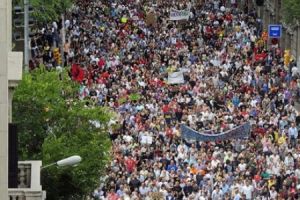 Anti-government protests in Barcelona, Spain on June 19, 2011
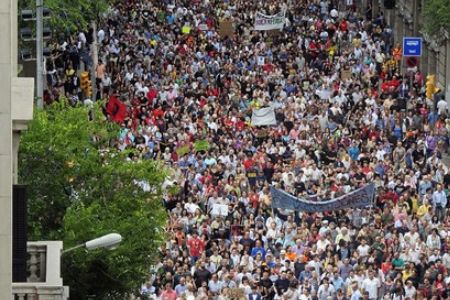
Spanish protesters have set off from Barcelona, marching toward the capital, Madrid, on their last and longest march against unemployment, welfare cuts and corruption.
The protesters, who currently number around 50, plan to campaign in every midway city to gather support for the Madrid rally, which is expected to take place on July 24, AFP reported.
The country has witnessed non-stop anti-government demonstrations since May 15.
“First we took to the streets, then the squares, and now the highways,” said Rafael de la Rubia, international coordinator of the movement World without War, who is among the demonstrators.
“After that, we will take Europe,” he asserted.
Spain is struggling to recover from nearly two years of recession triggered for the most part by the collapse of an overheated real estate sector.
The country’s unemployment rate has reportedly surpassed 21 percent in the first quarter of the year — the highest rate recorded for joblessness in the industrialized world.
Currently, some nine million people suffer from poverty across the country.
Last month, Amnesty International warned that hundreds of thousands of families in Spain are at the risk of losing their homes.
Protests are expected to continue as the Bank of Spain says the crippled economy will likely keep the recovery rate slow and the jobless figure will likely remain high for the foreseeable future.
Bankers Gear Up for the Rape of Greece, as Social Democrats Vote for National Suicide
Only a Referendum of the People Can Stop Them Now
By MICHAEL HUDSON | CounterPunch | June 24, 2011
The fight for Europe’s future is being waged in Athens and other Greek cities to resist financial demands that are the 21st century’s version of an outright military attack. The threat of bank overlordship is not the kind of economy-killing policy that affords opportunities for heroism in armed battle, to be sure. Destructive financial policies are more like an exercise in the banality of evil – in this case, the pro-creditor assumptions of the European Central Bank (ECB), EU and IMF (egged on by the U.S. Treasury).
As Vladimir Putin pointed out some years ago, the neoliberal reforms put in Boris Yeltsin’s hands by the Harvard Boys in the 1990s caused Russia to suffer lower birth rates, shortening life spans and emigration – the greatest loss in population growth since World War II. Capital flight is another consequence of financial austerity. The ECB’s proposed “solution” to Greece’s debt problem is thus self-defeating. It only buys time for the ECB to take on yet more Greek government debt, leaving all EU taxpayers to get the bill. It is to avoid this shift of bank losses onto taxpayers that Angela Merkel in Germany has insisted that private bondholders must absorb some of the loss resulting from their bad investments.
The bankers are trying to get a windfall by using the debt hammer to achieve what warfare did in times past. They are demanding privatization of public assets (on credit, with tax deductibility for interest so as to leave more cash flow to pay the bankers). This transfer of land, public utilities and interest as financial booty and tribute to creditor economies is what makes financial austerity like war in its effect.
Socrates said that ignorance must be the root of all evil, because no one deliberately sets out to be bad. But the economic “medicine” of driving debtors into poverty and forcing the selloff of their public domain has become socially accepted wisdom taught in today’s business schools. One would think that after fifty years of austerity programs and privatization selloffs to pay bad debts, the world has learned enough about causes and consequences.
The banking profession deliberately chooses to be ignorant. “Good accepted practice” is bolstered by Nobel Economics Prizes to provide a cloak of plausible deniability when markets “unexpectedly” are hollowed out and new investment slows as a result of financially bleeding economies, medieval-style while wealth is siphoned up to the top of the economic pyramid.
My friend David Kelley likes to cite Molly Ivins’ quip: “It’s hard to convince people that you are killing them for their own good.” The EU’s attempt to do this didn’t succeed in Iceland. And like the Icelanders, the Greek protesters have had their fill of neoliberal-learned ignorance that austerity, unemployment and shrinking markets are the path to prosperity, not deeper poverty. So we must ask what motivates central banks to promote tunnel-visioned managers who follow the orders and logic of a system that imposes needless suffering and waste – all to pursue the banal obsession that banks must not lose money?
One must conclude that the EU’s new central planners (isn’t that what Hayek said was the Road to Serfdom?) are acting as class warriors by demanding that all losses are to be suffered by economies imposing debt deflation and permitting creditors to grab assets. As if this won’t make the problem worse. This ECB hard line is backed by U.S. Treasury Secretary Geithner, evidently so that U.S. institutions not lose their bets on derivative plays they have written up.
This is a repeat of Geithner’s intervention to prevent Irish debt alleviation. The result is that we enter absurdist territory when the ECB and Treasury insist on “voluntary renegotiation” on the ground that some bank may have taken an AIG-type gamble in offering default insurance or bets that would make it lose so much money that yet another bailout would be necessary. It is as if financial gambling is economically necessary, not part of Las Vegas.
Why should this matter a drachma to the Greeks? It is an intra-European bank regulatory problem. Yet to sidestep it, the ECB is telling Greece to sell off its water and sewer rights, ports, islands and other infrastructure.
This veers on financial theater of the absurd. Of course some special interest always benefits from systemic absurdity, banal as it may be. Financial markets already have priced in the expectation that Greece will default in the end. It is only a question of when. Banks are using the time to take as much as they can and pass the losses onto the ECB, EU and IMF – “public” institutions that have more leverage than private creditors. So bankers become the sponsors of absurdity – and of the junk economics spouted so unthinkingly by the enforcers, cheerleaders for the banality of evil. It doesn’t really matter if their names are Trichet, Geithner or Papandreou. They are just kindred lumps on the vampire squid of creditor claims.
The Greek crowds demonstrating before Parliament in Syntagma Square are providing their counterpart to the “Arab spring.” But what really can they do, short of violence – as long as the police and military side with the government that itself is siding with foreign creditors?
The most effective tactic is to demand a national referendum on whether to accept the ECB’s terms for austerity, tax increases, public spending cutbacks and selloffs. This is how Iceland’s president stopped his country’s Social Democratic leadership from committing the economy to ruinous (and legally unnecessary) payments to Gordon Brown’s Labour Party demands and those of the Dutch for the Icesave and even the Kaupthing bailouts.
The only legal basis for demanding payment of the EU’s bailout of French and German banks – and U.S. Treasury Secretary Tim Geithner’s demand that debts be sacrosanct, not the lives of citizens – is public acceptance and acquiescence in such policy. Otherwise the imposition of debt may be treated simply as an act of financial warfare.
National economies have the right to defend themselves against such aggression. The crowd’s leaders can insist that in the absence of a referendum, they intend to elect a political slate committed to outright debt annulment. International law prohibits nations from treating their own nationals differently from foreigners, so all debts in specified categories would have to be annulled to create a Clean Slate. (The German Monetary Reform of 1947 imposed by the Allied Powers was the most successful Clean Slate in modern times. Freeing the German economy from debt [including reparations to Greece for the havoc of WW2, Editors] it became the basis of that nation’s economic miracle.)
This is not the first such proposal for Greece. Toward the end of the 3rd century BC, Sparta’s kings Agis and Cleomenes urged a debt cancellation, as did Nabis after them. Plutarch tells the story, and also explains the tragic flaw of this policy. Absentee owners who had borrowed to buy real estate backed the debt cancellation, gaining an enormous windfall.
This would be much more the case today than in times past, now that the great bulk of debt is mortgage debt. Imagine what a debt cancellation would do for the Donald Trumps of the economy – having acquired property on credit with minimum equity investment of their own, suddenly owing nothing to the banks! The aim of financial-fiscal reform should be to free the economy from financial overhead that is technologically unnecessary. To avoid giving a free lunch to absentee owners, a debt cancellation would have to go hand in hand with an economic rent tax. The public sector would receive the land’s rental value as its fiscal base.
This happens to have been the basic aim of 19th-century free market economists: tax land and nature – and natural monopolies – rather than taxing labor and capital goods. The aim was to keep for the public what nature and public infrastructure spending create. A century ago it was believed that monopolies such as the privatizers now set their eyes should be operated by the public sector; or, if left in public hands, their prices would be regulated to keep them in line with actual costs of production. Where private owners already have taken possession of land, mines or monopolies, the rental revenue from such ownership privileges would be fully taxed. This would include the financial privilege that banks enjoy in credit creation.
The way to lower costs is to lower “bad” taxes that add to the price of production, headed by taxes on labor and capital, sales taxes and value-added taxes. By contrast, rent taxes collect the economy’s “free lunch,” and thus leave less available to be pledged to banks to capitalize into debt service on higher loans. Shifting the Greek tax burden off labor onto property would reduce the supply price of labor, and also reduce the price of housing that is being bid up by bank credit.
A land tax shift was the primary reform proposal from the 18th and 19th century, from the Physiocrats and Adam Smith down through John Stuart Mill and America’s Progressive Era reformers. The aim was to free markets from the landed aristocracy’s hereditary rents stemming from the medieval Viking conquest. This would free economies from feudalism, bringing prices in line with socially necessary costs of production.
Every government has the right to levy taxes, as long as they do it uniformly to domestic property owners as well as to foreign owners. Short of re-nationalizing the land and infrastructure, fully taxing its economic rent (access payments for sites whose value is created by nature or by public improvements) would take back for the Greek authorities what creditors are trying to grab.
This classical threat of 19th century reformers is the response that the Greeks can make to the European Central Bank. They can remind the rest of the world that it was, after all, the ideal of free markets as expressed from Adam Smith through John Stuart Mill in England, and underlay U.S. public spending, regulatory agencies and tax policy during its period of take-off.
How strange (and sad) it is that Greece’s own ruling Socialist Party, whose leader heads the Second International, has rejected this centuries-old reform program. It is not Communism. It is not even inherently revolutionary, or at least was not at the time it was formulated. It is socialism of the reformist type that two centuries of classical political economy culminated in.
But it is the kind of free markets against which the ECB is fighting – backed by Treasury Secretary Geithner’s shrill exhortations from the United States. Obama says nothing, leaving it all to Wall Street bureaucrats to set national economic policy. Is this evil? Or is it just passive and indifferent? Does it make much of a difference as far as the end result is concerned?
To sum up, the aims of foreign financial aggression are the same as military conquest: land and the public domain. But nations have the right to tax their rental yield over and above a return to capital investment. Contrary to EU demands for “internal devaluation” (wage cuts) as a means of lowering the price of Greek labor to make it more competitive, reducing living standards is not the way to go. That reduces labor productivity while eroding the internal market, leading to a deteriorating spiral of economic shrinkage.
The need for a popular referendum
Every government has the right and indeed the political obligation to protect its prosperity and livelihood so as to keep its population at home rather than drive them abroad or drive them into a position of financial dependency on rentiers. At the heart of economic democracy is the principle that no sovereign nation is committed to relinquish its public domain or its taxing, and hence its economic prosperity and future livelihood, to foreigners or for that matter to a domestic financial class. This is why Iceland voted “No” in the debt referendum. Its economy is recovering.
Ireland voted “Yes” and now faces a new Great Emigration to rival that which followed the poverty and starvation driven emigrations of the mid-19th century. If Greece does not draw a line here, it will be a victory for financial and fiscal aggression imposing debt peonage.
Finance has become the 21st century’s preferred mode of warfare. Its aim is to appropriate the land and public infrastructure for its own power elites. Achieving this end financially, by imposing debt peonage on subject populations, avoids the sacrifice of life by the aggressor power – but only as long as subject debtor countries accept their burden voluntarily. If there is no referendum, the national economy cannot be held liable to pay the debts owed even to “senior” creditors: the IMF and ECB. Assets that are privatized at foreign bank insistence can be renationalized. And just as nations under military attack can sue, so Greece can sue for the devastation caused by austerity – the lost employment, lost output, lost population, capital flight.
The Greek economy will not end up with the proceeds of any ECB “bailout.” The banks will get the money. They would like to turn around and lend it out afresh to the buyers of the land, monopolies and other properties that Greece is being told to privatize. The user fees they collect (no doubt raising charges in the process, to cover the interest and pay themselves the usual salary jumps on privatized property) will be paid out as interest. Is this not like military tribute?
Margaret Thatcher used to say “There is no alternative.” But of course there is. Greece can simply opt out of this giveaway of assets and economic privilege to creditors.
What do Papandreou’s Socialist International colleagues have to say about current events in Greece? I suppose it is clear that the old Socialist International is dead, given the fact that Papandreou is its head, after all. What passes for socialism today is the diametric opposite of the reforms promoted under its name a century ago, in the era prior to World War I. Europe’s Social Democratic and Labour parties today have led the way in privatization, financializing their economies under conditions that have blocked the growth in living standards. The result promises to be an international political realignment.
Economic austerity cannot secure creditor claims in the end
On Thursday afternoon the Dow, having been down 230 points, leapt up at the close to lose “only” 60 points, on rumors that Greece had agreed to the IMF’s austerity plan. But what is “Greece”? Is it the cabinet alone? Certainly not yet the entire Parliament. Will there be a Parliamentary vote in opposition to the public interest, accepting austerity and privatization?
Only a referendum can commit the Greek government to repay new debts imposed under austerity. Only a referendum can prevent property that is privatized from being re-nationalized. Such a transfer is not legitimate under commonly accepted ideas of political and economic democracy. And in any event, a rent-tax can recapture for the Greek economy what the financial aggressors are trying to seize.
History is rife with instructive examples. Local oligarchies in the region invited Rome to attack Sparta, and it overthrew the kings and their successor Nabis (who may himself have been royal). The sequel is that Rome headed an oligarchic empire, using violence at home to murder democratic reformers such as the Gracchi brothers after 133 BC, plunging the republic into a century of civil war. The creditor interests ended up fully in control, and their own banal self-seeking plunged the Western half of the Roman Empire into an economic and social Dark Age.
Let’s hope the outcome is better this time around. There will indeed be fighting, but more in the financial and fiscal sphere than the overtly military one. The fight ultimately can be won only by understanding the corrosive dynamics of the “magic of compound interest” and the social need to subordinate creditor interests to those of the overall “real” economy. But to achieve this, economic theory itself needs to be brought out of its current post-classical “neoliberal” banality.
~
Michael Hudson is a former Wall Street economist. A Distinguished Research Professor at University of Missouri, Kansas City (UMKC), he is the author of many books, including Super Imperialism: The Economic Strategy of American Empire (new ed., Pluto Press, 2002) and Trade, Development and Foreign Debt: A History of Theories of Polarization v. Convergence in the World Economy. He can be reached via his website, mh@michael-hudson.com
Why Regime Change in Libya?
By ISMAEL HOSSEIN-ZADEH | CounterPunch | June 17, 2011
In light of the brutal death and destruction wrought on Libya by the relentless US/NATO bombardment, the professed claims of “humanitarian concerns” as grounds for intervention can readily be dismissed as a blatantly specious imperialist ploy in pursuit of “regime change” in that country.
There is undeniable evidence that contrary to the spontaneous, unarmed and peaceful protest demonstrations in Egypt, Tunisia and Bahrain, the rebellion in Libya has been nurtured, armed and orchestrated largely from abroad, in collaboration with expat opposition groups and their local allies at home. Indeed, evidence shows that plans of “regime change” in Libya were drawn long before the insurgency actually started in Benghazi; it has all the hallmarks of a well-orchestrated civil war [1].
It is very tempting to seek the answer to the question “why regime change in Libya?” in oil/energy. While oil is undoubtedly a concern, it falls short of a satisfactory explanation because major Western oil companies were already extensively involved in the Libyan oil industry. Indeed, since Gaddafi relented to the US-UK pressure in 1993 and established “normal” economic and diplomatic relations with these and other Western countries, major US and European oil companies struck quite lucrative deals with the National Oil Corporation of Libya.
So, the answer to the question “why the imperialist powers want to do away with Gaddafi” has to go beyond oil, or the laughable “humanitarian concerns.” Perhaps the question can be answered best in the light of the following questions: why do these imperialist powers also want to overthrow Hugo Cavez of Venezuela, Fidel Castro (and/or his successors) of Cuba, Mahmoud Ahmadinejad of Iran, Rafael Correa Delgado of Ecuador, Kim Jong-il of North Korea, Bashar Al-assad of Syria and Evo Morales of Bolivia? Or, why did they overthrow Mohammad Mossadeq of Iran, Jacobo Arbenz of Guatemala, Kusno Sukarno of Indonesia, Salvador Allende of Chile, Sandinistas in Nicaragua, Jean-Bertrand Aristide in Haiti and Manuel Zelaya in Honduras?
What does Gaddafi have in common with these nationalist/populist leaders? The question is of course rhetorical and the answer is obvious: like them Gaddafi is guilty of insubordination to the proverbial godfather of the world: US imperialism, and its allies. Like them, he has committed the cardinal sin of challenging the unbridled reign of global capital, of not following the economic “guidelines” of the captains of global finance, that is, of the International Monetary Fund, the World Bank and World Trade Organization; as well as of refusing to join US military alliances in the region. Also like other nationalist/populist leaders, he advocates social safety net (or welfare state) programs—not for giant corporations, as is the case in imperialist countries, but for the people in need.
This means that the criminal agenda of Messrs Obama, Cameron, Sarkozy, and their complicit allies to overthrow or kill Mr. Gaddafi and other “insubordinate” proponents of welfare state programs abroad is essentially part of the same evil agenda of dismantling such programs at home. While the form, the context and the means of destruction may be different, the thrusts of the relentless attacks on the living standards of the Libyan, Iranian, Venezuelan or Cuban peoples are essentially the same as the equally brutal attacks on the living conditions of the poor and working people in the US, UK, France and other degenerate capitalist countries. In a subtle (but unmistakable) way they are all part of an ongoing unilateral class warfare on a global scale—whether they are carried out by military means and bombardments, or through the apparently “non-violent” processes of judicial or legislative means does not make a substantial difference as far as the nature or the thrust of the attack on people’s lives or livelihoods are concerned.
In their efforts to consolidate the reign of big capital worldwide, captains of global finance use a variety of methods. The preferred method is usually non-military, that is, the neoliberal strategies of Structural Adjustment Programs (SAPs), carried out by representatives of big business disguised as elected officials, or by the multilateral institutions such as the IMF and the WTO. This is what is currently happening in the debt- and deficit-ridden economies of the United States and Europe. But if a country like Libya (or Venezuela or Iran or Cuba) does not go along with the neoliberal agenda of “structural adjustments,” of outsourcing and privatization, and of allowing their financial system to be tied to the network of global banking cartel, then the military option is embarked upon to carry out the neoliberal agenda.
The powerful interests of global capitalism do not seem to feel comfortable to dismantle New Deal economics, Social Democratic reforms and welfare state programs in the core capitalist countries while people in smaller, less-developed countries such as Libya, Venezuela or Cuba enjoy strong, state-sponsored social safety net programs such as free or heavily-subsidized education and health care benefits. Indeed, guardians of the worldwide market mechanism have always been intolerant of any “undue” government intervention in the economic affairs of any country in the world. “Regimented economies,” declared President Harry Truman in a speech at Baylor University (1947), were the enemy of free enterprise, and “unless we act, and act decisively,” he claimed those regimented economies would become “the pattern of the next century.” To fend off that danger, Truman urged that “the whole world should adopt the American system.” The system of free enterprise, he went on, “can survive in America only if it becomes a world system” [2].
Before it was devastated by the imperialist-orchestrated civil war and destruction, Libya had the highest living standard in Africa. Using United Nations statistics, Jean-Paul Pougala of Dissident Voice reports,
“The country now ranks 53rd on the HDI [Human Development Index] index, better than all other African countries and also better than the richer and Western-backed Saudi Arabia. . . . Although the media often refers to youth unemployment of 15 to 30 percent, it does not mention that in Libya, in contrast to other countries, all have their subsistence guaranteed. . . . The government provides all citizens with free health care and [has] achieved high coverage in the most basic health areas. . . . The life expectancy rose to 74.5 years and is now the highest in Africa. . . . The infant mortality rate declined to 17 deaths per 1,000 births and is not nearly as high as in Algeria (41) and also lower than in Saudi Arabia (21).
“The UNDP [United Nations Development Program] certified that Libya has also made ‘a significant progress in gender equality,’ particularly in the fields of education and health, while there is still much to do regarding representation in politics and the economy. With a relative low ‘index of gender inequality’ the UNDP places the country in the Human Development Report 2010 concerning gender equality at rank 52 and thus also well ahead of Egypt (ranked 108), Algeria (70), Tunisia (56), Saudi Arabia (ranked 128) and Qatar (94)” [3].
It is true that after resisting the self-centered demands and onerous pressures from Western powers for more than thirty years, Gaddafi relented in 1993 and opened the Libyan economy to Western capital, carried out a number of neoliberal economic reforms, and granted lucrative business/investment deals to major oil companies of the West.
But, again, like the proverbial godfather, US/European imperialism requires total, unconditional subordination; half-hearted, grudging compliance with the global agenda of imperialism is not enough. To be considered a real “ally,” or a true “client state,” a country has to grant the US the right to “guide” its economic, geopolitical and foreign policies, that is, to essentially forgo its national sovereignty. Despite some economic concessions since the early 1990s, Gaddafi failed this critical test of “full compliance” with the imperialist designs in the region.
For example, he resisted joining a US/NATO-sponsored military alliance in the region. Libya (along with Syria) are the only two Mediterranean nations and the sole remaining Arab states that are not subordinated to U.S. and NATO designs for control of the Mediterranean Sea Basin and the Middle East. Nor has Libya (or Syria) participated in NATO’s almost ten-year-old Operation Active Endeavor naval patrols and exercises in the Mediterranean Sea and neither is a member of NATO’s Mediterranean Dialogue military partnership which includes most regional countries: Israel, Jordan, Egypt, Tunisia, Algeria, Morocco and Mauritania [4].
To the chagrin of US imperialism, Libya’s Gaddafi also refused to join the U.S. Africa Command (AFRICOM), designed to control valuable resources in Africa, safeguard trade and investment markets in the region, and contain or evict China from North Africa. “When the US formed AFRICOM in 2007, some 49 countries signed on to the US military charter for Africa but one country refused: Libya. Such a treacherous act by Libya’s leader Moummar Qaddafi would only sow the seeds for a future conflict down the road in 2011” [5].
Furthermore, by promoting trade, development and industrialization projects on a local, national, regional or African level, Gaddafi was viewed as an obstacle to the Western powers’ strategies of unhindered trade and development projects on a global level. For example, Gaddafi’s Libya played a leading role in “connecting the entire [African] continent by telephone, television, radio broadcasting and several other technological applications such as telemedicine and distance teaching. And thanks to the WMAX radio bridge, a low cost connection was made available across the continent, including in rural areas” [3].
The idea of launching a pan-African system of technologically advanced network of telecommunication began in the early 1990s, “when 45 African nations established RASCOM (Regional African Satellite Communication Organization) so that Africa would have its own satellite and slash communication costs in the continent. This was a time when phone calls to and from Africa were the most expensive in the world because of the annual $500 million fee pocketed by Europe for the use of its satellites like Intelsat for phone conversations, including those within the same country. . . . An African satellite only cost a onetime payment of $400 million and the continent no longer had to pay a $500 million annual lease” [3].
In pursuit of financing this project, the African nations frequently pleaded with the IMF and the World Bank for assistance.
As the empty promises of these financial giants dragged on for 14 years, “Gaddafi put an end to [the] futile pleas to the western ‘benefactors’ with their exorbitant interest rates. The Libyan guide put $300 million on the table; the African Development Bank added $50 million more and the West African Development Bank a further $27 million – and that’s how Africa got its first communications satellite on 26 December 2007.
“China and Russia followed suit and shared their technology and helped launch satellites for South Africa, Nigeria, Angola, Algeria and a second African satellite was launched in July 2010. The first totally indigenously built satellite and manufactured on African soil, in Algeria, is set for 2020. This satellite is aimed at competing with the best in the world, but at ten times less the cost, a real challenge.
“This is how a symbolic gesture of a mere $300 million changed the life of an entire continent. Gaddafi’s Libya cost the West, not just depriving it of $500 million per year but the billions of dollars in debt and interest that the initial loan would generate for years to come and in an exponential manner, thereby helping maintain an occult system in order to plunder the continent” [3].
Architects of global finance, represented by the imperialist governments of the West, also viewed Gaddafi as a spoiler in the area of international or global money and banking. The forces of global capital tend to prefer a uniform, contiguous, or borderless global market to multiple sovereign markets at the local, national, regional or continental levels. Not only Gaddafi’s Libya maintained public ownership of its own central bank, and the authority to create its own national money, but it also worked assiduously to establish an African Monetary Fund, an African Central Bank, and an African Investment Bank.
The $30 billion of the Libyan money frozen by the Obama administration belong to the Central Bank of Libya, which “had been earmarked as the Libyan contribution to three key projects which would add the finishing touches to the African Federation – the African Investment Bank in Syrte (Libya), the establishment in 2011 of the African Monetary Fund to be based in Yaoundé (Cameroon) . . ., and the Abuja-based African Central Bank in Nigeria, which when it starts printing African money will ring the death knell for the CFA franc [the French currency] through which Paris has been able to maintain its hold on some African countries for the last fifty years. It is easy to understand the French wrath against Gaddafi.
“The African Monetary Fund is expected to totally supplant the African activities of the International Monetary Fund which, with only $25 billion, was able to bring an entire continent to its knees and make it swallow questionable privatization like forcing African countries to move from public to private monopolies. No surprise then that on 16-17 December 2010, the Africans unanimously rejected attempts by Western countries to join the African Monetary Fund, saying it was open only to African nations” [3].
Western powers also viewed Gaddafi as an obstacle to their imperial strategies for yet another reason: standing in the way of their age-old policies of “divide and rule.” To counter Gaddafi’s relentless efforts to establish a United States of Africa, the European Union tried to create the Union for the Mediterranean (UPM) region. “North Africa somehow had to be cut off from the rest of Africa, using the old tired racist clichés of the 18th and 19th centuries, which claimed that Africans of Arab origin were more evolved and civilized than the rest of the continent. This failed because Gaddafi refused to buy into it. He soon understood what game was being played when only a handful of African countries were invited to join the Mediterranean grouping without informing the African Union but inviting all 27 members of the European Union.” Gaddafi also refused to buy into other imperialist-inspired/driven groupings in Africa such as ECOWAS, COMESA, UDEAC, SADC and the Great Maghreb, “which never saw the light of day thanks to Gaddafi who understood what was happening” [3].
Gaddafi further earned the wrath of Western powers for striking extensive trade and investment deals with BRIC countries (Brazil, Russia, India and China), especially with China. According to Beijing’s Ministry of Commerce, China’s contracts in Libya (prior to imperialism’s controlled demolition of that country) numbered no less than 50 large projects, involving contracts in excess of $18 billion. Even a cursory reading of U.S. Africa Command (AFRICOM) strategic briefings shows that a major thrust of its mission is containment of China. “In effect, what we are witnessing here,” points out Patrick Henningsten, “is the dawn of a New Cold War between the US-EURO powers and China. This new cold war will feature many of the same elements of the long and protracted US-USSR face-off we saw in the second half of the 20th century. It will take place off shore, in places like Africa, South America, Central Asia and through old flashpoints like Korea and the Middle East” [5].
It is obvious (from this brief discussion) that Gaddafi’s sin for being placed on imperialism’s death row consists largely of the challenges he posed to the free reign of Western capital in the region, of his refusal to relinquish Libya’s national sovereignty to become another unconditional “client state” of Western powers. His removal from power is therefore designed to eliminate all “barriers” to the unhindered mobility of the US/European capital in the region by installing a more pliant regime in Libya.
Gaddafi’s removal from power would serve yet another objective of US/European powers: to shorten or spoil the Arab Spring by derailing their peaceful protests, containing their non-violent revolutions and sabotaging their aspirations for self-determination. Soon after being caught by surprise by the glorious uprisings in Egypt and Tunisia, the imperialist powers (including the mini Zionist imperialism in Palestine) embarked on “damage control.” In pursuit of this objective, they adopted three simultaneous strategies. The first strategy was to half-heartedly “support” the uprisings in Egypt and Tunisia (of course, once they became unstoppable) in order to control them—hence, the military rule in those countries following the departure of Mubarak from Cairo and Ben Ali from Tunis. The second strategy of containment has been support and encouragement for the brutal crackdown of other spontaneous and peaceful uprisings in countries ruled by “client regimes,” for example, in Bahrain and Saudi Arabia. And the third policy of sabotaging the Arab Spring has been to promote civil war and orchestrate chaos in countries such as Libya, Syria and Iran.
In its early stages of development, capitalism promoted nation-state and/or national sovereignty in order to free itself from the constraints of the church and feudalism. Now that the imperatives of the highly advanced but degenerate global finance capital require unhindered mobility in a uniform or borderless world, national sovereignty is considered problematic—especially in places like Libya, Iran, Syria, Venezuela, Bolivia and other countries that are not ruled by imperialism’s “client states.” Why? Because unhindered global mobility of capital requires doing away with social safety net or welfare state programs; it means doing away with public domain properties or public sector enterprises and bringing them under the private ownership of the footloose-and-fancy-free global capital.
This explains why the corporate media, political pundits and other mouthpieces of imperialism are increasingly talking about Western powers’ “responsibility to protect,” by which they mean that these powers have a responsibility to protect the Libyan (or Iranian or Venezuelan or Syrian or Cuban or …) citizens from their “dictatorial” rulers by instigating regime change and promoting “democracy” there. It further means that, in pursuit of this objective, the imperialist powers should not be bound by “constraints” of national sovereignty because, they argue, “universal democratic rights take primacy over national sovereignty considerations.” In a notoriously selective fashion, this utilitarian use of the “responsibility to protect” does not apply to nations or peoples ruled by imperialism’s client states such as Saudi Arabia or Bahrain. [6].
This also means that the imperialist war against peoples and states such as Libya and Venezuela is essentially part of the same class war against peoples and states in the belly of the beast, that is, in the United States and Europe. In every instance or place, whether at home or abroad, whether in Libya or California or Wisconsin or Greece, the thrust of the relentless global class war is the same: to do away with subsistence-level guarantees, or social safety net programs, and redistribute the national or global resources in favor of the rich and powerful, especially the powerful interests vested in the finance capital and the military capital.
There is no question that global capitalism has thus woven together the fates and fortunes of the overwhelming majority of the world population in an increasingly intensifying struggle for subsistence and survival. No one can tell when this majority of world population (the middle, lower-middle, poor and working classes) would come to the realization that their seemingly separate struggles for economic survival are essentially part and parcel of the same struggle against the same class enemies, the guardians of world capitalism. One thing is clear, however: only when they come to such a liberating realization, join forces together in a cross-border, global uprising against the forces of world capitalism, and seek to manage their economies independent of profitability imperatives of capitalist production—only then can they break free from the shackles of capitalism and control their future in a coordinated, people-centered mode of production, distribution and consumption.
Ismael Hossein-Zadeh, author of The Political Economy of U.S. Militarism (Palgrave-Macmillan 2007), teaches economics at Drake University, Des Moines, Iowa.
References
1. Michel Chossudovsky, “When War Games Go Live: Staging a ‘Humanitarian War’ against ‘SOUTHLAND’ Under an Imaginary UN Security Council Resolution 3003,” Global Research: http://www.globalresearch.ca/index.php?context=va&aid=24351
2. D. F. Fleming, The Cold War and Its Origins (New York: Double Day, 1961), p. 436.
3. Jean-Paul Pougal, “Why the West Wants the Fall of Gaddafi?” Dissident Voice: http://dissidentvoice.org/2011/04/why-is-gaddafi-being-demonized/
4. Rick Rozoff, “Libyan Scenario for Syria: Towards A US-NATO ‘Humanitarian Intervention’ directed against Syria?” Global Research: http://www.globalresearch.ca/index.php?context=va&aid=24562
5. Patrick Henningsten, “WEST vs. CHINA: A NEW COLD WAR BEGINS ON LIBYAN SOIL,” 21st Century Wire: http://21stcenturywire.com/2011/04/12/2577/
6. For an insightful and informative discussion of this issue see (1) F. William Engdahl, “Humanitarian Neo-colonialism: Framing Libya and Reframing War—Creative Destruction Part III,” Global Research: http://www.globalresearch.ca/index.php?context=va&aid=24617; (b) Marjorie Cohn, “The Responsibility to Protect – The Cases of Libya and Ivory Coast,” Counter Punch: http://www.counterpunch.org/cohn05162011.html
BBC journalist makes astonishing admission that Greek people have lost faith in mainstream media
Jane Burgermeister | June 16, 2011
From: Greek state starting to lose grip on functions of state, by Paul Mason, BBC
“This is my third blog post in 24 hours from here, and at the risk of repeating myself, I think the level of mismatch between perception and reality within the Eurozone is worrying. Because last year’s protests were mainly leftist; and the strikes mainly token, a pattern of thinking has emerged that dismisses all Greek protest as essentially this.
But a new situation is emerging: Greek people I have spoken to are beginning to express things in terms of nation and sovereignty – and this makes the Greek situation different, for now, to Ireland and Portugal.
While the centre right New Democracy would probably win any snap election, it is hard to find support for pro-austerity politics among ND’s natural support base, the business class. Because austerity for them means getting hammered with a tax bill the like of which they have never dreamed, nor indeed paid.
And I will repeat the point about hostility to the media: it’s not a problem for me and my colleagues to be hounded off demos as “representatives of big capital”, “Zionists”, “scum and police informers” etc. But to get this reaction from almost every demographic – from balaclava kids to pensioners – should be a warning sign to the policymaking elite. The “mainstream” – whether it’s the media, politicians or business people – is beginning to seem illegitimate to large numbers of people.
As one old bloke put it to me, when I said: “Don’t you want us to report what’s happening to you?” – “No.”
He was quite calm and rational as he waved his hand in my face: “It’s too late for that.”
Europe’s New Road to Serfdom
Trichet Threatens Greece with Iron Heel
By MICHAEL HUDSON | CounterPunch | June 3, 2011
Soon after the Socialist Party won Greece’s national elections in autumn 2009, it became apparent that the government’s finances were in a shambles. In May 2010, French President Nicolas Sarkozy took the lead in rounding up €120bn ($180 billion) from European governments to subsidize Greece’s unprogressive tax system that had led its government into debt – which Wall Street banks had helped conceal with Enron-style accounting.
The tax system operated as a siphon collecting revenue to pay the German and French banks that were buying government bonds (at rising interest-risk premiums). The bankers are now moving to make this role formal, an official condition for rolling over Greek bonds as they come due, and extend maturities on the short-term financial string that Greece is now operating under. Existing bondholders are to reap a windfall if this plan succeeds. Moody’s lowered Greece’s credit rating to junk status on June 1 (to Caa1, down from B1, which was already pretty low), estimating a 50/50 likelihood of default. The downgrade serves to tighten the screws yet further on the Greek government. Regardless of what European officials do, Moody’s noted, “The increased likelihood that Greece’s supporters (the IMF, ECB and the EU Commission, together known as the “Troika”) will, at some point in the future, require the participation of private creditors in a debt restructuring as a precondition for funding support.”
The conditionality for the new “reformed” loan package is that Greece must initiate a class war by raising its taxes, lowering its social spending – and even private-sector pensions – and sell off public land, tourist sites, islands, ports, water and sewer facilities. This will raise the cost of living and doing business, eroding the nation’s already limited export competitiveness. The bankers sanctimoniously depict this as a “rescue” of Greek finances.
What really were rescued a year ago, in May 2010, were the French banks that held €31 billion of Greek bonds, German banks with €23 billion, and other foreign investors. The problem was how to get the Greeks to go along. Newly elected Prime Minister George Papandreou’s Socialists seemed able to deliver their constituency along similar lines to what neoliberal Social Democrat and Labor parties throughout Europe had followed –privatizing basic infrastructure and pledging future revenue to pay the bankers.
The opportunity never had been better for pulling the financial strings to grab property and tighten the fiscal screws. Bankers for their part were eager to make loans to finance buyouts of public gambling, telephones, ports and transport or similar monopoly opportunities. And for Greece’s own wealthier classes, the EU loan package would enable the country to remain within the Eurozone long enough to permit them to move their money out of the country before the point arrived at which Greece would be forced to replace the euro with the drachma and devalue it. Until such a switch to a sinking currency occurred, Greece was to follow Baltic and Irish policy of “internal devaluation,” that is, wage deflation and government spending cutbacks (except for payments to the financial sector) to lower employment and hence wage levels.
What actually is devalued in austerity programs or currency depreciation is the price of labor. That is the main domestic cost, inasmuch as there is a common world price for fuels and minerals, consumer goods, food and even credit. If wages cannot be reduced by “internal devaluation” (unemployment starting with the public sector, leading to falling wages), currency depreciation will do the trick in the end. This is how Europe’s war of creditors against debtor countries turns into a class war. But to impose such neoliberal reform, foreign pressure is necessary to bypass domestic, democratically elected Parliaments. Not every country’s voters can be expected to be as passive in acting against their own interests as those of Latvia and Ireland.
Most of the Greek population recognizes just what has been happening as this scenario has unfolded over the past year. “Papandreou himself has admitted we had no say in the economic measures thrust upon us,” said Manolis Glezos on the left. “They were decided by the EU and IMF. We are now under foreign supervision and that raises questions about our economic, military and political independence.” On the right wing of the political spectrum, conservative leader Antonis Samaras said on May 27 as negotiations with the European troika escalated: “We don’t agree with a policy that kills the economy and destroys society. … There is only one way out for Greece, the renegotiation of the [EU/IMF] bailout deal.”
But the EU creditors upped the ante: To refuse the deal, they threatened, would result in a withdrawal of funds causing a bank collapse and economic anarchy.
The Greeks refused to surrender quietly. Strikes spread from the public-sector unions to become a nationwide “I won’t pay” movement as Greeks refused to pay road tolls or other public access charges. Police and other collectors did not try to enforce collections. The emerging populist consensus prompted Luxembourg’s Prime Minister Jean-Claude Juncker to make a similar threat to that which Britain’s Gordon Brown had made to Iceland: If Greece would not knuckle under to European finance ministers, they would block IMF release of its scheduled June tranche of its loan package. This would block the government from paying foreign bankers and the vulture funds that have been buying up Greek debt at a deepening discount.
To many Greeks, this is a threat by finance ministers to shoot themselves in the foot. If there is no money to pay, foreign bondholders will suffer – as long as Greece puts its own economy first. But that is a big “if.” Socialist Prime Minister Papandreou emulated Iceland’s Social Democratic Sigurdardottir in urging a “consensus” to obey EU finance ministers. “Opposition parties reject his latest austerity package on the grounds that the belt-tightening agreed in return for a €110bn ($155bn) bail-out is choking the life out of the economy.”
At issue is whether Greece, Ireland, Spain, Portugal and the rest of Europe will roll back democratic reform and move toward financial oligarchy. The financial objective is to bypass parliament by demanding a “consensus” to put foreign creditors first, above the economy at large. Parliaments are being asked to relinquish their policy-making power. The very definition of a “free market” has now become centralized planning – in the hands of central bankers. This is the new road to serfdom that financialized “free markets” are leading to: markets free for privatizers to charge monopoly prices for basic services “free” of price regulation and anti-trust regulation, “free” of limits on credit to protect debtors, and above all free of interference from elected parliaments. Prising natural monopolies in transportation, communications, lotteries and the land itself away from the public domain is called the alternative to serfdom, not the road to debt peonage and a financialized neo-feudalism that looms as the new future reality. Such is the upside-down economic philosophy of our age.
Concentration of financial power in non-democratic hands is inherent in the way that Europe’s centralized planning in financial hands was achieved in the first place. The European Central Bank has no elected government behind it that can levy taxes. The EU constitution prevents the ECB from bailing out governments. Indeed, the IMF Articles of Agreement also block it from giving domestic fiscal support for budget deficits. “A member state may obtain IMF credits only on the condition that it has ‘a need to make the purchase because of its balance of payments or its reserve position or developments in its reserves.’ Greece, Ireland, and Portugal are certainly not short of foreign exchange reserves … The IMF is lending because of budgetary problems, and that is not what it is supposed to do. The Deutsche Bundesbank made this point very clear in its monthly report of March 2010: ‘Any financial contribution by the IMF to solve problems that do not imply a need for foreign currency – such as the direct financing of budget deficits – would be incompatible with its monetary mandate.’ IMF head Dominique Strauss-Kahn and chief economist Olivier Blanchard are leading the IMF into forbidden territory, and there is no court which can stop them.” (Roland Vaubel, “Europe’s Bailout Politics,” The International Economy, Spring 2011, p. 40.)
The moral is that when it comes to bailing out bankers, rules are ignored – in order to serve the “higher justice” of saving banks and their high-finance counterparties from taking a loss. This is quite a contrast compared to IMF policy toward labor and “taxpayers.” The class war is back in business – with a vengeance, and bankers are the winners this time around.
The European Economic Community that preceded the European Union was created by a generation of leaders whose prime objective was to end the internecine warfare that tore Europe apart for a thousand years. The aim by many was to end the phenomenon of nation states themselves – on the premise that it is nations that go to war. The general expectation was that economic democracy would oppose the royalist and aristocratic mind-sets that sought glory in conquest. Domestically, economic reform was to purify European economies from the legacy of past feudal conquests of the land, of the public commons in general. The aim was to benefit the population at large. That was the reform program of classical political economy.
European integration started with trade as the path of least resistance – the Coal and Steel Community promoted by Robert Schuman in 1952, followed by the European Economic Community (EEC, the Common Market) in 1957. Customs union integration and the Common Agricultural Policy (CAP) were topped by financial integration. But without a real continental Parliament to write laws, set tax rates, protect labor’s working conditions and consumers, and control offshore banking centers, centralized planning passes by default into the hands of bankers and financial institutions. This is the effect of replacing nation states with planning by bankers. It is how democratic politics gets replaced with financial oligarchy.
Finance is a form of warfare. Like military conquest, its aim is to gain control of land, public infrastructure, and to impose tribute. This involves dictating laws to its subjects, and concentrating social as well as economic planning in centralized hands. This is what now is being done by financial means, without the cost to the aggressor of fielding an army. But the economies under attack may be devastated as deeply by financial stringency as by military attack when it comes to demographic shrinkage, shortened life spans, emigration and capital flight.
This attack is being mounted not by nation states as such, but by a cosmopolitan financial class. Finance always has been cosmopolitan more than nationalistic – and always has sought to impose its priorities and lawmaking power over those of parliamentary democracies.
Like any monopoly or vested interest, the financial strategy seeks to block government power to regulate or tax it. From the financial vantage point, the ideal function of government is to enhance and protect finance capital and “the miracle of compound interest” that keeps fortunes multiplying exponentially, faster than the economy can grow, until they eat into the economic substance and do to the economy what predatory creditors and rentiers did to the Roman Empire.
This financial dynamic is what threatens to break up Europe today. But the financial class has gained sufficient power to turn the ideological tables and insist that what threatens European unity is national populations acting to resist the cosmopolitan claims of finance capital to impose austerity on labor. Debts that already have become unpayable are to be taken onto the public balance sheet – without a military struggle, needless to say. At least such bloodshed is now in the past. From the vantage point of the Irish and Greek populations (perhaps soon to be joined by those of Portugal and Spain), national parliamentary governments are to be mobilized to impose the terms of national surrender to financial planners. One almost can say that the ideal is to reduce parliaments to local puppet regimes serving the cosmopolitan financial class by using debt leverage to carve up what is left of the public domain that used to be called “the commons.” As such, we now are entering a post-medieval world of enclosures – an Enclosure Movement driven by financial law that overrides public and common law, against the common good.
Within Europe, financial power is concentrated in Germany, France and the Netherlands. It is their banks that held most of the bonds of the Greek government now being called on to impose austerity, and of the Irish banks that already have been bailed out by Irish taxpayers.
On Thursday, June 2, 2011, ECB President Jean-Claude Trichet spelled out the blueprint for how to establish financial oligarchy over all Europe. Appropriately, he announced his plan upon receiving the Charlemagne prize at Aachen, Germany – symbolically expressing how Europe was to be unified not on the grounds of economic peace as dreamed of by the architects of the Common Market in the 1950s, but on diametrically opposite oligarchic grounds.
At the outset of his speech on “Building Europe, building institutions,” Trichet appropriately credited the European Council led by Mr. Van Rompuy for giving direction and momentum from the highest level, and the Eurogroup of finance ministers led by Mr. Juncker. Together, they formed what the popular press calls Europe’s creditor “troika.” Mr. Trichet’s speech refers to “the ‘trialogue’ between the Parliament, the Commission and the Council.”
Europe’s task, he explained, was to follow Erasmus in bringing Europe beyond its traditional “strict concept of nationhood.” The debt problem called for new “monetary policy measures – we call them ‘non standard’ decisions, strictly separated from the ‘standard’ decisions, and aimed at restoring a better transmission of our monetary policy in these abnormal market conditions.” The problem at hand is to make these conditions a new normalcy – that of paying debts, and re-defining solvency to reflect a nation’s ability to pay by selling off its public domain.
“Countries that have not lived up to the letter or the spirit of the rules have experienced difficulties,” Trichet noted. “Via contagion, these difficulties have affected other countries in EMU. Strengthening the rules to prevent unsound policies is therefore an urgent priority.” His use of the term “contagion” depicted democratic government and protection of debtors as a disease. Reminiscent of the Greek colonels’ speech that opened the famous 1969 film “Z”: to combat leftism as if it were an agricultural pest to be exterminated by proper ideological pesticide. Mr. Trichet adopted the colonels’ rhetoric. The task of the Greek Socialists evidently is to do what the colonels and their conservative successors could not do: deliver labor to irreversible economic reforms.
“Arrangements are currently in place, involving financial assistance under strict conditions, fully in line with the IMF policy. I am aware that some observers have concerns about where this leads. The line between regional solidarity and individual responsibility could become blurred if the conditionality is not rigorously complied with.
“In my view, it could be appropriate to foresee for the medium term two stages for countries in difficulty. This would naturally demand a change of the Treaty.
“As a first stage, it is justified to provide financial assistance in the context of a strong adjustment program. It is appropriate to give countries an opportunity to put the situation right themselves and to restore stability.
“At the same time, such assistance is in the interests of the euro area as a whole, as it prevents crises spreading in a way that could cause harm to other countries.
It is of paramount importance that adjustment occurs; that countries – governments and opposition – unite behind the effort; and that contributing countries survey with great care the implementation of the programme.
But if a country is still not delivering, I think all would agree that the second stage has to be different. Would it go too far if we envisaged, at this second stage, giving euro area authorities a much deeper and authoritative say in the formation of the country’s economic policies if these go harmfully astray? A direct influence, well over and above the reinforced surveillance that is presently envisaged? … (my emphasis)
The ECB President then gave the key political premise of his reform program (if it is not a travesty to use the term “reform” for today’s counter-Enlightenment):
“We can see before our eyes that membership of the EU, and even more so of EMU, introduces a new understanding in the way sovereignty is exerted. Interdependence means that countries de facto do not have complete internal authority. They can experience crises caused entirely by the unsound economic policies of others.
“With a new concept of a second stage, we would change drastically the present governance based upon the dialectics of surveillance, recommendations and sanctions. In the present concept, all the decisions remain in the hands of the country concerned, even if the recommendations are not applied, and even if this attitude triggers major difficulties for other member countries. In the new concept, it would be not only possible, but in some cases compulsory, in a second stage for the European authorities – namely the Council on the basis of a proposal by the Commission, in liaison with the ECB – to take themselves decisions applicable in the economy concerned.
“One way this could be imagined is for European authorities to have the right to veto some national economic policy decisions. The remit could include in particular major fiscal spending items and elements essential for the country’s competitiveness. …
By “unsound economic policies,” Mr. Trichet means not paying debts – by writing them down to the ability to pay without forfeiting land and monopolies in the public domain, and refusing to replace political and economic democracy with control by bankers. Twisting the knife into the long history of European idealism, he deceptively depicted his proposed financial coup d’état as if it were in the spirit of Jean Monnet, Robert Schuman and other liberals who promoted European integration in hope of creating a more peaceful world – one that would be more prosperous and productive, not one based on financial asset stripping.
“Jean Monnet in his memoirs 35 years ago wrote: ‘Nobody can say today what will be the institutional framework of Europe tomorrow because the future changes, which will be fostered by today’s changes, are unpredictable.’
“In this Union of tomorrow, or of the day after tomorrow, would it be too bold, in the economic field, with a single market, a single currency and a single central bank, to envisage a ministry of finance of the Union? Not necessarily a ministry of finance that administers a large federal budget. But a ministry of finance that would exert direct responsibilities in at least three domains: first, the surveillance of both fiscal policies and competitiveness policies, as well as the direct responsibilities mentioned earlier as regards countries in a ‘second stage’ inside the euro area; second, all the typical responsibilities of the executive branches as regards the union’s integrated financial sector, so as to accompany the full integration of financial services; and third, the representation of the union confederation in international financial institutions.
“Husserl concluded his lecture in a visionary way: ‘Europe’s existential crisis can end in only one of two ways: in its demise (…) lapsing into a hatred of the spirit and into barbarism ; or in its rebirth from the spirit of philosophy, through a heroism of reason (…).’”
As my friend Marshall Auerback remarked in response to this speech, its message is familiar enough as a description of what is happening in the United States: “This is the Republican answer in Michigan. Take over the cities in crisis run by disfavored minorities, remove their democratically elected governments from power, and use extraordinary powers to mandate austerity.” In other words, no room for any agency like that advocated by Elizabeth Warren is to exist in the EU. That is not the kind of idealistic integration toward which Trichet and the ECB aim. He is leading toward what the closing credits of the film “Z” put on the screen: The things banned by the junta include: “peace movements, strikes, labor unions, long hair on men, The Beatles, other modern and popular music (‘la musique populaire’), Sophocles, Leo Tolstoy, Aeschylus, writing that Socrates was homosexual, Eugène Ionesco, Jean-Paul Sartre, Anton Chekhov, Harold Pinter, Edward Albee, Mark Twain, Samuel Beckett, the bar association, sociology, international encyclopedias, free press, and new math. Also banned is the letter Z, which was used as a symbolic reminder that Grigoris Lambrakis and by extension the spirit of resistance lives (zi = ‘he (Lambrakis) lives’).”
As the Wall Street Journal accurately summarized the political thrust of Mr. Trichet’s speech, “if a bailed-out country isn’t delivering on its fiscal-adjustment program, then a ‘second stage’ could be required, which could possibly involve ‘giving euro-area authorities a much deeper and authoritative say in the formation of the county’s economic policies …’” Eurozone authorities – specifically, their financial institutions, not democratic institutions aimed at protecting labor and consumers, raising living standards and so forth – “could have ‘the right to veto some national economic-policy decisions’ under such a regime. In particular, a veto could apply for ‘major fiscal spending items and elements essential for the country’s competitiveness.’”
Paraphrasing Mr. Trichet’s lugubrious query, “In this union of tomorrow … would it be too bold in the economic field … to envisage a ministry of finance for the union?” the article noted that “Such a ministry wouldn’t necessarily have a large federal budget but would be involved in surveillance and issuing vetoes, and would represent the currency bloc at international financial institutions.”
My own memory is that socialist idealism after World War II was world-weary in seeing nation states as the instruments for military warfare. This pacifist ideology came to overshadow the original socialist ideology of the late 19th century, which sought to reform governments to take law-making power, taxing power and property itself out of the hands of the classes who had possessed it ever since the Viking invasions of Europe had established feudal privilege, absentee landownership and financial control of trading monopolies and, increasingly, the banking privilege of money creation.
But somehow, as my UMKC colleague, Prof. Bill Black commented recently in the UMKC economics blog: “One of the great paradoxes is that the periphery’s generally left-wing governments adopted so enthusiastically the ECB’s ultra-right wing economic nostrums – austerity is an appropriate response to a great recession. … Why left-wing parties embrace the advice of the ultra-right wing economists whose anti-regulatory dogmas helped cause the crisis is one of the great mysteries of life. Their policies are self-destructive to the economy and suicidal politically.”
Greece and Ireland have become the litmus test for whether economies will be sacrificed in attempts to pay debts that cannot be paid. An interregnum is threatened during which the road to default and permanent austerity will carve out more and more land and public enterprises from the public domain, divert more and more consumer income to pay debt service and taxes for governments to pay bondholders, and more business income to pay the bankers.
If this is not war, what is?
~
Michael Hudson is a former Wall Street economist. A Distinguished Research Professor at University of Missouri, Kansas City (UMKC), he is the author of many books, including Super Imperialism: The Economic Strategy of American Empire (new ed., Pluto Press, 2002) and Trade, Development and Foreign Debt: A History of Theories of Polarization v. Convergence in the World Economy. He can be reached via his website, mh@michael-hudson.com
Costly Arab Spring to yield bumper harvest for bankers (and Israel isn’t complaining either)
By Maidhc Ó Cathail | The Passionate Attachment | May 27, 2011
From the G8 summit, Reuters reports:
The external financing needs of oil-importing countries in the Middle East and North Africa will exceed $160 billion over the next three years and donor countries must step in to help, the International Monetary Fund said on Thursday.
In a report to the Group of Eight meeting in Deauville, France, the IMF urged G8 industrial nations and rich Arab partners to develop an action plan that lays out what help they could provide countries in need.
“The region needs to prepare for a fundamental transformation of its economic model,” Masood Ahmed, in charge of Middle East and Africa at the IMF, told journalists on the sidelines of a Group of Eight meeting in northern France.
“This will be greatly facilitated if international players including the G8 can enter into strategic partnership with these countries…where incentives are linked to a social agenda.”
Supporting the IMF’s call for deeper indebtedness to support the supposedly threatening democratic upheaval in the region, U.S. President Barack Obama said:
First, we’ve asked the World Bank and the International Monetary Fund to present a plan at next week’s G8 summit for what needs to be done to stabilize and modernize the economies of Tunisia and Egypt. Together, we must help them recover from the disruptions of their democratic upheaval, and support the governments that will be elected later this year. And we are urging other countries to help Egypt and Tunisia meet its near-term financial needs.
UK Prime Minister David Cameron:
Leading nations’ financial support for the so-called Arab Spring will reduce extremism and immigration, UK Prime Minister David Cameron has said. The UK is giving £110m over four years for political and economic development in North Africa and the Middle East. At the two-day G8 summit in France, the UK and US are pushing for other pledges of financial support. Mr Cameron said the summit should send a message to the countries of the Arab Spring that “we are on your side”.
French President Nicolas Sarkozy:
French President Nicolas Sarkozy said it is critical that Group of Eight leaders deliver firm commitments to help Tunisia and Egypt during their two-day summit in France. Speaking at a press conference, G8 summit host – French President Nicolas Sarkozy – said it is critical that the popular revolutions in Tunisia and Egypt succeed. He said mobilizing “considerable aid” is among the central goals of the G8 meeting here in Deauville.
Lest anyone think the three leaders’ putting taxpayers’ money where their mouths are in support of Arab democracy might be a betrayal of the West’s “unwavering ally” in the Middle East, Israeli Prime Minister Benjamin Netanyahu assured a sycophantic U.S. Congress that the “Arab Spring” is kosher:
Fifteen years ago, I stood at this very podium. By the way, it hasn’t changed. (Laughter.) I stood here and I said that democracy must start to take root in the Arab world. Well, it’s begun to take root, and this beginning holds the promise of a brilliant future of peace and prosperity, because I believe that a Middle East that is genuinely democratic will be a Middle East truly at peace.
Breakup of the Eurozone?
Is Iceland’s Rejection of Financial Bullying a Model for Greece and Ireland?
By MICHAEL HUDSON | CounterPunch | May 27, 2011
Last month Iceland voted against submitting to British and Dutch demands that it compensate their national bank insurance agencies for bailing out their own domestic Icesave depositors. This was the second vote against settlement (by a ratio of 3:2), and Icelandic support for membership in the Eurozone has fallen to just 30 per cent. The feeling is that European politics are being run for the benefit of bankers, not the social democracy that Iceland imagined was the guiding philosophy – as indeed it was when the European Economic Community (Common Market) was formed in 1957.
By permitting Britain and the Netherlands to blackball Iceland to pay for the mistakes of Gordon Brown and his Dutch counterparts, Europe has made Icelandic membership conditional upon imposing financial austerity and poverty on the population – all to pay money that legally it does not owe. The problem is to find an honest court willing to enforce Europe’s own banking laws placing responsibility where it legally lies.
The reason why the EU has fought so hard to make Iceland’s government take responsibility for Icesave debts is what creditors call “contagion.” Ireland and Greece are faced with much larger debts. Europe’s creditor “troika” – the European Central Bank (ECB), European Commission and the IMF – view debt write-downs and progressive taxation to protect their domestic economies as a communicable disease.
Like Greece, Ireland asked for debt relief so that its government would not be forced to slash spending in the face of deepening recession. “The Irish press reported that EU officials ‘hit the roof’ when Irish negotiators talked of broader burden-sharing. The European Central Bank is afraid that any such move would cause instant contagion through the debt markets of southern Europe,” wrote one journalist, warning that the cost of taking reckless public debt onto the national balance sheet threatened to bankrupt the economy.
Europe – in effect, German and Dutch banks – refused to let the government scale back the debts it had taken on (except to smaller and less politically influential depositors). “The comments came just as the EU authorities were ruling out investor ‘haircuts’ in Ireland, making this a condition for the country’s €85bn (£72bn) loan package. Dublin has imposed 80 percent haircuts on the junior debt of Anglo Irish Bank but has not extended this to senior debt, viewed as sacrosanct.” (Ambrose Evans-Pritchard, Daily Telegraph.)
At issue from Europe’s vantage point – at least that of its bankers – is a broad principle: Governments should run their economies on behalf of banks and bondholders. They should bail out at least the senior creditors of banks that fail (that is, the big institutional investors and gamblers) and pay these debts and public debts by selling off enterprises, shifting the tax burden onto labor. To balance their budgets they are to cut back spending programs, lower public employment and wages, and charge more for public services, from medical care to education.
This austerity program (“financial rescue”) has come to a head just one year after Greece was advanced $155 billion bailout package in May 2010. Displeased at how slowly the nation has moved to carve up its economy, the ECB has told Greece to start privatizing up to $70 billion by 2015. The sell-offs are to be headed by prime tourist real estate and the remaining government stakes in the national gambling monopoly OPAP, the Postbank, the Athens and Thessaloniki ports, the Thessaloniki Water and Sewer Company and the telephone monopoly. Jean-Claude Juncker, Luxembourg’s Prime Minister and chairman of the Eurozone’s group of finance ministers, warned that only if Greece agreed to start selling off assets (“consolidating its budget”) would the EU agree to stretch out loan maturities for Greek debt and “save” it from default.
The problem is that privatization and regressive tax shifts raise the cost of living and doing business. This makes economies less competitive, and hence even less able to pay debts that are accruing interest, leading toward a larger ultimate default.
The textbook financial response of turning the economy into a set of tollbooths to sell off is predatory. Third World countries demonstrated its destructive consequences from the 1970s onward under IMF austerity planning. Europe is now repeating the same shrinkage.
Financial power is to achieve what military conquest had done in times past. Pretending to make subject economies more “competitive,” the aim is more short-run: to squeeze out enough payments so that bondholders (and indeed, voters) will not be obliged to confront the reality that many debts are unpayable except at the price of making the economy too debt-ridden, too regressively tax-ridden and too burdened with rising privatized infrastructure charges to be competitive. Spending cutbacks and a regressive tax shift dry up capital investment and productivity in the long run. Such economies are run like companies taken over by debt-leveraged raiders on credit, who downsize and outsource their labor force so as to squeeze out enough revenue to pay their own creditors – who take what they can and run. The tactic attack of this financial attack is no longer overt military force as in days of yore, but something less costly because its victims submit more voluntarily.
But the intended victims of predatory finance are fighting back. And instead of the attacker losing their armies and manpower, it is their balance sheets that are threatened – and hence their own webs of solvency. When Greek labor unions (especially in the public enterprises being privatized), the ruling Socialist Party and leading minority parties rejected such sacrifices, Eurozone officials demanded that financial planning be placed above party politics, and demanded “cross-party agreement on any overhaul of the bail-out.” In other words, Greece should respond to its wave of labor strikes and popular protest by suspending party politics and economic democracy. “The government and the opposition should declare jointly that they commit to the reform agreements with the EU,” Mr. Juncker explained to Der Spiegel.
Criticizing Prime Minister George Papandreou’s delay at even starting to sell state assets, European financial leaders proposed a national privatization agency to act as an intermediary to transfer revenue from these assets to foreign creditors and retire public debt – and to pledge its public assets as collateral to be forfeited in case of default in payments to government bondholders. Suggesting that the government “set up an agency to privatize state assets” along the lines of the German Treuhandanstalt that sold off East German enterprises in the 1990s,” Mr. Juncker thought that “Greece could gain more from privatizations than the €50 billion ($71 billion) it has estimated” (Evans-Pritchard).
European bankers had their eye on the sale of as much as $400 billion of Greek assets – enough to pay off all the government debt. Failing payment, the ECB threatened not to accept Greek government bonds as collateral. This would prevent Greek banks from doing business, wrecking its financial system and paralyzing the economy. This threat was supposed to make privatization “democratically” approved – followed by breaking union power and lowering wages (“internal devaluation”). “Jan Kees de Jager, Dutch finance minister, has proposed that any more loans to Greece should come with collateral arrangements, in which European state lenders would take over Greek assets in the event of a sovereign default.” (Peter Spiegel, Financial Times.)
The problem is that ultimate default is inevitable, given the debt corner into which governments have recklessly deregulated the banks and cut property taxes and progressive income taxes. Default will become pressing whenever the ECB may choose to pull the plug.
The ECB makes governments unable to finance their spending
Introduction of the euro in 1999 explicitly prevented the ECB or any national central bank from financing government deficits. This means that no nation has a central bank able to do what those of Britain and the United States were created to do: monetize credit to domestic banks. The public sector has been made dependent on commercial banks and bondholders. This is a bonanza for them, rolling back three centuries of attempts to create a mixed economy financially and industrially, by privatizing the credit creation monopoly as well as capital investment in public infrastructure monopolies now being pushed onto the sales block for bidders – on credit, with the winner being the one who promises to pay out the most interest to bankers to absorb the access fees (“economic rent”) that can be extracted.
Politics is being financialized while economies are being privatized. The financial strategy was to remove economic planning from democratically elected representatives, centralizing it in the hands of financial managers. What Benito Mussolini called “corporatism” in the 1920s (to give it its polite name) is now being achieved by Europe’s large banks and financial institutions – ironically (but I suppose inevitably) under the euphemism of “free market economics.”
Language is adapting itself to reflect the economic and political transformation (surrender?) now underway. Central bank “independence” was euphemized as the “hallmark of democracy,” not the victory of financial oligarchy. The task of rhetoric is to divert attention from the fact that the financial sector aims not to “free” markets, but to place control in the hands of financial managers – whose logic is to subject economies to austerity and even depression, sell off public land and enterprises, suffer emigration and reduce living standards in the face of a sharply increasing concentration of wealth at the top of the economic pyramid. The idea is to slash government employment, lowering public-sector salaries to lead private sector wages downward, while cutting back social services.
The internal contradiction (as Marxists would say) is that the existing mass of interest-bearing debt must grow, as it receives interest – which is re-invested to earn yet more interest. This is the “magic” or “miracle” of compound interest. The problem is that paying interest diverts revenue away from the circular flow between production and consumption. Say’s Law says that payments by producers (to employees and to producers of capital goods) must be spent, in the aggregate, on buying the products that labor and tangible capital produces. Otherwise there is a market glut and business shrinks – with the financial sector’s network of debt claims bearing the brunt.
The financial system intrudes into this circular flow. Income spent to pay creditors is not spent on goods and services; it is re-invested in new loans, or on stocks and bonds (assets in the form of financial and property claims on the economy), or increasingly on “gambling” (the “casino capitalism” of derivatives, the international carry trade (that is, exchange-rate and interest-rate arbitrage) and other financial claims that are independent of the production-and-consumption economy. So as financial assets accrue interest – bolstered by new credit creation on computer keyboards by commercial banks and central banks – the financial rake-off from the “real” economy increases.
The idea of paying debts regardless of social cost is backed by mathematical models as complex as those used by physicists designing atomic reactors. But they have a basic flaw simple enough for a grade-school math student to understand: They assume that economies can pay debts growing exponentially at a higher rate than production or exports are growing. Only by ignoring the ability to pay – by creating an economic surplus over break-even levels – can one believe that debt leveraging can produce enough financial “balance sheet” gains to pay banks, pension funds and other financial institutions that recycle their interest into new loans. Financial engineering is expected to usher in a postindustrial society that makes money from money (or rather, from credit) via rising asset prices for real estate, stocks and bonds.
It all seems much easier than earning profit from tangible investment to produce and market goods and services, because banks can fuel asset-price inflation simply by creating credit electronically on their computer keyboards. Until 2008 many families throughout the world saw the price of their home rise by more than they earned in an entire year. This cuts out the troublesome M-C-M’ cycle (using capital to produce commodities to sell at a profit), by M-M’ (buying real estate or assets already in place, or stocks and bonds already issued, and waiting for the central bank to inflate their prices by lowering interest rates and untaxing wealth so that high income investors can increase their demand for property and financial securities).
The problem is that credit is debt, and debt must be paid – with interest. And when an economy pays interest, less revenue is left over to spend on goods and services. So markets shrink, sales decline, profits fall, and there is less cash flow to pay interest and dividends. Unemployment spreads, rents fall, mortgage-holders default, and real estate is thrown onto the market at falling prices.
When asset prices crash, these debts remain in place. As the Bubble Economy turns into a nightmare, politicians are taking private (and often fraudulent) bank losses onto the public balance sheet. This is dividing European politics and even threatening to break up the Eurozone.
Breakup of the Eurozone?
Third World countries from the 1960s through 1990s were told to devalue in order to reduce labor’s purchasing power and hence imports of food, fuel and other consumer goods. But Eurozone members are locked into the euro. This leaves only the option of “internal devaluation” – lowering wage rates as an alternative to scaling back payments to creditors atop Europe’s economic pyramid.
Latvia is cited as the model success story. Its government slashed employment and public sector wages fell by 30 per cent in 2009-10. Private-sector wages followed the decline. This was applauded as a “success story” and “accepting reality.” So now, the government has put forth a “balanced budget amendment,” to go with its flat tax on labor (some 59 percent, with only a 1 percent tax on real estate). Former U.S. neoliberal presidential candidate Steve Forbes would find it an economic paradise.
“Saving the euro” is a euphemism for governments saving the financial class – and with it a debt dynamic that is nearing its end regardless of what they do. The aim is for euro-debts to Germany, the Netherlands, France and financial institutions (now joined by vulture funds) to preserve their value. (No haircuts for them). The price is to be paid by labor and industry.
Government authority is to lose most of all. Just as the public domain is to be carved up and sold to pay creditors, economic policy is being taken out of the hands of democratically elected representatives and placed in the hands of the ECB, European Commission and IMF.
Spain’s unemployment rate is 20 per cent, much as in the Baltics, with nearly twice as high an unemployment rate among recent school graduates. But as William Nassau Senior is reported to have said when told that a million Irishmen had died in the potato famine: “It is not enough!”
Can anything be enough – anything that works for more than the short run? What “helping Greece remain solvent” means in practice is to help it avoid taxing wealth (the rich aren’t paying) and help it roll back wages while obliging labor to pay more in taxes while the government (i.e. “taxpayers,” a.k.a. workers) sells off public land and enterprises to bail out foreign banks and bondholders while slashing its social spending, industrial subsidies and public infrastructure investment.
One Greek friend in my age bracket has said that his private pension (from a computing company) was slashed by the government. When his son went to collect his unemployment check, it was cut in half, on the ground that his parents allegedly had the money to support them. The price of the house they bought a few years ago has plunged. They tell me that they are no more eager to remain part of the Eurozone than the Icelandic voters showed themselves last month.
The strikes continue. Anger is rising. When incoming IMF head Christine Lagarde was French trade minister, she suggested that: “France had to revamp its labor code. Labor unions and fellow ministers balked, and Ms. Lagarde backtracked, saying she had expressed a personal opinion.” This opinion is about to become official policy – from the IMF that was acting as “good cop” to the ECB’s “bad cop.”
I suppose that all that is really needed is for people to understand just what dynamics are at work that make these attempts to pay in vain. The creditors know that the game is up. All they can do is take as much as they can, as long as they can, pay themselves bonuses that are “free” from recapture by public prosecutors, and run to their offshore banking centers.
Michael Hudson is a former Wall Street economist and Distinguished Research Professor at University of Missouri, Kansas City (UMKC).
Featured Video

Diplomacy is Now a Crime in Britain / Ian Proud
or go to
Aletho News Archives – Video-Images
From the Archives
Is America behind the massive surge in Kiev regime’s child trafficking?
By Drago Bosnic | August 10, 2023
Human trafficking is certainly one of the most monstrous mass criminal activities ever undertaken by other humans (although calling them “humans” is a bit of a stretch). And yet, there’s a special kind of this deeply repulsive crime that pushes it to diabolical proportions – child trafficking. Underage kids, particularly those who were abandoned, sold or have very poor/abusive family backgrounds, are by far the most vulnerable group. The depraved criminals who engage in such illicit activities specifically target unfortunate children and given there are millions of them all around the globe, particularly in war-torn areas, the “recruitment pool” is effectively endless. Unfortunately, the demand on the black market also seems to be constant and growing, making it a very lucrative and appealing prospect for criminals. … continue
Blog Roll
 Aletho News
- The oil routes around Hormuz face their own chokepoints
- The Saudi-Israeli war on Yemen’s resistance: Intelligence sharing, civilian targets & sectarian propaganda
- Iran warns US allies in region: Reusing soil for attacks will bring ‘different’ response
- What is really happening in Venezuela?
- Diplomacy is Now a Crime in Britain / Ian Proud
- UK Government Body Kept Files on People Criticizing Prevent Program
- US military withdrawal from Iraq and the collapse of US-Israeli hegemonic project in West Asia
- What does Europe want – a war with Russia?
- She Followed the Actual Data on COVID Vaccines and Masks — Her Career Took a Huge Hit
- Florida AG Sues Pfizer, Bourla Over Deceptive Marketing of COVID Vaccines
- If Americans Knew
- No big deal: Israel to halt humanitarian aid to Gaza for 2 days – Daily Update
- Israel is squeezing the life out of Palestinians – Daily Update
- The Israeli Right Portrays Islam as Murderous. It Serves a Political Purpose
- Jordan Has Had Enough: King Abdullah’s Scathing Warning to Israel
- Israeli Colonizers (i.e. Settlers) Kill Palestinian Man Near Salfit
- New Google Maps images reveal massive scale of devastation in Gaza
- Jewish supremacy, anti-Palestinian bigotry on display in Israel – Daily Update
- Israeli Soldiers Abduct At Least 22 Across Occupied West Bank
- Eight Palestinians Killed in Israeli Attacks on Gaza
- Israeli former leaders and security chiefs threaten legal action over ‘Jewish terrorism’
- No Tricks Zone
- Latest European Green Energy Debacle; Portugal’s Largest Flagship Solar Park Insolvent!
- Green Energy Debacle: German Expert Professor Fritz Vahrenholt Warns Of Severe Economic And Social Consequences
- Two More Paleo Reconstructions Affirm Meters-Higher Sea Levels Across Ireland, Brazil 7000-6000 Years Ago
- New Study: Earth And Venus Surface Warmth Largely Explained By Convection And Lapse Rate, Not CO2 Or Radiation
- 2025 Nature Paper Claiming Worsening Global Drought Gets RETRACTED …Heavily Flawed
- New Study: ‘Global Drought Shows No Detectable Recent Acceleration Under Climate Warming’
- Economic Masterminds: German Socialists Suggest Taxing Productivity Gains Stemming From Using AI
- The South China Sea Has Not Been Cooperating With The Climate Change Narrative
- Energy Crisis: Germany Enters Heating Season With Historically Low Gas Reserve Fill Levels
- New Study: The Antarctic Ice Sheet Gained Mass From 2020-2024 Due To Staggering Snow And Ice Accumulation

