Spain protests persist ahead of polls
Press TV – May 19, 2011

Thousands of Spanish protesters demonstrate at the Puerta del Sol square in Madrid to protest against the economic crisis
Thousands of Spanish protesters have camped out in Madrid and several other cities to demand jobs as well as political change ahead of weekend local elections.
Outraged by Spain’s economic crisis and soaring jobless rate, demonstrators defied a ban by authorities and poured onto Madrid’s central Puerta del Sol square and in several cities, including Granada, Seville, Barcelona, Valencia, Zaragoza and Palma de Majorca, AFP reported on Wednesday.
Many protesters held up placards reading “Make the guilty pay for the crisis” and chanted “They call this democracy but it is not”, as they tried to draw attention to their economic hardships ahead of the regional and municipal elections on Sunday.
Disgruntled Spaniards, who began their protests on May 15 to demand jobs, housing and “real democracy,” have vowed to stay until Sunday elections if police try to use force to disperse their peaceful protest.
Reports indicate that about 15 police vehicles took up positions in and around the emblematic square in the capital Madrid on Wednesday evening.
Meanwhile, opinion polls by the centre-left El Pais and the conservative El Mundo portend humiliating losses for the Socialists candidate in the forthcoming regional and municipal elections, as voters are expected to punish them for the government’s handling of the economic crisis, including the failure to curb high employment rates.
Spain’s unemployment rate soared to 21.29 percent, with 4.9 million jobless for the first quarter of 2011, according to the government statistics published in late April.
In May 2010, the government of Prime Minister Jose Luis Rodriguez Zapatero introduced a slew of drastic austerity measures, including cutting civil servants pay as part of plans to curb budget deficit from 11 percent a year earlier to within the 3 percent of GDP limit set by the European Union by 2013.
Libyan Rebels Inspired by Globalization
By Tony Cartalucci – BLN – May 13, 2011
As NATO gloats over another assassination attempt against Colonel Moammar Qaddafi, resulting in the death of several workers, but again missing the embattled Libyan leader, the Libyan rebels are being lent ever increasing support from their long-time backers in the West.
British Foreign Secretary William Hague announced the approval of more “non-lethal” aid to the rebels including uniforms, bullet-proof vests, and communication gear. The UK also invited the rebels to open up a mission in London – an easy task as most of the opposition’s leadership have already lived in London and Washington for years. In fact the very call for the Libyan rebels’ February 17th “Day of Rage” was made by the NCLO out of London. Days later, Ibrahim Sahad, a co-founder of the NCLO and NFSL, would call for an international military intervention sitting directly in front of the White House.
Ibrahim Sahad of the National Front for the Salvation of Libya set the rhetorical groundwork for the US/UK/French military intervention in Libya. To this day his claims remain either unverified or in fact, verified lies.
….
Added to the mix of air strikes and “non-lethal” military aid, the West is also sending in “security contractor” firms to negotiate deals with the rebels in Benghazi. Of course “security contractors” in reality are armed mercenaries. One such firm, Secopex of France, was negotiating with rebels in Benghazi when the head of the firm, Pierre Marziali according to the New York Times, was shot in the stomach and later died. Secopex had done work in Somalia and boasts on its website that one of its specialties is the “training of national armies.”
While the governments leading this imperial adventure into Libya attempt to cling to the last vestiges of their legitimacy by denying recent attacks on Qaddafi’s family were assassination attempts, and while they claim ground troops are not part of the equation, Secopex’s presence in Benghazi is evidence that tacit support for a secret war has already been given. By claiming buildings, not people are the targets, and mercenaries from private companies, not soldiers define the current operations in Libya, the US, UK, and France make a mockery out of the supposed moral high-ground they claim to be fighting this war from.
Globalist Inspired Rebel Leader
According to US-educated Mahmoud Gibril Elwarfally, interim prime minister of the contrived “Libyan Transitional National Council,” in a May 12, 2011 talk before the Brookings Institution, “what’s taking place is a natural product of the globalizational process that started in the mid-80′s.”
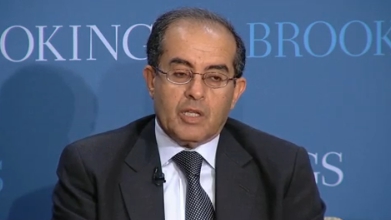
Mahmoud Elwarfally, self-proclaimed leader of the Libyan “Transitional National Council” speaks before the corporate-financier funded Brookings Institution, moderated by former CIA analyst Kenneth Pollack. Elwarfally maintains that the rebellion against Qaddafi was a natural product of the “globalizational process.”He still claims the rebellion is “peaceful.”
….
Elwarfally talks about a “new global cultural paradigm,” “new global values,” common values, shared by many “young people.” These young people, he says, are calling for human dignity, democracy, and inclusion at all levels of national government, repeating verbatim statements coming from geopolitical meddler Zbigniew Brzezinski and the myriad of US-funded NGOs that promote these “new global values.”
Deriding 30 years of documented history showing that the current armed uprising is but the latest campaign in a long war of foreign-funded armed sedition against Qaddafi, and recent admissions by rebel leaders themselves of having direct ties to Al Qaeda, Elwarfally claims such accusations are merely “Qaddafi projecting fears” onto the Libyan people and the world abroad. Elwarfally, rewriting history in mid-sentence, claims that armed struggle was forced upon them – despite 30 years of history saying otherwise. He proposes that current fighting is merely defensive and that the rebel is still peaceful. When asked about comments he made just minutes before regarding “marching on Tripoli,” Elwarfally maintains it was merely rhetorical.
Libya 2025
When asked by an audience member what Libya will look like in 2025, it turns out conveniently he was part of a study by Libya professors and “Libyan practitioners” in 2007-2008 titled “Libya: Vision 2025.” Not surprisingly, this project was conducted with input from the IMF and involved Libya’s placement within the “global scene.” Elwarfally laments that Libya’s oil reserves are limited and that the solution is a transition to a service economy. He also claims Vision 2025′s conclusion included an education shift, turning Libya into “a lake” to develop the skills of Africans to serve the needs of the European Union.
Surely Africans are eager to once again be in the service of wealthy Europeans, who at one point owned tremendous swaths of their continent, some tycoons naming entire nations after themselves in the ultimate expression of imperial megalomania. Elwarfally, a man educated in Pittsburgh, and apparently a lifelong fan of globalization, stuns us with his frank comments and his disturbing vision for the future of not only Libya, but the role it will play in directing Africa’s efforts and resources into the American and European corporate-financier interests. It is almost as disturbing as his breathtaking mis-characterization of the men who fight under him in what is most certainly not a “peaceful” rebellion.
Elwarfally concludes his talk by mentioning the “diminishing of the sense of the state” in Libya, due, he claims to a lack of “institutions” and “rule of law.” Kenneth Pollack, former CIA analyst and National Security Council member, chimes in declaring he hopes Elwarfally’s globalist dream becomes a reality even before 2025. Pollack, of course, is one of several contributors to the “Which Path to Persia?” report, within which open talk of funding terrorists, foreign-funded street protests, augmented with forms of US military support is made in regards to overthrowing Iran’s government. Quite obviously Pollack’s stratagems articulated in this treacherous report have already been applied to Iran as well as Libya, Syria, Egypt, Tunisia, and beyond.
If there was any doubt in the minds of those watching the “Arab Spring” unfold, doubts that haven’t been laid to rest by open admissions by the US that it was a plot of their own design, Mahmoud Gibril Elwarfally of the Libyan “Transitional National Committee” himself declares fealty to the globalist agenda and his commitment to propagating the interdependency and exploitation of the developing world by the global corporate-financier oligarchy. When similar calls for “democracy” and “dignity” are made by similar revolutions now festering in Eastern Europe along Russia’s border, and throughout China’s “String of Pearls” in South and Southeast Asia, remember Elwarfally’s words spoken before the globalist Brookings Institution.
Download the entire audio file from Brookings Institution here.
Italy’s Great Nuclear Swindle
The Radioactive Dictatorship of Silvio Berlusconi
By MICHAEL LEONARDI – CounterPunch – May 13, 2011
Italy’s democracy is in tatters as Silvio Berlusconi and his ruling right-wing coalition work to block a citizen’s referendum that would repeal the decision of the Berlusconi government to return to nuclear energy production on the peninsula. Italy has not produced nuclear energy since 1990 and recent polls indicate that more than 75 % of Italians are opposed to nuclear energy production. The referendum in question is on the ballot for the 12th and 13th of June, although a recent call by the Berlusconi government for a one year moratorium on the relaunch of nuclear energy in Italy threatens to push the referendum off the ballot through a last minute legal ruling. The campaign to bring this referendum to a vote was spearheaded by opposition political party Italia Dei Valori (Italy of Values) which led a broad based coalition of citizen and environmental groups to gather the 500,000 signatures needed to get the referendum on the ballot.
Italy is the only G8 country that does not produce nuclear energy. It has been free of functioning nuclear power plants since 1990 but does receive around 10% of its electricity from nuclear energy generated in France and Germany. Citizens successfully passed a referendum in 1987, one year after the catastrophic Chernobyl accident, that called for the phasing out and suspension of nuclear energy production. In 1987 Italy had two operating nuclear plants and has had four operational reactors in its history. In 2007 while campaigning for his third election, Berlusconi announced his intentions to return to nuclear energy production in Italy as a strategic part of a national energy policy.
Back in 2007 Berlusconi wasn’t the only one who supported a return to nuclear energy. Important elements of the newly formed Democratic Party also voiced their support for a return to nuclear power. A wikileaks cable 07ROME2438 revealed that Pier Luigi Bersani, the current secretary of the Italian Democratic Party who in 2007 was serving as Economic Development Minister for the Romano Prodi led Center Left coalition government, opened the door for Italy’s return to atomic energy by forging the Global Nuclear Energy Partnership agreement with then US energy secretary Samuel Bodman. At that time Bersani stated that “a return to nuclear energy was not excluded by the 1987 referendum” and that it was his hope that the agreement forged between the Prodi and Bush administrations would “help lead to a change in attitude from the Italian people toward nuclear energy.” Walter Veltroni, the ex-mayor of Rome who was the newly formed Democratic Party’s first candidate for president against Berlusconi in 2008, also voiced his openness to the idea of returning to Nuclear Energy production.
Since Fukushima Bersani and his fellow Democrats have been much more subdued about their support for Nuclear Energy and they have voiced strong opposition to the current government’s plan for the construction of new reactors. The Democrats have joined the chorus of the Green Party, Italia Dei Valori and scores of citizens groups in calling Berlusconi’s attempts to block the referendum a “theft” and a “deceptive attempt to hinder the democratic process.” Fukushima has inspired renewed vigor in the antinuclear movement and worked to sway public opinion in opposition to nuclear power that had become increasingly split over the past few years.
Following Berlusconi’s election victory in 2008 and his return to power for the third time since 1994, Italy’s new minister of economic development Claudio Scajola — before being forced out of office by a corruption scandal involving bribery and fraud in 2010 — announced that the government had scheduled the start of construction for the first new Italian nuclear power plant by 2013. On February the 24th of 2009, an agreement between France and Italy was signed allowing Italy to share in France’s expertise in the area of nuclear power station design. On July 9th 2009 the Italian legislature passed an energy bill covering the establishment of a Nuclear Regulatory Agency and giving the government six months to select sites for new plants. These sites have never been finalized. On the 3rd of August 2009, Italy’s energy giant Enel and Eletricite de France established a joint venture Sviluppo Nucleare Italia Srl for studying the feasibility of building at least four reactors using a design of French reactor builder Areva — the worlds largest nuclear energy company. These energy oligarchs, with Berlusconi as their champion, are doing everything in their power to preserve their multi-billion dollar investment in a nuclear future.
To this end Berlusconi’s council of ministers announced a one year moratorium on all questions relating to the research and activation of sites for new nuclear plants in Italy on the 24rd of March 2011, less than two weeks from the earthquake in Japan and subsequent Fukushima nuclear disaster. This move was immediately met with skepticism from Italy’s antinuclear movement and opposition political parties and was seen as a poorly veiled attempt to block the June referendum. On April 26th, the 25th anniversary of the catastrophic Chernobyl accident, Berlusconi held a press conference with French president Nikolay Sarkozy in Rome. At this press conference Berlusconi made his radioactive intentions clear for all. “We are absolutely convinced that nuclear energy is the future for the whole world,” he said. He went on to detail how recent polls showed that the referendum to block nuclear power for decades to come could pass at this time and that by temporarily suspending Italy’s return to nuclear program the issue would be revisited when the Italian voters had been “calmed down” and returned to the realization that Nuclear Energy was the most viable and safe way to produce electricity. He went on to explain how the “leftists and ecologists” had manipulated the emotions of the Italian voters after Chernobyl and penalized the Italian people who have to pay higher electric rates than France that operates 58 nuclear power plants. Berlusconi explained that the “situation in Japan had scared the Italian voters” and that the “inevitable return to nuclear power in Italy” would not be abandoned nor would the collaborations between Enel and Eletricite de France.
Now with Germany and Japan announcing the phasing out of their Nuclear programs and the scrapping of plans for the construction of new reactors, it would seem like political suicide to barge full steam ahead with a pro nuclear stance, but this is Italy and Berlusconi is still at the command. Berlusconi is now in control of all the major television outlets, including the state owned RAI, so getting the word out to the voters that there will be a vote on the 12th and 13th of June is proving difficult, and the heavy hand of State censorship has been wielded. At the annual May Day concert in Rome, sponsored by Italy’s two largest labor unions and televised on the state run RAI, the performing artists were required to sign a waiver agreeing not to speak about the upcoming referendums or risk a fine of over ten thousand euros. This left a bitter taste in the mouths of many of the attendees of this May Day celebration as news surfaced almost immediately that the state media outlet had censored the event.
As of now the referendum to block Nuclear Power is still on the ballot. Only a last minute ruling by the Supreme Court could remove it, and the Berlusconi government is banking on this decision as a result of their so-called nuclear moratorium. The antinuclear referendum is accompanied on the June ballot by two other referendums, one to repeal the Berlusconi government’s attempts to privatize water and the other to repeal a law called “legittimo impedimento” which was passed by the Right wing majority in order to protect Berlusconi from prosecution by giving him and members of parliament immunity from prosecution while serving in office. Each of these referendums required the gathering of half a million valid signatures and will need the high participation of 50 % plus 1 eligible voters to reach the mandated quorum in order to be considered valid. No legislative referendum has been able to reach this quorum in over a decade. Now the Berlusconi government is also trying to block the vote to keep water publicly owned. In recent legislation they created a new Water Authority in an attempt to legally block this referendum as well. While it is evident to the engaged and politically active citizenry that the Berlusconi government is pulling out all the stops to block the democratic process, the masses who get their information from Berlusconi’s private and state run television empire are being kept in the dark. No news on the referendums is reported unless it is it is very late at night or the early hours of the morning.
To publicize these referendums the citizens are taking to the streets, leafleting, using creative direct action and social networking on the internet to spread the news and get out the vote. On May 9th Greenpeace activists unfurled a large banner from Mussolini’s balcony on Palazzo Venezia in Rome. The banner includes a caricature of Berlusconi saying “Italians, I decide your future” and a call for Italians to vote on the Nuclear Referndum. Angelo Bonelli, President of the Italian Green Party, summed it up like this: “The referendums will be voted on anyway, despite the fact that the thieves of democracy have returned to action. The attempts of the government to steal the democratic rights of the Italian people to vote against nuclear energy and the privatization of water will not succeed.” On the 12th and 13th of June, the Italian people can change the course of their future by voting yes to say no to nuclear energy and the privatization of their water resources.
~
Michael Leonardi splits his time between Ohio and Italy. He can be reached at mikeleonardi@hotmail.com
Greeks strike protesting budget cuts
Press TV – May 11, 2011
Greek labor unions have staged a one-day strike in Athens against the government’s austerity measures adopted to tackle the country’s ailing economy.
Hundreds of thousands of civil servants, teachers and hospital staff, later joined by journalists, went on strike on Wednesday.
“We strike to show our anger and our opposition to the policies that are being introduced and new measures that hit workers and labor instead of those with money,” AFP quoted Stathis Anestis, a senior member of the confederation of Greek workers, as saying.
The unions argue that a recovery plan applied by the European Union and the International Monetary Fund, aimed to rescue the troubled economy of Greece, has deteriorated the living condition in the country.
“After a year, we find ourselves in a worse situation,” Anestis said. “Unemployment has skyrocketed, salaries are at their lowest point and there is no breakthrough in sight.”
The walk-out came a day after international debt inspectors headed to Athens to assess the country’s financial and economic progress and to determine whether Greece meets the conditions to receive the next bailout.
The European Union and the International Monetary Fund granted a USD 158-billion loan to the troubled state in 2010.
The bailout loan saved Greece from the brink of default. However, Athens was obliged to implement a strict austerity package, including the cutting of public sector salary and pensions, increasing taxes and overhauling the pension system, to survive.
Geithner scuppered IMF plan to impose haircut on Irish debt
WakeUpFromYourSlumber | May 8, 2011
According to Morgan Kelly, a highly-respected Irish economist, In November 16th 2010, the rarely-altruistic IMF suggested that unguaranteed bonds in failing Irish banks should be given a haircut by an average of two-thirds. This plan, which would have lessened the penury imposed on the Irish taxpayer, was apparently scuppered by one Timothy Geithner, US Treasury Secretary and Don of the Wall Street Mafia. Kelly describes this and more in his op-ed piece in the Irish Times of May 7th 2011, part of which is quoted below
On November 16th, European finance ministers urged [finance minister Brian] Lenihan to accept a bailout to stop the panic spreading to Spain and Portugal, but he refused, arguing that the Irish government was funded until the following summer. Although attacked by the Irish media for this seemingly delusional behaviour, Lenihan, for once, was doing precisely the right thing. Behind Lenihan’s refusal lay the thinly veiled threat that, unless given suitably generous terms, Ireland could hold happily its breath for long enough that Spain and Portugal, who needed to borrow every month, would drown….
Ireland’s Last Stand began less shambolically than you might expect. The IMF, which believes that lenders should pay for their stupidity before it has to reach into its pocket, presented the Irish with a plan to haircut €30 billion of unguaranteed bonds by two-thirds on average. Lenihan was overjoyed, according to a source who was there, telling the IMF team: “You are Ireland’s salvation.”
The deal was torpedoed from an unexpected direction. At a conference call with the G7 finance ministers, the haircut was vetoed by US treasury secretary Timothy Geithner who, as his payment of $13 billion from government-owned AIG to Goldman Sachs showed, believes that bankers take priority over taxpayers. The only one to speak up for the Irish was UK chancellor George Osborne, but Geithner, as always, got his way. An instructive, if painful, lesson in the extent of US soft power, and in who our friends really are.
The negotiations went downhill from there. On one side was the European Central Bank, unabashedly representing Ireland’s creditors and insisting on full repayment of bank bonds. On the other was the IMF, arguing that Irish taxpayers would be doing well to balance their government’s books, let alone repay the losses of private banks. And the Irish? On the side of the ECB, naturally.
The False Promise of Biomass
Blowing Smoke
By MATTHEW KOEHLER, IAN LANGE and JOHN SNIVELY | CounterPunch | May 5, 2011
Last fall news broke that the University of Montana was planning to construct a $16 million wood-burning biomass plant on campus next to the Aber Hall dormitory. UM officials claimed the biomass plant would save UM $1 million annually and protect Missoula’s air quality by reducing emissions over the existing natural gas heating system.
As interested citizens, we attended the university’s biomass “poster presentation” last December, which, unfortunately, raised more serious questions than it answered. So we continued to ask questions and research the proposal. In March, we even conducted an “open records” search of UM’s biomass project file, pouring over hundreds of documents and emails between UM officials and representatives of Nexterra, a Canadian biomass boiler manufacturer, and McKinstry, a Seattle energy services company. Suffice to say, our records search turned up even more troubling questions, especially related to costs, maintenance and emissions.
As the Missoulian reported last month, information in UM’s air quality permit application to the Missoula City-County Health Department showed that “Contrary to previous claims by UM administrators, the university’s proposed biomass boiler will not reduce emissions to levels below that of natural gas. In fact, UM’s proposed state-of-the-art biomass gasification plant will produce nearly twice as much nitrogen dioxide as its existing natural gas boilers – and in some cases, will release three times as much particulate matter.” The emissions are higher than what McKinstry’s feasibility study predicted.
Our records search also turned up a document showing that the biomass plant would also increase emissions of carbon dioxide, nitrogen oxides and volatile organic compounds by 40 percent or more over the existing natural gas system.
Obviously, Missoula is prone to severe inversions and air stagnation, especially during winter, when the greatest load would be on the biomass system. We found a UM biomass grant application that stated, “The Missoula Valley’s constrained topography presents ideal research conditions for long term analysis of environmental impacts of efficient woody biomass boiler combustion.” Do we really want to risk Missoula’s air quality for the sake of research?
It’s also been difficult to get an accurate assessment from UM of the biomass plant’s up-front and long-term costs, something all Montana taxpayers deserve. For starters, we noticed in the project file that in April 2010 the cost of the biomass plant was $10 million. By July, the cost went to $14 million. Now it sits at $16 million. UM’s financial pro forma also shows that during the first 20 years the biomass plant would need nearly $10 million for additional operation and maintenance expenses over the existing natural gas system.
The pro forma is also troubling in other aspects. It over-estimates the cost of natural gas, while under-estimating the cost of biomass fuel trucked to campus, especially given rising diesel costs. The pro forma also completely zeros out all natural gas expenses and maintenance costs, even though UM now admits that a natural gas boiler would be used during cold winter days to augment the biomass system, and also used from May to September, when the biomass system is too powerful to use.
Further complicating the picture, UM realized during the permitted process that its existing natural gas boilers are in violation of air pollution limits. The fix will cost around $500,000. And UM’s contract with McKinstry was amended recently, meaning that UM is already contractually committed to McKinstry for $532,000 just for project development.
It is our belief that all of these significant issues need to be fully analyzed and rechecked, not just by the biomass project’s supporters, but also by the Board of Regents, independent of McKinstry and UM. Guarantees of performance by McKinstry need to be carefully scrutinized, as other colleges have paid the price for poorly written contracts or poorly vetted companies.
At the end of the day, Montana taxpayers deserve to see accurate, updated financial information from UM concerning all aspects of the biomass plant, including the initial $16 million price tag and $10 million needed for additional operation and maintenance expenses. And Missoula’s citizens have a right to expect that the University of Montana would not risk Missoula’s fragile air quality by needlessly increasing emissions over present levels.
~
Matthew Koehler is executive director of the WildWest Institute; Ian M. Lange is a professor emeritus, Department of Geosciences at the University of Montana; and Dr. John Snively is a retired dentist. All three live in Missoula.
This column was originally published by The Missoulian.
‘Sustainable Rural Cities’, a Nightmare Come True in Chiapas
Biofuel Company Towns
Written by Koman Ilel, Translation by Jessica Davies – Upside Down World – 04 May 2011

More than three years ago torrential rains flooded the northern and central regions of the state of Chiapas. The rain seriously affected more than 1,200 families in 34 municipalities. This disaster, coupled with the inept dredging strategies of the National Water Commission (Conagua) and the Federal Electrical Commission (CFE), kept 404 households in 33 villages and 960 hectares of productive land under water for more than three months.Of all those concerned, the community of Juan de Grijalva suffered the worst fate: it was buried by the breaking away of a hill in the town of Ostuacán, in northern Chiapas. Shortly after the tragedy, the government, in the guise of a ‘philanthropic organisation’, held out its hand in solidarity to the people of Juan de Grijalva. Two years later they erected the brand new city of Nuevo Juan de Grijalva, the first Sustainable Rural City (SRC) in the whole of Mexico.
From being a poor village, Juan de Grijalva had become a leading city that had all the services that any Mexican could wish for: decent housing and quality basic services; drinking water; a water purification plant; drainage and sewerage; a waste treatment plant; electricity and public lighting using solar voltaic cells; a communications tower for fixed and mobile telephones; access to the Internet and information networks; a comprehensive basic education centre equipped with advanced technology; kindergarten, elementary and secondary schools; and a Health Centre with expanded services in the area of telemedicine equipment and technology. In addition, the inhabitants of the newly developed city were provided with opportunities for decent and gainful employment. Projects were launched for intensive production such as: greenhouses, nurseries, packing stations for tomatoes, poultry farms and a dairy processing plant. They also started ‘productive reconversion’, which allows residents to keep their land by replacing traditional crops with others of high commercial value.
It all sounded too good to be true. And, indeed, the dream became a nightmare. The city was from the beginning doomed to failure. There was not even the will to make a decent project: the houses are mousetraps, the basic services are inadequate, the health centers do not even have doctors, etc. But beyond these ‘details’, the new town is part of a state-wide program to rearrange the scattered population. As if we were in the sixteenth century, the aim is to create ‘authentic Indian villages’.
An Imposed Project
Under the pretext that most of the villages of Chiapas are scattered and that this high dispersion makes the provision of services and the economic and social development of communities difficult, the Rural Cities Program aims to focus on rural people in small villages. The aim is twofold: firstly, to take the land away from the small farmers (campesinos) and exploit it (with the participation of large businesses) and secondly, to concentrate the inhabitants of several villages in one place to serve as an ‘industrial reserve army’.
The ‘Believing People’ (el Pueblo Creyente) from the parish of San Pedro Chenalhó expressed it in these terms: “We are concerned that the rural cities project has been imposed, and that the people in the communities have not been consulted as to whether they agree with it or not, and if they do consult them, the consultation is based on lies and omissions, the government does not say clearly what this mega project actually brings or whether it is for the good or ill of the people. For example, it does not explain what ‘productive reconversion’ means, or who will be the beneficiaries of this reconversion.
“Rural cities were not invented by the state and federal government of this administration, but have a very long history, going back, for example, to the colonization of Latin America. At that time they were not called ‘rural cities’ but were known as ‘reducciones’, with the aim of making control of the population easier and more efficient in order to collect taxes (tribute), to use the people as labour for mines, plantations (most frequently sugar cane), for the construction of cities for the Spanish, and, of course, for political and military control. It is also true that then, as now, they argued that there would be benefits for the population directly affected, that by concentrating a population they can be provided with access to basic services of potable water, education, health, etc..”

The Wider Context
To address the issue of fighting poverty here in Chiapas, we must analyze the Sustainable Rural Cities in a broader context. On the one hand, in 2008 the presidents of Colombia, Mexico and other Central American countries signed the trade agreement Plan Mesoamerica (a new version of the Plan Puebla Panama). The purpose of this plan is to create an infrastructure and trade corridor that connects Southern Mexico to Colombia, and this area is intended to serve big capital. On the other hand, the political and economic plan of the World Bank, outlined in their report entitled ‘New Economic Geography’, suggests that economic integration is the fundamental way to bring development to all corners of the world. This report emphasizes population density as a key factor for the economic development of any country.
The construction of Santiago El Pinar, the second SRC, clearly unveils another facet of the project: that of a counterinsurgency strategy devised by the Chiapas government against the Zapatista Army of National Liberation (EZLN). Located very close to the Zapatista autonomous municipalities of San Juan de la Libertad and San Andrés Sakamch’en, the ‘city’ breaks down the traditional ways of life, and forces people to enter the capitalist mode of production of small businesses oriented towards the external market. Clearly, the Sustainable Rural City is a challenge to the Zapatista caracoles, who have built true autonomous systems of health, education and production. It seems that the government forgets that it is dealing with the same people who took up arms in January 1994, a dignified people and one increasingly more aware.
As we said, so far they have established two Sustainable Rural Cities: Nuevo Juan Grijalva and Santiago El Pinar. There are three more under construction: Jaltenango, Ixhuatan and Emiliano Zapata (and a final one in the process of being built: Copainalá). It is obvious that private interests are a fundamental component of the Sustainable Rural Cities, so it does not take much imagination to realize who the real beneficiaries of this project are. Certain companies (among whom stand out Telmex, Fundación Azteca, BBVA Bancomer, Banamex, Grupo Carso, Farmacias del Ahorro and Coparmex) who operate through their ‘third level’ employees (the governor and his cronies), and certain university institutions (IPN and UNACH ) are the ones who have assessed, evaluated and supported with funding the construction of the ‘self-sustaining cities’. All these have a place of honor on the Advisory Council of the Sustainable Rural Cities.
With even more irony, these companies have their place within the very broad commercial corridors included in the plans of these ‘cities’, in places where little is known about money and where the people are still dying of curable diseases. Now, the residents will not only be free to sell their labour, but they will also be free to obtain un-repayable micro-loans, cell phones, domestic electrical appliances by means of small payments, and other ‘benefits’ that the modern world brings.
No Longer Slaves?
In fact, the two Sustainable Rural Cities are a disaster for their new inhabitants. The plan promoted by the government is solely focused on benefiting the companies involved in the construction of these cities. We all need to inform ourselves about these illusions and publicly denounce the government’s plans.
The Sustainable Rural Cities affect all the communities of Chiapas and are intended to alienate the people from their land, thus making the land available to large multinational corporations who focus on “cheap labour”, destroying ancient farming practices, imposing community development models and forcing the population into the financial circle of capitalism. We conclude with the words of the Civil Society organisation The Bees (Las Abejas):
“We are not the only ones who know that this project [of rural cities] is part of the Mesoamerica Project, previously Plan Puebla Panama. This plan did not start with the bad government of Calderon nor with that of Sabines, but with Salinas de Gortari when he signed NAFTA (the North Atlantic Free Trade Agreement) which caused the uprising of our Zapatista brothers and sisters in the year 1994.
[…] Now they say we are no longer slaves, but it is just the same to make us work in their Mesoamerica Project with its plans for mines, sweatshops and plantations, which explains the campaign that the bad government is starting. This campaign is to have what they call ‘productive restructuring’.
“They do not explain much what this means, but we understand that now they do not want us to sow our cornfields (milpa), and our other ancestral foods any longer. They tell us that it is better for us to sow African (oil) palm and pine nuts, the reason they give us for this is to prevent fires.
“But what we see is that with the corn and beans we nourish ourselves; with oil palms and pine nuts they plan to produce biofuels to feed the cars and trucks. Do cars have more right to the food of Mother Earth than we do?”
Article originally published in Spanish by Koman Ilel, 26th April 2011
http://komanilel.blogspot.com/2011/04/ciudades-rurales-sustentables-una_21.html
~
See also:
Progressive ‘Green’ Counterinsurgency
Massachusetts Democrats vote to strip public unions of bargaining rights
By Stephen C. Webster | Raw Story | April 29th, 2011
Weren’t Democrats supposed to be in favor of collective bargaining rights? Well, maybe not.
Welcome to bizarro world.
The Democratic-controlled Statehouse in Massachusetts voted earlier this week to strip public employee unions of their collective bargaining rights, as part of the state’s budget measure. It passed by a vote of 157 to 1.
That’s precisely the same action taken by Republicans in Wisconsin, where it sparked a massive democratic outcry and weeks of rowdy protests.
The Massachusetts legislation would allow local municipalities to make unilateral changes to agreed-upon benefits, like health care, bypassing the need for union approval. It would, however, leave open a 30-day window where unions may be consulted on changes to benefits.
According to The Associated Press, the budget also cuts $800 million from the state’s Medicare-like program MassHealth, and strips more than $65 million in aid to state agencies and municipalities. Another $200 million would be withdrawn from the state’s “rainy-day fund” to help close their spending gap for this fiscal year.
“These are the same Democrats that all these labor unions elected,” Massachusetts AFL-CIO president Robert J. Haynes said in a media advisory. “The same Democrats who we contributed to in their campaigns. The same Democrats who tell us over and over again that they’re with us, that they believe in collective bargaining, that they believe in unions.”
He also pledged that the unions would fight this arrangement “to the bitter end.”
“We deserve better in Massachusetts. Working families lost collective bargaining rights in Game 1 of this budget process. It’s on to the Senate, then conference, then the Governor. Working people need to know who is for our right to collectively bargain and who is not.”
It was unclear if state Senate President Therese Murray would allow the budget to proceed.
Corporate Crime of the Century Portrayed as Conspiracy Theory
NPR Ombudsman Says No Response Allowed to Mass Transit Mess Up
By RUSSELL MOKHIBER | May 3, 2011
The NPR Ombudsman says that no response will be allowed to a story about mass transit in Los Angeles.
On April 21, 2011, NPR’s All Things Considered ran a story about how – after a fifty year absence – light rail is coming back to Los Angeles.
NPR reporter Mandalit Del Barco reported that eighty years ago, electric mass transit dominated the city.
“By the roaring 1920’s, more than 1,000 miles of electric trolley lines and train rails ran through the ever-expanding Los Angeles,” Del Barco reported.
But then in the middle of the century, the electric trolley cars disappeared.
Why?
“LA replaced the last of its streetcars with a web of freeways and bus lines,” Del Barco reported. “That led to conspiracy theories that the streetcars were dismantled by private companies who stood to profit – General Motors, Standard Oil and tire companies. That villainous plot figured into the 1988 movie ‘Who Framed Roger Rabbit.'”
In fact, it was more than just conspiracy theories.
It was an actual federal crime that led to the destruction of the nation’s electric mass transit.
The companies involved were indicted, convicted, and fined for destroying the nation’s electric mass transit systems.
Del Barco says she was familiar with the criminal history of the case, but didn’t report it.
We asked the NPR Ombudsman’s office to investigate and issue a clarification – at least tell NPR’s listeners that it wasn’t just a conspiracy theory – that it was an indicted and convicted federal crime.
The Ombudsman office said they would look into it.
Then, late last week, we got an e-mail from the NPR Ombudsman’s office.
“Our office talked to the reporter and editor of the piece,” wrote Lori Grisham of the NPR Ombudsman’s office. “They understand your concerns, but do not believe a correction is warranted. Time is one of the main constraints when it comes to producing a radio story and they were trying to condense a great deal of history into a small amount of time.”
Grisham passed along this from Jason DeRose, NPR’s Western Bureau Chief:
“The piece makes clear there had been better public transit in LA and that it was dismantled. We chose not to describe that demise in detail. There were many, many unproven allegations of conspiracy and two official fines. We chose to characterize the numerous unproven allegations as conspiracy theories to lead into the Roger Rabbit tape.”
Grisham ends her e-mail: “I apologize that NPR will not run a correction. Thank you again for taking time to contact us.”
And thank you Lori Grisham for looking into this.
But that’s just bad form – and one reason why America is angry with NPR.
We sent you the documented proven history of the criminal activity.
And still, Jason DeRose says that there were “many, many unproven allegations of conspiracy and two official fines.”
What gives?
This was proven and convicted criminal conduct.
There was nothing unproven about it.
In fact, the destruction of the nation’s electric mass transit system was perhaps one of the most egregious – and underreported – corporate crimes of the century.
Brad Snell is also not happy with the NPR Ombudsman’s decision.
Snell is in the final stages of writing a history of General Motors.
It will be published in 2013 by Knopf.
“Under our celebrated system of laws, the US Justice Department’s allegation of conspiracy by defendants General Motors, Standard Oil of California, and Firestone Tire to monopolize the sale of buses, fuel, and tires by eliminating electric transit was transformed from theory to fact upon their conviction by a Chicago jury in US District Court on March 19, 1949,” Snell told Corporate Crime Reporter. “That judgment was affirmed on appeal (186 F.2 562 (7th Cir. 1951)) and a further appeal by defendants to the US Supreme Court was denied (cert den. 341 US 916), leaving the judgment and convictions in National City Lines as final matters of settled fact and law.”
“In 1990, the Honorable George E. MacKinnon, Senior Judge of the US Court of Appeals in Washington DC, had occasion to review the entire trial record in the National City Lines case,” Snell said.
His conclusion appeared in the Washington Legal Times on May 7, 1990.
“That Chicago trial resulted in criminal conspiracy convictions of the General Motors Corp., Standard Oil of California, and the Firestone Tire & Rubber Co. for their concerted effort to replace electric streetcars with buses in numerous large and small cities,” Judge MacKinnon wrote.
“It is not a theory,” Snell said. “These are not ‘unproven allegations of conspiracy.’ It has been settled judicial fact for more than half a century. Beyond a reasonable doubt, as affirmed by the federal courts, and after denial of further review by the Supreme Court of the United States, it is an established and incontrovertible fact that General Motors, Standard Oil of California, and Firestone Tire conspired to replace electric transit in cities throughout America in order to effect a monopoly in the sale of buses and related products.”
“To suggest otherwise is to debase and mock our revered and time-honored system of American jurisprudence,” Snell said.
It is unconscionable that the NPR Ombudsman will not even consider running a response.
Russell Mokhiber edits the Corporate Crime Reporter.
Chavez vows to spend oil windfall revenues on social programs
RIA Novosti | April 23, 2011
Venezuelan President Hugo Chavez has announced that extra income from the country’s oil exports will be allocated for social spending.
Venezuela, South America’s biggest oil producer, has been receiving sharply higher income from its oil exports in recent months. Global prices on Venezuelan oil averaged $107 per barrel last week, while the 2011 state budget was balanced with the $40 per barrel benchmark.
“I have signed a decree that authorizes spending additional revenues from oil sales on the implementation of various social programs for the country’s population,” Chavez, who will seek re-election next year, said on national television on Friday.
The decree primarily hikes the so-called oil windfall tax, introduced by Chavez in 2008, from 60 percent to 95 percent on revenues from oil prices higher than $100 per barrel, giving Venezuela’s socialist leader enough room to conduct populist policies.
Chavez said the new law would allow the government to allocate additional $100 million on public housing projects and raise salaries nationwide.
He also predicted that war in Libya would drive oil prices up in the near future.
Venezuela produces about 3 million barrels of oil per day and sells almost half of it to the United States. U.S. oil futures closed at $112.29 on Thursday.
Featured Video

Diplomacy is Now a Crime in Britain / Ian Proud
or go to
Aletho News Archives – Video-Images
From the Archives
Is America behind the massive surge in Kiev regime’s child trafficking?
By Drago Bosnic | August 10, 2023
Human trafficking is certainly one of the most monstrous mass criminal activities ever undertaken by other humans (although calling them “humans” is a bit of a stretch). And yet, there’s a special kind of this deeply repulsive crime that pushes it to diabolical proportions – child trafficking. Underage kids, particularly those who were abandoned, sold or have very poor/abusive family backgrounds, are by far the most vulnerable group. The depraved criminals who engage in such illicit activities specifically target unfortunate children and given there are millions of them all around the globe, particularly in war-torn areas, the “recruitment pool” is effectively endless. Unfortunately, the demand on the black market also seems to be constant and growing, making it a very lucrative and appealing prospect for criminals. … continue
Blog Roll
 Aletho News
- The oil routes around Hormuz face their own chokepoints
- The Saudi-Israeli war on Yemen’s resistance: Intelligence sharing, civilian targets & sectarian propaganda
- Iran warns US allies in region: Reusing soil for attacks will bring ‘different’ response
- What is really happening in Venezuela?
- Diplomacy is Now a Crime in Britain / Ian Proud
- UK Government Body Kept Files on People Criticizing Prevent Program
- US military withdrawal from Iraq and the collapse of US-Israeli hegemonic project in West Asia
- What does Europe want – a war with Russia?
- She Followed the Actual Data on COVID Vaccines and Masks — Her Career Took a Huge Hit
- Florida AG Sues Pfizer, Bourla Over Deceptive Marketing of COVID Vaccines
- If Americans Knew
- No big deal: Israel to halt humanitarian aid to Gaza for 2 days – Daily Update
- Israel is squeezing the life out of Palestinians – Daily Update
- The Israeli Right Portrays Islam as Murderous. It Serves a Political Purpose
- Jordan Has Had Enough: King Abdullah’s Scathing Warning to Israel
- Israeli Colonizers (i.e. Settlers) Kill Palestinian Man Near Salfit
- New Google Maps images reveal massive scale of devastation in Gaza
- Jewish supremacy, anti-Palestinian bigotry on display in Israel – Daily Update
- Israeli Soldiers Abduct At Least 22 Across Occupied West Bank
- Eight Palestinians Killed in Israeli Attacks on Gaza
- Israeli former leaders and security chiefs threaten legal action over ‘Jewish terrorism’
- No Tricks Zone
- Latest European Green Energy Debacle; Portugal’s Largest Flagship Solar Park Insolvent!
- Green Energy Debacle: German Expert Professor Fritz Vahrenholt Warns Of Severe Economic And Social Consequences
- Two More Paleo Reconstructions Affirm Meters-Higher Sea Levels Across Ireland, Brazil 7000-6000 Years Ago
- New Study: Earth And Venus Surface Warmth Largely Explained By Convection And Lapse Rate, Not CO2 Or Radiation
- 2025 Nature Paper Claiming Worsening Global Drought Gets RETRACTED …Heavily Flawed
- New Study: ‘Global Drought Shows No Detectable Recent Acceleration Under Climate Warming’
- Economic Masterminds: German Socialists Suggest Taxing Productivity Gains Stemming From Using AI
- The South China Sea Has Not Been Cooperating With The Climate Change Narrative
- Energy Crisis: Germany Enters Heating Season With Historically Low Gas Reserve Fill Levels
- New Study: The Antarctic Ice Sheet Gained Mass From 2020-2024 Due To Staggering Snow And Ice Accumulation

