The Incalculable Cost of War
Shooting Children, One After Another
By KATHY KELLY | CounterPunch | March 4, 2011
Recent polls suggest that while a majority of U.S. people disapprove of the war in Afghanistan, many on grounds of its horrible economic cost, only 3% took the war into account when voting in the 2010 midterm elections. The issue of the economy weighed heavily on voters, but the war and its cost, though clear to them and clearly related to the economy in their thinking, was a far less pressing concern.
U.S. people, if they do read or hear of it, may be shocked at the apparent unconcern of the crews of two U.S. helicopter gunships, which attacked and killed nine children on a mountainside in Afghanistan’s Kumar province, shooting them “one after another” this past Tuesday March 1st. (“The helicopters hovered over us, scanned us and we saw a green flash from the helicopters. Then they flew back high up, and in a second round they hovered over us and started shooting.” (NYT 3/2/11)).
Four of the boys were seven years old; three were eight, one was nine and the oldest was twelve. “The children were gathering wood under a tree in the mountains near a village in the district,” said Noorullah Noori, a member of the local development council in Manogai district. “I myself was involved in the burial,” Noori said. “Yesterday we buried them.” (AP, March 2, 2011) General Petraeus has acknowledged, and apologized for, the tragedy.
He has had many tragedies to apologize for just counting Kunar province alone. Last August 26th, in the Manogai district, Afghan authorities accused international forces of killing six children during an air assault on Taliban positions. Provincial police chief Khalilullah Ziayee said a group of children were collecting scrap metal on the mountain when NATO aircraft dropped bombs to disperse Taliban fighters attacking a nearby base. “In the bombardment six children, aged six to 12, were killed,” the police commander said. “Another child was injured.”
In the Bamiyan province of Afghanistan, Zekirullah, a young Afghan friend of mine, age 15, rises at 2:00 a.m. several mornings each week and rides his donkey for six hours through the pre-dawn to reach a mountainside where he can collect scrub brush and twigs which he loads on the donkey in baskets. Then he heads home and stacks the wood – on top of his family’s home – to be taken down later and burned for heat. They don’t have electrical appliances to heat the home, and even if they did the villagers only get electricity for two hours a day, generally between 1:00 a.m. – 3:00 a.m. Families rely on their children to collect fuel for heat during the harsh winters and for cooking year round. Young laborers, wanting to help their families survive, mean no harm to the United States. They’re not surging at us: they’re not insurgents. They’re not doing anything to threaten us. They are children, and children anywhere are like children everywhere: they’re children like our own.
Sadly, more and more of us in America are getting used to the idea of child poverty – and even child labor – as our own economy sinks further under the burden of our latest nine years of war, of two billion dollars per week we spend creating poverty abroad that we can then emulate at home. Things are getting bad here, but in Afghanistan, children are bombed. Their bodies are casually dismembered and strewn by machines already lost in the horizon as the limbs settle. They lie in pools of blood until family members realize, one by one, that their children are not late in returning home but in fact never will.
In October and again in December of 2010, our small delegation of Voices for Creative Nonviolence activists met with a large family living in a wretched refugee camp. They had fled their homes in the San Gin district of the Helmand Province after a drone attack killed a mother there and her five children. The woman’s husband showed us photos of his children’s bloodied corpses. His niece, Juma Gul, age 9, had survived the attack. She and I huddled next to each other inside a hut made of mud on a chilly December morning. Juma Gul’s father stooped in front of us and gently unzipped her jacket, showing me that his daughter’s arm had been amputated by shrapnel when the U.S. missile hit their home in San Gin.
Next to Juma Gul was her brother, whose leg had been mangled in the attack. He apparently has no access to adequate medical care and experiences constant pain. The pilot of the attacking drone, perhaps controlling it from as far away as Creech Air Force Base here in the United States, knows nothing of this family or of the pain that he or she helped inflict. Nor do the commanders, the people who set up the base, the people who pay for it with their taxes, and the people who persist in electing candidates intent on indefinitely prolonging the war.
But sometimes the war is like it was this past Tuesday March 1st. Sometimes the issue is right in front of us – as it was to those helicopter crews – it’s up close so there can be no mistake as to what we are doing. According to the election polls we see the cost of war, dimly, but, as with the helicopter crews, it doesn’t affect – or prevent – our decisions. Afterward we deplore the tragedy; we make a pretense of acknowledging the cost of war, but it is incalculable. We can’t hope to count it. We actually, finally, have to stop making people like the nine children who died on March 1st, pay it.
~
Kathy Kelly co-coordinates Voices for Creative Nonviolence and has worked closely with the Afghan Youth Peace Volunteers. She is the author of Other Lives, Other Dreams published by CounterPunch / AK Press. She can be reached at: Kathy@vcnv.org
Iraqis march for economic reform
Press TV – March 4, 2011
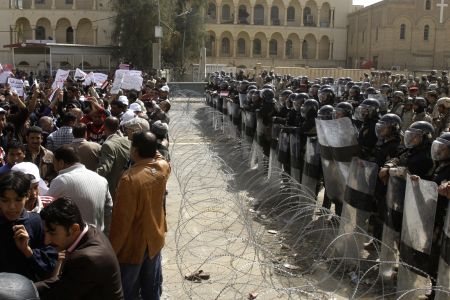 Security forces stand guard as people protest in Baghdad over corruption, unemployment and poor public services.
Thousands of Iraqi protesters have taken to the streets in main cities across the country, demanding economic reform and better living conditions.
Protest rallies over corruption, unemployment and poor government services were held in Baghdad, Basra, Nineveh, Anbar and Salahuddin following the Friday Prayers.
Unlike other demonstrations sweeping the Arab world, Iraqi protesters are seeking reforms, but not regime change.
“We live in a country rich with oil, yet we don’t have jobs,” demonstrators said. “The oil [is] for the people and not for thieves.”
They also chanted “Liar, Liar, Nouri al-Maliki” while carrying banners reading, “Where has the people’s money gone?” and “Yes to democracy and the protection of freedom.”
In the capital, where several thousands of demonstrators have already gathered in the city’s Tahrir (Liberation) Square, authorities have banned traffic across the city, forcing protesters to walk several kilometers to the square.
Iraqi authorities have also deployed thousands of security forces to Baghdad streets and protesters were frisked three times before reaching the square.
There were no reports of clashes between protesters and security forces.
Some Iraqis have named Friday’s rallies as the “Day of Regret,” to mark one year since the parliamentary elections. It took politicians more than nine months to form a new government after the poll on March 7, 2010, and even now, several major positions, including the ministers of interior, defense and planning, are unfilled.
Last week, at least 20 people were killed and more than 130 others were injured after Iraqi security forces attacked protesters.
Four top Iraqi officials, three southern provincial governors and Baghdad’s mayor, resigned following mass protests on February 25.
In response to nationwide protests, Iraqi Prime Minister Maliki called an emergency cabinet meeting on Sunday and gave government ministers a 100-day ultimatum to deliver results and eliminate corruption or face dismissal.
“Mr. Maliki specified a 100-day period after which an assessment of the work of the government and ministries will be carried out to find out the level of their individual success or failure in performing their jobs,” AFP quoted the statement as saying.
The Iraqi premier has also introduced measures to combat graft, cut politician salaries and dedicate more money to providing food for the poor in an attempt to contain protests.
Ohio Senate Restricts Workers’ Rights
Press TV – March 3, 2011
The Republican-controlled Ohio state Senate has followed Wisconsin in passing controversial legislation that restricts collective bargaining rights by public workers unions.
The Ohio bill was approved on Wednesday in a vote of 17 to 16, with six Republicans joining Democrats in opposing the measure.
“I’ve been saying for weeks that we have the votes to pass this bill. It reflects the diverse interests that our members have around the state of Ohio,” CNN quoted Senate President Tom Niehaus as saying.
The measure, known as Senate Bill 5, would limit a 1983 Ohio State law that grants collective bargaining rights to public employees.
The proposal was amended on Tuesday to include limits on worker’s vacation, new measures to settle workplace arbitration and to cut seniority-based pay hikes.
The modified regulation would restore collective bargaining rights on wages while it bans any kind of strikes by public workers. Ignoring the ban would impose fines and termination of employment contracts.
Meanwhile, demonstrators gathered outside the Senate in Columbus, Ohio and shouted slogans such as “Shame on you!” and “We will remember this,” following the vote.
On Tuesday, protesters occupied Wisconsin’s Capitol for the fifteenth consecutive day in a bid to oppose a similar measure taken by the Republican Governor Scott Walker to reduce employee pay and undermine unions in the state.
Also on Saturday, tens of thousands of people staged rallies in nearly all 50 states, including Washington, New York, California, and Nevada, to express their solidarity with Wisconsin protesters.
Lies and Truth in Wisconsin
Fact-Checking Gov. Walker
By WALTER M. BRASCH | CounterPunch | March 3, 2011
Historian Thomas Carlyle said “a lie cannot live.” However, Mark Twain casually remarked, “It shows that he did not know how to tell them.”
More than a century later, newly-elected Gov. Scott Walker and the Republican-dominated Wisconsin legislature have proven themselves to be “quick studies,” having learned how to tell whoppers about the working class and unions. Here are just a few.
LIE: The public workers’ pensions are what caused much of the financial crisis not just in Wisconsin but throughout the country. Gov. Walker has repeatedly said, “We’re broke . . . We don’t have any money.”
FACTS: Wisconsin had a $120 million surplus when Walker came into office in January. Had the newly-elected Republican-dominated Legislature in January not given about $140 million in special tax breaks (also known as “corporate welfare”) to business, the state could have had a surplus, according to the Legislative Fiscal Bureau. About two-thirds of all Wisconsin corporations pay no taxes at all, according to the Wisconsin Department of Revenue.
Wisconsin could also save significant expenses by having state-employed fiscal analysts, not Wall Street investment counselors, handle the entire pension investment portfolio. Wisconsin pays about $28 million to state managers to handle about half the portfolio; it pays about $195 million to Wall Street investment brokers to handle the other half, according to the 2010 annual report of the Wisconsin Investment Board… Even with the Wall Street crisis, and lower-than-expected revenue, the Wisconsin pension fund is fully funded, able to meet its obligation for several years, according to the independent PEW Center for the States.
Columnist Robert Greenwald says the “shortfall” would be wiped out if Wisconsin brought home only 151 troops from the war in Afghanistan. If the U.S. left Afghanistan completely, the state would save $1.7 billion, according to Greenwald’s analysis.
LIE: The reason the Republicans throughout the country want to end collective bargaining by the public service unions bargaining is to bring fiscal responsibility to the states.
TRUTH: In January 2010, the Supreme Court by a 5–4 decision along party lines declared that corporations enjoy the protection of the First Amendment. This meant that companies could increase funding and advertising for candidates. As expected, the Chamber of Commerce and corporate America gave vast amounts of money to Republican and conservative candidates; labor donated to liberal and Democratic candidates, who traditionally support the working class. In the 2010 mid-term election, seven of the top 10 donors contributed to conservative and Republican candidates. The other three in the Top 10 were labor political action committees. Eliminating collective bargaining for public sector workers would destroy the union movement and significantly reduce the influence of labor in campaigns. Walker has already shown his colors and intent when he was caught in a radio prank. On Feb. 23, Ian Murphy, editor of The Buffalo Beast, pretended to be billionaire David Koch, a supporter of far-right causes, and a major contributor to Walker’s gubernatorial campaign. Punked by the 20-minute call, Walker seemed to be little more than a sycophant for Big Business. The Republicans’ reaction? Instead of worrying about possible ethics violations by the governor, the Republicans planted a bill into the legislature to criminalize prank phone calls
LIE: The unions are greedy and won’t budge.
FACTS: The 267,000 Wisconsin public sector workers, as well as all elected officials, Democrat and Republican, do pay very little to their pensions. However, the unions have already said they’d be willing to pay a higher contribution, essentially taking an 8 percent pay cut, and negotiate fairly other parts of the contracts. Gov. Walker not only refused to budge on his autocratic stand, he refused to take calls from elected Democrats and bluntly told the Milwaukee Journal, “I don’t have anything to negotiate.”
LIE: Gov. Walker’s proposal affects every union in Wisconsin.
TRUTH: He exempted firefighters and police from his draconian assault upon unions, possibly because he was attempting to get support from the first responders, while mining sympathy from the public. What he didn’t count on was that the firefighters and police unions are firm in their opposition to the abolishment of collective bargaining.
LIE: Gov. Walker says he’s just helping the worker when he argues for elimination of the “dues check-off,” saying the workers would have more disposable income.
TRUTH: Eliminating dues check-off would cripple unions, which would have to rely solely upon voluntary contributions.
MYTH: Gov. Walker enjoys wide-spread support for his stand against the unions.
TRUTH: Walker has been governor less than two months. If the election were repeated, he’d receive only about 45 percent of the vote, according to the independent Public Policy Polling (PPP) of Raleigh, N.C. More important, while only 3 percent of Republicans voted for Tom Barratt, the Democratic candidate in the November election, 10 percent of the Republicans say they’d vote for him in a new election, according to PPP. The Republican governors of Florida, Michigan, Pennsylvania, and Indiana have said they will not follow Walker’s lead, and will support the rights of public workers to bargain collectively. The massive protests in Wisconsin—more than 100,000 in Madison on the same day—and throughout the nation give evidence that Walker doesn’t have the popularity he and his supporters believe. A New York Times/CBS poll, released March 1, indicates only about one-third of the nation supports the campaign against public sector collective bargaining. A week earlier, an independent USA Today/Gallup poll had almost the same results.
LIE: The protestors are unruly, and should be arrested for violating the law.
TRUTH: The First Amendment gives people the right to assemble peacefully. There have been no arrests because there have been no crimes committed by the protestors. Further, when the governor and the Legislature demanded that protestors be thrown out of the state capitol, and not allowed to stay overnight, the chief of the Capitol Police refused to do so, believing the order was a violation of Constitutional rights. In contrast, Walker had actually considered, then rejected, the idea of planting troublemakers among the protestors—a “dirty trick” that dates back to the ’60s.
LIE: Public sector union workers are overpaid.
TRUTH: A USA Today analysis, published March 1, shows that, on average, public service workers, with wages and benefits included, are paid about $2,500 more per year than those in the private sector. In Wisconsin, the difference is only about $1,800. However, government workers usually are “older and substantially better educated than private sector workers,” according to researchers Robert Pollin and Jeffrey Thompson, professors of economics at the University of Massachusetts. But, again contrary to the lies spewed by the anti-worker Rabid Right, individual union workers, when compared to the same criteria as private sector workers, actually earn 4 percent less income, according to the Center for Economic Policy Research. In Wisconsin, public sector union workers actually earn 4.8 percent less total compensation, according to research published in February by the Economic Policy Institute. One statistic stands out. “The average member of AFSCME, our largest public-sector union, earns less than $45,000 a year,” says author/journalist Bill Press, “and retires after a career in public service with a whopping pension of $19,000 per year.”
LIE: Public service union workers are lazier than non-unionized private sector workers.
TRUTH: Strong labor unions generally have higher productivity, according to independent research done by Harley Shalen of the University of California, because there is less turnover, better worker communication, better work conditions, and a better-educated workforce.”
~
Walter Brasch is an award-winning syndicated columnist, author of 17 books, is a former newspaper and magazine writer/editor and tenured full professor of mass communications. You may contact him at walterbrasch@gmail.com.
Social Crisis in America: Should Public Workers Make Concessions?
By Shamus Cooke | GlobalResearch | March 2, 2011
As workers all over the U.S. become inspired by the massive demonstrations in Wisconsin, a dangerous idea is being voiced by some working-class allies that could unravel it all. The threat lies in the following argument: to protect the bargaining rights of unions, state and city workers must be prepared to make concessions over wages, benefits, etc. This line of reasoning is not only false to the core, it’s suicidal.
Take for example a recent New York Times article on the battle in Wisconsin:
“It is not yet clear whether Gov. Scott Walker of Wisconsin will succeed in his quest to strip public employee unions of most of their bargaining rights. But by simply pressing the issue, he has already won major concessions that would have been unthinkable just a month ago.”
This is extraordinary: The Governor makes a radically anti-union threat, and some union leaders are ready to give him EVERYTHING, just not the kitchen sink.
The article continues:
“Some of Wisconsin’s major public sector unions, faced with what they see as a threat to their existence, have decided to accept concessions that they had been vigorously fighting…translating into a pay cut of around 7 percent…But Mr. Walker is not settling for that. He said that those concessions were “an interesting development, because a week ago they said that’s not acceptable.” (February 28, 2011).
So the anti-union Governor is making the unacceptable acceptable, merely by voicing a threat. If this precedent were established, what future do unions have? Especially when one considers that state budget deficits are projected to continue for years.
Imagine the following scenario: A war is declared by a foreign army and the defending General responds by announcing to the invaders, “I will only fight one battle to preserve this particular parcel of land (bargaining rights), and will wave the white flag over all other territory (wages, benefits, etc.).
Of course the foreign army would conclude “the enemy is already defeated!” And fight without mercy for total victory.
This is the situation in Wisconsin and other states. War has been declared on unions and some labor leaders are pretending that they can offer concessions to appease their attackers. Unfortunately, this strategy has failed for years, and is in fact why the right wing felt confident enough to officially declare war.
Every time unions agree to lower wages and benefits — as they have been doing for years — they weaken themselves internally, thus opening the way for further, deeper attacks. The right-wing attack on bargaining rights did not appear from nowhere; it was the result of years of concessionary bargaining, which inevitably leads to worker demoralization within the union. An army which concedes every battle will be composed of demoralized soldiers.
The union policy of concessionary bargaining is the policy of committing slow suicide, and after years of providing their executioners with nooses, some labor leaders act stunned when their hanging is announced. They believed that they could befriend the hangman, as long as they didn’t create too much trouble by aggressive protesting or well-planned strikes.
But hangmen are hangmen, and they must be treated accordingly.
Labor unions must mobilize the entire community in every state to demand “No Concessions” for all public workers. The fight to save collective bargaining can only be won if workers believe that collective bargaining will save their wages and benefits; the two cannot be separated.
Contrary to what the mainstream media and politicians constantly tells us, the general public would support such a fight. A recent CBS News/New York Times poll found that “Those surveyed said they opposed, 56 percent to 37 percent, cutting the pay or benefits of public employees to reduce deficits.” (March 1, 2011).
The battle in Wisconsin proves that private-sector workers do not hate their public-sector brothers and sisters, they passionately support them.
How can labor unions mobilize the general public towards a pro-worker solution to the state budget deficits? By exposing another media lie: that Americans are against ALL tax increases. In fact, the same pollsters discovered in 2009 that 74 percent of respondents “support higher taxes on the rich.” (April 6, 2009).
Labor unions must place this demand at the head of their campaign to save collective bargaining rights and workers wages and benefits. Workers will be further encouraged to fight for their wages and benefits when they see that there is a solution to the budget crisis.
Rose Ann DeMoro of National Nurses United agrees:
“So it’s time for all of us to say it loud: No More Cuts in Public Sector Pay, Pensions, or Health Benefits; Balance Budgets By Closing Corporate Tax Loopholes, Restoring Fair Share Taxes on Corporations and Wealthy Individuals; Guarantee Retirement Security and Healthcare for All.”
~
Shamus Cooke is a social service worker, trade unionist, and writer for Workers Action (www.workerscompass.org) He can be reached at shamuscooke@gmail.com
http://www.cbsnews.com/8301-503983_162-4923732-503983.html
http://www.globalresearch.ca/index.php?context=va&aid=23457
The Real U.S. National Security Budget
The Figure No One Wants You to See
By Christopher Hellman | March 1, 2011
What if you went to a restaurant and found it rather pricey? Still, you ordered your meal and, when done, picked up the check only to discover that it was almost twice the menu price.
Welcome to the world of the real U.S. national security budget. Normally, in media accounts, you hear about the Pentagon budget and the war-fighting supplementary funds passed by Congress for our conflicts in Iraq and Afghanistan. That already gets you into a startling price range — close to $700 billion for 2012 — but that’s barely more than half of it. If Americans were ever presented with the real bill for the total U.S. national security budget, it would actually add up to more than $1.2 trillion a year.
Take that in for a moment. It’s true; you won’t find that figure in your daily newspaper or on your nightly newscast, but it’s no misprint. It may even be an underestimate. In any case, it’s the real thing when it comes to your tax dollars. The simplest way to grasp just how Americans could pay such a staggering amount annually for “security” is to go through what we know about the U.S. national security budget, step by step, and add it all up.
So, here we go. Buckle your seat belt: it’s going to be a bumpy ride.
Fortunately for us, on February 14th the Obama administration officially released its Fiscal Year (FY) 2012 budget request. Of course, it hasn’t been passed by Congress — even the 2011 budget hasn’t made it through that august body yet — but at least we have the most recent figures available for our calculations.
For 2012, the White House has requested $558 billion for the Pentagon’s annual “base” budget, plus an additional $118 billion to fund military operations in Iraq and Afghanistan. At $676 billion, that’s already nothing to sneeze at, but it’s just the barest of beginnings when it comes to what American taxpayers will actually spend on national security. Think of it as the gigantic tip of a humongous iceberg.
To get closer to a real figure, it’s necessary to start peeking at other parts of the federal budget where so many other pots of security spending are squirreled away.
Missing from the Pentagon’s budget request, for example, is an additional $19.3 billion for nuclear-weapons-related activities like making sure our current stockpile of warheads will work as expected and cleaning up the waste created by seven decades of developing and producing them. That money, however, officially falls in the province of the Department of Energy. And then, don’t forget an additional $7.8 billion that the Pentagon lumps into a “miscellaneous” category — a kind of department of chump change — that is included in neither its base budget nor those war-fighting funds.
So, even though we’re barely started, we’ve already hit a total official FY 2012 Pentagon budget request of:
$703.1 billion dollars.
Not usually included in national security spending are hundreds of billions of dollars that American taxpayers are asked to spend to pay for past wars, and to support our current and future national security strategy.
For starters, that $117.8 billion war-funding request for the Department of Defense doesn’t include certain actual “war-related fighting” costs. Take, for instance, the counterterrorism activities of the State Department and the U.S. Agency for International Development. For the first time, just as with the Pentagon budget, the FY 2012 request divides what’s called “International Affairs” in two: that is, into an annual “base” budget as well as funding for “Overseas Contingency Operations” related to Iraq and Afghanistan. (In the Bush years, these used to be called the Global War on Terror.) The State Department’s contribution? $8.7 billion. That brings the grand but very partial total so far to:
$711.8 billion.
The White House has also requested $71.6 billion for a post-2001 category called “homeland security” — of which $18.1 billion is funded through the Department of Defense. The remaining $53.5 billion goes through various other federal accounts, including the Department of Homeland Security ($37 billion), the Department of Health and Human Services ($4.6 billion), and the Department of Justice ($4.6 billion). All of it is, however, national security funding which brings our total to:
$765.3 billion.
The U.S. intelligence budget was technically classified prior to 2007, although at roughly $40 billion annually, it was considered one of the worst-kept secrets in Washington. Since then, as a result of recommendations by the 9/11 Commission, Congress has required that the government reveal the total amount spent on intelligence work related to the National Intelligence Program (NIP).
This work done by federal agencies like the CIA and the National Security Agency consists of keeping an eye on and trying to understand what other nations are doing and thinking, as well as a broad range of “covert operations” such as those being conducted in Pakistan. In this area, we won’t have figures until FY 2012 ends. The latest NIP funding figure we do have is $53.1 billion for FY 2010. There’s little question that the FY 2012 figure will be higher, but let’s be safe and stick with what we know. (Keep in mind that the government spends plenty more on “intelligence.” Additional funds for the Military Intelligence Program (MIP), however, are already included in the Pentagon’s 2012 base budget and war-fighting supplemental, though we don’t know what they are. The FY 2010 funding for MIP, again the latest figure available, was $27 billion.) In any case, add that $53.1 billion and we’re at:
$818.4 billion.
Veterans programs are an important part of the national security budget with the projected funding figure for 2012 being $129.3 billion. Of this, $59 billion is for veterans’ hospital and medical care, $70.3 billion for disability pensions and education programs. This category of national security funding has been growing rapidly in recent years because of the soaring medical-care needs of veterans of the Iraq and Afghan wars. According to an analysis by the Congressional Budget Office, by 2020 total funding for health-care services for veterans will have risen another 45%-75%. In the meantime, for 2012 we’ve reached:
$947.7 billion.
If you include the part of the foreign affairs budget not directly related to U.S. military operations in Iraq and Afghanistan, as well as other counterterrorism operations, you have an additional $18 billion in direct security spending. Of this, $6.6 billion is for military aid to foreign countries, while almost $2 billion goes for “international peacekeeping” operations. A further $709 million has been designated for countering the proliferation of weapons of mass destruction, combating terrorism, and clearing landmines planted in regional conflicts around the globe. This leaves us at:
$965.7 billion.
As with all federal retirees, U.S. military retirees and former civilian Department of Defense employees receive pension benefits from the government. The 2012 figure is $48.5 billion for military personnel, $20 billion for those civilian employees, which means we’ve now hit:
$1,034.2 billion. (Yes, that’s $1.03 trillion!)
When the federal government lacks sufficient funds to pay all of its obligations, it borrows. Each year, it must pay the interest on this debt which, for FY 2012, is projected at $474.1 billion. The National Priorities Project calculates that 39% of that, or $185 billion, comes from borrowing related to past Pentagon spending.
Add it all together and the grand total for the known national security budget of the United States is:
$1,219.2 billion. (That’s more than $1.2 trillion.)
A country with a gross domestic product of $1.2 trillion would have the 15th largest economy in the world, ranking between Canada and Indonesia, and ahead of Australia, Taiwan, the Netherlands, and Saudi Arabia. Still, don’t for a second think that $1.2 trillion is the actual grand total for what the U.S. government spends on national security. Former Secretary of Defense Donald Rumsfeld once famously spoke of the world’s “known unknowns.” Explaining the phrase this way: “That is to say there are things that we now know we don’t know.” It’s a concept that couldn’t apply better to the budget he once oversaw. When it comes to U.S. national security spending, there are some relevant numbers we know are out there, even if we simply can’t calculate them.
To take one example, how much of NASA’s proposed $18.7 billion budget falls under national security spending? We know that the agency works closely with the Pentagon. NASA satellite launches often occur from the Air Force’s facilities at Vandenberg Air Force Base in California and Cape Canaveral Air Force Station in Florida. The Air Force has its own satellite launch capability, but how much of that comes as a result of NASA technology and support? In dollars terms, we just don’t know.
Other “known unknowns” would include portions of the State Department budget. One assumes that at least some of its diplomatic initiatives promote our security interests. Similarly, we have no figure for the pensions of non-Pentagon federal retirees who worked on security issues for the Department of Homeland Security, the State Department, or the Departments of Justice and Treasury. Nor do we have figures for the interest on moneys borrowed to fund veterans’ benefits, among other national security-related matters. The bill for such known unknowns could easily run into the tens of billions of dollars annually, putting the full national security budget over the $1.3 trillion mark or even higher.
There’s a simple principle here. American taxpayers should know just what they are paying for. In a restaurant, a customer would be outraged to receive a check almost twice as high as the menu promised. We have no idea whether the same would be true in the world of national security spending, because Americans are never told what national security actually means at the cash register.
~
Christopher Hellman is communications liaison at the National Priorities Project in Northampton, Massachusetts. He was previously a military policy analyst for the Center for Arms Control and Non-Proliferation, a Senior Research Analyst at the Center for Defense Information, and spent 10 years on Capitol Hill as a congressional staffer working on national security and foreign policy issues. He is a TomDispatch regular and a frequent media commentator on military planning, policy, and budgetary issues. To listen to Timothy MacBain’s latest TomCast audio interview in which Hellman explains how he arrived at his staggering numbers, click here, or download it to your iPod here.
[Note on Sources: The press release from the Office of The Director of National Intelligence disclosing the Fiscal Year 2010 $53 billion intelligence budget consists of 138 words and no details, other than that the office will disclose no details. It can be found by clicking here (.pdf file). An October 2010 analysis by the Congressional Budget Office entitled “Potential Costs of Veterans’ Health Care” projects rapid cost growth for Veterans Administration services over the next decade as a result of spiraling health care costs. To read the full report, click here (.pdf file). To see all the federal agencies that contribute to homeland security funding, click here (.pdf file)]
Copyright 2011 Christopher Hellman
IRELAND FACES BIGGEST TEST IN MODERN HISTORY AS EU/IMF CONDUCT ECONOMIC BLITZKRIEG
By Jane Burgermeister | February 28, 2011
– Ireland’s election called a “transformative moment” in nation’s history: a “pencil revolution” at the ballot box
– The Fianna Fail party has been annihilated at the polls: the party locked Ireland into an 85 billion euro loan from the EU/IMF at an interest rate of 6% and relinquished sovereignty
– New government has just days to stop transfer of tax payer money to foreign bondholders following draconian EU/IMF budget passed in December
– 85% of the income tax revenue will be used to service the EU/IMF loan by 2012 in an economic Blitzkrieg
– EU insists Ireland must pay banks setting stage for “collision” with new Irish government
– Spirit of independence of 1916 awakening as country faces crushing taxation without representation by imperial-style EU administration
Irish voters have delivered “electoral Armageddon” to the Fianna Fail government that saddled tax payers with the obligation to pay interest on a mountain of private bank debt.
Interest on the national debt is set to consume a 85% of the country’s income tax revenues by 2012, according to The Telegraph.
Fine Gael won the most seats in the 166-seat Dáil at 76 and looks set to form a government with the Labour party, which won around 37 seats. Sinn Fein trebled its seats to win 15, including Donegal South West.
Fianna Fail was relegated to the wilderness with 20 seats in an annihilation of historical proportions for the first government in the eurozone to lock its people into an EU/IMF loan.
The stunning ousting of the country’s ruling party that has ruled for 61 of the past 80 years has been called the “pencil revolution” and compared with the uprisings in the Middle East but without bloody street battles.
Fine Gael and Labour leaders met today to discuss at top speed how to deal with the interest payments on the EU/IMF loan.
Money will be taken from the Irish tax payers very fast in an economic “Blitzkrieg”. The EU/IMF have plans to repay 60 per cent of holders of non-guaranteed, unsecured senior bonds by the end of 2012, with bondholders getting €5.7bn this year and €7bn in 2012.
Banks have already received €53bn, or 33 per cent of GDP, since 2008. At the same time, GDP contracted by 11 per cent between 2007 and 2010.
The high voter turn-out at the election of 70% and the wipe out of FF at the polls suggests that the population has understood that corruption among the Irish and EU political and financial elite have caused the worst economic collapse in modern Ireland’s history, and want a government that shows the steely spirit of 1916 to rescue the country.
Polls show huge numbers of voters described themselves as “very angry” and “outraged at what is, in effect, the biggest transfer of wealth from the people of Ireland to foreign entities in history under the pretext of having to pay interest on a paper debt.
Vienna Economics Professor Franz Hörmann explained in a report in Der Standard how banks can create money– and also debt — out of thin air using the fractional reserve banking system. He also explained how they can use the fair value accounting rule to amass fraudulent losses on their books that can also be used as a pretext to suck real capital from taxpayers as long as government leaders acquiesce in the fraud.
The FF government and ECB helped fuel a property bubble by easy credit and they subsequently burst the bubble.
The ensuing property losses gave the banks a pretext to declare themselves in liquidity problems and get billions in real capital in the form of tax payer money in return for paper losses.
The EU and IMF are insisting that Irish taxpayers hand over their money to foreign bondholders at a brutal pace, leaving a new government little time to reverse the biggest transfer of wealth from the country to foreign entities in history before key summits in March.
“The cost of servicing Irish bank debt and the EU-IMF bank loans will consume 85 per cent of Ireland’s income tax revenue by 2012, a burden that a majority of voters find intolerable.,” reports Bruno Waterfield.
An average Irish family will have to pay about £3,900 a year in extra taxes , and most to the banks.
This burden comes after the FF leadership saddled the Irish people with private bank debt obligations which amount to about 135 billion in a backroom deal.
In November, 2010, FF locked the country into an 85 billion euro loan from the EU/IMF at an interest rate of about 6%. They also relinquished sovereignty to the EU and IMF and passed an EU/IMF budget in December 1010 to raise taxes by 5 billion and cut spending by 10 billion euros.
This triggered early elections and the wipe out of the FF party at the polls last Thursday in a warning to the EU and IMF and banks that voters have had enough.
Enda Kenny is set to attend at an EU summit on March 11, and on March 24 and 25.
Kenny has said he will try persuade his European counterparts to cut the interest rate on the EU loan. But it is not clear how this will help Ireland significantly given the size of the national debt and the pace at which it is being repaid.
According to EU officials, the Irish voters have no say, however, report the media. There will be taxation without representation in a development that puts the EU on the same footing as the colonial British empire.
The German and French government are pressing for an embryonic EU fiscal union, which is just another method for looting EU taxpayers who are increasingly opposing the extraction of their money by banks via the European Stability Fund.
The Irish people will never acquiesce in the open looting of their economy by the EU, German and French officials on behalf of the banks in what can only be described as an economic “Blitzkrieg” setting the scene for a collision, as the Telegraph reports.
Labour could reject Fine Gael and its polices on privatisation, austerity and income cuts and form a government with Sinn Fein and Independents and make a fresh start.
German economist Hans-Werner Sinn recently said that Greece should readopt the Drachma, recognizing that there is no way out of a eurozone country caught in the EU/IMF bank debt trap other than setting up a new currency and detaching a country’s economy from the blood sucking banks that control the apparatus of the EU government.
It should conduct an inquiry into the banking crisis and bring those responsible to account.
This was an economic crime comparable in the devastation it has wrecked to a war crime.
Ireland should strike out on a new path with full confidence, showing leadership and giving an example to the downtrodden people and tax slaves in the EU empire.
It freed itself from the grip of the British empire – and this is the same whatever mask or name the EU and IMF may give to their robbery of the Irish people.
With its back against the wall, Ireland has nothing to lose as it is. Following the EU and IMF path will result in the rapid and total destruction of the country.
The spirit of courage and independence of 1916 is surely required to make a clean break.
Any new Irish government should surely write off the paper bank debts, restructure the banks to separate the commercial from the investment or property arms and if it brings the eurozone currency built on debt to its knees in doing so, all the better.
Ireland is already entering a so-called debt-death spiral with soaring unemployment, falling tax receipts, growing mortgage defaults and banks requiring ever more bailouts, forcing the government to borrow more until it is finally pushed into a default.
Given the fact that euro is set to disintegrate anyway under inflationary pressures created by the way the ECB’s buying up the souvereign bonds of the growing numbers insolvent eurozone nations, Ireland would be advised to leave the euro altogether and adopt the punt again, something that would bolster its already strong export sector.
Attacks on unions barking up the wrong money tree
By Michael Winship | Intrepid Report | February 28, 2011
“More cheese, less sleaze!”
That was the funniest group chant at Tuesday’s rally of several hundred union and other progressive activists outside the Manhattan headquarters of Fox News.
Several “cheeseheads” were in attendance, their noggins topped by the now familiar wedge-shaped, orange hatwear made popular by Green Bay Packer fans. On Tuesday, they were out in the twilight chill expressing their opposition not to lactose intolerance but Wisconsin Governor Scott Walker’s intolerance of organized labor. (Unadorned by cheddar, I briefly spoke at the gathering as president of an AFL-CIO affiliated union, the Writers Guild of America, East.)
Governor Walker continues his obdurate opposition to the state’s public employee unions’ right to collective bargaining, despite a willingness on their part to concede pension and health givebacks he claims would help close Wisconsin’s alleged deficit. Meanwhile, there has been a decided increase on the sleaze end of the cheese vs. sleaze quotient, as evidenced in part by the prank phone call to the governor in which an online newspaper editor impersonating right wing billionaire David Koch elicited from Walker a proposed scheme to lure back, then double cross Democratic state senators who have prevented a quorum by retreating to Illinois. Further, when asked about planting troublemakers amongst the protesters, Walker told the trickster that he and his team had “thought about that” but decided not to. Apparently, all the really good disrupters are tied up in the Middle East.
But of course, this isn’t really about saving taxpayers’ money but consolidating political power. Walker and such leading lights of the GOP leadership as Governor Chris Christie of New Jersey and Ohio Governor John Kasich, among others, have decided that public employee unions make great punching bags, effective scapegoats for an outraged electorate and a satisfactory diversion from the real culprits of this grim, economic melodrama—the Simon Legrees of banking and finance who got us into this meltdown mess in the first place.
As Josh Dorner reported on the progressive ThinkProgress website last week, “Instead of making the tough choices necessary to help their states weather the current crisis with some semblance of the social safety net and basic government services intact, Republican governors are instead using it as an opportunity to advance several longtime GOP projects: union busting, draconian cuts to social programs, and massive corporate tax breaks. These misplaced priorities mean that the poor and middle class will shoulder the burden of fiscal austerity, even as the rich and corporations are asked to contribute even less.”
Dorner cites examples: in Arizona, Republican Governor Jan Brewer proposes kicking some 280,000 off the state Medicaid rolls but two weeks ago signed into law $538 million in corporate tax cuts. Florida Governor Rick Scott’s new budget calls for billions of dollars in cuts to essential programs and services to pay for corporate and property tax cuts of at least $4 billion. Rick Snyder, newly elected governor of Michigan, has asked for $180 million in concessions from public employees and more than a billion to be taken from schools, universities, local governments and others, most of which could be avoided if he wasn’t so deeply dedicated to giving business $1.8 billion in tax breaks.
Writing in the February 23 Boston Globe, Mark Erlich, executive secretary-treasurer of the New England Regional Council of Carpenters asks, “While there are legitimate and critical public policy issues about education reform, spiraling health costs, and pension liabilities at a time of state and municipal budget deficits, why is the fault laid at the feet of teachers, police, and firefighters? Today’s pension obligations are the product of massive investment losses, not excessively generous public pensions that, in fact, average about $19,000 a year. For that matter, a 2010 Economic Policy Institute study showed that, controlled for educational achievement, public sector workers actually earn less than their private sector counterparts.”
So instead of screaming about the advances public employee and other unions have made to preserve health care, job security and economic justice, angry voters should be asking what or who have been keeping them from obtaining the same. Nor does Wall Street’s pillaging of private 401(k) retirement plans justify tit-for-tat, eye-for-an-eye acts of covetous revenge against union pensions. As Erlich writes, “A generation ago, non-union workers often welcomed news of improved wages and benefits for unionized employees, recognizing that a rising tide lifts all boats. But . . . at a time of sacrifice and insecurity, many would prefer to sink their neighbor’s slightly bigger boat while wistfully hoping for a glance at a yacht in a gated marina.”
The American middle class largely exists because of unions; it would be a tragedy of Greek proportions if, in frustration, resentment and fear, members of that class were to turn on labor and bring about their mutual destruction. Conservative Republican governors and their associates are barking up the wrong money tree. Don’t reward corporate greed and malfeasance with yet more tax breaks and a blind eye to windfall bonuses. And don’t punish unions for whatever success they’ve had protecting members and holding on to an ever-dwindling power base of American workers. That’s just plain cheesy and sleazy.
~
Michael Winship is the former senior writer of Bill Moyers Journal on PBS and current president of the Writers Guild of America, East.
Egypt: Revisiting the Demands
Global Voices | February 10, 2011

A list of demands from the protesters at Tahrir Square is being circulated online today, the 17th day of massive demonstrations across Egypt calling for the overthrow of the Mubarak regime. The first item calls for the resignation of president Hosni Mubarak.
Wael Khalil lists those demands on his blog (Ar) and says:
These demands are the summary of various discussions at Tahrir Square, and are, of course, not representative of everyone at the square
The immediate demands are:
1. The resignation of president Mohammed Hosni Mubarak
2. Canceling the Emergency Law
3. Dismantling the state secret service
4. An announcement by (Vice-President) Omar Sulieman that he will not run in the next presidential elections
5. Dissolving the Parliament and Shura Council
6. Releasing all the prisoners since January 25
7. Ending the curfew so that life resumes as normal across the country
8. Dismantling the university guards system
9. Referring officials responsible for the use of violence against the peaceful protesters since January 25 and those responsible for the organised thuggery which followed January 28 to an investigation committee
10. Sacking Anas El Fiqi and stopping the attack on protesters in government owned media through threats and calling protesters traitors, and ending the spread of hate against foreigners in the streets
11. Reimbursing shop owners for their losses during the curfew
12. Announcing the demands above on government television and radio
Wael Khalil also lists demands for the transitional period as follows:
1. Drafting a new constitution
2. The right to set up newspapers and open television and radio stations without a prior permission
3. Putting the minimum wage of 1,200 Egyptian Pounds into effect
4. The right to set up political parties, by notification
5. The right to set up associations and unions, by notification
6. Achieving a real autonomy and independence for national newspapers and television and radio stations, through new legislation and the reformation of companies, establishments of ministries
7. Cancling the national service in the police force
8. Ending the security clampdown on telecommunications and the internet
Emphasis – Aletho News
Biofuels, Soaring Food Prices and Iowa
By ROBERT BRYCE | CounterPunch | February 25, 2011
When the chairman of the world’s largest food company says that using food crops to make biofuels is “absolute madness,” sensible people should take heed.
Alas, President Obama, along with a Congress that is dominated by Big Ag interests, just doesn’t seem to care that Peter Brabeck, the chairman of the Swiss food giant, Nestle, made that very declaration last month. And that blithe ignorance of the madness of biofuels is resulting in some truly horrifying results. Here are the numbers: This year, the US corn ethanol sector will consume 40 percent of all US corn – that’s about 15 percent of global corn production or 5 percent of all global grain – in order to produce a volume of motor fuel with the energy equivalent of about 0.6 percent of global oil needs.
Congress not only lavishes subsidies on the corn ethanol scam, it has mandated the use of corn ethanol, and provided tariff protections to an industry that is helping push global food prices to all-time highs and shrink grain reserves at the very same time that global grain production is faltering and protests over food prices are commonplace.
The quantity of grain to be consumed this year for US ethanol production – 4.9 billion bushels – boggles the mind. That’s more than twice as much as all the corn produced in Brazil and more than six times as much as is grown in India. Put another way, that’s more corn than the output of the European Union, Mexico, Argentina, and India combined.
Despite these facts, last month, President Obama, in his State of the Union speech, said “we can break our dependence on oil with biofuels.” Meanwhile, the Iowa Caucus, the nation’s first presidential primary is now less than one year away. And Newt Gingrich, the former speaker of the US House, who’s dearly hoping that he can be a viable candidate for the 2012 Republican presidential nomination, was recently in Iowa cravenly wooing the ethanol producers and slamming “big city” critics of the ethanol industry. Alas, there’s little reason to expect much bravery out of Gingrich’s fellow Republicans on Capitol Hill. Speaker of the House John Boehner recently told reporters not to expect cuts to the ethanol subsidies because they are “not in the discretionary spending pot.”
While Obama prevaricates and Congress dithers, ethanol boosters are once again claiming that their sector has negligible effect on grain prices. Instead, they blame surging grain prices on, well, everything but their industry. To be sure, bad weather in Russia and Australia has cut grain harvest in those countries. In addition, rising demand for grain in the developing world is affecting prices.
But the events of the last few weeks — corn futures at near-record highs and social unrest related to food prices – are nearly identical to the mayhem that occurred in 2007 and 2008. Back then, at least 15 studies, including ones by Purdue University, the World Bank and the Congressional Research Service, exposed the link between increasing ethanol production and higher food prices. Soaring food prices led to violent protests in Egypt, Cameroon, Ivory Coast, Haiti, Mauritania, Ethiopia, Madagascar, the Philippines and Indonesia. And worries about adequate food stocks led several countries to ban food exports.
New studies are, once again, finding a direct link between the corn ethanol scam and higher food prices. In December, a study by two US agriculture economists, Thomas Elam and Steve Meyer, found that corn prices are being pushed dramatically higher by demand from the ethanol sector. Elam and Meyer, who have done consulting work for the meat industry, found that without the ethanol mandates, the average price of corn would now be lower by more than $2 per bushel. And they conclude that “biofuels policy has caused significant cost increases for all users of feedgrains.”
There are many unfortunate aspects to America’s corn ethanol insanity. But among the most unfortunate is that US policymakers were warned, and they were warned by the Rand Corporation, one of the most conservative defense-oriented think tanks in America. In May 2008, Rand Corporation issued a report which said that diverting corn to the ethanol sector was not only bad economics, but a security threat: “Using corn for ethanol is economically inefficient and has harmed US national security. Diverting corn from food to ethanol production has pushed up world market prices for grains and other foods, which, in 2008, resulted in riots in a number of developing countries.”
In recent weeks, we’ve seen food-price hikes and protests that are reminiscent of 2008. There have been food riots in Algeria and Mozambique. Last month, some 8,000 Jordanians protested in the streets of Amman and other cities to protest rising food prices. In Egypt, the world’s biggest wheat importer, wheat prices are up by 30 percent over the past 12 months. This week, protesters took to the streets in India to protest surging food costs.
The surging price of wheat is being stoked by rising corn prices, which have doubled over the past six months and are now at about $7 per bushel. “Higher corn prices always means higher wheat prices,” says Bill Lapp, president of Advanced Economic Solutions, an Omaha-based commodity consulting firm.
David Orden, a senior research fellow at the International Food Policy Research Institute in Washington, told me that surging corn prices is “a continuation of what happened in 2008.” The push for biofuels, he said, “has clearly tightened up agricultural commodity markets. That’s good for farmers, but it is not good for poor people around the world.”
Many of those poor live in the US. Some 43.6 million Americans, about 14 percent of the population, are now receiving federal food stamps. Since October 2008, the number of Americans relying on food stamps jumped by 41.5 percent and enrollment in the program has increased for 26 consecutive months. And thanks to the ethanol scam, those many millions are being priced out of the meat aisle. Over the past year, beef prices have risen more than 6 percent and pork prices are up 11 percent. Economists are expecting overall grocery prices in the US to rise by about 5 percent this year.
But the real – and likely more dangerous – food-price increases will happen outside the US. Last year, the OECD projected that global grain prices are likely to be as much as 40 percent higher by 2020, and a London-based non-profit entity, ActionAid, predicted that some 600 million more people could be left hungry by 2020 due to increased production of biofuels.
Brabeck, the chairman of Nestle, the world’s biggest food company, has rightly put the spotlight on the biofuels madness. As the head of a company with $100 billion in annual food-related revenues, Brabeck clearly has a keen understanding of the global food industry. And last month during the World Economic Forum in Davos, he identified the stunningly obvious solution to the ongoing insanity. “No food for fuel,” he said.
“No food for fuel” should be the rallying cry on Capitol Hill and at the United Nations. It should be a required oath for all of the candidates (and Gingrich in particular) who are planning to campaign in Iowa for the 2012 presidential contest. As the biggest ethanol-producing state, Iowa has long had a stranglehold on America’s presidential selection process because it holds the first primary. And because it holds the first primary, the state’s powerful agriculture interests have, for decades, prevented viable candidates from speaking out against the corn ethanol madness.
It’s time – no, it’s long past time — to heed Brabeck’s advice. Stop the madness.
Greek P.M.: Zionism and the IMF’s Last Best Friend
By James Petras | February 25, 2011
In the midst of the Arab uprisings throughout the Middle East, at a time when even the European (EU) has publicaly condemned Israel’s blockade of Gaza and its illegal land seizures in the West Bank and East Jerusalem, Greek Prime Minister George Papandreou promised a visiting delegation of American Jewish leaders, that he would do everything possible to undermine EU opposition and promote Israeli economic, diplomatic and political interests in Europe.
US Zionists, recently returned from a visit to Athens described Papandreou as by far the most amenable (‘servile’) European leader they have met in recent memory. Papandreou’s slavish submission to Israeli interests includes his promise, to a delegation of U.S. Zionist notables, to use his influence to pressure the new Egyptian military junta to continue to uphold the Mubarak agreements with Israel (European Jewish Press 2/11/11). These include the continued blockade of Gaza and support of Israel’s military assaults on Lebanon, Syria and Palestinians. In other words Papandreou is openly supportive of Egypt’s past collaboration with Israeli clandestine assassinations and kidnapping of Arab militants.
Papandreou demonstrates a greater interest in promoting Israel’s exports to the European market, than the country he ostensibly represents. He promised a delegation from the Conference of Presidents of Major American Jewish Organizations “to integrate Israel into the European market” (European Jewish Press 2/11/11) while he shrinks the Greeks economy by 10% between 2009-11 and doubles unemployment from 8% to 16%. Papandreou’s gross servility to Israel and the American Zionist power structure is manifested in his cordial reception and recent agreements with Israel’s Prime Minister Netanyahu and his foreign minister, the notorious Zionist-fascist Avigdor Lieberman – the same Lieberman who advocates wholesale expulsion of Palestinians from the West Bank. No Greek Prime Minister, since the Zionist state was founded, has exhibited such a bizarre display of active collaboration with Israel’s colonial claims in the Middle East. No European leader has so eagerly anticipated and implemented the demands of American Zionist organizations with such zeal.
What is most striking about Papandreou’s servility to Israeli and American Zionist interests, is that it takes place when most of the rest of the world, from Europe, Turkey, Lebanon, Latin America, to North Africa (Egypt, Tunisia) and the vast majority of Arabs are moving toward isolating Israel. In other words, Papandreou is embracing a pro-Israel policy which is alienating Europe, isolating Greece from well over a hundred million Arabs and undermining Greek agricultural (citrus) exports to the EU market.
Papandreou’s perverse and highly prejudicial foreign policy is matched by his extraordinary adherence and enforcement of the debt payment policies dictated by the IMF and the bankers of the EU and the US. His behavior is particularly shameless at a time when the next Irish government is threatening to declare a debt default if payments are not reduced. In his eagerness to ingratiate himself with the overseas bankers, Papandreou has systematically extracted billions of euros via a 20% reduction in wages, salaries and pensions and transferred it to the coffers of the banks. In the process Papandreou’s policies have doubled the unemployment rate, shrank the economy and undermined any future growth for the next decade. Papandreou rejected the Argentine formula, which in the face of a similar crises in 2001-02 , defaulted rather than deepen poverty. Under President Kirchner, Argentina renegotiated its debt, shaving bond payments by 75% and imposing a moratorium. As a result, Argentina recovered from the crises and maintained a growth rate of 7% for over a decade while reducing unemployment from 22% to less than 6%.
If Papandreou acts as a submissive messenger boy for Israel and its Zionist fifth column in America, he features prominently as the eager and aggressive “bill collector” for the overseas banks. He will go down in historical infamy as a willing accomplice of Israeli war crimes, an upholder of its unequal treaties with Egypt in his foreign policy and the enforcer of financial predators who impoverish millions of Greeks at home.
Having decimated the Greek economy via transfers of billions abroad and undermined economic relations with the Arab countries, Papandreou offers to sell Greece’s most lucrative transport, ports, energy and communication companies to Chinese, Israeli and Wall Street investors and speculators. It is ironic that George Papandreou the son of former Prime Minister Andreas Papandreou should reverse each and every one of his father’s policies, especially with regard to the Middle East.
In 1981 after Andreas Papandreou was elected he invited me to Athens to discuss policies and programs of his future government. The first thing he told me was the importance of supporting the Palestinian struggle and how he had a successful meeting with Yasser Arafat, who regaled him with a prized pistol, which he displayed to me. A year later when I returned to Greece to direct and develop a research center, he invited me for a swim. We were accompanied by a dozen underwater security guards, patrolling offshore, against a potential assassination plot by Mossad, according to the prime minister, in reprisal for his solidarity with the Palestinians in Lebanon.
A few days later over 50,000 Greeks led by Culture Minister Melina Mercuri marched in solidarity with the Palestinians and in repudiation of Israel’s role in the bloody massacre of 2000 women and children in Sabra and Shatila. The contrast of the two generations of Papandreou’s could not be more stark; while Andreas saw Greece as a bridge between Europe and the Arab East, George sees Greece acting as a pimp for Israeli business interests in Europe and as a lobbyist for its dominance in the Middle East. The Zionists have lost an old client in Mubarek and gained a new one in Papendreou.
Like Mubarak, George Papandreou combines servility to his imperial mentors with arrogance and brutality to his Greek subjects. As the Egyptians demonstrated it will take the Greek people more than marches and occasional strikes to bring down an entrenched client of the empire. But it can be done as was exemplified in Cairo!
Featured Video

Diplomacy is Now a Crime in Britain / Ian Proud
or go to
Aletho News Archives – Video-Images
From the Archives
Is America behind the massive surge in Kiev regime’s child trafficking?
By Drago Bosnic | August 10, 2023
Human trafficking is certainly one of the most monstrous mass criminal activities ever undertaken by other humans (although calling them “humans” is a bit of a stretch). And yet, there’s a special kind of this deeply repulsive crime that pushes it to diabolical proportions – child trafficking. Underage kids, particularly those who were abandoned, sold or have very poor/abusive family backgrounds, are by far the most vulnerable group. The depraved criminals who engage in such illicit activities specifically target unfortunate children and given there are millions of them all around the globe, particularly in war-torn areas, the “recruitment pool” is effectively endless. Unfortunately, the demand on the black market also seems to be constant and growing, making it a very lucrative and appealing prospect for criminals. … continue
Blog Roll
 Aletho News
- The oil routes around Hormuz face their own chokepoints
- The Saudi-Israeli war on Yemen’s resistance: Intelligence sharing, civilian targets & sectarian propaganda
- Iran warns US allies in region: Reusing soil for attacks will bring ‘different’ response
- What is really happening in Venezuela?
- Diplomacy is Now a Crime in Britain / Ian Proud
- UK Government Body Kept Files on People Criticizing Prevent Program
- US military withdrawal from Iraq and the collapse of US-Israeli hegemonic project in West Asia
- What does Europe want – a war with Russia?
- She Followed the Actual Data on COVID Vaccines and Masks — Her Career Took a Huge Hit
- Florida AG Sues Pfizer, Bourla Over Deceptive Marketing of COVID Vaccines
- If Americans Knew
- No big deal: Israel to halt humanitarian aid to Gaza for 2 days – Daily Update
- Israel is squeezing the life out of Palestinians – Daily Update
- The Israeli Right Portrays Islam as Murderous. It Serves a Political Purpose
- Jordan Has Had Enough: King Abdullah’s Scathing Warning to Israel
- Israeli Colonizers (i.e. Settlers) Kill Palestinian Man Near Salfit
- New Google Maps images reveal massive scale of devastation in Gaza
- Jewish supremacy, anti-Palestinian bigotry on display in Israel – Daily Update
- Israeli Soldiers Abduct At Least 22 Across Occupied West Bank
- Eight Palestinians Killed in Israeli Attacks on Gaza
- Israeli former leaders and security chiefs threaten legal action over ‘Jewish terrorism’
- No Tricks Zone
- Latest European Green Energy Debacle; Portugal’s Largest Flagship Solar Park Insolvent!
- Green Energy Debacle: German Expert Professor Fritz Vahrenholt Warns Of Severe Economic And Social Consequences
- Two More Paleo Reconstructions Affirm Meters-Higher Sea Levels Across Ireland, Brazil 7000-6000 Years Ago
- New Study: Earth And Venus Surface Warmth Largely Explained By Convection And Lapse Rate, Not CO2 Or Radiation
- 2025 Nature Paper Claiming Worsening Global Drought Gets RETRACTED …Heavily Flawed
- New Study: ‘Global Drought Shows No Detectable Recent Acceleration Under Climate Warming’
- Economic Masterminds: German Socialists Suggest Taxing Productivity Gains Stemming From Using AI
- The South China Sea Has Not Been Cooperating With The Climate Change Narrative
- Energy Crisis: Germany Enters Heating Season With Historically Low Gas Reserve Fill Levels
- New Study: The Antarctic Ice Sheet Gained Mass From 2020-2024 Due To Staggering Snow And Ice Accumulation

