GATES FOUNDATION INVESTS IN MONSANTO
Both will profit at expense of small-scale African farmers
AGRA Watch | August 25, 2010
Seattle, WA – Farmers and civil society organizations around the world are outraged by the recent discovery of further connections between the Bill and Melinda Gates Foundation and agribusiness titan Monsanto. Last week, a financial website published the Gates Foundation’s investment portfolio, including 500,000 shares of Monsanto stock with an estimated worth of $23.1 million purchased in the second quarter of 2010 (see the filing with the Securities and Exchange Commission). This marks a substantial increase from its previous holdings, valued at just over $360,000 (see the Foundation’s 2008 990 Form).
“The Foundation’s direct investment in Monsanto is problematic on two primary levels,” said Dr. Phil Bereano, University of Washington Professor Emeritus and recognized expert on genetic engineering. “First, Monsanto has a history of blatant disregard for the interests and well-being of small farmers around the world, as well as an appalling environmental track record. The strong connections to Monsanto cast serious doubt on the Foundation’s heavy funding of agricultural development in Africa and purported goal of alleviating poverty and hunger among small-scale farmers. Second, this investment represents an enormous conflict of interests.”
Monsanto has already negatively impacted agriculture in African countries. For example, in South Africa in 2009, Monsanto’s genetically modified maize failed to produce kernels and hundreds of farmers were devastated. According to Mariam Mayet, environmental attorney and director of the Africa Centre for Biosafety in Johannesburg, some farmers suffered up to an 80% crop failure. While Monsanto compensated the large-scale farmers to whom it directly sold the faulty product, it gave nothing to the small-scale farmers to whom it had handed out free sachets of seeds. “When the economic power of Gates is coupled with the irresponsibility of Monsanto, the outlook for African smallholders is not very promising,” said Mayet. Monsanto’s aggressive patenting practices have also monopolized control over seed in ways that deny farmers control over their own harvest, going so far as to sue—and bankrupt—farmers for “patent infringement.”
News of the Foundation’s recent Monsanto investment has confirmed the misgivings of many farmers and sustainable agriculture advocates in Africa, among them the Kenya Biodiversity Coalition, who commented, “We have long suspected that the founders of AGRA—the Bill and Melinda Gates Foundation—had a long and more intimate affair with Monsanto.” Indeed, according to Travis English, researcher with AGRA Watch, “The Foundation’s ownership of Monsanto stock is emblematic of a deeper, more long-standing involvement with the corporation, particularly in Africa.” In 2008, AGRA Watch, a project of the Seattle-based organization Community Alliance for Global Justice, uncovered many linkages between the Foundation’s grantees and Monsanto. For example, some grantees (in particular about 70% of grantees in Kenya) of the Alliance for a Green Revolution in Africa (AGRA)—considered by the Foundation to be its “African face”—work directly with Monsanto on agricultural development projects. Other prominent links include high-level Foundation staff members who were once senior officials for Monsanto, such as Rob Horsch, formerly Monsanto Vice President of International Development Partnerships and current Senior Program Officer of the Gates Agricultural Development Program.
Transnational corporations like Monsanto have been key collaborators with the Foundation and AGRA’s grantees in promoting the spread of industrial agriculture on the continent. This model of production relies on expensive inputs such as chemical fertilizers, genetically modified seeds, and herbicides. Though this package represents enticing market development opportunities for the private sector, many civil society organizations contend it will lead to further displacement of farmers from the land, an actual increase in hunger, and migration to already swollen cities unable to provide employment opportunities. In the words of a representative from the Kenya Biodiversity Coalition, “AGRA is poison for our farming systems and livelihoods. Under the philanthropic banner of greening agriculture, AGRA will eventually eat away what little is left of sustainable small-scale farming in Africa.”
A 2008 report initiated by the World Bank and the UN, the International Assessment of Agricultural Knowledge, Science and Technology for Development (IAASTD), promotes alternative solutions to the problems of hunger and poverty that emphasize their social and economic roots. The IAASTD concluded that small-scale agroecological farming is more suitable for the third world than the industrial agricultural model favored by Gates and Monsanto. In a summary of the key findings of IAASTD, the Pesticide Action Network North America (PANNA) emphasizes the report’s warning that “continued reliance on simplistic technological fixes—including transgenic crops—will not reduce persistent hunger and poverty and could exacerbate environmental problems and worsen social inequity.” Furthermore, PANNA explains, “The Assessment’s 21 key findings suggest that small-scale agroecological farming may offer one of the best means to feed the hungry while protecting the planet.”
The Gates Foundation has been challenged in the past for its questionable investments; in 2007, the L.A. Times exposed the Foundation for investing in its own grantees and for its “holdings in many companies that have failed tests of social responsibility because of environmental lapses, employment discrimination, disregard for worker rights, or unethical practices.” The Times chastised the Foundation for what it called “blind-eye investing,” with at least 41% of its assets invested in “companies that countered the foundation’s charitable goals or socially-concerned philosophy.”
Although the Foundation announced it would reassess its practices, it decided to retain them. As reported by the L.A. Times, chief executive of the Foundation Patty Stonesifer defended their investments, stating, “It would be naïve…to think that changing the foundation’s investment policy could stop the human suffering blamed on the practices of companies in which it invests billions of dollars.” This decision is in direct contradiction to the Foundation’s official “Investment Philosophy”, which, according to its website, “defined areas in which the endowment will not invest, such as companies whose profit model is centrally tied to corporate activity that [Bill and Melinda] find egregious. This is why the endowment does not invest in tobacco stocks.”
More recently, the Foundation has come under fire in its own hometown. This week, 250 Seattle residents sent postcards expressing their concern that the Foundation’s approach to agricultural development, rather than reducing hunger as pledged, would instead “increase farmer debt, enrich agribusiness corporations like Monsanto and Syngenta, degrade the environment, and dispossess small farmers.” In addition to demanding that the Foundation instead fund “socially and ecologically appropriate practices determined locally by African farmers and scientists” and support African food sovereignty, they urged the Foundation to cut all ties to Monsanto and the biotechnology industry.
AGRA Watch, a program of Seattle-based Community Alliance for Global Justice, supports African initiatives and programs that foster farmers’ self-determination and food sovereignty. AGRA Watch also supports public engagement in fighting genetic engineering and exploitative agricultural policies, and demands transparency and accountability on the part of the Bill and Melinda Gates Foundation and AGRA.
Iran petrochemical projects attract $5bn
Press TV – August 23, 2010
Ten foreign investors have poured 5.1 billion dollars into Iran’s petrochemical industry, the head of the National Iranian Petrochemical Company (NIPC) says.
“The NIPC has set up a firm in the United Kingdom to attract foreign investors and finance [petrochemical projects],” Abdolhossein Bayat said on Monday.
“We have entered negotiations with foreign investors on three big projects with an estimated value of $2.2 billion,” Bayat told IRNA.
He stressed that Tehran was firmly pursuing development plans aimed at becoming the number one producer of petrochemical products and materials in the region in terms of value.
Last year, the overall production of petrochemical products was about 4 million tons which indicates 95 percent of Iran’s petrochemical development plans has been implemented, Bayat said.
NIPC earlier announced that Turkey plans to assist Iran with the construction of two petrochemical plants in southern and western Iran.
The announcement comes as the United States has voiced impatience with continued foreign cooperation in Iran’s energy sector, despite its latest unilateral sanctions targeting Iran’s oil and gas industry.
Last week, the US urged Turkish officials to comply with Washington’s sanctions against Iran. A Turkish foreign ministry source said Ankara had responded that it did “not feel itself bound to adhere to any sanctions other than those enacted by the UN.”
LATE VICTORIAN HOLOCAUSTS BY MIKE DAVIS

BOOK REVIEW
Critics of globalization point out with some justice that poor people around the world suffer far more than the citizens of industrialized nations during downturns in the global economy. Peasants in developing countries can find their lives hanging in the balance during a rise in food prices or a decline in the global market value of the goods they produce. Never was this more true than during the hey-day of the European imperialism in the last three decades of the nineteenth century. Aggressive trade practices and the ruthless use of military force effectively subdued nations in Asia, Africa, and South America and brought these countries into a global trade system. By the 1870s, and certainly by the turn of the century, many European countries, above all Great Britain, had created the world’s first global market economy. Financial markets in London, Paris, Amsterdam, and elsewhere were linked by telegraph to places where raw materials were produced for European consumption, while established trade routes were patrolled by European navies (particularly the Royal Navy). The economic power of the extensive British Empire was unparalleled and the inner workings of the global system dominated by London determined the fate of innumerable people around the world.
It is with the workings of the British economic system and their impact on indigenous populations in India, China, and elsewhere that Mike Davis’ book Late Victorian Holocausts is concerned. Davis’ point of departure is a simple question. Why is it that widespread hunger in Western Europe disappeared in the nineteenth century while famine and disease raged throughout multiple places in what today we would call the “Third World”? Davis provides a simple answer: European imperialism (especially British imperialism) created a global economic system through which the food and wealth of conquered nations (i.e. colonies) was siphoned off for the benefit of wealthy and powerful Europeans, while those in the colonies were left to starve and die. The result was mass death (what Davis calls “holocausts”) on an unprecedented scale in India, China, Brazil and other places, that was most intense during the El Niño drought years of 1876-77 and 1888-1902.
This imperial global economic system was certainly not a “free” market in any sense of the word. It was in fact bolstered by a long series of tariffs and unfavorable trade relationships that were forced by Europeans upon the peoples they conquered. Colonies were in turn subjected to economic pressure dictated by and manipulated from financial centers in Western Europe. It was these economic forces, as well as brutal gunboat diplomacy, that Davis argues created the Third World as we know it today.
THE “FREE MARKET” AS A MECHANISM OF MASS MURDER
Davis’ primary focus in fleshing out his story is the crown jewel of Britain’s colonial empire: India. Drought was the precipitating cause of the hardship faced by the Indian people. However, Davis demonstrates with statistics and anecdotes that it was the unregulated “free market” system imposed on India by Britain that led to the deaths of tens of millions in the mid-1870s and late 1880s.
How did death and human suffering on such a massive scale happen? Following the English conquest of India in the early nineteenth century, economic relationships in the sub-continent underwent revolutionary changes. Thousands of miles of railroad track were laid. Telegraph wire was strung between outlying areas and the capitol city of Bombay (Mumbai today). Central grain collection depots were created and Indian grain was exported in massive quantities to the British Isles. Also, Indian subsistence farmers were gradually forced out in favor of large land enclosures. Within these new enclosures cash crops like cotton were planted, which supplied the textile mills of Lancashire, but which could not feed the Indian peasants who farmed the land. Finally, the tax burden upon the Indian peasantry was increased exorbitantly to pay for these “improvements”. British authorities needed the revenue to finance war in neighboring Afghanistan.
The innovations imposed by the British on India re-directed the trajectory of Indian commerce and especially food production toward Great Britain and away from the local village markets where the food was needed. Rail lines and the adjacent grain depots enabled British authorities to stockpile grain and keep it under guard away from the people who needed it most, while telegraph lines dictated the price of grain on world commodities markets to local producers. When grain prices rose across the board in global trading, peasants could not afford to buy food.
In the face of these crippling economic forces, British colonial authorities did nothing, primarily because they would not “tamper” with the operation of the liberal “free” market that Britain had created. The Viceroy of India during the famine years of the 1870s was Lord Lytton, a mentally unbalanced English noble. Davis recounts that in the midst of widespread famine and the deaths of millions all around him, Lytton maintained a strict laissez-faire attitude toward famine relief. As Lytton wrote at the time, “there is to be no interference of any kind on the part of the Government with the object of reducing the price of food,” a policy proposal Lytton termed “humanitarian hysterics” and “cheap sentiment”. (p. 31)
Lytton and his fellow administrators preferred instead to blame the “laziness” of famine victims themselves for causing their own dire fate. Citing Lord Temple, “Nor will; many be inclined to grieve much for the fate which they brought upon themselves, and which terminated lives of idleness and too often of crime”. (p. 41) The task of saving life, therefore, was “beyond our power to undertake,” claimed Temple and Lytton, and it was “a mistake to spend so much money to save a lot of black fellows”. (p. 37)
British officials were thus completely unwilling to intervene in the operation of the “free” market despite seeing death on a massive scale all around them. Overall at least 7.1 million people, and perhaps as many as 10.3 million people, died during the famine years of 1876-1878. (p. 111) Furthermore, despite death on this scale and falling production caused by drought, British officials in India still managed to export 6.4 million cwt. of wheat to Great Britain. (p. 31)
LIFE AND DEATH FOLLOWS THE MARKET CYCLE
The years following 1879 were a time when the world market continued to expand. Monsoonal rains settled back into a normal pattern and grain production around the world rose considerably. These were also years when Britain and other colonial powers expanded their reach into the interior of the subjugated countries they held. In India, even more land is brought under cultivation. These lands are then connected to the market by expanded telegraph and rail lines. Then in 1888-89 and 1891-92, the bottom again fell out of the system as El Niño drought gripped the temperate regions of Asia once more.
The resulting death from famine and disease, caused by the very same factors operating in India and elsewhere in the 1870s, was unfathomably huge. By 1902 in India alone between 12.2 and 29.3 million people perished. In China, where the British, Americans, and other European powers controlled practically all trade using military force, between 19.5 and 30 million people died. In Brazil another 2 million perished over the same time span. (p. 7).
THE “FREE” MARKET AND THE MAKING OF THE THIRD WORLD
Mike Davis demonstrates beyond a doubt that the economic structure of exploitative globalization is not a new phenomenon in the world. The lives of millions of people who formerly had survived in localized economies based on subsistence farming were wiped out “in the process of being forcibly incorporated” into the modern world system. (p. 9) Davis reminds us that markets are never free and they never operate according to “iron laws” of economics. Rather, markets are created and often the power underpinning their operation is fiscal manipulation and simple brute force.
Great Britain’s global imperial economy was a case in point. It was never a “free” market. England imposed unfavorable trade terms and high tariff walls on India, China and on all of the other countries in its empire. Local economies forced open by the British were sucked dry of their vital raw materials and in return peasants were forced to buy expensive British manufactured goods. This practice was put into place throughout the colonial world by France, Portugal, Spain, Germany and other colonial powers. If anything, the economies of European colonies were more captive markets than free markets.
The latter point is perhaps the most important conclusion of Late Victorian Holocausts; specifically, that what we call the Third World today was a product of European and, to a lesser extent, American economic exploitation. The incorporation of formerly powerful countries like China and India into the global economy by Great Britain and others effectively destroyed indigenous production. Contrary to conventional wisdom, until around 1850, India and China had actually held their own against Europeans when it came to industrial production. The localized production of wealth and industry, however, was halted and then reversed by the imposition of the global economic system. It is for this reason, Davis concludes, that India’s per capita income did not increase between 1757 and 1947; and in fact declined by more than 50% between 1850 and 1900. (p. 311).
The Neoliberal Attack on Social Security
Why Democrats Are Not the Answer
By ALAN NASSER | August 18, 2010
Among Obama’s principal tasks right now are to reverse his dwindling popularity and to bolster the Democrats’ chances in the the upcoming fall elections. These are not unrelated objectives. He’s got to get people to perceive him as on their side with respect to matters that matter, and matter big, to the electorate, and to credibly distinguish himself from the Republicans on these same issues. After all, the cardinal political objective of liberal Democrats is to keep Republicans out of office.
Rasmussen Reports reveals that Obama’s popularity has plunged in the last three months As of Sunday, 43 percent of the nation’s voters “Strongly Disapprove” of his performance as president. Obama’s weekly radio address on Saturday was an effort to endear himself to the gullible by showing that he defends their most fundamental interests against clear and present Republican danger. With titanic irony, he chose Social Security as the issue that makes the difference.
Here is what he said:
“…some Republican leaders in Congress [are] pushing to make privatizing Social Security a key part of their legislative agenda if they win a majority in Congress this fall. It’s right up there on their to-do list with repealing some of the Medicare benefits and reforms that are adding at least a dozen years to the fiscal health of Medicare – the single longest extension in history.
That agenda is wrong for seniors, it’s wrong for America, and I won’t let it happen. Not while I’m President. I’ll fight with everything I’ve got to stop those who would gamble your Social Security on Wall Street. Because you shouldn’t be worried that a sudden downturn in the stock market will put all you’ve worked so hard for – all you’ve earned – at risk. You should have the peace of mind of knowing that after meeting your responsibilities and paying into the system all your lives, you’ll get the benefits you deserve.”
These cynical remarks assume -correctly, one fears- an under- and misinformed public. Obama says he opposes “repealing some of the Medicare benefits”, even as the legislative “reforms” he has defended do just that, in the name of reducing the costs -to business and government, not to working people- of health care.
More audaciously, Obama talks about the threat to Social Security and deliberately misidentifies both its nature and its political agents.
The immediate threat to workers dependent upon Social Security benefits is not privatization, but rather the recommendations of the bipartisan panel to reduce the federal deficit. The panel is Obama’s, not the Republicans’, creation and is packed with opponents of Social Security. (A detailed discussion of the panel, its key members and its reactionary agenda can be found here. ) It is an open non-secret that the panel will recommend, after the fall elections of course, reductions in Social Security benefits and an extension of the retirement age. The fact is that “after meeting your responsibilities and paying into the system all your lives’, you will not “get the benefits you deserve.” That Obama can pretend to be a defender of the most popular social program in US history bespeaks his conviction that most Americans are either unaware of, or capable of being distracted from, his own promotion of an historic assault on Social Security, Medicare and Medicaid.
If the Republicans did not exist, Democrats would have to invent them. The post-Carter Democratic Party’s race to the right is consistently masked by pointing, as Obama did on Saturday, to the more nakedly reactionary Republicans, a small number of whom do indeed press for the privatization of Social Security. But the more savvy privatizers of both Parties are fully aware that in the midst of an economic crisis and with an unstable and unpredictable stock market outright talk of privatization will not win hearts and minds. A creeping approach is now the favored strategy of the elite. Twelve years ago it was different. A then-editor of The New York Times, David Brock, wrote an article critical of the Social-Security-is-going-broke alarmists titled “Save Social Security? From What?” (Business section, November 1, 1998, p. 12). Brock attributed the faux hysteria to “hidden agendas…..Wall Street would love to get its hands on at least some of the billions of dollars in the Social Security trust fund . . . But knowing that the idea [of full privatization] won’t fly politically, [politicians] are pushing for partial privatization, in which individuals would invest a portion of their contribution in the stock market, all in the name of rescuing the system.”
That strategy has been rewritten. Partial privatization is at least for now off the page. Who would want to send their FICA obligations off to a stock broker? Reduced benefits and a shorter retirement are the favored starting points, in the name of reducing the deficit. But the Obama boys are too smart to talk about the coming blows to workers. Even as they are in the process of effecting the “reforms”, they’d have you worry about the Republicans. Liberal Democrats think that blaming the Republicans is essential if the Democrats’ constituency is to be made to remain faithful to the Party. That’s what Obama did on Saturday. The political game plan of the organization MoveOn displays this strategy in its unabashed purity.
MoveOn’s website (MoveOn.org: Democracy in Action) says that “The MoveOn family of organizations brings real Americans back into the political process.” In fact MoveOn shills for the Democratic Party. It’s recurrent theme is that the bad Republicans will take over unless we support the high-minded and properly liberal Democrats.
I receive all of MoveOn’s e-mail alerts. Here’s what they sent out on June 30:
“Breaking: Republicans to Cut Social Security
Dear MoveOn member,
Yesterday news broke that John Boehner, the Republican Leader in the House of Representatives, believes that Congress should raise the retirement age to 70 and cut Social Security so that we can finance the wars in Iraq and Afghanistan.
That’s right: Boehner told a reporter that he thinks we should cut Social Security to pay for war. And later in the day, several other Republicans came out and agreed with him…
The way things are looking, Republicans could actually win enough seats this fall to put them in charge and make that vision a reality.”
Republicans, Republicans, Republicans. MoveOn apparently wants you to know that there is a political movement among elites to assault Social Security, but you are to associate this threat with Republicans only. Not a word about alerting the electorate to Obama and his deficit reduction panel. No suggestion that the Democratic faithful announce that the president will lose their vote if he supports the recommendations of the panel. And of course no threat to bounce the president and his minions if they continue to champion “the wars in Iraq and Afghanistan.” (Are they ok with Pakistan?) The whole idea is to keep the flock within the fold. Here is MoveOn’s opposition plan:
“Can you take a moment to print out a sign making clear that you’re against raising the retirement age to 70 and snap a quick photo of yourself with it? We’ll deliver them to Congress and use them in online ads.”
But perhaps I’m being unfair. For in fact MoveOn had informed its members of Obama’s panel and the ideological predilections of its members. In this message of June 14 we find this beautiful example of liberal self-deception:
“Alert: Social Security Cuts Coming
Dear MoveOn member,
It sounds like something Glenn Beck would cook up: a powerful cabal of right-wing ideologues hatches a secret plan to force cuts to Social Security and Medicare, and they’re on the verge of succeeding. But it’s true.
Right now, the stars are aligned for conservatives who’ve spent decades trying to cut Social Security—the heart of the New Deal. They’re focusing public anxiety over the economy on the deficit—and even though the deficit is almost entirely a result of Bush cutting taxes for the rich while waging two wars, the “deficit hawks” want us to cut the programs vulnerable Americans rely on to survive—Social Security and Medicare.
And instead of articulating a progressive response, Democrats seem frozen, like deer in the headlights.
Against this backdrop, the President has appointed a “deficit commission” stacked with deficit hawks. Right after the election Congress will vote on the commission’s recommendations.
Why does the deficit commission pose such a threat? Because almost all of its members have interests in seeing cuts to Social Security, Medicare and other safety net programs.
Here’s an introduction to some of the folks on the Commission that we’re up against:
Erskine Bowles, Co-Chair: An investment-banking millionaire who now sits on the Board of Directors for Morgan Stanley and General Motors. Bowles was Chief of Staff for Bill Clinton, where he was called “Corporate America’s Friend in the White House” as he negotiated with Newt Gingrich for how best to cut safety net programs.
Alan Simpson, Co-Chair: A GOP power player during the Conservative movement’s heyday, he led Clinton-era attacks on Social Security and is already crusading publicly for cuts to Social Security and Medicare to address the deficit.
David M. Cote: CEO of Honeywell, a defense contractor making millions from the Department of Defense and responsible for costing us millions of dollars in misconduct—including failing to test bulletproof vests sent to US troops.”
The message’s title announces coming Social Security cuts, which are immediately associated with Glenn Beck, “ a powerful cabal of right-wing ideologues hatch[ing] a secret plan to force cuts to Social Security and Medicare”, and “conservatives who’ve spent decades trying to cut Social Security”. It’s not that MoveOn absolves the Democrats. It simply portrays them as passively unresponsive, “frozen, like deer in the headlights” in the face of aggressive “right-wing ideologues”.
But don’t they acknowledge that Obama himself appointed a deficit panel “stacked with deficit hawks”? They do, but this has happened “against this background” of unremitting Republican activism. MoveOn urges the president to cease yielding to Republican pressure.
But Obama’s neoliberalism is his own, not a response to external pressure. He made it clear before his election that he holds the New Deal and the Great Society in derision, and regards Ronald Reagan as America’s most prophetic post-War president. Were MoveOn a genuinely “progressive” organization its central task would be to mobilize the electorate in organized resistance to the president’s and his Party’s neoliberal agenda.
MoveOn’s comments above on Erskine Bowles’s dirty work when he was Bill Clinton’s Chief of Staff illustrates perfectly the shifty means by which liberal organizations attempt to exculpate the Party and its leadership.
We are told by MoveOn that Bowles “negotiated with Newt Gingrich for how best to cut safety net programs.” It is as if this were done behind Clinton’s back. But the left-liberal economist Robert Kuttner, in his 2007 book The Squandering of America, detailed how Washington elites of both Parties had been planning to weaken Social Security since the Clinton Administration. Clinton’s Treasury Secretary Robert Rubin prodded the president to cut a deal with Newt Gingrich to partially privatize Social Security. Clinton appointed Bowles as his intermediary. But in the plan’s initial stages the Monica Lewinsky scandal erupted, causing both embarrassed Congressional Democrats and Gingrich to distance themselves from Clinton. The plan fell apart. Kuttner’s account has been filled out in greater detail in Steven Gillon’s 2008 book The Pact, in which letters and interviews with reliable sources illustrate the means by which Clinton and Gingrich would work to get Congress behind the partial privatization plan.
Republican-bashing seems beside the point and distracting. This is a Democratic administration whose neoliberal bona fides is beyond question. The Republicans are doing what we expect them to do. The Democrats put themselves forward as a meaningful alternative. But they are no such thing. The task is to expose the Democrats for what they are and to urge that the Democrats-or-Republicans alternative is not written in stone.
Alan Nasser is Professor Emeritus of Political Economy at The Evergreen State College in Olympia, Washington. He can be reached at nassera@evergreen.edu
Deceptive Economic Statistics
While Economists Lied, the Economy Died
By PAUL CRAIG ROBERTS | August 18, 2010
On August 17, Bloomberg reported a US government release that industrial production rose twice as much as forecast, climbing 1 percent. Bloomberg interpreted this to mean that “increased business investment is propelling the gains in manufacturing, which accounts for 11 percent of the world’s largest economy.”
The stock market rose.
Let’s look at this through the lens of statistician John Williams of shadowstats.com.
Williams reports that “the primary driver of a 1.0% monthly gain in seasonally-adjusted July industrial production” was “warped seasonal factors” caused by “the irregular patterns in U.S. auto production in the last two years.” Industrial production “shrank by 1.0% before seasonal adjustments.”
If the government and Bloomberg had announced that industrial production fell by 1.0% in July, would the stock market have risen 104 points on August 17?
Notice that Bloomberg reports that manufacturing accounts for 11 percent of the US economy. I remember when manufacturing accounted for 18% of the US economy. The decline of 39% is due to jobs offshoring.
Think about that. Wall Street and shareholders and executives of transnational corporations have made billions by moving 39% of US manufacturing offshore to boost the GDP and employment of foreign countries, such as China, while impoverishing their former American work force. Congress and the economics profession have cheered this on as “the New Economy.”
Bought-and-paid-for-economists told us that “the new economy” would make us all rich, and so did the financial press. We were well rid, they claimed, of the “old” industries and manufactures, the departure of which destroyed the tax base of so many American cities and states and the livelihood of millions of Americans.
The bought-and-paid-for-economists got all the media forums for a decade. While they lied, the US economy died.
Now, back to statistical deception. On August 17 the census Bureau reported a small gain in July 2010 residential construction housing starts. More hope orchestrated. In fact, the “gain,” as John Williams reports, was due to a large downward revision” in June’s reporting. The reported July “gain” would “have been a contraction” without the downward revision in June’s “gain.”
So, the overestimate of June housing not only made June look good, but also the downward correction of the June number makes July look good, because starts rose above the corrected June number. The same manipulation is likely to happen again next month.
If the government will lie to you about Iraqi weapons of mass production, Iranian nukes, why won’t they lie to you about the economy?
We now have an all-time high of Americans on food stamps, 40.8 million people, about 14% of the population. By next year the government estimates that food stamp dependency will rise to 43 million Americans. So last week Congress cut food stamp benefits. Let them eat cake.
Wherever one looks–food stamps, home foreclosures, bankrupted states, mounting joblessness, the message to long-suffering Americans from “their government” is the same: go eat cake, while we fight wars for Israel that enrich the military/security complex and while we bail out banksters whose annual incomes are in the tens of millions of dollars and up.
It is impossible to get any truth out of the US government about anything. If private companies used US government accounting, the executives would be prosecuted, convicted, and incarcerated.
“Our government” is committed to fighting wars to enrich the military/security complex and Israel’s territorial expansion at the expense of cuts in Social Security and Medicare.
All most members of Congress, especially Republicans, want to do is to pay for the pointless wars by cutting Social Security and Medicare.
When they worry about the deficit, it is usually Social Security and Medicare–so-called “entitlements” that are in the crosshairs.
You don’t have to be smart to see that Wall Street’s and the government’s response to the amazing US budget deficit is not to stop the senseless wars and bailouts of mega-millionaires, but to cut “entitlements.”
I will end this column on unemployment. “Our government” tells us that the unemployment rate is just under 10 percent, a figure that would have wrecked any post-Great Depression administration. But, again, “our government” is lying.
Compare this fact with the number you read from the financial press. Right now, if measured according to the methodology of 1980, the US unemployment rate is about 22%. Thus, the reported rate of unemployment hides more than half of the unemployed.
And Secretary Treasury Tim Geithner welcomed us in the August 2 NewYork Times to “the recovery.”
Utterly amazing.
###
Paul Craig Roberts was an editor of the Wall Street Journal and an Assistant Secretary of the U.S. Treasury. His latest book, HOW THE ECONOMY WAS LOST, has just been published by CounterPunch/AK Press. He can be reached at: PaulCraigRoberts@yahoo.com
The Sierra Club: How Support for Industrial Wind Technology Subverts Its History, Betrays Its Mission, and Erodes Commitment to the Scientific Method
Jon Boone | April 18, 2010
Between the Gush for Wind and the Hard Place of Reality
The physical nature and enormous size of industrial wind projects has caused a lot of blowback. Between Maryland and West Virginia, for example, there is potential for around 2000 wind turbines, each nearly 500-feet tall; they would be placed atop 400 miles of the Allegheny Mountain ridges. About 20 acres of forest must be cut to support each turbine—4-6 acres to accommodate the free flow of the wind per turbine; one or more large staging areas for each wind project; access road construction; and a variety of substations and transmission lines. Cumulatively, about 40,000 acres of woodlands would be transformed into an industrial energy plant far larger than any conventional facility. Most of this montane terrain contains rare habitat and many vulnerable wildlife species.
How can such a looming industrial presence be reconciled with the goals of maintaining choice natural habitat while reducing the impact of human activity? For the Sierra Club, the answer is: The use of siting guidelines and wildlife assessment studies that would restrict limited liability wind companies from placing their huge machinery in the most sensitive places and away from rare and threatened species of plants and animals. If the war on carbon is to be won, and if skyscraper-sized wind turbines are part of the price for winning that war, then accommodation must be made. In the words of one wind developer, “some will have to sacrifice if we’re to have the clean, green energy from the wind” replacing coal and putting a stop to mountaintop removal coal extraction practices.
More than a few Sierra Club members and local chapters have resisted the national organization’s encyclicals on wind precisely because such hulking intrusion seems inimical to environmental common sense. The chair of the Maryland Chapter’s Conservation Committee, one of the nation’s leading naturalists, resigned in large part because of this concern. In response to such dissidents, the Club’s national leadership insists that it, and not its member chapters, be the final arbiter of what wind projects meet its standards: “It is important for the Club to speak with a unified, clear voice in its reaction to wind energy projects. It will not be good for the Club if one chapter is focusing totally on concerns about impacts on birds while the chapter in the next state is urging the public to support wind projects as a crucial element in reversing the impacts of global warming.” The organization enforces its authority under threat of expulsion, as was the case when its executive chairman, Carl Pope, in the wake of another controversy, excommunicated the entire Florida 35,000-memmber chapter for four years.
To “manage the negative environmental impacts of wind,” the Sierra Club, The Nature Conservancy, the American Bird Conservancy, Greenpeace, and the Audubon Society all recommend guidelines that, if followed, provide wind projects with their environmental seal of approval. Even on public lands. And with no evident sense of irony for the Sierra Club—since this is a policy taken from Gifford Pinchot’s playbook. John Muir is likely turning in his grave.
Siting guidelines that appear to make the wind industry more environmentally friendly, cognitively dissonant as the prospect seems to be, make sense only if the premise behind the policy is true, only if the technology can back down coal and offset significant amounts of carbon emissions.

Reality Bites
What is the scientific evidence that age-old technologies like wind, dressed up in high couture fashion, can provide clean, reliable, affordable, secure electricity to the masses, as the ruminations of Jacobsen and the optimism of the Department of Energy suggest?
Astonishingly, with 35,000 industrial wind turbines extant on this continent, no coal farms have closed because of the wind technology, and there is no empirical evidence there is less coal or natural gas burned per unit of electricity produced as a specific consequence of it. Contrary to the hopes of the Sierra Club, wind evidently is not an alternate energy source.
When the provisional ideas of ongoing scientific inquiry become politicized and then supported by a concatenation of groups seeking to profit from the ideas, both financially and ideologically—when science meets James Cameron and becomes entertainment for the masses in order to sell soap or sophistry, then we’ll get flying pigs, everywhere. Wind is not progressive, cutting edge, or effective, as the Sierra Club maintains. It is rather antediluvian, uncivil, and dysfunctional.
As a justification for wind promotion, science has become, for the Sierra Club and nearly all prominent environmental groups, not a method of seeking truth, but rather propaganda employed to prosecute its war on carbon. They routinely confuse engineering mechanics with science, and publish all kinds of techno-gismo birth announcements about saving the earth from those badass Big Oil/Big Coal corporations. But rarely do they provide the consequent obituaries. Or demand measurement of actual wind performance, which is the essence of scientific inquiry.
Promoting siting guidelines for such a rude, intrusive, shaggy beast of a technology implies that if wind machines were properly situated—somewhere, just not in the Sierra Club’s neck of the woods—they might actually do some good. This is the thinking behind the movement known as Responsible Windpower—an oxymoron at virtually every descriptive level, for it does little more than give a second-story burglary ring a ladder and an alibi.
Citizen wind opposition to the outsized nature of the technology began as a “not-in-my-backyard” phenomenon, eventually becoming a prod for the Sierra Club’s current wind siting guidelines. Responsible Windpower campaigns gave succor to those who support wind as a credible energy source, allowing them to save face with mainline environmental groups while protecting hearth and home, and vulnerable wildlife, from the worst of wind’s gigantic presence.
The wind industry perversely encourages discussion about wind plant siting and wildlife studies, much in the way cigarette manufactures once encouraged health-warning labels. But debate over set backs, noise levels, proximity to vulnerable flora and fauna, etc, distracts from the central issue: whether the technology provides the benefits claimed for it. Even as this discussion takes place, however, limited liability wind companies routinely ignore siting prescriptions, knowing there’s virtually no enforcement against wrongdoing. Siting guideline discussions and he said/she said bird studies foster a lot of dithering.
At the very least, support for massive wind technology betrays sound environmental and scientific precepts, ideas that many knowledgeable environmentalists hold dear, while putting at risk vulnerable species and valuable habitat and furthering the cause of civil discord. Every environmental group has expressed grave concern about bird mortality and cell towers. Wind projects are much more problematic.
See also:
Toward a Better Understanding of Industrial Wind Technology
Michael Morgan | Allegheny Treasures | October 26, 2009
On James Petras’ Twelve Reasons to Reject Obama

By James Petras | Axis of Logic | October 29, 2008
The presidential elections in the US, once again, provide an acid test of the integrity and consequential conduct of US intellectuals. If it is the duty and responsibility of the public intellectual to speak truth to power, the recent statements of most of our well-known and prestigious public pundits have failed miserably. Instead of highlighting, exposing and denouncing the reactionary foreign and domestic policies of Democratic Party candidate Senator Barack Obama, they have chosen to support him, ‘critically, offering as excuses that even ‘limited differences’ can result in positive outcomes,and that ‘Obama is the lesser evil’ and ‘creates an opportunity for a possibility of change.’
What makes these arguments untenable is the fact that Obama’s public pronouncements, his top policy advisers, and the likely policymakers in his government have openly defined a most bellicose foreign policy and a profoundly reactionary domestic economic policy totally in line with Paulson-Bush-Wall Street. On the major issues of war, peace, the economic crisis and the savaging of the US wage and salaried class, Obama promises to extend and deepen the policies which the majority of Americans reject and repudiate.
Twelve Reasons to Reject Obama
1. Obama publicly and repeatedly promises to escalate the US military intervention in Afghanistan, increasing the number of US troops, expanding their operations and engaging in systematic cross-border attacks. In other words, Obama is a greater warmonger than Bush.
2. Obama publicly has declared that his regime will extend the ‘war against terrorism’ by systematic, large-scale ground and air attacks on Pakistan, thus escalating the war to include villages, towns and cities deemed sympathetic to the Afghan resistance.
3. Obama opposes the withdrawal of US troops in Iraq in favor of redeployment; the relocation of US troops from combat zones to training and logistical positions, contingent on the military capability of the Iraqi Army to defeat the resistance. Obama opposes a clearly defined deadline to withdraw US forces from Iraq because US troops in Iraq are essential to pursuing his overall policies in the Middle East, which include military confrontations with Iran, Syria and Southern Lebanon.
4. Obama has declared his unconditional support for the position of the pro-Israel Lobby and the colonial expansionist and bellicose policies of the Jewish state. He has promised to back Israeli military attacks whatever the cost to the US. His abject servility to Israel was evident in his speech at the annual AIPAC conference in Washington 2008. Top advisers who have long and notorious links to the top echelons of the principle Zionist propaganda mills and the Presidents of the Leading Jewish American Organizations wrote the speech and formulate his Middle East policy.
5. Obama has promised to attack Iran if it continues to process uranium for its nuclear programs. Twice, just weeks before the elections, Obama’s running mate Joseph Biden spelled out a series of ‘points of conflict’ (including Iran, Afghanistan, Pakistan, Russia and North Korea) emphasizing that Obama ‘would respond forcefully’. Obama’s senior Middle East advisers include leading Zionists like Dennis Ross, closely linked to the ‘Bipartisan Policy Center’, which published a report serving as a blueprint for war with Iran. Obama’s proposed offer to negotiate with Iran is little more than a pretext for issuing an ultimatum to Iran to surrender its sovereignty or face massive military assault.
6. Obama unconditionally supports Israel’s expulsion of Palestinians and the expansion of Jewish settlements in the West Bank, the leading cause of Middle East hostility, warfare and the discredit of US policy in the region. With three dozen Israel-Firsters among his leading campaign organizers, top policy advisers, speech writers and among the likely candidates for cabinet positions, there is virtually no hope of ‘influencing from within’ or ‘applying popular pressure’ to change Obama’s slavish submission to the Zionist Power Configuration. By supporting Obama, the “progressive intellectuals” are, in effect, allies of his Zionist mentors.
7. On the domestic front, Obama’s key economic advisers have impeccable Wall Street credentials. He gave unquestioning and immediate endorsement to Treasury Secretary Paulson’s $700 billion dollar taxpayer bailout of the richest investment banks in the US. Obama has failed to challenge Paulson or the banks over the use of Federal funds for buyouts and acquisitions instead of loans and credit to producers and homeowners. Obama’s backing of Paulson and the Wall Street bailout is matched by his meager proposals to suspend mortgage foreclosures for a three-month period, pending re-negotiations of interest payments. Obama proposes to escalate transfers of government funds to mismanaged financial institutions and bankrupt capitalist corporations, in efforts to save failed capitalism rather than pursue any new large-scale, long-term public investment programs which will generate well-paid employment for workers.
1. Obama’s economic team has openly declared their embrace and practice of ‘free market’ ideology and opposition to any effort to engage in large-scale injections of government funds in publicly-owned productive activity and social services in the face of wide-spread private sector failure, corruption and collapse.
2. Obama embraces failed private sector health plans, run and controlled by corporate insurance companies, conservative medical and hospital associations and Big Pharma. He publicly rejects a universal national health program modeled after the successful Federal Medicare program in favor of inefficient, state-subsidized private for profit plans that are costly and beyond the means of over one third of US families.
3. Obama is and continues to be an advocate for Big Agro and its highly subsidized and profitable ethanol program, which has increased food prices for millions in the US and for hundreds of millions in the world.
4. Obama advocates continuing the criminal embargo on Cuba, hostile confrontation with Venezuela’s populist President Chavez and other Latin American reformers and the duplicitous policy of promoting protectionism at home and free market access to Latin America. His key policy advisers on Latin America propose cosmetic changes in style and diplomacy but unrelenting support for re-asserting US hegemony.
5. Obama has not proposed, nor do his free market advisers and billionaire financial backers envision, any comprehensive plan or strategy to get us out of the deepening recession. On the contrary, the course of piecemeal measures presented by Obama are internally inconsistent: Fiscal austerity is incompatible with job creation; bailing out Wall Street drains funds from productive investment; and pursuing new wars undermine domestic recovery.
CONCLUSION
The intellectuals who, in the name of ‘realism’, support a politician who publicly and openly embraces new wars, billionaire bailouts and for profit, private sector-run health programs are repudiating their own claims as ‘responsible critics’. They are what C. Wright Mills called ‘crackpot realists’, abdicating their responsibility as critical intellectuals. In purporting to support the ‘lesser evil’ they are promoting the ‘greater evil’: The continuation of four more years of deepening recession, colonial wars and popular alienation. Moreover, they are allies of the mass media, major parties and the legal system which has marginalized or outright excluded the alternative candidates, Ralph Nader and Cynthia McKinney, who do speak out and oppose the war, the pro-Wall Street bailouts and propose genuine large-scale public investment in the domestic economy, a universal single payer health program, sustainable and pro-environment economic policies and large-scale, long-term income redistributive policies.
What is crass and unacceptable is the argument of these intellectuals, (an insignificant pimple on the Democratic donkey’s rear-end) that for a single moment believe that their ‘critical support’ of the Obama political machine will open space for radical ideas. The Zionists and civilian militarists totally control Obama’s war policy in the Middle East: There will be no space for peace with Iran, Palestine, Pakistan, Afghanistan or Iraq. Wall Street controls the Obama’s financial policy: There will be no space for some Cambridge progressive to sneak in a handout for families losing their homes.
If the trade unions that have spent a hundred million dollars on each presidential campaign have failed to secure a single piece of progressive legislation in over 50 years, isn’t it delusional for our progressive ‘public intellectuals’ to imagine that they, in their splendid organizational isolation, can ‘pressure’ President Obama to renounce his advisers, backers and public defense of military escalation, to see his way to peace with Iran and to promote social justice for our workers and unemployed?
Gas deal with Iran still on, EGL says
Press TV – August 11, 2010
The Swiss energy group EGL says its €18 billion gas contract with Iran is still on, despite the US threats of sanctions over the gas deal with Tehran.
In 2007, the Elektrizitaetsgesellschaft Laufenburg (EGL) signed a 25-year agreement with the National Iranian Gas Export Company (NIGEC) to import around 5.5 billion cubic meters of gas per year from Iran.
The €18 billion gas contract was criticized in the US Congress because of possible violations of US sanctions against firms active in Iran’s gas and oil sectors.
“We are not violating any regulations, and [we] follow rules; we feel we are not really deserving to come on the [sanctions] list,” the Jerusalem Post quoted EGL spokeswoman Lilly Frei as saying.
Frei added that EU sanctions were “evaluated by our advisers, [who said that] offtake of gas at the border would not fall under these sanctions.”
After the UN Security Council ratified a sanctions resolution against Iran in July, the United States and the European Union imposed unilateral sanctions against the Islamic Republic over its nuclear program, mostly targeting the country’s energy and banking sectors.
Washington will deny access to US markets for companies that supply refined petroleum products to Iran.
The European Union measures target investment and technical assistance to Iran’s refining, liquefaction, and natural gas sectors. New investments in the energy sector are also banned. [War on oil]
Economists Without a Clue
Blaming Teachers and Firefighters, Not Wall Street Criminals
By Dean Baker | August 11, 2010
The latest cool thing for the Washington elite is to beat up on school teachers and firefighters for their overly generous pensions. It turns out that some of these public sector employees get enough money in their pensions that they can actually enjoy a decent retirement.
This is an outrage in modern America. After all, the Wall Street boys have made it so the vast majority of private sector workers can’t get by in their old age, and they plan to cut Social Security and Medicare to make it even harder. So given that factory workers and retail clerks can’t count on a decent standard of living in retirement, where does a school teacher get off earning a pension of $3,000 a month? The media want the public to be outraged over this incredible injustice. Of course, the men and women behind the curtain are saying: “Pay no attention to the Wall Street people earning millions of dollars a year.”
The attempt to provoke anger has momentum because most state and local pension funds are hugely underfunded. This is blamed on corrupt politicians who concealed pension fund expenses and used dubious accounting.
While this may be true in some cases, the real culprits of the underfunded pension funds are the country’s leading economists. Economists from across the political spectrum told the country that we could assume that stocks would provide an average return of 10 percent a year even when the stock bubble was at its peak in 2000. This consensus included the center-left economists in the Clinton Administration as well conservative economists. It was treated as absolute gospel in all the plans to privatize Social Security. Both the Congressional Budget Office and the Social Security Administration assumed that the market would give an average of 10 percent nominal returns in their analysis of Social Security privatization proposals.
Given the consensus within the economics profession, who could blame the managers of state and local pension funds for using the same assumption? After all, were they supposed to question the assessments of economists teaching at Harvard and M.I.T.?
And, it does make a difference. If the economists’ projections had been right, $1 billion held in the stock market in 2000 would be worth about $2.5 billion today. Instead, it is worth about $1 billion. In short, if the economists had been right, most of the troubled pension funds would be just fine today.
So let’s give credit where credit is due. The media want us to beat up school teachers and firefighters, but the real reason that more tax dollars might be needed to meet pension commitments is that the economists were clueless.
Dean Baker is the co-director of the Center for Economic and Policy Research (CEPR).
He is the author of Plunder and Blunder: The Rise and Fall of the Bubble Economy and False Profits: Recoverying From the Bubble Economy.
He also has a blog, “Beat the Press,” where he discusses the media’s coverage of economic issues.
Iran opens trade center in Iraq’s Soleimanieh
Tehran Times | Economic Desk | August 11, 2010
TEHRAN – Iran has inaugurated its first trade center in the Iraqi northern city of Soleimanieh.
Some 45 Iranian companies have established branches in the trade center, the Islamic Republic of Iran Broadcasting reported on Wednesday.
The project is aimed to supply genuine and accredited brands to the Iraqi market, offer after sales services and institutionalize the activity of economic enterprises in Iraq.
In the first four months of the current Iranian year (ended on July 21), Iran exported $1.2 billion worth of goods to Iraq.
Last April, Iran’s commercial attaché in Iraq, Mehdi Nejatnia, told Press TV that the value of trade between the two countries in 2009 increased by one billion dollars compared to the previous year.
The value of trade between the two neighboring countries stood at $7 billion last year.
Nejatnia stated that Iran exported over 2,000 different goods worth $4 billion to Iraq, while Iraq exported $3 billion of goods, mainly crude oil, sulfur, and iron, to Iran.
NY Times full-page ad demonstrates who is pushing for war against Iran
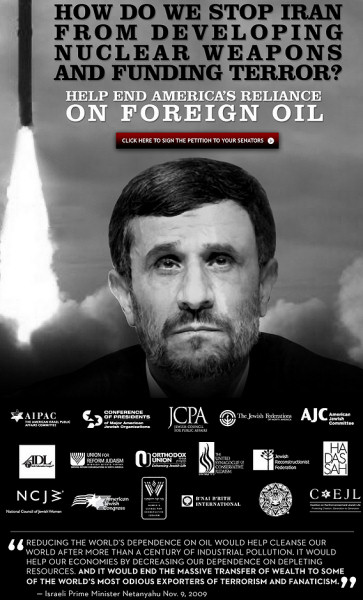
Also, the organizers say they’re actuated by fears of climate change, but why the Netanyahu quote and the emphasis on missiles?
And the NYTimes is still on message, Global Warming, Peak Oil and the War on Terror all seem to merge to support Zionism:
Letters to the International Herald Tribune – How to Fight Climate Change – NYTimes.com
The only way to effectively address climate change is for our leaders to make it an issue of national security: Emphasize the link between consumption of fossil fuels, especially foreign oil, and the rise of international terrorism. Once that link is clearly established, people will be willing to make an effort: The home-front will contribute to fighting against terrorism, which threatens every one of us. People will understand that there is no way to put a value on the lives of any of the nearly 3,000 people who perished in the Sept. 11 attacks, and that any effort is worth making to prevent recurrence of such a tragedy.
Update:
The Israel Lobby’s War on America’s Middle East Oil Dependence
By Maidhc Ó Cathail | The Passionate Attachment | October 26, 2012
See also:
US Jewish leaders push Obama to act on Iran
Jerusalem Post, September 10, 2009
Related efforts toward energy independence and war on Iran
- Obama uses Weekly Address to lobby for Israeli firm BrightSource (alethonews)
- Noam Chomsky: The Fate of Humanity Is at Stake — Why Are Romney and Obama Too Cowardly to Talk About What Really Matters? (alternet.org)
- Iran Underground Nuclear Plant Almost Finished, NY Times Says – Bloomberg (bloomberg.com)
- Earth Day in Israel: Apartheid Showing Through the Greenwash (alethonews)
US, EU states fail to isolate Iran
Press TV – August 9, 2010
As the US and its European allies are trying to increase unilateral sanctions against Iran, other major states show bold resistance to the punitive measures.
“China, Russia, India and Turkey move into the lucrative void left by US and EU sanctions that aim to halt Iran’s nuclear program,” the Los Angeles Times wrote on Sunday.
On June 9, the UN Security Council imposed a fourth round of sanctions against Iran’s military and financial sectors over allegations that Tehran is following a military nuclear program.
In recent weeks, the US, the European Union, Australia, and Canada have added unilateral measures to the UNSC sanctions, targeting the energy rich country’s oil and gas industry. But China, Russia, India and Turkey rejected the unilateral US and EU sanctions aimed at Iran’s energy sector.
The countries “are making it very clear they are not going to go along with the new American and European efforts to ratchet up pressure on Iran,” Ben Rhode, an analyst with the International Institute for Strategic Studies in London, told the Times. China’s move to expand its business Iran “has been amazing,” said a senior European official on condition of anonymity, the American newspaper said.
Iran’s Deputy Oil Minister Hossein Noqrehkar Shirazi announced last week that China is investing 40 billion dollars in Iran’s oil and gas industry.
The unilateral sanctions also gave China and Russia an opportunity to sell more gasoline to Iran.
“These countries have long-term interests in the region,” Bloomberg quoted Gary Sick, a member of the US National Security Council under Presidents Ford, Carter and Reagan, as saying on Monday. China wants “to maintain relations with Iran for the sake of maintaining some access to the oil,” Sick said.
“Looking at the political situation, I’m not sure if Europe and the US were 100 percent sure about the possible responses from places like Russia and China,” said Alexander Poegl, an analyst at JBC Energy in Vienna. “Iran will find partners supplying them gasoline,” he added.
Last week China defended its economic ties with Iran after a senior US official called on Beijing to adopt the UN sanctions against Tehran over its nuclear program.
“China’s trade with Iran is a normal business exchange, which will not harm the interests of other countries and the international community,” China Daily quoted Chinese Foreign Ministry spokeswoman Jiang Yu as saying on Thursday.
“Sanctions will not hinder us in our joint cooperation,” Sergei Shmatko, Russia’s energy minister, said last month in Moscow after signing an agreement for a long-term energy partnership with his Iranian counterpart.
Featured Video

Anthrax War – CBC The Passionate Eye
or go to
Aletho News Archives – Video-Images
Book Review
Shattered Dreams: The HPV Vaccine Exposed (2019)
By Christina England – 30 Q&As – Book Review & Summary
Lies are Unbekoming | September 4, 2026
… Gardasil received FDA fast-track approval in 2006, Cervarix followed in 2009, and Gardasil 9 was approved in December 2014 with more than double the aluminium adjuvant content of the original. The commercial context is specific. Merck was about to lose patent protection on Zocor and faced $18 billion in Vioxx injury claims from a cardiovascular drug the company had marketed while suppressing its own data showing a five-times increase in heart attacks. Analysts projected the global HPV vaccine market at $4 billion by 2011, contingent on government-funded national programs for teenage girls. The 1986 National Childhood Vaccine Injury Act had already granted manufacturers complete liability immunity. By 2013, Japan had withdrawn its HPV vaccine recommendation after cataloguing severe adverse reactions in hundreds of girls. No Western government followed. The establishment position across the UK, US, Australia, and most of Europe held, and still holds, that the vaccines are safe and effective, that reported injuries are coincidental, and that cervical cancer prevention justifies the program. The book was published into this position, not against a vacuum.
Shattered Dreams sits alongside Mary Holland’s The HPV Vaccine On Trial and Viera Scheibner’s foundational vaccination work as part of the documented record on what has been done to a generation of teenage girls under the banner of cancer prevention. The full summary unpacks three specific findings: that Merck used the aluminium adjuvant itself as the “placebo” control in 92.5% of trial subjects, making it structurally impossible to detect excess reactions from the adjuvant; that Dr. Sin Hang Lee found HPV DNA fragments bound to aluminium in every one of sixteen Gardasil samples tested, and in the blood and spleen of a New Zealand girl six months after her third dose; and that in every country with high vaccination coverage, including Australia, the UK, Norway, and Sweden, cervical cancer rates have stopped declining and started rising specifically in the vaccinated cohort. Martínez-Lavín’s 2017 calculation puts the number needed to seriously harm with Gardasil 9 at 140, and the number needed to vaccinate to prevent one case at 1,757. Thirteen young women are seriously harmed for every one who benefits. The vaccine was approved on the basis of trials that could not detect what the trials were supposed to detect, and it is still being given to twelve-year-olds today. … Read full review
Blog Roll
 Aletho News
- Georgia’s Largest Healthcare System Will Fire Employees Who Refuse Flu Vaccine
- The Five-Year Fuel Crisis: Why the World Economy Is Paying for a War It Thinks Is Ending
- Trump’s Big Bluff on Iran
- Swiss scammed out of millions by Ukraine-linked call centers – media
- Germany facing potential ‘violent conflict’ with Russia – spy chief
- Ukraine’s EU neighbors reject new plea from Kiev – Politico
- British Transport Police Facial Recognition Trial Scanned 926,912 People With Zero Arrests
- House Bill Would Ban Federal Use of Flock ALPR Data
- Can a Spice Rival a Drug? 10 Head-to-Head Trials Put It to the Test.
- The oil routes around Hormuz face their own chokepoints
- If Americans Knew
- “We See Our Homes Now From A Satellite, Like Strangers”
- Watch “Gaza: Doctors Under Attack”, originally censored by BBC
- NAZA: Israeli embassies in UK and US promote rival documentary to challenge Gaza genocide allegations
- David Ellison appoints Israeli to lead merged Paramount-Warner studios
- Turkish Red Crescent helps elderly Gaza man walk again after Israel confiscates his prosthetic limb
- Four Palestinians Killed in Israeli Attacks in Gaza
- Two Palestinian youths killed and village razed as Israeli attacks on West Bank continue
- Two more Christian women victims of Israeli raids on Gaza
- Cruelty, Deprivation, Indignity: A Journalist’s 22 Months in Israeli Prison
- New IDF Website Frames Slain Gaza Journalists as Terrorists
- No Tricks Zone
- Latest European Green Energy Debacle; Portugal’s Largest Flagship Solar Park Insolvent!
- Green Energy Debacle: German Expert Professor Fritz Vahrenholt Warns Of Severe Economic And Social Consequences
- Two More Paleo Reconstructions Affirm Meters-Higher Sea Levels Across Ireland, Brazil 7000-6000 Years Ago
- New Study: Earth And Venus Surface Warmth Largely Explained By Convection And Lapse Rate, Not CO2 Or Radiation
- 2025 Nature Paper Claiming Worsening Global Drought Gets RETRACTED …Heavily Flawed
- New Study: ‘Global Drought Shows No Detectable Recent Acceleration Under Climate Warming’
- Economic Masterminds: German Socialists Suggest Taxing Productivity Gains Stemming From Using AI
- The South China Sea Has Not Been Cooperating With The Climate Change Narrative
- Energy Crisis: Germany Enters Heating Season With Historically Low Gas Reserve Fill Levels
- New Study: The Antarctic Ice Sheet Gained Mass From 2020-2024 Due To Staggering Snow And Ice Accumulation

