Jurij Kofner: Europe Enters Century of Humiliation?
Glenn Diesen | August 20, 2025
Jurij Kofner is an economist and an economic policy advisor to AfD. Kofner discusses the de-industrialisation and economic decline in Germany, and the wider socio-economic and political challenges that continue to threaten the relevance of Europe.
China says there’s no justification for JCPOA snapback activation
Press TV – August 20, 2025
China’s mission to the United Nations has declared the country’s firm opposition to threats by European parties to the 2015 nuclear deal to activate the “snapback” mechanism within the framework of UN Security Council Resolution 2231.
The mission at the UN headquarters in New York distributed an explanatory note to the Security Council, stating that the difficult situation in implementing the JCPOA and Resolution 2231 is not the result of Iran’s actions but the disruption of the JCPOA’s implementation by the United States and the three European countries.
The statement said this cannot be an excuse to restore the anti-Iran sanctions that had been lifted under the 2015 deal.
In the note, China warned that attempts to activate the snapback could have “unpredictable and catastrophic” consequences, destroying all the diplomatic achievements of recent years.
The document said any attempt by some countries to activate the “snapback” without following the legal process would be an abuse of the Security Council’s powers and duties and would be invalid.
The note underscored Iran’s right to peaceful use of nuclear energy as a member of the NPT, calling on all parties to adhere to dialogue, mutual respect, and finding solutions that address the legitimate concerns of the international community.
China concluded by stating that it will continue to play an active role in the negotiation process and called on the Security Council to, instead of creating obstacles, pave the way for a new and lasting agreement.
As the 2015 nuclear deal nears its official end, Iran is preparing for the removal of confidence-building curbs on its nuclear program.
However, the European signatories have threatened to invoke the “snapback” mechanism, which would restore all UN sanctions on Iran that were lifted under the deal.
Western media reports indicate that three European nations have agreed to activate the snapback by the end of August if a new nuclear deal is not reached.
This move would disrupt the successful conclusion of the current agreement.
The United States and Iran had been in talks to find a replacement for the 2015 deal, but these negotiations were halted following a surprise US-Israeli aggression against Iran.
In a show of support for Iran, Russia has also publicly opposed Europe’s activation of the snapback, distributing an explanatory note to declare its position.
Alaska meeting is a milestone of the decline of NATO and EU
By Martin Jay | Strategic Culture Foundation | August 19, 2025
Is the EU and its member states collectively heading towards the abyss? For so many years analysts have thundered headlines of the flavour “end of the EU” – even myself I must admit – but in recent days the EU itself has never been placed so low on the world map as it was in the so-called Alaska meeting. A few weeks earlier, many supporters of the EU were stunned at just how pusillanimous the EU commission boss was facing Donald Trump, as she accepted 15% tariffs across the board on all EU goods entering the U.S. – absolutely amazing given there was no announcement of trade talks where officials on both sides would negotiate a more appropriate rate. This move alone revealed so much. The EU is, if nothing else, a pseudo superpower administration owned wholesale by the world’s largest corporations – like Pfizer, the U.S. drag maker who Ursula von der Leyen made part of a 600bn euro EU vaccine fund – and so it would have been absurd for her to have resisted.
And now it is the EU’s time to take another body blow as it plays a secondary role in the negotiations for a peaceful settlement for the Ukraine war. Yet few are betting on a peace deal. Even Trump himself doesn’t seem to hold out much hope as Putin has made it clear that he wants the Russian-speaking regions of eastern Ukraine to be handed over as part of the deal, plus guarantees that Ukraine can never be a NATO member.
Whether NATO will even be around in the coming months is another matter as it is worth noting that this transatlantic organization, which the U.S. runs, is currently going through its lowest point of its history, like the EU. What idiotic U.S. journalists who shout out to Putin in the press conference “are you going to stop killing civilians” don’t ask is more telling. Of course, they don’t shout out such stupid questions to Netanyahu when he visits, who is the architect of the most horrific genocide of the 21st century, where women and children who manage to miss the bombs which reign down on their tents are now starved to death – all supported by the U.S. But to Putin, U.S. journalists don’t ask “how’s the war going in Ukraine, sir?” or even “what do you think will happen to NATO if your army forces Zelensky to surrender?”.
The meeting was never going to be a deal breaker for a peace deal in Ukraine as the journalists’ temporary accommodation was a clue to that. What the Alaska meeting set out to do was for both leaders to show reverence for one another so that bigger deals can be worked out – perhaps energy and infrastructure deals in Alaska itself or even more rare earth and minerals in Russia – and if you listen carefully to Trump’s responses to questions from U.S. media, you will note the hints.
But with U.S.-Russia relations moving in a soberer, grown up direction, rather than the silly Biden stance, there are many possibilities on the table. Ukraine may well be resolved at some point if some of these super deals can see the light of day.
For the Europeans and the EU, they will have to dance to the beat of the Putin-Trump drum which makes them look even more ineffective and congruent to the bigger picture geopolitics which they crave. Same goes for NATO. Both of these institutions have poured oil on the fire in recent years by only seeing the war option – or more specifically the ‘escalate to de-escalate’ option which backfired spectacularly every single time that now to justify the huge amounts of money shovelled into a war project which cannot benefit the West, its leaders only have one narrative to repeat over and over again now, so that they can save their own jobs and credibility. War talk. More war. War, war and even more war.
It’s incredible. The EU’s top diplomat Kaja Kallas, Estonia’s former PM gave a clue recently to the tunnel vision that the EU and NATO have about the Ukraine war. They see it as the EU’s first test at hard-core foreign policy action, despite it being bank rolled by “Daddy” Trump. Probably the most delusional and idiotic quote of the month has to go to Kallas who told journalists “If Europe cannot defeat Russia how can it defeat China?”. The entire thinking is really all based on conflict rather than conflict prevention which is also about saving both NATO and the EU from its worst ever credibility crash when Russia finally defeats the Ukrainian army. These EU buffoons have created, since 2014 and even before, a war which was inevitable, which they don’t have the means, military capacity or even the leadership to win and yet their priorities now are making a massive cover-up of the failure and protecting their own dynasties. Europe is not preparing itself for war. This is the huge bluff. It is preparing itself for a huge fall which is unprecedented and may well be a catalyst for both the demise of the EU and NATO as we know them.
India Cancels Offshore Wind Tender–Due To Lack Of Interest
By Paul Homewood | Not A Lot Of People Know That | August 13, 2025
Now India is losing interest in offshore wind.
Renewablesnow report:
The Indian government has cancelled the process to allocate sea-bed lease rights for a total of 4,500 MW of offshore wind projects, it was announced on Tuesday.
While SECI itself did not state a reason for the decision in its announcement, The Economic Times quoted two sources as saying that there was a lack of interest among project developers. …
This follows Trump’s US move away from offshore wind and the lack of bidders at Germany’s offshore auction last week.
Meanwhile Orsted have had to launch a massive $9.4 billion Share Rights Issue, largely because of huge losses on offshore wind projects.
It seems that it is only the UK where anybody wants to build wind farms at sea, but only because of the obscene subsidies on offer.
Kremlin reveals details of Putin-Trump summit
RT | August 14, 2025
The summit between Russian President Vladimir Putin and his US counterpart, Donald Trump, on Friday will focus not only on the Ukraine conflict but on a broader security agenda and involve several top Russian officials, Kremlin aide Yury Ushakov has said.
Speaking to reporters on Thursday, Ushakov said that “final preparations” were underway for the meeting on Friday, which will take place at Joint Base Elmendorf-Richardson in Anchorage, Alaska. Given the short notice for the summit, “everything is being done in an intensive mode,” including tackling several technical issues, including visa-related matters, he added.
Ushakov said the summit will begin at approximately 11:30 a.m. local time (19:30 GMT) with a one-on-one conversation between Putin and Trump, accompanied by interpreters. “Then, there will be negotiations in the format of delegations, and these negotiations will continue over a working lunch,” he said.
The Kremlin aide noted the very high level of the Russian delegation, which he said would include Foreign Minister Sergey Lavrov, Ushakov himself, Defense Minister Andrey Belousov, Finance Minister Anton Siluanov, and Special Presidential Representative for Investment and Economic Cooperation with Foreign Countries Kirill Dmitriev, who has been a key figure in the Ukraine settlement process.
“In addition to the presidents, five members from each delegation will participate in the negotiations,” he said, adding that “of course, a group of experts will also be nearby.”
Regarding the agenda, it is “obvious” that the central issue in the talks will be the Ukraine conflict, Ushakov said, adding, though, that “broader objectives of ensuring peace and security will also be addressed, as well as current and most acute international and regional issues.”
There will also be an exchange of views “regarding the further development of bilateral cooperation, including in the trade and economic spheres,” Ushakov noted, adding that such ties have “enormous and, unfortunately, still untapped potential.”
Ushakov confirmed that Putin and Trump will not only deliver a short opening statement but also hold a joint press conference after the talks. He said the duration of the talks “would depend on how the discussion goes” and confirmed “the delegation will return [to Russia] immediately after the negotiations conclude.”
Iran overcomes heavy US sanctions and war with Israel, takes over key energy export markets
Inside China Business | August 12, 2025
China is a top buyer of Iranian crude, taking 90% of its crude exports. But Iran has recently passed Saudi Arabia, the UAE, and Qatar as the top producer and exporter of NG products, bringing in billions more. Ambitious expansions of their petrochemical industry are also ongoing. Iranians report little difficulty in business operations among different currencies, despite the US Treasury Department’s blacklisting of key energy suppliers, and firm control over the SWIFT systems.
Closing scene, Beihai, Guangxi
Resources and links: Iran Defies US Sanctions With Surging Exports of Liquefied Petroleum Gas https://www.bloomberg.com/news/articl…
Bloomberg, Iranian Oil Production Booms Amid the Bombs https://www.bloomberg.com/opinion/art…
S&P Global, Iran’s petrochemicals defy sanctions as exports, output on the rise https://www.spglobal.com/commodity-in…
Iran announces 15 petrochemical projects to expand domestic production to nearly 80 MMtpy https://www.hydrocarbonprocessing.com…
EU state blasts Ukraine over key pipeline attack
RT | August 13, 2025
Hungary has lashed out at Ukraine over a drone strike on Russia’s Druzhba oil pipeline system, a key supply route to EU countries, warning that the attack endangered its energy security.
Druzhba is one of the world’s longest networks, transporting crude some 4,000km from Russia and Kazakhstan to refineries in the Czech Republic, Germany, Hungary, Poland, and Slovakia.
In a post on X on Wednesday, Hungary’s Foreign Minister Peter Szijjarto wrote that “overnight, Ukraine launched a drone strike on a key distribution station of the Druzhba oil pipeline in Russia’s Bryansk Region.”
According to media reports, multiple Ukrainian drones struck Russia’s Bryansk Region on Tuesday night, sparking fires at several sites. One target was the Unecha station, a major hub in the Druzhba oil pipeline linking Russia and the EU.
The Ukrainian General Staff confirmed the attack on the pumping station in a Facebook post. Russia has so far not commented on the alleged incident.
Szijjarto called the attack “outrageous,” saying the pipeline is vital to Hungary’s energy security given that the country relies on oil shipments through the system.
He also noted that Hungary is Ukraine’s “number one electricity supplier” and that without it Ukraine’s energy security would be “highly unstable.” He urged Kiev to stop endangering Hungary’s energy supplies and to halt strikes on routes “in a war we Hungarians have nothing to do with.”
Ukraine has repeatedly targeted Russian energy infrastructure throughout the conflict, including the Druzhba system. In March, the Ukrainian General Staff confirmed having targeted the oil pipeline.
In January, Ukrainian forces attempted to attack a compressor station of the TurkStream pipeline, which supplies natural gas to Turkish customers and several European countries, including Hungary, Serbia, Bulgaria, Slovakia, Bosnia and Herzegovina, and Greece.
Russian officials have repeatedly condemned Ukrainian attacks on civilian energy infrastructure, labeling them acts of terrorism.
Why both sides want the Putin-Trump Alaska summit to succeed
By Dmitry Suslov | RT | August 13, 2025
On Friday, Vladimir Putin and Donald Trump will meet in Alaska. This will be the first full-scale Russia-US summit since June 2021 in Geneva, and the first official visit by a Russian president to American soil since Dmitry Medvedev’s trip in 2010 at the height of the “reset.”
It will also be the first time the leaders of Russia and the US have met in Alaska, the closest US state to Russia, separated only by the narrow Bering Strait, and once part of the Russian Empire. The symbolism is obvious: as far as possible from Ukraine and Western Europe, but as close as possible to Russia. And neither Zelensky nor the EU’s top brass will be in the room.
The message could not be clearer – Moscow and Washington will make the key decisions on Ukraine, then inform others later. As Trump has said, “they hold all the cards.”
From Geneva to Alaska: A shift in tone
The Alaska summit marks a sharp departure from the Biden years, when even the idea of such a meeting was unthinkable and Washington’s priority was isolating Russia. Now, not only will Putin travel to Alaska, but Trump is already planning a return visit to Russia.
Moderate optimism surrounds the meeting. Summits of this type are rarely held “just to talk”; they usually cap a long process of behind-the-scenes negotiations. The idea for this one emerged after three hours of talks in Moscow on August 6 between Putin and Trump’s special envoy, Steve Witkoff. Russian presidential aide Yuri Ushakov described Washington’s offer as “very acceptable.” That suggests Putin and Trump will arrive in Alaska with a preliminary deal – or at least a framework for a truce – already in place.
Why Trump needs this
Trump has good reason to want the summit to succeed. His effort to squeeze Moscow by pushing China and India to stop buying Russian oil has backfired badly. Far from isolating Russia, it triggered the worst US-India crisis in 25 years and drove New Delhi even closer to Moscow. It also encouraged a thaw between India and China, with Prime Minister Narendra Modi now set to attend the SCO summit in Tianjin.
BRICS, which Trump has openly vowed to weaken, has only grown more cohesive. The Alaska summit is Trump’s chance to escape the trap he built for himself – trying to pressure Moscow through Beijing and New Delhi – and to show results on Ukraine that he can sell as a diplomatic victory.
Why Russia does too
For Moscow, a successful summit would be a powerful demonstration that talk of “isolation” is obsolete – even in the West. It would cement Russia’s standing with the “global majority” and highlight Western Europe’s diminished influence. The transatlantic split would widen, weakening Brussels’ claim to be Russia’s toughest opponent.
Most importantly, Washington today has little real leverage over Russia, especially on Ukraine. If the summit yields a joint Russian–American vision for a truce or settlement, it will inevitably reflect Moscow’s position more than Kiev’s or Brussels’. And if the Western Europeans try to derail it, the US could pull the plug on all aid to Ukraine – including intelligence support – accelerating Kiev’s defeat.
Resistance at home and abroad
Not everyone in Russia is cheering. Many prominent “Z”-aligned war correspondents see the war as unfinished and oppose any truce. But they have been asked to stick to the official line. If the Alaska meeting produces a deal, they will be expected to back it – or at least use “cooling” language for their audiences. The Kremlin is betting it can manage this dissent.
Western Europe, for its part, will be watching from the sidelines. Its leaders are “scrambling” for scraps of information via secondary channels. The optics will underline a humiliating reality: for the first time in almost a century, decisions about Europe’s security will be made without the likes of Italy, France and Germany in the room.
Beyond Ukraine
The location hints at other agenda items. Arctic economic cooperation, largely frozen since 2014, could be revived. Both sides stand to gain from joint development in the far north, and a deal here would be politically symbolic – proof that the two countries can work together despite the baggage of the last decade.
Arms control will also be on the table. Moscow’s recent decision to end its unilateral moratorium on deploying intermediate-range missiles was almost certainly timed to influence the talks. Strategic stability after the New START Treaty expires in February 2026 will be a central concern.
The stakes
If Alaska delivers, it could reshape the conflict in Ukraine and the broader Russia-US relationship. A joint settlement plan would marginalize Kiev and Brussels, shift the diplomatic center of gravity back to Moscow and Washington, and reopen channels for cooperation on global issues – from the Arctic to arms control.
If it fails – if Trump bends to last-minute EU pressure – Moscow will continue fighting, confident that US involvement will fade. Either way, Russia’s position is stronger than it was two years ago.
What’s different now is that the two powers with “all the cards” are finally back at the same table – and Western Europe is on the outside looking in.
Dmitry Suslov, member of the Russian Council on Foreign and Defense Policy, deputy director of World Economy and International Politics at Moscow’s Higher School of Economics, and Valdai Club expert.
Ditching Gazprom Costs Moldova $1.16Bln Annually – Shoigu
Sputnik – 11.08.2025
In his article Moldova at a Crossroads for Sputnik, Russian Security Council Secretary Sergei Shoigu called Chisinau’s refusal to buy gas directly from Gazprom “a shot in the foot”, since the Moldovan budget loses more than 1 billion euros ($1.16 billion) a year from this.
“The refusal of the ‘yellow’ government to buy natural gas directly from Gazprom (although the republic still receives the same Russian gas from Europe) can hardly be called anything other than a shot in the foot. As a result, Moldova is forced to buy energy resources on the European market at inflated prices, which makes the budget annually lose more than 1 billion euros,” Shoigu said.
Since 2021, Moldova has had a government formed by the Party of Action and Solidarity (PAS), created by the incumbent president of the country, Maia Sandu. Next parliamentary elections in Moldova are scheduled for September 28, 2025.
The National Agency for Energy Regulation of Moldova previously reported that it had revoked Moldovagaz’s license to supply gas to local consumers. These rights will be transferred to the state-owned company Energocom by September 1. The decision was made in connection with Chisinau’s obligations to the EU to separate the gas infrastructure as part of the implementation of the Third Energy Package. The deprivation of Moldovagaz’s license to supply gas cannot be considered otherwise than the final stage of depriving Gazprom of its investment target; the Russian company will continue to protect its legal rights and interests by all available means, Gazprom said in turn. The Russian company owns 50% of Moldovagaz.
Europe’s Sad Trajectory: From Peace and Welfare to War and Scarcity
By Ricardo Martins – New Eastern Outlook – August 11, 2025
Once a beacon of peace and prosperity, the European Union is now marching into a new era of militarization and scarcity. Behind the rhetoric of security lies a project increasingly shaped by U.S. pressure, defense spending, and a quiet betrayal of its citizens.
For seven decades, the European project was presented as a beacon of peace, prosperity, and social welfare. Conceived in the ashes of the Second World War, the European Union (EU) emerged as a mechanism to bind former enemies through trade, shared institutions, and the promise that economic interdependence would prevent future wars. For much of its history, this narrative held true: the EU embodied the idea that Europe could reinvent itself as a moral community, anchored in social rights and collective security.
Today, that image is eroded. Europe is rearming at a scale unseen since the Cold War. The EU’s once-proud welfare model is being quietly sacrificed on the altar of militarization, as member states contemplate devoting up to 5% of GDP to defense spending. This transformation is not being driven by a sovereign European strategic vision, but rather by external pressure, primarily from the United States, whose military-industrial complex stands to benefit most.
From Peace Project to War Economy
The metamorphosis of the EU into what critics call a “war and scarcity” project is evident in both policy and rhetoric. European leaders, rather than articulating an independent security doctrine, appear increasingly subordinated to Washington’s priorities. The newly appointed NATO Secretary General and former Dutch Prime Minister, Mark Rutte, has become the face of this transformation.
During the so-called “Trump Summit” in The Hague, Rutte orchestrated an event less about strategy and more about appeasing U.S. President Donald Trump. Red carpets and ceremonial dinners replaced substantive debate. The summit, critics note, projected unity only by avoiding difficult questions, such as the long-term consequences of escalating the conflict in Ukraine or the feasibility of a 5% defense spending target.
Rutte even echoed unverified intelligence claims that Russia might attack a NATO member, offering no evidence, an act that some European observers described as “dangerous theatre.”
When NATO’s chief becomes a conduit for speculative threats to spread fear and make the militarization project palatable to the population, the alliance risks losing credibility and reinforcing the perception that Europe is less a sovereign actor and more a vassal of U.S. power.
The Costs of Militarization
The push toward 5% GDP in defense spending has profound implications for European societies. Bulgarian member of the European Parliament Petar Volgin, in an interview, warned that such a policy would neither enhance security nor foster stability. History shows that the accumulation of weapons often escalates risk rather than prevents conflict. Volgin invoked Anton Chekhov’s famous maxim: if a pistol hangs on the wall in the first act, it will inevitably be fired by the final one.
Beyond strategic risks, the economic trade-offs are stark. Channeling public resources into armaments will drain investments from social sectors like health, education, and welfare, which are the very foundations of the European social model. “This will turn Europe into a militarized monster devoid of social compassion,” Volgin warned.
Citizens, facing cuts in services and rising costs, will pay the price for a strategy that ultimately benefits the U.S. arms industry far more than European security, following Trump’s ruling.
Russophobia and the War Logic
Underlying this shift is what can be described as institutionalized Russophobia. Russophobia has become not just public opinion but a structured ideology shaping policy, media narratives, and diplomatic strategies.
While the focus is on Russian military action in Ukraine, the EU’s strategic response is viewed through the lens of historical Russophobia, which often replaces pragmatism with emotion and prejudice.
For centuries, Russia has been both part of and apart from Europe, contributing profoundly to its literature, music, and intellectual heritage, yet frequently treated as an alien civilization.
The military conflict in Ukraine provided an opportunistic moment for European elites to turn latent Russophobia into policy. Rather than pursuing a balanced security framework that might eventually integrate Russia into a stable European order, the EU doubled down on confrontation, sanctions, and militarization.
This approach carries a profound irony: a union born from the determination to overcome the hatreds of the past is now entrenching new fault lines on the continent. Calls for diplomacy, dialogue, or a broader European peace project, one that is social and moral, not merely military, have been marginalized or dismissed as naïve.
Democratic Disconnection and Strategic Drift
Perhaps the most troubling aspect of Europe’s new trajectory is the widening gap between its political class and its citizens. Surveys conducted in the first year of the Ukraine war showed that over 70% of Europeans preferred a negotiated peace to the indefinite prolongation of conflict. Yet, in the European Parliament, 80% of MEPs rejected amendments calling for diplomacy and only 5% voted in favor.
This dissonance reflects a structural malaise: the EU’s foreign and security policy is increasingly shaped not by democratic debate, but by lobbyists, bureaucratic inertia, and transatlantic pressures.
The shift from a welfare-oriented project to a war-driven agenda has happened without meaningful public consent. As Clare Daly and Mick Wallace, former Irish MEPs, have argued, the EU’s “liberal mask has slipped,” revealing a political architecture that prioritizes geopolitics over people.
War and Scarcity: A Vicious Cycle
The economic consequences of this transformation are already visible. Sanctions on Russia, while politically symbolic, have contributed to energy crises, inflation, and industrial slowdown, particularly in countries like Germany and Italy. Simultaneously, EU states are paying far higher prices for American LNG and U.S.-manufactured weapons, effectively transferring wealth across the Atlantic while their own populations face rising costs and stagnating wages.
This is the essence of Europe’s scarcity turn: by embracing a war economy, the EU sacrifices its social welfare model, undermines economic resilience, and fuels domestic discontent and the far-right parties. Instead of projecting stability, it imports volatility: economic, political, and social.
The Question of Purpose
The European Union now stands at a decisive moment in its evolution. If its purpose is to be a subordinate military bloc within a U.S.-led “Greater West,” it may achieve that at the cost of its original identity as a peace and welfare project.
However, if it seeks to reclaim strategic autonomy and moral credibility – deteriorated by its failure to condemn the genocide in Gaza -, it must confront uncomfortable questions: Can Europe imagine security beyond the logic of militarization and vassalage? Is Europe merely buying time, waiting for a non‑Trump administration, while reinforcing its subservience? Will it rebuild a peace project that addresses social justice and democratic legitimacy, not only deterrence? And can it rediscover the moral ambition that once made it a beacon for a conflict‑scarred world?
For now, the EU’s sad trajectory seems clear: a union that once promised prosperity and peace is becoming a fortress of fear and social uncertainty, defined by war spending, scarcity, and subservience. Its citizens were promised a shared future. What they are receiving instead is a militarized present, and an uncertain tomorrow.
Foreign investors disappear from US Treasury auctions, as China borrows at the lowest rates ever
Inside China Business | August 10, 2025
A staggering $11 trillion in US government debt needs to be borrowed or refinanced over the next 12 months.
Treasury Department officials are faced with painful choices, whether to borrow at very high rates, locked in for ten years or longer? Or instead borrow for one year or less, but at massive volumes?
Foreign governments and pension funds are also showing far less interest in absorbing new US government bonds, and are demanding ever-higher yields to compensate for inflation and policy risk.
China’s government, however, can borrow at far below half the rate Washington pays, across all maturities. And Chinese companies are paying the lowest interest rates in their history to access new capital. That represents a long-term structural advantage to Chinese policymakers and industry.
Closing scene, Hong Kong South China Morning Post, China cuts US Treasury holdings for third month amid trade war, debt ceiling fears https://www.scmp.com/economy/china-ec…
Zerohedge, Yields Spike After Very Ugly, Tailing 30Y Auction Sparks Steepening Fears https://www.zerohedge.com/markets/yie…
ZH, Very Ugly, Tailing 10Y Auction Sees Slide In Foreign Demand, Plunge In Bid To Cover https://www.zerohedge.com/markets/ver…
ZH, Ugly, Tailing 3Y Auction Sees Worst Foreign Demand Since 2023 https://www.zerohedge.com/markets/ugl…
Managing Risk in the Face of Historic U.S. Debt Refinancing https://www.tradingcentral.com/market…
What Is Happening with Mortgage Interest Rates? https://www.schwab.com/learn/story/wh…
How the Federal Reserve Actually Affects Mortgage Rates https://www.cnet.com/personal-finance…
Wall Street Journal, Trump and Bessent Bring New Style to Managing America’s Debt https://www.wsj.com/finance/investing…
Banking on the Belt and Road: Insights from a new global dataset of 13,427 Chinese development projects https://docs.aiddata.org/ad4/pdfs/Ban…
China 10-Year Government Bond Yield https://tradingeconomics.com/china/go…
What do falling Chinese yields tell us? https://www.dws.com/insights/cio-view…
X, Corporate borrowing costs in the US have never been lower than China’s today https://x.com/UnHedgedChatter/status/…
The geopolitics of India-US ‘trade war’
By Salman Rafi Sheikh – New Eastern Outlook – August 10, 2025
By slapping tariffs on India and linking them to its ties with Russia, the Trump administration exposed its willingness to strong-arm New Delhi into submission.
Unless India pulls off a dramatic reset with China—and thus reduce its dependence on the US for military support—it will remain caught between appeasing Washington and defending its strategic autonomy.
When the US President announced sweeping 25% tariffs on Indian goods in late July, his tone marked a jarring departure from the warmth once displayed toward New Delhi. Only months earlier, he had welcomed Prime Minister Narendra Modi to the Oval Office, hailing him as a “great friend” and celebrating the US-India relationship as a partnership destined for global leadership. Now, with the stroke of a Truth Social post, India is recast not as an ally, but as an economic adversary.
This abrupt reversal speaks volumes. The President’s social media declarations—accusing India of being a “dead economy”—ignored not only diplomatic decorum but economic reality. India is the world’s most populous nation and the fifth-largest economy, a critical player in global markets and geopolitics alike. To dismiss it so flippantly is to misunderstand the arc of global power.
But beyond the bluster lies a deeper provocation. Washington’s veiled threat—imposing additional, unspecified penalties on India over its continued oil trade with Russia—underscores a troubling shift in US foreign policy: coercion in place of collaboration. The implicit bargain offered to New Delhi is clear—cut ties with Moscow, and the US may relent on tariffs and even entertain a trade deal. Refuse and face economic punishment.
Why Trump Wants India to Submit
When Donald Trump referenced oil in the context of US-India relations, it wasn’t his only focus. A quieter, yet strategically significant, concern involved India’s long-standing defense ties with Russia. For decades, New Delhi has been one of Moscow’s most reliable customers in the global arms market. While India’s reliance on Russian military hardware has declined—from 55% of total imports in 2016 to an estimated 36% in 2025—Russia remains India’s top defense supplier.
To the Trump administration, however, this decline is an opening that must be exploited for American gains. A shrinking Russian share in India’s defense market presents the perfect opportunity to push more US-made military systems as replacements. In doing so, Washington hopes to edge out Moscow and deepen strategic ties with New Delhi in the process.
Signs suggest India may already be leaning toward such a transition. According to Indian defense media reports, the Indian Air Force (IAF) recently advised the government to prioritize acquiring US-made F-35 fighter jets instead of the fifth-generation aircraft offered by Russia earlier this year. Until now, India had remained undecided, caught between its historical ties with Russia and its evolving strategic calculus. However, should New Delhi proceed with the F-35 acquisition, it would mark a significant shift—not just symbolically, but financially and strategically. The Indian government reportedly plans to induct over 100 F-35s by 2035, an investment expected to run into billions of dollars, directly boosting the US defense sector. More importantly, such an investment will lock India as a firm US ally. As far as the Trump administration is concerned, this would also lend substance to Trump’s “Make America Great Again” agenda by channeling substantial foreign capital into the American economy.
As far as New Delhi is concerned, inducting F-35s could help bolster its regional standing vis-à-vis China and the latter’s continuous injection of its state-of-the-art defence technology into Pakistan, including its air-force. Indian defence analysts claim that this induction will allow India to avoid any more loses in aerial battles like the ones it suffered in its war with Pakistan in May.
What India Can Do
Yet, New Delhi’s strategic choices are far more complex than they might initially appear. Even if India opts to procure the F-35 fighter jets, it is far from certain that the US would permit their use in an offensive capacity against Pakistan—especially considering Washington’s increasingly cooperative ties with Islamabad. For context, Pakistan itself is restricted from employing its US-supplied F-16s for offensive operations against India. This raises a critical question for Indian policymakers: will a deepening defense relationship with the US genuinely enhance India’s air power posture vis-à-vis Pakistan, its principal adversary in South Asia?
The timing of New Delhi’s public disclosure of the Indian Air Force’s interest in F-35s—just days before a crucial deadline—was no accident. It seemed designed to sway the Trump administration’s position on trade tariffs. But the gambit failed to yield any concrete concessions. The episode underscores a deeper and more troubling question: should India continue to allow the US to exert disproportionate influence over its defense procurement and broader foreign policy?
This incident should prompt serious introspection among Indian policymakers. Rather than leaving its strategic vulnerabilities open to manipulation, India could take steps to insulate its foreign policy from external pressure. One pragmatic approach would be to normalize and even strengthen ties with regional competitors like China—an idea already gaining quiet traction. New Delhi has recently revived visa services with Beijing, and bilateral trade talks are beginning to show signs of momentum.
Interestingly, President Donald Trump’s remarks about “not doing much business with India” were widely interpreted as a thinly veiled reference to India’s growing economic engagement with China. In essence, Washington seeks to mold India’s foreign policy—particularly its relationships with China and Russia—to align more closely with American strategic interests. Should India capitulate to that pressure, it risks downgrading its role from an emerging regional power to a junior partner dependent on Washington for strategic direction.
India’s foreign policy establishment is now at a pivotal juncture. The choices made in the coming years will not just determine the shape of the country’s defense acquisitions or trade policies—they will define India’s role on the world stage for decades to come. If New Delhi is to maintain its claim to strategic autonomy, it must resist the temptation to shape its policies in reaction to US expectations.
Salman Rafi Sheikh, research analyst of International Relations and Pakistan’s foreign and domestic affairs
Featured Video
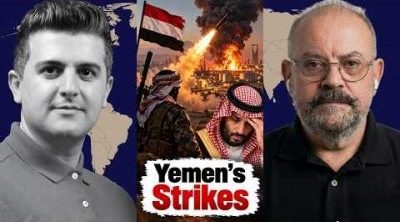
Elijah Magnier: Yemen’s strikes are shattering Saudi Arabia’s long-term strategy
or go to
Aletho News Archives – Video-Images
From the Archives
British weapons and personnel doing much of the killing in Yemen
Press TV – June 18, 2019
A detailed report published by the Guardian newspaper has shown how Britain is massively contributing to Saudi Arabia’s devastating war on Yemen as it suggests that London is not only supplying the bombs that fall on Yemenis, but it provides the personnel and expertise that keep the war going.
The comprehensive report by Arron Merat published on Tuesday showed that Britain was doing much of the killing in Yemen as the country continues to provide Saudi Arabia with everything it needs to turn its southern impoverished neighbor into a graveyard.
“Every day Yemen is hit by British bombs – dropped by British planes that are flown by British-trained pilots and maintained and prepared inside Saudi Arabia by thousands of British contractors,” said Merat in the report. … continue
Blog Roll
 Aletho News
- Racist Seinfeld Dances for Joy as Bibi Unveils His New Map
- A West Bank War for Netanyahu’s Election Campaign, Could It Backfire?
- Yemen denounces European Parliament’s ‘hypocritical’ push to blacklist Ansarullah
- Qalibaf: UAE’s UN bid aims to ‘clear the runway’ for ‘Greater Israel’, whitewash genocide
- Pakistan reopens Iran border after boosting security: Report
- Why are so many Brazilians voting for Flávio Bolsonaro?
- Democrats Put Anti-Russia Agenda Ahead of American Workers
- Elijah Magnier: Yemen’s Strikes Are Shattering Saudi Arabia’s Long-Term Strategy
- Pentagon designates Chinese cultural centers national security threat
- Israel Demolishes Home Of Lebanese Journalist Whose Viral Film Exposed Pager Attack
- If Americans Knew
- An error has occurred; the feed is probably down. Try again later.
- No Tricks Zone
- Sudden Stratospheric Warming, Powerful El Niño Combination May Lead To Extreme Europe Cold, Energy Crisis!
- Two New Studies Find Thwaites Glacier Melt Cannot Be Driven By Human Activity Or A Warming Ocean
- E-Cars Reduce CO2 Emissions By Only 41% Compared To Internal Combustion Engine Vehicles
- Predictions Made By Renowned Climate Professor Over Past Decades Have Been Proven To Be Poor
- New Study Suggests Large Regions Of The Pacific Ocean Have Been Cooling For The Last 80 Years
- Germany’s Green Energy Debacle: High Energy Costs Force Kahla Porzellan to Close After 182 Years!
- New Study: 50 Years Of The Most Aggressive ‘Net Zero’ Policies Can Only Affect The Global Climate By 0.03°C
- US September “Heat” Was No Record…Many Records Set Decades Ago
- Latest European Green Energy Debacle; Portugal’s Largest Flagship Solar Park Insolvent!
- Green Energy Debacle: German Expert Professor Fritz Vahrenholt Warns Of Severe Economic And Social Consequences

