‘America Must Avoid Following Europe into the CO2 Storage Rabbit Hole’
Texas Public Policy Foundation
Brussels Forces Energy Companies Into Expensive Climate Theater
The European Commission just delivered a wake-up call that Americans ignore at their own peril. In a sweeping new mandate, Brussels is forcing 44 oil and gas companies across Europe to build massive underground CO2 storage facilities by 2030.
Under the newly adopted Net-Zero Industry Act, European energy producers must collectively provide 50 million tons of annual CO2 injection capacity by 2030. The requirements, and costs, for individual companies are massive. Nederlandse Aardolie Maatschappij, the Dutch energy giant, now faces a mandate to store 6.35 million tons of CO2 annually. OMV PETROM must handle 5.88 million tons, while Romania’s SNGN ROMGAZ is on the hook for 4.12 million tons.
These companies have until June 30, 2025, to submit detailed plans showing exactly how they’ll meet these arbitrary government targets. European officials frame this as making oil and gas companies “part of the solution,” but the reality tells a different story. This massive regulatory burden will force energy companies to redirect billions of dollars from their core mission—producing reliable, affordable energy—into speculative technology with a deeply troubled track record.
The Inconvenient Truth About Carbon Capture
Here’s what Brussels bureaucrats don’t want to admit: carbon capture and storage simply doesn’t work as advertised. Despite decades of development and billions in investment worldwide, not one single CCS project has ever reached its target CO2 capture rate. The industry loves to talk about achieving 95% capture rates, but no existing project has consistently captured more than 80% of carbon emissions.
Projects from Algeria to Texas tell the same story: cost overruns, delays, and performance failures. For the hundreds of CO2 disposal projects currently being proposed around the world, there’s remarkably little solid information about whether their underground storage sites will actually work long-term.
Even if these technologies worked perfectly, the numbers are sobering. The Intergovernmental Panel on Climate Change estimates that carbon capture will account for only 2.4% of global carbon mitigation by 2030. Capturing and storing CO2 from power plants still costs more than $100 per ton of CO2, higher than even the Biden administration’s estimate for the social cost of carbon. Needless to say, cost-benefit analysis must be thrown out when there is a “climate crisis” to solve.
The Real Cost: Your Energy Bill
What does this mean for ordinary Europeans? Higher energy costs, plain and simple. When governments force energy companies to spend billions on unproven technology instead of investing in reliable energy production, consumers pay the price. Every euro diverted to these mandated CO2 storage projects is a euro not spent on maintaining and expanding the energy infrastructure that keeps the lights on and homes warm.
This isn’t theoretical. European families are already struggling with some of the world’s highest energy costs, and these new mandates will only make things worse. Energy companies will have no choice but to pass these massive compliance costs on to their customers. The result is less money in family budgets that are already paying the world’s highest energy prices, and higher costs for European businesses trying to compete in global markets.
America’s Dangerous Drift Toward European-Style Energy Policy
Unfortunately, the United States is already following Europe down this costly path. The Inflation Reduction Act expanded and extended the 45Q tax credits that subsidize carbon capture projects. These credits offer $85 per ton for capturing CO2 from power plants and industrial facilities and an eye-watering $180 per ton for direct air capture technology. The Treasury Department estimates that the credits will cost taxpayers $25 billion over the next 10 years.
Taxpayer money flows to unproven technology while reliable energy sources face increasing regulatory pressure. And while Congress looks set to heavily scale back tax credits for wind and solar, it is not touching these 45Q credits.
Thankfully, the Trump administration is set to overturn the newest iteration of the Clean Power Plan, which was set to mandate CO2 capture for all gas and coal power plants. We hope that in due time the Supreme Court will put an end to the insanity of the federal government’s attempts to regulate CO2 emissions and that Congress will bury the 45Q program. Until then, Life:Powered will be fighting to save your electric bill and your tax bill from the cost of fruitless carbon capture mandates and subsidies.
China accuses US of violating trade truce
RT | June 2, 2025
The US has “seriously” violated the latest trade deal between Washington and Beijing, the Chinese Ministry of Commerce said on Monday, vowing to take measures to defend China’s interests. The accusation followed similar claims made by US President Donald Trump against Beijing.
Under the deal announced on May 12 following breakthrough negotiations in Geneva, the world’s two largest economies agreed to suspend most new tariffs imposed since early April, pending further talks.
“If the US insists on its own way and continues to damage China’s interests, China will continue to take resolute and forceful measures to safeguard its legitimate rights and interests,” the ministry said in a statement. It went on to claim that the White House violated the consensus reached between Trump and Chinese President Xi Jinping during their most recent conversation earlier this year.
Among the US actions listed by the ministry were global warnings against the use of Huawei chips, the suspension of chip design software sales to Chinese companies, and the cancelation of visas for Chinese students.
On Friday, Trump lashed out at the Chinese government, claiming that the agreement had been “totally violated” by Beijing, without providing details. He added that China had been in “grave economic danger” as a result of the tariffs before Washington stepped in with the “fast” deal.
Under the terms of the deal reached in Switzerland, the 34% tariff hikes introduced on April 2 were paused for 90 days, with Beijing taking reciprocal measures. Both sides also committed to rolling back tariff increases introduced since April 8, while maintaining a baseline of 10% on mutual imports. China additionally agreed to ease certain non-tariff measures, such as export controls on US goods.
Last week, US Trade Representative Jamieson Greer claimed that China had not removed specific non-tariff barriers as agreed under the deal. Treasury Secretary Scott Bessent echoed this sentiment, stating that the talks were “a bit stalled” and might require direct involvement from Trump and Xi.
Beijing responded by calling on Washington to immediately correct “its erroneous actions,” cease discriminatory restrictions against China, and jointly uphold the consensus reached at the high-level talks in Geneva.
Tensions between the two economic powers escalated on April 2, when Trump introduced broad new tariffs targeting over 90 countries, including China, citing concerns over the trade deficit. China retaliated, launching a tit-for-tat trade standoff in which tariffs increased to 145% and 125%, respectively, on mutual imports by Washington and Beijing.
Iran and Russia: Three steps into strategic convergence
By Hazal Yalin | The Cradle | June 2, 2025
As Iran prepares for an official state visit by Russian President Vladimir Putin, the political signal could not be clearer: Iran and Russia are intent on formalizing their deepening partnership amid a global order in flux.
Iranian officials have confirmed that preparations are underway, even if the Kremlin has yet to set the date. For both countries – under siege from western sanctions and entangled in regional flashpoints – this visit is more than a ceremony; it marks an intensifying convergence of strategic purpose.
Putin’s trip follows a string of high-level engagements with his Iranian counterpart, President Masoud Pezeshkian, who took office in July of last year. Since then, the two leaders have met three times: in Ashgabat in October, in Kazan at the BRICS summit, and in January in Moscow to ink a long-term defense agreement. In the post-Ukraine war calculus, few relationships carry the same weight as the Islamic Republic in Russia’s pivot eastward.
Economic convergence through the EAEU
Ties between Tehran and Moscow have never advanced in a straight line. Even in their most frictionless periods, progress required determined effort. Still, three crucial milestones passed over the past year suggest that their bilateral relationship is set to accelerate.
The first milestone came on 25 December 2024, when Iran joined the Eurasian Economic Union (EAEU) as an observer member state. Initially seen as a post-Soviet mechanism to deepen regional economic ties, the bloc’s broader ambitions – particularly from Moscow’s perspective – quickly became clear. Iran’s accession had been a long-standing Russian objective since at least the mid-2010s.
The path to membership began in 2018 with a provisional agreement, but was drawn out by two key factors. The first was Israel’s negotiations with the bloc over free trade zones – launched despite a 2016 framework deal – which appeared designed to sabotage Iran’s entry. They largely succeeded.
The more substantive obstacle was internal. Under former Iranian president Hassan Rouhani, whose administration tilted westward, the EAEU was seen more as leverage in western talks than a genuine priority. By contrast, late Iranian president Ebrahim Raisi, a strong advocate of Iran’s ‘Look East’ policy, placed higher strategic value on deepening ties with Russia, propelling Iran’s EAEU bid forward.
By 2023–2024, trade between Iran and EAEU states hovered around $3.5 billion. The new agreement slashed tariffs: Iranian duties on EAEU goods dropped to 4.5 percent, while the bloc’s tariffs on Iranian exports fell from 6.6 to 0.8 percent.
Within five to seven years, trade volume is projected to hit $18–20 billion – a substantial gain for a petro-economy whose $60 billion in exports are more than 80 percent oil and gas. The bloc may also serve as a conduit to third-country markets.
Iran’s membership holds political as well as economic value for Moscow. Chief among these is the International North-South Transport Corridor (INSTC), a 7,200-kilometer route connecting St. Petersburg to Mumbai via Iranian territory. Completion of the Chabahar–Mumbai leg depends on India-Iran ties; the corridor’s viability also requires modernizing the Caspian Sea route–a project that gained urgency post-2022.
BRICS … and a whopping strategic partnership
Politically, the Kremlin’s need to forge a multipolar alliance structure – not a full-fledged global bloc, but a web of regional coalitions – has grown as confrontation with the west intensifies.
In this context, Iran’s accession to BRICS on 1 January 2025 marked the second major milestone. BRICS remains politically disjointed – a union of unequals – but its economic logic is compelling. It enables preferential access to massive markets and encourages bilateral flexibility between members.
Though it may not directly shape Iran–Russia relations, BRICS allows both states to expand cooperation in media, culture, and tourism – deepening their ties beyond traditional economic or military frameworks.
But the most consequential event of the year was the signing of a comprehensive strategic cooperation agreement between Tehran and Moscow. As with Iran’s drawn-out EAEU accession, the talks revealed lingering distrust. Negotiations began after Russia’s February 2022 military intervention in Ukraine.
Russia’s motives were transparent: Boxed in by NATO, Moscow sought to strengthen military alliances with regional powers and reap associated economic benefits.
The model agreement was the “comprehensive strategic partnership” signed with North Korea, which included commitments to scale up trade and a mutual defense clause. If either party is attacked or drawn into war, the other pledges to assist “by all means.”
A similar clause was expected in the Iran–Russia agreement, but never materialized. Instead, the pact reads more like a memorandum of understanding than a military alliance. The gap between its title and substance suggests unresolved disagreements during talks.
Two issues caused the rift. First, Moscow demanded that any military assistance be predicated on Tehran’s position being legally airtight under international law – lest Russia be entangled in a nuclear conflict with Tel Aviv. The definition of “aggression” became a flashpoint: What Tehran labels a provocation, Moscow feared Tel Aviv could call a justified “response.”
Second, the scope of assistance – especially the categorical exclusion of nuclear weapons – sparked further discord.
Though a compromise may have been within reach, unconfirmed reports indicate Moscow proposed the transit of Russian personnel or military preparation on Iranian soil – something the deeply sovereign Tehran outright rejected. This categorical refusal ultimately ensured the deal would remain declaratory.
The weight of history
Historical and ideological factors underpin Iran’s caution. Since the Caucasus wars of the 19th century – especially the 1826–1828 conflict – securing Iran’s northern frontier has been a persistent concern.
That anxiety intensified under the Pahlavi dynasty’s staunch anti-communism, compounded in the 1940s by two events: Soviet occupation of northern Iran until 1946, and the Soviet-backed, Kurdish-secessionist Mahabad Republic, widely viewed as an attempt to partition the country.
Simultaneously, Soviet Azerbaijani territorial demands and communist agitation in Iranian Azerbaijan further soured ties. Though these events belong to a pre-revolutionary era, the Islamic Republic’s early years were no less wary of Moscow – fueled in part by Iranian communists’ strategic missteps. The USSR, much like in Turkiye, was branded the “lesser Satan,” and anti-communism fused with inherited Russophobia.
These sentiments persist and are fueled by pro-west propaganda outlets. Among Iranian elites, accusations that Russia has “stabbed Iran in the back” are a common rhetorical tool for western-aligned factions. In 2023, a diplomatic crisis erupted after the Russian Foreign Ministry’s equivocal stance on sovereignty over contested Persian Gulf islands and muddled comments about the waterway’s name.
This blunder – unfolding as Iran’s EAEU talks progressed – not only inflamed Iranian Russophobia but handed ammunition to domestic pro-west voices, reinforcing the trope of “colonial Russia” as an unreliable partner.
What lies ahead
Even so, the Iran–Russia strategic pact is far from toothless. Though it omits a mutual defense clause, it commits both states to deepen security and defense ties and explicitly pledges cooperation to counter external destabilizing forces in the Caspian, Central Asia, the Caucasus, and West Asia. The emphasis is timely – especially in the wake of Syria’s devastation.
Today, Tehran faces heightened threats. Analysts and officials alike debate whether Israel will launch direct strikes against Iran, whether the US will try – or even be able – to restrain such moves, and whether US forces will intervene if Tel Aviv provokes open conflict. No clear decisions have emerged.
This uncertainty may prompt caution in the short term. But in the long run, only the alliances forged today will determine whether Tehran can deter tomorrow’s wars.
‘I lack the imagination of how to proceed now’ – German establishment very unhappy with Polish election outcome
Remix News | June 2, 2025
Following Poland’s presidential election last night, which saw the victory of conservative Karol Nawrocki, many establishment German politicians have expressed unhappiness and borderline despair with the outcome. Undoubtedly, the candidate overwhelmingly favored to win by the German government and the left lost the election, Rafał Trzaskowski, did not prevail.
Paul Ziemiak, chairman of the German-Polish parliamentary group and a member of the ruling Christian Democrats (CDU), admitted he’s at a loss regarding the future of bilateral relations.
“It is not easy with the new President Karol Nawrocki,” Ziemiak stated on Monday’s ARD “morning magazine,” while pointing to what he said was Nawrocki’s use of anti-German rhetoric during his campaign. Despite this, Ziemiak said that Chancellor Friedrich Merz remains convinced of the fundamental importance of strong cooperation between France, Germany, and Poland for Europe, especially during challenging times.
Ziemiak characterized the election outcome as a protest against “previously well-known faces” in Polish politics. As Remix News wrote before the election, Germany and many powerful voices in the left-liberal establishment in Brussels had much riding on a different outcome. Not only will Nawrocki’s victory complicate bilateral relations between Germany and Poland, but it will make it harder for the left to advance its agenda at the EU level.
Nawrocki’s victory grants him veto power over policies and laws put forward by Polish Prime Minister Donald Tusk, leading Ziemiak to question how the two factions will proceed: “I lack the imagination of how to proceed now,” he said, suggesting that either compromises must be found or early elections might be necessary.
Nawrocki has tremendous power compared to other presidents in Europe. As Polish president, he wields a powerful veto, is the leader of the Polish armed forces, can introduce bills in parliament, and generally dictates foreign policy. In other words, he has the power to generally stifle any moves Tusk makes, to the point that some are speculating Tusk may resign as prime minister following his party’s loss during the election.
The German Green Party also reacted skeptically to the Polish election outcome. Katrin Göring-Eckardt, former vice president of the Bundestag, commented on “a divided country, in the middle of Europe,” predicting “difficult times for everyone who loves freedom.”
Knut Abraham, the new Federal Government Commissioner for Poland, also described a “difficult” road ahead for Poland. Speaking on Berlin broadcaster RBB’s “Radioeins,” Abraham pointed to deep divisions between Poland’s liberal cities and its more rural areas in the east and south.
Abraham singled out areas such as judicial reform and abortion, which may become particularly difficult for the Tusk government to reform.
“So a very, very, very difficult coordination can be expected,” he said.
Perhaps some of the most dramatic words came from Free Democrats (FDP) politician Marie-Agnes Strack-Zimmermann, known for her extremely hawkish stance towards the war in Ukraine. She said that the Polish government should now “prepare for total opposition from a hostile president who will do everything possible to overthrow the Tusk government, as announced in the election campaign.”
She said it was a major setback for Europe, and described the outcome as “not a good morning for the largest peace project in the world.”
Strack-Zimmermann’s view may have to do with Nawrocki’s opposition to Ukraine joining NATO. Her FDP party, notably, was voted out of the German parliament in the last federal elections.
EU Commission President Ursula von der Leyen took a more neutral approach to the news, congratulating Nawrocki on X.
“So let us work to ensure the security and prosperity of our common home,” she wrote.
In response to her post, MEP Piotr Müller, a member of the conservative Law and Justice (PiS), wrote:
“Good relations should be based on the truth! Poles are waiting for the truth about the Pact on Migration and Asylum, the Green Deal, and the EU – Mercosur Agreement! Tusk lied, Trzaskowski lied, and you with the EU bureaucracy helped them!” he wrote.
China hits back at US over vilification
RT | June 1, 2025
Washington is “vilifying” Beijing, the Chinese foreign ministry said on Sunday. The accusation follows remarks made by US Defense Secretary Pete Hegseth, who is deliberately ignoring calls for peace from nations in the region, according to the ministry.
Earlier, Hegseth claimed that China poses a real and potentially imminent threat, and urged Washington’s allies in the Indo-Pacific region to increase defense and security spending.
“Hegseth deliberately ignored the call for peace and development by countries in the region and instead touted a Cold War mentality of bloc confrontation, vilified China with defamatory allegations, and falsely labeled China a ‘threat’,” the ministry said in a statement.
Speaking at the Shangri-La Dialogue in Singapore on Saturday, the defense secretary accused Chinese authorities of seeking to fundamentally alter the region’s status quo and aiming to “become a hegemonic power.” Hegseth also raised the issue of Taiwan, which relies on the US for its defense – accusing Beijing of preparing to invade the territory.
The Chinese foreign ministry described the comments as “deplorable” and “intended to sow division” in the Asia-Pacific. It emphasized that the only country that “deserves to be called a hegemonic power” is the US, which it accused of undermining peace and stability in the region.
Responding to Hegseth’s remarks on the self-governing island, the ministry reiterated that the issue is entirely China’s internal affair. It stressed that no foreign nation has the right to interfere and warned the US against using the Taiwan issue as leverage against Beijing.
Taiwan has long been a source of discord between Beijing and Washington. While China advocates peaceful reunification, it has warned that any move toward formal independence could trigger armed conflict. Beijing contends that certain elements within the US government are pushing Taiwan toward that outcome.
China has also repeatedly criticized US-led joint military drills in the Indo-Pacific, arguing that they destabilize the region and provoke tensions over Taiwan.
In addition to geopolitical disputes, the two nations are at odds over trade. US President Donald Trump has blamed Beijing for America’s significant trade deficit with China.
In May, both countries agreed to pause the tariff hikes introduced the previous month for 90 days, while maintaining a baseline 10% duty on mutual imports. Earlier this week, Trump accused China of violating that agreement.
Europe punching above weight for nothing
By Salman Rafi Sheikh – New Eastern Outlook – June 1, 2025
Recent European (UK plus EU) sanctions on Russia amid ongoing US-backed efforts to broker a ceasefire in Ukraine aim to assert Europe’s perceived ability to “correct” the course of events.
However, the continued reliance on sanctions also underscores the limits of what Europe can—and cannot—achieve in ultimately shaping geopolitical outcomes.
Sanctions amid Talks
In geopolitics, timing is often more telling than the event itself. Such is the case with the European Union’s and the UK’s recent decision to impose fresh sanctions on Russia—announced just a day after former President Donald Trump held a two-hour “serious” conversation with Vladimir Putin. This is not the first time European states have sanctioned Russia, nor will it be the last. But this round is different, not in content but in context. The timing sends a clear message: Europe is uneasy, not just about Russia’s actions in Ukraine, but also about the growing strategic vacuum left by an increasingly disengaged United States.
Despite the recent round of dialogue between Ukrainian and Russian officials—and other rounds expected to follow—European leaders remain skeptical of where this path may lead. Their fear? That a negotiated settlement—particularly one brokered without robust Western unity—could leave Russia in a stronger position than before the conflict began.
That anxiety is compounded by waning American commitment to NATO under the Trump administration. In the absence of a coherent transatlantic front, European powers are trying to assert their own leverage. This latest sanctions package, targeting Russia’s so-called “shadow fleet” of oil tankers and the financial networks enabling sanctions evasion, is as much a political statement as it is an economic measure.
According to German Foreign Minister Johann Wadephul, the sanctions are a response to Russia’s refusal to agree to an “immediate ceasefire without preconditions.” But here’s the strategic problem: Europe acted alone. Washington, notably silent, announced no corresponding measures. In fact, US Secretary of State Marco Rubio suggested that threatening sanctions now could derail ongoing talks rather than advance them. “The president … believes that right now, you start threatening sanctions, the Russians will stop talking,” Rubio told lawmakers in the US.
This divergence reveals a deeper strategic disconnect between Europe and the US. Despite intense lobbying from European capitals, the Trump administration remains hesitant to jeopardize fragile diplomatic progress. In the eyes of many analysts, this marks a foreign policy failure for Europe, unable to rally its closest ally at a critical juncture. Still, the broader implication is troubling: these sanctions are unlikely to shift Moscow’s calculus or alter the trajectory of ceasefire negotiations. Instead, they may highlight Europe’s limited influence in the absence of American backing—and underscore a growing realization that, in the new era of great power politics, Europe may have to fend more for itself. If the goal is to contain Russian power and shape the post-war regional order, sanctions without transatlantic unity are unlikely to suffice. Without Washington on board, Europe’s message is loud—but not necessarily strong.
Anatomy of Sanctions
As the conflict in Ukraine drags into its fourth year, Europe finds itself in a strategic bind. While its leaders continue to voice solidarity with Kyiv, the reality beneath the rhetoric is unmistakable: Europe’s message is not strong enough. But the more pressing question is—why is this message so weak?
The answer lies not in a lack of compassion or political will, but in the cold calculus of power, capability, and consequence. After years of bloodshed, destruction, and stalemate, European leaders increasingly grasp the sobering truth: hard military power has its limits. In this war, force has not produced victory and may never do so. But sanctions, Europe’s go-to instrument in lieu of military engagement, have proven even weaker. Despite wave after wave of economic penalties imposed on Russia—freezing assets, targeting oligarchs, cutting trade—Moscow has adapted.
Faced with this double bind—military impotence on one hand, economic ineffectiveness on the other—some European policymakers have flirted with the idea of escalating their involvement. The suggestion of deploying troops or enforcing a no-fly zone in Ukraine has crept into public discourse. Yet such options bring their own dangers, dangers that many in Europe are not prepared to face. The reality is stark: without the United States, neither NATO nor any coalition of European powers has the muscle to militarily confront Russia directly.
Moreover, sending European troops into Ukraine or deploying aircraft over Ukrainian skies risks a direct confrontation with a nuclear-armed state. It is a step that would almost certainly invite retaliation on European soil. The conflict, in other words, would no longer be something happening “over there”—it would be an immediate, domestic reality. And this, more than anything else, is the psychological wall European leaders are reluctant to breach.
This is the heart of Europe’s dilemma: a conflict it cannot win, a peace it cannot broker, and a strategic imperative it cannot fulfill without paying a heavy cost. Until Europe reconciles its ambitions with its capabilities, its message will remain what it is today—resolute in tone, but tragically weak in substance.
Salman Rafi Sheikh is a research analyst of International Relations and Pakistan’s foreign and domestic affairs.
Report: Biden May Not Have Even Known About Detrimental Climate Policies of his Own Administration

Power The Future | May 28, 2025
While the Biden administration was quick to tout and implement its aggressive climate agenda, a closer look raises a more troubling question: did President Joe Biden ever even know about some of the sweeping actions taken in his name?
We reviewed eight major executive actions that fundamentally reshaped American energy policy, from banning offshore drilling to invoking emergency powers to boost solar manufacturing, and found no evidence that President Biden ever personally spoke about any of them. Not in a press conference. Not in a speech. Not even a video statement.
These aren’t minor procedural documents, memos, or messaging documents. They include:
- Clean AI Data Centers EO (Jan. 14, 2025): Gave the Departments of Defense and Energy the green light to lease public land for AI data centers, provided they’re powered by “clean energy,” of course.
- Offshore Drilling Ban (Jan. 6 2025): Pulled over 625 million acres of the Outer Continental Shelf out of future oil and gas leasing. Biden never mentioned it on camera.
- EO 14143 (Jan. 16 2025): A last-days-of-the-administration decree making AmeriCorps alumni eligible for preferential federal hiring, potentially reshaping the makeup of the federal workforce without public debate and allowing eco-left to insert themselves in the administration.
- Arctic Drilling Ban (March 13, 2023): Prohibited oil and gas leasing in sensitive areas of the Arctic. Notably timed just after approval of the Willow Project, this was a political fig leaf, not a presidential priority.
- Defense Production Act Invocation (June 6, 2022): Used Cold War-era emergency powers to push solar panels and heat pumps without a peep from Biden himself.
- EO 14027 (May 7, 2021): Created a “Climate Change Support Office” buried in bureaucracy, giving climate staffers yet another taxpayer-funded silo of influence.
- EO 14030 (May 20, 2021): Ordered all federal agencies to assess “climate-related financial risk,” laying the groundwork for ESG-style investing mandates across the government.
- EO 14057 (Dec. 8, 2021): Committed the entire federal government to net-zero emissions by 2050 and required 100% carbon-free electricity by 2030—one of the most expansive decarbonization orders in history.
After uncovering this slew of major executive actions reshaping America’s energy landscape that were never publicly addressed by President Biden, Power The Future Executive Director stated: “Americans deserve to know which unelected staffers or radical unnamed activists implemented sweeping change through an autopen. The Biden energy agenda destroyed livelihoods of energy workers and fueled the record-high inflation that broke the budgets of millions of Americans. The question is simple, and deserves an immediate answer: what did Joe Biden know, and when did he know it?”
Despite their massive consequences for American energy producers, workers, and consumers, President Biden made no public comment, on camera or to press, about any of these actions.
This lack of public acknowledgment begs the question of whether these orders were auto-penned by eco-left policy by ghostwriters?
Americans deserve to know whether their president is making energy policy or whether it’s being run by anonymous staffers in federal agencies and activist NGOs behind closed doors.
When executive power is used to shut down energy production, rewire the economy, and restructure the federal workforce, the American people should at least expect their elected leader to own it.
Instead, we’re left with a pile of signed orders and zero accountability. Power The Future will continue investigating the true origins of these impactful policies.
Merz vows to block Nord Stream 2
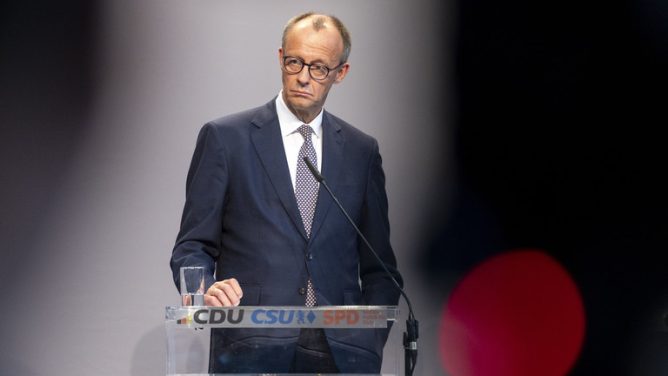
Friedrich Merz, leader of the Christian Democratic Union. © Maja Hitij/Getty Images
RT | May 28, 2025
German Chancellor Friedrich Merz has pledged to do “everything” to prevent the Russian Nord Stream 2 gas pipeline from being launched. The gas inter-connector from Russia through the Baltic sea to Germany was destroyed by a series of underwater explosions in September 2022 in an act of sabotage that Russia believes was orchestrated by Western intelligence agencies.
Merz’s declaration comes as Moscow and Kiev draft respective proposals for bringing about a ceasefire in the Ukraine conflict, following their first direct peace talks in three years in Istanbul.
The talks marked a shift for Kiev, which abandoned diplomatic efforts in 2022 in favor of seeking a military victory on orders from the West. While Moscow has reported progress on its proposal, Ukraine’s Vladimir Zelensky and his EU backers have accused Russia of stalling.
During a joint press conference with Zelensky in Berlin on Wednesday, Merz vowed to “further increase pressure on Russia” and “weaken Moscow’s war machine” through sanctions, including on Nord Stream 2.
“I say on behalf of the Federal Republic of Germany, we will do everything in this context to ensure that Nord Stream 2 cannot be put back into operation,” he stated. He claimed that the measures aim to “pave the way for negotiations,” despite Moscow’s repeated criticism of Western sanctions policy.
European Commission President Ursula von der Leyen said earlier this month that Brussels had planned an 18th sanctions package to include measures aimed at Nord Stream 2 AG, the Swiss-based entity that owns the pipelines, and any other companies necessary for their restart and operation.
Media reports have claimed that Merz has supported the move and that he has opened talks in Berlin and Brussels to prevent any revival of energy trade with Russia.
A number of European officials have opposed targeting the pipelines. Florian Philippot, a prominent French Euroskeptic, has warned that such a move would amount to a “death sentence” for European industry. Michael Kretschmer, the prime minister of the German state of Saxony, has argued that “Nord Stream is a possible opening for a conversation with Russia,” adding that such talks would benefit Germany as its economy needs Russian gas supplies to function normally.
Earlier reports have also claimed that Russia and the US were exploring ways to resume shipments through the still-intact line of Nord Stream 2.
Sanctions as Self-Harm: The West’s Strategic Blind Spot in Confronting Russia
By Ricardo Martins – New Eastern Outlook – May 28, 2025
This article critically analyzes the latest EU sanctions on Russia, arguing they are strategically flawed and economically self-destructive. Drawing from past failures, it shows how the West’s punitive measures are backfiring, hurting Europe and the U.S. more than isolating Russia.
What is the New Sanctions Package About?
The EU has unveiled a new sanction package targeting Russia, predominantly focusing on the energy sector, specifically oil and diesel exports. This builds upon earlier restrictions intended to cripple Russia’s economic capacity to sustain its military operations in Ukraine. The new sanctions include tighter enforcement mechanisms on the oil price cap, restrictions on ship-to-ship transfers in international waters, and efforts to curtail Russia’s access to Western insurance and logistics networks. But like the previous measures, they raise a fundamental question: Will they work?
The Status of Past Sanctions: Buying While Punishing
Historically, sanctions against Russia have been inconsistent and riddled with loopholes. Despite strong rhetoric, Europe has continued purchasing Russian commodities under various exemptions. The EU still imports significant quantities of Russian diesel, liquefied natural gas (LNG), coal, uranium, and even agricultural products like grain and fertilizer. The result is a paradox: while aiming to isolate Russia, the West remains economically entangled with it. This undermines the moral and strategic coherence of sanctions and allows Russia to adapt and thrive despite Western pressure.
Sanctions Hit Europe More Than Russia
While sanctions are theoretically aimed at weakening Russia’s economy, the practical consequences have disproportionately hit European industries and households. Russian exports are fungible: oil, coal, and fertilizers find alternate markets in Asia, Africa, and Latin America. Meanwhile, Europe has struggled with soaring energy prices, industrial shutdowns, and declining competitiveness. Diesel shortages, energy rationing, and inflation have become the new norm, particularly in Germany, which once depended heavily on Russian inputs for its industrial base.
Russia, by contrast, has localized production, developed new markets, and implemented mercantilist strategies to reduce dependence on Western technology and finance. As one Russian analyst put it, sanctions have become “psychological warfare,” increasingly irrelevant to daily life in Russia.
Oil and Diesel: The Inflation Time Bomb
The crux of the new sanctions is oil and diesel. But can the U.S. and EU afford to forgo Russian, Venezuelan, and Iranian crude without catastrophic inflation? The answer appears to be no.
Russia exports about 7.5 million barrels of oil per day, or nearly 10% of global supply. Taking that offline—especially in conjunction with sanctioned Venezuelan and Iranian oil—would create a massive global shortfall. Western refineries, particularly in the U.S. Gulf Coast, are calibrated to process heavy sour crude like Russia’s Urals blend. Without it, refineries operate suboptimally, and gasoline prices spike.
In the U.S., diesel drives nearly all logistics trucks, trains, and ships. Removing a major global supplier like Russia tightens global supply, causing diesel prices to surge and supply chains to buckle. Already, diesel refills for trucks cost over $2,000, with potential spikes threatening food prices and consumer goods. Inflation will soar again, just as it had started to cool.
Baltic Sea Escalation: Tankers and Arrests
The geopolitical tension is intensifying. Russian oil tankers, often flagged under third countries, are now escorted by Russian naval vessels in the Baltic Sea. An incident involving an Estonian ship attempting to halt a tanker, which ended up detained in Russian waters, demonstrates the volatility of the situation. This marks a dangerous escalation, with the potential for military clashes over enforcement of maritime sanctions—an area traditionally governed by international law, not unilateral action.
Western Industrial Decline: No Shipyards, No Leverage
Sanctions enforcement is further complicated by Western logistical decline. The U.S., Britain, and France have largely lost their shipbuilding industries. Insurance and shipping markets have globalized, and London no longer dominates maritime underwriting. Russian entities are increasingly self-insuring their fleet, rendering sanctions on Western insurers irrelevant.
Furthermore, without a domestic merchant marine, the U.S. relies on foreign ships even for military logistics—a vulnerability in any prolonged conflict. Meanwhile, China and Russia continue expanding their shipping capabilities and influence over global supply routes.
The Legal Quandary: Sanctions and Sovereignty
From a legal standpoint, unilateral sanctions that attempt to compel third-party countries to comply (so-called secondary sanctions) strain the legitimacy of the “rules-based international order.” It is lawful for the West to impose its own sanctions, but not to mandate their enforcement by sovereign nations like India or Brazil. Such overreach risks global backlash and accelerates moves toward de-dollarization and alternative trade systems, such as the BRICS currency initiative.
Is the EU Addicted to Sanctions?
The EU appears increasingly reliant on sanctions as a primary foreign policy tool. Yet, their efficacy is questionable. Past sanctions have not altered Russian behavior, destabilized its economy, or improved Western leverage. Instead, they’ve fostered economic nationalism in Russia, weakened EU industries, and exposed the strategic shallowness of Brussels and Washington’s policies.
Sanctions are not a strategy; they are a tactic. And overuse risks turning them from a deterrent into a diplomatic crutch—one that Europe may not survive intact if economic pain continues to mount.
Conclusion: A Strategy of Self-Harm
Sanctions as Self-Harm: The West’s Strategic Blind Spot in Confronting Russia
In sum, the latest sanctions package is more of the same: punitive in intent, performative in practice, and counterproductive in outcome. The West, particularly Europe, will likely bear the brunt of energy shortages, inflation, and industrial decline. Meanwhile, Russia’s diversified exports, strategic alliances with China and India, and robust internal adaptation mechanisms render sanctions increasingly futile.
History has shown that attempts to isolate Russia through economic pressure are not only ineffective—they risk reinforcing the very state structures they aim to dismantle. Unless sanctions are part of a broader diplomatic and economic strategy, they will continue to hurt the sanctioning powers more than their target.
Ricardo Martins ‒PhD in Sociology, specializing in policies, European and world politics and geopolitics
Ukraine in the EU? 5 reasons why it would crush Hungary (and Europe)
Remix News | May 28, 2025
The political elite in Brussels is increasingly trying to achieve that Ukraine’s planned EU accession takes place as soon as possible, preferably before 2030. Ursula von der Leyen, president of the European Commission, stated in early May that the accession process must be accelerated.
Von der Leyen previously stated in Kyiv that if the process continues at this pace and quality, accession could occur even earlier than 2030.
The EU often does what it wants now and simply bypasses all the old treaty rules. The EU migration pact, which basically amounts to migrant quotas, was supposed to be the type of law that passes with the unanimous consent of the member states. In other words, countries like Hungary and Poland should have had a veto. Instead, Brussels snuck it through the backdoor and passed this “pact” with a qualified majority of the EU’s interior ministers.
Something similar is bound to happen with Ukraine. They will bypass Hungary’s veto in violation of all treaty rules because they have the power — at least for the foreseeable future.
However, it is worth noting that this will not only harm Hungarians, but all of Europe. Mandiner news outlet compiled five reasons it will hit Hungary hard, but many of these reasons apply to a broad swathe of Europe’s population.
1. The wages of Hungarian workers would decrease
With Ukraine’s accession, at least 30 million Ukrainians would have the opportunity to work in any country in the European Union. This would expand the European labor market by about 7 percent. In Hungary, the average net salary is currently about three times that of Ukraine. It is clear that many people would decide that it is worth moving to neighboring Hungary, as well as other EU nations.
Ukrainian workers arriving with lower wage demands would create a competitive situation in Hungarian sectors already struggling with labor shortages (construction, hospitality, agriculture), and this could result in a real wage decrease of up to 10-20 percent.
It is the classic example of cheap labor flooding the market, which while good for owners of capital and big business, can decimate labor markets and undercut labor power.
This would be most prevalent among lower-skilled workers, but jobs requiring secondary education would not necessarily be secure either. The proportion of Ukrainian guest workers in Hungary reached 5 percent in the agricultural and construction sectors by early 2025. Now, 30-40 percent of commuters [itinerants] working in this sector are Ukrainian citizens. After accession, this number would increase dramatically, turning into permanent commuting and settlement in Hungary and other EU nations, which would further drive down basic wages and long-term unemployment in rural regions, further increasing social tensions.
Hungary is spending a fortune on families and social programs for its population. Suddenly, financing family benefits, child-rearing benefits and the 13th month pension would also face serious difficulties, and the cost of the system would increase by 200–300 billion forints annually with Ukraine’s EU accession. This amount can only be raised in the government budget at the expense of public services, healthcare and education. According to analysts, if wages were to fall by 5-10 percent, consumption would also fall by 3-4 percent, and this could mean an additional loss of 0.5-1 percent of Hungarian GDP growth on an annual basis, the compilation highlights.
2. The rapid accession of Ukrainians could cause a new migration crisis
With Ukraine’s accession to the EU, the immigration crisis that has plagued the European Union since 2015 would reach a new level, and this would put Hungary in a very difficult situation. In its study previously published on Mandiner, the Hungarian Institute of Foreign Affairs cites data from the 2023 research of the Ukrainian Future Institute, according to which 6.5 million people have left Ukraine, which had a population of 41-44 million before the war, in recent years, and there are also 3.5 million internal refugees.
With Ukraine’s accession, at least 30 million Ukrainians would have the opportunity to work in any country in the European Union, and a good number of them would understandably leave the collapsed country in the hope of a better life.
This internal, legal migration would significantly burden the EU – and since Hungary is a neighboring country, this would also affect the Hungarian healthcare system.
In addition, illegal migration could also gain momentum. It is currently unknown where Ukraine’s borders will be after the settlement of the Russian-Ukrainian war, but a new, currently unknown and unsettled border section of several hundred – perhaps a thousand – kilometers long will certainly be created.
If the Ukrainians are admitted, this line will separate the European Union and Russia. Controlling it is a task that neither the European Border and Coast Guard Agency (FRONTEX) nor the Ukrainian authorities would be able to cope with.
New migration routes could open up from Asia, and the EU would have to deal with new waves of migration coming from the east through Ukrainian soil. More people would try to enter the EU from Central Asia and Afghanistan through the new external borders. Some of the incoming migrants would try to reach the territory of the Western member states via Hungary. If Ukraine were also allowed to join the Schengen area, migrants would be able to travel across Europe at will, easily avoiding controls.
3. It would ruin Hungarian farmers
Ukraine’s accession to the EU would significantly increase the size of the EU’s 157 million hectares of agriculture by 41 million hectares.
Ukraine would become the largest beneficiary of the Common Agricultural Policy (CAP), pocketing about a third of the total budget, thereby undercutting farmers who comply with strict EU regulations, including Hungarian producers.
A large part of the budget’s agricultural subsidies are currently distributed on a regional basis, and due to money given to Ukraine, farmers in other member states would receive less of this amount. This reallocation of agricultural subsidies would mean Hungarian farmers would also receive orders of magnitude less EU funding than before, according to calculations by the Hungarian Institute of Foreign Affairs.
With Ukraine’s accession, the Hungarian agricultural sector is expected to suffer an annual loss of 672 billion forints (€1.68 billion) due to the loss of Common Agricultural Policy (CAP) funds.
A loss of resources of this magnitude, in addition to the aforementioned competitive disadvantage, would likely destroy the entire sector and could certainly bankrupt small and medium-sized family farms, Mandiner emphasizes.
Ukraine is one of the world’s largest grain producers and exporters, with vast acreage and excellent resources, but our eastern neighbor has much looser regulations than the European Union, and labor is much cheaper, which is why their production costs are much lower. If they were to enter the EU market, farmers from other European member states would be at a huge competitive disadvantage.
If Ukraine joins the EU, it would account for 15 percent of European wheat production, 49 percent of corn production, and 20 percent of overall grain production. This dumping would result in depressed prices, and Hungarian farmers would be unable to compete with cheap, often inferior-quality Ukrainian products.
4. The European Union would also import war by admitting Ukraine
According to a study by the Hungarian Institute of Foreign Affairs, Ukraine’s accession to the EU would necessitate the introduction of new coordination mechanisms, but it is clear that the European Union is currently unable to guarantee Ukraine’s security. Realistically, Ukraine’s accession to NATO has practically zero chance, so the security guarantees of the Ukrainian state could only be resolved through bilateral agreements.
The European Union’s mutual assistance clause is very similar to NATO’s famous Article 5. If a country is attacked, it can activate it independently, i.e., without the consensus of the European Council, and in this case the other member states must come to its aid.
This means that if Ukraine were an EU member, it could activate the article, which would – at least legally – automatically make all EU member states belligerents.
This is probably what Hungarian Prime Minister Viktor Orbán meant when he said, “If the European Union admits Ukraine, it will also be admitting war.” The aforementioned article has no implementing regulations, so it would cause an unprecedented debate on its interpretation, which would lead to divisions among the member states. On the other hand, the adversary could automatically consider the European Union a belligerent party, and if this were to happen, NATO would also have to deal with the issue.
It is unprecedented in the history of the European Union for a country at war to join the community, but even if peace were to be concluded, the aftermath of a legally closed conflict would pose dangers that the Union would be unable to deal with. The Russian-Ukrainian war will almost certainly end with a peace treaty that would change Ukraine’s current internationally recognized borders.
If the European Union were to include Ukraine as a member, it would be adding a conflict zone with a constant threat of war, with the associated tasks and costs. This step would eliminate the buffer zone between the European Union and Russia, which Ukraine has so far represented, with the two directly bordering each other. This would also drastically change the security situation of the European community.
5. We would allow the Ukrainian mafia into the EU
Ukraine is one of the most corrupt countries in Europe, where organized crime was very strong even before the war, but the situation is even worse now. A lot of weapons from the arms shipments that have flowed into the country have ended up on the black market and then in the hands of criminal groups. The Ukrainian mafia will not have HR problems either.
The rehabilitation of demobilized soldiers is currently unresolved, and many of them are likely to be unemployed and traumatized, but there is one area in which they have gained serious expertise in recent years, and this is very useful knowledge if someone wants to join organized crime.
If Ukraine were to join the EU at an accelerated pace, as the European Commission envisions, this problem would also affect Hungarians. With the possibility of free movement in the European Union and the avoidance of border controls, Ukrainian organized crime groups would be able to conduct their business much more easily in the territory of other member states, and due to our geographical proximity, this would definitely be felt in Hungary.
The domestic drug situation is already very serious, and it seems to be getting worse with the spread of synthetic drugs, and the Ukrainians’ “entry into the market” would not help this, just as Hungarian society does not want clashes between expanding criminal gangs back in their everyday lives.
Of course, the state of public security would not be improved by the fact that Ukraine’s accession to the EU would certainly lead to an increase in the intensity of migration and the number of migrants residing in Hungary. This in itself carries a serious public security threat. The examples of England, Germany, Sweden and France all show that integration attempts, which are impossible in the short term anyway, almost always fail, and the number of crimes increases in direct proportion to the increase in the number of immigrants, and in many cases new organized criminal networks are created in migrant communities.
Hungary’s opposition pushes for Ukraine’s EU membership
Charles Michel, the former president of the European Council, and Manfred Weber, the president of the European People’s Party (EPP), which has the largest faction in the European Parliament, both support the EU’s push for Ukrainian membership. The party of Hungarian opposition leader Péter Magyar has also joined the EPP.
It is no coincidence that the German politician, Weber, made it clear to Magyar before the Tisza Party could join his faction that he only works with those who are pro-Ukraine, pro-Europe, and pro-rule of law, and he expects the same from Péter Magyar’s party.
The Tisza Party is apparently trying to comply with this, as in April, in line with the People’s Party line, they voted for a proposal that urges Ukraine to become an EU member, and would even provide a large amount of support (approximately €35 billion) to the war-torn country to facilitate this.
Apparently, the majority of their supporters expect this from Péter Magyar’s party: in the Voice of the Nation poll, the majority of Tisza respondents support Ukraine’s accession to the EU (58.18 percent yes, 41.82 percent no).
Manfred Weber stated in relation to Ukraine’s EU accession that Ukrainians have the same right to belong to the European Union as we Hungarians.
The Hungarian government, on the other hand, takes the position that accelerating Ukraine’s EU accession would have a catastrophic impact on Hungary and the surrounding countries, as in addition to the fact that there is currently a war in the country and the process itself would cost an incredible amount of money, this step would bring serious long-term negative changes in many areas of life, affecting the lives of European people.
German Chancellor Merz threatens to cut EU funding for Hungary and Slovakia

By Thomas Brooke | Remix News | May 27, 2025
German Chancellor Friedrich Merz has warned that the European Union could withhold even greater funds from Hungary and Slovakia if they refuse to adhere to the values imposed upon member states by Brussels.
Speaking at the WDR Europaforum on Monday, Merz said, “Member states that violate the rule of law can face infringement procedures, and there is always the possibility of withdrawing European funds. If necessary, we will take care of it.”
“We cannot allow the decisions of the entire EU to depend on a small minority,” he added, in a thinly veiled attack on the nationalist-led governments in Bratislava and Budapest. Both countries have already seen parts of their EU funding frozen over legal and political disputes with Brussels.
His remarks come as Hungary faces renewed criticism over a bill targeting foreign-funded NGOs and media, while Slovakia, under Prime Minister Robert Fico, has raised alarm in Brussels following his recent visit to Moscow and long-held opposition to further European intervention in the Russo-Ukrainian conflict.
Following the trip, Brussels ramped up pressure on Slovakia with the arrival of a delegation of Members of the European Parliament from the Committee on Budgetary Control (CONT), led by Czech MEP Tomáš Zdechovský, to investigate alleged misuse of European subsidies.
Slovak Interior Minister Matúš Šutaj Eštok has dismissed the delegation’s visit as a politically motivated “punitive expedition” orchestrated by Brussels, accusing Eurocrats of defamation. “A carefully selected group is coming here with the aim of presenting Slovakia in Brussels as a black hole on the map of Europe,” he claimed.
Skepticism over Brussels’ approach to the war in Ukraine has been a point of contention in Hungary and Slovakia for the duration of the conflict, and Merz expressed his intention to advocate for punitive measures against the two member states should they seek to block European support to Kyiv.
“We will not be able to avoid this conflict with Hungary and Slovakia if we continue on this course,” Merz said.
Last month, Hungarian Prime Minister Viktor Orbán accused Brussels of conspiring with his country’s political opposition to bring about a change in government, remarks made after Hungarian left-wing MEP Kinga Kollár acknowledged the devastating effect that the withholding of EU funds for Hungary has caused, caveating her remarks by stating that “the deteriorating standard of living has actually strengthened the opposition and I am very positive about the ’26 elections.”
“They agreed to destroy the Hungarian economy, the Hungarian healthcare system, and to destroy the living standards of Hungarians, in order to help the Tisza party come to power,” Orbán said of the European Commission.
In response to Merz’s remarks, Hungarian Economy Minister Márton Nagy said on Monday that Budapest should reconsider its overdependence on trade with Berlin.
Russia could restrict return of Western brands – Izvestia
RT | May 27, 2025
The Russian parliament is set to pass a law that would regulate the right of foreign companies to reclaim assets sold during their exit from the country, Izvestia reported on Tuesday. The draft has reportedly been approved by the Finance Ministry and will be considered by the State Duma in its second and third readings simultaneously.
Numerous US, European, and Asian companies pulled out of Russia due to supply problems caused by unprecedented sanctions imposed on Moscow by the West after the escalation of the Ukraine conflict in 2022. Other firms left due to the risk of facing secondary sanctions or public relations pressure.
The bill, reviewed by Izvestia, allows Russian authorities or current owners to reject asset buybacks under certain conditions. Grounds for refusal include the foreign seller being from a country that has imposed sanctions on Russia, the repurchase price being below market value, or if more than two years have elapsed since the original deal with the Russian owner fulfilling obligations to employees and creditors.
The Russian authorities may also block asset buybacks if a company operates in sectors deemed vital to the country’s socio-economic stability, including defense or finance, the outlet said. In such cases, asset repurchase would require presidential approval.
According to Izvestia, the new measures will be voted on in June and could affect at least 18 foreign companies with buyback options, including Renault and McDonald’s. The draft law also reportedly stipulates that foreign businesses denied repurchase could be eligible for compensation, the amount of which would be determined by the government. However, if former owners failed to fulfill obligations before their exit, compensation could be reduced by court decision.
In March, Russian President Vladimir Putin ordered the government to draft regulations for Western firms seeking to return to the country’s market, which would prioritize the adequate protection of local businesses.
Following the exodus of foreign firms, the Russian market has largely adapted by promoting domestic and Chinese brands, making re-entry more challenging for Western companies. In sectors such as automotive and fashion, local alternatives have filled the void left by departing Western firms.
Putin said on Monday that foreign tech firms that continue operating in Russia while acting against the country should be “squeezed out.”
“They are trying to squeeze us, so we must respond in kind,” Putin said in response to a question about possible measures against companies such as Zoom and Microsoft. The president added that Russia had not expelled any companies and had instead created favorable conditions for their operations.
Featured Video
Elijah Magnier: Yemen’s strikes are shattering Saudi Arabia’s long-term strategy
or go to
Aletho News Archives – Video-Images
From the Archives
British weapons and personnel doing much of the killing in Yemen
Press TV – June 18, 2019
A detailed report published by the Guardian newspaper has shown how Britain is massively contributing to Saudi Arabia’s devastating war on Yemen as it suggests that London is not only supplying the bombs that fall on Yemenis, but it provides the personnel and expertise that keep the war going.
The comprehensive report by Arron Merat published on Tuesday showed that Britain was doing much of the killing in Yemen as the country continues to provide Saudi Arabia with everything it needs to turn its southern impoverished neighbor into a graveyard.
“Every day Yemen is hit by British bombs – dropped by British planes that are flown by British-trained pilots and maintained and prepared inside Saudi Arabia by thousands of British contractors,” said Merat in the report. … continue
Blog Roll
 Aletho News
- Racist Seinfeld Dances for Joy as Bibi Unveils His New Map
- A West Bank War for Netanyahu’s Election Campaign, Could It Backfire?
- Yemen denounces European Parliament’s ‘hypocritical’ push to blacklist Ansarullah
- Qalibaf: UAE’s UN bid aims to ‘clear the runway’ for ‘Greater Israel’, whitewash genocide
- Pakistan reopens Iran border after boosting security: Report
- Why are so many Brazilians voting for Flávio Bolsonaro?
- Democrats Put Anti-Russia Agenda Ahead of American Workers
- Elijah Magnier: Yemen’s Strikes Are Shattering Saudi Arabia’s Long-Term Strategy
- Pentagon designates Chinese cultural centers national security threat
- Israel Demolishes Home Of Lebanese Journalist Whose Viral Film Exposed Pager Attack
- If Americans Knew
- An error has occurred; the feed is probably down. Try again later.
- No Tricks Zone
- Sudden Stratospheric Warming, Powerful El Niño Combination May Lead To Extreme Europe Cold, Energy Crisis!
- Two New Studies Find Thwaites Glacier Melt Cannot Be Driven By Human Activity Or A Warming Ocean
- E-Cars Reduce CO2 Emissions By Only 41% Compared To Internal Combustion Engine Vehicles
- Predictions Made By Renowned Climate Professor Over Past Decades Have Been Proven To Be Poor
- New Study Suggests Large Regions Of The Pacific Ocean Have Been Cooling For The Last 80 Years
- Germany’s Green Energy Debacle: High Energy Costs Force Kahla Porzellan to Close After 182 Years!
- New Study: 50 Years Of The Most Aggressive ‘Net Zero’ Policies Can Only Affect The Global Climate By 0.03°C
- US September “Heat” Was No Record…Many Records Set Decades Ago
- Latest European Green Energy Debacle; Portugal’s Largest Flagship Solar Park Insolvent!
- Green Energy Debacle: German Expert Professor Fritz Vahrenholt Warns Of Severe Economic And Social Consequences

