Alternative for Germany (AfD) – the third largest opposition party in the national parliament – intends to take the country out of the EU if it wins the upcoming election, several media outlets reported on Friday, citing the party’s newly drafted election manifesto.
AfD has confirmed that the document is “ready” but has not released it to the public. The party also wants Germany to ditch the euro, and return to a “stable national currency,” media outlets including Die Zeit and Der Spiegel have claimed.
“We believe that Germany’s exit from the European Union and the establishment of a new European community are necessary,” the 85-page-long manifesto reportedly says.
The EU in its current form should be replaced by the “Economic and Interest Community” following a certain transition period that should be “negotiated… with both the old EU partner states and new interested parties,” media have cited the document as saying, adding that the AfD believes the EU is trying to become a “superstate.”
On its website, the party lists Germany’s exit from the EU as part of its political agenda and advocates a “Europe of nations” concept, adding that “irrevocable renunciation of sovereignty in favor of an ‘ever closer’ European Union is incompatible” with this vision.
The party is also seeking to restore trade ties with Russia, which were disrupted by EU sanctions imposed after the escalation of the Ukraine conflict in February 2022. The AfD text highlights Russia’s importance as a supplier of cheap natural gas for German industry, according to national media.
The document also calls for sanctions on Russia to be lifted and the Nord Stream gas pipelines to be repaired, according to Die Zeit. Nord Stream 1 delivered Russian gas to Germany before it was blown up in September 2022, along with Nord Stream 2.
The party also apparently wants Germany to exit the Paris Climate Agreement and introduce abortion restrictions.
AfD has neither confirmed nor denied the reports about its election program, but said that the document was sent to delegates of the federal party conference, scheduled for mid-January.
The document’s lead author, Professor Ingo Hahn, has described it as a “convincing work that not only names the pressing problems of our country, but also shows clear solutions that will lead Germany out of the current misery.”
Germany could hold an early parliamentary vote as soon as February 23 following the collapse of Chancellor Olaf Scholz’s three-party government coalition earlier this month. If Scholz’s now-minority cabinet loses a confidence vote in mid-December, the country will head into a snap election.
AfD became the fifth largest faction in the Bundestag following the 2021 parliamentary election, in which it gained more than 10% of the vote.
I had a conversation with Jeffrey Sachs and Alexander Mercouris about the political changes in Europe. The optimism of the European project as a region of peace and prosperity is long gone. The objective had been to resolve conflicts on the continent peacefully and use collective bargaining power to establish greater economic and political independence. Instead, the continent is experiencing war, de-industrialisation, socio-economic and political instability, excessive dependence on the US, and growing irrelevance in the wider world. What went wrong and can the decline be reversed?
The rest of the world adjusts to the emerging multipolarity with a multivector foreign policy by diversifying economic connectivity to improve economic competitiveness and enhance political autonomy. In contrast, the Europeans have subordinated themselves completely to the US and thus suffer from economic decline and political subordination. Declining rationality is also a clear problem as the Europeans pursued policies towards Russia that they knew would put them on a collision course with Russia. Instead of pursuing course correction, the proxy war with Russia increased the security dependence on the US, which enabled Washington to impose bloc discipline. The recovery of Europe requires reversing the militarisation of dividing lines in Europe, and diversifying economic ties to avoid excessive dependence on any one state or region.
According to a report published by the Financial Times, Trump’s new team intends to ‘bankrupt’ Iran during his second presidential term. The report, citing a national security expert close to the new team, states that executive orders targeting Iran, mainly its oil exports, could be signed on the first day Trump takes office.
The so-called ‘maximum pressure campaign’ is a set of measures imposed against Iran in 2018 after Trump brazenly and illegally withdrew Washington from the Joint Comprehensive Plan of Action (JCPOA). The agreement, signed in 2015, limited Iran’s nuclear programme in exchange for an easing of economic and financial sanctions. Trump called the agreement a ‘disaster’ only because it was signed by Democratic President Barack Obama. He allegedly stated that he was going to make sure that Iran would never receive nuclear weapons, while promising to limit Iran’s regional influence.
In other words, the world has a very dangerous precedent in the Middle East: on the one hand, Israel has completely illegally developed and put into service nuclear weapons and their means of delivery and, on the other hand, Trump is trying to limit – and, moreover, prohibit – Iran from developing peaceful nuclear energy and oppose Tehran’s relations with its neighbours. What kind of democracy is this and what exactly does Trump mean by the word ‘democracy’? This is no longer democracy, rather a medieval-type dictatorship: if I want to, I will allow it, but it is better not to allow it at all.
What was Trump’s goal previously?
Since 1979, Iran has constantly faced US sanctions. The Trump administration’s ‘maximum pressure’ campaign was not so much about inventing new limitations as about dramatically expanding the scope and viciously tightening compliance with previous or existing limitations.
Following the unabashed withdrawal of the United States from the JCPOA (an international document), Trump immediately reinstated sanctions against Iran’s energy, shipping, shipbuilding, automotive and oil sectors in accordance with a decree issued on August 6, 2018. The key difference was the aggressive implementation of so-called ‘secondary sanctions’, which punished foreign organisations for doing business with Iran, regardless of whether these transactions violated their own domestic laws. The aim was to put significant pressure on international players to comply with US sanctions. Apparently, Trump considered himself a liege lord and all others to be his vassals, the purpose of whom was to fulfill Trump’s will.
In May, 2019, the Trump administration dealt a blow to Iran’s metallurgical industry (the second largest source of export revenue) by tightening sanctions on the production of iron, steel, aluminum and copper. This included well-designed sanctions against any foreign financial institutions facilitating large transactions related to these industries. At the same time, Washington was completely uninterested in the opinions and interests of other parties involved in peaceful trade with Iran.
The third major decree issued by Trump was directed against the Islamic Revolutionary Guard Corps (IRGC) and any organisations or individuals conducting financial transactions with it. The stated goal was to limit Iran’s production of ballistic missiles, a weapon that, according to then-US Special Representative for Iran Brian Hook, existed only in Photoshop. Nevertheless, Trump hastened to impose severe sanctions on the IRGC.
The new Biden administration that came to power, contrary to expectations, did not put an end to Trump’s policy. According to Secretary of State Anthony Blinken, all sanctions were to remain in force and hundreds more new ones were added to them. It is incomprehensible how one strong and arrogant country is trying to rule the whole world and establish its own rules of life and trade that are only beneficial to it.
Did Trump’s policy bear fruit?
“The efficacy of US sanctions against a foreign government is measured by the economic damage not caused”, said Amir Ali Abolfat, an expert on North American affairs, “and the extent to which sanctions achieve their political goals and change the behaviour of the target government”. An analysis of statistics before the start of the ‘maximum pressure’ campaign shows that, although Trump made it more difficult for Iran to earn money from exporting oil and metals, he failed to reduce them so much that a brave and persistent Iran had to change its policy.
“Iran produces strategically important goods”, Abolfat explained. “As long as there is demand, these products will find their market. Although Iran no longer sells oil to Europe, it has begun supplying it to China, as evidenced by increased sales to that country, which is resisting pressure and US hegemony. The same principle applies to the export of Iranian metals”.
There is no doubt that Trump and Biden have created great difficulties for Iran, but did they manage to achieve their goals? Absolutely not. Iran’s uranium enrichment rate has increased from 3% to 60% and its military potential has expanded significantly over the past seven years. Moreover, Tehran is successfully developing friendly ties with its neighbours and has managed to create a so-called Axis of Resistance, which successfully opposes the United States and Israel in the region.
As for domestic needs, Iran has successfully reduced its dependence on European partners and former allies (such as Korea and Japan) by finding alternative suppliers. The departure of European automakers has led to a sharp increase in Chinese car imports, making Iran a major market. In addition, Iranian engineers and experts have independently completed projects to develop gas and oil fields that previously depended on Western cooperation. This self-confidence eventually spread to other industries previously dependent on imports, such as the food industry and medicine.
Sanctions and nothing else?
Central to Trump’s policy in the Middle East from 2017 to 2021 was an unsuccessful attempt to drive a wedge between Arab countries and Iran, while simultaneously positioning Israel as a key regional security partner.
Now this approach is much less viable. Iran’s improved relations with countries, such as Saudi Arabia, and ongoing efforts to normalise ties with others, such as Egypt, undermine this strategy. In addition, the successful Hamas operation on October 7 completely dispelled all notions of Israel’s invincibility and the actions of the Israeli regime to destroy the Palestinians made the continuation of the normalisation agreements concluded within the scope of Trump’s ‘Abraham Accords’ unlikely.
Experts believe that the only other untested option – the military option – to which hotheads in the United States and Israel are inclined, is fraught with enormous risk. Such actions could lead to devastating consequences for the West, potentially widespread disruption of oil supplies, attacks on Western bases in the Middle East and fundamental changes to Iran’s nuclear policy. Ultimately, Washington must recognise that enormous pressure alone will not help it achieve its goals with regard to Iran. To solve the US’ problems, Iran’s problems must also be acknowledged. It is only through returning to the JCPOA and sitting at the negotiating table that the most difficult tasks in the region can be solved. Iran is ready for this and has expressed this more than once. Is the ‘peacemaker’ Trump ready for this or is he only thinking of using force?
Türkiye is currently in talks with the US to secure a sanctions waiver that would allow it to continue using Russia’s Gazprombank to pay for natural gas imports, the country’s Energy Minister Alparslan Bayraktar told reporters on Monday.
Last week, the US Treasury Department imposed restrictions on more than 50 Russian financial institutions, including Gazprombank, which is linked to the eponymous Russian gas giant, and six of its international subsidiaries. The sanctions have effectively cut off Russia’s primary bank for energy-related transactions from the SWIFT interbank messaging system, meaning it can no longer be used for dollar-based transactions.
According to Bayraktar, unless a special exemption is made, Türkiye, which imports nearly all of its gas, won’t be able to pay Moscow for natural resources. Russia currently accounts for more than 50% of the country’s pipeline imports, according to Reuters.
In his comments, Bayraktar pointed to a previous waiver granted to Ankara when Washington had sanctioned Iran in 2012. At the time, the sanctions against Tehran included a clause that allowed the US President to issue a special exemption if an oil-importing country faced “exceptional circumstances” that made it impossible to reduce Iranian oil imports. Bayraktar has argued that Türkiye now needs a similar waiver for Gazprombank in order to secure its supply of natural gas.
“These sanctions will affect Turkey. We cannot pay. If we cannot pay, we cannot buy the goods. The foreign ministry is in talks,” Bayraktar said.
The latest US sanctions have also sparked disdain among several other European buyers of Russian gas. Last week, Hungarian Foreign Minister Peter Szijjarto accused Washington of trying to undermine energy security in the Central European region by imposing restrictions on Gazprombank.
In a post on Facebook, the diplomat stated that any attempts to jeopardize energy supplies to Hungary are “considered as an offence against our sovereignty” and stressed that Budapest denounces all such attacks and has vowed to “resist the pressure and pursue our national interests.”
He added that Hungary is currently in talks with other countries, such as Bulgaria, Serbia, Azerbaijan and Slovakia in hopes of finding a solution for securing energy supplies.
Meanwhile, despite the EU announcing plans to eliminate its dependence on Russian energy, it has remained one of the world’s major importers of Russian fossil fuels while its members have purchased record volumes of liquified natural gas (LNG) from Moscow.
RFK Jr. says the second in command at Smithfield Foods in Poland offered a $1 million bribe to a state official to pass legislation to essentially shut down local hog production.
The reveal was made during a podcast with farming expert Joel Salatin. The official turned Smithfield in over the bribe attempt, but others were quick to take the bribe and pass the desired legislation.
None of this is new news. However, RFK Jr.’s alliance with Trump, not to mention being nominated to serve as secretary of health and human services in his administration, has given him a new platform to draw attention to the issues surrounding commercial farming and the food we eat.
And when I say not new, I mean, this topic has been around for a couple decades, actually more.
A 2003 article from Ecologist highlighted the issues with the way Smithfield and “fellow industrial pork producers” delivered bacon, chops and other pork products to American consumers. The article stated these entities had “driven tens of thousands of family farmers off the land, shattered rural communities, poisoned thousands of miles of US waterways, killed billions of fish, put thousands of fishermen out of work, sickened rural residents and treated hundreds of millions of farm animals with unspeakable and unnecessary cruelty.”
Pretty harsh. And then, Smithfield turned its eyes to greener pastures. Where? All the way over in Poland, fresh out of its decades-long stint under the iron fist of communist rule. What may not be known by many was the rather strong presence, i.e., high number, of family farms that survived under communism. Kennedy refers to this himself in the podcast around minute 25, “small farms that were self-sufficient farms” and that had no money for chemicals.
However, despite surviving well under communism, these family farms could never have expected the “free market” might of “private” concerns that would come knocking at their doors, or more like come to knock their doors down.
“In 1999, Smithfield began buying slaughterhouses and state farms in Poland. On July 22 this year (2003), the firm’s vice president promised Poland’s Senate agricultural committee that Smithfield will ‘modernise’ Polish agriculture and bring prosperity and jobs to rural communities,” reads the Ecologist article.
Now 25 years later, RFK Jr., is bringing to light again exactly what happened in the name of American capitalism all those years ago.
Smithfield, he tells Salatin on the podcast, had come in and bought the old Soviet slaughterhouses and was modernizing these massive facilities. The legislation that Smithfield initiated stated that you could not operate a slaughterhouse if it did not have laser-automated faucets in the bathrooms, technology that small slaughterhouses servicing local family farms would not be able to afford. In this way, as Kennedy says, “in one fell swoop,” all of Smithfield’s competitors in Poland were put out of business. Kennedy did not clarify what year this happened.
There is pretty hefty coverage of the lawsuits between environmental groups, including RFK Jr.’s Waterkeeper Alliance, and Smithfield in the U.S., alleging, for example, that the giant put small farms out of business and polluted soil. One class action suit against Smithfield that Kennedy was a part of was thrown out in 2002.
What’s crazy is that this battle reached all the way to Poland. In a letter to the Polish prime minister, dated February 2004, MP Anna Sobecka presented a brief history of Smithfield’s practices back in the U.S., including that “one of the slaughterhouse’s managers was sentenced to prison for falsifying records in the case.”
“Smithfield Foods, the owner of the Animex Wielkopolska company it bought out, is constantly breaking the law by placing large piles of manure in nearby fields near the village of Więckowice without permits. Another such pile was recently built in Sierosław, near Więckowice. This is an expression of complete disregard for the recommendations of Polish officials,” the letter reads. The MP goes on to say that for unknown reasons, the company was still awarded the “Crystal Globe of Export Leaders” by the minister of economy, labor and social policy.
The primary concern of the letter was related to “several large piles of pigsty waste without the required permits and without the slightest safeguards” near Niepruszewickie Lake. It was then alleged that hazardous chemicals seeped into the lake and ended up causing illnesses, particularly in children, in the nearby town of Więckowice.
She adds that “Robert F. Kennedy Jr., representing American farmers, has visited Poland several times to warn against Smithfield Foods’ destructive activities. Kennedy warned that further expansion of the company could threaten to destroy Polish family farms. Kennedy’s speeches provoked a panic among Smithfield Foods management, which filed a defamation suit against the American politician in the district court in Poznań,” adding that “the documents and evidence available to the American politician clearly confirm the allegations he made against Smithfield Foods.”
This letter came after Smithfield’s subsidiary in Poland had sued Kennedy in Poznan for his remarks about the company’s practices during a debate in the Sejm, the Polish parliament, where he reportedly called it a “mafia organization” that violates environmental regulations and accused parties involved of selling out Polish small farmers and consumers for profits. The outcome of that suit is unclear. However, another suit filed against Smithfield by a group including Kennedy was dismissed by the judge, with all parties ordered to pay Smithfield’s legal fees.
What is also very clear is that the world today is an even smaller place than back then, and Smithfood’s primary challenger has now been nominated to serve in the cabinet of the U.S. president.
Today, Smithfield is a Chinese-owned company, RFK Jr. says in the abovementioned podcast, adding that China owns some 30 percent to 40 percent of the hog production in the U.S.
“We’re in a colonial model. USDA now works for China by keeping little farmers out of business and strip-mining and commoditizing our natural resources, our farmland, and everything else.”
As to why RFK Jr. brought up Poland after all these years and if he plans to do something about their operations there is unknown.
He is on a mission for consumers everywhere to know their food is safe, wholesome, and healthy. As he also told Joel Salatin, “only the worst food is reaching the American public… and it’s high cost.”
Businesses in NATO countries should prepare themselves for a “wartime scenario” and adjust their production lines and supply chains to be less vulnerable to blackmail by nations such as Russia and China, the outgoing chief of the US-led bloc’s military committee, Admiral Rob Bauer, said on Monday.
Speaking at a European Policy Center think-tank event in Brussels, he urged Western industries and businesses to implement deterrence measures.
“If we can make sure that all crucial services and goods can be delivered no matter what, then that is a key part of our deterrence,” Bauer argued.
“Businesses need to be prepared for a wartime scenario and adjust their production and distribution lines accordingly. Because while it may be the military who wins battles, it’s the economies that win wars,” the NATO official said. He mentioned China and Russia in the context of how he believes wars are waged in the economic sphere.
“We thought we had a deal with Gazprom, but we actually had a deal with [Russian President Vladimir] Putin,” he stated, apparently referring to the drop in Russian gas supplies to the EU, which took place after the escalation of the Ukraine conflict in 2022.
At the time, the EU declared that ending its reliance on Russian energy was a key priority, and many members voluntarily halted their imports, while supplies also plunged due to the sabotage of Russia’s Nord Stream pipelines.
American Pulitzer Prize-winning journalist Seymour Hersh blamed the sabotage on the CIA, alleging that the agency had carried out the attack under the direct orders of the White House – an allegation it has denied.
Bauer then extended his warning to China, claiming that Beijing could use its exports to NATO states and the infrastructure that it owns in Europe as leverage in the event of a conflict.
“We are naive if we think the [Chinese] Communist Party will never use that power. Business leaders in Europe and America need to realize that the commercial decisions they make have strategic consequences for the security of their nation,” the official claimed.
It is unclear what “wartime” Bauer is predicting in his statements.
NATO has long declared Russia to be a direct threat, and Western officials have repeatedly claimed that if Moscow is allowed to win the conflict in Ukraine, it could then attack other European countries. Russia has dismissed these claims as nonsense. Restrictions that Moscow introduced in trade with the West have largely come in response to unprecedented economic sanctions placed on the country in connection with the Ukraine conflict.
Beijing has also faced its share of trade barriers and restrictions introduced by Western states, and introduced similar measures in response. According to most experts, including many in the West, the sanctions policy has backfired on Western economies, leading to supply shortages and inflation.
Russia’s deputy foreign minister says the treaty on a comprehensive strategic partnership between his country and Iran will include cooperation in the defense and security sectors.
Speaking to Russia’s TASS news agency on Sunday, Andrei Rudenko said he would not disclose the details of the agreement that is expected to be signed in the near future.
“I would only note [that] it will meet challenges and requirements of our time and cover almost all current and promising spheres of Russian-Iranian cooperation, including defense and security,” he added.
In 2001, Tehran and Moscow signed a long-term cooperation deal, officially known as the Treaty of the Foundation of Mutual Relations and the Principles of Cooperation. It was initially set for 10 years but was extended up until 2026.
Now, the two capitals are making final arrangements for the comprehensive partnership pact, which may determine their bilateral ties in all fields for the next 20 years.
Russian Foreign Minister Sergei Lavrov has announced that his country will sign a strategic partnership agreement with Iran “in the near future.”
Rudenko emphasized that the nature of Iran-Russia interactions has notably changed over the past two decades.
“We are closely coordinating approaches with our Iranian friends and take necessary measures to strengthen peace and security” in the region, he added.
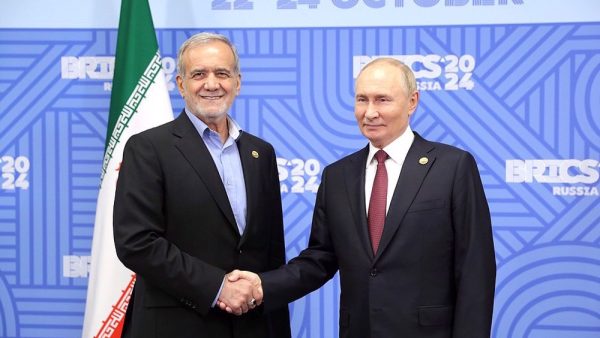
Last month, Iran’s Ambassador to Russia Kazem Jalali said the strategic partnership treaty would be signed during Iranian President Masoud Pezeshkian’s visit to Moscow. The date of this visit has yet to be decided.
Iran and Russia are both subject to illegal Western sanctions. They have over the past years deepened their relations in various fields, including military and defense, and become close allies.
Foreign government officials attending the ongoing U.N. climate change summit are advocating for de facto global climate taxes to fund green energy development in poor countries ahead of President-elect Donald Trump’s return to the White House, according to Financial Times. [emphasis, links added]
Officials from countries including France, Spain, and Kenya are pushing to plan so-called “solidarity levies” on various industries at this year’s conference so that a more developed version of the scheme can be presented at next year’s get-together in Brazil, FTreported.
The idea is to settle on a plan that would raise $100 billion or more annually to fund climate-related efforts in developing countries by imposing de facto taxes on the shipping and aviation industries, and possibly other sectors as well.
Past discussions on the issue of providing climate cash to poor nations have been fraught, and Trump — who pulled out of the U.N.’s Paris Climate Agreement in his first term and is primed to do so again — generally opposes routing money to other countries in the name of climate change, so attendees at this year’s summit are getting creative about finding sources of funding, according to FT.
Besides the shipping and aviation industries, cryptocurrency trades, fossil fuel production, plastic producers, billionaires, and financial transactions could possibly be subject to the “solidarity levies” scheme.
In fact, it is not even clear that the funding generated by the “solidarity levies” would even go directly to poor countries, as officials from some nations have suggested that the money should go to the shipping industry to help it with its decarbonization push, according to FT.
The shipping industry’s commitment to cutting emissions is putting more pressure on the aviation industry, which is itself pointing to the oil and gas industry to cough up more money.
Many major airline companies are already party to a global carbon offset pact reached in 2016, but that system is not meant to generate revenues that can then be repurposed, according to FT.
The task force assessing the “solidarity levies” concept is eyeing options for building upon duties on plane tickets already in place in 21 countries, which they think could raise as much as $164 billion annually.
Washington’s decision to blacklist Russia’s Gazprombank, a key conduit for gas purchases from Russia, is aimed at undermining energy security in the Central European region, Hungarian Foreign Minister Peter Szijjarto has claimed.
Earlier this week, the US Treasury Department imposed blocking sanctions on more than 50 Russian financial institutions, including Gazprombank, linked to the eponymous Russian gas giant, and six of its international subsidiaries.
The newly introduced restrictions effectively cut off Russia’s primary bank for energy-related transactions from the SWIFT interbank messaging system, meaning it can no longer conduct dollar-based transactions.
“Including Gazprombank to the sanctions list is a decision that deliberately puts some Central European countries in a difficult situation, and deliberately jeopardizes the security of energy supplies” to several nations in the region, Szijjarto wrote on Facebook on Friday.
The Hungarian diplomat stated that any attempts to jeopardize energy supplies to Hungary “either by imposing sanctions or by cutting off transit supplies are considered as an offence against our sovereignty.”
“We reject all the attacks of the kind against our sovereignty, resist the pressure, and pursue our national interests,” he said.
Szijjarto added that he discussed the issue of gas supplies to Hungary with the first deputy head of the Russian Energy Ministry, Pavel Sorokin, on the sidelines of the Istanbul Energy Forum, which convened in Türkiye on November 22.
“We reviewed the situation in the field of gas transportation and confirmed that we will support necessary cooperation for secure energy supplies to Hungary,” he stated.
Budapest is also discussing the situation with the energy ministers of Türkiye, Azerbaijan, Bulgaria, and Serbia, and consulting with Slovakia to find a solution for securing energy supplies, Szijjarto added.
EU nations are still purchasing record volumes of liquified natural gas (LNG) from Russia. Despite the bloc’s plans to eliminate its dependence Russian energy, it remains one of the world’s major importers of Russian fossil fuels.
In August, pipeline gas comprised the largest share of the EU’s purchases of Russian fossil fuels (54%), followed by LNG (25%), according to the Center for Research on Energy and Clean Air (CREA).
Previous episodes of this series explained NATO’s senseless expansion that threatened Russia and caused a disastrous war in Ukraine. The plot to add Ukraine to NATO failed. As Russian troops advance to occupy all of Ukraine to secure it as a close ally, nearby nations may choose to join the prospering Russian led Eurasian Economic Union. Russia may encourage Ukraine’s neighboring nations to join its economic block with a return of Ukrainian land seized by the Soviets.
The loss of Eastern Europe would be a huge setback for the Anglo-American empire as members leave NATO and the EU to trade freely with Russia and China, or join a new Hungarian led Eastern Europe economic union that does not support EU and Anglo-American sanctions nor imperial adventures in Africa and Asia. This is likely to happen if Russian troops reach Ukraine’s western border to open the door to the east. As a result, the Anglo-American empire may risk World War III and send NATO troops into Ukraine to block further Russian advancement and halt a rebellion by its vassal states.
_________________________________
“As EU Confirms Economic Punishments On China, U.S. Panics Over Impending Iran Oil Attack”; Sean Foo; YouTube; October 5, 2024; • As EU Confirms Economic Punishments O…
A ranking Iranian diplomat has strongly discouraged Western countries from resorting to pressure, intimidation, and confrontational approach against the country over its legitimate and peaceful nuclear energy activities.
Seeking recourse to the above measures “does not amount to adoption of a sustainable and credible course, and [application of such methods] will eventually hit a dead end,” Mohsen Naziri Asl, Iran’s permanent representative at the United Nations office in Vienna, said on Friday.
“The Islamic Republic is [rather] prepared for joining positive interaction through dialog and constructive cooperation towards potential achievement of a sustainable solution [to standing issues].”
The remarks came after the Board of Governors of the UN’s nuclear watchdog, the International Atomic Energy Agency (IAEA), adopted an anti-Iranian resolution based on a proposal that had been forwarded by the UK, France, and Germany. The resolution reiterated the trio and their allies’ accusations against the Islamic Republic of insufficient cooperation with the IAEA.
In chorus with the United States and others, the threesome European states have been taking numerous similar measures against Iran in line with the accusations that run counter to the standing status of the country and the agency’s cooperation, which has even increased in frequency and quality over the past years.
The ongoing confrontational approach on the part of the West comes, while it was the US that broke off its internationally-endorsed commitments to Iran by unilaterally and illegally leaving a 2015 nuclear agreement between the Islamic Republic and world countries and returning the sanctions that the deal had lifted.
The European trio, which were likewise signatories to the deal, meanwhile, failed to return Washington to the accord, despite their repeated insistence that they would do so.
Naziri considered the US’s illegal withdrawal from the deal to be the principal reason behind the deal’s current unfavorable status, noting that Washington “has not stopped short of taking any measure to destroy the deal.”
He also reminded the European parties of their refusal to live up to their commitments under the accord.
The official also pointed to the retaliatory measures that Iran has been taking in response to the US’s withdrawal, and the European countries’ and the IAEA’s confrontational attitude, which, most recently, saw the country activating its advanced centrifuges.
He cited Iranian President Masoud Pezeshkian and Foreign Minister Abbas Araghchi’s repeated statements, during which the officials asserted that the Islamic Republic would walk back its legal remedial steps if the American sanctions were effectively and verifiably annulled and the nuclear deal’s other parties returned to performing their contractual duties.
Naziri, therefore, advised the European sides “not to repeat their unsuccessful courses of action of the past.”
Separately, he strongly condemned the European countries’ recent sanctions against the Iranian national carrier and shipping company, considering the bans to be in violation of the nuclear deal’s “spirit and text.”
“We consider these [economic] measures to be in contradiction with the commitments that could serve as the foundation of any future interaction.”
The official also denounced the European trio for ignoring their duty towards lifting the sanctions that they have illegally imposed over Iran’s missile program, which they have to lift under their commitment to the nuclear deal’s sunset clauses.
“One must stress that, in line with an announcement that has been made by the UN Secretariat, Iran’s missile program will no longer be subject to the restrictions that have been imposed by the UN Security Council.”
Naziri again asserted that the Islamic Republic was ready for positive interaction as long as the other parties to the nuclear deal proved their political will and commitment to the accord by not tying negotiations that address the agreement’s potential revival to irrelevant issues.
The latest round of US sanctions against Russian financial institutions, which specifically target Gazprombank, is an attempt to block Russia’s gas supplies to the EU, Kremlin spokesman Dmitry Peskov stated on Friday. The lender is Russia’s primary bank for energy-related transactions.
Peskov warned that Moscow would respond to restrictions with countermeasures, though he did not specify what they would entail.
The Kremlin spokesman’s remarks follow an announcement by the US Office of Foreign Assets Control (OFAC) on Thursday, which said Gazprombank and six of its international subsidiaries had been added to its sanctions blacklist. Gazprombank had already been sanctioned by the UK and Canada shortly after the escalation of the Ukraine conflict in 2022. However, the US had previously avoided placing restrictions on the lender as it was used by EU states to pay for Russian gas.
When asked whether the Kremlin viewed sanctions on Gazprombank as an attempt to jeopardize supplies of Russian gas to Europe, and whether Moscow planned any response, Peskov replied: “The answer is ‘Yes’ to both questions.”
He noted that Russian authorities were already working on ways to alleviate the problems that the new restrictions could cause Russia and its foreign gas buyers.
“Of course, we’ll find options. It is impossible to introduce completely blocking measures against a country like Russia. It may take some time, but a solution will still be found,” Peskov said.
The new measures mean Gazprombank can no longer carry out transactions that involve the dollar-based financial system. Gazprombank earlier said that sanctions would not affect its operations within Russia, but warned that its UnionPay cards may stop working outside the country.
Apart from Gazprombank, the new US restrictions also targeted more than 50 small-to-medium Russian lenders, some 40 securities registrars, and 15 financial officials.
After the escalation of the Ukraine conflict in 2022, the EU declared the elimination of its reliance on Russian energy to be its top priority. Many member states, including Poland, Bulgaria, Finland, the Netherlands, and Denmark, voluntarily halted their imports. However, several EU nations, including Austria, Hungary, Slovakia, the Czech Republic, and Italy continue to rely on Russian gas to meet their energy needs, and have not stopped buying the commodity despite pressure from peers within the bloc.
Moscow has slammed Western sanctions as illegal, and noted that they keep backfiring on the countries that impose them. Russia has also been gradually moving away from the dollar in trade, switching to transactions using national currencies with most of its international partners.
The newly imposed US sanctions against Russia’s Gazprombank are expected to send energy costs surging in parts of Europe, Finam Financial Group analyst Aleksandr Potavin told TASS on Friday. The risk of secondary restrictions will force buyers of Russian oil and gas to seek new payment tools, he predicted.
On Thursday, the US Treasury Department introduced blocking sanctions against more than 50 Russian lenders, including Gazprombank and six of its international subsidiaries. The new penalties effectively cut one of Russia’s largest banks off from the SWIFT interbank messaging system, meaning it can no longer carry out transactions that involve the dollar-based financial system. Gazprombank’s assets in the US have also been frozen.
“Due to the new sanctions against Gazprombank, foreign buyers of Russian gas and oil will be faced with the need to look for alternative payment routes that are likely to complicate the entire process, increase risks, and make the payment procedure more expensive,” Potavin said.
He specified that European buyers could use accounts in other banks or pay for energy supplies via other world currencies as an alternative.
“The new sanctions will lead to an increase in prices for Russian hydrocarbons in Europe, and supply disruptions can’t be ruled out as well, since all this creates new risks for foreign companies working with Russia,” he explained.
According to Alexander Frolov, expert at the InfoTek energy news center, the latest restrictions won’t have a direct impact on buyers of Russian gas who previously agreed to adopt the “gas for rubles” scheme to pay for their energy purchases. They will only apply to individuals and legal entities subject to US jurisdiction, he said, as quoted by TASS.
The analyst admitted, however, that companies using rubles for Russian energy supplies are at risk of secondary sanctions, “so gas buyers from Europe will turn to the US Treasury for clarification.”
Supplies of Russian pipeline gas to Europe have substantially declined due to Ukraine-related restrictions and the sabotage of the Nord Stream pipelines, although EU nations are still importing record volumes of LNG from the sanctions-hit state. Despite the bloc’s vows to drop purchases of Russian energy, it remains one of the world’s major buyers of Russian fossil fuels. In August, pipeline gas comprised the largest share of the EU’s purchases of Russia’s fossil fuels (54%), followed by LNG (25%), according to the Centre for Research on Energy and Clean Air (CREA).
Fifteen of the 9/11 “hijackers” from Saudi Arabia were CIA agents working for the United States government, which was seeking to destroy the Middle East for Israel and to double the American military budget, says Dr. Kevin Barrett, an American academic who has been studying the events of 9/11 since late 2003…. continue
This site is provided as a research and reference tool. Although we make every reasonable effort to ensure that the information and data provided at this site are useful, accurate, and current, we cannot guarantee that the information and data provided here will be error-free. By using this site, you assume all responsibility for and risk arising from your use of and reliance upon the contents of this site.
This site and the information available through it do not, and are not intended to constitute legal advice. Should you require legal advice, you should consult your own attorney.
Nothing within this site or linked to by this site constitutes investment advice or medical advice.
Materials accessible from or added to this site by third parties, such as comments posted, are strictly the responsibility of the third party who added such materials or made them accessible and we neither endorse nor undertake to control, monitor, edit or assume responsibility for any such third-party material.
The posting of stories, commentaries, reports, documents and links (embedded or otherwise) on this site does not in any way, shape or form, implied or otherwise, necessarily express or suggest endorsement or support of any of such posted material or parts therein.
The word “alleged” is deemed to occur before the word “fraud.” Since the rule of law still applies. To peasants, at least.
Fair Use
This site contains copyrighted material the use of which has not always been specifically authorized by the copyright owner. We are making such material available in our efforts to advance understanding of environmental, political, human rights, economic, democracy, scientific, and social justice issues, etc. We believe this constitutes a ‘fair use’ of any such copyrighted material as provided for in section 107 of the US Copyright Law. In accordance with Title 17 U.S.C. Section 107, the material on this site is distributed without profit to those who have expressed a prior interest in receiving the included information for research and educational purposes. For more info go to: http://www.law.cornell.edu/uscode/17/107.shtml. If you wish to use copyrighted material from this site for purposes of your own that go beyond ‘fair use’, you must obtain permission from the copyright owner.
DMCA Contact
This is information for anyone that wishes to challenge our “fair use” of copyrighted material.
If you are a legal copyright holder or a designated agent for such and you believe that content residing on or accessible through our website infringes a copyright and falls outside the boundaries of “Fair Use”, please send a notice of infringement by contacting atheonews@gmail.com.
We will respond and take necessary action immediately.
If notice is given of an alleged copyright violation we will act expeditiously to remove or disable access to the material(s) in question.
All 3rd party material posted on this website is copyright the respective owners / authors. Aletho News makes no claim of copyright on such material.


 Aletho News