The Democratic Party Faces Its Day of Reckoning
By Leonard C. Goodman | Scheer Post | November 19, 2024
Following its crushing defeat in the 2024 election, the Democratic Party might finally face its day of reckoning. The party markets itself as the champion of the working class and a bulwark against the party of the plutocrats. But this has been a lie for at least three decades.
The Democratic Party has partnered with Wall Street donors since at least the 1990s. Under President Bill Clinton, the party overturned Glass Steagall and other New Deal programs that had effectively restrained Wall Street greed for 60 years. It also sold out American workers with so-called trade deals that freed their bosses to ship American jobs overseas. It ended welfare “as we know it” and passed draconian crime bills that destroyed mostly black and brown communities, sending mothers and fathers to prison for decades in the name of a cruel and senseless war on drugs.
Into the 21st century, the Democrats continued pushing the lie that they were fighting for working people. After September 11, 2001, the party put up a token resistance to the Bush/Cheney regime of illegal regime-change wars, black sites, indefinite detention and torture. All the while, it continued soliciting campaign contributions from the arms dealers profiting from Bush’s wars.
In 2008, the party found a Black face to carry on its Wall Street-friendly agenda. Gullible Americans, myself included, were taken in by Barack Obama’s promises to end “dumb wars” and to institute a single payer healthcare system. We ignored the red flags, like the fact that Obama’s campaign broke records in pocketing Wall Street donations. It was later revealed by Wikileaks that nearly every member of Obama’s cabinet had been selected by the giant Wall Street bank Citigroup.
It didn’t take long for President Obama to crush our hopes that he was a different kind of Democrat. One of his first acts as president was to funnel trillions of dollars to the big banks that, newly freed by Clinton from FDR-era regulations, had embarked on an orgy of unbridled greed, swindling millions of Americans out of their homes and retirement savings with a scheme to sell worthless mortgage-backed securities.
Adding insult to injury, Obama saw to it that the bailed-out bank executives faced no criminal prosecutions and received their year-end bonuses. In their place, the Obama Justice Department brought federal mortgage fraud charges against thousands of poor people — I represented a half dozen of these folks — who had signed their names to the phony mortgage loans that the Wall Street bankers encouraged, packaged and sold to pension funds and other unwitting investors.
The pipe dream that Obama would be an anti-war president was also quickly dispatched. During his two terms, Obama ushered in a new era of continuous war, envisioned by George Orwell and favored by Wall Street. Obama expanded Bush’s bombing campaigns into Libya, Pakistan, Yemen, Syria and Somalia. Today’s Democratic Party is indistinguishable from the Republicans in its ties to war profiteers and trillion-dollar Pentagon budgets.
Obama also effectively ended the Democrats’ promise to fight for a true national health care system in which all Americans would be able to go to the doctor when sick without fear of bankrupting their families. In its place, Obama pushed through a health care plan developed in right-wing think tanks, that guaranteed profits (and taxpayer subsidies) for the private insurance industry and did little to contain costs.
By 2012, Glen Ford of the Black Agenda Report was describing the Democratic Party as the “more effective evil” for using its reputation as protector of the working class to neutralize effective opposition and push through right-wing policies that the Republicans could not get passed.
In 2016, the Democrats received a wake-up call when their chosen successor to Obama lost the White House to a crude-talking New York City real estate developer and game show host with no prior political experience. But with the help of its partners in corporate media, the party managed to limp along for another eight years, first by telling the American people that President Trump was an agent of Russia, and then by claiming that Trump was Hitler who was planning concentration camps and firing squads for his political enemies.
Now after the November 2024 elections in which Trump won every swing state and the popular vote, the Democratic party is finally being forced to face some uncomfortable truths. The party’s partners in the corporate media initially tried blaming the election result on the voters for being too misogynist, too racist, or too dumb to vote correctly. But there is little trust that remains in corporate media.
The party’s corporate consultants have put the blame on the party’s excessive focus on identity politics. But the issues for the Democrats run much deeper than bad messaging. The real problem is that the party takes direction from plutocrats whose interests are antagonistic to the needs of the working people it pretends to represent. Both Democrats and Republicans are financed by the same corporate interests. Thus, there is general agreement and support for policies that guarantee high rates of return on investment capital, policies like continuous war, for-profit health care, and outsourcing jobs. This leaves few issues for the parties to fight about other than abortion and identity politics.
Fifty years ago, American capitalists still relied on American workers to build everything from cars and televisions to sneakers and light bulbs. These titans of industry had to care about things such as functioning schools, decent wages, cities and public transportation. But the times have changed. Today’s plutocrats support outsourcing jobs to low-wage countries and have little concern for the condition of American workers. And while ordinary Americans want the country’s resources to be spent at home, plutocrats are heavily invested in foreign wars, and they shun diplomacy.
These contradictions could only be covered up for so long. Even with reliable partners in the corporate press, the internet has given Americans alternative sources for their news. During the last few years, in a desperate effort to keep its scheme afloat, the Democrats embraced censorship and a regime of corporate “fact checkers” to police social media and remove or punish unsanctioned speech. In so doing, the party abandoned the last of its core principles: standing up for free speech and the right to dissent.
Many Democrats argue that they had to go after Wall Street money to compete with the Republicans. In 2016, Senate Majority Leader Chuck Schumer explained the strategy: “For every blue-collar Democrat we lose in western Pennsylvania we will pick up two moderate Republicans in the suburbs in Philadelphia, and you can repeat that in Ohio and Illinois and Wisconsin.” But for this plan to work, the party still needed an actual message to take to the voters.
Forbes Magazine reports that during the 2024 presidential race, Kamala Harris’s campaign raised a billion dollars while Trump’s campaign raised $388 million. Harris’s substantial edge in fundraising allowed her to flood the airwaves with commercials. But she had nothing of substance to say to voters.
The Atlantic Magazine reports that early in her campaign, Harris gained ground by attacking Trump as a stooge of corporate interests—and touted herself as a relentless scourge of Big Business. But then, suddenly, Harris abandoned her attacks on big business at the urging of her brother-in-law, Tony West, Uber’s chief legal officer.
Many Democrats, especially in swing states, opposed the Biden Administration’s unfailing support for Israel’s genocidal campaign in Gaza, which has killed more than 43,000 Palestinians and displaced nearly all of its 2.3 million residents. Harris could have gained the support of many of these voters by promising to stop arming Israel during the genocide. But her Party’s donors wouldn’t allow her to even hint at such a change in policy. Two days before the election, while campaigning in the swing state of Michigan, Harris stated, “I will do everything in my power to end the war in Gaza.” But as Ali Abunimah of the Electronic Intifada pointed out on election night, this promise carried no weight because Harris had also promised that she would never do the one thing within her power to stop the slaughter: cut off the flow of bombs to Israel.
After decades of malfeasance and deception, it has become evident that the corporate Democratic Party cannot serve as the lone opposition party to the corporate Republicans. The American people need a viable political party that represents the interests of ordinary working people.
A true workers party will not raise as much money as the corporate Democrats. But it will have an honest message with the potential to appeal to large numbers of Americans. Further, a political party that actually represents workers will press for reforms that begin to even the playing field between the haves and the have nots.
For example, one the most effective ways plutocrats game the political system is by flooding campaign contributions to the lawmakers who sit on the key committees that oversee their businesses. Members of Congress covet these committee chairs because they guarantee high fundraising numbers. Lawmakers who sit on the House Financial Services Committee have jurisdiction over banks and insurance companies and are targeted by those firms with campaign contributions. Lawmakers who sit on the Armed Services and Appropriations Committees provide funding for lucrative government contracts and are flooded with war industry cash.
These practices are corrupt and deprive American citizens of their right to be governed by representatives free from conflicts of interest. A judge who has received political contributions from a litigant must be removed from the case. Similarly, the most important functions of government, such as determining tax and how our tax revenue will be spent, should be performed by lawmakers who have not been bribed.
In 2017, the Center for American Progress, a think tank aligned with the Democratic Party, proposed a “Committee Contribution Ban” for Congress. It asserted: “Congress should enact a law to make it unlawful for members of Congress to accept campaign contributions from entities that fall within the jurisdiction of their committees.” Unsurprisingly, this proposal never reached the floor of Congress, that I could find.
Some states have enacted similar conflict of interest rules. And Congress could certainly pass such a law, if it chose. Of course, this will never happen as long as we are ruled by two corporate parties that benefit from the corruption. But if we had a political party that represented ordinary people, countless opportunities for positive change would soon emerge.
Leonard C. Goodman is a Chicago criminal defense lawyer and has been an Adjunct Professor of Law at DePaul University.
Germany threatens China with “consequences” for alleged drone supplies to Russia
By Patrick Poppel | November 20, 2024
The federal government is assuming greater Chinese involvement in the Ukraine war. On the sidelines of an EU meeting in Brussels, Foreign Minister Annalena Baerbock spoke of “Chinese drone support” for Russia and demanded: “This must and will have consequences.”
The European Union’s Foreign Service had previously confirmed that indications are currently being examined that China produces drones for Russia. An EU official said: “We have received reports from intelligence sources about the existence of a factory in China that produces drones that are supplied to Russia and used in the war against Ukraine.”
If direct cooperation between China and Russia in the field of military equipment is confirmed, sanctions could be imposed. According to diplomats, drone production is a joint project between Russia, China and Iran.
Lithuania’s Foreign Minister Gabrielius Landsbergis demanded that the EU react decisively. Europe should not show weakness because it is afraid of the Chinese reaction, said Landsbergis, referring to Europe’s dependence on raw materials from the People’s Republic.
Finland’s Foreign Minister Elina Valtonen said there could be no “business as usual” in trade with China if Beijing was compromising Europe’s security. A very anti-Chinese sentiment is clearly evident in all of these statements.
China rejects the allegations. With regard to arms exports, China has always taken a responsible stance and has never provided the parties to the conflict with lethal weapons, said a Chinese Foreign Office spokesman. China strictly controls drones for military purposes and those that can be used for civil and military purposes in accordance with the law.
However, this German advance against China must be clearly seen in the context of the current economic war. China is currently a major competitor against the German automotive industry. The fact that the German Foreign Minister in particular is demanding consequences is very interesting.
In this context, consequences mean that sanctions are required. Will such sanctions perhaps also affect the import of Chinese cars? Since the German automotive industry is currently in a major crisis, politicians must of course react.
The high energy prices in particular make it impossible for Germany to remain competitive against Chinese production. The EU and the USA are currently trying to compensate for the difference in production costs with punitive tariffs on the import of Chinese cars.
However, since an even larger difference is now foreseeable due to Europe’s difficult economic situation, these punitive tariffs can only be viewed as a first step. The only way to protect the internal market for cars in the long term would be to stop imports of cars from China.
However, such a situation can only be achieved with sanctions. The current discussion is clearly heading in this direction, but the question is whether the actors in European politics are prepared to follow this path to the end.
Maybe people are just speculating about a warning against China. But in this context, politicians in Europe are too short-sighted. It can be assumed that China is adequately prepared for any economic punitive measures from Europe.
In contrast to companies in Europe, China has been much more successful in finding new markets. For example, due to European sanctions, Russia is quickly becoming a large market for many Chinese companies. This is particularly evident in the automotive industry.
The current discussion about the unproven delivery of drones to Russia is an attempt to take the next step in the economic war against China. And as is usually the case with decisions in European politics, this can immediately become a shot in the foot.
This reality is clearly visible in the example of the sanctions against Russia, as we can analyze it based on the state of German industry. Furthermore, attempting to defend one’s own market with punitive tariffs and sanctions is a sign of weakness.
German politicians have managed to bring the growth of the German economy to a standstill and forecasts even speak of a negative development. The German automobile industry will be overtaken by Chinese cars and this trend will most likely not change in the next few years.
After the next federal election, a new government in Germany must take care of repairing the damage caused to the German economy. The time of the German “economic miracle” from the 1950s, which made Germany a top location for the automobile industry, is over. This reality must be understood by those responsible. The attempts to punish China for its success show that there are currently no other strategies to save the German automotive industry.
Patrick Poppel is an expert at the Center for Geostrategic Studies (Belgrade).
To secure peace in Ukraine, Trump must review misguided western sanctions
By Ian Proud | Strategic Culture Foundation | November 17, 2024
Following Trump’s election, there has been much speculation about how the war in Ukraine might end. But to understand how it might end, it’s vital to understand how it started.
The origins of the war in Ukraine can be traced back to the ouster of Ukrainian President Yanukovych in February 2014. Russia labelled it a coup, realists would say it was unconstitutional change in power, and U.S. & British officials would shrug their shoulders.
After Russia occupied Crimea and as insurgency broke out in the Donbas, the French and Germans launched a peace process involving the Presidents of Russia and Ukraine. From this so-called ‘Normandy format’ emerged two peace deals named the Minsk agreements. But the UK was sidelined from the peace process and the Americans suspicious of it.
Left out, Britian, supported by the U.S., pushed sanctions as the primary vehicle to contain Russia, running counter to what the French and Germans were trying to achieve. By the summer of 2015, the Minsk agreements had become sidelined, and sanctions were set in stone.
Since that time, Russia has become the most sanctioned country on the planet. Thirty-three western countries, led by the USA, imposed more than twenty thousand sanctions against Russian people and companies. That’s fifteen times more sanctions than Iran in a distant second place.
If we could completely cut Russia’s economic ties with the west, so the theory went, then that would be so damaging that Russia would have to withdraw from Ukraine. Western powers therefore sanctioned everything that they could, from money, ships, oil, gold, diamonds, weapons and all manner of hi-tech components. But from a very early stage, it was clear that sanctions weren’t altering Russian policy to Ukraine, quite the opposite.
When I left the Foreign Office in 2023, the UK government with its western partners, had gone through all the sanctions that they thought might weaken Russia. The west could probably find more people or entities to sanction. But policy makers never really gripped Russian gas, as some European countries still rely on it. And anyway, the destruction of the Nordstream pipeline solved that conundrum. Russian oligarchs that had political connections in the west were spared as were Russian companies that owned factories in the USA, to prevent American job losses. But we hit most things and neared the bottom of the barrel.
Yet, Russia’s economy always seemed to bounce back. That’s partly because, sanctions were never as big a deal as other events that moved the global economy, such as the oil price collapses in 2014 and 2016 and Covid. But it was also because Russia continually adapted its macroeconomic policy to absorb and, in the end, profit from sanctions. Following an immediate post-sanctions contraction of economic growth in 2022, Russia has grown more strongly than the western countries that imposed sanctions.
Western powers therefore needed something stronger, so sanctions evolved into a political tool to isolate Russia on the world stage. The USA, European Union and other countries including Japan and Australia sanctioned every possible type of economic, social and cultural activity involving Russia. Western academics no longer collaborate with Russian academics. Russian airliners can’t pass over western airspace and vice versa. Border posts have been closed or minimised. Russia can’t compete in international sporting events or even the Eurovision song contest.
Russian Ministers are subjected to indignant walkouts by western diplomats and ministers at international gatherings. Ordinary Russian people were denied a weekend ParkRun. Ukraine did its part, cancelling the Russian Orthodox church and going on a propaganda offensive with any western company that sold goods with the word ‘Russia’ in their branding.
And yet, outside of the west, Russia’s standing on the global stage doesn’t seem to be in decline. In a process accelerated by the Ukraine war, Russia, with China, has spearheaded a rapid shift by the developing world to create their own formats for dialogue and cooperation. There are over 200 countries on this planet, so the wealthy ‘west’ is in a minority. The BRICS group has grown rapidly, with a long queue of countries waiting to join, including NATO member Turkey. Vladimir Putin has an International Criminal Court arrest warrant out on him, yet he still travels freely to ‘friendly’ countries, where he receives the red-carpet treatment. He recently hosted a successful BRICS summit in Kazan while war continued to rage in Ukraine.
War started in February 2022 a few days after the Ukrainian government finally signalled the death knell of the Minsk peace agreements. But the point is that the Minsk agreement was [not] necessarily bad; it’s simply that the U.S. and UK invested significant efforts in ensuring its failure.
Sanctions never looked likely to prevent war, nor force its end, despite the death or injury to over one million people and a vast exodus of Ukraine’s population. War in Ukraine became reduced to the brutal, bloody town by town fighting in Europe after D-Day, while life in the west, and in Russia, carried on almost as normal. Fighting alone, Ukraine has never had sufficient resources to survive and never will.
There is a strong case that sanctions created the conditions for war to erupt, by undermining the very peace process – the Normandy Format – that was established to prevent it. And that the west’s continued blind faith in sanctions took us to the brink of a doomsday scenario, more horrific than the use of nuclear weapons in Hiroshima and Nagasaki.
Western leaders, not wanting war themselves, focussed blindly on supporting Ukraine for as long as it takes. But the notion of ‘as long as it takes’ became tarnished with increasing numbers of western politicians started complaining that it is taking too long. Not least as the economics and demographics of war still show that Russia can continue fighting for as long as it takes, and that Vladimir Putin has the domestic political support to do that.
So, beyond the hype, if Trump is serious about ending the war in Ukraine, he must look at its origins. A ceasefire alone won’t cut it with Putin. There needs finally to be a peace proposal that includes targeted sanctions reduction. That, and a final reckoning with the NATO membership issue, the brightest red line of all.
This time Trump really means business
By Fyodor Lukyanov | Rossiyskaya Gazeta | November 13, 2024
US President-elect Donald Trump has moved quickly to form his proposed new administration. His team is better prepared to take power than it was in 2016 – when neither the candidate himself nor the vast majority of his supporters believed he could win.
It’s too early to draw far-reaching conclusions, but in general, the composition of the preferred government reflects the ideological and political coalition that has gathered around the president-elect. From the outside, it may look motley, but so far it is all in line with Trump’s views.
Contrary to the perception actively propagated by Trump’s opponents, he is not an unpredictable and inconsistent eccentric. More precisely, we should separate his character and mannerisms, which are flighty, from his overall worldview. The latter has not changed, not only in the years since Trump entered big politics, but more generally in his public life since the 1980s. It suffices to look through the old interviews of the famed tycoon to see this: ‘Communism (in the broadest sense) is evil’, ‘the allies must pay up’, ‘the American leadership does not know how to make favorable deals but I do’, and so on.
Trump’s personal qualities are important. But more importantly, in a somewhat cartoonish way, he embodies a set of classic Republican notions. America is at the center of the universe. However, not as a hegemon that rules everything, but simply as the best and most powerful country. It must be the strongest, including (or especially) militarily, in order to advance its interests wherever and whenever it needs to. Essentially, there is no need for Washington to get directly involved in world affairs at all.
Profit is an absolute imperative for the future president (he is a businessman), and this does not contradict conservative ideals. America is a country built on the spirit of enterprise. Hence his rejection of over-regulation and his general suspicion of the extensive powers of the bureaucracy. In this, Trump joins forces with the equally flamboyant libertarian Elon Musk, who promises to rid the state of a hodgepodge of bureaucrats.
Musk himself is unlikely to be hanging around the president’s office for long, but politicians who think along these lines are likely to be there.
An important difference between the new Trump cohort and traditional Republicans is a significantly lower degree of ideologization of politics in general and international politics in particular. Domestically, the rejection of an aggressive agenda in the spirit of the Woke movement and the imposition of the cult of minorities (which the Republicans call ‘Marxism’ and ‘communism’) plays an important role. It’s about imposition, because the human right to any lifestyle is not in itself questioned by conservatives. For example, key figures around Trump – ardent supporter and former ambassador to Germany Ric Grenell and billionaire Peter Thiel – are married to men.
In foreign policy, the conceptual difference is that Trump and his entourage do not believe, as the Biden White House does, that at the core of international relations is the struggle of democracies against autocracies. This does not mean ideological neutrality. The idea of the ‘free world’ and criticism of ‘communism’ (in which they include China, Cuba, Venezuela, and by inertia, Russia) plays an important role in the thinking of many Republicans. But the defining factor is something else – intolerance of those who for various reasons do not accept American supremacy.
Trump’s choice for national security adviser, Michael Waltz, for example, speaks negatively and disparagingly of Russia, but not in terms of a need to be ‘re-educated’, but because it interferes with America. Marco Rubio, who is being considered for secretary of state, does not oppose regime change in his ancestral homeland of Cuba, but is otherwise not a militant supporter of American intervention anywhere.
The undoubted priority of the Trumpists and those who have joined them is to support Israel and confront its opponents, first and foremost Iran. Last year, Elise Stefanik, the likely US ambassador to the UN, publicly shamed the presidents of leading American universities in Congress for alleged anti-Semitism. It is worth remembering that the only really effective use of force in Trump’s first term was the assassination of General Qassem Soleimani, the head of the special forces of the Iranian Revolutionary Guard Corps.
Trump is not a warrior. Threats, pressure, violent demonstrations – yes. A large-scale armed campaign and mass bloodshed – why? Perhaps because of the peculiarities of relations with China, which is clearly seen as the number one rival. Not in a military sense, but rather in the political and economic sphere, so any ‘war’ with it (forcing it to accept terms favorable to America) should be cold and ruthless. This also applies in part to Russia, though the situation is very different. All of this is neither good nor bad for Moscow. Or to put it another way, it’s both good and bad. But the main thing is that it is not the way it has been up to now.
Fyodor Lukyanov is the editor-in-chief of Russia in Global Affairs, chairman of the Presidium of the Council on Foreign and Defense Policy, and research director of the Valdai International Discussion Club.
This article was first published by the newspaper Rossiyskaya Gazeta and was translated and edited by the RT team
EU must reconsider ‘hare-brained’ Russia sanctions – Orban
RT | November 15, 2024
The EU must reconsider the sanctions it has placed on Russia in connection with the Ukraine conflict, and work to end hostilities as soon as possible, Hungarian Prime Minister Viktor Orban has said.
Speaking on Kossuth Radio on Friday, Orban explained that the current economic problems within the bloc stem from Brussels’ “hare-brained” decision to respond to the Ukraine conflict by placing restrictions on Moscow, which have driven up energy prices and overall inflation, hindering the EU’s competitiveness.
The EU declared the elimination of its reliance on Russian energy as a key priority after the Ukraine conflict escalated in February 2022. Sanctions and the sabotage of the Nord Stream pipelines later that year led to a dramatic drop in Russia’s gas supplies to the bloc, resulting in a spike in energy prices and soaring inflation.
“Sanctions were a wrong, hare-brained answer to the [Ukraine conflict], the EU made a mistake… Energy prices must definitely be brought down. This means that the sanctions must be reconsidered, because the policy of sanctions… it will destroy the European economy,” Orban stated. He called for an “anti-bureaucratic rebellion” within the bloc so that decisions on EU policies will be made with the people’s welfare in mind, both in regard to sanctions and to peace.
Orban also said that European businesses and industries cannot focus on development goals and growth opportunities when there is a war going on, so everything needs to be done to end the Ukraine conflict.
“If we look at this conflict from the point of view of our pockets, our economy, our income, it is a scourge of God on us all… In order to be successful again, we have to end it, end it as soon as possible,” he stressed.
Orban said Hungary would continue its diplomatic efforts toward peace in Ukraine, but said that it needs “a protagonist” who will be “strong enough to not only want peace but also to be able to create it.” He reiterated his hope that the power shift in the US with Donald Trump’s election would help achieve that goal. The Republican has previously claimed that he could end the Ukraine conflict in 24 hours. Until Trump takes office in January, Budapest will work on “achieving change in Brussels” to make sure “EU bureaucrats” do not decide to “continue the war without the Americans,” Orban pledged.
Orban has long been at odds with Brussels over the approach to Ukraine, opposing both aid to Kiev and sanctions on Moscow. Tensions grew further after he met with Russian President Vladimir Putin as part of his Ukraine ‘peace mission’ earlier this year.
Some EU leaders accused Orban of siding with Russia and abusing Hungary’s rotating presidency of the bloc. The premier clarified that he was representing only his own nation, but pledged to continue to work on changing the EU’s overall stance on the conflict.
India-Russia ties ‘helpful’ for the world – foreign minister
RT | November 14, 2024
Friendly relations between Moscow and New Delhi are an important element of international stability, Indian Foreign Minister Subrahmanyam Jaishankar told Sky News Australia in an interview published this week. According to the diplomat, the West should be less concerned about countries enjoying good relationships with Russia and more about diplomacy and ending the Ukraine conflict.
The minister defended New Delhi’s decision to increase oil purchases from Russia after the US and its allies slapped Moscow with unprecedented sanctions over the Ukraine conflict, which targeted Russia’s financial sector and international trade.
“If we had not made the moves we had, let me tell you the energy markets would have taken a completely different turn and actually would have precipitated a global energy crisis. It would have caused inflation across the world as a consequence,” Jaishankar said.
Imports of crude oil from Russia currently constitute nearly 40% of India’s total oil purchases, up from less than 1% before the escalation of the Ukraine conflict in February 2022. Earlier this week, the foreign minister said that he expected bilateral trade between the two nations to reach a target volume of $100 billion before 2030.
The minister was responding to Sky News host Sharri Markson, who said that New Delhi’s close ties to Moscow were causing “angst” in Australia. Jaishankar hit back by saying that “countries don’t have exclusive relationships” nowadays. Using the same logic, India should be worried about any country who has a relationship with its regional rival, Pakistan.
“What India has done and is doing with Russia is actually… helpful to the international community as a whole,” the minister said. He said that not only had India’s actions helped to avert a potential global energy crisis, but may also contribute to ending the fighting between Moscow and Kiev.
New Delhi can talk to both parties and “try to find some intersection in those conversations” to eventually find a way to get them both to the negotiating table, according to the top diplomat.
“I think the world, including Australia, needs such a country that will help bring this conflict back to the conference table,” he stated, adding that “conflicts rarely ends on the battlefield, mostly they end [through] negotiations.”
When further pressed by Markson on whether India is concerned about growing cooperation between Russia, China, North Korea and Iran, Jaishankar replied that such developments, which were further encouraged by the Ukraine conflict, show that the West should also be primarily interested in ending the hostilities.
”It’s in everybody’s interest that the sooner the conflict ends the better,” the minister said. “The longer the conflict drags out… all sorts of things are going to happen. Not all those things could necessarily be to Australia’s advantage or… that of Western countries.”
BRICS stockpiling gold as the G7 weaponised finance
The predictable consequences of stealing Russia’s sovereign funds
By Glenn Diesen | November 13, 2024
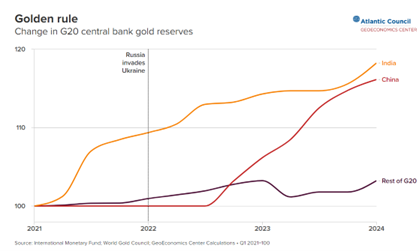
The West’s decision to freeze and legalise the theft of Russian sovereign funds predictably diminished trust in the Western financial system, resulting in a huge demand for gold and other precious metals as a safe haven. Gold is not a yield-bearing asset, yet it preserves its value during turbulent times. There are some more twists to the story: There is a rise in demand for physical gold and a push to store it in their home countries due to the lack of trust it can be stored safely in the West.
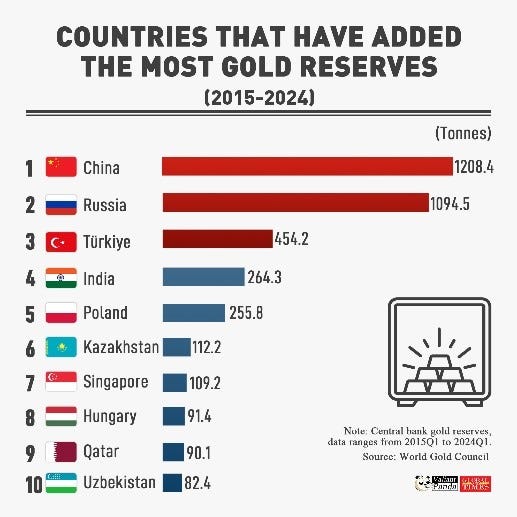
What was done to Russia could happen to anyone. An adversary like China is obviously next in line as the economic coercion to prevent its continued development intensifies. The EU demands China must pay a “higher cost” for supporting Russia, linking Russia and China seemingly for the purpose of convincing Trump to continue the war in Ukraine. Even friendly countries such as India could be targeted anytime with secondary sanctions for failing to bow to the demands of Washington.
From the US seizure of Afghanistan’s sovereign funds to Britain confiscating Venezuela’s gold, there is evidently reason for distrust. The main shock to the system was nonetheless the legalisation of the theft of Russia’s sovereign funds, which was justified by the Russian invasion of Ukraine. The moral premise is dubious at best as it would obviously not be considered acceptable if countries around the world seized the funds of the US and its NATO allies to pay reparations to the countries they have invaded.
Even within Western countries, predictability diminishes as the rules of law weaken. A British journalist reporting from Donbas had his bank account frozen without a day in court.[1] In Canda, hundreds of people had their bank accounts frozen for organising or attending the trucker protest.[2] Even the British opposition politician, Nigel Farage (“Mr. Brexit”), had his account suspended for political reasons.[3] Metro Bank used access to its financial services to punish opposition to its gender ideology as it denied banking services to an organisation opposed to the medical transitioning of children.[4] With many similar cases emerging, the term “de-banking” has entered the vocabulary.
Inflation and weaponisation of the dollar, coupled with growing political instability, are compelling large powers to take their money out of the Western financial system. China is still making dollars with its great trade surplus, but there is a growing reluctance to buy Western bonds or even leave the money in the Western financial system. China lends these dollars to other countries around the world rather than reinvesting it into the US market.

BRICS countries also prefer buying physical gold and they are also moving it to their own countries. Central banks and investors are not interested in exchange-traded funds (ETFs) as a cheap and easy way to own gold. Paper gold is not trusted, and investors demand physical gold. The gold is not even trusted to be stored in Western vaults anymore. China is having hundreds of tonnes of gold shipped from the West to China. Switzerland alone sent 524 tonnes of gold to China in 2022.[5] India brought home 100 tonnes of gold from the UK in 2024, the first large shipment since 1991. The transfer and storage of these metals are neither convenient nor cheap, yet the collapse in trust demands drastic actions. Bloomberg reports on Singapore constructing a six-story warehouse “designed to hold 10,000 tons of silver, more than a third of global annual supply, and 500 tons of gold”.[6]
There are many reasons not to store assets in rogue states: Risk of seizure or confiscation, lack of transparency, economic volatility, political instability etc. Unfortunately, all of these symptoms are becoming associated with the G7 countries as the financial system was weaponised. A key lesson of sanctions is that severe and prolonged sanctions result in the rest of the world adapting by learning to live without the belligerent actors.
Large gold reserves safely protected within national borders can also become important as new trade and reserve currencies are promoted. Fiat currencies will lose much trust in the financial turmoil that awaits, and future alternatives may need to yet again be backed by gold. Gold will certainly play a greater role as BRICS prepares a post-American financial system.
[1] PETER HITCHENS: Freedom for all means freedom for nasty people – Mail Online – Peter Hitchens blog
[2] Canada Ends Its Freeze on Hundreds of Accounts Tied to Protests – The New York Times
[3] Debanking: How Nigel Farage’s Banking Woes Have Raised Serious Concerns Over Account Closures
[4] The terrifying rise of ‘debanking’ – spiked
[5] Switzerland sent 524 tonnes of gold to China last year, the most since 2018 | Euronews
[6] As the Rich Snap Up Gold Bars, Storage Vaults Brace for Business – Bloomberg
Israel’s Economic Implosion: “Genocide Blowback” Threatens the Zionist Entity…
… And the US empire
By Kevin Barrett | November 10, 2024
When a nation becomes known as a genocide perpetrator it suffers reputational damage. And reputational damage has economic consequences. A whole branch of the public relations industry specializes in such matters: Well-paid damage-control hacks are hired by wealthy individuals, corporations, and governments when reputations propping up fortunes are threatened.
By murdering tens of thousands of civilians in Gaza in a transparent effort to steal more and more Palestinian land, the illegitimate state of “Israel” has labeled itself genocidal in the eyes of the world. And a nation that is genocidal, like an individual who is a serial killer, cannot expect to be treated as a respectable member of the community. Just ask the Germans, who were labeled “genocidal” after World War II and have been suffering economic consequences ever since.[i]
Partisans of Israel have used ethnic nepotism to gain control over western media. Due to its disproportionate media influence, the zionist entity has thus far managed to evade critical scrutiny of its long list of outrageous crimes. But as social media and international media erode the power of the zionist monopoly on western mainstream media, Israel’s hasbara flacks have entered ever-more-desperate damage-control mode.
Their uphill battle is not winnable in the long term. Today, well-informed people in all of the world’s nearly 200 countries know that “Israel” is committing genocide in Gaza. That knowledge is now a permanent part of humanity’s collective consciousness, and will remain so for generations.
“Israel” has become an international pariah due to the Gaza genocide. And even if it stopped committing genocide and other crimes tomorrow, the damage has already been done. The zionist entity is tainted and unsustainable. The only question is the timing of its forthcoming collapse. And economic data reveal that the collapse could happen sooner rather than later.
Since Hamas’s “most successful military raid of this century” on October 7, 2023, the Israeli economy has lost roughly 50,000 businesses to bankruptcy. According to some estimates as many as 500,000 zionist squatters (aka settlers) have fled the country, leaving shuttered businesses and unfilled positions in their wake. What’s worse, from the zionist perspective, is that the people fleeing “Israel” are, by and large, its most productive citizens. Or make that “former citizens.” These disgruntled expatriates are the well-educated engineers, doctors, entrepreneurs, technicians, and above all, the computer professionals who run Israel’s high-tech sector, the most productive element of its economy. Shir Hever writes:
Prof. Dan Ben David, a famous economist argued that the Israeli economy is held together by 300,000 people (the senior staff in universities, tech companies, and hospitals). Once a significant portion of these people leave he says “We won’t become a third world country, we just won’t be anymore.”
So who will remain in “Israel” after its most highly-educated and productive citizens leave? Increasingly, the zionist entity is becoming dominated by millenarian-messianic religious fanatics. These are the people who vote for ultra-genocidal lunatics like Ben Gvir and Smotrich, and who make up the bulk of the illegal squatters on stolen West Bank land.
This ultra-zionist segment of the population is characterized by extremely high birthrates, with families routinely reaching double figures. They get little or no education in history, math, science, and other non-religious subjects. The ultra-zionists are exempt from military duty and often evince no interest in work, preferring to live on public subsidies.
Handouts to messianic settlers are “widely unpopular among secular Israelis but ultra-Orthodox parties are a key pillar of Netanyahu’s ruling coalition” according to the Washington Post. The messianic maniacs long for the day their Messiah will return, conquer the world for the Jews, and give every Jew 2800 non-Jewish slaves. The demographic explosion of these unproductive, parasitical lunatics spells doom for the zionist settler colony.
Though western economic institutions are disproportionately run by Jews sympathetic to “Israel,” that systemic bias can’t hide harsh reality. Foreign investments were down 60% by the first quarter of 2024 and have gone even lower since then. The zionist entity’s credit rating has sunk to almost junk-bond levels. Multinational corporations like Intel, which recently canceled its plan for a $25 billion dollar factory, are increasingly aware that the genocidal zionist entity has no future.
Desperate for funds, the zionists have begun swindling local governments in the United States by having their mobbed-up agents purchase worthless “Israel bonds” that will ultimately be paid for by US taxpayers. The worst offender, Florida’s Palm Beach County, is now facing a lawsuit of epic proportions.
Proverbial wisdom has it that if you find yourself deep in a hole, you should stop digging. But the deeper the hole gets, the faster the zionists dig. When I wrote the original version of this article on October 21, 2024, “Israel” had all but announced plans to launch a huge and devastating attack on Iran. Israeli leaders vaunted their plans to destroy Iran’s nuclear program, while others hinted they might “only” destroy oil refineries and other energy infrastructure. But when the attack finally came on October 26, it was anticlimactic. Israeli planes were forced to turn back before entering Iranian airspace, reportedly after being locked onto by a new Iranian air defense system, and their standoff missiles killed four soldiers and damaged radar systems. Iran says it will retaliate with a “crushing response… involving more weapons and more powerful warheads than the 1 October attack… the new barrage would come between Tuesday’s US elections and the inauguration of the next US president in January.”
In the wake of the upcoming (November or December) Iranian retaliation against Israel, which will be larger and more destructive than the two previous Iranian rocket barrages, the Zionists will once again threaten to target Iranian leadership, nuclear, or energy facilities. But if Tel Aviv conducts a major attack by targeting Iranian leadership, nuclear facilities, or energy infrastructure, the Iranian response—even a limited one—could push the zionist settler colony off the cliff.[ii]
If the zionists attack Iran’s nuclear facilities, Iran will almost certainly retaliate in kind. The sight of Iranian rockets pulverizing Israeli nuclear sites, with ensuing concerns about radiation, would accelerate the flight of the zionist entity’s most productive citizens and intensify the financial world’s disinclination to invest in an obviously doomed settler colony. And since Iran would likely react to an Israeli attack on its nuclear facilities by changing its principled anti-WMD stance and quickly developing and deploying nuclear weapons, thereby destroying the zionists’ regional monopoly, such an attack would amount to raising a self-inflicted radioactive mushroom cloud of doom over the zionist entity. (Indeed, it is not unlikely that Iran has already secretly changed its doctrine and now has a covert nuclear weapons capability waiting to be announced in the wake of regional escalation.)
The Biden regime, knowing this, has succeeded in convincing “Israel” to refrain from attacking Iran’s nuclear facilities. But even if the zionists “only” attack Iran’s leadership or energy infrastructure, the response could be just as devastating. Iran has demonstrated its ability to defeat the so-called Iron Dome and land its missiles, beginning with hypersonic ones, anywhere it likes inside “Israel.” And if the zionists attack Iran’s leadership or infrastructure, Iran will likely target the Achilles heels of the zionist energy grid. In a worst case (for the zionists) scenario, “Israel” could lose most of its transformers and find itself without reliable electricity for up to two years.
Any Axis of Resistance attack on Israel’s energy infrastructure would intensify already-existing vulnerabilities. Shir Hever writes:
The biggest supplier of coal to Israel is Colombia which announced that it would suspend coal shipments to Israel as long as the genocide was ongoing. After Colombia the next two biggest suppliers are South Africa and Russia. Without reliable and continuous electricity Israel will no longer be able to pretend to be a developed economy. Server farms do not work without 24-hour power and no one knows how many blackouts the Israeli high-tech sector could potentially survive.
If South Africa and Russia follow Columbia and cut off Israel’s coal supply, pressure on Turkey will mount to do the same to the zionists’ oil supplies. “Israel” is running its genocide on oil from the Baku-Tbilisi-Ceyhan pipeline, which Erdogan is under pressure to turn off. One way or another, the lights in “Israel” will soon be going out.
The election of the uber-genocidal Donald “finish the job” Trump may hasten the process of Israel’s destruction. Trump, true to his promises to Miriam Adelson and other poorly-informed and emotionally-overwrought ultra-zionists, will likely give Netanyahu enough rope to hang himself and his genocidal settler colony. By wading ever-deeper into a conflict he can’t possibly win, Netanyahu, obeying orders from messiah-awaiters Smotrich and Ben Gvir, is courting national suicide. And even rabid-zionist-owned Trump won’t be able to save Israel from its own hubris. If the US doesn’t sever its bonds with the zionists and cut its losses, it too will go down.
The zionists think they can terrorize the world into submission in perpetuity. But reputational damage will gradually erode their impunity and impose accountability. Israelis, due to their own actions, have become global pariahs. Genocidal war criminals, they are despised wherever they go. No-one wants to deal with them, and no-one thinks they have a future. The economic blowback from their crimes will doom the blood-soaked settler colony and finally end its abominations in the Holy Land of Palestine.
[i] Germany was a genocide victim as well as perpetrator. Millions of Germans were murdered by the partially-implemented Morgenthau plan and by ethnic cleansings orchestrated by the Jewish-dominated US and Soviet occupiers in the wake of World War II. Today’s emasculated Holocaust-reparations-paying Lesser Germany, whose economy was devasted by its American masters’ destruction of the Nordstream pipeline, is a pale shadow, both economically and culturally, of what a sovereign Germany would have become. For more information on the anti-German holocaust see Thomas Goodrich’s Hellstorm and James Bacque’s Other Losses.
[ii] Most Zionist settlers, especially those who are educated and economically productive, are (1) rootless cosmopolitans who could live reasonably well in any large Western city, and (2) relatively intolerant of pain and insecurity. By initiating a long-term genocidal war that will inevitably make “Israel” the target of billions of people’s wrath for generations, the Zionist entity’s leaders are rendering the colonists’ lives insecure, and inadvertently “cleansing” Occupied Palestine of the very people who make the settler colony economically sustainable.
Why Trump’s return is of little consequence to Iran
Press TV – November 10, 2024
Rolling sanctions imposed on Iran for years have generated a degree of endurance and resourcefulness which enables the country to deal with any possible fallout of Donald Trump’s return to the White House.
The mainstream Western media is already conjuring the things that will come out, citing what they call people briefed on his early plans saying he will drastically increase sanctions on Iran and throttle its oil sales as part of an aggressive strategy to undercut Tehran’s abilities.
Trump took a dim view of Iran during his first term, aborting a six-nation agreement with Tehran—known as the Joint Comprehensive Plan of Action. He also imposed what was described as a “maximum pressure” strategy in hopes Iran would abandon its anti-US and anti-Israeli policies.
However, he sounded contrite at an event for the New York Economic Club in September, where he fielded questions about his future plans, saying he would use sanctions as little as possible and singling out Russia and Iran.
“The problem with what we have with sanctions, and I was using the sanctions, but I put them on and take them off as quickly as possible, because ultimately it kills your dollar and it kills everything the dollar represents. And we have to continue to have that be the world currency. I think it’s important. I think we’d be losing a war.
“If we lost and we lost the dollar as much as the world currency, I think that would be the equivalent of losing a war. That would make us a third-world country. We can’t let it happen.
“So I use sanctions very powerfully against countries that deserve it. And then I take them off because, look, you’re losing Iran. You’re losing Russia. China is out there trying to get their currency to be the dominant currency, as you know better than anybody.
“All of these things are happening. You’re losing so many countries because there’s so much conflict with all of these countries that you’re going to lose that, and we can’t lose that.
“So I want to use sanctions as little as possible,” Trump said.
Analysts say a Trump administration return to a maximum-pressure campaign on Iran would mean tougher enforcement of US oil sanctions, but it could struggle to get China as Iran’s top crude customer to cooperate.
China, they say, could retaliate by strengthening work in the BRICS club of emerging economies, consisting of Iran, Brazil, Russia, India, China, South Africa and others, including by reducing reliance on the dollar in deals in oil and other goods.
Iranian officials have played down the significance of the US election result, with the government saying it will not affect the livelihoods of the Iranians.
“The US elections are not really our business. Our policies are steady and don’t change based on individuals. We made the necessary predictions before and there will not be change in people’s livelihoods,” Government spokesperson Fatemeh Mohajerani said Wednesday after Trump claimed victory.
Iranian economists think Trump’s return to power is unlikely to lead to any turbulence in the country’s economy.
Nevertheless, much depends on measures taken by state planners to deal with the situation. The history of sanctions has shown every threat entails an opportunity that can be used to stabilize the situation and improve.
Trump’s sanctions in 2018 initially led to a steep drop in Iran’s oil exports, but they forced the country to find alternative export channels and return the Iranian oil to the market.
Iran has also been able to tamp down the effect of American sanctions by expanding its trade with third countries through a proactive economic policy.
One should not forget the wise leadership of the country’s top authority to the accompaniment and support of the people which have greatly reduced and sometimes neutralized the effects of the sanctions.
Moreover, the hegemonic power of the United States is waning, and its last tactic of using economic sanctions as a weapon against countries is losing effectiveness in the face of rising multilateralism.
As reflected in Trump’s remarks, further resort of such coercive measures has grave consequences for the country.
China, Russia and Iran have built a trading system that uses mostly national currencies in trade, avoiding the dollar and exposure to US regulators, making sanctions enforcement tough.
When Trump imposed sanctions during his first term, Iran was an observer member of BRICS. Now, it is a full member of the expanding strategic and economic coalition, which has given it diverse means of trade and ways to effectively fend off any hostile measure.
Russia, India are early birds as Pax Americana is ending
By M. K. BHADRAKUMAR – Indian Punchline – November 10, 2024
The working visit of Russia’s First Deputy Prime Minister Denis Manturov to Mumbai and Delhi on November 11-12 has been in the cards for sometime. It assumes added interest today as, in a delightful coincidence, it overlaps with the beginning of the end of Pax Americana in international politics.
Manturov, 55, is one of the brightest stars of the new generation of leaders in the Russian political firmament with a brilliant record as an economist and technocrat in the energy and military-industrial complex, two key sectors of the economy.
President Vladimir Putin has entrusted him with responsibilities that go far beyond the portfolio of Minister of Trade and Industry, a position he held for 12 years until May 2024 when he was elevated as First Deputy Prime Minister. Manturov is now a familiar face at the high table when Putin takes meetings on Ukraine war, which shows he wears many hats.
Manturov is the co-chairman of Russian-Indian joint commission, alongside External Affairs Minister S. Jaishankar. To be sure, Jaishankar will have wide-ranging discussions with Manturov. Who else Manturov is meeting in Delhi will be an indication of the stirrings in the air in the Russian-Indian cooperation.
The timing of the visit is notable since the neoconservatives who dominated the Biden administration — Secretary of State Antony Blinken, CIA director William Burns, et al — are on their way out and a brave new world is taking shape in Washington, DC.
The influential CEO of the Chicago Council on Global Affairs Ivo Daalder, who was the US ambassador to Nato, succinctly captured the imminent power shift in DC when he wrote in Politico in the weekend, “Trump won in a landslide. He helped Republicans take control of the Senate and may well help them keep the House (by the way, Republicans have flipped the House as well) — ensuring single-party control across all three branches of government. He can rightly claim a mandate to implement all the policies he touted… All the while, he’ll be shielded by a Supreme Court.”
Of course, Ambassador Daalder is an acolyte of the “rules-based order” and a firm believer in America’s manifest destiny to lead the world. He wrote in his column titled The end of Pax Americana: “I also worry about what this means for the rest of the world. In his first term, Trump made clear he doesn’t buy into Washington’s global leadership role as his predecessors have done. He doesn’t believe in leading — he believes in winning…
“Moscow and Beijing have long chafed at Washington’s leadership, and for the past decade, they’ve sought to counter and undermine it. They may now get their wish. Trump isn’t interested in sustaining the Pax Americana in the ways his 14 predecessors were… The end of the Pax Americana will have profound consequences…The Pax America will officially end on Jan. 20, 2025, when the US inaugurates Donald J. Trump as its 47th president. The country and world will be very different because of it.”
Suffice to say, we are getting a preview of this historic juncture. Although, taking place in the conditions under sanctions, Manturov’s agenda of discussions in Delhi will have a futuristic dimension. The point is, while the sanctions against Russia may take some time to be scrapped, their cutting edge — the fanaticism and the sound and fury with which Blinken and Treasury Secretary Janet Yellen applied that intrusive diplomatic tool to dictate other countries’ economic and military relations with Russia — may now become blunt, what with all signs already pointing toward a Russian-American engagement.
The Indian side should be mindful of this transition to accelerate the economic and military-technical cooperation with Russia with a medium and long-term term perspective. This is one thing.
Second, we are edging toward a conversation between Trump and Putin. Do not be surprised if they decide to meet at an early date. Historically speaking, there is nothing like summitry to energise political systems with top-down culture as the US and Russia have.
Suffice to say, we are nearing a point when the International Criminal Court which has an arrest warrant against Putin won’t know where to hide itself. From our perspective, that opens the door leading to the rose garden for a state visit by Putin to India — perhaps, as the chief guest at the celebrations marking the 75th anniversary of the Indian Republic on January 26, 2025.
Putin is a great friend of India’s. Only two days ago, he described India as unparalleled in the global arena and went on to say Russia is strengthening its relationship with India on multiple fronts, with a high level of trust underpinning their bilateral ties. Putin paid fulsome praise to India’s rise saying, “India should undoubtedly be added to the list of superpowers, with its billion-and-a-half population, the fastest growth among all economies in the world, ancient culture, and very good prospects for further growth.”
To be sure, India finds itself in a truly privileged position in the international political arena with the consolidation of the Indian-Russian partnership, prospects opening for a spurt to take the US-Indian ties to new heights taking advantage of Trump’s goodwill, and, indeed, the nascent signs of a thaw in the troubled Sino-Indian relationship — and as the fastest growing major economy in the world.
India’s optimal aim should be to create synergy out of all three relationships running on parallel tracks — with Russia, US and China respectively. No matter the complexities of their mutual relationships, India should aspire for a confluence of the three streams for advancing its development.
There is a whiff of hope in the air for a warming of bilateral relations between Moscow and Washington under Trump, which have been in a free fall. But Russophobia is deeply entrenched in the American elites and Russia will remain a toxic issue. Yet, Trump has repeatedly stressed good relations with Putin, as well as mutual respect. And Putin is a very talented politician who understands Trump.
As for Russia-China relationship, Moscow and Beijing are at a high noon of partnership unparalleled in their history. That relationship is anchored in the great camaraderie between Putin and Chinese president Xi Jinping, is rock solid and will remain so despite the fluidity in the international environment.
Of course, there are misgivings about the trajectory of the US-China relationship going forward. But, here again, the crux of the matter is the US’ economic rivalry with China in the American mindset. Per se, China does not hold any threat to the US. And China, unlike Russia, does not challenge American power, influence and interests directly or by design.
A military confrontation between the US and China will not happen under Trump’s watch. Besides, the Indo-Pacific strategy is floundering, the latest sign being Indonesia, the largest country in southeast Asia, turning its back on US-led alliance systems. and seeking BRICS membership.
The presence of Tesla CEO Elon Musk as an influencer in Trump’s inner circle can be seen as a stabilising factor for US-China relations. Above all, only China can be a meaningful interlocutor to help Trump realise the ambitious MAGA project.
Indo-Pacific braces for Trump 2.0
By Salman Rafi Sheikh – New Eastern Outlook – November 10 2024
The victory of Donald Trump in the US presidential election is far from unexpected. Yet, the fact that he has won means that many countries across the world will brace for the impact this win will have on them.
This is especially true for countries in Asia – in particular, in the Asia Pacific region – where the Biden administration, despite its flawed plans, appeared willing to invest US resources, both economic and military, to offset China. Although Donald Trump is, in many ways, more anti-China than Joe Biden is, his anti-China geopolitics is confined primarily to one arena: the US-China trade (im)balance.
It means that the Trump administration will be far less interested in extending military and economic assistance to the regional countries than the Biden administration has been in the past four years. On the contrary, his administration is likely to slap heavy tariffs, which will negatively affect Washington’s bilateral trade with regional countries. In such a scenario, regional countries will have one key policy option: turn more towards China to resolve bilateral ties via diplomatic means and reduce their dependence on Washington.
The Aftermath of the Victory
If Trump’s previous four years in office are any guides to the future, Washington’s Indo-Pacific allies, such as Japan and South Korea, are deeply worried. As former officials of the Trump administration, such as the former National Security Adviser John Bolton, revealed later in their memoirs, Trump had plans to withdraw US military forces from South Korea, keep up with his planned rapprochement with North Korea, and demand massive payments from Japan to pay for the American defence role. During his campaign, Trump defended his foreign policy and repeatedly vowed to continue after assuming the presidency.
For Japan, defence payments are, however, only one of the major areas of concern. Trump will hit trade as well. A key Trump campaign pledge is slapping 10- to 20-percent tariffs on all imports to the United States. Trump has also vowed to “absolutely” block Nippon Steel Corp.’s proposed 2-trillion-yen ($13 million) acquisition of US Steel Corp. More importantly, the US-Japan trade gap has widened to the disadvantage of the US – a situation that Trump would like to reset. According to US official data,
“In 2022, both U.S. exports to Japan and imports from Japan continued to grow for a third year in a row. U.S. exports totaled $80.3 billion, an increase of 7.7% ($5.8 billion), and U.S. imports totaled $148.3 billion, an increase of 10.0% ($13.5 billion). The trade deficit was $68.0 billion, increasing 12.8% ($7.7 billion) from 2021”.
“Our allies have taken advantage of us more than our enemies,” Trump said in a media interview on October 15, referring to the US trade deficit and other issues. With Trump having repeatedly referred to cutting off US support for NATO, Japan’s idea of an ‘Asian NATO’, too, seems in deep trouble. The military pacts Joe Biden made with Japan, South Korea, and Australia are likely to face the same fate. According to Trump, one of the key reasons why the Biden administration entered into these pacts was the pressure the Ukraine conflict generated on these states.
Therefore, he believes, that if he can end the Ukraine conflict – which he promised to end quickly by cutting off US aid to Ukraine – this will allow for the US to divest its sources away from these countries. On the other hand, Trump would not only want South Korea and Japan to spend more on defence but also push them to join him in slapping tariffs on China, thus pushing them into a ‘trade war’ with Beijing. Given South Korea’s and Japan’s trade (im)balance with China, they are bound to suffer from such a policy step because China has the leverage to retaliate. Therefore, they are unlikely to initiate their ‘trade war’. Alternative routes, however, exist.
The Alternative Option
Official Think Tanks in India are already proposing that India should join the China-led Regional Comprehensive Economic Partnership (RCEP) Agreement. This policy shift probably speaks volumes about the direction that most regional countries might be willing to take. India is also one country that recently signed an agreement to jointly manage the disputed border. Now, this pact is crucial – not only because it signifies peaceful management of tensions, but also because the India-China border dispute is probably one major issue where China actually fought. This is unlike the South and East China Seas. Therefore, if China is able to diplomatically resolve its tense issues with India, there is little denying that other countries can do the same. There is, thus, a silver lining for countries like Japan, the Philippines, etc. to resolve their issues without relying on the US (or any other external power, such as the EU or NATO).
In some ways, an inward-looking approach, i.e., an approach that does not seek external mediation, would help push external powers permanently out of the region. Knowing that the Trump administration will itself be looking for disengagement, regional countries wouldn’t have to worry about annoying the US too.
For China, it presents an excellent opportunity to capitalise on US disengagement and deepen its ties with countries in the Indo-Pacific. Although China will probably be fighting a ‘trade war’ in the Atlantic, it can still find a major leeway in the Indo-Pacific. Its willingness and openness will only find regional countries ready to jump on the regional bandwagon of free trade for growth and diplomacy for dispute resolution.
Salman Rafi Sheikh, research analyst of International Relations and Pakistan’s foreign and domestic affairs.
Featured Video

Houthis Keep Advancing as the Red Sea Crisis Deepens
or go to
Aletho News Archives – Video-Images
From the Archives
15 Saudi ‘hijackers’ were CIA agents working for US: Scholar
Press TV – April 13, 2016
Fifteen of the 9/11 “hijackers” from Saudi Arabia were CIA agents working for the United States government, which was seeking to destroy the Middle East for Israel and to double the American military budget, says Dr. Kevin Barrett, an American academic who has been studying the events of 9/11 since late 2003…. continue
Blog Roll
 Aletho News
- Israel seeks ‘compensation’ from Washington over Saudi F-35 sale
- Saudi crown prince seeks dialogue with Ansarullah after Yemeni blows: Report
- Damascus rejects Saudi request for Syrian fighters to counter Yemen: Report
- South Korea says will not send troops to join terrorist US war on Iran
- Russia Just Struck the Eyes of NATO’s War Machine in Ukraine
- Russia summons UK charge d’affaires over Kiev drone support
- NATO member warns bloc seeking pretext for war with Russia
- Macgregor: We Haven’t Seen the Worst of the Iran War Yet
- ‘We are not like everyone else’ laws that bind other nations do not apply to Israel, says Likud lawmaker
- Report: Saudi Arabia seeks allies’ assistance as missiles deplete amid war on Yemen
- If Americans Knew
- CPJ demands release of arrested Palestinian-US journalist near Bethlehem
- Robert Kraft: The Billionaire Friend of Netanyahu Pulling The Strings Behind the Macklemore/Ed Sheeran Blow Up
- Columbia Administered Fund Gives Big Money to Pro-Israel Groups
- Deportation Case of Palestinian Activist Salah Sarsour Tests First Amendment
- ‘We Will Not Forget’: Palestinians Mark 44 Years since Sabra and Shatila
- Why do we let Zionists decide what we can and can’t say?
- US welcomes Israeli, Iranian delegations to UN, but not Palestinians – Daily Update
- Biden’s Genocide Accomplices Targeted by New Accountability Campaign
- AIPAC’s Network Has Already Spent $67.2 Million to Shape the Midterm Elections
- Jewish Supremacist Manufacturing a Civilizational Threat to License Bigotry
- No Tricks Zone
- New Study: ‘Global Drought Shows No Detectable Recent Acceleration Under Climate Warming’
- Economic Masterminds: German Socialists Suggest Taxing Productivity Gains Stemming From Using AI
- The South China Sea Has Not Been Cooperating With The Climate Change Narrative
- Energy Crisis: Germany Enters Heating Season With Historically Low Gas Reserve Fill Levels
- New Study: The Antarctic Ice Sheet Gained Mass From 2020-2024 Due To Staggering Snow And Ice Accumulation
- Study: Ocean Heating Rates From Thousands Of Years Ago ‘Dwarf’ Modern Ocean Heating Rates
- Climate Extremists Target, Attack Large-Scale Power Grid Infrastructure In Germany!
- New Study: Antarctic Ice Melt Has Contributed Less Than 1 Centimeter To Sea Level Rise In The Last 30 Years
- Fear Of Debate: Alarmist German Climate Scientist Calls On Mainstream Media To Discredit Skeptic Voices
- End-Of-August Arctic Sea Ice Extent Hasn’t Fallen In 20 Years, Official Data Show!
 Aletho News