EU shifting back towards Russian energy – Welt
RT | September 2, 2024
Russia has overtaken the US to once again become the second-largest supplier of natural gas to the EU, Die Welt reported on Sunday, citing analysis. The German newspaper added that the symbolism of the development is “huge.”
Brussels declared the elimination of its reliance on Russian energy as one of its key priorities after hostilities in the Ukraine conflict broke out in February 2022. Expensive US liquified natural gas (LNG) filled up a large portion of the market, exacerbating economic crises throughout the EU.
In the second quarter of 2024, Russian gas accounted for roughly 17% of all EU imports, just ahead of supplies from the US, Welt noted, citing the Brussels-based think-tank Bruegel. According to its figures, European customers received 12.27 billion cubic meters of US LNG over that period or time, while Russia delivered 12.73 billion cubic meters to the bloc.
The Russian supplies include both LNG and pipeline gas, which flows to the EU via Belarus and Ukraine and through the TurkStream undersea gas pipeline. Kiev, which receives transit fees for fuel delivered through its territory, has threatened to suspend operations after the current contract expires at the end of 2024. However, it has indicated that it is open to third nations, such as Azerbaijan, stepping up their use of Soviet-built infrastructure.
Dmitry Birichevsky, head of the economic cooperation department at the Russian Foreign Ministry, has described the gas import dynamics as a testament to the failure of EU sanctions policy.
“While it’s true that the indicators are significantly lower than before 2022, the facts speak for themselves,” he told RIA Novosti on Monday. “Greece alone has ramped up the purchase of Russian gas fourfold over 2023.”
The US has sought to replace Russia as an energy supplier to Europe since before the Ukraine conflict. The administration of President Donald Trump infamously branded American LNG “molecules of freedom”, when it pressured the EU nations to select it over Russian gas. Norway has historically been the top supplier of gas to the market.
Moscow now considers the EU an unreliable customer, which has shown that it is willing to let US political goals trump its economic needs.
“Under the circumstances of the de facto economic war declared on us, our plans to redirect foreign trade to the nations of the Global South and East remain a priority,” Birichevsky said.
Anti-Establishment Parties Have Triumphed in Germany’s Regional Elections
By Ekaterina Blinova – Sputnik – 02.09.2024
The Eurosceptic party, Alternative for Germany (AfD), won a regional ballot for the first time, surpassing Scholz’s ruling coalition.
AfD secured 32.8% in Thuringia, leading the race, followed by the Christian Democratic Union (CDU) with 23.6%, according to exit polls.
In Saxony, the Eurosceptic party garnered 30.6%, losing to the CDU by a narrow margin.
The Sahra Wagenknecht Alliance (BSW) claimed third place in both races, with 15.8% in Thuringia and 11.8% in Saxony.
Scholz’s “traffic-light” coalition of Social Democrats (SPD), the Greens, and the Free Democrats (FDP) performed poorly. The FDP failed to reach the 5% threshold required to enter either regional legislature, and the Greens did not make it into the parliament in Thuringia.
SPD received 6.1% and 7.3% in Thuringia and Saxony, respectively.
“We are ready to take on government responsibility,” AfD leader in Thuringia, Bjorn Hocke, declared, celebrating what he called a “historic victory.”
Omid Nouripour, co-leader of the Greens, lamented the outcome and described it as “a profound turning point” in German history.
The AfD’s victory sparked a heated debate, with mainstream Western media warning that Germany’s political center is “crumbling” ahead of the next federal election in September 2025. Some outlets noted that Scholz have been “humbled” by the German right-wing party.
Others highlighted the rise of anti-establishment parties in Germany, acknowledging that both AfD and BSW, which advocate halting arms supplies to Ukraine, and imposing immigration controls, have performed notably well.
Glimpse into the Future of Food
By Meryl Nass | Brownstone Institute | September 1, 2024
Is your food making you sick?
Suddenly, the fact that food is making us sick, really sick, has gained a lot of attention.
When Robert F. Kennedy, Jr. announced he would suspend his presidential campaign and campaign for President Trump on August 23, both he and Trump spoke about the need to improve the food supply to regain America’s health.
The same week, Tucker Carlson interviewed the sister-brother team of Casey and Calley Means, coauthors of the #1 New York Times bestseller Good Energy: The Surprising Connection Between Metabolism and Limitless Health Their thesis, borne out by thousands of medical research studies, is that food can make us very healthy or very sick. The grocery store choices many Americans have made have led us to unprecedented levels of diabetes, obesity, and other metabolic and neurologic diseases that prematurely weaken and age us, our organs, and our arteries.
There is a whole lot wrong with our available food.
- Chemical fertilizers have led to abusing the soil, and consequently, soils became depleted of micronutrients. Unsurprisingly, foods grown in them are now lacking those nutrients.
- Pesticides and herbicides harm humans, as well as bugs and weeds.
- Some experts say we need to take supplements now because we can’t get what we need from our foods anymore.
- Subsidies for wheat, corn, and soybean exceed $5 billion annually in cash plus many other forms of support, exceeding $100 billion since 1995, resulting in vast overproduction and centralization.
- We are practically living on overprocessed junk made of sugar, salt, wheat, and seed oils.
And that is just the start. The problem could have been predicted. Food companies grew bigger and bigger, until they achieved virtual monopolies. In order to compete, they had to use the cheapest ingredients. When the few companies left standing banded together, we got industry capture of the agencies that regulated their businesses, turning regulation on its head.
Consolidation in the Meat Industry
Then the regulators issued rules that advantaged the big guys, and disadvantaged the small guys. But it was the small guys who were producing the highest quality food, in most cases. Most of them had to sell out and find something else to do. It simply became uneconomic to be a farmer.
The farmers and ranchers that were left often became the equivalent of serfs on their own land.
Did you know:
- “Ninety-seven percent of the chicken Americans eat is produced by a farmer under contract with a big chicken company. These chicken farmers are the last independent link in an otherwise completely vertically integrated, company-owned supply chain.”
- “Corporate consolidation is at the root of many of the structural ills of our food system. When corporations have the ability to dictate terms to farmers, farmers lose. Corporations place the burden of financial liability on farmers, dictate details of far.”
- “Corporations also consolidate ownership of the other steps of the supply chain that farmers depend on — inputs, processing, distribution, and marketing — leaving farmers few options but to deal with an entity against which they have effectively no voice or bargaining power.”
When profitability alone, whether assisted by policy or not, determines which companies succeed and which fail, cutting corners is a necessity for American businesses — unless you have a niche food business, or are able to sell directly to consumers. This simple fact inevitably led to a race to the bottom for quality.
Look at the world’s ten largest food companies. Their sales are enormous, but should we really be consuming their products?
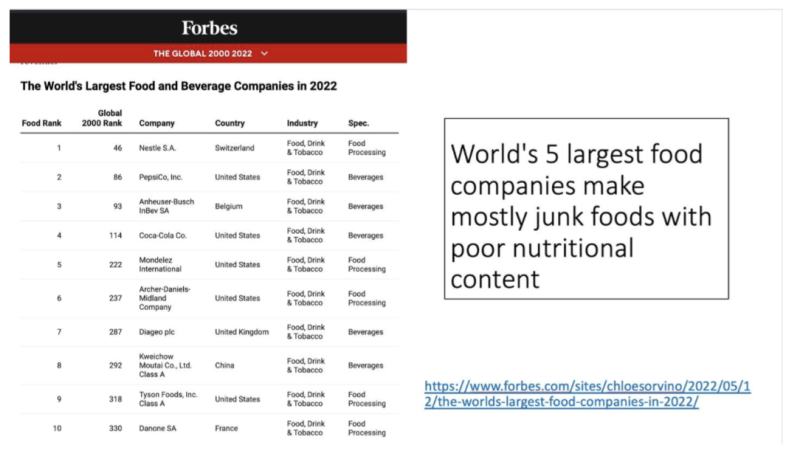
Perhaps the regulators could have avoided the debasement of the food supply. But they didn’t.
And now it has become a truism that Americans have the worst diet in the world.
Could food shortages be looming?
If it seems like the US, blessed with abundant natural resources, could never suffer a food shortage, think again. Did you know that while the US is the world’s largest food exporter, in 2023 the US imported more food than we exported?
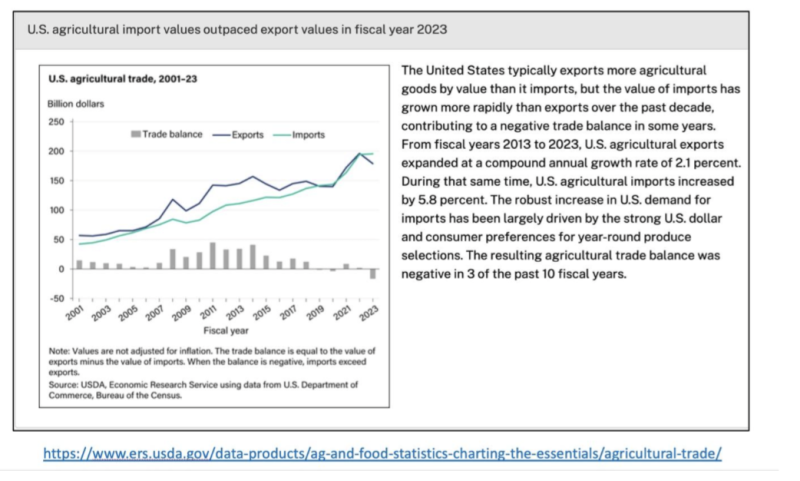
Cows are under attack, allegedly because their belching methane contributes to climate change. Holland has said it must get rid of 30-50% of its cows. Ireland and Canada are also preparing to reduce the number of their cows, using the same justification.
In the US, the number of cows being raised has gradually lessened, so that now we have the same number of cows that were being raised in 1951 — but the population has increased by 125% since then. We have more than double the people, but the same number of cows. What!? Much of our beef comes from Brazil.
Pigs and chickens are now mostly raised indoors. Their industries are already consolidated to the max. But cows and other ungulates graze for most of their life, and so the beef industry has been unable to be consolidated in the same way.
But consolidation is happening instead in the slaughterhouses because you cannot process beef without a USDA inspector in a USDA-approved facility — and the number of these facilities has been dropping, as have the number of cows they can handle. Four companies now process over 80% of US beef. And that is how the ranchers are being squeezed.
Meanwhile, efforts are afoot to reduce available farmland for both planting crops and grazing animals. Bill Gates is now the #1 owner of US farmland, much of which lies fallow. Solar farms are covering land that used to grow crops — a practice recently outlawed in Italy. Plans are afoot to impose new restrictions on how land that is under conservation easements can be used.
Brave New Food
That isn’t all. The World Economic Forum, along with many governments and multinational agencies, wants to redesign our food supply. So-called plant-based meats, lab-grown meats, “synbio” products, insect protein, and other totally new foods are to replace much of the real meat people enjoy — potentially leading to even greater consolidation of food production. This would allow “rewilding” of grazing areas, allowing them to return to their natural state and, it is claimed, this would be kinder to the planet. But would it?
Much of the land used for grazing is unsuitable for growing crops or for other purposes. The manure of the animals grazing on it replenishes soil nutrients and contributes to the soil microbiome and plant growth. “Rewilding” may in fact lead to the loss of what topsoil is there and desertification of many grazing areas.
Of course, transitioning the food supply to mostly foods coming from factories is a crazy idea, because how can you make a major change in what people eat and expect it to be good for them? What micronutrients are you missing? What will the new chemicals, or newly designed proteins, or even computer-designed DNA (that will inevitably be present in these novel foods) do to us over time? What will companies be feeding the insects they farm, when food production is governed by ever cheaper inputs?
It gets worse. Real food production, by gardeners and small farmers or homesteaders, is decentralized. It cannot be controlled. Until the last 150 years, almost everyone fed themselves from food they caught, gathered, or grew.
But if food comes mainly from factories, access can be cut off. Supply chains can break down. You can be priced out of buying it. Or it could make you sick, and it might take years or generations before the source of the problem is identified. How long has it taken us to figure out that overprocessed foods are a slow poison?
There are some very big problems brewing in the food realm. Whether we like it or not, powerful forces are moving us into the Great Reset, threatening our diet in new ways, ways that most of us never dreamed of.
Identifying the Problems and Solutions
But we can get on top of what is happening, learn what we need to, and we can resist. That’s why Door to Freedom and Children’s Health Defense have unpacked all of these problems and identified possible solutions.
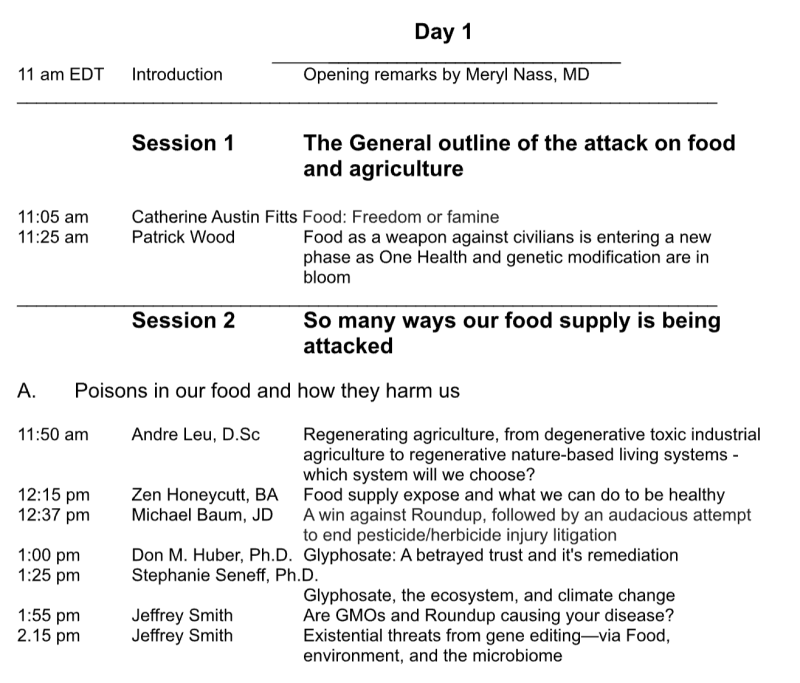
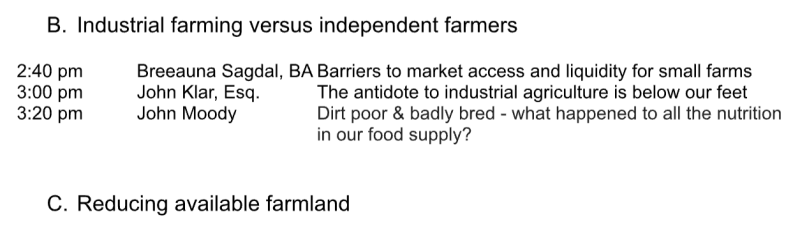
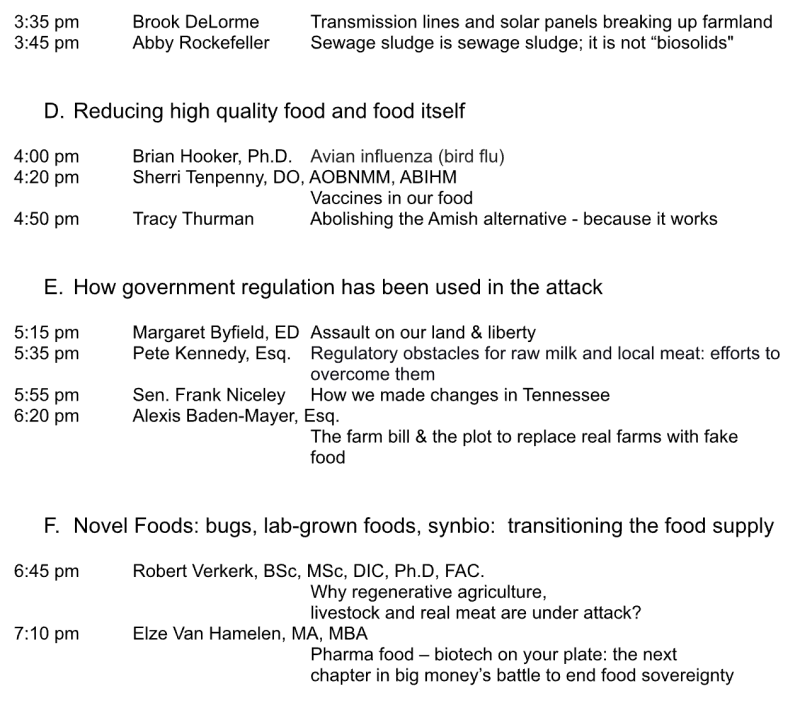
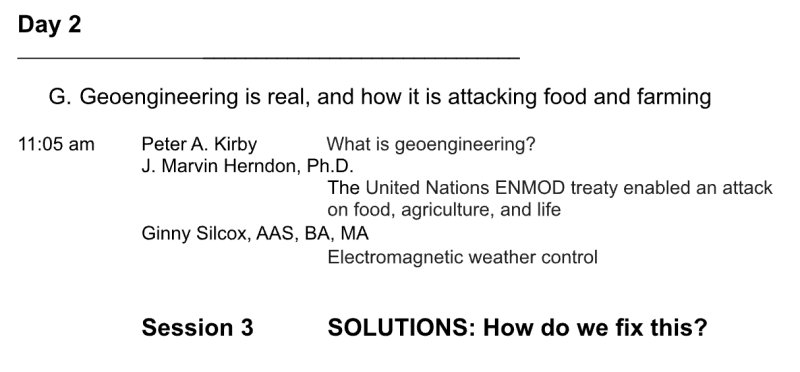
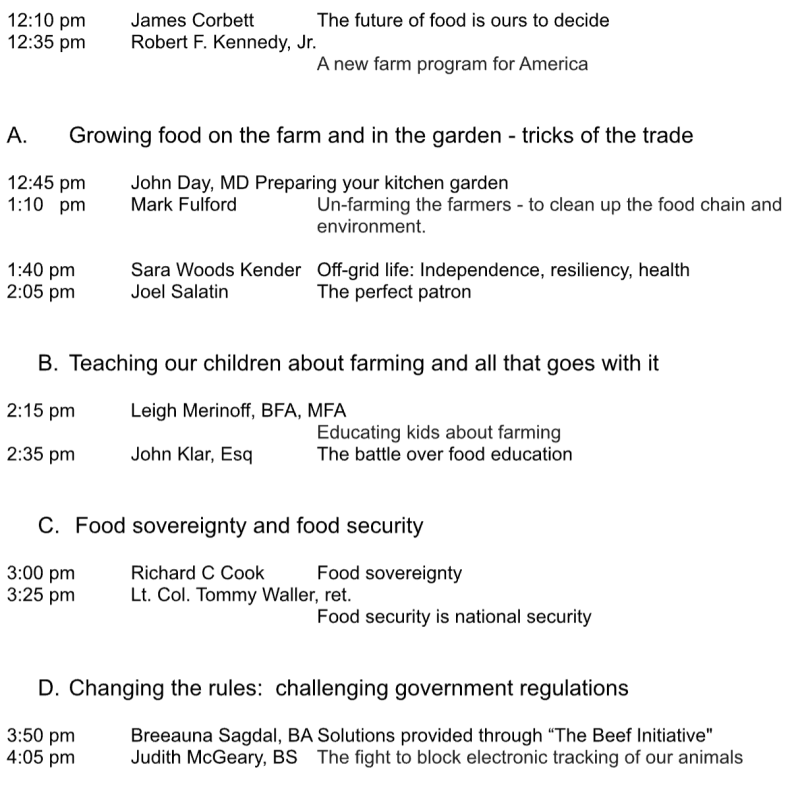
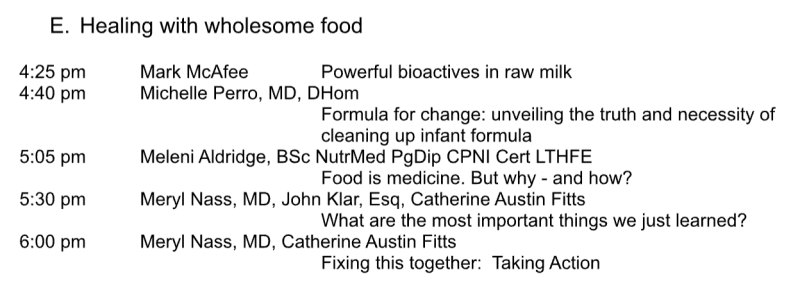
During a jam-packed two-day online symposium, you will learn about all facets of the attack on food, and how to resist. This is an entirely free event, with a fantastic lineup of speakers and topics. Grab a pad and pencil, because you will definitely want to take notes!
The Attack on Food and Farmers, and How to Fight Back premieres on September 6 and 7. It will remain on our channels for later viewing and sharing as well. By the end of Day 2, you will know what actions to take, both in your own backyard, and in the halls of your legislatures to create a healthier, tastier, safer, and more secure food supply.
See below for a summary and for the complete program.

Hungary May Defect – Part Nineteen of The Anglo-American War on Russia
Tales of the American Empire | August 29, 2024
Most Europeans know the United States provoked the conflict in Ukraine, profits from banning Russian oil and gas, and remain uneasy about the mysterious destruction of the Nordstream pipelines. The American government promoted a mindless NATO expansion strategy that caused a disastrous war and weakened NATO nations, who were pressured to donate billions of dollars and much of their military equipment to Ukraine, even though it isn’t a member of the NATO alliance.
Eastern European states were excited to join NATO and the European Union economic block, called the EU, but were soon pressured to boost military spending to buy American weaponry, accept foreign migrants, host foreign troops, and donate money and arms to a lost cause in Ukraine. Profitable trade and tourism with Russia sharply declined while energy costs soared, causing economic decline.
The people of some European nations have already decided that joining NATO and the EU was a bad idea. Hungarian Prime Minister Viktor Orban openly states his dislike of EU mandates to allow mass immigration and continued trade sanctions on Russia. EU leaders denounce Orban and threaten sanctions because they can abuse Hungary since it is landlocked and surrounded by Ukraine and EU members.
But if Russian troops reach Ukraine’s western border, Hungary may defect. Conquered Ukraine would become a close Russian ally and allow access to energy pipelines to import cheap Russian oil and gas, and permit rail and road access to Russia and all of Asia. There are several neighboring nations who may also defect from the American empire. This explains why NATO is considering sending forces to secure western Ukraine to keep its vassal states captive.
________________________________
Related Tale: “The Destruction of Libya in 2011”;  • The Destruction of Libya in 2011
“Slovakia, Hungary say Ukraine has halted Lukoil’s Russian oil transit”; Jason Hovet; Reuters; July 18, 2024; https://www.reuters.com/business/ener…
“Kyiv Will Face Retaliation”; EU nation Slovakia has issued an open threat to Ukraine amid war with Russia. Slovakia said it would take retaliatory measures against Ukraine if Kyiv continues to stop Russian oil transiting via the Druzhba pipeline.; “Times of India”; July 25, 2024; • ‘Kyiv Will Face Retaliation…’: NATO…
“MEPs call to strip Hungary’s EU voting rights amid Orbán’s ‘peace missions’”; Steb Starcevic; Politico; July 16, 2024; https://www.politico.eu/article/lette…
Related Tale: “The Destruction of Yugoslavia”; • The Destruction of Yugoslavia
Related Tales: “The Anglo-American War on Russia”; • The Anglo-American War on Russia
How is the US Convincing the Philippines to Destroy Itself?
By Brian Berletic – New Eastern Outlook – 29.08.2024
As China rises, Asia rises with it. The Southeast Asian state of the Philippines stood to rise alongside the rest of the region until relatively recently as the United States successfully convinces the Philippines to do otherwise.
Before the current administration of Ferdinand Marcos Jr. took office, China was working with the Philippines to build badly needed modern infrastructure. Now, rather than working and trading together with China, the Philippines is pointing missiles at China. It has “invited” the United States, the Philippines’ former colonial master, to build new military facilities across its territory, using semantics and legal loopholes to sidestep the Philippines own constitution and undermine its sovereignty in the process.
Instead of rising with the rest of Asia, the Philippines continues to escalate toward a conflict that could set the entire region back decades or more.
Just as the United States politically captured Ukraine in Eastern Europe in 2014 and transformed it into a geopolitical battering ram against neighboring Russia at the expense of Ukraine’s population, economy, sovereignty, and possibly even its existence, it is repeating the same process with the Philippines vis-à-vis China.
How has the United States convinced a nation of over 115 million people to forego economic progress and development in exchange for an escalating confrontation with its own largest trade partner? What are the mechanisms Washington uses to convince an entire nation to race toward conflict and self-destruction?
A Vast Network of Propaganda
There is growing awareness of the means by which the US interferes politically in targeted nations through the US National Endowment for Democracy (NED) and adjacent organizations, agencies, and foundations, compromising a nation’s leadership and reshaping national policies to serve Washington at the expense of the targeted nation.
The NED does this through targeting every aspect of a nation-state, from its political system, to academia, from its courts and legal system to a nation’s information space.
Philippine information space, like many nations around the globe, has been targeted by a vast media network built up by the US government as well as corporate money funneled through intermediaries including foundations and endowments, to poison the Philippine people not only against China specifically, but against the Philippines’ own best interests in general.
Part of this vast network are so-called “fact-checking” projects the US government together with the largest names in Western media as well as US-based tech giants like Google uses to paradoxically reinforce US government disinformation and attack and undermine people and organizations working to inform the public – including the Philippine public – of what the US is really doing and why.
In the Philippines, this network includes PressOne. Its “fact-checking” activities have repeatedly targeted those exposing US interference in the Philippines’ internal political affairs and undermining Philippine sovereignty.
PressOne has falsely “fact-checked” claims regarding the building of US military bases across the Philippines using semantics to argue that while the US is certainly building military facilities for its own use in the Philippines, technically the Philippines retains ownership over these facilities.
PressOne outright lied claiming, “President Ferdinand Marcos, Jr. has denied that the facilities were intended to be military bases.” The Reuters report PressOne cites does not deny the facilities are indeed military bases, it simply claims the bases are not meant for “offensive action” against any country – another example of semantics.
In another example, PressOne conducted a smear against this author citing US and Philippine government claims, as well as through the use of a number of logical fallacies including guilt by association.
PressOne’s task is to convince those reading its content that a US-led effort to transform the Philippines into a Ukraine-style proxy against its largest trading partner, China, is not taking place, but if it were, it is somehow in the Philippines’ best interests.
It should then come as no surprise that PressOne’s “fact-checking” activities are the result of US government funding to stand-up such projects. At the bottom of each “fact-check” article on PressOne it claims, “PressOne.PH is a verified signatory of the Code of Principles of the International Fact -Checking Network (IFCN) at Poynter.”
Poynter in turn discloses it is funded by the US government through the NED along with corporate-funded foundations connected to the Omidyar Network as well as the Google News Initiative, itself a partner of the US State Department as well as other US-allied governments.
All of this, in turn, is part of an influence operation targeting China the US spends hundreds of millions of dollars on every year.
Funding Disinformation Hundreds of Millions a Year
In 2021 the US Congress introduced the “Countering Chinese Communist Party Malign Influence Act.” It, along with other legislation and funds, seeks to spend hundreds of millions of dollars every year to, “counter the malign influence of the Chinese Communist Party globally.”
In practice, however, such legislation only seeks to reinforce the US’ actual malign influence.
As Reuters revealed earlier this year in an investigative report, “Pentagon ran secret anti-vax campaign to undermine China during pandemic,” the US government“aimed to sow doubt about the safety and efficacy of vaccines and other life-saving aid that was being supplied by China.” Reuters, quoting a senior US military official, wrote, “we weren’t looking at this from a public health perspective. We were looking at how we could drag China through the mud.”
The same Reuters report admitted that, far from an isolated instance, the US has a myriad of such programs run out of “psychological operations” centers engaged in systematic propaganda. Thus, while the US government was certainly “countering” China, it wasn’t because China was wielding “malign influence,” it was because China was undermining America’s own malign influence.
A Long-Run Policy to Contain China
In addition to lying about public health, the US seeks to convince the Philippine public to give up trade, economic development, and infrastructure projects with China and instead invest public funds into military spending ahead of what will likely be a Ukraine-style proxy war against China.
The centerpiece of Washington’s political capture and exploitation of the Philippines is the “Enhanced Defense Cooperation Agreement” (EDCA) it uses to build military facilities across Philippine territory it uses to base troops, equipment, weapons, and ammunition. The facilities contribute toward a wider regional strategy of militarily encircling and containing China, a foreign policy objective pursued by Washington since the end of World War 2.
Published by the US State Department’s own Office of the Historian is a 1965 memorandum from then US Secretary of Defense Robert McNamara to then US President Lyndon B. Johnson titled, “Courses of Action in Vietnam” which admitted that US military operations in Southeast Asia only“made sense” if they were “in support of a long-run United States policy to contain Communist China.” The same memorandum identified 3 fronts along which the US sought to contain China, including East Asia, Pakistan and India, as well as Southeast Asia where the Philippines is located.
Today, this policy of encirclement continues through mechanisms like the EDCA. Despite clearly running in contradiction to the Philippine people’s best interests, the well-funded propaganda campaign the US runs worldwide including in the Philippines (including the above mentioned PressOne) is attempting to convince the Philippine people that China is a threat, that the Philippines’ former colonial masters are their“allies,” and that buying US weapons and fighting Washington’s wars alongside US troops is the path forward toward a brighter future.
Considering the pile of ashes and bones the US is transforming Ukraine into even as this same process gains momentum in the Philippines, it is clear that along this path, there is no future at all for the Philippines. This unfortunate transformation and the deep socio-political scars it is creating within the Philippines serves as yet another warning about the importance of treating a nation’s information space as it does its physical domains and the importance of protecting this domain as well or better than a nation protects its land borders, shores, and air space. Only time will tell if other nations heed this warning, or simply follow Ukraine and the Philippines into self-destruction.
Brian Berletic is a Bangkok-based geopolitical researcher and writer.
Brazil’s High Court Freezes Starlink Assets Over Musk’s X Censorship Refusal
By Dan Frieth | Reclaim The Net | August 29, 2024
Brazil’s Supreme Court has escalated the country’s retaliation against Elon Musk by freezing the financial assets of Starlink Holding, a subsidiary of Musk’s. This action is in response to another Musk company, X, which has refused to censor posts and designate a legal representative in Brazil.
This decision was part of a broader action taken by the controversial Justice Alexandre Moraes of the Supreme Court, who targeted an economic entity led by Musk. According to Brazilian media, on August 18, Moraes mandated the freezing of all financial assets of Starlink within Brazil to secure the payment of penalties levied against X by Brazilian courts.
Justice Moraes’ decision stems from the ongoing dispute involving X’s operations in Brazil. The company, under Musk’s direction, had recently shut down its Brazilian office on August 17, citing disagreements with the Supreme Court’s fines and content censorship mandates. This closure followed the court’s demand, made the day before, for X to appoint a legal representative to address these issues formally.
The lack of a legal representative prompted Justice Moraes to issue an ultimatum to the social network, giving them 24 hours to comply under threat of service suspension in Brazil. The urgency and consequences of these legal actions were communicated via a post on the Supreme Court’s X profile, directly responding to X’s announcement about the office closure to protect employees and the withdrawal of their representative.
Aside from X, Musk’s Starlink operates within Brazil, providing satellite internet services, particularly in the Northern region. The leadership of Starlink in Brazil has been informed and summoned to respond to the financial obligations imposed on X by the Brazilian judiciary.
Starlink, the satellite internet service by SpaceX, is particularly significant in Brazil for enhancing connectivity in remote and underserved regions, such as the vast Amazon rainforest where traditional broadband is impractical. This technology provides reliable internet access, supporting educational resources, digital commerce, and connectivity during natural disasters, which are frequent in regions prone to floods and landslides.
Additionally, improved internet access aids environmental monitoring efforts in the Amazon, facilitating better resource deployment against illegal activities such as deforestation and wildlife trafficking.
Zelensky’s Gas Threats Making Europeans ‘Realize It’s Not Profitable to Go to War with Russia’
Sputnik – 28.08.2024
Volodymyr Zelensky warned on Tuesday that Kiev has no plans to “extend the [gas transit] agreement with Russia” after the current arrangement expires December 31. Unable to find alternatives to Russian energy, landlocked Hungary, Slovakia, Austria and the Czech Republic have expressed serious concerns about the fate of the Gazprom-Naftogaz deal.
A decision by Ukraine to cut Central Europe off from access to Russian natural gas via Russia’s only remaining operational gas pipeline to the region “will seriously harm the interests of European consumers who still want to buy Russian gas,” Kremlin spokesman Dmitry Peskov told reporters on Wednesday.
“They will simply have to pay much more, which will make their industry less competitive,” Peskov said.
The five-year Gazprom-Naftogaz transit agreement signed in 2019 is set to expire at the end of the year, and Kiev has announced that it has no plans to extend it.
“After the Hungarians, the Slovaks, the Austrians, the Italians, and even the Germans are beginning to realize that it is not profitable to go to war with Russia, pump money into Ukraine, and cut the umbilical cord between the eastern and western half of Europe,” Hungarian Community for Peace president Endre Simo told Sputnik, commenting on Kiev’s threats.
“The European Union has fallen victim to its own policy, as the announcement by… Zelensky fits perfectly into the European Union’s policy of sanctions against Russia,” Simo said.
“Nevertheless, Kiev will probably not be thanked for the move, since the gas will bypass Ukraine, presumably through Turkiye, and from there through the Balkans and Hungary to EU western countries, and will be much more expensive. As a result, consumer goods and services will become even more expensive. Its price will be paid by Western European consumers. It is a question of how much they will accept the further reduction of their purchasing power and the further deterioration of their standard of living,” he added.
“We actually owe Zelensky a debt of gratitude for his decision, as he proved to the country and the world who is a reliable economic partner and who is not. While Ukraine stops the gas supply for political reasons, Russia sees no obstacle to continuing it in other ways,” Simo suggested, emphasizing that the EU will never turn away from Russian gas completely, even if it becomes more expensive thanks to Kiev’s decision, since it will “still” be “cheaper than American liquefied gas.”
Ukraine Announces Partial Halt to Payments on Its Gargantuan Debt
By Ilya Tsukanov – Sputnik – 28.08.2024
Kiev is notoriously dependent on foreign military and economic support and debt-based spending fueling the NATO proxy war with Russia, with its national debt nearly doubling under Volodymyr Zelensky to over $152 billion. A World Bank official warned this spring that Ukraine could declare bankruptcy in 2025 unless its sponsors bail it out.
Ukraine’s Cabinet of Ministers issued a resolution on Tuesday ordering a partial halt to the servicing of its obligations on Eurobonds, sovereign GDP warrants and other loan instruments, driving the country one step closer to formal financial ruin.
Starting September 3, Ukraine will stop servicing its roughly $700 million debt to Cargill Financial Services International, a Minneapolis-registered agribusiness giant. From November 9 on, Kiev will halt servicing state national power company Ukrenergo’s ‘green and sustainability-linked’ Eurobonds, issued in 2021 and worth about $830 million.
Payments on GDP warrants – a financial instrument linked to economic growth, will be stopped May 31, 2025. Ukraine owes some $2.6 billion on this instrument, according to US banking giant JPMorgan.
The above debt reportedly fell outside a large-scale debt restructuring agreement announced earlier this month and designed to allow Kiev to stave off defaulting on its obligations.
The government decree instructs the State Treasury to temporarily suspend operations with GDP warrant-related funds, with Kiev last making an 2.89 billion hryvnia ($70.52 million US) payment, corresponding to the deferred payment of earnings and interest accrued from 2021, on July 31. On August 1, the treasury paid a 5.33 billion hryvnia ($130 million) fee for a separate debt restructuring deal reached in 2022. In 2023, Kiev agreed to defer GDP warrant payments to August 1, 2024 with 7.75% interest.
Kiev announced on July 22 that it had reached agreements in principle on the restructuring of some $23 billion in Eurobond debt with a committee of debt holders, with the deal reportedly involving the write-off of up to 37% of the debt, minus 12% if a high level of GDP growth can be restored by 2028.
The remaining debt is set to be reissued as new Eurobonds maturing in between 2029 and 2036, with interest increasing from 1.75% to 7.75% over time. Investors ready to participate in the Eurobond exchange have been offered a 1.25% bonus, with agreements requiring consent of 2/3 of debt holders. The deadline for deal was August 27, 5 pm New York time.
Settlements are expected to be paid out by August 30.
Big Three credit agency S&P Global Ratings downgraded Ukraine’s credit rating earlier this month from CC/C (‘vulnerable/highly vulnerable’) to SD/SD (‘selective default’) after Kiev missed a payment on its Eurobonds. “We do not expect the payment within the bond’s contractual grace period of 10 business days,” S&P said, pointing to Kiev’s July measure “that authorizes the government to suspend payments” on some debt.
A month earlier, Fitch Ratings downgraded Ukraine’s rating from “CC” (‘default imminent with little prospect of recovery’) to “C” – one notch above default.
An anonymous World Bank official told Russian media in March that Ukraine could formally declare bankruptcy in 2025 if Western creditors don’t write off its debts, including obligations to private entities and banks. Ukraine’s budget deficit is expected to hit a record $43.9 billion in 2024, notwithstanding the fact that the country has received upwards of $200 billion in military, economic, and humanitarian aid from Western countries since early 2022.
The arrest of Durov isn’t just about Telegram
By Fyodor Lukyanov | Russia in Global Affairs | August 27, 2024
The arrest of Telegram founder Pavel Durov, when he had decided to take a little trip to Paris, has caused a stir in various spheres – from the business and tech world to media and politics. We will focus on the latter, especially as the incident is becoming another milestone in a wider political reorganization.
Durov comes from a niche that claims transnational status above all else. Information and communication technologies seem to have turned the world into a common space and abolished sovereign jurisdiction. The enormous influence that the IT giants have acquired has been converted into gigantic amounts of money, which has in turn increased their influence further. Transnational corporations have always existed – in areas such as mining, engineering, and finance. But despite their international character, they were still tied to particular states and their interests. The global communications industry, and its associated innovation sector, has dared to break that link.
The period of globalization that lasted from the late 1980s to the late 2010s favored this sort of attitude. It encouraged the creation of a level playing field on which the most developed countries had a clear advantage. They benefited the most. The costs associated with the techno-giants’ growing ability to manipulate societies – including their own in the West – were not seen as critical.
The crisis of liberal globalization has led to a change in the international reality (you could also invert that statement and say the reverse without changing the essence). Thus, the willingness to play by common rules has rapidly and universally diminished. What is fundamental is that this applies even where these laws were originally written, in the leading states of the Western community.
The previous era has not disappeared without a trace. The world has become fiercely competitive, but it remains closely interconnected.
Two things hold it together. The first is trade and production, the logistical chains for which were created during the globalization boom and have qualitatively transformed the economy. They are extremely painful to break. And the second is a unified information field, thanks to ‘nationally neutral’ communications giants.
But there is something strange that separates us. It is not a desire to grab more of the pie – in the sense of what Lenin called the expansionist “imperialist predators” – but rather a sense of internal vulnerability that is growing in various states.
Paradoxically, this is more of a factor in the bigger and more important countries, because these are the powers that are involved in the biggest game. This explains their impulse to minimize any factor that might affect internal stability. First and foremost, this pertains to the channels that serve as conduits for influence (read: manipulation), either from outside or from certain internal forces.
Structures that operate transnationally – understandably – immediately look suspect. The view is that they should be ‘nationalized’, not through ownership but in terms of demonstrating loyalty to a particular state. This is a very serious shift, and in the foreseeable future this process could dramatically weaken the second pillar of the current global interconnectedness.
Durov, a committed cosmopolitan liberal, is a typical representative of the ‘global society’. He has had tensions with all the countries he has worked in, starting with his homeland and continuing throughout his more recent travels. Of course, as a big businessman in a sensitive industry, he has been in dialectical interaction with the governments and intelligence services of different countries, which has required maneuvering and compromise. But the attitude of avoiding any national entrenchment persisted. Having passports for all occasions seemed to widen his scope for action and increase his confidence. At least for as long as this very global society lived and breathed, calling itself the liberal world order. But it’s now coming to an end. And this time the possession of French nationality, along with a number of other things, promises to exacerbate rather than alleviate the predicament of the accused.
The ‘transnational’ entities will increasingly be required to ‘ground’ themselves – to identify with a particular state. If they do not want to, they will be affixed to the ground by force, by being recognized as agents not of the global world but of specific hostile powers. This is what is happening now with Telegram, but it’s not the first and it will not be the last such instance.
The struggle to subjugate the various actors in this sphere, thus fragmenting a previously unified field, is likely to be a key component of the next global political phase.
The tightening of control over everything to do with data will inevitably increase the degree of repression in the information sphere, especially since it is not easy in practice to block unwanted channels. But if relatively recently it seemed impossible to dig up the world’s information superhighway and make it unusable for travel, this no longer seems so far-fetched.
The most interesting question is how the likely shrinking of the global information realm will affect trade and economic connectivity, the remaining pillar of world unity. Judging by the pace of change, there will soon be newsworthy developments there too.
This article was first published by Russia in Global Affairs, translated and edited by the RT team
Germany: Upcoming state elections to bring major political shift
By Dénes Albert | Remix News | August 26, 2024
On Sept. 1, two key East German states, Saxony and Thuringia, will hold landmark elections: The Alternative for Germany (AfD) looks unstoppable and the popularity of the left-wing Sahra Wagenknecht Alliance (BSW) is soaring.
The whole of Germany is watching anxiously as local people decide their future on Sept. 1. In the former East Germany, there is a growing discontent with the policies and actions of the federal coalition government, which, according to opinion polls, the Alternative for Germany (AfD) is now without doubt the strongest party in Saxony and Thuringia, followed by the Christian Democrats (CDU), while the Sahra Wagenknecht Alliance (BSW), which was formed in the winter, is in third place and starting to catch up with 15 to 20 percent.
The right-wing AfD, which is calling for more action against illegal immigration, and the similarly oppositional but left-wing BSW are not only united by a general dissatisfaction with the CDU; both parties are opposed to further support for Ukraine and call for peace as soon as possible.
A poll in January this year already showed that if the elections in Saxony had taken place then, the radical anti-immigration AfD would almost certainly have won the most votes, 37 percent, followed by the CDU with around 30 percent, while the Social Democrats would not even have been elected to the state parliament.
The latest figures show a slight difference, but this does not mean that Michael Kretschmer, who currently leads the CDU-SPD-Green coalition in Saxony, can sit back comfortably. Opinion polls show them with a lead of just 4 percent, while the AfD is a close second with 30 percent.
And the serious terrorist attack in Solingen on Friday and the steady increase in other migrant-related crimes are probably not a reflection on the Kretschmer’s side either.
In Thuringia, where the CDU is in government with the Greens, the AfD is confidently in the lead with 30 percent, with only 21 percent supporting the CDU and 3 percent the Greens.
UAE’s support of Israeli economy and militarism
Press TV – August 24, 2024
The UAE has allocated $10 billion for direct investment in the Zionist entity in compliance with its obligations under the US-guided Abraham Accords.
The UAE’s deep involvement in Zionist militarism is barely noticed in the shadow of the Gaza genocide.
A deal was signed in 2021 between state-owned UAE arms firm, Edge Group, and weapons manufacturer, Israel Aerospace Industries, to design unmanned surface vessels with a range of military applications.
The UAE has also initiated a partnership between G42 and the Zionist entity-owned arms firm, Rafael Advanced Defense Systems. G42 is run by Tahnoun bin Zayed Al Nahyan, the UAE’s National Security Advisor who is the controlling shareholder and chairs the company.
Dorian Barak, co-president of the UAE-Israel Business Councilو expects to see about 1000 Israeli-owned companies operating in the Persian Gulf state very soon.
One such example could be Elbit Systems, which has set up a subsidiary in the UAE known as Elbit Systems Emirates. The branch produces weapons for both the UAE military and Israel.
The UAE state-owned firm, Mubadala, has an 11% participating interest in the Tamar and Dalit leases, which includes the bountiful Tamar gas field.
Mubadala has also invested in the Israeli venture capital firm, Pintango Venture Partners. Originally named Polaris Venture Capital, it was founded in 1993 by Chemi Perez, the son of the late Israeli president, Shimon Peres.
The UAE has also invested in the tech firm Synaptech, which is closely linked to the Israeli military. The chairman of Synaptech is the former war minister and the military chief of staff, Moshe Ya’alon.
The UAE is deeply integrated, economically, with the Zionist entity.
US threatens to sanction countries which host Russian banks
RT | August 24, 2024
Nations which maintain economic ties with Russia risk secondary sanctions if they allow Russian banks to open local branches to facilitate bilateral trade, the US Treasury’s Office of Foreign Assets Control (OFAC) stated on Friday.
The measures are aimed at closing workarounds that Moscow is said to be using to circumvent the existing sanctions. The Treasury Department has claimed that the Russian authorities are utilizing vague schemes to pay for dual-use goods that are allegedly imported from the third states.
“Treasury is aware of Russian efforts to facilitate sanctions evasion by opening new overseas branches and subsidiaries of Russian financial institutions,” the statement reads.
The department urged foreign regulators and financial institutions to be “cautious about any dealings with overseas branches or subsidiaries” of Russian banks, including efforts to set up new branches or subsidiaries, having warned that it has a range of tools to target “the establishment of new evasion channels.” The measure is aimed at Russian banks that are not sanctioned yet.
Washington has introduced several rounds of sanctions which target the interaction of foreign banks with Russian companies and financial organizations since the escalation of the Ukrainian conflict in February 2022.
Last December, US President Joe Biden ordered the introduction of so-called secondary sanctions against financial institutions that allegedly support Russia’s defense sector.
At the time, the US administration blacklisted over 4,500 Russian entities in an effort to force foreign lenders not to work with them.
In June, the White House expanded the scope of the crackdown on foreign banks that do business in Russia, targeting any such institution that works with any sanctioned entity in the country with the updated policy. At the same time, the US imposed sanctions on the subsidiaries of VTB, Sberbank, Promsvyazbank and Vnesheconombank in China, Kyrgyzstan and India.
The US and its allies have introduced a record number of restrictions against Moscow since 2014, when Crimea rejoined Russia and a conflict between Ukraine and the Donbass republics broke out as the result of a Western-backed coup in Kiev. Last week, Washington announced additional restrictions against 400 individuals and companies in Russia, Asia, Europe and the Middle East, accusing them of supporting Moscow’s military-industrial supply chains.
Commenting on the move, Russia’s Ambassador to the US Anatoly Antonov said that the sanctions are fruitless and continue to harm US domestic consumers, as well as America’s partners in third countries. Moscow has repeatedly called the curbs illegitimate, and responded with travel bans on Western officials and other moves.
Featured Video

Macgregor: We Haven’t Seen the Worst of the Iran War Yet
or go to
Aletho News Archives – Video-Images
From the Archives
15 Saudi ‘hijackers’ were CIA agents working for US: Scholar
Press TV – April 13, 2016
Fifteen of the 9/11 “hijackers” from Saudi Arabia were CIA agents working for the United States government, which was seeking to destroy the Middle East for Israel and to double the American military budget, says Dr. Kevin Barrett, an American academic who has been studying the events of 9/11 since late 2003…. continue
Blog Roll
 Aletho News
- Iran’s Plan to Shut Down AI in the Persian Gulf
- Israel seeks ‘compensation’ from Washington over Saudi F-35 sale
- Saudi crown prince seeks dialogue with Ansarullah after Yemeni blows: Report
- Damascus rejects Saudi request for Syrian fighters to counter Yemen: Report
- South Korea says will not send troops to join terrorist US war on Iran
- Russia Just Struck the Eyes of NATO’s War Machine in Ukraine
- Russia summons UK charge d’affaires over Kiev drone support
- NATO member warns bloc seeking pretext for war with Russia
- Macgregor: We Haven’t Seen the Worst of the Iran War Yet
- ‘We are not like everyone else’ laws that bind other nations do not apply to Israel, says Likud lawmaker
- If Americans Knew
- Debunking The Claim That Macklemore Has A “History Of Antisemitism”
- CPJ demands release of arrested Palestinian-US journalist near Bethlehem
- Robert Kraft: The Billionaire Friend of Netanyahu Pulling The Strings Behind the Macklemore/Ed Sheeran Blow Up
- Columbia Administered Fund Gives Big Money to Pro-Israel Groups
- Deportation Case of Palestinian Activist Salah Sarsour Tests First Amendment
- ‘We Will Not Forget’: Palestinians Mark 44 Years since Sabra and Shatila
- Why do we let Zionists decide what we can and can’t say?
- US welcomes Israeli, Iranian delegations to UN, but not Palestinians – Daily Update
- Biden’s Genocide Accomplices Targeted by New Accountability Campaign
- AIPAC’s Network Has Already Spent $67.2 Million to Shape the Midterm Elections
- No Tricks Zone
- New Study: ‘Global Drought Shows No Detectable Recent Acceleration Under Climate Warming’
- Economic Masterminds: German Socialists Suggest Taxing Productivity Gains Stemming From Using AI
- The South China Sea Has Not Been Cooperating With The Climate Change Narrative
- Energy Crisis: Germany Enters Heating Season With Historically Low Gas Reserve Fill Levels
- New Study: The Antarctic Ice Sheet Gained Mass From 2020-2024 Due To Staggering Snow And Ice Accumulation
- Study: Ocean Heating Rates From Thousands Of Years Ago ‘Dwarf’ Modern Ocean Heating Rates
- Climate Extremists Target, Attack Large-Scale Power Grid Infrastructure In Germany!
- New Study: Antarctic Ice Melt Has Contributed Less Than 1 Centimeter To Sea Level Rise In The Last 30 Years
- Fear Of Debate: Alarmist German Climate Scientist Calls On Mainstream Media To Discredit Skeptic Voices
- End-Of-August Arctic Sea Ice Extent Hasn’t Fallen In 20 Years, Official Data Show!
 Aletho News