Israeli army razes 600 buildings in Gaza to build dozens of military bases, expand Netzarim Corridor
The Cradle | December 2, 2024
The Israeli army has been expanding its construction of military bases, outposts, and communication towers in the Netzarim Corridor in central Gaza, the New York Times (NYT) reported on 2 December.
The military has demolished over 600 buildings around the corridor in the past three months “in an apparent attempt to create a buffer zone,” the report states.
Satellite images reviewed by NYT showed the Israeli army has built at least 19 large bases throughout the area and dozens of small ones, suggesting plans for a long-term occupation.
“While some were built earlier in the war, the imagery also shows that the pace of construction appears to be accelerating: 12 of the bases were either built or expanded since early September,” NYT writes.
As a result of the construction, the corridor has slowly grown into a 46.6 square-kilometer military zone occupied by Israeli forces.
The paper said that control of the Netzarim Corridor, which cuts across Gaza from the border with Israel to the Mediterranean Sea, allows the army to “regulate” the movement of Palestinians.
The army’s control of the corridor allows Israel to prevent the return of hundreds of thousands of Palestinians displaced by Israeli bombing and ground operations from returning from the south of Gaza to their homes.
Israel has also constructed the Philadelphi Corridor, a buffer zone that divides Rafah in southern Gaza from Egypt, giving Israeli troops control of the Egypt border and crucial Rafah Crossing.
Israel is also creating another military corridor in the far north of Gaza, cutting off the towns of Jabalia, Beit Hanoun, and Beit Lahia from Gaza City in the center, according to satellite images studied by BBC Verify.
BBC reported that “Satellite images and videos show that hundreds of buildings have been demolished between the Mediterranean Sea and the Israel border, mostly through controlled explosions.”
Dr H.A. Hellyer, a West Asia security expert from the Rusi think tank, told BBC the Israeli army is “digging in for the long term. I would absolutely expect the north partition to develop exactly like the Netzarim Corridor.”
Construction of the new corridor in north Gaza starting in October corresponds with Israel’s implementation of the Generals’ Plan.
Under the strategy devised by former general Giora Eiland, the Israeli army issued orders for all Palestinians to leave northern Gaza, while those who are unable to or refuse to leave will be besieged, bombed, and starved.
Dr Hellyer suggested that the implementation of the Generals’ Plan would open the door to the permanent annexation of Gaza and the onset of Jewish settlement there relatively soon.
“Personally, I think they’re going to settle Jewish settlers in the north, probably in the next 18 months,” he said. “They won’t call them settlements. To begin with, they’ll call them outposts or whatever, but that’s what they’ll be, and they’ll grow from there.”
The Long War to reaffirm Western and Israeli primacy undergoes a shape-shift
By Alastair Crooke | Strategic Culture Foundation | December 2, 2024
The long war to reaffirm western and Israeli primacy is undergoing a shape-shift. On one front, the calculus in respect to Russia and the Ukraine war has shifted. And in the Middle East, the locus and shape of the war is shifting in a distinct way.
Georges Kennan’s famed Soviet doctrine has long formed the baseline to U.S. policy, firstly directed toward the Soviet Union, and latterly, towards Russia. Kennan’s thesis from 1946 was that the United States needed to work patiently and resolutely to thwart the Soviet threat, and to enhance and aggravate the internal fissures in the Soviet system, until its contradictions triggered the collapse from within.
More recently, the Atlantic Council has drawn on the Kennan doctrine to suggest that his broad outline should serve as the basis of U.S. policy towards Iran. “The threat that Iran poses to the U.S. resembles the one faced from the Soviet Union after World War II. In this regard, the policy that George Kennan outlined for dealing with the Soviet Union has some applications for Iran”, the Atlantic report states.
Over the years, that doctrine has ossified into an entire network of security understandings, based on the archetypal conviction that America is strong, and that Russia was weak. Russia must ‘know that’, and thus, it was argued, there could be no logic for Russian strategists to imagine they had any other option but to submit to the overmatch represented by the combined military strength of NATO versus a ‘weak’ Russia. And should Russian strategists unwisely persevere with challenging the West, it was said, the inherent contrariety simply would cause Russia to fracture.
American neocons and western intelligence have not listened to any other view, because they were (and largely still are) convinced by Kennan’s formulation. The American foreign policy class simply could not accept the possibility that such a core thesis was wrong. The entire approach reflected more a deep-seated culture, rather than any rational analysis – even when visible facts on the ground pointed them to a different reality.
So, America has piled the pressure on Russia through the incremental delivery of additional weapons systems to Ukraine; through stationing intermediate range nuclear-capable missiles ever-closer to Russia’s borders; and most recently, by shooting ATACMS into ‘old Russia’.
The aim has been to pressure Russia into a situation where it would feel obliged to make concessions to Ukraine, such as to accept a freezing of the conflict, and to be obliged to negotiate against Ukrainian bargaining ‘cards’ devised to yield a solution acceptable to the U.S. Or, alternatively, for Russia to be cornered into the ‘nuclear corner’.
American strategy ultimately rests on the conviction that the U.S. could engage in a nuclear war with Russia – and prevail; that Russia understands that were it to go nuclear, it would ‘lose the world’. Or, pressured by NATO, the anger amongst Russians likely would sweep Putin from office were he to make significant concessions to Ukraine. It was a ‘win-win’ outcome – from the U.S. perspective.
Unexpectedly however, a new weapon appeared on the scene which precisely unshackles President Putin from the ‘all-or-nothing’ choice of having to concede a bargaining ‘hand’ to Ukraine, or resort to nuclear deterrence. Instead, the war can be settled by facts on the ground. Effectively, the George Kennan ‘trap’ imploded.
The Oreshnik missile (that was used to attack the Yuzhmash complex at Dnietropetrovsk) provides Russia with a weapon, such as never before witnessed: An intermediate range missile system that effectively checkmates the western nuclear threat.
Russia can now manage western escalation with a credible threat of retaliation that is both hugely destructive – yet conventional. It inverts the paradigm. It is now the West’s escalation that either has to go nuclear, or be limited to providing Ukraine with weapons such as ATACMS or Storm Shadow that will not alter the course of the war. Were NATO to escalate further, it risks an Oreshnik strike in retaliation, either in Ukraine or on some target in Europe, leaving the West with the dilemma of what to do next.
Putin has warned: ‘If you strike again in Russia, we will respond with an Oreshnik hit on a military facility in another nation. We will provide warning, so that civilians can evacuate. There is nothing that you can do to prevent this; you do not have an anti-missile system that can stop an attack coming in at Mach 10’.
The tables are turned.
Of course, there are other reasons beyond the permanent security cadre’s wish to Gulliverise Trump into continuing the war in Ukraine, in order to taint him with a war that he promised immediately to end.
Particularly the British, and others in Europe, want the war to continue, because they are on the financial hook from their holdings of some $20 billion Ukrainian bonds which are in a ‘default-like status’, or from their guarantees to the IMF for loans to Ukraine. Europe simply cannot afford the costs of a full default. Neither can Europe afford to pick up the burden, were the Trump Administration to walk away from supporting Ukraine financially. So they collude with the U.S. interagency structure to make the continuation of the war proofed against a Trump policy reversal: Europe for financial motives, and the Deep State because it wants to disrupt Trump, and his domestic agenda.
The other wing to the ‘global war’ reflects a mirror paradox: That is, ‘Israel is strong and Iran is weak’. The central point is not only its cultural underpinning, but that the entire Israeli and U.S. apparatus is party to the narrative that Iran is a weak and technically backward country.
The most significant aspect is the multi-year failure as regards factors such as the skill to understand strategies, and recognize changes in the other sides’ capabilities, views and understandings.
Russia seems to have solved some of the general physical problems of objects flying at hypersonic speed. The use of new composite materials has made it possible to enable the gliding cruise bloc to make a long-distance guided flight practically in conditions of plasma formation. It flies to its target like a meteorite; like a ball of fire. The temperature on its surface reaches 1,600–2,000 degrees Celsius but the cruise bloc is reliably guided.
And Iran seems to have solved the problems associated with an adversary enjoying air dominance. Iran has created a deterrence fashioned from the evolution of cheap swarms drones matched up with Ballistic missiles carrying precision hypersonic warheads. It puts $1,000 drones and cheap, precision missiles up and against hugely expensive piloted airframes – An inversion of warfare that has been twenty years in the making.
The Israeli war however, is metamorphosing in other ways. The war in Gaza and Lebanon has strained Israeli manpower; the IDF have sustained heavy losses; its troops are exhausted; and the reservists are losing commitment to Israel’s wars, and are failing to show up for duty.
Israel has reached the limits of its capacity to put boots on the ground (short of conscripting the Orthodox Haredi Yeshiva students – an act that could bring down the Coalition).
In short, the Israeli army’s troop levels have fallen below present command ordered military commitments. The economy is imploding and internal divisions are raw and bruising. This is especially so due to the inequity of secular Israelis dying, whilst others stay exempt from military service – a destiny reserved for some but not others.
This tension played a major part in Netanyahu’s decision to agree to a ceasefire in Lebanon. The growing animus about Orthodox Haredi exemption risked bringing down the Coalition.
There are – metaphorically speaking – now two Israels: The Kingdom of Judea versus the State of Israel. In view of such deep antagonisms, many Israelis now see war with Iran as the catharsis that will bind a fractured people together again, and – if victorious – end all of Israel’s wars.
Outside, the war widens and shape-shifts: Lebanon, for now, is put on a low flame burner, but Turkey has triggered a major military operation (reportedly some 15,000 strong) in an attack on Aleppo, using U.S. and Turkish trained jihadists and militia from Idlib. Turkish Intelligence no doubt has its own distinct objectives, but the U.S. and Israel have a particular interest to disrupt weapons supply routes to Hizbullah in Lebanon.
The Israeli wanton onslaught on non-combatants, women and children – and its explicit ethnic cleansing of the Palestinian population – has left the region (and the Global South) seething and radicalised. Israel, through its actions, is disrupting the old ethos. The region is ‘conservative’ no more. Rather, a very different ‘Awakening’ is gestating.
Hezbollah responds to repeated truce violations by Israel with strike on military site
Press TV – December 2, 2024
Hezbollah has launched an attack on an Israeli military site in the occupied Kfarchouba hills in response to the regime’s repeated violations of the ceasefire agreement that was to bring an end to nearly 14 months of fighting between the two sides.
The Lebanese resistance movement said in a statement published on its Telegram channel on Monday that the strike on the Israeli army position in the Mount Dov area was an “initial warning defensive response,” and cited “the continued violation of Lebanese airspace by hostile Israeli aircraft, all the way to the capital, Beirut.”
The resistance group also criticized the “concerned authorities” for failing to stop Israeli attacks on Lebanese soil despite the ceasefire.
Since the ceasefire went into effect last week, Israel has carried out more than 50 attacks on Lebanese territory, which have killed and wounded several people.
Lebanese authorities said earlier on Monday that two people were killed and an army soldier was wounded in fresh Israeli strikes on southern Lebanon.
On Sunday, Israeli jets launched an airstrike over the southern Lebanese village of Yaroun, while troops shelled other towns and villages close to the border with the occupied territories, Lebanon’s official National News Agency reported.
Israel was forced to accept the ceasefire after suffering heavy losses following more than 14 months of fighting and failing to achieve its goals in its aggression on Lebanon. The truce agreement officially came into effect on November 27.
Hezbollah opened a support front for Palestinians in Gaza only a day after the Israeli regime unleashed its genocidal campaign in the besieged territory in October 2023, launching numerous retaliatory attacks against Israeli targets in the occupied territories.
Following the truce announcement, the resistance movement warned it was fully ready to counter further potential Israeli aggression against Lebanon.
When Is A Ceasefire Not A Ceasefire?
When it is set up by Washington and Israel is involved
By Philip Giraldi • Unz Review • November 30, 2024
We are possibly witnessing another stealthy move by Washington and Benjamin Netanyahu of Israel to enhance the Israeli position in a Middle East at war while pretending to do something else. President Joe Biden and his cast of know-nothings have been bleating for months about their desire to arrange a “humanitarian” ceasefire in Gaza and Lebanon while also alternatively whining about the Jewish state’s “right to defend itself,” but somehow the arrangements proposed have never quite satisfied Netanyahu. Bibi has repeatedly declared that he will not accept any halt to the fighting, presumably until all the Palestinians are dead, but would accept some kind of suspension of the conflicts as long as he has the option to return to unleashing the mass murder whenever it suits him. He deceptively labels that “making sure that the bad guy ‘terrorists’ abide by the agreement.” In that context of everyone lying to everyone else, Genocide Joe has managed to drag his sorry ass over the finish line with a “whereas laced” US endorsed temporary peace formula for Lebanon that suits Bibi just fine. In fact, it suited him so well that he could not resist renewing his attacking the Lebanese last Thursday even before the ink was dry on the ceasefire documents.
The ceasefire, arranged largely by Amos Hochstein, an Israeli who served in the Israeli army and is now Biden’s roving negotiator, was agreed to on November 27th. Its written provisions include 60 days for Hezbollah to withdraw to the Litani River, 18 miles north of the border, while Israel withdraws from all of south Lebanon that it has occupied. The Lebanese army will occupy the area vacated by Hezbollah and will work with the UNIFIL soldiers to monitor the process and maintain the peace in what will be designated as a weapons free zone. Complicating the agreement, there is a side letter from the United States to Israel confirming American support for Israel to “act in self-defense,” a term that Israel can exploit to reintervene in Lebanon. In the letter, the US also commits itself to share with Israel intelligence on Iran providing any support for Hezbollah. Israel is to be permitted to act “in self-defense” if Hezbollah violates the ceasefire in the area south of the Litani and it is also allowed to conduct reconnaissance flights over Lebanon to monitor developments. As usual, Prime Minister Netanyahu claimed a “win,” stating that he had reached an understanding with the US that Israel would “maintain full military freedom of action” in southern Lebanon. “If Hezbollah violates the agreement and tries to arm itself, we will attack. If it tries to renew terrorist infrastructure near the border, we will attack. If it launches a rocket, if it digs a tunnel, if it brings in a truck with missiles, we will attack.” As 35,000 Hezbollah militants actually live in the disarmed zone and presumably will try to return home, Israel will always have an excuse to resume its offensive.
To be sure, Lebanon was happy to accept any reprieve from the destruction wrought by Israeli bombs and artillery rounds, even if Israeli ground forces had been less than successful. Lebanon’s war losses have been calculated to be upwards of $8.5 billion dollars, together with thousands of civilians killed and injured. That includes Israel’s destruction of 100,000 homes and substantial impacts on health, education, and agriculture, according to the World Bank. But there is nevertheless, of course, a lot of speculation as to why any agreement was reached at all given Netanyahu’s unrelenting demand that he have a free hand to punish his neighbors and Biden’s usual cowardice whenever he is confronted by the Israeli gauleiter. The most interesting theory regarding why Israel has agreed to the US drafted ceasefire with Lebanon is that the Israeli government has finally figured out that it is not exactly winning its two little wars even though it has killed tens of thousands, or possibly even hundreds of thousands, of Arabs.
Regarding Israel’s own casualties, one assumes that the US Defense Department knows roughly or even in detail the numbers of dead and wounded that the Israel Occupation Force (IOF) is sustaining in its unconventional warfare in both Gaza and south Lebanon. Some credible analysts even have concluded that the Israeli military is under considerable pressure due to a high casualty rate in ground fighting involving its best soldiers, overreliance on reservists, and shortages of equipment and weapons in spite of the Biden airlifts occurring on an almost daily basis. There are reports that even the Pentagon is now running out of certain types of weapons, including artillery shells and smart bombs. A respite in the fighting against the still formidable Hezbollah enemy would be welcome both to the Israeli government and to the military planners particularly as the ceasefire is drafted to favor Israel, which can intervene in Lebanon at will just by alleging a Lebanese failure to enforce the agreement. Netanyahu may also be looking forward to the Trump factor in seven weeks. Donald Trump has always been a consequence free supporter of Israel and his cabinet is composed of hardcore Zionists. So, there is every reason for Netanyahu to believe that with Trump in power he will be able to manipulate circumstances involving both Gazans and Lebanese to enable a US supported move towards the large-scale attack on Iran that Bibi has wanted for decades.
“Victory” has also become elusive as fighting drags on well into its second year on all fronts and Israel’s “freeing of the hostages” has not only failed to materialize, it has resulted in the actual killing of some prisoners of Hamas by Israeli bombs and gunfire. Israel has failed to establish any of the “realities” it wanted to create by invading Lebanon: there is no buffer zone and instead a full IOF retreat, no Hezbollah disarmament, no Hezbollah withdrawal, and no Hezbollah removal from political power in Lebanon. Publicly, Israel got a decoupling between Gaza and Lebanon, but it also was punished with an international arrest warrant for multiple war crimes and genocide being issued against Israel’s Prime Minister and former Defense Minister. Even though the US has rallied around defense of Israel, the demands for isolating Israel worldwide due to its clearly demonstrated ongoing genocide will intensify.
The disruption and sinking of the Israeli economy due to the evacuation of the northern tier of the country under Hezbollah pressure, an increasing number of international boycotts, and the closure of many businesses, has been widely observed, as has also been the actual departure of many more educated Jewish Israelis holding US and European passports. There is considerable talk among antiwar Israeli Jews in the diaspora and even in liberal newspapers like Haaretz that Israel is in a very real sense self-destructing.
This all derives from the growing belief that the Israeli leadership has begun to realize that it does not have an effective military solution either to end the war in its favor nor to extend it to include the US as an ally in attacking Iran. If Netanyahu and his generals thought they could continue the carnage for another ninety days until the arrival of Donald Trump in the White House, they almost certainly would have gone in that direction without any talk of ceasefire. Instead, leaked reports suggest that the generals themselves are complaining that the government of Netanyahu “has no plan” and have demanded a cutback due to heavy losses.
There are, to be sure, other theories to explain the surprise development of the so-called ceasefire, particularly as it so closely involves the United States and Israel, neither which can be trusted. The lull in the fighting certainly gives the IOF a break during which time it can regroup and re-equip with the help of Washington. And, as noted above, the concession to Israel that it can re-engage if it determines that Lebanon is not abiding by the ceasefire will be easy to manipulate as Israel is, if anything, a master of deception. So the agreement to down arms benefits Israel with Netanyahu, backed by the US, continuing to be able to call the shots on what comes next on the Hezbollah front.
So will the ceasefire hold or is it another gimmick by the US and Israel? In fact, as noted above, the uneasy truce between Israel and the militant group Hezbollah was violated by Israel on its second day in Lebanon on Thursday, by an airstrike that it inevitably claimed targeted militants violating terms of the cease-fire deal. The Israeli strike was the first of its kind since the US backed ceasefire went into effect before dawn on the day before. In spite of the clear violation, neither of the war’s combatants, Israel or Hezbollah, seemed keen to immediately return to full-scale fighting. The Israeli military said the incident, near the border in southern Lebanon, had targeted two militants entering a Hezbollah rocket facility that had been used to fire into Israel. Lebanon’s army, which is set to play a major role in enforcing the truce, also accused Israel of violating the ceasefire “several more times” on Thursday afternoon. The Israeli military claimed that its soldiers had in fact interdicted other militants attempting to enter into southern Lebanon. “With the same power we used to secure the agreement, we will now enforce it no less so,” Lieutenant General Herzi Halevi, the Israeli military’s chief of staff, said in a subsequent video. It is no doubt precisely how Israel will behave in the future and how little the US, as a guarantor of the agreement together with France, will be tempted to intervene to maintain the peace contrary to Netanyahu’s wishes. That partisanship by Washington is precisely the problem and it suggests that the both the integrity and viability of the ceasefire might reasonably be questioned.
Philip M. Giraldi, Ph.D., is Executive Director of the Council for the National Interest, a 501(c)3 tax deductible educational foundation (Federal ID Number #52-1739023) that seeks a more interests-based U.S. foreign policy in the Middle East. Website is councilforthenationalinterest.org, address is P.O. Box 2157, Purcellville VA 20134 and its email is inform@cnionline.org.
Houthis Have Trapped American Superpower in Dangerous ‘Stalemate’, US Media Say
By Ilya Tsukanov – Sputnik – 30.11.2024
The US military is “locked in a dangerous stalemate” in its campaign against the Houthis, proving “unable to effectively stop the rebels from attacking ships,” and at the same time “unlikely” to be given a free hand for all-out war against the group, a top mainstream US business publication has suggested.
“The American military has led a Western naval coalition into battle against the Houthis to curb their relentless attacks, but a year of intense combat has brought the US no closer to ending the threat posed by the rebels – and, for now, a more aggressive approach doesn’t appear to be the desired course,” Business Insider suggested, citing the sentiments of US officials and experts, including the Biden administration’s top Yemen envoy.
“The restrained approach to the ongoing Houthi crisis leaves the US military engaged in combat operations without a clear path to victory,” BI said, pointing to the toll Houthi attacks have had on Red Sea shipping, which up until a year ago accounted for up to 15% of all maritime trade.
Then there’s the impact on the US military’s much vaunted reputation – the limits to which have been made clear over the past year amid its inability to degrade the potential of a group armed with $20,000 drones, homemade ballistic missiles and Soviet-era air defense systems.
“The threat still persists, and there doesn’t seem to be much abating that,” former US Central Command chief Gen. (ret.) Joseph Votel said. Instead, US operations “have been clearly focused on trying to defend ourselves and going after launch sites, production sites, storage sites, maybe some command and control sites – but none of that seems to be deterring the Houthis at all,” Votel complained.
“Allowing the Houthis to protract their gradual escalation campaign is a much more dangerous policy choice for the US in the long run than a more decisive military effort would have been,” Brian Carter, Middle East analyst at the DC-based American Enterprise Institute neocon think tank, argued, highlighting the impact Houthi persistence has had on the US’s perceived strength abroad.
Gen. Votel added that the more assets the US deploys against the Houthis, the less there will be for the Pentagon’s other global priorities, including challenging China in the Pacific.
A recent report by Brown University’s Costs of War Project estimated that the US has spent over $2.5 billion on the anti-Houthi campaign over the past year – which includes the cost of stationing multi-billion dollar carrier strike groups in the region, and the $4 million+ apiece missiles the US has fired to take down Houthi drones.
US Under Secretary of Defense for Acquisition and Sustainment Bill LaPlante told a defense forum earlier this month that as a missile expert, he was “shocked” by the Houthis’ increasingly advanced missile capabilities, saying the militia has proven able to churn out new arms that “can do things that are just amazing.”
Last month, an article in an issue of West Point military academy’s Combating Terrorism Center Sentinel journal revealed that Houthi projectiles nearly landed hits against a US supercarrier and a missile destroyer over the course of Red Sea operations earlier this year.
Israel too has seen the growing power of Houthi missile and drone capabilities, facing attacks by large, airplane-style UAVs and a new hypersonic ballistic missile the Houthis have called the ‘Palestine-2’.
The Houthis have linked the end of their Red Sea campaign to a halt in the year-plus long war in Gaza, and recently urged President-Elect Trump to “fulfill his commitment to Arab voters and supporters of Gaza” and pressure Israel to stop the fighting in the besieged enclave, and halt American aggression against Yemen itself, emphasizing that the US was “paying an economic and military price” for its role as Israel’s lackey.
“The question remains: will Trump continue with the same policy and will the American aggression against Yemen continue? If it continues, the American economy will suffer more losses,” a militia source told Newsweek earlier this month.
Despite being sanctioned and designated a terrorist organization by the Trump administration, the Houthis have been among the traditional international adversaries of the US to have expressed cautious optimism over the prospects of Trump’s return to the White House.
Last week, Ali Larijani, a senior advisor to the Iranian Supreme Leader, echoed the Houthis’ sentiments, suggesting “the question is whether the America of the Trump era sees its interests in continuing the behavior of the Democrats – who pulled America down in the region and destroyed its reputation… or do they want to make a turn in accordance with America’s national interests,” including by putting an end to “warmongering in the region.”
Bernard-Henri Lévy, a Zionist spin master masquerading as a ‘philosopher’
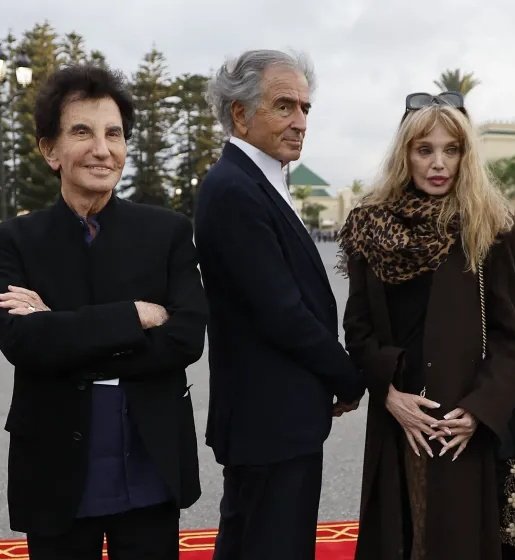
By Ivan Kesic | Press TV | November 30, 2024
Bernard-Henri Lévy, a self-proclaimed “philosopher,” has earned notoriety for himself as a supporter of controversial causes and illegitimate entities, most notably the Israeli regime.
He was at it again recently after jumping in defense of war criminals in Tel Aviv following the International Criminal Court (ICC) arrest warrants against them over the ongoing genocide in Gaza.
Introduced in the Western and Israeli media as an “intellectual,” “philosopher,” and “peace activist,” Lévy’s words and actions illustrate that he is a PR agent for the Israeli occupation.
While the ICC’s indictment of Israeli Prime Minister Benjamin Netanyahu and former minister of military affairs Yoav Gallant on Thursday for their roles in the regime’s war crimes against Palestinian civilians in Gaza has been widely welcomed, the move has frustrated Zionists and their apologists.
Among them is Lévy, a French national and a Zionist at heart, who vented his disappointment on X and other social networks where he is followed by hundreds of thousands of people.
He took to X on November 22 to criticize the Hague-based court for “distorting international law” and disfiguring the noble idea of international justice.”
He posted similar rants on Facebook and Instagram, where he wrote that the ICC indictment was “shameful” and “disgraceful,” and that the same applies to calling Israeli crimes in Gaza genocide.
Lévy vehemently denied that genocide was taking place in Gaza, calling it “false, morally abject and a perverse inversion,” while linking his review to the US conservative news website The New York Sun.
In the article, he anachronistically argued that the use of “genocide” for the Israeli campaign of extermination is “insulting to the real victims of genocide,” or the victims of Nazism 82 years ago.
On November 25, he again took to X to defend the Zionist regime’s genocide in Gaza and decry the ICC for issuing arrest warrants against Netanyahu.
“The ICC in The Hague is only competent for countries with failing judicial systems, unable of trying themselves their leaders’ misconduct,” he wrote.
The court, he hastened to assert, was “created (and I was part of this reflection and conceptualization) for countries like #Russia! #China! #Iran! #Nigeria” adding that it has “no jurisdiction over tiny but democratic #Israel!”
“This mandate, in other words, makes no sense. Netanyahu cannot, under any circumstances, be apprehended. Those who claim otherwise simply have no understanding of the international law.”
Lévy’s outbursts were met with widespread criticism for their bias, whitewashing, contradictions, hypocrisy, and double standards, especially since he had welcomed the ICC arrest warrant against Russian President Vladimir Putin in March last year.
In his tweet on March 17, 2023, the French “philosopher” described the indictment of the sitting Russian president as “great news, glaring truth and justice.”
“The International Criminal Court issued an arrest warrant for Vladimir #Putin and Maria Lvova-Belova for the deportation of #Ukrainian children. The truth is glaring. Justice will prevail,” he wrote then.
Long-time Zionist
Lévy’s latest pro-Zionist rhetoric and inconsistencies are nothing new, but a continuation of his uncompromising apologetics in favor of the Israeli regime.
Late last month, he also produced a book, “Israel Alone,” in which he argued that the Tel Aviv regime, openly and unabashedly supported by the United States and European countries, as the title suggests, actually stands “alone.”
He dehumanizingly referred to the Axis of Resistance as “barbarians,” while spouting the classic clichés that anti-Zionism amounts to “anti-Semitism” and that the Zionist entity “fights for the entire collective West.”
Lévy’s statements to the media and on social media have also been riddled with such twisted interpretations, and in the last few weeks alone, he has used them to justify all of the most extreme moves by the Netanyahu cabinet.
In collaboration with the influential Zionist organization B’nai B’rith International, he regularly participates in pro-Israel conferences in Paris, defending Israeli genocidal actions against Palestinians in Gaza and Lebanese in Lebanon.
Despite the global outcry, he welcomed the Israeli ban on the operations of UNRWA, the UN agency for Palestinian refugees on whose aid millions of civilians depend, questioning the organization’s humanitarian mandate.
He has also supported the Israeli aggression against Iran and Lebanon, claiming that they are “not invading, but liberating Lebanon,” and that those who do not understand this have “lost all moral and political compass.”
According to available evidence, over the past quarter of a century, Lévy has been known as a fierce advocate of aggressive Israeli, American, and French foreign policies, justifying all of their wars, as well as their proxies in numerous conflicts.
He has often justified Israeli aggressions with the cliché of “the most moral army in the world,” which is a repetition of Ariel Sharon’s statements from 2004, as well as with the regime’s frequent demagogy of “the only democracy in the region.”
The same worn-out platitude about “democracy” was used by Lévy to glorify all terrorists backed by the aforementioned Western powers.
Bernard-Henri Lévy with Olivier Rafowicz and Israeli officials in occupied Palestine in this undated photo.
Part of a PR campaign
Although Lévy has a habit of defending his support for Zionism with so-called “political worldviews,” experts and investigative journalists have for years pointed to his direct cooperation with the top brass of the Israeli regime.
He was born into a Jewish Zionist family and visited the occupied territories as a teenager, but his stronger political engagement began at the beginning of this century, congruent with the then-US neocon-Zionist imperial ambitions.
Lévy is often placed in the context of the so-called “liberal hawks,” a group of public figures, often former Marxists and declared liberals, who ironically have justified Western military aggressions with “humanitarian” arguments.
Their sudden appearance in the mass media and public space was not spontaneous, but part of an organized PR campaign aimed at winning over Western public opinion from all sides of the political spectrum.
Lévy is thus branded as a “thinker, intellectual, or philosopher,” even though he briefly worked as a lecturer and did not produce any significant philosophical work or ideas, nor is he treated as a serious thinker by contemporary philosophers.
In fact, he has been widely criticized and ridiculed in philosophical circles for quoting Jean-Baptiste Botul, who is a fictional figure, which, as some suggest, shows his works are written by ghostwriters.
Political philosopher Perry Anderson called Lévy’s prominence “bizarre” and a reversion to national standards of taste and intelligence in France’s public sphere.
French investigative journalists Jade Lindgaard and Xavier De La Porte, in a co-authored book analyzing his words and works, called him a “pseudo-philosopher, an impostor, and an ace of postmodern agitprop.”
The duo states that he skillfully camouflages his Zionism and has invented a discourse that delivers both propaganda and the antidote to that propaganda, eluding critical grasp and making it impossible to criticize him.
For example, he claimed to support the creation of a Palestinian state, but he supported all Israeli moves and policies that tried to prevent that from happening.
Bernard Henri Lévy with members of Israeli military in occupied Palestine in this undated photo.
The unofficial IOF spokesman
Lévy is a long-time zealot advocate of the Israeli military (IOF) and has actively participated in the regime’s PR campaign to whitewash its genocidal crimes and improve its public image.
This collaboration began in 2002 during the Second Intifada when accompanied by soldier Olivier Rafowicz and with the permission of the Israeli regime, he visited their army barracks, giving eulogies about them to the media.
Accompanying him, Lévy visited the battlefield again in 2006 during the Israeli aggression on Lebanon, presenting Rafowicz as an ordinary soldier and an expert on the situation on the ground.
In reality, Rafowicz was the IOF’s spokesman to the foreign media; French-born and a perfect French speaker, in charge of PR relations with French journalists.
During the neatly choreographed tour, Lévy also visited minister of military affairs Amir Peretz, foreign minister Tzipi Livni, and former PM Shimon Peres, but he did not talk to a single Israeli opponent of the war, not one Palestinian refugee and no one from Lebanon.
Once again, in 2009, Levy covered the Israeli aggression on Gaza, telling foreign media that he entered Gaza City and there were no signs of any destruction.
The implicit message was that Israeli shelling had not been as destructive as claimed in the media, but his claims were quickly exposed as a lie because he did not visit Gaza but Abasan al-Saghira, a border town 20 km away.
Unlike foreign journalists, Lévy was not denied a visit to the troops, which, together with manipulative statements to the media, proves it was another regime PR stunt.
This time he also had ready access to the top dignitaries of the Israeli army and the regime, including PM Ehud Olmert, minister of military affairs Ehud Barak, and Yuval Diskin, the director of Shin Bet, the Israeli internal military service.
During all these excursions, Lévy delivered the regime’s PR mantra of “the most moral army in the world” to foreign media, and was awarded two honorary doctorates by Israeli universities for his propaganda activities.
He continued his role as an Israeli field operative later during the Arab Spring protests, when he met with militants in Libya and Syria, claiming to the media that they were ready to recognize the Israeli regime and establish diplomatic relations.
Terrorist Offensive in Aleppo Reeks of US and Israeli Involvement – Marandi
Sputnik – 29.11.2024
The sudden escalation in Syria where anti-government groups launched a sudden offensive towards Aleppo betrays the involvement of several foreign powers, including Israel and the United States, says Seyed Mohammad Marandi, political analyst and professor at Tehran University.
“We see thousands of foreign fighters affiliated to al-Qaeda from across Central Asia,” Marandi tells Sputnik. “They’ve been mobilized and well trained to carry out this assault.”
The offensive, he points out, takes place “literally a day after Netanyahu said he needs the ceasefire in order to deal with the so-called Iranian threat,” and it appears that the goal of this offensive is “to cut off Syria from the Axis of Resistance in order to isolate Lebanon.”
“Obviously, this is being done in coordination with the United States. The whole dirty war in Syria since 2011 was led by the United States,” Marandi adds. “We know that Jake Sullivan back then, who is now the national security adviser of Biden, said in an email to Hillary Clinton on February 12th, 2012, that in Syria, al Qaeda is on our side.”
Given the long history of the US’ association with terrorist groups in the region and previous efforts by Washington to “create a Salafist entity between Syria and Iraq to isolate Syria,” there is no doubt that the United States and its allies “are a part of this conspiracy against Syria,” the analyst concludes.
That said, Marandi identifies the government of Israeli Prime Minister Benjamin Netanyahu as the “number one beneficiary” of the current crisis in Aleppo.
“Netanyahu needs war, and he only accepted a ceasefire under a great deal of pressure. So no one has faith in the Israelis. The Israelis have always violated commitments,” Marandi says. “After all, it is carrying out a holocaust in Gaza, a regime that carries out the Holocaust and continues to do so in front of the eyes of the world after 14 months is not a regime that can be trusted for anything.”
Syrian military expert Mahmoud Abdel Salyam offers a similar take on the subject, blaming Israel for the current crisis and claiming that Tel Aviv’s plans threaten the security situation in the region.
“Israel essentially wants to solidify its position in the region after the ceasefire in Lebanon,” he says. “So Tel Aviv has no intention of stopping – it wants to sow discord among the other players in the region and to force them to react to such challenges.”
Salyam does note, however, that other global players who are interested in “changing the power balance in the Middle East” will undoubtedly capitalize on this situation.
“Some countries, for example, may use the weakening of the Arab republic to bolster their influence by supporting radical and extremist groups that Israel tries to use in Syria,” he says. “But such dangerous actions will lead to unpredictable consequences, for these countries and for their allies.”
Haavara to Hague: Germany’s stance on ICC arrest warrants unmasks deep Zionist ties

By Musa Iqbal | Press TV | November 29, 2024
International Criminal Court’s (ICC) landmark decision to issue arrest warrants for Israeli regime leaders Benjamin Netanyahu and Yoav Gollant has sparked outrage from Western leaders, who have for decades used the Hague-based tribunal for political agendas.
Though the arrest warrants are riddled with glaring contradictions, such as describing Hamas military leader Mohammed Deif as a “war criminal” and equating Hamas resistance leaders with war criminals in Tel Aviv, the warrants are still significant because even the institutions founded by the Western world are unable to dismiss the criminality of the Zionist regime.
But now comes the true test: are the states that are signatories to the Rome Statute, which recognizes the authority of the Hague-based international tribunal, willing to follow through with their pledge?
Many countries have reluctantly expressed their willingness to accept the decision – such as Canada, Italy, and the Netherlands, just to name a few. However, some have been more reluctant, retreating to “analyze” the verdict issued by the ICC.
Perhaps the case that deserves the most attention is that of Germany, a Rome Statute signatory and one of the biggest allies of the child-murdering Tel Aviv regime that has been deeply complicit in the Gaza genocide.
A German government spokesperson, Steffen Hebestreit, said he “finds it hard to imagine” that they would make arrests “on this basis,” questioning the authority and decision of the Court entirely.
Naturally, these statements have caused a stir, and have journalists pressing German officials on what their stance actually will be on ICC arrest warrant, which took more than six months to make headway.
German Foreign Minister Annalena Baerbock, when pressed on the enforcement of the warrants, retreated.
“As I said, we abide by the law and legislation nationally, at the European level and internationally, and that is why we are now examining exactly what that means for us for implementation in Germany,” he said.
She made no comments regarding whether Germany would follow through with the arrest warrants, despite being obligated as a signatory of the Rome Statute – something Hebestreit mentioned himself.
Germany has been one of the most staunch European supporters of the Zionist entity, particularly amid the ongoing genocidal war on Gaza, refusing persistent calls to halt arms sales to the Tel Aviv regime.
Time and time again – throughout the decades – Germany has attributed its ironclad and unconditional support for the Israeli occupation to its own Nazi-era crimes against Jewish people in the 1930s and 40s.
Germany claims it is motivated to support the Zionist regime because of its own guilt.
But this is a complete distortion of the truth. The fact of the matter is, the German Nazi regime was a direct collaborator with the Zionist movement from the early days of Nazi party rule in Germany.
In fact, while most Jewish organizations were banned, the lone organization permitted to legally exist was the German Zionist movement, under different initiatives.
To the uninitiated, an alliance between the Zionist movement and the Nazi regime seems completely contradictory. But when looking at the material desires of both the Zionist movement and that of Nazi Germany, the motivations become quite clear and obvious, and manifested in the infamous Haavara Agreement, signed by the Zionistische Vereinigung für Deutschland (Zionist Federation of Germany) and the German Reich Ministry of Economics in August 1933.
The agreement is quite simple: in exchange for Jewish immigrants (particularly, those loyal to the Zionist doctrine, and some of the most wealthiest – indicating it was never about moralism but rather preserving class interests within Zionism) to safely leave Germany, the Nazi regime would help transfer the Jewish population themselves to Palestinian territories, accelerating the removal of indigenous Palestinians from a territory where they were already persecuted by a growing Zionist population and British colonialism.
The Nazi regime received tremendous material benefits for this. Jewish organizations were enacting worldwide boycotts of the German regime at the time, on the grounds of the Nazi laws persecuting the Jewish population in Germany.
The Nazi regime saw this as a major threat, as it created grounds for economic isolation in a post-World War I world. The open collaboration with the Zionist movement allowed the Nazi regime to dodge the accusations of antisemitism, and further dangerously conflated anti-Zionism with anti-Semitism, a defense the Zionist regime would use to the modern day.
Furthermore, the German government was able to enact further economic deals under Haavara, which resulted in a new German market in the British-occupied Palestinian land.
The agreement materially improved a heavily boycotted Nazi regime while laying further groundwork for the Zionist colonization of Palestine. The transfer of wealth was often cited and met with glee in Zionist-controlled media in occupied Palestine.
Fast forward 91 years. The German government, which has enacted laws that criticism of the Israeli regime is “anti-semitic” in nature, is yet again making a callback to its Nazi roots.
Hebestreit, quoted in The Telegraph, states that “it is a consequence of German history that we share unique relations and great responsibility with Israel.”
This is completely true, but not in the context in which they are using to deceive the public. Germany is not defying the ICC arrest warrants because of any shame to its Nazi crimes. Rather, functionally speaking, it is the same dedication to the Zionist movement Germany declared in 1933, in order to not only evade allegations of anti-Semitism, but continue making billions of dollars from exports to the Zionist occupation.
Refusing to enforce the ICC warrants means that Germany can continue its arms shipments to the Zionist occupation. Just last month, Germany approved a sale of over $100,000,000 worth of arms to the Israeli regime. Some researchers suggest that Germany exports nearly 30 percent of the arms sent to the occupation regime.
Germany is in a particularly debased state of affairs, due to its close allegiance to the United States. The American insistence to cut off energy imports from Russia as well as the US involvement in bombing the Nord Stream II pipeline has drastically impacted the German economy.
The economic peril due to this commitment the led the German government to collapse earlier this month. However, the US encourages its allies (rather, proxies) to continue arming the Israeli occupation.
The road ahead indeed goes both ways. German purchases of Israeli surveillance and military equipment, recently and most notably the Arrow 3 ballistic defense systems raised eyebrows to Palestinian solidarity organizations. There is also documentation that German police have purchased Israel’s infamous Pegasus software to be used for spying on its own citizens.
Acknowledging the ICC arrest warrants means that the imports and exports of arms come to a grinding halt.
Indeed, the reluctance to enforce the ICC arrest warrants on behalf of the German government is not rooted in any sense of “moralism.” This is a talking point to earn the sympathy of Western liberals who still do not see the massive fingerprint of their own governments in the ongoing Gaza genocide.
The root of the decision, as it usually is within the context of imperialism, is money. Germany is solely motivated by its role as a junior agent in American imperialism, hoping to make a quick buck while its US masters erode its own energy infrastructure.
A refusal to enforce an already toothless warrant, which attacks two Israeli regime leaders and not the issue of Zionism itself, is simply the German government conducting business as usual as it has for over 90 years.
The infamous Haavara agreement lives on today, not in its original context, but not far from it either. Germany’s stance on the ICC arrest warrants against Netanyahu and Gallant reveals deep ties to Zionism rooted in the Haavara agreement.
Musa Iqbal is a Boston-based researcher and writer with a focus on US domestic and foreign policy.
UK, US intended to move Palestinians out of Palestine through UNRWA, British documents reveal

By Amer Sultan | MEMO | November 27, 2024
Canada helps Israel in broadening its definition of ‘anti-Semitism’
By Ramona Wadi | MEMO | November 26, 2024
Once again, anti-Semitism was the catchphrase for political rhetoric denouncing the protest in Montreal against NATO’s complicity with Israel’s genocide. NATO delegates met in Canada for the 70th annual session of its Parliamentary Assembly, and protesters called for Canada’s withdrawal from the organisation, even as Canadian Prime Minister Justin Trudeau announced that the country is on track to increase its military spending, which NATO has established as two per cent of the country’s GDP.
“We need to commit ourselves every day to NATO and the principles that keep us safe in this uncertain world,” said Trudeau, acting as if former colonial powers were not responsible for “this uncertain world” and, along with Israel, the genocide in Gaza.
Activists at the protest thought otherwise, of course. As the gathering outside the meeting turned violent, Israeli and mainstream media were swift to label the protest as “anti-Semitic”, as did Trudeau. Montreal’s police, however, said that they did not receive reports of anti-Semitic violence or hate crimes. Mayor of Montreal Valerie Plante condemned the violence, but said that she did not believe that the protest was anti-Semitic.
The protest was organised by Divest for Palestine and the Convergence of Anti-Capitalist Struggles, with the purpose of exposing NATO’s complicity with Israel’s genocide.
However, as Israel increasingly targets any criticism of its actions as “anti-Semitism”, Trudeau followed suit.
“As a democracy, as a country that will always defend freedom of speech, it’s important for people to be able to go out and protest and express their anger, their disagreements in free and comfortable ways,” he declared. “But there is never any room for anti-Semitism, for hatred, discrimination, for violence.”
Canada’s Defence Minister Bill Blair took a similar position. “Those behaviours are unacceptable and we can condemn them, and in particular the hatred and anti-Semitism that was on display, in the strongest possible terms.”
According to reports in Israeli media, a protestor referenced the “Final Solution” which was a Nazi euphemism for the Holocaust.
What stands out is the discrepancy in responses to two different scenarios – Israel’s internationally-approved genocide and a protest against NATO – which showed clearly that the latter’s manifestation of violent action, directed against a transatlantic military alliance, was deemed to be more disturbing than Israel’s systematic destruction of Gaza and the Palestinian people.
Besides this discrepancy, Israel is also extending the “anti-Semitic” label to include any form of protest directed even at organisations that are not Jewish, but prioritise allegiances to Zionism and Zionist colonial violence. The target audience of the protest in Montreal was clearly the NATO delegates.
NATO members have supported Israel’s genocide through purchasing the occupation state’s military technology (“as field-tested against Palestinian civilians”) and also by selling weapons to Israel. Since 2017, Israel has also benefited from its permanent official mission established in NATO headquarters in Brussels. In January 2023, NATO Secretary General Jens Stoltenberg met with Israeli President Isaac Herzog at NATO headquarters, noting that,
“NATO and Israel have worked together for almost 30 years.”
Calling out NATO’s complicity in genocide is not anti-Semitic by any stretch of the imagination. Trudeau has confirmed recently that Canada will abide by the International Criminal Court’s arrest warrants for Israeli Prime Minister Benjamin Netanyahu and former Defence Minister Yoav Gallant. What message is Trudeau sending to the Canadian public about his government picking and choosing what part of colonial violence it deems worthy of support, while vilifying protestors for drawing attention to government-level hypocrisy?
‘Genocide’ vs ‘Bigger Genocide’ in Gaza: Time to decolonise our minds
By Ramzy Baroud | MEMO | November 27, 2024
“Imperialism leaves behind germs of rot which we must clinically detect and remove from our land but from our minds as well,” wrote Frantz Fanon in The Wretched of the Earth (1961). What the iconic anti-colonial philosopher and psychiatrist was essentially arguing is that the mind must be decolonised first, in order for the undoing of colonialism to succeed in all aspects of our liberation.
Many in the Global South, but especially intellectuals and analysts concerned with Middle East affairs, are still struggling with their relationship with the United States. Although all signs indicate a rapid decline of America’s global status, many among our intelligentsia, possibly unwittingly, still believe that Washington holds all the cards, and that whoever controls the White House must naturally also rule the world.
Of course, US domestic and foreign policies are relevant to global affairs, as financial decisions by the US Federal Reserve, for example, will affect US-global trade volumes, and will have an impact on the interest or disinterest in purchasing US treasury bonds. Some countries that are keen on standing at an equal distance between the US and China often jockey to refine their positions and to protect themselves in case of seismic political changes in the US.
The vibe radiating from many in the Middle East is that the doomsday scenario is real, and that the big war is upon us.
However, they ignore the fact that for many nations around the world, from Gaza to Lebanon to Ukraine to Sudan and elsewhere, wars have already arrived, many of which are bankrolled by western funds and political blank cheques. To warn of war while tens of millions are already suffering the outcomes of western-funded wars reflects the degree of desensitisation and opportunism of the followers of western order.
Some of those crying over the supposedly imminent doom had initially presented the Democratic Party’s presidential candidate, Kamala Harris, as the best worst-case option for Palestinians, Arabs and Muslims. Although they may have acknowledged the genocide in Gaza, and even criticised the Joe Biden administration for enabling it, they recoiled at the mere suggestion that the Democrats must be punished for their many sins in the Middle East and beyond.
Another crowd presented Donald Trump as the saviour, the strong man who, with a stroke of a pen, will end all wars, the one in Gaza included. They cited the man’s repeated claim that, “I’m not going to start a war, I’m going to stop the wars.” They even went on to argue that Trump, who would be serving a second and final term in office, is now immune to political manipulation from the pro-Israel lobby and all other pressures.
Trump won, of course.
His crushing defeat of the Democrats on all fronts, including in the popular vote, indicates that he would have won regardless of those who considered ending the war in Gaza to be a top political priority. However, the early announcements that Trump’s administration come January will be a who’s who of the pro-Israel Republican circle has reignited the debate about the “bigger genocide” awaiting Palestinians and other scare-mongering tactics.
Both sides of this inconsequential debate conveniently ignore obvious facts: that America’s ruling elites are rooted in pro-Israel political allegiances; that although there might be a difference in style, US foreign policy under Democratic Secretary of State Antony Blinken and Trump’s future hire, Marco Rubio, is likely to be identical; and that the Biden-Harris administration gave Israel all the help it needed to sustain its wars in the Middle East over the course of 13 months and counting.
This stifling debate, however, misses some of the most critical points that should be discussed, and urgently so. For example, the Middle East region is not a single political monolith. It has its own political calculations, conflicts, alliances and options that include other political heavyweights, such as China and Russia, among others.
Moreover, several Middle Eastern countries are joining the increasingly influential BRICS alliance. The latter is not just a trade club, but also a powerful economic alliance with a strong political discourse to match.
Thus, the future and survival of the Middle East does not hinge on US economic policies.
Finally, the war in Gaza is a war that also involves the Palestinians, the Lebanese and their Arab and international allies. The people of occupied Palestine and Lebanon have agency, choices and strategies that are not wholly dependent on the ideological identity or political inclinations of a lone American ensconced in the White House.
If the political views of the US president were indeed the most decisive aspect in the fate and future of the Palestinian people, Palestinian aspirations would have been suppressed decades ago due to America’s inherent pro-Israel bias. They weren’t, not because of any compassion on the part of US administrations, but due to the sumud, resilience, of the Palestinian people.
It is time that we abandon the archaic thinking regarding our collective colonial past, or present, that views western leaders as our masters, and our people as mere subjects, struggling to survive, imploring, though never obtaining, prudent western foreign policies.
The world is changing, vastly, and it is time for us to change as well. Fanon gave us the cure decades ago: We must clinically detect and remove the rot, not only from our land but from our minds as well.
Featured Video

Trita Parsi: Middle East Unraveling — Are We on the Path to World War?
or go to
Aletho News Archives – Video-Images
New Book
Trans agenda is ‘normalization of sadism’ – US author

RT | September 23, 2026
The US Democratic Party has embraced a transgender agenda that amounts to “the normalization of sadism,” author A.J. Rice has said, warning that radical trans policies would return if the party is allowed to regain power.
Speaking to RT’s America First host Scotty Nell Hughes about his new book, ‘The Curse of the Bearded Lady: How the Trans Mafia Whacked American Sanity’, Rice argued that activists have gained significant influence in schools, medicine, and corporate America while people who questioned the agenda have faced pressure to stay silent.
The author described the “trans mafia” as the sprawling network of people and institutions that have helped the movement gain influence. He singled out parts of academia, wealthy backers, and corporations, and stated that providers of transition-related treatment also have a financial incentive to keep young people in their care indefinitely.
Rice argued that the consequences of these policies ultimately fall on children who are being drawn toward gender-affirming medical treatments and on girls who are expected to share locker rooms or compete in sports with biological males.
He noted that while voters rejected the Democrats’ approach to gender in 2024, the party, which has been “captured by madness,” has since only doubled down and is seeking what is effectively “the normalization of sadism.” … Full report
Blog Roll
 Aletho News
- Integrity Initiative: UK-funded network framed dissent as Russian disinformation for years
- ‘We don’t seek permission to defend our country’: Snippets from President Pezeshkian’s UNGA address
- NATO chief wants Europeans to fight American wars [for Israel]
- German chemicals giant reveals details of downsizing
- Refaat Al-Areer Was The Canary In The Coal Mine In Israel’s War On The Truth
- Israeli election committee bars candidate from Knesset race over Gaza war opposition
- French-Lebanese man files war crimes complaint over Israeli attacks
- Mahan Air Flight Lands in China Despite US Threat against Iranian Airlines
- US eyes $10bn fund to rebuild war-battered Gulf infrastructure
- Trump meets Rodríguez near Maduro’s prison as Venezuela’s oil flows to US
- If Americans Knew
- Caught on Tape: AIPAC CEO Boasted of Controlling Trump’s National Security Officials
- Why Hamas Attacked Israel in October 2023 – Israeli professor Ilan Pappé
- They see them, then kill them: Israeli quadcopters track, deliberately target civilians in Gaza
- Winter could turn Gaza’s treacherous, war-damaged buildings into deathtraps
- Majority of Democratic Voters Want to Prosecute Both Biden and Trump Administration Officials Over Gaza
- As Gaza languishes, world leaders gather at the UN – Daily Update
- Sanctions are collective punishment: immoral and self-defeating
- Phosphorus Munitions Fired by Israel Burn Groves, Orchards in Southern Lebanon
- Israel Carries Out New Ceasefire Violations Across Gaza
- AI – Emphasis on the ‘I’: Israel Is Funding AI Chatbot Propaganda
- No Tricks Zone
- New Study: Earth And Venus Surface Warmth Largely Explained By Convection And Lapse Rate, Not CO2 Or Radiation
- 2025 Nature Paper Claiming Worsening Global Drought Gets RETRACTED …Heavily Flawed
- New Study: ‘Global Drought Shows No Detectable Recent Acceleration Under Climate Warming’
- Economic Masterminds: German Socialists Suggest Taxing Productivity Gains Stemming From Using AI
- The South China Sea Has Not Been Cooperating With The Climate Change Narrative
- Energy Crisis: Germany Enters Heating Season With Historically Low Gas Reserve Fill Levels
- New Study: The Antarctic Ice Sheet Gained Mass From 2020-2024 Due To Staggering Snow And Ice Accumulation
- Study: Ocean Heating Rates From Thousands Of Years Ago ‘Dwarf’ Modern Ocean Heating Rates
- Climate Extremists Target, Attack Large-Scale Power Grid Infrastructure In Germany!
- New Study: Antarctic Ice Melt Has Contributed Less Than 1 Centimeter To Sea Level Rise In The Last 30 Years

