Humanitarian aid and Israel’s ‘voluntary migration’ scheme
By Ramona Wadi | MEMO | June 20, 2024
Greek Foreign Minister George Gerapetritis said earlier this week that, “We have offered ourselves to host injured people from Palestine but also children from Palestine to come to Europe and stay here until the war is over.” Israel would be thrilled at such an idea, for sure. “Voluntary migration” in the guise of humanitarian aid could not get any better for Israel’s colonial expansion plans.
In October last year, Gerapetritis declared his government’s pro-Israel stance: “Greece, from the very first moment, supported the right of Israel to defend itself in line with international law.” No such right exists for an occupation state against the people living under its brutal military occupation.
In the same month, Greece also abstained from the UN General Assembly vote calling for a humanitarian ceasefire. A month earlier, the Greek government purchased 300 precision-guided munitions from Israel, known as spice bombs, for $130 million. And in a move aimed at curbing activism on university campuses, nine EU and UK individuals are facing deportation for participating in protests against the Gaza genocide, with Greek Prime Minister Kyriakos Mitsotakis stating that the authorities would forbid “universities from becoming sites for protest”.
As the genocide continues, the ways that politicians and diplomats try to make amends are becoming even weaker. The suggestion by Gerapetritis plays directly into the humanitarian paradigm which the EU hides behind, even as it continues to invest in Israel’s military and surveillance systems, all field tested on Palestinians in Gaza, of course.
There is not a single European country that can speak with honesty about Gaza and Israel, because investment in the latter has generated high stakes in terms of profit and complicity.
Humanitarian gestures, meanwhile, are becoming meaningless for Palestinians and strategically valuable for Israel, because there is no deterrent, no measure that forces Israel to stop the genocide.
Keeping in mind that Israel wants Gaza empty of Palestinians, why would the EU, which is complicit in arming the apartheid state, offer a humanitarian gesture that would help the settler-colonial entity in its ethnic cleansing? This begs a bigger question: why do diplomats insist on depoliticising humanitarian aid for the recipients, when the donors are involved in human rights abuses, war crimes and crimes against humanity?
Offering temporary safe haven for Palestinian children maimed by the war might be an acceptable humanitarian gesture if European countries weren’t complicit in the genocide conducted by the settler-colonial state which maimed them in the first place. “We have to remind ourselves of one thing: It is not enough to build only settlements,” said far-right Israeli National Security Minister Itamar Ben Gvir recently, in the context of emphasising the “voluntary migration” of Palestinians, otherwise known as normalised ethnic cleansing.
A look at the recent statement by the EU High Representative for Foreign Affairs and Security Policy shows how the Gaza genocide is not called to attention, but rather focuses on specific Israel violations while still recognising “Israel’s right to defend itself”. Josep Borrell also called for “the unconditional release of all hostages held by Hamas,” which essentially tells Palestinians that, as the colonised population, they should remain voiceless and not articulate any demands. Palestinians are facing genocide, and the EU’s statement is careful to protect Israel’s ability to act with impunity.
Any plan for EU states to host Palestinian children from Gaza cannot be allowed to pass unchallenged. Such a safe haven in Europe is part of the colonial framework that aids Israel, as does Europe’s complicity in Israel’s bombing and destruction of hospitals in Gaza, and murder of medical personnel. Apart from the fact that the number of Palestinian children taken in by Greece would be symbolic more than anything else, politicising medical treatment to aid Israel’s “voluntary migration” scheme is depraved and self-serving. Gerapetritis should have been more honest and said that his country will not stop the genocide, but will host and treat an insignificant percentage of its victims that will not jeopardise its relationship with Israel.
No political gesture will disguise the fact that Europe has much bigger obligations than playing humanitarian saviour to a relatively few wounded and severely traumatised Palestinian children.
Nearly 50,000 Palestinians reported dead, missing in Gaza
The Cradle | June 20, 2024
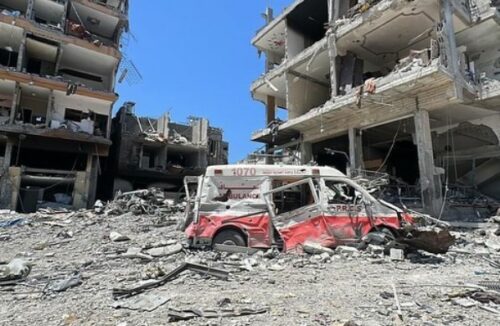
The Ministry of Health in Gaza reported on 20 June that Israel’s assault on the strip has left over 47,000 Palestinians killed or missing, with at least 3,000 massacres to date.
“There are more than 47,000 martyrs and missing persons in Gaza due to the occupation committing more than 3,000 massacres,” the government ministry said.
Gaza’s health ministry emphasized that they are working with the “bare minimum” equipment in the northern Gaza Strip as Israel continues to deny medicines, medical supplies, and fuel to the besieged enclave.
“We are trying to restart vital departments in the Al-Shifa Medical Complex and the Indonesian Hospital,” the health ministry added.
Both hospitals have come under direct attacks by the Israeli army in the 258 days of war in the Gaza Strip.
The government body registered 37,431 Palestinian deaths and estimates at least 10,000 bodies trapped under rubble that health workers are unable to reach, with around 5,000 of them children.
Three-quarters of the registered deaths are children (about 15,747), women (10,406), and elderly people.
Over 85,653 have been injured due to Israel’s bombing of the strip, most of whom are children and women.
Gaza’s health ministry also noted that 98 percent of children in Gaza “do not have access to safe drinking water.”
At least “33 children across the Gaza Strip, especially in the northern areas, died as a result of malnutrition and dehydration amid growing famine,” the ministry wrote.
Israel continues its onslaught on the Gaza Strip as it seeks to push further into the southernmost city of Rafah despite international condemnation.
Rafa’s mayor, Ahmed al-Soufi, told Anadolu Agency that “over 70 percent of public facilities and infrastructure have been destroyed in the Israeli onslaught.”
Soufi noted that Israel, earlier this week, destroyed dozens of homes in western Rafah’s Saudi neighborhood.
“Israel seeks to turn Gaza into an uninhabitable area by destroying the Rafah Crossing and preventing the entry of humanitarian and relief aid,” the mayor said.
Israeli actions in Gaza ‘intentional attack on civilians’: UN inquiry
Press TV – June 19, 2024
A new report by a United Nations-backed independent commission has discovered that the Israeli military’s deliberate use of heavy weapons during its relentless offensives in the Gaza Strip has been an “intentional and direct attack on the civilian population.”
Navi Pillay, chairperson of the Independent International Commission of Inquiry on the Occupied Palestinian Territory, said on Wednesday that “Israeli authorities are responsible for war crimes, crimes against humanity, and violations of international humanitarian and human rights law.”
These include “extermination, intentionally directing attacks against civilians and civilian objects, murder or willful killing, using starvation as a method of war, forcible transfer, gender persecution targeting Palestinian men and boys, sexual and gender-based violence amounting to torture, and cruel or inhuman treatment,” Pillay said as she presented the report to the UN Human Rights Council.
The UN commissioner said the Israeli military “forcibly transferred almost the entire population [in Gaza] into a small enclosure that is unsafe and uninhabitable” and used heavy weapons in densely populated areas in “an intentional and direct attack on the civilian population”.
Pillay said the commission concluded that specific forms of sexual and gender-based violence constituted part of the Israeli forces’ procedures.
The UN commissioner said the world faces its biggest threat of impunity for violations of international law unless perpetrators are held to account and justice is delivered for all victims.
She underscored that the large-scale surprise attack by members of Hamas and other Gaza-based resistance fighters against Israel in early October did not occur in a vacuum as it was preceded by decades of violence and retribution against Palestinians.
“Thousands of Palestinians have been detained and are being held incommunicado… ” Pillay said.
“The enormity of this tragedy overwhelms us, and we are deeply disturbed by the immense human suffering.”
Pillay’s commission found that the immense numbers of civilian casualties in Gaza, and the widespread destruction of civilian objects and infrastructure were the inevitable result of an intentional strategy to cause maximum damage.
Pillay also noted that the daily onslaught in Gaza must not sideline attention to a parallel wave of violence in the occupied West Bank, where more Palestinians have been killed by Israeli forces or settlers since the start of the Gaza war in any other recorded period.
Israel waged the atrocious onslaught against the Gaza Strip, targeting hospitals, residences, and houses of worship after Palestinian resistance movements launched a surprise attack, dubbed Operation al-Aqsa Storm, against the usurping regime on October 7.
Israel has killed more than 37,390 Palestinians, most of them women and children, in Gaza since that October day.
Over 85,500 individuals have also sustained injuries. More than 1.7 million people have been internally displaced during the war as well.
‘France provided Israel with weapons used to bomb civilians in Gaza’
MEMO | June 19, 2024
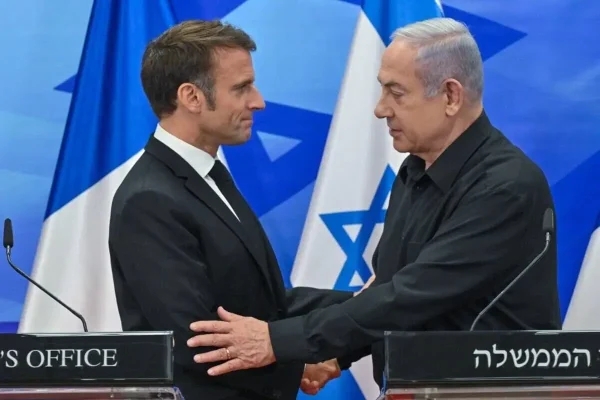
France has approved the sale of weapons equipment used by Israel to bomb civilian targets in the Gaza Strip, including a hospital, an investigation by the French non-profit media outlet Disclose revealed on Monday.
Dozens of classified documents obtained by the outlet revealed that French IT company the Thales Group has recently delivered electronic components used to construct Israel’s Hermes 900 armed drones. France owns a 26 per cent stake in the company.
The investigation showed that “the French company delivered to Israel the communication equipment during 2024,” despite repeated confirmations by the French defence ministry that “French arms exports to [Israel] were limited to defensive military equipment used in the Iron Dome to confront Palestinian resistance rockets.”
The outlet quoted the head of Israel’s Squadron 166, which flies Hermes 900 assault drones, as admitting to targeting a hospital in Khan Yunis in February following France’s delivery of the surveillance and targeting equipment.
“At least eight of these transponders were supposed to be flown to Israel between December 2023 and the end of May 2024,” said Disclose. “That’s several months after the first aerial bombings. Two transponders were delivered in 2024… The other six are reported to have been stopped by French customs.”
According to the outlet, the French armed forces ministry’s Directorate General for International Relations stated that the eight TSC 4000 IFF transponders are not allowed to be “sold, gifted, leased nor transformed without the prior agreement of the French government.”
Since 7 October, the Israeli occupation forces have continued to bombard the besieged Gaza Strip, killing 37,343 Palestinians and wounding 85,372 others. Around 1.7 million people have been displaced, according to the UN, amid massive destruction of civilian infrastructure.
Israel stands accused of genocide at the International Court of Justice. The occupation state denies the allegation.
Germany lists BDS movement as ‘extremist’ for questioning ‘Israel’
Al Mayadeen | June 19, 2024
A new report issued by Germany’s Federal Interior Minister Nancy Faeser on Tuesday revealed that it was dealing with the Boycott, Divestment, and Sanctions (BDS) movement as a “suspected extremist case,” noting that it had “links to secular Palestinian extremism.”
The report claimed that the BDS is not a homogeneous association, party, or organization.
German news site Watson cited the report as saying that “there is sufficient, strong, factual evidence to suggest that [the] BDS thereby violates, among other things, the idea of international understanding” by questioning “Israel’s” existence.
The report said, “After the terrorist attacks by Hamas on Israel on October 7, 2023, BDS-affiliated groups mobilized and participated in many anti-Israel gatherings and intensified their demands for an end to an alleged ‘Israeli apartheid’ as well as called for a boycott of companies and goods related to Israel.”
German news site Judische Allgemeine quoted Faeser as stating, “We must oppose internal threats from extremism just as decisively as [we do] external threats,” adding, “We absolutely have to break the spiral of escalations in the Middle East, leading to even more disgusting hatred of Jews here.”
“Security authorities are reacting with great vigilance to the latest developments and are actively taking action against any kind of anti-Israel and antisemitic agitation,” she continued.
German-Israeli Society welcomes decision
Meanwhile, German public-broadcasting radio station Deutschlandfunk confirmed reports that Germany’s federal domestic intelligence agency labeled the BDS movement as an extremist movement – and the German-Israeli Society (DIG) welcomed the decision.
DIG’s president Volker Beck released a statement applauding the announcement.
“For the first time, the Federal Office for the Protection of the Constitution names the anti-Israeli boycott movement BDS as a suspected extremist case in its annual report,” stressing, “This supports the assessment of the German Bundestag in its ‘confront the BDS-Movement Resolutely – Fighting Antisemitism’ resolution in 2019.”
According to Beck, “All forms of antisemitism must be fought equally – consistently. The trivialization of or even sympathy by some cultural institutions with [the] BDS must finally stop.”
“We welcome the recent bans on associations issued by Federal Interior Minister Nancy Faeser, which weakened the infrastructure of significant extremist-antisemitic organizations. We call for this course to be consistently continued,” she concluded.
This comes only days after more than 2,000 German academics signed a letter calling for the resignation of the country’s Education Minister Bettina Stark-Watzinger criticizing her efforts to penalize scholars supporting pro-Palestinian students.
The scholars emphasized in a statement that “academics in Germany are experiencing an unprecedented attack on their fundamental rights, on the 75th anniversary of the Basic Law.”
They emphasized that Stark-Watzinger’s recent actions have made her position “untenable”.
“The withdrawal of funding ad personam on the basis of political statements made by researchers is contrary to the Basic Law: teaching and research are free. The internal order to examine such political sanctions is a sign of constitutional ignorance and political abuse of power,” the statement pointed out.
Jailed Iranian musician’s social media activities belie French claims against him
By Ivan Kesic | Press TV | June 19, 2024
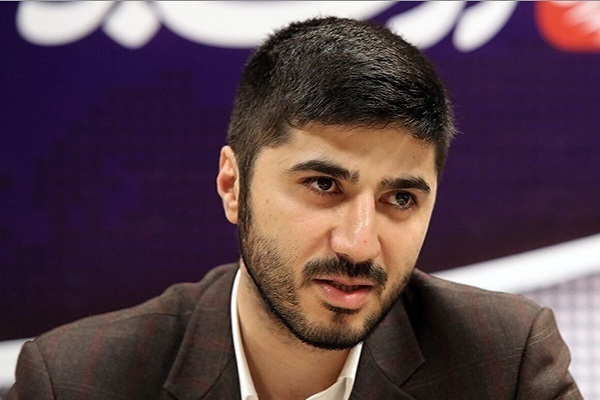
It’s been more than two weeks since Bashir Biazar, an acclaimed Iranian musician and filmmaker, was arrested and imprisoned in France over charges widely described as politically motivated.
In a chargesheet filed by the French interior ministry, a copy of which is in the possession of Press TV, Biazar is accused of “Iranian propaganda,” “anti-Zionism and anti-Americanism,” “hateful social media posts,” being a “vector of hatred,” and posing a “threat to public order in France.”
Human rights activists, officials, and Biazar’s family and friends have categorically rejected the charges as baseless and driven by the French government’s political motives against the Islamic Republic.
A detailed examination of the charges and Biazar’s social media activities, especially in recent months, makes it clear that the case against him is not based on merit but is politically motivated.
Born and raised in the Islamic Republic of Iran, Biazar is an independent music composer and filmmaker internationally acclaimed for his work.
He has previously served as managing director of the New Horizon Institute of Arts and Culture and was the secretary of the London-based Islamic Student Association.
For many years, he also worked as a production manager at the Music and Song Department of IRIB, Iran’s state broadcaster, and was behind many acclaimed works produced by the organization.
French indictment against Biazar
The French interior ministry accuses Biazar of disseminating alleged Iranian “state propaganda” and promoting “anti-Zionism and anti-Americanism,” which they view as “political-religious interference.”
It also claims that Biazar has “an operational mission to act against Iranian opponents, Jewish, and Israeli targets,” in France and thus represents “a threat to the country’s integrity and security, as well as its international relations.”
The most serious accusations are that he “incites terrorism with hatred,” is involved in “hateful posts on social networks,” “supports Hamas and Hezbollah,” and “smears France.”
French authorities further describe Biazar as “a vector of hatred that seriously threatens public order and fundamental interests of the state,” recommending his expulsion from the country.
His case is cited as “an absolute emergency,” with France believing that his “hostile activities” are damaging the international situation, likely fueling tension, hatred, and violence between communities in the country.
Le Point, a major French weekly political news magazine, recently reported that the ministerial expulsion order was signed on May 22, two weeks before his arrest and imprisonment.
A French court reportedly ordered Biazar to leave the country within 28 days, but French police have not released him, providing no explanation for the continued detention.
False accusations of undermining France
Since his arrest, many commentators, officials, and Biazar’s family and associates have condemned the French indictment and charges against him, terming them baseless and politically motivated.
A close examination of his activities on various social media networks, particularly the X platform (formerly Twitter), reveals the unfounded nature of the charges leveled against him.
Biazar used X for 13 years before his profile was deleted in 2022 “without explanation, warning, and reason.” After that, he created another account on X where he is active now.
He has also been using Instagram to a much lesser extent, leaving only 43 posts on the network.
Instagram, a Meta-affiliated network, has strict rules against pro-Palestinian resistance movements, leading to many pro-Palestine voices being blocked or suspended.
The fact that Biazar’s profile was not deleted or suspended proves he has not broken any rules.
All his social media posts, comments, and tags—whether on X or Instagram—are written in Persian, indicating they are not intended for a French audience.
According to Press TV analysis and examination of his social media activities, no French person follows him, and no French citizen has ever interacted with his posts.
His social media activities, like millions of pro-Palestine advocates around the world, including in France, have primarily focused on the unfolding Israeli genocide in Gaza since October last year.
Voice against Gaza genocide
Biazar, like other conscientious pro-Palestine campaigners, has raised his voice against the Israeli genocide in Gaza, which has claimed the lives of 37,400 Palestinians, most of them children and women.
The pinned post on Biazar’s X handle features a video of him addressing a United Nations session on anti-Iran sanctions, Israeli actions in Gaza, and the world body’s passivity.
“The Zionists have never been so alone, hated, defeated, and humiliated,” he wrote in the tweet.
In a tweet on May 28, Biazar criticized the silence of French President Emmanuel Macron, CNN, and the BBC on Israeli crimes in Gaza, particularly the massacre in southern Gaza’s Rafah refugee camp.
He also posted about anti-Iran elements in London, holding an Israeli flag, and harassing an Iranian woman who was heading to a memorial ceremony.
Some of his tweets showed the massive gathering in different Iranian cities paying tribute to late Iranian president Ebrahim Raeisi and his companions martyred in a helicopter crash.
But, most of his social media activities in recent months were wholly concentrated on the Israeli genocide in Gaza and the Western silence and complicity in it.
In a tweet on May 9, he shared a video clip of the Piers Morgan show in which an Israeli regime spokesman was not able to defend the crimes of the regime against Palestinians.
On October 27, 2023, he criticized the French police’s decision to cancel a permit for a public gathering in support of the Palestinian people and declare it illegal.
Some of his tweets were also dedicated to the US campus movement and police violence against students, like millions of other netizens tweeting about the same.
Biazar commented on French internal security affairs only once, on May 10, comparing adolescent violence during anti-government protests in France to West-backed Iranian riots.
Biazar stated that controlling teenagers during social unrest is the primary responsibility of their parents, aligning with the French Ministry of Justice’s decision last July.
French Minister of Justice Eric Dupond-Moretti said parents who neglect their children under 17 and leave them out at night could face two years in prison and a fine of 30,000 euros.
Biazar emphasized that just two days after this statement, the protests over the police killing of Nahel Merzouk were extinguished completely.
False accusations about resistance movements
Since the Israeli genocide on Gaza began on October 7 last year, Biazar has posted hundreds of tweets about Palestine, the suffering of Palestinians, and criticism of the Israeli regime and Western governments’ indifference, similar to what many French and Western citizens do regularly.
Among these tweets, only nine have mentioned the Gaza-based resistance movement Hamas, all in Persian. Seven were replies to other comments, achieving limited reach.
The two direct tweets commented on videos of Khaled Mashal and Israeli military commander Gadi Eisenkot discussing the impact of Hamas operations.
In reply comments, Biazar criticized media manipulations about Hamas and mentioned their operations’ goals. He stated that Hamas operates in the occupied territories according to UN resolutions and noted the scale of Israeli brutality in Gaza.
Biazar has not commented on Hezbollah in recent months, except for a single comment on a speech by its leader, Seyyed Hassan Nasrallah, criticizing media manipulation of his words.
He has never published material that could indirectly link him to the charges, such as videos of Palestinian resistance groups’ military operations.
#FreeBashir campaign growing louder
The campaign to release Biazar from French captivity has been growing louder and bigger in recent days, with many journalists, activists, artists, and academics joining it.
Richard Medhurst, a British journalist, called his arrest and imprisonment “outrageous” in a post on X.
“French police summoned an Iranian musician on June 4 with no explanation, immediately arrested him for ‘supporting terrorism,’ and drove him 100 km to a camp meant for illegal immigrants. This is purely political and ridiculous,” wrote Medhurst.
Ramy Abdu, the chairman of Euro-Med Human Rights Monitor, shared an article on X stating that Biazar “has been languishing in a French prison for almost two weeks following his arbitrary arrest for pro-Palestinian activism.”
Tim Anderson, an Australian academic and writer, said the Macron regime in France has jailed the Iranian musician “for pro-Palestinian activism.”
Marwa Osman, a Lebanese journalist and TV host, asked if Macron had taken the Iranian national “hostage” to “release his agents whom he sent to spy on Iran in 2022.”
“This is how #France is going to play it now? Well, I’d say this is one risky game Macron is playing. Because you know, two can play the same game… always,” she wrote on X.
On Israel, White House Lives in ‘Parallel Reality’
By Ian DeMartino – Sputnik – 19.06.2024
On Tuesday, US special envoy Amos Hochstein met with Lebanese officials, including Parliament Speaker Nabih Berri, a day after visiting with Israeli officials. The trips were made in an attempt to prevent a full-on war between the two countries after exchanges escalated in the region.
Hezbollah and Israel have been exchanging fire since Israel launched its siege on Gaza following Hamas’ surprise attack on October 7. Hezbollah said it launched its campaign in response to Israel’s actions in Gaza and that it will stop once a ceasefire is implemented in the area.
Hochstein stated that Hamas needs to “just say yes and accept” the ceasefire deal outlined by US President Joe Biden nearly three weeks ago. Those comments are part of a trend among high-ranking US officials that Israel has accepted the ceasefire deal and only Hamas is preventing a pause in fighting.
“[With] the statements from the White House officials, they seem to live in a parallel reality from everyone, including Israeli officials,” Esteban Carrillo, a Beirut-based journalist and the editor of The Cradle, told Sputnik’s Fault Lines.
While Hamas has reportedly made some amendments to the deal, it has responded positively while Israel has refused to say if it will accept it and promised to keep fighting until Hamas is defeated. Israeli officials have also refused to confirm if the ceasefire deal presented by Biden was their creation, as US officials claim.
“Just today, a top Israeli negotiator told the Israeli media that there would be absolutely no room to negotiate any of the amendments that Hamas asked for in response to the ceasefire proposal,” Carrillo explained, adding that the negotiator said the war will continue after the Israeli assault on the southern city of Rafah is completed. “These are their words. This is not anybody putting words in their mouth.”
While the US continues to provide political cover for the Israelis by insisting that Israel has accepted a deal, its officials have been clear that they expect their actions in Gaza to continue for the foreseeable future. The day after Biden gave his speech outlining the ceasefire deal, Israeli Prime Minister Benjamin Netanyahu insisted that their conditions for ending the war “have not changed.” Days earlier, Israeli national security adviser, Tzachi Hanegbi said Israel expects at least “another seven months of fighting,” extending the killing until 2025.
An estimate by the Israeli Defense Force (IDF) said that they expect the war to continue until 2026 and that a full-scale war with Lebanon will begin in September.
“[US Secretary of State Antony] Blinken and [US Defense Department spokesperson Matthew] Miller [are] saying that Hamas is the one being intransigent. No, it’s Israel that is being completely intransigent and they have been so for the past several decades,” Carrillo argued.
In 2006, Israel and Hezbollah fought to what is generally described as a tie, with more than 1,200 IDF soldiers wounded and another 120 dead, including the two soldiers who were captured at the Zar’it-Shtula incident, Israel failed to meet its objectives in that conflict and in the meantime Hezbollah has become increasingly sophisticated and powerful.
“This is what the US has also been warning them,” Carrillo said. “It’s time to de-escalate the North because you’re going to get your asses kicked.”
On Tuesday, Hezbollah released drone footage of Haifa and other parts of northern Israel, highlighting critical Israeli military and civilian infrastructure, including weapon depots, military bases and sea and airports.
Netanyahu said earlier this month that his country is “prepared for a very intense operation” against Lebanon.
Haifa, about 17 miles (27km) from the closest Lebanese border, is Israel’s most active port. Its importance has increased since the Ansar Allah (Houthi) movement in Yemen successfully shut down the Port of Eilat through its blockade of Israel in the Red Sea.
More than 60,000 Israelis have been ordered to evacuate from communities near the border with Lebanon, and many of the towns have been virtually abandoned since October.
Palestinian doctor tortured to death during Israeli interrogation
The Cradle | June 18, 2024
A senior doctor from Gaza was killed in November while under interrogation by the Shin Bet, Israel’s internal security service, Haaretz reported on 18 June.
Dr Iyad Rantisi, 53, directed a women’s hospital that is part of Kamal Adwan Hospital in Beit Lahia, in the northern Gaza Strip.
Rantisi was detained on 11 November at an Israeli army checkpoint while seeking to flee south to escape Israeli bombing in northern Gaza. Rantisi’s family and hospital colleagues heard nothing more about him, leading them to worry he was killed in Israeli custody.
Rantisi was declared dead six days later at Shikma Prison, which is home to a Shin Bet interrogation facility.
It is unclear how Dr Rantisi died, but Israel has a long history of torturing Palestinian detainees.
His death has prompted a probe by the Justice Ministry department that investigates complaints against Shin Bet interrogators.
The Shin Bet claims Dr Rantisi was interrogated on suspicion of involvement in holding Israeli captives in Gaza.
Israel’s Justice Ministry said the department had concluded its investigation into the circumstances of Rantisi’s death and is reviewing its findings, Haaretz reported.
The liberal Israeli daily added that after Rantisi was killed, the Ashkelon Magistrate’s Court issued a six-month gag order prohibiting the publication of all details of the case, including the existence of the gag order. Haaretz is now able to report on the case because the court order expired in May.
Another Palestinian physician from Gaza, Dr Adnan al-Bursh, 53, was also killed while in Israeli custody.
Bursh led the orthopedic surgery department at Gaza City’s Al-Shifa Hospital and was detained by Israeli forces in Khan Yunis in December.
The father of six died four months later, on 19 April, at Ofer Prison in the occupied West Bank.
Israeli authorities have not explained the circumstances of Bursh’s death.
Thirty-six Palestinians from Gaza detained at Israel’s Sde Teiman detention facility have also died, presumably under torture.
On 6 June, the New York Times published a report which included accounts of torture at Sde Teiman. Israeli guards used electric chairs to shock detainees and anally raped them with hot, electrified metal rods.
Two Palestinians have also died at the Anatot detention center, while two more died en route to a detention center.
These figures do not include Palestinians from Gaza who died in prisons operated by the Israel Prison Service. Thousands of Palestinians have been detained and held captive in Israel’s detention facilities and prisons since the start of the war on 7 October last year.
Hezbollah’s Undetected Drones: All Israeli Installations Within Sight, Reach
Hezbollah releases aerial footage of northern occupied Palestine
Hezbollah Military Media | June 18, 2024
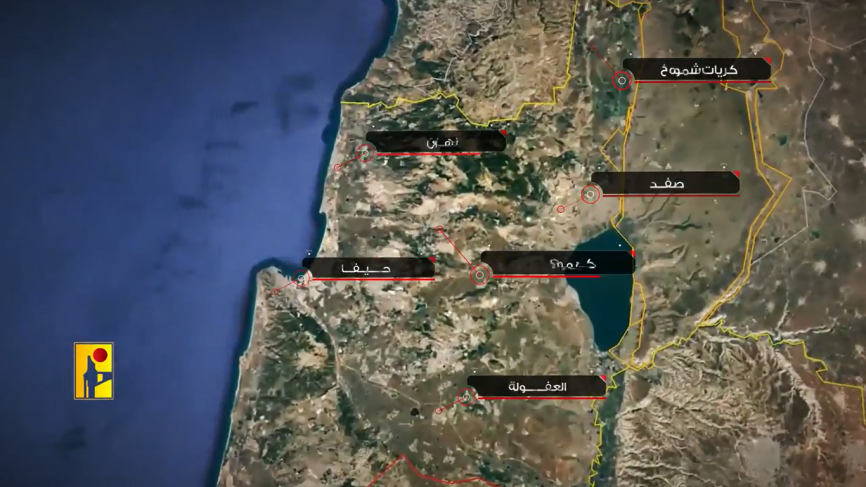
The compelling 9-minute video prominently reveals aerial footage of the city of Haifa, showing the Rafael Military Industries Complex and the Haifa Port area, which includes the Haifa Military Base (the main naval base of the Israeli occupation forces), the Haifa Civil Port, the Haifa Power Station, the Haifa Airport, oil tanks, and petrochemical facilities.
The video also highlights key military assets, including the submarine unit’s command building, the Sa’ar 4.5 logistical support corvette, and the Sa’ar 5 corvette.
Earlier on Tuesday, the group’s military media promoted this episode under the title “Stay tuned… for what the hoopoe has brought back” as the American presidential envoy Amos Hochstein visits Lebanon, holding Israeli threats to the country.
Hebrew Media Panic
Israeli media commented on the footage, with the Yedioth Ahronoth Hebrew newspaper stating that “Hezbollah published an exceptional drone recording that filmed northern ‘Israel’, including Haifa Bay.”
Other Israeli media outlets raised the question: “The Air Force must provide an answer to the following query: How did X manage to reach and fly over the Israeli army’s battleships in Haifa Bay?”
The military correspondent for Israeli Channel 14 reported that “Hezbollah has released extraordinary footage from deep within “Israeli territory,” showcasing Israeli targets, including those at the Haifa port and naval base.”
“The capabilities demonstrated by Hezbollah have left a significant gap among military and security personnel,” he added.
In addition, the Israeli occupation army has requested that the defense industries develop a technological solution to better intercept Hezbollah’s drones, according to the Hebrew Yedioth Ahronoth newspaper on Monday.
The footage released by Hezbollah has dominated social media discussions, with users describing the video as “a clear message to the entire Zionist entity.” They highlighted that “hundreds of targets within occupied Palestinian lands are now under Hezbollah’s surveillance, and any reckless action by the Zionists against Lebanon will come at a high price.”
We Spent a Billion Dollars Fighting the Houthis… and Lost
By Ron Paul | June 17, 2024
Why does it seem the Pentagon is far better at spending money than actually putting together a successful operation? The failed “Operation Prosperity Guardian” and the disastrous floating Gaza pier are but two recent examples of enormously expensive initiatives that, though they no-doubt enriched military contractors, were incapable of meeting their stated goals.
To great fanfare, last December the Pentagon announced the launch of Operation Prosperity Guardian, a joint US/UK military operation to halt the Yemeni Houthi disruption of Israel-linked commercial shipping through the Red Sea. The Houthis announced their policy in response to civilian deaths in Israel’s war on Gaza, but when the US and UK military became involved they announced they would target US and UK shipping as well.
The operation was supposed to be quick and easy. After all, the rag-tag Houthi militia was no match for the mighty US and UK navies. But it didn’t work out that way at all. Over the weekend the Wall Street Journal published a devastating article revealing that after spending more than one billion dollars on munitions alone, the operation had failed to deter the Houthis and failed to re-open commercial shipping in the Red Sea.
The Journal reported that Avril Haines, the director of national intelligence, recently told Congress that “the U.S.-led effort has been insufficient to deter the militant group’s targeting of ships and that the threat will ‘remain active for some time.’”
Meanwhile, the article informed us that a continued US effort to fight the Houthis over Red Sea shipping was “not sustainable.” Perhaps the most revealing part of the article comes from a Washington military expert, Emily Harding of CSIS: “Their supply of weapons from Iran is cheap and highly sustainable, but ours is expensive, our supply chains are crunched, and our logistics tails are long.”
It is reminiscent of a recollection by Col. Harry G. Summers of a discussion he had with North Vietnamese Col. Tu: “You know, you never defeated us on the battlefield,” said Summers. Tu paused for a moment, then replied, “That may be so. But it is also irrelevant.”
Similarly, the US military spent a quarter of a billion dollars building a temporary floating pier to deliver aid to the starving Palestinians even though a land route already existed and would have been far cheaper to use. The project was doomed from the beginning, as days after opening stormy weather broke up the pier and washed part of it up on Israel’s shore. The US military managed to gather the pieces together again, but in total only a few aid trucks managed to use it before, over the weekend, the pier was again disassembled for fear of another weather-related break-up.
The only thing the pier was good for, it seems, was assisting the Israeli military in a Gaza raid on June 8th that killed 270 Palestinian civilians.
As neocons inside the Beltway continue to plot war with China over Taiwan, it seems someone should notice the trouble we have had dealing with Houthis and floating piers. For now, the growth in military spending seems unlimited, but increasing spending bringing diminishing results raises the question of just how much bang are we getting for our bucks?
We have the most expensive military on earth, they say. That may be true, but it is also irrelevant.
Candace Owens and Briahna Joy Gray reveal media ‘red line’ on Israel
If Americans Knew | June 16, 2024
Conservative Candace Owens interviews progressive Briahna Joy Gray about their experiences getting fired because of their criticism of Israel. This clip is from the Candace Show on June 14, 2024.
Background information:
Krystal Ball, Saagar Enjeti, Glenn Greenwald reveal details of the campaign against her:
Featured Video

EUROPE FEARS RUSSIA’S NEXT MOVE / Ian Proud
or go to
Aletho News Archives – Video-Images
New Book
New Book: No Autoimmunity The Body Doesn’t Attack Itself
Lies are Unbekoming | September 24, 2026
 The label for Humira, once the best-selling drug in the world, lists its risks in plain print. One of them, in the label’s own words, is new “autoimmune” disease.
A drug prescribed for a condition labelled autoimmune carries a warning that it can cause a condition labelled autoimmune. That contradiction sits in every box, on a folded paper almost nobody reads.
My new book starts there.
No Autoimmunity: The Body Doesn’t Attack Itself
For seventy years, “your body is attacking itself, and we don’t know why” has ended the conversation for people diagnosed with multiple sclerosis, lupus, rheumatoid arthritis, Hashimoto’s, Type 1 diabetes, Crohn’s and psoriasis. More than eighty conditions now carry the autoimmune label. The diagnosis comes with a prescription for life. It almost never comes with a question about cause.
This book asks the question and answers it from the framework’s own records: its drug labels, its journals, its regulatory filings, and its own experiments. … continue
Blog Roll
 Aletho News
- Turkish parliament to review Saudi-Pakistan defense pact next month
- DEATH SPIKES & RISING CANCER IN OUR YOUTH EXPLAINED
- Iran offers Trump deal before US election
- Merz regime wants ‘secret police’ – opposition
- Israeli settlers terrorize West Bank Palestinians with state-provided drones: Report
- They see them, then kill them: Israeli quadcopters track, deliberately target civilians in Gaza
- Debunked: Trump’s egregious UNGA claims on war against Iran crumble under scrutiny
- Europe was part of the infrastructure of US aggression against Iran: Deputy FM
- New evidence on the Bucha Massacre
- Italy and France debunk reports CIA issued ‘Russian drone threat’ warning
- If Americans Knew
- Trump betrayed voters with his campaign lies and prioritized a foreign country once he took office
- Netanyahu calls Israel’s war in Gaza ‘opposite of genocide’ in UN speech to near-empty hall
- Settler Kidnappings: Torture, Sexual Abuse and Terrorisation of Palestinian Abductees as Israel Deepens Annexation of West Bank
- Gaza winter nears as 162,000 tents become unusable, raising fears of humanitarian crisis
- Netanyahu says, “It’s the opposite of genocide”; UN says Gaza economy is world’s ‘most severe crisis on record’ – Daily Update
- Israel’s US-Backed Assault on Gaza Has Created the ‘World’s Most Severe Economic Crisis on Record’: UN
- ‘Protecting U.S. Citizens’… From Israel
- ‘This is where I live now, the back of a truck’: a day in the life of a grandmother in Gaza
- In UN Speech, Iran’s President Displays Pictures of Children Killed by US, Brings Attention to Israel’s Nuclear Arsenal
- Israel displaces hundreds of Palestinians amid wave of demolitions in West Bank
- No Tricks Zone
- New Study: Earth And Venus Surface Warmth Largely Explained By Convection And Lapse Rate, Not CO2 Or Radiation
- 2025 Nature Paper Claiming Worsening Global Drought Gets RETRACTED …Heavily Flawed
- New Study: ‘Global Drought Shows No Detectable Recent Acceleration Under Climate Warming’
- Economic Masterminds: German Socialists Suggest Taxing Productivity Gains Stemming From Using AI
- The South China Sea Has Not Been Cooperating With The Climate Change Narrative
- Energy Crisis: Germany Enters Heating Season With Historically Low Gas Reserve Fill Levels
- New Study: The Antarctic Ice Sheet Gained Mass From 2020-2024 Due To Staggering Snow And Ice Accumulation
- Study: Ocean Heating Rates From Thousands Of Years Ago ‘Dwarf’ Modern Ocean Heating Rates
- Climate Extremists Target, Attack Large-Scale Power Grid Infrastructure In Germany!
- New Study: Antarctic Ice Melt Has Contributed Less Than 1 Centimeter To Sea Level Rise In The Last 30 Years

