US Report on Israel’s Conduct in Gaza Strip Delayed Indefinitely – Reports
Sputnik – 08.05.2024
WASHINGTON – The Biden administration’s report on whether Israel violated US law and international humanitarian law during its military operations in the Gaza Strip has been delayed indefinitely, Politico reported on Tuesday.
If the report determines that US and international law have been violated, the Biden administration would be expected to stop sending military assistance to Israel.
The administration emailed Congress notifying lawmakers that it will miss the deadline to submit the report but did not provide additional details.
When the National Security Council was asked to explain the delay, they referred any inquiries to the State Department.
Earlier on Tuesday, State Department spokesperson Matthew Miller said that the US government is trying very hard to meet the “self-imposed deadline.”
Miller said it is possible to “slip” a little bit, but the administration is trying to get the report done by Wednesday.
On Monday night, some 200 attorneys, 27 of whom are currently in the Biden administration, sent a letter to top US officials arguing that sending weapons to Israel would be illegal.
The report’s delay comes as Israel started a military operation in Rafah in the southern Gaza Strip, where some 1.4 million Palestinians – are sheltering.
Ecocide: Israel’s systematic destruction of Palestinian agriculture revealed
British-based investigation unveils targeting, destruction of land by Israeli forces in Gaza Strip since last October
By Dilara Hamit – AA – 05.05.2024
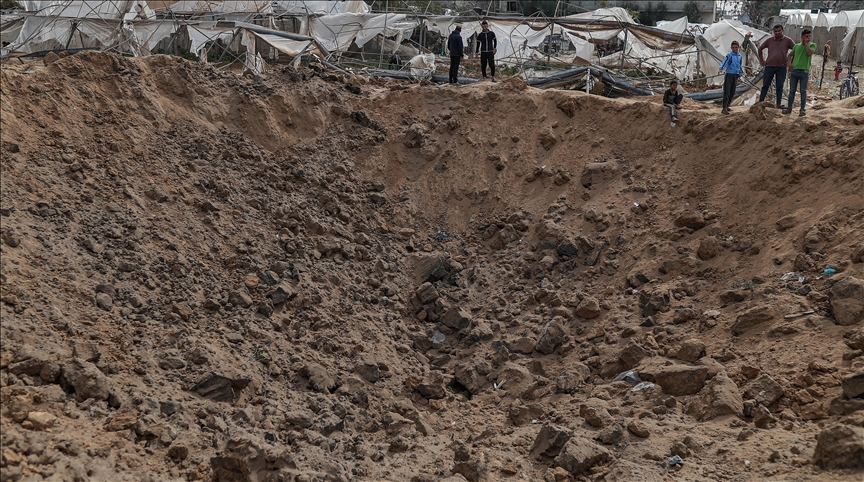
A British-based investigation group has unveiled the systematic targeting and destruction of orchards and greenhouses by Israeli forces in the Gaza Strip since last October, when the current conflict in Gaza began, undermining Gazan Palestinians’ ability to feed and provide for themselves.
Analysis by Forensic Architecture, a multidisciplinary research group based at Goldsmiths, University of London, identified more than 2,000 agricultural sites, including farms and greenhouses, that have been deliberately destroyed, and often replaced with Israeli military earthworks.
The destruction, particularly intense in northern Gaza, has led to the devastation of nearly one-third of the region’s greenhouses and approximately 40% of agricultural land previously used for food production.
The investigation suggests that the destruction is a deliberate act of ecocide exacerbating the ongoing catastrophic famine in Gaza, part of a wider pattern of depriving Palestinians of critical resources for survival.
“Since 2014, Palestinian farmers along Gaza’s perimeter have seen their crops sprayed by airborne herbicides and regularly bulldozed, and have themselves faced sniper fire by the Israeli occupation forces. Along that engineered ‘border,’ sophisticated systems of fences and surveillance reinforce a military buffer zone,” according to a statement from Forensic Architecture marking March 30, Land Day, a day when Palestinians protest and plant olive trees to reaffirm their connection to the land.
The investigation, built on collaborations with local farmers’ associations and agricultural workers, highlights the ongoing Israeli destruction of vegetation in Gaza and its severe effects on Palestinian food security and livelihoods.
The analysis indicates the ongoing resilience of Palestinian farmers who continue to cultivate their lands despite forced alterations to the landscape by the Israeli occupation.
Greenhouses, farmland replaced by Israeli military construction
Before 2023, Gaza boasted 170 square kilometers (65 square miles) of agricultural land, or 47% of its total area. The fields and orchards were crucial for local food security amid the siege conditions faced by Palestinians under the 15-year blockade of Gaza since 2007, followed by the even harsher blockade since last Oct. 7.
“Our analysis shows that Israel’s ground invasion has advanced over nearly 50 percent of Gazan farms and orchards,” said Forensic Architecture.
“We used remote sensing to measure the scale of agricultural destruction resulting from this military activity, by comparing the region’s ‘vegetation index’ (an indicator of the health and robustness of plant life, measured by analysing satellite imagery) before and after the invasion. This comparison reveals that as of March 2024, of the agricultural areas targeted, approximately 40 percent of the land in Gaza previously used for food production has been destroyed.”
The findings show that the destruction of agriculture along Gaza’s perimeter suggests a potential expansion of the Israeli army’s buffer zone, further limiting livable space for Palestinians.
Additionally, vital agricultural infrastructure like greenhouses has been systematically targeted since the onset of the ground invasion.
It stressed that satellite imagery reveals extensive destruction of greenhouses, with nearly one-third of Gaza’s greenhouses demolished between last October and this March. Forensic Architecture identified more than 2,000 agricultural sites, including farms and greenhouses, destroyed during that period, often replaced by Israeli military constructions.
The destruction has been particularly severe in northern Gaza, where 90% of greenhouses were demolished in the early stages of the invasion, an area which the head of the UN World Food Program (WFP) said Saturday was in “full-blown famine.”
“As the Israeli military advances south, destruction of agricultural land and infrastructure moves with it. We observe that 40% of the greenhouses in the areas around the southern city of Khan Younis, where many hundreds of thousands of Palestinians are now displaced, have been destroyed since January 2024,” said Forensic Architecture.
“Military support vehicles and tractors accompany the Israeli ground invasion, routinely building earthworks to reinforce military outposts. Once those vehicles depart, they leave behind a devastated and unliveable area,” it added.
Dutch police smash pro-Palestine protest camp
The Cradle | May 7, 2024
Riot police bulldozed barricades and temporarily detained 125 people to break up a pro-Palestine student protest at the University of Amsterdam in the early hours of 7 May, Reuters reported.
Four of the protesters are still being held on charges of public violence and insulting an officer, while the remainder have been released.
Organizers said they were “taking back this campus” in solidarity with Palestine and “in the spirit” of student protests that began in the US in response to Israel’s genocide in Gaza.
Along with pro-Palestine demonstrators at universities in the US and Europe, the Dutch students are demanding the university boycott academics and businesses in Israel.
Similar protests have occurred at Ghent University in Belgium and France’s prestigious Sciences Po University.
The National reported that in a social media message shortly before 3 am, organizers said they were being “violently evicted” by police arriving in riot vans.
Dutch television showed footage of police wielding batons advancing on the protesters and destroying tents.
Reuters adds that the police claimed student protesters ignored requests from university administrators and the mayor for the protesters to leave the campus and threw stones and fireworks.
“The police’s input was necessary to restore order. We see the footage on social media. We understand that those images may appear as intense,” police claimed.
Due to pressure from students, the University of Amsterdam published a list of eight research projects with ties to Israel.
It said one was about detecting explosives but “does not contribute to Israel’s military actions,” while others involved machine learning, gender issues, and safer streets.
Israel has used machine learning and artificial intelligence to generate bombing targets in Gaza.
A group of academics called Dutch Scholars for Palestine expressed support for the student protests.
“We have to resist political frames that will cast their efforts as antisemitic or a danger to the university community,” they said.
The media in the US and Europe have attempted to cast the protests as driven by antisemitism rather than by anger at Israel’s horrific bombing campaign in Gaza that has killed over 14,000 children.
Many Jewish students have participated in the university protests in opposition to Israeli policies.
“As the death toll and humanitarian crisis in Gaza increases … we should be proud of our students who are standing up to these abhorrent atrocity crimes,” the academics added.
LAPD’s Failure to Protect Peaceful Protesters at UCLA from Right-Wing Mob Shows Real Priorities
By Jeremy Kuzmarov | CovertAction Magazine | May 6, 2024
 In 1991, Frank Donner, former director of the ACLU’s Project on Political Surveillance, published a book entitled Protectors of Privilege, which provided a history of police suppression of left-wing and labor protests in the United States.
A key chapter in the book focused on the Los Angeles Police Department (LAPD), whose reactionary political function was epitomized by two of its most notorious chiefs: William Parker and Daryl Gates, who were overtly racist and supported anti-democratic paramilitary policing practices.
The LAPD’s true colors were on display at the University of California at Los Angeles (UCLA) at the end of April when its officers stood by for hours as hundreds of right-wing vigilantes attacked pro-Palestinian demonstrators in what Al Jazeera described as a “really shocking and ugly scene of violence.”
The LAPD then aggressively broke up the pro-Palestinian demonstrators’ encampment using flash bangs and riot gear, arresting around 200 of the anti-genocide protesters who were entirely peaceful. (none of the vigilantes were arrested).[1]
![Pro-Israel attackers try to remove barricades at a pro-Palestinian encampment at the University of California, Los Angeles, on May 1, 2024 [David Swanson/Reuters]](https://i0.wp.com/covertactionmagazine.com/wp-content/uploads/2024/05/pro-israel-attackers-try-to-remove-barricades-at-a.jpeg?resize=696%2C473&ssl=1)
Pro-Israel attackers try to remove barricades at a pro-Palestinian encampment at the University of California, Los Angeles, on May 1, 2024. [Source: msn.com]
On May 2, a day after the break-up of the encampment, I visited the UCLA campus and witnessed students and university employees clearing the protest area.
Though many of the students were refusing to speak to any media, I managed to interview one, Lisa Cooper, who described herself as a seasoned organizer originally from New York who had joined the protesters in solidarity with them.
Cooper told me that she helped run a wellness center in the encampment that brought in acupuncturists who administered treatment to students who had either been physically attacked or were dealing with emotional trauma and the stress of living in the encampment while studying for mid-terms.
The students believed they had to do something in the face of the horrific atrocities going on in Gaza.
Cooper said that dissent was currently under siege in the U.S. and that the protests provided an opportunity to get people thinking about societal problems and realities, and that the students involved felt empowered by their experience, which they would take with them into other aspects of their lives.
As part of the daily programming, students coordinated teach-in events like during the 1960s era Vietnam campus protests. Benjamin Kersten, a Ph.D. student in art history, told the UCLA Daily Bruin that “this is a public university that preaches the importance of education, and yet, topics like Palestine are not taught. A lot of the programming shows that people here are taking their education into their own hands, and learning what it means to teach each other and enact activist values.”[2]
According to Cooper, public protest is a right Americans enjoy under the U.S. Constitution and that this should not be forgotten.
Cooper said that the right wing vigilantes who stormed the encampment were equipped with bear mace, projectiles and other weapons that they deployed against protesters, causing injuries to some of the students.
One protester had 16 staples inserted into his scalp.
Because the students did not want to call 911 and put themselves at risk of suspension or arrest, other students drove them to the hospital by car.
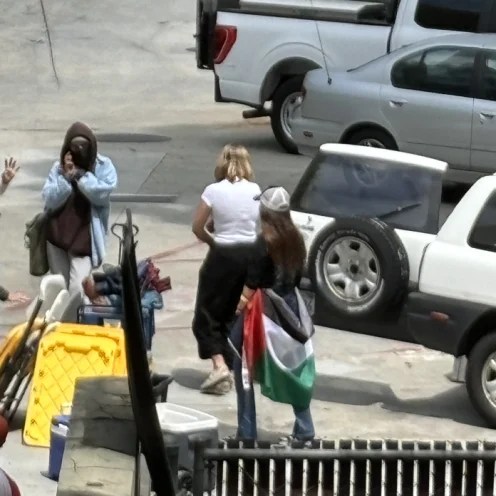
UCLA students clearing material from protest encampment on May 2. [Source: Photo courtesy of Jeremy Kuzmarov]
Cooper herself was not injured in the attack, but said that the vigilantes hurled racial slurs at her (she is African-American).
The main police units that broke up the encampment were officers of the California Highway Patrol (CHP) who, she said, are not required to wear body cam devices. CHP was backed up by the LAPD, whose presence was ubiquitous around the campus during my visit.
Cooper said that UCLA should be called to account for not allowing peaceful protests on public property.
UCLA President Michael Drake released a statement supporting the university’s decision to label the protest encampment as unlawful, noting that, “when it threatens the safety of students or everyone else, we must act.”[3]
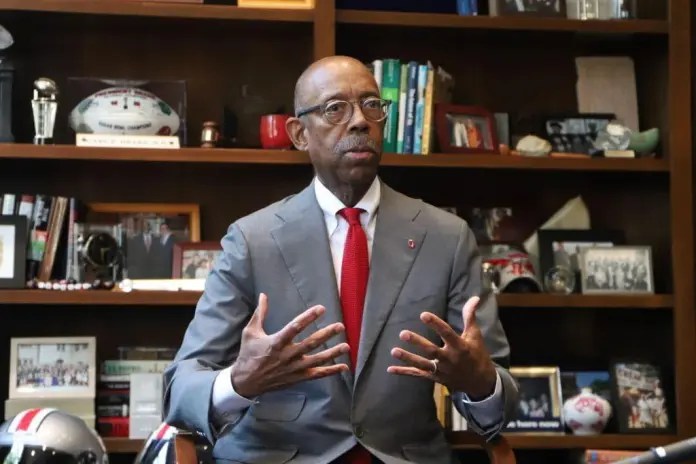
UCLA President Michael Drake [Source: thelantern.com]
However, there is no evidence that the encampment threatened the safety of UCLA students in any way[4]; rather, it was the vigilante counter-demonstrators who compromised the safety of UCLA students expressing their constitutional right to dissent.

- During the vigilante attack, a group reportedly piled on one person who lay on the ground, kicking and beating the person until others pulled him out of the scrum. The editor of the UCLA Daily Bruin, Catherine Hamilton, was punched in the chest and upper abdomen by the vigilantes. Robert Reynolds of Al Jazeera reported that the vigilante mob, which called for a second Nakba, “appear[ed] to be all largely people who are not of student age and they’re not from the UCLA campus, but what they’re doing is trying to harass and attack the pro-Palestinian demonstrators.” The leaders of the anti-war encampment at UCLA said that “law enforcement simply stood at the edge of the lawn and refused to budge as we screamed for their help. The only means of protection we had was each other as the attack went on for more than seven hours.” “The university would rather see us dead than divest,” it added in a statement posted on X. The Los Angeles Public Defenders’ Union called the UCLA arrests “shameful and a complete failure of leadership.” President Garrett Miller said they are ready to “represent every person facing charges.”
- Dylan Winward, “Encampment Hosts Programming, Draws Counter-Protesters,” UCLA Daily Bruin, April 26, 2014, 2. Winward’s article detailed how Jewish Voices for Peace organized a passover seder in the encampment and shabbat service, dispelling the myth that somehow the students involved in the encampment were anti-semites.
- Anna Dai-Liu and Dylan Winward, “Pro-Israel counter-protesters attempt to storm encampment, sparking violence,” UCLA Daily Bruin, May 1, 2024, 1.
- Sam Mulick, “UCLA Community Responds to Palestine Solidarity Encampment,” UCLA Daily Bruin, APril 26, 2024, 3 quotes from students, the majority of whom had highly positive views of the encampment. This included numbers of Jewish students. One student quoted in the article expressed appreciation that students of this generation were politically active and cared about the plight of oppressed people in the world, while another said the encampment was an effective method to engage community members on the campus. Still another, a psychology student, Erin Lee, told The Daily Bruin that UCLA should offer more support to Palestinian students, and that the university had taken a direct role in the war in Gaza through its investments in companies affiliated with the Israeli military. She added correctly that while she thinks students in the encampment were sending a very powerful message, she doubts the UC system will respond to their actions.
The beast of ideology lifts the lid on transformation
By Alastair Crooke | Strategic Culture Foundation | May 6, 2024
The Transformation is accelerating. The harsh, often violent, police repression of student protests across the U.S. and Europe, in wake of the continuing Palestinian massacres, exposes sheer intolerance towards those voicing condemnation against the violence in Gaza.
The category of ‘hate speech’ enacted into law has become so ubiquitous and fluid that criticism of the conduct of Israel’s behaviour in Gaza and the West Bank is now treated as a category of extremism and as a threat to the state. Confronted by criticism of Israel, the ruling élites respond by angrily lashing out.
Is there a boundary (still) between criticism and anti-semitism? In the West the two increasingly are being made to cohere.
Today’s stifling of any criticism of Israel’s conduct – in blatant contradiction with any western claim to a values-based order – reflects desperation and a touch of panic. Those who still occupy the leadership slots of Institutional Power in the U.S. and Europe are compelled by the logic of those structures to pursue courses of action that are leading to ‘system’ breakdown, both domestically – and concomitantly – provoking the dramatic intensification of international tensions, too.
Mistakes flow from the underlying ideological rigidities in which the ruling strata are trapped: The embrace of a transformed Biblical Israel that long ago separated from today’s U.S. Democratic Party zeitgeist; the inability to accept reality in Ukraine; and the notion that U.S. political coercion alone can revive paradigms in Israel and the Middle East that are long gone.
The notion that a new Israeli Nakba of Palestinians can be forced down the throats of the western and the global public are both delusional and reek of centuries of old Orientalism.
What else can one say when Senator Tom Cotton posts: “These little Gazas are disgusting cesspools of antisemitic hate, full of pro-Hamas sympathisers; fanatics and freaks”?
When order unravels, it unravels quickly and comprehensively. Suddenly, the GOP conference has had its nose rubbed in dirt (over its lack of support for Biden’s $61bn for Ukraine); the U.S. public’s despair at open border immigration is disdainfully ignored; and Gen Z’s expressions of empathy with Gaza is declared an internal ‘enemy’ to be roughly suppressed. All points of strategic inflection and transformation – likely as not.
And the rest of the world now is cast as an enemy too, being perceived as recalcitrants who fail to embrace the western recitation of its ‘Rules Order’ catechism and for failing clearly to toe the line on support for Israel and the proxy war on Russia.
It is a naked bid for unchecked power; one nevertheless that is galvanising a global blow-back. It is pushing China closer to Russia and accelerating the BRICS confluence. Plainly put, the world – faced with massacres in Gaza and West Bank – will not abide by either the Rules or any western hypocritical cherry-picking of International Law. Both systems are collapsing under the leaden weight of western hypocrisy.
Nothing is more obvious than Secretary of State Blinken’s scolding of President Xi for China’s treatment of the Uighurs and his threats of sanctions for Chinas trade with Russia – powering ‘Russia’s assault on Ukraine’, Blinken asserts. Blinken has made an enemy of the one power that can evidently out-compete the U.S.; that has manufacturing and competitive overmatch vs the U.S.
The point here is that these tensions can quickly spiral down into war of ‘Us’ versus ‘Them’ – ranged against not just the China, Russia, Iran “Axis of Evil”, but vs Turkey, India Brazil and all others who dare to criticise the moral correctness of either of the West’s Israel and Ukraine projects. That is, it has the potential to turn into the West versus the Rest.
Again, another own goal.
Crucially, these two conflicts have led to the Transformation of the West from self-styled ‘mediators’ claiming to bring calm to flashpoints, to being active contenders in these wars. And, as active contenders, they can permit no criticism of their actions – either inside, or out; for that would be to hint at appeasement.
Put plainly: this transformation to contenders in war lies at the heart of Europe’s present obsession with militarism. Bruno Maçães relates that a “senior European minister argued to him that: if the U.S. withdrew its support for Ukraine, his country, a Nato member, would have no choice but to fight alongside Ukraine – inside Ukraine. As he put it, why should his country wait for a Ukrainian defeat, followed by [a defeated Ukraine] swelling the ranks of a Russian army bent on new excursions?”
Such a proposition is both stupid and likely would lead to a continent-wide war (a prospect with which the unnamed minister seemed astonishingly at ease). Such insanity is the consequence of the Europeans’ acquiescence to Biden’s attempt at regime change in Moscow. They wanted to become consequential players at the table of the Great Game, but have come to perceive that they sorely lack the means for it. The Brussels Class fear the consequence to this hubris will be the unravelling of the EU.
As Professor John Gray writes:
“At bottom, the liberal assault on free speech [on Gaza and Ukraine] is a bid for unchecked power. By shifting the locus of decision from democratic deliberation to legal procedures, the élites aim to insulate [their neoliberal] cultish programmes from contestation and accountability. The politicisation of law – and the hollowing out of politics go hand in hand”.
Despite these efforts to cancel opposing voices, other perspectives and understandings of history nonetheless are reasserting their primacy: Do Palestinians have a point? Is there a history to their predicament? ‘No, they are a tool used by Iran, by Putin and by Xi Jinping’, Washington and Brussels says.
They say such untruths because the intellectual effort to see Palestinians as human beings, as citizens, endowed with rights, would force many Western states to revise much of their rigid system of thinking. It is simpler and easier for Palestinians to be left ambiguous, or to ‘disappear’.
The future which this approach heralds couldn’t be farther from the democratic, co-operative international order the White House claims to advocate. Rather it leads to the precipice of civil violence in the U.S. and to wider war in Ukraine.
Many of today’s Woke liberals however, would reject the allegation of being anti-free speech, labouring under the misapprehension that their liberalism is not curtailing free speech, but rather is protecting it from ‘falsehoods’ emanating from the enemies of ‘our democracy’ (i.e. the ‘MAGA contingent’). In this way, they falsely perceive themselves as still adhering to the classical liberalism of, say, John Stuart Mill.
Whilst it is true that in On Liberty (1859) Mill argued that free speech must include the freedom to cause offence, in the same essay he also insisted that the value of freedom lay in its collective utility. He specified that “it must be utility in the largest sense – grounded on the permanent interests of man as a progressive being”.
Free speech has little value if it facilitates the discourse of the ‘deplorables’ or the so-called Right.
In other words, “Like many other 19th-century liberals”, Professor Gray argues, “Mill feared the rise of democratic government because he believed it meant empowering an ignorant and tyrannical majority. Time and again, he vilified the torpid masses who were content with traditional ways of living”. One can hear here, the precursor to Mrs Clinton’s utter disdain for the ‘deplorables’ living in ‘fly-over’ U.S. states.
Rousseau too, is often taken as an icon of ‘liberty’ and ‘individualism’ and widely admired. Yet here too, we have language which conceals its’ fundamentally anti-political character.
Rousseau saw human associations rather, as groups to be acted upon, so that all thinking and daily behaviour could be folded into the like-minded units of a unitary state.
The individualism of Rousseau’s thought, therefore, is no libertarian assertion of absolute rights of free speech against the all-consuming state. No raising of the ‘tri-colour’ against oppression.
Quite the reverse! Rousseau’s passionate ‘defence of the individual’ arises out of his opposition to ‘the tyranny’ of social convention; the forms, rituals and ancient myths that bind society – religion, family, history, and social institutions. His ideal may be proclaimed as that of individual freedom, but it is ‘freedom’, however, not in a sense of immunity from control of the state, but in our withdrawal from the supposed oppressions and corruptions of collective society.
Family relationship is thus transmuted subtly into a political relationship; the molecule of the family is broken into the atoms of its individuals. With these atoms today groomed further to shed their biological gender, their cultural identity and ethnicity, they are coalesced afresh into the single unity of the state.
This is the deceit concealed in classical Liberalism’s language of freedom and individualism – ‘freedom’ nonetheless being hailed as the major contribution of the French Revolution to western civilisation.
Yet perversely, behind the language of freedom lay de-civilisation.
The ideological legacy from the French Revolution, however, was radical de-civilisation. The old sense of permanence – of belonging somewhere in space and time – was conjured away, to give place to its very opposite: Transience, temporariness and ephemerality.
Frank Furedi has written,
“Discontinuity of culture coexists with the loss of the sense of the past … The loss of this sensibility has had an unsettling effect on culture itself and has deprived it of moral depth. Today, the anticultural exercises a powerful role in western society. Culture is frequently framed in instrumental and pragmatic terms and rarely perceived as a system of norms that endow human life with meaning. Culture has become a shallow construct to be disposed of – or changed.
“The western cultural elite is distinctively uncomfortable with the narrative of civilisation and has lost its enthusiasm for celebrating it. The contemporary cultural landscape is saturated with a corpus of literature that calls into question the moral authority of civilisation and associates it more with negative qualities.
“De-civilization means that even the most foundational identities – such as that between man and woman – is called into question. At a time when the answer to the question of ‘what it means to be human’ becomes complicated – and where the assumptions of western civilisation lose their salience – the sentiments associated with wokeism can flourish”.
Karl Polyani, in his Great Transformation (published some 80 years ago), held that the massive economic and social transformations that he had witnessed during his lifetime – the end of the century of “relative peace” in Europe from 1815 to 1914, and the subsequent descent into economic turmoil, fascism and war, which was still ongoing at the time of the book’s publication – had but a single, overarching cause:
Prior to the 19th century, he insisted, the human way of being had always been ‘embedded’ in society, and that it was subordinated to local politics, customs, religion and social relations i.e. to a civilisational culture. Life was not treated as separated into distinct particulars, but as parts of an articulate whole – of life itself.
Liberalism turned this logic on its head. It constituted an ontological break with much of human history. Not only did it artificially separate the ‘economic’ from the ‘political’, but liberal economics (its foundational notion) demanded the subordination of society – of life itself – to the abstract logic of the self-regulating market. For Polanyi, this “means no less than the running of society as an adjunct to the market”.
The answer – clearly – was to make society again a distinctly human relationship of community, given meaning through a living culture. In this sense, Polanyi also emphasised the territorial character of sovereignty – the nation-state as the pre-condition to the exercise of democratic politics.
Polanyi would have argued that, absent a return to Life Itself as the pivot to politics, a violent backlash was inevitable. (Though hopefully not as dire as the transformation through which he lived.)
Target Israel and we’ll target you: US senators warn ICC
Press TV – May 6, 2024
A dozen American senators have strongly warned the International Criminal Court (ICC)’s chief prosecutor against the UN court’s potential issuance of arrest warrants against Israeli officials over the regime’s ongoing genocidal war on the Gaza Strip.
The warning was issued in a harshly-toned letter addressed by the senators to the British lawyer Karim Khan on Monday.
“Target Israel and we will target you,” wrote the senators, who included Tom Cotton, Mitch McConnell, Rick Scott, Tim Scott, Ted Cruz, and Marco Rubio.
The ICC, located in The Hague, is currently conducting investigations into reported war crimes committed by the Israeli military.
Speculations have been rife that the court could issue arrest warrants against top Israeli officials over the October-present war that has so far killed nearly 35,000 Palestinians, mostly women and children.
The Israeli officials facing the prospect include Prime Minister Benjamin Netanyahu, Minister for Military Affairs Yoav Gallant, and the Israeli military’s Chief of Staff Herzi Halevi.
The senators, however, said by serving the warrants, the ICC risked losing the United States’ support.
The undersigned also cautioned Khan that they would move to “sanction your employees and associates, and bar you and your families from the United States,” adding, “You have been warned.”
Back in January, the International Court of Justice (ICJ), the United Nations’ legal arm, ruled that “there is a plausible risk of genocide in Gaza and the continuing serious harm to civilians since then.” The court ordered Tel Aviv to take all measures to prevent genocide in the coastal sliver, but stopped short of ordering a ceasefire.
Ever since the ruling, though, the regime has even stepped up its deadly assaults on the Palestinian territory, and has vowed to carry out a ground invasion against the southern Gazan city of Rafah, where some 1.5 million people are seeking refuge from the ravages of the war.
Israel acknowledges barbarous strike on UNRWA building in Gaza
Press TV – May 6, 2024
Israel has bombed a building belonging to the UN agency for Palestinian refugees (UNRWA) in the besieged Gaza Strip.
Israel’s broadcaster KAN said the military hit the UN facility late Sunday on the proclaimed grounds that it was being used as a “military command center” by the resistance movement Hamas.
Many people were also killed in airstrikes by Israeli warplanes on two schools in Gaza where displaced families had taken shelter.
Israel has previously targeted UNRWA centers and UN-run schools across the besieged Palestinian territory.
UNRWA Commissioner-General Philippe Lazzarini recently called for countries to back an independent investigation into killings and detentions of its staff and damage to its premises in Gaza.
UNRWA has accused Israel of targeting its facilities since early October.
The agency says 182 of its staff there had been killed and more than 160 of its shelters hit, resulting in the death of hundreds of people fleeing Israeli bombardment.
UNRWA is the biggest humanitarian aid provider in Gaza, where its 13,000 staff there also run schools and social services for the refugees who make up the majority of Gazans.
The regime is forcibly evacuating Palestinians from the eastern part of Rafah in the southern Gaza Strip amid the prospect of its widely-discouraged ground invasion.
Hamas has called on humanitarian organizations, including UNRWA, not to leave Rafah.
The Palestinian resistance movement has also called on the international community to take urgent action to stop Israel’s planned invasion.
Israel has killed nearly 34,700 Palestinians, mostly women and children, in Gaza since October 7, 2023.
The International Court of Justice has said it is “plausible” that Israel is committing genocide in Gaza.
Israel signals rejection of ceasefire proposal accepted by Hamas
Press TV – May 6, 2024
The Palestinian resistance movement Hamas has agreed to a ceasefire proposal in Gaza, where it has fought a seven-month Israeli aggression that has left tens of thousands dead.
A short statement from Hamas on Monday said that head of the group’s politburo, Ismail Haniyeh, had informed Qatari and Egyptian mediators that it accepted their proposal for a ceasefire in Gaza.
The Israeli regime, however, appears not to have accepted the deal.
If the ceasefire agreement takes effect, it would be the first truce since a week-long pause in the fighting in November 2023.
The statement by Hamas came hours after senior officials in the group said efforts for reaching a ceasefire would stop if Israel goes ahead with its plans to invade the city of Rafah in southern Gaza, where more than half of the territory’s population of 2.3 million people has been sheltering from Israel’s brutal bombardments in other regions.
Israel on Monday ordered people in some parts of Rafah to evacuate in an apparent move to prepare for an invasion of the city.
The US government said it had warned the Israeli regime against a major operation in Rafah.
Speaking to reporters after Hamas’ announcement on the ceasefire, the Israeli military spokesperson Daniel Hagari would not confirm whether Israel would go ahead with plans to attack Rafah.
However, he said that the Israeli regime will exhaust “every possibility regarding negotiations and returning the hostages.”
A senior Hamas official told Al Jazeera that the proposal presented by Qatar and Egypt consists of a three-stage plan, and includes the complete withdrawal of Israeli forces from Gaza, the return of Palestinian refugees, and a prisoner exchange.
Khalil al-Hayya, deputy head of Hamas politburo in Gaza, explained that the plan is interconnected in terms of the stages of its implementation.
In the first stage of the agreement, the Israeli military will withdraw to areas adjacent to Gaza, he said. In the second stage, he said, a permanent ceasefire and cessation of hostilities will be declared.
Al-Hayya insisted that the ball was now in the Israeli regime’s court whether to accept the deal and end the war.
The Hamas official also said that the mediators promised that US President Joe Biden had signaled a commitment to ensuring the implementation of the proposed deal.
Biden spoke over the phone with Israeli prime minister Benjamin Netanyahu on Monday to warn him that Washington is concerned about Israel’s Rafah invasion plans.
Saudi Arabia also warned of the dangers of Israel targeting Rafah as part of its “bloody” and “systematic campaign to storm all areas of the Gaza Strip and displace its residents”.
Nearly 35,000 people have been killed in Gaza since Israel launched its aggression on the enclave on October 7 last year.
The invasion came hours after Hamas carried out a brief but extensive military operation into the Israeli-occupied territories near Gaza, killing nearly 1,200 Israeli settlers and military forces.
Hamas also took some 250 captives during its anti-Israeli operation in October. Under growing pressure from settler communities living in the occupied Palestine, the Israeli regime has been pushing for the release of the captives as part of a potential ceasefire deal with Hamas.
Belgium working on Israel sanctions
RT | May 6, 2024
The Belgian government is “working on further sanctions against Israel,” Deputy Prime Minister Petra De Sutter said on Monday. Brussels has already sanctioned Israeli settlers, and plans to cut trade ties with the Jewish state over the war in Gaza.
In a post on X (formerly Twitter), De Sutter said that Israel’s planned invasion of Rafah – a city in southern Gaza where around 1.4 million Palestinian refugees have sought shelter – would “lead to [a] massacre.”
Israel ordered the evacuation of Rafah on Monday, with the Israel Defense Forces (IDF) warning that it would strike the city with “extreme force” shortly thereafter.
“I met with Palestinian Minister of Foreign Affairs Dr. Riad Malki. We discussed how Belgium can help to end the atrocities,” De Sutter said in a follow-up post, adding that “Belgium is working on further sanctions against Israel.”
Belgium and the EU’s 26 other member states imposed sanctions last month on four individuals and two organizations involved in the construction of illegal Jewish settlements on Palestinian land in the West Bank. The people and entities sanctioned are responsible for property theft and “serious human rights abuses against Palestinians,” according to the European Council.
Belgium currently holds the rotating presidency of the European Council. Speaking to Belgian newspaper Het Laatste Nieuws on Monday, Prime Minister Alexander De Croo said that he would use the presidency to push the European Commission to review its trade agreement with Israel, and if necessary, gather a group of like-minded European leaders willing to cut ties with the country.
“Can we now simply continue with Israel as a trading partner? I do not think so,” he told the newspaper.
De Croo rejected calls from the Belgian opposition to sanction Israel two months ago. “But in the meantime there have been 35,000 deaths, including 10,000 children,” he explained. “In ten years’ time people are going to say, ‘You watched and took no action.”
The EU is Israel’s largest trading partner, with 32% of Israel’s imports originating from the EU and 25% of its exports sent to the bloc, according to data from 2022. Belgium is Israel’s fourth biggest trading partner within the EU, largely due to the diamond trade.
Türkiye announced on Thursday that it would suspend all trade with Israel due to the latter’s “aggression against Palestine in violation of international law and human rights.” Turkish President Recep Tayyip Erdogan has been one of Israel’s fiercest critics since the war in Gaza began, comparing Israeli Prime Minister Benjamin Netanyahu to Adolf Hitler and accusing him of committing “genocide” against the Palestinians.
Israel declared war on Hamas after the Palestinian militants launched a surprise attack on October 7, killing around 1,200 people and taking roughly 250 hostages back to Gaza. The death toll from Israel’s retaliation in the enclave is approaching 35,000 as of Monday, according to the Palestinian health authorities.
Israel/Gaza: The Masks Come Off in American Society
BY RON UNZ • UNZ REVIEW • MAY 6, 2024
I think the striking events we have witnessed in American society over the last few months—and especially the last few days—are best understood if we consider a shrewd observation widely misattributed to Voltaire:
To learn who rules over you, simply find out who are not allowed to criticize.
From the years of my childhood I’d always been aware that political activism and protests were a regular feature of college life, with the 1960s movement against our Vietnam War representing one of its peaks, an effort widely lauded in our later textbooks and media accounts for its heroic idealism. During the 1980s I remember seeing a long line of crudely constructed shanties protesting South African Apartheid that spent weeks occupying the edges of the Harvard Yard or perhaps it was the Stanford Quad, and I think around the same time other shanties and protesters at UCLA maintained a long vigil in support of the Jewish Refusedniks of the USSR. Political protests seemed as much a normal aspect of college years as final exams and had largely replaced the hazing rituals and wild pranks of traditional fraternities, which were increasingly vilified as politically incorrect by hostile social censors among the students and faculty.
Over the last decade or so, the Black Lives Matter movement raised such nationwide protests by college students to new heights, both on and off campus, often involving large marches, sit-ins, or vandalism, and this was possibly propelled by the increasing influence of smartphones and social media. Meanwhile, the mainstream media regularly praised and promoted this “racial justice movement,” which reached its sharp peak following the death of George Floyd in the summer of 2020. Soon afterward, a massive wave of generally youthful political protests, riots, and looting engulfed some 200 cities across our entire nation, the worst urban unrest since the late 1960s. But unlike during that earlier era, most of our establishment media and political class fiercely denounced as outrageous any suggestions that the police be deployed to quell that violence. Indeed, in many or most cases local law enforcement stood down and did nothing, even as some of their political masters loudly raised the outcry “Defund the Police!”
During those years many universities became heavily caught up in such controversies with Yale renaming its Calhoun residential college in early 2017 and the list of name changes due to the 2020 George Floyd protests is so long that it warrants its own Wikipedia page, a list that notably included some of our most storied military bases such as Ft. Bragg and Ft. Hood. Verbal or even physical attacks against the symbols and statues of America’s most famous presidents and national heroes became quite common and were often favorably reported in the media, with George Washington, Thomas Jefferson, Abraham Lincoln, Theodore Roosevelt, Woodrow Wilson, and Christopher Columbus all being vilified and denounced, sometimes with elite endorsement. A lead opinion piece in the New York Times called for the Jefferson Memorial to be replaced with a towering statue of a black woman while one of the regular Times columnists repeatedly demanded that all monuments honoring George Washington should suffer a similar fate. Many observers argued that 2020 America almost seemed to be undergoing its own version of the Chinese Cultural Revolution, amid widespread claims that much of our entire historical past was irretrievably tainted and therefore had to be expunged from the public square.
Most of these political protests, especially those on college campuses, were widely hailed by those holding the media megaphones as representing one of the greatest virtues of American democracy. The many elite defenders of these social and cultural upheavals argued that these events demonstrated the great strength of our society, which freely allowed the fiercest public attacks against our most sacred national icons and heroes, providing the sort of searing self-criticism that would surely be permitted almost nowhere else in the world.
That long history of permitted or even glorified public protests against perceived injustices had naturally been absorbed and taken to heart by the young college students who began their classes in September 2023. Then within weeks, a remarkably daring surprise raid by the Hamas militants of long-besieged Gaza caught the Israelis napping and surmounted the high-tech defenses that had cost them perhaps a half-billion dollars to construct. Many hundreds of Israeli soldiers and security officers were killed along with similar numbers of civilians, with most of the latter probably dying from the friendly-fire of Israel’s own panic-stricken and trigger-happy military units. Some 240 Israeli soldiers and civilians were captured and taken back to Gaza as prisoners, with Hamas hoping to exchange them for the freedom of the many thousands of Palestinian civilians who had been held for years in Israeli prisons, often under brutal conditions.
As usual, our overwhelmingly pro-Israel mainstream media portrayed the attack in extremely one-sided fashion, devoid of any historical context, a pattern that had been followed for three generations. As a result, Israel received an enormous outpouring of public and elite sympathy as it mobilized for a retaliatory attack against Gaza. Within days, our own Secretary of State Antony Blinken flew to Israel declaring that he came “as a Jew” and pledging America’s unwavering support in that moment of crisis, sentiments completely echoed by President Joseph Biden and his entire administration. But the Hamas fighters and their Israeli captives were hidden in a network of fortified tunnels and rooting them out might produce heavy casualties, so Israeli Prime Minister Benjamin Netanyahu and his advisors decided upon a different strategy.
Instead of attacking Hamas, Netanyahu took advantage of the wave of global sympathy by unleashing an unprecedented military assault against Gaza’s more than two million civilians, apparently intending to kill huge numbers of them and drive the remainder into Egypt’s Sinai desert, allowing Israel to annex their territory and resettle it with Jews. Soon afterward, the Israeli government began distributing assault rifles to the Jewish Settlers of the West Bank, ordering some 24,000 of those automatic weapons for that purpose. Putting such armaments in the hands of religious fanatics would surely lead to local massacres and these might provide an excuse for driving all the millions of Palestinians over the border in Jordan. The ultimate result would be the creation of a racially-pure Greater Israel stretching “From the River to the Sea,” the longstanding dream of the Zionist movement. And if he were successful, Netanyahu’s place in Jewish history might become a glorious one, with his many venal sins and blunders easily overlooked.
As American airlifts supplied an unending flood of the necessary munitions, the Israelis began a massive aerial bombardment campaign against densely-populated Gaza and its helpless residents. Secure in their underground tunnels, relatively few Hamas fighters were killed, but Gaza’s civilians suffered devastating losses, much of it inflicted by two thousand pound bombs, almost never previously deployed against urban targets. Large portions of Gaza were soon transformed into moonscapes, with some 100,000 buildings destroyed, including hospitals, churches, mosques, schools, universities, government offices, bakeries, and all the other infrastructure necessary for maintaining civilian life. After just a few weeks, the Financial Times reported that the destruction inflicted upon much of Gaza was already worse than had been suffered by German cities after years of Allied bombing attacks during World War II.
Although Netanyahu was strictly secular, he played to his religious base by publicly declaring the Palestinians to be the tribe of Amalek, whom the Hebrew God had commanded be exterminated down to the last newborn baby. Many other top Israeli leaders voiced very similar genocidal sentiments, and some of the more zealously religious Israeli soldiers and commanders probably took those statements quite literally.
This gigantic bloodlust was further inflamed as the Israeli government and its supportive propagandists began promoting outrageous Hamas atrocity-hoaxes such as beheaded or roasted Israeli babies, sexual mutilations, and gang-rapes. The notoriously pro-Israel global media credulously reported these stories, using them to deflect attention from the enormous ongoing slaughter of Palestinian civilians. To ensure that the coverage remained one-sided, the Israelis targeted independent journalists in Gaza for death, killing some 140 of them over the last few months, a figure as large as the combined total in all the world’s other wars over the last several years.
With Israel’s leaders publicly declaring their genocidal plans for their Palestinian enemies and their troops committing the greatest televised massacre of helpless civilians in the history of the world, international organizations gradually came under serious pressure to involve themselves in the ongoing conflict. In late December, South Africa filed a 91-page legal brief with the International Court of Justice (ICJ) accusing Israel of committing genocide. Within a few weeks the ICJ jurists issued a series of near-unanimous rulings supporting those accusations and declaring that the Gazans were at serious risk of suffering a potential genocide at Israel’s hands, with Israel’s own appointed judge, a former Chief Justice of the Israeli Supreme Court, concurring in most of those verdicts.
But instead of backing off, Netanyahu government merely redoubled his attacks against Gaza, tightening the blockade of food shipments by banning the UN organization responsible for distributing them, believing that starvation together with bombs and missiles would be the most effective means of killing or driving out all the Palestinians.
Over the last few months I discussed these unfortunate developments in a long series of articles, with most of the material also summarized in a couple of interviews with Mike Whitney:
- Gazacaust: Placing the Blame Where It Belongs
Mike Whitney Interview with Ron Unz
Ron Unz • The Unz Review • February 5, 2024 • 4,600 Words - The Jewish Roots of the Gaza Rampage
Mike Whitney Interview with Ron Unz
Ron Unz • The Unz Review • March 11, 2024 • 5,900 Words
In past decades, these horrifying events might have gone relatively unnoticed, with the overwhelmingly pro-Israel gatekeepers of our mainstream media ensuring that little if any of this distressing information reached the eyes or ears of ordinary Americans. But technological developments had changed this media landscape and video on relatively uncensored social platforms such as TikTok and Elon Musk’s Twitter now easily circumvented that blockade. Despite their decades of suffering and oppression, Gaza’s Palestinians were a fully modern people, well-equipped with smartphones, and the scenes they filmed were shared worldwide, quickly attracting huge audiences among the younger Americans who relied upon social media as their primary source of news.
For generations, college students had been heavily indoctrinated with the horrors of the Holocaust, endlessly told that they must never remain silent while helpless men, women, and children were brutally attacked and slaughtered by cruel oppressors. The images they now saw of devastated cities and dead or dying children seemed exactly like something out of the movies, but they were instead happening in real-time in the physical world.
A couple of years earlier, the Trump and the Biden Administrations had both jointly proclaimed that the Chinese government was guilty of “genocide” against its Uighur minority despite failing to provide any evidence that significant numbers of Uighurs had been harmed let alone killed. So by that standard, the total destruction of Gaza and the massive slaughter or deliberate starvation of its population obviously constituted an enormous “genocide,” and within weeks student activists all across college campuses had taken up that cry and begun organizing public protests against the horrendous massacre that Israel was committing:

Three years earlier, a lifelong career criminal named George Floyd had died of a drug overdose while in police custody, and a single, highly-misleading video of his last moments had provoked the greatest wave of American public protests since the 1960s. So it was hardly surprising that the widespread dissemination of hundreds or thousands of videos showing dead and mutilated Gazan children inspired a powerful protest movement. But this time, instead of being praised for their humanitarian commitment, those students—and the university administrators who allowed their protests—were ferociously attacked and punished as I described at the time:
With graphic images of devastated Gaza neighborhoods and dead Palestinian children so widespread on Twitter and other social media outlets, polls have revealed that a majority of younger Americans now favor Hamas and the Palestinians in their ongoing struggle with Israel. This is a shocking reversal from the views of their parents, which had been shaped by generations of overwhelmingly pro-Israel material across broadcast television, films, and print publications, and such trends are only likely to continue now that Israel is being prosecuted in the International Court of Justice by South Africa and 22 other nations, accused of committing genocide in Gaza.
As a consequence of these strong youthful sentiments, anti-Israel demonstrations have erupted at many of our universities, outraging numerous pro-Israel billionaire donors. Almost immediately, some of the latter launched a harsh retaliatory campaign, with many corporate leaders declaring that they would permanently blacklist from future employment opportunities any college students publicly supporting the Palestinian cause, underscoring these threats with a widespread “doxxing” campaign at Harvard and other elite colleges.
A few weeks ago, our uniformly pro-Israel elected officials entered the fray, calling the presidents of several of our most elite colleges—Harvard, Penn, and MIT—to testify before them regarding alleged “antisemitism” on their campuses. Members of Congress severely brow-beat these officials for permitting anti-Israel activities, even ignorantly and absurdly accusing them of allowing public calls for “Jewish genocide” on their campuses.
The responses of these college leaders emphasized their support for freedom of political speech but were deemed so unsatisfactory by pro-Israel donors and their mainstream media allies that enormous pressure was exerted to remove them. Within days, the Penn president and her supportive Board chairman had been forced to resign, and soon afterward Harvard’s first black president suffered the same fate, as pro-Israel groups released evidence of her widespread academic plagiarism to drive her from office.
I am unaware of any previous case in which the president of an elite American college had been so rapidly removed from office for ideological reasons and two successive examples within just a few weeks seems an absolutely unprecedented development, having enormous implications for academic freedom.
I’d think that most of the students involved were absolutely stunned at that these developments. For decades, they and their predecessors had freely protested on a wide range of political causes without ever encountering a sliver of such vicious retaliation, an organized campaign that quickly forced the resignation of two of the Ivy League presidents who had allowed their protests. Some of their student organizations were immediately banned and the future careers of the protesters were harshly threatened, but the horrifying images from Gaza continued to reach their smartphones. As Jonathan Greenblatt of the ADL had previously explained in a leaked phone call, “We have a major TikTok problem.”
Indeed, the Israelis continued to generate an avalanche of gripping content for those videos. Swarming Israeli activists regularly blocked the passage of food-trucks, and within a few weeks, senior UN officials declared that more than a million Gazans were on the verge of a deadly famine. When the desperate, starving Gazans swarmed one of those few food delivery convoys allowed through, the Israeli military shot and killed more than 100 of them in the “Flour Massacre” and this was later repeated. All these horrific scenes of death and deliberate starvation were broadcast worldwide on social media, with some of the worst examples coming from the accounts of gleeful Israeli soldiers, such as their video of the corpse of a Palestinian child being eaten by a starving dog. Another image showed the remains of a bound Palestinian prisoner who had been crushed flat while still alive by an Israeli tank. According to a European human rights organization, the Israelis had regularly used bulldozers to bury alive large numbers of Palestinians. UN officials reported finding mass graves near several hospitals, with the victims found tied and stripped, shot execution-style. As Internet provocateur Andrew Anglin has pointed out, the behavior of the Israeli Jews does not seem merely evil but “cartoonishly evil,” with all their blatant crimes seeming to be based upon the script of some over-the-top propaganda-film but instead actually taking place in real life.
Although the official Gazan death-toll reported in our media has remained relatively constant in recent weeks, this is almost certainly an illusion. During the first month or two of the massive Israeli attack, the Gazan Public Health Ministry had maintained very detailed rosters of the dead, including the names, ages, and ID codes of the victims, and regularly released updates of the total, so those numbers seemed absolutely solid. But the Israeli assault soon targeted all of Gaza’s government offices and hospitals, and by early December, the Gazan officials responsible for tabulating the dead had themselves been killed or gone missing, so the count naturally tended to stagnate, even as conditions horrifically worsened for the surviving Gazans.
After less than three months of the Israeli slaughter, some 22,000 Gazans had officially been reported dead, but now after more than seven months of starvation and continuing attacks, including the destruction of all of Gaza’s hospitals and medical facilities, the official body-count reported in our media has only increased to around 34,000, which seems highly implausible. In early March, progressive icon Ralph Nader focused attention on that point, noting that Gazan fatalities must surely be massively under-reported, and he speculated that the true number of deaths might have already reached 200,000. Although that total seemed quite high to me at the time, Nader’s figure usefully emphasized the absurdly low numbers widely quoted in the media.
A recent front-page story in the New York Times reported the tragic case of a particular Palestinian-American pharmacist living in New Jersey, who had personally lost 200 relatives killed in Gaza, including his parents and siblings, and that sort of single datapoint suggests the magnitude of the media under-count after seven months of horror, with Prof. Jeffrey Sachs of Columbia suggesting the same thing in a recent interview. Although solid estimates are impossible, I’d think a civilian death toll of 100,000 or even something considerably higher seems perfectly plausible at this date.
These grim circumstances have naturally sparked a continuing wave of public student protests against Israel for committing these monstrous crimes and against our own Biden Administration for enabling it with money and munitions. Prof. John Mearsheimer of the University of Chicago is one of our highest-ranking mainstream academics, a very sober-minded scholar of the Realist School, and in an interview last week he expressed little surprise at these matters. After all, he pointed out, Israel was obviously an Apartheid-state currently committing a genocide before the eyes of the entire world so political protests on college campuses were only to be expected.
Throughout these last few months, pro-Israel partisans have regularly denounced the the anti-Zionism of their opponents as antisemitic and insisting that it be suppressed. Back in February I had noted the ironic implications of their position:
This is certainly an odd situation, warranting careful analysis and explanation. The word “antisemitism” merely means criticizing or disliking Jews, and in recent years, Israel’s partisans have demanded with some success that the term should be extended to encompass anti-Zionism as well, namely hostility to the Jewish state.
But let us suppose that we concede the latter point and agree with pro-Israel activists that “anti-Zionism” is indeed a form of “antisemitism.” Over the last few months, the Israeli government has brutally slaughtered tens of thousands of helpless civilians in Gaza, committing the greatest televised massacre in the history of the world, with its top leaders using explicitly genocidal language to describe their plans for the Palestinians. Indeed, the South African government submitted a 91 page legal brief to the International Court of Justice cataloging those Israeli statements, prompting a near-unanimous ruling by the jurists that millions of Palestinians faced the prospect of genocide at Israeli hands.
These days most Westerners claim to regard genocide in a decidedly negative light. So does this not syllogistically require them to embrace and endorse “antisemitism”? Surely a visitor from Mars would be very puzzled by this strange dilemma and the philosophical and psychological contortions it seems to require.
It is rather surprising for the extremely “politically correct” ruling elites of America and the rest of the Western world to be loudly cheering on the racially-exclusivist State of Israel even as it kills enormous numbers of women and children and works very hard to starve to death some two million civilians in its unprecedented genocidal rampage. After all, the far milder and more circumspect regime of Apartheid South Africa was universally condemned, boycotted, and sanctioned for merely the tiniest sliver of such misdeeds.
- American Pravda: Gaza, Jewish Power, and the Holocaust
Ron Unz • The Unz Review • February 19, 2024 • 10,400 Words
An important turning point may have come on April 17th when Columbia University President Minouche Shafik, herself of Egyptian origins, was raked over the coals by a Congressional Committee for permitting anti-Israel protests on her campus. Her interrogators claimed that these were “antisemitic” acts and caused some of Columbia’s Jewish students to “feel unsafe,” a dire situation that seemingly trumped both freedom of speech and academic freedom.
Shafik may or may not have agreed with those arguments, but she surely remembered that just a few months earlier her counterparts at Harvard and Penn had both been summarily purged for giving the wrong answers, and she hardly wished to share their fate. So she firmly promised to root out all public antisemitism at her university and soon afterward 100 helmeted NYC riot police were invited onto the campus to crush the demonstrations and arrest the protesters, mostly charging the latter with “trespassing,” a rather strange accusation given that they were enrolled students on the grounds of their own campus.
This sort of harsh and immediate police crackdown seems almost unprecedented in the modern history of college political protests. Back in the 1960s, there were a few scattered cases of police being called in to arrest militant protesters who had seized and occupied administrative offices at Harvard, paraded around with firearms at Cornell, or burned down a campus building at Stanford. But I have never heard of peaceful political protesters being arrested on the grounds of their own college merely for the content of their political speech.
Although those Congressional demands for a crackdown at Columbia were obviously intended to quell American campus protests, it predictably had the opposite effect. Scenes of burly, helmeted riot police arresting peaceful college students on their own campus went viral on social media, inspiring a wave of similar protests at numerous other colleges across the nation, with police arrests quickly following in most locations. By latest count, some 2,300 students have now been arrested at dozens of universities.
The actions by the Georgia State Police at Emory University seemed particularly outrageous, and a Tweet containing a clip of one of those incidents has already viewed some 1.5 million times. A 57-year-old tenured professor of Economics named Carolyn Frohlin was concerned at seeing one of her own students being wrestled down to the pavement and walked towards him only to find herself be brutally thrown to the ground, hogtied, and arrested by a couple of hulking officers led by a sergeant, something that utterly shocked CNN anchor Jim Acosta when he reported it.
Even worse scenes took place at UCLA as an encampment of peaceful protesters was violently attacked and beaten by a mob of pro-Israel thugs having no university connection but armed with bars, clubs, and fireworks, resulting in some serious injuries. A professor of History described her outrage as the police on the scene stood by and did nothing as UCLA students were attacked by outsiders, then arrested some 200 of the former. According to local journalists, the violent mob had been organized and paid by pro-Israel billionaire Bill Ackman.
I have never heard of any American case in which organized mobs of outside thugs were allowed to violently assault peaceful student protesters on their own campus, and this seems far more reminiscent of turbulent Latin American dictatorships than our own country’s history. The closest example from our own history might be the notorious 1970 “Hard Hat Riot” in New York City in which hundreds of pro-Nixon construction workers battled similar numbers of anti-war protesters on the streets of lower Manhattan, an incident so infamous that it has an extensive Wikipedia page of its own.
However, a somewhat different but much closer and more recent analogy does come to mind. After Donald Trump launched his unexpectedly successful presidential campaign, right-wing, pro-Trump speakers invited to college campuses were regularly harassed and assaulted together with their audiences by mobs of violent antifa, with many of the latter apparently recruited and paid for the purpose.
This sort of very physical “deplatforming” was intended to ensure that their threatening ideas never reached impressionable college students and as a consequence conservatives soon began organizing their own groups such as the Proud Boys aimed at providing physical protection. Violent clashes occurred at Berkeley and some other colleges, while similar antifa riots in DC and elsewhere had disrupted Trump’s inauguration. From what I remember, most of the organizers and financial backers of these violent antifa groups seemed to be Jewish, so it’s hardly surprising that other Jewish leaders have now begun employing very similar tactics to suppress different political movements that they regard as distasteful.
Some years ago a former senior AIPAC official once boasted to a friendly journalist that if he wrote anything on a simple napkin, within 24 hours he could get signatures of 70 Senators to endorse it, and the political power of the ADL is equally formidable. Therefore it was hardly surprising that last week an overwhelming bipartisan 320-91 majority in the House passed a bill broadening the meaning of anti-Zionism and antisemitism in the anti-discrimination policies of the Department of Education by codifying the definitions used in our Civil Rights laws to classify those ideas as discriminatory.
Although I haven’t tried to read the text, the obvious intent is to force colleges to expunge such noxious activities as anti-Israel protests from their campus community or face loss of federal funds. This represents a striking attack against America’s traditional freedom of speech and thought as well as academic freedom, and may also serve to put enormous pressure on other private organizations to adopt similar policies. In a particularly ironic twist, the definition of antisemitism used in the bill clearly covers portions of the Christian Bible, so the ignorant and donor-controlled Republican legislators have now wholeheartedly endorsed banning the Bible in a country in which 95% of the citizens have Christian roots.
While I doubt that any arrests along those lines would occur or stand up to legal challenge, once controversial ideas are increasingly banned from all respectable venues, much of the public, perhaps even including some confused law enforcement officers, may vaguely begin to assume that they have actually become illegal.
Put in simple form, “antisemitism” is the dislike or criticism of Jews and “Anti-Zionism” is the same thing with regard to the State of Israel. So potentially banning any criticism of Jews or Israel would certainly be a remarkable legal development in our society.
This massive suppression of all political opposition to Zionism through a mixture of legal, quasi-legal, and illegal means has hardly escaped the notice of various outraged critics. Max Blumenthal and Aaron Mate are young Jewish progressives very sharply critical of Israel and its current attack on Gaza, and in their most recent livestream video a day or two before that Congressional vote, they agreed that Zionists were the greatest threat to American freedom and that our country was “under political occupation” by the Israel Lobby.”
They may or may not have been aware that their angry denunciation closely paralleled one of the most notorious Far Right phrases of the last half-century, which condemned America’s existing political system as nothing more than ZOG, a “Zionist Occupation Government.” Over time, obvious factual reality gradually becomes apparent regardless of ideological predispositions.
Although it’s difficult to be sure, I personally think that passage of that controversial House bill may have been a major strategic blunder for the pro-Israel forces, the ADL, and the other Jewish groups behind it. Jews only constitute about 2% of American population and over the last several generations many of them seem to have waged a successful campaign to gain control over the key nodes of our society, but this has always required that their growing strength and influence remain invisible. However, the absolutely lock-step and uniform American political support for Israel’s ongoing massacre of the Palestinians has raised the awareness of some elements of our population and this legislative attempt to essentially outlaw criticism of Jews and Israel may have a similar impact. Views that had previously only circulated in extreme fringe circles may now begin to gain much greater traction.
For example, cartoonist Scott Adams has become a popular commentator in conservative, anti-Woke circles and he just released a blistering denunciation of the proposed legislation in which he sounded no different than far more extreme figures.
During the early decades of the Twentieth Century the enormous Russian Empire was only about 4% Jewish, but after the heavily Jewish Bolsheviks seized power, the top political leadership of that country became overwhelmingly of that one ethnicity. This enormous, blatant mismatch between ruled and rulers naturally provoked a great deal of hostility in the broader public, and the Bolsheviks responded to this problem by outlawing antisemitism, with the penalty sometimes even including summary execution.
Since America’s Jewish groups do not possess such extreme administrative power, they have been forced to rely upon concealment and political manipulation to achieve their ends, and they may have severely over-reached themselves with that latest legislative effort to outlaw criticism. More and more people may start to pay closer attention to the seemingly inexplicable political decisions taken by so many of our elected officials while also noticing the unusual composition of the top ranks of our government. On that last point, one of my 2023 articles pointed out the obvious:
Consider, for example, the leading figures in our current Biden Administration, who are playing a crucial role in determining the future of our own country and the rest of the world. The list of Cabinet departments has wildly proliferated since Washington’s day, but suppose we confine our attention to the half-dozen most important, led by the individuals who control national security and the economy, and then also add the names of the President, Vice President, Chief of Staff, and National Security Advisor. Although “Diversity” may have become the sacred motto of the Democratic Party, the background of the handful of individuals running our country appears strikingly non-diverse, especially if we exclude the two political figureheads at the very top.
- President Joe Biden (Jewish in-laws)
- Vice-President Kamala Harris (Jewish spouse)
- Chief of Staff Jeff Zients (Jewish), replacing Ron Klain (Jewish, Harvard)
- Secretary of State Antony Blinken (Jewish, Harvard)
- Secretary of the Treasury Janet Yellen (Jewish, Yale)
- Secretary of Defense Lloyd Austin III (Black)
- Attorney General Merrick Garland (Jewish, Harvard)
- National Security Advisor Jake Sullivan (White Gentile, Yale)
- Director of National Intelligence Avril Haines (Jewish)
- Secretary of Homeland Security Alejandro Mayorkas (Jewish)
Oddly enough, while America’s current political predicament might have alarmed some important individuals from the first half of the last century, it probably would hardly have surprised them. Five or six years ago I read a fascinating book by Prof. Joseph Bendersky, an academic historian specializing in Holocaust Studies and the history of Nazi Germany. As I wrote at the time:
Bendersky devoted ten full years of research to his book, exhaustively mining the archives of American Military Intelligence as well as the personal papers and correspondence of more than 100 senior military figures and intelligence officers. The “Jewish Threat” runs over 500 pages, including some 1350 footnotes, with the listed archival sources alone occupying seven full pages. His subtitle is “Anti-Semitic Politics of the U.S. Army” and he makes an extremely compelling case that during the first half of the twentieth century and even afterward, the top ranks of the U.S. military and especially Military Intelligence heavily subscribed to notions that today would be universally dismissed as “anti-Semitic conspiracy theories.”
Put simply, U.S. military leaders in those decades widely believed that the world faced a direct threat from organized Jewry, which had seized control of Russia and similarly sought to subvert and gain mastery over America and the rest of Western civilization.
In these military circles, there was an overwhelming belief that powerful Jewish elements had financed and led Russia’s Bolshevik Revolution, and were organizing similar Communist movements elsewhere aimed at destroying all existing Gentile elites and imposing Jewish supremacy throughout America and the rest of the Western world. While some of these Communist leaders were “idealists,” many of the Jewish participants were cynical opportunists, seeking to use their gullible followers to destroy their ethnic rivals and thereby gain wealth and supreme power. Although Intelligence officers gradually came to doubt that the Protocols of the Elders of Zion was an authentic document, most believed that the notorious work provided a reasonably accurate description of the strategic plans of the Jewish leadership for subverting America and the rest of the world and establishing Jewish rule.
Although Bendersky’s claims are certainly extraordinary ones, he provides an enormous wealth of compelling evidence to support them, quoting or summarizing thousands of declassified Intelligence files, and further supporting his case by drawing from the personal correspondence of many of the officers involved. He conclusively demonstrates that during the very same years that Henry Ford was publishing his controversial series The International Jew, similar ideas, but with a much sharper edge, were ubiquitous within our own Intelligence community. Indeed, whereas Ford mostly focused upon Jewish dishonesty, malfeasance, and corruption, our Military Intelligence professionals viewed organized Jewry as a deadly threat to American society and Western civilization in general. Hence the title of Bendersky’s book.
Let us take a step back and place Bendersky’s findings in their proper context. We must recognize that during much of the era covered by his research, U.S. Military Intelligence constituted nearly the entirety of America’s national security apparatus—being the equivalent of a combined CIA, NSA, and FBI—and was responsible for both international and domestic security, although the latter portfolio had gradually been assumed by J. Edgar Hoover’s own expanding organization by the end of the 1920s.
Bendersky’s years of diligent research demonstrate that for decades these experienced professionals—and many of their top commanding generals—were firmly convinced that major elements of the organized Jewish community were ruthlessly plotting to seize power in America, destroy all our traditional Constitutional liberties, and ultimately gain mastery over the entire world.
I have never believed in the existence of UFOs as alien spacecraft, always dismissing such notions as ridiculous nonsense. But suppose declassified government documents revealed that for decades nearly all of our top Air Force officers had been absolutely convinced of the reality of UFOs. Could I continue my insouciant refusal to even consider such possibilities? At the very least, those revelations would force me to sharply reassess the likely credibility of other individuals who had made similar claims during that same period.
These same views were also fully articulated in the later books and memoirs of prominent former Military Intelligence officers such as Prof. John Beaty and Prof. Revilo Oliver.
- American Pravda: Secrets of Military Intelligence
Ron Unz • The Unz Review • June 10, 2019 • 12,500 Words
When we consider a government run by individuals who seem to have little political independence, it is interesting to consider the means by which control is actually exercised over these nominal leaders. Several years ago I discussed some strong indications of the possible means, perhaps explaining strange decisions or reversals that seem to defy logic.
Today when we consider the major countries of the world we see that in many cases the official leaders are also the leaders in actuality: Vladimir Putin calls the shots in Russia, Xi Jinping and his top Politburo colleagues do the same in China, and so forth. However, in America and in some other Western countries, this seems to be less and less the case, with top national figures merely being attractive front-men selected for their popular appeal and their political malleability, a development that may eventually have dire consequences for the nations they lead. As an extreme example, a drunken Boris Yeltsin freely allowed the looting of Russia’s entire national wealth by the handful of oligarchs who pulled his strings, and the result was the total impoverishment of the Russian people and a demographic collapse almost unprecedented in modern peacetime history.
An obvious problem with installing puppet rulers is the risk that they will attempt to cut their strings, much like Putin soon outmaneuvered and exiled his oligarch patron Boris Berezovsky. One means of minimizing such risk is to select puppets who are so deeply compromised that they can never break free, knowing that the political self-destruct charges buried deep within their pasts could easily be triggered if they sought independence. I have sometimes joked with my friends that perhaps the best career move for an ambitious young politician would be to secretly commit some monstrous crime and then make sure that the hard evidence of his guilt ended up in the hands of certain powerful people, thereby assuring his rapid political rise.
- American Pravda: John McCain, Jeffrey Epstein, and Pizzagate
Ron Unz • The Unz Review • July 29, 2019 • 6,400 Words
More and more thoughtful Americans are becoming aware that on so many important matters our two major political parties often seem more like separate wings of a single political entity, sometimes labeled the “uniparty.” I discussed this disturbing phenomenon in the closing paragraphs of my original American Pravda article:
Most of the Americans who elected Barack Obama in 2008 intended their vote as a total repudiation of the policies and personnel of the preceding George W. Bush administration. Yet once in office, Obama’s crucial selections—Robert Gates at Defense, Timothy Geither at Treasury, and Ben Bernanke at the Federal Reserve—were all top Bush officials, and they seamlessly continued the unpopular financial bailouts and foreign wars begun by his predecessor, producing what amounted to a third Bush term.
Consider the fascinating perspective of the recently deceased Boris Berezovsky, once the most powerful of the Russian oligarchs and the puppet master behind President Boris Yeltsin during the late 1990s. After looting billions in national wealth and elevating Vladimir Putin to the presidency, he overreached himself and eventually went into exile. According to the New York Times, he had planned to transform Russia into a fake two-party state—one social-democratic and one neoconservative—in which heated public battles would be fought on divisive, symbolic issues, while behind the scenes both parties would actually be controlled by the same ruling elites. With the citizenry thus permanently divided and popular dissatisfaction safely channeled into meaningless dead-ends, Russia’s rulers could maintain unlimited wealth and power for themselves, with little threat to their reign. Given America’s history over the last couple of decades, perhaps we can guess where Berezovsky got his idea for such a clever political scheme.
Several months ago a young military serviceman named Aaron Bushnell from a strongly Christian background became so distraught at his country’s active involvement in what he regarded as the supreme crime of genocide that he set himself on fire and died as an act of protest, an event certainly without precedent in American history and extraordinarily rare elsewhere in the world. Although the story quickly vanished from our own media, the coverage on global social media was enormous, and may have lasting consequences.
After discussing that tragic incident, I then went on to say that the dire fate of Gaza’s Palestinians might ultimately be seen as having played a similar role, suddenly allowing both Americans and others around the world to glimpse the long-hidden rulers of our own country:
For similar reasons, I think that the tens of thousands of dead Gazans did not lose their lives in vain. Instead, their martyrdom has dominated the global media for the last five months, conclusively revealing to the entire world the moral bankruptcy of the international system that had condemned them to their fate.
Probably hundreds of millions of people worldwide have now begun asking themselves questions that they never would have previously considered. I suspect that those responsible for the destruction of Gaza may come to rue the day when they helped open doors that they may eventually wish had been kept tightly shut.
Dr. Ghassan Abu Sitta speaks to Al Mayadeen on EU entry ban
Al Mayadeen | May 5, 2024
Doctor Ghassan Abu Sitta, a renowned Palestinian Plastic and Reconstructive surgeon, detailed to Al Mayadeen his experience in France’s Charles De Gaulle International Airport, where French authorities stopped and turned him back on Saturday.
Dr. Abu Sitta flew to France to speak at the French Senate at the invitation of the Ecologists Party (The Greens), however, he was stopped and interrogated after arriving at Charles De Gaulle airport, to be later put on a flight back home. French authorities told Abu Sitta that he was barred from entering EU member states after German authorities banned him from the Schengen Area.
The surgeon volunteered with Doctors Without Borders in the Gaza Strip, working in the besieged territories hospitals amid a blatant Israeli genocide, which he bore witness to.
He told Al Mayadeen that the main reason why French authorities denied him entry to the country was to deny him access to the International Criminal Court (ICC) in The Hague. The doctor was also scheduled to speak to authorities in the ICC, which is reportedly exploring issuing arrest warrants for Israeli war criminals, including Prime Minister Benjamin Netanyahu.
In the interview, Abu Sitta underlined the political pressure that the ICC is being subjected to from the United States Congress, the Joe Biden administration, and the European governments abetting the Israeli regime’s war on Gaza.
In this context, the humanitarian said that a European political decision has been made, aiming to silence any witnesses of Israeli war crimes in Gaza. This policy comes in parallel with an Israeli decision to assassinate all other witnesses to the war crimes remaining in the Gaza Strip or held in detention, Abu Sitta explained.
Moreover, Abu Sitta pointed to collusion between Israeli and European officials, aimed at restricting the movement of witnesses to the Israeli genocide of Palestinians, specifically to international courts.
Featured Video

Death Spikes & Rising Cancer In Our Youth Explained
or go to
Aletho News Archives – Video-Images
From the Archives
Politicians lie
By Mazin Qumsiyeh | Popular Resistance | August 18, 2013
There is no way to say this truth nicely: Politicians lie. That includes Japanese, American, Egyptian, Israeli, and Palestinian politicians! Is there something more common sense than that? Yet, so many citizens around the world believe their own politicians or wistfully acknowledge lies but think it is part of the job needed to run things. They believe even when politicians contradict themselves blatantly. This phenomenon is rather remarkable. It is a dissonance and disconnect from reality that many seem oblivious to. It is very dangerous because it can lead to accepting rationales for going to war. These can be deadly wars that lead to millions of lives lost as happened in what was called World War 1 and WW2. Even when incredible and declassified evidence abound, politicians continue to lie and old mythologies refuse to die. Here are just a few of the countless lies told to us over the past few decades… continue
Blog Roll
 Aletho News
- China pushes back against US on Cuba, Iran
- Ukrainian Soldiers, Potential Mercenaries: Have Gun, Will Travel!
- Burnham’s UN debut… A masterclass in British disinformation
- Iran flights continue despite US aviation sanctions
- Global Tipping Points Lead the World Into a State of Entropy
- The day-after at the White House: USA and Xi Jinping
- The Geopolitical Balance in the Red Sea: The UAE Being Displaced by New Players
- Iraqi resistance group vows to stage airport sit-ins over Iran aerial blockade
- Turkish parliament to review Saudi-Pakistan defense pact next month
- DEATH SPIKES & RISING CANCER IN OUR YOUTH EXPLAINED
- If Americans Knew
- Deconstructing Netanyahu’s pants-on-fire UN rant – Daily Update
- Trump betrayed voters with his campaign lies and prioritized a foreign country once he took office
- Netanyahu calls Israel’s war in Gaza ‘opposite of genocide’ in UN speech to near-empty hall
- Settler Kidnappings: Torture, Sexual Abuse and Terrorisation of Palestinian Abductees as Israel Deepens Annexation of West Bank
- Gaza winter nears as 162,000 tents become unusable, raising fears of humanitarian crisis
- Netanyahu says, “It’s the opposite of genocide”; UN says Gaza economy is world’s ‘most severe crisis on record’ – Daily Update
- Israel’s US-Backed Assault on Gaza Has Created the ‘World’s Most Severe Economic Crisis on Record’: UN
- ‘Protecting U.S. Citizens’… From Israel
- ‘This is where I live now, the back of a truck’: a day in the life of a grandmother in Gaza
- In UN Speech, Iran’s President Displays Pictures of Children Killed by US, Brings Attention to Israel’s Nuclear Arsenal
- No Tricks Zone
- New Study: Earth And Venus Surface Warmth Largely Explained By Convection And Lapse Rate, Not CO2 Or Radiation
- 2025 Nature Paper Claiming Worsening Global Drought Gets RETRACTED …Heavily Flawed
- New Study: ‘Global Drought Shows No Detectable Recent Acceleration Under Climate Warming’
- Economic Masterminds: German Socialists Suggest Taxing Productivity Gains Stemming From Using AI
- The South China Sea Has Not Been Cooperating With The Climate Change Narrative
- Energy Crisis: Germany Enters Heating Season With Historically Low Gas Reserve Fill Levels
- New Study: The Antarctic Ice Sheet Gained Mass From 2020-2024 Due To Staggering Snow And Ice Accumulation
- Study: Ocean Heating Rates From Thousands Of Years Ago ‘Dwarf’ Modern Ocean Heating Rates
- Climate Extremists Target, Attack Large-Scale Power Grid Infrastructure In Germany!
- New Study: Antarctic Ice Melt Has Contributed Less Than 1 Centimeter To Sea Level Rise In The Last 30 Years

