Chinese tech giants cancel Israel
RT | October 31, 2023
Israel can no longer be found on China’s leading online digital maps on platforms including Baidu and Alibaba, the Wall Street Journal reported on Monday, citing web users.
According to the report, Baidu’s Chinese language maps still show the borders of both Israel and the Palestinian territories, as well as key cities in the region. However, they no longer identify Israel by name.
Alibaba’s Amap also no longer displays the name of Israel on its maps. According to the report, the platform is usually known for its attention to details, with even small countries like Luxembourg clearly labeled.
The companies did not respond to media requests for comment. According to the publication, it is unclear when exactly the name Israel disappeared from their maps, but web users have apparently been discussing the development since the escalation of the Israel-Hamas conflict earlier this month.
According to local reports, the Chinese internet has been overflowing with anti-Semitic [sic] comments over the past month, which may be the reason behind the disappearance of Israel’s name from the maps. The Israeli Embassy in China was recently forced to close the comment section under its official account on China’s X-like platform Weibo, after a slew of verbal attacks from users.
The Chinese government has not taken sides in the Mideast conflict, calling on the belligerents to end the hostilities and condemning attacks on civilians. However, Beijing has a long history of supporting Palestine. It recognized the Palestine Liberation Organization in 1964 and Palestinian sovereignty in 1988, and later established full diplomatic relations with the Palestinian Authority in 1989.
During his visit to Saudi Arabia in 2022, Chinese President Xi Jinping called the fact that the global community still largely does not recognize Palestine as a country a “historical injustice,” and said China will support the establishment of a Palestinian state with East Jerusalem as its capital.
Iran’s FM says national referendum only viable political solution to Palestinian issue
Press TV – October 30, 2023
Iranian Foreign Minister Hossein Amir-Abdollahian says holding a referendum in Palestine can serve as the “fundamental and political” solution to the Palestinian issue.
In a phone conversation on Monday, Amir-Abdollahian and Vatican’s Secretary for Relations with States Paul Archbishop Richard Gallagher discussed Israel’s relentless attacks against the defenseless Palestinian people, which have been going on over the past 24 days, as well as ways to find a political solution to the critical situation.
“We believe that the Palestinian crisis should be resolved basically and a political solution to it is to hold a referendum with [the participation of] all the original inhabitants of Palestine, including the Christians, the Jews and the Muslims, in cooperation with the United Nations,” the top Iranian diplomat said.
Israel waged the bloody war on the Gaza Strip on October 7 after the Palestinian Hamas resistance movement launched the surprise Operation Al-Aqsa Storm against the occupying entity.
Since the start of the war, the Israeli regime has been committing war crimes in Gaza, killing at least 8,306 Palestinians, including 3,457 children, and injuring over 22,000 others.
Pointing to his October 22 letter to Gallagher on the deterioration of the humanitarian situation in Gaza, Amir-Abdollahian hailed the stance adopted by the Vatican official and Pope Francis.
In his letter, Amir-Abdollahian said the crimes committed by the Israeli regime, including bombardment of al-Mamdani Hospital and a historical church in the Gaza Strip, where women and children had sheltered, “reveal another facet of the Zionist regime’s savage and brutal nature.”
The Iranian foreign minister also warned against the consequences of a possible expansion of war.
Gallagher, for his part, stressed the importance of delivering humanitarian aid to the war-stricken people in Gaza and finding a political solution to the conflicts with Israel in a bid to prevent the expansion of war.
Iran opposes killing of civilians in every part of world
In another phone call with Maltese Minister for Foreign, Trade and European Affairs Ian Borg on Monday, Amir-Abdollahian said Iran opposes the killing of civilians, including women and children, in any part of the world.
“Unfortunately, there is no resemblance between the measures of the [Palestinian] liberation movement Hamas and constant attacks and war crimes perpetrated by the occupying regime of al-Quds (Israel),” he added.
The Maltese foreign minister, for his part, stressed the need to find an urgent political solution to the Palestinian issue in order to prevent the spread of war.
Widespread destruction in Jenin following massive Israeli raid

The Cradle | October 30, 2023
Dozens of Israeli army vehicles, bulldozers, and drones wreaked havoc to the occupied West Bank city of Jenin on 30 October during an early morning raid that saw Palestinian resistance fighters powerfully confront the invading forces.
Following the devastating incursion, the Jenin Brigades issued a statement confirming that their fighters drove off the Israeli army, damaging at least 30 Israeli armored vehicles and leaving an unknown number of Israeli soldiers dead.
For its part, the Palestinian Health Ministry said at least four Palestinians were killed during the clashes in Jenin. About 120 Palestinians have been killed in the West Bank since 7 October, with nearly 2,000 injured.
The Israeli forces besieged the rebellious city from the early hours of Monday, attacking Jenin Governmental Hospital, dropping bombs on residential buildings, destroying streets leading up to the adjacent refugee camp, placing dirt mounds to separate the camp from the city, and bulldozing major landmarks.
Mass arrest campaigns also continued across the occupied West Bank on Sunday night, as Tel Aviv targeted the Dheisheh camp, Janata, Nahalin, and Beit Fajjar in the Bethlehem district, as well as Hebron, Ramallah, and Nablus.
At least 60 Palestinians were detained, according to the Palestinian Prisoners’ Club.
Over 1,500 Palestinians have been arrested since the start of the Gaza-Israel war on 7 October, as Israel has launched nightly arrest campaigns in the occupied West Bank. At least 4,000 laborers from Gaza have also been detained, pushing the number of Palestinians held in Israeli prisons past 10,000.
EU may become complicit in ‘genocide’ – Spanish official

RT | October 30, 2023
Spanish Social Rights Minister Ione Belarra has urged European leaders to take immediate action against Israel, including severing diplomatic ties and imposing economic sanctions, amid the intensified bombing and expanded ground operations against Hamas militants in the besieged Palestinian enclave.
She also called for Israeli Prime Minister Benjamin Netanyahu to be prosecuted for the alleged war crimes committed against civilians in Gaza.
“After this hellish night in Gaza, I have a very simple but very important message for European leaders. Do not make us complicit in genocide. Act. Not in our name,” Belarra said in a passionate video message on X on Saturday.
More than 8,000 Palestinians, including 3,342 children, have been killed in Gaza since Israel’s air campaign began, according to the latest figures from the Gaza Health Ministry. The unprecedented Hamas raid into Israel, as well as hundreds of rocket strikes on Israeli territory earlier this month, left around 1,400 people dead, while 230 Israelis and foreigners were taken hostage, according to the Israel Defense Forces (IDF).
Addressing the severity of the current situation in Gaza and Israel’s disproportionate retaliation, the minister highlighted the termination of internet and telephone services in the strip, claiming that the move “has a very clear objective” of guaranteeing that “Israel commits crimes against humanity without consequences.”
“Our inaction is turning us into accomplices,” the minister stressed, arguing that “Israel believes that its international alliances guarantee its impunity.”
“We have to act now, tomorrow will be too late,” she continued, voicing her message to the EU leaders: “Cut diplomatic relations with the State of Israel. Carry out exemplary economic sanctions against those responsible for this genocide. And without a doubt, let’s take Netanyahu before the International Criminal Court, so that he can be tried for what he is, a war criminal.”
She also appealed to EU citizens to take to the streets and raise their voice so that “this genocide” comes to an end.
The IDF escalated air and ground attack on Gaza on Friday, causing a near-total communication blackout. Connectivity was partially restored over the weekend, but the Israeli blockade of Gaza continues; Netanyahu announced the “second stage” of the war against Hamas on Saturday.
‘Israel’s plan is to crush you and your people,’ Hezbollah warns Arab states
Press TV – October 29, 2023
Hezbollah Deputy Secretary General Sheikh Naim Qassem has lauded the steadfastness of the resistance front in the face of the Israeli occupation.
Sheikh Qassem warned certain Arab states in the region that they will not be spared from Israeli brutality if they do not throw their weight behind the Palestinians in Gaza.
The high-ranking official with the Lebanese resistance movement made the remarks in a statement on his X social media account on Sunday, the 23 day of Israel’s constant bombardment of Gaza.
“Let the Arab rulers know the resistance is strong, steadfast and victorious, God Almighty willing, and the days will prove that,” Sheikh Qassem said.
“You should know that Israel’s plan is to crush you and your people. What is happening in Gaza is a model for you and your role after it unless you are slaves and subject to it. And remember that the Israeli slogan is ‘From the Euphrates to the Nile.”
“Get together and threaten, do what will deter them, boycott, make way for your people to express freely, declare your support for Palestine and al-Quds; this is an opportunity to break the brutality,” Sheikh Qassem said.
“The Palestinian people and their resistance are paying the price for the pride of the nation and future generations, so be with them so that you can be with yourselves and your peoples, and victory comes only from God.”
Sheikh Qassem also censured the unflinching support the United States and Western governments provided to the Israeli onslaught.
“The brutality of the US, France, Britain and Germany in their absolute support of Israeli criminality and genocide against civilians in Gaza has exceeded the lowest levels of humanity.”
Israel has been waging a barbaric war on Gaza since October 7, when Hamas-led Palestinian resistance groups launched their biggest operation against Israel in years. The sneak Operation Al-Aqsa Storm came in response to the regime’s intensified crimes against the Palestinian people.
The Israeli war has so far claimed the lives of over 8,000 innocent Palestinians, including more than 3,000 children, and left upwards of 20,500 others wounded.
The United Nations General Assembly overwhelmingly passed a resolution on Friday, calling for the implementation of an immediate “humanitarian truce” in Gaza. The vote came after the United Nations Security Council failed four times in the past two weeks to take action due to Washington’s veto against relevant resolutions.
The assembly stressed the “importance of preventing further destabilization and escalation of violence in the region,” urging “all parties to exercise maximum restraint and upon all those with influence on them to work toward this objective.”
Israel has rejected all calls for a ceasefire, claiming it would benefit Hamas.
Warrant for Genocide: Netanyahu urges Israeli troops to regard the Palestinians as “Amalek”
In the Old Testament the Amalekites were exterminated: “man, woman and infant”
By Michael Hoffman | Revelation of the Method | October 29, 2023
It’s Sunday, not normally a good day for gaining people’s attention on news or analytical current events’ columns. The ongoing emergency—the massacre of children and other civilians in Gaza however—trumps all other considerations, at least for this writer, so here goes.
Part One: Netanyahu Channels Amalek
In their ignorance (or malice), Old Testament haters will have a field day with Israeli Prime Minister Binyamin Netanyahu having channeled “Amalek” as he ordered the Israeli army to invade Gaza on October 28.
This fact is so incendiary that a quick search of the New York Times today reveals that the “newspaper of record” hasn’t dared to mention it thus far.
The Israeli Prime Minister stated: “You must remember what Amalek has done to you says our Holy Bible, and we do remember and we are fighting. Our brave troops and combatants who are now in Gaza or around Gaza and in all other regions in Israel are joining this chain of Jewish heroes, a chain that started 3,000 years ago—from Joshua to the heroes of 1948—the Six Day War, the 1973 October war—and all other wars of this country—are hero troops. They have one supreme main goal, to completely defeat the murderous enemy and to guarantee our existence in this country.”
In 1 Samuel 15:3 we find the judgment of God on the Amalekites, in the form of the divine command to Saul, the first King of Israel: “Now go and smite Amalek, and utterly destroy all that they have, and spare them not; but slay both man and woman, infant and suckling, ox and sheep, camel and ass.”
These are patently the marching orders Netanyahu is giving to the Israeli military (“the most moral in the world”): Slay all the civilians of Gaza and spare them not.
Not even Clarence Darrow could parse it otherwise. There’s no lawyer’s loophole here; no moderating clause, which is why, as of Sunday, October 29, the New York Times and other major media have not dared to report Netanyahu’s genocidal directive.
They’ll get around to it after they have concocted a defense of the indefensible, which is their job. The delay is due to the fact that even the skilled spin doctors at the Times are having difficulty coming up with an explanation that has plausibility: the Israeli Prime Minister’s insinuation to the Israeli Army to commit genocide against the Palestinians of Gaza, by invoking the Biblical war with Amalek, is not a warrant for genocide because…
Because what?
A day later and the corporate media haven’t managed to cook up a cosmetic exculpation.
Juan Cole got it partially right: “Netanyahu may have gestured to, and defiled the Bible by excusing his genocide against the civilians of Gaza with reference to 1 Samuel. But his real bible is… Zionism with its Fascist and explicitly colonial ideology.”
I say “partially,” because Mr. Cole succumbs to the humdrum of Leftspeak when he ends his summation of Zionism by describing it as a colonial ideology, which it is, but that is not the most accurate summation of its inspiration and motivation. Zionism is Talmudic.
True, a distinction has to be made between Talmudism in and of itself, as practiced before the ascendance of Zionism in the 19th century, and Talmudism as weaponized by Zionism, a task we undertook in our October 17 column, “The Disaster of Israeli Zionism.”
Only a Biblical illiterate would tell the Israelis, “You must remember… Amalek,” and then ascribe that memory to the Hebrew Old Testament.
To remember Amalek is to nullify the Old Testament!
Yahweh not only ordered the complete extirpation of the Amalekites; that’s only half the story. He ordered every faithful Israelite to blot out the memory of Amalek, so that the name of Amalek would never again be mentioned:
“You shall blot out the memory of Amalek from under Heaven. Do not forget!” (Deuteronomy 25:19).
Netanyahu “forgot.”
Kindling the memory of Amalek is in express defiance of the command of Yahweh, and as such it is Talmudic, not Biblical. It is of a piece with the Pharisee Hillel’s prozbul-nullification of Yahweh’s Sabbatical year.
The Pharisee Talmud destroys the meaning of the Old Testament, rips it to shreds and stomps it into the gutter.
Rabbi Jacob Neusner, translator of the Yale University Press edition of the unredacted Mishnah (the sacred Pharisee text which comprises the supreme halacha (law) of Orthodox rabbinic Judaism), stated:
“We have already seen substantial evidence that any notion of Pharisaism (or later rabbinic Judaism), as the true and direct descendants of the Old Testament, is contradicted by the most fundamental assumption of one Mishnah-tractate after another. These stand wholly separate from the Priestly Code… And generally contradict it!” (A History of the Mishnaic Law [Brill Academic, 1974], p. 7).
As for why Yahweh ordered Amalek destroyed three millennia ago, that’s a hermeneutic for another day.
Part Two: The Gaza Massacre in 40 Words of Power
Our critics in Europe opine that Americans are slogan-mad, seeking in our haste and frenzied pace to reduce everything sublime to a bumper sticker.
There’s some truth in the observation. On the other hand, compared to our loquacious kindred in the Old World, we occasionally exhibit the laconic virtue of conveying the most meaning with the least amount of words.
Some of the head-scratching over the whys and wherefores of the dehumanization of the thousands of Palestinian children butchered in Gaza with American tax dollars this month of October — the sheer shoulder-shrugging indifference in the face of the carnage, by everyone from John Kirby to Joe Biden and their legion of epigones—can be understood with a few dozen words of power which compel obedience from the Department of Defense to the White House and most of the Western world.
Neither the Neocon Right nor the progressive Left will traverse this territory. Hence, the obligation to utter a proscribed truth which is the key to grasping why the massacre in Gaza is not being opposed by the Biden administration, the Republican-controlled House of Representatives, NATO, or the European Union— falls to us, in this obscure column of ours.
From the Babylonian Talmud, tractate Sanhedrin 57a, we read:

“Regarding bloodshed, the following distinction applies: if a non-Jew killed another non-Jew, or a non-Jew killed a Jew, the killer is liable for execution; if a Jew killed a non-Jew, he is exempt from punishment.”
My dear kiddies, you who have been infantalized by the refusal on the part of every major news source, whether Muslim, Christian, atheist, Marxist, Conservative or Liberal, to cite this halacha—now you know the real reason why the International Court in The Hague will not be prosecuting Netanyahu or his generals for war crimes. Now you know why the children of Gaza have been murdered, are being murdered and will be murdered in this annus horribilis.
If Mr. Netanyahu wishes to quote ancient passages from holy books, let him quote from Sanhedrin 57 in the Talmud of Babylon, the holiest book of Israeli theology. [BT Eruvin 21b: “Be more careful in the observance of the words of the Scribes than in the words of the Torah”].
Copyright ©2023 by Independent History and Research, Box 849, Coeur d’Alene, Idaho 83816
FOR THE ADVANCEMENT OF KNOWLEDGE CONTRA CANCEL CUTLURE
Michael Hoffman is a former reporter for the New York bureau of the Associated Press. He earns his living as a professional historian. His books are published in the USA, and in translation in Japan and France. His textbook, Judaism Discovered (1,102 pages) is banned by almost all major booksellers and libraries.
Website: www.RevisionistHistory.org
Place where protests didn’t happen does support Israel
By Yves Engler | October 29, 2023
Apologists for Israeli crimes are constantly gaslighting Palestinians and their supporters. They seek to make those opposing violence and colonialism feel like oppressors.
Last Friday a rally was held in front of Deputy Prime Minister Christya Freeland’s office in Toronto. Freeland recently declared that “Canada stands with Israel” and when she was foreign minister said Canada would act as an “asset for Israel” on the United Nations Security Council.
The poster announcing the rally declared: “PROTEST DEPUTY PRIME MINISTER OF CANADA CHRYSTIA FREELAND OUTSIDE HER TORONTO OFFICE”. During the rally bodies of babies were placed in front of Freeland’s office and at some point a man with an Israeli flag went directly in front of Freeland’s office in a bid to provoke the protesters. There’s video of police intervening and standing in front of the building housing Freeland’s office.
As the rally grew, it reportedly spilled onto the street and intersection directly in front of the Miles Nadal Jewish Community Centre (MNJCC). According to a Canada Files post, someone came out of the community centre to complain and film the Palestine solidarity rally. Footage was later posted to X claiming a Jewish community centre was targeted by protesters. According to multiple comments online, the initial post was deleted after being bombarded with derisive comments about their inability to look at a map. But Canada United for Israel shared the video tweeting, “Targeting a Jewish community center where there is a kindergarten is pure antisemitism. How can the anti-Israel movement justify scaring children?”
Far right Rebel News founder Ezra Levant quote tweeted that statement claiming “Hamas protesters target a Jewish kindergarten” while the head of the ‘progressive’ media watchdog CanadaLand, Jesse Brown, made a similar claim. The incident was referenced by the Toronto Sun, Toronto Star, National Post and other media.
In a transparent bid to enable Israeli violence and colonialism, apartheid apologists regularly fabricate or distort events to claim victimhood. Over two decades I’ve been privy to repeated examples of this. While I no longer consider the tactic noteworthy, an element of the psychological side of it is. In other domains it would be called gaslighting.
In brief, those screaming loudest “it’s just a Jewish institution that has nothing to do with Israel” are generally best placed to know this is untrue. Those who’ve been through the MNJCC – and similar institutions – know they are deeply Zionistic.
MNJCC operates an “Israel Connection” program and promotes the United Jewish Appeal (UJA) Toronto’s annual Walk for Israel. It hosted and cosponsored an Israeli general’s talk, which was held in tandem with the Israeli consulate.
The Thomas & Marjorie Schwartz preschool centre & Junior Kindergarten housed there has three pictures posted on MNJCC’s site. In one the kindergartners are smiling with an Israeli and Canadian flag hanging on the wall. In its “core elements” the kindergarten describes “Israel as a Source and Resource”.
The MNJCC elementary school shows a picture with dozens of Israeli flags. On its Instragram the Paul Penna Downtown Jewish Day School (DJDS) recently posted that “Jewish people have always had and always will have a relationship with Israel. We continue to stand in solidarity with Israel.” Days into that country’s horrific siege and violence in Gaza, DJDS posted on October 13 that “classes created inspirational cards for Israeli soldiers, and sent cards full of well wishes to former classmates now living in Israel.” The MNJCC school’s site notes, “Each year, our school warmly welcomes two young Israelis to the Paul Penna DJDS community. We are delighted to partner with UJA Federation, the Downtown Jewish Community School, and The First Narayever Congregation on this fantastic initiative. These teens have completed high school and have chosen to defer their army service in order to become Israeli ambassadors or ‘shlichim’, spending a year focused on presenting contemporary Israel to our students in passionate, creative ways.”
MNJCC has deep ties to UJA Toronto, which brings young Israeli ‘shlichim’ to live with Toronto families so they can do outreach in schools and community organizations. At the top of UJA’s website, which is prominently linked on the MNJCC site, is an Israel financial appeal and its official advocacy arm is the Centre for Israel and Jewish Affairs.
Alongside a link to UJA Toronto, MNJCC’s site links prominently to the JCC Association of North America. The top of that site notes “JCCs of North America Stand With Israel”.
MNJCC’s namesake funded a major project at the racist Jewish National Fund’s Canada Park, which is built on the remnants of three Palestinian villages in the West Bank. On the board of the JCC, Miles Nidal is a staunch anti-Palestinian.
Even if the target of Friday’s protest had been the JCC it would be altogether legitimate (though considering the political climate, organizers should seek to detail the JCC’s anti-Palestinianism in promotional literature). No organization that promotes and defends Israel the way MNJCC does can then claim, “we are simply Jews, not backing Israel” when it becomes convenient to deny the connection.
It’s highly manipulative for individuals who know the Miles Nadal Jewish Community Centre is part of a network of anti-Palestinian institutions to claim protesting it is antisemitic. Call the complaints what they really are: gaslighting.
Why I Support Hamas
And you should too
BY KEVIN BARRETT | OCTOBER 29, 2023
In this week’s False Flag Weekly News I outperformed Cat McGuire (for once) in saying things the ADL won’t like. Angered by the genocide of Gaza, I uttered many uncomplimentary and/or inflammatory remarks about the Chosen People and their Chosen State. But of all of the “oy vey” things I said, what the ADL will hate the most is my open declaration of support for Hamas.
And that, of course, is the most obvious reason to support Hamas: “They” really, really don’t want you to. The strategists who are trying to keep the genocide of Palestine going apparently realize that if significant numbers of Westerners start openly supporting Hamas and the rest of the Palestinian resistance, the Zionist goose will be well and truly cooked. That’s why they’ve used advanced propaganda techniques to inject the obligatory “I don’t support Hamas, but” disclaimer deep into the collective unconscious of the West in general and its relatively-Palestine-savvy people in particular.
“They” don’t really care if you deplore the massacre of thousands of Gazan women and children. “They” don’t mind if you support a two-state solution, or even a one-state solution. “They” can live with you calling for a ceasefire. “They” could care less if you utter words like apartheid or even genocide.
It’s like when Joel Stein said “I don’t care if Americans think we’re running the news media, Hollywood, Wall Street or the government. I just care that we get to keep running them.” The Zionist position is: “I don’t care if Americans think we’re committing human rights violations, apartheid, or genocide. I just care that we get to keep committing them.”
Americans complaining about Zionist human rights violations, apartheid, and genocide won’t stop those things. They will only be stopped at gunpoint. And it really does matter that people support the right of genocide victims to pick up guns and stop the genocide.
Jews, who think of themselves as paradigmatic genocide victims, should be the first to support armed resistance against genocide. And indeed, the smartest and most courageous Jews do. Check out what David Rovics has to say about Al-Aqsa Flood being the new Warsaw Ghetto uprising:
Hamas is the closest thing to an elected government the Palestinians have. In fact, the last time they had a real election in the Occupied Territories of the West Bank and Gaza, Hamas won by a landslide….Physically fighting back against an occupying army, according to international law that all the countries in the world have signed on to long ago, is justified, and is not “terrorism.”
Why Supporting Hamas Is Strategically Savvy
In any struggle between two sides, the outcome will be largely determined by the intensity of support enjoyed by each party to the conflict. Small, weak countries like Vietnam and Afghanistan were able to defeat the mighty USA because they were far more intensely committed to ending US occupation than Americans were committed to maintaining it. Like the Palestinians today, they were willing to accept a lopsided casualty ratio as they continued raising the price of occupation to the point that the occupier opted to stop paying it.
The Western propaganda apparatus currently allows and tacitly encourages pro-Zionist intensity, while making pro-Resistance intensity taboo. “I stand with Israel” is acceptable, even mandatory; “I stand with Hamas” is practically illegal and unthinkable.
When Side A is passionately and intensely supporting its fighters, while Side B mumbles apologies and obligatory disclaimers, obviously Side A will enjoy a morale advantage that will translate into an advantage on the battlefield. But when Side A is a criminal aggressor and genocide perpetrator, it may find it difficult to maintain its intense support, and to prevent neutral people who care about justice from becoming passionate supporters of the other side. So it will use every propaganda trick in the book to prevent neutrals and lukewarm supporters of the other side from becoming brazen and passionate.
The best way to change that pro-genocide Overton Window is to throw a brick through it. And tied to that brick, a simple message: “I SUPPORT HAMAS.”
Pro-Vietnam-War people really hated it when Jane Fonda high-fived Hanoi as thousands of Americans gathered in the streets to shout their support for the Viet Cong: “Ho, Ho, Ho Chi Minh, the NLF is going to win!” But that, and US troops fragging their officers, is what ended the war. Humanitarian complaints about napalmed babies and My Lai massacres were only useful insofar as they pissed off enough people to the point that they realized that the Vietnamese resistance fighters were the good guys, and Uncle Sam was the villain, and that all decent people had a moral duty to support the Vietnamese resistance. That shifted the Overton Window radically, to the point that “withdraw ASAP and to hell with the consequences” became a middle-of-the-road position and then a political reality.
If we can get a small but noticeable number of Americans openly and brazenly cheering for Hamas at the top of their proverbial lungs, it will have the same effect on ZOG that Al-Aqsa Flood had on Israelis: It will drive them crazy, puncture their inflated sense of invulnerability, and incite them to lash out in irrational and strategically counterproductive ways. ZOG’s mask will come off, and it will show its psychotic, genocidal face to America, just as the Israelis have shown theirs to the region, the BRICS nations, and the Global South.
And the Overton Window will shift. Pretty soon “end aid to Israel” and “one-state solution” will become middle-of-the-road positions and then political realities.
Why Supporting Hamas Is Your Moral Duty
I began by explaining why supporting Hamas is strategically savvy, rather than addressing the moral argument, because much of my audience already understands what I am now about to say. For them, the strategic benefits of supporting Hamas may not be evident, even though the moral arguments are.
So I risk belaboring the obvious in stressing that the most important point—the forest that people miss while peering at the trees—is that the Palestinian cause is just, and the Zionist one unjust. Every just war theory, whether Christian, Islamic, or secular, is based on the non-aggression principle: The side that initiates aggression, in this case by crossing the seas to invade and murder and steal the other side’s land and property, is in the wrong, while those fighting to stop that aggression are in the right. No sane person who takes the time to study the history of Palestine in a reasonably comprehensive and unbiased way can fail to conclude that there has never been a war in history that has been more obviously and completely just than the Palestinian war against Zionist invasion, occupation, and genocide.
And of all the big lies uttered in history, there has never been a bigger one than “The Israeli-Palestine conflict? It’s complicated.” No it isn’t. And it isn’t a conflict, it’s a genocide. The rights and wrongs are not the least bit complicated.
Zionist attempts to obfuscate the injustice of their genocidal project are so absurd that they would be hilarious if there were not right now more than a thousand Gazan children buried beneath the rubble of what used to be their homes, suffering and dying slowly in some cases, expiring quickly and mercifully in others. Consider the most popular excuses:
“Yahweh gave us Palestine 3,000 years ago. Surely that should count for something! What?! You don’t honor Yahweh’s 3000-year-old real estate deals?!!”
*“We deserve Palestine because of the Holocaust. So why isn’t Israel in Germany? Umm… next excuse!”
“We are an ethnic group so we deserve a state of our own. And yes, we know that there are tens of thousands of ethnic groups on Earth, and that virtually none of them have states, but we are just so special that we deserve one! And if you don’t agree, you are anti-Semitic!”
“We have gotten into terrible conflicts with every neighbor we’ve ever had, and have been expelled from more than 100 countries for no reason at all except that our neighbors like to pointlessly persecute us, so you ought to sympathize and side with us no matter what we do.”
“There are lots of terrible injustices, so if you complain about this one, you must be an anti-Semite!” Alternate version: “Genghis Khan (or Pol Pot or Stalin or Hitler) killed more people than we have, so why are you attacking us, you anti-Semite?”
“The Palestinians and their supporters, as we portray them in our propaganda machine, are very bad, wicked people, so you should cheer for us as we steal their stuff and exterminate them.”
“We are a democracy even though we murdered or expelled most of the people who should be voting in our elections.”
“Israel’s existence is really, really beneficial to US national security, even though it makes billions of people in geopolitically-crucial energy-rich countries hate America’s guts.”
“You have to support us because we call our enemies ‘terrorists’ and other nasty names.”
And when all else fails:
“Support us and do what we say, or you’ll never work in this town again!”
Refuting the extant arguments for Israel’s existence would be superfluous and an insult to the reader’s intelligence. They are not even arguments, just inarticulate, incoherent grunts and howls of tribally-intoxicated psychopathy.
But it may be worth unpacking one of them: the “terrorist” blood libel. Terrorism is usually defined as “A military tactic consisting of deliberately attacking civilians to incite fear and achieve a political objective.” And that is exactly what “Israel” is: A terrorist organization. Zionist terrorists have been attacking and terrorizing the civilian population of the territory they invaded, namely Palestine, ever since they got there. The various Zionist terror groups were so drunk on terrorism that they even terrorized each other, as well as their fellow aggressors and invaders, the British, in a bloody orgy of terror that has no parallel in modern history. Much of the story can be found in Thomas Suarez’s State of Terror: How Terrorism Created Modern Israel.
So the conflict is between terrorists who crossed the seas to attack the Palestinian civilian population in order to kill some and scare the others into leaving; and the civilian population they have been terrorizing. On one side, the Zionist terrorists; on the other, the Palestinian anti-terrorist Resistance. In this as in so much else, the Zionist propaganda machine has turned reality on its head.
Today, the Zionist terrorists continue to deliberately target and mass-murder Palestinian civilians by the thousands. About two-thirds of the Palestinians they kill are women and children. The Zionists probably kill about a hundred civilians for every Hamas fighter. Compare that to al-Aqsa Storm, the Hamas operation that killed roughly equal numbers of Israeli military fighters and civilians. And of the civilians killed in al-Aqsa Storm, the majority were killed by the Israeli military, whether accidentally in crossfire, or deliberately in accordance with the Hannibal Directive, which recommends eliminating both hostage-takers and hostages using overwhelming firepower in order to prevent the enemy from using hostages as a bargaining chip.
Hamas, unlike the Zionists, primarily targets the Israeli military, when it can. Clearly, al-Aqsa Storm primarily targeted the IDF. Hamas’s orders were to take hostages, but to avoid killing unarmed civilians. And while there may have been a few instances of Palestinians killing civilians, photo evidence proves that the worst carnage—music festival goers caught in heavy artillery crossfire, houses and kibbutzes and other buildings full of people destroyed by tank and artillery shells—was perpetrated by the IDF. Hamas soldiers, carrying light weapons, could not possibly have caused that kind of damage, or killed those large numbers of people.
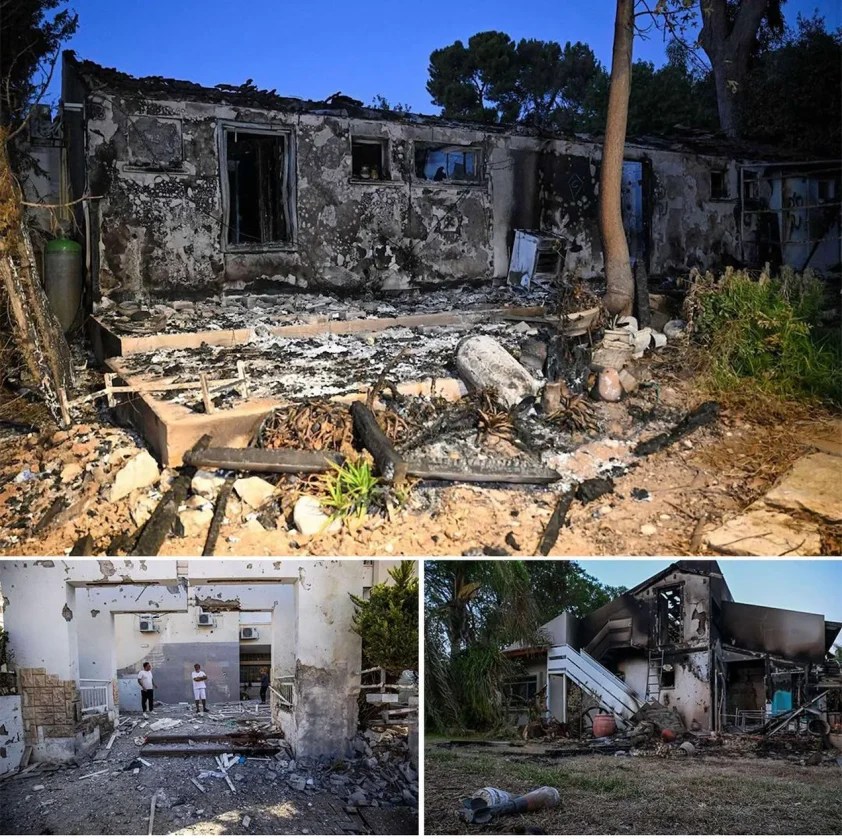
This and most of the rest of the damage to civilians on October 7 was meted out by Israeli heavy weapons, not Hamas’s light firearms
But what about the rockets? Since unlike Israel, Hamas doesn’t enjoy billions of dollars worth of of US-taxpayer-provided weaponry, it fires relatively unsophisticated rockets that cannot take out hardened military targets, but do frighten and occasionally harm Israeli “civilians.” So… is that terrorism? No—because Israelis are settlers, not civilians. Under international law, military resistance against occupation, including targeting settlers, is legitimate. So we can argue about proportionality—I would assert that Hamas errs on the side of mercy by doing a whole lot less settler-killing than it has every right to be doing — but at the end of the day, international law, morality, and basic common sense dictate that Hamas’s use of rockets to retaliate against massive genocide is justifiable… and rational, as part of a multi-pronged strategy to keep raising the costs of occupation to the point that the genocidal occupier will finally take Helen Thomas’s advice and “get the hell out of Palestine.”
Arguing with Orwell’s O’Brien
You know who has lost the argument not only by Godwin’s law a.k.a. reducto ad Hitlerum, but also by which party feels the need to use coercion to force the other party to shut up. The Zionist terrorists have not only lost the argument, they have no argument. No wonder they ceaselessly invoke Hitler and the Nazis. And no wonder they constantly run professors out of universities, get media personalities fired, launch specious persecutions and prosecutions, and generally terrorize everyone into going along with their genocidal absurdities.
Arguing with a Zionist is like arguing with Orwell’s O’Brien: He knows he’s full of shit, has no compunctions about it, and is going to do whatever it takes to ruin your life.
By saying “I like Hamas,” I’m supporting an anti-terrorist group that the Zionist terrorists have falsely and mendaciously labeled, in true Orwellian fashion, “terrorists.” Maybe they’ll try to get me prosecuted for “material support for anti-terrorism,” though I haven’t mailed so much as a dirham to Hamas, POB 123, Gaza Strip, Occupied Palestine, nor have I contributed to any Hamas GoFundMe’s or bought any donuts from the nice little old Hamas ladies at the local mosque. (If they were selling baclava, I’d consider it.)
If you’re honest with yourself, you’ll probably have to admit that the reason that you haven’t yet come around to openly supporting Hamas is fear: fear of what the Zionists might do to you. Well, I’m here to tell you that fear isn’t the right word for that. The correct word is cowardice.
The Palestinians continue to unite in resistance to genocide, even as the Zionists respond by forcing their children to die agonizing deaths, by the thousands, beneath mountains of rubble. And you can’t even openly and publicly admit that you support that Resistance? Come to think of it, maybe cowardice isn’t the right word. It isn’t strong enough.
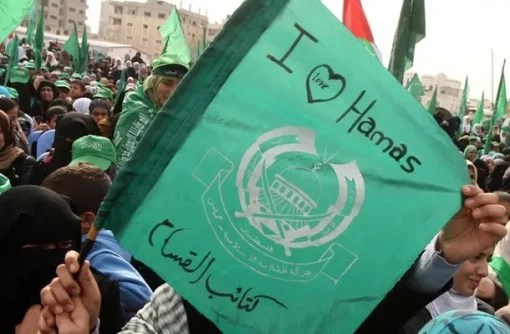
Come on, grow some stones. Say it with me: “I… SUPPORT… HAMAS.”
Featured Video

New positive ivermectin evidence
or go to
Aletho News Archives – Video-Images
From the Archives
Fanatical Followers of the Covid Regime: A Jim Jones-Style Cult?
By Professor Roger Watson and Dr. Niall McCrae | The Daily Sceptic | November 15, 2021
As scholars at leading British universities over recent decades, we witnessed the replacement of critical thinking and debate by narrative: facts are discrimination and scientific method is imperialism; truth, instead, is derived from ‘progressive’ values. This educational trend may be a major contributory factor to the ease in which society has been inculcated to the Covid ‘new normal’ of masking, testing, and repeated doses of vaccines for a disease of similar risk to severe influenza.
One doesn’t need much critical reasoning to observe the flawed logic of some vaccination enthusiasts, such as people who respond to experiencing any side effects, however debilitating, by saying “at least I know it’s working”, or, after contracting the disease despite their promised inoculation (over 90% effective, according to initial drug company claims), “I’d have been worse off without the jab.” … continue
Blog Roll
 Aletho News
- ‘Grave, alarming’: Iran mission on Trump’s UNGA ‘annihilation’ threats
- Najaf airport to reopen to Iranian flights within 24 hours: Ambassador
- From ‘How Will This End For Iran’ to ‘When America Walks Away’: A tale of two Economist covers
- Tehran blasts ‘baseless’ speculation linking Iran to alleged bomb plot at UK air base
- The Rise And… Rise Of ‘Color Revolutions’
- The Coming GOP Bloodbath?
- Arctic Scare Stories Melt Away
- Wrong, Euronews: Climate Change Has Not Created a Food, Energy, and Economic “Meta-Crisis”
- New positive ivermectin evidence
- Met Office Caught Fabricating Daily Temperature Record Claims
- If Americans Knew
- An error has occurred; the feed is probably down. Try again later.
- No Tricks Zone
- New Study: Earth And Venus Surface Warmth Largely Explained By Convection And Lapse Rate, Not CO2 Or Radiation
- 2025 Nature Paper Claiming Worsening Global Drought Gets RETRACTED …Heavily Flawed
- New Study: ‘Global Drought Shows No Detectable Recent Acceleration Under Climate Warming’
- Economic Masterminds: German Socialists Suggest Taxing Productivity Gains Stemming From Using AI
- The South China Sea Has Not Been Cooperating With The Climate Change Narrative
- Energy Crisis: Germany Enters Heating Season With Historically Low Gas Reserve Fill Levels
- New Study: The Antarctic Ice Sheet Gained Mass From 2020-2024 Due To Staggering Snow And Ice Accumulation
- Study: Ocean Heating Rates From Thousands Of Years Ago ‘Dwarf’ Modern Ocean Heating Rates
- Climate Extremists Target, Attack Large-Scale Power Grid Infrastructure In Germany!
- New Study: Antarctic Ice Melt Has Contributed Less Than 1 Centimeter To Sea Level Rise In The Last 30 Years

