“The Donald Trump I know”: Abbas’ UN Speech and the Breakdown of Palestinian Politics
By Ramzy Baroud | Dissident Voice | February 20, 2020
A precious moment has been squandered, as Palestinian Authority President, Mahmoud Abbas, had the chance to right a historical wrong, by reinstating Palestinian national priorities at the United Nations Security Council on February 11, through a political discourse that is completely independent from Washington and its allies.
For a long time, Abbas has been a hostage to the very language that designated him and his Authority as ‘moderates’ in the eyes of Israel and the West. Despite the Palestinian leader’s outward rejection of the US ‘Deal of the Century’ – which practically renders Palestinian national aspirations null and void – Abbas is keen to maintain his ‘moderate’ credentials for as long as possible.
Certainly, Abbas has given many speeches at the UN in the past and, every single time, he has failed to impress Palestinians. This time, however, things were meant to be different. Not only did Washington disown Abbas and the PA, it also scrapped its own political discourse on peace and the two-state solution altogether. More, the Trump administration has now officially given its blessing to Israel to annex nearly a third of the West Bank, taking Jerusalem ‘off the table’ and discarding the right of return for Palestinian refugees.
Instead of directly meeting with leaders of the various Palestinian political parties and taking tangible steps to reactivate dormant but central political institutions such as the Palestinian National Council (PNC) and the Palestine Liberation Organization (PLO), Abbas preferred to meet with former Israeli right-wing Prime Minister, Ehud Olmert, in New York, and to carry on regurgitating his commitment to a by-gone era.
In his UN speech, Abbas said nothing new which, in this instance, is worse than not saying anything at all.
“This is the outcome of the project that has been introduced to us,” Abbas said, while holding a map of what a Palestinian state would look like under Donald Trump’s ‘Deal of the Century’. “And this is the state that they are giving to us,” Abbas added, referring to that future state as a ‘Swiss cheese’, meaning a state fragmented by Jewish settlements, bypass-roads and Israeli military zones.
Even the term ‘Swiss cheese’, which was reported in some media as if a new phrase in this ever-redundant discourse, is actually an old coinage that has been referenced repeatedly by the Palestinian leadership itself, starting with the onset of the so-called peace process, a quarter of a century ago.
Abbas labored to appear exceptionally resolute as he emphasized certain words, like when he equated the Israeli occupation with the system of apartheid. His delivery, however, appeared unconvincing, lacking and, at times, pointless.
Abbas spoke of his great ‘surprise’ when Washington declared Jerusalem as Israel’s undivided capital, subsequently relocating its embassy to the occupied city, as if the writing was not already on the wall and that, in fact, the embassy move was one of Trump’s main pledges to Israel even before his inauguration in January 2017.
“And then they cut off financial aid that was given to us,” Abbas said in a lamenting voice with reference to the US decision to withhold its aid to the PA in August 2018. “$840 million are held from us,” he said. “I don’t know who is giving Trump such horrid advice. Trump is not like this. Trump that I know is not like this,” Abbas exclaimed in a strange interjection as if to send a message to the Trump administration that the PA still has faith in the US President’s judgement.
“I would like to remind everyone that we have participated in the Madrid peace conference, and the Washington negotiations and the Oslo agreement and the Annapolis summit on the basis of international law,” Abbas recounted, signaling that he remains committed to the very political agenda that reaped the Palestinian people no political rewards whatsoever.
Abbas then went on to paint an imagined reality, where his Authority is supposedly building the “national institutions of a law-abiding, modern and democratic state that is constructed on the basis of international values; one that is predicated on transparency, accountability and fighting corruption.”
“Yes,” Abbas emphasized, as he looked at his audience with theatrical seriousness, “We are one of the most important countries (in the world) that is fighting corruption.” The PA leader, then, called on the Security Council to send a commission to investigate allegations of corruption within the PA, a bewildering and unnecessary invitation, considering that it is the Palestinian leadership that should be making demands on the international community to help enforce international law and end the Israeli occupation.
It went on like this, where Abbas vacillated between reading pre-written remarks that introduce no new ideas or strategies and unnecessary rants that reflect the PA’s political bankruptcy and Abbas’ own lack of imagination.
The PA President, of course, made sure to offer his habitual condemnation of Palestinian ‘terrorism’ by promising that Palestinians would not “resort to violence and terrorism regardless of the act of aggression against us.” He assured his audience that his Authority believes in “peace and fighting violence.” Without elaborating, Abbas declared his intention of continuing on the path of “popular and peaceful resistance,” which, in fact, does not exist in any shape or form.
This time around, Abbas’ speech at the UN was particularly inappropriate. Indeed, it was a failure in every possible way. The least, the Palestinian leader could have done is to articulate a powerful and collective Palestinian political discourse. Instead, his statement was merely a sad homage to his own legacy, one that is riddled with disappointments and ineptitude.
Expectedly, Abbas returned to Ramallah to greet his cheering supporters once more, who are always ready and waiting to raise posters of the ageing leader, as if his UN speech had succeeded in fundamentally shifting international political momentum in favor of Palestinians.
It has to be said that the real danger in the ‘Deal of the Century’ is not the actual stipulations of that sinister plan, but the fact that the Palestinian leadership is likely to find a way to co-exist with it, at the expense of the oppressed Palestinian people, as long as donors’ money continues to flow and as long as Abbas continues to call himself a president.
Ramzy Baroud is a journalist and the Editor of The Palestine Chronicle. He is the author of five books. His latest is “These Chains Will Be Broken: Palestinian Stories of Struggle and Defiance in Israeli Prisons” (Clarity Press, Atlanta). Dr. Baroud is a Non-resident Senior Research Fellow at the Center for Islam and Global Affairs (CIGA), Istanbul Zaim University (IZU). His website is http://www.ramzybaroud.net
Hamas delegation meets Russia’s Deputy Foreign Minister
MEMO | February 20, 2020
A senior Hamas delegation has met with Russia’s Deputy Foreign Minister Mikhail Bogdanov in Doha, the capital of Qatar.
In a statement issued on Wednesday, the Islamic Resistance Movement said that its delegation was led by the head of its International Office, Mousa Abu Marzook, accompanied by Political Bureau member Sami Khater and the former leader of its Political Bureau, Khaled Meshaal, as well as its representative in Moscow.
The Hamas delegation briefed Bogdanov on the latest political developments in the Palestinian cause, including the US “deal of the century”.
They reiterated that the deal is targeting the Palestinian people, their legitimate right to return and the efforts to establish an independent and sovereign state, which is why it has been rejected not only by the movement, but also all segments of Palestinian society.
Bogdanov reaffirmed his country’s support for the Palestinian people and rejection of any “peace plan” rejected by them. Russia, he explained, is ready to provide support for the Palestinians in order to end the internal division and achieve the national unity that is the key to achieving their legitimate objectives.
Furthermore, the Russian official stressed that the Israeli-Palestinian conflict should be solved on the basis of international law, including UN General Assembly resolutions and the Arab Peace Initiative.
The PA is blindly accepting international impositions on Palestinians
By Ramona Wadi | MEMO | February 20, 2020
Israel and the Palestinian Authority have been trading the same rhetoric about not having a suitable partner for diplomatic negotiations. The senior adviser and spokesman for Mahmoud Abbas, Nabil Abu Rudeineh, recently took the statement further to again assert the PA’s distaste for legitimate armed resistance. This was his attempt to reassure Israel about the PA’s commitment to remain tethered to failed diplomacy.
“The Palestinians do not want violence and it is very important for us that the Israelis know this and understand that our path is not violent,” Abu Rudeineh told Israeli political correspondents. Why would the PA seek to reassure the colonial presence in Palestine built and maintained upon violence that the colonised population are not seeking to use violent measures to escape from the Israeli yoke?
Unlike Israel’s ongoing ethnic cleansing of the Palestinian population and other measures such as its colonial settlement expansion, which are clearly defined as war crimes by international law, Palestinian resistance against the colonial violence of occupation is entirely legitimate. Abu Rudeineh is doing Palestinians yet another disservice by refusing to recognise the whole spectrum of the anti-colonial struggle. Furthermore, the PA does not differentiate between various forms of violence, which are defined by context.
It is the Palestinians who should be seeking reassurances that no further violence will be inflicted upon them. However, the normalisation of Israeli violence, combined with the diplomacy which allows Israel to function as a violent colonial state, prevent Palestinians from making such demands.
![A group of protesters gather in front of United Nations headquarters to protest against U.S. President Donald Trump's Middle East plan as Palestinian President, Mahmoud Abbas speaks at the UN Security Council meeting in New York, United States on 11 February 2020. [Islam Doğru - Anadolu Agency]](https://i2.wp.com/www.middleeastmonitor.com/wp-content/uploads/2020/02/20200211_2_40796245_52056273.jpg?resize=933%2C622&quality=85&strip=all&ssl=1)
Protesters at the UN headquarters oppose U.S. President Donald Trump’s Middle East plan as Palestinian President, Mahmoud Abbas, speaks at the UN Security Council meeting in New York on 11 February 2020. [Islam Doğru – Anadolu Agency ]
What’s more, Palestinians are not guaranteed protection from Israeli violence; their rights are simply brushed aside. To make matters worse, Abu Rudeineh has eliminated this factor in his discussions regarding future “peace negotiations” to enable the façade of Israel’s “victim” status to be preserved. In keeping with the parameters set by the international community’s endorsement of Israel’s false “security” and “self-defence” narrative, Abbas’s spokesman is misrepresenting the Palestinian anti-colonial struggle and, as a result, regaling Israel with further opportunities to portray itself as the only democratic partner in negotiations. The PA would do well to remember that such talks would not have been necessary if the UN had taken the necessary steps to halt the earlier settler-colonial presence in Palestine and thus prevented Israel from manifesting itself on ethnically-cleansed Palestinian land.
However, the PA is merely absorbing the external narratives imposed by the international community on one hand, and the US on the other, the latter through its so-called “deal of the century”. The constant definition of the Palestinians according to external agendas have damaged the Palestinian cause beyond recognition.
Non-violent resistance and diplomacy have been manufactured by the international community as acceptable paths for Palestinians precisely because, on their own, they fragment the efficacy of anti-colonial struggle. The right to resist colonialism by all means is legitimate, whether diplomatic negotiations are taking place, or might be taking place in the future. Neither the international community nor the PA have the right to prevent Palestinians from exercising their right to armed struggle. It is a decision that must be made by the people themselves, since the Palestinian leadership has long abandoned the Palestinian cause to curry favour with the international community for its own self-serving hierarchy.
There is no need to reassure Israel as Abu Rudeineh has done; the only reminder that Israel needs is that Palestinians have every right to reclaim their land. Beyond that assurance, the PA’s rhetoric must be seen for what it is; an additional means of destroying the Palestinian struggle, for the benefit of Israel and the international community.
Putin questions America’s creepy collection of Russian DNA for possible bio-weapons program
The US Air Force is trying collect samples of ethnic Russian DNA. If history is a guide, the purposes of this new US program are highly nefarious.

By Adam Garrie | The Duran | November 1, 2017
In recent months, the US Air Force has issued calls for ethnic Russians to provide DNA samples for a mysterious “research” program. US Air Force Captain Beau Downey claimed that the samples were required for “locomotor studies to identify various biomarkers associated with trauma.”.
Downey further stated,
“The request (by the research centre) did not specify where the samples should be received from, but to continue the study, similar samples were required. Since the supplier originally provided samples from Russia, suitable for the initial group of diseases, the control group of the samples should also be of Russian origin.
The goal is the integrity of the study, not the origin (of the samples)”
However, given the fact that the US military has attempted to obtain Russian DNA samples without the permission of the Russian government and furthermore, given the low state of Russia-US relations, many are questioning whether the sought samples are intended to be part of a biogenetic weapons program.
Biogenetic weapons are defined as biological agents designed to inflict debilitating diseases or other internal bodily afflictions on a specific group of people, based on a shared genetic code.
While it is unclear if such a weapon has ever successfully been developed, the US and Israel have in the past, attempted to create such a devastating bio-genetic weapon.
In the late 1990s, it was reported that Israel had successfully created a biogenetic weapon which was specifically designed to target Arabs and only Arabs.
An archived press clipping from 1998 reports,
“According to a Jerusalem Post report quoting the London-based Foreign Report, Israel has successfully developed what is being called an ‘ethnic-bullet’, which will target only Arabs. The report quotes an ‘unconfirmed report’ which originated in South Africa, which details how Israeli scientists have made a biological weapon tailor made to attack targets with the Arab genetic system. Long-term studies of Iraqi Jews was credited with providing the genetic code needed to target Arabs. According to the report, the ethnic-bullet program was originally developed for use in Apartheid South Africa for use against blacks. Scientist in both countries worked together towards the development of the Israeli program. Israeli officials declined to confirm the existence of the ‘ethnic bullet,’ but one told the newsletter: ‘We have a basket full of strategic surprises which we will not hesitate to use if we feel that the State of Israel is under serious threat”.
The popular US based technology magazine Wired, also ran a story on Israel’s biogenetic weapons program in 1998. The story reads,
“ISRAEL IS REPORTEDLY developing a biological weapon that would harm Arabs while leaving Jews unaffected, according to a report in London’s Sunday Times. The report, citing Israeli military and western intelligence sources, says that scientists are trying to identify distinctive genes carried by Arabs to create a genetically modified bacterium or virus.
The ‘ethno-bomb’ is reportedly Israel’s response to the threat that Iraq may be just weeks away from completing its own biological weapons.
The ‘ethno-bomb’ program is based at Israel’s Nes Tziyona research facility. Scientists are trying to use viruses and bacteria to alter DNA inside living cells and attack only those cells bearing Arabic genes.
The task is very complex because both Arabs and Jews are Semitic peoples. But according to the report, the Israelis have succeeded in isolating particular characteristics of certain Arabs, ‘particularly the Iraqi people.’
Dedi Zucker, a member of the Israeli parliament, denounced the research in the Sunday Times. ‘Morally, based on our history, and our tradition and our experience, such a weapon is monstrous and should be denied.’
Last month, Foreign Report claimed that Israel was following in the ignominious footsteps of apartheid-era research, in their supposed efforts to develop an “ethnic bullet.”
A year later, a report from Reuters citing British scientists, confirmed that such a biogenetic weapon was possible given the advanced state of genetic mapping, although the report neither confirmed nor denied the existence of an Arab killing Israel biogenetic weapon.
Russians are therefore clearly worried that the US military intends to collect samples of Russian DNA in order to engineer a biogenetic weapon similar to the ones Israel is said to have created in the 1990s. The fact that genetic mapping technology has advanced even further since the 1990s, makes this fear all the more magnified.
In the 1980s, the Soviet Union feared that the AIDS virus was created in a US military bio-weapons lab in Fort Detrick, Maryland. While the story was dismissed by the US as geo-political propaganda, many black Africans and African-Americans continue to believe that the CIA had a hand in either creating or weaponising the AIDS virus. To this day, AIDS continues to disproportionately effect black men across the globe.
The notion that AIDS was part of a CIA experiment aimed at population modification, was spoken of widely in the 1980s. The American musician Frank Zappa even wrote a musical about the alleged phenomenon called ‘Thing Fish’.
In the year 2000, the neocon think-thank that would provide the George W. Bush administration with many important advisers, the Project for the New American Century published a report which spoke of the desirability of weaponising genetically mapped biological agents for use in 21st century warfare. This was one of the factors leading to Russia banning the export of domestic DNA samples in 2007, as was reported in Russian mainstream media at the time.
While exporting Russian DNA samples remains illegal in most circumstances, the US military is still keen on flaunting Russian law.
President Vladimir Putin has responded to the latest attempts by the US military to collect Russian DNA samples in the following way,
“Do you know that biological material is being collected all over the country, from different ethnic groups and people living in different geographical regions of the Russian Federation? The question is – why is it being done? It’s being done purposefully and professionally. We are a kind of object of great interest.
Let them do what they want, and we must do what we must”.
The latter part of Putin’s statement derives from the Melian Dialogue of the Athenian historian Thucydides. In his History of the Peloponnesian War, Thucydides recounts Athenian envoys trying to convince the small island of Melos to surrender its sovereignty or be destroyed. The dialogue includes a famous line which is usually translated as “The strong do as they will and the weak submit as they must”.
Putin therefore is suggesting that no matter what the US has in store for Russia, the leadership of the Russian Federation is able and willing to take defensive matters in any scenario. The seemingly cautious statement from Putin, is actually incredibly forceful when read carefully.
Based on past experiences, the US is not operating under innocent intentions and therefore, Russia should not take any chances.
Israeli policy of assassinations cannot terrorize Palestinians to accept Trump’s deal: Nakhala

Secretary-General of the Palestinian Islamic Jihad resistance movement Ziad al-Nakhala speaks during a televised speech broadcast live from Gaza City on February 19, 2020.
Press TV – February 19, 2020
The secretary-general of the Palestinian Islamic Jihad resistance movement says the Tel Aviv regime’s plan to return to “the policy of assassinations” against distinguished figures of Palestinian resistance groups in the Gaza Strip cannot terrorize Palestinians to acknowledge US President Donald Trump’s so-called deal of the century on the decades-old Israeli-Palestinian conflict.
“The policy of assassinations will not make the Palestinian people give up their rights, nor will it manage to break up the resistance front. We will respond to any assassination in time, and any act of aggression against our people in the Gaza Strip will be met with resistance that the occupation [Israel] has not experienced before,” Ziad al-Nakhala said in a televised speech broadcast live from Gaza City on Wednesday afternoon.
He added, “The threats of enemy leaders will not intimidate us, nor will make us accept what they have crafted and called the deal of the century. They will not make us relinquish our historical rights in Palestinian lands and al-Quds (Jerusalem).”
‘Oslo Accords bore nothing for Palestinians other than humiliation’
Nakhala also censured the Oslo Accords signed between the Palestine Liberation Organization (PLO) and the Israeli regime more than two decades ago, stating that the set of agreements brought nothing for Palestinians other than humiliation, shame and delusions.
“We presented our history as well as our children, and sacrificed them on the altar of delusion of peace. We reaped nothing other than despair that was represented by the deal of the century,” he pointed out.
The Oslo Accords — consisting of Oslo I and Oslo II accords — were signed by the late chairman of the PLO, Yasser Arafat, and former Israeli Prime Minister Yitzhak Rabin, respectively in Washington DC, in 1993 and Egypt in 1995. The purported goal of the accords was to achieve peace based on the United Nations Security Council resolutions 242 and 338, and to realize the right of the Palestinian people to self-determination.
The senior Palestinian official also lambasted some Arab and Muslim countries for supporting and acknowledging Trump’s proposal in the eye of the international community.
Nakhala then called upon all Palestinian resistance movements to join forces, and tirelessly protect Jerusalem al-Quds and the Palestinian cause from liquidation.
‘The US decision to declare al-Quds as the capital of Israel was not surprising, given that America is the sponsor of the Zionist project ever since its inception (back in 1948). It is a full partner to this project, and is in fact spearheading the Western project in our region,” he underscored.
On January 28, Trump unveiled his so-called deal of the century, negotiated with Israel but without the Palestinians.
Palestinian leaders, who severed all ties with Washington in late 2017 after Trump controversially recognized Jerusalem al-Quds as the capital of the Israeli regime, immediately rejected the plan, with President Mahmoud Abbas saying it “belongs to the dustbin of history.”
Palestinian leaders say the deal is a colonial plan to unilaterally control historic Palestine in its entirety and remove Palestinians from their homeland, adding that it heavily favors Israel and would deny them a viable independent state.
Sanders tells New York Times he would consider a preemptive strike against Iran or North Korea
By Jacob Crosse and Barry Grey | WSWS | February 14, 2020
Bernie Sanders has won the popular vote in both the New Hampshire and Iowa presidential primary contests in considerable part by presenting himself as an opponent of war. Following the criminal assassination of Iranian General Qassem Suleimani last month, Sanders was the most vocal of the Democratic presidential aspirants in criticizing Trump’s action. His poll numbers have risen in tandem with his stepped-up anti-war rhetoric.
He has repeatedly stressed his vote against the 2003 invasion of Iraq, reminding voters in the Iowa presidential debate last month, “I not only voted against that war, I helped lead the effort against that war.”
However, when speaking to the foremost newspaper of the American ruling class, the New York Times, the Sanders campaign adopts a very different tone than that employed by the candidate when addressing the public in campaign stump speeches or TV interviews.
The answers provided by Sanders’ campaign to a foreign policy survey of the Democratic presidential candidates published this month by the Times provide a very different picture of the attitude of the self-styled “democratic socialist” to American imperialism and war. In the course of the survey, the Sanders campaign is at pains to reassure the military/intelligence establishment and the financial elite of the senator’s loyalty to US imperialism and his readiness to deploy its military machine.
Perhaps most significant and chilling is the response to the third question in the Times’ survey.
Question: Would you consider military force to pre-empt an Iranian or North Korean nuclear or missile test?
Answer: Yes.
A Sanders White House, according to his campaign, would be open to launching a military strike against Iran or nuclear-armed North Korea to prevent (not respond to) not even a threatened missile or nuclear strike against the United States, but a mere weapons test. This is a breathtakingly reckless position no less incendiary than those advanced by the Trump administration.
Sanders would risk a war that could easily involve the major powers and lead to a nuclear Armageddon in order to block a weapons test by countries that have been subjected to devastating US sanctions and diplomatic, economic and military provocations for decades.
Moreover, as Sanders’ response to the Times makes clear, the so-called progressive, anti-war candidate fully subscribes to the doctrine of “preemptive war” declared to be official US policy in 2002 by the administration of George W. Bush. An illegal assertion of aggressive war as an instrument of foreign policy, this doctrine violates the principles laid down at the Nuremberg Trials of Nazi officials after World War II, the United Nations charter and other international laws and conventions on war. Sanders’ embrace of the doctrine, following in the footsteps of the Obama administration, shows that his opposition to the Iraq war was purely a question of tactics, not a principled opposition to imperialist war.
The above question is preceded by another that evokes a response fully in line with the war policies of the Obama administration, the first two-term administration in US history to preside over uninterrupted war.
Question: Would you consider military force for a humanitarian intervention?
Answer: Yes.
Among the criminal wars carried out by the United States in the name of defending “human rights” are the war in Bosnia and the bombing of Serbia in the 1990s, the 2011 air war against Libya that ended with the lynching of deposed ruler Muammar Gaddafi, and the civil war in Syria that was fomented by Washington and conducted by its Al Qaeda-linked proxy militias.
The fraudulent humanitarian pretexts for US aggression were no more legitimate than the lie of “weapons of mass destruction” used in the neo-colonial invasion of Iraq. The result of these war crimes has been the destruction of entire societies, the death of millions and dislocation of tens of millions more, along with the transformation of the Middle East into a cauldron of great power intervention and intrigue that threatens to erupt into a new world war.
Sanders fully subscribes to this doctrine of “humanitarian war” that has been particularly associated with Democratic administrations.
In response to a question from the Times on the assassination of Suleimani, the Sanders campaign calls Trump’s action illegal, but refuses to take a principled stand against targeted assassinations in general and associates itself with the attacks on Suleimani as a terrorist.
The reply states:
Clearly there is evidence that Suleimani was involved in acts of terror. He also supported attacks on US troops in Iraq. But the right question isn’t ‘was this a bad guy,’ but rather ‘does assassinating him make Americans safer?’ The answer is clearly no.
In other words, the extra-judicial killing of people by the US government is justified if it makes Americans “safer.” This is a tacit endorsement of the policy of drone assassinations that was vastly expanded under the Obama administration—a policy that included the murder of US citizens.
At another point, the Times asks:
Would you agree to begin withdrawing American troops from the Korean peninsula?
The reply is:
No, not immediately. We would work closely with our South Korean partners to move toward peace on the Korean peninsula, which is the only way we will ultimately deal with the North Korean nuclear issue.
Sanders thus supports the continued presence of tens of thousands of US troops on the Korean peninsula, just as he supports the deployment of US forces more generally to assert the global interests of the American ruling class.
On Israel, Sanders calls for a continuation of the current level of US military and civilian aid and opposes the immediate return of the US embassy from Jerusalem to Tel Aviv.
On Russia, he entirely supports the Democratic Party’s McCarthyite anti-Russia campaign and lines up behind the right-wing basis of the Democrats’ failed impeachment drive against Trump:
Question: If Russia continues on its current course in Ukraine and other former Soviet states, should the United States regard it as an adversary, or even an enemy?
Answer: Yes.
Question: Should Russia be required to return Crimea to Ukraine before it is allowed back into the G-7?
Answer: Yes.
Finally, the Times asks the Sanders campaign its position on the National Security Strategy announced by the Trump administration at the beginning of 2018. The new doctrine declares that the focus of American foreign and military strategy has shifted from the “war on terror” to the preparation for war against its major rivals, naming in particular Russia and China.
In the following exchange, Sanders tacitly accepts the great power conflict framework of the National Security Strategy, attacking Trump from the right for failing to aggressively prosecute the conflict with Russia and China:
Question: President Trump’s national security strategy calls for shifting the focus of American foreign policy away from the Middle East and Afghanistan, and back to what it refers to as the ‘revisionist’ superpowers, Russia and China. Do you agree? Why or why not?
Answer: Despite its stated strategy, the Trump administration has never followed a coherent national security strategy. In fact, Trump has escalated tensions in the Middle East and put us on the brink of war with Iran, refused to hold Russia accountable for its interference in our elections and human rights abuses, has done nothing to address our unfair trade agreement with China that only benefits wealthy corporations, and has ignored China’s mass internment of Uighurs and its brutal repression of protesters in Hong Kong. Clearly, Trump is not a president we should be taking notes from. [Emphasis added].
In a recent interview Ro Khanna, a Democratic congressman and national co-chair of the Sanders campaign, assured Atlantic writer Uri Friedman that Sanders would continue provocative “freedom of the seas” navigation operations in the Persian Gulf and the South China Sea, while committing a Sanders administration to “maintain some [troop] presence” on the multitude of bases dotting “allied” countries from Japan to Germany.
Millions of workers, students and young people are presently attracted to Sanders because they have come to despise and oppose the vast social inequality, brutality and militarism of American society and correctly associate these evils with capitalism. However, they will soon learn through bitter experience that Sanders’s opposition to the “billionaire class” is no more real than his supposed opposition to war. His foreign policy is imperialist through and through, in line with the aggressive and militaristic policy of the Democratic Party and the Obama administration.
The Democrats’ differences with Trump on foreign policy, though bitter, are tactical. Both parties share the strategic orientation of asserting US global hegemony above all through force of arms.
No matter how much Sanders blusters about inequality, it is impossible to oppose the depredations of the ruling class at home while supporting its plunder and oppression abroad.
Sanders is no more an apostle of peace than he is a representative of the working class. Both in foreign and domestic policy, he is an instrument of the ruling class for channeling the growing movement of the working class and opposition to capitalism back behind the Democratic Party and the two-party system of capitalist rule in America.
EU delaying tactics bring it closer to Trump’s deal
By Ramona Wadi | MEMO | February 18, 2020
For all its purported peace-building efforts and support for Palestinian rights, the EU is committed to supporting Israel’s colonial-settler expansionism. Its feeble response to US President Donald Trump’s so-called “deal of the century” was accentuated in the recent decision to refuse to pass any official resolutions until after next month’s Israeli General Election.
Palestine is never a priority in foreign policy anywhere. Yet the Palestinian Authority persists in pursuing non-existent international support, notably that of the EU, ostensibly to navigate the labyrinth of dispossession which the UN’s 1947 Partition Plan forced upon the people of Palestine. The truth is that the PA is scrambling to retain its bequeathed diplomatic standing and the funding that allows it to function as the “sole representative” of the Palestinians.
In return, the PA facilitates the waiting game for the international community, while Palestinians suffer statements such as the latest by EU Foreign Affairs Chief Josep Borrell. “We briefly discussed how best to relaunch a political process that is acceptable to both parties and how best to defend the internationally agreed parameters, equal rights and international law,” he declared on Monday. Defending internationally agreed parameters has nothing to do with protecting Palestinian rights, and PA leader Mahmoud Abbas is aware of this discrepancy.
Meanwhile, Israel is lobbying EU countries to refrain from taking a stance against Trump’s plan. Israeli media highlights the fact that recognition of the State of Palestine by several European countries has “little, if any, diplomatic effect.” While in previous years, recognition of Palestine raised Israel’s ire, it is now being touted as a futile PA effort in comparison with the US-Israeli partnership to colonise Palestine, as well as the EU’s increasingly non-committal stance towards Palestinians and their legitimate political rights.
Nevertheless, Israel will not take any risk that the EU might voice a unified condemnation of Trump’s plan. The delay communicated by the EU with regard to its response over US-Israeli scheming indicates diplomatic activity that favours Israel. The latter allegedly “fears” the EU playing a major role in any future negotiations. Netanyahu has pledged to carry out the annexation of the occupied West Bank if re-elected, and the EU has done nothing other than issue the usual bland condemnation. If the EU does indeed take on a more influential role in negotiations, whether these are based on the defunct two-state compromise or Trump’s proposal, it will clearly adopt a pro-Israel stance.
Behind the scenes, Israel is lobbying for such a scenario and there is nothing to impede the EU from continuing with its track record of marginalising Palestinians. Before Trump’s deal was revealed, EU diplomats attempted to differentiate between the allegedly law-abiding EU and the international law-abusing US. The illusion of a political struggle between both entities was the focus of analysis, which suited Israel as it shifted attention away from the Palestinians.
The final step in this process will matter little to Israel as long as the EU does not depart from its decades-long policy of pretending to support Palestinian rights while actively pursuing stronger ties with Israel. One point, however, must be clarified. If the EU is seeking additional delays before issuing a statement regarding the deal of the century, the words of former EU representative for Foreign Affairs Federica Mogherini must be recalled: the EU would consider working with the US plan if the two-state paradigm is included. One obsolete imposition has now been replaced by another that offers fragments of a state, which the EU and its backing for Israeli expansionism has supported tacitly all along.
Profiting from Loss: How Business in Illegal Israeli Settlements Continues Unchecked
UN efforts to protect Palestinian land from economic exploitation are failing, and exposing the hypocrisy of western states
By Jonathan Cook – The National – February 18, 2020
After lengthy delays, the United Nations finally published a database last week of businesses that have been profiting from Israel’s illegal annexation and settlement activity in the West Bank.
The UN High Commissioner for Human Rights, Michelle Bachelet, announced that 112 major companies had been identified as operating in Israeli settlements in ways that violate human rights.
Aside from major Israeli banks, transport services, cafes, supermarkets, and energy, building and telecoms firms, prominent international businesses include Airbnb, booking.com, Motorola, Trip Advisor, JCB, Expedia and General Mills.
Human Rights Watch, a global watchdog, noted in response to the list’s publication that the settlements violate the Fourth Geneva Convention. It argued that the firms’ activities mean they have aided “in the commission of war crimes”.
The companies’ presence in the settlements has helped to blur the distinction between Israel and the occupied Palestinian territories. That in turn has normalised the erosion of international law and subverted a long-held international consensus on establishing a viable Palestinian state alongside Israel.
Work on compiling the database began four years ago. But both Israel and the United States put strong pressure on the UN in the hope of preventing the list from ever seeing the light of day.
The UN body’s belated assertiveness looks suspiciously like a rebuke to the Trump administration for releasing this month its Middle East “peace” plan. It green-lights Israel’s annexation of the settlements and the most fertile and water-rich areas of the West Bank.
In response to the database, Israeli Prime Minister Benjamin Netanyahu threatened to intensify his country’s interference in US politics. He noted that his officials had already “promoted laws in most US states, which determine that strong action is to be taken against whoever tries to boycott Israel.”
He was backed by all Israel’s main Jewish parties. Amir Peretz, leader of the centre-left Labour party, vowed to “work in every forum to repeal this decision”. And Yair Lapid, a leader of Blue and White, the main rival to Netanyahu, called Bachelet the “commissioner for terrorists’ rights”.
Meanwhile, Mike Pompeo, the US secretary of state, accused the UN of “unrelenting anti-Israel bias” and of aiding the international boycott, divestment and sanctions (BDS) movement.
In fact, the UN is not taking any meaningful action against the 112 companies, nor is it encouraging others to do so. The list is intended as a shaming tool – highlighting that these firms have condoned, through their commercial activities, Israel’s land and resource theft from Palestinians.
The UN has even taken an extremely narrow view of what constitutes involvement with the settlements. For example, it excluded organisations like FIFA, the international football association, whose Israeli subsidiary includes six settlement teams.
One of the identified companies, Airbnb, announced in late 2018 that it would remove from its accommodation bookings website all settlement properties – presumably to avoid being publicly embarrassed.
But a short time later Airbnb backed down. It is hard to imagine the decision was taken on strictly commercial grounds: the firm has only 200 settlement properties on its site.
A more realistic conclusion is that Airbnb feared the backlash from Washington and was intimidated by a barrage of accusations from pro-Israel groups that its new policy was anti-semitic.
In fact, the UN’s timing could not be more tragic. The list looks more like the last gasp of those who – through their negligence over nearly three decades – have enabled the two-state solution to wither to nothing.
Trump’s so-called peace plan could afford to be so one-sided only because western powers had already allowed Israel to void any hope of Palestinian statehood through decades of unremitting settlement expansion. Today, nearly 700,000 Israeli Jews are housed on occupied Palestinian territory.
On Monday European Union foreign ministers were due to meet to discuss their response to the plan. Tepid criticism was the most that could be expected.
The actions of several European states continue to speak much louder than any words.
On Friday, Germany followed the Czech Republic in filing a petition to the International Criminal Court at The Hague siding with Israel as the court deliberates whether to prosecute Israeli officials for war crimes, including over the establishment of settlements.
Germany does not appear to deny that the settlements are war crimes. Instead, it hopes to block the case on dubious technical grounds: that despite Palestine signing up to the Rome Statute, which established the Hague court, it is not yet a fully fledged state.
So far Austria, Hungary, Australia and Brazil appear to be following suit.
But if Palestine lacks the proper attributes of statehood, it is because the US and Europe, including Germany, have consistently broken promises to the Palestinians.
They not only refused to intervene to save the two-state solution, but rewarded Israel with trade deals and diplomatic and financial incentives, even as Israel eroded the institutional and territorial integrity necessary for Palestinian self-rule.
Germany’s stance, like that of the rest of Europe, is hypocritical. They have claimed opposition to Israel’s endless settlement expansion, and now to Trump’s plan, but their actions have paved the way to the annexation of the West Bank the plan condones.
Back in November the European Court of Justice finally ruled that products made in West Bank settlements – using illegally seized Palestinian resources on illegally seized Palestinian land – should not be labelled deceptively as “Made in Israel”.
And yet European countries are still postponing implementation of the decision. Instead, some of them are legislating against their citizens’ right to express support for a settlement boycott.
Similarly, Europe and North America continue to afford the Jewish National Fund, an entity that finances settlement-building, “charitable status”, giving it tax breaks as it raises funds inside their jurisdictions.
The Israeli media is full of stories of how the JNF actively assists extremist settler groups in evicting Palestinians from homes in East Jerusalem. But Britain and other states are blocking legal efforts to challenge the JNF’s special status.
Soon, it seems, Europe will no longer have to worry about its hypocrisy being so visible. Once the settlements have been annexed, as the Trump administration intends, the EU can set aside its ineffectual agonising and treat the settlements as irrevocably Israeli – just as it has done in practice with the Israeli “neighbourhoods” of occupied East Jerusalem.
Then, the UN’s list of shame can join decades’ worth of condemnatory resolutions that have been quietly gathering dust.
Explaining Syria
It’s everyone’s fault except the U.S. and Israel
By Philip Giraldi • Unz Review • February 18, 2020
The first week in February was memorable for the failed impeachment of President Donald Trump, the “re-elect me” State of the Union address and the marketing of a new line of underwear by Kim Kardashian. Given all of the excitement, it was easy to miss a special State Department press briefing by Ambassador James Jeffrey held on February 5th regarding the current situation in Syria.
Jeffrey is the United States Special Representative for Syria Engagement and the Special Envoy for the Global Coalition to Defeat ISIL. Jeffrey has had a distinguished career in government service, attaining senior level State Department positions under both Democratic and Republican presidents. He has served as U.S. Ambassador to both Turkey and Iraq. He is, generally speaking, a hardliner politically, closely aligned with Israel and regarding Iran as a hostile destabilizing force in the Middle East region. He was between 2013 and 2018 Philip Solondz distinguished fellow at the Washington Institute for Near East Policy (WINEP), a think tank that is a spin-off of the American Israel Public Affairs Committee (AIPAC). He is currently a WINEP “Outside Author” and go-to “expert.”
Professor John Mearsheimer of the University of Chicago and Stephen Walt, academic dean at Harvard University’s Kennedy School of Government, describe WINEP as “part of the core” of the Israel Lobby in the U.S. They examined the group on pages 175-6 in their groundbreaking book The Israel Lobby and US Foreign Policy and concluded as follows:
“Although WINEP plays down its links to Israel and claims that it provides a ‘balanced and realistic’ perspective on Middle East issues, this is not the case. In fact, WINEP is funded and run by individuals who are deeply committed to advancing Israel’s agenda … Many of its personnel are genuine scholars or experienced former officials, but they are hardly neutral observers on most Middle East issues and there is little diversity of views within WINEP’s ranks.”
In early 2018 Jeffrey co-authored a WINEP special report on Syria which urged “…the Trump administration [to] couple a no-fly/no-drive zone and a small residual ground presence in the northeast with intensified sanctions against the Assad regime’s Iranian patron. In doing so, Washington can support local efforts to stabilize the area, encourage Gulf partners to ‘put skin in the game, drive a wedge between Moscow and Tehran, and help Israel avoid all-out war.”
Note the focus on Iran and Russia as threats and the referral to Assad and his government as a “regime.” And the U.S. presence is to “help Israel.” So we have Ambassador James Jeffrey leading the charge on Syria, from an Israeli perspective that is no doubt compatible with the White House view, which explains why he has become Special Representative for Syria Engagement.
Jeffrey set the tone for his term of office shortly after being appointed by President Trump back in August 2018 when he argued that the Syrian terrorists were “. . . not terrorists, but people fighting a civil war against a brutal dictator.” Jeffrey, who must have somehow missed a lot of the head chopping and rape going on, subsequently traveled to the Middle East and stopped off in Israel to meet Prime Minister Benjamin Netanyahu. It has been suggested that Jeffrey received his marching orders during the visit.
Two months later James Jeffrey declared that he would like to see Russia maintain a “permissive approach” to allow the Israelis to attack Iranian targets inside Syria. Regarding Iran’s possible future role in Syria he observed that “Iranians are part of the problem not part of the solution.”
What Jeffrey meant was that because Israel had been “allowed” to carry out hundreds of air attacks in Syria ostensibly directed against Iran-linked targets, the practice should be permitted to continue. Israel had suspended nearly all of its airstrikes in the wake of the shoot down of a Russian aircraft in September 2018, an incident which was caused by a deliberate Israeli maneuver that brought down the plane even though the missile that struck the aircraft was fired by Syria. Fifteen Russian servicemen were killed. Israel reportedly was deliberately using the Russian plane to mask the presence of its own attacking aircraft.
Russia responded to the incident by deploying advanced S-300 anti-aircraft systems to Syria, which can cover most of the more heavily developed areas of the country. Jeffrey was unhappy with that decision, saying “We are concerned very much about the S-300 system being deployed to Syria. The issue is at the detail level. Who will control it? what role will it play?” And he defended his own patently absurd urging that Russia, Syria’s ally, permit Israel to continue its air attacks by saying “We understand the existential interest and we support Israel” because the Israeli government has an “existential interest in blocking Iran from deploying long-range power projection systems such as surface-to-surface missiles.”
Later in November 2018 James Jeffrey was at it again, declaring that U.S. troops will not leave Syria before guaranteeing the “enduring defeated” of ISIS, but he perversely put the onus on Syria and Iran, saying that “We also think that you cannot have an enduring defeat of ISIS until you have fundamental change in the Syrian regime and fundamental change in Iran’s role in Syria, which contributed greatly to the rise of ISIS in the first place in 2013, 2014.”
As virtually no one but Jeffrey and the Israeli government actually believes that Damascus and Tehran were responsible for creating ISIS, the ambassador elaborated, blaming President Bashar al-Assad for the cycle of violence in Syria that, he claimed, allowed the development of the terrorist group in both Syria and neighboring Iraq.
He said “The Syrian regime produced ISIS. The elements of ISIS in the hundreds, probably, saw an opportunity in the total breakdown of civil society and of the upsurge of violence as the population rose up against the Assad regime, and the Assad regime, rather than try to negotiate or try to find any kind of solution, unleashed massive violence against its own population.”
Jeffrey’s formula is just another recycling of the myth that the Syrian opposition consisted of good folks who wanted to establish democracy in the country. In reality, it incorporated terrorist elements right from the beginning and groups like ISIS and the al-Qaeda affiliates rapidly assumed control of the violence. That Jeffrey should be so ignorant or blinded by his own presumptions to be unaware of that is astonishing. It is also interesting to note that he makes no mention of the U.S. invasion of Iraq, kneejerk support for Israel and the unrelenting pressure on Syria starting with the Syrian Accountability Act of 2003 and continuing with embrace of the so-called Arab Spring. Most observers believe that those actions were major contributors to the rise of ISIS.
Jeffrey’s unflinching embrace of the Israeli and hardline Washington assessment of the Syrian crisis comes as no surprise given his pedigree, but in the same interview where he pounded Iran and Syria he asserted oddly that “We’re not about regime change. We’re about a change in the behavior of a government and of a state.”
Some of James Jeffrey’s comments at last week’s press conference are similarly illuminating. Much of what he said concerned the mechanics of relationships with the Russians and Turks, but he also discussed some core issues relating to Washington’s perspective on the conflict. Many of his comments were very similar to what he said when he was appointed in 2018.
Jeffrey expressed concern over the thousands of al-Nusra terrorists holed up in besieged Idlib province, saying “We’re very, very worried about this. First of all, the significance of Idlib – that’s where we’ve had chemical weapons attacks in the past… And we’re seeing not just the Russians but the Iranians and Hizballah actively involved in supporting the Syrian offensive… You see the problems right now in Idlib. This is a dangerous conflict. It needs to be brought to an end. Russia needs to change its policies.”
He elaborated, “We’re not asking for regime change per se, we’re not asking for the Russians to leave, we’re asking…Syria to behave as a normal, decent country that doesn’t force half its population to flee, doesn’t use chemical weapons dozens of times against its own civilians, doesn’t drop barrel bombs, doesn’t create a refugee crisis that almost toppled governments in Europe, does not allow terrorists such as HTS and particularly Daesh/ISIS emerge and flourish in much of Syria. Those are the things that that regime has done, and the international community cannot accept that.”
Well, one has to conclude that James Jeffrey is possibly completely delusional. The core issue that the United States is in Syria illegally as a proxy for Israel and Saudi Arabia is not touched on, nor the criminal role in “protecting the oil fields” and stealing their production, which he mentions but does not explain. Nor the issue of the legitimate Syrian government seeking to recover its territory against groups that most everyone admits to be terrorists.
Virtually every bit of “evidence” that Jeffrey cites is either false or inflated, to include the claim of use of chemical weapons and the responsibility for the refugees. As for who actually created the terrorists, that honor goes to the United States, which accomplished that when it invaded Iraq and destroyed its government before following up by undermining Syria. And, by the way, someone should point out to Jeffrey that Russia and Iran are in Syria as allies of its legitimate government.
Ambassador James Jeffrey maintains that “Russia needs to change its policies.” That is not correct. It is the United States that must change its policies by getting out of Syria and Iraq for starters while also stopping the deference to feckless “allies” Israel and Saudi Arabia that has produced a debilitating cold war against both Iran and Russia. Another good first step to make the U.S. a “normal, decent country” would be to get rid of the advice of people like James Jeffrey.
Philip M. Giraldi, Ph.D., is Executive Director of the Council for the National Interest, a 501(c)3 tax deductible educational foundation (Federal ID Number #52-1739023) that seeks a more interests-based U.S. foreign policy in the Middle East. Website is councilforthenationalinterest.org, address is P.O. Box 2157, Purcellville VA 20134 and its email is inform@cnionline.org.
Karl Marx and Jewish Power
By Laurent Guyénot • Unz Review • February 17, 2020
In a recent article, I explored the influence of Freud’s Jewishness on the formation, reception and propagation of his psychoanalytical theory. I wish now to do the same for Karl Marx (1818-1883). In contrast to Freud’s, Marx’s Jewishness is seldom considered an important factor. If you type “Freud Jewish” as key-words on Amazon.com, you will be suggested a dozen books dealing specifically with Freud’s Jewishness, whereas “Marx Jewish” will yield no result except Marx’s own essays “On the Jewish Question”, and a discussion of them, with precious little about Marx’s own Jewish background and connections.
Even in the literature exposing the role of Jews in the Bolshevik revolution in Russia and other revolutionary movements of the twentieth century, such as Alexander Solzhenitsyn’s two-volume 200 Years Together, a contextualized analysis of Marx’s Jewishness is lacking.
One obvious reason is that Marx was not Jewish: he had been baptized a Lutheran at the age of six. Yet to claim that baptism had washed away all traces of Jewishness would be absurd, and particularly ironic in the case of a person who insisted that religion was an inessential part of Jewishness (as we shall see).
My purpose here is to examine Marx’s contribution to Jewish empowerment, and, ultimately, to the historical movement toward Jewish global domination that made a major breakthrough a century exactly after the Communist Manifesto (1848).
I must say in preamble that the question is not: Did Marx deliberately conspire with other Jews to advance the Jewish global agenda, while pretending to emancipate Gentile proletarians? Jewishness doesn’t necessarily work that way. It could be defined as the inability to distinguish between the interest of peoples, and the interest of the chosen people, between what is good for mankind and what is good for the Jews. As a rule, Jews who believe they are working for the salvation of the world while thinking Jewishly are advancing Jewish power one way or another. This applies, of course, to Jewish thinkers who believe that Jews have a mission to guide mankind toward perpetual peace, like Theodore Kaufman, who in 1941 believed that the first step to that goal was to “sterilize all Germans” (his interview with the Canadian Jewish Chronicles), or like David Ben-Gurion, who in 1962 believed that the next step was to make Jerusalem the “seat of the Supreme Court of Mankind, to settle all controversies among the federated continents, as prophesied by Isaiah.”[1] But it also applies to Jewish thinkers who do not publicly identify as Jews and are even critical of Jews, yet whose worldview is profoundly biblical, that is, both materialistic and prophetic. It is a question of inherited cognitive pattern, rather than deliberate intention. That being said, in Marx’s case, there is evidence of intellectual dishonesty, concealment and deception, as we shall see.
Marx’s prophecy and Bakunin’s foresight
According to Karl Popper, “the heart of the Marxian argument … consists of a historical prophecy, combined with an implicit appeal to the following moral law: Help to bring about the inevitable!”[2] There is no doubt that Marx’s prophecy of a messianic transformation of the world was profoundly Jewish in inspiration. What distinguishes Marx’s prophetic vision from the biblical project is that its explicit goal (as we shall see) is the international dictatorship of a cosmopolitan proletariat, not of Jewry. Yet, as Mikhail Bakunin warned in Statism and Anarchy (1873), Marx’s proletarian state “is a lie behind which the despotism of a ruling minority is concealed.” Behind the expression “scientific socialism”, Marx could only mean “the highly despotic government of the masses by a new and very small aristocracy of real or pretended scientists.”[3] That centralized state, according to Marxist doxa, will be a transitional stage before true socialism; it will “wither away”, according to Engels’ expression. To this, Bakunin replies “that no dictatorship can have any other objective than to perpetuate itself, and that it can engender and nurture only slavery in the people who endure it.” Bakunin suspected that if Marx had his way, German Jews like him would end up ruling the communist state.
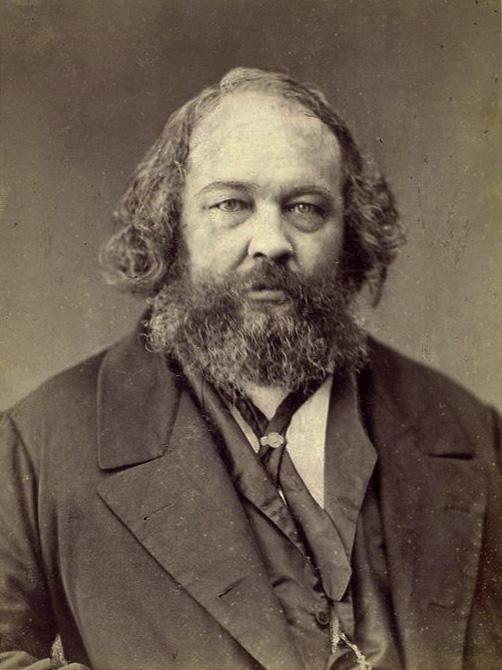
Bakunin photographed by Nadar
Indeed, Marx’s revolutionary prophecy appealed particularly to non-proletarian German Jews. Fritz Kahn hailed him as more than a prophet in Die Juden als Rasse und Kulturvolk (1920): “in 1848, for the second time, the star of Bethlehem was raised to the firmament … and it rose again above the rooftops of Judea: Marx.”[4]
If Marx was the Messiah in 1848, then Benjamin Disraeli could be called his prophet. In his novel Coningsby, published in 1844, the Jewish character Sidonia—“a cross between Lionel de Rothschild and Disraeli himself,” according to Disraeli’s biographer[5]—declared:
“That mighty revolution which is at this moment preparing in Germany, and which will be, in fact, a second and greater Reformation, and of which so little is as yet known in England, is entirely developing under the auspices of Jews, who almost monopolise the professorial chairs of Germany.”
Four years after these words were written, the Communist Manifesto was published and, almost simultaneously, the revolution broke out in Germany, as Disraeli had predicted . Jews did play a major role in the 1848 revolution, as Amos Elon has shown in his book The Pity of It All: A History of Jews in Germany 1743-1933. “80 percent of all Jewish journalists, doctors, and other professionals” supported the revolution. The most prominent were Ludwig Bamberger in Mainz, Ferdinand Lassalle in Dusseldorf, Gabriel Riesser in Hamburg, Johan Jacoby in Koeningsberg, Aron Bernstein in Berlin, Herman Jellinek in Vienna, Moritz Harmann in Prague, and Sigismund Asch in Breslau. “All over the country,” Elon writes, “rabbis in their sermons greeted the revolution as a truly messianic event.” The Jewish magazine Der Orient praised “the heroic Maccabean battle of our brethren on the barricades of Berlin,” and raved, “The savior from whom we have prayed has appeared. The fatherland has given him to us. The messiah is freedom.” The Jewish scholar Leopold Zunz, founder of academic Judaic Studies (Wissenschaft des Judentums),
“described what was happening in specifically biblical terms shot through with the Messianic political view which saw revolutionary politics as the fulfillment of biblical promise. Haranguing the Berlin students from the barricades, Zunz portrayed Metternich [Chancellor of the Austrian Empire] as Haman and hoped that ‘perhaps by Purim, Amalek [meaning the Prussian king Friedrich Wilhelm IV] will be beaten.’”[6]
After the failure of the revolution, many revolutionaries exiled themselves to London, where they were known as the Forty-Eighters. Marx settled there for the rest of his life, “living encased in his own, largely German, world, formed by his family and a small group of intimate friends and political associates,” according to Isaac Berlin.[7] Apart from Engels, Marx’s friends and associates were, in fact, almost all Jewish. Marx’s influence, which had been small in the 1848 revolution, would then develop, thanks to what Bakunin would call in 1872, in an unpublished “Lettre au Journal La Liberté de Bruxelles,” his “remarkable genius of intrigue,” adding:
“he also has in his service a numerous corps of agents, hierarchically organized and acting secretly under his direct orders; a kind of socialist and literary freemasonry in which his compatriots, the German Jews and others, occupy a considerable place and deploy a zeal worthy of a better cause.”
Bakunin was particularly intrigued by Marx’s insistence on the centralization of all banking activity. The Communist Manifesto not only proclaims the abolition of private banks, but: “Centralisation of credit in the hands of the State, by means of a national bank with State capital and an exclusive monopoly.” In another unpublished editorial of 1872, Bakunin wrote:
“this Jewish world is today, for the most part, at the disposal of Marx on the one hand, and of Rothschild on the other. I am convinced that the Rothschilds, on their side, appreciate the merits of Marx and that Marx, on his side, feels an instinctual attraction and a great respect for the Rothschilds. / This may seem strange. What can there be in common between socialism and a major bank? The point is that Marx’s communism wants a strong centralization of the state, and where there is centralisation of the state, there must necessarily be a central bank, and where such a bank exists, the parasitic nation of the Jews, speculating with the Labour of the people, will always thrive.”[8]
Having succeeded to get Bakunin and his “anti-authoritarian” followers expelled from the International Workingmen’s Association (the First International), Marx transferred its General Council from London to New York—the city that would soon become the Western capital of Jewry, where another German Jew, Leon Braunstein aka Trotsky, would be preparing the Bolshevik revolution, with the financial support of Wall Street Jewish bankers like Jacob Schiff.[9]
The Jewish Question in nineteenth-century Germany
 In order to understand Marx’s hidden agenda, the best is to start with his first two significant articles, published in 1844 in the Deutsch-Französische Jahrbücher, four years before the Communist Manifesto. Their topic was the “Jewish Question”. Before we present what Marx had to say about it, we must recall the context.
The “Jewish Question” is the question of the possibility and means of Jewish assimilation. The problem, as it was commonly formulated from the end of the eighteenth century, was that Jews considered themselves, and were considered, as aliens in the European nations among which they lived. One solution was to transform Jewishness from a nationality into a religion compatible with the secular values of modern nations. Moses Mendelssohn (1729–1786) paved the way in Germany for a “Reform Judaism” that defined itself as purely religious and renounced nationalist aspirations. On the basis of this new pact, Napoleon granted political emancipation to the Jews in France, and was hailed as a liberator by German Jews when he invaded the German principalities. Although Jewish emancipation underwent a setback in Prussia when he withdrew in defeat, it was complete by 1848.
 However, the assumption that Jewishness was a matter of private religion created a new problem for the Jewish community, aggravated by residual forms of segregation: for many secular and educated Jews, Judaism had little appeal as a religion, and converting to Christianity seemed the logical continuation of their conversion to the Enlightenment. Half the Jews of Berlin converted to Protestantism or Catholicism in the late eighteenth and early nineteenth century.
Karl Marx’s family falls in that category. His father Herschel Levi, though the son and brother of rabbis, became a Lutheran in order to practice law in the Prussian courts, and had his six children and his wife baptized in 1824, when Karl was six years old. Another famous case is Heinrich Heine (1797–1856), who conceived of his baptism in 1825 (one year after Marx) as the “entrance ticket to European civilization.”[10] Marx met Heine, a generation his elder, shortly after his arrival in Paris in 1843, and the two men met frequently until Marx moved to London in 1849. It is believed that their conversations had a formative influence on both men. Heine may in fact have introduced Communism to Marx, for he wrote in 1842, one year before meeting Marx:
“Though Communism is at present little talked about, vegetating in forgotten attics on miserable straw pallets, it is nevertheless the dismal hero destined to play a great, if transitory role in the modern tragedy… There will then be only one shepherd with an iron crook and one identically shorn, identically bleating human herd.”[11]

Heine with Marx and his wife Jenny
The dissolution of Jewish identity into a religious faith led to a reaction in the form of a Jewish nationalist movement that would ultimately morph into Zionism. It was the German Jewish historian Heinrich Graetz (1817-1891), almost the same age as Marx, who gave the first impetus to a new Jewish national consciousness with his multivolume History of the Jewish People, published in 1853 . Marx first met Heinrich Graetz in the summer 1874, while “taking the waters” at Carlsbad in Bohemia. The two following summers, they coordinated their vacations there. We do not know what they talked about, but, as Shlomo Avineri comments, “a more dramatic prefiguration of the encounter between Zion and Kremlin could not be imagined.”[12]
Graetz reawakened the national consciousness of European Jews such as Moses Hess (1812-1875), author in 1862 of Rome and Jerusalem: The Last National Question, which in turn impressed Theodor Herzl. According to Hess, the efforts of the Jews to merge with a nationality other than their own are doomed to failure. “We shall always remain strangers among the nations,” for “the Jews are something more than mere ‘followers of a religion,’ namely, they are a race brotherhood, a nation.”[13]
Interestingly, before his conversion to Jewish nationalism, Moses Hess (originally Moritz) was a pre-Marxist communist. He was the founder of the Rheinische Zeitung, for which Marx served as Paris correspondent in 1842-43 . Hess had a strong influence on both Engels and Marx.[14] Marx borrowed from Hess’ 1845 essay on “The Essence of Money” his concept of economic alienation.[15] Hess always remained close to Marx; in 1869, at Marx’s request, he even penned an article slandering Bakunin, accusing him to be an “agent provocateur” of the Russian government.[16]
Marx’s response to Bruno Bauer
Marx’s essays on the Jewish Question were critical reviews of two works by Bruno Bauer (1809-1882), a leading figure of the Young Hegelians: a book titled Die Judenfrage (1842), and a follow-up article on “The Capacity of Present-day Jews and Christians to Become Free.”[17]
Bauer’s approach to the question of Jewish assimilation was innovative. For him, the religious nature of Judaism is the problem, not the solution. He argued that Jews cannot be emancipated politically without first being emancipated religiously, because the Jews’ resistance to assimilation is based on the commandment of the Torah to live permanently in separation from other people. The essence of their religion is their claim to be the chosen people, and that prevents them from even respecting other peoples.
“Jews as such can not amalgamate with peoples and associate their fate with theirs. As Jews, they must wait for a particular future, allotted to them alone, the chosen people, and assuring them the dominion of the world.”
Therefore, there can be no emancipation of the Jews. A Jew can emancipate himself only by ceasing to be a Jew, because his true alienation is his Jewishness.
Bauer was the first since Voltaire to point at the toxic influence of the Tanakh as the key to the Jewish Question. Christians could obviously never reach that conclusion, but even secular thinkers who subscribed to the new science of “higher criticism” (pioneered by David Strauss’ Life of Jesus, 1835) generally looked away from the xenophobia of the Tanakh. “One even screams at betrayal of the human race when the critics try to examine the essence of the Jew as a Jew,” noted Bauer.
In his critical reviews, Marx does not argue against Bauer’s point that Jewish religion is opposed to assimilation. Rather, he denies altogether that Jewishness is a matter of religion.
“Let us consider the actual, worldly Jew—not the Sabbath Jew, as Bauer does, but the everyday Jew. Let us not look for the secret of the Jew in his religion, but let us look for the secret of his religion in the real Jew.”
Since Marx downplays the religious definition of Jewishness, it would be expected that he opt for the second term of the alternative and define Jewishness as a nationality, as will his friend Hess twenty years later. But he doesn’t. Instead, Marx posits, for the first time, his dogma that religion belongs to the cultural “superstructure” of society, while the real “infrastructure” is economic. The essence of the Jew, he writes, is not his religion, but his love of money:
“What is the secular basis of Judaism? Practical need, self-interest. What is the worldly religion of the Jew? Huckstering. What is his worldly God? Money.”
Marx redefines Jewish religion as the cult of money: “Money is the jealous god of Israel, in face of which no other god may exist.” He does the same for Jewish nationality, in one short sentence: “The chimerical nationality of the Jew is the nationality of the merchant, of the man of money in general.” It follows naturally, according to Marx, that if you abolish money you will solve the Jewish question:
“Very well then! Emancipation from huckstering and money, consequently from practical, real Judaism, would be the self-emancipation of our time. An organization of society which would abolish the preconditions for huckstering, and therefore the possibility of huckstering, would make the Jew impossible. His religious consciousness would be dissipated like a thin haze in the real, vital air of society.”
Jews will be emancipated when all men will be emancipated, for there is no other emancipation than emancipation from money.
Marx makes the radical claim that love of money and economic alienation came to the world from the Jews. He equates economic alienation to Jewish influence:
“the practical Jewish spirit has become the practical spirit of the Christian nations. The Jews have emancipated themselves insofar as the Christians have become Jews. … The Jew is perpetually created by civil society from its own entrails. … The god of the Jews has become secularized and has become the god of the world”
And so, “In the final analysis, the emancipation of the Jews is the emancipation of mankind from Judaism.” That sounds terribly anti-Semitic, from today’s standards. Because of these essays on the Jewish Question, Marx’s biographers have been more concerned by the question, “Was Marx an anti-Semite?” (see Edmund Silberner’s 1949 book of that title) than by the issue of his Jewish background, environment, and mindset. This is best illustrated by this article by Michael Ezra, “Karl Marx’s Radical Antisemitism.”
 But in the context of the time, Marx’s view of the Jews as money worshippers was rather banal. It was almost unanimously shared among socialists, as Hal Draper reminds us in “Marx and the Economic-Jew Stereotype.”[18] It was especially common among revolutionary Jews as well as among Zionists who were generally socialists. Moses Hess himself, for instance, wrote in “The Essence of Money”: “The Jews, who in the natural history of the social animal-world had the world-historic mission of developing the beast of prey out of humanity have now finally completed their mission’s work.”
What Marx did was to push the stereotype to its limit: he made the love of money not just an attribute of some Jews, but the very essence of the Jews. But by doing so, he was in effect dissolving the Jewish question into a socio-economic question: the Jew becomes the archetypal bourgeois. By this sleight of hand, Marx eliminated the Jewish question once and for all. He would never come back to it.[19]
In fact, never again would Marx target specifically Jewish financiers. Nesta Webster draws attention to that anomaly in her World Revolution: The Plot Against Civilization (1921):
“The period of 1820 onwards became, as Sombart [Werner Sombart, The Jews and Modern Capitalism, 1911)] calls it, ‘the age of the Rothschilds,’ so that by the middle of the century it was a common dictum, ‘There is only one power in Europe, and that is Rothschild.’ Now how is it conceivable that a man who set out honestly to denounce Capitalism should have avoided all reference to its principal authors? Yet even in the section of his book dealing with the origins of Industrial Capitalism, where Marx refers to the great financiers, the stock-jobbing and speculation in shares, and what he describes as ‘the modern sovereignty of finance,’ he never once indicates the Jews as the leading financiers, or the Rothschilds as the super-capitalists of the world.”[20]
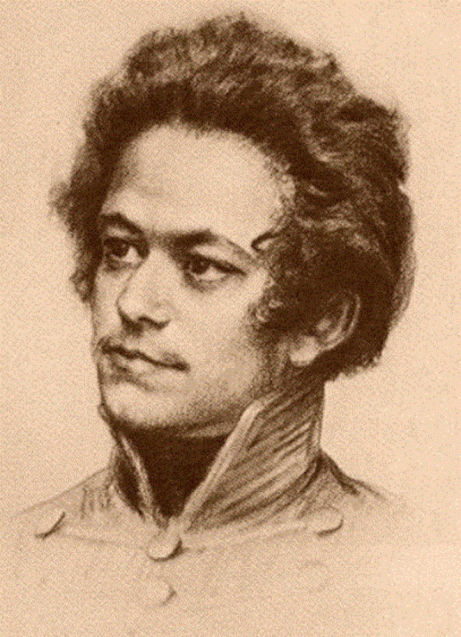
Young Karl Marx
By reducing Jewishness to capitalism, Marx was also overlooking another side of Jewish influence in the world: the revolution. The strong involvement of Jews in revolutionary movements would not become fully apparent to the world before 1848, but Marx, being himself a German Jewish revolutionary, could not be unaware of it. He could not be ignorant of the fact that Jews loved not only money, but also the revolution. Jewish revolutionary activity is one form of resistance to assimilation, especially when it calls for the destruction of the nations in the name of internationalism. By simply ignoring it, Marx was, at the very least, concealing the role of his own Jewishness in his revolutionary enterprise, while at the same time removing in advance all suspicion of his Jewish sympathies.
I believe Marx’s treatment of the Jewish question set the standard of his subsequent method. First, Marx misrepresents the arguments of his adversaries, often turning them upside down before proceeding to criticize them. For example Marx pretends that Bauer sees Jewishness as a religious faith, but that was not Bauer’s point. Rather, Bauer showed that defining Jewishness as a religion or ethnicity makes no big difference, because either way, the essence of Jewishness is separateness. Being religious only worsens the xenophobic nature of Jewishness, because it makes separateness a divine commandment rather than simply an ancestral habit. Secondly, Marx dismisses the complexity of things, in order to focus exclusively on a single and often secondary aspect of reality, making it look two-dimensional. Defining Jewishness as the love of money is obviously inadequate for anyone who has reflected even superficially on the question. Either Marx believes what he says, and that tells a lot about his intellectual ability, or he doesn’t—which is more likely—, and that tells a lot about his intellectual honesty. With the same reductionism Marx will claim in 1848, in the Communist Manifesto (Engels credited this insight to Marx alone), that, “The history of all hitherto existing society is the history of class struggles.” It is obvious to any (non-Marxist) historian that class struggles fall far behind ethnic struggles in the forces shaping history, even in modern times. Even an internationalist socialist like Bakunin could only be puzzled by Marx’s total ignorance of this fact:
“Marx completely ignores a most important element in the historic development of humanity, that is, the temperament and particular character of each race and each people, a temperament and a character which are themselves the natural product of a multitude of ethnological, climatological, economic, and historic causes, but which exercise, even apart from and independent of the economic conditions of each country, a considerable influence on its destinies and even on the development of its economic forces.”[21]
Coming from someone who grew up in a Jewish home and, despite his baptism, evolved in a mostly Jewish circle, counting among his friends zealot Jewish nationalists, I find it unbelievable that Marx’s ignorance of the national factor was sincere. Or perhaps, it must be considered very typical of Jewish discourse targeted at Gentiles. In that sense, Marx’s internationalism confirms Bauer’s remark that Jews consider only their own nationality as real:
“According to their fundamental representation, they wanted to be absolutely the people, the unique people, that is to say the people beside whom other peoples did not have the right to be a people. Any other people was, in comparison with them, not really a people; as the chosen people they were the only true people, the people who were to be All and take the world.”
Proudhon and the socialist movement before Marx
Having examined how Marx positioned himself on the background of the Jewish question, we can now do the same with the social question that occupied socialist thinkers.
At the time when Marx and Engels joined the movement, the most influential socialist theorist was Pierre-Joseph Proudhon (1809-1865), of nine years Marx’s elder. There is no better way to understand the originality of Marx’s economic ideas than by comparing them to Proudhon’s. (Proudhon’s work is accessible to English readers through Iain McKay’s anthology: Property is Theft! A Pierre-Joseph Proudhon Anthology, AK Press, 2011. McKay’s 82-page introductory chapters, including one on “Proudhon and Marx,” can be read here).
Proudhon’s book Qu’est-ce que la propriété? (What is Property? An Inquiry into the Principle of Right and of Government) published in 1840, had a huge echo and became a cornerstone of the European socialist movement. Proudhon was the first to use the expression “scientific socialism”, meaning a society ruled by a scientific government, one whose sovereignty rests upon justice and reason, rather than sheer will. His book was a critic of previous theories of economy (then called “political economy”) developed in Great Britain by Adam Smith (1723-1790) and David Ricardo (1772-1823). As explained by McKay, “It was Proudhon who first located surplus value production within the workplace, recognizing that the worker was hired by a capitalist who then appropriates their product in return for a less than equivalent amount of wages” (McKay 66).

A portrait of Proudhon by his friend Gustave Courbet (1865)
Proudhon’s thought was in constant evolution, and therefore not totally consistent from beginning to end, even in terminology. Nevertheless, if we want to summarize it, we shall say that Proudhon advocated a decentralized, self-managed, federal, bottom-up socialism, which he called “anarchism”. His vision was based on an organic model of society, the basic cell of which was the patriarchal family, while the “commune” was the fundamental unit of democratic sovereignty. In contrast, “governmental power is mechanical” and fundamentally inhuman (Confession of a Revolutionary, McKay 404).
Proudhon consistently spoke against projects of state socialism. For him, state ownership of the means of production was the continuation of capitalism with the state as the new boss. Nationalization would simply make a nation of wage-workers, and Proudhon viewed the condition of the wage-worker as little better than slavery. State control also kills competition, and Proudhon considered that “competition is as essential to labour as division”; it is “the vital force which animates the collective being” (System of Economic Contradictions, McKay 197 and 207).
Although he called himself a revolutionary, Proudhon was a reformist and a democrat. He recommended that workers gain political and economic emancipation by organizing themselves in “clubs”, cooperatives and associations for mutual credit, by electing representatives, and by exercising pressure and influence onto the state.
Proudhon’s central formula, “Property is theft,” is often misunderstood. Proudhon was attacking the capitalistic property of the means of production. Whereas the French constitution of 1793 defined property as “the right to enjoy the fruit of one’s labor,” capitalist property is, according to Proudhon, “the right to enjoy and dispose at will of another’s goods—the fruit of another’s industry and labour” (What is Property? McKay 124). In fact, Proudhon formulates a thesis and an antithesis. While claiming that “property is theft,” he devotes long pages to the apology of the small owner, whether artisan or peasant, whose property is based on use, what he calls “possession”. “Individual possession is the condition of social life. … Suppress property while maintaining possession, and, by this simple modification of the principle, you will revolutionize law, government, economy, and institutions” (What is Property? McKay 137). Proudhon encouraged mutualist forms of possession, but he condemned communism, which called for the complete abolition of private property: “Communism is oppression and slavery” (What is Property? McKay 132). Proudhon’s ideal was less the abolition of private property than its fair distribution.
Marx’s hijacking of the Proudhonian legacy
In The Holy Family, published in 1845, Marx and Engels praised Proudhon’s book What is Property?
“Proudhon makes a critical investigation — the first resolute, ruthless, and at the same time scientific investigation — of the basis of political economy, private property. This is the great scientific advance he made, an advance which revolutionizes political economy and for the first time makes a real science of political economy possible.”
“Proudhon was the first to draw attention to the fact that the sum of the wages of the individual workers, even if each individual labour be paid for completely, does not pay for the collective power objectified in its product, that therefore the worker is not paid as a part of the collective labour power.”
But the praises of Marx and Engels for Proudhon suddenly ceased in 1846. Two reasons can be conjectured. First, in 1846, Proudhon rejected Marx’s invitation to become his correspondent in Paris. In his answer, Proudhon criticizes Marx’s will to forge a unifying dogma:
“Let us seek together, if you will, for the laws of society, the manner in which these laws are manifested, the progress of our efforts to discover them. But for God’s sake, after having demolished all a priori dogmatisms, let us not in turn dream of making our own, of indoctrinating the people; … let us show the world an example of learned and insightful tolerance, but since we are in the lead, let us not set ourselves up as leaders of a new intolerance; let us not be the apostles of a new religion, one that makes itself a religion or reason, a religion of logic. We should welcome and encourage all protestations. Let us get rid of all divisiveness, all mysticism. Let us never consider a question exhausted, and when we do get down to our last argument, let’s start again, if need be, with wit and irony! I will join your organization on that condition—or else not!”
Proudhon also expressed reservations on the idea of violent revolution: “Our proletariat has a great thirst for science, which would be very poorly served if you only brought them blood to drink” (“Letter to Karl Marx,” McKay 163-165).
The second reason for Marx’s about-face regarding Proudhon was the Frenchman’s publication of Philosophie de la Misère (or System of Economic Contradictions), in which he developed new conceptual tools to understand the structure of the capitalist world. Marx, who had announced in 1846 a book of economy, was taken by surprise. He responded with a pamphlet in French, Misère de la philosophie, which Proudhon would describe as “a tissue of vulgarity, of calumny, of falsification and of plagiarism,” written by “the tapeworm of socialism” (McKay 70). McKay agrees:
“While, undoubtedly, Marx makes some valid criticisms of Proudhon, the book is full of distortions. His aim was to dismiss Proudhon as being the ideologist of the petit-bourgeois and he obviously thought all means were applicable to achieve that goal. So we find Marx arbitrarily arranging quotations from Proudhon’s book, often out of context and even tampered with, to confirm his own views. This allows him to impute to Proudhon ideas the Frenchman did not hold (often explicitly rejects!) in order to attack him. Marx even suggests that his own opinion is the opposite of Proudhon’s when, in fact, he is simply repeating the Frenchman’s thoughts. He takes the Frenchman’s sarcastic comments at face value, his metaphors and abstractions literally. And, above all else, Marx seeks to ridicule him.” (McKay 70-71)
Twenty years later, and two years after Proudhon’s death, the most essential concepts of Marx’s Capital: A Critique of Political Economy, would be borrowed from Proudhon, without any credit given him . When Marx writes that, “property turns out to be the right, on the part of the capitalist, to appropriate the unpaid labour of others or its product, and the impossibility, on the part of the worker, of appropriating his own product” (Capital, vol. 1, quoted in McKay 66), he is repeating what Proudhon wrote 27 years earlier in What is Property?
In 1867, when Marx published the first volume of Das Kapital, Proudhon’s notoriety and influence still far exceeded Marx’s in Europe. The International Workingmen’s Association (the First International) had been founded in 1864 by Proudhon’s followers, who called themselves mutualists and anti-authoritarians. Mikhail Bakunin (1814-1876), who became Marx’s strongest opponent within the International after Proudhon’s death, considered his own ideas as “Proudhonism widely developed and pushed right to its final consequences” (as quoted in McKay 46), although he criticized the Proudhonians’ attachment to hereditary property. At the Geneva Congress of 1866, the Proudhonians prevailed and convinced the Congress to vote unanimously in favor of working towards the suppression of salaried status through the development of co-operatives. Marxism had almost no influence on the French Commune of 1871, which was predominantly inspired by Proudhon’s ideas of decentralized federations of communes and workers’ associations.
The intensity of Marx’s will to supplant Proudhon can be seen in a letter to Engels dated July 20, 1870, at the dawn of the Franco-Prussian War, a war in which Marx saw the opportunity to get the upper hand over his rival:
“The French need a thrashing. If the Prussians win, the centralisation of the state power will be useful for the centralisation of the German working class. German predominance would also shift the centre of gravity of the workers’ movement in Western Europe from France to Germany, and one has only to compare the movement in the two countries from 1866 till now to see that the German working class is superior to the French both theoretically and organisationally. Their predominance over the French on the world stage would also mean the predominance of our theory over Proudhon’s, etc.”
The outcome of the war gave entire satisfaction to Marx.
The Communist Manifesto, a monopolist’s dream
Although Marx’s economic theory is largely plagiarized from Proudhon, his solutions are the exact opposite. That is because Marx’s project doesn’t proceed from his economic theories. According to Karl Jaspers, Marx’s approach “is one of vindication, not investigation, but it is a vindication of something proclaimed as the perfect truth with the conviction not of the scientist but of the believer.” British historian Paul Johnson concurs and, after quoting from the apocalyptic and “Luciferian” poetry of Marx’s youth, he concludes that,
“Marx’s concept of a Doomsday … was always in Marx’s mind, and as a political economist he worked backwards from it, seeking the evidence that made it inevitable, rather than forward to it, from objectively examined data.”[22]
Therefore, Marx’s theoretical sum published in 1867, Das Kapital, is almost irrelevant to understand his program, laid out in 1848 with Friedrich Engels in the Manifesto of the Communist Party. “The theory of the Communists,” we read there, “may be summed up in the single sentence: Abolition of private property.” As if responding to protests by the Proudhonians, they add:
“We Communists have been reproached with the desire of abolishing the right of personally acquiring property as the fruit of a man’s own labour, which property is alleged to be the groundwork of all personal freedom, activity and independence. / Hard-won, self-acquired, self-earned property! Do you mean the property of the petty artisan and of the small peasant, a form of property that preceded the bourgeois form? There is no need to abolish that; the development of industry has to a great extent already destroyed it, and is still destroying it daily.”
Abolition of private property naturally includes “abolition of all rights of inheritance,” especially since the Manifesto also proclaims the “abolition of the family,” seen as a bourgeois institution “based … on capital, on private gain.” Nations will disappear too, because “the working men have no country”; capitalism “has stripped him of every trace of national character.”
The current epoch “has simplified class antagonisms. Society as a whole is more and more splitting up into two great hostile camps, into two great classes directly facing each other—Bourgeoisie and Proletariat.” Engels adds in a footnote to the 1888 English edition that, “By bourgeoisie is meant the class of modern capitalists, owners of the means of social production and employers of wage labour.” Marx and Engels await the complete disappearance of “the lower strata of the middle class—the small tradespeople, shopkeepers, and retired tradesmen generally, the handicraftsmen and peasants—all these sink gradually into the proletariat.” The bourgeoisie, on the other hand, “has concentrated property in a few hands.”
Marx and Engels predict that this concentration of wealth in ever fewer hands, and the corresponding increase in misery among the growing working class, will intensify class warfare, and lead inevitably to the violent revolution of the proletariat. The Communists “openly proclaim that their goals cannot be reached except through the violent overthrow of the entire social order of the past.” After the failure of the 1848 revolution in Germany, Marx wrote that, “there is only one way in which the murderous death agonies of the old society and the bloody birth throes of the new society can be shortened, simplified and concentrated, and that way is revolutionary terror.”
The goal of the revolution is to establish the “dictatorship of the proletariat,” as a transition toward the abolition of all classes. This stage is necessary for the proletariat to defend itself against a counter-revolution and to bring about the classless society. Although the expression “dictatorship of the proletariat” doesn’t appear until 1852, the idea is clearly stated in the Manifesto:
“The proletariat will use its political supremacy to wrest, by degree, all capital from the bourgeoisie, to centralise all instruments of production in the hands of the State, i.e., of the proletariat organised as the ruling class; and to increase the total productive forces as rapidly as possible.”
The first thing to note is that Marx and Engels have no intention to appease the antagonism between the proletarians and the bourgeois, by improving the condition of workingmen. On the contrary, they hope that the conflict will intensify to the point of turning into a bloody civil war. For that, the misery of the working class must increase. We should remember here that tearing apart the social fabric of nations by exacerbating social, racial, generational or gender tensions is a strategy that Jewish intellectuals have used to this day.
Secondly, Marx and Engels have no intention to stop or even resist the progress of capitalism. On the contrary, they call for the total disappearance of the social and economic structures that preceded it, and look forward to its most extreme development, when all the means of production have fallen into a few hands. For only then, they claim, the new world can be born. Capitalism contains the seeds of its own destruction, but capitalism must first reach its full maturity, which is the monopoly of a few billionaires.
Obviously, monopolists can support wholeheartedly that goal. Should they fear the next step, the revolution and the appropriation of all capitals and all means of production by the state? Not necessarily, as Bakunin argued in 1872, and as Antony Sutton explained in more detail in Wall Street and the Bolshevik Revolution (2001):
“one barrier to mature understanding of recent history is the notion that all capitalists are the bitter and unswerving enemies of all Marxists and socialists. This erroneous idea originated with Karl Marx and was undoubtedly useful to his purposes. In fact, the idea is nonsense. There has been a continuing, albeit concealed, alliance between international political capitalists and international revolutionary socialists — to their mutual benefit. This alliance has gone unobserved largely because historians — with a few notable exceptions — have an unconscious Marxian bias and are thus locked into the impossibility of any such alliance existing. The open-minded reader should bear two clues in mind: monopoly capitalists are the bitter enemies of laissez-faire entrepreneurs; and, given the weaknesses of socialist central planning, the totalitarian socialist state is a perfect captive market for monopoly capitalists, if an alliance can be made with the socialist powerbrokers. Suppose — and it is only hypothesis at this point — that American monopoly capitalists were able to reduce a planned socialist Russia [or Germany] to the status of a captive technical colony? Would not this be the logical twentieth-century internationalist extension of the Morgan railroad monopolies and the Rockefeller petroleum trust of the late nineteenth century?”
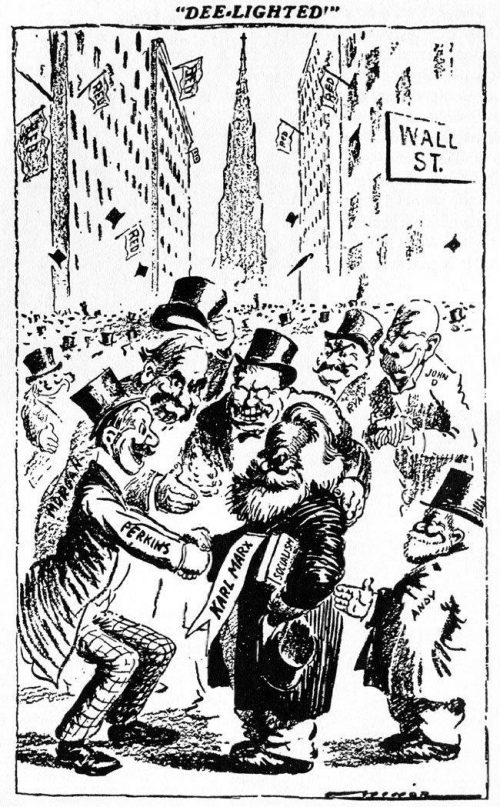
Marx being congratulated by Wall Street bankers (1911 cartoon reproduced by Sutton)
Sutton sees no Jewish conspiracy in this collusion between the Bank and the Revolution. But documents relative to the failed Russian revolution of 1905 show that there is another dimension to that unnatural alliance, as explained in this article by Alexandros Papagoergiou. In 1904, Russian Prime Minister Sergei Witte was tasked to secure a huge foreign loan to stabilize Russian public finances. He tells in his memoirs that, after turning down the offer of the Jewish banks headed by the Rothschilds, because it was conditioned on “legal measures tending to improve the conditions of the Jews in Russia,” he was able to raise the enormous amount of 2,250,000,000 francs via “Christian Banks”.[23] Revolutionary riots started soon after. A report of the Russian Foreign Minister to Tsar Nicholas II notes that it happened “just at the time when our government tried to realize a considerable foreign loan without the participation of the Rothschilds and just in time for preventing the carrying out of this financial operation; the panic provoked among the buyers and holders of Russian loans could not fail to give additional advantages to the Jewish bankers and capitalists who openly and knowingly speculated upon the fall of the Russian rates.” According to the report, the revolutionaries “are in possession of great quantities of arms which are imported from abroad, and of very considerable financial means,” which had been collected by Anglo-Jewish capitalists “under the leadership of Lord Rothschild, … for the officially alleged purpose of helping Russian Jews who suffered from pogroms.”[24]
Marxism vs Zionism: the dialectical pliers
Jewish movements seem to be working history through dialectical antagonisms that ultimately advance the Big Project. The capacity of the Jewish community to present itself either as a religion or as a nationality, depending on the circumstances, is the prime example. After gaining political emancipation in the name of religious freedom in the first part of the 19th century, European Jews were in the position to reclaim their special nationhood. For a few decades, reformed rabbis would ostensibly oppose Jewish nationalism, proclaiming in the 1885 Pittsburgh Conference: “We consider ourselves no longer a nation, but a religion community.”[25] Yet the same Pittsburgh Conference saw no contradiction in adopting the theory of German rabbi Kaufman Kohler, that “Israel, the suffering Messiah of the centuries, shall at the end of days become the triumphant Messiah of the nations,”[26] which amounts to say that Israel is not an ordinary nation, but the super-nation. In the 20th century, any trace of a contradiction between Reformed Judaism and Zionism was removed.
The early collaboration between Marx and Hess and the late encounter between Marx and Graetz both prefigure another dialectical opposition between Communism (the International revolution aimed at destroying Christian nations) and Zionism (the national project aimed at building the Jewish nation). Both movements developed in the same milieu. Chaim Weizmann recounts in his autobiography (Trial and Error, 1949) that in early twentieth-century Russia, revolutionary communists and revolutionary Zionists belonged to the same milieu. Weizmann’s brother Schmuel was a communist, and that was not a source of family discord. These divisions were relative and changeable; many Zionists were Marxists, and vice versa. The borderline was all the more vague that the Communist Bund, born the same year as Zionism (1897), inscribed in its revolutionary agenda the right of the Jews to found a secular Yiddish-speaking nation. As Gilad Atzmon recently wrote, the Bund was “also an attempt to prevent Jews from joining the ‘Hellenic’ route by offering Jews a tribal path within the context of a future Soviet revolution.”
But the most important thing to note is that, from the early days, Jewish revolutionary activity provided Zionists with a diplomatic argument in favor of their alternative program for the Jews. Herzl mentions in his diary (June 4, 1900) that “intensifying Jewish Socialist activities” was a way to “stir up the desire among the European governments to exert pressure on Turkey to take in the Jews” (Palestine was then under Ottoman control). He hawked Zionism as a solution to the problem of Jewish revolutionary subversion when meeting Kaiser Wilhelm II in 1898, and again when meeting Russian ministers in St. Petersburg in 1903.[27] The next generation of Zionists continued the stratagem. Churchill, who spoke with one voice with Chaim Weizmann,[28] dramatized the opposition between the “good Jews” (Zionists) and the “bad Jews” (communists) in his 1920 article “Zionism versus Bolshevism: A struggle for the soul of the Jewish people.” He referred to Bolshevism as “this world-wide conspiracy for the overthrow of civilization” and to Zionism as the solution “especially in harmony with the truest interests of the British Empire.” (Churchill’s later alliance with Stalin proves that his Zionism was stronger than his anti-communism.)
In the aftermath of World War II, the rivalry between the Communist and the Capitalist worlds remained the indispensable context for the creation and expansion of Israel. That explains why Roosevelt’s administration, largely controlled by Jews, helped Stalin conquer half of Europe and thwarted all attempts to stop him. Curtis Dall, Roosevelt’s son-in-law, has revealed a secret diplomatic channel demonstrating that the White House went out of its way to give the USSR all the time and the armament necessary to invade Central Europe.[29] Thus the Second World War was completed with the determined aim of laying the foundations for the Cold War, that is, a highly explosive polarization of the world that would prove crucial for Project Zion. In fact, during this whole period, it is almost impossible to distinguish, among the Jewish advisors of Roosevelt and Truman on foreign policy, the pro-Communists from the pro-Zionists, as David Martin remarks in The Assassination of James Forrestal. A case in point is David Niles (Neyhus), who was guilty of spying for the Soviets while advising Roosevelt, but then played a key role in Truman’s support of the U.N. Partition Plan and the recognition of Israel.[30]
The Cold War proved instrumental when Nasser, Israel’s most formidable enemy, was pushed into the communist camp in 1955, setting off an intense Zionist campaign to present him as a danger to the stability of the Middle East, and to present Israel, by contrast, as the only reliable ally in the region. The Cold War was also the crucial context for Israel’s defeat of Egypt in 1967 and Israel’s annexation of territories stolen from Egypt, Syria and Lebanon.
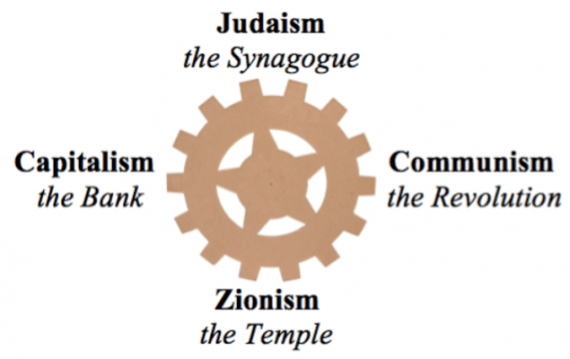
Yahweh’s dialectical machinery
Laurent Guyénot, Ph.D., has recently edited some of his Unz Review articles in book form, under the title Our God is Your God Too, But He Has Chosen Us: Essays on Jewish Power. He is also the author of From Yahweh to Zion: Jealous God, Chosen People, Promised Land … Clash of Civilizations, 2018, and JFK-9/11: 50 years of Deep State, Progressive Press, 2014.
Notes
[1] David Ben-Gurion and Amram Duchovny, David Ben-Gurion, In His Own Words, Fleet Press Corp., 1969, p. 116. Ben-Gurion’s prophecy appeared in the magazine Look on January 16, 1962, reproductions of which can be found on Internet.
[2] Karl Popper, Unended Quest: An Intellectual Autobiography (1976), Routledge, 2002, books.google.com
[3] Bakunin, Statism and Anarchy, trans. Marshall S. Shatz, Cambridge UP, 1990, pp. 538-545.
[4] Quoted in Alexandre Soljénitsyne, Deux siècles ensemble (1795–1995), tome I: Juifs et Russes avant la Révolution, Fayard, 2003, tome 1, p. 269.
[5] Robert Blake, Disraeli (1966), Faber Finds, 2010, p. 202.
[6] Amos Elon, The Pity of It All: A History of Jews in Germany 1743-1933, Metropolitan Books, 2002, pp. 153, 157, 163-164.
[7] Isaac Berlin, Karl Marx: His Life and Environment, 1939, 2nd ed, 1948, p. 17.
[8] Aux compagnons de la Fédération des sections internationales du Jura, quoted in Henri Arvon, Les Juifs et l’Idéologie, PUF, 1978, p. 50. Partial quote in Francis Wheen , Karl Marx, Fourth Estate, 1999, p. 340.
[9] Antony Sutton, Wall Street and the Bolshevik Revolution (1976), Clairview Books, 2011.
[10] Quoted in Kevin MacDonald, Separation and Its Discontents: Toward an Evolutionary Theory of Anti-Semitism, Praeger, 1998, kindle 2013, k. 4732–4877.
[11] Amos Elon, The Pity of It All, op; cit., p. 146.
[12] Shlomo Avineri, Karl Marx: Philosophy and Revolution, Yale UP, 2019, pp. 171-172.
[13] Moses Hess, Rome and Jerusalem: A Study in Jewish Nationalism, 1918 (archive.org).
[14] Sydney Hook, “Karl Marx and Moses Hess,” 1934.
[15] Shlomo Avineri , Moses Hess: Prophet of Communism and Zionism, 1985.
[16] Read Bakunin’s response to Hess’s article, “Aux citoyens rédacteurs du Réveil”
[17] French translation, Bruno Bauer, La Question juive (1843), Union générale d’Éditions, 1968, on
[18] Hal Draper, “Marx and the Economic-Jew Stereotype,” from Karl Marx’s Theory of Revolution, Vol.1: State and Bureaucracy, Monthly Review, New York 1977, pp. 591-608. Read also Gary Ruchwarger, “Marx and the Jewish Question: A Response to Julius Carlebach,” Marxist Perspectives, Fall 1979, pp. 19-38.
[19] I am aware that another “anti-Semitic” article, unsigned and titled “The Russian Loan” (New York Daily Tribune, January 4, 1856), has been attributed to Marx by his daughter, but I find Marx’s authorship dubious. See the discussion on its authenticity here.
[20] Nesta Webster, World Revolution: The Plot Against Civilization, 1921 , on archive.org, pp. 95-96.
[21] “Lettre au Journal La Liberté de Bruxelles,” October 5, 1872.
[22] Paul Johnson, Intellectuals: From Marx and Tolstoy to Sartre and Chomsky (1990), HarperCollins, 2007.
[23] The Memoirs of Count Witte, Doubleday, Page & Co, 1921, on archive.org, pp. 292-294.
[24] Quoted in Boris Brasol, The World at the Cross Roads, 1923, on archive.org, pp. 74-78.
[25] Quoted in Alfred Lilienthal, What Price Israel? (1953), Infinity Publishing, 2003, p. 14.
[26] Kaufmnann Kohler, Jewish Theology, Systematically and Historically Considered, Macmillan, 1918 (www.gutenberg.org), p. 290.
[27] The Complete Diaries of Theodor Herzl, edited by Raphael Patai, Herzl Press & Thomas Yoseloff, 1960, vol. 1 , pp. 362–363, 378–379, and vol. 3, p. 960.
[28] Martin Gilbert, Churchill and the Jews: A Lifelong Friendship, Henry Holt & Company, 2007.
[29] Curtis Dall, FDR: My Exploited Father-in-Law, Christian Crusade Publications, 1968 , pp. 146–157.
[30] David Martin, The Assassination of James Forrestal, McCabe Publishing, 2017, pp. 57-65. On Nile’s influence in the U.N. vote, see Alfred Lilienthal, What Price Israel ? (1953), 50th Anniversary Edition, Infinity Publishing, 2003, p. 50.
US names members of panel for West Bank annexation
PNN – February 16, 2020
The US government has appointed members of a committee tasked with mapping out areas of the occupied West Bank that Israel plans to annex as part of President Donald Trump’s self-proclaimed “Deal of the Century.”
A senior Trump administration official told the Israel Hayom daily that US ambassador to Israel David Friedman will lead the joint committee.
“Honored to serve on the Joint Committee,” tweeted Friedman Saturday. “Looking forward to getting started right away,” he said.
Other committee members will include Friedman’s senior adviser Aryeh Lightstone, and Scott Leith, a US National Security Council expert on Israel.
Israeli members will include tourism minister Yariv Levin and Israeli ambassador to the United States Ron Dermer.
The committee was announced by Trump last month during the unveiling of his scheme, which would see Israel control swathes of the West Bank in violation of the fundamental rights of the Palestinians.
Trump said the joint committee would be formed to “convert the conceptual map into a more detailed and calibrated rendering so that recognition can be immediately achieved.”
There is still no set timeline for when the committee will finish its work, but Israeli prime minister Benjamin Netanyahu has been pressured by right-wing lawmakers in recent weeks to announce the immediate annexation of all settlements before Israelis head to the polls.
Three weeks ago, both Netanyahu and Friedman said that Israel would be able to do so before the election, and Netanyahu planned to turn the issue into the cornerstone of his re-election campaign.
Trump’s son-in-law and adviser Jared Kushner, who is believed to be the architect of the so-called “Vision for Peace,” has said the US administration and Israel had decided to wait until a team was formed to examine the maps, and that he hoped Israel would wait until after the election.
On January 28, Trump unveiled his plan negotiated with Israel but without Palestinians, as one side of any agreement, being involved in the process.
Palestinian leaders immediately rejected the plan, with President Mahmoud Abbas saying it “belongs in the dustbin of history.”
They view the deal as a colonial plan meant to unilaterally control Palestine in its entirety and remove Palestinians from their homeland.
Sayyed Nasrallah: Trump’s Two Recent Crimes Usher Direct Confrontation with Resistance Forces
By Mohammad Salami – Al-Manar – February 16, 2020
Hezbollah Secretary General Sayyed Hasan Nasrallah stressed Sunday that the United States of America has recently committed two major crimes, the assassination of the head of IRGC’s Al-Quds Force general Qasem Suleimani as well as the deputy chief of Iraq’s Hashd Shaabi Abu Mahdi Al-Muhandis and the announcement of Trump’s Mideast plan.
Sayyed Nasrallah stressed that those two crimes had ushered a direct confrontation with the axis of resistance in Lebanon, calling for forming a comprehensive resistance front against the United States all over the world.
Delivering a speech during Hezbollah’s “Martyrdom & Insight” Ceremony which marks the anniversary of the martyrs Sheikh Ragheb Harb, Sayyed Abbas Al-Moussawi and Hajj Imad Mughniyeh and the 40th day after the martyrdom of General Suleimani and Hajj Al-Muhandis, Sayyed Nasrallah emphasized that in this confrontation with the United States, we have to trust God’s help, keep hopeful for a bright future and challenge our fear.
Sayyed Nasrallah pointed out that the so-called “deal of the century” cannot be described as a ‘deal’ because it refers merely to the plan of the US president Donald Trump’s plan to eradicate the Palestinian cause.
All the Palestinian forces have rejected and may never approve Trump’s scheme, according to Sayyed Nasrallah who considered that this is basic in frustrating the US plan.
Sayyed Nasrallah noted that consistency of stances which reject Trump’s plan is required to frustrate it, adding that the US will is not an inevitable destiny and citing previous cases of Washington’s failure when opposed by resistance.
No one approved the US plan except Trump and Netanyahu, according to Sayyed Nasrallah who underscored the Palestinian, Arab and international rejection of the scheme.
The Hezbollah leader hailed the consensus of the Lebanese political parties which have rejected Trump’s plan, attributing this attitude to the recognition of the dangers of the scheme to Lebanon and the entire region.
Sayyed Nasrallah noted that Trump’s plan affects Lebanon because it grants the occupied Shebaa Farms, Kfar Shuba hills and the Lebanese part of Al-Ghajar town to the Zionist entity, stipulates naturalizing the Palestinian refugees and impacts the border demarcation.
“The spirit of Trump’s plan will be decisive in the issue of demarcating the land and sea borders with occupied Palestine and will affect Lebanon’s oil wealth.”
Sayyed Nasrallah pointed out that what reassures the Lebanese about the rejection of the naturalization of the Palestinian refugees is the consensual attitude of all the parties in this regard, calling for respecting certain groups’ fears related to this issue.
Featured Video
10K More U.S. Troops Deploy as Trump Weighs New Iran Strikes
or go to
Aletho News Archives – Video-Images
From the Archives
Genetic baloney in thick slices
MAYBE COULD BE INC.
By Jon Rappoport | No More Fake News | July 8, 2021
Gene research companies tend to come and go. They start out banging and popping like fireworks in the sky, and then they fade out—selling themselves to larger outfits who’ve hired better liars…
Once upon a time, it sounded easy. Start with a disease, find the gene responsible for the disease, and correct the problem.
Then, researchers wondered, was disease the result of one gene or a group of genes acting together?
Either way, the proof would be in devising cures for diseases using gene therapy. “Not yet, but soon…”
And regardless, the major need was: money. Lots and lots of money.
This need required good PR people. “We have to pump up the idea that we’re on the edge of tremendous breakthroughs. We’re always on that edge…”
This hype also needed to obscure the fact that there wasn’t (and isn’t) ANY gene cure for ANY disease. … continue
Blog Roll
 Aletho News
- US military withdrawal from Iraq and the collapse of US-Israeli hegemonic project in West Asia
- What does Europe want – a war with Russia?
- She Followed the Actual Data on COVID Vaccines and Masks — Her Career Took a Huge Hit
- Florida AG Sues Pfizer, Bourla Over Deceptive Marketing of COVID Vaccines
- Von der Leyen gifts her spin doctor a job for life
- 10K More U.S. Troops Deploy as Trump Weighs New Iran Strikes /Suliaman Ahmed
- Iranian crew declared Dena training vessel ‘unarmed’ to US warship before deadly torpedo strike: Report
- Iran’s NPT debate moves beyond parliament
- Houthis condemn Saudi claims of attack on Medina
- Fatuous False Flags
- If Americans Knew
- Israel is squeezing the life out of Palestinians – Daily Update
- The Israeli Right Portrays Islam as Murderous. It Serves a Political Purpose
- Jordan Has Had Enough: King Abdullah’s Scathing Warning to Israel
- Israeli Colonizers (i.e. Settlers) Kill Palestinian Man Near Salfit
- New Google Maps images reveal massive scale of devastation in Gaza
- Jewish supremacy, anti-Palestinian bigotry on display in Israel – Daily Update
- Israeli Soldiers Abduct At Least 22 Across Occupied West Bank
- Eight Palestinians Killed in Israeli Attacks on Gaza
- Israeli former leaders and security chiefs threaten legal action over ‘Jewish terrorism’
- Israel map in LA Times ad includes all land from the river to the sea
- No Tricks Zone
- Green Energy Debacle: German Expert Professor Fritz Vahrenholt Warns Of Severe Economic And Social Consequences
- Two More Paleo Reconstructions Affirm Meters-Higher Sea Levels Across Ireland, Brazil 7000-6000 Years Ago
- New Study: Earth And Venus Surface Warmth Largely Explained By Convection And Lapse Rate, Not CO2 Or Radiation
- 2025 Nature Paper Claiming Worsening Global Drought Gets RETRACTED …Heavily Flawed
- New Study: ‘Global Drought Shows No Detectable Recent Acceleration Under Climate Warming’
- Economic Masterminds: German Socialists Suggest Taxing Productivity Gains Stemming From Using AI
- The South China Sea Has Not Been Cooperating With The Climate Change Narrative
- Energy Crisis: Germany Enters Heating Season With Historically Low Gas Reserve Fill Levels
- New Study: The Antarctic Ice Sheet Gained Mass From 2020-2024 Due To Staggering Snow And Ice Accumulation
- Study: Ocean Heating Rates From Thousands Of Years Ago ‘Dwarf’ Modern Ocean Heating Rates

