Netanyahu-Pompeo Meeting Solidifies War Plan on Iran
By Finian Cunningham | Strategic Culture Foundation | December 10, 2019
Ratcheting economic sanctions, military force encirclement, inciting seditious violence and relentless war rhetoric. This all by the US and its allies over the past year towards Iran, yet it is Iran which is portrayed as posing “potential threats” to American interests.
The hastily arranged meeting last week between Israeli leader Benjamin Netanyahu and US Secretary of State Mike Pompeo had the hallmarks of a war-plan summit amid a peak in renewed media provocation against Iran.
In the last weeks there has been a flurry of US media reports claiming that Iran is secretly moving ballistic missiles into Iraq and elsewhere across the region. As usual the media credulously cite anonymous intelligence and Pentagon officials on those claims.
Here’s CNN quoting one administration official: “There has been consistent intelligence in the last several weeks,” the official said, referring to “a potential Iranian threat against US forces and interests in the Middle East.”
Last month, the head of US CentCom made a similar dire forecast of Iranian intentions. General Kenneth McKenzie said: “I would expect that if we look at the past three or four months, it’s possible they [Iran] will do something that is irresponsible.”
Notice how General McKenzie tacitly acknowledges the background of the Trump administration’s “maximum pressure” campaign of economic sanctions and US military force buildup against Iran as if that is somehow normal international conduct. Then he turns all that US aggression on its head by accusing Iran of possibly doing “something that is irresponsible”.
There are worrying signs that the US and Israel are redoubling the pressure of war against Iran. This pressure has to be seen in the context of a formidable deployment of US military forces – troops, warplanes and warships in the region since May this year. The earlier buildup was announced on the basis of unfounded claims that Iran was preparing to launch offensive operations against American interests. Then came a series of mysterious attacks on oil tankers in the Persian Gulf over the summer which Washington blamed on Iran without evidence.
Street protests in Iran since mid-November over fuel-price increases appear to be hijacked by subversive elements. President Trump and other US officials have openly called for the protests to destabilize the Iranian government.
Fresh claims that Iran is sending ballistic missiles to neighboring countries appear to be setting the stage for justifying a pre-emptive US attack on Iran.
No doubt the Iranian government is under severe pressure from the economic hardship that the US has re-imposed unlawfully since Trump dumped the international nuclear accord in May 2018. No doubt too Iran is apprehensive about the relentless military threats against it from Washington and its Israeli ally. Almost certainly, Iran will have mobilized forces in the reasonable calculation that it may come under attack at any moment.
But, perversely, US intelligence and military officials are interpreting Iranian defensive moves as “indications of a potential threat” to American “interests”.
The meeting last week between Israeli Prime Minister Benjamin Netanyahu and US Secretary of State Mike Pompeo signals a foreboding development. Recall that this is in the context of US media reports of Iranian ballistic missiles being deployed and of reports that the Trump administration is considering a doubling of troop levels in the Middle East to 28,000, as well as sending more missiles and warplanes.
Netanyahu met Pompeo in Lisbon, Portugal, on Wednesday, December 04. The meeting was called urgently and was unscheduled. Netanyahu – who is fighting for his political survival over corruption charges – tried to arrange discussions with Pompeo on the sidelines of the NATO summit near London, but according to Israeli media reports there was not enough time for security logistics to be put in place by the British. That indicates the Israeli leader was trying to meet Pompeo in a hurry.
When Netanyahu met with Pompeo in Lisbon, he said at the start of their discussions: “The first subject that I will raise is Iran. The second subject is Iran, and so is the third. And many more.
The Israeli premier added: “We have been fortunate as President Trump has led a consistent policy of exerting pressure on Iran. Iran is increasing its aggression in the region as we speak, even today, in the region. They are trying to have staging grounds against us and the region from Iran itself, Iraq, Syria, Lebanon, Gaza and Yemen and we are actively engaged in countering that aggression.”
Netanyahu also gloated that the “Iranian empire [sic] is tottering… let’s make it totter even more.”
For several months Iran has steadfastly refused to take the bait of war laid down by the Trump administration. But with pressures mounting both within the country and externally, it would be imperative for the Iranian authorities to marshall their defenses.
US intelligence and military officials are using contorted logic to accuse Iran of posing a threat, and the American corporate media are ably assisting in the propagation of this oxymoron.
Netanyahu’s hasty meeting with Pompeo last week suggests that the US and Israel are putting the final touches to their malignant masterpiece for provoking a war with Iran.
Israeli FM threatens to target Tehran with ‘hundreds of Tomahawk missiles’
Press TV – December 8, 2019
Hawkish Israeli foreign minister Israel Katz has threatened a military operation against Iran with the help of the United States, Saudi Arabia and the United Arab Emirates.
Katz said Israeli bombing in Iran was “an option,” making the most brazen threat in years in an interview with the Italian newspaper Corriere della Sera Saturday on the sidelines of the Mediterranean Dialogues (MED) conference in Rome.
“If Iran crosses the ‘red line’, it will discover a uniform front between Saudi Arabia, UAE and the United States, which will launch hundreds of Tomahawk missiles at Tehran,” he said.
By the red line, Katz meant, “We will not allow Iran to acquire or stockpile nuclear weapons. If that is the last option – we will act militarily.”
Iran has repeatedly enunciated its nuclear program as exclusively civilian, subject to the most intensive UN supervision ever.
Unlike Israel, Iran is a signatory to the Treaty of the Non-Proliferation of Nuclear Weapons (NPT), whose aim is to prevent the spread of nuclear arms and weapons technology.
Israel is the only possessor of nuclear weapons in the Middle East, but maintains a policy of ambiguity, neither confirming nor denying its atomic bombs.
Nevertheless, Tel Aviv is estimated to have between 200 and 400 atomic warheads in its arsenal.
Tehran signed the Joint Comprehensive Plan of Action (JCPOA) in 2015 to forge closer cooperation with the International Atomic Energy Agency (IAEA) which has always confirmed the country to be in full compliance.
President Donald Trump pulled the US out of the international accord last year and announced sanctions on Iran in an attempt to wreck the agreement.
Katz criticized European countries for not supporting the hard line Washington has adopted against Tehran.
“As long as the Iranians delude themselves into thinking they have Europe’s backing, it will be more difficult for them to back down,” he said.
In his Friday address to the MED 2019, the top Israeli diplomat claimed that it was “high time” for Western and Arab countries to “create a coalition that would threaten Iran and tell it to stop its nuclear program.”
‘Shameless Racism’: 13 Countries Change Long-Standing Position on Palestine at UN
Palestine Chronicle – December 5, 2019
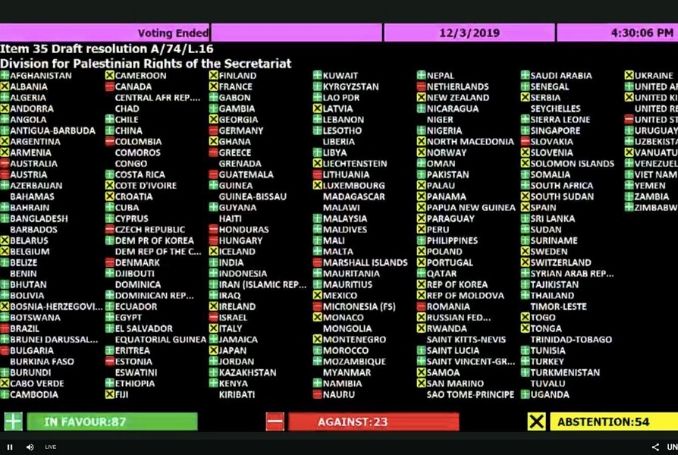
For the first time, 13 countries changed their longstanding positions and voted against a pro-Palestine measure at the United Nations on Tuesday.
Germany, the Czech Republic, Austria, Bulgaria, Denmark, Estonia, Greece, Lithuania, Netherlands, Romania, Slovakia, Brazil, and Colombia voted against the annual resolution regarding the “Division for Palestinian Rights of the Secretariat”, according to the Times of Israel.
They had previously abstained on the vote.
The resolution, which includes a call to halt to illegal Israeli settlements being constructed in the occupied West Bank, still passed with a large majority voting in favor.
The Palestinian representative told the council: “If you protect Israel, it will destroy you all.” He also said Israel’s character as a Jewish state is “shameless racism”.
The New York-based Division for Palestinian Rights oversees the Committee on the Exercise of the Inalienable Rights of the Palestinian People.
The resolution was co-sponsored by Comoros, Cuba, Indonesia, Jordan, Kuwait, Lao People’s Democratic Republic, Qatar, Saudi Arabia, Senegal, the United Arab Emirates, and Yemen.
The UK, France, and Spain abstained, as they do every year, allowing the resolution to pass with a vote of 87-54, with 21 other abstentions.
The General Assembly adopted five resolutions on the question of Palestine and the Middle East, including one calling on the Member States not to recognize any changes to the pre-1967 borders, including with regards to Jerusalem, other than those agreed by the parties through negotiations.
Chief Rabbi’s Pious Bid to Sabotage Corbyn

Chief Rabbi Ephraim Mirvis speaking in London, 24 March 2015. Credit: Foreign and Commonwealth Office/ Flickr)
By Stewart Littlewood | American Herald Tribune | December 5, 2019
The mainstream media failed to make the connection between Chief Rabbi Ephraim Mirvis’s brazen intervention to damage Jeremy Corbyn’s election chances and the Shai Masot affair three years ago. And, indeed, all the other orchestrated media smears against the Labour Party leader since then.
So who is this interfering rabbi? Mirvis came to the UK via South Africa, Israel and Ireland and succeeded Jonathan Sacks (bizarrely elevated to the Lords) as Chief Rabbi in 2013. Now Mirvis puts the boot in – right in the middle of the general election campaign – with a stinging outburst in The Times.
As I don’t subscribe to The Times I’ll quote from the Jewish Chronicle report:
… the Chief Rabbi said: “The claims by leadership figures in the Labour Party that it is ‘doing everything’ it reasonably can to tackle the scourge of anti-Jewish racism and that it has ‘investigated every single case’ are a mendacious fiction.”
Without referring to Mr Corbyn by name, Rabbi Mirvis asks: “How complicit in prejudice would a leader of Her Majesty’s opposition have to be in order to be considered unfit for high office?”
He then adds: “Would associations with those who have openly incited hatred against Jews be enough?
Rabbi Mirvis insists he decided to speak out on behalf of the Jewish community.
He says: “The Jewish community has endured the deep discomfort of being at the centre of national political attention for nearly four years.
“We have been treated by many as an irritant, as opposed to a minority community with genuine concerns.”
In a sustained attack on Mr Corbyn’s party, he writes: “The party leadership have never understood that their failure is not just one of procedure, which can be remedied with additional staff or new processes.
“It is a failure to see this as a human problem rather than a political one. It is a failure of culture.
“It is a failure of leadership. A new poison – sanctioned from the very top – has taken root in the Labour Party.”
“A failure of culture” (er, whose culture)?
“A new poison”?
“Openly inciting hatred”?
Mirvis is reported to have accompanied Sacks on the annual Jerusalem Day March of the Flags in 2017. Haaretz correspondent Bradley Burston describes it as “an annual, gender-segregated, extreme-right, pro-occupation religious carnival of hatred, marking the anniversary of Israel’s capture of Jerusalem by humiliating the city’s Palestinian Muslims. We knew what was coming from previous years, in which marchers have vandalized shops in Jerusalem’s Muslim Quarter, chanted: ‘Death to Arabs’ and ‘The (Jewish) temple will be built, the (Al Aqsa) Mosque will be burned down,’ shattered windows and door locks and poured glue into the locks of shops forced to close for fear of further damage.”
And in 2015 Burston wrote: “The Flag Parade, and with it, Jerusalem Day, has come to symbolize the worst in us. Arrogance, xenophobia, brute dominance, racist hatred. A march of, by, and for, the worst of our worst.”
So we don’t need lectures on culture, poison or racial hatred from people who hobnob with the worst of Israel’s worst.
People in stained-glass houses shouldn’t throw stones
The Archbishop of Canterbury, Justin Welby, tweeted: “That the chief rabbi should be compelled to make such an unprecedented statement at this time ought to alert us to the deep sense of insecurity and fear felt by many British Jews.” As a result of which a leading campaigner against racism immediately resigned from a Church of England advisory body in protest. Gus John, a respected author and academic, said: “As a matter of principle, I cannot continue to work with the Anglican church… after the archbishop of Canterbury’s disgraceful endorsement of the chief rabbi’s unjust condemnation of Jeremy Corbyn and the entire Labour party.” He wrote to the CofE’s national adviser on minority ethnic issues: “Those who occupy houses clad with stained glass should perhaps be a trifle more careful when they join others in throwing stones”.
Ever since Corbyn was elected leader of the Labour Party, the pro-Israel lobby has been terrified by the possibility that, if he becomes prime minister, Britain’s supine tolerance of Israel’s crimes against Palestinians and other Arab neighbors will end, and so will trade and arms deals.
Over two years ago Israeli insider Miko Peled, a former Israeli soldier and the son of an Israeli general, warned that Israel was going to “pull all the stops, they are going to smear, they are going to try anything they can to stop Corbyn” and the reason anti-Semitism is used is because they have no other argument.
And his prediction was spot-on.
IHRA definition of anti-Semitism ‘is not fit for purpose’, ‘is open to manipulation’, ‘has no legal effect’, ‘should not be adopted’
Since then we’ve had a queue of high profile Labourites and others sticking the knife into Corbyn, including Zionist extremist Sacks and ex-prime minister Gordon Brown, a dedicated pimp for Israel and dyed-in-the-wool Zionist. Brown insisted that the IHRA definition “is something we should support unanimously, unequivocally and immediately.” He urged Corbyn to remove the “stain” of prejudice from Labour by writing the definition and all of its examples into the party’s new Code of Conduct.
He obviously wasn’t paying attention to the Home Office Select Committee which had recommended two caveats or to eminent legal minds Hugh Tomlinson QC and Sir Stephen Sedley who explained how the IHRA’s diktat is trumped by our right to free expression, which is part of UK domestic law by virtue of the Human Rights Act (something every Labour member ought to know and uphold) and other conventions. Added to which Geoffrey Robertson QC warned that the IHRA definition is “not fit for any purpose that seeks to use it as an adjudicative standard. It is imprecise, confusing and open to misinterpretation and even manipulation.”
Robertson added: “The Government’s ‘adoption’ of the definition has no legal effect and does not oblige public bodies to take notice of it. The definition should not be adopted, and certainly should not be applied, by public bodies unless they are clear about Article 10 of the European Convention on Human Rights which is binding upon them, namely that they cannot ban speech or writing about Israel unless there is a real likelihood it will lead to violence or disorder or race hatred.”
Had everyone forgotten that the state of Israel was founded by terror groups like the one that murdered 91 in an attack on the British mandate government in the King David Hotel and carried out the Deir Yassin massacre? Israel is the expert in terror. As Norman Finkelstein remarked, “It is more than a rogue state. It is a lunatic state… The whole world is yearning for peace, and Israel is constantly yearning for war.”
And the Israeli government was described by one of Brown’s own (Jewish) MPs, the late and much respected Sir Gerald Kaufman, as a ‘gang of amoral thugs’.
Corbyn a loose cannon who had to be ‘spiked’
Mirvis and others of his ilk fail to understand that the mounting dislike of pro-Israel Jews is due to the failure of people like him to condemn the Israeli regime’s decades-long brutal oppression and foul crimes against our Palestinian friends – Muslim and Christian. Has anyone ever heard Mirvis or Sacks or any of the so-called leaders of the Jewish community here call out Netanyahu and these thugs for their hateful behavior and inhumane policies?
Corbyn isn’t the problem, Zionists are. Corbyn has a long record of support for the Palestinians and other justice causes. He has spent a lifetime campaigning against racism. He has met and spoken with Israel’s enemies, and so what? They are no our enemies. But it doesn’t sit well with the eminence grise pulling the strings. As a loose cannon in a carefully controlled political battlefield, he has to be ‘spiked’. The chosen way to do that is to pick off his allies one by one and, with the help of a compliant media, derail his party’s election prospects by weaponizing so-called anti-Semitism against Labour’s naive and easily scared troops.
But why would anyone take allegations of anti-Semitism seriously from bully-boys who themselves practice or support racism? It is long past time Labour’s Friends of Israel were questioned about their shameless support for the criminal state and its land-grabbing Zionist Project. From the start – before Balfour even – this was unashamedly racist in purpose, as illustrated only last year when Israel enacted Nation-State laws that discriminate against its non-Jewish citizens making them distinctly second-class. There is no place in a socialist organization, or in British public life at all, for people who cannot bring themselves to condemn a regime that behaves in such an obscene manner towards its neighbors, defies international law, thinks it’s exempt from the norms of decent conduct and shows no remorse. What does aligning with apartheid Israel really say about them?
And, by the way, who said it’s OK to use any British political party as a platform to promote the interests of a foreign military power? If people holding public office put themselves in a position where they are influenced by a foreign power, they flagrantly breach the Principles of Public Life. There are far too many Labour and Conservative MPs and MEPs who fall into that category and get away with it.
Pattern of subversion
The upsurge in carefully orchestrated allegations of anti-Semitism coincided with the arrival of Mark Regev as Israel’s new ambassador in London. Regev is big trouble – an ace propagandist, the mastermind of Israel’s hasbara Lie Machine and former spokesman for Israel’s extremist prime minister. Shortly after he took up his post came revelations that a senior political officer at the embassy, Shai Masot, had been plotting with stooges among British MPs and other maggots in the political woodwork to “take down” senior government figures including Boris Johnson’s deputy at the Foreign Office, Sir Alan Duncan.
The Foreign Office and Johnson promptly dismissed the Shai Masot affair, saying: “The UK has a strong relationship with Israel and we consider the matter closed.” The Speaker of the House of Commons John Bercow, who is Jewish, also declined to investigate.
But Masot was an employee of the Israeli embassy and probably a Mossad agent. His hostile scheming was captured and exposed by an Al Jazeera undercover investigation and not, as one would have hoped, by Britain’s own security services and press. And this is when the escalation to de-stabilize really began. Funny how the mainstream failed to connect Corbyn’s election as Labour leader in September 2015, Regev’s arrival in April 2016 and Masot’s activities later that year. Subversion peaked again at general election time in 2017 and raises its ugly head yet again at election time right now with Mirvis and the Jewish Labour Movement’s submission of 70 sworn statements by serving and ex-Labour officials to the Equality & Human Rights Commission’s inquiry. The JLM is urging the Commission to make Labour acknowledge that it is “institutionally anti-Semitic”.
OK, so Corbyn isn’t the leader he should be. But who is, in the never-ending parade of élite political screwballs? I have sympathy with Mirvis’s concerns that the Party is too lackadaisical over its handling of anti-Semitism complaints, having looked into a couple of them myself. They take an absurdly long time to investigate and lack ‘due process’. And I wonder why the Party, in a situation like this, is so stupid that it cannot provide a running total of cases outstanding, upheld and rejected.
I’d also like to know what happens to the troublemakers who hurl malicious and baseless accusations. Are they exposed and thrown out of the Party too? I don’t suppose so – there’d be even more screams of “anti-Semitism!”
When holidays bring hate: Sarah’s Day in Occupied Hebron

Extremist and racist propaganda placed around Hebron (H2) ahead of Sarah’s Day, a major Jewish holiday.
International Solidarity Movement | November 28, 2019
Hebron, occupied Palestine – The Jewish holiday of Shabbat Chayei Sarah (Sarah’s day’) took place in Al Khalil (also known as Hebron) over the weekend of 22-23 November. Over the two days around 50,000 Israeli settlers flocked to the city, to celebrate the festival in the place that Zionists believe is their religious right (despite the fact that it is historically Palestinian and is clearly within the demarcation of Palestinian Territories).
For weeks the area was being adapted and prepared to accommodate the thousands of visitors. Israeli settlers from nearby illegal settlement Kiryat Arba were to be joined by other observant Jews from across Israel, as well as from countries abroad such as France, the UK, and the USA. The mood was set by blatant Zionist propaganda adorning the streets, such as a banner proclaiming “Palestine never existed – and never will”. Whole areas of the old city and surrounding areas were taken over by gazebos, tents and caravans for the weekend. Exclusive and expensive VIP tickets to celebrate ‘Sarah’s day’ were available for hundreds of US dollars, enabling attendees to meet and dine with religious leaders, alongside Knesset members, and IDF commanders.
By Friday afternoon, thousands of celebrants had arrived in the city and the already extensive Israeli Occupation Force (IOF) presence (normally 4000 IOF soldiers guard the 400 Israeli settlers) was even greater than usual. Enhanced security measures were in place and major roads were blocked off, obstructing Palestinian movement around the city, and forcing Arab shops to close for business in an already suffocated economic environment (due to businesses and areas being closed by military order, and commerce/tourism heavily suppressed by restrictions on movement through checkpoints).
Many of the visiting settlers were visibly armed, with handguns or automated weapons, in stark contrast to Palestinians for whom it is illegal to carry a weapon, tightly enforced at all of the numerous checkpoints.
Each day International Solidarity Movement (ISM) received reports of serious, violent attacks on Palestinians living in or passing through vulnerable areas where settlers filled the streets.
On Friday evening, on the ‘Prayer Road’, leading up to the large settlement of Kiryat Arba, a group of 8 Palestinians were attacked in a barber shop. ISM spoke to one of the victims, Fayed, who reported a large group of settlers forcing entry to his father’s shop. Despite attempts to persuade the settlers to leave, more arrived to join the attack. Up to 100 settlers sprayed pepper spray, threw stones, chairs and pieces of wood, damaging property and injuring Fayed, his brother, his uncle and father. Fayed’s 21 year old cousin suffered a broken hand, whilst he and his uncle and father sustained injuries to the head and arms, resulting in hospitalization. The police eventually moved the settlers on however no arrests were made. Only basic details of the attack were taken down and there has been no further investigation of the crime.
Later that night there were further reports of violent attacks by groups of settlers in the same area, including an assault on a young old child, who was kicked and sprayed with pepper spray, requiring him to be taken to hospital. A Palestinian bride was also harassed and attacked by settlers as she celebrated her wedding day.
Despite the heaviness of occupation pressing down on them, the brutal and unprovoked attacks from the settlers, and frustration at the lack of protection from the authorities, Fayed and his family are quietly resistant. “Our life here is hard, but we have to resist. We try to be nice to everyone… to treat them nice, we don’t want any violence. Violence is not the solution…. the settlers carry M16 guns. It’s normal for us and our situation here – to be attacked, arrested, killed. We grew up like this. What can we do? We don’t have a lot of power or support. We can’t fight with guns or knives, this is not the solution. How many Palestinians have been killed? Guns and knives are not free, they do not make Palestine free. We are not against Jews, we are against Zionists and settlers, and those that occupy our houses. ”
The following day, the entire old city plus large swathes of the normally unrestricted area (known as ‘H1’) was locked down, making way for thousands of settlers to be given religious tours of the city. Many were intoxicated, chanting provocative anti-Palestinian songs, shouting abuse, and urinating on Palestinian property. As the day progressed, their behavior became increasingly violent, with numerous incidents of settlers throwing rocks, bottles and other items at Palestinian people and homes, as well as unlawfully entering or climbing on Palestinian property. IOF remained passive, merely supervising the passage of the crowds through Palestinian areas.
In one shocking incident, a group of settlers attacked the home of a known Palestinian activist, Imad, who has been frequently targeted since speaking out against the murder of a Palestinian by the IOF several years ago.
Imad and his family are some of the few Palestinians brave enough to continue living in Tel Rumeida, part of an area in the heart of the old city which has been designated a restricted military zone (known as ‘H2’). Since 1968 Al Khalil has been subject to the establishment of illegal Jewish settlements, and over the last 20 years, the area has seen a huge influx of hardcore settlers who believe for religious reasons they have a right to occupy the land. These are some of the most extreme settlers in Israel, who routinely perpetrate abuse and violence against Palestinian residents, including children going to school. Many Palestinians have been forced out of their homes and for those who remain, living in this area is extremely dangerous for Palestinians. There is a daily threat to life and limb.
On Saturday, as the streets of Tel Rumeida were inundated with thousands more armed settlers, the violence and intimidation escalated. There were multiple reports of attacks on Palestinian people and property. Footage was recorded of large groups of drunk settlers climbing on the roofs of Palestinian homes, and abusing and intimidating residents.
On Saturday Imad remained confined at home with his grandchildren, due to the large numbers of settlers who had been marching and congregating in the streets outside, making it unsafe for Palestinians to leave the house. Imad heard settlers climbing on his roof, and trying to enter his home through the entrance way. He called friends to come and help. and unsuccessfully tried to convince the settlers to leave. The large group were shouting abuse, spitting and throwing stones at bottles. Moments later Imad heard crying from where his 18 month old grandson was sleeping. As he ran into the room he discovered that a settler had thrown a stone through the open window, striking the child on the head and wounding him.
Due to the closed and restricted nature of this part of the city, an ambulance was unable to reach the house to attend to the child. The child had to be carried through the streets, protected by a circle of local people from the settlers who continued to try to attack the group as they tried to reach the ambulance.
Imad explains that the IOF soldiers arrived at the house during the attack, however they only stood watching, and failed to intervene to stop the violence. When local Palestinian’s arrived to provide support, the soldiers pushed and held them back, threatening to arrest them. The IOF also failed to provide any first aid or show concern for the injured child.
Despite the heavy IOF and Israeli police presence throughout the city during this weekend, it was abundantly clear that they were there to protect the settlers, and not the Palestinian residents. There was a complete failure to protect the Palestinians under attack. Police also failed to undertake any investigation into the various incidents, or attempt to bring to justice those settlers engaging in violence against Palestinians.
This raises concerns that the IOF are turning a blind eye to the violence, sanctioning and enabling it to occur, or alternatively that they simply have no power or authority to control the settlers’ violence. The risk for Palestinians trying to resist the occupation and violence, such as Imad, is to be punished, singly or collectively, for their defiance in the face of the creeping genocide of the Palestinian land and people.
Whilst trying to document and observe violence and abuse, ISM experienced hostility and aggression from both settlers and the IOF, including physical and verbal threats, restriction of movement as well as having our passports photographed by police and threatened arrest, in a clear attempt to deter us from our work. Pro-Palestinian activists in Israel risk deportation, including a 10 year ban from the country, serving to silence and prevent the documenting of human rights violations in Palestine.
Is Criticism of Israel Already an Official Hate Crime in America?
By Philip Giraldi – American Free Press – December 2, 2019
One subject that congressmen and the mainstream media tend to avoid is the erosion of fundamental liberties in the United States as a consequence of the war on terror and American involvement in the Middle East. Some of America’s legislators apparently do not even understand that freedom of speech actually means that one can say things that others might find distasteful. The assault on freedom of speech has been accelerated through the invention of so-called “hate speech,” which has in turn morphed into “hate crimes” where punishments are increased if there is any suggestion that hatred of groups or individuals is involved. Some have rightly questioned the whole concept, pointing out that if you murder someone the result is the same whether you hate your victim or not.
Freedom of speech is particularly threatened in any situations having to do with Israel, a reflection of the power of that country’s lobby in the United States. At a recent town hall gathering, Rep. Dan Crenshaw (R-Texas) demonstrated how he and his colleagues run and hide whenever the issue of Israel is raised when he would not respond directly to a question over whether any criticism of Israel should or should not be protected under the First Amendment. Crenshaw is a Republican and generally reliably conservative, though he recently spoke out against the “For the People Act of 2019,” which he claimed “would limit free speech dramatically.”
A constituent specifically asked Crenshaw’s opinion about federal laws that require citizens in some states to sign a pledge that they will not boycott Israel if they wish to get government contracts or obtain a government job. The audience member also mentioned a law passed in Florida that bans anti-Semitism in public schools and universities, defining “anti-Semitism” as criticism of Israel. The constituent observed, “These laws are obviously flagrant and troubling violations of the First Amendment to free speech.”
“Will you honor your oath and denounce these laws here, now and forever?” Crenshaw was then asked. Crenshaw quickly fired back that the critic was “cloaking yourself in the First Amendment” to enable engaging in “vehement anti-Semitism.” Crenshaw then asserted that the questioner was “advocating the BDS movement,” a recent target of much of the legislation that the critic was addressing.
BDS refers to the Boycott, Divestment, and Sanctions movement, which calls on people to protest Israel by pulling investments from and boycotting the country.
Israel is engaged in what might be described as a war with the objective of driving any and all criticism of the Jewish state out of polite discourse, making it illegal wherever and whenever possible. The Knesset has passed legislation criminalizing anyone who supports BDS and has set up a semi-clandestine group called Kella Shlomo to counteract its message. The country’s education minister has called BDS supporters “enemy soldiers” and has compared them to Nazis. Netanyahu has also backed up the new law with a restriction on foreigners who support the BDS movement entering the country, including American Jewish dissidents, several of whom have been turned around at the airport and sent home.
Israel has been particularly successful at promoting its own preferred narrative, together with sanctions for those who do not concur, in the English language speaking world and also in France, which has the largest Jewish population in Europe. The U.S. government under Donald Trump is completely under the thumb of the Israeli prime minister’s office, with Secretary of State Mike Pompeo recently saying “our major focus is stamping out anti-Semitism.”
Sanctions already in place in Europe consist of fines and even jail time. The legal penalties come into play for those criticizing Israel or questioning the accuracy of the accepted holocaust narrative, i.e., disputing that “6 million died.” Even attacking specific Israeli government policies, like its slaughter of Palestinians in Gaza every Friday, can be found guilty of anti-Semitism, which is now considered a hate crime in Britain, France, Germany, and, most recently, the Czech Republic. In Britain, where the Jewish lobby is extremely strong, a law passed in December 2016 made the UK one of the first countries to use the definition of anti-Semitism agreed upon earlier in the year at a conference of the Berlin-based International Holocaust Remembrance Alliance (IHRA).
A statement from the British prime minister’s office at that time explained that the intention of the new definition was to “ensure that culprits will not be able to get away with being anti-Semitic because the term is ill-defined, or because different organizations or bodies have different interpretations of it.”
The British government’s own definition relies on guidance provided by the IHRA, which asserts that it is considered anti-Semitic to accuse Jews of being “more loyal to Israel or their religion than to their own nations, or to say the existence of Israel is intrinsically racist.” In other words, even if many Jews are more loyal to Israel than to the countries they live in and even though Israel is in fact intrinsically racist, it is now illegal to say so in Great Britain.
One should not be surprised, as the British government’s subservience to Jewish and Israeli interests is nearly as enthusiastic as is government in the United States, though it is driven by the same sorts of things—Jewish money and Jewish power, particularly in the media. A majority of Conservative Party members of parliament have joined Conservative Friends of Israel, and the Labour counterpart is also a major force to be reckoned with on the political left.
Here in the United States, the friends of Israel appear to believe that anyone who is unwilling to do business with Israel or even with the territories that it has illegally occupied should not be allowed to obtain any benefit from federal, state or even local governments. Constitutional guarantees of freedom of speech and association for every American are apparently not valid if one particular highly favored foreign country is involved, as the discussion with Crenshaw reveals.
Twenty-seven states now have laws sanctioning those who criticize or boycott Israel. And one particular pending piece of federal legislation that is regularly re-introduced into the Senate would far exceed what is happening at the state level and would set a new standard for deference to Israeli interests on the part of the national government. It would criminalize any U.S. citizen “engaged in interstate or foreign commerce” who supports a boycott of Israel or who even goes about “requesting the furnishing of information” regarding it, with penalties enforced through amendments of two existing laws, the Export Administration Act of 1979 and the Export-Import Act of 1945, that include potential fines of between $250,000 and $1 million and up to 20 years in prison.
Israel, and its friends like Crenshaw, are particularly fearful of the BDS movement because its non-violence is attractive to college students, including many young Jews, who would not otherwise get involved on the issue. The Israeli government clearly understands, correctly, that BDS can do more damage than any number of terrorist attacks, as it represents a serious critique of the behavior of the Jewish state while also challenging the actual legitimacy of the Israeli government and its colonizing activity in Palestine. Much of the current hate crime legislation in places like Germany and the Czech Republic directly targets BDS, stating specifically that it is “inherently” anti-Semitic. In late July, the House of Representatives overwhelmingly passed its own resolution condemning BDS explicitly in a 398-to-17 vote.
Going hand-in-hand with the condemnation of BDS is a drive to maintain the exclusivity of Jewish suffering. In June, when Rep. Alexandria Ocasio- Cortez (D-N.Y.) called border detention centers holding asylum seekers “concentration camps,” she was inundated with protests from Jewish groups that claimed she was denigrating the holocaust and “insulting victims of genocide.” The United States Holocaust Memorial Museum even published a statement objecting to comparisons between “the holocaust and other events.”
It is important for Americans to realize that Israel not only spies on the U.S., digs its paws deep into our Treasury, and perverts Washington’s Middle East policy, it is also attempting to dictate what we the people can and cannot say. And Congress and much of the media are fully on board, which is the real tragedy.
French MPs pass pro-Zionism resolution, defy warnings by advocates of Palestine rights
Press TV – December 4, 2019
The lower house of France’s Parliament has passed a nonbinding resolution equating criticism of the Zionists occupying Palestinian territories with anti-Semitism, defying warnings that such a move could serve to stifle the advocates of Palestinian rights.
The National Assembly passed the resolution on Tuesday, with 154 votes for and 72 against, various media outlets reported.
The resolution states, “Criticizing the very existence of Israel as a collective composed of Jewish citizens is tantamount to hatred towards the Jewish community as a whole.”
“Such abuses increasingly make anti-Zionism ‘one of the contemporary forms of anti-Semitism’ in the words of the President of the Republic,” it adds, citing French President Emanuel Macron.
The Zionist entity proclaimed existence in 1948 after occupying huge swathes of regional countries during a Western-backed war.
Right before the war, it had already gone on a campaign of ethnic cleansing that lasted until 1949, leading to the expulsion of between 750,000 and 850,000 Palestinians from their homeland while the Israeli regime was replacing them with a similar number of Jewish migrants.
Still using far-and-wide Western backing, the regime staged another wholesale war in 1967 that saw it seizing more chunks of land, including the West Bank, East Jerusalem al-Quds, the Gaza Strip and parts of Syria’s Golan Heights.
Many Jews worldwide are opposed to the occupation of Palestinian land and reject the Zionist concept of Israel being a legitimate Jewish state, arguing that the Zionist entity has hijacked their religious identity so it could push ahead with its land theft agenda.
Israeli Minister of Strategic Affairs Gilad Erdan applauded the French lawmakers’ approval of the resolution, urging Paris to take “practical steps” against the international pro-Palestine Boycott, Divestment, and Sanctions (BDS) movement.
Inspired by the South African anti-apartheid movement, the BDS was initiated in 2005 by over 170 Palestinian organizations and later turned international. It is meant to initiate “various forms of boycott against Israel until it meets its obligations under international law” and end its occupation of Palestinian lands.
The French MPs’ move came despite earlier warnings by activists and rights organizations that such a resolution could work to block any criticism of the occupying entity.
In a letter to National Assembly President Richard Ferrand in October, 39 organizations said the resolution would compromise “defense of freedom of expression and assembly for groups and activists that must be allowed to defend the rights of Palestinians and criticize Israel’s policy without being falsely accused of anti-Semitism.”
The resolution would also “weaken the universalist approach” to combating all forms of racism,” the letter added.
As the French legislators were about to adopt the measure, a group of 129 Jewish and Israeli scholars signed a petition calling on the parliament to vote against the resolution.
The signatories said, “It is cynical and insensitive to stigmatize them (Palestinians) as anti-Semites for opposing Zionism… They oppose Zionism not because they hate Jews, but because they experience Zionism as an oppressive political movement.”
Speaking to France 24, James Cohen, a professor at the Université Sorbonne Nouvelle Paris 3 and one of the signatories, said that “by equating anti-Zionism with anti-Semitism, you’re broadening the definition of anti-Semitism too much […] you’re going very far afield.”
Only 19.7% of Americans agree with US State Dept on Israeli settlements
IRmep Poll: “International law SHOULD APPLY to Israel’s military occupation & colonization of the West Bank, Golan Heights, E. Jerusalem and displacement of their indigenous populations. Do you Disagree or Agree?”
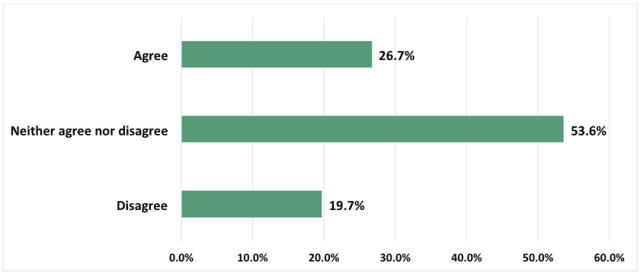
More than 80 percent of Americans seem unwilling to let Israel reinterpret international law to suit its colonialist agenda.
By Grant F. Smith | IRmep Polls
IRmep representative public opinion poll of 2,034 American adults through Google Surveys on November 20-22. Answer order randomly reversed.
Most American adults of voting age don’t appear willing to reject the applicability of international law to Israel’s ongoing colonization of occupied territories in East Jerusalem, the West Bank and Golan Heights.
On Monday, November 18, U.S. Secretary of State Mike Pompeo reversed a 1978 State Department legal opinion stating that Israeli settlements were “inconsistent with international law.” Citing President Ronald Reagan’s 1981 assessment that the settlements were not “inherently illegal,” Pompeo stated that, “After carefully studying all sides of the legal debate… the establishment of Israeli civilian settlements in the West Bank is not, per se, inconsistent with international law.”
The Trump administration relocated the U.S. Embassy from Tel Aviv to Jerusalem in 2018 and recognized the city as the capital of Israel. This most recent announcement is yet another blow to rule of law and international consensus. However, when polled, 53.6 percent of Americans don’t yet appear ready to register any concrete view on the matter. This may be due to the longstanding absence of serious U.S. mass media coverage of historical and legal issues. In other countries, informed and ongoing international legal analysis is the norm. Given that reality, it is surprising that 26.7 percent of Americans believe international law still applies, while only 19.7 percent believe it does not.
In a Nov. 21 letter sent to Pompeo, 107 House Democrats condemned the State Department’s recent decision on settlements.
Grant F. Smith is the director of the Institute for Research: Middle Eastern Policy in Washington, DC. For more IRmep polls, visit https://IRmep.org/Polls.
Israeli Minister of Defense to Impose Sanctions on Palestinian ‘Militants’ Abroad
IMEMC & Agencies – December 3, 2019
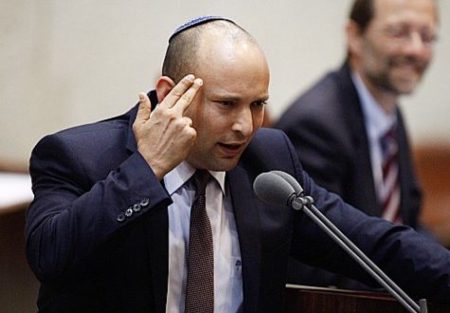
Israeli Minister of Defense, Naftali Bennett, on Tuesday, issued a written order imposing international economic sanctions on Palestinian militants abroad, The Palestinian News and Info Agency reported.
Hebrew media outlets broadcast Bennett’s decision, pointing out that this move has never been attempted before.
Bennett issued his first order against Jamil Hersh, a member of the Arab Society for Human Rights in London, members of Lebanon’s Hezbollah party will also be sanctioned.
Say No To The US-Israel Mutual Defense Pact
By Eric Striker | National Justice | December 3, 2019
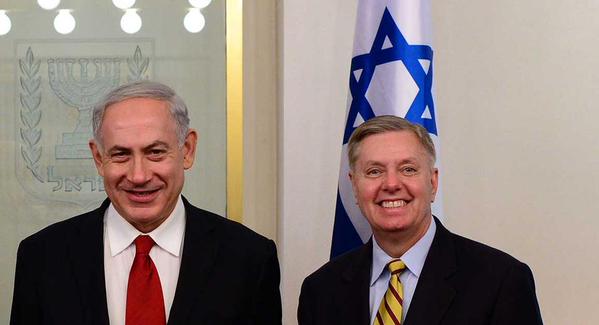
Last September, Donald Trump and Benjamin Netanyahu hinted that they were working on a mutual defense pact. Such a treaty, if signed, would officially and permanently mandate an American military intervention if Israel were to ever start a conflict with its neighbors.
The Trump administration is desperate to get this done, but Netanyahu is having trouble selling the idea to his rival Benny Gantz. The Likud party has so far been unable to form a government and Netanyahu is battling corruption charges. As a side note, two major GOP donors, Sheldon Adelson and Larry Ellison, are defense witnesses in Bibi’s case.
The major reason why some sectors of the Israeli state want Netanyahu gone is that they believe his government’s belligerence is responsible for Iran’s stunning rise. Netanyahu has chosen Israel-above-all unilateralism using Zion’s cats-paws in Washington to try and bully Tehran, but have walked all over Chinese and Russian interests in the process.
Two years into the Trump/Israel “maximum pressure” campaign, Iran is not only more powerful than before, it is participating in joint war games with China and Russia. This has angered competing Jewish factions inside Israel, who preferred the Obama method of passively subverting Iran through its countries pro-US/pro-Europe “moderate” liberal reformists. Hassan Rouhani, who they saw as the Persian “Gorbachev,” has now been fully discredited in the eyes of his people thanks to Trump and Netanyahu.
While all segments of Israeli society are having a public debate on the pros and cons of a military pact for their country, here in the US nobody has consulted with the 1.3 million active-duty American servicemen who will die in a world war to expand Israel’s borders.
JINSA’s Plan
Lindsay Graham has told Jews at private events that he is working on this bill and is confident it will be ratified in the Senate. So far, the only people within US borders participating in this conversation are the Republican Jewish Coalition and JINSA (Jewish Institute for National Security of America). The latter fifth column is writing the terms of the treaty.
Last July, JINSA released details of the pact they want Graham to push through, titled “For a Narrow US-Israel Defense Pact,” which can be obtained online (I will not link to downloads on JINSA’s website for security reasons).
The policy paper demands that Israel be granted special access to intelligence collected by the “Five Eyes Alliance” (Australia, UK, New Zealand, Canada and the US), officially turning the entire Anglo-Saxon world into a global Jewish spy network (which is already unofficially true).
Furthermore, it calls on the war clause be triggered if any country “threatens” to use chemical or nuclear weapons against the Jewish state or physically undermines Israel’s economic activities. This is very open-ended.
The most ludicrous part of the Graham/JINSA treaty is section 3.4, where Israel is under no obligation to notify or seek approval from the United States when it decides to engage in a military attack against another party.
In other words, if Israel decides to start a war with Iran (or China, or Russia, or all of them), it doesn’t have to discuss this with its “ally” first. Israel reserves its right to act unilaterally and America must go along for the ride whether we want to or not.
America gets absolutely nothing from joining such an agreement, except the possibility of a catastrophic world war that can be started by unstable psychopaths like Benjamin Netanyahu without warning, whenever they please.
The US has not signed a mutual defense treaty since 1962.
It’s time the 98% start demanding Donald Trump and Lindsey Graham include us in this debate, and prepare to protest as soon as this bill hits the Senate floor.
French vote one step closer to anti-Zionism ban
By Ramin Mazaheri – Press TV – December 3, 2019
Paris – France’s media has remained nearly silent ahead of a vote on a resolution which is one step away from criminalizing opposition to Zionism.
If the motion passes, in a vote on December 3rd, it will throw open the door to false accusations of anti-Semitism for anyone openly criticising Israeli crimes, war atrocities and its Apartheid policies.
The resolution purposely tries to confuse “Zionism”, which refers to the imperialist and segregationist political project upon which Israel is based, with “anti-Semitism” which is a bigotry against Jews and Judaism that has nothing to do with Israeli massacres and crimes against Palestinians and non-Jews.
The hypocritical irony is that the law arrives just as France is in the midst of its latest wave of Islamophobia. Last month many top, alleged leftist politicians refused to denounce Islamophobia because they said that doing so could mean they are not allowed to publicly criticise the tenets of Islam. Protesters in Paris asked: where are France’s many self-proclaimed defenders of free speech?
The resolution states that, “Criticizing the existence of a Jewish state is a way to express hate towards the entire Jewish community.” Not only is this logically false, but inaccurate: studies show the majority of Jews in Europe are also anti-Zionist. Such a view also unjustly and dangerously tries to hold all Jews responsible for the crimes committed by Israel.
Many believe that nowhere in the world is right and wrong clearer than in Palestine, and the inability to discuss the imperialist, segregationist and constantly murderous project of Zionism will surely lead to more funerals for innocent Palestinians.
Featured Video
10K More U.S. Troops Deploy as Trump Weighs New Iran Strikes
or go to
Aletho News Archives – Video-Images
From the Archives
Genetic baloney in thick slices
MAYBE COULD BE INC.
By Jon Rappoport | No More Fake News | July 8, 2021
Gene research companies tend to come and go. They start out banging and popping like fireworks in the sky, and then they fade out—selling themselves to larger outfits who’ve hired better liars…
Once upon a time, it sounded easy. Start with a disease, find the gene responsible for the disease, and correct the problem.
Then, researchers wondered, was disease the result of one gene or a group of genes acting together?
Either way, the proof would be in devising cures for diseases using gene therapy. “Not yet, but soon…”
And regardless, the major need was: money. Lots and lots of money.
This need required good PR people. “We have to pump up the idea that we’re on the edge of tremendous breakthroughs. We’re always on that edge…”
This hype also needed to obscure the fact that there wasn’t (and isn’t) ANY gene cure for ANY disease. … continue
Blog Roll
 Aletho News
- UK Government Body Kept Files on People Criticizing Prevent Program
- US military withdrawal from Iraq and the collapse of US-Israeli hegemonic project in West Asia
- What does Europe want – a war with Russia?
- She Followed the Actual Data on COVID Vaccines and Masks — Her Career Took a Huge Hit
- Florida AG Sues Pfizer, Bourla Over Deceptive Marketing of COVID Vaccines
- Von der Leyen gifts her spin doctor a job for life
- 10K More U.S. Troops Deploy as Trump Weighs New Iran Strikes /Suliaman Ahmed
- Iranian crew declared Dena training vessel ‘unarmed’ to US warship before deadly torpedo strike: Report
- Iran’s NPT debate moves beyond parliament
- Houthis condemn Saudi claims of attack on Medina
- If Americans Knew
- Israel is squeezing the life out of Palestinians – Daily Update
- The Israeli Right Portrays Islam as Murderous. It Serves a Political Purpose
- Jordan Has Had Enough: King Abdullah’s Scathing Warning to Israel
- Israeli Colonizers (i.e. Settlers) Kill Palestinian Man Near Salfit
- New Google Maps images reveal massive scale of devastation in Gaza
- Jewish supremacy, anti-Palestinian bigotry on display in Israel – Daily Update
- Israeli Soldiers Abduct At Least 22 Across Occupied West Bank
- Eight Palestinians Killed in Israeli Attacks on Gaza
- Israeli former leaders and security chiefs threaten legal action over ‘Jewish terrorism’
- Israel map in LA Times ad includes all land from the river to the sea
- No Tricks Zone
- Green Energy Debacle: German Expert Professor Fritz Vahrenholt Warns Of Severe Economic And Social Consequences
- Two More Paleo Reconstructions Affirm Meters-Higher Sea Levels Across Ireland, Brazil 7000-6000 Years Ago
- New Study: Earth And Venus Surface Warmth Largely Explained By Convection And Lapse Rate, Not CO2 Or Radiation
- 2025 Nature Paper Claiming Worsening Global Drought Gets RETRACTED …Heavily Flawed
- New Study: ‘Global Drought Shows No Detectable Recent Acceleration Under Climate Warming’
- Economic Masterminds: German Socialists Suggest Taxing Productivity Gains Stemming From Using AI
- The South China Sea Has Not Been Cooperating With The Climate Change Narrative
- Energy Crisis: Germany Enters Heating Season With Historically Low Gas Reserve Fill Levels
- New Study: The Antarctic Ice Sheet Gained Mass From 2020-2024 Due To Staggering Snow And Ice Accumulation
- Study: Ocean Heating Rates From Thousands Of Years Ago ‘Dwarf’ Modern Ocean Heating Rates

