The International Zionist Conspiracy
It poisons everything it touches

By Philip Giraldi • Unz Review • December 3, 2019
A recent article by Philip Weiss on the Mondoweiss website lays out an argument that most liberal Jews, like Weiss, are hesitant to support, namely that Jewish power, and more to the point its money, as exercised through the so-called Israel Lobby in the United States and elsewhere, has been the principal enabling force behind the international pariah that the state of Israel has become.
Weiss notes how “most observers accept the antisemitism redlines echoed lately by Bernie Sanders: you are not to speak of an outsize Jewish role in politics. So few write about the Israel lobby, though they know it to be a significant force…” In other words, Sanders, liberal to the core and ostensibly supportive of Palestinian rights, draws a line that forbids any real discussion of Jewish power in the United States even though everyone who has not been asleep is more than aware of just how powerful American Jews, and by extension Israel, are.
Weiss details how the vast sums of money raised by both Democratic and Republican Jews has distorted American politics since the time of President Harry S. Truman. He describes how president after president has backed down versus Israel when confronted by Jewish power and observes that “This is not just a domestic political question, it’s a foreign policy problem. The Israel lobby is the root cause of the Israel Palestine conflict. Consider the two… main causes of the conflict. 1, Israeli settlement/colonialism (or in Zionist terms, the effort to liberate European Jewry from persecution by establishing a Jewish homeland in historical Palestine). 2, Palestinian resistance to 1. Neither of these historical forces would still be a source of serious conflict 71 years after Israel’s establishment were it not for the lobby. Without the blind support of the United States, Israel would have made a deal a long time ago. The country would have followed through on the historic Palestinian concession of 1988 followed by the Arab Peace Initiative of 2001, and accepted partition of the land on highly favorable terms (Israel gets 78 percent). Without U.S. support, Israel would have been internationally isolated and would have grabbed the deal. The Israelis have been able to continue to devour the land only because the United States supports the occupation in international fora, and gives Israeli a diplomatic umbrella against any storm, due to blind bipartisan political backing here.”
Jewish power in America and elsewhere must never be discussed unless it is a discussion involving only Jews, who openly recognize and appreciate the phenomenon. Weiss notes how “Israel lobbyists themselves extol Jewish political power in the U.S. as Israel’s lifeline for money and arms and diplomatic protection” and quotes Michael Koplow of the Israel Policy Forum, who boasts how “I have no qualms about pointing out that the American Jewish community is almost certainly the most influential minority community in the history of the U.S., and possibly in the history of the world. American Jews have worked hard to make it so, and have built a network of outward-facing institutions that protect this privileged position.”
Beyond Weiss’s observations, one might note how Zionist Jews are essentially able to shut down any discussion of Palestine or of Palestinian rights. Given the extreme over-representation of Jews in both the news generation process and in various choke points in the political process, an honest discussion of Israel-Palestine and the actual U.S. interests in the region is extremely difficult to find anywhere in the mainstream media.
In both the 2012 and 2016 Democratic Party conventions, for example, there was considerable pressure from the members of the party base to include language reflective of the need to recognize Palestinian suffering and condemn the Israeli “occupation.” Long-time liberal activist James Zogby pushed for an amendment to the party platform in 2016 calling for “an end to occupation and illegal settlements” in Israel-Palestine. In both conventions, Hillary Clinton interests pushed back and rejected any changes, arguing that they would constitute “terrible mistake[s],” too “one-sided” toward the Palestinians. In both instances there was loud and sustained booing from the floor when the reflexively pro-Israel platform was announced, but the speaker rejected calls for any floor vote.
To cite another example, two weeks ago, California’s Democratic party concluded its fall convention by finalizing what would be included in the state party platform. An amendment promoted by Palestinian supporters was defeated in a floor vote. It was offered by delegate David Mandel, himself a Jew, and called on the party to support “a solution of the Israeli-Palestinian conflict negotiated by the parties that guarantees equality, security and democracy for all, no matter what the final settlement regarding states and borders” and called on party members to “oppose any unilateral annexation of territory, and support the right of all those who were forced from their homes to return to their homelands and receive compensation for their losses.” Mandel’s proposal attracted the ire of Zionist apologists including State Senator Scott Wiener and Assemblywoman Laura Friedman, who asserted that “This amendment cuts to the core of Israel’s ability to be its own state.”
One might observe that the Mandel amendment was pretty mild stuff relatively speaking, even excluding the word “occupation,” and that the Wiener-Friedman riposte is nonsense, but the result was more of the same. Reliably liberal California Democrats delivered the usual pander to Israeli-Jewish interests. They surrendered to the persistent Jews-in-politics demand never to give even one inch when it comes to permitting Israel absolute license to behave badly while at the same time extracting from the United States billions of dollars in subsidies every year.
And the Israel conspiracy might well be regarded as international. In France, which has the largest diaspora Jewish population after the United States, hate legislation which de facto protects only Jews has been employed to shut down any and all criticism. It has become common all across Europe to regard any criticism of Israel as anti-Semitism and therefore as a hate crime, with criminal penalties attached. French comedian Dieudonné, who admittedly is rather pointed in his satire, has been convicted eight times.
And then there is the sad case of Jeremy Corbyn, British Labour Party leader who will be contesting a national election on December 12th. Corbyn has been accused of being an anti-Semite based on his fairly mild defense of Palestinians, which one might have thought to be a good, sound socialist human rights position. And so it would be if Israel were not involved. With the election looming, British Jews have increased pressure on Corbyn and by default are endorsing his conservative opponent Boris Johnson, who has spoken repeatedly about his love of Israel. Britain’s Chief Rabbi Ephraim Mirvis recently produced an article for the influential Times of London declaring Corbyn “unfit for office” because “the way in which the [Labour] leadership has dealt with anti-Jewish racism is incompatible with the British values of which we are so proud — of dignity and respect for all people.”
The good rabbi is not, of course including Palestinians as worthy of “dignity and respect.” He is really only concerned about his own tribe and the “racism” he refers to is largely concentrated among those Britons who are opposed to Israeli government policies. Britain is already in some senses Zionist controlled territory, even more so than the United States. Jews are prominent at many choke points in the media and entertainment industries while 80% of Conservative Party politicians are members of “Conservative Friends of Israel.” The Labour Party is also active engaged with their own version of the same, Labour Friends of Israel, which includes 80 out of the party’s 262 members of parliament.
Finally, International Zionism is very well represented in recent announcements coming from the world of professional sports, where billionaire Jewish team owners take their orders from Israel to combat critics and the scourge of anti-Semitism.
In January 2019 New England Patriots owner Robert Kraft received the Genesis prize, a million-dollar award given annually to Jews “who have attained excellence and international renown in their chosen professional fields.” Kraft’s friend Israeli Prime Minister Benjamin Netanyahu personally presented the plaque and Kraft told the audience that he would use the money to combat anti-Semitism and the BDS (the Boycott, Divestment and Sanctions) movement. He also pledged to add $20 million of his own money to set up a foundation to do more of the same. Kraft enthused “Israel is so special to me and my family… I have sponsored dozens of missions and countless other trips for people to experience Israel for the first time. Spiritually, there is no place like it on earth.”
Perhaps Kraft should move to Israel so he won’t be troubled by allegations of dual loyalty made by people like me. He has now been joined by Britain’s Chelsea football club owner Roman Abramovich, a billionaire investor who has pledged £3.9m ($5 billion) of his own money to support the foundation “to tackle anti-Semitism.” Abramovich was born in the Soviet Union but is an Israeli citizen and lives most of the year in that country. He has been linked to a number of financial scandals.
Kraft, of course, has his own baggage. On February 22nd, 2019, he was charged in Jupiter Florida for “soliciting another to commit prostitution.” Kraft was reportedly video recorded by a hidden camera while engaged in sexual activity within the confines of a seedy enterprise called the Orchids of Asia Day Spa that sold the services of Asian sex trafficked women. The case is still being resolved but Kraft denies the charges and he has plenty of high- priced lawyers to make sure that he walks.
Beyond all that, if one doubts the power of the Jewish/Israel lobby internationally, note one of the first actions undertaken by the new coup government in Bolivia. It has moved to reestablish diplomatic relations with Israel as a top priority. Brazil also sought a closer relationship with Israel after conservative Jair Bolsonaro was elected president and pledged to visit the Jewish state, a promise which he carried out in March. Everyone in the world understands that the way to gain favor with Washington is to go through Israel.
Philip M. Giraldi, Ph.D., is Executive Director of the Council for the National Interest, a 501(c)3 tax deductible educational foundation (Federal ID Number #52-1739023) that seeks a more interests-based U.S. foreign policy in the Middle East. Website is councilforthenationalinterest.org, address is P.O. Box 2157, Purcellville VA 20134 and its email is inform@cnionline.org.
UN: Israeli occupation costs Palestinians $48 billion
MEMO | December 2, 2019
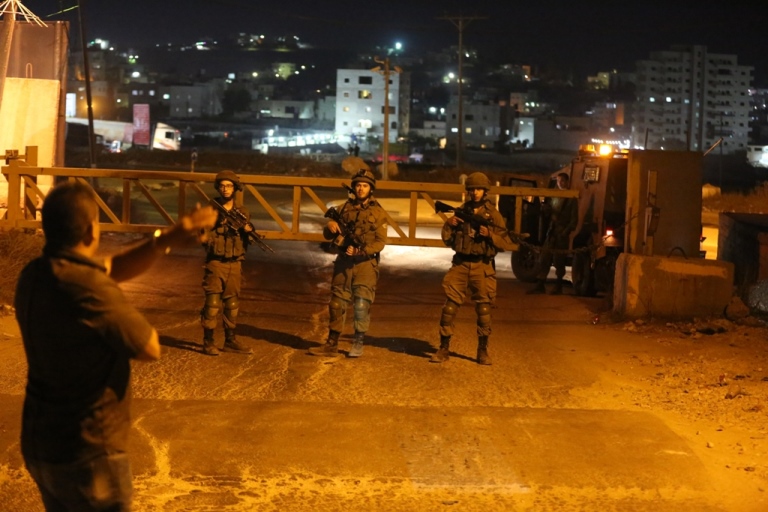
A UN report found that the fiscal cost of Israeli occupation for the Palestinian people in 2000-2017 period is estimated at $47.7 billion, or three times the size of the Palestinian economy in 2017, reports Anadolu Agency.
Mutasim Elagraa, an economist with the UN Conference on Trade and Development (UNCTAD), discussed the report Monday at a news conference in Geneva.
“In the last decade, several UNCTAD studies and reports have addressed the Palestinian fiscal leakage to Israel,” said Elagraa.
The report – entitled Economic cost of the Israeli occupation for the Palestinian people: Fiscal aspects – will be presented to the UN General Assembly on Tuesday.
“This fiscal leakage prompted other international organizations to bring this issue into question, which helped in retroactively retrieving part of the fiscal resources of the Palestinian National Authority (PNA) from Israel,” he said.
The economist said the estimate comprises lost public revenues and interest payments.
According to the report, it includes $28.2 billion in estimated accrued interest and $6.6 billion of leaked Palestinian fiscal revenues to Israel, and the amount continues to rise.
“This estimated cumulative fiscal cost of occupation by Israel would not only have eliminated the Palestinian budget deficit estimated at 17.7 billion US dollars during the same period. It would have also generated a surplus nearly twice the size of the deficit,” Elagraa said.
Alternatively, it would have increased more than tenfold the Palestinian government’s development spending, pegged at $4.5 billion during the period under review, according to the report.
Remember traditional knowledge?
Climate Discussion Nexus | November 27, 2019
If not, don’t worry. Apparently Canadian authorities don’t either. Outgoing Environment Minister Catherine McKenna decided to reduce the number of polar bears the Inuit can hunt in Nunavik, in northern Quebec, despite their claim that from living on the land they knew there were lots. Now a judge has ruled that all that stuff about the wisdom of the ancestors was just virtue-signaling with forked tongue and that when it matters Eurocentric science elbows the ancestors aside. Which is ironic since even Eurocentric science actually says polar bears are flourishing, even if saying so out loud did get Susan Crockford fired.
The back story is that the Makivik Corporation, which represents the Inuit of Nunavik in legal matters, launched a suit in 2016 saying “By and large, Nunavik residents have observed an increase in the polar bear population, and a particularly notable increase since the 1980s.” Despite which Stephen Harper’s environment minister, Peter Kent, had written to the local wildlife board in 2012 asking them to establish the first-ever quota to limit hunting of the big white cute really scary grizzly bears. (Yes, polar bears are a subspecies of grizzlies.) The board, charged with melding western and traditional ways of thinking, ended up establishing a quota of 28 which the federal and Nunavut governments both rejected, annoying the board, which said the federal decision “clearly disregards the extensive body of Inuit traditional knowledge” relying instead “solely on the scientific population estimate.”
Catherine McKenna then cut the quota to 23, prompting Makavik to accuse her of setting “aside entirely the Inuit traditional knowledge” and failing “to even attempt the integration of the two systems of knowledge.” Not that anyone ever said what to do if they seemed to disagree.
The government of course oozed the usual rhetoric about their great respect for Inuit knowledge and claimed the quota was actually above the sustainable harvest rate of 4.5% if the numbers were as western science claimed. And a Federal Court just upheld the decision, though calling for “better communication”, while a spokesman for the minister said “Indigenous peoples are key partners in conserving and protecting nature, and we recognize their unique perspectives, knowledge, rights and responsibilities that can improve conservation outcomes”. But when they say there are so many bears it’s dangerous, well, our global warming computer model says there aren’t and since we’re in Ottawa we’re not worried if we’re wrong.
Michael Bloomberg’s Israel connection runs deep
The Democratic Party’s Michael Bloomberg, has strong ties to Israel and apparently no time for justice for Palestinians; his media empire has also pushed a pro-Israel agenda.

Then-Mayor Bloomberg kissing the Western Wall in Jerusalem on a visit to Israel in 2003 (GETTY IMAGES)
By Kathryn Shihadah – If Americans Knew – November 29, 2019
The pool of democratic candidates for president just expanded again with the addition of billionaire and three-term mayor of New York City, Michael Bloomberg. If Americans Knew has published multiple reports on the candidates’ positions regarding Israel/Palestine (including an in-depth analysis of Joe Biden and a comparison of Elizabeth Warren and Bernie Sanders); it’s only fair to have a look at Bloomberg as well.
The newest candidate has close ties to the Jewish state and asserts a commitment to what he calls “Jewish values.” The New York Times quoted Bloomberg:
The values I learned from my parents are probably the same values that, I hope, Christians and Muslims and Hindus and Buddhists learned from their parents. They’re all centered around God put us on Earth and said we should take care of each other. We have an obligation not to just talk about it but to actually do it. [Those values are] freedom, justice, service, ambition, innovation.
Michael Bloomberg’s record indicates that, when it comes to Palestinians, his close affiliation with Israel has hampered his ability to act on his values of freedom and justice.
Israel ties
Bloomberg has made many trips to Israel and donated millions to charitable causes in Jerusalem, including in 2003 a Mother and Child Center at the Hadassah University Medical Center dedicated to his mother, and in 2007 a blood bank and massive ambulance station named after his father.
During his time as NYC mayor, Bloomberg initiated a $2 billion high-tech research campus in Manhattan, a joint venture between Cornell University and the Technion-Israel Institute of Technology (Haifa, Israel). He personally donated $100 million to the effort.
In 2014, he talked about his closeness to the Jewish state:
My parents saw in our lives just why Israel had to exist, and why it must always exist, and those lessons were passed on to us. We are as one with this city [Jerusalem], and this country and this people as you can be.
[Jewish history] gives us a special obligation to build a brighter future for everyone, and to always believe that tomorrow can be better than today. For them and for so many Jews who witnessed the horrors of World War II, the creation of Israel embodied that obligation and validated that belief. It was a dream fulfilled.After all, if the dream of Israel can be realized, what dream can’t be?
Bloomberg’s words betray a total disregard for the Palestinian experience: the birth of the state of Israel came at the cost of the indigenous Palestinians’ loss of a homeland. 750,000 became refugees, thousands were massacred, and hundreds of villages were bulldozed – so that Jewish immigrants (and a small number of indigenous Jews) could have a nearly Arab-free state.
Michael Bloomberg was the inaugural recipient of the Genesis Prize, which was created to “inspire Jewish pride” and “strengthen the bond between Israel and the Diaspora.” He turned the $1 million prize into a global competition for ten $100,000 prizes – to be awarded to young entrepreneurs who demonstrated “Jewish values” and innovative ideas.
One of those prizes was awarded to Building with Israelis & Palestinians (BIP), which according to its website, “gives an opportunity for people around the world to partner with; and support Israelis & Palestinians willing to build together.” In 2016, BIP worked in the Palestinian town of Al-Auja to provide a solar facility that would enable farmers to pump more water less expensively.
What is not publicized about this project is the fact that in 1967, after Israel’s occupation of the West Bank, about 30% of Al-Auja’s land was confiscated from its Palestinian owners, some of which became four illegal Israeli settlements. More land was then confiscated in order to build a military base to protect the residents of the settlements. Most of the remaining village land is under total Israeli control.
Israeli skies
In 2009, when Israel was embroiled in an invasion of Gaza and the Federal Aviation Administration (FAA) downgraded Ben Gurion Airport’s security rating, then-mayor Bloomberg took his private jet to Israel as a show of solidarity. He visited Sderot, an Israeli city close to Gaza and within range of its rockets (rockets that had, as of that time, caused the deaths of 18 Israelis in 8 years).
Significantly, Sderot was built on the site of the demolished Palestinian village of Najd – a village whose history went back at least four centuries.
Bloomberg did not address the reason for the rockets – Israel’s then-two year long illegal siege of Gaza (a siege that still continues, and is designed to keep the Strip on the verge of collapse and its residents on the edge of starvation). Instead, he Bloomberg accused Gaza’s leaders of “trying to destroy [Israel].”
It would appear that the opposite is true: the Israeli invasion killed over 1,400 Gazans (over 900 of them civilians) and 13 Israelis (3 of them civilians).
In July 2014, during another Israeli onslaught, when Ben Gurion Airport was within reach of Gazan rockets, the FAA announced the suspension of all US flights to Israel; in defiance of this decision and solidarity with Israel, Bloomberg again flew to Israel.
Ignoring the facts of the ongoing blockade of Gaza and the humanitarian crisis that it had created, he wrote in an op-ed:
Every country has a right to defend its borders from enemies, and Israel was entirely justified in crossing into Gaza to destroy the tunnels and rockets that threaten its sovereignty. I know what I would want my government to do if the U.S. was attacked by a rocket from above or via a tunnel from below; I think most Americans do, too. Israel has no stronger ally than the U.S.
Michael Brown noted in the Electronic Intifada that Bloomberg’s op-ed failed to contextualize Israel’s onslaught: no reference was made to the occupation of Palestine or the siege of Gaza, and “[h]e says not a word about Palestinian freedom, but speaks only in general terms about ‘bringing peace to the region.’”
In a CBS interview a short time later, Bloomberg declared that Israel was not under obligation to limit itself to “proportional” response to Gaza’s rockets, and “nobody’s attacking schools or hospitals, we’re attacking Hamas.”
And indeed, Israel was unrestrained. Its 2014 assault killed 2,250 Gazans (about 1,600 civilians) and 73 Israelis (6 of whom were civilians).
Israel’s failure to act with proportionality – and Michael Bloomberg’s endorsement of this failure – clashes with international law, which prohibits attacks that would cause “excessive” civilian damage or loss of life in relation to the anticipated military advantage of the attack.
Israel’s military objective in both 2008-9 and 2014 was to end Gaza’s practice of shooting rockets – rockets that were rarely lethal – but Israel’s attacks caused heavy civilian casualties and immense destruction in a region that was already suffering the effects of an illegal blockade. Because of the disproportionate nature of the attacks and other factors, the United Nations determined that Israel committed war crimes and crimes against humanity in both the 2008-9 invasion (read more about it here) and that of 2014 (read more here). The Hamas leadership in Gaza also faced accusations of war crimes.
Through pro-Israel eyes
Other “small” incidents can be added to the above large, conspicuous examples of Michael Bloomberg’s affinity for all things Israeli.
For example, in 2014, he referred to the nonviolent movement known as Boycott, Divest, and Sanction (BDS) – modeled after the movement that brought the downfall of apartheid in South Africa – as “an outrage” that is “totally misplaced.” The ACLU has argued in favor of BDS as free speech, but Israel partisans routinely label it anti-Semitic.
As early as 2002, Bloomberg’s mainstream media empire, Bloomberg News, was demanding that its writers sanitize news reporting about Israel/Palestine. Mondoweiss quotes leaked memos:
Avoid referring to Palestine, as in “Israel’s incursion into Palestine,” because there is no such country. Instead, describe the occupied areas by their names, as in the West Bank or Gaza Strip. Palestinian people or Palestine Authority is OK.
A 2010 memo gave a selective history lesson:
Palestine signifies different territory in different contexts. The land historically belonged to the kingdoms of Israel and Judah. Palestine represented the area west of the Jordan River that was a British mandate from the 1920s until the creation of modern Israel in 1948.
Significantly, Bloomberg News, usually a stickler for objectivity in reporting, relaxes its standards when it comes to Israel. The above memo – and others circulated in the organization – were understood by Scott Roth, “dissenting Jew” and publisher of Mondoweiss as “an attempt to avoid using the term Palestine in any way that would signify that it ought to be or can be a country on its own.” He also noted that Bloomberg’s directives look:
like something out of an AIPAC primer. The land historically belonged to ancient Israel and Judah? It also belonged to a lot of other people. Plus no reference to partition, ’48, ’67 occupation or millions of human beings living under Israel’s boot that have no vote.
No surprise
The question is whether Michael Bloomberg would be very good for the United States.
From killed Armenian priest in Syria to the roots of hatred and genocide
By Steven Sahiounie | December 1, 2019
Father Hovsep Bedoyan, the head of the Armenian Catholic community in Qamishli, and the priest’s father, Abraham Bedoyan, were killed November 11, on the road leading from Qamishli to Deir Ez Zor, where they were headed to check on the rebuilding of the Forty Martyr’s Armenian Apostolic Church in Deir Ezzor, which was destroyed in 2014 by terrorists who targeted Christians and churches. Deacon Fati Sano of the Al-Hasakeh church was injured in the attack when the car was ambushed at a checkpoint by masked gunmen on motorcycles, which shot at point-blank range. The car they drove was inscribed with the Armenian Church’s logo. The same day, a series of bomb blasts in Qamishli occurred, targeting the Armenian Catholic church, an Assyrian Christian-owned business, and a Catholic school, killing at least 6 people and wounded 22 others. More than 100,000 ethnic Armenians lived in Syria, mainly in the province of Aleppo prior to 2011; however, after the constant targeting of Christians by the Free Syrian Army (FSA) beginning in 2011, thousands have fled and many hundreds went to Armenia, who offered the Syrians a visa, when most of the world had shut its doors to them.
Tens of thousands of Christians from the Assyrian minority fled attacks in 2015, and have not returned. Christians in Homs were targeted very early in 2011 by the FSA, with churches attacked, burned and priests killed. Christians in Damascus were dodging missiles fired into Bab Touma by terrorists, in East Ghouta, until the Syrian Arab Army defeated them and they could walk again safely on the street called straight, from Bible passages about Saint Paul.
In September 2012, the large Christian neighborhood in Aleppo, Azizia, fought the FSA, with Christian civilians holding arms to defend their homes and churches. George, an Armenian Christian of Aleppo said, “The Armenians are fighting because they believe the FSA are sent by their Turkish oppressors to attack them, the Christians want to defend their neighborhoods.”
“FSA snipers were on the rooftops and they were attacking the Maronite church and Armenian residents there,” said a former clergyman calling himself John. A Syrian Armenian mother said, “They are shouting ‘the Alawites to the graves and the Christians to Beirut.”
While many Syrian Christians have resisted leaving Syria, for the life of a refugee abroad. Many have gone even though they were living in safe areas, such as the coast. They saw their Christian countrymen leaving in large numbers, and they feared that the FSA terrorists that the Obama administration was supporting would win, and in that case, they could never live safely in Syria.
Father Hovsep Bedoyan had been visiting Deir Ez Zor every 2 weeks while overseeing the rebuilding of the church there. The France-based association, L’Oeuvre d’Orient, is a Catholic charity aimed at reconstructing infrastructure for the return of the Christian community. Monseigneur Pascal Gollnisch, the group’s head, pointed at Turkey’s recent invasion of Northern Syria: “It is the responsibility of all occupying forces to protect the safety of the local Christian minority,” he insisted.
The United Nations (UN) estimates that almost 200,000 people have been displaced by the Turkish invasion, dubbed “Operation Peace Spring”, during which there have been eyewitness accounts of summary executions, beatings, and torture, unlawful detention, and kidnappings by the Turkish military and the FSA, who are Radical Islamic terrorists, employed as mercenaries.
The FSA is the Turkish backed terrorists/mercenaries
“It was sadly learned that a cleric from the Syrian Armenian community was killed in a vicious attack in the area under the control of the terrorist organization PYD/YPG/PKK,” the Turkish Foreign Ministry said in a written statement, which deflected responsibility, and blamed the Syrian Kurds who had been allied to the US, and denying their own FSA mercenaries were the actual killers. ISIS has claimed responsibility for the killings, but the FSA and ISIS are allies, and sources close to the events on the ground have said it was the FSA who killed them, and ISIS only issued the claim of responsibility to shield the blame from the FSA.
FSA history in Syria and sectarianism
The FSA and its political wing, the SNC, have never been secular or moderate. The founding members of the SNC and FSA were members of the Muslim Brotherhood. Their goal for Syria has always been to establish an Islamic government, thus abolishing the secular Ba’ath Party as well as the Syrian Social Nationalist Party (SSNP).
“The Free Syrian Army practically doesn’t exist,” Kamal Sido, a Mideast expert at the human rights group Society for Threatened Peoples (GfbV) told Germany’s Deutschlandfunk broadcaster. “The Free Syrian Army is a smokescreen hiding various names, and if you look at the names, at these groups’ videos, you’ll find they are radical Islamist, Jihadist groups.”
The FSA was not only fighting the Syrian government but they were also killing, raping, maiming and kidnapping unarmed Syrian civilians, most of whom were Sunni Muslims, like themselves. On July 20, 2017, President Trump cut the CIA’s covert program to equip and train the FSA.
The CIA program began in 2013 by Obama to overthrow President Assad; however, CIA officials observed that many FSA had joined ISIS and other radical groups, and feared the weapons they gave the group might end up with ISIS.
The Marmarita massacre
On August 17, 2013, in Marmarita, Amin Nakour, Maya Barshini, Atalla Aboud, and Ibrahim Saadi were attending a Christian celebration to honor the annual commemoration of “Mother Mary’s Day”. The small village of Marmarita sits in the historic “Valley of the Christians” which is near Homs. It was a hot August night, and Christian party-goers were suddenly attacked the FSA and their allies. The four were killed when they attempted to flee the party in a car. The FSA and their allies, have vowed to make Syria a Sunni Muslim State, and have targeted Christians and minorities for 8 years.
The invasion, occupation, and destruction of Kessab
On March 21, 2014, Kessab was attacked when shelling from the Turkish side of the border rained down on the undefended Armenian village, sending its 2,000 residents into panic. Over 20,000 fanatics from the FSA and its allies came pouring over the border. They desecrated all 3 churches, and looted the village’s graves, before scattering the bones of the deceased around the town. The FSA held 26 elderly Armenians against their will for forty days in Turkey, where the FSA kidnappers brought the US Ambassador to Turkey, Francis J. Riccardone, Jr., to visit the elderly captives, but offered no help or release.
Samuel Poladian, who stayed in Kessab for the 3-month occupation, claims he heard Turkish military helicopters overhead on the morning of the invasion, and that Turkey assisted in the invasion.
Monseigneur Ayvazian said, ”They burned all my books and documents, many of them very old, and left my library with nothing but 60cm of ash on the floor.” He has a photo of the church altar, which was desecrated by the FSA before the Syrian Arab Army liberated Kessab on June 15, 2014. The Armenians claim the Kessab attack, which was directed solely against Armenian Christians, was Turkey’s brutal way of showing the Armenians and the Syrian government that they can attack at any time.
Armenian Church in Deir Ez Zor destroyed
On November 10, 2014, terrorists blew up the Armenian Church in Deir el-Zour, which is dedicated to the 1.5 million Armenians slaughtered by the Turks during the 1915 genocide, when many hundreds of thousands of victims died in death camps around Deir el-Zour. Because the FSA has received arms from Turkey, the destruction of the church is regarded by Armenians as crimes carried out by Turks, harkening back to the genocide. “During the Armenian genocide, the Turks entered the church and killed its priest, Father Petrus Terzibashian, in front of the congregation,” Monseigneur Ayvazian said, adding “Then they threw his body into the Euphrates. This time when the Islamists came, our priest there fled for his life.”
The Turkish hatred of Armenians
The 19th century Armenian Surp Asdvadzadzin Church in Gurun district of Sivas (Sebastia), Turkey, will reopen as a museum. At different times the church has been used as a prison, movie theater, storeroom, and wedding hall. The local mayor hopes it will boost the development of tourism in the region. That is the stark reality in Turkey, where Muslims account for 98% of the population, compared to the large Christian minority in Syria. In Turkey, they have tried to erase their Christian history, and have used the old Armenian churches as museums, or locked up or ruined them.
The Armenian Genocide, Turkish denial, the US House recognition
The Armenian Genocide was the systematic mass extermination and expulsion of 1.5 million ethnic Armenians within the Ottoman Empire, from approximately 1914 to 1923. Other ethnic groups were similarly targeted for extermination; such as Assyrians and the Greeks, also strictly Christians. Mass executions were followed by the deportation of women, children, the elderly, and the infirm on death marches leading to Deir Ez Zor, which were driven forward by military escorts, as the deportees were deprived of food and water and subjected to periodic robbery, rape, and massacre.
On Oct. 29, 2019, the US House voted overwhelmingly to formally recognize the Armenian genocide and denounce it. Lawmakers had previously failed to support such a resolution to preserve the United States’ relationship with Turkey, a NATO ally that has steadfastly denied that the atrocities amounted to genocide. Livid at Turkey’s recent bloody military invasion in Syria, lawmakers saw a possible tie to the Armenian genocide, as many feared the withdrawal of American forces would lead to ethnic cleansing in northeast Syria.
The ballad of India’s Kashmir and Israel’s Palestine
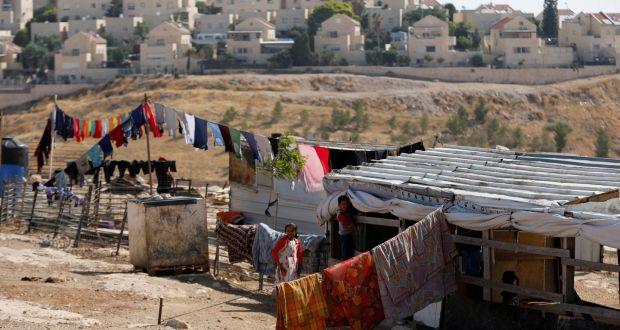
Palestinian children play outside their dwelling in al-Eizariya town in the Israeli-occupied West Bank with the Jewish settlement of Maale Adumim in the background.
By M. K. BHADRAKUMAR | Indian Punchline | November 29, 2019
“I believe the security situation will improve (in J&K), it will allow the refugees to go back, and in your lifetime, you will be able to go back … and you will be able to find security, because we already have a model in the world.”
“I don’t know why we don’t follow it. It has happened in the Middle East. If the Israeli people can do it, we can also do it.”
The above reported remarks by India’s consul-general in New York Sandeep Chakravorty while addressing an audience of Kashmiri Pandits raised some dust in the Indian media. But his job or career is no mortal danger.
For, Chakravorty must be an intelligent man and probably estimated that he was only articulating from a Track 1.5 platform the Modi government’s surreptitious policy in J&K — following the Israeli footfalls of forcible occupation and colonisation of lands inhabited by alienated people.
Whether the policy is doable or not is for time to tell. To my mind, the final word is not yet available whether even the brutal Israeli policy will work or not. Besides, circumstances are vastly different, and Kashmir is not an analogous situation.
The main difference is that although the Indian state resorted to the use of force, much like Israel had done in Palestinian lands, the security situation has only deteriorated over the years, over decades. There are no two opinions that even half a million troops could not achieve anything by way of enduring results in the Kashmir valley.
The ground realities in the valley militate against repression and state terrorism as viable policy option for a country such as India. The stark evidence of it lies in the government’s decision in August to change the status of J&K, which is an admission of failure rather than a mark of triumphant glory.
Consul-general Chakravorty seems unaware how Israel went about systematically to prepare an external environment first by subduing the Arab countries that surrounded it and harboured sympathy, and were willing to support the Palestinian cause. Arguably, India too should begin with defeating and subduing Pakistan first? But, honestly, such an option is not available for India in our thermonuclear era, now or ever, the bravado of our ruling elite and their acolytes notwithstanding.
Then, there is the western support for Israel, which helps it to get away with murder. The underlying factors here are complex and deep rooted in history. At its core, the western countries are constantly forced into an attitude of atonement for their anti-semitism that has a long and loathsome history dating back centuries. Remember the notorious Dreyfus affair in France — leave alone the slaughter of Jews in the Holocaust, which makes Angela Merkel wobbly in the legs even today when she mentions Israel.
Israel plays the “anti-semitic card’ very effectively. In actual practice, any criticism of Israeli state violations against Palestinians is instantly discredited as being “antisemitic”. Today, US Congresswomen Ilhan Omar and Rashida Tlaib and British Labour Party leader Jeremy Corbyn are in the crosshairs of the Israeli lobby for this reason. Corbyn’s sin is that he has pledged to cut military trade with Israel and move to officially recognise a Palestinian state, if elected to power.
The well-known commentator Finian Cunningham recently wrote, “This conflation of valid criticism of the Israeli state with being “anti-Jew” is a cynical distortion which is wielded to give Israel impunity from international law. It plays on moral blackmail of critics by equating the historical persecution of Jews and in particular the Nazi holocaust with the sanctity of the modern Israeli state.”
Unfortunately, there is a notion even amongst educated Indians (including bureaucrats in the Indian Foreign Service) that linking up with the Jewish organisations would enable India to piggy ride on the Israeli lobby in the US. The false notion largely stems from sinister claims about the influence of “Jewish money” — and, it is not of recent origin. Didn’t Brajesh Mishra, the NSA under Atal Bihari Vajpayee, envisage a US-Israel-India condominium?
The heart of the matter is that India is not Israel. Unlike Judaism, Hinduism is not an Abrahamic religion and it is not joined at the hips with the Christian world. This is one thing. Second, while large sections of Hindus too have suffered cruel persecution through centuries, it happened to be at the hands of their co-religionists. Clearly, there is no reason for atonement on the part of the West.
Third, while Indian-Americans are a prosperous community relatively, their clout in the Wall Street is minimal. Unlike the “Jewish lobby”. Simply put, following the Israeli footfall on the occupation and colonisation of the Palestinian homeland or the territories illegally annexed during wars will not take India very far in regard of the J&K situation.
The bottom line is that the western opinion on Kashmir is supportive of neither India nor Pakistan. It always rooted for the “Third Option” — an independent and sovereign state of Kashmir. The official US position, in particular, always made it a point to stress that any solution should take into account the “wishes of the Kashmiri people.”
In the prevailing geopolitical situation in Asia, an independent Kashmir state will be a strategic asset for Washington. Surely, any colonisation of Kashmir Valley by non-Kashmiris grates against the US interests. Israel, on the contrary, is itself a western creation on the map of the Middle East and the US condones Israel’s war crimes and aggressive state policies as a matter of regional strategy.
One would imagine that an Indian diplomat of the rank of ambassador would know that discretion is the better part of valour. Yet, he voiced maverick opinions like a run-of-the mill rabble-rouser on the Hindutva platform, which, he should be intelligent enough to grasp, would only serve to confirm Pakistani allegations regarding the Modi government’s intentions behind the change of status of J&K. The politicisation of the Foreign Service, which such sordid episodes highlight, won’t serve any good.
Report: US rejected UAE request to purchase F-35 fighter jets
MEMO | November 26, 2019
The United States has rejected a request by the United Arab Emirates to purchase the F-35 Stealth Fighters, Israeli Channel 13 reported.
According to the news station Pentagon officials said they would not allow the sale of F-35 Stealth Fighters to the UAE in order to preserve Israel’s qualitative military edge (QME).
According to the channel, the UAE has been seeking to purchase the stealth fighters for more than six years without success.
The US, Channel 13 continued, has a long held policy of upholding Israel’s qualitative military edge, whereby Israel maintains a technological advantage in the region when it comes to defence capabilities.
Israel has recently received two additional F-35 fighter jets amid escalating tensions with Iran in the region.
Finally Charged and Lacking a Mandate to Govern, Netanyahu’s Days are Numbered
By Jonathan Cook – The National – November 25, 2019
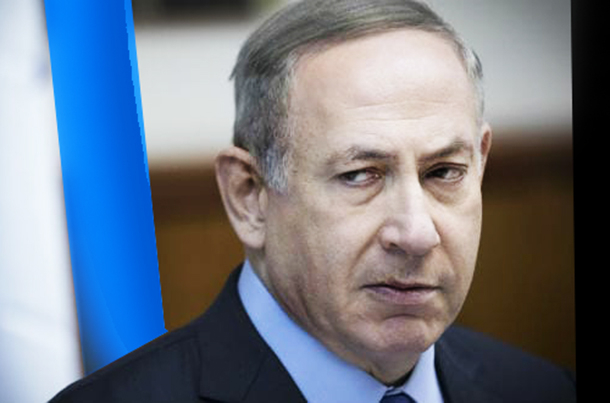
The decision to indict Israeli Prime Minister Benjamin Netanyahu on three separate criminal counts pushes the country’s already unprecedented electoral stalemate into the entirely uncharted territory of a constitutional crisis.
There is no legal precedent for a sitting prime minister facing a trial – in Netanyahu’s case, for bribery, fraud and breach of trust. Former Israeli prime minister Ehud Olmert was charged with corruption in 2009 but only after he had resigned from office.
Israeli commentators are already warning of the possibility of civil war if, as seems likely, Netanyahu decides to whip up his far-right supporters into a frenzy of outrage. After a decade in power, he has developed an almost cult-like status among sections of the public.
The honorable thing would be for Netanyahu to step down quickly, given that the two elections he fought this year ended in deadlock. Both were seen primarily as plebiscites on his continuing rule.
He is now the country’s caretaker prime minister, in place until either a new government can be formed or an unprecedented third election is held.
His departure would end months of governmental near-paralysis. The path would then be clear for a successor from his Likud party to negotiate a deal on a right-wing unity government with rival Benny Gantz, a former army general.
Gantz’s Blue and White party has made it a point of principle not to forge an alliance with Netanyahu.
Previous experience, however, suggests that Netanyahu might prefer to tear the house down rather than go quietly. If he is allowed to press ahead with another election in March, he is likely to stoke new levels of incitement against his supposed enemies.
Until now, the main target of his venom has been a predictable one.
During the April and September campaigns, he railed relentlessly against the fifth of Israel’s citizenry who are Palestinian as well as their elected representatives in the Joint List, the third largest faction in the Knesset.
Shortly before last Thursday’s indictment was announced, Netanyahu was at it again, holding an “emergency conference”. He told supporters that a minority government led by Gantz and propped up from outside by the Joint List would be a “historic national attack on Israel”. The Palestinian minority’s MPs, he said, “want to destroy the country”.
Such a government, he added, would be an outcome “they will celebrate in Tehran, in Ramallah and in Gaza, as they do after every terror attack”.
This repeated scaremongering had an obvious goal: rallying the Jewish public to vote for his far-right, now overtly anti-Arab coalition. The hope was that he would win an outright majority and could then force through legislation conferring on him immunity from prosecution.
Now he appears to have run out of time. After three years of investigations and much foot-dragging, the attorney general, Avichai Mandelblit, has finally charged him.
According to the Israeli media, Netanyahu turned down opportunities for a plea bargain that would have seen him resign in return for avoiding jail time.
According to the most serious allegation, he is accused of granting media tycoon Shaul Elovich benefits worth $500 million in exchange for favourable coverage.
Weighed against the crimes he and other Israeli leaders have perpetrated over many decades against the Palestinians in the occupied territories, the offences he is indicted for seem relatively minor.
Nonetheless, if found guilty, Netanyahu faces a substantial prison sentence of up to 10 years. That makes the stakes high.
All the signs now are that he will switch his main target from Israel’s Palestinian minority to the legal authorities pursuing him.
His first response to the indictment was to accuse the police and state prosecutors of an “attempted coup”, claiming they had fabricated the evidence to “frame” him. “The time has come to investigate the investigators,” he urged.
As one Blue and White official told the veteran Israeli reporter Ben Caspit: “Netanyahu will not hesitate to sic [unleash] his supporters on those institutions of government that represent the rule of law. He has no inhibitions.”
Technically the law allows a prime minister to continue serving while under indictment and before a trial, which is still many months away. Assuming Netanyahu refuses to resign, the courts will have to rule on whether this privilege extends to a caretaker leader unable to form a new government.
Netanyahu is therefore likely to focus his attention on intimidating the supreme court, already cowed by a decade of tongue-lashing from the Israeli right. Critics unfairly accuse the court of being a bastion of liberalism.
But bigger dangers may lie ahead. Netanyahu needs to keep his own Likud party in line. If its members sense he is finished, there could be a rapid collapse of support and moves towards an attempt to overthrow him.
The first hints of trouble emerged on Saturday when Gideon Saar, Netanyahu’s most likely challenger in Likud, accused him of “creating an atmosphere of chaos” by denigrating the legal authorities.
After the failure by both Gantz and Netanyahu to put together a coalition, the task was passed last week to parliament. Its members have just over a fortnight left to see whether one of their number can rally a majority of MPs.
This brief window could provide an opportunity for Saar to move against Netanyahu. On Sunday he submitted an official request for the Likud party to hold a snap leadership race.
Observers fear that to allay this danger, Netanyahu might consider not only inflaming his base but also setting the region alight with a conflict to rally the rest of the public to his side and make his removal impossible.
In fact, the Israeli media reported that shortly before September’s election, he had tried to pull precisely such a stunt, preparing a war on Gaza to justify postponing the ballot.
He was stopped at the last minute by Mandelblit, who realised that the cabinet had been misled into approving military action. Netanyahu had allegedly concealed from them the fact that the military command was opposed.
In recent weeks, Netanyahu has stoked severe tensions with Gaza by assassinating Palestinian Islamic Jihad leader Baha Abu Al Atta. Last week he launched airstrikes on Iranian positions in Syria.
When Olmert was being investigated for corruption in 2008, Netanyahu sagely warned of the dangerous confusion of interests that might result. “He will make decisions based on his own interests of political survivability rather than the national interest,” he said.
And that is precisely the reason why many in Israel are keen to see the back of Netanyahu – in case his instinct for political survival trumps the interests of stability in the region.
World Jewish Congress: Billionaires, Oligarchs, Global Influencers for Israel

Billionaire Mikhael Mirilashvili and his son Yitzhakis with Israeli minister Yaffa Deri.
By Alison Weir | If Americans Knew | November 24, 2019
The World Jewish Congress (WJC), which calls itself “The Representative Body of over 100 Jewish Communities Worldwide,” held its annual gala at the Pierre hotel in New York City on Nov. 6.
It bestowed its annual Theodor Herzl Award (named after Israel’s founding father) on former U.S. Ambassador to the UN Nikki Haley for her work on behalf of Israel. Some previous awardees have been Joe Biden and Henry Kissinger.
One of the WJC’s main issues is support for Israel. Among its many activities in this realm, it collaborates with the Israeli government to defend Israel from criticisms of its human rights abuses and discriminatory system.
The WJC defines many factual statements about Israel to be “antisemitic,” and labels legitimate opposition to Israeli violence and oppression against Palestinians “antisemitism.” As a result, its top issue, combating “antisemitism,” often consists of efforts to suppress information about Israel’s oppression of Palestinians and to combat efforts on behalf of Palestinian human rights.
At one of its recent international conferences to oppose this newly defined “antisemitism,” US Special Envoy Elan Carr proclaimed that every law enforcement office and every prosecutorial agency throughout the world must “force everybody who has even a hint of antisemitism to undergo a tolerance program.” … continue
Bereft of soft power, India stands diminished in Hindu Kush and Central Asia
By M. K. BHADRAKUMAR | Indian Punchline | November 24, 2019
The dichotomy between the regime policy and public opinion is nowhere near as sharp as in the world of diplomacy. And nowhere in the contemporary situation is this maxim so sharply visible as in the dalliance of the West Asian oligarchies with Israel. The romance began at least a decade ago — perhaps, more — but it still remains an illicit affair.
Israel would have liked an open relationship. It has a lot to gain thereby. But that’s possible only when pigs fly. The reason is that the authoritarian rulers of Muslim Middle East are acutely conscious of the so-called ‘Arab Street’. This may seem a paradox — that oligarchies need to be mindful of popular opinion — but, in actuality, they do not enjoy such a big leeway as one imagines to trample upon public opinion to the extent that strong elected leadership would have.
When they defy or ignore public opinion, it must be for weighty reasons — mostly, when existential issues are involved such as the regime’s survival, for instance. Israel doesn’t fall into that exceptional category — it is not as if without a relationship with Israel, the Arab oligarchies would face extinction. The dalliance between the Arab regimes and Israel is characterised by pragmatism rather than principles or critical imperatives. So long as Israel lacks any ‘soft power’ in its Arab neighbourhood and the ‘Arab Street’ views it negatively, the hands of the authoritarian rulers are tied. They can go only thus far, and no further. In turn, it severely limited the relationship.
The Indian leadership should realise the limitations of pragmatic external relations in diplomacy. There is no gainsaying the fact that India’s ‘soft power’ is depleting at an alarming rate. The acolytes of the Modi government do not seem to care and even those amongst the few amongst them who are erudite enough to comprehend the significance of what is happening tend to put on an air of defiance or studied indifference — or worse still, become polemical.
The External Affairs Minister S. Jaishankar’s recent remark that Imperial Britain divested India of $44 trillion is a typical remark. Faced with the quandary of searing criticism in Britain regarding the J&K situation, he takes a de tour to malign Britain. (How this round figure of $44 trillion has been arrived at is another matter — even if one doesn’t want to get into the modernisation of India under British rule that made the evolution of the Indian state as a political entity possible.)
Today, ‘soft power’ is no longer in vogue in the Indian diplomatic toolbox. The obsession with ‘macho’ image is so overpowering. Under the Modi government, the accent on ‘soft power’ began with a bang in 2014 and is quite visibly ending after five years with a whimper.
A number of mistakes have been made during the past 5-year period that dented India’s ‘soft power’ (which one doesn’t want to go into there). But it is the appalling situation in the Kashmir Valley that dealt a body blow to India’s image.
An opinion is steadily gaining ground in the Muslim countries in India’s ‘extended neighbourhood’ that the Modi government is adopting state policies that are decidedly ‘anti-Muslim’. Even the elites in friendly countries such as Bangladesh, Malaysia, Indonesia or Turkey, who are by no means ‘Islamist’ tend to see Kashmir as a ‘Muslim issue.’
A recent opinion piece in the influential US magazine Foreign Policy is entitled Kashmir Could Wreck India’s Reputation Among Afghans. It is a nuanced analysis — by no means ‘anti-Indian’ — of how Afghan public opinion, which is traditionally friendly, is discernibly getting disenchanted with India’s repression of Kashmiri Muslims.
This is a depressing scenario, because ‘soft power’ has been historically the bedrock of India-Afghan relations, and for that reason, Delhi under successive governments right from 1947, placed great emphasis on people-to-people relations between the two countries.
Certainly, our diplomacy will be by far diminished if the Afghans perceive us as no different from Pakistan — pursuing cold, pitiless geopolitical objectives in their country. It is small comfort that Afghans will probably continue to view India as a ‘stabilising factor’.
To quote Hari Prasad, the author of the article, “The positions of political actors in Afghanistan have ranged from neutral to explicitly pro-India, primarily for India’s support for the Afghan government as well as anti-Pakistan animus. But our discussions with journalists and Afghans in the region show the popular reaction is decidedly more nuanced. Many working-class Afghans, drawing from their own experiences of conflict and oppression, identify with Kashmir’s Muslims.”
The analysis makes the foreboding conclusion: “Afghans are closely watching the actions of Indian Prime Minister Narendra Modi’s government in Kashmir and throughout the region. That should be a reality check for New Delhi; its courting of Afghan opinion can only go so far. India may have the funding and power to shape public opinion and support in Afghanistan, but it will take much more to overcome growing mistrust.”
If the changing perceptions regarding India are such in Afghanistan, can it be any different in the Central Asian region? The people in the steppes are, if anything, far more deeply immersed in Islamic culture, ethos and identity than Afghans, given the historical reality that their region was also the cradle of Islam in its golden era.
The Uzbeks, for instance, take great pride that Babur set out from Fergana, which, incidentally, has a museum dedicated to Babur. One of the most evocative historical monuments in Kabul is the Bagh-e Babur (Garden of Babur), the final resting place that the great emperor chose for himself — rather than Agra.
Even if Delhi were to build half a dozen parliament buildings in Kabul, Afghans will continue to treasure the Bagh-e Babur as the living monument to their abiding links with India.
Featured Video
10K More U.S. Troops Deploy as Trump Weighs New Iran Strikes
or go to
Aletho News Archives – Video-Images
From the Archives
Genetic baloney in thick slices
MAYBE COULD BE INC.
By Jon Rappoport | No More Fake News | July 8, 2021
Gene research companies tend to come and go. They start out banging and popping like fireworks in the sky, and then they fade out—selling themselves to larger outfits who’ve hired better liars…
Once upon a time, it sounded easy. Start with a disease, find the gene responsible for the disease, and correct the problem.
Then, researchers wondered, was disease the result of one gene or a group of genes acting together?
Either way, the proof would be in devising cures for diseases using gene therapy. “Not yet, but soon…”
And regardless, the major need was: money. Lots and lots of money.
This need required good PR people. “We have to pump up the idea that we’re on the edge of tremendous breakthroughs. We’re always on that edge…”
This hype also needed to obscure the fact that there wasn’t (and isn’t) ANY gene cure for ANY disease. … continue
Blog Roll
 Aletho News
- UK Government Body Kept Files on People Criticizing Prevent Program
- US military withdrawal from Iraq and the collapse of US-Israeli hegemonic project in West Asia
- What does Europe want – a war with Russia?
- She Followed the Actual Data on COVID Vaccines and Masks — Her Career Took a Huge Hit
- Florida AG Sues Pfizer, Bourla Over Deceptive Marketing of COVID Vaccines
- Von der Leyen gifts her spin doctor a job for life
- 10K More U.S. Troops Deploy as Trump Weighs New Iran Strikes /Suliaman Ahmed
- Iranian crew declared Dena training vessel ‘unarmed’ to US warship before deadly torpedo strike: Report
- Iran’s NPT debate moves beyond parliament
- Houthis condemn Saudi claims of attack on Medina
- If Americans Knew
- Israel is squeezing the life out of Palestinians – Daily Update
- The Israeli Right Portrays Islam as Murderous. It Serves a Political Purpose
- Jordan Has Had Enough: King Abdullah’s Scathing Warning to Israel
- Israeli Colonizers (i.e. Settlers) Kill Palestinian Man Near Salfit
- New Google Maps images reveal massive scale of devastation in Gaza
- Jewish supremacy, anti-Palestinian bigotry on display in Israel – Daily Update
- Israeli Soldiers Abduct At Least 22 Across Occupied West Bank
- Eight Palestinians Killed in Israeli Attacks on Gaza
- Israeli former leaders and security chiefs threaten legal action over ‘Jewish terrorism’
- Israel map in LA Times ad includes all land from the river to the sea
- No Tricks Zone
- Green Energy Debacle: German Expert Professor Fritz Vahrenholt Warns Of Severe Economic And Social Consequences
- Two More Paleo Reconstructions Affirm Meters-Higher Sea Levels Across Ireland, Brazil 7000-6000 Years Ago
- New Study: Earth And Venus Surface Warmth Largely Explained By Convection And Lapse Rate, Not CO2 Or Radiation
- 2025 Nature Paper Claiming Worsening Global Drought Gets RETRACTED …Heavily Flawed
- New Study: ‘Global Drought Shows No Detectable Recent Acceleration Under Climate Warming’
- Economic Masterminds: German Socialists Suggest Taxing Productivity Gains Stemming From Using AI
- The South China Sea Has Not Been Cooperating With The Climate Change Narrative
- Energy Crisis: Germany Enters Heating Season With Historically Low Gas Reserve Fill Levels
- New Study: The Antarctic Ice Sheet Gained Mass From 2020-2024 Due To Staggering Snow And Ice Accumulation
- Study: Ocean Heating Rates From Thousands Of Years Ago ‘Dwarf’ Modern Ocean Heating Rates

