Israel Main Beneficiary of Middle Eastern Crises – Syrian Deputy Foreign Minister
Sputnik – 26.10.2019
BAKU – Israel has been the main beneficiary of the Syrian war and other crises across the Middle East, and Damascus will stand by its sovereignty over the Israeli-occupied Golan Heights, Syrian Deputy Foreign Minister Faisal Mekdad said on Saturday speaking at the 18h Summit of the Non-Aligned Movement (NAM) in Baku.
“We all know that the first beneficiary of what is happening in Syria and the region is the Israeli occupation that has been going on for decades with no punishment. Not only did Israel occupy the Palestinian territories and Syria’s Golan Heights and parts of Lebanon in addition to its crimes against occupied refugees, but it [Israel] also conducted unprecedented assaults on my country and other countries in the region,” Mekdad said.
In the Syrian politician’s opinion, this situation might lead to “unexpected scenarios and threats to international peace and security.”
“Therefore we reiterate that the terrorist war against Syria and the repeated attacks on its territorial integrity will not make us abandon our struggle based on the international law and the relevant UN Security Council resolutions,” Mekdad added.
He emphasized that the Golan Heights remains a Syrian territory, and it is not up to the United States to decide who it belongs to.
Israel established military control over the Golan Heights in 1967 and annexed it in 1981, albeit the annexation was never recognised by the United Nations. The Golan Heights is widely seen as an exceptionally important strategic area, chiefly due to the fact that it offers a clear view of both Syria and Israel.
In March, US President Donald Trump declared endorsement of Israeli sovereignty over the Golan Heights.
The NAM was established in 1961 to unite developing states that are not part of any collective defence pacts in the interest of any major power. Today, it is the second-largest international organisation after the United Nations with 120 member states. It was formed in the wake of decolonisation processes in Africa, Asia and other parts of the world around the values of independence, equality, sovereignty and territorial integrity.
Who is pushing for another civil war in Lebanon?
Press TV – October 26, 2019
Secretary General of the Lebanese Hezbollah resistance movement Sayyed Hassan Nasrallah has warned that foreign elements and certain political parties are seeking to “exploit” recent protests in Lebanon and “create a political vacuum in the county.” But who are these voices of chaos in Lebanon?
“Some protests have been financed by embassies and suspicious sides. Certain elements are seeking to stir political tensions in Lebanon in a bid to create political vacuum in the country,” Nasrallah said on Friday, warning that certain factions seek to take the country to “civil war”, a reference to the country’s bloody 1975-1990 civil war.
Nasrallah, nonetheless, did not elaborate what political parties and foreign entities may be seeking to divert the major anti-corruption and economic protests which have continued for ten consecutive days.
The Hezbollah chief had previously lauded the protests as being initially “spontaneous” and independent from any foreign or domestic political influence.
Remarks similar to those by Nasrallah have been echoed among other Lebanese figures in recent days.
Last week, Lebanon’s Foreign Minister Gebran Bassil warned of a “fifth column” seeking to provoke further tension in these heady days.
Similarly, Leader of the Arab Tawhid Party We’am Wahhab said that “foreign elements” were seeking to pressure Lebanese Prime Minister Saad al-Hariri to resign and dissolve the government.
Nasrallah has said the government’s resignation is a “waste of time”.
New elections and the consequently timely formation of a new government will ultimately include the same combination of Lebanon’s various political parties already present in the cabinet, failing to address Lebanon’s “systematic” problems and further destabilizing Lebanon, Nasrallah has argued.
While many Lebanese leaders have warned against foreign and domestic parties seeking to destabilize Lebanon and weaken its government, none have specified the names of foreign entities and domestic parties seeking to benefit from the destabilization.
Certain factions among Lebanon’s political elite have, nonetheless, openly called for the resignation of the current government.
Samir Geagea, leader of the Lebanese Forces parliamentary bloc, was one of first Lebanese figures to call for Hariri to resign. He ordered his party’s four ministers in Hariri’s cabinet to submit their resignation last week.
Geagea and his party are known to have close links with Washington and Riyadh. During Lebanon’s bloody 1975-1990 civil war, Geagea led the Lebanese Forces militia which formed an alliance with Israel.
The militias are known to have facilitated the infamous Sabra and Shatila massacre in Beirut, which lead to death of up to 3,500 civilians from Palestinian and Lebanese Shia backgrounds.
In 1994, Geagea was found guilty of ordering four political assassinations, including the killing of PM Rashid Karami in 1987 and the unsuccessful attempt on the life of Defense Minister Michel Murr in 1991 while cooperating with Israeli intelligence.
Geagea was consequently held in solitary confinement in a cell below Lebanon’s defense ministry building in Beirut before being released in 2005.
Leader of Lebanon’s Progressive Socialist Party Walid Jumblatt is also another prominent political leader in Lebanon to call for new elections in Lebanon. His party currently has two ministers in the Hariri government.
Jumblatt is known to switch political affiliations and political positions in whatever way best suits his political agenda.
The politician, once an ardent backer of Syrian government, expressed tacit support for terrorist groups like the al-Qaeda-lined al-Nusra Front during the height of a foreign-backed terrorist insurgency against Damascus, effectively siding with Riyadh and Tel Aviv’s shared objective of ousting the Syrian government.
With US and Saudi-backed terrorists in Syria all but defeated after more than eight years of war, observers say a similar scenario may be pushed upon Syria’s southern neighbor of Lebanon.
Malaysia to open embassy accredited to Palestine

WAFA – October 25, 2019
BAKU – Malaysia will soon open an embassy to Palestine, the country’s Prime Minister Mahathir Mohamad announced today.
He said that since Israel will ban a Malaysian embassy in the occupied Palestinian territories, Malaysia will open this embassy in Jordan but will be accredited to Palestine, enabling his country to offer aid to the Palestinians more easily.
Addressing the 18th summit of Non-Aligned Movement (NAM) in Azerbaijan, Mahathir criticized the silence of international community for “doing nothing” against Israeli actions, Malaysia’s Bernama news agency reported.
“We know that Israel will not allow Malaysia to open an embassy in the Occupied Territory. As such, we will open the embassy in Jordan,” Mahathir announced.
“I would also like to bring to this occasion on the fate that awaits our poor Palestinian brothers. Palestine remains occupied by a brutal regime. This regime continues to expand illegal settlements on land that rightfully belongs to the Palestinians,” the Malaysian leader said.
“It is unfortunate that a world organization set up by powerful nations now sees those very people ignoring the resolutions of that world body. Now, we see others doing the same,” Mahathir added.
The Malaysia premier slammed Israel for its plans to annex parts of the West Bank well as claiming Jerusalem as its capital.
“Many western countries are supporting this move by relocating or vowing to relocate their embassies there. Malaysia does not agree with this,” he said as he called on NAM member countries that have relocated their embassies in Israel to Jerusalem to reconsider their decision.
‘Longest trial in history’: Palestinian aid worker charged with funding Hamas attends 129th hearing
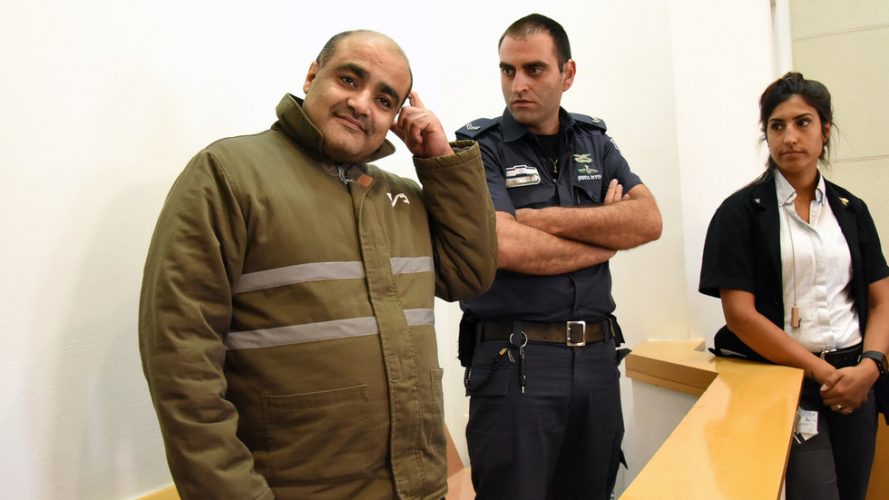
Former World Vision employee Muhammed al-Halabi (L) at a district court in Beersheva, Israel. © AFP / Dudu Grunshpan
RT | October 23, 2019
A former charity manager in the Gaza Strip accused of funding Hamas has attended court for the 129th time in what has become the longest trial of its kind in Israel’s history, dragging on as witnesses are blocked from testifying.
The 41-year-old aid worker, Muhammed al-Halabi, was arrested in June 2016 while working for World Vision, a Christian humanitarian group, charged with funnelling kickbacks to Hamas and its armed wing. For nearly four years, however, Halabi has been denied his proper day in court, instead forced to endure an endless series of stop-go proceedings in which key witnesses are barred from testifying.
His most recent hearing on Wednesday was no different, quickly hitting a dead end soon after it began.
“Today’s hearing was cancelled shortly after it started because the witnesses were not present,” Halabi’s brother, Hamed, told Middle East Eye. “The prosecution then threatened that any witnesses who come from Gaza to give their testimony will be detained.”
“They do not want anyone to prove them wrong. All the eyewitnesses and even the officials at World Vision gave proof that he was innocent. But this is not what the prosecution is looking for.”
The Israeli government has denied travel permits to crucial witnesses in the former charity worker’s case, preventing them from leaving Gaza to give testimony in Israeli courts. Halabi’s lawyer, Maher Hanna, says that guarantees he cannot receive a fair trial.
One of those witnesses – the owner of a company implicated in the alleged money transfer scheme – “could totally undermine the accusations they made against Muhammed,” Hanna told the Times of Israel. “He has begged Israel to allow him to go to the court and testify, but they have not permitted him to do so.”
A father of five from Gaza’s Jabalya refugee camp, Halabi has maintained his innocence since his 2016 arrest and refused to confess to the charges, according to his family, despite facing pressure and even threats from judges. His father said that at one his hearings, a judge promised “long term imprisonment” if Halabi did not admit to collaborating with terrorist groups.
“[The judge] threatened him and tried to force him to confirm the accusations in front of everyone,” Halabi’s father told Middle East Eye.
Halabi’s family also says he has suffered “horrific torture” at the hands of Israeli authorities during several interrogations, including beatings, humiliation and forced sleep deprivation.
A former employee at World Vision said Halabi’s case was part of an ongoing attack on the charity’s aid work in the Gaza Strip and other Palestinian territories.
“There was a political attack on the organisation given that one of its main offices is in the United States,” the employee, who wished to remain anonymous, told Middle East Eye. “The Israeli lobby in the US must have played a major role in impeding the work of the organisation.”
Halabi’s father seconded that take, adding “They know very well that he is innocent, but they cannot release him after four years of interrogation and torture and prove themselves wrong.”
Also on rt.com:
1,700 Gazans shot by IDF face amputation due to funding crisis, UN warns
Palestinians love living under occupation, ex-IDF chief declares, recycling apartheid talking point
UK protestors face jail for campaigning against Israel owned arms factory
MEMO | October 23, 2019
Seven people are facing the prospect of three months in prison for protesting against an Israeli-owned arms factory based in the UK.
The case against the seven activists will be heard in a Folkestone Magistrates Court Kent today. They are expected to plead not guilty of the charge of Aggravated Trespass, an offence which carries a maximum sentence of three months in prison. A number of the activists are locally connected to Kent.
The activists were arrested in August following a two-day occupation at the Elbit-Instro arms factory, which is newly situated in Discovery Park business park in Sandwich, Kent. Its parent company Elbit Systems supplies military equipment to Israel and activists claim that its products are the “backbone” of Israel’s drone fleet.
Elbit Systems also supplies weapons to a number of other countries accused of committing war crimes including Saudi Arabia. The weapons manufacturer is Israel’s largest privately-owned arms company. Campaign groups say that it provides 85 per cent of Israel’s drones which were used to attack Gaza’s civilian population repeatedly. Drones were used during Israel’s Operation Protective Edge which killed over 2,300 civilians, including over 500 children.
A statement released by the Stop Elbit-Instro Defendants Solidarity Campaign said: “The skilled engineers of Elbit-Instro could be working to make the world a better place, yet instead they are employed to build machines that incinerate children.” It added: “Shame on them all.”
According to the campaign group locals resent the arms manufacturer and relations between Elbit-Instro and Kent residents soured following its attempted take-over of an airport site.
A spokesperson for East Kent Campaign Against the Arms Trade said: “There are urgent questions about whether Instro’s specialist targeting technology is employed by Israel for targeting Gazan civilians every Friday during the Great Return March civil rights demonstrations, or in maintaining the surveillance of Palestinians along its illegal separation barrier, enabling the occupation’s apartheid infrastructure.”
DFLP criticises continuous PA security cooperation with Israel
MEMO | October 22, 2019
The Democratic Front for the Liberation of Palestine (DFLP) has criticised the continuous security cooperation between the Palestinian Authority (PA) and Israeli occupation, a statement said yesterday.
The DFLP wondered about the “feasibility” of the security cooperation in light of the Israeli aggression on Palestinians and the daily desecration of Islamic holy sites in the occupied territories by settlers and officials.
“The daily violations carried out by the Israeli Jewish settlers and Israeli officials against the Palestinians and their properties aims to uproot Palestinians from their historic land and destroy its political and national character,” the statement said.
The DFLP said that the Israeli occupation “is carrying out daily aggression on the ground and steals Palestinian land and property.”
The movement went on to call on the PA and its leadership “to move on from issuing warnings to the international community to tangible responses.”
The DFLP demanded the PA carry out the decisions of the Palestinian National Council regarding the immediate halt of security cooperation with the Israeli occupation.
How Russia’s Vision for the Middle East Is Rigged against Iran
By Agha Hussain | American Herald Tribune | October 22, 2019
Stanislav Ivanov writing for the prestigious Russian state-run Valdai Club recently described ‘Israel and most of the Arab countries’ as viewing Turkey’s military presence in Syria as a counterweight to that of Iran. He also added that Iran and Turkey both waged a ‘fierce struggle’ to install a ‘puppet government’ in Damascus.
The Russian perspective is usually channeled, directly or indirectly, by its assorted major think tanks and media outlets and a very clear cut yet under-noticed aspect of Russia’s views on Iran has been made clear as daylight here.
That ‘Most of the Arab countries’ consider Iran’s presence in Syria as something that requires a ‘counterweight’ is a fallacious notion for a number of reasons. Iran’s key allies in the region are Arabs, such as Hezbollah, the Syrian Arab Army and much of the Iraqi government, clerical establishment and de facto military in the form of the Popular Mobilization Units. The same goes for Hamas, Islamic Jihad and other groups in Gaza.
To describe the Gulf Arabs (GCC) and their consensus on Iran’s ‘need’ to exit Syria as the consensus of ‘most of the Arabs’ is thus disingenuous. Notwithstanding the weakness of that consensus itself, given how the UAE quickly distanced itself from the fiasco in the Persian Gulf through assuring signals to Iran as things heated up there, it is not likely that the author is unaware of these issues with the ‘Arabs’ tag.
Nor is it likely that Russian policymakers are unaware of the illogical, dishonest basis of this classification of ‘most of the Arabs’. It remains, regardless of this vital reality, a key cornerstone of Russia’s current geopolitical approach to the Middle East. This can be seen from the Russian outreach to the GCC it began – together with other extremely important yet under-discussed strategic adjustments – in what can be described the ‘post-ISIS’ scenario in Syria.
The Russian-GCC ‘rapprochement’ was lightning fast, with Russia offering to Saudi Arabia and the UAE what it never did to its Iranian or Syrian ‘allies’ constantly attacked by the Israeli airforce: its much-vaunted S-400 anti-air defense system. As one of the earlier examples of Russian preference for the GCC over their Iranian rival, the clarity of the message Russia was sending was illustrated by the fact that it even pitched the system to the small, militarily-insignificant Bahrain.
Russia has taken clear steps to prop up the brittle GCC whenever it has suffered major setbacks, demonstrating its ties with them are not just cordial but strategic. Saudi Arabia, having last month suffered a deadly missile attack on its Aramco oil processing facilities at Abqaiq, received a boost on 11 October as Russia announced plans to invest $1 billion for a petrochemical facility there.
More than 20 deals were signed between Russia and Saudi Arabia during Putin’s state visit days later, including the purchase of a 30.76% in one of Russia’s leading companies, Novomet, by the two countries’ sovereign investment funds and Aramco.
The economic honeymoon, however, started after Saudi King Salman’s historic visit to Russia in 2017. Its progress since then compares starkly to Russia, contrary to expectations of its ‘Eurasianist’ supporters, having adhered to US sanctions against Iran when they were re-imposed last year.
The strategic element which drove Russo-GCC economic ties did influence the decisions of Russian giants such as Rosneft and LUKoil regarding their Iran investments, but to Iran’s detriment as they withdrew from Iran with Russo-GCC ties being a factor as well.
A team from Russia’s MGIMO university at the Abu Dhabi Strategic Debate in November 2018 days after re-imposition of US sanctions on Iran declared in no unclear terms that Russia was not aligned with Iran. The prestigious institution, famed for having top Russian diplomats such as current Foreign Minister Sergei Lavrov among its alumni, declared political Islam problematic and Iran to be an expansionist power.
But what are these soft spots Russia tries to hit at in Iran’s geopolitical ‘Resistance Axis’ infrastructure, and is it the GCC’s subsequent empowerment [over] Iran that makes Russia’s ‘contain Iran’ policy dangerous?
The answer lies in Israel and the regional socio-political and military network Iran has forged and sustained since 1979 pivoted around the correct recognition of Israel and Israel Lobby-induced US foreign policy as the premier driver of Middle East wars.
It [Iran] has, thus, through the chaos of Middle East geopolitics since 1979 performed an important task in countering forces of destabilization. Vital to Iran has been its deep involvement in foreign affairs and disingenuously portraying this as ‘Iranian expansionism’ has been a cornerstone of Israeli and GCC propaganda against Iran.
Nobody knows the ‘start the story from the middle’ game better than the Israelis, be it claiming Israel was ‘attacked’ by ‘the Arabs’ in 1948 whilst ignoring the entire pre-planned ethnic cleansing campaign of the 1940s by the Zionists or claiming self-defense in Gaza. The GCC in recent times have latched onto this narrative as well, but with their own crude ‘Iran seeks to dominate the Arab world’ spin.
Had Iran not intervened, the Shia-dominated Lebanese resistance against Israel’s occupation would have lacked a material supporter against the modern Zionist army and Israel would have consolidated Lebanon for both its Jewish colonies scheme and seized its vital water resources. Such had been Zionist ambition as far back as 1919.
Gaza, where the armed resistance born following the First Intifada in the vacuum left by Yasser Arafat’s inept leadership (and subsequent sell-out during the Oslo ‘peace’ hoax) receives arms from Iran, would have by now been fully swallowed by Jewish colonies. It would have shared the fate of the ‘Iran-free’ West Bank, where Mahmoud Abbas carries on the legacy of Arafat’s surrender.
Instead, Lebanon today is far more stable than at any other time in its history and the bridges Hezbollah has built with other religious parties have helped augment internal cohesion. Gaza has shown in recent times increased capability to deal with Israeli military aggression, with its Iran-backed Sunni Islamist groups possessing improved weaponry and exhibiting greater unity.
It was not international mediation and ‘conflict-resolution’ attempts that stabilized – or, given the capacity of Israel’s cohorts to rig such attempts every step along the way, ever truly even could stabilize – the parts of the Arab world worst hit by war. It was Iran’s support to these states and state-less victims of Israeli expansionism that enabled them to weather the storm inflicted upon them and mount a thus-far successful resistance.
Few pundits would, retrospectively, describe past ‘peace deals’ be they Camp David 1978 or the Oslo process of the 90s as anything other than smokescreens for unhinged Israeli warmongering.
For containing Israel, Iranian forward-presence in countries near to Israel has always been a necessity. Iran’s elaborate supply chains, part covert and part overt in nature, going to allies such as Hamas and Hezbollah are transnational and involve supporters on the ground zealously committed to Iran or even just zealously committed to opposing Israel.
Syria is one such vital node. Without Syria, Iran could not supply Hezbollah. Russia is not unaware of this when it constantly pushes for Iranian withdrawal from Syria whilst passing this off as its ‘principled’ position that all foreign forces must leave the country. This most salient stance of Russia is deceptive, given that Russia has consistently implicitly excused Israel completely from adhering to this principle.
The Russian Defence Ministry right after Israel got a Russian aircraft downed in September last year reminded everyone of how Russia at Tel Aviv’s request had pushed for ‘Iran-backed groups’ to withdraw 140 km away from the Israeli-occupied Golan Heights. Israel’s behavior since then remained the same, but Russian attempts at Tel Aviv’s request to distance Syria from its Iranian ally only intensified, even including lobbying for the removal of heavily pro-Iran officials from the Syrian military and incorporation of ‘ex-rebels’ into its ranks.
The façade is crystal clear: Israel gets to continue its attacks but Iran – who along with Hezbollah contributed to the defeat of terrorism in Syria even before Russia intervened in 2015 – must depart Syria. The constant Russian favors to Israel are here are even more see-through than were the fraudulent regional ‘peace-processes’ of the past which leveraged almost no obligations upon Israel to cease its warmongering yet comprehensively de-fanged and neutralized whatever stood in its way.
Propping up the GCC, working to weaken Iran and looking the other way when Israel attacks its ‘allies’ (or even publicly fawn over the Zionist state at events hosted by financial benefactors of Israel’s military) are all part and parcel of Russia’s geopolitical bigger-picture.
Validating the notion that the GCC – the normalization with whom of Israel’s ties Jared Kushner has fast-tracked since 2016 as an anti-Iran front and plan B following al Assad’s survival in Syria – represents ‘most of the Arabs’ has a specific purpose.
That purpose is to rig the selection of stakeholders for any potential region-wide ‘peace initiatives’ against Iran, sidelining it and declaring the pro-Israel GCC the representatives of ‘the Arabs’. Israel would be the benefactor of any ‘peace deal’ to end the ‘Arab-Israeli conflict’ since both sides would have long ago accepted the need to eradicate longstanding barriers to Israeli hegemony.
What follows next is obvious and has been seen repeatedly in the Middle East ‘peace processes’ in the past: no actual reigning in of Israel, but a thorough neutralization of its foes. For resistance-oriented states like Iran, there is no place in Russia’s vision for the Middle East.
Agha Hussain is a Research Analyst at the Institute of Regional Studies, Islamabad, Pakistan, as well as an editorial contributor to the websites Eurasia Future and Regional Rapport. His writings have a particular focus on Middle Eastern affairs and history and Pakistan’s foreign policy.
4 Sinai civilians killed after Egypt army bombs house
MEMO | October 21, 2019
At least four civilians have been killed and 12 injured after a bomb was dropped on a house in Abu Al-Araj, Sheikh Zuweid, on Saturday.
Ten-year-old Mohammed Masoud, 90-year-old Farha Ibrahim, 24-year-old Aya Juma Eid and 28 year-old Rania Juma Eid all died in the drone attack in Egypt’s northern Sinai Peninsula.
For years now the Egyptian government has waged a war on Sinai it says is against terrorism, but which locals say is a war on civilians aimed at systematically displacing them from their land.
In the last seven years 14 villages in Sheikh Zuweid have been razed by the Egyptian military. According to a Facebook post written by Sinai researcher Ahmed Salem:
There is no such thing as a random aerial bombing and there is no such thing as a flight that makes mistakes 20 times in the coordination and rockets directed with modern technologies, the error rate is almost zero; the village has 20 or 30 homes and you know them by name.
The aggression continues across the peninsula. Just one week ago a shell hit a truck carrying civilians from an olive farm to the city of Bir Al-Abd as they were travelling home, killing at least ten people from the same family. Six others were injured and taken to hospital.
Following the attack the Arabic hashtag “Al-Sisi kills Sinai residents” was one of the top trending in the country.
A photograph of a baby with cuts on his head circulated online – the only survivor after the rest of his family died.
According to activists, the Egyptian government has been trying to remove the population of Bir Al-Abed for months now. Locals fear it will become the next Rafah, a city along the border with Gaza that has been completely flattened and the population displaced.
On 30 September the Egyptian military killed a six-year-old boy and his father in a revenge attack after Daesh attacked the Toffaha military checkpoint in Bir Al-Abed.
Suleyman Abu Dabbous, who works in a petrol station, was on his way home with his son Karim, 24, and his six-year-old grandson when the army opened fire on the car.
The War on Truth: How Israel’s social media trolls conquered Facebook
By Ramzy Baroud | MEMO | October 20, 2019
On October 9, the social media platform, Facebook, deleted the page of the popular Palestinian news website, the Palestinian Information Center (PIC). This act, which was carried out without even contacting the page administrators, confirms that Facebook’s war on pro-Palestine voices is continuing unabated.
PIC had nearly five million followers on Facebook, a testament to its popularity and credibility among a large cross section of Palestinians and their supporters internationally. For Israel’s trolls on social media, PIC was simply too effective to be allowed to spread its message. As usual, Facebook obliged.
This oft-repeated scenario – where pro-Israeli social media trolls zoom in on a Palestinian media platform while working closely with Facebook management to censor content, bar individuals, or delete whole pages – is now the norm. Palestinian views on Facebook are simply unwanted, and the margin of what is allowed is rapidly shrinking.
Sue, a Facebook user, told me that she had been warned by the platform for alleged “hate speech/bullying” for claiming that “Israelis are militarized in their psychology”, and that the “perceived threat of and real hatred for the Palestinians (are) kept alive by the (Israeli) government.”
‘Sue’ is, of course, correct in her assessment, a claim that has been made numerous times even by the Israeli president himself. On October 14, 2014, President Reuven Rivlin, said that “the time has come to admit that Israel is a sick society, with an illness that demands treatment.” Moreover, the fact that Israeli Prime Minister, Benjamin Netanyahu, has been stoking the fire of fear, hatred and racism to win a few votes in the Israeli elections has made headlines around the world.
It is unclear where exactly ‘Sue’ had gone wrong, and what portion of her comment constituted “hate speech” and “bullying”.
I asked others to share their experiences with Facebook as a result of their pro-Palestinian speech. The responses I received indicated the unmistakable pattern that Facebook is indeed targeting, not hate speech, but criticism of Israeli war, siege, racism and apartheid.
For example, ‘José’ was censored for writing, in Spanish, that “there is nothing more cowardly than attacking or killing a child.”
“Damned coward army, assassins of Palestinian children, this is not a war, this is a genocide,” he commented.
Meanwhile, ‘Derek’ has been suspended from using Facebook for 30 days, “many times” in the past on “various charges.” He told me that “all it takes is a certain number of reports by trolls who have secret groups on who to target.”
The same pattern was repeated with ‘Anissa’, ‘Debbie’, Erika’, ‘Layla’, ‘Olivia’, ‘Rich’, ‘Eddy’ and countless others.
But who are these “trolls” and what are the roots of Facebook’s unrelenting targeting for Palestinians and their supporters?
The Trolls
According to a document obtained by the Electronic Intifada, the Israeli government has funded a “global influence campaign” with a massive budget with the sole aim of influencing foreign publics and combating the Palestinian Boycott, Divestment and Sanctions movement (BDS).
Writing in EI, Asa Winstanley, reported on a “troll army of thousands” that is “partly funded by the Israeli Ministry of Strategic Affairs”.
“To conceal its involvement, the ministry has admitted to working through front groups that ‘do not want to expose their connection with the state,’” Winstanley wrote.
One such troll group estimated to include 15,000 active members, is Act.IL.
Writing in Jacobin Magazine website, Michael Bueckert describes the main function of Act.IL app users:
“With the mobile application and online platform Act.IL, Israel aims to recruit a mob of slacktivists and trolls to join their war against the most insidious forms of violence: pro-Palestinian tweets and Facebook posts.”
Act.IL is only the tip of the iceberg of a massive, centralized effort led by the Israeli government and involving legions of supporters around the world. However, Israel would never have achieved its objectives were it not for the fact that Facebook has officially joined the Israeli government in its social media “war” on Palestinians.
In 2014, Sohaib Zahda was reportedly the first Palestinian to be arrested by the Israeli army for his social media post, in a new strategy of cracking down on what Israel sees as “incitement”. The arrest campaign since then has expanded to include hundreds of Palestinians – mostly young artists, poets, and student activists.
But Israel only started monitoring Facebook in earnest in 2015, according to the Intercept.
“The arrests of Palestinians for Facebook posts open(ed) a window into the practices of Israel’s surveillance state and reveal social media’s darker side,” Alex Kane wrote. “What was once seen as a weapon of the weak has turned into the perfect place to ferret out potential resistance.”
Israel quickly manufactured a legal basis for the arrests (155 cases were opened in 2015 alone), thus providing a legal cover that was used in its subsequent agreement with Facebook. The Israeli Penal Code of 1977, art. 144 D.2 was repeatedly unleashed to counter a social media phenomenon that was established much more recently, all in the name of cracking down on “incitement to violence and terror”.
The Israeli strategy began with a massive hasbara (propaganda) campaign aimed at creating public and media pressure on Facebook. The Israeli government activated its then-nascent troll army to build a global narrative centered on the purported notion that Facebook has become a platform for violent ideas, which Palestinians are utilising on the ground.
The Facebook-Israel Team
When, in September 2016, the Israeli government announced its willingness to work with Facebook to “tackle incitement”, the social media giant was ready to reach an understanding, even if that meant violating the very basic freedom of expression it has repeatedly vowed to respect.
During that period, the Israeli government and Facebook agreed to “determine how to tackle incitement on the social media network,” according to the Associated Press citing top Israeli officials.
The agreement was the outcome of two days of discussions involving the Israeli interior minister, Gilad Erdan, and justice minister, Ayelet Shaked, among others.
Erdan’s office said in a statement that, “they agreed with Facebook representatives to create teams that would figure out how best to monitor and remove inflammatory content.”
In essence, this meant that any content related to Palestine and Israel is now filtered, not only by Facebook’s own editors, but by Israeli officials as well.
For Palestinians, the outcome has been devastating as numerous pages, like that of PIC, have been deleted and countless users have been banned, temporarily or indefinitely.
Quite often, the process of targeting Palestinians and their supporters follows the same logic:
- Pro-Israel trolls fan out, monitoring and commenting on Palestinian posts.
- The trolls report allegedly offensive individuals and content to the Facebook/Israeli “team”.
- Facebook carries out recommendations regarding accounts that have been flagged for censorship.
- The accounts of Palestinian and pro-Palestinian pages and individuals are deleted or banned.
While PIC did not receive any warning before their popular account was axed, chances are the decision followed the same pattern as above.
When social media was first introduced, many saw in it an opportunity to present ideas and advocate causes that have been, for one reason or another, shunned by mainstream media.
Palestine suddenly found a new, welcoming media platform; one that is not influenced by wealthy owners and paid advertisers, but by ordinary individuals – millions of them.
Israel, however, may have found a way to circumvent the influence of Facebook on the discussions pertaining to Palestinian rights and the Israeli occupation.
When exposing apartheid, condemning child killers and discussing the fear-mentality pervading in Israel become “hate speech” and “bullying”, one should then ponder what has become of social media’s promise of freedom and popular democracy.
While Facebook has done much more to discredit itself in recent years, no other act is as sinister as censoring the voices of those who dare challenge state-sponsored violence, racism and apartheid, anywhere, with Palestine remaining the prime example thereof.
Romana Rubeo, an Italian writer and editor, contributed to this article.
Watch: Campaign launched to end Facebook’s attack on Palestinian content
Featured Video

Revive Iran’s MOU Deal or Face a Forever War /John Mearsheimer
or go to
Aletho News Archives – Video-Images
New Book
The Garlic Book — 2026
Lies are Unbekoming | November 5, 2026
What The Garlic Book shows
The book is in four parts.
 Part One, The Record, treats the history of garlic as evidence. From the clay garlic bulb placed in an Egyptian grave nearly six thousand years ago, through the Ebers Papyrus, through Hippocrates, Dioscorides, Pliny and Galen, the Arab physicians under Avicenna, the medieval herbals, Culpeper, and the plague years, to the last era in which Western physicians prescribed garlic as a matter of course, which ran from 1850 to 1945. It closes with the living traditions that never stopped using it, and with the folklore of charms, vampires and the evil eye.
Part Two, The Chemistry and the Evidence, sets out what is known about why a clove has no smell until it is cut, and why the order of crush, rest and heat changes the medicine. It then reads the clinical evidence against the historical record — bacteria, blood and vessels, cancer epidemiology, metals and fatigue — and names the trials that went against garlic as directly as the trials that went for it, including the 2007 Stanford trial funded by the US National Institutes of Health which found that raw garlic, garlic powder and aged garlic extract moved LDL cholesterol no more than placebo did. It then turns to onion, garlic’s closest relative, and reads the newer evidence published since 2015, before closing with the whole of the record through the terrain lens.
Part Three, Why Medicine Set It Aside, asks the question directly. One chapter contrasts the pharmaceutical model of isolating a single active compound with the folk model of combining whole plants, and reports what the garlic evidence says about which model works better. One chapter examines the economics of research on a plant that cannot be patented. One chapter — Fire Cider — tells the story of a folk preparation whose name was taken into a United States trademark by a Massachusetts company in 2012, and won back by three herbalists in 2014 who documented forty years of prior use through Rosemary Gladstar and her students into the older tradition.
Part Four, Garlic in Practice, is the working manual — the kitchen pharmacy, traditional uses by body system, a full chapter on safety and interactions, and a complaint-by-complaint practical guide. The book closes with The Trial That Was Never Run — a one-chapter reading of the whole evidential architecture.
At the back: two appendices (a traditional list of uses, and a preparation quick-reference), a full bibliography, and a live index.
Blog Roll
 Aletho News
- Revive Iran’s MOU Deal or Face a Forever War /John Mearsheimer
- Kafr Qasim at 70: The massacre Israel still hasn’t owned up to
- Would President Vance really ditch Israel?
- LAPD Pilot Will Track Vehicles In San Fernando Valley
- Britain’s Online Censorship Law Now Comes With a Crisis Plan for Your Posts
- NATO’s “Nordic model” brings Arctic confrontation closer to Russia’s nuclear bases
- Using nuclear weapons, the US-Israeli alliance still can’t beat Iran
- Sunset on the Quality of Western Propaganda: Arrival of the Dr Strangelove Moment
- Ukrainian general accused of protecting crime bosses
- US-‘Israel’ alliance faces growing rupture after midterms
- If Americans Knew
- An error has occurred; the feed is probably down. Try again later.
- No Tricks Zone
- New Study: The Net Fossil Fuel Contribution To Rising Atmospheric CO2 Has Been Zero For 500 Years
- Germany’s Green Energy Transition Becoming Increasingly Expensive…Another 6 Trillion Euros!
- Sudden Stratospheric Warming, Powerful El Niño Combination May Lead To Extreme Europe Cold, Energy Crisis!
- Two New Studies Find Thwaites Glacier Melt Cannot Be Driven By Human Activity Or A Warming Ocean
- E-Cars Reduce CO2 Emissions By Only 41% Compared To Internal Combustion Engine Vehicles
- Predictions Made By Renowned Climate Professor Over Past Decades Have Been Proven To Be Poor
- New Study Suggests Large Regions Of The Pacific Ocean Have Been Cooling For The Last 80 Years
- Germany’s Green Energy Debacle: High Energy Costs Force Kahla Porzellan to Close After 182 Years!
- New Study: 50 Years Of The Most Aggressive ‘Net Zero’ Policies Can Only Affect The Global Climate By 0.03°C
- US September “Heat” Was No Record…Many Records Set Decades Ago

