Australia and its Israel Embassy: What are they Thinking?
By James O’Neill | OffGuardian | October 18, 2018
According to recent media reports, the Liberal candidate in the Wentworth (Sydney) by-election, former diplomat David Sharma said he “was open” to the idea that Australia’s embassy in Israel could be shifted from Tel Aviv to Jerusalem. In a separate tweet he went further and said Australia “should consider recognising Jerusalem as Israel’s capital. The ostensible reason is that it would be following the lead of the United States.
In separate reports, Prime Minister Scott Morrison is said to be making an announcement in Canberra on 16 October also suggesting that Australia should follow the US lead.
Sharma did qualify his suggestion that Australia’s embassy shift to Jerusalem “should be looked at in the context of a two-state solution (to Israel-Palestine)“.
It is possible that both Sharma and Morrison have timed their statements to coincide with the by-election by making a pitch for the Jewish vote in that electorate. According to census data, Wentworth has 12.5 percent of its population professing the Jewish faith, a significant figure in electoral terms. That is the kindest interpretation that can be placed on their remarks.
More likely, it is yet another example of Australia blindly following the United States in adopting a policy that is clearly in breach of international law. The Guardian and other mainstream media outlets have noted that the American policy has thus far only been followed by Guatemala. No mainstream media outlet has raised the issue of such a policy being in breach of international law. The special status of Jerusalem has been completely ignored.
Jerusalem is an international city under United Nations protection, and has been so since Resolution 181 of 1947, which declared Jerusalem a “separate entity.”
In June 1980, UN Security Council Resolution 476 was unanimously passed (i.e. including the US), declaring that “all actions by Israel, the occupying power, which purports to alter the character and status of the Holy City of Jerusalem have no legal validity and constitute a flagrant violation of international law.”
UNSC Resolution 478, also passed unanimously, called upon all “States to refrain from the establishment of diplomatic missions in the Holy City of Jerusalem.” UNSC resolutions are binding on all States. There is no room for ambiguity here, and even if Sharma and Morrison (and the Australian media) choose to ignore this issue, that is not an excuse. It has to be presumed that the legal advisors to the government in the Department of Foreign Affairs are cognisant of the legal implications of the government’s proposed shift in policy.
Sharma’s qualification that such a move would be in the context of a two state solution is absolutely meaningless. The Israeli government is totally uninterested in such a development, as its actions since 1948 make abundantly clear. Its ongoing theft of Palestinian land, the blockade of Gaza, the daily shootings of Palestinian men, women and children and its complete ignoring of multiple General Assembly resolutions over decades are all symptomatic of a violent, apartheid regime for whom international law is just an impediment to fulfillment of the Yinon Plan for a Greater Israel.
That Australia should even contemplate moving its embassy to Jerusalem beggars belief. UNSC resolutions are binding on member states. The fact that the United States chooses to ignore international law comes as no great surprise, even when, as with the Jerusalem resolutions they were a party to their formulation and voted for them.
The latest suggestions about Australia moving its embassy to Jerusalem puts them in the same dubious company as the US and Israel, both serial violators of international law. Does Australia really want to be in that company? Its voting record in the UN on Israel-Palestine issues tends to answer that question in the affirmative. This latest disregard for international law is consistent with Australia’s disregard for its international obligations toward the treatment of refugees on Manus and Nauru. It therefore marks a continuing downward slide from its earlier proud role as a supporter of a principled approach to foreign policy issues, and especially issues of international law.
This degradation of policy has not been matched with a reduction in the rhetoric of Australia’s professed belief in the “rules based international order.” The manifest hypocrisy of that position is now exemplified even more by the proposed shifting of the Australian embassy to Jerusalem. Australia’s policies are no more than a hollow sham.
James O’Neill is a Barrister at Law and geopolitical analyst. He may be contacted at joneill@qldbar.asn.au
The reduction of Israel’s reliance on Bin Salman
MEMO | October 18, 2018
There have been remarks in Israel recently expressing disappointment at Saudi Crown Prince Mohammad Bin Salman’s performance regarding the disappearance of journalist Jamal Khashoggi. This does not stem from his bloody repression of his opponents, but from the fact that this policy has reduced Israel’s ability to rely on him to draw a new map of the Middle East or to push US President Donald Trump’s plan for the Palestinian cause in a manner that serves the policies of the occupation. Reading between the lines, we can also see more of Israel’s hidden aspirations for Bin Salman.
A comment in Yedioth Ahronoth newspaper yesterday is a case in point. An Israeli journalist specialising in Arab affairs noted that the regional strategy adopted by the Trump administration and the government of Benjamin Netanyahu for the Arab region depends on two things: a close alliance with Abdel Fattah Al-Sisi’s Egypt and the anti-Iran axis in the Gulf, led by Saudi Arabia. In the journalist’s opinion, the Israel-Saudi axis was supposed to completely change the status quo in the region regarding the anti-Tehran front by achieving comprehensive open normalisation with Israel. At the same time, she stressed that many Israelis and Jews who have met with Bin Salman said that he gave them a strong impression of being “the Arab leader” capable of bringing about such change. She noted that unlike many other Arab leaders who agree with the Israelis on everything behind closed doors and then attack it publically, Bin Salman’s discourse regarding Israel in the Saudi media and social media is very positive.
In this regard, we must note that Israeli research centres have warned in the past against relying on Arab states defined as moderate by Israel to force the Palestinians to accept Trump’s plan. One institute described this assumption as “a dangerous illusion.”
This is not due to the Israeli conviction that these Arab states are keen on the Palestinian cause, but because of the Arab leaders’ limited willingness to deviate from the prevailing positions held by the general public in their countries on this issue, especially in the wake of the Arab Spring revolutions. This has been noted by the same Israeli writers.
The current remarks about Bin Salman are reminiscent of those made about the Arabs by the founder of the Zionist movement, Theodor Herzl, in his novel Altneuland (The Old-New Land). Herzl’s character, Reschid Bey, was an intellectual educated in Germany who gladly agreed with the Jews coming to Palestine, believing that they would bring blessings and civilisation and save it from underdevelopment. The author described Bey’s father as “among the first to understand the beneficent character of the Jewish immigration, and enriched himself, because he kept pace with our economic progress. Reschid himself is a member of our New Society.” Herzl also put submissive words in the character’s mouth: “Our profits have grown considerably. Our orange transport has multiplied tenfold since we have had good transportation facilities to connect us with the whole world. Everything here has increased in value since your immigration.” Furthermore, “The Jews have enriched us. Why should we be angry with them? They dwell among us like brothers. Why should we not love them?”
While Herzl did not mention the Arab issue in his novel and deliberately chose to ignore it completely, along with the indigenous Arab people, he did portray the Jews as the masters and guardians who will bring civilisation and culture with them, while portraying the Arabs as the submissive and lowly side of the equation who promote the benefits of Jewish immigration.
It is no exaggeration to say that the general Zionist view of the Arabs is still attached to this vision. Moreover, it seems that some of the Arabs have internalised it about themselves.
This article first appeared in Arabic on Al-Araby Al-Jadeed on 17 October 2018
Why Liberal Jews in Israel and the US have made Lara Alqasem a Cause Celebre
By Jonathan Cook | The National | October 15, 2018
An American student of Palestinian descent detained in Israel’s airport for nearly a fortnight has become an unexpected cause celebre. Lara Alqasem was refused entry under legislation passed last year against boycott activists, and Israeli courts are now deciding whether allowing her to study human rights at an Israeli university threatens public order.
Usually those held at the border are swiftly deported, but Ms Alqasem appealed against the decision, becoming in the process an improbable “prisoner of conscience” for the boycott cause.
The Israeli government, led by strategic affairs minister Gilad Erdan, claims that the 22-year-old is a leader of the growing international boycott, divestment and sanctions (BDS) movement. Activists like Ms Alqasem, he argues, demonise Israel.
Two lower courts have already ruled against the student. Israel’s supreme court has postponed her deportation until Wednesday while it reconsiders the evidence. But refusing to go quietly, Ms Alqasem is attracting increasing international attention to her plight.
So far Israeli officials have shown only that Ms Alqasem once belonged to a small Palestinian solidarity group at a Florida university that backed boycotting a hummus company over its donations to the Israeli army.
Under pressure, Ms Alqasem has disavowed a boycott of Israel, citing as proof her decision to enroll in a masters programme in Hebrew University in Jerusalem.
Given the blanket hostility in Israel to the boycott movement, Ms Alqasem has found a surprisingly wide array of allies in her legal struggle.
Members of the small Zionist-left Meretz party visited her and demanded she be allowed to attend the course, which began on Sunday.
Ami Ayalon, a retired head of the Shin Bet, the secret police that oversees security checks at Israel’s borders, warned that the agency was now “a problem for democracy” in repeatedly denying foreigners entry.
Vice-chancellors of eight Israeli universities sent a letter of protest to the government and 500 academics at Hebrew University submitted a petition decrying Ms Alqasem’s incarceration.
The solidarity has been unprecedented – and perplexing.
Israeli officials control entry not only to Israel but also to the occupied Palestinian territories. For decades, foreigners with Arab-sounding names – like Ms Alqasem – have been routinely harassed or turned back at the borders, with barely a peep from most on the Israeli left.
And over the same period, Israel has stripped many thousands of Palestinians from the occupied territories of the right to return to their homeland after living abroad. These abuses, too, have rarely troubled consciences in Israel.
So what makes Ms Alqasem’s case different? The answer confers little credit on liberal Israelis.
Israel’s universities are worried that the academic boycott has highlighted their long-term complicity in Israel’s occupation and is gradually eroding their international standing. Joint research projects with foreign universities are in jeopardy, as is their lucrative income from programmes they wish to expand for overseas students.
The universities want to co-opt Ms Alqasem as a poster girl for academic freedom in Israel.
They hope she will provide cover for their guilty secret: that they have stood by, or actively assisted, as Israel made a mockery of academic freedom for Palestinians under occupation. Research shows that Israel’s universities have strong ties to the nation’s military, which regularly attacks Palestinian places of learning and limits Palestinians’ freedom to study by enforcing strict movement restrictions.
Jewish liberals in Israel and the US, meanwhile, are concerned at the entrenchment of the Israeli far-right’s rule. In recent weeks, a wave of Israeli and American Jewish activists have been detained and questioned at the border over their politics.
Those liberals desperately need to draw a red line, halting the expansion of racial profiling into political forms of profiling that undermine their own status. If the courts uphold the fundamental rights of Ms Alqasem, their own rights will be more secure too.
That was why progressive Jewish leaders in the US added their own voices last week, signing a petition calling for Ms Alqasem to be allowed to study in Israel.
But the case has shone a light not only on the self-interested opportunism of Israeli liberals but also on the hypocrisy of leaders of progressive American Jewish communities.
Ms Alqasem was identified as a boycott activist via a McCarthyite website called Canary Mission, which has murky ties to the Israeli government.
Since it launched in 2014 under the slogan “If you’re racist, the world should know”, the site has built an online database profiling thousands of US academics and students, including Jewish ones, critical of Israel.
Its aim is to terrify US academia into silence on Israel. The site explicitly threatens to send letters to prospective employers accusing its targets – those who show solidarity with Palestinians – of being antisemitic.
Until recently, this blacklist had passed largely unremarked outside pro-Palestinian circles. But since its role in helping Israeli officials bar Jewish and non-Jewish activists became clear, interest in its provenance has grown.
This month the Forward, an American Jewish publication, unmasked several of Canary Mission’s major donors. They include the communal funds of Jewish federations representing liberal communities in San Francisco and Los Angeles.
The trail leads back to a shadowy registered charity in Israel called Megamot Shalom, which aims to “protect the image of the state of Israel”.
Simone Zimmerman, an American Jewish peace activist who was detained at the border by Israeli officials in August, lamented that the American Jewish establishment’s secret support for Canary Mission “reeks of hypocrisy and betrayal”.
Supposedly liberal Jewish institutions in Israel and the US wish to be seen battling racism and aiding good causes, including the rights of a Palestinian-American student after she repudiated a boycott of Israel.
But covertly they support and finance projects intended to silence criticism of Israel and enforce the oppression of Palestinians they say they want to help.
Ms Alqasem has been turned into a pawn in the struggle between Jewish liberals and Israeli ultra-nationalists. Israel’s continuing violations of the wider rights of Palestinians – to enter and freely move around their homeland, and to receive an education – are simply not part of the discussion.
“Just Another Mother Murdered”
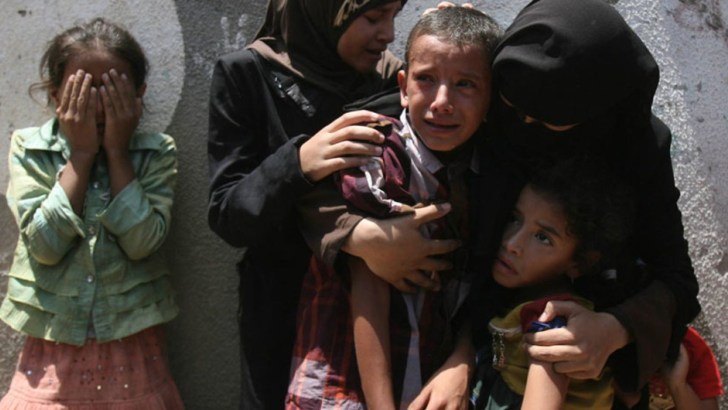
Palestinian children weep in Rafah, southern Gaza Strip (July 15, 2014)
A dozen years ago Alison Weir described how U.S. media ignored a Palestinian death… This pattern has persisted year after year after year…
By Alison Weir – If Americans Knew – October 6, 2006
Almost no one bothered to report it. A search of the nation’s largest newspapers turned up nothing in USA Today, the Boston Globe, Boston Herald, Chicago Sun-Times, Atlanta Journal-Constitution, San Francisco Chronicle, Seattle Times, St. Louis Post-Dispatch, Houston Chronicle, Tampa Tribune, etc.
There was nothing on CBS, NBC, ABC, CNN, PBS, NPR, Fox News. Nothing.
The LA Times, the Washington Post, the New York Times, and Associated Press each had one sentence, at most, telling about her. All three left out the details, the LA Times had her age significantly off, and the Washington Post reported that she had been killed by an Israeli tank shell.
It hadn’t been a tank shell that had killer her, according to witnesses. It had been bullets, multiple ones, fired up close.
Neighbors report that Israeli soldiers had been beating her husband because he wasn’t answering their questions. Foolishly or valiantly, how is one to say, the 35-year-old woman had interfered. She tried to explain that her husband was deaf, screamed at the soldiers that her husband couldn’t hear them and attempted to stop them from hitting him. So they shot her. Several times.
Her name was Itemad Ismail Abu Mo’ammar.
She didn’t die, though. That took longer. It required her life to flow out of her in the form of blood for several hours, as Israeli soldiers refused to allow an ambulance to transport her to help. Her husband and children could do nothing to save her.
Finally, after approximately five hours, an ambulance was allowed to take her to a hospital, where physicians were able to render one service: pronounce her dead, a few days before the commencement of Ramadan, a season of family gatherings much like the Christmas season for Americans. She left 11 children. None of this was in the Washington Post story, which had reported her death in one half of one sentence.
Her husband’s brother, who lived in the same house, was also killed. He was a 28-year-old farmer.
Why did this all happen? The family lived behind a resistance fighter wanted by Israel. They were simply “collateral damage” in a failed Israeli assassination/kidnapping operation.
All together, five Palestinians were killed that day. The other three were young shepherds killed in another area, two 15 years old and one 14, who seem to have simply been in the wrong place at the wrong time. Gaza.
None of this was reported in most of America’s news media, and so the American public never learned about a mother bleeding to death in front of her children, or young shepherds being blown to pieces. Apparently, it just wasn’t newsworthy.
A Case Study of “Good” News Coverage
The Washington Post at least mentioned these deaths, so perhaps those who care about journalistic standards should laud the Post for its coverage.
And yet, the Post in its short report got so much so wrong.
In addition to misreporting Itemad’s cause of death and omitting critical facts, the Post’s story portrayed the entire context incorrectly, telling readers that these five deaths had broken a period of “relative calm.”
The fact is that while it was true that in the previous six months not a single Israeli child had been killed by Palestinians, during this period Israelis had killed 75 Palestinian young people, including an 8-month-old and several three-year-olds.
I phoned the Post and spoke to a foreign editor about the need to run a correction, providing information on Itemad’s murder. The editor said that she would pass this on to their correspondent (who is based in Israel), but explained that it was “impossible for him to go to Gaza.” When I disagreed, she amended the “impossible” to “very difficult.” She neglected to mention that the Post has access to stringers in Gaza available to check out any incident the editors deem important.
Next, I wrote a letter to the paper containing the above information. Happily, the Post letters department apparently checked it out and decided it was a good letter. They sent an email informing me that they were considering my letter for publication and needed to confirm that I was the one who had written it, and that I had not sent the information elsewhere.
I replied in the affirmative, we exchanged a few more messages, and everything appeared on target. Normally, when publications contact you in this way, your letter is published shortly thereafter. I waited in anticipation. And waited.
It is now almost two weeks after their report, and I have just been informed that the paper has decided not to print my letter. The Post has apparently determined that there is no need to run a correction.
I think I understand.
Although the Washington Post’s statement of principles proclaims, “This newspaper is pledged to minimize the number of errors we make and to correct those that occur… Accuracy is our goal; candor is our defense,” the American Society of Newspaper Editors clarifies these ethical requirements: corrections need only be printed when the error of commission or omission is “significant.”
And, after all, these were only Palestinians, and it was just another mother dead.
Alison Weir is the founder and executive director of If Americans Knew. She is the author of Against Our Better Judgment: The Hidden History of How the U.S. Was Used to Create Israel.
Another Palestinian mother has just been killed. For a list of Palestinian and Israeli women killed see this Timeline.
Israeli historian thinks 1956 massacre was part of a secret plan to expel Palestinians

Issachar “Yiska” Shadmi, right, following his show trial.
If Americans Knew | October 13, 2018
Israel’s Ha’aretz newspaper reports that the highest Israeli officer tried for Israel’s 1956 Kafr Qasem massacre admitted before his death that his trial was staged to protect military and political elites.
Israeli historian Adam Raz believes that a secret plan to transfer Israel’s Arabs was behind the 1956 attack, in which Israeli soldiers shot dead 19 men, 6 women, and 23 children (some reports give the total killed as 51). They were allegedly killed because they had violated an Israeli imposed curfew, of which they were unaware.
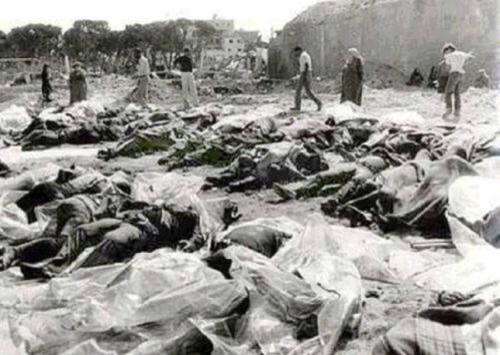
Palestinian villagers killed by Israeli forces in Kafr Qasim, October 29, 1956
The Israelis who perpetrated the massacre were courtmartialed and convicted, but their sentences were soon commuted, they received presidential pardons and were released from jail. Some were awarded desirable jobs; Ben Gurion appointed the batallion commander head of security at the Dimona nuclear reactor.
The most senior defendant, Col. Issachar Shadmi, commander of the brigade in charge of the area, was fined 10 pennies for exceeding authority.

Issachar “Yiska” Shadmi, after his trial, holding the 10-prutot coin he had to pay as a fine.
Until his death last month at the age of 96, Shadmi lived in a spacious home in an upscale neighborhood of Tel Aviv.
Ha’aretz journalist Ofer Aderet interviewed Shadmi in 2017.
During the interview Shadmi said that the 1958 court case was “a show trial, staged in order to keep Israel’s security and political elite – including Prime Minister Ben-Gurion, IDF Chief of Staff Moshe Dayan, and GOC Central Command (and later chief of staff) Tzvi Tzur – from having to take responsibility for the massacre.”
The trial, Aderet reports, “was intended to mislead the international community with regard to Israel’s ostensible pursuit of justice.”
Shadmi said: “They explained to me that they needed to put me on trial, because if I had tried in my own country and convicted, even if I was fined only a penny, I wouldn’t go to The Hague…. If they didn’t prosecute me… I would be tried at The Hague. And that is something that neither I nor the country were interested in.”
Aderet writes that Shadmi said he was well compensated as a civilian for going along with the show trial: “I turned into a major Defense Ministry building contractor.”
Israeli historian Adam Raz has filed a lawsuit demanding that Israel declassify documents relating to the affair. He says: “Most of the material is still classified. I was surprised to discover that it’s easier to write about the history of Israel’s nuclear program than about Israel’s policies regarding its Arab citizens.”
Raz believes that another reason for the show trial was to hide a secret program called “Operation Mole.” The goal was to expel Palestinians from the area. He says: “The public is familiar with the ‘Mole’ program only as a rumor.” says Raz; much of the documentation remains classified in the IDF archive.
Aderet writes: “Raz thinks one must see the Kafr Qasem massacre in this context: ‘The massacre wasn’t perpetrated by a group of soldiers who were out of control, as has been argued until today. From their point of view they were following orders, which in essence would lead to the expulsion of the villagers,’ he says. Or, in other words, they were operating in line with the directives of Operation Mole, as they understood them.”
Raz has written a book about the massacre scheduled to be published this month, but it appears it will only be available in Hebrew.
Israel advocates are the 2 largest donors in lead-up to U.S. midterm elections

Former New York City Mayor and political donor Michael Bloomberg with Israeli Prime Minister Benjamin Netanyahu
By Alison Weir | If Americans Knew | October 13, 2018
Two Israel partisans are the top campaign donors in the midterm elections, each pumping millions of dollars into campaign coffers.
Billionaire Sheldon Adelson, who once said he wished he’d served in the Israeli military instead of the American one, is donating tens of millions of dollars to Republicans. He is expected to be the top donor in this election cycle.
Adelson, accompanied by his wife, speaking to an Israeli group in July 2010 :
Billionaire Michael Bloomberg, who has twice flown to Israel in the midst of its massacres in Gaza to demonstrate his support for Israel, is coming in second, giving tens of millions of dollars to Democrats. Bloomberg has pledged to spend $100 million in the final weeks leading up to the election.
Bloomberg, who was a Republican until recently, has hinted that he may run for President in 2020.
In addition to giving candidates money, Bloomberg is also personally campaigning for some, including Tennessee’s Phil Bredesen and Florida’s Andrew Gillum.
Last week the Tampa Bay Times reported: “[Andrew Gillum] walked into one of the most dependable voting precincts in South Florida wearing a yarmulke and touted his ties to Florida’s Jewish community. In the company of the Jewish former New York Mayor Michael Bloomberg, [Andrew] Gillum delivered a short speech in which he spoke about his three trips to Israel during his time in office in Tallahassee and his family’s history.”

Michael Bloomberg, Debbie Wasserman Schultz and Andrew Gillum at Century Pines Jewish Center in Pembroke Pines, Florida, 10-7-2018. Gillum is the Democratic candidate for Governor.
Bloomberg gives both personal donations and PAC donations from his political action committee “Everytown for Gun Safety.”
While Bloomberg appears to be an opponent of guns, he supports Israel, where settlers on illegally acquired Palestinian land carry and use guns regularly.

Israeli settlers open fire in vicinity of elementary school near Bethlehem, June 2018. Also see “Israeli settlers injure dozens of Palestinian students in Nablus“
For a list of Israelis and Palestinians killed since 2000, see this Timeline:
Palestinian Woman Stoned to Death by Israeli Settlers
IMEMC News – October 13, 2018
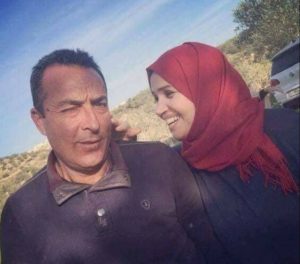 A group of Israeli paramilitary settlers attacked a Palestinian couple south of Nablus, in the northern part of the West Bank, on Friday, killing the woman and severely injuring her husband.
Aisha Mohammed Talal al-Rabi, 47, was riding in a car with her husband near the Za’tara roadblock, south of Nablus, in the northern part of the West Bank, when a group of Israeli settlers came onto the road and began throwing rocks at their car.
The slain woman was from Bidya town, northwest of Salfit.
The Israeli colonial settlers threw a number of large rocks, breaking the windshield of the car. They then continued to throw rocks, according to local sources, hitting the couple multiple times in the head and upper body.
Aisha died of blunt force trauma to the head, caused by a rock that was thrown at her head by the settlers.
Armed Israeli paramilitary settlers have launched a number of attacks on the Palestinian civilian population in the Nablus area, with the number of attacks drastically increasing since two Israeli settlers were killed by a Palestinian in the area on Monday.
Stanford’s Hoover Institution implicated in “astroturfed” pro-Israel demonstration
If Americans Knew | October 12, 2018
A leaked clip from a censored documentary indicates that a pro-Israel, anti-Arab protest was manufactured with the help of some staff and students from the Hoover Institution.
The documentary, produced by Al Jazeera, says that the protestors at the demonstration were “on a fellowship program run by a conservative think tank called the Hoover Institution.” A student says in the clip that they were “forced” to participate.
The Hoover Institution is located at Stanford University and is funded under Stanford University’s tax-exempt status as an educational institution. The Hoover Institution has refused to answer questions about the report.

Hoover Tower occupies a central place on the Stanford campus, one of four Hoover Institution buildings at Stanford.
The student in the clip has not yet been identified, and it is unclear which Hoover program he was on. At one point in the video he laughs and says that he and others “sold out” for $50,000 and benefits.
Israel’s Ha’aretz newspaper reports about the clip:
The Al Jazeera reporter joined a group of students who received a fellowship from the right-wing Hoover Institution, and they are seen telling him that their presence in a small pro-Israeli demonstration has been declared mandatory by their supervisors.
“’his is actually the first foot-soldier activity that we’ve been forced to do,” one of the students says. Another describes it as “a chance to shout at Arabs” who will protest against Israel at the same location.
The students also describe their presence at the demonstration as “astroturfing” – a political term that describes inauthentic political activism, which pretends to be grass-roots based activism. “It’s when you set up fake protests,” one student says. The same students are later seen holding “pro-Israel” signs at the demonstration.
The clip is from an Al Jazeera documentary about the Israel lobby in the U.S. that has not yet been broadcast. Ha’aretz reports that the film was pulled in a bid “to appease the U.S. Jewish community.”
Two sources from pro-Israeli organizations confirmed that the video excerpts were indeed filmed by the Al Jazeera reporter.
Hoover officials have refused to comment on the actions by Hoover staff members reported in the documentary, and it is unclear whether the institution approves of their behavior.
Stanford officials also failed to respond to inquiries about the report.
Hoover’s director is Thomas W. Gilligan, 650-723-1198, and its associate director is Eryn Witcher Tillman (also listed as a media contact for Stanford), 650-725-3076.
Featured Video

Houthis Don’t Have to Conquer Saudi Arabia to Make It Pay
or go to
Aletho News Archives – Video-Images
From the Archives
A Lesser “Grade” of Human
By Michael Hoffman | Revelation of the Method | January 3, 2024
Will the more than 100 Iranians killed by terrorist bombs today be mourned in the West as victims of terrorism? Certainly not. Allied doctrine has it that the killing of Israeli or American civilians is a crime of cosmic proportions, while shedding the blood of “enemy” women and children is perfectly acceptable; indeed commendable.
The West does not memorialize the hundreds of thousands of civilians bombed by the U.S. in Serbia, Iraq, Afghanistan and every major German city 1943-1945. America’s fire-bombing of the city of Tokyo by General Curtis LeMay in March 1945 was followed by Harry Truman’s atomic incineration of Hiroshima and Nagasaki in August of that year. Truman never had a moment of doubt or regret over the murder of more than a 100,000 Asian children, mothers and non-combatant boys and men. It was business as usual for the “noble” Allies during the “Good War.”
In the West human rights signifies passionate concern only for civilians designated as truly human: Israelis first, then Americans and British, followed by their satraps.
This inhumanity is the legacy of Talmudic ideology, beginning with tractate Sanhedrin 57a from 400 A.D., concerning liability for capital punishment: “If a Jew murders a gentile, he is exempt.”
This teaching of contempt was reiterated in the dogma of Chabad Lubavitch founder Rabbi Shneur Zalman in the 18th century. … continue
Blog Roll
 Aletho News
- Houthis Don’t Have to Conquer Saudi Arabia to Make It Pay
- MOE: Nearly 22,000 Students and Education Workers Killed
- Guterres in Islamabad: Genocide, cowardice, and the cage of Imran Khan
- Johnson, Marandi say Yemen holds upper hand over Saudi Arabia
- False flags won’t save aggressors, Iran FM spokesman says
- The Makkah Pact Enters Into Force: The End of American Dominance or Its New Form?
- NATO’s top generals gather in Kiev
- EU’s continuing expansion – greater threat to Russia
- US Senator Murphy says Pentagon denied him entry to US base in Qatar
- Israel expands “incitement” charge to target Palestinian education and memory
- If Americans Knew
- Three Years of Genocide: How America’s Israel-First Media Filtered Out the Truth
- Israeli war chief briefs ministers on potential war against Palestinian Authority
- New Report: Israel Killed nearly 21,000 Palestinian Students and Education Workers in Past Three Years
- Israel’s flailing chatbot army
- Five Palestinians Killed, Others Injured by Israeli Fire in Gaza
- Israel is rewriting the Palestinian curriculum in East Jerusalem to erase Palestinian identity
- Three years of genocide: Israel turned prisons into killing grounds and torture sites
- Three years of genocide. Words fail. Daily Update
- ‘I’d rather die than go back’: A Palestinian teen’s 10-month nightmare in Israeli jail
- How Jared Kushner’s firm’s investment in an Israeli company could be a major conflict of interest
- No Tricks Zone
- New Study: 50 Years Of The Most Aggressive ‘Net Zero’ Policies Can Only Affect The Global Climate By 0.03°C
- US September “Heat” Was No Record…Many Records Set Decades Ago
- Latest European Green Energy Debacle; Portugal’s Largest Flagship Solar Park Insolvent!
- Green Energy Debacle: German Expert Professor Fritz Vahrenholt Warns Of Severe Economic And Social Consequences
- Two More Paleo Reconstructions Affirm Meters-Higher Sea Levels Across Ireland, Brazil 7000-6000 Years Ago
- New Study: Earth And Venus Surface Warmth Largely Explained By Convection And Lapse Rate, Not CO2 Or Radiation
- 2025 Nature Paper Claiming Worsening Global Drought Gets RETRACTED …Heavily Flawed
- New Study: ‘Global Drought Shows No Detectable Recent Acceleration Under Climate Warming’
- Economic Masterminds: German Socialists Suggest Taxing Productivity Gains Stemming From Using AI
- The South China Sea Has Not Been Cooperating With The Climate Change Narrative

