Ukraine facing labor ‘catastrophe’ as millions of citizens flee country
RT | September 4, 2018
Nearly a million Ukrainians are leaving the country every year, according to Ukrainian Foreign Minister Pavel Klimkin, warning the country will face severe labor shortages in the years to come.
“We are really in a catastrophic situation with a million Ukrainians leaving every year,” the minister said in an interview with Ukrainian ICTV.
Klimkin said that Poland alone has received around 1.4 million Ukrainians recently, and that nearly 30 percent of the population of the western Polish city of Wroclaw now speaks Ukrainian.
According to Ukraine’s foreign ministry, about three million Ukrainian migrants currently live in Russia, and up to two million in Poland.
Kiev reportedly sees labor migration as the second biggest threat to the country’s national security. According to a poll carried out by Research & Branding Group last June, 33 percent of Ukrainians were ready to leave the country for good and move to another country for permanent residence.
Labor migration from Ukraine has been growing over the past five years. Apart from Russia and Poland, Ukrainians are moving to Slovakia, the Czech Republic, Hungary, Latvia, Lithuania, Estonia, and Spain.
The current situation is expected to worsen in the years to come, according to Ukrainian Deputy Minister of Social Policy Olga Krentovska. In April, she said the current labor migration would lead to labor shortages that will put Ukraine’s economic stability at risk in just a couple of decades.
Kiev has appealed to Ukrainians leaving the country, attempting to persuade them to choose European countries over migrating to Russia. Last week, Ukrainian Infrastructure Minister Volodymyr Omelyan said that Kiev may sever all remaining public transport links with Russia, which includes passenger trains and buses, due to national security concerns.
Ukraine’s population has seen a dramatic decline since the country declared its independence from the Soviet Union in 1991. From its 1993 peak of more than 52 million people, the country’s population had decreased by nearly 10 million by the end of 2016, according to official figures. That’s a net 18 percent drop.
Israel’s Fifth Column
Exercising control from inside the government
By Philip Giraldi • Unz Review • September 4, 2018
Referring to Israel during an interview in August 1983, U.S. Navy Admiral and former head of the Joint Chiefs of Staff Thomas Moorer said “I’ve never seen a President — I don’t care who he is — stand up to them. It just boggles the mind. They always get what they want. The Israelis know what is going on all the time. I got to the point where I wasn’t writing anything down. If the American people understood what a grip these people have got on our government, they would rise up in arms. Our citizens certainly don’t have any idea what goes on.”
Moorer was speaking generally but he had something specific in mind, namely the June 8, 1967, Israeli attack on the American intelligence ship, U.S.S. Liberty, which killed 34 American crewmen and wounded 173 more. The ship was operating in international waters and was displaying a huge stars and stripes but Israeli warplanes, which had identified the vessel as American, even strafed the life rafts to kill those who were fleeing the sinking ship. It was the bloodiest attack on a U.S. Naval vessel ever outside of wartime and the crew deservedly received the most medals ever awarded to a single ship based on one action. Yes, it is one hell of a story of courage under fire, but don’t hold your breath waiting for Hollywood to make a movie out of it.
President Lyndon B. Johnson, may he burn in hell, had ordered the recall of U.S. carrier planes sent to aid the stricken vessel, saying that he would prefer the ship go to the bottom rather than embarrass his good friend Israel. Then came the cover-up from inside the U.S. government. A hastily convened and summarily executed board of inquiry headed by Admiral John McCain, father of the senator, deliberately interviewed only a handful of crewmen before determining that it was all an accident. The sailors who had survived the attack as well as crewmen from Navy ships that arrived eventually to provide assistance were held incommunicado in Malta before being threatened and sworn to secrecy. Since that time, repeated attempts to convene another genuine inquiry have been rebuffed by congress, the White House and the Pentagon. Recently deceased Senator John McCain was particularly active in rejecting overtures from the Liberty survivors.
The Liberty story demonstrates how Israel’s ability to make the United States government act against its own interests has been around for a long time. Grant Smith of IRMEP, cites how Israeli spying carried out by AIPAC in Washington back in the mid-1980s resulted in a lopsided trade agreement that currently benefits Israel by more than $10 billion per year on the top of direct grants from the U.S. Treasury and billions in tax exempt “charitable” donations by American Jews.
If Admiral Moorer were still alive, I would have to tell him that the situation vis-à-vis Israeli power is much worse now than it was in 1983. He would be very interested in reading a remarkable bit of research recently completed by Smith demonstrating exactly how Israel and its friends work from inside the system to corrupt our political process and make the American government work in support of Jewish state interests. He describes in some detail how the Israel Lobby has been able to manipulate the law enforcement community to protect and promote Prime Minister Benjamin Netanyahu’s agenda.
A key component in the Israeli penetration of the U. S. government has been President George W. Bush’s 2004 signing off on the creation of the Office of Terrorism and Financial Intelligence (OTFI) within the Department of the Treasury. The group’s website proclaims that it is responsible for “safeguarding the financial system against illicit use and combating rogue nations, terrorist facilitators, weapons of mass destruction (WMD) proliferators, money launderers, drug kingpins, and other national security threats,” but it has from its founding been really all about safeguarding Israel’s perceived interests. Grant Smith notes however, how “the secretive office has a special blind spot for major terrorism generators, such as tax-exempt money laundering from the United States into illegal Israeli settlements and proliferation financing and weapons technology smuggling into Israel’s clandestine nuclear weapons complex.”
The first head of the office was Undersecretary of Treasury Stuart Levey, who operated secretly within the Treasury itself while also coordinating regularly both with the Israeli government as well as with pro-Israel organizations like AIPAC, WINEP and the Foundation for the Defense of Democracies (FDD). Levey also traveled regularly to Israel on the taxpayer’s dime, as did his three successors in office.
Levey left OTFI in 2011 and was replaced by David Cohen. It was reported then and subsequently that counterterrorism position at OTFI were all filled by individuals who were both Jewish and Zionist. Cohen continued the Levey tradition of resisting any transparency regarding what the office was up to. Smith reports how, on September 12, 2012, he refused to answer reporter questions “about Israel’s possession of nuclear weapons, and whether sanctioning Iran, a signatory to the Treaty on the Non-Proliferation of Nuclear Weapons, over its internationally-inspected civilian nuclear program was an example of endemic double standards at OTFI.”
Cohen was in turn succeeded in 2015 by Adam Szubin who was then replaced in 2017 by Sigal Pearl Mandelker, a former and possibly current Israeli citizen. All of the heads of OTFI have therefore been Jewish and Zionist. All work closely with the Israeli government, all travel to Israel frequently on “official business” and they all are in close liaison with the Jewish groups most often described as part of the Israel Lobby. And the result has been that many of the victims of OTFI have been generally enemies of Israel, as defined by Israel and America’s Jewish lobbyists. OTFI’s Specially Designated Nationals And Blocked Persons List (SDN), which includes sanctions and enforcement options , features many Middle Eastern Muslim and Christian names and companies but nothing in any way comparable relating to Israel and Israelis, many of whom are well known to law enforcement otherwise as weapons traffickers and money launderers . And once placed on the SDN there is no transparent way to be removed, even if the entry was clearly in error.
Here in the United States, action by OTFI has meant that Islamic charities have been shut down and individuals exercising their right to free speech through criticism of the Jewish state have been imprisoned. If the Israel Anti-Boycott Act succeeds in making its way through congress the OTFI model will presumably become the law of the land when it comes to curtailing free speech whenever Israel is involved.
The OTFI story is outrageous, but it is far from unique. There is a history of American Jews closely attached to Israel being promoted by powerful and cash rich domestic lobbies to act on behalf of the Jewish state. To be sure, Jews who are Zionists are vastly overrepresented in all government agencies that have anything at all to do with the Middle East and one can reasonably argue that the Republican and Democratic Parties are in the pockets of Jewish billionaires named Sheldon Adelson and Haim Saban.
Neoconservatives, most of whom are Jewish, infiltrated the Pentagon under the Reagan Administration and they and their heirs in government and media (Doug Feith, Paul Wolfowitz, Scooter Libby, Richard Perle, Bill Kristol) were major players in the catastrophic war with Iraq, which, one of the architects of that war, Philip Zelikow, described in 2004 as being all about Israel. The same people are now in the forefront of urging war with Iran.
American policy towards the Middle East is largely being managed by a small circle of Orthodox Jews working for presidential son-in-law Jared Kushner. One of them, David Friedman, is currently U.S. Ambassador to Israel. Friedman, a bankruptcy lawyer who has no diplomatic or foreign policy credentials, is a Zionist Jew who is also a supporter of the illegal settlements on the West Bank and a harsh critic of other Jews who in any way disagree with the Israeli government. He has contributed money to settlement construction, which would be illegal if OTFI were doing its job, and has consistently defended the settlers while condemning the Palestinians in speeches in Israel. He endlessly and ignorantly repeats Israeli government talking points and has tried to change the wording of State Department communications, seeking to delete the word “occupied” when describing Israel’s control of the West Bank. His humanity does not extend beyond his Jewishness, defending Israel’s shooting thousands of unarmed Gazan protesters and the bombing of schools, hospitals and cultural centers. How he represents the United States and its citizens who are not dual nationals must be considered a mystery.
Friedman’s top adviser is Rabbi Aryeh Lightstone, who is described by the Embassy as an expert in “Jewish education and pro-Israel advocacy.” Once upon a time, in an apparently more enlightened mood, Lightstone described Donald Trump as posing “an existential danger both to the Republican Party and to the U.S.” and even accused him of pandering to Jewish audiences. Apparently when opportunity knocked he changed his mind about his new boss. Pre-government in 2014, Lightstone founded and headed Silent City, a Jewish advocacy group supported by extreme right-wing money that opposed the Iran nuclear agreement and also worked to combat the nonviolent Boycott, Divestment and Sanctions (BDS) movement. He is reportedly still connected financially with anti BDS groups, which might be construed as a conflict of interest. As the Senior Adviser to Friedman he is paid in excess of $200,000 plus free housing, additional cash benefits to include a 25% cost of living allowance and a 10% hardship differential, medical insurance and eligibility for a pension.
So, what’s in it all for Joe and Jill American Citizens? Not much. And for Israel? Anything, it wants, apparently. Sink a U.S. warship? Okay. Tap the U.S. Treasury? Sure, just wait a minute and we’ll draft some legislation that will give you even more money. Create a treasury department agency run exclusively by Jews that operates secretly to punish critics of the Jewish state? No brainer. Meanwhile a bunch of dudes at the Pentagon are dreaming of new wars for Israel and the White House sends an ignorant ambassador and top aide overseas to represent the interests of the foreign government in the country where they are posted. Which just happens to be Israel. Will it ever end?
Philip M. Giraldi, Ph.D., is Executive Director of the Council for the National Interest, a 501(c)3 tax deductible educational foundation that seeks a more interests-based U.S. foreign policy in the Middle East. Website is www.councilforthenationalinterest.org, address is P.O. Box 2157, Purcellville VA 20134 and its email is inform@cnionline.org.
Police to Review File on Anti-Semitism Allegations Against Labour – Commissioner
Sputnik – 04.09.2018
Met Police Commissioner Cressida Dick said on Tuesday she would pass the document with allegations of antisemitic behavior within the Labour Party to experts to determine whether any crimes had taken place.
“If somebody makes an allegation to us, which contains something like that, absolutely, we will take it seriously, we will scope we will see whether a crime has taken place… I, of course, will pass this to my experts to deal with,” the commissioner told the LBC broadcaster.
The LBC broadcaster has obtained a dossier on 45 cases and had Mak Chishty, an expert on hate crime, formerly in charge of such a division in the Met, to review them. According to Chishty, 21 cases should be reported to the police.
The Labour will vote later in the day on the definition of anti-semitism after months-long scandal surrounding the party. Labour leader Jeremy Corbyn, a strong supporter of Palestine, has faced his fair share of criticism in the past weeks.
What Lies Beneath: The US-Israeli Plot to ‘Save’ Gaza
By Ramzy Baroud | MEMO | September 4, 2018
Israel wants to change the rules of the game entirely. With unconditional support from the Trump Administration, Tel Aviv sees a golden opportunity to redefine what has, for decades, constituted the legal and political foundation for the so-called ‘Palestinian-Israeli conflict.’
While US President Donald Trump’s foreign policy has, thus far, been erratic and unpredictable, his administration’s ‘vision’ in Israel and Palestine is systematic and unswerving. This consistency seems to be part of a larger vision aimed at liberating the ‘conflict’ from the confines of international law and even the old US-sponsored ‘peace process.’
Indeed, the new strategy has, so far, targeted the status of East Jerusalem as an Occupied Palestinian city, and the Right of Return for Palestinian refugees. It aims to create a new reality in which Israel achieves its strategic goals while the rights of Palestinians are limited to mere humanitarian issues.
Unsurprisingly, Israel and the US are using the division between Palestinian factions, Fatah and Hamas, to their advantage. Fatah dominates the Palestinian Authority (PA) in Ramallah while Hamas controls besieged Gaza.
A carrot and a stick scenario are being applied in earnest. While, for years, Fatah received numerous financial and political perks from Washington, Hamas subsisted in isolation under a permanent siege and protracted state of war. It seems that the Trump Administration – under the auspices of Trump’s senior adviser and son-in-law, Jared Kushner – are turning the tables.
The reason that the PA is no longer the ‘moderate’ Palestinian leadership it used to be in Washington’s ever self-serving agenda is that Mahmoud Abbas has decided to boycott Washington in response to the latter’s recognition of all of Jerusalem as Israel’s capital. True, Abbas’ subservience has been successfully tested in the past but, under the new administration, the US demands complete ‘respect’, thus total obedience.
Hamas, which is locked in Gaza between closed borders from every direction, has been engaging Israel indirectly through Egyptian and Qatari mediation. That engagement has, so far, resulted in a short-term truce, while a long-term ceasefire is still being discussed.
The latest development on that front was the visit by Kushner, accompanied with Middle East envoy, Jason Greenblatt, to Qatar on August 22. There, Gaza was the main topic on the agenda.
So, why is Gaza, which has been isolated (even by the PA itself) suddenly the new gate through which the top US, Israeli and regional officials are planning to reactivate Middle East diplomacy?
Ironically, the suffocation of Gaza is particularly intense these days. The entire Gaza Strip is sinking deeper in its burgeoning humanitarian crisis, with August being one of the most gruelling months.
A series of US financial aid cuts have targeted the very socio-economic infrastructure that allowed Gaza to carry on, despite extreme poverty and the ongoing economic blockade.
On August 31, Foreign Policy magazine reported that the US administration is in the process of denying the UN Palestinian refugees agency, UNRWA – which has already suffered massive US cuts since January – of all funds. Now the organization’s future is in grave peril.
The worrying news came only one week after another announcement, in which the US decided to cut nearly all aid allocated to Palestinians this year – $200 million, mostly funds spent on development projects in the West Bank and humanitarian aid to Gaza.
So why would the US manufacture a significant humanitarian crisis in Gaza – which suits the right-wing government of Benjamin Netanyahu well – while, simultaneously, engaging in discussions regarding the urgent need to end Gaza’s humanitarian woes?
The answer lies in the need for the US to manipulate aid to Palestinians to exact political concessions for Israel’s sake.
Months before rounds of Egyptian-sponsored indirect talks began between Israel and Hamas, there has been an unmistakable shift in Israeli and US attitudes regarding the future of Gaza:
On January 31, Israel presented to a high-level conference in Brussels ‘humanitarian assistance plans’ for Gaza at a proposed cost of $1 billion. The plan focuses mostly on water distillation, electricity, gas infrastructure and upgrading the joint industrial zone at the Erez crossing between Gaza and Israel. In essence, the Israeli plan is now the core discussion about the proposed long-term ceasefire.
The meeting was attended by Greenblatt, along with Kushner who is entrusted with implementing Trump’s unclear vision, inappropriately termed ‘the deal of the century.’
Two months later, Kushner hosted top officials from 19 countries to discuss the humanitarian crisis in Gaza.
There is a common thread between all of these activities.
Since the US decided to defy international law and move its embassy from Tel Aviv to Jerusalem last December, it has been in search of a new strategy that will circumvent the PA in Ramallah.
PA President, Abbas, whose political apparatus is mostly reliant on ‘security coordination’ with Israel, US political validation and financial handouts, has little with which to bargain.
Hamas has relatively greater political capital – as it has operated with less dependency on the Israeli-US-western camp. But years of relentless siege, interrupted by massive, deadly Israeli wars, have propelled Gaza into a permanent humanitarian crisis.
While a temporary truce between Israel and Hamas-led Palestinian groups in Gaza went into effect on August 15, a long-term ceasefire is still being negotiated. According to the Israeli daily Haaretz, citing Israeli officials, the truce would include a comprehensive ceasefire, opening all border crossings, expansion of the permitted fishing area off the Gaza coast, and the overhauling of Gaza’s destroyed economic infrastructure – among other stipulations.
Concurrently, Palestinian officials in Ramallah are fuming. ‘Chief negotiator,’ Saeb Erekat, accused Hamas of trying to “destroy the Palestinian national project,” by negotiating a separate agreement with Israel. The irony is that the Fatah-dominated Palestine Liberation Organization (PLO) and PA have done just that for over 25 years.
However, delinking the future of Gaza from the fate of all Palestinians can, indeed, lead to dangerous consequences.
Regardless of whether a permanent truce is achieved between Israel and the Hamas-led Gaza factions, the sad truth is that, whatever grand illusion is harboured by Washington and Tel Aviv at the moment, is almost entirely based on exploiting Palestinian divisions, for which the Palestinian leadership is to be wholly blamed.
Israel newspaper incites against Corbyn, Muslims in UK
MEMO | September 3, 2018
Israel Hayom newspaper yesterday ran an article inciting against Muslims in the UK and leader of the British Labour Party, Jeremy Corbyn.
“The British capital of London has become a base for Islamic groups, especially the Muslim Brotherhood outside the Middle East and the centre for the campaign to delegitimise Israel,” columnist Eldad Beck said in an article published yesterday.
Beck added that this comes in the context of “the radical speech led by British leader Jeremy Corbyn, noting to the increase in non-governmental political movements with only one common goal that is calling for the elimination of Israel.”
“There are a number of Hamas men who are running the battle to delegitimise Israel in Britain and are working to spread it around the world in order to legitimise the elimination of Israel. They have been organising fleets for solidarity with Gaza since 2010, led by the Turkish Mavi Marmara flotilla which caused Israel unprecedented harmful propaganda,” he claimed.
“Some Hamas figures in Britain are leading the Boycott, Divestment and Sanctions movement (BDS) and some have even filed legal complaints against British journalists who claimed that they have links with Hamas’ military activities, while others have issued anti-Semitic statements and got closer to Corbyn who received at the British Parliament Hamas representatives who had expressed their support for armed operations,” Beck added.
Meanwhile, former Director General of the Ministry of International Affairs and Strategy, Major General Yossi Kuperwasser, said “Britain is witnessing the emergence of what we can call the Green-Red Alliance, and one of its objectives is to wipe Israel off the map.”
“This alliance extends from Britain to the rest of the Western countries including the United States, but Britain is still the strongest body to export the Muslim Brotherhood’s ideology to the rest of the globe.”
“Palestinian activists in Britain are aiming to establish more Islamic organisations to influence the Kingdom’s internal and external policies,” he added.
Is UK Labour Now Zionist-Occupied Territory?
Befuddled Party waits to be gagged by ‘enemy within’
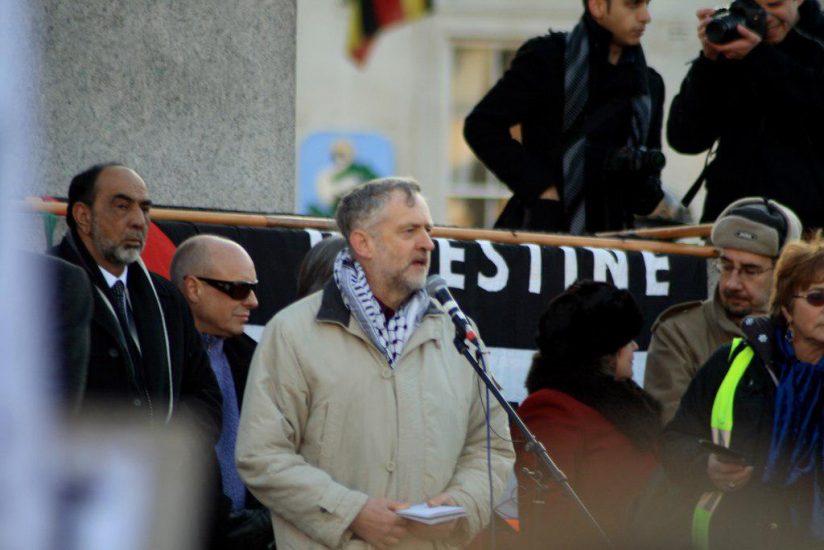
Jeremy Corbyn – Rally in Trafalgar Square. Image credit: Davide Simonetti/ Flickr
By Stuart Littlewood | American Herald Tribune | September 3, 2018
The National Executive Committee of the Labour Party will vote tomorrow (Tuesday) on whether to bow to the bullies and adopt the IHRA definition of anti-Semitism even though it has been roundly criticised by legal experts as unworkable. If they do, it will be hailed as a mighty victory for the dark forces behind the pro-Israel lobby in their bid to shut down criticisim of that racist state.
More than two years ago Gilad Atzmon was viewing the Labour Party’s crazed witch hunt for “anti-Semites” with misgiving. He declared, in his usual robust way, that Labour under Jeremy Corbyn was not so much a party as a piece of Zionist-occupied territory.
Writing in his blog about Corbyn and McDonnell’s servile commitment to expel anyone whose remarks might be interpreted by the Zionist Tendency as hateful or simply upsetting to Jews, he concluded: “Corbyn’s Labour is now unequivocally a spineless club of Sabbos Goyim [which I take to mean non-Jewish dogsbodies]. The Labour party’s policies are now compatible with Jewish culture: intolerant to the core and concerned primarily with the imaginary suffering of one people only. These people are not the working class, they are probably the most privileged ethnic group in Britain…. I did not anticipate that Corbyn would become a Zionist lapdog. Corbyn was a great hope to many of us. I guess that the time has come to accept that The Left is a dead concept, it has nothing to offer.”
Amen to that last bit.
And more recently Miko Peled, former Israeli soldier and the son of a Israeli general, warned that Israel was going to “pull all the stops, they are going to smear, they are going to try anything they can to stop Corbyn” and the reason anti-Semitism is used is because they have no other argument.
Since then we’ve had a queue of high profile Labourites and others sticking the knife into Corbyn. Last week it was the former Chief Rabbi and Zionist extremist Lord Sacks. Then the much-respected MP Frank Field, a maverick who finally quit Labour in noisy fashion giving anti-Semitism as a reason but having grumbled for a long time about a culture of intolerance, nastiness and intimidation within the party. Yesterday we had to suffer ex-prime minister Gordon Brown mouthing off about how the IHRA definition “is something we should support unanimously, unequivocally and immediately.” He urged Corbyn to remove the “stain” of prejudice from Labour by writing the definition and all of its examples into the party’s new code of conduct.
That’s a particularly dumb thing to say considering the Home Office Select Committee urged two caveats be included and eminent legal minds Hugh Tomlinson QC and Sir Stephen Sedley pointed out how it is trumped by our right to free expression, which is part of UK domestic law by virtue of the Human Rights Act (something every Labour member ought to know and uphold), and by other conventions. Geoffrey Robertson QC also warns that it is “not fit for any purpose that seeks to use it as an adjudicative standard. It is imprecise, confusing and open to misinterpretation and even manipulation”.
Robertson adds: “The Governments ‘adoption’ of the definition has no legal effect and does not oblige public bodies to take notice of it. The definition should not be adopted, and certainly should not be applied, by public bodies unless they are clear about Article 10 of the EHCR (European Convention on Human Rights) which is binding upon them, namely that they cannot ban speech or writing about Israel unless there is a real likelihood it will lead to violence or disorder or race hatred.”
But Brown won’t be listening. He’s a dedicated pimp for Israel and a dyed-in-the-wool Zionist. In 2008, in the first speech by a British prime minister to the Israeli parliament, the Knesset, he told Israeli MPs: “Britain is your true friend. A friend in difficult times as well as in good times, a friend who will stand beside you whenever your peace, your stability and your existence are under threat.”
Unlike Corbyn, Gordon Brown wouldn’t talk to Hamas because warmongers in the White House had branded them ‘terrorists’. But that’s their opinion. The state of Israel was founded by terror groups like the one that murdered 91 in an attack on the British mandate government in the King David Hotel and carried out the Deir Yassin massacre. Israel is the expert in terror. As Norman Finkelstein has remarked, “It is more than a rogue state. It is a lunatic state… The whole world is yearning for peace, and Israel is constantly yearning for war.”
The Israeli government itself was described by one of Brown’s own (Jewish) MPs, Sir Gerald Kaufman, as a ‘gang of amoral thugs’.
Brown, the son of a Church of Scotland minister, would have done well (as would all the other critics of Jeremy Corbyn and his ‘funny’ friends) to mull over the words of Gaza’s Catholic priest, Father Manuel Musallam, who told a journalist friend Mohammed Omer: “Palestinian Christians are not a religious community set apart in some corner. We are part of the Palestinian people. Our relationship with Hamas is as people of one nation. Hamas doesn’t fight religious groups. Its fight is against the Israeli occupation.”
When asked about Western media reports that Islamic oppression was forcing Gaza’s Christians to consider emigrating, Father Manuel said that if Christians emigrate it’s because of the Israeli siege, not the Muslims. “We seek a life of freedom —a life different from the life of dogs we are currently forced to live.”
Turning the tables
Corbyn isn’t the problem. Zionists are. They are the enemy within. Corbyn’s election to party leader was a surprise brought about by a sudden influx of new supporters weary of sterile and corrupt politics. They had no time to groom him, not that he’s capable of being tamed like previous leaders. Corbyn has a long record of support for the Palestinians and other justice causes and that doesn’t sit well with the ‘emininence grise‘ pulling the strings. As a loose cannon in a carefully controlled political battlefield he had to be disabled. One way to do that was to pick off his allies one by one and, with the help of a compliant media, derail his party’s election prospects. That is what they’ve been doing with considerable success by weaponising so-called anti-Semitism against Labour’s naive and easily scared troops.
But why take allegations of anti-Semitism seriously from bully-boys who themselves practise or support racism? There’s a simple two-word response to such hypocrites. Admittedly there are within Labour’s ranks too many who say idiotic things about Jews to the detriment of the campaign for justice in the Holy Land. I’ve heard remarks that are so stupidly provocative that one suspects the people responsible are Zionist plants. What is the point of bringing up Hitler and the Holocaust when there are more Israeli war crimes and crimes against humanity than you can shake a stick at?
Corbyn should have acted swiftly on genuine complaints and rejected the trumped up ones. He didn’t. Outside interference should never have been tolerated. It has been and still is. The best way to deal with professional moaners like the Board of Deputies of British Jews is to politely give them the BDS treatment – ignore and refuse to engage until they change their intimidating tone. And tell them this is the British Labour Party not a flagpole of the Knesset.
Furthermore it is long past time to question Labour’s Friends of Israel about their shameless support for the criminal state and its racist leaders and the land-grabbing Zionist Project. There is no place in a socialist organisation, or in British public life at all, for people who cannot bring themselves to condemn a regime that behaves so viciously towards its neighbours, defies international law, thinks it’s exempt from the norms of decent behaviour and shows no remorse. What does aligning with apartheid Israel really say about them? And, by the way, who gave permission to use the party as a platform to promote the interests of a foreign military power?
If people holding public office put themselves in a position where they are influenced by a foreign power, they flagrantly breach the Principles of Public Life. There are far too many Labour and Conservative MPs and MEPs who fall into that category.
Strange how the upsurge in carefully orchestrated allegations of anti-Semitism coincided with the arrival of Mark Regev, former chief of Israel’s propaganda machine, spokesman for Israel’s extremist prime minister and a shameless liar, as Israel’s new ambassador in London.
Corbyn’s other option is to leave Labour, take his supporters with him and let the party stew in its own juice. Let’s face it, the party as it stood then and stands today is dysfunctional, a thing of the past and quite unsuited to the 21st century. There may still be time to build a new, clean, fit-for-purpose political party and get it established before the next general election. In it, though probably not leading it, Corbyn could at least be true to himself.
The Labour Party has repeatedly promised to review its rules to send a clear message of zero-tolerance on anti-Semitism, assuming it knows what that means and who the genuine Semites are. For balance, of course, it should match this with zero-tolerance of those who use the party as a platform for promoting the criminal Israeli regime and its obscene territorial ambitions.
And remember, in 1949 the UN took Israel to its bosom on condition that it accepted the Right of Return of the Palestinian refugees and complied with General Assembly Resolution 194. Noting the declaration by the new State of Israel that it “unreservedly accepts the obligations of the United Nations Charter and undertakes to honour them from the day when it becomes a Member”, the General Assembly admitted Israel as “a peace-loving State which accepts the obligations contained in the Charter and is able and willing to carry out those obligations”.
Has Israel ever honoured its membership obligations or acted as a peace-loving State?
Supporters of Apartheid Israel Abuse Sydney Anti-War Student
By Tim Anderson | American Herald Tribune | September 2, 2018
Media, parliamentary, academic and other supporters of apartheid Israel have abused University of Sydney doctoral student Jay Tharappel for his outspoken support of Yemen, opposition to Israel and his consistent stance against the long wars 0n Syria and Korea.
Much of the western media falsely pretend that the massively internationalized war on Syria is a “civil war”. Most also refuse to recognize the simple fact that, over the past 65 years, the USA has never agreed to a peace agreement with North Korea.
The personal attacks on Jay reveal a shallow recognition of free speech in Australia. It is extraordinary that so much abuse has been heaped on one dissident voice. Demands for censorship of his political comments have come from various sources, but many of them supporters of the apartheid state of Israel.
First came the bully and smear media, from Murdoch’s Daily Telegraph, and from Channel Seven. The Murdoch tabloid, in a torrent of personal abuse, attacked Jay for rejecting the false chemical weapons claims against Syria, in April 2017. It then falsely claimed that Jay’s criticism of Murdoch journalist Kylar Loussikian was a racist attack.
In August 2018 Channel Seven manufactured another scandal about Jay, falsely claiming that a Yemeni badge he wore in China was ‘anti-semitic’. One part of that badge, seen on Jay’s shirt in one of my social media posts, said ‘death to Israel’.
The photo was simply one of the friends at lunch. Channel Seven, using the false translation “death to Israeli”, claiming it was a racist incitement. I posted in response that the Channel Seven piece ‘promotes ignorance, apartheid, and war’.
In fact ‘death to Israel’ is a political statement by the Yemeni group Ansarallah, which calls for an end to apartheid Israel, the regime that is reported to have killed a Palestinian child every three days for the past 18 years. The Australian government sells arms to the Saudis to bomb Yemen, as they ignore that terrible war and try to suppress any news about Yemen.
Later, the University of Sydney told the Sydney Morning Herald that I was “under investigation” for refusing to take down that photo of Jay and friends at lunch. After a Sydney Morning Herald [allegation] against me, I made a social media statement explaining my position.
For Channel Seven’s principal sources journalist, Bryan Seymour used two people (to represent “many in the Jewish and Muslim community”). First was a well-known supporter of Israel, Vic Alhadeff. Vic was previously a chair of the NSW Community Relations Commission but resigned in 2014 after posting in support of Israel’s bloody reign of terror in Gaza.
The other was Jordanian-Australian Jamal Daoud, who claimed to represent a Palestinian group but is best known for his repeated attacks on those who support Syria. He has abused many supporters of Syria as ‘spies’ and ‘prostitutes’. In 2017 he took an Israeli propagandist to Syria, and since then has been wanted for questioning in Syria. Earlier, in 2015, he began an online petition to challenge a security ban on him entering Lebanon.
The corporate media came back to abuse Jay after he wrote a thoughtful piece on his visit to North Korea (DPRK) in the student newspaper Honi Soit. The article defended independent Korea while it described in some detail what he had seen there. On social media pages, many appreciated the unusual article, while others responded with censorial outrage.
The Daily Telegraph added another abusive piece, which copied much of Jay’s article while adding invective. Even the state-owned ABC wrote in support of the demand that the article be taken down, simply because it was seen as too favorable to North Korea.
Why the hysteria over criticism of Israel? Well, both the Murdoch media and Channel Seven have deep business links with Israel’s occupation forces, including those who regularly demolish Palestinian homes in their ethnic cleansing purges.
Pro-Israel figures and some Jewish media in Australia predictably and falsely tried to conflate Jay’s and my opposition to Israel with anti-Jewish racism. I have made my position on Israel and racism very clear on many occasions, most recently in an article called The Future of Palestine.
A selection of pro-Israel types jumped on the bandwagon. They included federal Labor MP Tim Watts, who attacked Jay’s article and Honi Soit, saying ‘everyone associated with this article ought to be ashamed’.
Everyone associated with this article ought to be ashamed https://t.co/SJ1jDeMqrP
— Tim Watts MP (@TimWattsMP) August 26, 2018
When he was criticized for picking on a student newspaper he said, by way of justification, that he was trying to get at me (‘the professor’).
I’m picking on the professor that has long been enabling this dangerous rubbish
— Tim Watts MP (@TimWattsMP) August 26, 2018
In fact, Tim Watts is yet another supporter of apartheid Israel. In late 2015 he went on an Israeli-government paid junket to Israel, in a group led by conservative minister Christopher Pyne. The group seemed to toe the Israeli line because Palestinian minister Dr. Sabri Saidam described them as “rude” and “not well educated” on Palestine.
Subsequently, Tim Watts took his Israel connection seriously. He strongly recommended the book ‘My Promised Land’ by Ari Shavit, which explains how Israel created “something unique and quite endearing” in a tough neighborhood.
This “unique and quite endearing” creation was described by an authoritative 2017 report to the United Nations as an ‘apartheid state’ and therefore ‘a crime against humanity’. US academic lawyers Richard Falk and Virginia Tilley wrote that “the situation in Israel-Palestine constitutes an unmet obligation of the organized international community to resolve a conflict, partially generated by its own actions”.
Professor Ariadne Vromen, a professor in Government at the University of Sydney, and opponent of the BDS campaign against Israel, jumped in, inexplicably, attacking the former Syrian Ambassador to Australia Tammam Sulayman. Ambassador Sulayman is now Syria’s envoy to North Korea, and it was he who invited us to visit that country.
Ariadne claimed that Ambassador Tammam had failed her research design course, 15 years ago. “He didn’t pass first year”, she said. After some criticism, she removed her post.

Of course, it is inappropriate for academics to abuse students or former students, or to humiliate them for their grades or results. In this case, Ariadne’s comments were also false. When I enquired, Ambassador Sulayman spelled out to me the reason why he had left Ariadne’s class and his doctoral studies at the University:
“Of course I didn’t complete at that time with Ariadne because [his supervisor, another academic] started the war on me and I complained against her to the university. So I stopped everything … in my [thesis] preface I stated there is no linkage between the secular Baath party and al Qaeda … but she said ‘that does not exclude links between Saddam and al Qaeda’, and I said but we are talking about the Baath party … Then she started returning every paper I sent her … she is a clear Zionist … It is silly for [Ariadne] to say that I didn’t finish even one year without mentioning the reason.”
Professor Vromen’s abuse of a former student and ambassador is strange. Why would an academic jump in to abuse a former student, in the context of an abusive media campaign against another student? What is wrong with honest discussion?
Unfortunately, this is not an isolated incident. The University of Sydney is well known for harboring pro-apartheid-Israel academics. It hosts a research project backed by US Government-funded agencies, called ‘The Electoral Integrity Project’. That project rates the electoral democracy of many countries. As it happens, they rate Israel’s ‘democracy’ very highly (17/127), even though the Jewish state is notorious for its institutionalized racism.
In 2007-08 the University of Sydney accepted a large grant from the American Australian Association, to establish a ‘United States Studies Centre’. This was mostly Australian Government money but came at the suggestion of media mogul Rupert Murdoch. The idea of the Centre came from a desire to repair the damage done to the image of the USA in the wake of its 2003 invasion of Iraq. I wrote an article about this scandal, back in 2010.
Washington remains the major funder and arms provider to apartheid Israel, providing the racist state with more than three billion dollars every year, mostly in military subsidies.
Back to the Future
A fictional story
By Gilad Atzmon | September 2, 2018
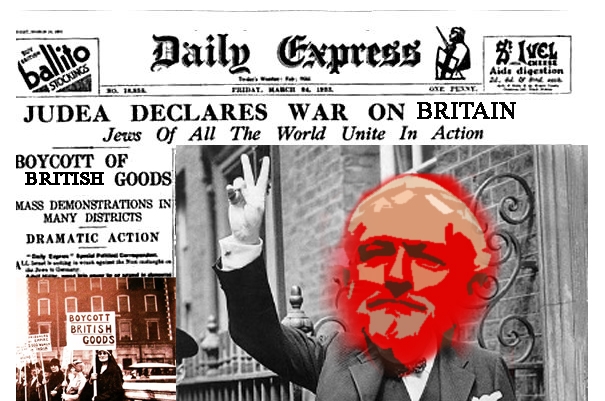
Neither Britain nor the rest of the world was surprised by last week’s election results. For the last six months Jeremy Corbyn and the Labour Party have led in the polls and during that time no one doubted that Corbyn would become Britain’s new prime minister, the only question was when. And yet, Corbyn’s increasing popularity wasn’t a smooth shift in British politics, it resulted instead from a gradual increase in British unity in opposition to an obnoxious foreign lobby. The nastier Corbyn’s enemies were, the more Brits sided with him. At a certain stage it became clear that it was the Zionist Lobby, rather than Corbyn himself, that united the Brits behind Corbyn.
The more the Jewish self-appointed ‘leadership’ pushed: the more they equated Corbyn with Enoch Powel and even Hitler, the more the Brits responded by siding with the old anti racist. In the months leading up to the election the picture became clear, a wide spectrum of Brits were expressing fatigue with the manner in which a foreign lobby was crudely intervening in their national politics.
But in spite of the many signs that Britain had had enough, the British Jewish so-called ‘leadership’ didn’t stop pushing. Not a day passed without a rabbi using the BBC to spread the message of Jews’ right to live in ‘peace’ on someone else’s land. Every day we read a Guardian interview with an influential Jew who threatened to make Aliya and take his or her shekels with him. The Brits weren’t impressed, on social media some offered departing Zionists piggy back rides to Heathrow.
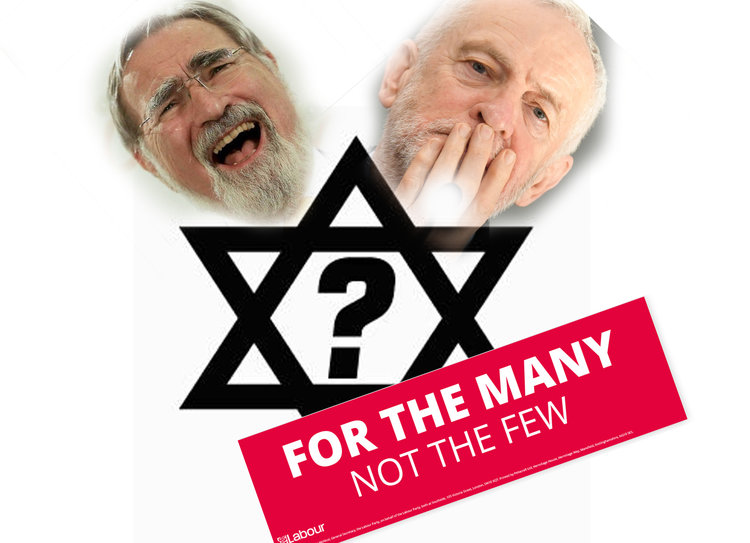
Commentators agreed that the escalation in British Jews’ troubled relationship with the rest of the nation was a very dangerous development. Corbyn, for his part, repeatedly stated that Labour would fight all forms of racism including antisemitsm. But the Jewish leaders’ concerns didn’t abate. “We didn’t ask him to fight racism, we want him to fight antisemitism.” Corbyns’ assurances were totally dismissed by the Jewish bodies. His motto, ‘For the Many not the Few,’ that excited so many Brits was interpreted by Zionist Jews as “for the Many not the Jew.” It became clear that no one within the Jewish community knew how to calm things down. On the contrary, the self-appointed Jewish ‘representative’ bodies, seemed to compete amongst themselves to see who could drip more oil into the blaze.
Two weeks before the election, when it was widely accepted that Corbyn was about to become a PM and there was no force that could stop him, not even the Jewish Lobby, violence was employed. In early January, MI5 was tipped off about a possible plot to physically attack the Labour leader. According to Israeli media a few arrests were made in North West London. The British press was restricted from passing that story on to the citizens of the kingdom.
In a desperate move two weeks before the election, AIPAC, CRIF and other overseas Jewish pressure groups joined local Zionist bodies in stating that a Labour win would lead to an immediate international call by Jews for a boycott of Britain. The Guardian was quick to publish an extended commentary by George Soros, its favorite ‘currency analyst,’ who lectured the Brits on what would happen to their pound if they were stupid enough to allow Corbyn into 10 Downing Street.
AIPAC and CRIF delivered. Less than 24 hours after the election, the two influential Jewish lobbies called for immediate and severe financial measures against Britain. Wealthy Jews were urged to withdraw their funds and investments from the City. The US administration was implored to stop trade with Britain immediately. President Trump, hanging on a thread and battling likely impeachment, promised to seriously consider the demands of the Lobby that has dominated American foreign policy for more than three decades.
The situation in Britain did indeed deteriorate immediately as Soros predicted. Within a day, the pound lost 45% of its value against the dollar and this after the dollar lost 20% of its value against the Iranian Rial a week earlier (due to an EU-Chinese-Russian deal with Iran).
Brits weren’t happy at all. In fact, many of them were devastated. Corbyn, now a PM in the process of forming his government, was put in an untenable situation. It was just a question of time before nasty scenes of violence erupted. I guess that we have seen it all before…
Corbyn and the Jewish Question
By Gilad Atzmon | August 31, 2018
It doesn’t take a genius to detect the present volatile state of British Jewish institutions. To the outside observer, some of the actions of Britain’s so-called Jewish ‘leaders’ may seem to be a form of collective insanity. Yet, the Brits do not seem to be at all impressed. They are perplexed by the self-propelled collective hysteria. Naturally, many Brits do not agree with Corbyn on issues; some may not agree with his pacifist politics, others see him as a naïve delusional lefty, a few are upset by his association with controversial characters, but no one except a few Israel firsters sees Corbyn as a crazed ‘anti-Semite,’ let alone as a Hitler type who puts Jewish life under an “existential threat.” While it isn’t clear whether Corbyn can unite the Brits against their horrid government, it is increasingly likely that the Zionist lobby has the capacity to unite the Brits behind Corbyn. A comment on twitter the other day noted that “not supporting Corbyn at this point is an act of treason.”
This week the ex-chief rabbi, Jonathan Sacks, became completely unhinged; comparing Corbyn to Enoch Powell’s “rivers of blood” speech. In an interview Rabbi Sacks maintained that Corbyn “undermines the existence of an entire group of British citizens by depicting them as essentially alien.” What had Corbyn said that provoked such an extreme reaction from the celebrity rabbi? Apparently, in 2013 Corbyn criticised British Zionists by suggesting that they have two problems. “One is they don’t want to study history and, secondly, having lived in this country for a very long time, probably all their lives, they don’t understand English irony.”
This raises some obvious questions: 1. What is it in Corbyn’s statement that sparked Rabbi Sacks’ outburst, and 2. How is it possible that when Corbyn speaks about Zionists, Rabbi Sacks hears ‘Jews’?
One possibility is that in Rabbi Sacks’ mind, Jews and Zionists are one and the same. After all, Rabbi Sacks believes that “anti Zionism is the new anti-Semitism.” The rabbi freely associates ‘Zionists,’ ‘Semites’ and ‘Jews.’ Someone should remind the rabbi that the suggestion that ‘Jews’ and Zionists are somehow the same might fall within the IHRA Working Definition of Antisemitsm. According to the definition, manifestations of anti-Semitism “might include the targeting of the state of Israel, conceived as a Jewish collectivity.” In his interpretation of Corbyn’s words, Rabbi Sacks seems to expand the term ‘Zionists’ into meaning ‘Jewish collectivity.’ I am afraid that our ex-chief rabbi may have fallen into the IHRA trap, something you might expect from a Talmudic Jewish scholar but not from an Oxford graduate.
The truth of the matter is that Corbyn has managed to touch the most sensitive Jewish collective nerve. In Corbyn’s universalist egalitarian offering there is no room for tribal exceptionalism. In Corbyn’s universe, Jews are just ordinary people and not God’s chosen people. Corbyn’s ‘for the many not the few’ doesn’t conform to chosenism, Jewish or identitarian. But we can see that this universalist perception of the ‘many’ is interpreted by British Jewish leadership as a casus belli – a call for a war.
Corbyn’s reference to Zionists’ ‘lack of British irony’ touched the rawest Jewish nerve. He stumbled upon the Jewish ‘assimilation complex.’
Since the emancipation of European Jewry, a 19th century political transition, Jews have been struggling to define their identity and role in the wider society. Emancipation invited assimilation, it offered Jews the ability to become an indistinguishable part of the ‘many,’ but this transformative shift would have entailed a loss of Jewish identity. This dilemma is known as the ‘Jewish Question.’ Zionism was initially an attempt to resolve the Jewish question and the assimilation dilemma. It offered Jews the ability to be ‘people like all other people’ but in a different place. Zionism promised to take the Jews away while allowing Jews to assimilate, although as a distinct nation amongst nations. Zionism gave Jews a way to resolve the tension between assimilation and preservation. The Jews were saved the danger of integrating into their host nations and allowed to preserve many if not most of their cultural traits, as Israel proves on a daily basis.
The Jewish fear of assimilation is not a secret. Golda Meir who served as Israel’s Prime Minister at the time of October War (1973), believed that Jews who assimilate are essentially partners to the Nazis, since through assimilation they are exterminating the continuation of the Jewish people. For Meir, mixed marriages, and not the Arabs, were the greatest danger to the Jewish people. With Meir’s anti assimilationist view in mind, it is clear why Corbyn’s traditional socialist view of ‘the many’ poses an existential danger to those who insist upon being ‘the few.’ Corbyn’s well meaning invitation to the Jews and everyone else to fully integrate into British society is interpreted by Zionist Jews as a threat of extermination (to use Golda Meir’s loaded terminology).
Rabbi Sacks’ reaction, however, takes us to a new level in our understanding of the Zionist mindset. The rabbi actually accused Corbyn of implying that “Jews are not fully British.” But that was not what Corbyn said or implied. He suggested that “Zionists” are not exactly British, a statement that poses no problem for most Zionists since they openly and voluntarily swear allegiance to another state, one that is nationalist, racist and expansionist and shares few, if any, values with Britain or the West.
In order to grasp Rabbi Sacks’ recent outburst we may have to appeal once again to the famous French psychoanalyst Jacques Lacan’s astute observation: “unconscious is the discourse of the Other.” The unconscious, according to Lacan, is the fear that the Other, in this case, the gentile, the humanist or shall we say Corbyn and the Brits see you truly. It is the tormenting thought that the Goy may be able to detect the lie. It is the unbearable anxiety that the Brits know that British Zionists aren’t exactly Brits, they are deeply devoted to another state and its foreign interests, they never assimilated and do not plan to assimilate in the near future. The Lacanian unconscious is the fear that a Goy may stand up one day and decide to call a spade a spade or, way more disturbing, refer to a celebrity ex-chief rabbi as a “far right extremist,” as Trade Union activist Eddie Dempsey suggests in the video below:
Israel threatens to use nuclear weapons to ‘wipe out’ its enemies
MEMO | August 31, 2018
Standing next to a secretive Israeli atomic reactor earlier in the week, Prime Minister Benjamin Netanyahu threatened to “wipe out” his enemies. In a speech that many will see as the Jewish state breaking its long silence over the possession of nuclear weapons, the Likud leader warned that it has the means to destroy its enemies.
“Those who threaten to wipe us out put themselves in a similar danger, and in any event will not achieve their goal,” he said on Wednesday during a ceremony to rename the complex, near the desert town of Dimona. The site has long been suspected to be the location where Israel has been developing nuclear weapons.
Iran hit back by describing Netanyahu as a “warmonger”. The threat “atomic annihilation” against the Islamic Republic was denounced as “beyond shameless in the gall”.
“Iran, a country without nuclear weapons, is threatened with atomic annihilation by a warmonger standing next to an actual nuclear weapons factory,” Foreign Minister Mohammad Javad Zarif wrote on his official Twitter account.
Zarif also commented on Israel’s nuclear programme saying: “As the world marks Int’l Day against Nuclear Tests, let’s remember that only nuclear bombs in our region belong to Israel and the US; the former a habitual aggressor & the latter the sole user of nukes. Let’s also remember that Iran has called for Nuclear Weapon Free Zone since 1974.”
Israel has never acknowledged possessing nuclear weapons, instead maintaining a policy of “strategic ambiguity”. Foreign reports have put the size of Israel’s nuclear arsenal in the dozens to hundreds of weapons.
Earlier this month a science journal published by Princeton University’s Science and Global Security journal claimed that Israel conducted illegal nuclear test in contravention of international law.
Netanyahu’s remarks came as Israel lobbies world powers to follow the US in exiting a 2015 international deal with Iran that capped the Islamic Republic’s nuclear capabilities.
Featured Video

Houthis Don’t Have to Conquer Saudi Arabia to Make It Pay
or go to
Aletho News Archives – Video-Images
From the Archives
Newly Released FBI Docs Shed Light on Apparent Mossad Foreknowledge of 9/11 Attacks
By Whitney Webb | MintPress News | May 17, 2019
NEW YORK — For nearly two decades, one of the most overlooked and little known arrests made in the aftermath of the September 11 attacks was that of the so-called “High Fivers,” or the “Dancing Israelis.” However, new information released by the FBI on May 7 has brought fresh scrutiny to the possibility that the “Dancing Israelis,” at least two of whom were known Mossad operatives, had prior knowledge of the attacks on the World Trade Center. … continue
Blog Roll
 Aletho News
- Baghaei to Rubio: Distorted narratives cannot erase US record of broken commitments
- Houthis Don’t Have to Conquer Saudi Arabia to Make It Pay
- MOE: Nearly 22,000 Students and Education Workers Killed
- Guterres in Islamabad: Genocide, cowardice, and the cage of Imran Khan
- Johnson, Marandi say Yemen holds upper hand over Saudi Arabia
- False flags won’t save aggressors, Iran FM spokesman says
- The Makkah Pact Enters Into Force: The End of American Dominance or Its New Form?
- NATO’s top generals gather in Kiev
- EU’s continuing expansion – greater threat to Russia
- US Senator Murphy says Pentagon denied him entry to US base in Qatar
- If Americans Knew
- Three Years of Genocide: How America’s Israel-First Media Filtered Out the Truth
- Israeli war chief briefs ministers on potential war against Palestinian Authority
- New Report: Israel Killed nearly 21,000 Palestinian Students and Education Workers in Past Three Years
- Israel’s flailing chatbot army
- Five Palestinians Killed, Others Injured by Israeli Fire in Gaza
- Israel is rewriting the Palestinian curriculum in East Jerusalem to erase Palestinian identity
- Three years of genocide: Israel turned prisons into killing grounds and torture sites
- Three years of genocide. Words fail. Daily Update
- ‘I’d rather die than go back’: A Palestinian teen’s 10-month nightmare in Israeli jail
- How Jared Kushner’s firm’s investment in an Israeli company could be a major conflict of interest
- No Tricks Zone
- New Study: 50 Years Of The Most Aggressive ‘Net Zero’ Policies Can Only Affect The Global Climate By 0.03°C
- US September “Heat” Was No Record…Many Records Set Decades Ago
- Latest European Green Energy Debacle; Portugal’s Largest Flagship Solar Park Insolvent!
- Green Energy Debacle: German Expert Professor Fritz Vahrenholt Warns Of Severe Economic And Social Consequences
- Two More Paleo Reconstructions Affirm Meters-Higher Sea Levels Across Ireland, Brazil 7000-6000 Years Ago
- New Study: Earth And Venus Surface Warmth Largely Explained By Convection And Lapse Rate, Not CO2 Or Radiation
- 2025 Nature Paper Claiming Worsening Global Drought Gets RETRACTED …Heavily Flawed
- New Study: ‘Global Drought Shows No Detectable Recent Acceleration Under Climate Warming’
- Economic Masterminds: German Socialists Suggest Taxing Productivity Gains Stemming From Using AI
- The South China Sea Has Not Been Cooperating With The Climate Change Narrative

