Importing Jihadi Terror to the UK – Cui Bono?
By Craig Murray | September 25, 2018
If Osama Bin Laden was not sufficient warning that decades of money, arms and other support from the Western security services does not render a jihadi a friend of the West, then the Manchester bomber, Salman Abedi, should have opened British eyes forever to the danger. In collaboration with MI5, Abedi had been fighting in the ongoing proxy war for Western oil interests in Libya, before being rescued by the Royal Navy. Back home in Manchester, he carried out an attack of appalling violence against a primarily young and female target group.
So it would be very foolish indeed to rely on the fact that the jihadi logistic support and propaganda group the White Helmets is largely British government funded, to expect its members who are now, like Abedi, being brought into the UK, to behave as quiet citizens. The links of the White Helmets to Al-Nusra and Al-Shams and other jihadi groups are deep – they chose to be evacuated to Idlib together from numerous sites. The reason there is no substantial corpus of independently filmed evidence of the White Helmets’ work is that they co-operate with people who would chop off western journalists’ heads on sight. In many well-attested cases, they are the same people.
In ending all funding to the White Helmets, the Dutch government did not wish to be confrontational towards the other neo-conservative governments who are funding and exploiting the propaganda from the White Helmets. Their report was therefore diplomatically phrased. Funding for the White Helmets may have “inadvertently” fallen into the hands of armed extremists, while unacceptable contact between the White Helmets and extreme jihadists was “inevitable” in the areas they operated.
Thanks to social media, there is an awareness among the UK’s general population of who the White Helmets really are, that belies the solidarity of the entire political and media class in maintaining the official fiction. Even the arch government supporting Daily Telegraph in reporting the story of White Helmets’ admittance to the UK, has a majority of readers’ comments pointing out the true nature of the White Helmets. (Being a Tory paper, there are naturally other comments which are simply Islamophobic).
Which is of course the irony of this. Entirely innocent British Muslims face the day to day surveillance state harassment of the Prevent programme, where Muslim students pursuing security studies are reported to the police for reading books on terrorism, and school pupils are reported for expressing opposition to the mass bombing of Libya by NATO or arms sales to Saudi Arabia. I cannot give a talk in a university about Palestine without a Prevent strategy risk assessment being formally compiled by the university authorities and approved by the police.
Yet not only has the largest terrorist attack of the last decade been committed by somebody working with MI5 and brought into the country by the Royal Navy, we are now importing jihadis with no prior connection to the UK other than receipt of British government funding.
Britain has never had larger or better-funded security services. As a major economic interest in its own right, the “security industry” has grown into a major component of the military industrial complex. Just as the arms industry requires external enemies, the security industry requires internal enemies. It is notable that many of the “foiled” terrorist plots of the last decade involved prior MI5 contact, sometimes bordering on agent provocateur operations. “Prevent” produces enemies who are not actually enemies at all.
Nobody has consciously decided to import the White Helmets to maintain the internal terrorist threat in the UK. But institutions, on analysis over time, almost always promote their institutional interest. Increasing the terrorist threat in the UK undeniably serves the economic self-interest of the security industry. Just as the promotion of war and internal tension has always benefited the arms industry and the rest of the military industrial complex. Importing the White Helmets into the UK is obviously nuts if your purpose is to minimise jihadi activity in the UK. So we have to ask, is that really the purpose?
The Incredible Case of Boshirov and Petrov’s Visas
By Craig Murray | September 24, 2018
The Metropolitan Police made one statement in the Skripal case which is plainly untrue; they claimed not to know on what kind of visa Boshirov and Petrov were travelling. As they knew the passports they used, and had footage of them coming through the airport, that is impossible. The Border Force could tell them in 30 seconds flat.
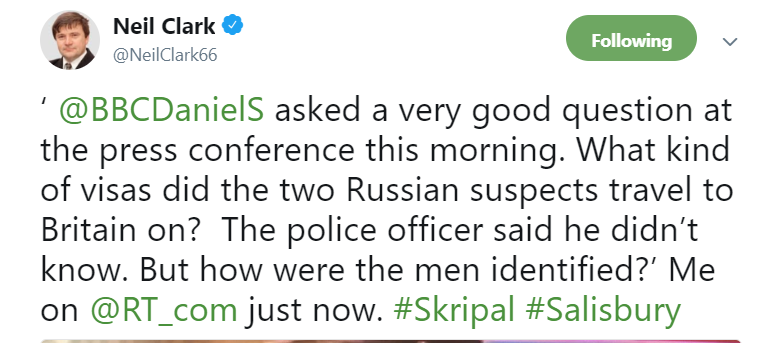
To get a UK visa Boshirov and Petrov would have had to attend the UK Visa Application Centre in Moscow. There not only would their photographs be taken, but their fingerprints would have been taken and, if in the last few years, their irises scanned. The Metropolitan Police would naturally have obtained their fingerprints from the Visa Application.
One thing of which we can be certain is that their fingerprints are not on the perfume bottle or packaging found in Charlie Rowley’s home. We can be certain of that because no charges have been brought against the two in relation to the death of Dawn Sturgess, and we know the police have their fingerprints. The fact of there being no credible evidence, according to either the Metropolitan Police or the Crown Prosecution Service, to link them to the Amesbury poisoning, has profound implications.
Why the Metropolitan Police were so coy about telling us what kind of visa the pair held, points to a wider mystery. Why were they given the visas in the first place, and what story did they tell to get them? It is not easy for a Russian citizen, particularly an economically active male, to get past the UK Border Agency. The visa application process is very intrusive. They have to produce evidence of family and professional circumstances, including employment and address, evidence of funds, including at least three months of bank statements, and evidence of the purpose of the visit. These details are then actively checked out by the Visa Department.
If they had told the story to the visa section they told to Russia Today, that they were freelance traders in fitness products wanting to visit Salisbury Cathedral, they would have been refused a visa as being candidates for overstaying. They would have been judged not to have sufficiently stable employment in Russia to ensure they would return. So what story did Petrov and Boshirov give on their visa application, why were they given a visa, and what kind of visa? And why do the British authorities not want us to know the answer to these questions?
Which brings us to the claims of neo-conservative propaganda website Bellingcat. They claim together with the Russian Insider website to have obtained documentary evidence that Petrov and Boshirov’s passports were of a series issued only to Russian spies, and that their applications listed GRU headquarters as their address.
There are some problems with Bellingcat’s analysis. The first is that they also quote Russian website fontanka.ru as a source, but fontanka.ru actually say the precise opposite of what Bellingcat claim – that the passport number series is indeed a civilian one and civilians do have passports in that series.
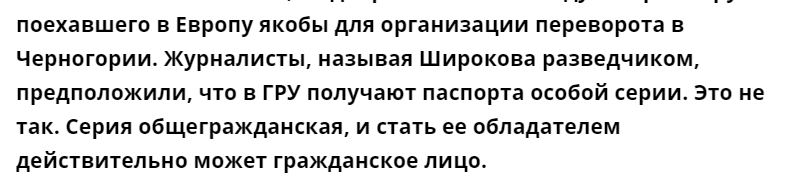
Fontanka also state it is not unusual for the two to have close passport numbers – it merely means they applied together. On other points, fontanka.ru do confirm Bellingcat’s account of another suspected GRU officer having serial numbers close to those of Boshirov and Petrov.
But there is a bigger question of the authenticity of the documents themselves. Fontanka.ru is a blind alley – they are not the source of the documents, just commenting on them, and Bellingcat are just attempting the old trick of setting up a circular “confirmation”. Russian Insider is neither Russian nor an Insider. Its name is a false claim and it consists of a combination of western “experts” writing on Russia, and reprints from the Russian media. It has no track record of inside access to Russian government secrets or documents, and nor does Bellingcat.
What Bellingcat does have is a track record of shilling for the security services. Bellingcat claims its purpose is to clear up fake news, yet has been entirely opaque about the real source of its so-called documents.
MI6 have almost 40 officers in Russia, running hundreds of agents. The CIA has a multiple of that. They pool their information. Both the UK and US have large visa sections whose major function is the analysis of Russian passports, their types and numbers and what they tell about the individual.
We are to believe that Boshirov and Petrov were GRU agents whose identity was plainly obvious from their passports, who had no believable cover identities, but that neither the visa department nor MI6 (which two cooperate closely and all the time) knew they were giving visas to GRU agents. Yet this information was readily available to Bellingcat ?
I do not know if the two are agents or just tourists. But the claimed evidence they were agents is, if genuine, so obvious that the two would have been under close surveillance throughout their stay in the UK. If the official story is true, then the failures of the UK visa department and MI6 are abject and shameful. As is the failure to take simple precautions for the Skripals’ security, like the inexplicable absence of CCTV covering the house of Sergei Skripal, an important ex-agent and defector supposedly under British protection.
A further thought. We are informed that Boshirov and Petrov left a trace of novichok in their hotel bedroom. How likely is it, really, that, the day before the professional assassination attempt, which involved handling an agent with which any contact could kill you, Boshirov and Petrov would prepare, not by resting, but by an all night drugs and sex session? Would you really not want the steadiest possible hand the next day? Would you really invite a prostitute into the room with the novichok perfume in it, and behave in a way that led to complaints and could have brought you to official notice?
Is it not astonishing that nobody in the corporate and state media has written that this behaviour is at all unlikely, while scores of “journalists” have written that visiting Salisbury as a tourist, and returning the next day because the visit was ruined by snow, would be highly unlikely?
To me, even more conclusively, we were informed by cold war propagandists like ex White House staffer Dan Kaszeta that the reason the Skripals were not killed is that novichok is degraded by water. To quote Kaszeta “Soap and water is quite good at decontaminating nerve agents”.
In which case it is extremely improbable that the agents handling the novichok, who allegedly had the novichok in their bedroom, would choose a hotel room which did not have an en suite bathroom. If I spilt some novichok on myself I would not want to be queuing in the corridor for the shower. The GRU may not be big on health and safety, but the idea that their agents chose not to have basic washing facilities available while handling the novichok is wildly improbable.
The only link of Boshirov and Petrov to the novichok is the trace in the hotel room. The identification there of a microscopic trace of novichok came from a single swab, all other swabs were negative, and the test could not be repeated even on the original positive sample. For other reasons given above, I absolutely doubt these two had novichok in that bedroom. Who they really are, and how much the security services knew about them, remain open questions.
The Skripal Affair – Another False Flag in NATO Litany to Criminalize Russia
By Finian CUNNINGHAM | Strategic Culture Foundation | 20.09.2018
If we start from a premise which understands that Britain and its NATO allies are capable of mounting false flag events in Syria with chemical weapons, then it is entirely possible that British secret services carried out a similar propaganda stunt in England with regard to former Russian double agent Sergei Skripal.
We also need to bear in mind that British state intelligence agencies are plausibly running a covert assassination program targeting Russian exiles living in Britain – for the purpose of incriminating Moscow.
Over the past two decades, more than a dozen Russian dissidents have met untimely deaths while residing in England, including Alexander Litvinenko and Boris Berezovsky. Their deaths provide propaganda fodder for the British to accuse Moscow of carrying out “revenge killings”.
However, the suspicious circumstances surrounding each death could more conceivably point to the British liquidating the Russian exiles as propaganda assets.
In the case of Sergei Skripal, the disgraced former Russian military intelligence officer was convicted in Russia of being a spy working for Britain’s MI6. He was exiled to England more than a decade ago as part of an espionage swap deal.
When Skripal was apparently poisoned in his resident town of Salisbury in southwest England on March 4, along with his adult daughter, Yulia, the British authorities immediately pointed the finger of blame at Russian President Vladimir Putin for allegedly ordering an assassination. The Kremlin was accused of dispatching agents who supposedly poisoned the Skripals with a deadly nerve agent.
The publication last week by Scotland Yard police of CCTV images showing two Russian men, Alexander Petrov and Ruslan Boshirov, walking the streets of Salisbury on the weekend of the alleged attack was reported in the British media as “proof” of the supposed Kremlin assassination plot. The Skripal affair is conveniently portrayed as “one more” example of Putin’s “Kremlin killing machine”.
But let’s look at the whole affair from a different perspective. The following scenario draws on observations and evidence cited by sources such as former British ambassador Craig Murray, the informed analytical website Moon of Alabama, and US-based political analyst Randy Martin (in personal correspondence).
Let’s ask the following question: was Sergei Skripal’s propaganda usefulness to the British as an exiled spy at some later point seen by the British as being better served as a victim of an apparent poison-assassination. That is, as a victim of a false flag attack that was actually carried out covertly by the British state agents in order to give the Western-led anti-Russia media campaign a significant boost?
Recall the Salisbury incident occurred at the time when Putin won re-election as Russian president, and it was during the build-up to the 2018 World Cup tournament hosted by Russia.
There is evidence that Sergei Skripal may have been a drug addict. His movements on the Sunday of March 4 when he was found incapacitated on a public park bench in Salisbury along with daughter Yulia suggest he may have been fixing a drug habit. That day he and his daughter both reportedly switched off their cell phones as they visited parks in Salisbury and nearby Amesbury. The latter venue was also a haunt for the two heroin junkies Charlie Rowley and Dawn Sturgess who later became embroiled in the affair when both apparently were also poisoned with the same nerve agent. Sturgess died days later from her ailment in early July.
Was Skripal visiting venues on March 4 known for scoring drugs? The switching off of phones would indicate some kind of illicit behavior. Recall, too, that earlier on that day, Skripal was reportedly acting in a hurry and very agitated while lunching in a restaurant with his daughter, both of them leaving abruptly. Did he have a monkey on his back, pushing him to get his drug fix?
We can be sure that Skripal was being kept under surveillance by Britain’s MI5 and MI6 all during his decade-long exile in Britain. The postulated drug habit would have been known to his “handlers”.
Moving to cash in their espionage asset for propaganda value, it is possible that British state agents surreptitiously spiked Skripal’s drug fix with some incapacitating substance, such as fentanyl. Indeed, the distressed symptoms of the father and daughter later found in a park on the afternoon of March 4 by members of the public were initially reported as signs of drug overdose.
From that point on, it is contended here, the British secret services intervened as they had anticipated to take control of the “Skripal affair”.
While Sergei and Yulia were comatose in a secured hospital wing, it could have been possible for their blood samples to be doctored with a chemical weapon, the notorious Novichok, which was subsequently and hastily attributed to Russia. That attribution in the British media is wildly overplayed. The British chemical weapons facility at Porton Down is only a few miles away from Salisbury where the Skripals were hospitalized. Without doubt, Porton Down would have its own supply of organophosphate nerve agents, if not samples of Novichok. It is not a uniquely Russian chemical, as British politicians and media falsely imply.
There are gaping anomalies in the official British narrative of a Kremlin-directed “hit job” on Skripal with a deadly nerve agent, a claim which Moscow has vehemently denied.
For a start, Sergei and his daughter have, according to the British government, recovered from their ordeal. Yet, the British authorities were claiming that the alleged nerve poison, Novichok, was a super lethal toxin, multiple times more deadly than related organophosphate chemical weapons Sarin or Tabun. A single drop of Novichok on the skin would be enough to kill almost instantly, so it is claimed.
The official British narrative claims that the killer chemical was applied to the front door handle at the Skripal home. The two Russian men caught on CCTV and accused last week by the British of being Kremlin assassins were not in Salisbury until just before midday on March 4, according to the published CCTV time data. By that time, the Skripals had left the home and were not seen returning. That means the pair were stricken while away from the home, perhaps, as speculated here, while they were in the public park scoring a drug deal.
Plausibly, they were not assaulted with a chemical weapon, but with a spiked drug sample, which British state agents had arranged for the purpose of incapacitating them. In an incapacitated state, the Skripals could then be used as guinea pigs, whose bodily fluids could be contaminated to frame up Russia with a story of “assassination by Novichok”.
Here are some challenging questions: why have the Skripals seemingly gone into hiding since the alleged poison incident over six months ago?
Why did Yulia make only one public statement to the Reuters news agency – three months after the poison incident and apparently having recovered from her “lethal ordeal” – in which she expressed a desire to return to her native Russia? Yet since that one-off public statement nearly three months ago, Yulia or her father have not been seen since. Would she really express such a wish to go back to Russia if she believed the British claim that Russian state agents had just tried to assassinate her and her father?
Why have all official Russian requests for consular contact with Yulia been repeatedly denied by the British side, in flagrant violation of international law and diplomatic norms?
The implication is that the Skripals are being detained under duress by the British authorities who realize that the official version of a Kremlin assassination plot with Novichok might be fatally contradicted by the Skripals’ version of events. Hence the pair are being denied access to public communication.
What about the junkies Charlie Rowley and the late Dawn Sturgess? It is plausible that they were also set up in a covert poison attack by British intelligence using spiked drugs in order to “refresh” the anti-Russia propaganda stunt. Then the story about a perfume bottle containing Novichok was thrown in to the mix to conjure up a murder weapon discarded by alleged Kremlin assassins.
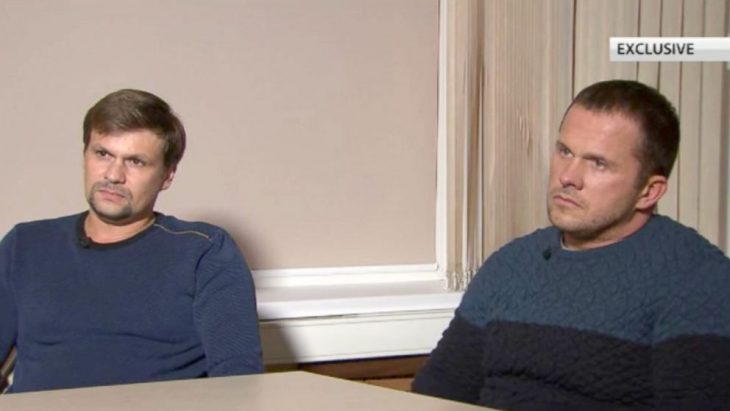
What about the two Russian men caught on CCTV in Salisbury on the weekend that the Skripals were apparently poisoned? Petrov and Boshirov upset the official British narrative by coming forward last week to give a media interview. They said they were ordinary civilians traveling under their own names, not aliases, as the British claimed. They said they are not Russian military intelligence, that they had no perfume bottle with Novichok nor any other substance on their possession in England, and that they were in Salisbury as weekend tourists.
Salisbury and its world-famous 13th century cathedral – reputed to be the most ornate in England – as well as nearby neolithic-age Stonehenge, attract millions of tourists from around the world each year, including many Russian nationals. It is not a stretch that British authorities scanned through reams of CCTV footage on the weekend of March 4, and got a lucky break to find Petrov and Boshirov walking the streets of Salisbury. The two men say they are caught up in a “fantastical coincidence”. More to the point, it seems, they are caught up in a British false flag to incriminate, demonize and delegitimize Russia.
The Skripal false flag is only one in a whole series of propaganda campaigns conducted by Western governments, their state intelligence and their ever-obliging news media in recent years. The alleged “annexation of Crimea”, the “covert invasion of Ukraine”, shooting down a Malaysian airliner, illicit doping of Olympic athletes, meddling in US and European elections, launching cyberattacks on Western power-grids, supporting “brutal dictator Assad” in Syria, among other malicious memes.
The litany of false flags to demonize Russia as a “pariah state” is itself indicative of relentless media orchestration by NATO governments.
The Skripal affair fits into this phenomenal propaganda effort.
Idlib: Lull Before the Hurricane
By Peter FORD, former UK ambassador to Syria | September 17, 2018
It appears that the Russians have pressed the pause button on their plans for an offensive alongside the Syrian government to retake Idlib. By the time they return to play mode the martial music may have changed.
New US policies for Syria
Without fanfare the US has just reformulated its position to create the conditions for it to launch devastating strikes on Syria no longer just on the pretext of alleged use of chemical weapons but on any ‘humanitarian’ pretext the US sees fit. In an interview with the Washington Post on 6 September, James Jeffrey, the hawkish new Special Envoy for Syria fresh from the neocon incubator of the Washington Institute for Near East Policy, did not mince words:
“We’ve started using new language,” Jeffrey said, referring to previous warnings against the use of chemical weapons. Now, he said, the United States will not tolerate “an attack. Period.”
“Any offensive is to us objectionable as a reckless escalation” he said. “You add to that, if you use chemical weapons, or create refugee flows or attack innocent civilians.”
Jeffrey’s remarks were little noticed because he was that day announcing something else more immediately striking: a ‘new’ policy on Syria involving cancellation of Trump’s announced departure of US troops before the end of 2018 and in statement of a plan to stay on indefinitely until achievement of the twin goals of removing all trace of the Iranian presence in Syria and installation of a Syrian government which would meet US conditions – conditions which President Assad would by Jeffrey’s own admission not be likely to meet.
The headlines naturally focussed on this latest Washington folly – do they think Iran will up sticks as long as there is a single US soldier on Syrian soil, or that there is a Syrian Mandela waiting in the wings? – and the importance of the remarks about Idlib was missed. Yet those words may be about to bring the world to the brink of global war.
New doctrine for US intervention
What Jeffreys was saying was quite clear. That with or without alleged use of chemical weapons, a sudden exodus of frightened civilians from a part of Idlib, use of the fabled ‘barrel bombs’, or launch of a major offensive will be taken by the US as a trigger for drastic and probably sustained bombing aimed at bringing the government of Syria to its knees.
Until now successive US administrations have been careful to draw the red line for intervention in Syria at use of chemical weapons, presumably on the grounds that there is universal agreement and international law to the effect that use of prohibited weapons is taboo. WMD after all were the casus belli for Iraq, even if it turned out to be false. Now suddenly we have a new, broader and consequently more dangerous doctrine.
The State Department has not yet favoured the American public, Congress or anyone else with an explanation or justification for the change, but we can speculate. Can it be, for example, that US policy makers realise that when the next alleged use of chemical weapons occurs in Syria, as surely it will, it will be more difficult to sell intervention to the public than the first two times because the game has now been rumbled? Not only has the idea that the White Helmets might not be all they seem entered the bloodstream of media discourse, but the OPCW inspectors, able for once after Douma actually to visit a crime site, failed to find any proof of use of prohibited weapons. Add to that those pesky Russians unhelpfully telling the world exactly how and where the White Helmets were going to stage their next Oscar-winning performances. So why bother with all that rigmarole over chemical weapons when Western opinion is already sufficiently primed to accept any intervention whatever as long as it is somehow ‘humanitarian’ and doing down the evil Russians?
Responsibility to Protect
Step up ‘Responsibility to Protect’, the innocuous-sounding UN-approved doctrine beloved of interventionists of both Left and Right. Never mind that most legal scholars utterly reject the notion that this doctrine legalises armed aggression other than with Security Council approval or in self-defence. Was it not effectively invoked in the British government’s legal position statement provided at the time of the post-Douma strikes? (The US administration, knowing their audience, never bothered to provide any legal justification whatever.)
Slight snag: although the British government have preemptively sought with their legal statement to give themselves cover to commit acts of war on a whim, and without recourse to Parliament, as long as it can be dressed up as humanitarian, nevertheless there might be considerable disquiet in Parliament and possibly even among service chiefs were the government to appear to be about to launch strikes alongside the US had there not been even the appearance of a chemical weapons incident. For this reason it is likely that the British government will attempt to persuade the US not to give up just yet on chlorine.
Is it this new amplified threat – of strikes whether or not Assad obliges or appears to oblige with suicidal use of chlorine – which has given the Russians reasons to call off the dogs, pro tem at least? Probably not, because the Russians were taking it as read that fake chemical attacks were coming anyway. They will take note however that the US has just effectively lowered the bar on its own next heavy intervention in Syria and will not be deterred by any blowing of the gaff.
For those who naively but sincerely believed that if Assad laid off the chlorine he would not get bombed the world has suddenly become a lot more dangerous. For realists however the new doctrine merely removes a hypocrisy, or rather introduces an inflexion into the hypocrisy, whereby the itch felt by those salivating at the prospect of striking Syria, Russia and Iran can be masked as a humanitarian concern which goes beyond abhorrence of chemical weapons.
Petrov, Boshirov and the Burden of Proof
By Rob Slane | The Blog Mire | September 14, 2018
For some time now, I have been concerned that our generation has been busy burying some of the most cherished legal concepts that many of our forebears seemed to instinctively understand, and which were enshrined into English Common Law. Concepts such as innocent until proven guilty, and that the burden of proof rests with the prosecution to prove its case against the accused, rather than on the accused to prove his or her defense against the accusations.
My biggest initial gripe in the Salisbury case was that the British Government completely discarded these concepts and simply presented unsubstantiated accusations as if they were fact. Not only did this prejudice the investigation from the outset, but it went a long way towards poisoning the wells of justice. So much for their much vaunted “British Values”.
More recently, the same has been done again. The Metropolitan Police, The Crown Prosecution Service and Her Majesty’s Government (TMP/CPS/HMG) named two suspects in the case, stating that they had enough evidence to prosecute the men. They then presented at least some of that evidence, before — at least in the case of the Government and the media — then going on to treat the suspects as if it had been proven that they had brought something called “Novichok” into the country and had carried out an assassination attempt on 4th March at the home of Sergei Skripal at 47 Christie Miller Road, Salisbury.
But it has not been proven. Very far from it. Accusations are not convictions. Suspects are not culprits. And if we are going to pretend that the extraordinarily flimsy evidence against the two men — at least that presented in public — is enough to claim “case closed; culprits caught”, then we have basically torn up 1,000 years or so of legal history, and are pretty well lost as a nation.
All of which is a prelude to saying that whatever the two men said in their interview with Margarita Simonyan, the onus is absolutely not on them to make their case, nor to sound convincing, nor to defend themselves. No, the onus is absolutely on their accusers — TMP/CPS/HMG — to present the evidence they claim they have for their assertion that these men attempted to kill Sergei Skripal, Yulia Skripal and Detective Sergeant Nick Bailey.
And so if Petrov and Boshirov had stated in their interview that they went to Salisbury to see St. John’s Church in Lower Bemerton, where the great 17th century poet, George Herbert was minister, the Salisbury branches of Waitrose and Marks and Spencer’s, and Dauwalders coin and stamp shop, yes it would have been jolly strange, but it would also have been neither here nor there as far as the claims against them are concerned. Whether we find their claims plausible, totally implausible, or somewhere in between, I repeat: they are not the ones who need to convince us why they came to Salisbury and what they did there; it is TMP/CPS/HMG who need to convince us why they came to Salisbury and what they did whilst they were there, since they are the ones accusing.
I am aware that some will say this is not a courtroom, and that the claims so far have been made in the media and are therefore not subject to the same thresholds of evidence. However, the problem is that TMP/CPS/HMG:
A) Has presented its evidence (or at least part of it) in public, and
B) Has sent no further evidence to the Russian Attorney General, calling for the extradition of the men.
Which means that the accused — Alexander Petrov and Ruslan Boshirov — have presumably seen as much of the evidence against them as you and I have.
This is disturbing, and the reason given — that the Russian constitution does not allow for the extradition of suspects — is as pathetic as it is disingenuous. It is not TMP/CPS/HMG’s issue if the Russian Government refuses to extradite the suspects. The British side should simply present its evidence through the proper channels, but has instead chosen to do it through a press conference and the media, naming two men who under the law of the land are innocent until proven guilty. Having taken this course, they now have a duty to present the evidence they have against the men to the public.
As far as the interview itself goes, it was at least helpful in that it narrows things down to the following three possibilities:
1. The men are GU Intelligence Officers who came to Salisbury to assassinate Sergei Skripal by placing nerve agent on the handle of his front door. If this is the case, they were therefore lying through their teeth.
2. The men really did come to Salisbury on Saturday 3rd and Sunday 4th March as tourists. In which case not only are they telling the truth, but the claims against them are utterly false and contrived.
3. The men came to Salisbury, not as assassins, but to do something else which they cannot reveal, but they did so posing as tourists. In which case, there is an element of truth behind the tourist claims — they really did see the sights — but there is also an element of deception as they have not told the full story, even though it is not the one their accusers claim.
Much of the commentary in the British Press seems to assume that the onus is on Petrov and Boshirov to prove that 2 is true, and that 1 and 3 are false.
Not so. The onus is on TMP/CPS/HMG to back up their claims with evidence, which basically means proving that number 1 is true, and that numbers 2 and 3 are false.
And so when a Downing Street spokesperson dismissed the men’s story, saying it was an insult to people’s intelligence, this is a mealy mouthed smokescreen, and an insult to our intelligence, designed to obscure the basic fact that it is for TMP/CPS/HMG to back up their accusations, not for the two men they have accused to back up their defence
So although the question of what to make of Petrov’s and Boshirov’s claims is interesting, it is not the real one we should be asking. The real question is simply this: Have TMP/CPS/HMG presented credible evidence to back up their claims against the two? Let’s see.
The basic evidence they have advanced against them is as follows:
1. That they flew into London from Moscow on 2nd March, and flew back on 4th March.
2. That they visited Salisbury on 3rd and 4th March.
3. That they are GU Intelligence Officers.
4. That they visited the home of Sergei Skripal on 4th March, and there applied “Novichok” on the front door handle.
5. That traces of “Novichok” were found in the London hotel they were staying in.
Regarding points 1 and 2, both men have admitted that they are true. They did indeed fly into London from Moscow on 2nd March, and then back on 4th March. They did indeed visit Salisbury on 3rd and 4th March. So far then, the men agree with the assessment of TMP/CPS/HMG and the claims are therefore not incriminating.
Regarding point 3, although Theresa May claimed in her speech to the House of Commons that these men were GU officers (well, she said GRU), in his press conference of that same day, Neil Basu did not do the same. So far no evidence has been presented to back up Mrs May’s claim that the two men are intelligence officers; on the contrary, the fact that they turned out to have travelled under their real names, rather than using aliases, as alleged by the Metropolitan Police, if anything undermines the claim. As things stand, the assertion that they are GU officers is just that: an assertion backed up by nothing.
Regarding point 4, the Metropolitan Police showed a CCTV still of the two men walking near the Shell garage on Wilton Road at 11:48am on 4th March. Is this evidence that the two men went to Christie Miller Road to apply nerve agent to a door handle? No, it isn’t. It is evidence that they were on the Wilton Road at 11:48am and nothing more. Real evidence would be footage showing the two men at 47 Christie Miller Road just after noon on that day. If the Metropolitan Police want us to believe that the two men were there, they are going to have to do better than showing an image of them on a different street altogether. Perhaps even an image from the CCTV camera that Mr Skripal’s niece, Victoria, claims Mr Skripal had on his house.
And regarding point 5, if “Novichok” (or “Novichok or related agent” as Porton Down have referred to it) was found in the hotel room on 4th May:
Firstly, how on earth would the two men have left traces of it there and not in other places they visited?
Secondly, how did they themselves manage to avoid contamination?
Thirdly, why wasn’t the hotel immediately cordoned off when the discovery was made?
Fourthly, why were the guests who stayed in the hotel between the 4th March and 4th May not contacted and checked over?
Fifthly, why was the OPCW not informed?
And sixthly, why was the hotel owner not informed about nerve agent being found in his hotel until 6th September, when TV crews turned up outside his hotel?
In other words, unless a reasonable explanation for this clear negligence and failure to act responsibly can be given, we have every right to dismiss the claim that “Novichok” was found in the hotel room. I’m certainly not prepared to just accept the word of people who have acted in such a shoddy way as to not even inform the hotel owner of what was apparently found on his property, and nor should you.
To conclude, I don’t entirely know what to make of Petrov’s and Boshirov’s claims. The images of them in Salisbury City Centre, after the Metropolitan Police claim they had put “Novichok” on the door handle, do not remotely fit the bill of assassins having carried out their deed, but do possibly fit the bill of tourists looking around a city. On the other hand, their wandering up the Wilton Road certainly looks odd.
But as I say, they are under no obligation to prove their defence. The obligation is entirely on the shoulders of TMP/CPS/HMG to prove their case against the two men. And so far they have spectacularly failed to do so.
Lynch Mob Mentality
By Craig Murray | September 14, 2018
I was caught in a twitterstorm of hatred yesterday, much of it led by mainstream media journalists like David Aaronovitch and Dan Hodges, for daring to suggest that the basic elements of Boshirov and Petrov’s story do in fact stack up. What became very plain quite quickly was that none of these people had any grasp of the detail of the suspects’ full twenty minute interview, but had just seen the short clips or quotes as presented by British corporate and state media.
As I explained in my last post, what first gave me some sympathy for the Russians’ story and drew me to look at it closer, was the raft of social media claims that there was no snow in Salisbury that weekend and Stonehenge had not been closed. In fact, Stonehenge was indeed closed on 3 March by heavy snow, as confirmed by English Heritage. So the story that they came to Salisbury on 3 March but could not go to Stonehenge because of heavy snow did stand up, contrary to almost the entire twittersphere.
Once there was some pushback of truth about this on social media, people started triumphantly posting the CCTV images from 4 March to prove that there was no snow lying in Central Salisbury on 4 March. But nobody ever said there was snow on 4 March – in fact Borisov and Petrov specifically stated that they learnt there was a thaw so they went back. However when they got there, they encountered heavy sleet and got drenched through. That accords precisely with the photographic evidence in which they are plainly drenched through.
Another extraordinary meme that causes hilarity on twitter is that Russians might be deterred by snow or cold weather.
Well, Russians are human beings just like us. They cope with cold weather at home because they have the right clothes. Boshirov and Petrov refer continually in the interview to cold, wet feet and again this is borne out by the photographic evidence – they were wearing sneakers unsuitable to the freak weather conditions that were prevalent in Salisbury on 3 and 4 March. They are indeed soaked through in the pictures, just as they said in the interview.
Russians are no more immune to cold and wet than you are.
Twitter is replete with claims that they were strange tourists, to be visiting a housing estate. No evidence has been produced anywhere that shows them on any housing estate. They were seen on CCTV camera walking up the A36 by the Shell station, some 400 yards from the Skripals’ house, which would require three turnings to get to that – turnings nobody saw them take (and they were on the wrong side of the road for the first turning, even though it would be very close). No evidence has been mentioned which puts them at the Skripals’ House.
Finally, it is everywhere asserted that it is very strange that Russians would take a weekend break holiday, and that if they did they could not possibly be interested in architecture or history. This is a simple expression of anti-Russian racism. Plainly before their interview – about which they were understandably nervous – they prepared what they were going to say, including checking up on what it was they expected to see in Salisbury because they realised they would very obviously be asked why they went. Because their answer was prepared does not make it untrue.
That literally people thousands of people have taken to twitter to mock that it is hilariously improbable that tourists might want to visit Salisbury Cathedral and Stonehenge, is a plain example of the irrationality that can overtake people when gripped by mob hatred.
I am astonished by the hatred that has been unleashed. The story of Gerry Conlon might, you would hope, give us pause as to presuming the guilt of somebody who just happened to be of the “enemy” nationality, in the wrong place at the wrong time.
Despite the mocking mob, there is nothing inherently improbable in the tale told by the two men. What matters is whether they can be connected to the novichok, and here the safety of the identification of the microscopic traces of novichok allegedly found in their hotel bedroom is key. I am no scientist, but I have been told by someone who is, that if the particle(s) were as the police state so small as to be harmless to humans, they would be too small for mass spectrometry analysis and almost certainly could not be firmly identified other than as an organophosphate. Perhaps someone qualified might care to comment.
The hotel room novichok is the key question in this case.
Were I Vladimir Putin, I would persuade Boshirov and Petrov voluntarily to come to the UK and stand trial, on condition that it was a genuinely fair trial before a jury in which the entire proceedings, and all of the evidence, was open and public, and the Skripals and Pablo Miller might be called as witnesses and cross-examined. I have no doubt that the British government’s desire for justice would suddenly move into rapid retreat if their bluff was called in this way.
As for me, when I see a howling mob rushing to judgement and making at least some claims which are utterly unfounded, and when I see that mob fueled and egged on by information from the security services propagated by exactly the same mainstream media journalists who propagandised the lies about Iraqi WMD, I see it as my job to stand in the way of the mob and to ask cool questions. If that makes them hate me, then I must be having some impact.
So I ask this question again – and nobody so far has attempted to give me an answer. At what time did the Skripals touch their doorknob? Boshirov and Petrov arrived in Salisbury at 11.48 and could not have painted the doorknob before noon. The Skripals had left their house at 09.15, with their mobile phones switched off so they could not be geo-located. Their car was caught on CCTV on three cameras heading out of Salisbury to the North East. At 13.15 it was again caught on camera heading back in to the town centre from the North West.
How had the Skripals managed to get back to their home, and touch the door handle, in the hour between noon and 1pm, without being caught on any of the CCTV cameras that caught them going out and caught the Russian visitors so extensively? After this remarkably invisible journey, what time did they touch the door handle?
I am not going to begin to accept the guilt of Boshirov and Petrov until somebody answers that question. Dan Hodges? David Aaronovitch? Theresa May? Anybody?
UK Wants Skripal Hysteria to Soften Public Before Attacks in Syria – Scholar
Sputnik – September 14, 2018
Two men suspected by London of poisoning ex-spy Sergei Skripal and his daughter Yulia in Salisbury were interviewed by RT, and said they had visited Salisbury as tourists. Sputnik discussed the issue with Dr. George Szamuely, political analyst and author of “Bombs for Peace: NATO’s Humanitarian War on Yugoslavia”.
Sputnik: What is your take on London’s allegations that the Skripal attack was approved at a senior level of the Russian state? What would Russia gain from this?
Dr. George Szamuely: Well it’s very hard to tell what’s been going on behind the scenes, there’s obviously some attempt on the British authorities’ part to keep the Skripal hysteria going.
I think it is connected with the events taking place in Syria and the expectation that the United States, Britain and France are set to launch missile attacks on Syria, and I think that this is part of softening up the public in anticipation of these attacks.So at the very time that Russia is in the headlines associated with chemical weapons, lo and behold, chemical weapons are supposedly being used by the Syrian government, which itself is being backed by Russia. So I think this latest disclosure, if we can call it that, is really tied up with what’s going on in Syria.
Sputnik: What do you make of the fact that the Russians have not been allowed to be involved in the investigation, the Russian side was not given the information that they had on the perpetrators, they were not given their passport numbers, is that normal or do you see anything strange in that?
Dr. George Szamuely: No, I don’t think it’s at all normal, I think Russia had every reason to be rather upset about this.First of all, it isn’t normal for them not to have access to the two victims of the poisoning, certainly Yulia Skripal is a Russian citizen and, therefore, they have every need to talk to her, there’s been an attempted murder on her, and they’ve been denied that, and they’ve been denied all of the investigatory material on which the Russians can actually be able to provide their own assesment, their own analysis, to have their own input.
The British attitude towards Russia seems to be: just admit your guilt! You have to admit your guilt! — any other response is unacceptable, but in the meantime we’re not going to even show you any evidence upon which you can make any inferences, any evidence upon which you can conduct your own investigation.
See also:
UK Lied Saying That Names of ‘Suspects’ in Skripal Case Were Fictitious – Russian Foreign Ministry
‘Straight out of the RT propaganda machine’: MP attacked for urging UK military restraint in Syria
RT | September 12, 2018
Labour’s Emily Thornberry has come under fire on social media for simply asking the UK government not to rely on “open source intelligence from terrorist groups” in the event of a reported chemical attack in Syria.
Thornberry, Labour’s shadow foreign secretary, asked the government if they would consult Parliament before taking military action over reports of chemical weapon attacks in areas controlled by Al-Qaeda proxy Hayat Tahrir al-Sham (HTS), a US-proscribed terrorist organization.
This prompted hysterical responses on social media, with one Twitter user claiming: “This is UK Labour guided by the spirit of Thomas Mair” – the far-right activist who murdered Thornberry’s fellow Labour MP Jo Cox. Another accused Thornberry of providing cover for Syrian President Bashar Assad’s alleged crimes.
Notice the pro-Kremlin, Islamophobic dogwhistle; notice the casual smearing of Syrian first-responders; and notice the complete absence of concern for the 3 million civilians trapped in Idlib. This is @UKLabour guided by the spirit of Thomas Mair. https://t.co/86Ql5aGYy8
— Idrees Ahmad (@im_PULSE) September 10, 2018
There were numerous references to this news organization, with accusations Thornberry was doing the work of “propaganda” outlets such as RT and Sputnik. There was even a charge of “genocide denying” leveled at the MP.
In turn, Thornberry’s position drew levels of support from both left-wing and right-wing critics of UK military involvement in Syria.
HTS are thought to have some 10,000 fighters in the last rebel stronghold – Idlib province, a region in Syria’s northwest along the Turkish border.
Upon reports of a potential chemical attack, Thornberry urged the UK to wait “until the chemical weapons inspectors, the OPCW [Organisation for the Prohibition of Chemical Weapons], have visited those sites under the protection of the Turkish government, independently verified those reports and attributed responsibility for any chemical weapons used.”
“Relying on so-called open source intelligence provided by proscribed terrorist groups is not an acceptable alternative,” she said.
Featured Video
BRITAIN’S WARNING: PREPARE FOR WAR
or go to
Aletho News Archives – Video-Images
From the Archive
How Ukraine Tortured and Slaughtered Donbass
By Kit Klarenberg | Al Mayadeen | July 11, 2024
Almost immediately after the proxy war erupted, ISIS-tier footage of the torture and murder of Russians in Ukrainian custody emerged.
On July 6th, the New York Times published an astonishing investigation: In Ukraine, Killings of Surrendering Russians Divide an American-Led Unit. The article documents in grim detail how Chosen Company, an international volunteer battalion for Kiev, routinely executes Russian prisoners of war. It is the very first mainstream admission that this practice – a brazen breach of the Geneva Conventions, and a grave war crime – is widespread among Ukraine’s fighters, both foreign and homegrown. … continue
Blog Roll
 Aletho News
- Israel Demolishes Home Of Lebanese Journalist Whose Viral Film Exposed Pager Attack
- Record Oil, Empty Tanks: The UAE’s Miracle Recovery
- Burnham tackles Britain’s poverty with aggression in Yemen
- Peace in Ukraine: the easy way – or the hard way
- Trump & the Rrrrussians
- US taxpayer money laundered back through Ukraine – Musk
- Before COVID, an NIH lab chief proposed making a SARS-like bat virus more infectious
- Gates, Bourla on Trial in Netherlands Accused of ‘Great Reset’ Scheme at Vaccine Injury Hearing
- BRITAIN’S WARNING: PREPARE FOR WAR
- “Historic Russia”: The Land Putin Will Not Give Back
- If Americans Knew
- An error has occurred; the feed is probably down. Try again later.
- No Tricks Zone
- Two New Studies Find Thwaites Glacier Melt Cannot Be Driven By Human Activity Or A Warming Ocean
- E-Cars Reduce CO2 Emissions By Only 41% Compared To Internal Combustion Engine Vehicles
- Predictions Made By Renowned Climate Professor Over Past Decades Have Been Proven To Be Poor
- New Study Suggests Large Regions Of The Pacific Ocean Have Been Cooling For The Last 80 Years
- Germany’s Green Energy Debacle: High Energy Costs Force Kahla Porzellan to Close After 182 Years!
- New Study: 50 Years Of The Most Aggressive ‘Net Zero’ Policies Can Only Affect The Global Climate By 0.03°C
- US September “Heat” Was No Record…Many Records Set Decades Ago
- Latest European Green Energy Debacle; Portugal’s Largest Flagship Solar Park Insolvent!
- Green Energy Debacle: German Expert Professor Fritz Vahrenholt Warns Of Severe Economic And Social Consequences
- Two More Paleo Reconstructions Affirm Meters-Higher Sea Levels Across Ireland, Brazil 7000-6000 Years Ago

