The more I look at the statement issued by Assistant Commissioner Neil Basu on 5th September, in relation to the Salisbury and Amesbury Investigation, the more I am astonished at the sloppiness on display. Mr Basu took the trouble of informing the public that the investigation has involved around 250 detectives from across the Counter Terrorism Policing Network, “brilliantly led by Counter Terrorism Policing South East, and supported by officers from Wiltshire,” and that they have been meticulously following the evidence for six months. So the statement he read out and the accompanying images ought to be entirely accurate, right?
Except they are not, and in fact they contain numerous extremely careless, and sometimes downright bizarre errors. For example:
Firstly, the two images of the suspects in Fisherton Street are headed with captions describing them as being in a place called Fisherton Road. There is no location called Fisherton Road in Salisbury.
Secondly, we have the images of the two men at Gatwick airport, famously taken at the exact same second, 16:22:43. Yet the captions above tell us that the images are of the men at 15:00hrs. This is mighty odd, not just because the timestamp on the images shows otherwise, but also because the airplane the men were travelling in had not even landed at 15:00hrs. It eventually landed nearer to 16:00 than it did to 15:00, so they can’t have been going through the gates at 15:00hrs, can they?
Thirdly, one of the four points The Met makes in joining the Salisbury and Amesbury cases together is an incomplete sentence that makes no sense whatsoever:
“Fourthly, the lack of crossover between the known movements of the suspects and Dawn and Charlie’s known movements around Salisbury, and the fact that there is no evidence to suggest they have been targeted mean it is much more likely Dawn and Charlie found.”
Found…? Found what? Who knows?
Fourthly, the picture of the two men at Salisbury station on 3rd March has a timestamp of 16:11:27. Yet in the timeline The Met tells us that they left Salisbury at approximately 16:10. So they left at approximately a minute and a half before they were photographed standing on the other side of the turnstiles from the platform? Is The Met, with all its massive resources and 250 detectives on the case unable to find out what time the train actually departed?
Fifthly, there is the fact that at least one of the pictures they issued has been very heavily cropped (see here). Why was it cropped and what confidence can we have that the other images were not tampered with as well?
Am I nit-picking? Nope. 250 detectives working on what may be the biggest investigation this country has ever seen, with six months to get their facts straight, ought to be pinpoint accurate. And yet all we find is sloppiness and little regard to detail.
And not for the first time. We’ve seen it before in the fact that The Met has still released no footage clearly showing the Skripals or the two suspects on 4th March (still images don’t count). This is beyond bizarre given that on numerous occasions they have appealed to the public for help in piecing together the events of the day. And we have seen it in the incomplete and incorrect timeline of events released on 17th March (which now seems to have disappeared from The Met’s website altogether).
But I want to focus on what I consider to be the biggest issue with the statement released on 5th September, which is the astonishing lack of detail given about the two suspects’ movements in Salisbury on 3rd and 4th March. Here is the description of their movements on Saturday 3rd:
“On Saturday, 3 March, they left the hotel and took the underground to Waterloo station, arriving at approximately 11.45am, where they caught a train to Salisbury, arriving at approximately 2.25pm.
They are believed to have taken a similar route when they returned to London on the afternoon of Saturday, 3 March. Leaving Salisbury at approximately 4.10pm and arriving in Bow at approximately 8.05 pm.
We assess that this trip was for reconnaissance of the Salisbury area and do not believe that there was any risk to the public from their movements on this day.”
So tell me, what did they do and where did they go in Salisbury on Saturday 3rd March? You have no idea whatsoever, do you, because Mr Basu has not mentioned it. We are treated to the absurd word “reconnaissance”, as if the two men were in Afghanistan staking out the Tora Bora caves, rather than in a quiet city in the South of England covered by Google maps, but there are absolutely no details of what this alleged reconnaissance actually entailed. More on that in a moment.
What of their movements the next day? Surely there’s some detail here, given the allegations against them. Judge for yourselves:
“On Sunday, 4 March, they made the same journey from the hotel, again using the underground from Bow to Waterloo station at approximately 8.05am, before continuing their journey by train to Salisbury.
CCTV shows them in the vicinity of Mr Skripal’s house and we believe that they contaminated the front door with Novichok.
They left Salisbury and returned to Waterloo Station, arriving at approximately 4.45pm and boarded the London Underground at approximately 6.30pm to London Heathrow Airport. From Heathrow Airport, they returned to Moscow on Aeroflot flight SU2585, departing at 10.30pm on Sunday, 4 March.”
In both descriptions, there are more details of their movements in London than their movements in Salisbury. The only glimmer of detail around their movements in Salisbury on 4th March is the claim that there is CCTV showing them in the vicinity of Mr Skripal’s house. But which CCTV are they referring to? Is it the image of the two men outside the Shell garage on the Wilton Road? If so, as I discussed here, this is highly misleading, since this location is some 600 yards or so from Mr Skripal’s house, and on a completely different street. Then again, perhaps The Met does have something more incriminating, but in which case why not show that, rather than the image of them walking past a garage on a different road?
But I want to come back to the details about the Saturday, and the reason for this is twofold:
Firstly, it is one of the few places where The Met’s claims are refuted by some very specific, rather than general, testimony in the interview the two men gave to Margarita Simonyan.
Secondly, the claims made by the men in that interview, which refute The Met’s allegations, could themselves easily be refuted by The Met.
Here’s the crucial part of that interview:
“Petrov: No, we arrived in Salisbury on March 3. We wanted to walk around the city but since the whole city was covered with snow, we spent only 30 minutes there. We were all wet.
Boshirov: There are no pictures. The media, television – nobody talks about the fact that the transport system was paralyzed that day. It was impossible to get anywhere because of the snow. We were drenched up to our knees.
Simonyan: All right. You went for a walk for 30 minutes, you got wet. What next?
Petrov: We travelled there to see Stonehenge, Old Sarum, and the Cathedral of the Blessed Virgin Mary. But it didn’t work out because of the slush. The whole city was covered with slush. We got wet, so we went back to the train station and took the first train to go back. We spent about 40 minutes in a coffee shop at the train station.
Boshirov: Drinking coffee. A hot drink because we were drenched.
Petrov: Maybe a little over an hour. That’s because of large intervals between trains. I think this was because of the snowfall. We went back to London and continued with our journey.”
(As an aside, I can confirm that they are correct about the conditions. There was a lot of snow on the ground on the Saturday morning, and my children went off sledging, but by early afternoon they came back as it was rapidly turning to slush).
What we have are two versions of events, which are mutually exclusive.
On the one hand, The Met claims that the men arrived at Salisbury train station at approximately 14:25; that they left at approximately 16:10 (although as I say, they were still there at 16:11:27); and that during this 1 hour 45 minutes they went on a reconnaissance mission of the Salisbury area.
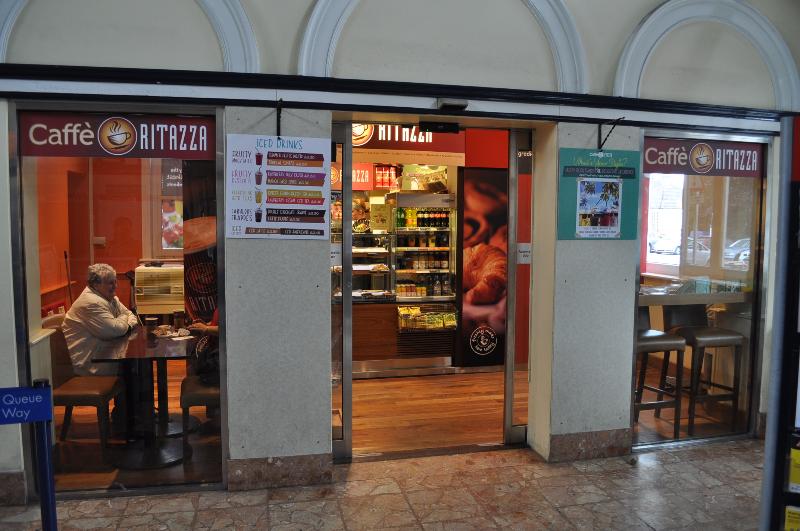
On the other hand, Petrov and Boshirov claim that after leaving the station (and they don’t dispute the 14:25 time) they walked about for about half an hour, before heading back to the station, where they sat in a café for more than 40 minutes and possibly up to an hour or so (this would be Café Ritazza in the ticket hall, shown at the top of this piece). This would therefore put them in the café from about 15:10 until about 16:10.
Now, I take it as obvious that for the reconnaissance claim made by The Met to be correct, this would mean the men visiting the alleged location of the intended poisoning — Mr Skripal’s house, or at the very least Christie Miller Road — since the purpose of reconnaissance is to survey vital locations, and this is the only really vital location in connection with the claims made against them. The only other possible location of interest to them, according to the claims against them, would be the back of The Cloisters on Catherine Street, where they allegedly dumped the poison. But let’s just say I would take an awful lot of persuading as to why anyone should need to do reconnaissance of a bin.
It takes between 20-25 minutes to walk from the station to Christie Miller Road. Double it for there and back, and you get 40-50 minutes. However, the very nature of reconnaissance means that it involves checking out an area, and so as well as walking there and back we could, at a conservative estimate, perhaps add 10 minutes to the walking times. Which means that we are looking at 50-60 minutes at least for a reconnaissance mission.
This entirely conflicts with Petrov’s and Boshorov’s claims. Of course, we have no way of knowing whether their claims are true or not, but the point is this: The Met knows exactly whether their claims are true or false, and they could easily disprove them simply by showing the two men walking through Salisbury when they say they were in the café.
Of course, it could well be that The Met does have CCTV footage of the two men in the city outside the half hour or so timeframe they have claimed. It could be that they have CCTV footage of the café from 15:10 to 16:10, and that there is no sign of the two men there. And it could well be that they have CCTV footage of the men on their way to or from Mr Skripal’s house.
Yet despite the very specific claims made by the men, the only evidence ever presented by The Met of their movements in Salisbury on that day is the image of them standing in the ticket hall at 16:11:27. Nothing else has been released of their movements. Nothing else has been stated. Other than the claim about reconnaissance, which has been backed up by nothing, there is nothing at all.
Some will say that The Met is under no obligation to publicly reveal any more CCTV footage than they want to. Ordinarily, I might agree. But not in this case. It was The Met that made serious allegations in public about the two men, and yet they did so without producing any evidence to back up their claims. But now that the two suspects have themselves publicly refuted The Met’s claims about what they did on 3rd March with some quite specific details, The Met now surely has an obligation either to show the evidence they have to back up their claim of “reconnaissance”, or withdraw it.
So here are the three questions that The Met needs to answer in connection with Saturday 3rd March:
-
- Do you have CCTV footage of the two men that contradicts their claim to have spent only about half an hour in the City that day?
- Do you have CCTV footage that contradicts the claims made by Petrov and Boshirov to have been in the station café between approximately 15:10 and 16:10?
- If neither of the above exists, on what basis has the claim been made that the two men were in Salisbury on 3rd March on a reconnaissance mission?
October 25, 2018
Posted by aletho |
Deception, False Flag Terrorism, Russophobia | UK |
Leave a comment
TRANSCRIPT AND SOURCES
Forget for one moment everything you’ve been told about September 11, 2001. Instead let’s ask ourselves one question: What was 9/11? A terrorist atrocity? An attack on America? The first salvo in a new war? “A day that changed everything”?
The question may seem simple, but how we answer it is of vital importance. It determines how we proceed with our investigation of that day. And once you strip away the emotional rhetoric and the fear-inducing imagery, we’re left with a simple truth: 9/11 was a crime. And as with any crime, there is one overriding imperative that detectives must follow to identify the perpetrators: Follow the money.
This is an investigation of the 9/11 money trail.
The 9/11 Heist
In 1998, the Port Authority of New York and New Jersey agreed to privatize the World Trade Center, the complex of office towers in Lower Manhattan that they had owned and operated since their construction in 1973. In April 2001 an agreement was reached with a consortium of investors led by Silverstein Properties, and on July 24th, 2001, Larry Silverstein, who already owned World Trade Center Building 7, signed a 99-year lease for the Twin Towers and Buildings 4 and 5.
The lease was for $3.2 billion and was financed by a bridge loan from GMAC, the commercial mortgage arm of General Motors, as well as $111 million from Lloyd Goldman and Joseph Cayre, individual real estate investors. Silverstein Properties only put down $14 million of its own money.
The deal was unusual in a variety of ways. Although the Port Authority carried only $1.5 billion of insurance coverage on the WTC complex, which earlier that year had been valued at $1.2 billion, Silverstein had insisted on doubling that amount, insuring the buildings for $3.55 billion. Silverstein’s insurance broker struggled to put that much coverage in place and ultimately had to split it among 25 dealers. The negotiations were so involved that only temporary contracts were in place for the insurance at the time the lease was signed, and by September the contracts were still being finalized.
Silverstein’s group was also explicitly given the right to rebuild the structures if they were destroyed—and even to expand the amount of retail space on the site if rebuilding did take place.
Within hours of the destruction of the Twin Towers on September 11th, Silverstein was on the phone to his lawyers, trying to determine if his insurance policies could “construe the attacks as two separate, insurable incidents rather than one.” Silverstein spent years in the courts attempting to win $7.1 billion from his $3.55 billion insurance policy and in 2007 walked away with $4.55 billion, the largest single insurance settlement ever. As soon as the deal was announced, Silverstein sued United and American Airlines for a further $3.5 billion for their “negligence” in the 9/11 attacks, a claim that was struck down by the courts but is still on appeal.
Perhaps even more outrageously, in a secret deal in 2003, the Port Authority agreed to pay back 80% of their initial equity in the lease, but allowed the Silverstein group to maintain control of the site. The deal gave Silverstein, Goldman and Cayre $98 million of the $125 million they put down on the lease, and a further $130 million in insurance proceeds that were earmarked for the site’s rebuilding.
In the end, Silverstein profited from the 9/11 attacks to the tune of $4.55 billion and counting.
But that’s the 9/11 insurance heist you saw. There was a much deeper, more complex, and well-hidden heist that was taking place behind closed doors on September 11, 2001, deep in the heart of the World Trade Center itself.
Marsh & McLennan is a diversified risk, insurance and professional services firm with over $13 billion in annual revenue and 57,000 employees. In September of 2001, 2,000 of those employees worked in Marsh’s offices in the World Trade Center. Marsh occupied floors 93 to 100 of the North Tower, the exact area of the impact and explosion.
In the year prior to 9/11, Marsh had contracted with SilverStream software to create an electronic connection between Marsh and its clients for the purpose of creating “paperless transactions.” SilverStream had already built internet-based transactional and trading platforms for Merrill Lynch, Deutsche Bank, Banker’s Trust, Alex Brown, Morgan Stanley and other financial services firms that were later involved in 9/11, but this new project was unlike anything that had been attempted before.
Richard Andrew Grove, the salesperson who handled the Marsh & McLennan project for SilverStream, explains.
RICHARD GROVE: In 2000 SilverStream was contracted by Marsh to provide a technological solution beyond what we had done for any of the above-named companies; insofar as it would be used to electronically connect Marsh to its major business partners via internet portals, for the purpose of creating “paperless transactions” and expediting revenue and renewal cycles, and built from the ground up at the client’s site.
SilverStream provided a specific type of connectivity that was used to link AIG and Marsh & McLennan—the first two commercial companies on the planet to employ this type of transaction—and in fact Marsh was presented with something called the ACORD Award in the summer of 2001 for being the first commercial corporation to do so…. And what you should take away from that is this: it means that no other companies were doing this type of transaction. So the question in your mind should be: What then were Marsh and AIG doing, and why did they need to leverage technologies that no other commercial entity on the face of the earth needed to conduct business?
Once securing the contract, SilverStream then stationed approximately 30-to-40 developers at Marsh, and this team was led by two-to-three managers, with whom I liaised to ensure delivery of the “solution” that was promised. The development team regularly worked late into the night, if not all night, and sometimes worked seven days a week in order to adhere to Marsh’s indicated pre-September 11th deadline.
(SOURCE: Project Constellation)
But it was not long before severe irregularities in the billing of the account for this project led Richard Grove into the heart of a deeper mystery about the software, and about the work he was engaged in.
RICHARD GROVE: I first noticed fiscal anomalies with respect to the Marsh.com project, when I was in a meeting on the 98th floor in October of 2000 with a gentleman named Gary Lasko. Gary was Marsh’s North American Chief Information Officer, and that particular afternoon a colleague and I helped him identify about $10,000,000 in suspicious purchase orders—after I recognized that certain vendors were deceiving Marsh, and specifically appeared to be selling Marsh large quantities of hardware that were not necessary, as this was later confirmed by Gary.
I brought my concerns up to executives inside of SilverStream, and I was urged to keep quiet and mind my own business. I went to an executive at Marsh, and he advised me to do likewise…. But then I mentioned it to a few executives at Marsh whom I could trust—ike Gary Lasko…and Kathryn Lee, Ken Rice, Richard Breuhardt, John Ueltzhoeffer—people who became likewise concerned that something untoward was going on.
The concerned colleagues I just mentioned were murdered on September 11th, and the executives who expressed dismay at my concerns are alive and free today because of it.
I feel that it’s no coincidence, as the Marsh executive who urged me to drop my line of inquiry made sure that his personnel, who I just mentioned, were in the office bright and early for a global conference call before the staff meeting upon which I was to intrude—a conference call which I was informed this executive in question conducted but attended from the safety of his Upper West Side apartment.
(SOURCE: Project Constellation)
The global conference call with Marsh’s IT staff on the morning of 9/11, a meeting that included the staff who were investigating the suspicious billing on the SilverStream deal, was confirmed in a 2006 interview with Marsh’s then-Chief Information Officer, Ellen Clarke.
Richard Grove had been asked to attend the meeting but was stuck in traffic on the way to the Towers when the attack began. His friends at Marsh were not so lucky: 294 Marsh employees, including all of the participants in the conference call in the North Tower, died that morning. Meanwhile the Marsh executive who had scheduled the meeting, the same one who had asked Grove to drop the issue of the billing anomalies, was safe in his apartment, attending the meeting via telephone.
So what was the Marsh.com project really about? Why was it so important for it to be finished before September 11th, and what kind of transactions did it enable? More importantly, what information was lost when the data center on the 95th floor of the North Tower suffered a direct hit on 9/11 and the buildings were demolished?
A partial answer comes from reports that emerged in late 2001: that a German firm, Convar, had been hired to reconstruct financial data from the hard disks recovered at Ground Zero. The firm talks about this work in its promotional videos.
September the 11th, 2001. The whole world is in shock following the attacks on the World Trade Center. Convar has some solutions to offer.
Data stored on countless hard drives retrieved from the collapsed towers was believed to have been lost, but Convar’s specialists can render irreplaceable information readable again at Europe’s only high-security data recovery center. Burnt, crushed or dirty storage media are ready to relinquish their secrets by the time we finish.
(SOURCE: CONVAR – Repair & Service Center)
More details on the work come from an IDG News Service story posted to CNN.com in December 2001. Under the headline “Computer disk drives from WTC could yield clues,” the article notes: “An unexplained surge in transactions was recorded prior to the attacks, leading to speculation that someone might have profited from previous knowledge of the terrorist plot by moving sums of money. But because the facilities of many financial companies processing the transactions were housed in New York’s World Trade Center, destroyed in the blasts, it has until now been impossible to verify that suspicion.”
A Reuters article from the same time, later posted to Convar’s website, offers revealing glimpses into the investigation’s early results. It quotes Peter Herschel, Convar’s director at the time.
“The suspicion is that inside information about the attack was used to send financial transaction commands and authorizations in the belief that amid all the chaos the criminals would have, at the very least, a good head start. Of course it is also possible that there were perfectly legitimate reasons for the unusual rise in business volume. It could turn out that Americans went on an absolute shopping binge on that Tuesday morning. But at this point there are many transactions that cannot be accounted for. Not only the volume but the size of the transactions was far higher than usual for a day like that. There is a suspicion that these were possibly planned to take advantage of the chaos.”
It also quotes Richard Wagner, one of the companies data retrieval experts. “There is a suspicion that some people had advance knowledge of the approximate time of the plane crashes in order to move out amounts exceeding $100 million. They thought that the records of their transactions could not be traced after the mainframes were destroyed.”
Was the revolutionary electronic trading link between AIG and Marsh being used to funnel money through the World Trade Center at the time of the attack? Were the attack perpetrators hoping that the destruction of Marsh’s data center, on the 95th floor at the dead center of the North Tower explosion, would conceal their economic crime?
One piece of corroborating evidence for this idea comes from author and researcher Michael Ruppert, who reported in 2004 that immediately before the attacks began, computer systems in Deutsche Bank, one of SilverStream’s other e-link clients, had been taken over from an external location that no one in the office could identify.
MICHAEL RUPPERT: Within, I would guess — I’d have to go back and look at the book, but it was no more than a week of the attacks — I was being contacted by a lot of people, from inside official sources who were raising a lot of questions. This one particular person was extremely credible. They absolutely convinced me they had been an employee of Deutsche Bank in the Twin Towers, and they told me very clearly that in the moments right before the attacks and during the attack — there was a 40-minute window between the time the first plane struck the World Trade Center and the second plane — that Deutsche Bank’s computers in New York City had been “taken over.” Absolutely co-opted and run. There was a massive data purge, a massive data download, and all kinds of stuff was moving.
And what this person said very clearly was that no one in the Deutsche Bank offices in the towers at the time had the ability to prevent what was going on from any of their terminals.
(SOURCE: Terror Trading 9/11)
Sadly, no answer to the questions raised by these accounts is forthcoming from Convar. After the initial reporting on the investigation, which noted that the company was working with the FBI to recover and analyze the data, Convar now refuses to talk about the information they discovered.
DUTCH REPORTER: Is it true that large amounts of money were transferred illegally out of the World Trade Center on the morning of 9/11, just before the attacks?
CONVAR SPOKESMAN: If you would look on the website, I would say “Yes.”
DUTCH REPORTER: Uh huh.
CONVAR SPOKESMAN: Because that was the information from a previous release.
DUTCH REPORTER: Uh huh.
CONVAR SPOKESMAN: If you were to ask me today I would need to tell you I could not give you any additional information about that. I’m really sorry about…
DUTCH REPORTER: What if I were to ask you one year ago? What would you have…
CONVAR SPOKESMAN: I would have said that what we have there is what we said before. Yes, exactly.
(SOURCE: Dutch TV show Zembla investigates 9/11 theories)
At the time of 9/11, Marsh’s chief of risk management was Paul Bremer, the former managing director of Kissinger and Associates who went on to oversee the US occupation of Iraq. On the morning of 9/11 he was not in his office at Marsh & MacLennan, but at NBC’s TV studio, where he was delivering the official story of the attack.
NBC4 ANCHOR #1: Can you talk to us a little bit about…about…who could…I mean, there are a limited number of groups who could be responsible for something of this magnitude, correct?
PAUL BREMER: Yes, this is a very well-planned, very well-coordinated attack, which suggests it is very well-organized centrally, and there are only three or four candidates in the world really who could have conducted this attack.
NBC4 ANCHOR #2: Bin Laden comes to mind right away, Mr. Bremer.
PAUL BREMER: Indeed, he certainly does. Bin Laden was involved in the first attack on the World Trade Center which had as its intention doing exactly what happened here, which was to collapse both towers. He certainly has to be a prime suspect. But there are others in the Middle East, and there are at least two states, Iran and Iraq, which should at least remain on the list of potential suspects.
NBC4 ANCHOR #2: I don’t recall anything like this. Pearl Harbor happened a month before I was born and I hear my parents talk about that as a seminal event in their lives all the time. I’m not aware of anything like this in the United States before. Americans are now — I think it’s fair to say — really scared. Should we be?
NBC4 ANCHOR #1: This is a day that will change our lives, isn’t it?
PAUL BREMER: It is a day that will change our lives, and it’s a day when the war that the terrorists declared on the United States — and after all, they did declare a war on us — has been brought home to the United States in a much more dramatic way than we’ve seen before, so it will change our lives.
(SOURCE: Paul Bremer interview, NBC)
9/11 Insider Trading
On September 12, 2001, before the dust had even settled on Ground Zero, the Securities and Exchange Commission opened an investigation into a chilling proposition: that an unknown group of traders with advance knowledge of the 9/11 plot had made millions betting against the companies involved in the attacks.
ANTONIO MORA: “What many Wall Street analysts believe is that the terrorists made bets that a number of stocks would see their prices fall. They did so by buying what they call ‘puts.’ If you bet right the rewards can be huge. The risks are also huge unless you know something bad is going to happen to the company you’re betting against.
DYLAN RATIGAN: This could very well be insider trading at the worst, most horrific, most evil use you’ve ever seen in your entire life.
ANTONIO MORA: One example, United Airlines. The Thursday before the attack more than two thousand contracts betting that the stock would go down were purchased. Ninety times more in one day than in three weeks. When the markets reopened, United’s stock dropped, the price of the contracts soared, and someone may have made a lot of money, fast.
DYLAN RATIGAN: $180,000 turns into $2.4 million when that plane hits the World Trade Center.
ANTONIO MORA: It’s almost the same story with American Airlines.
DYLAN RATIGAN: That’s a fivefold increase in the value of what was a $337,000 trade on Monday (September 10, 2001).
ANTONIO MORA: All of a sudden becomes what?
DYLAN RATIGAN: $1.8 million.
ANTONIO MORA: And there’s much more, including an extraordinarily high number of bets against Morgan Stanley and Marsh & McLennan, two of the World Trade Center’s biggest tenants. Could this be a coincidence?
DYLAN RATIGAN: This would be one of the most extraordinary coincidences in the history of mankind if it was a coincidence.”
(SOURCE: 9/11 Wall Street Blames Put Option Inside Trading On Terrorists)
Although the put options on American and United Airlines are usually cited in reference to the 9/11 insider trading, these trades only represent a fraction of the suspicious trades leading up to the attack. Between August 20th and September 10th, abnormally large spikes in put option activity appeared in trades involving dozens of different companies whose stocks plunged after the attack, including Boeing, Merrill Lynch, J.P. Morgan, Citigroup, Bank of America, Morgan Stanley, Munich Re and the AXA Group.
Traders weren’t just betting against the companies whose stocks dove after 9/11, however. There was also a sixfold increase in call options on the stock of defense contractor Raytheon on the day before 9/11. The options allowed the traders to buy Raytheon stock at $25. Within a week of the attack, as the American military began deploying the Raytheon-supplied Tomahawk missiles they would eventually use in the invasion of Afghanistan, the company’s share price had shot up 37% to over $34.
The SEC weren’t the only ones interested in this particular 9/11 money trail, either. Investigations into potential insider trading before the attacks were opened by authorities around the globe, from Belgium to France to Germany to Switzerland to Japan. It wasn’t long before this global financial manhunt started yielding clues on the trail of the terror traders.
On September 17th, Italian Foreign Minister Antonio Martino, addressing Italian Consob’s own investigation into potential 9/11 trading, said: “I think that there are terrorist states and organizations behind speculation on the international markets.”
By September 24th, the Belgian Finance Minister, Didier Reynders, was confident enough to publicly announce Belgium’s “strong suspicions that British markets may have been used for transactions.”
The president of Germany’s central bank, Ernst Welteke, was the most adamant: “What we found makes us sure that people connected to the terrorists must have been trying to profit from this tragedy.”
These foreign leaders were not alone in their conviction that insider trading had taken place. University of Chicago finance professor George Constantinides, Columbia University law professor John Coffee, Duke University law professor James Cox and other academics as well as well-known options traders like Jon Najarian all expressed their belief that investors had traded on advance knowledge of the attacks.
The scale of the SEC investigation was unprecedented, examining over 9.5 million securities transactions, including stocks and options in 103 different companies trading in seven markets, 32 exchange-traded funds, and stock indices. The probe drew on the assistance of the legal and compliance staff of the 20 largest trading firms and the regulatory authorities in ten foreign governments. The Commission coordinated its investigation with the FBI, the Department of Justice, and the Department of the Treasury.
The result of this investigation?
“We have not developed any evidence suggesting that those who had advance knowledge of the September 11 attacks traded on the basis of that information.”
Although this sounds like the investigation did not find evidence of insider trading, a second look reveals the trick; they are not saying that there was no insider trading, only that there is no evidence that “those who had advance knowledge of the September 11 attacks” participated in such trading. But this begs the question: Who had that advance knowledge, and how did the SEC determine this?
The 9/11 Commission Report begs the question even more blatantly in their treatment of the anomalous put option activity on United Airlines stock on September 6: 95% of the puts were placed by “a single U.S.-based institutional investor with no conceivable ties to al Qaeda.” Again, it is taken as a foregone conclusion that a lack of ties to “al Qaeda” means there could not have been advance knowledge of the attack, even if the evidence shows insider trading took place.
To be sure, insider trading almost certainly did take place in the weeks before 9/11. Although some have used the Commission report to conclude that the story was debunked, the intervening years have seen the release of not one, not two, but three separate scientific papers concluding with high probability that the anomalous trading was the result of advance knowledge.
In “Unusual Option Market Activity and the Terrorist Attacks of September 11, 2001,” University of Chicago professor Allen Poteshman concluded: “Examination of the option trading leading up to September 11 reveals that there was an unusually high level of put buying. This finding is consistent with informed investors having traded options in advance of the attacks.”
In “Detecting Abnormal Trading Activities in Option Markets,” researchers at the University of Zurich used econometric methods to confirm unusual put option activity on the stocks of key airlines, banks and reinsurers in the weeks prior to 9/11.
And in “Was There Abnormal Trading in the S&P 500 Index Options Prior to the September 11 Attacks?” a team of researchers concluded that abnormal activity in the S&P index options market around the time of the attack “is consistent with insiders anticipating the 9-11 attacks.”
The only question, then, is who was profiting from these trades and why was no one ever indicted for their participation in them?
One lead is pursued by researcher and author Kevin Ryan. In “Evidence for Informed Trading on the Attacks of September 11,” he examines an FBI briefing document from 2003 that was declassified in 2009. It describes the results of FBI investigations into two of the pre-9/11 trades that the Bureau had identified as suspicious, including the purchase of 56,000 shares of Stratesec in the days prior to 9/11. Stratesec provided security systems to airports (including, ironically, Dulles Airport, as well as the World Trade Center and United Airlines) and saw its share price almost double when the markets re-opened on September 17th, 2001.
The trades traced back to a couple whose names are redacted from the memo, but are easily identifiable from the unredacted information: Mr. and Mrs. Wirt D. Walker III, a distant relative of the Bush family and business partner of Marvin Bush, the President’s brother. The document notes that the pair were never even interviewed as part of the investigation because it had “revealed no ties to terrorism or other negative information.”
In addition to begging the question, this characterization is provably false. As Ryan noted in a conversation with financial journalist Lars Schall:
KEVIN RYAN: “Wirt Dexter Walker at Stratesec hired several people from a company called The Carlyle Group, and The Carlyle Group had Bin-Laden family members as investors. Also Wirt Walker’s fellow (inaudible) director James Abrahamson was a close business associate of a man named Mansoor Ijaz, a Pakistani businessman and Mansoor Ijaz claimed to be able to contact Osama Bin-Laden on multiple occasions.
So there does seem to be some circumstantial evidence indicated that these people were connected to Al-Qaeda, at least to the point where we should investigate.
LARS SCHALL: And isn’t it also true that some members of the Bin-Laden family were actually in Washington at the gathering of The Carlyle Group on 9/11?
KEVIN RYAN: That’s true. The Carlyle Group had a meeting at the Ritz-Carlton Hotel in Washington on September 11th and present there were former President George H. W. Bush, James Baker and the brother of Osama Bin-Laden. I believe his name was Salem, I can’t recall his exact name. But they were there, investors from the Bin-Laden family meeting with Carlyle Group representatives in Washington on September 11th.”
(SOURCE: Terror Trading 9/11)
Was this why the FBI thought better of questioning him over his highly profitable purchase of Stratesec shares right before 9/11?
The CIA figures prominently in another line of investigation. One suspicious United Airlines put option purchase that was investigated by the FBI involved a 2,500-contract order for puts in the days before 9/11. Instead of processing the purchase through United Airlines’ home exchange, the Chicago Board of Options Exchange, the order was split into five 500-contract chunks and run through five different options exhchanges simultaneously. The unusual order was brokered by Deutsch Bank Alex. Brown, a firm that until 1998 was chaired by A.B. “Buzzy” Krongard, a former consultant to CIA director James Woolsey who at the time of 9/11 was himself the Executive Director of the CIA.
MICHAEL C. RUPPERT: So right after the attacks of 9/11 the name Buzzy Krongard surfaced, it was instant research that revealed that Buzzy Krongard had been allegedly recruited by CIA Director George Tennant to become the Executive Director at (the) CIA, which is the number three position, right before the attacks.
And Alex Brown was one of the many subsidiaries of Deutsche Bank, (which was) one of the primary vehicles or instruments that handled all of these criminal trades by people who obviously knew that the attacks were going to take place where, how and involving specific airlines.
(SOURCE: Terror Trading 9/11)
Perhaps the most frank admission of insider trading is notable for three things: It was recorded on video, it has never been investigated by any agency or law enforcement official, and it was made by former CIA agent and frequent foreign policy commentator Robert Baer, the real-life inspiration for the character portrayed by George Clooney in “Syriana.” Talking to citizen journalists after a speaking event in Los Angeles in 2008, Baer was recorded on video making a startling assertion about 9/11 insider trading:
JEREMY ROTHE-KUSHEL: …the last thing I want to leave you with is the National Reconnaissance Office was running a drill of a plane crashing into their building and you know they’re staffed by DoD and CIA…
ROBERT BAER: I know the guy that went into his broker in San Diego and said “Cash me out, it’s going down tomorrow.”
JEREMY ROTHE KUSHEL: Really?
ROBERT BAER: Yeah.
STEWART HOWE: That tells us something.
ROBERT BAER: What?
STEWART HOWE: That tells us something.
ROBERT BAER: Well, his brother worked at the White House.
(SOURCE: WeAreChangeLA debriefs CIA Case Officer Robert Baer about apparent Mossad and White House 9/11 foreknowledge)
This truly remarkable statement bears further scrutiny. If Baer is to be believed, a former CIA agent has first-hand knowledge that a White House insider had foreknowledge of the attacks, and to this day not only has Baer never revealed the identity of this person, but no one has questioned him about his statement or even attempted to pursue this lead.
So how is it possible that the SEC overlooked, ignored, or simply chose not to pursue such leads in their investigation? The only possible answer, of course, is that the investigation was deliberately steered away from such persons of interest and any connections that would lead back to foreknowledge by government agencies, federal agents, or their associates in the business world.
Unfortunately, we will likely never see documentary evidence of that from the Commission itself. One researcher requesting access under the Freedom of Information Act to the documentary evidence that the 9/11 Commission used to conclude there had been no insider trading received a response that stated “that the potentially responsive records have been destroyed.”
Instead, we are left with sources that refuse to be identified, saying that CBOE records of pre-9/11 options trading have been destroyed and [with] second-hand accounts of traders who had heard talk of an event in advance of 9/11.
In a round-about way, perhaps the 9/11 Commission reveals more than it lets on when it tries to dismiss key insider trades with the pithy observation that the traders had no conceivable ties to Al Qaeda. If those with foreknowledge of the attacks weren’t connected to Al Qaeda, what does that say about the identity of the real 9/11 perpetrators?
ANTONIO MORA: ABC News has now learned that the Chicago Board of Options Exchange launched their investigation into the unusual trading last week. That may have given them enough time to stop anyone from profiting from death here in the U.S. It may also give investigators, Peter, a “hot trail” that might lead them to the terrorists.
PETER JENNINGS: Thanks very much. As a reminder of the complications here, the Secretary of the Treasury said here today of this investigation, “You’ve got to go through ten veils before you can get to the real source.”
ANTONIO MORA: Yeah.
PETER JENNINGS: Thanks, Antonio.
(SOURCE: 9/11 Wall Street Blames Put Option Inside Trading On Terrorists)
PTech and Vulgar Betrayal
PTech was a Quincy, Mass.-based company specializing in “enterprise architecture software,” a type of powerful computer modeling program that allows large-scale organizations to map their systems and employees and to monitor them in real time. The person running this software has a “God’s-eye” view of processes, personnel and transactions, and even the ability to use this data to foresee problems before they happen and to intervene to stop them from happening.
As a senior consultant working on risk management for JPMorgan at the time of 9/11, Indira Singh was looking for exactly this type of software to implement the bank’s next-generation risk blueprint. In her search for the ultimate risk management software, PTech’s name was floated as the best candidate for the task.
INDIRA SINGH: I had a good life. I did “risk” at JP Morgan Chase, just to take a break from all the heavy stuff. What I’d do was to devise a way to monitor everything going on in a very large company to stop big problems from happening. There is that little cloud there and my very bizarre picture of how I think about this problem. I am a person who was merging two disciplines: Risk Management and something called “Enterprise Architecture” which is fairly esoteric but at the end of the day, we seek to prevent large problems from happening anywhere in a large global enterprise.
At JP Morgan I was working on the next generation “risk blueprint” which is all about how to prevent these things from happening. Bad business practice such as money laundering, rogue trading and massive computer failures, anything you could imagine (that) could go wrong.
I had a lot of leeway consulting as a “Senior Risk Architect” to think out of the box and actually get my ideas implemented. I was funded out of a strategic fund, I reported to the directors and I was pretty happy. JP Morgan thought very highly of me and they were thinking of funding, in conjunction with my project in D.C., the next-generation risk software.
What I need to do (and) what I did was (find) a really smart piece of software. Really, really smart. It’s job would be to think about all of the information and this is where you may connect a dot. The job of this software would be to think about all of the information that represented what was going on in the enterprise at any given time as bank business was being transacted world-wide. For example, it would (act) as a surveillance software that looked for trading patterns that indicated that someone was up too no good and then do something about it: send a message somewhere, send transaction information somewhere, perhaps shut their system down, perhaps shut another system down, perhaps start something else up elsewhere. This type of capability is very, very essential in today’s world.
However this kind of software is not found in Microsoft or not even in IBM. A small group of very esoteric software companies make this kind of enterprise software and it is very pricey. So you can’t afford to pick wrong and I asked all my colleagues who were industry gurus; what would they recommend for this?
My buddies recommended PTech.
(SOURCE: 9/11 Omission Hearings – Indira Singh Reads Sibel Edmonds’ Letter – 9/9/2004)
Indeed, it’s not difficult to see why PTech came so highly recommended. Given the nature of this sensitive risk-management work, only a company with experience delivering software to large-scale organizations with secrets to protect would fit the bill, and in this regard PTech did not disappoint. Their client roster included a veritable who’s who of top-level corporate and governmental clients: the FBI, the IRS, NATO, the Air Force, the Naval Air Command, the Departments of Energy and Education, the Postal Service, the US House of Representatives, the Department of Defense, the Secret Service, even the White House.
From the inner sanctum of the White House to the headquarters of the FBI, from the basement of the FAA to the boardroom of IBM, some of the best-secured organizations in the world running on some of the most-protected servers housing the most sensitive data welcomed PTech into their midst. PTech was given the keys to the cyber kingdom to build detailed pictures of these organizations, their weaknesses and vulnerabilities, and to show how these problems could be exploited by those of ill intent. But like all such systems, it could be exploited by those of ill intent for their own purposes, too.
Given the nature of the information and secrets being kept by its clients, it should come as no surprise that many of PTech’s top investors and employees were men with backgrounds that should have been raising red flags at all levels of the government. And as it turns out, at least one of these men did raise red flags with a pair of diligent FBI field agents.
In the late 1990s, Robert Wright and John Vincent—FBI special agents in the Chicago field office—were running an investigation into terrorist financing called Vulgar Betrayal. From the very start, the investigation was hampered by higher-ups; they were not even given access to the computer equipment needed to carry out their work. Through Wright and Vincent’s foresight and perseverance, however, the investigation managed to score some victories, including seizing $1.4 million in terrorist funds. According to Wright, “these funds were linked directly to Saudi businessman Yasin al-Qadi.”
Yasin al-Qadi is a multi-millionaire businessman and philanthropist who, according to business associates, liked to boast of his relationship with former Vice President Dick Cheney. But in the late 1990s he was sanctioned by the UN Security Council for his suspected links to Al Qaeda, and after 9/11 he was put on a terrorist watch list by the US Treasury for his suspected ties to terrorist financing.
During the 1990s, as Vulgar Betrayal was being thwarted from opening a criminal investigation into his activities, the Qadi-backed investment firm Sarmany Ltd. became an “angel investor” to a software startup called PTech, providing $5 million of the initial $20 million of capital that got PTech off the ground.
At the time, PTech’s CEO denied that al-Qadi had any involvement with the company other than his initial investment, but the FBI now maintains he was lying and that in fact al-Qadi continued investing millions of dollars in the company through various fronts and investment vehicles. Company insiders told FBI officials that they were flown to Saudi Arabia to meet PTech’s investors in 1999 and that al-Qadi was introduced as one of the owners. It has also been reported that Hussein Ibrahim, PTech’s chief scientist, was al-Qadi’s representative at PTech and al-Qadi’s lawyers have admitted that al-Qadi’s representative may have continued to sit on PTech’s board even after 9/11.
Ibrahim himself was a former president of BMI, a New Jersey-based real estate investment firm that was also one of the initial investors in PTech and provided financing for PTech’s founding loan. PTech leased office space and computer equipment from BMI and BMI shared office space in New Jersey with Kadi International, owned and operated by none other than Yassin al-Qadi. In 2003, counterterrorism czar Richard Clarke said: “BMI held itself out publicly as a financial services provider for Muslims in the United States, its investor list suggests the possibility this facade was just a cover to conceal terrorist support.”
Suheil Laheir was PTech’s chief architect. When he wasn’t writing the software that would provide PTech with detailed operational blueprints of the most sensitive agencies in the U.S. government, he was writing articles in praise of Islamic holy war. He was also fond of quoting Abdullah Azzam, Osama Bin Laden’s mentor and the head of Maktab al-Khidamat, which was the precursor to Al-Qaeda.
That such an unlikely cast of characters were given access to some of the most sensitive agencies in the U.S. federal government is startling enough. That they were operating software that allowed them to map, analyze and access every process and operation within these agencies for the purpose of finding systemic weak points is equally startling. Most disturbing of all, though, is the connection between PTech and the very agencies that so remarkably “failed” in their duty to protect the American public on September 11, 2001.
BONNIE FAULKNER: Could you describe the relationship of PTech with the FAA? PTech worked with the FAA for several years, didn’t they?
INDIRA SINGH: Yes. It was a joint project between PTech and MITRE. It is interesting. They were looking at, basically, holes in the FAA’s interoperability with responding with other agencies—law enforcement—in the case of an emergency such as a hijacking.
They were looking for the escalation process—what people would do, how they would respond in case of an emergency—and find the holes and make recommendations to fix it. Now if anyone was in a position to understand where the holes were, PTech was, and that is exactly the point: if anybody was in a position to write software to take advantage of those holes, it would have been PTech.
BONNIE FAULKNER: Was there a reference to PTech having operated in the basement out of the FAA?
INDIRA SINGH: Yes. Typically, because the scope of such projects are so over-arching and wide-ranging, when you are doing an enterprise architecture project, you have access to how anything in the organization is being done, where it is being done, on what systems, what the information is. You have carte blanche.
If it is a major project that spends several years, the team that comes in has, literally, access to almost anything that they want because you are operating on a blueprint level, on a massive scale. So, yes, they were everywhere, and I was told that they were in places that required clearances. I was told that they had log-on access to FAA flight control computers. I was told that they had passwords to many computers that you may not, on the surface, think has anything to do with finding out holes in the system, but let’s say you isolated part of a notification process that was mediated by computer and you wanted to investigate it further, then you would typically get log-on access to that computer. From that, back upstream or downstream. So, who knows?
From my own experience I could have access to almost anything I wanted to in JP Morgan Chase. And did not, for the reason that if anything went wrong, I did not want to have the access. But if you were up to no good as an enterprise architect with such a mandate, you typically could have access to anything.
(SOURCE: Guns n Butter: Indira Singh, PTech and the 911 software)
So who was really behind PTech? Did Ziade, Ibrahim and the others somehow evade the due diligence of all of the government agencies and multinational corporations that PTech contracted with? Did PTech just happen to end up working on the interoperability of the FAA and the Pentagon systems on the morning of 9/11? Did al-Qadi’s friend Dick Cheney really know nothing of Qadi’s connections or activities? Was this all some devious Al Qaeda plot to infiltrate key systems and agencies of the US government?
Not according to the people who were really investigating the company.
INDIRA SINGH: Who’s really behind PTech is the question. Correct. I asked that of many intelligence people who came to my aid as I was being blacklisted and I was told: “Indira, it is a CIA clandestine operation on the level of Iran-Contra.” And I have reason to believe this because CARE International is a renamed version of Al Kifah, which was the finding arm for WTC 93, prior to Al Kifah it was called Maktab al-Khidamat which was the funding arms for the Afghani mujahidin. It was how the moneys got to Osama Bin-Laden through the Pakistani ISI.
I asked the FBI in Boston: ‘”How come Mak was being run out of Ptech and 9/11?” and that jived with a lot of what intel was telling me that “it’s a CIA front, shut up and go away.” At that level I said “Well why doesn’t the FBI take advantage of their celebrated difference with the CIA’ and I was told ‘because at that level they work together.”
(SOURCE: 9/11 Omission Hearings – Michael Ruppert & Indira Singh Q&A – 9/9/2004)
So what did the 9/11 Commission have to say about PTech? Absolutely nothing. The co-chair of the commission, Thomas Kean, had been involved in a $24 million real estate transaction with BMI, one of the PTech investors, but no mention was made of that at the time and the Commission never looked into PTech or its activities on 9/11.
Meanwhile, Cheney’s friend al-Qadi has since been removed from the Swiss, European, UN Security Council and US Treasury terrorist sanctions lists.
And Robert Wright? After Vulgar Betrayal was shut down, the FBI did eventually raid PTech’s offices in December 2002…but not before the company was given advance warning of the “raid.” The very next day then-Homeland Security chief Tom Ridge declared that PTech “in no way jeopardizes the security of the country.”
Oussama Ziade is still wanted by the FBI for lying about al-Qadi’s involvement with the company, but the case is now cold.
ROBERT WRIGHT: To the families and victims….of September 11th…on behalf of John Vincent, Barry Carnaby and myself…we’re sorry.
(SOURCE: 9-11 FBI Whistleblower Robert Wright Testimony)
The Pentagon’s Missing Trillions
DONALD RUMSFELD: The topic today is an adversary that poses a threat, a serious threat, to the security of the United States of America. This adversary is one of the world’s last bastions of central planning. It governs by dictating five-year plans. From a single capital, it attempts to impose its demands across time zones, continents, oceans and beyond. With brutal consistency, it stifles free thought and crushes new ideas. It disrupts the defense of the United States and places the lives of men and women in uniform at risk.
(SOURCE: Defense Business Practices)
On September 10, 2001, Defense Secretary Donald Rumsfeld declared a new war. Not a war on a shadowy terrorist organization in Afghanistan, or even a war on terror, but a war on the Pentagon itself.
DONALD RUMSFELD: The adversary is closer to home. It’s the Pentagon bureaucracy.
(SOURCE: Defense Business Practices)
Perhaps it is no surprise that Rumsfeld felt compelled to declare a war on the Pentagon’s bureaucracy. The issue of the Pentagon’s $2.3 trillion accounting nightmare had been dogging him since his confirmation hearings in January of 2001. Although Rumsfeld was interested in pushing forward a modernization of the military that was projected to cost an additional $50 billion in funding, that agenda was politically impossible in the face of the Department of Defense’s monumental budget problem.
SEN. BYRD: How can we seriously consider a $50 billion increase in the Defense Department budget when DoD’s own auditors—when DoD’s own auditors—say the department cannot account for $2.3 trillion in transactions in one year alone.
Now, my question to you is, Mr. Secretary, what do you plan to do about this?
DONALD RUMSFELD: Decline the nomination! (Laughs.) (Laughter.) Ah! Senator, I have heard —
SEN. BYRD: I don’t want to see you do that! (Laughter.)
SEN. LEVIN: (Sounds gavel.) We’ll stand adjourned, in that case! (Laughter.)
DONALD RUMSFELD: Senator, I have heard some of that and read some of that, that the department is not capable of auditing its books. It is — I was going to say “terrifying.”
(SOURCE: Defense Secretary Nomination Hearing Jan 11 2001)
“Terrifying” only begins to describe the problem.
The Department of Defense’s own Inspector General report for Fiscal Year 1999 noted that the Defense Finance and Accounting Service had processed $7.6 trillion of department-level accounting entries in that year. Of that amount, only $3.5 trillion could be properly accounted for. $2.3 trillion in transactions were fudged to make entries balance, run through without proper documentation, or made up entirely. The Inspector General’s office did not even examine the other $1.8 trillion in transactions because they “did not have adequate time or staff to review” them.
In 2002 one DFAS accountant blew the whistle on the problem and the cover-up that was underway to stop investigators from finding out where the money went.
VINCE GONZALES: $2.3 trillion with a “T.” That’s 8,000 dollars for every man, woman and child in America. To understand how the Pentagon can lose track of trillions, consider the case of one military accountant who tried to find out what happened to a mere $300 million.
JIM MINNERY: We know it’s gone, but we don’t know what they spent it on.
VINCE GONZALES: Jim Minnery, a former Marine turned whistleblower, is risking his job by speaking out for the first time about the millions he noticed were missing from one defense agency’s balance sheets. Minnery tried to follow the money trail, even crisscrossing the country looking for records.
JIM MINNERY: The director looked at me and said, “Why do you care about this stuff?” That took me aback, you know. My supervisor asked me why I care about doing a good job.
VINCE GONZALES: He was reassigned, and says officials then covered up the problem by just writing it off.
JIM MINNERY: They’ve got to cover it up.
(SOURCE: 9-11 Pentagon missing $2.3 trillion)
As Comptroller of the Pentagon from 2001 to 2004, Dov Zakheim was the man tasked with solving this problem.
DONALD RUMSFELD: There are all kinds of long-standing rules and regulations about what you can do and what you can’t do. I know Dr. Zakheim’s been trying to hire CPAs because the financial systems of the department are so snarled up that we can’t account for some $2.6 trillion in transactions that exist, if that’s believable. And yet we’re told that we can’t hire CPAs to help untangle it in many respects.
REP. LEWIS: Mr. Secretary, the first time and the last time that Dov Zackheim and I broke bread together, he told me he would have a handle on that 2.6 trillion by now. (Laughter.) But we’ll discuss that a little —
DONALD RUMSFELD: He’s got a handle; it’s just a little hot. (Laughter.)
(SOURCE: Testimony before the House Appropriations Committee: FY2002 Budget Request)
From 1987 to 2001, Zakheim headed SPC International, a subsidiary of System Planning Corporation, a defense contractor providing airwarfare, cybersecurity and advanced military electronics to the Department of Defense and DARPA. SPC’s “Radar Physics Laboratory” developed a remote control system for airborne vehicles that they were marketing to the Pentagon prior to 9/11.
Zakheim was also a participant in drafting “Rebuilding America’s Defenses,” a document that called for a sweeping transformation of the US military, including the implementation of the $50 billion missile defense program and increased use of specialized military technologies. The paper even noted how “advanced forms of biological warfare that can target specific genotypes may transform biological warfare from the realm of terror to a politically useful tool.”
“Rebuilding America’s Defenses” was a white paper produced by the Project for a New American Century, a group founded in 1997 with the goal of projecting American global dominance into the 21st century. Joining Zakheim in the group were a host of other neocons who ended up populating the Bush administration, including Dick Cheney, Paul Wolfowitz, Richard Perle, Jeb Bush, and Donald Rumsfeld. In their September 2000 document, the group lamented that their plan for transforming the military was not likely unless a defining event took place, one that would galvanize public opinion: “[T]he process of transformation, even if it brings revolutionary change, is likely to be a long one, absent some catastrophic and catalyzing event—like a new Pearl Harbor.”
DONALD RUMSFELD: We know that the thing that tends to register on people is fear, and we know that that tends to happen after there’s a Pearl Harbor, tends to happen after there’s a crisis. And that’s too late for us. We’ve got to be smarter than that. We’ve got to be wiser than that. We have to be more forward-looking.
There’s a wonderful book on Pearl Harbor by Roberta Wohlstetter, and a forward by Dr. Schelling, that talks about this problem of seeing things happen and not integrating them in your mind and saying, “Yes, we need to be doing something about that now,” that I reread periodically because it’s so important.
(SOURCE: Defense Secretary Nomination Hearing Jan 11 2001)
And on 9/11/2001, America received its new Pearl Harbor.
The attack on the Pentagon struck Wedge One on the west side of the building. An office of the U.S. Army called Resource Services Washington had just moved back into Wedge One after renovations had taken place there. The office was staffed with 45 accountants, bookkeepers and budget analysts; 34 of them were killed in the attack.
A 2002 follow-up report from the DoD Inspector General on the missing trillions noted that a further $1.1 trillion in made up accounting entries were processed by the Pentagon in fiscal year 2000, but they did not even attempt to quantify the missing funds for 2001. The Secretary of the Army, Thomas White, later explained they were unable to produce a financial report for 2001 at all due to “the loss of financial-management personnel sustained during the Sept. 11 terrorist attack.”
Before becoming Secretary of the Army, Thomas White was a senior executive at Enron. Enron was one of the largest energy companies in the world, posting a $111 billion profit in 2000 before being exposed as an elaborate corporate accounting fraud in 2001. The SEC, which investigated the Enron scandal, occupied the 11th to 13th floors in World Trade Center Building 7, and their offices were destroyed on 9/11, destroying 3,000 to 4,000 documents on active investigations in the process.
Perhaps unsurprisingly, Rumsfeld’s War on the Pentagon’s Bureaucracy did not yield the results he promised. By 2013, the unaccountable money in the Pentagon’s coffers had reach $8.5 trillion.
REPORTER: The latest scandal to hit Washington comes from a report revealing the Pentagon “misplaced” $8.5 trillion. Military leaders have also been found ordering subordinates to doctor books to hide the missing money. This is the conclusion of a special report by Reuters.
One former Pentagon employee, Linda Woodford, said she spent 15 years there falsifying financial records. Woodford had a job checking Navy accounting records against figures supplied by the Treasury Department. She said money was missing from the report every month.
(SOURCE: $8.5 Trillion Missing From Pentagon Budget)
GAYANE CHICHAKYAN: National security expert Steve Miles is here with me to help us crunch these numbers. $8.5 trillion unaccounted for?
STEPHEN MILES: That’s a lot of money. This is the kind of thing that you would think would bring Capitol Hill to a screeching halt. There’d be hearings almost every day. You’d have various committees looking into it. None of that. It just leads to massive waste and there can be all sorts of fraud that you don’t know about.
Just one example, when the Inspector General looked at Iraq — which was a lot of money, but in the grand scheme just a portion of the money the U.S. spent — what they found was about $50 billion of the money the U.S. spent there was wasted and about $6 billion was completely lost. They had no idea where it went, it was completely unaccounted for. Put that in perspective. That’s about the amount of money that other countries would spend on their defense, total. And that’s just the loose pocket change that we lost in the couch.
GAYANE CHICHAKYAN: One thing I found very interesting in this report is that the Pentagon apparently uses standard operating procedure to enter false numbers, or so-called “plugs,” to cover lost or missing information in their accounting in order to submit a balanced budget to the Treasury. So they can write in everything.
STEPHEN MILES: This is probably the most shocking part of this. They get to the end of the day and they say, “Oh, there’s money missing, what do we do?” “Well, we’ll just put a number in there that says it’s there and we’ll sort it out later.” Again this is the type of operating practice that if you did it in your own business—if you try to do it with your own taxes for the government—they’d haul you off to jail.
(SOURCE: Black Budget: US govt clueless about missing Pentagon $trillions)
But then, given that the trillions have never been accounted for, and given that American defense spending soared to record levels after the attack, perhaps Rumsfeld’s war on the Pentagon, the one he announced on September 10th, was successful after all. And perhaps September 11th was the key battle in that war.
DONALD RUMSFELD: Some might ask, how in the world could the Secretary of Defense attack the Pentagon in front of its people? To them I reply, I have no desire to attack the Pentagon; I want to liberate it.
(SOURCE: Defense Business Practices)
No Conclusion
Insurance scams and insider trading, electronic fraud and Vulgar Betrayal, missing money and evidence destroyed. There are at least 8.5 trillion reasons to investigate the money trail of 9/11.
Curious, then, that the US government’s final word on the attacks, the 9/11 Commission Report, concluded that the money trail was not worthy of investigation at all. In Chapter Five of the report, the commission noted: “To date, the U.S. government has not been able to determine the origin of the money used for the 9/11 attacks. Ultimately the question is of little practical significance.”
9/11 was a crime. And as every detective knows, the first rule of criminal investigation is to follow the money. So why did the 9/11 Commission specifically reject this rule?
The answers to 9/11 are not going to come from the suspects of the crime. Instead, it’s up to investigators to continue to unearth the true evidence on the 9/11 money trail.
Follow the money…
October 24, 2018
Posted by aletho |
Deception, False Flag Terrorism, Timeless or most popular, Video | 9/11, United States |
Leave a comment
Watch at Bitchute
Or Rumble
Ed Mays October 11, 2018
Investigative journalist and best selling author Chris Bollyn makes the case for why he believes the Israeli Zionist government was behind the 9/11 attack in order to trick the US into carrying out it’s agenda in the Middle East.
Recorded 9/22/18 Pirate TV is a 58 minute weekly TV show that provides the book talk and lecture content for Free Speech TV.
Pirate TV challenges the Media Blockade, bringing you independent voices, information and programming unavailable on the Corporate Sponsor-Ship. These posts are for YouTube and are usually longer than the broadcast versions.
You will notice that I don’t monetize my videos. I’m irritated by constant interruptions as I’m sure are you. If you would like to pitch in to support this work, consider a donation: http://www.edmaysproductions.net/pira…
October 19, 2018
Posted by aletho |
False Flag Terrorism, Timeless or most popular, Video, Wars for Israel | Israel, Middle East, Palestine, United States, Zionism |
Leave a comment
Our Vexed and Bitter Masters Seek Regime Change Again
Back in April of this year, a journalist in Gaza wearing a vest marked “PRESS” was deliberately shot and killed by IDF snipers. That brings the total number killed to 18 since the start of the Second Intifada. No one of consequence called for regime change in Israel.
As of July this year, there had already been six journalists killed in Mexico by drug cartels linked to Mexico’s corrupt government and our own intelligence services. The last one beaten to death in a horrific murder. Last year the number of journalists murdered set a new record for the country at 42. As far as I know, the MSM and Lindsey Graham have yet to call for sanctions and regime change.
In Columbia there have been two murdered for covering things the rulers didn’t want covered. But we like Columbia’s neoliberal government so for now, not a peep about changing it.
What makes the disappearance of Jamal Khashoggi so different? This is a question a few writers and researchers have been asking themselves and a couple of us have come to some honest, sensible, business-oriented answers… since of course the U.S. and her allies are all about Business.
Now let’s be clear. I write about Khashoggi’s disappearance because the only hard evidence that we have before us is this…
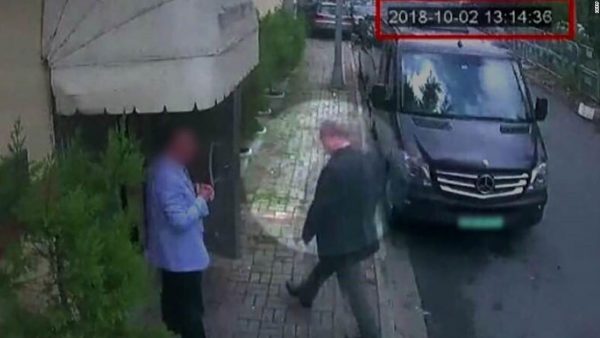
CCTV image of the missing Saudi Journalist Jamal Khashoggi entering the Saudi consulate
That is a blurry image of a middle aged man walking toward the door of the Saudi consulate in Istanbul. It is not proof of a murder. It is proof someone walked toward a door and then entered the building.
Everything else is speculation or statements from “anonymous sources close to the investigation” meaning it’s all baseless rumor, innuendo or deliberate disinformation.
It is entirely possible that the man in the image is not Jamal Khashoggi. And it is entirely possible that it is.
Therefore it is also entirely possible that Khashoggi is not dead by the hands of the Saudis and simultaneously… it is.
But it is not definitive by any stretch of the imagination in either way… unless all of a sudden you take our intelligence assets at face value as if they never lied to us before. Which is quite a leap of faith in my opinion.
All of the journalist murders I listed above have definite proof of their demise. Bodies. DNA. Causes of death. Death certificates. Coroner’s reports. Things of that nature. Here there is only that grainy image taken from a grainy video of about 4 seconds in length. And that, boys and girls, is it.
So why all the pressure being put on Saudi Arabia to essentially foment a regime change in the Kingdom of Saud over a grainy picture of a man who set up a Saudi Regime change NGO in Delaware back in January of this year? A regime change NGO promoted by the National Endowment for Democracy.
Why are MSM outlets and even so-called “alternative anti-war” (Common Dreams, Moon of Alabam and others) ones suddenly parroting the likes of Bernie Sanders and Lindsey Graham in calling for Mohammad bin Salmon’s removal from office?
Was the murder so brutal that it offended even the hardest regime change advocates in D.C. and their allies in the Washington Post? Do they not know the UAE hired a for-profit death-squad based in the U.S. to kill political rivals in Yemen in vicious brutal ways from 2015-2017?
In one case the American former Special Ops mercs put a big bomb on the door of a building they thought their one target was holding a meeting with a whole bunch of others. They hoped to kill EVERYONE in the building but were too late. So later they developed a methodology of using bikes to put bombs on cars in busy traffic intersections killing their targets that way. Them and anyone else who happened to be close.
Have you ever seen someone die slowly after a bomb goes off and blows off their legs or arms or rips open their guts? It’s horrible. And they weren’t even the target.
And yet this hit squad operated with impunity for a favored nation of ours and most involved with the operation find it hard too believe our military and political leadership didn’t know about it. Notice, it started under Obama and continued under Trump. What a shock huh?
You think the alleged abduction, torture, murder and dismemberment was so shocking to those folks they just HAD to do SOMETHING?
Or do you think it was because Khashoggi was pretending to be a journalist at the Washington Post as he fought for regime change in Saudi Arabia?
As some journalists , some news agencies and bloggers have pointed out, Khashoggi’s disappearance perfectly coincides with a number of international events that make this case rather suspect. Unfortunately that number is relatively low.
Khashoggi had extensive ties to Lockheed Martin, the old guard of Saudi royalty, the CIA and other intelligence assets… and of course… his very own regime change focused NGO.
We also know that the deal President Trump made with MbS and Saudi Arabia last year for 110 billion dollars worth of weapons sales was falling through and a deadline for them to purchase the horribly untrustworthy THAAD missile defense system came and went on Sept. 30th of this year with no purchase by MbS.
And we know that the Saudi ambassador to Russia was worried about the U.S. imposing sanctions on Saudi Arabia as recently as Sept. 21 due to them buying the Russian S-400 system instead.
Add to all that the Davos in the Desert meeting taking place this week which the risk of sanctions would seriously screw up… and you have a perfect storm of motive for someone OTHER than Saudi Arabia to either kidnap, kill or “send into early retirement” one Jamal Khashoggi. Right?
Now, 110 billion dollars in deals promised to the MIC is a lot of money, that is for sure. But the question kept rattling around in my feeble little brain… is that really enough to motivate every sector of American empire support, including the fake “alt-right and alt-left” outlets to go all out calling for YET ANOTHER regime change operation in the Middle East?
Seems like a damn good question doesn’t it?
And my answer was “no”
Then I started digging again and what I found makes that 110 billion dollars look like something I give to the local homeless guy every morning when he shows up lightly rapping, rapping upon my chamber door.
Try 4 trillion on for size. Four Trillion spread across every facet of our glorious business community and stretching into every pocket of every director sitting on both the U.S. Chamber of Commerce and the for-profit Central Bank system.
Now THAT is something that EVERYONE can get behind, huh?
Yes, MbS is on the outs as they say but it’s not entirely due to his reluctance to buy U.S. made crappy weapons of war (though that is part of it)
What is really at play here is his apparent reneging on an even bigger deal and an ideological shift that made him the darling of all neoliberals in D.C., New York, London and Tel Aviv.
You see, MbS was installed by our intelligence assets for one purpose: he was finally going to be the Saudi royal family member to fully neoliberalize Arabia on behalf of our hot money speculators and Big Business interests.
The plan was called Vision 2030 (put together by globalist neoliberal technocrats from McKinsey in 2014) and when he first signed on for it (open financial markets to hot money speculators and Wall Street, privatization of everything from nationalized oil company to healthcare) MbS immediately became the DARLING of the Middle East. Man, the right and left of the Business Party loved him to death. Lindsey Graham drooled over him right along side Chris Mathews. Obama praised him as did Trump and everyone in between.
They coupled that with some bullshit about letting women drive cars so the left would get on board and suddenly the brutal dictatorship in Saudi Arabia was something left of Sesame Street. Bert and Ernie would still get beheaded for being gay, the Grouch would have his trash-can privatized and Big Bird would still loose his head for asking too many questions… but the facade was going to hold and a Saudi Arabia would be the new Shining City on the Hill.
All was great in the land Colonel Thomas Edward Lawrence.
But then a funny thing happened on the way to neoliberalization: the vulture capitalists kept being told … to wait till the feeding frenzy could begin.
The oil company IPO was the biggest single disappointment for the masters of the universe but there were many others detailed in the Vision 2030 plan. The IPO, the largest single offering of it’s kind in history, was supposed to have already taken place, making folks like Exxon, Goldman Sachs and BP shareholder in Saudi Arabia’s massive oil business. But it never happened and from the looks of it, the owners of all things planet Earth are getting tired of waiting around for the feast.
Mohammad bin Salmon was raised up and made the heir apparent to the throne in Saudi Arabia ahead of older, more established royal family members for one reason and one reason alone: he was willing to allow the West to roll into the country and chop it up and sell it off for profits.
Keep in mind… by 2014 the glorious captains of industry and banksters had already digested their latest consumables found in places like Libya, Ukraine and Iraq. Syria was resisting and the Russians and Iranians were making it hard for them to anticipate when they would get their next mergers and acquisitions meal fed to them so they needed something to tide them over so to speak. They needed new markets to exploit and pillage and Obama apparently refused to invade Venezuela so something had to give.
Then along came a power struggle in a country they have coveted for decades. A nation with tons of state-owned property and businesses and services they could consume.
Saudi Arabia.
All they needed was a front-man on the inside they could promote and then control.
Prince Mohammad bin Salmon fit the bill perfectly.
He was young, would be their man for decades to come and his youth made him seem like something they could promote as the new face of the old kingdom.
But something has changed in him and thus, in our masters’ opinion and trust of him.
Hell hath no fury like a globalist spurned and what we see now is clearly a ramification of that love lost and turned to hatred.
Is it a coincidence that all of these things are coming to a head at the exact same time a man committed to removing MbS from power goes “missing” at the consulate in Istanbul?
Possible I assume.
But I quit believing in geo-political coincidences right around the same time I quit believing in our two party “democracy” so for me, this seems like the beginnings of another neoliberal regime change operation.
Only this one will be fueled by the fire of an unrequited love and the desperation of vulture capitalists starving for another carcass upon which too feed.
October 18, 2018
Posted by aletho |
Deception, Economics, False Flag Terrorism, Mainstream Media, Warmongering, Timeless or most popular | Saudi Arabia |
Leave a comment
I am currently in the U.S., and so watching from afar as the biggest criminal investigation Britain has ever seen is sub-contracted out to the Atlantic Council/Soros-sponsored website, Bellingcat. Pinch yourself once. Pinch yourself twice. Yes, it really is happening.
It is truly remarkable that having seen millions of pounds spent on an investigation which has failed to give consistent and logical answers to some of the biggest questions in the case, and which has been remarkably economical with the actualité on things like timelines, a website with dubious connections to various neo-conservative organisations has now ridden to the rescue to fill in the gaps which The Met has apparently missed (as an aside neo-conservative is of course a misnomer, since they don’t actually conserve anything. They are in reality neo-Trotskyists, since they are globalists and like destroying stuff). Any taxpayers out there feel like a refund?
The media seems to be having a field day quoting Bellingcat as if it were now the official mouthpiece of The Metropolitan Police and the Government. Of course it may well be the official mouthpiece, only we can’t quite tell as The Met and HMG sneakily hide behind the claims instead of either confirming or denying them:
“A spokesman for the Home Office said it would not comment as it was a police investigation.”
“The Metropolitan Police said they would not comment on the ‘speculation’.”
“And Lady Justice said she would not comment on the case anymore, because she’s had enough and needs to sit down in a corner of a darkened room with a stiff drink, before considering what her next career move might be.”
I have no intention of being sucked into the black hole of analysing the Bellingcat claims. I have no idea of the validity of their claims. They may well be correct. They may well not. However, as I have pointed out many times before, the case against the two suspects is not that they were undercover intelligence officers; rather, it is that they carried out an assassination attempt at the front door of 47 Christie Miller Road using something called “Novichok”. And I am only really interested in whether that case does, or does not stack up.
Reading through the charges made against the two men again, which were given in the statement put out by The Metropolitan Police on 5th September, it strikes me as fairly obvious that investigators do not actually have the evidence of the men’s culpability that they claimed to have when they said:
“We now have sufficient evidence to bring charges in relation to the attack on Sergei and Yulia Skripal in Salisbury.”
Why do I say this? Because although Mr Basu stated that he would go through their movements “in detail”, in actual fact he did nothing of the sort. Take a look at what he said about their movements on Saturday 3rd March:
“On Saturday, 3 March, they left the hotel and took the underground to Waterloo station, arriving at approximately 11.45am, where they caught a train to Salisbury, arriving at approximately 2.25pm. They are believed to have taken a similar route when they returned to London on the afternoon of Saturday, 3 March. Leaving Salisbury at approximately 4.10pm and arriving in Bow at approximately 8.05 pm.”
Question: How much detail did he actually give about their movements in Salisbury that day? The answer is none at all. Read it again. There’s nothing. Yes, there’s a lot of fluff about their movements in London, but other than the fact that they arrived in Salisbury, and then left Salisbury, there is nothing whatsoever about their movements whilst they were there. And just to remind you, the charge against the men relates to what they did in Salisbury, not in London.
Why is this and what does it indicate?
Well, it isn’t that they don’t have evidence of the movements of the two men. One of the commenters here, Peter, has established via a Freedom of Information request to Wiltshire Council that all CCTV cameras were operational on both days, and that all footage in relation to the March incident was handed over to the Counter-Terrorism Police.
This means that The Met has detailed footage of the two men in Salisbury on 3rd March, but not only have they chosen to release none of it, apart from one still image of the men at Salisbury station heading back to London, but they have also declined to give any actual detail of the men’s movements in the town that day. Surely if the footage exists — which it does — then The Met ought to be able to tell us what the two men were doing and where they went. But the extraordinary thing is, not only did they fail to do this, but they actually appealed for help in establishing their movements:
“We’d also like to hear from anyone who saw them while they were in the UK between Friday, 2 March and Sunday, 4 March. We are particularly interested in establishing as much as possible about their movements during the period 2pm to 4.30pm on Saturday, 3 March, and 11.30am to 2pm on Sunday, 4 March.”
Why would they need help when plenty of CCTV exists for them to be able to trace their movements?
Actually, it gets worse. Despite the existence of CCTV showing the men’s movements, but still apparently not knowing where the men went, The Met felt fit to draw the following conclusion:
“We assess that this trip was for reconnaissance of the Salisbury area and do not believe that there was any risk to the public from their movements on this day.”
Reconnaissance? What on earth is this supposed to mean? Did they go and check out Mr Skripal’s house that day? If so, where is the CCTV footage of them doing so? Presumably there would be footage of them walking past the Shell garage on that day too. Where, then, is it (and again, I’m asking for footage, not a still image)?
The use of the word reconnaissance is simply absurd. It makes it sound like they were involved in some clandestine military operation, behind enemy lines, checking out the lie of the land. But actually they were in the rather genteel city of Salisbury, and could have checked their destination using Google maps. Or were they just checking that the door had a handle?
Let’s see how The Met fares on the Sunday:
On Sunday, 4 March, they made the same journey from the hotel, again using the underground from Bow to Waterloo station at approximately 8.05am, before continuing their journey by train to Salisbury. CCTV shows them in the vicinity of Mr Skripal’s house and we believe that they contaminated the front door with Novichok. They left Salisbury and returned to Waterloo Station, arriving at approximately 4.45pm and boarded the London Underground at approximately 6.30pm to London Heathrow Airport.”
Again, most of this is fluff. What has their journey from their hotel to Waterloo got to do with what they are charged with doing in Salisbury? What has their return journey to Waterloo and on to Heathrow got to do with what they are charged with doing in Salisbury? Not much. The charge against them is that they carried out an assassination attempt in Salisbury, not that they got on a train here, a tube there, and an airplane somewhere else.
Ah but they do mention what happened in Salisbury, don’t they? Well, yes they do, but as I pointed out in my previous piece, it’s actually a deeply misleading claim. The CCTV footage released by The Met does not show the men in the vicinity of Mr Skripal’s house; it shows them on a different street altogether, hundreds of yards away.
The entirety of the evidence given verbally by Mr Basu of the two men’s activities in Salisbury on both the 3rd and 4th March, is therefore this:
“CCTV shows them in the vicinity of Mr Skripal’s house and we believe that they contaminated the front door with Novichok.”
That’s it! Nothing more! Not exactly compelling, is it?
But here’s the thing: The Met knows exactly where the men went on both days, because it has an awful lot of CCTV footage showing where they went. Yet not only does it refuse to release footage, but it skips out all details of Saturday’s Salisbury wanderings, and makes a misleading statement about the Sunday wanderings. I would submit that the most plausible explanation for this is not that the CCTV doesn’t exist (it does). Nor is it that it exists, but is deemed too sensitive to be released (it isn’t). Rather, the most plausible explanation is that it does exist, but it doesn’t actually back up the claims being made.
Even if the Bellingcat claims turn out to be true, it doesn’t alter this crucial point: The Metropolitan Police has so far failed to provide any convincing evidence that the two suspects they have named walked up to 47 Christie Miller Road and placed “Novichok” on the door handle. They have CCTV footage of the men in Salisbury on 3rd and 4th March. And yet the actual details of their movements that they have given out are in reality non-existent. Perhaps Bellingcat would like to answer the question of why this is. Since they appear to have taken over the investigation, that is.
October 10, 2018
Posted by aletho |
Deception, False Flag Terrorism, Russophobia | UK |
Leave a comment
An intelligence service given free rein to commit ‘serious crimes’ in its own country is an intelligence service that is the enemy of its people.
The quite astounding revelation that Britain’s domestic intelligence service, MI5, has enjoyed this very freedom for decades has only just been made public at a special tribunal in London, set up to investigate the country’s intelligence services at the behest of a coalition of human rights groups, alleging a pattern of illegality up to and including collusion in murder.
The hitherto MI5 covert policy sanctioning its agents to commit and/or solicit serious crimes, as and when adjudged provident, is known as the Third Direction. This codename has been crafted, it would appear, by someone with a penchant for all things James Bond within an agency whose average operative is more likely to be 5’6” and balding with a paunch and bad teeth than any kind of lantern-jawed 007.
The Pat Finucane Centre, one of the aforementioned human rights groups involved in bringing about this tribunal investigation (Investigatory Powers Tribunal, to give it its Sunday name) into the nefarious activities of Britain’s domestic intelligence agency, issued a damning statement in response to the further revelation that former Prime Minister David Cameron introduced oversight guidelines with regard to the MI5 covert third direction policy back in 2012.
Cameron’s decision to do so, the group claims, was far from nobly taken:
“It can be no coincidence that Prime Minister David Cameron issued new guidelines, however flawed, on oversight of MI5 just two weeks before publication of the De Silva report into the murder of Pat Finucane. The PM was clearly alive to the alarming evidence which was about to emerge of the involvement of the Security Service in the murder. To date no-one within a state agency has been held accountable. The latest revelations make the case for an independent inquiry all the more compelling.”
Pat Finucane, a Belfast Catholic, plied his trade as a human rights lawyer at a time when the right to be fully human was denied the minority Catholic community of the small and enduring outpost of British colonialism in the north east corner of Ireland, otherwise known as Northern Ireland. He was murdered by loyalist paramilitaries in 1989, back when the decades-long conflict euphemistically referred to as the Troubles still raged, claiming victims both innocent and not on all sides.
Unlike the vast majority of those killed and murdered in the course of this brutal conflict, Finucane’s murder sparked a long and hard fought struggle for justice by surviving family members, friends and campaigners. They allege – rather convincingly, it should be said – that it was carried out with the active collusion of MI5.
Stepping back and casting a wider view over this terrain, the criminal activities of Britain’s intelligence services constitute more than enough material for a book of considerable heft. How fortunate then that just such a book has already been written.
In his ‘Dead Men Talking: Collusion, Cover Up and Murder in Northern Ireland’s Dirty War’, author Nicholas Davies “provides information on a number of the killings [during the Troubles], which were authorized at the highest level of MI5 and the British government.”
But over and above the crimes of MI5 in Ireland, what else have those doughty defenders of the realm been up to over the years? After all, what is the use of having a license to engage in serious criminal activity, including murder and, presumably, torture, if you’re not prepared to use (abuse) it? It begs the question of how many high profile deaths attributed to suicide, natural causes, and accident down through the years have been the fruits of MI5 at work?
And what about the possibility of MI5’s involvement in, dare we use the term, false flag operations?
As someone who abhors the premise of conspiracy theory on principle, the fact that more and more are turning to its warm embrace as an intellectual reflex against what is politely described as the ‘official narrative’ of events, well this is no surprise when we learn of the egregious machinations of Western intelligence agencies such as Britain’s MI5.
What we are bound to state, doing so without fear of contradiction, is this particular revelation opens up a veritable Pandora’s Box of grim possibilities when it comes to the potential crimes committed by Britain’s domestic intelligence agency, ensuring that a full and vigorous investigation and public inquiry is now both necessary and urgent.
If any such investigation is to be taken seriously, however, it must include in its remit the power to investigate all possible links between Britain’s intelligence community and organisations such as, let’s see, the Libyan Islamic Fighting Group?
The deafening UK mainstream media and political class silence over the trail connecting 2017 Manchester Arena suicide bomber Salman Abedi and MI6, Britain’s foreign intelligence agency, leaves a lingering stench of intrigue that will not out. The work of investigative journalist Mark Curtis on this sordid relationship is unsurpassed.
As Curtis writes, “The evidence suggests that the barbaric Manchester bombing, which killed 22 innocent people on May 22nd, is a case of blowback on British citizens arising at least partly from the overt and covert actions of British governments.”
In the same report he arrives at a conclusion both damning and chilling: “The evidence points to the LIFG being seen by the UK as a proxy militia to promote its foreign policy objectives. Whitehall also saw Qatar as a proxy to provide boots on the ground in Libya in 2011, even as it empowered hardline Islamist groups.”
Finally: “Both David Cameron, then Prime Minister, and Theresa May – who was Home Secretary in 2011 when Libyan radicals were encouraged to fight Qadafi [Muammar Gaddafi] – clearly have serious questions to answer. We believe an independent public enquiry is urgently needed.”
In words that echo down to us from ancient Rome, the poet Juvenal taunts our complacency with a question most simple and pertinent: “Quis custodiet ipsos custodes?” Who will guard the guards themselves?
Edward R Murrow puts it rather more bluntly: “A nation of sheep will beget a government of wolves.”
Sooner or later, people in Britain are going to have to wake up to who the real enemy is.
Read more:
October 8, 2018
Posted by aletho |
Civil Liberties, Deception, False Flag Terrorism, Timeless or most popular | Human rights, MI5, MI6, UK |
Leave a comment
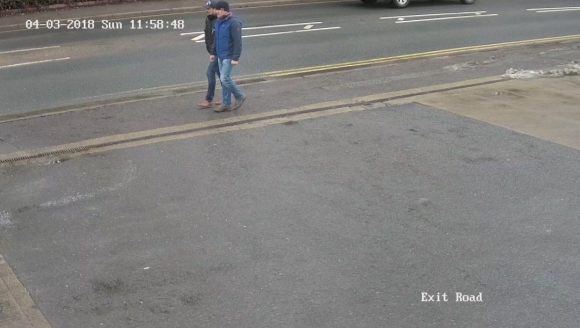
The images and timeline released by the Metropolitan Police on September 5th, when they formally accused two men of the attempted assassination of Sergei Skripal, contain a number of problems and oddities. These include:
- The fact that very few of the images have the original timestamps on them, but rather have the Metropolitan Police’s own timings.
- The fact that there is an unaccounted for, yet vital, 42 minutes between the image of the men at the entrance to Summerlock Approach (said to be 13:08), and the image of the men at the train station (said to be at 13:50:56). Why is this vital? Because it not only takes just 5 minutes, rather than 42 to get from the one location to the other, but also because it potentially places the men within a few minutes walk of Sergei and Yulia Skripal within that 42 minute timeframe.
- The fact that only stills were released, rather than actual footage (public appeals for witnesses involving CCTV usually show actual footage – why not in this case?).
But there is one crucial image which I would like to focus your attention on: CCTV Image 5 (at the top of this piece). This is one of the few pictures that is properly timestamped (11:58:48), although I have to say I’m highly sceptical that the two men could have got to that location by that time, given that The Met says they were at the station at 11:48:20. It takes over 12 minutes at a quick walk, and so unless they ran some of the way (and neither picture gives the impression that they are in a particular hurry), I think it highly likely that one or other of these times is incorrect.
The reason this image is particularly crucial is that it is the only image shown to the public, which can be said to connect the men (albeit extremely tenuously) to the claim made against them by the Met. None of the other images do this at all.
If I happened to be a juror at the trial of these two men, and I was presented with the other images, my reaction would largely be “so what?” (this is of course pure fantasy, since the Blair Government, in its infinite wisdom, tore up centuries of legal practice to allow such trials to be held without a jury on the grounds of that mindless buzz phrase, “national security”). Here are some images showing them entering and leaving the UK. So what! Here are some images of them arriving in and departing from Salisbury. So what? Here are some images of them walking around the town. Actually, this one is not so much a “so what?”; more a “hang on a minute, are you telling me they went walkies around the town after allegedly carrying out the most audacious (and stupid) assassination attempt ever seen in Britain?”
Without the Wilton Road image, none of these other images would mean diddly squat. That image, assuming it to be authentic, is the closest The Met comes to backing up its claim against them. But as we shall see, it actually turns out to be no more convincing than the others.
As I said in my previous piece, it is crucial to understand what the claim being made by The Met against the two men actually is. Here goes:
“That between approximately 12:10pm and 12:40pm on 4th March, the two men named as suspects – Ruslan Boshirov and Alexander Petrov – walked up to the house of Sergei Skripal at 47 Christie Miller Road, Salisbury, and there applied a high purity, military grade nerve agent to the handle of the front door in an attempt to assassinate Mr Skripal.”
(Note: see the previous piece if you want to know why there is a 12:10-12:40pm window).
Now let’s turn back to the statement made by The Met on 5th September. This is what they said:
“CCTV shows them in the vicinity of Mr Skripal’s house and we believe that they contaminated the front door with Novichok.”
The big question that arises from this claim is this: What is this CCTV footage, which apparently shows them in the vicinity of Mr Skripal’s house? There are two basic possibilities:
Firstly, it could be that there is indeed CCTV that shows them close to Mr Skripal’s house (i.e. within a few yards of it), and perhaps which even shows them applying something to the door handle.
Secondly, it could be that The Met is simply referring to the CCTV of the men on the Wilton Road, which they released in the statement.
The second is almost certainly the case, for the following reasons:
- If there is CCTV footage of the two men near (or at least nearer the house), why not show that rather than the Wilton Road image?
- If such footage does exist, why does The Met only “believe” that the two men contaminated the door handle with something called “Novichok” as opposed to “know” that they did so (note: Porton Down does not call it “Novichok”, but rather “a Novichok or related agent”)?
- When you read The Met’s statement of 5th September, it is fairly clear that the reason the Wilton Road image is there, is that it is precisely this image which is being used to back up the statement about the men being in the vicinity of the house (i.e. they say: “Image five shows the suspects ten minutes later – at 11.58 – on Wilton Road, Salisbury, we say, moments before the attack”).
This is deeply misleading. The Shell garage on the Wilton Road could plausibly be said to be in the vicinity of 47 Christie Miller Road if we were talking about the two locations in terms of Salisbury as a whole. But it can in no way be said to be “in the vicinity” of 47 Christie Miller Road, if it is being spoken of in connection with a highly specific claim about an assassination attempt at the door of the house. The claim is that they were at the door. The image, assuming its authenticity, shows them on a different street, many hundreds of yards away.
This sort of sloppiness and looseness has been the hallmark of the investigation from day one, and has been the reason why so many have come to treat the official claims with scepticism.
Let me caveat this, however, by saying that I don’t believe Boshirov’s and Petrov’s claims either. The chief reason for this is that The Met says they arrived in Salisbury at 14:25 on the Saturday, and this was not disputed by them in their interview with Margarita Simonyan. What they did claim, however, is that they came to visit Stonehenge, but were unable to do so due to the bad weather. This was kind of true. Stonehenge was indeed closed that day due to bad weather. However, had it opened that day, it would have closed at 17:00 with last admissions at 15:00. Getting to Salisbury at 14:25 with the hope of then going to see Stonehenge by 15:00 is not very plausible — even if it had been good weather.
But as I’ve said previously, it is largely irrelevant whether Boshirov’s and Petrov’s account is credible. It is The Met that has accused them, and it is therefore for The Met to come up with credible evidence to back up their claim. Showing an image of the two men in broad daylight, on a completely different street, hundreds of yards away from the alleged crime scene, does not do it. Worse still, claiming that this image “shows them in the vicinity of Mr Skripal’s house” — which it manifestly does not — is deeply misleading.
If The Met has more conclusive footage (footage that is, not another still), actually showing the two men in the vicinity of the house, they should release it. Until they do, we can assume the claim that “CCTV shows them in the vicinity of Mr Skripal’s house” is referring to the Shell garage on the Wilton Road, which since it is not in fact in the vicinity of the house, is misleading. We can therefore continue to treat their claims with the scepticism that they have so far deserved, and to believe that there is another explanation altogether for Boshirov’s and Petrov’s two Salisbury trips; an explanation that neither the British or Russian Government seem very eager to come clean on.
October 7, 2018
Posted by aletho |
Deception, False Flag Terrorism | UK |
Leave a comment
SYRIA, seat of an Islamic Caliphate. Syria, site of the Middle East’s newest liberal democracy. Syria, socialist paradise. Syria, a corrupt and murderous dictatorship that practices genocide. Syria, a failed state. Syria a state that is too strong. Syria, soon to be partitioned into ethnic enclaves. Syria, a pawn of Iran. Syria, a tool of Russia. Syria, a haven for terrorists that threaten our friends and way of life. Syria, where Saddam sent his fabled WMDs. In other words: Syria is whatever you want it to be. Syria, if it exists, apparently only exists to satisfy your desires, where you get to freely confuse where you think the world ought to go, with where it is going.
Syria, if you take at face-value any of the many authoritative North American and European pronouncements about “what needs to be done,” has seemingly joined the list of “disappeared” nation-states. It was a country made to vanish into thin air, like Libya, Iraq, and Yugoslavia before it. Anything goes when it comes to Syria: it can be whatever we imagine it to be. It was as if “Syria” was just a name for a template. We speak and behave as if it were first a tabula rasa—a clean slate—or more accurately, terra nullius—a land belonging to no one. It is land that belongs to no one, that is, until we arrive on the scene and forge our models for a new Syria. Syrians are not allowed to have their Syria until we first get a say on what Syria will be.
Syria Not For Syrians
Over the past seven years we have seen in virtually every side to the foreign debate about Syria’s present and future(s) an immense amount of apparently self-gratifying wishful thinking. We have witnessed the very real danger involved in the ideological mode of thinking, especially when the ideologies are backed by real material power and conveyed as action on the ground. Whenever we have the rare chance to hear any Syrians, they are instantly dismissed and disqualified by one side or another. We are happier dealing with a “Syria” that is a figment of our political imaginations, a projection of the discontent we have with our own domestic politics, a method for beating up all “enemies, foreign and domestic”. “Syria” is the plaything of those who are equal to any of our hedge fund managers: we pick a side, and bet on it. More than that even, “Syria” is a meeting ground for fantasy and political economy, and it’s a sign of just how ugly is the recolonization effort wrought by neoliberal globalization.
And it most definitely is the case that what we are dealing with here is globalization’s destruction of sovereignty, of national self-determination. How do we know that? Watch this: while there was no real debate about the US sending troops to Syria (where they can cancel out Syria’s sovereignty), there was instead massive, urgent, melodramatic panic about the US sending troops to its own border, where they could affirm US sovereignty. If a nation can send its troops to another continent, but not to its own border (i.e., stay at home), something is really wrong. Some must have wondered what US troops were doing on the US border, as if they naturally belonged in Syria instead. The jarring juxtaposition of the two contrasting stances came out in a single question by a reporter at a White House press briefing—a reporter who nevertheless failed to note the contrast:
“there seems to be a perception that, at times, the President makes announcements and then the White House has to come up with policy to match what the President said. Like with the talk about the military at the border, there weren’t really a lot of details about that at first. And with the issue with Syria, and him saying he wanted to, kind of, pull all the troops back”.
In another White House press briefing, reporters once again failed to notice the absurd contradiction between their thinly veiled criticisms of Trump’s desire to pull US troops back from Syria, while apparently complaining about the decision to send troops to the US border. The only way one can reconcile these two apparently contradictory positions is to recognize that they both reduce to a common denominator: the destruction of nations as viable entities. Any and all nations, everywhere, have been the target. Some were surprised to learn that this included the US itself.
Syria, likewise, is denied the right to defend itself. It has no right to its own territory. Israel is free to bomb at will, as are a range of NATO members, and the US can freely decide to make a presence for itself, to create “interests” on Syrian soil (which in principle, does not exist). When other nations send forces at the request of the Syrian government, then those nations suddenly have no right to be there. Why not? Because they are there precisely as a result of decisions made by the Syrian government, and Syria can have no government because it also has no soil. Who decided on this arrangement?
For globalization to work, it required a policeman. After all, neoliberals believe that states are still useful as law enforcers. This introduced a fatal flaw into the globalist agenda, which was pushed and enforced by states: not all states are equal in power, and thus the only reliable global policeman was the US. The US, some would argue, has no right to determine who crosses its borders, yet retains the right to decide on who is allowed across Syrian borders. That such arrangements are subject to a backlash in the US itself, the power core of globalization, is the main reason that globalization is in such extreme jeopardy.
For the globalists, Syria and the US are nonetheless alike in one key respect: they both belong to the rest of the world. What they are not allowed to belong to is themselves. The world the globalists tried to invent out of thin air was one of forced associations, unwanted encounters, and false dependencies. No wonder that the reactions have in some cases been so scathing, so filled with spite. If such reactions are deemed a problem, and if one wanted to avoid such reactions, then logically you would cease creating the causes of the problem. But the world imagined by globalists is never inhabited by real people; it’s a world where everyone is subject to “learned helplessness” and like a repeatedly abused dog learns to “just take it”—a world that is unreal, inhumane, and was therefore never sustainable.
Terra Nullius
This is how Sven Lindqvist explains the idea of “terra nullius” in his book, published in English in 2007:
“Terra nullius. From the Latin terra, earth, ground, land, and nullius, no one’s.
“Thus: no one’s land, land not belonging to anybody. Or at any rate, not to anybody that counts.
“Originally: land not belonging to the Roman Empire.
“In the Middle Ages: land not belonging to any Christian ruler.
“Later: land to which no European state as yet lays claim. Land that justly falls to the first European state to invade the territory.
“Empty land. Uninhabited land. Land that will soon be uninhabited because it is populated by inferior races, condemned by the laws of nature to die out. Land where the original inhabitants are, or can soon be rendered, so few in number as to be negligible.
“The legal fictions summed up as terra nullius were used to justify the European occupation of large parts of the global land surface”. (Lindqvist, 2007, pp. 3–4)
Syria was land not belonging to the Roman Empire, until it was. It is also land not belonging to the American Empire, and powerful interests in the US would obviously like to change that. Outside of the high echelons of the military-industrial-complex, other US interests have also vested themselves in Syria. A loose coalition has formed, ranging across from generals in the Pentagon right across to establishment media, freelance “journalists,” self-appointed humanitarian activists, and university-based anarchists and some Marxist academics. They all agree on one fundamental point: Syria can no longer belong to Syria alone; Syrian decision-making, and the right to make decisions about citizens on Syrian territory, is to be subject to some sort of veto wielded by foreigners, backed by US firepower.
For this mission of foreign ideological occupation to work, Syria first has to be symbolically and politically emptied. Only an empty zone can be so liberally filled with fantasy and spectral assaults: fabricated gas attacks, mysterious missile strikes in the dead of night, cities in ruins suggesting they were once occupied by a settled, peaceful civilization that has long disappeared, even mystery adversaries jamming US communications. The Onion, interestingly, had it right when in playing to the propaganda that has become the norm, it portrayed Syria as a land being trampled on by legendary monsters and super-human beasts, ruled by fears that “bombed-out buildings and blast craters could be harboring bands of angry scorpions, komodo dragons, mace-wielding cavaliers in full chain mail, or, as children recently swimming off the country’s coast discovered, giant piranhas”. Chemical weapons, the weapons of the new barbarians, are an essential feature of the kinds of made-up tales that are made to prevail in a frontier zone of projected fantasies of monsters. In the land of make-believe “evil,” Sadistic Arab “dictators” unleash troops powered by Viagra to engage in systematic rape, rip babies from incubators, threaten to massacre entire cities, and then wipe out communities with poison gas. Accusations we would never tolerate against our own, let alone treat credibly, are instead freely plastered on others. It’s amazing that in the new, fastidious and prickly racism-consciousness that prevails in North American media and academia, such routine colonial racism is instead still perpetuated, as much as the incessant myth-making.
Fantasy is useful in other ways: by dismissing the value of evidence, and replacing facts with belief, any accusations can be given the weight of “credibility”—but only if enough people have been successfully trained to mistake credibility for truth. What the US has developed, for example, is a fact-free, faith-based approach in its foreign policy rhetoric, one that is used to justify permanent US intervention. Why? Because there is no objective argument one can make for one country to occupy another. It’s not a matter of logic and rationality; it’s a matter of ideology and a thirst for power.
Having projected onto Syria an absence of “civilization,” this creates wide open space for demonization. Demonization is a valued part of Western myth-making structures, especially in justifying imperial domination. Demonization turns very human opponents into monsters (and they are referred to as such, as monsters, animals, and of course “evil”). Adversaries of the West are played up as villains in a morality tale, that always allocates to us—by default—the role of saviours and victors, if we will have our victory (as the late Charles Krauthammer put it, “The choice is ours. To impiously paraphrase Benjamin Franklin: History has given you an empire, if you will keep it”). We thus have these endless moral crusades on our part, where morality is used to mask politics.
Moral crusaders love it when in the distance they make out the outline of a new terra nullius on the horizon. Places like Syria offer the opportunity for adventure, to go out and exercise yourself, to use Syria as part of your own personal self-fulfillment, an object of your ambition and desire. Eurocentric missionary aspirations flourish in such contexts, robed as “humanitarian interventionism,” “internationalism,” “solidarity,” “civil society activism,” “democracy-building,” “conflict resolution,” “peace-building,” or just plain regime-change.
The paradox of foreign intervention is that it empties everyone, not just Syria. Britain and France earlier this year saw their foreign policy being taken over by the US, restricting any domestic parliamentary debate about the decision to militarily strike Syria, until well after the fact. The US was no exception: the decision to attack Syria in April of this year was done without Congressional approval. The process had been emptied of political representation by those elected and legally appointed to (dis)approve war-making, as dictated by the respective constitutions, which for a moment vanished. War, in violation of both international and domestic laws, damaged democracy in the US, UK, and France. This is what imperialism in the globalist age looks like, even when one of they key actors sometimes likes to sound like an angry anti-globalist.
The key themes of this renewed terra nullius are thus:
- land without a legitimate state to own it;
- civilization vs. barbarism (along with civilized vs. barbaric forms of violence, for example, Tomahawk missiles vs. nerve gas);
- demonization and dehumanization;
- a nation-state reduced to a “regime” which is reduced to one person who is reduced to a monster/animal; and,
- a fertile site for imposed models.
One question readers might ask is: why? Why should “terra nullius” or anything resembling the idea be in use here? One simple theory is that any society works with a finite set of cultural materials. These cultural materials can be reproduced, amended, extended, or reworded. We end up with multiple translations of a small set of original sources. Imagine that centuries after European colonialism began, we are still speaking of “civilization” vs. “barbarism,” in the very same terms. A second theory, that goes with the first, is that except in cataclysmic situations (which are extremely rare—the exception), real cultural change occurs only very slowly, at an almost glacial pace. Changes to our basic cultural materials do take place in our lifetimes, but often more in form and application than a change in the original “code”.
Moral Imperialist Economy
Whenever members of a society imagine the rest of the world as a mass of “problems,” and imagine themselves as possessing the “solutions” to those problems, what we have then is the structure for a relationship that involves a transfer of capital. The producers of problems owe a permanent debt to the exporters of solutions—ideally. Reality is different of course: this structural relationship of extraction needs to be maintained, and sometimes the maintenance costs exceed the profits. First, let’s look at some of the basic elements of the moral imperialist economy. Ideologically transforming Syria into a new terra nullius is a form of creative destruction (paralleled by real, military destruction), and as we should know, crisis always creates opportunity, and opportunity attracts opportunists.
Syria is a free for all for various patrons and clients. These new Wild Wests are a great place for freelancers of all kinds to upgrade their status, for example. Syria has thus been transformed into a Wild West of misinformation, of selective information, of forms of activism and a way to invest political interests in the creation of custom-made propaganda. Inevitably there are patrons for this or that stream of propaganda, whether it’s a news agency, the CIA, a NGO of some sort, or elements of “the crowd” funding one’s work through something like “gofundme”. The result is a kind of wild stock market for values of all kinds.
New commodities are produced by the new information warfare, designed to conduct war on the minds of all media consumers, whether of the established or social media kind (it makes little difference). One of the key new commodities is, of all things, the baby photo. Not just any babies though—no, these always have to be dead babies, sometimes mangled, sometimes partly decomposed, sometimes about to die, or those that have barely escaped death but are nonetheless permanently disfigured, burnt, or without limbs. These commodities are avidly traded by all sides. The open borders/refugee advocates have their photo of a dead Syrian child on a beach; the regime changers have pictures of child gas victims; and even the anti-imperialists have their photo of a little Palestinian boy, seized from a hospital bed, looking helpless moments before being beheaded by beefy bearded jihadists. Printing dead baby photos is like printing money. Such photos call the attention of powerful patrons, supposedly “provoked” to act when the photos are sufficiently publicized. When such patrons intervene, it further raises the value of such photos, virtually creating a demand for more. Now the most conclusive way to make one’s case “credible” is by flashing the appropriate dead baby photo. This commerce is part of the humanitarian trafficking that liberal imperial globalism encourages.
Wildly inflated numbers, numbers that go up, come down, that get divided, are indicative of the existence of this kind of stock market. Thus the debates over the number of civilians “killed by the regime,” and how often the number is inflated to include all the soldiers and civilians killed by those opposed to “the regime”. So everyone who has been killed in Syria was supposedly killed by the Syrian state—that’s convenient, because after all we have the moralistic demon tales that instruct us that “Assad is a monster,” and just like a monster, he “kills his own people”. (Funny, isn’t it, how easily we always manage to imagine these low-down Third World leaders as sub-humans.)
Status upgrades come easily: take the appropriate moralistic, virtuous stance in front of the right audience—by just saying that you believe in X or Y—and lo and behold you have achieved a status upgrade. You are one of the good people, a trusted source, a credible figure, because you said the right things to the right people in the right place at the right time. This internationalized form of virtue signalling is almost as good as printing money, and nearly identical to it in its most basic sense.
Like in the Wild West, betting in the saloon is also common when it comes to Syria. The US State Department under Obama placed all its bets on some entity they invented, which they liked to call “moderate rebels” (why not “respectable terrorists” or “polite criminals”?). They lost. Numerous left-wing academics signed on to regime change years ago, and because they only pretend to be seasoned analysts for their day jobs, they did not foresee the collapse of the anti-government forces in Syria. That list included noted “post-colonial” scholars and anthropologists, united in their belief in “democracy promotion” and remaking Syria into something palatable to them, with the right leaders in place. Five years later and a smaller group—including feminists like Gloria Steinem and Judith Butler, anarchists like Noam Chomsky and the anthropologist David Graeber, the Marxist David Harvey, and advocates of recolonization like Michael Walzer—placed their bets on socialist Kurdish militias, presumably increasing the value of their bet by the important sign value of their brand name authority. Ironically, in the process of re-imagining legendary Rojava as the site of a second Spanish Civil War, they were openly collaborating with Donald Trump (not naming him directly, since “the US government” was more convenient). These signatories were thus complicit with the very same commander-in-chief of the armed forces they were calling on for support of Syrian Kurds. They wanted “the US government,” whose President is Donald Trump, to impose sanctions on Turkey, and to develop a foreign policy that put Kurdish interests at the forefront. You can be sure that, elsewhere, in front of different crowds, they return to “the Resistance” by puffing up their little chests and sounding all “anti-Trump”—but when it came to cheering their favourite band of ethnic anarchists, they could dispel with appearances. Less “prestigious” characters, publishing in a less “prestigious” outlet, countered the call to “defend Rojava”, a call which appropriated “progressive” politics for the cause of imperialism (reigniting an old marriage). (David Harvey, by the way, having cashed in on abundant sales of his volume, The New Imperialism, has recently changed his mind: he has decided that imperialism is merely a metaphor, “rather than anything real”. Out of curiosity, we have to wonder if “capitalism” is also a metaphor, rather than anything real, seeing how Marxists have linked capitalism with imperialism. Perhaps even socialism is a metaphor, rather than anything real.)
(Recommended here is “The Fake Left at the Left Forum” by Danny Haiphong, Black Agenda Report, June 13, 2018, and “Antifa or Antiwar: Leftist Exclusionism Against the Quest for Peace,” by Diana Johnstone, Consortium News, May 21, 2018.)
Of course activists, academics, and the freelancers that make all the Twitter noise, are just bit players in the drama of their dreams. Some of the really big heavy hitters are the various weapons manufacturers, politely termed “defense contractors,” and their army of lobbyists in Washington, DC. For them, any sniff of a chance for permanent occupation smells like permanent war, and thus permanent profit, paid for by debt in the present to be paid by future tax-payers. Advocates of permanent occupation concede only one alternative to occupation: regime change, thus recolonization, which has the same effect as permanent occupation. Advocates include beneficiaries of status upgrades like Senator Lindsey Graham, converted into the de facto US Secretary of State by his friends at Fox News and CNN.
For powerful patron states like the US, “chaos” offers valuable opportunities—in the technocrats’ language, this is duplicitously referred to as “preventing chaos”. The official assumption, intended for popular consumption, is that “chaos” predates foreign intervention. Remember: other peoples are producers of problems, chaos is thus a permanent and normal state for them. Add to the assumption that chaos predates US intervention the assumption that there is no Syrian government (the officially existing one is not acceptable to the US, so it vanishes), then Syria becomes the name for a wide-open wilderness. That means the US gets to train and reinforce “local forces”—like the separatists cheered on by a select group of leftist academics. But this all costs money, what to do? Here comes Trump’s transfer of costs for extracting capital: emphasis is placed on Saudi Arabia and the Gulf States to pay for the costs of US occupation and proxy-training in Syria. This model is essentially one that places the US in the role of an international mercenary. Where such support payments are not forthcoming, then there is the fallback of debt-financed US military spending. The loans are provided by a range of creditors, domestic and foreign, including foreign central banks. Many states thus own US debt, and what we see here is essentially the rest of the planet financing its own domination by a US debt-fuelled warhorse. (This is one of the “secrets” that ought to inform revised and reworked theories of imperialism: empires function best and last longest when the ostensible objects of imperial domination actively collaborate in supporting empire. Theories uninformed by this observation can become trite conspiracy theories of imperialism.)
To maintain the value of US “investment” in Syria, the US needs to create a need for protection, while reducing the value of alternatives (competitors). One way to create a need for protection is to create that crisis that would seem to beg for it: phony gas attacks, like those happening at the end of a week of public debate that erupted after Trump announced he wished to withdraw US forces from Syria soon. Another means for bolstering US intervention in Syria is by invoking the threat of Iran.
As mentioned at the start of this section, the structural relationship of extraction needs to be maintained, and sometimes the maintenance costs exceed the profits. For example, “humanitarian activists” who plead for greater accessibility to refugees, disconnecting the fact of their homelessness from our own military interventions which uprooted those people in the first place, is one way that costs can exceed profits. Humanitarians need to prove that they are needed, and refugees prove the need. However, the backlash from citizens in receiving countries who realize that refugee entrants, in large enough numbers, will usher in a new wave of de facto austerity measures as health, education, and public housing come under pressure, represents a threat to humanitarians and their careers. With humanitarian profit-seeking threatened, one way to respond is to caricature critics as xenophobic haters, which further inflames opposition to their project—few people accept having their pockets picked and being insulted. The result is a generalized closing of doors and the rise of parties that demand an end to foreign occupations.
Finally, I do not mean to imply that all imperialism reduces to economic factors alone. There are several different types and methods of imperialism, and sometimes military imperialism is decidedly uneconomical, just as economic imperialism can appear totally pacific. Again, trite conspiracy theories about the presence of oil pipelines, or plans for building them—in other words, that there must always be some wonderfully profitable economic opportunity for imperialism to make sense—are sometimes wrong. What I am suggesting is that all types of imperialism must involve loss for the dominated, there is a transfer of values and costs, and a system of extraction, such that every type of imperialism could be analyzed as if it were economic in nature.
Dreaming of Power, Projecting Our Fantasies
No doubt most citizens in places like the US and Canada do not spend much time, or any time, worrying about Syria—and that is probably a good thing. If only their example could be followed by those with much greater power, or those with much louder voices.
One of the striking features of the Syrian war are those individuals outside of Syria who have decided to make Syria their business. This goes well beyond personal curiosity and a desire to learn about a different place—it’s instead something which is invested with a thick desire to turn Syria into something which they want and currently lack. Syria is experienced vicariously and voyeuristically. Some are learning what they can because they wish to stop our intervention in Syria, and in the process they are learning a great deal about their own society. Others, however, engage in no such reflection.
For those outsiders who would presume to have a say in Syria’s future, Syria is required to put on a pleasing performance. Syria has to perform like a “democracy” before it can be left alone; some on the left instead argue it is already democratic, and see in Syria the salvation of a true liberalism. What unites both is the assumption that Syria is culturally empty: it can create nothing of its own. At best, Syria and other places like it (target nations) are pictured as mere fertile ground ready to be planted with foreign seeds. The only job locals have is to be receivers of imports. Why would a country with a civilization that long predates either Karl Marx or Adam Smith not have a right to develop its own approaches?
As I wrote about elsewhere earlier this year, there is an internal debate among North American leftists as to whether Syria’s Ba’athists are “true socialists”. As I wrote then,
“does Syria exist to satisfy dogmatic demands in exchange for certification from those US Marxists who have never held power and thus know nothing about actual responsibility?… US Marxists in particular have an overweening sense of their centrality to the world, when they are beyond marginal at home. Perhaps their role as peripheral spectators in domestic politics is what has them casting about overseas for a mission to fulfill their frustrated ambitions”.
One would think Syria had submitted an application for a job, and “history” put us in place to acts as its judges. If Syria is not a “democracy,” or is not “socialist,” what then? Does it get destroyed as a result? I would hate to be on the receiving end of such “solidarity” and I would pray that “internationalists” learn the virtues of minding their own business.
“We’re not particularly keen to be friends with you. We’re not begging you for friendship. We want normal, civilized relations—which you arrogantly refuse, disregarding basic courtesy. You are misguided to think you have friends. Your so-called friends are just those who can’t say no to you. This is your only criteria for friendship”.—Vassily Nebenzia, ambassador of Russia to the UN Security Council, responding to US ambassador Nikki Haley on April 9, 2018.
October 6, 2018
Posted by aletho |
Ethnic Cleansing, Racism, Zionism, False Flag Terrorism, Illegal Occupation, Mainstream Media, Warmongering, Militarism, Progressive Hypocrite, Timeless or most popular | France, Syria, UK, United States |
Leave a comment
Germany has approved the extradition of an Iranian diplomat over a suspected bomb plot, according to a statement by a local court. The 46-year-old man, arrested on German soil in July, will be handed over to Belgium.
The diplomat, identified as Vienna-based Assadollah Assadi, is suspected of plotting an attack on an Iranian opposition group near Paris, according to AP. He was detained in July near the German city of Aschaffenburg on a European arrest warrant.
Now, a superior regional court in a Bavarian town of Bamberg said in a statement that it had approved the extradition of Assadi to Belgium. The man “cannot cite diplomatic immunity” to oppose the extradition because he was detained outside of his host state, Austria.
Also, Assadi was not traveling “between his host country and the state that dispatched him,” the court has said.
Back in July, Assadi had allegedly contracted an Antwerp-based couple and gave them a device containing 500 grams of TATP, a homemade explosive produced from easily available components.
The couple in question, identified by the media as a 38-year-old man, Amir S., and a 33-year-old woman, Nasimeh N., were stopped in Belgium and authorities reported finding the explosives in their car. The pair were then charged with attempted terrorist murder and preparation of a terrorist act.
Soon after the news on Assadi broke, Iranian Foreign Minister Javad Zarif denounced the allegations as a foiled terrorist plot, calling them “a sinister false-flag ploy.” He said the timing of Assadi’s arrest was particularly notable.
“How convenient: Just as we embark on a presidential visit to Europe, an alleged Iranian operation and its ‘plotters’ arrested,” Zarif tweeted. He stated that Tehran “unequivocally condemns all violence and terror anywhere.”
October 1, 2018
Posted by aletho |
False Flag Terrorism | Belgium, Germany, Iran |
Leave a comment
Proof that the Bottom of the Barrel Hadn’t Previously Been Reached
The regurgitation by most of the British media of claims made by Bellingcat, that Ruslan Boshirov is in reality a decorated Colonel of the GU, marks a new low in the already low standards of journalism in this country.
I don’t want to spend my time going through Bellingcat’s claim. I have no idea whether it is true or not. However, I will say that if the purpose of the report was intended to prove to discerning people that Colonel Anatoliy Chepiga and Ruslan Boshirov are one and the same person, it failed miserably. If, on the other hand, the intention was to hoodwink less discerning people into thinking that the connection had been proved, then it was a fine job. Regardless of whether or not Boshirov turns out to be Chepiga, all Bellingcat essentially did was make an inconclusive photographic connection, and then proceed to treat readers to a biography of Chepiga, as if it had just been proven conclusively that he is Boshirov. Which it hadn’t.
Another point to note is that even if it turns out that Boshirov is really Chepiga, although this would prove that he didn’t tell the truth in his interview with RT, and that Vladimir Putin misled when he said that the two accused men are civilians, would it actually prove the central claim against him? As a reminder, this is that between 12:10pm and 13:30 on 4th March, he walked up to the house of Sergei Skripal at 47 Christie Miller Road, Salisbury, and applied a high purity, military grade nerve agent to the door handle of the front door in an attempt to assassinate Mr Skripal. In this Post-Truth society we find ourselves in, many apparently believe it would. But this is not so.
Footage of Boshirov or even Boshirov/Chepiga walking up to Mr Skripal’s house, and applying a substance to the door handle, filmed by the CCTV camera that Mr Skripal, as an active MI6 asset and potential assassination target, would almost certainly have had installed somewhere on his house might do it. But an image of a prostitute-cavorting, dope-smoking, coin-shopping Boshirov, or even a prostitute-cavorting, dope-smoking, coin-shopping Boshirov/Chepiga, 600 yards away from Mr Skripal’s house, walking constantly together with his chum, under cover of daylight, and looking like he’s auditioning for the “World’s Worst Impersonation of a Spetsnaz Colonel on a Mission to Kill with a Deadly Nerve Agent,” is unlikely to convince the impartial and enquiring mind.
But I digress. The real point I want to make is that the media ran with this story as if it were proven fact. What is more, they don’t even seem to have checked with The Metropolitan Police to see whether they think it’s credible. You know, that’s the guys who have spent thousands of man hours and millions of pounds on the case and who made the initial claims about Boshirov and Petrov.
To my knowledge, although the media seem to have treated the Bellingcat claims with the same importance as they might do official claims, The Met itself has maintained a conspicuous silence. So too has the Government, although in a fit of squiffy, boyish excitement, Gavin Williamson got a bit ahead of himself and Tweeted the claim as if it were proven fact, only to delete it a few minutes later, presumably when someone in his school tuck shop pointed out to him that Bellingcat is not officially in charge of the investigation and their claims had not been corroborated. Detention task for Gavin: Write out 100 times, “Must engage brain before endorsing unverified assertions and treating them as fact.”
Not for the first time in this case, I am — as the King James Version would put it — astonied. Not only has Her Majesty’s Government ridden roughshod over the rule of law in this case by recklessly rushing to judgement before the investigation had properly begun; not only has The Met put out clearly suspect, inconsistent and incomplete timelines; and not only has the media consistently refused to ask even the most basic and obvious questions on this case, but it now seems that the unverified and utterly uncorroborated claims made by a blogger are to be treated as if they were official statements of fact.
We really are reaching a new and dangerous phase in the disintegration of the country formerly known as Great Britain. Having seemingly forgotten basic concepts of justice, logic and reason, we now appear to be losing our collective marbles. We are run by a collection of pettifogging middle managers, whose hero seems to be Governor Gumpas from the Voyage of the Dawn Treader, and who mix extreme levels of incompetence with an inability to either ask or answer basic questions in plain English, and whose role it seems is to obfuscate, confuse, and muddy waters, rather than clarify and seek the truth. And now we have a subservient media, who have steadfastly refused to ask the questions that have urgently needed to be put to The Met and the Government from day one of this case, taking a blogger’s unproven claims and regurgitating them without question.
It’s the road to totalitarianism folks, and we’re careering down the fast lane.
But let’s see if another blogger writing about this case can get the media to show some interest. Here’s something that should be of interest to them, since it involves their integrity being called into question not by the likes of me, but by The Met itself.
Every single one of the early media reports that looked into the movements of the Skripals on the afternoon of 4th March stated that they went to Zizzis first, then the Mill. The reason they said this was because the journalists that were sent to Salisbury interviewed a number of people who had been in those venues, and their testimony agreed. You can read more on that here. Yet the Metropolitan Police, in their timelines of 13th and 17th March, reversed this order.
There really are only two possible explanations for that: either all those reports and witnesses were wrong, or The Met is wrong. Which is it? Won’t someone who wrote one of those early pieces ask The Met why they have ignored their report and the testimony of numerous witnesses?
Just supposing there’s a journalist out there who is willing to stop scraping the bottom of the barrel to ask this, allow me to arm you with ten more that you may as well ask The Met while you’re at it:
1. Do you have footage of Boshirov and Petrov any closer to the Skripal house than Wilton Road, especially that taken by a CCTV camera at Mr Skripal’s house?
2. Why was one of the images of the two men coming into Gatwick doctored (as shown convincingly here) and how does this instill confidence that the other images have not been doctored and that the times that have been added to them are correct?
3. What were the two men doing between 13:08 on 4th March, when they were at Summerlock Approach, and 13:50:56, when according to The Met timeline, they were at Salisbury train station — a distance of less than five minutes?
4. Does The Met endorse Bellingcat’s claims about the real identity of Boshirov, and if so, why did The Met, with all its resources, not make this discovery?
5. Why did it take two weeks to get in touch with the families of the three boys who received bread from Mr Skripal’s allegedly contaminated hands on 4th March?
6. Why was the duck-feeding incident left out of the timeline presented on 17th March?
7. Can you now update the timeline of 17th March to include the movements of the Skripals on the morning of 4th March?
8. Can you confirm whether Mr Skripal and Yulia were out of his house at 12:10pm on 4th March, and if so, do you have evidence showing that they returned prior to 13:30?
9. When will Detective Sergeant Nick Bailey appear in public to speak about his part in the events of 4th March?
10. Assuming Sergei Skripal is not dead, can it be confirmed that he endorses The Met’s claims as to what happened to him and his daughter on 4th March, and if so, will he shortly be making a public statement, with members of the media able to question him?
September 29, 2018
Posted by aletho |
Deception, False Flag Terrorism, Russophobia | UK |
Leave a comment
LONDON – UK media reports that police and security services managed to identify another Russian national linked to the Salisbury poisoning incident are a new spin of the campaign to smear Russia, the Russian embassy in London told Sputnik.
“Unfortunately, we are once again witnessing another round of a powerful information campaign launched by the conservative government in March with the aim to smear and isolate Russia in the international arena… the entire situation around the Skripal affair is a well-planned provocation,” an embassy spokesman said.
The statement of the Russian embassy comes following reports by the UK media published earlier in the day claiming that the UK authorities allegedly tracked down and identified a third suspect in the Skripal case, who is believed to have visited Salisbury for reconnaissance purposes before the poisoning.
Earlier, Russian Foreign Minister Sergey Lavrov said that the Skripal affair was falling apart due to the lack of evidence proving Russian involvement.
The Russian Foreign Ministry has sent some 60 diplomatic notes to the UK Foreign Office demanding that Russia be given access to the investigation and the injured Russian citizens, as well as requesting legal assistance and proposing cooperation, including on the joint inquiry. However, no response from the UK authorities has been received.
In March, then UK Foreign Secretary Boris Johnson claimed that London had evidence of Moscow’s involvement in the Salisbury incident. The accusation turned out to be false as the head of the UK Ministry of Defence’s secret laboratory said that the UK experts could not determine the source of origin of the substance, which, according to the United Kingdom, was used to poison the Skripals. On the same day, the UK Foreign Office admitted that the conclusions on Russia’s involvement in the Salisbury incident were based on their evaluations of the information, not on proven facts.
September 28, 2018
Posted by aletho |
False Flag Terrorism | Russia, UK |
Leave a comment
Firstly, I’d like to thank the UK Defence Secretary, Gavin Williamson, who in a Tweet, which he subsequently deleted, wrote in response to the new Bellingcat report:
“The true identity of one of the Salisbury suspects has been revealed to be a Russian Colonel. I want to thank all the people who are working so tirelessly on this case.”
I like to think that Gavin was including all the contributors to this website, who are indeed working tirelessly to get to the truth of what really happened on 4th March and following, so many thanks for that Gavin. Why he subsequently deleted his Tweet I don’t know, but I suspect it may be that even he couldn’t quite square the prostitute-cavorting, cannabis-smoking, coin-shopping, Boshirov, who got lost and couldn’t find his way back to Salisbury train station after his alleged mission, with his being a Spetsnaz officer. Some things are too absurd even for Gavin, I guess.
Secondly, I was somewhat amused to see a commenter on the previous thread refer to Occam’s Razor in reference to the Salisbury case. Apparently “Occam says that Russia assassinates Russian traitors, ergo Russia attempted to murder the Skripals”. As a reminder, here is what Occam’s Razor is all about:
“Occam’s razor is the problem-solving principle that the simplest solution tends to be the right one. When presented with competing hypotheses to solve a problem, one should select the solution with the fewest assumptions.”
Now, if Mr Skripal had dropped dead at his doorstep from symptoms consistent with exposure to the deadliest nerve agent on the planet, and if Petrov and Boshirov had actually been seen at the house, then there may have been a case for “Russia murdering Skripal with the world’s deadliest nerve agent” as being Occam’s most plausible explanation (although of course, there are plenty of others who might have done that and indeed could have done it). But of course this didn’t happen. Far from it.
So what would Occam actually have made of the Skripal case? Let’s see:
1. The official narrative says that Sergei and Yulia Skripal were poisoned at the door handle of his house, yet it also says that they collapsed on a park bench, simultaneously, some 4 hours later.
Occam’s verdict: They were probably poisoned near the bench.
2. The official narrative says that the substance used to poisoned them was a military grade nerve agent, 5-8 times more toxic than VX, and of “high purity”. Yet not only did they not die on the spot, but they went into town, fed some ducks, had a meal and a drink, before collapsing on a bench, simultaneously, with symptoms far more in keeping with an incapacitant, such as Kokokol-1, for instance.
Occam’s Verdict: They were probably poisoned by an incapacitant, such as Kolokol-1, not a military grade nerve agent.
3. The table they ate at in Zizzis was subsequently taken away and incinerated, apparently because it was heavily contaminated with “Novichok”. Yet literally hundreds of people came into contact with items they touched before they got to the table, without becoming contaminated. This includes the three boys who received bread from Mr Skripal’s hands (one of whom ate a piece). It includes the hundreds of people who would have touched the ticket machine in Sainsbury’s car park before it was cordoned off on 12th March (eight days after the incident). It includes the dozens of people who touched the door handles at Zizzis and The Mill throughout the rest of 4th March and some of 5th March (yes, they touched more door handles than just the one at Chez Skripal that day). And let’s not forget the policemen who entered the house before the door handle theory was conjured up.
Occam’s Verdict: Their hands were not contaminated with military grade nerve agent when they touched these things.
4. Official statements for public consumption refer to the substance alleged to have poisoned the Skripals by the nebulous name “Novichok” (which “Novichok” is it Theresa?). Yet in its official statement to the High Court on 20-22nd March, Porton Down referred to the substance using the much broader phrase, “a nerve agent or related compound” and a “Novichok or related agent.” Why the inability or reluctance to be more specific in this official statement, despite apparent Government certainty?
Occam’s Verdict: The folks at Porton Down refused to identify the substance used on 4th March as one of the series A-230-A-234 because it wasn’t.
5. The Metropolitan Police have made their case, and yet their timelines are full of holes. For instance, they have given out incomplete timelines and then conspicuously failed to update them, such as the movements of the Skripals on the morning of 4th March. They have reversed the timeline from what all the early reports and witnesses testified to, that the Skripals visited Zizzis first then The Mill, and they have done so without explaining how all those witnesses could be so wrong. They have left crucial details out of their timelines, such as the duck feed at 13:45. They have been absurdly vague in other timelines, such as the claim that Mr Skripals car was seen in London Road, Churchill Way North, and Wilton Road, all at 9:15am. And they have altered timestamps on some images (i.e. the Gatwick entrance images), and added them to others (i.e. most of those of Boshirov and Petrov on 4th March).
Occam’s Verdict: There’s a massive cover up going on, and more than a little incompetence.
We could go on for a long time, but let’s leave it with one more:
It is claimed that Sergei Skripal was deliberately poisoned by Ruslan Boshirov and Alexander Petrov, at the door handle of his house on 4th March. Mr Skripal has been out of hospital for over four months now. And yet he has not been seen in public, there have been no public statements from him, and he has not been in contact with his mother, who I understand recently turned 90.
Occam’s Verdict: Where is Sergei? He’s either dead, or he can’t be prevailed upon to make a statement backing up the official narrative, because he knows it isn’t true.
September 27, 2018
Posted by aletho |
Deception, False Flag Terrorism, Russophobia, Timeless or most popular | UK |
Leave a comment
 Aletho News
