Czech President’s ‘Novichok bombshell’ undermines London’s credibility in Skripal case
RT | May 4, 2018
The UK’s intelligence services seem to have lost all remaining credibility, after the Czech President’s admission that his country had previously produced a nerve agent similar to the one Britain claims was used against Skripals.
“I think there are problems in and around the English spy agencies, who seem to be quite ready to manufacture evidence, in the case of the Steele dossier, maybe manufacture evidence in the case of the Skripal poisoning. And they are damaging their credibility. It takes a long time to regain credibility if you damage it this severely,” political analyst Charles Ortel told RT.
On Thursday, the Czech Republic’s president Milos Zeman revealed that his country had previously developed and tested an A-230 chemical agent of the Novichok group, similar to the one which, according to London, was Russia’s exclusively and was “highly likely” used by Moscow to poison former double agent Sergei Skripal and his daughter Yulia in Salisbury on March 4.
The accusations were followed by sanctions against Russia and the expulsion of Russian diplomats from the UK and other countries that backed Britain’s stance. Ortel blamed the media for dangerously exacerbating the crisis without vetting the information coming out of London with due diligence.
“I think it is irresponsible the way supposed main street journalists leap on these stories without really vetting it and then get us into a place where tensions are escalated around the world, including two nuclear-armed powers Russia and the United States, and the third in the UK. This is a dangerous business,” Ortel said.
The claims of Russian involvement have not been backed up by either Britain’s own scientists at the Porton Down laboratories or by the Organization for the Prohibition of Chemical Weapons (OPCW), both of which say it’s not their job to apportion blame or to identify the toxin’s origin, but only the type of substance involved. Russia has also repeatedly denied the allegations and accused the UK of excluding it from the investigation, and of destroying evidence.
“I think it is a very dangerous business to start making accusations as serious as have been made in the case of Skripal, in the case of Steele… that are not actually backed up by hard facts,” the political analyst noted.
Baseless accusations, Ortel believes, could potentially ruin the career of British Prime Minister Theresa May, who, together with Foreign Secretary Boris Johnson, led the charge against Moscow. After all, Russia has repeatedly reiterated that a number of countries had the means to produce nerve agents of the Novichok group.
“Lots of countries have made these. There is probably at least a dozen countries that have the capabilities to make these persistent nerve agents. And it does not surprise me that the Czech Republic and many other countries could do this. The Czech Republic is very advanced in their chemical and synthetic chemistry ability. And many nation states could have done this,” chemical weapons expert and Rice University professor James Tour told RT.
“Britain is in a very dangerous place and they kind-of have to stick to their story and it is possible that, by sticking to this story, the May government may ultimately be sacked,” Ortel told RT. “So they are in a place where it will be very difficult for them to admit a mistake after all these weeks and after their strong positions and actions that so many governments took, our own included, the US in reliance mostly on UK analysis.”
Previously, Moscow pointed out that UK authorities themselves admitted that their lab in Porton Down was in possession of the nerve agent that poisoned the Skripals. In fact, many countries have been developing and testing the A-class nerve agents just to have them in their own arsenals or find ways to defend against them, Professor Tour explained.
“Many countries have made it in the past as part of a study of making the nerve agents. And many countries have made nerve agents if you want to study what persistent nerve agent could be like – something that is harder to detect, something that lasts much longer than a typical nerve agent like Sarin, Soman, or GF – then you want to be making these and understanding how they work. Sometimes countries make it just to learn how to defend against it. They might make it to learn how to build an antidote for it.”
See also:
UK, Slovakia, Sweden, Czech Republic among most probable sources of ‘Novichok’ – Moscow
We get impression UK govt is deliberately destroying evidence in Skripal case – Russian Ambassador
Dr Alexander Yakovenko, Ambassador to the UK – RT – May 3, 2018
On 4 March 2018 two Russian citizens Sergei and Yulia Skripal were reportedly poisoned in Salisbury, Wiltshire with the toxic chemical named A-234 under the British classification.
On 12 March Foreign Secretary Johnson summoned me to the Foreign and Commonwealth Office and said that Russia was “highly likely” responsible for the attack. He invited us to respond by the next day, whether this had been a direct act by the state or Russia had lost control over this nerve agent.
The incident had international repercussions, including expulsion of 150 Russian diplomats from 28 countries, notwithstanding the fact that the charges were based on assumptions and unverifiable intelligence. The Western countries lost the same number of Moscow-based staff. Meanwhile, the British government provided no evidence either to the public, its allies or Russia. Subsequent events revealed that no proof of Russia’s involvement existed. On 1 May, National Security adviser Sir Mark Sedwill confirmed that (despite a number of previous leaks) no suspect had been identified, a statement that speaks for itself.
Two months have passed since the poisoning and more than a month since Prime Minister May accused Russia of this crime. However, despite our numerous requests, we have not been granted access to the investigation. The FCO and the Metropolitan Police have refrained from contacts.
We have been denied consular access to our citizens in violation of the Vienna Convention on the Consular Relations and the bilateral Consular Convention. We are still unable to verify their whereabouts, health and wishes. Considering all the facts, we now have more reasons to qualify this situation as an abduction of the two Russian nationals. We will continue to seek the truth and demand answers from the British side.
We also get the impression that the British government is deliberately destroying the evidence, classifying all remaining materials and making independent investigation impossible. Sergei Skripal’s pets were incinerated without having been tested for exposure to nerve agents. Then a decontamination of the area was announced, which reportedly included destruction of potentially contaminated objects along with Sergei Skripal’s house, the “Mill” pub and the “Zizzi” restaurant.
The media coverage of the Salisbury poisoning is not as free as it should be. On 8 April it was reported that the National Security Council “had seized control” over the media response to the incident. On 18 April the media regulator Ofcom announced investigations into the RT channel regarding Salisbury. Is it a coincidence that no one has ever seen any photos of the Skripals since the incident, and no attempts have been made by the media to interview them? Hospital privacy and security might be an excuse, but it looks like the Skripals’ privacy is better protected than that of pop stars and even the Royal family.
The UK has also refused to interact with Russia in the OPCW. Instead of using the standard procedures, whereby Britain could have engaged Russia directly or through the OPCW Executive Council, the British government has chosen to cooperate with the OPCW Technical Secretariat under a classified arrangement. On 13 April Russia itself initiated Article IX of the Chemical Weapons Convention procedure to obtain a response to a list of questions to the UK submitted via the OPCW.
Replies received are unsatisfactory and don’t answer our legitimate and reasonable questions and thus don’t help establish the truth. As to the OPCW report, it clearly lacked impartiality as the OPCW-designated laboratories were given only one task, which was to check whether the nerve agent identified by the UK was present in the biomedical samples, and the samples were taken only in the locations designated by the British side.
Meanwhile, the UK is depicted, by the Conservative government, as the “leader” of the Western efforts to “hold Russia to account”. It seems that the Cabinet has no interest in functional bilateral relations, which have reached a new low since the Salisbury poisoning. Russia is again presented as a “cyber threat” and the British public is being prepared for a massive cyber attack against Russia, which would purport to be retaliatory by nature, but in fact would constitute an unprovoked use of force. The Foreign Office has ignored the Russian offer for consultations on cyber-security.
Nevertheless, every day the Embassy receives letters from the British public with regrets over the current official policy towards Russia. People fail to understand how it is possible to blame Russia without any proof or evidence being presented to the international community. This contradicts the British tradition of open and fair work of judiciary. Many believe that this policy is rooted in the anti-Russian sentiment within the current Conservative government.
The Embassy has published a report “Salisbury: a classified case”, which summarizes the sequence of events and Britain’s and Russia’s positions. I invite the British side to give it a thorough consideration. The list of questions to the British government is constantly growing. What we demand in the first place is transparency.
Dr Alexander Yakovenko, Russian Ambassador to the United Kingdom of Great Britain and Northern Ireland, Deputy foreign minister (2005-2011). Follow him on Twitter @Amb_Yakovenko.
Not linked to 9/11, Iran has to pay billions: US judge
Press TV – May 2, 2018
A federal judge in New York has ordered Iran to pay $6 billion to the alleged families of 9/11 attacks even though a state investigation has found no link between Tehran and those who carried out the bombings.
The judgement, issued by Manhattan federal judge George Daniels on Tuesday, is also hollow because Iran has never responded to the lawsuit and is unlikely to ever pay.
The lawsuit claims that Iran provided technical assistance, training and planning to the al-Qaeda operatives that conducted the attacks.
However, the official investigation on the attacks, known as the 9/11 Commission Report, said that Iran did not play a direct role.
Nevertheless, Daniels insisted that the country was liable to more than 1,000 “parents, spouses, siblings and children” involved in the lawsuit. He signed off on a pro forma default order against “the Islamic Republic of Iran, the Islamic Revolution Guards Corps and the Central Bank of the Islamic Republic of Iran” after they refused to respond to the suit.
The lawsuit is not linked to a case filed against Saudi Arabia, which families of 9/11 victims say provided direct support for the attackers. Fifteen of the 19 Sept. 11 hijackers were Saudi citizens.
Last April, a federal judge in New York ordered Tehran to pay $11 billion in compensation to victim families of the 9/11 attacks while Saudi Arabia was cleared, prompting Iranian Foreign Minister Mohammad Javad Zarif to denounce the ruling.
“I have lost every respect for US justice. The judgment by the Supreme Court and the other, even more absurd judgment by a New York circuit court deciding that Iran should pay damages for 9/11 are the height of absurdity,” he said.
“How would you explain Iran being held accountable for the damages to the victims of 9/11—and others being absolved of any responsibility, those who were actually responsible for it?” he said apparently referring to Saudi Arabia.
The judge order on Tuesday does make the families eligible to collect from a small fund of seized Iranian assets.
Iran’s assets held in foreign banks have been subject to a witch hunt by the Americans who have used Washington’s animosity toward the Islamic Republic to easily win lawsuits against the country in US courts.
In February, a set of “plaintiffs” sought to seize priceless Persian artifacts held at a Chicago museum to satisfy a $71.5 million court judgment against Iran but their bid was blocked on appeal by the Iranian government and University of Chicago.
Iran has denounced US seizures of its frozen assets as “highway robbery” and pledged to haul the United States before the International Court of Justice (ICJ) at The Hague.
The Central Bank of Iran (CBI) is suing a subsidiary of German stock-exchange operator Deutsche Borse for holding $4.9 billion of Iranian assets.
The assets reportedly include about $1.9 billion which Clearstream has turned over to the US to “compensate” around 1,000 Americans claiming damage from Iran over a 1983 bombing in Beirut and another attack in 1996 in Saudi Arabia.
Skripal attack: Still no suspects, admits UK national security adviser but still blames Russia
RT | May 1, 2018
British police still have no suspects in the Skripal poisoning investigation, the UK’s national security adviser has admitted to a committee of MPs, despite the government continuing to place blame squarely on Russia.
Former Russian double agent Sergei Skripal and his daughter Yulia were found slumped on a bench in Salisbury on March 4. They were both taken to hospital in a critical condition after apparently being poisoned by nerve agent A-234 (‘Novichok’). Yulia Skripal has since left hospital.
Sir Mark Sedwill, who co-ordinates the work of MI5, MI6 and GCHQ, conceded to the Defence Select Committee that the UK is yet to identify the source of the agent used against the Skripals, or even a suspect in the case.
Britain publicly continues to directly blame Russia for the attack, but when asked whether anyone had been identified as being responsible for the poisoning, Sedwill said: “Not yet.”
Among the reasons given for the failure to identify a suspect is a lack of CCTV footage from Salisbury, despite the police saying they had collected thousands of hours worth of footage, and Britain having a reputation as being one of the most surveilled nations on earth. The Guardian reports that known Russian spies in Britain have also been ruled out after an investigation.
Sedwill explained that Russian defectors are also being monitored saying: “The police, who are responsible for protective security and the various agencies alongside them, are reviewing the security of all people who might be vulnerable.”
Britain has said only Russia could be responsible because the nerve agent used had been produced in the Soviet Union. However, ‘Novichok’ has reportedly been reproduced in other countries since, including in Iran in 2017.
The international chemical weapons watchdog, the Organization for the Prohibition of Chemical Weapons (OPCW), however, has repeatedly claimed it cannot identify the source.
Sergei Skripal, 66, a former military colonel who betrayed dozens of agents to British intelligence agency MI6, had been sentenced in 2006 to 13 years in a Russian prison for spying. But he was openly living under his real name in the UK after he was released as part of a spy swap between the US and Russia in 2010.
Russia has consistently denied being responsible for the poisoning, accusing Britain of making allegations without evidence and denying access to the Skripals despite both being Russian citizens.
The UK Government’s Skripal Conspiracy Theory – or The Art of Holding a Mass of Contradictory Thoughts in Your Head
By Rob Slane – TheBlogMire – April 30, 2018
The Official Narrative on the poisoning of Sergei and Yulia Skripal is a collection of illogical claims and assertions that cannot be made to fit together, that make no rational sense, and which would require us to hold a mass of contradictory thoughts in our head if we were to accept it. It is in short a conspiracy theory, and a particularly bad one at that.
As I have pointed out before, I am not attempting to counter this conspiracy theory with one of my own. I make no claims to know what happened in the Skripal incident. I am merely stating that the story that the UK Government and media have so far asked the public to believe cannot be true, since it is full of discrepancies and claims that are impossible to reconcile with the known facts.
They are, of course, welcome at any time to show how those contradictions and improbable assertions can be reconciled, but until such time as they advance a compelling and coherent explanation, rational and objective observers shall just have to assume that these contradictions exist for a reason – namely that the official narrative of what happened in the Skripal case is not in fact what really happened in the Skripal case.
So what exactly are those contradictory elements and improbable assertions in the Official Narrative, which place it firmly in the territory of a Very Bad Conspiracy Theory? There are many, but below are 10 of the most obvious:
1. A lethal nerve agent followed by a drink and a meal
The Official Narrative requires you to believe not only that Sergei and Yulia Skripal were poisoned by the military grade nerve agent A-234, a substance which is said to be 5-8 ten times the toxicity of VX nerve agent (which itself has a median lethal dose of 10mg), and the effects of which are said to take place within 30 seconds to two minutes.
… But also that after coming into contact with this substance, they then spent the next four hours wining and dining in the City of Salisbury.
2. A deadly nerve agent without antidote, but where everyone is fine
The Official Narrative requires you not only to believe that Mr and Miss Skripal were poisoned by a deadly nerve agent with no known antidote (according to Gary Aitkenhead, Chief Executive of Porton Down), and for which treatment is “practically impossible”, according to The Handbook of Toxicology of Chemical Warfare Agents.
… But also that just a few weeks later, both were fine and one of them at least was fit to be discharged from hospital.
3. Symptoms that don’t match those produced by the substance allegedly used
The Official Narrative requires you to believe that the Skripals were poisoned by a substance which produces the following symptoms:
“Acetylcholine concentrations then increase at neuromuscular junctions to cause involuntary contraction of all skeletal muscles. This then leads to respiratory and cardiac arrest (as the victim’s heart and diaphragm muscles no longer function normally) and finally death from heart failure or suffocation as copious fluid secretions fill the victim’s lungs.”
… Yet according to witnesses at the bench in The Maltings, Mr Skripal was making “strange hand movements”, “looking up to the sky” and “looking out of it” – symptoms which strongly suggest poisoning by a hallucinogenic, such as BZ or Fentanyl, and not A-234, which tends to produce death, rather than hallucinations.
4. That Salisbury District Hospital mistook the symptoms of military grade nerve agent for opioid poisoning
The Official Narrative requires you to believe that the Skripals were the victims of poisoning by a lethal nerve agent, which produces the symptoms mentioned above, including “involuntary contraction of all skeletal muscles”, “respiratory and cardiac arrest” and “finally death from heart failure or suffocation.”
… Yet it also requires you to believe that Salisbury District Hospital completely mistook the symptoms of nerve agent poisoning for opioid poisoning — even though the symptoms are very different — since on the following day a press release was issued stating that they were treating the pair for exposure to Fentanyl:
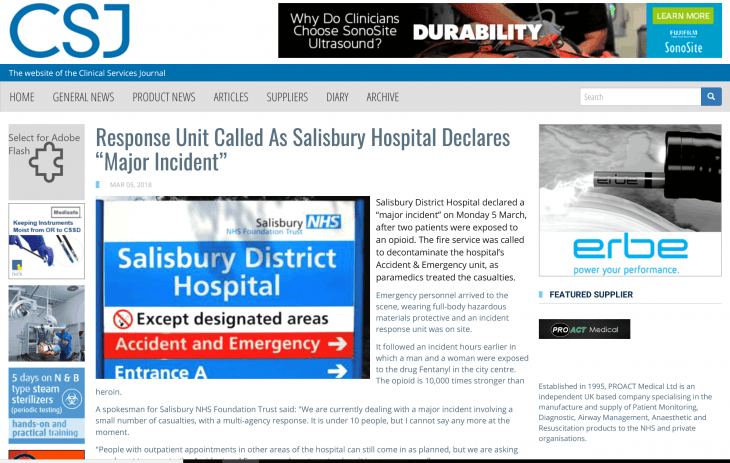
(This, by the way, is extremely interesting. The screen shot above is the original report on the website of Clinical Services Journal, and it can now be found on the website, web.archive.org. The original piece, however, has since been updated on the Clinical Services Journal, not with a correction, but with the reference to Fentanyl being removed altogether (compare here with here h/t Dilyana Gaytandzhiev)
5. A lethal nerve agent that can be dealt with by water and baby wipes
The Official Narrative requires you not only to believe that the substance which poisoned the Skripals is so deadly that Mr Skripal’s house may need to be demolished and a multi-million pound clean-up of Salisbury with chaps in HazMats a necessity.
…But that the same substance can be treated with warm water, soap and baby wipes, as evidenced by the advice given by Public Health England (PHE) a week after the incident, to anyone who may have come into contact with it:
“Wash the clothing that you were wearing in an ordinary washing machine using your regular detergent at the temperature recommended for the clothing. Wipe personal items such as phones, handbags and other electronic items with cleansing or baby wipes and dispose of the wipes in the bin (ordinary domestic waste disposal)… Other items such as jewellery and spectacles which cannot go in the washing machine or be cleaned with cleansing or baby wipes, should be hand washed with warm water and detergent and then rinsed with clean cold water. Please thoroughly wash your hands with soap and water after cleaning any items.”
6. The nerve agent went undetected on a door handle for weeks
The Official Narrative requires you not only to believe that the assassins poured “military grade nerve agent”, in liquid form, on the handle of Mr Skripal’s front door, and that the British Government had possession of an FSB “assassin’s handbook” detailing this procedure.
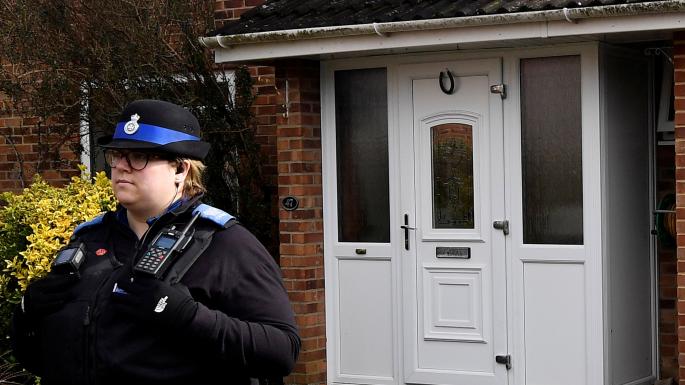
… But that despite apparently having this handbook, the door handle theory was only mentioned more than three weeks after the incident, during which time many people (such as the unsuspecting policewoman at the top of this piece), came within a few feet of a door apparently smeared with lethal nerve agent, with no protective clothing, and suffered no ill effects.
7. The highly volatile nerve agent that was still highly pure weeks later
The Official Narrative requires you not only to believe that the substance examined in blood and environmental samples by the OPCW, weeks after the incident was:
“…of high purity. The latter is concluded from the almost complete absence of impurities.”
… But also that the substance used is known to be both unstable and vulnerable to water – and Salisbury definitely had plenteous rain and even snow between the incident and the coming of the OPCW!
8. That the substance used is proof of Russian state culpability
The Official Narrative requires you to believe that because the substance allegedly used was first developed in Russia (actually Soviet Union), there are only two explanations for the poisoning:
- It was an act of the Russian state
- That the Russian state lost control of its stocks
… Yet it requires you to believe this in the full knowledge that not only have other countries produced it (the United States has been patenting “Novichok” products for years; Iran produced it in 2016; and the United Kingdom possesses samples of it), but according to the chairman of the OPCW, Ahmet Uzumcu, A-234 could be produced:
“…in any country where there would be some chemical expertise.”
9. That the movements of Detective Sergeant Bailey on 4th March cannot be officially confirmed
The Official Narrative requires you to believe not only that Detective Sergeant Nick Bailey, who is a member of Wiltshire Criminal Intelligence Department (CID), was poisoned with the same substance as the Skripals.
…But that his movements cannot be established, since it has still not been officially confirmed whether he was at the bench in The Maltings or at Mr Skripal’s house (and in point of fact, either scenario is remarkably odd, since D.S. Bailey is a member of CID, and there was no suggestion until at least 24 hours after the incident that a crime may have been committed).
10. The cleansing of Salisbury hotspots, but not all Salisbury hotspots
The Official Narrative requires you to believe not only that there are parts of Salisbury that may be contaminated with a lethal substance, and that this will require a clean up operation involving thousands of man hours, costing millions, and taking months to complete.
…But that some of these areas were no danger to the public for a month-and-a-half, when they were cordoned off with nothing more than police tape. In addition, some of the areas that the Skripals were known to have walked down after apparently coming into contact with the substance, such as the Market Walk, have been free to the public to walk through since the start of the incident and remain completely open (I know this personally, because as a Salisbury resident, I have walked through the Market Walk in the last few days).
* * *
Put all these things together — and this is not to even mention the current condition and whereabouts of the Skripals — and what you have is a theory in which claims are flatly contradicted by basic facts, many so-called facts are simply not facts at all, and assertions are made without any recourse to the reality on the ground. It is abundantly clear that the Official Narrative not only did not happen; it cannot have happened. As things stand it is “highly likely” that what we have been told is a conspiracy theory of “high purity”, “of a type developed by Whitehall.”
The West Closes its Ears to Douma Testimony
By Jonathan Cook | Dissident Voice | April 28, 2018
The response from the US, UK and France to a briefing on Thursday at the Organisation for the Prohibition of Chemical Weapons (OPCW) in the Hague was perverse, to say the least. Russia had brought 17 witnesses from Douma who stated that there had been no chemical weapons attack there earlier this month – the pretext for an illegal air strike on Syria by the three western states.
The witnesses, a mix of victims and the doctors who treated them, told accounts that confirmed a report provided last week from Douma by British reporter Robert Fisk – a report, it should be noted, that has been almost entirely blanked by the western media. According to the testimony provided at the OPCW, the victims shown in a video from the site of the alleged attack were actually suffering from the effects of inhaling dust after a bombing raid, not gas.
The first strange thing to note is that the US, UK and France boycotted the meeting, denouncing Russia for producing the witnesses and calling the event an “obscene masquerade” and “theatre”. It suggests that this trio, behaving like the proverbial three monkeys, think the testimony will disappear if they simply ignore it. They have no interest in hearing from witnesses unless they confirm the western narrative used to justify the air strikes on Syria.
Testimony from witnesses is surely a crucial part of determining what actually happened. The US, UK and France are surely obligated to listen to the witnesses first, and then seek to discredit the testimony afterwards if they think it implausible or coerced. The evidence cannot be tested and rebutted if it is not even considered.
The second is that the media are echoing this misplaced scorn for evidence. They too seem to have prejudged whether the witnesses are credible before listening to what they have to say (similar to their treatment of Fisk). Tellingly, the Guardian described these witnesses as “supposed witnesses”, not a formulation that suggests any degree of impartiality in its coverage.
Notice that when the Guardian refers to witnesses who support the UK-UK-French line, often those living under the rule of violent jihadist groups, the paper does not designate them “supposed witnesses” or assume their testimony is coerced. Why for the Guardian are some witnesses only professing to be witnesses, while others really are witnesses. The answer appears to depend on whether the testimony accords with the official western narrative. There is a word for that, and it is not “journalism”.
The third and biggest problem, however, is that neither the trio of western states nor the western media are actually contesting the claim that these “supposed witnesses” were present in Douma, and that some of them were shown in the video. Rather, the line taken by the Guardian and others is that: “The veracity [of] the statements by the Russian-selected witnesses at The Hague will be challenged, since their ability to speak truthfully is limited.”
So the question is not whether they were there, but whether they are being coerced into telling a story that undermines the official western narrative, as well as the dubious rationale for attacking Syria.
But that leaves us with another difficulty. No one, for example, appears to be doubting that Hassan Diab, a boy who testified at the hearing, is also the boy shown in the video who was supposedly gassed with a nerve agent three weeks ago. How then do we explain that he is now looking a picture of health? It is not as though the US, UK and French governments and the western media have had no time to investigate his case. He and his father have been saying for at least a week on Russian TV that there was no chemical attack.
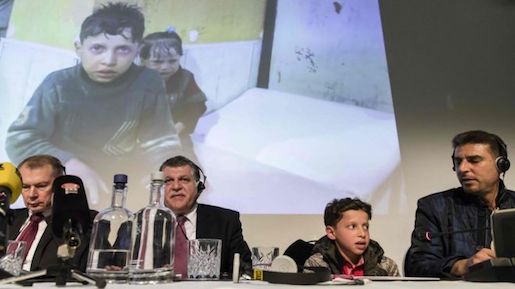
Instead, we are getting yet more revisions to a story that was originally presented as so cut-and-dried that it justified an act of military aggression by the US, UK and France against Syria, without authorisation from the UN Security Council – in short, a war crime of the highest order.
It is worth noting the BBC’s brief account. It has suggested that Diab was there, and that he is the boy shown in the video, but that he was not a victim of a gas attack. It implies that there were two kinds of victims shown in the video taken in Douma: those who were victims of a chemical attack, and those next to them who were victims of dust inhalation.
That requires a great deal of back-peddling on the original narrative.
It is conceivable, I suppose, that there was a chemical attack on that neighbourhood of Douma, in which people like Diab assumed they had been gassed when, in fact, that they had not been, and that others close by were actually gassed. It is also conceivable that the effects of dust inhalation and gassing were so similar that the White Helmets staff mistakenly filmed the “wrong victims”, highlighting those like Diab who had not been gassed. And it is also conceivable, I guess, that Diab and his family now feel the need to lie under Russian pressure about there not being a gas attack, even though their account would, according to this revised narrative, actually accord with their experience of what happened.
But even if each of these scenarios is conceivable on its own, how plausible are they when taken together. Those of us who have preferred to avoid a rush to judgment until there was actual evidence of a chemical weapons attack have been invariably dismissed as “conspiracy theorists”. But who is really proposing the more fanciful conspiracy here: those wanting evidence, or those creating an elaborate series of revisions to maintain the credibility of their original story?
If there is one thing certain in all of this, it is that the video produced as cast-iron evidence of a chemical weapons attack has turned out to be nothing of the sort.
Syrian children should be seen, not heard
Apparently, evidence is to be claimed, and not shown

By Frank Sellers | The Duran | April 27, 2018
As the Russian delegation to the OPCW conducts a press briefing at the Organization for the Prohibition of Chemical Weapons’ headquarters, the Western media is blasting the evidences that it is presenting, which includes the testimony of some of the very alleged victims of the suspected chemical attack that took place in Douma on April 7th, allegedly by Syrian government forces under the direction of the Syrian President, Bashar al-Assad.
One of those witnesses who has come forward at the briefing is the boy, Hassan Diab, who was featured prominently in the video that the White Helmets NGO released in a twitter post, and which was then used by Western governments and media as evidence of the supposed chemical attack which was utilized as a pretext to conduct an illegal joint military ‘precision’ strike on the Syrian capital of Damascus.
In the video produced by the White Helmets, the ‘evidence’ of the chemical attack, Hassan Diab is shown allegedly suffering from the symptoms of a chlorine gas attack, and being hosed with water while White Helmets ‘volunteers’ shout ‘chemical attack’, rushing about with children in their arms.
The briefing also hosts medical personnel who witnessed the incident and who also treated people at the site, who are adamant that no one who was treated at the site shown in the White Helmets video was experiencing symptoms of such an attack.
This video footage, which is now being described as showing a scene that is inconsistent with the claims made by Western governments and media, shows no real evidence for a chlorine gas attack, other than the shouts made by White Helmets participants.
To date, this video footage, posted to Twitter, is the only evidence that has been released to the world of a supposed chemical attack in Douma on the 7th of April. Based on the testimony of these witnesses, over a dozen of whose testimonies are presented at the briefing, the video therefore cannot be considered legitimate evidence of a chemical attack, let alone a justification of Western military intervention in Syria.
Russia and Syria are declaring that the video is that of a staged event, and therefore is not genuine, while the testimonies of witnesses at this press briefing are consistent with this finding, as no real victims or casualties of chemical weapons have so far turned up as a result of the alleged chemical attack. Much less evidence that a chemical weapons attack was launched by Syrian government forces, or even at the behest of the Syrian President.
The West is calling the press briefing a ‘mounting propaganda campaign’, with the British Ambassador to the OPCW, Peter Wilson, calling it ‘a stunt’ to ‘misuse’ the OPCW as a ‘theatre’ to ‘undermine the OPCW’s work’.
Similarly, the French Ambassador to the OPCW, Phillippe Lalliot, is denouncing it as an ‘obscene masquerade’, and is indirectly lodging accusations that the contents of the briefing are bogus.
Additionally, the AFP, in this article, is even going so far as to hint that the boy testifying before the press briefing may not actually be Hassan Diab.
In a mounting propaganda campaign, Hassan, who is seen in the footage being hosed down and shivering, told a press conference in a hotel in The Hague that he didn’t know why people began pouring water on him in the hospital.
He was among a dozen people presented as victims or doctors or hospital workers, who all told similar stories — that someone had shouted out “chemical weapons” as hospital staff were treating injured people from a missile bombardment and panic spread.
“Unknown people started creating chaos, and pouring water on people. We were specialists and we could see there were no symptoms of the use of chemical weapons,” said physician Khalil, who said he was on duty in the emergency care unit.
He said “patients with choking symptoms” had begun coming to the hospital about 7:00pm, but it “was the result of people breathing in dust and smoke” from the bombardment.
Everyone was treated and sent home, Khalil added, denying reports from the Syrian American Medical Society (SAMS) and the White Helmets who jointly said dozens of people had died.
Britain boycotted the group’s earlier briefing at the OPCW, saying it was a stunt, in a move followed by France, the United States and EU countries.
“The OPCW is not a theatre. Russia’s decision to misuse it is yet another Russian attempt to undermine the OPCW’s work,” said British ambassador to the OPCW Peter Wilson in a statement.
French ambassador Philippe Lalliot also denounced the briefing as an “obscene masquerade”.
“This masquerade only betrays the huge nervousness of those who organised it and who have the most to fear from the OPCW investigation,” Lalliot said.
“No-one is fooled. The truth will come out.”
– ‘We saw no poison’ –
Hassan, who was said to be 11 years old, told dozens of journalists: “We were in the basement. We heard cries on the street that we should go to the hospital. We got scared.”
“We went to the hospital through the tunnel. They started pouring water on me in the hospital I don’t know why.”
His father, Omar Diab, said: “The children were taken without explanation. After that we learnt it was fake. We never saw any poison or chemical agents. Neither I nor my family.”
The OPCW has also criticised the meeting in its headquarters, saying it had recommended to Russia that it should wait until its inspectors had completed their work.
AFP then goes on to label the White Helmets organization ‘a humanitarian organization’, who are being unfairly targeted by the Syrian government for the label of ‘terrorists’.
The White Helmets, a humanitarian organisation made up of some 3,000 volunteers, has regularly been the target of disinformation campaigns by the Syrian regime which has labelled them “terrorists”.
But the White Helmets have a history of cooperating with terrorist organizations in Syria, and of conducting horrific atrocities, as documented here:
Meanwhile, Western governments insisted that they were in possession of ‘proof’ of the chemical weapons attack and that the Syrian government perpetrated it. The US has alleged that they are in possession of blood and urine samples from the site of the alleged attack which provided conclusive proof that chlorine and some unidentified nerve agent were used in the attack.
France’s President, Emmanuel Macron, is also insisting that his government is in possession of “proof”, which is declared without providing any details relative to what the proof is or how it was acquired, that not only were chemical weapons employed in this attack, but that Bashar al-Assad’s regime was indeed behind it all. Additionally, the UK Prime Minister, Theresa May, declared that nearly 600 people were killed in the attack, all the while pointing to the video produced by the White Helmets on Twitter.
These alleged ‘proofs’ which were never released for examination by any independent authority, were never publicly presented, but were nevertheless utilized as the catalyst to launch a joint offensive against the Syrian capital of Damascus.
The video in question, however, does not show 575 people suffering from or dying from exposure to a chemical and ‘mystery’ nerve agent. Neither, however, have such casualties appeared in the town of Douma in or around the site as a result of exposure to the banned chemical agents. Hence, evidence that a chemical weapon was utilized in Douma is severely lacking.
It begs the question, from whence the blood and urine tests that the US and WHO are claiming as their ‘evidence’? How was this ‘evidence’ obtained? Where are these victims of chlorine gas and the ‘nerve agent’? Why are the testimonies of witnesses from the site of the alleged attack not describing events consistent with a legitimate chemical attack? Further, why is the West being so rash to judgment against the presentation of the testimonies of these witnesses? Why are France and the US boycotting the briefing? If the chemical research lab in Damascus that was struck by US led coalition air strikes was indeed manufacturing or storing chemical weapons, why has the OPCW declared that their investigation has found no such evidence?
Apparently, evidence is to be claimed, and not shown. Victims are to be seen, and not heard. Claims are to be made, and not verified. Guilt is to be assumed, and not proven. Military strikes are to be conducted, but not justified. Military campaigns are to be carried out, but not for cause. The forces of the West are righteous, but not for reason.
Russia ‘won’t allow’ another US military action in Syria based on false flag – OPCW envoy
RT | April 26, 2018
Russia’s envoy to the OPCW said it was crucial to avoid new false-flag attacks in Syria and that Moscow “won’t allow” US military action there, as he described details of Russian findings on the site of the alleged Douma incident.
New false-flag operations against Damascus are “possible, since our American partners are once again threatening to take military action against Syria, but we will not allow that,” Russia’s permanent representative to the Organization for the Prohibition of Chemical Weapons (OPCW), Aleksandr Shulgin, said during a press conference in The Hague on Thursday.
The meeting was called by Russia’s OPCW mission and featured witnesses of the April 7 alleged chemical incident in the city of Douma. It highlighted the findings of Russian military experts, who were among the first to reach the site of the purported attack and locate the “munitions” that supposedly hit the residential buildings.
“Russian experts performed a detailed analysis of the information on the ground,” Major-General Igor Kirillov, the head of Russia’s Nuclear, Biological and Chemical Protection (RKhBZ) Troops, said. “Two gas cylinders, allegedly dropped by the government forces from helicopters, were found in two apartments.”
The cylinders and the damage they supposedly caused did not fit the tale of an airstrike entirely, Kirillov said. One of the cylinders lacked any makeshift upgrades, such as fins, to make it usable as an aerial munition, and, surprisingly, it was not even deformed.
“An empty gas cylinder found at the top floor. The apartment was partially destroyed earlier by an aerial bomb explosion, parts of roof and outer wall were missing,” Kirillov stated. “Other walls were sprayed with shrapnel. It’s quite peculiar that the cylinder was not deformed, which doesn’t fit its purported fall from a big altitude on concrete floor.”
The other cylinder, while fitted with some crude fins, also remained in nearly pristine condition despite its “fall.” The device miraculously did little to no damage to the room it supposedly hit, besides a large hole in the ceiling, which, however, was unlikely made by the object, according to military specialists.
“The cylinder has partially retained impermeability and is almost undamaged, which is impossible after a fall from some 2,000 meters, the usual altitude used by the Syrian army helicopters,” Kirillov said. “A tail part of an unguided rocket has been uncovered on the roof near the gap in the ceiling. The munition was likely to make the hole, but we cannot rule out an artificial nature of the damage made to the roof, since we discovered a pinch bar at the stairwell of the building.”
The cylinder was likely hauled by the “authors of the staged video” from outside, the official stated, as “multiple chips and dragging marks at the stairwell” indicated. An apartment below was being used by its owner to breed chickens, and all the livestock miraculously “made through the so-called chemical attack alive,” according to Kirillov.
“Moreover, the RKhBZ troops have uncovered a booby-trapped chemical laboratory and chemical stockpile in the city of Douma, which was liberated from the militants. They’ve been presumably used by the terrorists to manufacture toxic substances,” the official said, adding that a chlorine-filled canister that was very similar to the purported munitions used during the Douma incident was recovered from the militant-run warehouse. OPCW-controlled substances, which can be used to produce mustard gas, have been also found there.
The Douma incident was featured in videos released by the controversial White Helmets group and spread through militant-linked social media accounts. It was seemingly taken at face value by the US and its allies, who promptly pinned the blame on Damascus and launched a massive missile strike on the country in “retaliation” on April 14. The attack came hours before the OPCW experts were set to embark on their fact-finding mission in Douma.
The experts have already visited the site of the purported incident. Shulgin, meanwhile, called on the OPCW to visit the chemical laboratories left behind by the militants to see for themselves who is actually behind the use of chemical arms in Syria.
“We urge the OPCW technical secretariat and experts to make use of their time in Syria and examine the undercover underground chemical laboratories of the militants, the terrorists, who used them, as we believe, to produce chemical munitions, including those used for all kinds of false flag attacks,” Shulgin stressed.
Whether it’s Russiagate, Skripal or Syria, the Media Have Lost Their Grip on Reality
Despite a series of collapsing mainstream narratives, the establishment can’t help but doubling (and tripling) down on their official conspiracy theories.
By Paul Mansfield | 21st Century Wire | April 26, 2018
The “Blame Russia” for absolutely everything world we currently occupy has reached a point almost beyond return and is scaling heights that would turn Joseph McCarthy green with envy. Whether it is internally produced political turmoil and scandal, or because of generally reckless and failed foreign policy endeavours, the US and UK governments are more wiling than ever to pin the blame on Russia without fail.
The instant blame on Russia for the poisoning of Sergei and Yulia Skripal, or “highly likely it was Russia”, as Theresa May put it, proved grossly premature, graduating onto maybe not so likely at all – thanks to dedicated alt media and social media researchers and activists uncovering the development of Novichoks in multiple countries, making it entirely plausible that some country other than Russia may be responsible for the improbable Salisbury event.
No sooner did the Skripal Affair wind up, than another supposed ‘chemical attack’ unfolded, this time in Syria, where an alleged chemical weapons airstrike was said to have taken place in Douma on 7 April. Accounts of this incident were reliant entirely for its evidence on two dubious sources, the US and UK-backed White Helmets and the Syrian American Medical Society (SAMS). It didn’t take long before the official story started springing leaks though. The hilarity of seeing chlorine cylinders laying on a bed, rather than smashing through it, numerous witness statements there was no chemical attack, the testimony of over a dozen medical personnel at the medical centre concerned that the White Helmets caused a panic by shouting chemical attack when there was none and the interview of 11 year old Hassan Diab, who was not a chemical weapon victim, but certainly was a victim of an unwarranted drenching as part of a staged event, have all demolished yet another false flag instigated by western intelligence agencies and their White Helmets operatives. All this was irrelevant however to the criminal Troika, the US, UK and France, who bypassed the United Nations and bombed Syria in the early hours of 14 April, provoking Russia into an instant reaction which never came.
Some are of the opinion that the Troika and Russia reached an agreement beforehand and so therefore there was never the threat of outbreak of conflict which could escalate to a catastrophic WWIII.
Here is the White Helmets ‘hose-down’ video which triggered a western military intervention:
Faced with rapidly dwindling legitimacy and credibility, the UK government in particular set their attack dogs in the mainstream media on to alt media and social media activists. The result is a coordinated and intensive smear campaign against independent journalists, academics and social media activists with large followings. The gutter press of the UK have demonstrated that in terms of propaganda and disinformation, they are without peer. US media Russophobes almost look like babes in the woods in comparison.
What we are witnessing is a war on truth, vicious intimidation of dissenting voices, the negating of fierce independent voices as Russian puppets and bots and Assad apologists, and ad hominem attacks all designed to shut down a powerful narrative which shines a light on the warmongering narrative propagated by the mainstream media.
The campaign reached a level of absurdity beyond comprehension when Twitter activist @Ian56789 was asked by Sky News hosts if he was a bot as he was being interviewed live on air!

As disinformation against Russia soars off the fake news Richter Scale and independent journalists and activists are being personally targeted, one only has to revisit the recent Devon Nunes Memo story as an example of a real domestic US political scandal which the derelict US mainstream media attempted to transform into yet another Russian disinformation campaign.
You would have to be living under a rock to not know of the salacious, but unverified dossier on US President Donald Trump, which purportedly started out as a piece of opposition research during the 2016 election campaign, but quickly became the driving force behind allegations that Trump colluded with the Russian government in order to win the presidential election. In the mind of many a deep state adoring Democrat and mainstream media journalist, it is beyond dispute that Trump colluded with Russia. The major questions are how extensive the collusion was and does it amount to having committed federal crimes. To answer these questions, the Mueller investigation must continue expanding as far and wide as necessary.
Many Republicans believe the widely ridiculed and discredited dossier prepared by a former British spy, Christopher Steele, was the catalyst for the FBI decision to investigate allegations of Trump campaign collusion with Russia. A mocked and debunked dossier, which looked like it was concocted in a teenagers bedroom bought down on CNN and Buzzfeed a truck load of embarrassment when they decided to run with a story other media outlets balked at.
So how did it transform into such a vital document that initiated the Mueller probe into suspected Trump collusion with Russia?
We have had the mainstream media pumping this story 24/7. They will not let it go, determined that it bring about the downfall of Donald Trump. By gleefully accepting any lead from their highly coveted ‘sources’, the MSM begs to be subverted by the intelligence community, thereby subverting any prospect of a properly functioning US democracy and informed citizenry.
However, the revelations of #ReleaseTheMemo which alleged shocking FISA abuses by the FBI has raised the spectre of another alleged collusion; the FBI and the Obama DOJ colluding against Trump. The major accusation is that the FBI hid from the FISA court judge the fact that it was heavily relying on the dodgy Trump Dossier to obtain a surveillance warrant to spy on Trump, the man who was to become the future President. What is even more explosive is that it was not revealed to the judge that the Democratic National Committee and Hillary Clinton’s presidential campaign paid for the dossier. Dirty partisan politics has gone a step too far in this sordid affair, with the DNC and FBI duping the FISA court into unwittingly assisting them in their campaign against Trump.

And let’s be clear here; this is the work of the Obama administration and any rigorous investigation would pursue whether or not the collusion against Trump went all the way to former president Obama himself.
Republicans were outraged and demanded the release of the memo.
This is hardly a surprise, being shocked and alarmed at possible internal interference in the election by US intelligence agencies, the very agencies that told us it was Russia that undermined US democracy by its electoral interference.
It is crucial to grasp the fact that this affair is a case of internal interference in the election campaign and has generated intense reaction within the US political establishment and among many in the general public.
One may question then the spin the Hamilton 68 propaganda organ placed on the interest whipped up by the memo. It attempted to reframe calls to release the memo as yet another so-called Russian influence operation, using trolls and bots to amplify the message across cyberspace.
‘Hamilton 68’ doesn’t track propaganda. It is propaganda. Its “Council”? Stuffed with Bill Kristol, Michael Chertoff, Mike Morell, etc. Its funding? Opaque (see its 990s). Its methodology? Unfalsifiable–Twitter users put on ad-hoc secret lists based on political view. Appalling.
— Julian Assange ⌛ (@JulianAssange) January 19, 2018
Hamilton 68, a banal and comical operation, is projecting on to Russia the very thing it is doing itself; spreading disinformation aimed at undermining and destabilizing Russia, but also the US political system. On the strength of CNN’s dumpster diving, Hamilton 68 likes to tell us all about how the cryptic ‘Internet Research Agency’ in St. Petersburg is one big giant troll factory. Sorry, Hamilton 68, but you are one big NATO/Deep state cyberspace troll factory yourselves.
The Democratic Party Russophobia icons, Dianne Feinstein and Adam Schiff, quickly took the opportunity to deflect from the emerging memo scandal, pulling out the playbook of Russian subversion through social media for the umpteenth time. Quite comfortable with the fact that they have secured the social media giants as appendages of the US deep state, Feinstein and Schiff wrote to Twitter and Facebook asking them to investigate what they claimed are Russian bots spreading the #ReleaseTheMemo hashtag. The letter reads in part:
“… Several Twitter hashtags, including #ReleaseTheMemo, calling for release of these talking points attacking the Mueller investigation were born in the hours after the Committee vote. According to the German Marshall Fund’s Alliance for Securing Democracy, this effort gained the immediate attention and assistance of social media accounts linked to Russian influence operations. By Friday, January 19, 2018, the #ReleaseTheMemo hashtag was “the top trending hashtag among Twitter accounts believed to be operated by Kremlin-linked groups.” Its use had “increased by 286,700 percent” and was being used “100 times more than any other hashtag” by accounts linked to Russian influence campaigns. These accounts are also promoting an offer by WikiLeaks to pay up to $1 million to anyone who leaks this classified partisan memo.
If these reports are accurate, we are witnessing an ongoing attack by the Russian government through Kremlin-linked social media actors…”
Nice sleight of hand Hamilton 68, Schiff and Feinstein, but this is a scandal that whipped Republicans, not Russians into a frenzy. It is a stand-alone scandal that raised questions about the ethics, partiality and possible illegal acts of the US intelligence community and the Obama DOJ. It does not need any Russian trolls to inflate the gravity of the situation.
Florida Republican Rep. Ron Desantis tweeted, “Yesterday, I viewed a deeply troubling report compiled by House Intelligence that raises questions about Obama DOJ & the so-called collusion investigation.”
Desantis said it right there: collusion between the Obama DOJ and the FBI. If true, it is a shocking indictment on deep state interference in US politics, going all the way to the top in attempting to subvert the US presidential election.
So we have at least 2 allegations of collusion; the longstanding and tiresome Russiagate story, which the mainstream media will not give a moments rest and the newer, but equally shocking FBI/DOJ collusion emerging from the woodworks with the news of the classified memo.
You can read and watch RussiaGate stories in both US/Western MSM and Russian media. Fair enough, it was a big story, newsworthy and deeply concerning if it was true (the US media has overplayed their hand though to put it mildly). As time goes on and without a shred of evidence produced, it is time to put the whole issue to bed and move on. It is only the absurdity of the MSM insistence that collusion has been proved beyond doubt and any who question it are conspiracy theorists, that maintains the interest of the reasonable person, even if only to mock media figures and politicians who are the true conspiracy theorists.
The calls to release the Devon Nunes compiled memo also attracted huge coverage in both US and Russian media. However, US media framed it in terms of a partisan struggle between Democrats and Republicans; detracting from the implications of the abuse of the FISA system and placing the scandal into the realm of normal everyday, if somewhat dirty party politics.
There is nothing everyday about the possibility that this whole Russia investigation is in reality a conspiracy by top FBI officials and the DOJ to sabotage Trump and install Hillary Clinton (remember her?) as president. Look at Peter Strzok and Lisa Page as examples, whose texts made no secret of their contempt for Trump and their desire to see him lose the election.
So why did CNN, the New York Times and the supposedly reputable Business Insider deem it newsworthy to claim Russian influence networks were spreading the release the memo hashtag like wildfire across the social media landscape. Business Insider even implied the Nunes memo has been given wings by being amplified by Russian trolls and bots across the social media landscape.
The compiling of the memo by Republican aides on the House Intelligence Committee that led to the unfolding scandal was not initiated by Russia. The angry calls for action came from Republicans, not Russians.
We can’t even be sure if these so-called Russian networks of trolls are Russian at all. But let’s assume for a minute they are. Big deal if they spread the story. It is fascinating, very interesting and could have huge consequences of DOJ and FBI heads rolling. It also serves to relieve some of the pressure on Russia, so why wouldn’t they promote it heavily. They are merely acting in the interests of Russia, which no reasonable person could complain about.
Many people believe Americans are simply apathetic victims and that these supposed Russian trolls or bots are drowning them in disinformation, and that western media figures and politicians are powerless to stop it. That’s the mainstream’s moderate narrative. However, a look at the number of followers of some US media celebrities on Twitter should dispel that misinformation in a heartbeat. Rachel Maddow, with 9 million followers, retweeted a tweet by NBC reporter Ken Dilanian, a tweet which itself got 6K retweets and 19K likes. His tweet, included, “your #ReleaseTheMemo is the top trending hashtag among the Russian bots and trolls over the last 48 hours, and you might want to ask yourself why.”
So a media figure from NBC is clearly muddying the waters, throwing us a red herring in implying the nefarious hand of Russia is at play. Maddow gave Dilanian huge impetus in his attempt to try to flip the story to turn it into yet another opportunity to attack Russia. Deeply troubling allegations which could rock the foundations of the intelligence and justice communities are made a mockery of by a disreputable journalist who sees it as another chance to Russia bait. Before you know it, they will be telling us the #Memo was a joint venture put together by the FSB and Republicans, thus proving the collusion is still going as strong as ever. This level of hysteria is way beyond Cold War McCarthyism.
And when Rachel Maddow retweets something, how many likes and retweets does that generate. Enough to turn the Russian bots and trolls green (or should that be red) with envy.
Maddow herself is capitalizing very nicely on the Russophobia being generated by the whole Russiagate affair to boost her own ratings and affection within the political establishment. She has not got a single progressive bone in her body and epitomizes the dumbed down, hyped up claims about Russian interference in American political and social life. The spectacle is the theatre of the absurd, as Americans are subjected to Hollywood type entertainment to titillate and shock with the never ending “revelations” which roll out like clockwork. And, true to Hollywood style fiction, the more outrageous and sensational the better.
This is why Maddow is able to get away with calling Jill Stein a Kremlin puppet, and to feign seriousness and solemnity as she continues to call Trump a Putin puppet, putty in his hands, even as Trump has clearly embarked on a path which has plummeted US/Russian relations to their lowest point since the darkest days of the Cold War.

Maddow uses a technique for these claims which may enthrall Never-Trumpers and fill Le Resistance with fear, but it is straight from the neocon playbook. It is that any sign of Trump not being totally committed to overt and outright hostility to Russia proves that he is a Russian puppet. He must adopt the neocon attitude of Russia being the eternal enemy, the biggest threat the US faces and that it must be confronted and made to pay a price for its aggression, expansionist ambitions and meddling in US affairs.
Putin has Trump in a vice like grip with the “compromat” on him, using it to blackmail him in to doing Russia’s bidding according to Maddow. Putin is forcing Trump to declare war on the intelligence community, fomenting chaos in a crowning glory of undermining US national security. How better to leave the US vulnerable to the rapacious desires of Russia than by shattering the institutions of US national security.
Maddow believes Putin blackmailed Trump with the Golden showers tape to hire Paul Manafort as his campaign manager, to hire Rex Tillerson as Secretary of State, and to pressure him to withdraw US forces in Eastern Europe and the Baltics, (which hasn’t happened).
“Is the new President gonna take those troops out? After all the speculation, after all the worry, we are actually about to find out if Russia maybe has something on the new President? We’re about to find out if the new President of our country is going to do what Russia wants once he’s Commander-in-Chief of the US military starting noon on Friday. What is he gonna do with those deployments? Watch this space.”
In Maddows demented mind, anything less than the Trump administration universally standing poised to unsheathe their swords and land a mortal blow on Russia is proof of collusion with the Kremlin. Any conciliatory overtures are met by howls of derision by the Maddow/Hillary Clinton led “resistance.” Amid this red hot rhetoric and witch hunt for internal traitors, Maddow and her ilk are the ones to claim it is Russia sowing discord and discontent.
“This is international warfare against our country,” Maddow said on her show.
Maddow says she goes to bed every night wondering what new Russia scandal awaits the country the next morning, propelling the Russia hysteria all the way to election 2020 and bankrolling her show and career almost exclusively on one issue threadbare of any evidence. The McCarthy of the modern mainstream media some say. It’s Clickbait applied to cable TV you could also say:
“If the presidency is effectively a Russian op, if the American presidency right now is the product of collusion between the Russian intelligence services and an American campaign — I mean, that is so profoundly big, we not only need to stay focused on figuring it out. We need to start preparing for what the consequences are going to be if it proves to be true.”
‘If it proves to be true.’ That’s right, and we’re still waiting for the evidence.

Maddow and her fellow military industrial complex media mouthpieces don’t need evidence to believe Russia interfered in the election, as she spreads her poison to millions of viewers night after night. She sees Vladimir Putin as pure evil, the embodiment of the terrifying KGB and tells her viewers this repeatedly. She has become the torchbearer for an ever wilder conspiracy theory, whipping her audience into a frenzy, baying for Russian blood.
It is extraordinary that anyone listens to a word Maddow says after she produced her only evidence on Trump; his tax return which revealed he paid $38million in federal taxes on more than $150 million in income in 2005. Bombing out big time on alleged Trump tax cheating has clearly not stopped Maddow proceeding full steam ahead in accusing him of being a Kremlin installed puppet.
So who is running an influence campaign here, Moscow, or the US military industrial complex media?
What is never discussed outside of alt-media circles is how far were the FBI, the DOJ, and the Hillary Clinton campaign involved in what is increasingly looking every day more like FBIgate than Russiagate? What about the roles of powerful deep state actors like John Brennan and James Clapper, who are bound to have played a hand in concocting and promoting the official conspiracy theory? Clapper, who thinks it is in Russian DNA to hack things and Brennan who sees Russia as a long term threat intent on attacking US democracy, sternly warning the incoming President Trump not to ignore the huge threat Russia poses.
What was also not overtly acknowledged is that by pressuring for the release of the memo, Devon Nunes and other Republicans actually carried out a duty they were elected to perform; holding the intelligence community accountable. As former CIA analyst Ray McGovern of Consortium News said:
At this point, the $64 question is whether the various congressional oversight committees will remain ensconced in their customarily cozy role as “overlook” committees, or whether they will have the courage to attempt to carry out their Constitutional duty. The latter course would mean confronting a powerful Deep State and its large toolbox of well-practiced retaliatory techniques, including J. Edgar Hoover-style blackmail on steroids, enabled by electronic surveillance of just about everything and everyone. Yes, today’s technology permits blanket collection, and “Collect Everything” has become the motto.
The take-away from all of this is that no sin is too great, and no scandal can’t be flipped to pin the blame on Russia.
Meanwhile, any criminal or unethical conduct of Democrats and deep staters will not be plastered across the newspapers and cyberspace.
Don’t worry about it. Just say its Russian disinformation. Works every time.
Featured Video
BRITAIN’S WARNING: PREPARE FOR WAR
or go to
Aletho News Archives – Video-Images
From the Archive
How Ukraine Tortured and Slaughtered Donbass
By Kit Klarenberg | Al Mayadeen | July 11, 2024
Almost immediately after the proxy war erupted, ISIS-tier footage of the torture and murder of Russians in Ukrainian custody emerged.
On July 6th, the New York Times published an astonishing investigation: In Ukraine, Killings of Surrendering Russians Divide an American-Led Unit. The article documents in grim detail how Chosen Company, an international volunteer battalion for Kiev, routinely executes Russian prisoners of war. It is the very first mainstream admission that this practice – a brazen breach of the Geneva Conventions, and a grave war crime – is widespread among Ukraine’s fighters, both foreign and homegrown. … continue
Blog Roll
 Aletho News
- Israel Demolishes Home Of Lebanese Journalist Whose Viral Film Exposed Pager Attack
- Record Oil, Empty Tanks: The UAE’s Miracle Recovery
- Burnham tackles Britain’s poverty with aggression in Yemen
- Peace in Ukraine: the easy way – or the hard way
- Trump & the Rrrrussians
- US taxpayer money laundered back through Ukraine – Musk
- Before COVID, an NIH lab chief proposed making a SARS-like bat virus more infectious
- Gates, Bourla on Trial in Netherlands Accused of ‘Great Reset’ Scheme at Vaccine Injury Hearing
- BRITAIN’S WARNING: PREPARE FOR WAR
- “Historic Russia”: The Land Putin Will Not Give Back
- If Americans Knew
- An error has occurred; the feed is probably down. Try again later.
- No Tricks Zone
- Two New Studies Find Thwaites Glacier Melt Cannot Be Driven By Human Activity Or A Warming Ocean
- E-Cars Reduce CO2 Emissions By Only 41% Compared To Internal Combustion Engine Vehicles
- Predictions Made By Renowned Climate Professor Over Past Decades Have Been Proven To Be Poor
- New Study Suggests Large Regions Of The Pacific Ocean Have Been Cooling For The Last 80 Years
- Germany’s Green Energy Debacle: High Energy Costs Force Kahla Porzellan to Close After 182 Years!
- New Study: 50 Years Of The Most Aggressive ‘Net Zero’ Policies Can Only Affect The Global Climate By 0.03°C
- US September “Heat” Was No Record…Many Records Set Decades Ago
- Latest European Green Energy Debacle; Portugal’s Largest Flagship Solar Park Insolvent!
- Green Energy Debacle: German Expert Professor Fritz Vahrenholt Warns Of Severe Economic And Social Consequences
- Two More Paleo Reconstructions Affirm Meters-Higher Sea Levels Across Ireland, Brazil 7000-6000 Years Ago

