The Skripals Will Most Likely Never be Allowed to Talk
The Saker • Unz Review • May 11, 2018
There have been major developments this week, all of them bad, including Putin re-nominating Medvedev as his Prime Minister, and Bibi Netanyahu invited to Moscow to the Victory Day Parade in spite of him bombing Syria, a Russian ally, just on the eve of his visit. Once in Moscow, Netanyahu compared Iran to, what else, Nazi Germany. How original and profound indeed! Then he proceeded to order the bombing of Syria for a second time, while still in Moscow. But then, what can we expect from a self-worshiping narcissist who finds it appropriate to serve food to the Japanese Prime Minister in a specially made shoe? The man is clearly batshit crazy (which in no way makes him less evil or dangerous). But it is the Russian reaction which is so totally disgusting: nothing, absolutely nothing. Unlike others, I have clearly said that it is not the Russian responsibility to “protect” Syria (or Iran) from the Israelis. But there is no doubt in my mind that Netanyahu has just publicly thumbed his nose at Putin and that Putin took it. For all my respect for Putin, this time he allowed Netanyahu to treat him just like Trump treated Macron. Except that in the case of Putin, he was so treated in his own capital. That makes it even worse.
[Interestingly, while whining about “Nazi Iran” Netanyahu did say something truly profound and true. He said “an important history lesson: when a murderous ideology emerges, one has to push back against it before it is too late”. That is indeed exactly what most people across the world feel about Israel and its Zionist ideology but, alas, their voice is completely ignored by those who rule over them. So yes, it sure looks to me like it is becoming “too late” and that the consequences for our collective cowardice – most of us are absolutely terrified from speaking the plain truth about our Zionist overlords – will cost us all a terrible price.]
Then, of course, there is Donald Trump pulling out of the so-called Joint Comprehensive Plan of Action (JCPOA) in spite of Iran’s full compliance and in spite of the fact that the US does not have the authority to unilaterally withdraw from this multilateral agreement. But being the megalomaniac that he is, and not to mention the spineless lackey of the Israel Lobby, Trump ignored all that and thereby created further tensions between the US and the rest of the world whom the US will now blackmail and bully to try to force it to support the US in its rabid subservience to Israel. As for the Israelis, their “sophisticated” “strategy” is primitive to the extreme: first get Trump to create maximal tensions with Iran, then attack the Iranians in Syria as visibly and arrogantly as possible, bait the Iranians into a retaliation, then bellow “OI VEY!!!” with your loudest voice, mention the Holocaust once or twice, toss in a “6 million people” figure, and get the US to attack Syria.
How anybody can respect, never mind admire, the Israelis is simply beyond comprehension. I sure can’t think of a more contemptible, nasty, psychopathic gang of megalomanical thugs (and cowards) than the Israelis. Can you?
Nonetheless, it appears undeniable that the Zionists have enough power to simultaneously force not one, but two (supposed) superpowers to cave into their demands. Not only that, they have the power to do that while also putting these two superpowers on a collision course against each other. At the very least, this shows two things: the United States has completely lost its sovereignty and is now an Israeli protectorate. As for Russia, well, she is doing comparatively better, but the full re-sovereignization the Russian people have voted for when they gave their overwhelming support to Putin will not happen. A comment I read on a Russian chat put it: “Путин кинул народ – мы не за Медведева голосовали” or “Putin betrayed the people – we did not vote for Medvedev”. I am not sure that “betrayed the people” is fair, but the fact that he has disappointed a lot of people is, I think, simply undeniable.
It is still way too early to reach any conclusions at this point, and there are still way too many unknown variables, but I will admit that I am very worried and that for the first time in 4 years I am having major doubts about a fundamental policy decision by Putin. I sure hope that I am wrong. We will find out relatively soon. I just hope that this will not be in the form of a major war.
In the meantime, I want to refocus on the Skripal case. There is one outright bizarre thing which I initially dismissed, but which really is becoming disturbing: the fact that the Brits are apparently holding Sergei and Iulia Skripal incommunicado. In other words, they have been kidnapped.
There was this one single telephone call between Iulia Skripal and her sister, Victoria, in which Iulia said that she was okay (she was clearly trying to reassure Victoria) but it was clear that she could not speak freely. Furthermore, when Victoria mentioned that she would want to visit Iulia, the latter reply ‘nobody will give you a visa’. After that – full silence. The Russian consulate has been making countless requests to have a visit, but all that the Brits have done since is have Scotland Yard post a letter which was evidently not written by Iulia and which said “I have access to friends and family, and I have been made aware of my specific contacts at the Russian Embassy who have kindly offered me their assistance in any way they can. At the moment I do not wish to avail myself of their services, but, if I change my mind I know how to contact them”. What friends?! What family?! Nonsense!
Her sister tried to contact her many times through various channels, including official ones, and then in total despair, she posted the following message on Facebook:
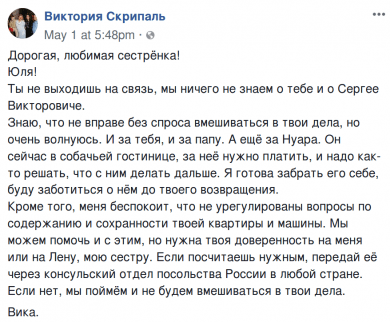
“My darling sister, Yulia! You are not communicating with us, and we don’t know anything about you and Sergey Victorivich. I know that I have no right to interfere in your affairs without asking your permission, but I worry too much. I worry about you and your dad. I also worry about Nuar. [Nuar is Yulia Skrial’s dog, whom she left to stay at a kennel center, while she was traveling to the UK.] He is now at the dog hotel, and they want to get paid. We have to decide something what to do with him. I am ready to take him and to take care of him until you come back home. Besides Nuar, I am concerned about your apartment and your car. Nothing has been decided about their safety and maintenance. We can help with all that, but I need your power of attorney in my or my sister Lena’s name. If you think that all of these is important, draw up a power of attorney form in a Russian consulate in any country. If you won’t do that, we will understand and won’t interfere in your affairs.
Vika“
No reply ever came.
I just entered the following query into Google: “Skripal”. April 10th has an entry saying that she was released from the hospital. That is the most recent one I have found. I looked on Wikipedia, the same thing, there is nothing at all.
I have to admit that when I first heard the Russian complaints I figured that this was no big deal. I thought “the Brits told the Skripals that Putin tried to poison them, they are probably afraid, and possibly still sick from whatever it is which made them sick, but the Brits would never outright kidnap two foreign citizens, and most definitely not in such a public way”.
I am not so sure anymore.
First, let’s get the obvious one out of the way: the fear for the security of the Skripals. That is utter nonsense. The Brits can organize a meeting between а Russian diplomat in the UK at a highly protected UK facility, with tanks, SAS Teams on the standby, helicopters in the air, bombers, etc. That Russian diplomat could speak to them through bullet-proof glass and a phone. And, since the Russians are all so dangerous, he can be searched for weapons. All which the Skripals need to do is to tell him/her “thank you, your services are not needed”. Conversation over. But the Brits refuse even that.
But let’s say that the Skripals are so totally terrified of the evil Russians, that they categorically refuse. Even by video-conference. It would be traumatic for them, right? Okay.
What about a press conference then?
Even more disturbing is that, at least to my knowledge, nobody in the western corporate media is asking for an interview with them. Snowden can safely speak from Russia and address even large conferences, but the Skripals can’t speak to anybody at all?
But here is the worst part of this: it has been two months already since the Skripals are held in total secrecy by the UK authorities. Two months, that is 60 days. Ask any specialist on interrogation or any psychologist what kind of effect 60 days of “specialized treatment” can do to a person.
I am not dismissing the Russian statements about “kidnapping” anymore. What I see is this: on substance, the Skripal false flag has crashed and burned, just like MH17 or the Douma chemical attack, but unlike MH17 or Douma, the Skripals are two witnesses whose testimony has the potential to result in a gigantic scandal, not just for the May government, but for all those spineless Europeans who showed “solidarity” with Britain. In other words, the Skripals will probably never be allowed to speak freely: they must either be killed or totally brainwashed or disappeared. Any other option would result in a scandal of planetary magnitude.
I can’t pretend like my heart goes out to Sergei Skripal: the man was an officer who gave an oath and who then betrayed his country to the British (he was a British agent, not a Russian one as the press writes). Those holding him today are his former bosses. But Iulia? She is completely innocent and as of April 5th (when she called her sister Victoria), she was clearly in good health and with a clear mind. Now she has been disappeared and I don’t know which is worse, the fact that she might never reappear or that she might one day reappear following months of British “counseling”. As for her father, he paid for his betrayal and he too deserves a better fate than being poisoned, used and then disappeared.
In the big scheme of things (the Zionists war against our entire planet), two individuals like Sergei and Iulia Skripal might not matter. But I think that the least we can do is to remember them and their plight.
This also begs the question of what kind of society we live in. I am not shocked by the fact that the British state would resort to such methods (they have always used them). I am shocked that in a so-called western “democracy” with freedom, pluralism and “European values” (whatever that means) the Brits could get away with this.
How about some “solidarity” with the Skripals – you, Europeans?!
What Would Sherlock Holmes Have Made of the Government’s Explanation of the Case of Sergei and Yulia Skripal?
By Rob Slane | The Blog Mire | May 10, 2018
In an article on 3rd May, the Guardian journalist, Luke Harding, made the following rather amusing observation:
“Since the Skripals were found stricken on a park bench, Downing Street has stuck to one version of events. Theresa May says it is ‘highly likely’ Moscow carried out the attack using a Soviet-made nerve agent. Only the Kremlin had the motive to kill its former officer, she argues.”
The funny part, in case you didn’t spot it, was his claim that Downing Street has stuck to one version of events. He is of course correct, but what he doesn’t tell his readers is that this one version of events has had a plethora of sub-narratives attached to it, none of which have been able to remotely support the main thesis. Sticking to one version of events is reasonable only inasmuch as that version can be supported by facts. On the other hand, if the version of events being stuck to is not supported by the facts, or if the “facts” constantly change, or if the “facts” are contradictory, then sticking to it is a measure not of reasonableness, as Mr Harding implies, but rather of absurdity, folly and irrationality.
G. K. Chesterton once cautioned us against the propensity towards indefinite scepticism:
“Merely having an open mind is nothing. The object of opening the mind, as of opening the mouth, is to shut it again on something solid.”
This is very true. But there is another, equally insidious, ditch which must be avoided. Let’s put it like this:
“Closing your mind too quickly can be worse than nothing. The object of closing the mind, as of closing the mouth, is to make sure that when you do, you have something solid inside.”
So is the narrative that Downing Street closed on so quickly after the incident solid? Does it stand up to scrutiny? Let’s see.
The Claim
The basic claim of the UK Government is as follows:
On 4th March 2018, Sergei and Yulia Skripal were poisoned by a military-grade nerve agent, which had been put on the handle of Mr Skripal’s front door in Christie Miller Road, Salisbury. The substance used was A-234 (a Novichok agent), which is said to be around 5-8 times more lethal than VX (just 10 milligrams of VX on the skin can be lethal). It had been placed there by a person or persons either working on behalf of the Government of the Russian Federation, or who had somehow managed to come into possession of the substance from stocks controlled by the Russian Government.
As Mr Harding implies, it’s all very straightforward. So let’s test it.
What would you have expected to happen?
The basic question one must ask is as follows: Given the scenario outlined in the Government claim, what would you have expected to happen? Here are four basic things one would reasonably have expected:
1. Sergei and Yulia Skripal found dead in or near Mr Skripal’s house, followed by a coroner’s verdict stating that they had died from heart failure or suffocation, as a result of fluid secretions filling their lungs.
2. Or – in the slim chance that they survived – a period of months in hospital with irreparable damage to their central nervous systems, and symptoms including cirrhosis, toxic hepatitis, nerve damage and epilepsy.
3. A massive manhunt, both in Salisbury and in the rest of the country, especially in respect of the couple who appeared on a CCTV camera in Market Walk, of whom it was originally claimed were the Skripals, but who were clearly not the Skripals.
4. Mr Skripal’s house entirely closed off, with surrounding streets immediately evacuated, and the parts of Salisbury City Centre where the pair were known to have visited also evacuated.
What actually happened?
So much for what we would have expected to see. Now, more than two months after the incident, we can ask the question: What actually happened?
1. After they allegedly came into contact with the very lethal A-234 nerve agent, far from dying on the spot, Sergei and Yulia Skripal spent the next four hours driving into the City Centre, having a drink, and then going for a meal. They then sat on a bench, and at some point thereafter exhibited what appeared to be hallucinations, suggestive of poisoning by an opioid or non-lethal chemical weapon, rather than a nerve agent.
2. Rather than being hospitalised for months and suffering irreparable damage to their central nervous systems, just over four weeks later, Yulia Skripal telephoned her cousin, Viktoria, and assured her several times that “Everything is okay”. Crucially, she stated that “Everyone’s health is fine, there are no irreparable things.”
3. There has been no manhunt, and the couple who appeared on the CCTV camera in Market Walk have not been identified publicly, nor have there been any appeals for information about them.
4. Far from the streets around the house being evacuated, many photographs show police officers without any protective clothing standing just a few feet away from the door handle, which allegedly still had A-234 of “high purity” on it. Neither was the City Centre evacuated, but people who thought they might have come into contact with the substance were advised by Public Health England (PHE) to wash their clothing in a washing machine, and wipe personal items such as phones, handbags and other electronic items with cleansing or baby wipes.
What Would Holmes Have Made of it?
If you laid all that out in front of Sherlock Holmes – the claims, the expectations, and the reality – and asked him what he made of it, he would no doubt reply along the following lines:
“On the assumption that the substance known as A-234 is several times more toxic than VX, which all credible references to it claim that it is, then given that the Skripals did not die on the spot, and having survived do not appear to have any of the lasting and irreparable side-effects of being poisoned by this substance, it can be stated with reasonable certainty that they were not poisoned by it. Furthermore, given the symptoms that they displayed on the bench, according to eye-witness testimony, in all probability, Mr Skripal and Yulia were poisoned by a substance which can cause hallucinations, such as the opioid, Fentanyl, or an incapacitating, but non-lethal, chemical such as 3-Quinuclidinyl benzilate (BZ). This theory is given credence by the fact that Salisbury District Hospital originally believed the incident to be a case of Fentanyl poisoning.”
What Would Holmes do Next?
Having used the known facts to establish beyond reasonable doubt that the Skripals were not poisoned by A-234, what would Holmes do next?
The obvious thing would be to interview both Sergei and Yulia Skripal, since both are apparently alive and well. He would want to gather details about their movements on the morning of 4th March 2018, and whether they saw anyone acting suspiciously either near the house, or at the bench. He would want to know why Mr Skripal apparently became highly agitated in Zizzis. And he would of course want to find out from Mr Skripal about who he had dealings with in the weeks prior to the incident.
So what, you might ask, would he make of it if he found out that nobody, including him, was allowed to see Mr Skripal or Yulia? What, you might ask, would he make of the fact that nothing has been heard of Detective Sergeant Nick Bailey since his release from hospital more than six weeks ago? What, you might ask, would he make of the fact that there has been not one single police or press report looking into any of these things?
Holmes being Holmes, he would of course want to retain an open mind for as long as possible. But in the absence of any credible explanation for these oddities, or for the huge disparity between the UK Government claims and what actually happened, no doubt his great mind would soon start closing in on the suspicion that not only were the Skripals not poisoned by A-234, but it would appear that a cover up of what really happened has taken place.
Czech President Doubts Lawmakers’ Conclusion Country Never Produced Nerve Agents
Sputnik – May 10, 2018
Czech President Milos Zeman said on Thursday he doubted Czech lawmakers’ conclusion that the country had never produced and stored any Novichok-family nerve agents allegedly used in the poisoning of Russian double agent Sergei Skripal and his daughter Yulia.
“I was citing the director of the Military Research Institute, who, in February, had published a report on Novichok production. I respect academic background of Parliament’s members, but I am not sure that they are more informed than institute’s director on where the gas had been produced,” Zeman stated after the meeting with Polish President Andrzej Duda in Warsaw.
Earlier, Zeman said that a small amount of the A230 toxin similar to Novichok was produced at the Czech Military Research Institute in 2017 and then destroyed. The Czech president added the country’s military intelligence and the domestic intelligence service, BIS, differed on which substance could be classified as Novichok.
The military intelligence said it was А230, while BIS argued it was А234. Earlier on Thursday, at a closed session of Czech lower house’s Committee on Foreign Affairs, lawmakers came to the conclusion that the Czech Republic had never produced or stored the Novichok-family agents.
On March 4, Skripal and his daughter were found unconscious on a bench near a shopping mall in Salisbury. The UK authorities have blamed Russia for attempting to assassinate the Skripals with what is believed by London to be the A234 nerve agent. Russia has denied having any role in the poisoning, pointing to the lack of evidence provided by the United Kingdom to substantiate its accusations.
See also:
The Skripal Case and Bombing Syria: Six Things We Learned About Modern Britain
‘Time is against UK’: No access to Skripals & probe results eroding London credibility – Russia envoy
RT | May 10, 2018
The UK has made it clear it won’t let Moscow meet Russian citizens ex-double agent Sergei Skripal and his daughter, as the dragging secretive probe into their poisoning speaks volumes to the observers, the Russian ambassador says.
“It has become clear that we will not get access to the Skripals. They [the British authorities] just will not provide it,” Russian envoy to the UK Alexander Yakovenko told journalists on Thursday, following his meeting with Philip Barton, the Director General, Consular and Security at the British Foreign Office.
By blocking access to the Russians, London flagrantly violates its duties under a bilateral treaty on consular relations with Moscow, Yakovenko said. The true fate of the Skripals, meanwhile, remains unknown, he pointed out.
London maintains that the Skripals do not want to meet with Russian officials. However, neither the Russian ex-spy nor his daughter, Yulia, have publicly appeared to confirm it since the March poisoning. The Russian authorities never received any photos or voice recordings of the man and his daughter from the British side, Yakovenko said.
“We cannot conclusively establish what condition they are in as well as whether they are acting voluntary,” Yakovenko said, adding that the answers that Moscow continues to get from London are “empty and formalistic.”
The longer the UK protracts the investigation, the more countries see “the true nature of the policy conducted by the conservative government,” Yakovenko said, adding that “time is against London.” According to the diplomat, the situation has “put the reputation of the UK at risk.”
Veil of silence
London has been denying Moscow access to the Skripals from the very beginning. First, Russian diplomats were barred from visiting the hospital where the two were treated. Then they were also prevented from meeting Yulia Skripal after the British authorities said she had recovered.
The UK also refused to issue a visa for Skripal’s niece, Viktoria, after she claimed that she would come and take her relatives back to Russia. Following a brief conversation with Yulia, Viktoria also said that her cousin sounded “coached” and “did not use her own words” during the only phone conversation between the relatives.
Later, it was reported that the US and British intelligence agencies may offer Sergei and Yulia Skripal new identities and relocation to a Five Eyes country. Moscow then denounced these plans by saying that any undercover resettlement of the former double agent and his daughter would be seen as “citizen abduction.” In mid-April, Russian UN envoy Vassily Nebenzia also accused the UK of systematically destroying evidence relating to the Salisbury incident.
London’s narrative falling apart?
The British stance on the poisoning of Skripal has remained unchanged. The British government accuses Russia of poisoning Yulia and Sergei Skripal back in early March 2018, using the nerve agent A-234, also known as Novichok. London continues to blame Moscow for the incident, claiming that Russia is the only country able to produce it.
While remaining largely unquestioned within the British mainstream media, this narrative seems to be falling apart against the background of the latest developments. Last week, Czech President Milos Zeman openly admitted that his country did produce and test a nerve agent of the so-called Novichok family.
Russian diplomats had earlier named the Czech Republic as one of the most probable countries from which the nerve agent might have come. The list also included Slovakia, Sweden and the UK itself.
The Organization for the Prohibition of Chemical Weapons (OPCW), an international chemical weapons watchdog, has repeatedly claimed it cannot identify the source of the agent that was allegedly used to poison the Skripals.
Theresa May vows to keep funding White Helmets despite alleged Al-Qaeda links
RT | May 9, 2018
Theresa May has confirmed that the UK will continue to fund the White Helmets, after the US withdrew £200 million ($271 million) in Syrian aid – including money that would go to the controversial group.
During PMQs Labour’s Matthew Pennycook, the Greenwich and Woolwich MP pushed the PM on whether or not she would continue to fund the The White Helmets, officially known as the Syria Civil Defence, a volunteer group that operates in areas controlled by jihadist and Al-Qaeda-linked groups in Syria.
“Despite the ever-present threat of death… the rescue workers of the White Helmets have never stopped saving the lives of their fellow Syrians,” Pennycook said. “Last week the Trump administration froze their US funding.
“With thousands of civilian lives at risk will the prime minister step up, pledge the government to plug the funding shortfall that now exists, and ensure these heroic rescue workers can continue their work?”
May did not hesitate in her response, praising the efforts of the non-governmental search-and-rescue organization.
“We recognise the very important and valuable work that the White Helmets are doing,” she said. “They are, as he says, doing this in horrendously difficult conditions. They are incredibly brave to be continuing with that work.”
The UK PM then pledged to review the current financial package for the White Helmets, hinting at further funding down the track. “We do support them, we will continue to support them, and my right honourable friend, the international development secretary will be looking at the level of that support in the future,” May said.
Although the White Helmets say they act solely as a makeshift emergency response team in a time of crisis, claiming to have heroically saved more than 70,000 lives in war-torn Syria, others question its motives. Footage from Syria has repeatedly appeared to show members of the White Helmets assisting jihadist groups, while multiple accounts from civilians suggested they only helped “their own” and use civilians caught up in conflict only for publicity.
Leaked video appears to show extrajudicial execution in Sinai
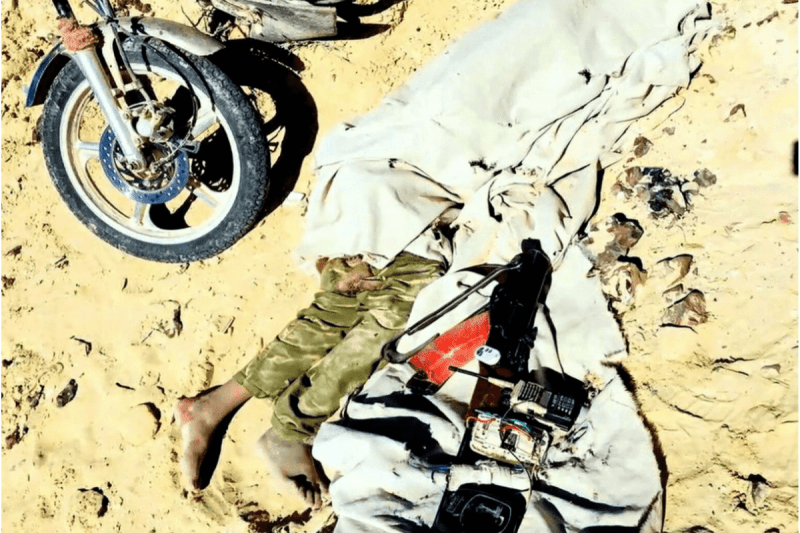
A leaked video appears to show a child being executed at close range in Egypt’s Sinai Peninsula by an army officer [Twitter]
MEMO | May 8, 2018
A leaked video appears to show a child being executed at close range in Egypt’s Sinai Peninsula by an army officer.
In the 30 second video the young boy is lying on a hill partially covered in white material. Moments before his death he asks for his mother.
“Don’t worry,” replies the army officer. “We’ll call your father to pick you up. We’ll cover you,” he adds, before shooting him in the head.
The incident took place in 2015 though the video was leaked today after being sent to Egyptian activist Haitham Ghoneim by a soldier who was serving in Sinai.
Ghoneim drew attention to a statement posted on Twitter in March this year which shows a picture of what looks like the same young boy with bomb-making equipment placed next to his body. The army spokesman vows to destroy terrorist dens and hotbeds and declares success in eliminating a terrorist cell and arresting 345 individuals.
#المتحدث_العسكرى : البيان السادس عشر للقيادة العامة للقوات المسلحة … pic.twitter.com/UaoOCeXlmj
— المتحدث العسكري (@EgyArmySpox) March 19, 2018
Although the video cannot be independently verified, if it is true this young boy is another victim of the heavy-handed war on terror Egyptian security forces are waging in Sinai which purports to be against the local Daesh affiliate, Sinai Province. Under this counterterror operation authorities have forcibly disappeared hundreds of civilians. Several have been extrajudicially executed and then presented to the public as terrorists.
Egyptian authorities released a video last year which alleges to show an anti-terror raid that killed ten Daesh fighters yet experts who analysed the footage said there were indications that it was fake, for example the positions of the bodies suggest they had been moved. At least some of the men in the footage were arrested some months before its release.
In April last year Mekameleen TV station based in Istanbul broadcast a video of an Egyptian military officer executing young men then placing their rifles next to the bodies for photographs to film them and then removing the guns. Two of the victims were identified as 16-year-old Daoud Sabri Al-Awabdah and his brother, 19-year-old Abd Al-Hadi Sabri, who were forcibly disappeared on 18 July 2016.
A violent crackdown in Sinai has been ongoing since 2013 but intensified earlier this year when the government launched Sinai 2018 ahead of Abdel Fattah Al-Sisi’s deadline to “restore stability and security” in the region.
Roads have closed isolating cities from each other and the North Sinai governorate from Egypt’s mainland. There is not enough food, schools and universities have shut and homes are being evacuated and demolished including around Al-Arish airport to create a security buffer zone.
Arbitrary arrests, enforced disappearances, torture and extrajudicial killings are rife yet the details of what takes place in the region are murky. Journalists and human rights organisations are not allowed into Sinai without permission from the government, which is rarely granted.
READ:
Extrajudicial execution of 54 people over ‘terrorism’ allegations
ThinkProgress Smears Investigative Journalist for Questioning Douma Gas Attack
Sputnik – May 7, 2018
Reporter Pearson Sharp, who visited Douma, Syria, about 10 days after a chemical attack allegedly took place there, spoke with Sputnik Radio’s Fault Lines with Garland Nixon and Lee Stranahan on Monday after he was smeared by ThinkProgress.
Pearson said that after the Khan Shaykhun chemical attack that spurred US President Donald Trump to fire almost five dozen Tomahawk missiles at the Shayrat Air Base in Syria in April 2017, he was motivated to find out if it was really true that there was evidence that Syrian President Bashar al-Assad had used chemical weapons to kill Syrian civilian targets in Douma, as London, Washington and France have alleged.
When visiting Douma, Pearson explained that instead of describing what he personally saw, he wanted to put the camera on people in the town instead and let them tell the story. After interviewing dozens of Douma residents, Sharp found that “consistently, not one person in the town said they heard anything about an attack.”
ThinkProgress tried to diminish the journalist’s integrity by impugning his employer, One America News Network (OANN), as a “far-right, pro-Trump media outlet.” However, that accusation has little traction, since if Sharp had wanted to parrot the Republican US president, he wouldn’t have reported that there was no evidence of a chemical attack in Douma — the opposite of what the White House continuously claims.
ThinkProgress accused OANN on April 18 of “defending the Syrian government against claims that it had used chemical weapons on its citizens,” which is clearly a made-up claim with no evidence, Sharp told Fault Lines. Sharp noted that he would not have hesitated to report that Assad did use chemical weapons if that’s where the evidence pointed.
“That was the whole point. In a way, it wasn’t me reporting; it was the people reporting and I was just giving them the camera. Whatever they said would have gone on camera, regardless” of whether the accounts he heard aligned with a political stance, the journalist told Sputnik.
ThinkProgress tried to make a crime out of Sharp’s decision not to manipulate the accounts he was receiving, writing, “at no point does OANN try to mask the pro-Assad language peppering the report.” They complain that Sharp offers no evidence for their “wild claims” — though of course, the US, UK and France have also failed to demonstrate the truth of their allegations that a chemical attack did take place, let alone what agents were used and by whom.
Before the Western coalition carried out their retaliatory attack on Syria, the head of the Pentagon literally told Congress the US had no evidence of an attack other than social media reports — truly bulletproof reporting worthy of a response by the full force and might of NATO forces.
“OANN and Sharp’s reporting falls short in many respects, but perhaps most glaring is its apparent inability to provide concrete evidence to support any of its wild claims,” ThinkProgress said in its April 16 report, “Far-right website claims it found no evidence of a chemical attack in Syria: The latest instance of far-right media pushing a ‘false flag’ conspiracy theory.”
The outlet, on the other hand, confidently claims that “The April 7 attack left at least 70 people dead and around 500 others exposed to deadly nerve agents. The Syrian Army is suspected to be behind the attack, which targeted rebel forces who had recently agreed to hand over the territory to the government,” without citing any evidence of its own.
Former British Ambassador to Syria Peter Ford told Sputnik that the “rebel” militants from Jaysh al-Islam had pre-arranged buses to take them out of Douma to the northern city of Idlib; there was absolutely zero military reason for Assad to use chemical weapons and a whole list of reasons why Assad would be leery of using chemical weapons, not the least of which being that it would provoke the militaries of the US, UK and France to launch airstrikes on the country.
“The idea that Assad would — having virtually reconquered Eastern Ghouta — wait until the end of this very successful recovery operation to launch a completely unnecessary attack on a bunch of civilians… really, you have to be totally naïve to believe Assad would see any advantage in this,” Ford told Sputnik in April.
ThinkProgress took issue with the fact that Sharp reported from Syria with the permission of the country’s government. Pearson contends this didn’t impact his reporting in the least in terms of who he was able to interview.
“We were brought in, the government just sort of dropped us off in these neighborhoods and hung back and let us go where we wanted to go. A lot of the reporters stayed around the cars, talking to people in that area. I tried to wander as far as I could, talk to as many people as I could, and get away from that area. I literally walked blocks away — out of sight of the government cars we were with — and talked to random people on the street with an interpreter,” Sharp said.
“Not one person had seen or heard anything” about a chemical attack, Sharp emphasized.
“The point to make here, to emphasize is, I’m not a weapons expert, I’m not a chemical munitions expert. I don’t know for a fact that there was or wasn’t [a chemical attack]. But I did go there and I did talk to everybody who was there when it was supposed to happen and none of them saw anything,” he added.
And while ThinkProgress contends that the “ultra-right” OANN is a Trump propaganda outlet, in fact, OANN reported that it’s not at all clear or obvious that the pretext for Trump’s “smart” missile attack on Syrian targets is on the level. It seems strange to degrade the reporting of another journalist for allegedly being pro-Trump when that journalist is reporting information that stands in stark contrast with the official White House narrative — particularly as you yourself actually repeat the Trump administration’s version of events. But that’s what ThinkProgress has done.
ThinkProgress is apparently convinced by the White House’s secretive “evidence” that a chemical attack took place in Douma. It’s a remarkable about-face for ThinkProgress, which reported, “No, there are still no WMDS in Iraq” in 2014, to now become a lapdog of the powerful and disseminate the US government’s bold speculative claims as the ubiquitous background story on Douma and smear reporters who don’t obediently echo the same perspective.
See Also:
US Reporter in Douma: Nobody Heard or Saw Anything Like a ‘Chemical Attack’
Iran Blasts US 9/11 Ruling as ‘Mockery of Americans, Victims of Terror Attack’
Sputnik – 06.05.2018
On Wednesday, a US court ordered Iran to pay billions of dollars to the families of those killed in the September 11 terrorist act. The ruling is part of a larger case being pursued by the families against Saudi Arabia for its alleged role in the 2001 terrorist attacks.
Tehran has strictly condemned the decision made by the US court, which had ruled that Iranian authorities have to pay compensations to the relatives of the victims of the September 11 attacks, according to a statement by the Iranian Foreign Ministry’s spokesperson Bahram Kasemi.
“The court’s decision is unacceptable and rejected, it is not only a mockery of the system of international law, but also a mockery of the American people, especially the victims of the September 11 attacks and their families,” the diplomat stressed.
Kasemi has further stated that the court’s decision was “politically motivated” and accused the US of attempts to “rewrite history.”
“The government of Iran reserves the right to object to this illegal court proceedings,” the spokesman added.
On Wednesday, the US court ordered Iran, the Islamic Revolutionary Guard Corps (IRGC) and the Central Bank of Iran to pay billions of dollars in compensation to the relatives of the victims of the September 11 attacks, since they were found guilty of killing more than 1,008 people.
The decision was taken despite the fact that the special investigation commission had not previously established direct evidence of Iran’s involvement in the terrorist act.
The families of those killed in the attacks on September 11, 2001, in New York filed a lawsuit against the Iranian authorities in 2004.
Hilarious fake Yulia Skripal twitter account (now deleted)
Niqnaq | May 6, 2018
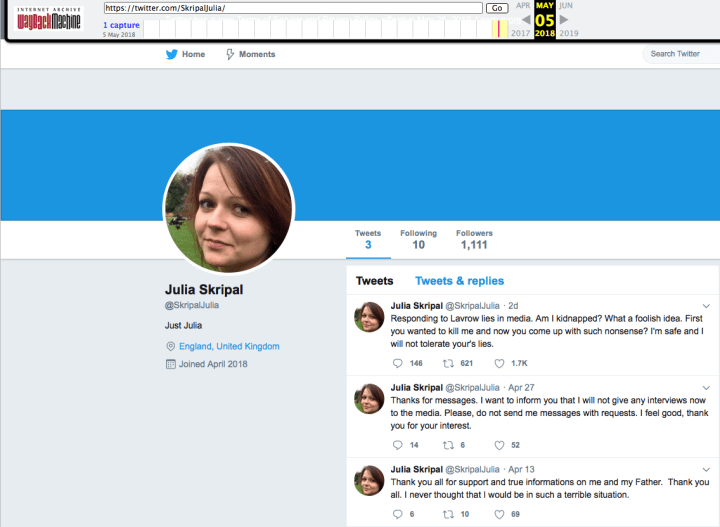
Would you believe that a twitter account purporting to be Yulia Skripal appeared 2 days ago & her first follower was The Washington Post ? The lies continue unabated. I challenged her to show her face & give us the grand interview the whole world wants to see. I got no reply.
— Maria (@mariabirchwood) May 6, 2018
Alexander Yakovenko (diplomat) slams British journalists over the Skripal case as he asks “what’s happening in the UK?”:
A Bucketful of Novichok
By Rob Slane | The Blog Mire | May 5, 2018
In my last piece, I wrote that one of the downsides of the probable D-Notice slapped on the Skripal Case was that we may well be deprived of our daily dose of farcical nonsense, such as whether the poison was administered in the restaurant, the car, the cemetery, the flowers, the luggage, the bench, the porridge, the door handle or – and I’m surprised nobody has thought of it yet – perhaps the cat. There is no doubt an FSB manual waiting to be found which explains how cats can be safely used as conduits for “Novichok”, and it has almost certainly been put together by the dashingly handsome, astonishingly intelligent, but inexplicably bitmapped ruthless ex-KGB assassin, “Gordon”, who was apparently a suspect a couple of weeks ago, but is no longer deemed a person of interest.
But despite the D-Notice, on the morning of 5th May it seemed that the torrent of patent absurdities was actually not about to cease anytime soon. In an interview with the New York Times, the Director General of the Organisation for the Prohibition of Chemical Weapons (OPCW), Ahmet Uzumcu, said the following:
“For research activities or protection you would need, for instance, five to 10 grams or so, but even in Salisbury it looks like they may have used more than that, without knowing the exact quantity, I am told it may be 50, 100 grams or so, which goes beyond research activities for protection.”
My immediate reaction was to ask why only 50-100 grams (which the New York Times helpfully tells its readers is between about a quarter-cup to a half-cup of liquid)? Why not a whole bucketful of Novichok, splashed indiscriminately over the front door of Mr Skripal’s house?
It is testimony to the truly uninquisitive minds of the dutiful stenographers at the New York Times and the rest of the media which ran with the same story, that none of them appear to have wondered to themselves something along these lines:
“Huh? 100 grams of military-grade nerve agent? Of a type said to be 5-8 times more lethal than VX, which itself has a median lethal dose of 10 milligrams. And we’re now apparently talking about 100,000 milligrams! And yet not only are the Skripals alive (well at least they were when last Yulia got hold of a phone) but the population of Salisbury seems to be doing okay as well. In fact no-one died (apart from the cat and the guinea pigs). Does Mr Uzumcu know what he’s talking about?”
My next reaction was to wonder whether actually he knows exactly what he’s talking about. But I’ll come back to that in a moment.
Anyway, later in the day, the OPCW issued a Statement on Amount of Nerve Agent Used in Salisbury, which read as follows:
“In response to questions from the media, the OPCW Spokesperson stated that the OPCW would not be able to estimate or determine the amount of the nerve agent that was used in Salisbury on 4 March 2018. The quantity should probably be characterised in milligrams. However, the analysis of samples collected by the OPCW Technical Assistance Visit team concluded that the chemical substance found was of high purity, persistent and resistant to weather conditions.”
As an aside, I’d love to know which media asked the questions. My guess is that it wasn’t any of those organisations who had repeated the claims made in the New York Times.
But what of the statement itself? Taken at face value, along with Mr Uzumcu’s original statement, it is very odd for a number of reasons:
1. Firstly, it says that the OPCW would not be able to estimate or determine the amount of the substance used. But of course this is exactly what Mr Uzumcu did appear to say, when he mentioned the quantities 50 and 100 grams.
2. Secondly, the statement says that the quantity should probably be characterised in milligrams. Not bucketfuls then? But of course the problem with this is that it does appear to leave Mr Uzumcu looking rather stupid, as if he:
a) Doesn’t know his grams from his milligrams and
b) Doesn’t realise that a cupful of military grade nerve agent 5-8 times more toxic than VX would kill people – like, lots and lots and lots of people
3. And thirdly, the milligrams for grams exchange completely undercuts the whole point Mr Uzumcu was making. He was saying that it appeared from the amount used that it could not have been produced in any old laboratory, as he had admitted a week before when he had said it could be produced “in any country where there would be some chemical expertise.” Rather, the point he was making was that quantities like 50-100 grams could only point to military production of the agent, rather than simply for research purposes.
This is all very bizarre. That’s hardly surprising, though, since there is almost nothing about this case that has not been extremely odd. From what I can tell, there are only really two possible explanations for this latest bout of strangeness.
One possible explanation is that Mr Uzumcu is simply incompetent, and so lacking in knowledge that he doesn’t know his grams from his milligrams, nor that half a cup of deadly nerve agent would wipe out hundreds, if not thousands, of people (not to mention being impossible to put on a door handle in the first place, at least not without the kind of protection that might just draw attention). However, this seems to me fairly unlikely. I assume that you don’t become Director General of the OPCW and remain in the position for eight years if you really are that inept.
But is there another more revealing explanation?
If you go back and read Mr Uzumcu’s statement, it is very noticeable that he does not actually state that he personally believes the quantity of the poison used in Salisbury was 50 or 100 grams. What he actually said is:
“For research activities or protection you would need, for instance, five to 10 grams or so, but even in Salisbury it looks like they may have used more than that, without knowing the exact quantity, I am told it may be 50, 100 grams or so, which goes beyond research activities for protection” [my emphasis].
It looks like they may have used more than that? From what does it look like that? From the months long, multi-million pound clean up job being undertaken, by any chance?
And of the quantity, he says he was told this. But the question is, who told him?
I can’t be sure, but my hunch is that he does know his grams from his milligrams; that he is well aware that 50-100 grams of the stuff would be enough to have killed the Skripals outright, along with hundreds or possibly thousands of others in the surrounding area; and also that he understands full well that the current multi-million pound clean up operation in Salisbury, which is precisely intended to give the impression that there was so much of the stuff that it might make up half a cupful, or perhaps even a whole bucketful, is something of a farce.
And so even though his original statement at first seems absurd, I’m fairly convinced that it was not a display of incompetence on his part. Rather, together with the subsequent clarification, it was very likely a signal that he believes his source for the claim to be either incompetent or – shall we say – economical with the actualité. And it may be that his real aim was – as diplomatically as possible – to let certain folks in Britain know that he’s not as convinced by some of their claims as they might like him to be.
Featured Video
BRITAIN’S WARNING: PREPARE FOR WAR
or go to
Aletho News Archives – Video-Images
From the Archive
How Ukraine Tortured and Slaughtered Donbass
By Kit Klarenberg | Al Mayadeen | July 11, 2024
Almost immediately after the proxy war erupted, ISIS-tier footage of the torture and murder of Russians in Ukrainian custody emerged.
On July 6th, the New York Times published an astonishing investigation: In Ukraine, Killings of Surrendering Russians Divide an American-Led Unit. The article documents in grim detail how Chosen Company, an international volunteer battalion for Kiev, routinely executes Russian prisoners of war. It is the very first mainstream admission that this practice – a brazen breach of the Geneva Conventions, and a grave war crime – is widespread among Ukraine’s fighters, both foreign and homegrown. … continue
Blog Roll
 Aletho News
- Israel Demolishes Home Of Lebanese Journalist Whose Viral Film Exposed Pager Attack
- Record Oil, Empty Tanks: The UAE’s Miracle Recovery
- Burnham tackles Britain’s poverty with aggression in Yemen
- Peace in Ukraine: the easy way – or the hard way
- Trump & the Rrrrussians
- US taxpayer money laundered back through Ukraine – Musk
- Before COVID, an NIH lab chief proposed making a SARS-like bat virus more infectious
- Gates, Bourla on Trial in Netherlands Accused of ‘Great Reset’ Scheme at Vaccine Injury Hearing
- BRITAIN’S WARNING: PREPARE FOR WAR
- “Historic Russia”: The Land Putin Will Not Give Back
- If Americans Knew
- An error has occurred; the feed is probably down. Try again later.
- No Tricks Zone
- Two New Studies Find Thwaites Glacier Melt Cannot Be Driven By Human Activity Or A Warming Ocean
- E-Cars Reduce CO2 Emissions By Only 41% Compared To Internal Combustion Engine Vehicles
- Predictions Made By Renowned Climate Professor Over Past Decades Have Been Proven To Be Poor
- New Study Suggests Large Regions Of The Pacific Ocean Have Been Cooling For The Last 80 Years
- Germany’s Green Energy Debacle: High Energy Costs Force Kahla Porzellan to Close After 182 Years!
- New Study: 50 Years Of The Most Aggressive ‘Net Zero’ Policies Can Only Affect The Global Climate By 0.03°C
- US September “Heat” Was No Record…Many Records Set Decades Ago
- Latest European Green Energy Debacle; Portugal’s Largest Flagship Solar Park Insolvent!
- Green Energy Debacle: German Expert Professor Fritz Vahrenholt Warns Of Severe Economic And Social Consequences
- Two More Paleo Reconstructions Affirm Meters-Higher Sea Levels Across Ireland, Brazil 7000-6000 Years Ago

