London systematically destroying evidence in Skripal case – Russia’s UN envoy
RT | April 19, 2018
The UK continues to conceal and destroy evidence relating to the Salisbury incident and have crossed all boundaries in their rhetoric by alleging President Putin’s personal involvement, Russia’s UN envoy Vassily Nebenzia has said.
“The British authorities are engaged in the systematic destruction of evidence,” Nebenzia told the United Nations Security Council, which held a session, called by UK on Wednesday, to discuss the OPCW report and other developments in the Skripal case.
“Skripal’s pets were killed. No samples were obviously taken. The places attended by the Skripals – a bar, a restaurant, a bench, park ground, etc – are all being cleared,” the diplomat said, pointing out that, despite some loud statements about the alleged contamination of the area, “people continue to live in Salisbury as if nothing happened.”
The envoy also reminded the council members that Sergei and Yulia Skripal, who, according to London, are now both recovering from the poisoning by a deadly military grade nerve agent A-234 (‘Novichok’), are kept hidden from the public eye ever since the March 4 incident. In the meantime, London categorically refuses to provide Russia any access to the investigation, and so far has left 45 out of 47 questions addressed to British authorities about the case unanswered.
In a summary of its report, the OPCW didn’t not independently identify the nerve agent used in the Salisbury case nor its origin, but instead only confirmed “the findings of the United Kingdom relating to the identity of the toxic chemical that was used in Salisbury.”
The conclusions made by OPCW were based on samples provided by the UK investigators and do not prove London’s claim of Russia’s involvement in the poisoning, Nebenzia noted. “The main thing that the report lacks, and what the British side was so eager to see, is the conclusion that the substance used in Salisbury was produced in Russia,” he said.
The UK Ambassador to the United Nations, Karen Pierce, however, downplayed the lack of technical evidence and urged the council members to look at “the wider picture which has led the United Kingdom to assess that there’s no plausible alternative explanation than Russian State responsibility for what happened in Salisbury.”
Extensively using the ‘highly likely’ argument, the UK envoy once again claimed in her address to the UNSC that only Russia had the “technical means, operational experience and the motive to target the Skripals.” At one point she even claimed that “President Putin himself was closely involved in the Russian chemical weapons programme.”
“London apparently thinks the Russian President has a hobby of running chemical weapons programs in his free time. I don’t know whether you appreciate that you’ve crossed all possible boundaries,” Nebenzia replied.
While the UK is yet to produce clear evidence of Russian involvement in the alleged poisoning of the former double agent and his daughter, US Ambassador to the UN Nikki Haley once again attacked Moscow during the council meeting, parroting its ally’s narrative.
“As we have stated previously, the United States agrees with the UK’s assessment that Russia is responsible for the chemical weapons in Salisbury,” Haley said. “Whether that is in their direct act, or irresponsibly losing control of the agent, which could be worse, our support for our British friends and colleagues is unwavering.”
Read more:
Lebanese Journalist Names Washington’s Goal Number One in Syria
Sputnik – April 19, 2018
Sputnik spoke to Lebanese journalist and commentator Sharmine Narwani to find out more about situation in Syria and Washington’s goals and actions there.
It has been revealed that US Secretary of Defence, James Mattis, tried to urge US President Donald Trump to obtain congressional approval before launching airstrikes on targets in Syria last weekend. According to reports, President Trump was however set on the use of military force, and overruled the Pentagon chief’s advice. In other developments, Saudi Arabia is reportedly holding talks with the United States and Egypt about sending an Arab coalition force into Syria.
Sputnik: We’re hearing news that the US is in talks with Saudi Arabia to build an Arab force and send it to Syria. Saudi Arabia’s foreign minister has said that he is in talks with US National Security Advisor John Bolton to plan building this force – what do you make of this, what do you think its purpose is?
Sharmine Narwani: Look Trump wants to clear exit the debacle in Syria and eliminate the need to spend billions of dollars a year in maintaining US forces there and participating in the war. The recent chemical weapons allegations came shortly after Trump vocalised this desire; but the likelihood of an Arab force to physically base themselves in Syria on the Syrian-Iraqi border is virtually nil. We must view this new tactic with some suspicion. The US has always trumpeted ISIS as its main goal in Syria or the elimination of ISIS. If ISIS is gone, then what’s the need to have foreign forces based on that border? It seemed clear all along that containing Iran’s access from Iran to the borders of Palestine has always been the goal. It’s not as though Saudi Arabia and Egypt have stellar or significant nation-building expertise anyway. And they have many differences – the Saudis and the UEA for instance are heavily involved militarily in Yemen and are overextended there. Egypt has shown reluctance to participate in that Arab conflict, let alone another one with a government that it has actually sort of ideologically supported in the Syrian conflict. So it’s not likely to become a reality.
Sputnik: Of course in the lead up to the Western bombing campaign on Syria the US was saying that President Bashar al-Assad had used sarin gas, but we’ve now found out that they did not have sufficient evidence of this at the time. Also, the New York Times has revealed that Defence Secretary Jim Mattis urged Trump to get congressional approval for the strikes, but the president overruled him on that – what does this all tell you about the lead up to the events of last weekend?
Sharmine Narwani: If we look at the recent events leading up to the alleged chemical weapons incident, it took place under cover of two important developments: one was Trump’s declaration of exiting Syria, and removing US troops from there soon. The second would be the Syrian army’s very rapid defeat of terrorists in Eastern Ghouta and the reclamation of that strategically vital territory around Damascus. I think the sort of bringing up Sarin, the nerve gas sarin, it’s always kind of utilised as an emotional trigger, as is the mention of chemical weapons by itself and the general assumption if we’re talking about sarin would be that only states would have access to that particular substance, and not terrorist groups and non-state actors, unlike say with a substance like chlorine that is readily available. So I think it was very deliberately invoked, meaning sarin, to create an emotional response globally.
But Sarin has been used in Iraq by insurgents since at least 2004, in the form of IEDs. Turkey for instance, in May 2013, way later during the Syrian conflict, captured 12 Nusra members, Nusra is the Al-Qaida arm in Syria, they captured 12 Nusra members with significant amounts of Sarin and that was believed to be heading toward Syria. And major US-UK risk analysis firm IHS Conflict Monitor, in 2016, told us in a report that ISIS has used chemical weapons more than 52 times in both Syria and Iraq.
Sputnik: We’ve heard today that US senators are increasingly becoming concerned at the absence of a coherent US strategy in Syria, where do you see things from here?
Sharmine Narwani: Even during Obama’s term, we talked about there being a lack of coherent strategy. I would say that there is maybe a lack of a coherent verbalised strategy, one that was disseminated to the American public and an international one. There was certainly a strategy behind the scenes, one that was not vocalised and actions speak louder than words, so when we look at the arming, training and financing of terrorists when it was clear that there wasn’t enough Syrian support to topple Assad in the way leaders had been toppled in Tunisia and Egypt. We had the arming, training & financing but there was a very clear strategy, and the goal was number one, regime change, and two, to weaken the most important Iranian Arab state ally. So that was the strategy. When people say there wasn’t a coherent one they probably mean there wasn’t a coherent vocalised one. US actions have certainly shown us that regime change and weakening Iran were in fact the strategy in Syria and this is apparent today because the escalation still continues.
Russia exposes British lies on Skripal, but trail leads to US
By M.K. Bhadrakumar | Asia Times | April 19, 2018
The sensational case of the poisoning of the ex-MI6 agent and former Russian military intelligence colonel Sergei Skripal on March 4 in Salisbury, in the UK, is becoming more and more curious. Under a blinding spotlight from Moscow, the British allegation regarding a Russian hand in the poisoning of Skripal is getting exposed. An engrossing plot in big-power politics is also unfolding. There is stuff here for a Le Carre novel.
Are we witnessing a replay of the false flag Gulf of Tonkin attack of August 1964, the imaginary “incident” concocted by the US military to provide legal and political justification for deploying American forces in South Vietnam and for commencing open warfare against North Vietnam?
To recap, Britain alleged without any empirical evidence that a military grade nerve agent of a type known as Novichok was used in Salisbury, saying it was originally developed in the former Soviet Union, and therefore, Moscow’s hand – possibly, even President Vladimir Putin’s hand – was “highly likely”.
Moscow has maintained, on the other hand, that it had destroyed all its chemical weapons and an Organization for the Prohibition of Chemical Weapons (OPCW) investigation verified and testified to that.
The British allegation quickly morphed into a large-scale expulsion of Russian diplomats (over 100 of them) by western capitals, under heavy pressure from Washington and London. The US alone expelled 60 Russian diplomats, while Britain expelled 23.
Egg on May’s face
Britain is studiously ignoring the Russian requests for samples of the chemical agent used in the Salisbury attack and for consular access to be granted to the former spy’s daughter Yulia. Meanwhile, Britain instead approached the OPCW to investigate.
The OPCW has now responded that it cannot identify the country of origin of the chemical agent used in the Salisbury attack.
There is egg on PM Theresa May’s face.
However, Russians managed to get their hands on the report prepared for the OPCW by its reputed laboratory in Spiez, the Swiss Center for Radiology and Bacteriological Analysis. According to the Swiss lab’s report, the chemical formula used in the Salisbury attack has been in service in the US, the UK and other NATO countries. Furthermore, neither the Soviet Union nor Russia “ever developed or stockpiled similar chemical weapons.”
That’s more egg on May’s face.
Now comes the bombshell. On April 18, Moscow disclosed that it has formally handed over to the OPCW proof to the effect that the Novichok agent purportedly used in the Salisbury attack actually happens to be patented as a chemical weapon in 2015 in the US and produced in that country. (By the way, unlike Russia, the US is yet to destroy its chemical weapon stockpiles, as required under the Chemical Weapons Convention of 1997.)
Now, not only the British government but Washington too has some explaining to do.
Was Skripal attack a covert op by the West?
Simply put, the Salisbury attack might even have been an Anglo-American joint covert operation undertaken with the ulterior motive to ratchet up tensions between the West and Russia. (The Washington Post reported on Monday that the former National Security Advisor HR McMaster might have hoodwinked President Donald Trump into approving the expulsion under the wrong notion that similar numbers of expulsions by European allies was in the pipeline. In the event though, the Europeans made only token expulsions.)
Britain is steadily edging away from the Skripal case, hoping, perhaps, that the matter will die down. But will Moscow let Britain off the hook?
On their part, the Russians seem to be holding back on some explosive information pointing toward the US’s direct complicity in this affair.
Indeed, if this was McMaster’s swan song, the indefatigable Russophobe probably hoped to kill two birds with one shot – push Russia’s relations with the West to a crisis point and second, scotch the prospects of an early US-Russia presidential summit (which Trump wanted.)
McMaster reportedly tried to stop Trump from congratulating Putin on his big victory in the Russian election on March 18 in a phone conversation where they discussed a possible summit meeting in a near future.
How far all this is linked to Trump’s decision on March 22, finally, to sack McMaster as his National Security Advisor is yet another template. By the standards of military people, McMaster probably has the reputation of being an “intellectual” but the man proved to be an unvarnished Cold Warrior fit for a museum.
From all accounts, Trump never trusted McMaster and the two had an acrimonious relationship. The one-star general who was overlooked for promotion by the Pentagon was Trump’s default choice following the abrupt departure of Michael Flynn.
Michael Wolff narrates a hilarious episode in his book ‘Fire and Fury’ that during the job interview for the NSA post, McMaster tried to impress Trump when he showed up in military uniform with his silver star and launched into a wide-ranging lecture on global strategy. After, Trump reportedly remarked, “That guy bores the shit out of me.”
BBC presenter declares ‘info war against Russia’ after ex-navy chief questions Syria ‘evidence’
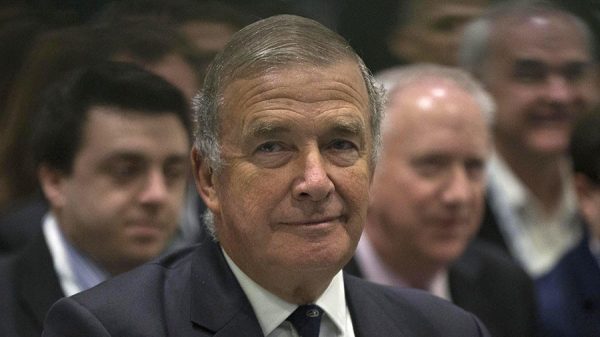
Britain’s Admiral Lord West. © Neil Hall / Reuters
RT | April 18, 2018
During a live interview, a BBC news presenter declared “we’re in an information war with Russia” after a former Royal Navy chief questioned the “extraordinary” claims surrounding an alleged chemical attack in Syria.
Former Navy Admiral Lord West’s questioning of the mainstream narrative surrounding the alleged chemical weapons attack in the town of Douma led the BBC’s Annita McVeigh to suggest that truthfully stating his position and posing questions risked “muddying the waters” in an ongoing “information war with Russia.”
Lord West had described how in his view the claim that Bashar Assad ordered the attack “doesn’t ring true,” asking “what benefit is there for his military?” He went on to say “we know that in the past some of the Islamic groups have used chemicals, and of course there would be huge benefit in them labelling an attack as coming from Assad.”
West went on to question the ‘evidence’ provided by groups like the White Helmets and the World Health Organization, both of which he described as “not neutral.”
The former First Sea Lord then described how in the past he had been put under pressure to support politically motivated narratives: “I had huge pressure put on me politically to try and say that our bombing campaign in Bosnia was achieving all sorts of things which it wasn’t. I was put under huge pressure, so I know the things that can happen.”
At that point the BBC’s McVeigh appeared to question whether he should actually be expressing his opinion truthfully, asking: “Given that we’re in an information war with Russia on so many fronts, do you think perhaps it’s inadvisable to be stating this so publicly given your position and profile, isn’t there a danger that you’re muddying the waters?”
West replied: “I think the answer is, if there’s a real concern, let’s face it, if [Assad] hasn’t done it then that is extremely bad news. If Assad hasn’t carried out the attack, I think it’s just worth making that clear. I think our government’s policy towards Assad has not been clever since 2013.”
The Skripal case & the perils of a rush to judgment
By James O’Neill | OffGuardian | April 16, 2018
The perils of coming to premature conclusions before all the facts are available has been starkly demonstrated by the latest developments in the alleged nerve gas attack upon the former Russian double agent Sergei Skripal and his daughter Yulia in the English town of Salisbury on 4 March 2018.
Followers of this particular saga will be aware that British Prime Minister Theresa May and her Foreign Secretary Boris Johnson have made a series of statements to the United Kingdom House of Commons and to the media. They alleged, without qualification, that the Skripals were poisoned with a nerve agent of the “Novichok” class, of a type “developed by Russia.”
That these statements were made before it was possible for the British chemical and biological research facility at Porton Down to have made an analysis and reached a scientifically valid conclusion did not matter. The object of the exercise was to demonize Russia in general and its President Mr Putin in particular.
As serious questions about the United Kingdom’s version of events were increasingly raised, the government’s explanations changed, along with increasingly bizarre allegations. The one common denominator to all of these “explanations” was that they were devoid of that troublesome substance known as “evidence.”
Very belatedly, and contrary to their obligations under the Chemical Weapons Convention (CWC), the United Kingdom made a request to the OPCW to conduct an independent investigation. While this investigation was ongoing, the propaganda continued unabated. One aspect of that was the United Kingdom persuading a number of its NATO and EU allies, plus Australia to expel Russian diplomats.
Australia’s Foreign Minister Julie Bishop issued a media release on 27 March that blamed the Skripal attack upon Russia, relying on
advice from the United Kingdom government that the substance used on 4 March was a military grade nerve agent of a type developed by Russia……….. The attack is part of a pattern of reckless and deliberate conduct by the Russian state that constitutes a growing threat to international security, global non-proliferation rules against the use of chemical weapons, the rights of other sovereign nations and the international rules based order that underpins them.
Russia’s denials of culpability were disregarded.
The OPCW has now issued its report dated 12th April 2018. At the time of writing (15 April) there has been no mention of this report, much less its implications, in the Australian mainstream media. The report is in two versions. The first part, headed Note by the Technical Secretariat was released for public use. The second and more detailed version was released to all nations who were parties to the CWC, which includes Australia.
Even the two page summary report contains valuable information. The first revelation is that the samples collected by the OPCW technical team that went to the United Kingdom on 21 March 2018 (17 days after the attack on the Skripals) were of a “high purity.”
The alleged significance of this is that it could only have been produced in a very sophisticated laboratory, which almost certainly rules out any resources other than those of an advanced nation state.
The second point is that a “pure toxin” is not a “military grade nerve agent.” This latter phrase is one used by the British Prime Minister and Foreign Secretary and repeated in Foreign Minister Bishop’s media release. The suggestion to the contrary by Gary Aitkenhead, the CEO of Porton Down, was therefore misleading. Mr Aitkenhead is not a scientist and may not have known better, but he was relying on a statement prepared for him. The Porton Down scientists certainly knew better.
Thirdly, the OPCW summary notes that there were no additives to the substance, which would have been necessary had the substance been applied to the Skripal’s front door handle. That particular version was seriously advanced by Boris Johnson who also claimed to have evidence that Russia had been training its agents for several years in how to apply nerve agents to door handles!
Perhaps needless to add, like most of Mr Johnson’s pronouncements on this topic, this was bereft of evidence and logic, let alone scientific validity.
One of the two most important points in the OPCW summary is that the environmental samples collected by the OPCW technical team were of “high purity” and demonstrated “the almost complete absence of the impurities.” This is literally impossible if the samples related to the time when the OPCW technical team was in the United Kingdom for that purpose. Of the various nerve agents in existence, the most durable is VX, which has a durability of 2 to 3 days, not the three weeks between the attack and the collection of the samples.
The irresistible conclusion is that the places where the samples were taken had evidence planted immediately (within a few hours at most) prior to the OPCW technical team’s arrival at the locations from where the samples were collected. It defies common sense and logic to suggest that the Russians were responsible for the planting of such fake evidence. The most logical candidate is the United Kingdom government or someone acting on their behalf.
That finding alone destroys the argument of the United Kingdom government and its acolytes in the Australian government and media. There was however, a further fatal blow to the UK government’s claims. As noted, the full OPCW report was made available to all governments who were signatories to the Chemical Weapons Convention.
There is no prohibition on any of those governments from publishing the full report or parts thereof. The Russian Foreign Minister Sergei Lavrov has released what he claims is another key finding of the report. That is, that the agent used on the Skripals was in fact a substance known as BZ (3-Quinuclidinyl benzilate). BZ is an hallucinogenic incapacitating chemical warfare agent. It afflicts both the peripheral and central nervous systems.
The signs of its use are disorientation, tremors, ataxia, stupor and coma. It is administered by an aerosol spray. These symptoms accord with the descriptions given by eyewitnesses and Salisbury Hospital as to the Skripal’s medical conditions. BZ is not produced in Russia. It is an agent that is used by the United Kingdom and the United States.
When one puts together the now known nature of the substance, its means of delivery and the symptoms that its victims exhibit, it is a further compelling inference that they were “sprayed” at some point between leaving Zizzi’s restaurant and moving to the park bench.
Given the ubiquitousness of CCTV cameras in the vicinity it should be possible to identify the actual perpetrator. One might draw further negative inferences about the UK government and the Police investigation from the fact that no details of the Skripal’s movements at this time have been released.
The British, Australian and other governments who rushed to judgement have a dilemma. Do they attempt to rebut the information that Mr Lavrov released? To try and do so would serve to highlight the revelations and any denials would be easily rebutted by the release of the full report.
On the other hand, ignoring this new evidence inevitably raises further questions about the veracity of the government’s version of events. The details outlined briefly above have already been widely disseminated on the alternative media and at least some British mainstream outlets.
The option that appears to have been taken thus far by the Australian media is to ignore Mr Lavrov’s revelations. Bishop and Turnbull, so recently and frequently condemnatory of alleged chemical warfare misbehaviour by Russia are now completely silent.
Their rush to judgement has now been exposed for the empty propaganda that it was. It is probably too much to expect an apology and a withdrawal of their false claims. Such an apology seems the very least they can do in the light of the actual evidence revealed by the investigation which stands in such stark contrast to the hyperbole and falsehoods perpetrated by the British government and their acolytes.
James O’Neill is a Barrister at Law and geopolitical analyst. He may be contacted it joneill@qldbar.asn.au
Russia: Chemical weapons inspection delayed due to West’s airstrikes
Press TV – April 16, 2018
Russia says a visit by inspectors from the United Nations chemical watchdog to the site of an alleged gas attack in Syria’s Douma has been delayed due to recent Western airstrikes on the Arab country.
“This is the latest conjecture of our British colleagues,” Deputy Foreign Minister Sergei Ryabkov was quoted as saying by Russia’s RIA news agency on Monday, in reaction to accusations that Moscow and Damascus have blocked the inspection team’s access to the area.
The British delegation to the Organization for the Prohibition of Chemical Weapons (OPCW) claimed that the fact-finding mission was in the Syrian capital Damascus but still unable to visit Douma, where dozens of people reportedly lost their lives in the aftermath of a suspected chemical attack on April 7.
Kremlin spokesman Dmitry Peskov denounced as “groundless” the British accusation, adding that Russia had consistently supported an investigation into the suspected gas attack.
“We called for an objective investigation. This was at the very beginning after this information [of the attack] appeared. Therefore allegations of this towards Russia are groundless,” Peskov said.
The Russian embassy in the Netherlands, where the OPCW is based, also dismissed the British claims and said Moscow would not “interfere in its work.”
Meanwhile, the Syrian government announced that it was “fully ready” to cooperate with any OPCW investigation.
Syrian Deputy Foreign Minister Faisal al-Mekdad said that government officials had held meetings with the inspection team in Damascus a number of times to discuss cooperation.
Inspectors for the Hague-based OPCW met Mekdad in the presence of Russian officers and a senior Syrian security official in Damascus for about three hours on Sunday.
Russia has ‘not tampered’ with Douma site
Also on Monday, Russian Foreign Minister Sergei Lavrov rejected accusations leveled by the US envoy to the OPCW that Moscow may have tampered with the site of last week’s incident in Douma.
“I can guarantee that Russia has not tampered with the site,” Lavrov said in an interview with the BBC.
The top Russian diplomat said that evidence of a chemical attack cited by Britain, France and the United States was a “staged thing,” and based “on media reports and social media.”
The Syrian government surrendered its chemical weapons stockpile during a process monitored by the OPCW in 2014.
In the early hours of Saturday, the US, Britain and France launched a barrage of missile attacks against Syria in response to what they claim to have been a chemical attack by the Syrian government in Douma.
Syria rejected the accusations as “chemical fabrications” made by the foreign-backed terrorists in the country in a bid to halt advances by pro-government forces.
Syrian air defenses responded firmly to the Western powers’ attacks, shooting down most of the missiles fired at the country.
The Pentagon, however, has claimed that the airstrikes “successfully hit every target.”
US officials said that Tomahawk cruise missiles and other types of bombs were used in the attack.
Caught in a lie, US & allies bomb Syria the night before international inspectors arrive
“If there were chemical weapons, we would not be able to stand here”

A Syrian firefighter inside the destroyed Scientific Research Center in Damascus, Syria April 14, 2018 © Omar Sanadiki / Reuters
By Eva Bartlett | RT | April 15, 2018
The US, Britain and France trampled international law to launch missiles against Syria, claiming to have “evidence” of the government’s use of chemical weapons. That evidence is based on terrorist lies.
After a week of outrageous tweets and proclamations by POTUS Trump, which included continued accusations that Syria’s president ordered a chemical weapons attack on civilians in Douma, east of Damascus, with Trump using grotesque and juvenile terminology, such as “animal Assad,” the very evening before chemical weapons inspectors of the OPCW were to visit Douma, America and allies launched illegal bombings against Syria. The illegal bombings included 103 missiles, 71 of which Russia states were intercepted.
For the past week, we were told that the US had ‘evidence’ and the UK had ‘evidence’ that Syria had used chemicals. The ‘evidence’ largely relied on video clips and photos shared on social media, provided by the Western-funded White Helmets (that “rescuer” group that somehow only operates in Al-Qaeda and co-terrorist occupied areas and participates in torture and executions), as well as by Yaser al-Doumani, a man whose allegiance to Jaysh al-Islam is clear from his own Facebook posts, for example of former Jaysh al-Islam leader, Zahran Alloush.
This, we were told, was ‘evidence.’ This and the words of the highly partial, USAID-funded, US State Department allied Syrian American Medical Society, which, like Al-Qaeda’s rescuers, only supports doctors in terrorist-occupied areas.
On April 12, even US Secretary of Defense James Mattis told the House Armed Services Committee that the US government does not have any evidence that sarin or chlorine was used, that he was still looking for evidence.
Syria, finding the claims to be lies and the sources tainted, requested that the Organisation for the Prohibition of Chemical Weapons (OPCW) immediately come to Syria to investigate the claims. Accordingly, the OPCW agreed to send a team—the visas for which Syria granted immediately—which arrived in Damascus on April 14.
President Trump, instead of waiting for an investigation to confirm his ‘evidence,’ chose the very night before this investigative team would arrive in Syria to inspect the allegations, to bomb Syria. The timing of the attacks is more than just a little timely. And the bombings were illegal.
General Mattis tried to dance around the legality, stating, “the president has the authority under Article II of the Constitution to use military force overseas to defend important United States national interests.”
But he is wrong, this does not permit the US to illegally bomb a sovereign nation, and he knows it. So does Russia. In a statement on April 14, Russian President Vladimir Putin declared the attacks as illegal, noting:
“Without the sanction of the Security Council of the United Nations, in violation of the UN Charter, norms and principles of international law, an act of aggression against a sovereign state that is at the forefront of the fight against terrorism has been committed.”
What if chemicals had been at targeted locations?
In the same Pentagon briefing, General Joseph Dunford specified the US and allies’ targets in Syria, alleging they were “specifically associated with the Syrian regime’s chemical weapons program.” One target, at which 76 missiles were fired, was the Barzeh scientific research centre in heavily-populated Damascus itself, which Dunford claimed was involved in the “development, production and testing of chemical and biological warfare technology.”
This ‘target’ is in the middle of a densely-inhabited area of Damascus. According to Damascus resident Dr. (of business and economy) Mudar Barakat, who knows the area in question, “the establishment consists of a number of buildings. One of them is a teaching institute. They are very close to the homes of the people around.”
Of the strikes, Dunford claimed they “inflicted maximum damage, without unnecessary risk to innocent civilians.”
If one believed the claims to be accurate, would bombing them really save Syrian lives, or to the contrary cause mass deaths? Where is the logic in bombing facilities believed to contain hazardous, toxic chemicals in or near densely populated areas?
Regarding the actual nature of the buildings bombed, Syrian media, SANA, describes the Pharmaceutical and Chemical Industries Research Institute as “centered on preparing the chemical compositions for cancer drugs.” The destruction of this institute is particularly bitter, as, under the criminal western sanctions, cancer medicines sales to Syria are prohibited.
Interviews with one of its employees, Said Said, corroborate SANA’s description of the facility making cancer treatment and other medicinal components. One article includes Said’s logical point: “If there were chemical weapons, we would not be able to stand here. I’ve been here since 5:30 am in full health – I’m not coughing.”
Of the facility, the same SANA article noted that its labs had been visited by the OPCW, which issued two reports negating claims of any chemical weapons activities. This is a point Syria’s Ambassador al-Ja’afari raised in the April 14 UN Security Council meeting, noting that the OPCW “handed to Syria an official document which confirmed that the Barzeh centre was not used for any type of chemical activity” that would be in contravention to Syria’s obligations regarding the OPCW.
Bombings based on Al-Qaeda and Jaysh al-Islam Claims
The entire pretext of the US and allies’ illegal bombings of Syria is immoral and flawed. There is no evidence to the claims that Syria used chemicals in Douma. Numerous analysts have pointed out the obvious: that Syria would not benefit from having used chemical weapons. But America, Israel and allies would benefit from staged attacks.
The website Moon of Alabama noted discrepancies in the videos passed around on social media as “evidence” of Syria’s culpability, including the following:
“The ‘treatment’ by the ‘rebels’, dousing with water and administering some asthma spray, is unprofessional and many of the ‘patients’ seem to have no real problem. It is theater. The real medical personnel are seen in the background working on a real patient.”
Russia’s Defense Ministry has released interviews with two men who were included in the footage alleging a chemical attack has occurred. One of the men, Halil Ajij, said he worked in the hospital in question, they had treated people for smoke poisoning, saying: “We treated them, based on their suffocation,” also noting: “We didn’t see any patient with symptoms of a chemical weapons poisoning,” he said.
In an April 14 interview on Sky News, the former British Ambassador to Syria, Peter Ford, argued that the most elementary stage in the accusations game is to allow the actual inspection to occur.
“The evidence that chemical weapons were dropped is non-existent. Let the inspectors go in and possibly within days we will have a verdict but the jury is still out. … I’m totally confident that the inspectors will not produce one shred of evidence to back up the assertions of the Americans. If the Americans had proof, they’d have brought it forward. What they’re saying and what Mrs. May is saying, is just ‘take our word for it, trust us’. There’s not even a dodgy dossier this time.”
Israel and America benefit from the attacks… and are guilty of chemical weapons use
While the world’s eyes have been glazed over by chemical weapons script-reading journalists of corporate media, little notice is given to the ongoing Israeli slaughter and maiming of Palestinian unarmed demonstrators, targeted assassinations that last re-began with the March 30 murders of at least 17 unarmed Palestinians protesting in Gaza’s eastern regions. Israel’s murder of these unarmed youths, women and men got only mild tut-tuts from the UN, and was relegated to “clashes” by slavish corporate media. Israel is literally getting away with murder, as eyes are turned elsewhere.
According to Secretary Mattis, the US-led illegal attack on Syria “demonstrates international resolve to prevent chemical weapons from being used on anyone under any circumstances in contravention of international law.”
 The irony? Both America and its close ally Israel have used chemical weapons on civilians. The US has attacked civilians in Vietnam and Iraq, to name but two countries, with chemical weapons.
In 2009, I was living in Gaza and documenting Israel’s war crimes when Israel bombed civilians all over Gaza with white phosphorous. These were civilians with nowhere to run or hide, including civilians who had fled their homes and taken shelter in a UN-recognized school. I myself documented numerous instances of Israel’s use of white phosphorous.
If this doesn’t outrage American citizens, the billions of US taxpayers’ dollars sent to Israel and spent on the bombing of sovereign nations — and not on America’s impoverished, nor on affordable health care — should outrage.
However, as author Jonathan Cook noted, the issue is not merely Trump’s threats to Syria:
“There is bipartisan support for this madness. Hillary Clinton and the Democratic leadership in the US, and much of the parliamentary Labour party in the UK, are fully on board with these actions. In fact, they have been goading Trump into launching attacks.”
By not attacking Russian forces in Syria this time, the US narrowly avoided a direct military confrontation with Russia, one which would have had global ramifications, to say the least.
The question now is: will the regime-change alliance be stupid and cruel enough to support yet another false flag chemical attack in their unending efforts to depose the Syrian president, or will they give up the game and allow Syria’s full return to peace? The US and allies claim their concern for Syrian civilians, but do everything in their power to ensure civilians suffer from terrorism and sanctions.
Read more:
Strike on Syria legitimate as 3 UNSC members acted – Macron
RT | April 15, 2018
French President Emmanuel Macron said that the US-led strike on Syria was legitimate, but “history will judge” whether the operation was justified. He added that neither France nor its allies are at war with the country.
Macron was giving a live interview following the Saturday strike on Syria that was carried out without any resolution from the UN security council. The US-led attack, that hit three targets in Syria, a research center and military bases, was launched in response to an alleged chemical attack in Douma on April 7.
The French president defended the lack of a UN resolution before conducting the strikes against Syria, saying that it was “the international community” that intervened.
“We have complete international legitimacy to act within this framework,” Macron said in the interview broadcast by BFMTV, RMC radio and Mediapart. “Three members of the Security Council have intervened.”
Macron also alleged that he was the one who convinced US President Donald Trump to remain in Syria and that the coalition should limit their strikes to chemical weapons facilities.
“Ten days ago, President Trump was saying ‘the United States should withdraw from Syria’. We convinced him it was necessary to stay,” Macron said. “We convinced him it was necessary to stay for the long term.”
He also asserted that Assad has lied “from the beginning” about the alleged use of chemical weapons by forces under his control. Macron also reaffirmed that the French government has proof that chemical weapons, notably chlorine gas, were used in Syria, adding that the “the priority for France’s military intervention remains in the fight against ISIS” and that the “precision strikes” did not inflict any collateral damage on Russian forces.
He also accused Russia of being complicit in the alleged chemical weapons attacks carried out by pro-Assad forces by disrupting the work of the international community and the Organization for Prohibition of Chemical Weapons (OPCW) using “diplomatic channels.” He didn’t mention, however, that the strike took place hours before the inspectors of the OPCW were to start their mission at the place of the alleged attack and were guaranteed full access by the Syrian government who took control over the area this week.
The Skripal event and the Douma “gas attack” – two acts in the same drama?

OffGuardian | April 14, 2018
The illegal air strikes on Syria by the coalition of the guilty (US, France, UK) have happened, to no one’s great surprise. As such things go all current indications are that they were more token than anything else. The Russians are saying around 100 missiles were fired at an unclear number of targets, of which around 70% were intercepted. Syrian General Staff are reporting 3 injuries and no deaths. Mattis was at pains to say this was a one-off, though adding the reckless caveat that any further evidence of chemical weapons usage by Assad might change that (thus giving every lunatic or CIA/neocon-controlled cell in Syria a pure gold motive for a false fag).
Compared to how bad this might have been, this is a fairly harmless result for the present.
We’ve resisted the temptation to do any kind of analysis of things so far, preferring to let them play out and to document developments and opinions. But maybe this is a good time to offer a tentative overview of what seems to have been going on in the past weeks.
1) The Douma “gas attack” was likely faked
The only evidence we have for any “gas attack” in Douma on April 7 is the video released on April 7-8, showing piles of corpses, mostly children, some with foam around their mouths. When, where or how the video was made is not verifiable. Who killed the children shown or how they died is not verifiable. Additionally we have images of an alleged “gas canister”, again without any sourcing or verification, and which have been widely suggested to be implausible. And there is Bellingcat (Eliot Higgins), contributing his usual brand of “comparisons” of images and Google maps, adding nothing that could be described even loosely as verification of the salient claims.
In opposition to this the Russians are claiming the event was staged. They allege their armed forces entered Douma shortly after the alleged attack and claim to have found no evidence of chemical weapons usage, no witnesses and no victims.
They have also released video statements by two young men claiming to be doctors at the hospital. They describe people running in to the hospital screaming that there had been a chemical attack, inciting panic among the people there, and “unqualified” people administering to children, giving them “asthma inhalers.” However, he says, there were no victims of such a chemical treated there, only victims of smoke inhalation from recent shelling and subsequent fires.
There is also the notable reluctance by US Defense Secretary, James Mattis to fully endorse the reality of this narrative. Even on April 12, just hours before the air strikes were to be implemented, he was still publicly saying he had seen no evidence to show the gas attacks happened or who may have been responsible. Given his senior position on the Trump administration, and his previously gungho attitude to military adventurism, this is significant.
Of greatest potential significance is the claim by the Russian foreign ministry that they have evidence the UK government was directly involved in staging the fake attack or encouraging a false flag. So far they haven’t released this data, so we can’t comment further at this time.
2) Primarily UK initiative?
The fact (as stated above) that Mattis was apparently telegraphing his own private doubts a) about the verifiability of the attacks, and b) about the dangers of a military response, suggests he was a far from enthusiastic partaker in this adventure. Trump’s attitude is harder to gauge. His tweets veered wildly between unhinged threats and apparent efforts at conciliation. But he must have known he would lose (and seemingly has lost) a great part of his natural voter base (who elected him on a no-more-war mandate) by an act of open aggression that threatened confrontation with Russia on the flimsiest of pretexts.
Granted the US has been looking for excuses to intervene ever more overtly in Syria since 2013, and in that sense this Douma “initiative” is a continuation of their long term policy. It’s also true Russia was warning just such a false flag would be attempted in early March. But in the intervening month the situation on the ground has changed so radically that such an attempt no longer made any sense.
A false flag in early March, while pockets of the US proxy army were still holding ground in Ghouta would have enabled a possible offensive in their support which would prevent Ghouta falling entirely into government hands and thereby also maintain the pressure on Damascus. A false flag in early April is all but useless because the US proxy army in the region was completely vanquished and nothing would be gained by an offensive in that place at that time.
You can see why Mattis and others in the administration might be reluctant to take part in the false flag/punitive air strike narrative if they saw nothing currently to be gained to repay the risk. They may have preferred to wait for developments and plan for a more productive way of playing the R2P card in the future.
The US media has been similarly, and uncharacteristically divided and apparently unsure. Tucker Carlson railed against the stupidity of attacking Syria. Commentators on MSNBC were also expressing intense scepticism of the US intent and fear about possible escalation.
The UK govt and media on the other hand has been much more homogeneous in advocating for action. No doubts of the type expressed by Mattis have been heard from the lips of any UK government minister. Even May, a cowardly PM, has been (under how much pressure?) voicing sterling certitude in public that action HAD to be taken.
Couple this with the – as yet unverified – claims by Russia of direct UK involvement in arranging the Douma “attack” and a tentative story-line emerges.
The Skripal consideration
Probably the only thing we can all broadly agree on about the Skripal narrative is that it manifestly did not go according to plan. However it was intended to play out, it wasn’t this way. Since some time in mid to late March it’s been clear the entire thing has become little more than an exercise in damage-limitation, leak-plugging and general containment.
The official story is a hot mess of proven falsehoods, contradictions, implausible conspiracy theories, more falsehoods and inexplicable silences where cricket chirps tell us all we need to know.
The UK government has lied and evaded on every key aspect.
1) It lied again and again about the information Porton Down had given it
2) Its lawyers all but lied to Mr Justice Robinson about whether or not the Skripals had relatives in Russia in an unscrupulous attempt to maintain total control of them, or at least of the narrative.
3) It is not publishing the OPCW report on the chemical analyses, and the summary of that report reads like an exercise in allusion and weasel-wording. Even the name of the “toxic substance” found in the Skripals’ blood is omitted, and the only thing tying it to the UK government’s public claims of “novichok” is association by inference and proximity. Indeed if current claims by Russian FM Lavrov turn out to be true, “novichok” may indeed not have been found in those samples at all and the active substance was a compound called “BZ”, a non-lethal agent developed in Europe and America. (more about that later).
None of the alleged victims of this alleged attack has been seen in public even in passing since the event. There is no film or photographs of DS Bailey leaving the hospital, no film or photographs of his wife or family members doing the same. No interviews with Bailey, no interviews with his wife, family, distant relatives, work colleagues.
The Skripals themselves were announced to be alive and out of danger mere days after claims they were all but certain to die. Yulia, soon thereafter, apparently called her cousin Viktoria only to subsequently announce, indirectly through the helpful agency of the Metropolitan Police, that she didn’t want to talk to her cousin – or anyone else – at all. She is now allegedly discharged from hospital and has “specially trained officers… helping to take care of” her in an undisclosed location. A form or words so creepily sinister it’s hard to imagine how they were ever permitted the light of day.
Very little of this bizarre, self-defeating, embarrassing, hysterical story makes any sense other than as a random narrative, snaking wildly in response to events the narrative-makers can’t completely control.
Why? What went wrong? Why has the UK government got itself into this mess?
Is this what happened?
If a false flag chemical attack had taken place in Syria at the time Russia predicted, just a week or two after the Skripal poisoning, a lot of the attention that’s been paid to the Skripals over the last month would likely have been diverted. Many of the questions being asked by Russia and in the alt media may never have been asked as the focus of the world turned to a possible superpower stand-off in the Middle East.
So, could it be the Skripal event was never intended to last so long in the public eye? Could it be that it was indeed a false flag, as many have alleged, planned as a sketchy prelude to, or warm up act for a bigger chemical attack in Syria, scheduled for a week or so later in mid-March – just around the time Russia was warning of such a possibility?
Could it be this planned event was unexpectedly canceled by the leading players in the drama (the US) when the rapid and unexpected fall of Ghouta meant any such intervention became pointless at least for the moment?
Did this cancellation leave the UK swinging in the wind, with a fantastical story that was never intended to withstand close scrutiny, and no second act for distraction?
This would explain why the UK may have been pushing for the false flag to happen even after it could no longer serve much useful purpose on the ground, and why the Douma “attack” seems to have been so sketchily done by a gang on the run. It would explain why the US has been less than enthused by the idea of reprisals. Because while killing Syrians to further geo-strategic interests is not a problem, killing Syrians (and risking escalation with Russia) in order to rescue an embarrassed UK government is less appealing.
If this is true, Theresa May and her cabinet are currently way out on a limb even by cynical UK standards. Not only have they lied about the Skripal event, but in order to cover up that lie they have promoted a false flag in Syria, and “responded “ to it by a flagrant breach of international and domestic law.
This is very bad.
But even if some or all of our speculation proves false, and even if the Russian claims of UK collusion with terrorists in Syria prove unfounded, May is still guilty of multiple lies and has still waged war without parliamentary approval.
This is a major issue. She and her government should resign. But it’s unlikely that will happen. So what next? There is a sense this is a watershed for many of the parties involved and for the citizens of the countries drawn into this.
Will the usual suspects try to avoid paying for their crimes and misadventures by more rhetoric, more false flags, more “reprisals”? Or will this signal some other change in direction?
We’ll all know soon enough.
Featured Video
BRITAIN’S WARNING: PREPARE FOR WAR
or go to
Aletho News Archives – Video-Images
From the Archive
How Ukraine Tortured and Slaughtered Donbass
By Kit Klarenberg | Al Mayadeen | July 11, 2024
Almost immediately after the proxy war erupted, ISIS-tier footage of the torture and murder of Russians in Ukrainian custody emerged.
On July 6th, the New York Times published an astonishing investigation: In Ukraine, Killings of Surrendering Russians Divide an American-Led Unit. The article documents in grim detail how Chosen Company, an international volunteer battalion for Kiev, routinely executes Russian prisoners of war. It is the very first mainstream admission that this practice – a brazen breach of the Geneva Conventions, and a grave war crime – is widespread among Ukraine’s fighters, both foreign and homegrown. … continue
Blog Roll
 Aletho News
- Israel Demolishes Home Of Lebanese Journalist Whose Viral Film Exposed Pager Attack
- Record Oil, Empty Tanks: The UAE’s Miracle Recovery
- Burnham tackles Britain’s poverty with aggression in Yemen
- Peace in Ukraine: the easy way – or the hard way
- Trump & the Rrrrussians
- US taxpayer money laundered back through Ukraine – Musk
- Before COVID, an NIH lab chief proposed making a SARS-like bat virus more infectious
- Gates, Bourla on Trial in Netherlands Accused of ‘Great Reset’ Scheme at Vaccine Injury Hearing
- BRITAIN’S WARNING: PREPARE FOR WAR
- “Historic Russia”: The Land Putin Will Not Give Back
- If Americans Knew
- DAILY UPDATE: Latest essential news on Palestine, Israel, & region
- Damning report shows the media must confront its failures on Gaza
- BBC senior broadcaster speaks out on Gaza coverage
- Netanyahu vows vast West Bank invasion in response to 20-minute skirmish that left 2 Israeli soldiers and 2 Palestinian fighters dead
- Tied up and tortured: Israel using US-made electroshock weapons on Palestinian detainees
- The outsourced risk: how newsrooms rely on Gaza’s freelancers without protecting them
- Gaza bakeries forced to shut as Israel blocks flour shipments
- Gaza’s breast cancer patients face a deadly wait for treatment amid Israel’s genocide
- DAILY UPDATE: Latest essential news on Palestine, Israel, & region
- The Israel Lobby’s Changing Fortunes
- No Tricks Zone
- Two New Studies Find Thwaites Glacier Melt Cannot Be Driven By Human Activity Or A Warming Ocean
- E-Cars Reduce CO2 Emissions By Only 41% Compared To Internal Combustion Engine Vehicles
- Predictions Made By Renowned Climate Professor Over Past Decades Have Been Proven To Be Poor
- New Study Suggests Large Regions Of The Pacific Ocean Have Been Cooling For The Last 80 Years
- Germany’s Green Energy Debacle: High Energy Costs Force Kahla Porzellan to Close After 182 Years!
- New Study: 50 Years Of The Most Aggressive ‘Net Zero’ Policies Can Only Affect The Global Climate By 0.03°C
- US September “Heat” Was No Record…Many Records Set Decades Ago
- Latest European Green Energy Debacle; Portugal’s Largest Flagship Solar Park Insolvent!
- Green Energy Debacle: German Expert Professor Fritz Vahrenholt Warns Of Severe Economic And Social Consequences
- Two More Paleo Reconstructions Affirm Meters-Higher Sea Levels Across Ireland, Brazil 7000-6000 Years Ago

