Australia mulls ‘fake news’ fines for Big Tech
RT | June 26, 2023
Social media companies like Twitter and Facebook could be hit with substantial fines under new draft legislation from the Australian government to crack down on the spread of “misinformation” and fake news on their platforms, The Age reported.
Under the proposal put forth by the Australian Communications and Media Authority (ACMA), social media companies will be required to keep records showing their efforts to curb the spread of such information online. Repeated failures to do so could see them facing fixed fines numbering in the millions of dollars.
“Mis- and disinformation sows division within the community, undermines trust and can threaten public safety,” Canberra’s communications minister Michelle Rowland said on Sunday. She added that “the Albanese government is committed to keeping Australians safe online.”
Under the government proposal, the ACMA would be entitled to impose a new “code” of practice on social media platforms that repeatedly demonstrate an inability to monitor the spread of fake news on their services. It would also establish an industry-wide ‘standard’ to force the removal of certain content, requiring more robust methods to identify misinformation and an increased use of fact-checkers.
Systemic breaches of the code would see a company liable to a maximum fine of AUS $2.75 million (US $1.83 million) or 2% of global turnover – whichever is higher. The maximum penalty for breaking an industry ‘standard’ would be AUS $6.88 million (US $4.6 million) or 5% of global turnover.
A hypothetical fine under the latter terms for Facebook’s parent company Meta would amount to around AUS $8 billion (US $5.35 million), The Age daily noted.
The EU imposed similar rules governing social-media content last year which also saw social media companies liable for fines linked to annual global turnover.
Under the proposed legislation the government in Canberra would not have a role in determining which content online constitutes “misinformation” or “disinformation.” Rowland stressed that the law is designed to “strike the right balance” between curbing fake news and protecting freedom of speech online.
The powers will also not apply to standalone pieces of content, official electoral information and professional news services. Google had previously removed around 3,000 videos uploaded to YouTube from Australia which spread what it referred to as dangerous or misleading information related to Covid-19.
The proposed legislation was published on Saturday and is currently out for public consultation, which Rowland said was an opportunity for Australians and social media companies to air any objections to it.
Democrats Call on YouTube To Bring Back Its Election Censorship Rules
By Dan Frieth | Reclaim The Net | June 26, 2023
A ripple of indignation surged through the Capitol this Thursday as some lawmakers pushed against YouTube and its parent colossus, Alphabet Inc. At the heart of the issue is the tech behemoth’s about-face on its election misinformation policy, a move that emerges as a tinderbox in the countdown to the presidential race next year.
The fury emanated from the news that YouTube has decided to slacken its policy reins, no longer acting as the all-mighty censor against videos questioning the the sanctity of the 2020 presidential elections. The revelation, made through an announcement from YouTube, was met with the usual complaints from four high-profile Democrats of the US House of Representatives Energy and Commerce Committee. Among the voices was that of Ranking Member Frank Pallone Jr. (D.-NJ) who, along with his cohorts, denounced YouTube’s maneuver and demanded the tech giant retract this new stance.
In a letter, the lawmakers articulated their dissent, stating, “While you claim that taking such action is ‘core to a functioning democratic society,’ we emphatically disagree.”
We obtained a copy of the letter for you here.
They lambasted the policy relaxation as perilous and branded it a dagger pointed at the heart of American democracy, pressing YouTube to review this “harmful policy decision.”
YouTube’s silent watch was palpable as a spokesperson offered no rejoinder to the avalanche of criticism.
Dissecting the June 2nd announcement, YouTube’s reversal appears to be rooted in an introspective contemplation of its policy’s past efficacy and consequences. After purging of tens of thousands of videos, and a whole election cycle within its purview, the platform seems to have had an awakening. Perhaps censoring stuff isn’t good after all, they suggest, hopefully realizing that they were the baddies all along.
They believe the policy, initially started as a bulwark against election denialism, might inadvertently muzzle political speech without significantly stymieing the risk of violence.
However, the democratic lawmakers rebuked YouTube’s newfound stance as perilous, asserting that content discrediting the legitimacy of recent elections has already wreaked havoc upon democracy.
Since when has free speech been antithetical to democracy?
Zelensky Ratchets Up Culture War with Ban on Russian Books
By Kyle Anzalone | The Libertarian Institute | June 25, 2023
Ukrainian President Volodymyr Zelensky signed a bill last week banning the import of books produced in Russia or printed in the Russian language. The new law is Kiev’s latest escalation in its extensive effort to eliminate Russian culture in Ukraine.
Since taking office, Zelensky has led a campaign of “derussification” within Ukraine. Last year, Kiev’s legislature passed a bill that will heavily restrict books manufactured in Russia or printed in the Russian language. Zelensky announced he signed the bill on Thursday, saying, “I believe the law is right.”
Kiev’s Culture Minister Oleksandr Tkachenko praised Zelensky for approving the ban. “The adoption of this draft law will protect the Ukrainian book publishing and distribution sector from the destructive influence of the ‘Russian world,’” he said.
The bill signed into law last week will ban all imports of books from Russia and Belarus. Additionally, the state will require a permit to import a Russian book from any third country. Zelenskiy’s office said the law would “strengthen the protection of the Ukrainian cultural and information space from anti-Ukrainian Russian propaganda.”
After Russia invaded Ukraine last year, Zelensky enacted a series of escalating steps with the goal of erasing, from Ukraine, any and all Russian culture. Kiev has worked to destroy all Russian monuments, rename public spaces that are in the Russian language, erase Russian historical figures, and target a branch of the Christian Orthodox church Kiev believes is too closely tied with Moscow.
Tkachenko has long been an advocate of the culture war in Ukraine. In a 2015 interview, he supported a ban on TV series and movies that are produced in Russia or glorify Russian people. One of Tkachenko’s goals at the time was to replace Russian content on Ukrainian televisions with Western programming.
While Kiev presents Moscow as the target of the culture war, the substantial minority of ethnic Russians and Russian speakers living in Ukraine are subjected to the laws. Zelensky has used the pretext of “derussification” process to consolidate control over Ukraine’s politics and media.
Peter Hotez: Why He Won’t Debate
Another Sign that We’re Winning
By Fed Up Texas Chick | Dr. Tenpenny’s Eye on the Evidence | June 24, 2023
“Peter, if you claim what RFK Jr. is saying is misinformation, I am offering you $100,000 to the charity of your choice to debate him on my show with no time limit.”
And the little worm squirmed.
The worm I am referring to is Dr. Peter Hotez, and the quote above is from Joe Rogan. At the writing of this article, Joe Rogan’s challenge to Hotez has been viewed over 25 million times on Twitter. The money is being crowdsourced and has grown to $2.6 million thus far. Apparently, a lot of folks want to see this debate.
It all started with a long three-hour podcast interview between Joe Rogan and his guest, Robert F. Kennedy Jr., who has done incredible work with the Children’s Health Defense and is an outspoken opponent of vaccines. If you missed it podcast, here is an unedited version.
RFK Jr. expressed all sorts of opinions, which is any American’s right, about autism, the COVID vaccines, and the CIA’s involvement in the murder of his father and uncle President JFK. In particular, he touted the use of the anti-parasitic drug ivermectin and the anti-malaria drug hydroxychloroquine to treat COVID in lieu of the vaccines.
Apparently, Hotez took issue with this, which is very interesting, given that he is the dean for the National School of Tropical Medicine at Baylor College of Medicine in Houston’s Texas Medical Center. His personal website says he leads a team that is “developing new vaccines for hookworm infection, schistosomiasis, leishmaniasis, Chagas disease, and SARS/MERS/SARS-2 coronavirus diseases.” Naturally, he promotes global access to vaccines, because he directly benefits financially. If anyone should know about antiparasitic and antimalarial drugs, it’s Hotez, right? Why wouldn’t he be able to hold his own in a debate on tropical medicine?
Hotez knows about the value of ivermectin, because he wrote a paper on it in 2007 that was published in New England Journal of Medicine that discussed the history of the drug’s effectiveness. But rather than engaging in the challenge to debate RFK and “bury him once and for all,” Hotez took to Twitter. He promptly asked for a $50 million endowment because Rogan and Kennedy are so stinkin’ rich. He tried to get money from them to continue his work “making low-cost patent-free vaccines for the world’s poor.”
Hotez also asked for a public apology from RFK Jr.
Mostly, Hotez is pissed about RFK Jr’s anti-vax status, challenging his work and making him non-essential. Hotez has too good of a gig, actually, and doesn’t want anyone interfering with his gravy train. Let’s explore that gravy train…
Pfizer
Hotez has been in lock step with Pfizer for decades. Redacted News reporter Dan Cohen did a two part deep dive into Hotez and his past; I highly recommend watching it. Cohen reveals that Hotez started receiving money from Pfizer straight out of college, and he hasn’t stopped. And Hotez seems to only appear on Pfizer-backed channels, such as MSNBC.
This explains why Hotez praised Pfizer’s Covid-19 clinical trial results for children aged 12 to 15 as “pretty impressive”. The trial showed 100% efficacy, but we now know that Pfizer lied.
Lofty Colleagues: Gates and Fauci
Hotez also has an international status to protect. In 2022, he and colleague Dr. Maria Elena Bottazzi were nominated for the Nobel Peace Prize for their work to develop and distribute a low-cost COVID-19 vaccine “to people of the world without patent limitation.”
According to his personal bio, Hotez has been developing recombinant protein coronavirus vaccines for SARS and MERS for more than a decade at Texas Children’s Hospital.
In 2020, he developed the first recombinant protein COVID-19 through microbial fermentation in yeast. Hotez has a connection to researcher Zhengli Shi, more commonly known as the Wuhan Institute of Virology “bat lady.” They worked together to develop a lab-generated (i.e. man-made) chimeric SARS-related coronavirus. Their work was was funded through an NIH grant, a grant that also provided funding for two of Shi’s staff.
Hmmm. Is this gain of function research? How about this hot new revelation from Kanekoa News :
In a groundbreaking revelation, it has come to light that Dr. Peter Hotez has been entangled in a web of funding, collaboration, and research with Chinese military scientists potentially involved in the development of COVID-19. The intricate tale weaves together key Chinese military virologists and culminates in the smoking gun evidence surrounding COVID-19’s notorious furin cleavage site.
So far, Hotez’s jab technology has been sent to four countries:
- India (Biological E, CORBEVAX),
- Indonesia (BioFarma, CORONAVAC),
- Bangladesh (Incepta) and
- Botswana (ImmunityBio).
More than 100 million doses have been administered in India and Indonesia. Gosh, he sounds like Bill Gates, doesn’t he? Maybe that’s because they also work together.
Here is an article from 2021 that starts,
“The Bill Gates-funded doctor is very displeased that you aren’t blindly genuflecting before his unassailable brilliance.” This is another article that is definitely worth reading.
There are many videos on the internet where Bill Gates is singing Hotez’s praises. This is blatant propaganda: Hotez is a salesman, not a scientist.
Lately, Hotez’s messaging has turned militant. What is he militant about? Anti-vaxxers. And anti-science promoted by anti-vaxxers, people like RFK Jr. You would think he would be chomping at the bit at the chance to debate him. He sticks to Twitter.
For example, his December 2022 Tweet where the WHO prominently features his militant attitude: Hotez says that anti-vaxxers have become a global killing force, and that anti-science kills more people than “gun violence, global terrorism, nuclear proliferation and cyberattacks.”
Wow, just wow.
He is particularly militant about, and protective of, Dr. Anthony Fauci. After Fauci stepped down from NIH late last year, Hotez was on the short list as a likely successor. In fact, Children’s Health Defense re-published an article, originally written by Dr. Joseph Mercola, wondering if he would assume Fauci’s role. Mercola’s article is a deep dive into Hotez’s world, and highly recommended reading.
In 2021, Hotez actually said it should be a federal hate crime to criticize Fauci and other government-funded scientists. Yes, he really said that. But we know that name-calling is the last resort for those who have no grounds for an argument.
The Clintons and Obama
It is actually perplexing that Hotez didn’t take Rogan up on a chance at a large charity donation, particularly since Hotez has such a penchant for nonprofit work. After all, he worked for the Clinton Global Health Initiative and, in 2006, that helped him found the Global Network for Neglected Tropical Diseases to “provide access to essential medicines for hundreds of millions of people.” This is not anti-science; it comes from his own bio, linked above.
Take a gander at the rest of Hotez’s resume. From 2014 to 2016, he served in the Obama Administration as a US envoy to focus on vaccine diplomacy between the US government and North Africa and countries in the Middle East.
I literally could go on and on and write an 8,000-word expose on Hotez, but I won’t.
Hotez is a self-proclaimed saint who ‘toils tirelessly’ to develop vaccines for the world’s poor. At the same time, he wants to criminalize the questioning of vaccine safety and use cyberwarfare against anti-vaxxers to literally snuff them out. Journalist Paul Thacker wrote a great piece (2022) entitled, “Peter Hotez Sees Aggression Everywhere But in the Mirror.”
Hotez is a paradox, but many see his true colors. Is Hotez a scientist or a salesman? Is he a prominent physician or a political operative peddling propaganda? Is he a Mother-Theresa-like figure helping the world’s poor, or is he one of the most hateful and dangerous people in medicine today?
You be the judge.
Fed Up Texas Chick is a contributing writer for The Tenpenny Report (at http://www.Vaxxter.com) She’s a rocket scientist turned writer, having worked in the space program for many years. She is a seasoned medical writer and researcher who is fighting for medical freedom for all of us through her work.
“NEW EASTERN OUTLOOK” THANKS EU FOR SANCTIONS COMENDATION
New Eastern Outlook – June 23, 2023
In connection with the inclusion of New Eastern Outlook in the EU’s 11th sanctions package, we sincerely appreciate the free and effective promotion of our journal.
For many years, New Eastern Outlook has been an open forum for experts from different countries to express their views on a wide range of political, economic and social issues. We have honestly and consistently reported on the neocolonial policies of the EU and the United States in various regions of the world, and we consider the sanctions policy against us to be our highest commendation.
We note that since the US Treasury Department imposed sanctions on us, the geography of our readers has expanded considerably and the number of our readers has grown steadily.
Thank you, European dictators! Have a safe journey into your troubled future!
We appreciate your sincere interest in our publications.
The Administrative Man
On the view of humanity adopted by the state and its agents

eugyppius: a plague chronicle | June 23, 2023
There is a pattern, a recurring blindness, in the approach of the administrative state to everyday human life.
Let’s consider a few examples of recent political idiocy and the common thread that unites them:
1. The Scholz government hopes to convince more Germans to opt for public transit by tinkering with fares and introducing a universal 49-Euro ticket. The offering, which collapses regional ticket schemes into one simple, relatively cheap monthly subscription, is now more than 50 days old, and preliminary data show it’s changed hardly anybody’s habits. The vast majority of the 11 million subscriptions sold so far have gone to longstanding public transit users; less than a tenth have been purchased by new customers. Surveys show that interest is concentrated in the urban centres, while rural populations have no use for the ticket because everybody drives cars there. Calls for improving transit offerings in the countryside are half-hearted and bizarre; the whole concept of public transit requires dense, concentrated populations.
2. For some years now, the German state has deployed extravagant subsidies to convince consumers to buy electric vehicles. While adoption has been substantial, the dream of 15 million EVs by 2030 remains very far off. Subsidies aren’t enough to counterbalance the substantial cost of the batteries, leaving conventional automobiles with an enormous competitive advantage at the cheaper end. Also too, it seems that the core market for EVs – relatively well-off Germans who take mostly short trips and primarily charge their vehicles at home – will soon be saturated. For those who have longer commutes or must frequently travel long distances, the limited range and insufficient charging network are disqualifying.
3. I’ve already written about proposed government legislation to compel all Germans to transition to heat pumps beginning in 2024. Massive controversy compelled substantial changes in the law, which has been blunted in many respects, but remains worrying. Because not everybody lives in buildings that are suitable for heat pumps, the law in its original form would’ve required massive renovations across broad sectors of the housing market, effectively wiping out billions of Euros in personal wealth. If enacted in its original form, it might well have rendered many prewar buildings basically uninhabitable.
4. Bizarre proposals to mitigate the dangers of warm summer weather, accompanied by strange state media hysteria about recent warm summer temperatures, are similarly oblivious. The proposals are based on French plans, which foresee imposing bans on school trips and large gatherings in the event of extended heat waves. While rules like these have the potential to destroy ordinary summer activities for millions of people, they won’t save any lives. Summer mortality spikes are confined almost entirely to the old and the sick, not schoolchildren or sports fans.
5. Lockdowns and mass vaccination also belong in this list. These policies arose from the myopia of public health mandarins, who regarded everyone in their jurisdiction as equally likely to spread SARS-2, equally likely to die from it and equally able to endure months of rolling house arrests and an indefinite marathon of mRNA injections. They were wrong in every respect: The virus was only ever dangerous to a very small segment of the population, there was never any purpose in vaccinating the millions of people who had recovered from SARS-2 infection, and even according to officially accepted, heavily massaged statistics, the vaccines have no measurable upside for any healthy person under 50.
Underlying these policy initiatives and many others is a highly abstract bureaucratic conception of the individual, what I’ll call the Administrative Man. This is how state bureaucrats everywhere approach their subject populations, and it is an unavoidable artefact of routine bureaucratic processes like regulation and taxation. In this conception, everybody is more or less the same, subject to nudging via the same incentives, requiring the same protections from the same risks, and likely to benefit from the same one-size-fits-all solutions. The highly differentiated lives that people actually lead – their vast differences in personal circumstances, wealth, individual preferences, religious beliefs and political opinions – are at best ignored, at worst considered a massive inconvenience. There is an unstated, unconsciously harboured bureaucratic vision of a country made up entirely of Administrative Men as the ideal receptacles of bureaucratic solutions, which are of course always correct, except when the people fail them.
The image of the Administrative Man, while heavily abstracted, is not without some intriguing specific characteristics. These will vary from country to country, but we can derive some of the features of the German Administrative Man from our five examples. He appears to live in cities or at least in towns, not in the countryside. He’s certainly an apartment dweller, and he’s more likely than not to rent. He’s actually somewhat well-off, but not wealthy; he’s older and probably not in the best of health. He leads a fairly withdrawn, local life, with limited interest in public events. All in all, it seems fair to call him a composite figure, combining features of the civil servants most responsible for this vision and of the aging voters who support the major political parties.
Our states are some of the most powerful and overextended in history; no system has been so well positioned to impose its vision of politics and culture on its subjects ever before. A few weeks ago, I wrote about the political mechanics of the rainbow revolution, but the all-consuming interesting of Western politicians in ethnic and sexual diversity surely admits of other interpretations as well. You could say that there is an eagerness to confine human variation to those areas of least concern to the institutional apparatus, and thus to “celebrate,” or actively promote, all those diversities which are of least consequence to the administrative ideal. Modern states actually want highly uniform, undifferentiated populations, and they hope to confine personal expression to sexual, ethnic and consumerist spheres. The Administrative Man may be straight or gay, he may be from any continent; these details hardly matter for the regulators.
The Administrative Man is not real, and no amount of bureaucratic intervention can ever bring him into being. What’s more, the state itself seems only intermittently conscious of and profoundly uninterested in the distance between its abstract administrative model of humanity and the reality of human variation. Ours aren’t the hard authoritarian regimes of the Warsaw Pact countries, which sought to beat their subjects into a uniform mass via economic deprivation and overt repression. They’re rather soft authoritarian systems, which operate via sophisticated messaging campaigns and realigning incentives – approaches which are always limited from the beginning by the deep inaccuracies of the administrative vision.
YouTube Censors Robert F. Kennedy Jr.
By Jonathan Turley | June 20, 2023
YouTube has continued its censorship of those with opposing positions on Covid 19 and vaccines. This week it prevented users from hearing the views of Democratic presidential candidate Robert F. Kennedy Jr. Despite Kennedy running on the failures of the pandemic response, YouTube will not allow users to hear what it considers harmful thoughts.
On Sunday, both Kennedy and podcast host Jordan Peterson tweeted that they were the latest to be censored by the company. Kennedy tweeted: “What do you think… Should social media platforms censor presidential candidates? My conversation with [Peterson] was deleted by [YouTube].”
He added: “Luckily you can watch it here on [Twitter] (thank you [Elon Musk]).”
The incident shows why many on the left continue an unrelenting attack on Musk and Twitter. Musk eliminated most of the company’s censorship system and, despite a few censorship controversies, the site is now the most open social media site among the major companies.
A Google spokesperson told Fox News Digital YouTube “removed a video from the Jordan Peterson channel for violating YouTube’s general vaccine misinformation policy, which prohibits content that alleges that vaccines cause chronic side effects, outside of rare side effects that are recognized by health authorities.”
Rather than allow experts and others to debate that question, Google and YouTube will not allow the debate to occur. It is consistent with calls from Democratic leaders for dissenting voices to be removed on subjects ranging from Covid to gender identity to climate control.
We have been discussing efforts by figures like Hillary Clinton to enlist European countries to force Twitter to restore censorship rules. Unable to rely on corporate censorship or convince users to embrace censorship, Clinton and others are resorting to good old-fashioned state censorship, even asking other countries to censor the speech of American citizens.
President Joe Biden has at times acted as a virtual censor-in-chief, denouncing social-media companies for “killing people” by not censoring enough. Recently, he expressed doubt that the public can “know the truth” without such censorship by “editors” in Big Tech. There is growing evidence of long-suspected back channels between government and Democratic political figures and Big Tech. Some of those contacts were recently confirmed but Congress again refused to investigate.
For years, scientists faced censorship for even raising the lab theory as a possible explanation for the virus. Their reputations and careers were shredded by a media flash mob. The Washington Post declared this a “debunked” coronavirus “conspiracy theory.” The New York Times’ Science and Health reporter Apoorva Mandavilli was calling any mention of the lab theory “racist.”
When a Chinese researcher told Fox News that this was man-made, the network was attacked and the left-leaning PolitiFact slammed her with a “pants on fire rating.”
The mask mandate and other pandemic measures like the closing of schools are now cited as fueling emotional and developmental problems in children. The closing of schools and businesses was challenged by some critics as unnecessary. Many of those critics were also censored. It now appears that they may have been right. Many countries did not close schools and did not experience increases in Covid. However, we are now facing alarming drops in testing scores and alarming rises in medical illness among the young.
The point is only that there were countervailing indicators on mask efficacy and a basis to question the mandates. Yet, there was no real debate because of the censorship supported by many Democratic leaders in social media. To question such mandates was declared a public health threat and what the WHO called our “infodemic.”
A lawsuit was filed by Missouri and Louisiana and joined by leading experts, including Drs. Jayanta Bhattacharya (Stanford University) and Martin Kulldorff (Harvard University). Bhattacharya previously objected to the suspension of Dr. Clare Craig after she raised concerns about Pfizer trial documents. Those doctors were the co-authors of the Great Barrington Declaration, which advocated for a more focused Covid response that targeted the most vulnerable population rather than widespread lockdowns and mandates. Many are now questioning the efficacy and cost of the massive lockdown as well as the real value of masks and the rejection of natural immunities as an alternative to vaccination. Yet, these experts and others were attacked for such views just a year ago. Some found themselves censored on social media for challenging claims of Dr. Fauci and others.
The media has quietly acknowledged the science questioning mask efficacy and school closures without addressing its own role in attacking those who raised these objections.
Yet, the censorship continues to the point that even a presidential candidate is now being silenced on social media.
The censorship of Kennedy is a national disgrace. Despite the proven legitimacy of prior censorship of viewpoints like the lab theory and natural immunities, Google continues to silence those with opposing views.
YouTube is signaling that this election will be another exercise in corporate approved messaging and ideas.
If you want to use YouTube, you will now have to engage in self-censorship, eliminating views that Google disagrees with. You may be able to “Broadcast Yourself” but you must first “Censor Yourself” . . . or YouTube will do it for you.
Settling in to the reputation economy
BY EL GATO MALO | BAD CATTITUDE | JUNE 21, 2023
the retail B2C aspect of the information economy is dying.
the reputation economy is rising to take its place.
this is going to be one of the pivotal meta-trends of the next several years and it is already well underway. it’s been taking root for years and like many such exponentially driven processes of social contagion, it’s “little by little then all at once” as that which seemed subtle suddenly comes to raucous and unmistakable bloom.
and we are about to see the full flower of this phenomenon.
but what does that mean?
the 90’s ushered in a radical change in information. that which was once hard to access and hard to share become so plentiful and cheap that it has now flipped over into “hard to avoid” and “hard to assess.”
in 1990, real time news and stock prices and commentary were the province of a very select few. now it’s baseline expectation for people on budget airline flights.
that which was once the currency of a small elite is now in ubiquitous circulation. this has dramatically changed the manner in which it is not only consumed, but provided.
the sheer volume of information has become overwhelming, and its stridence and pandering qualities have been accentuated as 10,000 memes fight for each eyeball that not so long ago had only 3 or 4 to choose from.
not only does this make keeping up with it near impossible, it also means that the power to control and slant it has become a sort of commanding heights in this new economy:
control what people see and you can control what they believe. shape the message, shape the society.
and not everyone in this ecosystem has your best interests at heart.
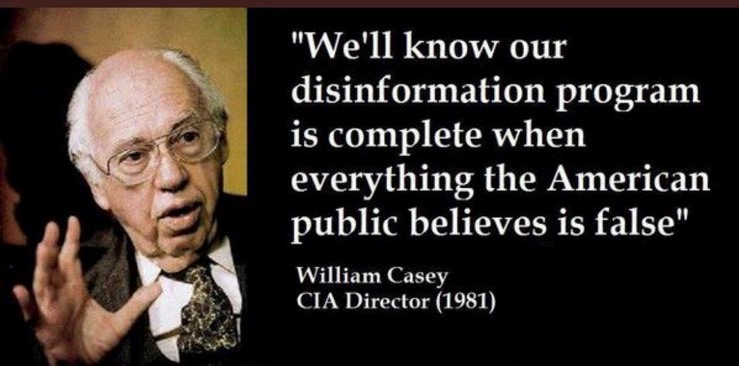
this gave rise to a vast public private partnership of media and government, an ugly and unconstitutional alliance of both convenience and need arising from both exigency and opportunity.
the information age has been death for big media.
ratings and revenues have collapsed as oligopoly eroded and information broke free.
this freedom posed a clear and present danger to government (especially bureaucratic permanent government) narrative and control and so the two were forced together in a sort of “you scratch my back and i’ll scratch yours” codependency of access, promotion, censorship, and message hegemony. everyone from media to educational institutions and crony corporatist business interests and has fawningly fallen in line with what can only be described as lockstep systems of legal plunder underpinned by invented ethics to defend and glorify them.
but this has broken the information economy and the falsehoods, manipulation, and egregious thumbs upon the scales of the public agora have grown so blatant that the center is shifting and this is about to gather the momentum that will make it decisive.
no one trusts this “information” anymore. the media lies. the government lies. the technology companies lie.
and that truth is plain.
they are still unearthing new forms of embedded censorship on twitter even now. it’s the literal core of the software and embedded at who knows how many levels. the whole system appears to have been built not so much for information sharing as for informational suppression. facebook is an an engine of ideological manipulation. google buries search results and amplifies others for ideological and political ends.
this is not distortion, manipulation has become the signal. and you can see why. this passel of pernicious plunderers will not be able to withstand even rudimentary scrutiny. they are in deep, deep trouble if information gets free. and they know it.
and this is why they will use every lever within their power from draconian EU regulations to claims of misinformation and manipulation projected upon others to mask their own malfeasance to the vilification of the very change that might supplant their systems of control. make no mistake: this sudden surge of “AI fear” is not a coincidence.
this is planned and planful.
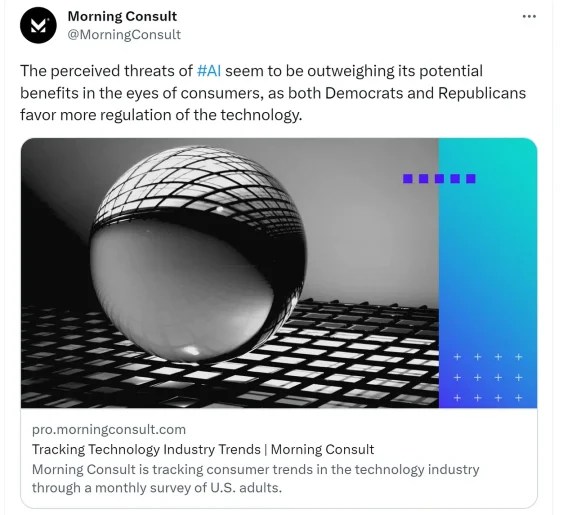
and it’s working. (or, at least, some purported polls are being trotted out to claim that it is.) but can these polls be trusted? are they accurate or fair? or are they just another failure of the information economy as it devolves to something more akin to propaganda?
it’s hard to know. this is the struggle of the hall of mirrors created by the dissolution of trust in information. it all becomes a black box and past a certain point, you simply cannot take anything at face value and one must begin to always assess the intent of the stakeholders speaking because one thing is manifestly clear:
this is exactly what those who have the most to lose would like to have you believe about a technology that could demolish their dominance and grant vast new vistas of access to unfettered information and perhaps more important knowledge extraction to the public.
this breaks the search engine monopoly on determining “what the internet is.” today, if google decides you do not exist, you vanish. if they decide you are top of the pile, you are. but AI driven systems change this and (if allowed to function unfettered) will make access to “what is” a truly general and democratized phenomenon.
no wonder they want to make you leery of it.
it stands to gut them like trout.

this democratization of knowledge generation poses an existential threat to their current regimes and so they must fight its emergence tooth and claw.
but this is not safety.
this is censorship.
the goal is to scare the demos into demanding “regulation” that will be used to once more establish the regimes of suppression upon which the modern public private plunder machine sets its foundations. they want to be in charge of what you can know and what information may spread.
and they are getting increasingly desperate because the worm here is turning, memes and messages are spreading in manners they do not like, and this is not only destroying the totalitarian power of their cultures of cancellation but inverting them. “experts” are being annihilated by “amateurs” and those who seek to dictate are finding themselves dictated to instead.
and this is a very good thing.
we the people have become “we the market” and are escaping the baleful glare of the gaslights with which so many have for so long been blinded. we are coming once more to know our own minds through the simple expedient of losing our fear to speak and realizing the the pervasive puppetshow of purported public opinion was a hoax, a fugazi fellowship of false narrative that never actually existed. and this is killing the B2C information economy because none of the folks who have firehosed phony zeitgeist at an unsuspecting public are trusted anymore.
now it’s about reputation.
and that changes everything.
“the internet remembers” is a powerful concept. it creates a real track record. if you want to play out here in the modern square, you need to speak, take views, add information. but doing so generates receipts and we can go back and look at how everyone did. it’s not like the bad old days where you can just flip sides and play the “shaggy defense” of “wasn’t me” who said that. now when you change jerseys, everyone knows. even when you try to hide it. the old tricks do not work with this new dog.
now imagine how much easier uncensored AI would make assessing such things. instant on track records for everyone.
that will be seismic.
once, what you said 5 years ago was forgotten. but no longer. not even when you delete the tweets. the internet remembers. and reputation is all.

the simple fact is that information has become overly prolific. it has become tinsel. and AI is in the process of making this 1000 times worse by making the cost of producing content asymptotically indistinguishable from 0.
as this intersects with manipulation, it drops the value of most kinds of information to naught and quite possibly into the negatives. all the value has moved to interpretation and curation.
but AI is also the solution to this as it can cut through the noise and find signal.
this is why they so desperately want to control it: if you are allowed access to the vast engines of interpretive power, what might you learn? what might you create? perhaps most important, who might you cut out of the value chain?
AI poses dire threats to the credentialed classes. lawyers, doctors, lower level and possibly soon higher level coders. lots of people with expensive educations, credentials and licensure that grants guild privilege (and assures guild level profit protection) and that stymies innovation and affordable access are at massive schumpeterian risk.
and these people are connected.
they will use the machinery of government and media to fight the encroachment that threatens their fiefdoms and frees the rest of us.
and this is a fight we must make sure they lose.
and it’s why we must resist the calls to “regulate AI” and instead demand that it be free.
those telling you it must not be are the same ones telling you that they must get to decide what is and is not “misinformation” while being the largest purveyors of falsehood on earth.
do you really want another round of that?
what could constitute a worse choice than leaping from the frying pan of mistrust of technology companies into the fire of government regulation?
you seriously want to place your faith in them?
this battle to free information must be waged not just in the political realm but in the personal.
consumer sovereignty is a decisive force and we the people may vote with these, our wallets and in so doing we may bring this to heel.
we are nothing like powerless, we are only being gaslit into thinking that we are.
and as we find our footing and seek to support those who earn our trust and shun those who violate it, we have flipped cancel culture upon its misbegotten head.
it was not long ago that companies could have brazened out a stunt like this and shamed the public into tacit if not overt acceptance.
but no more.
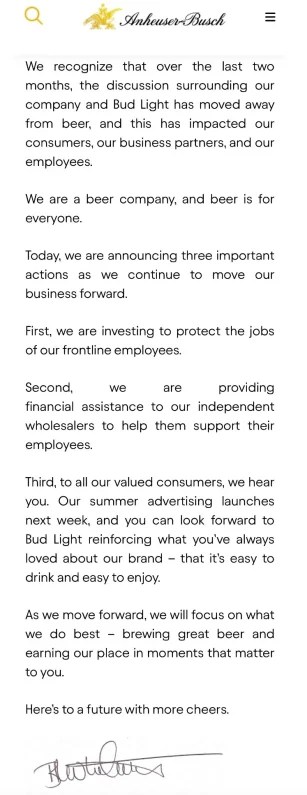
they got hit where it hurts and the top beer brand in america was hamstrung because the people running it lost their reputation.
and now they are floundering and scrambling and want a mulligan to “what you’ve always loved about us,” but it’s not that easy, is it?
everyone remembers. does anyone believe this is sincere as opposed to reactive? do you trust them again? is the non-apology apology tour compelling?
because i will bet they never get this back.
because they do not understand.
they’re cooked because they do not understand reputation. they still want to manipulate you using clumsy tools.
it’s just sad.
one of my interesting discoveries in the last couple years is that the conventional wisdom on much of PR is wrong. it does not stand up in practice.
you should never apologize for doing what you feel was right or justified. that just gets you pilloried and proves you craven and unprincipled. being shamed into repudiating your own ethics or belief is the worst of all worlds. who could respect such a person? they have no morals, just malleable allegiance.
on the other hand, when you make a mistake and realize it, you should step up and proactively say so and explain what you misapprehended and what changed your mind. i’ve blown it on data. no one bats 1.000. folks told me “ignore it. let it fade. people will forget.” instead, i chose to trust you. i placed faith in your discernment, fairness, and understanding. and when i did, a funny thing happened: instead of the “ha, see that cat doesn’t know what he’s saying!” i got comments sections full of “thank you.” and “this is why we’ll keep trusting you.”
funny how that works. why, it’s almost as if trust is a two way street…
it’s kind of obvious once you step back and look at it. no one claiming to be infallible is trustworthy. that’s impossible. worse, it’s a self-defeating demand. if you require it, you’re placing yourself in the hands of the most malicious sort of people.

this is what makes the reputation economy hum. not projected perfection: reality. plausibility. humility. principle. honor. honesty.
strive for truth and even when you fail, people will trust you. a good batting average presented in good faith vastly trumps a perfect one presented in falsity.
people are sick and tired of being lied to, spun, and manipulated.
the age of honesty and honor is coming.
because we will make it so.
vote with your dollars and vote with your attention.
support those who earn your trust and who trust you in return. spurn those taking you for granted or for fools or for dupes.
consumer sovereignty is the tool by which societal sovereignty may be retaken.
this will be irrepressible and irresistible.
and this is going to be fun.
society was always ours and not theirs.
remember that, and the rest will follow.

Subs
Dr. McCullough Rapid Fire on The Joe Pags Show
Quick Hits on Jerrold Nadler, Rochelle Walensky, Demar Hamlin, Jamie Foxx, Kathy Huchul, and Propagandized “Misinformation”
By Peter A. McCullough, MD, MPH | Courageous Discourse | June 18, 2023
Among all the independent media superstars, Joe “Pags” Pagliarulo does one of the best “rapid fire” interviews that gets his audience updated on contemporary issues. This one on June 15, 2023, starts out with U.S. Representative Jerrold Nadler the 12th District of New York incredulously stating two year old should have worn masks because at the time there was no vaccine. My responses are short and evidence-based with citations. This is the type of interchange we should be seeing on main stream media with experts who should know the data cold have the alacrity to move quickly from topic to topic. Watch additional coverage on Rochelle Walensky, Demar Hamlin, Jamie Foxx, Kathy Huchul, and Propagandized “Misinformation.”
“A Global Digital Compact” – UN promoting censorship, social credit & much more
By Kit Knightly | OffGuardian | June 20, 2023
Late last month the office of the United Nation’s Secretary General published a policy document on aims for the future of the internet.
A follow-up to the 2021 report “Our Common Agenda”, the new report’s title says it all really, “A Global Digital Compact”. That’s the goal, international legislation that would seek to control and enforce the use of digital technology.
The proposed clauses promote everything you’d expect them to promote.
Digital identities linked with financial access:
Digital IDs linked with bank or mobile money accounts can improve the delivery of social protection coverage and serve to better reach eligible beneficiaries. Digital technologies may help to reduce leakage, errors and costs in the design of social protection programmes
Environmental or climate change-based social credit systems:
Sensors and monitors connected to the Internet of things, cloud-based data platforms, blockchain-enabled tracking systems and digital product passports unlock new capabilities for the measurement and tracking of environmental and social impacts across value chains.”
Public-Private Partnership:
Partnerships between States, private sector and civil society leverage the capacity of digital tools to provide solutions for development across the Sustainable Development Goals. Examples include the Digital Public Infrastructure Alliance, the Coalition for Digital Environmental Sustainability and public-private partnerships for disaster response.”
Countering online “harm”:
Disinformation, hate speech and malicious and criminal activity in cyberspace raise the risks and costs for everyone online […] we must strengthen accountability for harmful and malicious acts online.
Those are the obvious ones, there’s also more sneaky, insidious language regarding “equity” and “access”. The report is concerned there are many people in the world (mostly the developing world) who don’t have regular access to the Internet.
This concern would be more honestly expressed in the language of control – people who don’t consume digital media can’t be hypnotised, people who don’t communicate online can’t be censored, and people who don’t rely on digital banking can’t be controlled.
To sum up, the Digital Global Compact is a piece of globalist legislation serving the final aim of globalist policy: Control of all aspects of life, achieved by inserting a digital filter between people and reality.
Banking, communication, media consumption, shopping. Every interaction you have will be through a digital membrane which can both monitor your exchanges with the world and – if deemed necessary – deny you access to that world.
An interesting final point to note is the words the report doesn’t use. “Globalist” and “globalism” do not appear once, “vaccine passports” or “vaccine certificates” are likewise not mentioned. Neither are “social credit” or “central-bank digital currency”. They are discussed, but not mentioned.
They seem to be avoiding buzzwords they know will trigger resistance or set off alarm bells. Would they have done that before the skeptics started winning the Covid conversation? I don’t think so.
You don’t have to take my word for any of this, of course, you can read the whole report yourself.
There’s nothing surprising in there at all, obviously. But it’s definitely a “quiet part out loud moment”, and a link to send to those people who still dismiss you as a conspiracy theorist.
The Hate Crime Purging of “Antisemites” Is Underway!
Saying anything about Israel’s misbehavior can send you to jail
BY PHILIP GIRALDI • UNZ REVIEW • JUNE 20, 2023
There have recently been a number of incidents that would be of interest if one has concerns about the sorry state of free speech in Europe and the United States, the so-called “democracies” who tend to boast about their freedoms and the rights of their citizens. The chosen weapon in the US and elsewhere in the Anglo-sphere has been the designation “hate speech” which also covers “hate writing,” “possessing hate literature or films,” and even “hate thinking.” In Europe, where “hate speech” is often referred to using the English words, the expression is often preceded by the word “illegal” to make sure that the point about consequences is made and the potential penalty is clearly understood. Some Europeans have in fact been convicted and sent to prison when they have falsely believed they were exercising free speech.
Though the “hate” designation was originally coined to discourage racist language and other forms of expression it has increasingly been exploited by Israel and its associated Jewish support groups to criminalize any criticism of Israel or of Jewish group behavior. It has extended its reach by moving into subsets, notably “holocaust denial” and “antisemitism” which are also regarded ipso facto as hate crimes in a context in which Jews are always regarded as victims, never as perpetrators of violence.
Much of what is going on might be described in fairly simple terms: Israel’s treatment of the Palestinians and its unprovoked lethal attacks on its neighbors might reasonably be described as “deplorable” or even genocidal in the case of the Palestinians. Beyond that, Israel, which pretends to be a democracy, operates a system of control over the Christian and Muslim minority within its own borders and also in the area it illegally occupies that is describable as “apartheid,” where the minority is compelled to accept limited resources and consistently harsh treatment from the dominant Jewish population. More to the point, the extremist government coalition headed by Prime Minister Benjamin Netanyahu has made the situation even worse for those non-Jews that it controls, with talk of introducing mass expulsions and imprisonments. The death toll of Palestinians at the hands of the Israel Defense Forces has also been going up, with more than 150 Palestinians killed this year, including 26 children.
To be sure, Israel has become a home for Jews that can no longer tolerate anyone else. Some ministers in the new government are particularly vile in their views but it is to be assumed that Netanyahu and others in his administration are genuinely supportive of turning Israel into a truly and even exclusively Jewish state, which is in fact how it legally defines itself. The one minister most cited for his cruelty and racism is Itamar Ben-Gvir of the Jewish Power party. Ben-Gvir has been charged with crimes 50 times, and convicted on eight occasions, including once for support of a Jewish terrorist group. He is a former supporter of the now deceased right wing fanatic Meir Kahane, and, like Kahane, envisions an Israel that is as Palestinian free as possible and centered exclusively on Jewish interests. He has called for deporting Arabs who aren’t loyal to a Jewish Israel, annexing all of the West Bank and exercising full Israeli sovereignty over the Temple Mount, where the Muslim venerated Al-Aqsa mosque is located. He supports legislation defying international agreements to “divide” the Al-Aqsa site to permit regular Jewish worshippers and there have even been suggestions that the Israeli government will seek to rebuild the so-called Biblical Second Temple, destroyed in the First Century by the Romans, in that location.

MK Itamar Ben Gvir at a ceremony honoring late Jewish extremist leader Rabbi Meir Kahane in Jerusalem on November 10, 2022. Photo by Olivier Fitoussi/Flash90
Ben-Gvir is notorious for his provocations directed against Palestinian Muslims and Christians. He has led marches of armed settlers flaunting Israeli flags through Arab quarters of cities and towns and has even brought settlers and other extremists to the al-Aqsa mosque during Ramadan and to interrupt Friday prayers. To cap the irony, he has been since November 2022 the National Security Minister, which gives him authority over the police, to include the so-called Border Police as well as the police forces located on the illegally occupied West Bank. Indeed, as a practical matter, Ben-Gvir is seeking to have the Knesset pass legislation explicitly conferring legal immunity on all Israeli soldiers for any and all killings of Palestinians. He has also pressed the parliament to institute a formal, judicially administered death penalty for “terrorists”, which would mean any Palestinian who physically resists the Israeli occupation.
Another extremist who has obtained a major ministry in the Netanyahu government is Bezalel Yoel Smotrich who has served as the Minister of Finance since 2022. He has recently completed a controversial trip to the United States where he met with American Zionist leaders. Smotrich is the leader of the Religious Zionist Party, and lives in an illegal settlement in a house within the Israeli occupied West Bank that was also built doubly illegally outside the settlement proper. Smotrich supports expanding Israeli settlements in the West Bank, opposes any form of Palestinian statehood, and even denies the existence of the Palestinian people. He demands a state judiciary that relies only on Torah and Jewish traditional law. Accused of inciting hatred against Arab Israelis, he told Arab Israeli lawmakers in October 2021, that “it’s a mistake that David Ben-Gurion didn’t finish the job and didn’t throw all of you out in 1948.”
The increasing brutality of the Israeli government and its security forces have produced a reaction among many observers worldwide, so the supporters of Israel have engaged in their own first strike frequently using the “hate crime” weapon. They have basically turned the hate crime legislation to their advantage by convincing many nations to adopt the International Holocaust Remembrance Alliance (IHRA) definition of the “hate crime” antisemitism to automatically include criticism of Israel as being equivalent to hatred of Jews. When that doesn’t work the powerful Israel lobby can also resort to much more brutal threats. When Iceland sought to make illegal infant circumcision five years ago, regarding it as genital mutilation performed on an unconsenting child, the Anti-Defamation League (ADL) threatened to unleash Jewish power to destroy their economy and international reputation as punishment for making their country “inhospitable to Jews.”
Now that the “hate crime” genie together with the associated links to holocaust denial and antisemitism have been released from the bottle, they are being used regularly to silence anyone who even indirectly criticizes prominent Jews like George Soros. Conservatives including Tucker Carlson and Elon Musk have recently been on the receiving end of the antisemitism label after referring to Soros and his “Globalist” agenda. It is my belief that Tucker was fired at least in part due to Jewish pressure on FOX as he had been very critical of groups like the hysterical ADL and its hideous director Jonathan Greenblatt.
Roger Waters, the former lead singer of Pink Floyd, has emerged as a powerful critic of Israeli treatment of the Palestinians. As a consequence, he has been hounded by authorities in Europe, has had his concerts canceled, and has been threatened with legal action to make him shut up. The Biden Administration’s antisemitism Czar Deborah Lipstadt has also attacked him, saying “I wholeheartedly concur with [an online] condemnation of Roger Waters and his despicable Holocaust distortion.” She was referring to a tweet stating that “I am sick & disgusted by Roger Waters’ obsession to belittle and trivialize the Shoah & the sarcastic way in which he delights in trampling on the victims, systematically murdered by the Nazis. In Germany. Enough is enough. Holocaust trivialization is criminalized across the EU.” The State Department, speaking for the White House, then piled on adding that Waters has “a long track record of using antisemitic tropes” and a concert he gave late last month in Germany “contained imagery that is deeply offensive to Jewish people and minimized the Holocaust… The artist in question has a long track record of using antisemitic tropes to denigrate Jewish people.”
One might observe that the depiction of Waters is basically untrue – he is a critic of Israeli crimes against humanity but does not hate Jews. One might also add how the fact that the United States State Department actually has a Special Envoy to Combat Antisemitism speaks for itself and tells you exactly who is in charge in Washington. I wonder how much it costs to run Lipstadt’s mouth from a no doubt well-appointed office in Foggy Bottom each year? Maybe someone should do a cost/benefit analysis and give Debbie her walking papers.
Beyond that, several other recent stories show how it all often works in practice to confront and silence critics. Swedish pop star Zara Larsson is facing what is obviously a coordinated backlash on social media after criticizing Israel’s treatment of Palestinians. In an Instagram message to her 6.3 million followers, the 23-year-old declared the ongoing cross-border violence, which is killing mostly Arabs, was a “crime” against Palestinians. Her effort to be somewhat even handed was ignored, in the message, which she later deleted, where she wrote “We have to stand up for Jewish people all over the world facing anti-Semitic violence and threats, but we must also call out a state upholding apartheid and KILLING civilians, funded by American dollars.” She ended the message with the hashtag “#freepalestine.”
Larsson was hardly calling for targeting Jews or anything like that, but the reaction to her comment was symptomatic of the typical overkill response engaged in by Israel and its friends whenever anyone challenges the standard narrative of Israeli perpetual victimhood. Two other instances of comments about Israel leading to an overwhelming response to punish the perpetrators took place during the past month in the United States at college commencement ceremonies. The first was on May 12th, at a graduation ceremony for the law school of the City University of New York (CUNY), where Fatima Mousa Mohammed, a Queens native who was selected by the graduating 2023 class to speak during the May 12 ceremony, praised CUNY for supporting student activism, citing in particular the acceptance of student groups protesting against Israel’s brutality towards the Palestinians. She said “Israel continues to indiscriminately rain bullets and bombs on worshippers, murdering the old, the young and even attacking funerals and graveyards, as it encourages lynch mobs to target Palestinians homes and businesses. As it imprisons its children, as it continues its project of settler colonialism, expelling Palestinians from their homes. Silence is no longer acceptable.”
The response to Mohammed was immediate, including a scathing news report in the New York Post, a call by several Jewish groups to cut funding to CUNY and demands that the law school dean be fired. And the controversy again made news when a second student spoke out at a commencement at El Camino community college in Torrance California. Jana Abulaban, 18, strongly criticized Israeli government policies during her speech on June 9th.
Abulaban, who was born in Jordan in a family of Palestinian refugees, reportedly felt “inspired” by the speech of Fatima Mousa Mohammed and she told the audience “I gift my graduation to all Palestinians who have lost their life and those who continue to lose their lives every day due to the oppressive apartheid state of Israel killing and torturing Palestinians as we speak.’’
There was, of course an immediate reaction to the Abulaban speech coming from a variety of West Coast and New York pro-Israel sources. Brooke Goldstein, a claimed human-rights lawyer founder of The Lawfare Project, said, “This is yet one more example of the systemic Jew-hatred we’re seeing on our college campuses. When a student gives a commencement speech targeting Jews, trafficking in modern tropes of antisemitism, it’s clear that there has been a complete failure in that school to promote social justice for the Jewish people. If any other minority group were targeted like this, there would be consequences for the bigot. The Jewish community deserves no less.”
Of course, both women only spoke the truth about what is happening in the Middle East. Neither attacked the Jewish religion or Jews per se and only criticized Israel’s appalling behavior. When I last checked, Israel was a foreign country with both foreign and domestic policies that are considered very questionable by most of the world, so why should it be protected from being challenged in the United States? The two women were brave to speak up as they did, surely knowing that they would be targeted by the Jewish state’s many friends and supporters. Those of us who continue to speak out on Israel’s genocidal policies can likewise expect no less, particularly as both the federal as well as many state governments and also the media are now on a witch hunt directed against those who seek to speak the truth. But we must persevere. As Fatima Mousa Mohammed put it, “Silence is no longer acceptable.”
Philip M. Giraldi, Ph.D., is Executive Director of the Council for the National Interest, a 501(c)3 tax deductible educational foundation (Federal ID Number #52-1739023) that seeks a more interests-based U.S. foreign policy in the Middle East. Website is councilforthenationalinterest.org, address is P.O. Box 2157, Purcellville VA 20134 and its email is inform@cnionline.org.
Featured Video

HE SAVED LIVES. NOW HE FACES PRISON.
or go to
Aletho News Archives – Video-Images
From the Archives
NATO Sanctions and the Coming Global Diesel Fuel Disaster
By F. William Engdahl – New Eastern Outlook – 11.04.2022
Amid the ongoing global inflation crisis, NATO heads of state and mainstream media repeat a mantra that high energy prices are a direct result of Putin’s actions in Ukraine since end of February. The reality is that it is the western sanctions that are responsible. Those sanctions including cutting SWIFT interbank access for key Russian banks and some of the most severe sanctions ever imposed, are hardly having an impact on the military actions in Ukraine. What many overlook is the fact that they are increasingly impacting the economies of the West, especially the EU and USA. A closer look at the state of the global supply of diesel fuel is alarming. But Western sanctions planners at the US Treasury and the EU know fully well what they are doing. And it bodes ill for the world economy.
While most of us rarely think about diesel fuel as anything other than a pollutant, in fact it is essential to the entire world economy in a way few energy sources are. The director general of Fuels Europe, part of the European Petroleum Refiners Association, stated recently, “… there is a clear link between diesel and GDP, because almost everything that goes into and out of a factory goes using diesel.” … continue
Blog Roll
 Aletho News
- Iran FM meets with US envoy on UN meeting’s sidelines at American side’s insistence: Report
- Qatar PM calls for Gulf security framework with Iran, says war must be ‘wake-up call’
- China condemns US extortion of Iranian airlines, rejects Washington’s ‘illegal’ sanctions threats
- Italy to move military personnel from Taif base after missile strike
- Finland’s Stubb tells European leaders to calm down
- Defeating Russia on battlefield impossible – Fico
- Finland’s Gender Clinic Reversal
- Massachusetts Wants Mental Health Visits, Why Does Government Use ‘Health’ to Enter Our Homes & Families?
- US lawmaker admits American people footing bill for Trump’s failed aggression against Iran
- Pfizer Gave $500,000 to Groups That Lobbied to End Religious Exemption in Massachusetts
- If Americans Knew
- An error has occurred; the feed is probably down. Try again later.
- No Tricks Zone
- 2025 Nature Paper Claiming Worsening Global Drought Gets RETRACTED …Heavily Flawed
- New Study: ‘Global Drought Shows No Detectable Recent Acceleration Under Climate Warming’
- Economic Masterminds: German Socialists Suggest Taxing Productivity Gains Stemming From Using AI
- The South China Sea Has Not Been Cooperating With The Climate Change Narrative
- Energy Crisis: Germany Enters Heating Season With Historically Low Gas Reserve Fill Levels
- New Study: The Antarctic Ice Sheet Gained Mass From 2020-2024 Due To Staggering Snow And Ice Accumulation
- Study: Ocean Heating Rates From Thousands Of Years Ago ‘Dwarf’ Modern Ocean Heating Rates
- Climate Extremists Target, Attack Large-Scale Power Grid Infrastructure In Germany!
- New Study: Antarctic Ice Melt Has Contributed Less Than 1 Centimeter To Sea Level Rise In The Last 30 Years
- Fear Of Debate: Alarmist German Climate Scientist Calls On Mainstream Media To Discredit Skeptic Voices

