EU and UN Discuss How to Address “Disinformation” on Digital Platforms
By Cindy Harper | Reclaim The Net | June 30, 2023
In an apparent display of bureaucratic synergy, the European Union and United Nations have convened to muse over the implementation of new social media regulations, ostensibly in the pursuit of a more secure and transparent digital milieu. What stirs apprehension, however, is the overt enthusiasm of the UN’s Under-Secretary-General for Global Communications, Melissa Fleming, who anticipates that the EU’s Digital Services Act will establish a “new de facto global regulatory benchmark.” The skepticism arises from the suspicion of veiled intentions to curb free speech under the guise of combating “disinformation.”
Platforms are constantly blamed for the proliferation of “disinformation” and “hate speech,” with detractors painting them as adversaries to science, democracy, and human rights. The UN Secretary-General António Guterres brandishes a doomsday brush, asserting that large-scale disinformation constitutes “an existential risk to humanity.”
What is crucial here is the essence of the dialogue and the response it seeks to galvanize. The UN is fervently plotting a Code of Conduct premised on a policy brief that stresses the imperative for an international clampdown on disinformation. It lays out what seems to be an ambitious and comprehensive framework, involving governments, tech companies, advertisers, and other stakeholders. All very fine, but what remains unaddressed is the question of who gets to define what is “disinformation,” and what criteria determine the line between free speech and misinformation.
The Code of Conduct, steeped in an aura of academic rigor and global research, envisages a change in the fabric of digital platforms. However, the aspects it emphasizes – detaching from engagement-driven business models, and ostensibly placing human rights, privacy, and safety at the forefront – are nebulous in terms of implementation and potential overreach. Furthermore, the UN’s admission of wielding moral authority without sanctions may be viewed as a tacit endorsement of soft power coercion.
While Melissa Fleming’s words convey a seeming commitment to protect human rights and access to information, the phraseology she employs – “human rights-based,” “multi-stakeholder,” and “multi-dimensional” – are threadbare buzzwords that do little to assuage the concerns over censorship and institutional overreach.
The concern is not with the stated objectives of fostering a safe and open digital environment, but rather with the specter of global entities like the EU and UN using the cloak of “disinformation” to infringe on the bedrock principle of free speech.
House Weaponization Committee Concludes DHS Agency Colluded With Big Tech To Facilitate Censorship
By Dan Frieth | Reclaim The Net | June 28, 2023
With the publishing of a new report, a House Judiciary subcommittee disclosed that the Cybersecurity and Infrastructure Security Agency (CISA), a division within the Department of Homeland Security (DHS), has been engaging in censoring online content and conducting domestic surveillance in conjunction with Big Tech companies and other private groups.
This report, released on Monday, is titled “The Weaponization of CISA: How a ‘Cybersecurity’ Agency Colluded With Big Tech and ‘Disinformation’ Partners to Censor Americans.”
CISA, founded in just 2018, was originally envisioned as an auxiliary agency focused on safeguarding critical infrastructure and fending off cybersecurity threats.
The report asserts that CISA morphed into “the nerve center of the federal government’s domestic surveillance and censorship operations on social media” by 2020. It accuses CISA of systematically reporting social media posts that it believed disseminated “disinformation.”
Adding to the alarming developments, the report unveils that by 2021, CISA established a formal “Mis-, Dis-, and Malinformation” (MDM) team. In the ensuing years, the agency faced escalating criticism from both public and private quarters, which led it to clandestinely downplay its activities by portraying itself as solely informational in nature.
The report particularly highlights an instance in which, following lawsuits from Missouri and Louisiana contesting CISA’s censorship tactics, the agency allegedly sidestepped the allegations by transferring its censorship undertakings to a non-profit organization, the Center for Internet Security (CIS), which it financially supported.
Further, the report divulges an email from a CISA advisory board member and former assistant general counsel for the CIA, Suzanne Spaulding, to her colleague, revealing concerns about the potential public discovery and scrutiny of their activities.
CISA has been accused of attempting to obscure its activities in response to growing scrutiny, such as erasing mentions of its domestic surveillance and censorship operations from its website.
The report argues that CISA’s focus on “malinformation” is worrisome. The agency defines malinformation as factual information used out of context to mislead or manipulate, but the subcommittee report challenges whose context is being used, and questions the government’s role in deciding this context.
Despite these allegations, CISA denies any involvement in censoring or facilitating censorship.
With the unveiling of this report, questions surrounding the extent of CISA’s involvement in domestic surveillance and online censorship have become central in a broader debate on the role of government agencies in relation to civil liberties and constitutional rights.
Celebrities and Online Personalities Sign Letter, Telling Social Media Platforms To Crackdown On “Hate”

By Cindy Harper | Reclaim The Net | June 29, 2023
The Gay and Lesbian Alliance Against Defamation (GLAAD) has rounded up a bunch of celebrities to bolster a letter to social media platforms, asking them to censor “hate” towards the LGBT community.
With the signatures of over 250 celebrities and community leaders, the organization has directed its fervor toward the giants of the digital world. Addressing Facebook, Instagram, YouTube, Twitter, and TikTok.
In the public letter the organization charged that the platforms were nurturing platforms where “high-follower anti-LGBTQ hate accounts” proliferated. A group of celebrities, including the likes of actors Elliot Page and Jameela Jamil, alongside singer Ariana Grande, lent their ink to this plea.
The offending content, as per the letter, was outlined as speech that makes what they allege are falsehoods about gender-based procedures for minors, specifically “content that spreads malicious lies about medically necessary healthcare for trans youth.”
“Directing hate toward queer and trans public figures online is a vehicle to promote hate and violence against all LGBTQ people,” the letter states. “This translates to real-world harm.”
GLAAD’s post elaborated, saying, “This is leading to real-life harm, like death threats against healthcare providers and violence against trans and LGBTQ people.”
The group also complained about “Anti-trans hate speech, including targeted misgendering, deadnaming, and hate-driven tropes.”
Palestinian journalist wins wrongful termination appeal against DW
The Cradle | June 29, 2023
Palestinian-Jordanian journalist Farah Maraqa on 28 June announced winning an appeal filed by Germany’s Deutsche Welle (DW) media network over her unlawful dismissal for alleged “antisemitism.”
The decision comes nine months after the German judiciary ruled that her dismissal by state-owned broadcaster DW on charges of anti-Semitism was “legally unjustified,” which the German broadcaster appealed.
“It is a relief that the judge ruled in Farah’s favor and held Deutsche Welle accountable for this illegal dismissal,” Giovanni Fassina, director of the European Legal Support Center (ELSC), which advocates for the legal rights of Palestinians in Europe, said at the time.
In February 2022, DW fired Maraqa alongside five other Arab journalists – all Palestinian or Lebanese – accusing them of “antisemitism” in social media posts and articles they had written for outside publications.
The charges were based on the International Holocaust Remembrance Alliance’s (IHRA) controversial extended definition of antisemitism, which includes criticism of Israel’s military occupation of Palestinian land and the system of apartheid imposed on Palestinians.
The definition, which Germany adopted, has been criticized as a means of silencing pro-Palestinian support and dissent against Israeli policies.
In May 2021, DW reportedly sent an internal two-page memo to employees banning them from using terminology such as “colonialism” and “apartheid” when describing Israel.
Over the past few years, western outlets have come under fire for firing or suspending Arab journalists over alleged “antisemitism.”
In March, France24 suspended four journalists from their Arabic branch at the behest of the pro-Israel media monitoring organization, Committee for Accuracy in Middle East Reporting and Analysis (CAMERA).
Last October, the New York Times (NYT) fired Palestinian photojournalist Hosam Salam over social media posts supporting Palestinian resistance factions.
The freelance journalist was dismissed after the Israeli lobby organization Honest Reporting alerted the NYT of his posts.
Social media giants like WhatsApp, Facebook, and TikTok have also been accused of silencing or “purging” Palestinian journalists in Gaza and the occupied West Bank who report on Israeli war crimes.
Furthermore, Google employees accused the tech giant of censuring them for protesting against a controversial $1.2 billion contract signed with Israel to provide the country with advanced artificial intelligence (AI), which many fear will worsen human rights abuses in Palestine.
I try to use logic in my articles
This has led to some very disturbing conclusions
BY BILL RICE, JR. | JUNE 28, 2023
In my last article, I tried to use deductive reasoning or “logic” to explain how I knew the spike in all-cause deaths would NOT be exposed.
As I understand it, logic is simply an intellectual exercise where someone says “If A or B is true – or if one thinks these are true – then C, D or E must also be true.”
In layman’s terms, someone can make confident predictions based on some “known knowable(s).”
I use such deductive reasoning/syllogisms all the time in my writing (or try to). This is what probably makes me a “contrarian” and has allowed me to pen some fairly-original articles.
There’s another example that allows me to make another bold prediction with a pretty high degree of confidence.
Recently, a flurry of stories in the alternative press has shown conclusively that the government pressured social media companies to be much more aggressive in their censorship of users’ comments that do not align with the “authorized” Covid narratives.
(See my article on Missouri et al vs. Biden).
In reading legal documents from the Missouri v Biden lawsuit, I found a few comments from people who pointed out that the big social media companies like Meta (Facebook and Instagram), Google and YouTube are still censoring un-authorized comments at the same rate they have for the past 40 months.
I know this is true because Facebook keeps suspending my account and/or censoring or shadow-banning or restricting the reach of my Facebook posts.
Anyway, it would qualify as a “known knowable” to me that companies like these have NOT curtailed their censorship programs even after serious plaintiffs filed this lawsuit.
From this simple observation, several “logical” inferences occur to me. These include:
* These companies are NOT afraid of any terrible consequences happening to their companies if they don’t stop this censorship.
* Said differently, they seem to be very confident such a result will NOT happen.
* These companies must have concluded that nothing damaging to their companies is going to happen as a result of this lawsuit and investigation.
- In other words, executives at these companies have concluded they are “safe” to continue to censor like Big Brother.
- In fact, they probably realize they’ll be rewarded for “playing ball” with the legions of censors, “fact checkers” and “disinformation warriors” who are now omnipresent in myriad organizations.
Again, from these “logical” conclusions, I’ve deduced that, somehow, these executives must know that nothing significant or damaging to their companies is going to result from this lawsuit.
This conclusion/observation prompts this question: How do they know this?
Here, I circle back to the point I tried to make in my last column: These executives probably know this because they are all members of the same “club” …. and these club members happen to be the most powerful people and organizations on the planet.
Apparently, one iron-clad rule of said club is that members protect each other. They all benefit from sticking together.
Conversely, they all probably recognize they could be exposed and disgraced and lose their wealth, influence, benefits and power if they do NOT stick together and act together.
To use one example, my guess is that Mark Zuckerberg of Meta somehow knows nothing bad is going to happen to his company even if his army of “content moderators” and the platform’s algorithms continue to suppress my free speech (which the company continues to do).
Here, one has to state that if Missouri v Biden was successfully litigated, the conclusion would surely qualify as an epic scandal.
It would tell the world that many agents of our own government have conspired with companies like Meta to censor free speech.
Basically, the First Amendment to the U.S.Constitution would now be null and void.
Put it this way: If the U.S. government can compel partners in the media world to censor speech the government doesn’t like, we all now live in a dystopian, Orwellian world.
Well, that’s the “bet” that Zuckerberg, Google et al have apparently made. This is our “New Normal” world and these social media and Big Tech companies have no problem with this whatsoever. (Nor does the legacy press.)
It’s also possible these companies have made a more prosaic observation. For example, they have no doubt taken note of what’s happening at their competitor, Twitter, since Elon Musk bought this social media company.
According to comments Musk made in his recent conversation with Robert Kennedy, Jr., there seems to be a conspiracy of corporate advertisers to boycott Twitter now that it’s allowing far more free speech.
One doesn’t know if any memo went out to all these companies (and their ad agencies) to punish Twitter by withholding advertising spends on this platform. Here, one guesses these executives aren’t stupid enough to put any message like this in writing.
Still, we can observe what’s actually happened – “a known knowable” … as Musk, who would know, has told us.
One strongly suspects that corporate executives work in “pack” fashion just like corporate journalists do. In “journalism,” all the editors and reporters intuitively know what stories they can write and, perhaps more importantly, what stories they can’t write. Or what investigations they can’t pursue.
The same approach seems to apply to which companies are allowed to receive advertising dollars and which media companies should never receive advertising dollars.
We saw the same dynamic with the “case study” of one Tucker Carlson, formerly the star talking head at Fox News.
Yes, Tucker had the No. 1-rated TV news talk show in the world. However, his time slot at Fox News probably ranked last in “advertising revenue” from Coca-Cola, GM, IBM, Pfizer, Procter & Gamble, Johnson & Johnson, J.P. Morgan Chase and any company with scores of branded products or services.
Here’s the lesson even a caveman would get: If you want to air “dissident” commentary or journalism, you are not going to get any advertising dollars from our club members.
As you might have heard, Tucker Carlson was finally fired from Fox News. Today, I imagine the “memo” has gone out – It’s okay to once again advertise on Fox News between 8 and 9 p.m. EST.
I think this is called the “carrot-and-stick” approach to compelling compliance. (This approach seems to work in media as well as when it comes to promoting official propaganda such as “the vaccines are safe and effective.”)
Anyway, Meta and Google must have taken note of this “real-world” reality as well.
Regarding my “logical” belief that most social media companies are now completely captured (and are “all in” with Big Brother), I can make even more logical inferences.
As noted, censoring social media and Big Tech companies must not be too worried about the plaintiffs winning Missouri vs. Biden, which suggest to me that they know the U.S. Court system is also captured and will not allow any verdict that would disgrace their companies.
Here, I would opine that some lower court might rule in favor of the plaintiffs, but when this case finally gets to the Supreme Court, the Bad Guys perhaps know they have the vote of John Roberts in the bag?
They must also know that the leaders of Congress aren’t going to hold any Watergate-type hearings and expose their complicity and convince the citizens of our nation that, say, Facebook is evil and despises the First Amendment (which would mean the company despises and rejects everything the Founders of this nation stood for).
I’ll go even further. I think “club members” must know that “Joe Biden” is going to be re-elected president (or, if “Joe Biden” has to be replaced, another political clone who also hates and rejects the Constitution).
Think about it for a second. If these companies thought that Missouri v Biden might prevail – and the public might rise up against their companies – these companies would probably be throttling back on their censorship programs right now.
In fact, they’ve shrugged off these legal proceedings and are doubling, tripling and quadrupling down on the censorship of “misinformation” and “disinformation” of all varieties (not just dissident Covid speech).
This makes me think our “rulers behind the curtain” must know that they’ve also captured and control elections … and that “their” candidates will always win (even if their candidate is obviously suffering from worsening dementia, which is perhaps one reason they love this particular politician so much).
In other words, I think club members somehow know that Donald Trump, Robert Kennedy, Jr. or Ron DeSantis are not going to become the next president of the United States.
Any of these candidates, if elected, might push for hearings and prosecutions that could expose these companies for what they really are.
It seems pretty clear to me that this possibility doesn’t concern these people. Perhaps because they know this is NOT going to happen?
In my last article, I tried to explain why the “club members” aren’t worried about any of the Covid truths being exposed to the citizens of the world.
 They know they hold all the key cards and that their not-so-little fraternity isn’t going allow this to happen.
This is probably the same reason Facebook and Google aren’t worried about being humiliated and possibly facing financial ruin from their roles in attacking the Bill of Rights.
Somehow they know this is not going to happen.
Again, the most important known-knowable seems to be the knowledge that club members control all the levers of power … And so they act accordingly.
I know the above might sounds like wild conspiracy stuff to many people, but Mr. Spock would probably reach the same “logical” and deeply-disturbing conclusions I’ve reached.
I’m thinking about putting aside this “logic tool” in future articles. It’s starting to interfere with my sleep.
YouTube Escalates Its Attack on Robert F Kennedy Jr., Censors Another Interview
By Christina Maas | Reclaim The Net | June 27, 2023
YouTube has taken down another interview featuring Democratic Presidential candidate Robert F Kennedy Jr., raising eyebrows and fueling debate over the role of tech giants in controlling information. The interview, a spirited chat with Al Guart, a former New York Post reporter, was removed for allegedly breaching the platform’s “community standards.”
This has further ignited concerns over censorship and its potential ramifications on democratic dialogue.
The episode marked the launch of a podcast in which Kennedy, an environmental attorney and presidential aspirant for the 2024 election, discusses an array of subjects. From his meditation routine to his ambition of overhauling federal health agencies and the Democratic Party, the conversation traversed numerous topics. Other issues covered included handling environmental concerns and the middle class.
Al Guart expressed dismay over the removal in a statement, remarking, “YouTube just banned my interview with RFK Jr. for allegedly violating ‘community standards.’ RFK Jr. and I covered many topics of public interest and there was no threat or harm contained in the hour-long discussion.” Guart also highlighted that the podcast was gaining traction and popularity on other platforms.
During the interview, Kennedy made noteworthy remarks concerning censorship, a topic he himself has encountered on platforms such as Instagram and YouTube. He opined that, if elected President, he would engage with tech giants to explore ways to put an end to what he perceives as the unAmerican practice of censorship. He further asserted that if a satisfactory resolution could not be reached, he would consider transforming these companies into common carriers.
Kennedy, who has previously faced the ax on YouTube for violating its policy on vaccine “misinformation,” voiced his concerns over the platform’s removal of the video. He drew a parallel with concerns over foreign intervention in elections through information manipulation, stating, “People made a big deal about Russia supposedly manipulating internet information to influence a Presidential election. Shouldn’t we be worried when giant tech corporations do the same?”
In an earlier instance, YouTube removed a video featuring Kennedy in conversation with podcast host Jordan Peterson, citing a violation of its policy against “vaccine misinformation.” A YouTube spokesperson explained that content alleging vaccines cause chronic side effects, beyond the “rare” side effects acknowledged by health authorities, is not permitted on the platform.
15 Signs That You Might Be In An Abusive Relationship…
… With Your Government
The Naked Emperor | June 28, 2023
The Workplace Mental Health Institute delivers mental health training and consultancy to medium and large-sized organizations across the world. On their website they have various resources that you can download and put in your office, to help boost productivity, by addressing mental health issues.
One of their infographic downloads provides 15 signs that your might be in an abusive relationship. You may be in an abusive relationship if they [your partner]:
- Stop you seeing friends and family;
- Won’t let you go out without permission;
- Tell you what to wear;
- Monitor your phone or emails;
- Control the finances, or won’t let you work;
- Control what you read, watch and say;
- Monitor everything you do;
- Punish you for breaking the rules, but the rules keep changing!
- Tell you it is for your own good, and that they know better;
- Don’t allow you to question it;
- Tell you you’re crazy and no one agrees with you;
- Call you names or shame you for being stupid or selfish;
- Gaslight you, challenge your memory of events, make you doubt yourself;
- Dismiss your opinions;
- Play the victim. If things go wrong, it’s all your fault.
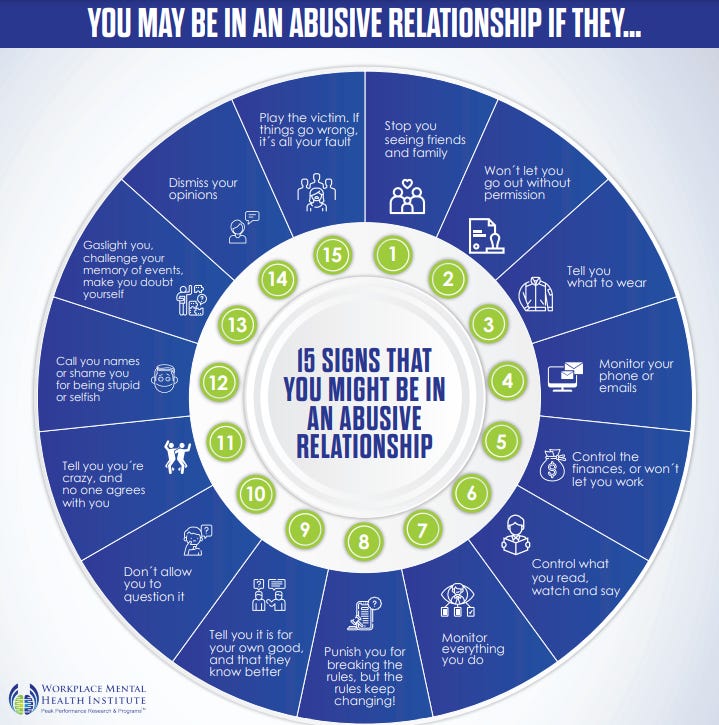
Now go back through that list and see which ones your government has subjected you to over the past three years. For most western countries it is every single one.
Your government has been mentally abusing you for years, in an almost identical fashion as an abusive partner would.
The UN Wants People To Report Each Other For “Hate Speech”
Alleges that speech can be violence
By Didi Rankovic | Reclaim The Net | June 26, 2023
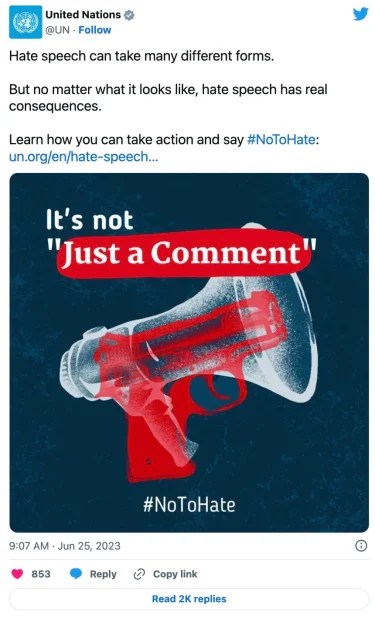 There’s been a lot of talk about the United Nations (UN) and its actions of late – mostly, those actions that fall way beyond the scope of what its founding Charter designates the organization’s role to be.
As a short history reminder – the UN is basically the international body that succeeded the League of Nations – the one that failed to prevent the (previous, atrocious) world war.
The UN is – and has, for a long time, focused its energy on “doing better” – mediating, providing a neutral ground for dialogue, helping those places around the globe unfortunately afflicted by local wars since 1945 – and just in general, not repeating the mistake of its predecessor of miring itself into irrelevancy.
You would think that with the real danger of another global war now on the cards, that would take up all of the UN’s energy and focus. But you would be wrong.
Here’s the UN, dabbling in things like alleged “hate speech.”
But – world peace – that’s supposed to be the mission. Not policing social media for dubiously defined “hate speech.”
The UN is now using its always precarious resources (depending on member-countries’ contribution, and, consequently, the way the organization satisfies the biggest contributors’ own agendas) to deal with things like real or perceived “hate speech” online.
But can that really be the mission of the world organization set up to make sure another world war doesn’t happen, and help/mediate in regional conflicts?
It seems almost absurd. Yet here it is. The UN is reported to be descending into internet censorship by “encouraging” people to report one another for hate speech online.
Really? That’s your mission now? How about providing food and drinking water to warzones and brokering peace deals?
One way to fade into obscurity as a trusted and impartial broker, is for an organization to put out statements like this.
Let’s not worry about a nuclear Armageddon – instead, what steps can we take to “combat” those pesky tweets?
Well, according to a UN tweet – there’s as many as eight: “pause, fact-check, react, challenge, support, report, educate, and commit.”
It would be comical, if it wasn’t ultimately smacking of tragedy.
‘Journalism is Not a Crime’: Experts Lambast EU Media Freedom Act
By Ekaterina Blinova – Sputnik – 26.06.2023
The European Media Freedom Act envisages installing spyware on journalists’ phones for the sake of “national security”. Sputnik sat down with some international observers to discuss how the provision correlates with the act’s name and basic European principles.
“There is no legitimate reason to spy on journalists,” Lucy Komisar, an investigative journalist based in New York, told Sputnik.
“Remember, this law targets people identified as journalists, not as spies or terrorists or criminals. Journalism is not a crime, unless Julian Assange does it. The real reason is to protect government officials from journalists reporting on officials’ misguided policies, abuses and corruption. It’s quite ironic in view of the EU’s self-congratulatory rules trumpeted as protecting peoples’ data from tech companies. Stealing data when a company does it is bad, stealing audio and written text when a government does it is just fine.”
Tightening Screws on Free Press
The bloc’s new media regulation was proposed by the European Commission (EC) in September 2022. The initial draft stipulated that European governments could deploy spyware on journalists’ devices “on a case-by-case basis” to ensure national security or to investigate “serious crimes,” such as terrorism, human or weapons trafficking, exploitation of children, murder or rape.
However, in May 2023, Politico obtained a document penned by French policy-makers who called to narrow journalists’ immunity under the new EU rules and strike what they called “a fair balance between the need to protect the confidentiality of journalists’ sources and the need to protect citizens and the state against serious threats.”
According to the media, Paris’ argument was accepted by the EC. As a result, the draft legislation was amended to loosen safeguards for the journalists’ immunity. The EC’s original list of “serious crimes” allowing surveillance on reporters was replaced by a broader 2002’s Council Framework Decision of the European arrest warrant consisting of 32 offenses.
The development triggered a storm of criticism from European journalist organizations, NGOs and activist groups. In particular, the European Federation of Journalists (EFJ), representing over 300,000 members, denounced the EU’s move as a “blow to media freedom”. The EFJ warned that empowering EU governments to install spyware on journalists’ devices under the guise of “national security” would in particular have a “chilling effect on whistleblowers” and confidential sources.
“Since the eighteenth century when newspapers began to circulate, the secrecy of sources has been sacrosanct,” Professor Ellis Cashmore, the author of Screen Society and an independent media analyst, told Sputnik. “Journalists have, over generations, respected this and steadfastly refused to reveal sources. As recently as 2005, Judith Miller, a New York Times journalist, was sentenced to prison for not revealing sources. So, it is an extremely important principle in the media.”
For their part, the British media warned that despite the UK leaving the EU, the bloc’s legislation in its current form poses a surveillance risk to British journalists residing in the EU. European Digital Rights (EDRi), a network of digital rights advocates, urged the European Council to reconsider the legislation’s spyware provisions.
The proposed legislation will not only infringe the freedom of press but contribute to the further erosion of the public trust in the Western mainstream media which is increasingly merging with the government and elitist structures, according to Sputnik’s interlocutors.
“The two cataclysmic events of the COVID pandemic and the Ukraine conflict have changed the media’s relationships with governments,” explained Cashmore. “One important effect is what we might call a neutering of the media. I mean by this that news organizations are now so reliant on governments for intel that they have been deterred from being critical of administrations. In the West, the phrase is ‘do not bite the hand that feeds you’.”
One shouldn’t delude oneself into believing that those proposing the spyware provision are really concerned about “national interests,” echoed Lucy Komisar: “The security they are protecting is not that of European nations but of themselves,” she pointed out.
According to Komisar, much of the Western media “already walks in lock-step with their governments.” The newly proposed bill “aims at the few courageous ones left, to keep the public from finding out about officials’ abuses and lies” and “to intimidate the few Julian Assanges who are left in European media that reach the broad public.”
Once the legislation is passed “real journalists will have to do what other critics of repressive governments do: user burner phones, have computers not connected to the internet, have secret meetings with brave sources,” the investigative journalist projected.
“Democracy is distorted when citizens are prevented from getting the information they need for informed choices,” Komisar warned.
Bans and Censorship Do More Harm Than Good
Meanwhile, the latest developments don’t seem surprising against the backdrop of the West’s steady attack on freedom of speech over the last several years. One glaring example is WikiLeaks founder Julian Assange who has been persecuted for exposing the US-NATO criminal conduct in Afghanistan and Iraq and the CIA’s cyber-spying techniques. Assange is indicted on 18 counts of violating the Espionage Act in the US. The WikiLeaks founder has been held in London’s high-security Belmarsh Prison for more than four years and is now facing extradition to the US.
Likewise, Washington charged former NSA contractor-turned-whistleblower Edward Snowden under the Espionage Act for shedding light on the US global surveillance program and spying on American civilians in a clear contradiction with the nation’s constitution. Snowden evaded Assange’s fate by finding asylum in Russia. In September 2022, Vladimir Putin signed a decree granting Russian citizenship to the whistleblower.
Most recently, the collective West has ramped up pressure against Russian media outlets by resorting to censorship and outright bans after the beginning of Moscow’s special military operation to demilitarize and de-Nazify Ukraine.
In particular, in March 2022, the EU slapped sanctions and suspended the broadcasting activities of Sputnik and RT thus stripping Europeans of any alternative news about the Ukraine conflict and imposing a one-sided vision of what’s going on in the Eastern European military theater. Concurrently, the UK passed legislation ordering social media, internet services and app store companies to block content from RT and Sputnik.
Remarkably, some Western human rights advocates warned at the time that banning Russian media “does more harm than good”: “History offers numerous examples of emergency speech restrictions threatening the very democracies they were supposed to protect,” wrote Danish lawyer and free speech activist Jacob Mchangama in August 2022.
“I am not a conspiracy theorist, but any sentient person can see a systematic removal of the media’s ability to operate without fear or favor – that is, impartially,” said Cashmore. “A dependency has been cultivated: the media have been encouraged to rely on political powers for information and, if they don’t, they face expulsion. The ejection of Sputnik and RT from the UK illustrates the measures governments are prepared to take to eliminate not just critical but alternative commentary. So, I believe the EU is seeking a closer compliance with mainstream or dominant narratives and the minimization of perspectives that challenge or criticize.”
The value of the concept of the freedom of speech is fading given that just a handful of European parliamentarians have shown any independence or courage to uphold this basic principle of the EU, according to Komisar. She expects that the draconian legislation may be passed, apparently with a meaningless disclaimer “this should not be used to attack a free press.”
“Calling this ‘Orwellian’ becomes a cliché,” Komisar concluded.
House Committee Passes Rule Banning Pentagon From Funding Pro-Censorship Organizations
By Dan Frieth | Reclaim The Net | June 27, 2023
In a move to limit the influence of organizations involved in rating or indirectly causing online censorship, the House Armed Services Committee has greenlighted a regulation that forbids the Pentagon from allocating funds to such entities. This development took place during the early hours of Thursday when the committee approved the 2024 National Defense Authorization Act.
The amendment was introduced by Republican Representative Rich McCormick of Georgia. The amendment specifically names the Global Disinformation Index (GDI), Graphika, NewsGuard, and their kin as prohibited from accessing Pentagon funds. These organizations, with the stated goal of flagging and assessing online content for “disinformation,” have been on the receiving end of criticism that argues that their rating systems are tainted by bias.
Rep. McCormick made his position clear when he expressed satisfaction with the passage of his amendment, stating, “Proud to pass my amendment that prohibits the Department of Defense from contracting with any one of a number of ‘misinformation’ or ‘disinformation’ monitors that rate news and information sources. While these media monitors claim to be nonpartisan, the reality is they are not.”
In practical terms, the amendment prohibits the Department of Defense from engaging with or financing any entity that actively partakes in advising censorship or blacklisting of news sources on grounds that may be subjective or politically biased. Furthermore, advertising and marketing agencies, which the Department of Defense relies upon for recruitment campaigns, must affirm that they do not avail the services of these types of organizations.
Robert F Kennedy Jr. Calls CBDCs “Instruments of Control and Oppression”
By Ken Macon | Reclaim The Net | June 26, 2023
In an interview with The New York Post, Robert F. Kennedy Jr., a Democratic Party presidential candidate, took a deep dive into the topic of currency. He unfolded his candid views on Bitcoin, expressed trepidations over central bank digital currencies (CBDCs), and rang the bell of caution around artificial intelligence (AI).
Kennedy plans to “support Bitcoin and the freedom to transact,” and enable individuals to wield command over “Bitcoin wallets, nodes, and passwords.” In his world, regulatory fetters would be whittled down to the bare essentials to curb money laundering.
Kennedy also locked horns with Biden’s proposed crypto tax, a formidable 30%, and sounded the alarm against CBDCs.
His argument on CBDCs was clear-cut – CBDCs, in his estimation, are “instruments of control and oppression, and are certain to be abused.” He’s not alone in this battle-cry; his rival from the Republican stables, Ron DeSantis, shares a kindred spirit.
His disquiet was not merely consigned to the domain of cryptocurrency; artificial intelligence was equally ensnared in his critical lens. Kennedy called for the global harnessing of AI, citing figures like Elon Musk, whose advocacy for free speech he commended. The omens, as he foresees, are grave – where AI’s formidable might could “control narratives, create illusions, surveil our activities to dictate our behaviors and enforce compliance, and ultimately enslave humanity.”
Facebook Trusts Former CIA Analyst To Manage Election Policies

By Dan Frieth | Reclaim The Net | June 26, 2023
Meta recently appointed Aaron Berman, an ex-CIA agent, to take charge of its Elections Policies. Berman, who previously led the misinformation team at the company during the 2020 elections, now occupies a prominent position with extensive oversight over elections-related content across the globe.
The move is part of the revolving door between the intelligence community and social media platforms.
Aaron Berman boasts a career that spans nearly two decades with the CIA, from March 2002 to July 2019, Breitbart reported. During his tenure, he wielded significant influence, assuming various roles including editing and writing for the President’s Daily Brief – a high-profile classified document prepared every morning for the President of the United States by the intelligence community. Besides this, he supervised numerous analysts and managed multimillion-dollar budgets. His wide-ranging duties also encompassed providing briefings to members of Congress and the National Security Council.
After his extensive tenure with the CIA, Berman joined Facebook in 2019. Here, he took on the role of Senior Product Policy Manager for “misinformation.” He was instrumental in constructing the misinformation policy team’s workforce in the US and implementing policies during what he refers to as “critical events.” Although Berman has not specified the nature of these events, his stint at Facebook’s misinformation department coincided with the period leading up to the 2020 election, which was marred by controversies such as suppression of voices and news outlets.
Now as the Head of Elections Policies, Berman has wide-ranging responsibilities, as described on his LinkedIn profile: “Leads a team responsible for elections-related content policies worldwide. Oversees policy development, advises senior executives, coordinates with teams on implementation via technical and human workflows, and represents Meta with external stakeholders. Puts policies into practice on key elections.”
Featured Video
HE SAVED LIVES. NOW HE FACES PRISON.
or go to
Aletho News Archives – Video-Images
From the Archives
NATO Sanctions and the Coming Global Diesel Fuel Disaster
By F. William Engdahl – New Eastern Outlook – 11.04.2022
Amid the ongoing global inflation crisis, NATO heads of state and mainstream media repeat a mantra that high energy prices are a direct result of Putin’s actions in Ukraine since end of February. The reality is that it is the western sanctions that are responsible. Those sanctions including cutting SWIFT interbank access for key Russian banks and some of the most severe sanctions ever imposed, are hardly having an impact on the military actions in Ukraine. What many overlook is the fact that they are increasingly impacting the economies of the West, especially the EU and USA. A closer look at the state of the global supply of diesel fuel is alarming. But Western sanctions planners at the US Treasury and the EU know fully well what they are doing. And it bodes ill for the world economy.
While most of us rarely think about diesel fuel as anything other than a pollutant, in fact it is essential to the entire world economy in a way few energy sources are. The director general of Fuels Europe, part of the European Petroleum Refiners Association, stated recently, “… there is a clear link between diesel and GDP, because almost everything that goes into and out of a factory goes using diesel.” … continue
Blog Roll
 Aletho News
- Iran FM meets with US envoy on UN meeting’s sidelines at American side’s insistence: Report
- Qatar PM calls for Gulf security framework with Iran, says war must be ‘wake-up call’
- China condemns US extortion of Iranian airlines, rejects Washington’s ‘illegal’ sanctions threats
- Italy to move military personnel from Taif base after missile strike
- Finland’s Stubb tells European leaders to calm down
- Defeating Russia on battlefield impossible – Fico
- Finland’s Gender Clinic Reversal
- Massachusetts Wants Mental Health Visits, Why Does Government Use ‘Health’ to Enter Our Homes & Families?
- US lawmaker admits American people footing bill for Trump’s failed aggression against Iran
- Pfizer Gave $500,000 to Groups That Lobbied to End Religious Exemption in Massachusetts
- If Americans Knew
- Sanctions are collective punishment: immoral and self-defeating
- Phosphorus Munitions Fired by Israel Burn Groves, Orchards in Southern Lebanon
- Israel Carries Out New Ceasefire Violations Across Gaza
- AI – Emphasis on the ‘I’: Israel Is Funding AI Chatbot Propaganda
- Israel Blocking Hundreds of Wheelchairs for Injured Children From Entering Gaza
- Israel Is Expanding and Upgrading Compounds for Palestinian Militias in Gaza
- The Palestinian-American Residents of This West Bank Town Are Wondering: Where Is Trump?
- Gaza desperately needs tents, wheelchairs, fuel… and everything else (Israel blocks it all) – Daily Update
- Israeli Attacks in Gaza Kill at Least Seven Palestinians Over Three Days, including Woman and Child
- Trump’s militarization of Washington DC as he pursues Israel’s war against Iran
- No Tricks Zone
- 2025 Nature Paper Claiming Worsening Global Drought Gets RETRACTED …Heavily Flawed
- New Study: ‘Global Drought Shows No Detectable Recent Acceleration Under Climate Warming’
- Economic Masterminds: German Socialists Suggest Taxing Productivity Gains Stemming From Using AI
- The South China Sea Has Not Been Cooperating With The Climate Change Narrative
- Energy Crisis: Germany Enters Heating Season With Historically Low Gas Reserve Fill Levels
- New Study: The Antarctic Ice Sheet Gained Mass From 2020-2024 Due To Staggering Snow And Ice Accumulation
- Study: Ocean Heating Rates From Thousands Of Years Ago ‘Dwarf’ Modern Ocean Heating Rates
- Climate Extremists Target, Attack Large-Scale Power Grid Infrastructure In Germany!
- New Study: Antarctic Ice Melt Has Contributed Less Than 1 Centimeter To Sea Level Rise In The Last 30 Years
- Fear Of Debate: Alarmist German Climate Scientist Calls On Mainstream Media To Discredit Skeptic Voices

