Killing Julian Assange: Justice Denied When Exposing Official Wrongdoing
By Philip Giraldi | Strategic Culture Foundation | October 31, 2019
The hideous treatment of WikiLeaks founder Julian Assange continues and many observers are citing his case as being symptomatic of developing “police state” tendencies in both the United States and in Europe, where rule of law is being subordinated to political expediency.
Julian Assange was the founder and editor-in-chief of the controversial news and information site WikiLeaks. As the name implies, after 2006 the site became famous, or perhaps notorious, for its publication of materials that have been leaked to it by government officials and other sources who consider the information to be of value to the public but unlikely to be accepted by the mainstream media, which has become increasingly corporatized and timid.
WikiLeaks became known to a global audience back in 2010 when it obtained from US Army enlisted soldier Bradley Manning a large quantity of classified documents relating to the various wars that the United States was fighting in Asia. Some of the material included what might be regarded as war crimes.
WikiLeaks again became front page news over the 2016 presidential election, when the website released the emails of candidate Hillary Clinton and her campaign manager John Podesta. The emails revealed how Clinton and her team collaborated with the Democratic National Committee to ensure that she would be nominated rather than Bernie Sanders. It should be noted that the material released by WikiLeaks was largely documentary and factual in nature, i.e. it was not “fake news.”
Because he is a journalist ostensibly protected by the First Amendment guarantee of free speech, the handling of the “threat” posed by journalist Assange is inevitably somewhat different than a leak by a government official, referred to as a whistleblower. Assange has been vilified as an “enemy of the state,” likely even a Russian agent, and was initially pursued by Swedish authorities after claims of a rape, later withdrawn, were made against him. To avoid arrest, he was given asylum by a friendly Ecuadorean government seven years ago in London. The British police had an active warrant to arrest him immediately as he had failed to make a bail hearing after he obtained asylum, which is indeed what took place when Quito revoked his protected status in April.
As it turned out, Julian Assange was not exactly alone when he was in the Ecuadorean Embassy. All of his communications, including with his lawyers, were being intercepted by a Spanish security company hired for the purpose allegedly by the CIA. There apparently was also a CIA plan to kidnap Assange. In a normal court in a normal country, the government case would have been thrown out on constitutional and legal grounds, but that was not so in this instance. The United States has persisted in its demands to obtain the extradition of Assange from Britain and London seems to be more than willing to play along. Assange is undeniably hated by the American political Establishment and even much of the media in bipartisan fashion, with the Democrats blaming him for Hillary Clinton’s loss while Secretary of State Mike Pompeo has labeled him a “fraud, a coward and an enemy.” WikiLeaks itself is regarded by the White House as a “hostile non-government intelligence service.” Sending Julian Assange to prison for the rest of his life may be called justice, but it is really revenge against someone who has exposed government lies. Some American politicians have even asserted that jail is too good for Assange, insisting that he should instead be executed.
The actual charges laid out in the US indictment are for alleged conspiracy with Chelsea Manning to publish the “Iraq War Logs,” the “Afghan War Logs” and the US State Department cables. On May 23rd, the United States government further charged Assange with violating the Espionage Act of 1917, which criminalizes any exposure of classified US government information anywhere in the world by anyone. Its use would create a precedent: any investigative journalist who exposes US government malfeasance could be similarly charged.
Assange is currently incarcerated in solitary confinement at high-security Belmarsh prison. It is possible that the Justice Department, after it obtains Assange through extradition, will attempt to make the case that Assange actively colluded with the Russian government, a conspiracy to “defraud the United States” to put it in legalese. Assange is unlikely to receive anything approaching a fair trial no matter what the charges are.
Assange’s prison term ended on September 22nd, but an earlier procedural hearing at Westminster Magistrates’ Court had already decided that a full hearing on extradition to the US would not begin until February 25th, 2020. District Judge Vanessa Baraitser ruled that Assange would not be released even though the prison term had ended, because he was a flight risk. His status in the prison system was duly changed from a serving prisoner to a person facing extradition and his final hearing would be at the high security Belmarsh Magistrates’ Court rather than in a normal civil court. Belmarsh is where terrorists are routinely tried and the proceedings there permit only minimal public and media scrutiny.
Most recently, on October 21st, 2019, Assange was again in Westminster Magistrates’ Court for a “case management hearing” regarding his possible extradition to the US, Judge Baraitser denied a defense team request for a three-month delay so that they could gather evidence in light of the fact that Assange had been denied access to his own papers and documents in order to prepare his defense. British government prosecutor James Lewis QC and the five US “representatives” present opposed any delay in the extradition proceedings and were supported by Judge Baraitser, denying any delay in the proceedings.
Another procedural hearing will take place on December 19th followed by the full extradition hearing in February, at which time Assange will presumably be turned over to US Marshalls for transportation to the Federal prison in Virginia to await trial. That is, of course, assuming that he lives that long as his health has visibly deteriorated and there have been claims that he has been tortured by the British authorities.
Former British Ambassador Craig Murray, who knows Julian Assange well, was present when he appeared in court on the 21st. Murray was shocked by Assange’s appearance, noting that he had lost weight and looked like he had aged considerably. He was walking with a pronounced limp and when the judge asked him questions, to include his name and date of birth, he had trouble responding. Murray described him as a “shambling, incoherent wreck” and also concluded that “one of the greatest journalists and most important dissidents of our times is being tortured to death by the state, before our eyes.”
The British court was oblivious to Assange’s poor condition, with Judge Baraitser telling the clearly struggling prisoner that if he were incapable of following proceedings, then his lawyers could explain what had happened to him later. Objections to what was happening made by both Assange and his lawyers were dismissed by the Crown’s legal representatives, often after discussions with the American officials present, a process described in full by Murray, who, after describing the miscarriage of justice he had just witnessed observed that Julian Assange is being “slowly killed in public sight and arraigned on a charge of publishing the truth about government wrongdoing.” He concluded that “Unless Julian is released shortly he will be destroyed. If the state can do this, then who is next?” Indeed.
Is it climate socialism – or eco-fascism?
Green New Deal climate alarm socialism is really intolerant, totalitarian eco-fascism
By Paul Driessen | Watts Up With That? | October 28, 2019
Green New Dealers have convinced themselves that our planet faces an imminent, existential, manmade climate cataclysm – that can be prevented solely and simply by government edicts replacing fossil fuels with biofuel, wind, solar and battery energy. They achieve this state of absolute certainty largely by propagating constant scare stories, while ignoring and suppressing contradictory evidence and viewpoints.
They deliberately and deceptively talk about “carbon pollution.” Carbon is soot – what our cars, factories and power plants now emit in very small quantities. The honest, accurate term is carbon dioxide: the colorless, odorless, invisible gas that we exhale and plants need to grow, by using the tiny but growing 0.04% of Earth’s atmosphere that is CO2 to grow faster, better and with greater resistance to droughts.
They are climate change deniers, who say Earth’s climate is stable and can be kept stable by controlling minor factors (human carbon dioxide and methane emissions) and ignoring water vapor (the dominant greenhouse gas) and fluctuations in solar energy, cosmic rays, clouds, oceanic circulation, volcanoes, planetary orbits and other powerful natural forces that have brought climate changes throughout history.
They insist that even another half-degree increase in planetary temperatures since Earth emerged from the Little Ice Age (1350-1850) would be cataclysmic. That’s absurd. They also rely on computer models that project rapidly soaring temperatures – but already claim average global temperatures should be 0.9 degrees F higher than they actually are, according to satellite and weather balloon measurements.
Climate Crisis True Believers say tornadoes and hurricanes are becoming more frequent and intense. In reality, from 1950-1984, the US averaged 55 violent (F4 to F5) tornadoes every year; but over the next 33 years (1985-2018) only 35 per year. And in 2018, for the first time in recorded history, not one F4-F5 tornado touched down anywhere in the United States. (Is this due to rising atmospheric CO2 levels?)
Similarly, from 1920 through 2005, fifty-two Category 3 to 5 hurricanes made US landfall (1.6/year on average). And then, from October 2005 until August 2017 – a record twelve years – not one Category 3 to 5 ’cane struck the US mainland. Harvey and Irma ended that hurricane drought in 2017, but were hardly unprecedented in their intensity or rainfall. (Was that drought due to rising atmospheric CO2 levels?)
The Washington Post reported that “the Arctic Ocean is warming up … and in some places seals are finding the water too hot.” That was in 1922, and explorers wrote about Arctic ice cycles long before that. “We were astonished by the total absence of ice in Barrow Strait,” Sir Francis McClintock wrote in 1860, whereas at this time in 1854 it was “still frozen up.” As to continental USA weather, a commentator said “Snows are less frequent and less deep, and the rivers scarcely ever [freeze over] now.” That was Thomas Jefferson, in 1799. The 1970s manmade global cooling scare was replaced by today’s warming crisis.
After rising some 400 feet since the last ice age ended about 12,000 years ago, oceans are rising at 7 to 10 inches per century. That’s a minimal threat to coastal communities, some of which are more seriously threatened by land subsidence – including Chesapeake Bay lands (Maryland), Hampton Roads (Virginia), Houston and Miami. There has been no increase in the rate of sea level rise in more than a century.
Seawaters cannot become “more acidic.” They are slightly alkaline. They may be getting slightly less alkaline, depending on where and when pH levels are measured. But they are not becoming acidic.
Coral bleaching can result from pollution but is mostly natural, caused by coral animals ejecting their symbiotic zooxanthellae single-celled dinoflagellates, when seawaters become warmer or colder. Corals replace them with new species better adapted to the new temperatures – and then recover their former color and glory, as they have in Australia’s Great Barrier Reef, Hawaii’s reefs and elsewhere. Corals also grow as seas rise, just as they have since the last Pleistocene Ice Age, creating today’s splendid reefs.
Polar bears are at their highest population levels in memory: as many as 31,000 of them. They’ve survived multiple ice ages, interglacial periods and warming episodes. They are hardly endangered.
We face no climate crisis, no unprecedented warming, climate or extreme weather threat – manmade or natural. Equally important, proposals to replace fossil fuels with biofuel, wind, solar and battery power would be far more ecologically destructive than their climate crisis – and would severely harm food supplies, nutrition, jobs, living standards, health and life spans, in rich and poor countries alike.
For the United States alone, replacing 100% of US gasoline and petrochemical feed stocks with ethanol would require some 700 million acres of biotech corn. That’s four times the land area of Texas turned into biofuel corn plantations – or soy/canola farms for biodiesel – leaving little land for food and wildlife.
Let’s suppose we’re going to use wind power to replace: the 3.9 billion megawatt-hours of electricity that Americans consumed in 2018, coal and gas-fired backup power plants, natural gas for home heating, coal and gas for factories, and gasoline-powered vehicles. We’ll also use wind turbines to generate enough extra electricity, every windy day, to charge batteries for just seven straight windless days.
We’ll also account for electricity loss along lengthy transmission lines, and every time we charge and discharge batteries. As we erect turbines in steadily lower quality wind locations, instead of generating full nameplate power maybe 33% of the year, on average, they will do so only 16% of the year.
Instead of the 58,000 we have now, the United States would need some 14 million 400-foot-tall turbines, each one capable of generating 1.8 megawatts at full capacity, when the wind is blowing at the proper speed. Each turbine would need about 120 acres of open space and access roads, as at BP’s 50,000-acre Fowler Ridge wind energy factory in Indiana. That would total 1.7 billion acres – ten times the area of Texas … or most of the Lower 48 United States! Plus thousands of miles of new transmission lines!
Their bird-butchering blades would wipe out raptors, other birds and bats across much of America. Would Extinction Rebellion go apoplectic? or not give a spotted owl hoot, since wind turbines are “eco-friendly”?
Manufacturing those wind turbines would require something on the order of 15 billion tons of steel, copper, rare earth metals, concrete, petroleum-based composites, gravel and other raw materials. Extracting them would require a hundredfold increase in global mining: removing hundreds of billions of tons of earth and rock overburden, and crushing and processing tens of billions of tons of ore.
Imagine the cumulative land use, eminent domain, property rights, environmental and wildlife impacts.
Using batteries to replace coal and gas-fired backup power plants for intermittent, weather-dependent wind facilities would require some one billion 100-kilowatt-hour, 1,000-pound lithium and cobalt-based Tesla battery packs – and still more mining and raw materials. And that doesn’t include extra battery storage for the cars, trucks and buses that Green New Dealers want to replace with electric vehicles.
Climate Crisis True Believers proudly proclaim themselves environmental socialists, while obstinately ignoring and suppressing these climate and energy realities. They certainly promote a political-economic system under which central government controls the means of production, while limiting private property rights or replacing them with communal ownership. That’s classic socialism.
But what they really want is eco-fascism: an even more extreme and intolerant system under which an authoritarian national or international government does not own businesses and industries outright, but dictates what they can make, do, sell and say – while redistributing wealth and property, employing laws, intimidation, and Antifa-style violence to control people’s thinking, speech and access to information.
Along with Google, Face Book, YouTube, Twitter, Wikipedia, universities and the “mainstream” media – they try to censor, marginalize, ostracize, disinvite, shadow-ban, electronic book burn, and algorithm-eradicate differing, alternative, contrarian evidence, analyses and viewpoints on energy and climate.
They got Dr. Peter Ridd fired for exposing fabrications about the Great Barrier Reef’s demise – and Dr. Susan Crockford cashiered for daring to challenge bogus claims about polar bears. Robert Kennedy Jr., Senator Sheldon Whitehouse and others even want climate and energy dissenters prosecuted and jailed.
We must keep speaking truth to power – to ensure that our future is not compromised by climate lies.
Paul Driessen is senior policy advisor for the Committee For A Constructive Tomorrow (www.CFACT.org) and author of many books, reports and articles on energy, climate and environmental issues.
FIGURE 1. This graph compares the average temperature predictions of 102 climate models relied on by the Intergovernmental Panel on Climate Change (IPCC) versus actual temperature measurements by satellites and weather balloons, and reanalyses of those measurements. Based on John Christy and Roy Spencer; updated September 2019.
![clip_image002[4]](https://i0.wp.com/wattsupwiththat.com/wp-content/uploads/2019/10/clip_image0024.png?resize=616%2C348&ssl=1 "clip_image002[4]")
FIGURE 2. America’s unexpected 12-year reprieve from Category 3-5 hurricanes making landfall, by far the longest such “hurricane drought” in US history. Based on official government hurricane records.
![clip_image004[4]](https://i1.wp.com/wattsupwiththat.com/wp-content/uploads/2019/10/clip_image0044.png?resize=616%2C348&ssl=1 "clip_image004[4]")
Will phony assault charge intimidate Grayzone editor? Unlikely.
By Damian Wilson | RT | October 29, 2019
The heavy handed arrest and detention of Grayzone founder and editor Max Blumenthal comes five months after an attempted coup and assassination plot against the Venezuelan President failed. Maybe the US is running out of ideas…
The US intelligence service finally ran out of patience with Max Blumenthal last Friday morning and stormed his home, seizing him and spiriting him away to prison for a weekend of illegal detention, mistreatment and threats.
If that had happened to a well-respected investigative journalist in Caracas, Venezuela then the international media would have risen as one in outrage, condemning the heavy-handed tactics of President Nicolás Maduro and his security forces.
There would have been calls for the Venezuelans to explain their actions, demands to release the journalist immediately and to guarantee their future security. Sanctions already in place by the US would have been tightened and denunciations would have been forthcoming from all corners.
But with this happening in the US capital, it is a different story because the intelligence services do not like people like Max Blumenthal. He is the sort of troublemaker who asks awkward questions of the powers that be, who raises issues that are considered best left unexplored and generally makes them squirm when rocks are kicked over and their less honourable activities are revealed in daylight.
Ask Edward Snowden how that goes down. (Better still, read his autobiography Permanent Record which came out a few weeks ago.) Ask Chelsea Manning, ask Julian Assange.
If you cause a fuss that US intelligence does not like then your card is marked and it is only a matter of time before you will be whisked away for a weekend of fun and games while shackled in a cage. It might not be today, or tomorrow, but that knock on the door will come.
So Blumenthal’s reporting from outside the Venezuelan embassy, as he and other activists attempted to deliver food and sanitary supplies to those besieged inside was exactly the sort of thing to make the men in dark suits see red.
He told how, “the pro-coup mob outside turned violent, physically assaulting embassy protectors, and hurling racist, sexist and homophobic abuse at others” and he, along with his colleagues, tweeted details of pro-coup individuals vandalising the Venezuelan embassy and abusing the Embassy Protection Collective activists.
This sort of exposure did not fit in with the plans of the US Government to demonize Venezuela or its president, with Obama having kicked things off by declaring the nation a national security threat way back in 2015.
Current Secretary of State Mike Pompeo reiterated that belief earlier this year in case anyone thought there had been a thaw in the frozen relationship since the change in the White House residents.
And as the powers have spoken, don’t you dare disagree with them or make them look bad. Which is what Blumenthal has done.
Having made its mind up about Maduro, the US managed to sign up 50 nations to somehow back the notion that the Venezuelan opposition figure Juan Guaido should actually be recognised as president of the oil-rich nation. There are some powerful dissenting voices, however, namely Russia and China who sit alongside the US as permanent members the United Nations Security Council.
America decided to try and orchestrate a coup back in June this year and along with Colombia and Chile, devised a plot to overthrow the Venezuelan government and assassinate Maduro.
Around the same time, the embassy in DC became a focus for the plotters, who included supporters of Guaido but the local activists were too quick and managed to get people embedded inside the building to report on and record the siege as it unfolded.
That was not what the intelligence services wanted.
Blumenthal and Co needed to be shut down. Stooges willing to press fake charges were found and Blumenthal was wrongly accused of assault albeit five months after the incident apparently took place. Why the delay?
A puzzled Blumenthal wrote online: “If the government had at least told me I had a warrant I could have voluntarily surrendered and appeared at my own arraignment.”
But it is not justice that is being sought here. This is an exercise in intimidation and fear, hence the unheralded 9am arrival of the forces of law and order, the shackles, the cages and the denial of contact with legal representation.
Whatever happened to the press freedom guaranteed under the First Amendment which permits information, ideas and opinions without interference, constraint or prosecution by the government? Or doesn’t that count anymore?
Are threats, insults and attacks now simply occupational hazards for journalists in the USA?
Will Max Blumenthal and his colleagues at The Grayzone, and investigative journalists elsewhere, let an increasingly authoritarian regime intimidate them into early retirement? Unlikely.
Blumenthal has had an unpleasant experience, no doubt, and while the assault charge may not succeed in unnerving him he would certainly know now that the fight to maintain press freedom does not come easily. First amendment or not.
Damian Wilson is a UK journalist & political communications specialist.
Read more:
Don’t Make Mark Zuckerberg America’s Political Truth Czar
By Thomas L. Knapp – The Garrison Center – October 29, 2019
Politicians lie.
Not all of them. Not every time. But most of them, from both “major” political parties, lie. A lot.
It’s not always easy to tell when they’re lying. It’s not always easy to prove they’re lying. Often, it’s not even easy to tell if they’re just lying to us or to themselves as well.
Some politicians want Facebook to stop politicians from lying. They phrase that desire as a request for Facebook to “fact check” content posted by politicians, especially political advertising.
Perhaps I’m too cynical, but I’m not sure it’s coincidence that the examples politicians offer tend to be drawn from content posted by their political opponents.
US Representative Alexandria Ocasio-Cortez (D-NY) is a notable exception. She asked Facebook CEO Mark Zuckerberg if Facebook would let her target Republican politicians by running ads falsely accusing them of voting for her “Green New Deal” proposal (Zuckerberg said he couldn’t answer “off the top of his head”).
On the other hand, AOC’s own take seems a bit naive. “So you will take down lies or you won’t take down lies?” she asked Zuckerberg. “I think this is a pretty simple yes or no.”
It isn’t.
Let’s use the Green New Deal as an example.
If a Facebook employee has to “fact check” an ad asserting that the proposal would “tank the American economy,” how should that employee evaluate the truth or falsehood of the claim?
What criteria should that employee use for deciding what “tank” means? Is slow economic growth “tanking?” Or would it take a recession or depression to meet the threshold?
Should that employee rely on analyses from the Heritage Foundation? Or perhaps from People for the American Way? Or the Congressional Budget Office? Or the Office of Management and Budget? Four sources, likely four wildly conflicting sets of claims and projections.
For a conflicting ad claiming the Green New Deal would “boost the American economy,” should that employee “fact check” the ad using the same sources as for the original ad, or different sources? Would 1% growth of GDP constitute a boost? If not, what number, applied to what metric, would?
What if both ads fail the “fact check?” Should the public just flip a coin and vote accordingly, since the two sides are forbidden to offer us their takes to evaluate and decide between for ourselves?
Politics consists of conflicting narratives. No two opposing narratives can both be true. In fact, both could be false (Spoiler: Both are probably at least partially false, intentionally or not; personal biases affect politicians’ beliefs, and ours, at least as much as facts do).
The question is not whether politicians’ claims should be fact checked. The question is who should do the checking.
In an even remotely free society, the only answer is “all of us.”
Yes, some of us will fail to accurately distinguish truth from falsehood. Some of us will get things wrong.
That’s better than one centralized “fact checking” operation getting them wrong for all of us.
Thomas L. Knapp (Twitter: @thomaslknapp) is director and senior news analyst at the William Lloyd Garrison Center for Libertarian Advocacy Journalism (thegarrisoncenter.org).
A Window into Jewish Guilt
By Gilad Atzmon – October 28, 2019
It has become an institutional Jewish habit to examine how much Jews are hated by their host nations and how fearful Jews are of their neighbours. Jewish press outlets reported yesterday that “9 out of 10 US Jews worry about anti-Semitism.”
I, for one, can’t think of another people who invest so much energy in measuring their unpopularity. Despite the scale of Islamophobia and anti-Black racism, we are not subjected to a constant barrage of ‘statistics’ to ‘warn us’ of how hated Blacks are or how unsafe Muslims feel.
The American Jewish Committee’s (AJC) statistics suggest that “most Jews think that the situation is getting worse.” I find their statistics unlikely but I guess any mathematically inclined person would agree that if 9 out of 10 are fearful, then the situation can’t get much ‘worse’ as 10 out of 10 would constitute only a minor increase (11%).
Assume, for a moment, that the AJC’s statistics reflect reality and that the overwhelming majority (90%) of 1,200 Jewish respondents, from all political and religious positions, regard Jew-hatred as a serious problem with potentially disastrous consequences.
We might wonder who are the ‘naughty’ one out of ten Jews who, unlike their brethren, are not scared of their American neighbours. I suspect these are the so-called ‘self-haters,’ that infamous bunch of horrid humanist Jews who support Palestine and are disgusted by the manifold of recent Jewish #MeToo scandals and paedophilia/organised crime networks. This small minority (10%) of disobedient Jews might be disturbed by the opioid scandal that left 400.000 Americans dead, they probably know who were the prime actors in this saga of class genocide. They are likely troubled by a range of financial crimes from Madoff to Israeli banks evading US taxes, to the Israeli binary options companies that defraud American citizens. These universalist Jewish outcasts are often vocal critics of their people, their culture and their politics. They may denounce AIPAC and the ADL, Soros and even JVP for acting as the controlled opposition. The AJC’s statistics point to the possible existence of a comic scenario in which 9 out of 10 Jews are intimidated by the 1 out of 10 Jews who speak out.
There is a less humorous, more serious interpretation of the AJC’s findings. It is possible that the large number of Jews who worry about anti-Semitism indicates that Jews at large are aware of the worrying traits associated with their politics, culture, identity, lobbying and Israeli criminality.
Jews may feel that they are stained as a group by problematic characters such as Weisntein, Epstein and Maxwell. They may feel polluted by Israeli politics and the intensive Zionist lobbying that plunders billions of American taxpayers dollars every year. As the White House seems to turn its back on the Neocons’ immoral interventionism, some Jews may be discomfited by the fact that the Neocon war mongering doctrine has been largely a Jewish project. As Haartez writer Ari Shavit wrote back in 2003: “The war in Iraq was conceived by 25 neoconservative intellectuals, most of them Jewish…” Maybe some Jews now understand that the Zionist shift from a ‘promised land’ to the Neocon ‘promised planet’ doesn’t reflect well on the Jews as a group.
I am trying to point out the possibility that the overwhelming fear of ‘anti-Semitism,’ documented however poorly by the AJC, might well be the expression of guilt. American Jews may feel communal guilt over the disastrous politics and culture of some sections of their corrupted elite. They might even feel guilty as Americans about the brutal sacrifice of one of America’s prime values, that of freedom of speech as guaranteed by the 1st Amendment, on the altar of ‘antisemitsm.’ .
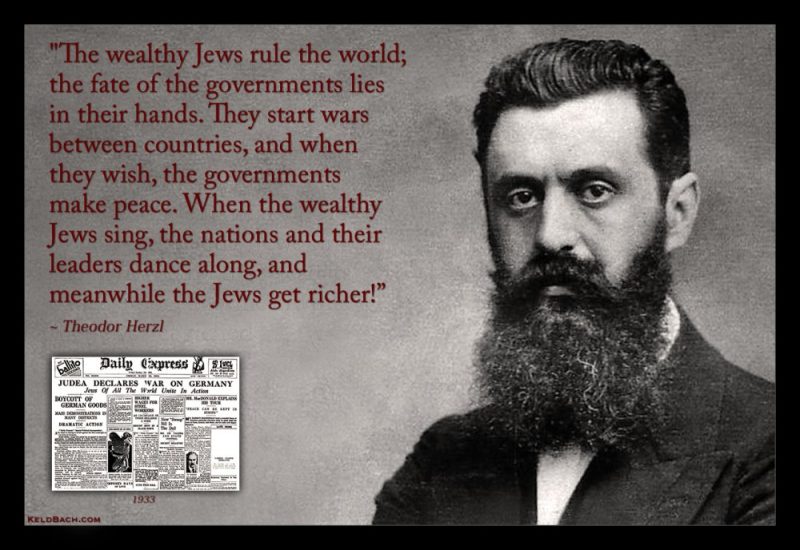
Obviously, I would welcome AJC’s further investigation of this. It would be interesting to learn about the correlation between the Jewish fear of anti Semitsm and Jewish guilt. It would also be fascinating to find out how Jewish anxiety translates into self-reflection. In that regard, I suggest that instead of blaming the American people, Jews try introspection. US Jews may want to follow the early Zionists, such as Theodor Herzl, who turned guilt into self-examination. Herzl was deeply disturbed by anti Semitism but this didn’t stop him from digging into its causes. “The wealthy Jews control the world, in their hands lies the fate of governments and nations,” Herzl wrote. He continued, “They set governments one against the other. When the wealthy Jews play, the nations and the rulers dance. One way or the other, they get rich.” Herzl, like other early Zionists, believed that Jews could be emancipated from their conditions and even be loved globally by means of a cultural, ideological and spiritual metamorphosis with the aspiration of ‘homecoming.’ Herzl and his fellow early Zionists were clearly wrong in their proposed remedy for the Jewish question, but were absolutely spot on in their adherence to self-reflection and harsh self-criticism.
American Jews have much to learn from Herzl and other early Zionists. They should ask themselves how their American ‘Golden Medina’ their Jewish land of opportunities, has turned into a ‘threatening’ realm. What happened, what has changed in the last few years? Was it the constant cries over anti-Semitism and the desperate and institutional attempts to silence critics that turned their Golden Medina into a daunting space?
U.S. Universities Bow to Pressure
President Trump’s Education Department now says that protesting Israel is a “hate crime.” Incredibly many colleges and universities are bowing to pressure to limit activities of the BDS movement.
By Philip Giraldi | American Free Press | October 24, 2019
The Israel lobby in the United States and its counterparts in Europe have been paying particular attention to curtailing the activities of the Boycott, Divestment, and Sanctions movement (BDS). This is because BDS, which is non-violent and based on established human rights principles, is extremely appealing to college students, who will be tomorrow’s leaders. Israel, which promotes its own largely fictional narrative about itself, is reluctant to allow any competing stories about its foundation and current activities, so it has worked hard to exclude any and all criticism of its practices on college campuses and even among students in public high schools.
Unfortunately, many colleges and universities are all too ready to compromise their principles, such as they are, whenever a representative of Israel or of Jewish groups comes calling. A popular line that has proven to be particularly effective is that Jews on campus feel threatened whenever anyone advocates for the Palestinians or Iranians, intended to convey that their civil rights are being violated.
Even if that type of allegation is actually relevant to whether or not one allows free speech and association, one wonders how violated the Palestinians and Iranians must feel when confronted by the endless stream of hostility emanating from the U.S. media and Hollywood as well as from select politicians representing both parties and the White House.
In the most recent manifestation of suppression of views critical of Israel, the federal government’s Department of Education has ordered Duke University and the University of North Carolina at Chapel Hill to reorganize the Consortium for Middle East Studies program run jointly by the two colleges based on their failure to include enough “positive” content relating to Christianity and Judaism. The demand came with a threat to suspend federal funding of Title VI Higher Education Act international studies and foreign language grants to the two schools if the curriculum is not changed.
Of course, the demands have nothing to do with Christian groups demanding inclusion and everything to do with organized Jewish pressure to present Israel in a positive light while also casting aspersions on the Jewish state’s perceived enemies in the region and also on university campuses. Anyone who has even cursory knowledge about the Middle East knows that Christians and Jews constitute only a tiny minority in the region, so the emphasis on teaching about Islam, the Arabs, and the Persians makes sense if the instruction is to have any actual relevance.
One particular event that apparently led to an earlier investigation in June launched by the Education Department consisted of a conference in March called “Conflict Over Gaza: People, Politics, and Possibilities.” A Republican congressman was outraged by the development and asked Education Secretary Betsy DeVos to investigate because the gathering was full of “radical anti-Israel bias.”
Even The New York Times acknowledged in their coverage of the story that “Betsy DeVos, the education secretary, has become increasingly aggressive in going after perceived anti-Israel bias in higher education.” Her deputy—who has served as a focal point for the effort to root out anti-Israel sentiment—is Assistant Secretary of Civil Rights Kenneth L. Marcus, who might reasonably be described as “a career pro-Israel advocate.”
Marcus is the founder and president of the Louis D. Brandeis Center for Human Rights Under Law, a foundation that he has used to exclusively defend the rights of Jewish groups and individuals against BDS and other manifestations of Palestinian pushback against the Israeli occupation of their country. He has not hesitated to call opponents anti- Semites and has worked with Jewish students to file civil rights complaints against college administrations, including schools in Wisconsin and California. In an op-ed that appeared, not surprisingly, in The Jerusalem Post, he observed that even when student complaints were rejected, they created major problems for the institutions involved. “If a university shows a failure to treat initial complaints seriously, it hurts them with donors, faculty, political leaders, and prospective students.”
Last year Marcus reopened an investigation into alleged anti-Jewish bias at Rutgers University that the Obama administration had closed after finding that the charges were baseless. Marcus indicated that the re-examination was called for, as his office in the Education Department would henceforth be using the State Department definition of anti-Semitism that includes “denying the Jewish people their right to self-determination,” making much criticism of Israel a hate crime.
In the current North Carolina-Duke case, DeVos and Marcus expressed concern over course content that had “a considerable emphasis placed on understanding the positive aspects of Islam, while there is an absolute absence of any similar focus on the positive aspects of Christianity, Judaism, or any other religion or belief system in the Middle East.” The complaint called for balancing content relating to “the historic discrimination faced by, and current circumstances of, religious minorities in the Middle East, including Christians, Jews, Baha’is, Yazidis, Kurds, Druze, and others.”
Zoha Khalili, a staff lawyer at Palestine Legal, explained how the message coming from Washington is actually quite simple and has nothing to do with balance: “They really want to send the message that if you want to criticize Israel, then the federal government is going to look very closely at your entire program and micromanage it to death. . . . [It] sends a message to Middle Eastern studies programs that their continued existence depends on their willingness to toe the government line on Israel.”
The possible consequences are very clear. If you are an educational institution that criticizes Israel in any way, shape or form, you will lose any funding you receive from the federal government. The move has nothing to do with budgetary demands or the national security of the United States or even with the efficacy of the programs that are being funded. It has everything to do with promoting Israeli interests. That a demonstrated and outspoken Israeli advocate like Marcus should be placed in a key position to decide who gets what based on his own biases is a travesty, but it is something that we should all be accustomed to by now, as there is apparently no limit to what the Trump administration is willing to do for Israel and for that monstrous country’s powerful, wealthy, and incessantly vocal supporters in the United States.
Lecturing the ‘peons’? Pelosi blames voter disenchantment on outside forces who ‘poisoned’ social media
RT | October 27, 2019
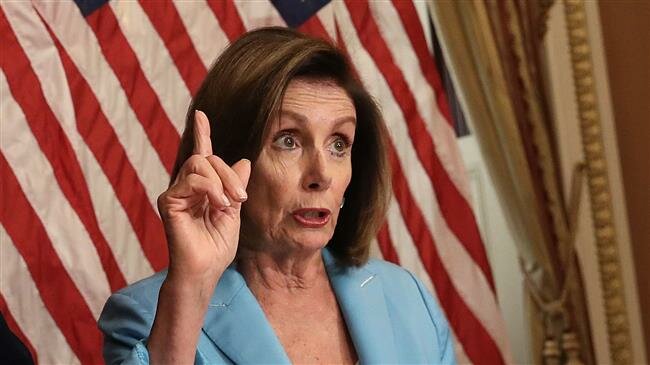
Dark forces have tainted social media and turned optimistic, hopeful, Americans into unhappy voters, Nancy Pelosi has conveniently claimed. The House Speaker’s explanation for the current political mood did not impress Twitter.
The senior Democratic lawmaker told a crowd in Iowa on Saturday that any negative or ambivalent feelings about US politics likely stems from actors “inside and outside” the country who have “poisoned” social media.
[They use social media to] undermine the mindset of what is America. America is optimistic, entrepreneurial, about the American dream and things can be better. And what they do with their poison is discourage – ‘nobody is paying attention to you, it’s no use for you to vote.’
Paraphrasing Pelosi’s rather disjointed remarks, journalist Michael Tracey noted: “So if social media makes you pessimistic, you are the victim of ‘interference’ rather than a critical thinker.”
Her comments elicited considerable internet heckling, with Twitter users accusing Pelosi of deflecting criticism of her party.
Others suggested that Pelosi was just bitter that social media users don’t take orders from her “oligarch masters” – making the platforms far harder to control than traditional news outlets.
With Little Fanfare, William Barr Formally Announces Orwellian Pre-Crime Program
By Whitney Webb | MintPress News | October 25, 2019
Last Wednesday, U.S. Attorney General William Barr issued a memorandum to all U.S. attorneys, law enforcement agencies and top ranking Justice Department officials announcing the imminent implementation of a new “national disruption and early engagement program” aimed at detecting potential mass shooters before they commit any crime.
Per the memorandum, Barr has “directed the Department [of Justice] and the FBI to lead an effort to refine our ability to identify, assess and engage potential mass shooters before they strike.” The Attorney General further described the coming initiative, slated to be implemented early next year, as “an efficient, effective and programmatic strategy to disrupt individuals who are mobilizing towards violence, by all lawful means.” More specific information about the program is set to follow the recent memorandum, according to Barr, though it is unclear if that forthcoming document will be made public.
Barr also requested that those who received the memorandum send their “best and brightest” to a training conference at FBI headquarters this coming December where the DOJ, FBI and “private sector partners” will prepare for the full implementation of the new policy and will also be able to provide “new ideas” for inclusion in the program.
Perhaps the most jarring aspect of the memorandum is Barr’s frank admission that many of the “early engagement” tactics that the new program would utilize were “born of the posture we adopted with respect to terrorist threats.” In other words, the foundation for many of the policies utilized following the post-9/11 “war on terror” are also the foundation for the “early engagement” tactics that Barr seeks to use to identify potential criminals as part of this new policy. Though those “war on terror” policies have largely targeted individuals abroad, Barr’s memorandum makes it clear that some of those same controversial tactics will soon be used domestically.
Barr’s memorandum also alludes to current practices by the FBI and DOJ that will shape the new plan. Though more specifics of the new policy will be provided in the forthcoming notice, Barr notes that “newly developed tactics” used by the Joint Terrorist Task Forces “include the use of clinical psychologists, threat assessment professionals, intervention teams and community groups” to detect risk and suggests that the new “early engagement program” will work along similar lines. Barr also alludes to this “community” approach in a separate instance, when he writes that “when the public ‘says something’ to alert us to a potential threat, we must do something.”
However, the memorandum differentiates suspected terrorists from the individuals this new program is set to pursue. Barr states that, unlike many historical terrorism cases, “many of today’s public safety threats appear abruptly and with sometimes only ambiguous indications of intent” and that many of these individuals “exhibit symptoms of mental illness and/or have substance abuse problems.”
Thus, the goal of the program is ostensibly to circumvent these issues by finding new and likely controversial ways to determine intent. As will be shown later in this report, Barr’s recent actions suggest that the way this will be accomplished is through increased mass surveillance of everyday Americans and the use of algorithms to analyze that bulk data for vaguely defined symptoms of “mental illness.”
Barr also suggested the likely courses of action that would follow the identification of a given individual as a “potential mass shooter.” The Attorney General notes that in past cases individuals deemed a violent or terroristic threat before they commit a crime are subject to “detention, court-ordered mental health treatment, substance abuse counseling, electronic monitoring”, among other measures. Ostensibly, the new program would then apply these same practices to individuals in the U.S. that federal authorities believe are “mobilizing towards violence,” as Barr put it.
Bill Barr’s been busy
The memorandum, despite heralding a new era of Orwellian surveillance and “pre-crime” on a national level, has been sparsely covered by the mainstream media. One of the few reports that did cover the new Justice Department policy, published Wednesday by the Huffington Post, framed the new Barr-led initiative as largely positive and asserted that the “anti-terror tactics” to which Barr alluded could “help thwart mass shooters.” No mention was made in the piece of the threat such a program is likely to pose to civil liberties.
Furthermore, no mention was made of Barr’s clear push over the past few months to lay the groundwork for this recently announced program. Indeed, since becoming Attorney General under President Trump, Barr has spearheaded numerous efforts to this end, including pushing for a government backdoor into consumer apps or devices that utilize encryption and for a dramatic increase of long-standing yet controversial warrantless electronic surveillance programs.
On July 23rd, Barr gave the keynote address at the 2019 International Conference on Cyber Security (ICCS) and mainly focused on the need for consumer electronic products and applications that use encryption to offer a “backdoor” for the government, specifically law enforcement, in order to obtain access to encrypted communications as a matter of public safety.
Barr went onto say that “warrant-proof encryption is also seriously impairing our ability to monitor and combat domestic and foreign terrorists.” Barr stated that “smaller terrorist groups and ‘lone wolf’ actors” — such as those involved in the series of mass shootings in California, Texas and Ohio that occurred in the weeks after his speech — “have turned increasingly to encryption.” Barr later noted that he was specifically referencing encryption used by “consumer products and services such as messaging, smartphones, email, and voice and data applications.”
To overcome the resistance by some private companies — who do not want to renege on their right to privacy by giving the government backdoor access to their devices — and American consumers, Barr tellingly anticipated “a major incident may occur at any time that will galvanize public opinion on these issues.” Shortly after this speech, several mass shootings, including one at an El Paso Walmart took place, which again brought the issue to the forefront of political discourse.
As MintPress reported at the time, Barr’s uncanny prediction and a litany of other oddities related to the El Paso shooting left many answered questions about the FBI’s foreknowledge of the event. In addition, the tragedy did appear to serve as the very “galvanizing” event that Barr had anticipated, as the solution offered by President Trump in the wake of the shootings was the creation of a government backdoor into encryption as well as calling for the very pre-crime system Barr formally announced just last week.
The pre-crime dragnet takes shape
More recently, Barr and U.K. Home Secretary Priti Patel signed a data access agreement on October 3rd that allows both countries to demand electronic data on consumers from tech companies based in the other country without legal restrictions. It is the first executive agreement reached as part of the controversial Clarifying Overseas Use of Data Act or CLOUD Act passed by the U.S. Congress last year.
The CLOUD Act has come under fire from rights groups who have warned that the legislation gives “unlimited jurisdiction to U.S. law enforcement over any data controlled by a service provider, regardless of where the data is stored and who created it” and that this also “applies to content, metadata, and subscriber information”, including private messages.
Yet, Barr and Patel claimed that the data access agreement will instead “enhance” civil liberties and further asserted that the agreement would be used to go after “pedophiles” and “organized crime”, even though both Barr and his U.K. equivalent have shown minimal interest in pursuing the co-conspirators of child sex trafficker and pedophile Jeffrey Epstein, whose sex trafficking network has been linked to both organized crime and the intelligence agencies of both the U.S. and Israel. Some have charged that the lack of interest on the part of William Barr is due to the fact that Barr’s father once hired the now deceased pedophile.
Notably, Jeffrey Epstein also had an apparent interest in pre-crime technologies, and was a key funder of the controversial technology company Carbyne911, along with former Israeli Prime Minister and close Epstein associate Ehud Barak. Carbyne911 is one of several Israeli companies that market their software products to the U.S. as a means of reducing mass shootings and improving the response times of emergency service providers. These companies boast numerous and troubling connections to the governments and intelligence communities of both the U.S. and Israel. Epstein, himself linked to the intelligence apparatuses of both nations, invested at least $1 million in Carbyne911 through a “data mining” company he controlled.
As was detailed in a recent MintPress exposé on these companies, Carbyne911 and similar companies extract any and all data from consumer smartphones for merely making emergency calls and then use it to “analyze the past and present behavior of their callers, react accordingly, and in time predict future patterns,” with the ultimate goal of smart devices making emergency calls to the authorities, as opposed to human beings.
Data obtained from these software products, already used by several U.S. counties and slated to be adopted nationwide as part of a new national “next generation” 911 system, will then be shared with the same law enforcement agencies who will soon be implementing Barr’s “national disruption and early engagement program” to target individuals flagged as potentially violent based on vague criteria.
Notably, following the El Paso shooting, President Trump has been mulling the creation of a new federal agency known as HARPA that would work with the Department of Justice to use “breakthrough technologies with high specificity and sensitivity for early diagnosis of neuropsychiatric violence,” specifically “advanced analytical tools based on artificial intelligence and machine learning.” The data to be analyzed would be harvested from consumer electronic devices as well as information provided by health-care providers to identify who may be a threat.
It is important to point out that such initiatives, whether HARPA or Barr’s newly announced program, are likely to define “mental illness” to include some political beliefs, given that the FBI recently stated in an internal memo that “conspiracy theories” were motivating some domestic terror threats and a series of questionable academic studies have sought to link “conspiracy theorists” to mental illnesses. Thus, the Department of Justice and “mental health professionals” have essentially already defined those who express disbelief in official government narratives as both a terror threat and mentally ill — and thus worthy of special attention from pre-crime programs.
Sleepwalking into a nightmare
This widely overlooked background is crucial to understanding William Barr’s recent memorandum and the massive and greatly underreported shift in the policy it heralds. Over a period of several months, Barr — aided by “private sector partners” as well as other current and former government officials — has been laying the groundwork for the system he has now formally announced.
Through the software products offered by companies like Carbyne911 and through Barr’s personal crusade to mandate government backdoors into encrypted software and products, Barr’s new pre-crime program already has the tools for the mass extraction and storage of consumer data by means of both private tech companies and public services like emergency call centers.
Through the already drafted plan for HARPA and its proposed solution to identifying “mental illness” via artificial intelligence and machine learning, this newly announced “pre-crime” program will have the means to analyze the mass of data harvested from consumer electronic devices from Carbyne and other means using vague “mental health criteria.”
While many of the specifics of the program remain unknown, the actions of Barr and others in government and private sectors show that this newly announced initiative is the product of years of careful planning and many of the tactics and tools it is poised to use have been in the works for months and even years.
In recent decades, and especially after the September 11 attacks, Americans have quietly traded an increasing number of civil liberties for increased government “counter-terrorism” programs and wars purportedly waged to “keep us safe.” Now, those same policies used to target “terrorists” are set to be used against ordinary Americans, whose electronic lives and communications are now set to be scoured for evidence of “mental illness.” If these untransparent algorithms flag an individual, that could be enough lead to court-ordered “mental health treatment” or even imprisonment regardless of whether or not a crime was committed or even planned.
As a consequence, William Barr’s coming “pre-crime” program is arguably worse than the stuff of dystopian science fiction novels and films as it not only aims to detain Americans who have committed no crime but will expressly target individuals based on their use of electronic consumer products and the contents of their communications with their friends, family, co-workers, and others.
Whitney Webb is a MintPress News journalist based in Chile. She has contributed to several independent media outlets including Global Research, EcoWatch, the Ron Paul Institute and 21st Century Wire, among others. She has made several radio and television appearances and is the 2019 winner of the Serena Shim Award for Uncompromised Integrity in Journalism.
Banning ‘sexist’ language won’t make sexism disappear, any more than banning racial slurs killed racism
RT | October 23, 2019
A Massachusetts congressman wants to end sexism by punishing sexist language – specifically the word “b***h” – with fines and even jail. But policing speech doesn’t kill the underlying sentiment – that requires real social change.
Massachusetts Democrat Daniel Hunt’s bill to ban the “b-word,” fining offenders $150 on the first offense and $200 or six months in prison if they can’t stop saying it, sounds like the kind of joke conservatives might make to poke fun at the uber-liberal Bay State. But the bill – titled ‘An act regarding the use of offensive words’ – is real. Worse, any witness to the use of the word can complain.
A person who uses the word ‘bitch’ directed at another person to accost, annoy, degrade or demean the other person shall be considered to be a disorderly person.
Hunt’s bill, which he insists was submitted at the request of a constituent, is far from the only example of the Democratic Party clutching its pearls over speech while giving the sentiment beneath that speech a pass. A vocal segment of the Left has become notorious as America’s “speech police,” calling out offenses real and imagined on social media and inciting outrage mobs to force apologies out of celebrities and businesses, sometimes sincere but often perfunctory and defensive.
Criminalizing “sexist” language to curb sexism reverses cause and effect. Martin Luther King Jr. wouldn’t have gotten very far during the Civil Rights era had he merely strove to end the use of racial slurs in order to achieve equality for the races. Such words are no longer acceptable to use because of significant organizing, marching, and other forms of protest from sit-ins to boycotts. Social change comes first – language is just a reflection of societal norms.
Yet liberals seem to have forgotten even that. College students and professors at the University of Connecticut turned out in protest earlier this week, demanding the arrest of two students who were overheard calling each other racial slurs in a vulgar word game. The mob didn’t stop to realize that the slur – once a commonplace insult directed at black people – is now considered an obscenity thanks to the strides American society has made toward equality. The students were using it to shock – rather like someone yelling “b***h” in a public place.
Politicians should have a better grasp of history than college students, but this is not always the case. Earlier this week, Democratic congressman Al Green pounced on President Donald Trump for comparing his impeachment probe to a “lynching.” Green, who is black, excoriated the president for appropriating his racial history – even though the word simply means an extrajudicial execution by a mob, and Democrats used it to defend their own president Bill Clinton during his impeachment in 1999.
Green’s histrionics allowed Congress to avoid addressing the president’s point – that his impeachment investigation was proceeding at record speed, with little regard for legal precedent, and that it put future presidents in jeopardy. This is the usual outcome of speech-policing: bringing down an outrage mob on the head of whoever used the forbidden word, while utterly obscuring the context and negating any point they may have been making.
It’s not that there isn’t room for improvement in the US with regard to gender and racial equality. Congress – should it desire – could pass laws to help reduce the racial disparities in criminal convictions and sentencing, instead of demanding (in California, at least) that felons be referred to as “justice-involved persons” so as not to offend their delicate sensibilities.
It could mandate paid maternity leave like the rest of the developed world, giving women more opportunities to advance in the workplace without penalizing them for giving birth; instead, some states (California again) mandate “de-gendering” of job titles like postman, policeman, and fireman. But playing speech-police is the easy way to signal virtue, while changing social norms is difficult.
Massachusetts’ ‘b***h bill’ is clearly unconstitutional, civil rights attorney Harvey Silverglate told the Herald, and fortunately Hunt is getting some pushback from his fellow legislators. Given the current state of affairs, though, it’s only a matter of time before the speech police strike again.
Survey claims Americans want government-imposed press restrictions & curbs on free speech
© Reuters / Michael Dadler
RT | October 24, 2019
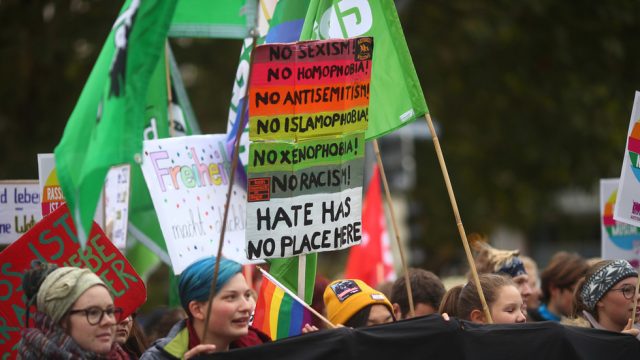
Some Americans are having second thoughts about the First Amendment, a new survey has found. Over half are calling for it to be rewritten, and some 61 percent believe there should be limits on freedom of speech.
The First Amendment, which guarantees Americans freedom of speech, should be overhauled to reflect current cultural norms, according to 51 percent of the respondents to a survey published on Wednesday by the Campaign for Free Speech. The campaign is hoping to call attention to the dire state of Americans’ preeminent civil right with the poll, which breaks down opposition along gender, race, class, and educational lines.
The younger respondents were, the more they supported overhauling the law to restrict speech. However, college graduates were the least likely of all educational groupings to support the restrictions, indicating that the increasingly regulated speech environment at American universities may be backfiring in some cases and producing adults who cherish their rights because they know what it’s like to be deprived of them.
Over half of millennials believe “hate speech” should be against the law, though no definition of “hate speech” was given (and indeed the definition tends to vary given the time and place). Most of those who want a ban on such speech consider jail time an appropriate penalty – though female respondents were the least supportive of such draconian sentencing.
And it isn’t just ordinary speech that Americans want restricted – 57 percent support government action against “newspapers and TV stations that publish content that is biased, inflammatory, or false,” with nearly half of those agreeing such offenses should carry a jail sentence. The media is not particularly well-liked in 2019, with the average American trusting the press less even than lawyers and members of Congress, and people over 65 years-old were the only group in which the majority opposed punitive government regulation.
Alternative media were the only outlets that escaped the scorn of the majority – just 36 percent agreed that the government should review online content. Even Facebook, hardly expected to be a bastion of openness, saw just 49 percent agree that the platform should censor “offensive speech.” Interestingly, millennials and Generation Z were the most supportive of a censor-free Facebook, with some 47 percent of 18 to 34 year-olds telling CEO Mark Zuckerberg to get his hands off their content.
The survey did some digging into what people believe constitutes the kind of hate speech that the government should regulate, and the results were illuminating. “Racists” were the least popular group, with 52 percent calling for a government crackdown on their utterances, followed closely by neo-Nazis, who were loathed by half the respondents. Radical Islamists were not a priority for anyone but the middle class and those with just a high school education. Holocaust deniers rankled just 35 percent, while anti-vaccine advocates and climate-change deniers were an issue for a fifth or less of the population. Some 37 percent of respondents didn’t think any of those groups should be banned from speaking – a figure that climbed to 42 percent among college graduates.
The 1,004 respondents were not categorized politically, though that might have provided an explanation for some of the more intriguing statistics that suggested college graduates oppose restrictions on so-called hate speech.
College conservatives are crying foul at what they believe are the stifling speech restrictions enacted on modern campuses. In Connecticut, a coalition of Republicans at 22 schools is demanding political ideology be added to the list of protected attributes in schools’ discrimination codes after two allegedly racist incidents at the University of Connecticut sparked calls for stricter ‘hate speech’ codes on campus.
Meanwhile, state schools in Idaho, Michigan and Tennessee are urging professors not to grade writing on its quality, lest they somehow impose “white language supremacy” on their students. Controversial speakers have sparked riots at the University of California at Berkeley, while Evergreen College’s notorious “no whites on campus” day has made headlines two years in a row. The drive to avoid racial hate has inadvertently given rise to its own form of hate, in which any view that deviates from social justice orthodoxy is demonized.
“Hate speech” has also become a cudgel for internet platforms to censor political views they dislike, from slamming criticism of mass immigration as racism to attacking critics of the Israeli government as anti-Semites. YouTube recently enraged its users by proclaiming its devotion to hosting unpopular opinions at the same time it kicked a number of popular but controversial creators off its platform.
YouTube suppressed Tulsi Gabbard search results during Hillary Clinton ‘foreign asset’ row
RT | October 23, 2019
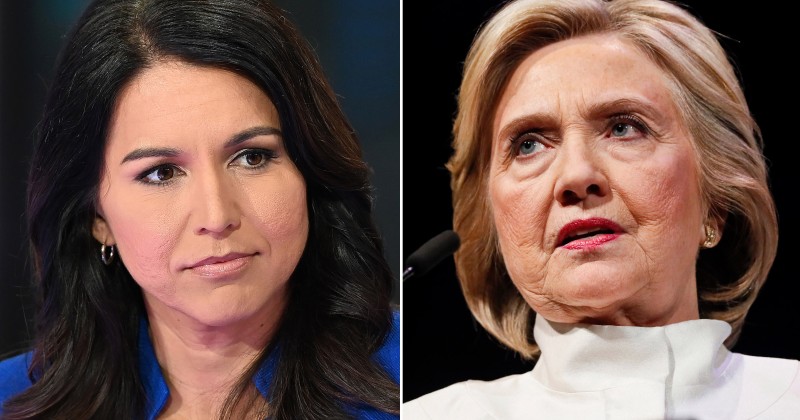
Conservative internet personality Steven Crowder has accused YouTube of suppressing search results for 2020 Democratic hopeful Tulsi Gabbard during her recent spat with former Secretary of State Hillary Clinton.
Following Clinton’s suggestion last Friday that Gabbard (D-Hawaii) was being “groomed” by foreign election-meddlers, the dovish congresswoman shot back with a harsh rebuttal labeling Clinton the “queen of warmongers,” but in a lengthy video posted on Tuesday, Crowder says YouTube concealed her content amid the dispute.
Using a virtual private network (VPN) to observe search results in different countries, Crowder claims to have found evidence the platform demoted Gabbard’s official campaign videos for searches conducted in the US.
The first VPN test was carried out last Friday and compared search results from the US and Spain, showing Gabbard’s channel and videos were buried far below other content in American queries at the height of her feud with Clinton.
A second test two days later, after the Clinton quarrel had calmed down, had a much different outcome, showing similar results between searches attempted in the two countries.
Crowder, who ran afoul of YouTube earlier this year and had his own channel demonetized, claims the platform deliberately throttled Gabbard’s content to limit her message in an attempt at “election meddling.”
Over the summer, Gabbard filed a lawsuit against YouTube’s parent company, Google, alleging the tech giant intentionally blocked her campaign ads on the heels of a Democratic presidential debate that – as shown by Google’s own search analytics – generated intense interest in her candidacy.
A number of conservative commentators weighed in on the allegation, noting the “chilling effect” such suppression could have on anyone challenging “establishment politicians” and the Washington swamp.
“We all knew, now we have proof,” another commenter said.
Some in Crowder’s camp took issue with the claim, however, with New York congressional candidate Joey ‘Salads’ Saladino arguing the comedian failed to prove what he alleged.
Another critic similarly challenged Crowder’s accusation, stating his tests did not show any manipulation of search results, but rather a new feature on YouTube which prioritizes news items curated by its partner “fact checkers” over other videos. While YouTube says the feature was rolled out to combat “misinformation,” it nonetheless raises questions about how the platform chooses which stories to serve up to viewers, at the expense of other content.
Australian media stages front-page ‘blackout’ to protest against govt clampdown on press freedom
RT | October 21, 2019
In a rare show of unity, all major news outlets in Australia have staged a mass protest against increasingly draconian secrecy laws passed by the government, which are infringing on press freedom and the public’s right to know.
Rivals News Corp Australia and Nine, among others, printed front pages which showed blacked-out, ‘redacted’ text emblazoned with red stamps that read “secret.”
The protest was organized by the Right to Know Coalition, with the support of numerous TV, radio, newspaper and digital outlets.
Collectively, the press are arguing against national security laws which are stifling the freedom of the press and, in doing so, creating a “culture of secrecy” in Australia wherein freedom of information requests relating to even the most trivial government affairs are being denied. Some 60 laws relating to secrecy have been passed in the past two decades.
ABC Managing Director David Anderson warned that “Australia is at risk of becoming the world’s most secretive democracy.” The Australian media argue the government is trying to penalize whistleblowing, criminalize journalism, and infringe upon the public’s right to know.
The protest comes after a series of high-profile raids on the offices of the Australian Broadcasting Corporation (ABC) and the home of a News Corp Australia journalist following the publication of articles detailing alleged war crimes and domestic spying carried out by the government.
Three journalists may face prosecution following the raids for their part in the whistleblower articles’ publication.
During these press investigations, it was revealed that the Australian Secret Intelligence Service had bugged the offices of Timor-Leste officials during a multimillion-dollar resource negotiation in 2004.
Meanwhile, Australian Tax Office whistleblower Richard Boyle is facing up to 161 years in prison for revealing abuse of powers by the Australian tax authority apparatus.
Prime Minister Scott Morrison said that while press freedom was important, it is still subject to the rule of law, adding that “no one was above the law.”
“That includes me, or any journalist, or anyone else.”
A press freedom inquiry is under way, the findings of which will be revealed in parliament next year. The media are fighting for the right to challenge government applications for warrants against journalists, while calling for freedom of information and defamation law reform, and the introduction of special protections for journalists and public sector whistleblowers.
Featured Video

AIDS Inc. by Gary Null (2007)
or go to
Aletho News Archives – Video-Images
From the Archives
Clash of Civilization, Iran Part II
By Jamal Kanj – Intifada-Palestine.com – January 14, 2011
Israel’s survival kit is: perpetuate conflict, insecurity to rationalize collective hate and finally playing victim.
Devoid of conflict, Israel implodes internally; without hate, Zionism loses its justification; and playing eternal victim to continue blackmailing the West. Absence of this holy trinity, Israel ceases to exist.
From its inception, the house of Zion has mastered exploiting adversarial powers to advance Israel’s cause. For instance, their influence over the Democratic Party in the US began with President Truman’s bid for 2nd term election in 1948.
Responding to strong opposition from Secretary of State General George Marshall and Department experts urging against recognition of Israel, President Truman replied: “I’m sorry gentlemen but I have to answer to hundreds of thousands [Jewish voters] who are anxious for the success of Zionism. I do not have hundreds of thousands of [voting] Arabs among my constituents”
Zionists influence over liberal American politics was matched with the doctrinal school of Conservative theoreticians aligning the Republican Party’s platform with Israel’s objectives. The Neoconservative Zionists, coined Zioncons, invented the “Clash of Civilization” concept to fight Israel’s wars. … continue
Blog Roll
 Aletho News
- Merck Virologists Admitted to Falsely Certifying Vaccine Efficacy
- Mandatory Folic Acid for every man, woman & child
- Pro-Palestine protesters arrested outside UK’s ruling Labour Conference in Liverpool
- Mauritius denies landing permit to flight from Israel, forcing cancellation: Tour operator
- Israeli finance minister calls for genocidal war on West Bank, annexation of south Lebanon
- 12 Things Your Psychiatrist Was Trained Not to Tell You
- From Unipolar Universalism to Multipolar Civilizational Distinctiveness
- RSF military group defects, joins Sudanese army: State media
- Ireland goalkeeper refuses to play ‘Israel’ as squad weighs boycott
- China pushes back against US on Cuba, Iran
- If Americans Knew
- Israel forces Gazans to live in constant peril – Daily Update
- Deconstructing Netanyahu’s pants-on-fire UN rant – Daily Update
- Trump betrayed voters with his campaign lies and prioritized a foreign country once he took office
- Netanyahu calls Israel’s war in Gaza ‘opposite of genocide’ in UN speech to near-empty hall
- Settler Kidnappings: Torture, Sexual Abuse and Terrorisation of Palestinian Abductees as Israel Deepens Annexation of West Bank
- Gaza winter nears as 162,000 tents become unusable, raising fears of humanitarian crisis
- Netanyahu says, “It’s the opposite of genocide”; UN says Gaza economy is world’s ‘most severe crisis on record’ – Daily Update
- Israel’s US-Backed Assault on Gaza Has Created the ‘World’s Most Severe Economic Crisis on Record’: UN
- ‘Protecting U.S. Citizens’… From Israel
- ‘This is where I live now, the back of a truck’: a day in the life of a grandmother in Gaza
- No Tricks Zone
- New Study: Earth And Venus Surface Warmth Largely Explained By Convection And Lapse Rate, Not CO2 Or Radiation
- 2025 Nature Paper Claiming Worsening Global Drought Gets RETRACTED …Heavily Flawed
- New Study: ‘Global Drought Shows No Detectable Recent Acceleration Under Climate Warming’
- Economic Masterminds: German Socialists Suggest Taxing Productivity Gains Stemming From Using AI
- The South China Sea Has Not Been Cooperating With The Climate Change Narrative
- Energy Crisis: Germany Enters Heating Season With Historically Low Gas Reserve Fill Levels
- New Study: The Antarctic Ice Sheet Gained Mass From 2020-2024 Due To Staggering Snow And Ice Accumulation
- Study: Ocean Heating Rates From Thousands Of Years Ago ‘Dwarf’ Modern Ocean Heating Rates
- Climate Extremists Target, Attack Large-Scale Power Grid Infrastructure In Germany!
- New Study: Antarctic Ice Melt Has Contributed Less Than 1 Centimeter To Sea Level Rise In The Last 30 Years

