YouTube Has Informed Me That It Will Soon Delete The Richie Allen Show Channel

By Richie Allen | February 22, 2018
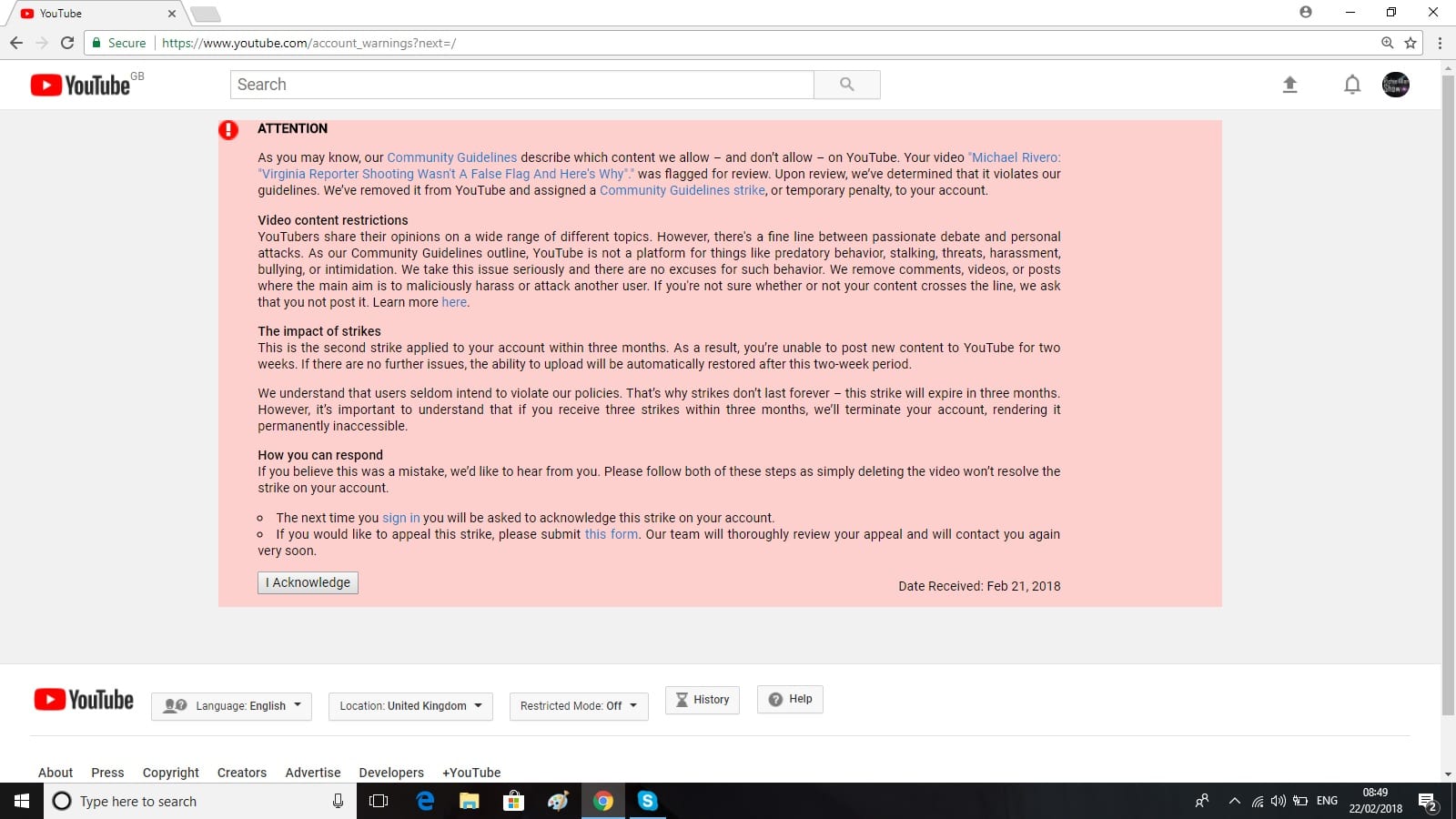
YouTube operates a three strikes and you are out policy. Content creators are told that if they violate community standards three times, their channel and all its content will be deleted. Two weeks ago The Richie Allen Show received a strike. Incredibly, I was informed that I had violated the bullying and harassment guidelines. The video in question was of an interview I conducted with Wolfgang Halbig over two years ago about The Sandy Hook school shooting. There was nothing harassing about it, there was certainly no bullying. I repeatedly challenged Wolfgang in the interview and pressed him for evidence to support his theory. Nevertheless that was strike one. YouTube said that as punishment, I couldn’t live stream for three months. I don’t live stream anyway. But of course I was worried. I had been warned repeatedly, by commercial presenters and producers and former colleagues of mine, that the show would be targeted.
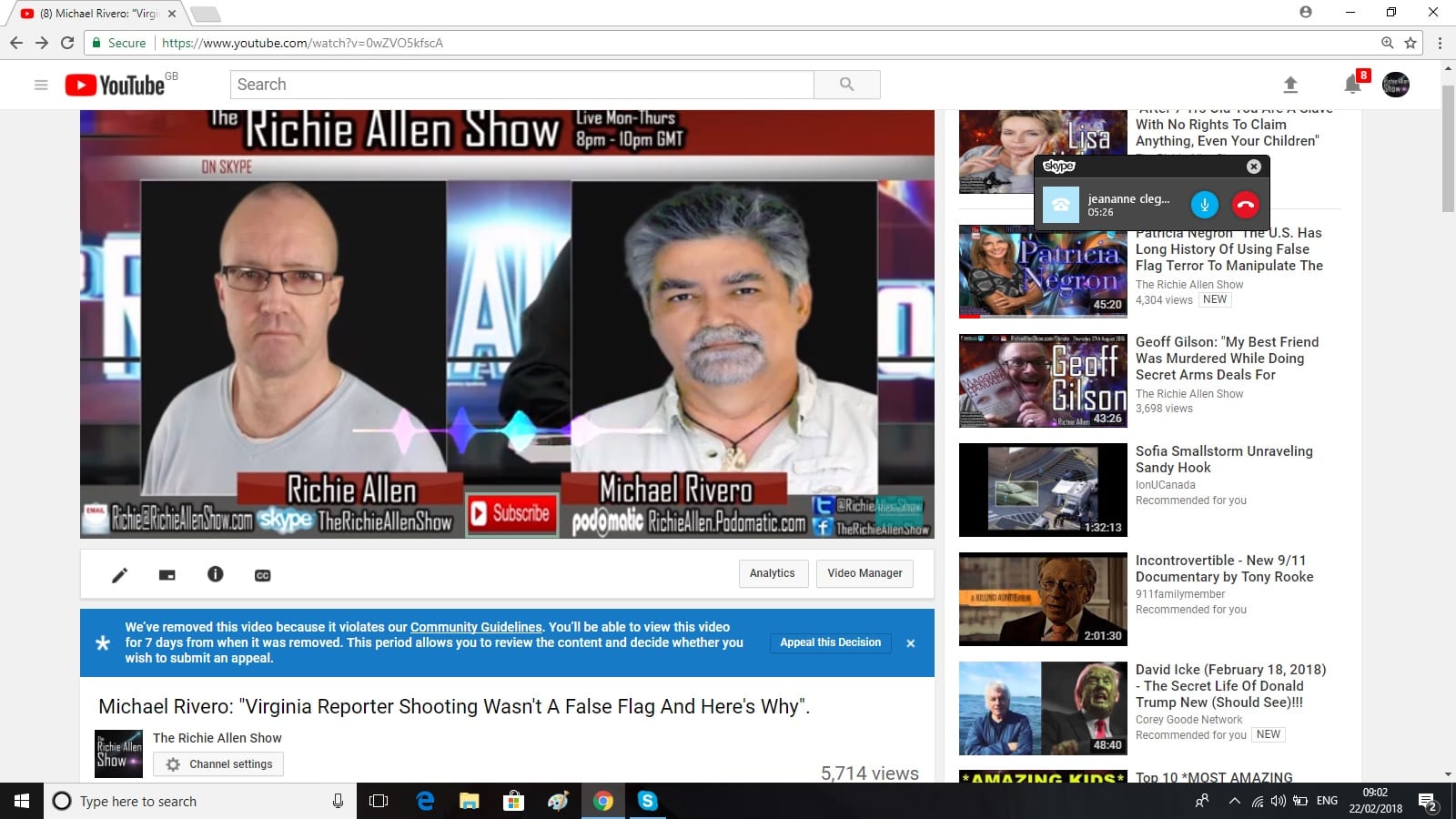 Strike two came this morning. The offending video this time was an interview I did with Michael Rivero about the shooting of journalist Alison Parker and cameraman Adam Ward in Virginia in August 2015. Yes that’s right, YouTube has issued me with a community guideline strike for an interview I uploaded two and a half years ago. Get this, in the interview, Mike clearly states that he does not believe that the shooting was staged or a false flag. Mike talked about the background of the shooter Bryce Williams and what led him to murder the journalists. This morning, YouTube told me that the interview violated its guidelines on bullying and harassment. Again, there was no harassment or bullying. Mike went with the official story, as did I. Tough shit Paddy, that’s strike two. I was told today, that a third strike will see the channel deleted. A third strike is inevitable, as there are 1,400 interviews on the channel which was created in 2014. Oh and the punishment for strike two? We have been banned from uploading content to YouTube for the next three weeks.
This is fascism, this is tyranny, this is terrifying and we knew that this was coming didn’t we? Yes, there are other platforms but Google/YouTube is the only game in town. I could upload elsewhere, but those platforms don’t have the subscribers, it would be a waste of a lot of time for very little reward. The establishment knows this. This is why these monopolies were allowed to develop, so that they could come after shows like The Richie Allen Show when they felt like it. Over the last eighteen months, they have limited the reach of the channel by shadow banning it, in other words making it difficult for users to discover it. They even began demonetising the videos before they had even been published and then re-monetising them after they’d been watched over 5,000 times, meaning by the time the ads went on the vids, most people had watched them. I’ve talked about this and demonstrated it with photographic evidence. Now they’re about to delete the channel, the coup de grace.
 Now I mentioned that colleagues of mine in commercial TV/Radio had warned me that our channel would be specifically targeted. I’ve been warned time and again, but I knew it was coming anyway. Why The RA show specifically? The reason is simple. There is no other show like it in the independent media. We hold ourselves to the highest professional standards, our production values are second to none and uniquely, we put politicians, academics and other journalists on the air and ask them questions that they would never be asked on mainstream media. That has seen the show become the most listened to independent news show in Europe, the most downloaded podcast in news/politics on Podomatic and has seen us listed on Spotify and iheartradio.
Don’t call me arrogant. I am not now and never have been. I worked for and worked with the best producers and presenters in the world. I served my time and bring all that experience to bear on our show, it’s as simple as that. I am not important, the show is not and never has been about me. The information is the star, I’m just a gobby curmudgeonly Irishman, who learned his trade well. It’s always been about the amazing researchers who come on and share their discoveries and it is about getting their information to people who otherwise would be dismissive of conspiracy research. David Icke implicitly understood the importance of bringing mainstream production values to independent radio and the conspiracy research arena. We talked about it often and back in 2014, when he asked me to consider making my own show, produced edited and introduced by me and me alone, he said, “you can make alternative radio sound as good as or better than commercial radio.”
Of course beauty is in the eye of the beholder, ultimately the audience decides whether a show is any good or not, but there is overwhelming evidence here, that someone/something wants to make life very difficult for me, by removing our YouTube channel and deleting over 1,400 archived interviews. Google has served notice on The Richie Allen Show today, that there is no room for a professionally produced radio show, which asks uncomfortable questions and presents credible evidence that challenges the mainstream narrative.
‘Russian bots’ outcry: Is Twitter cracking down on people who ‘challenge the status quo’?
RT | February 22, 2018
It seems that ‘the bots’ (especially the ‘Russian bots’) narrative is being used as a kind of defensive mechanism, journalist and human rights activist Mike Raddie told RT amid reports of a massive account purge on Twitter.
A crackdown on bot spam or dissent?
“The whole meme of the bots, especially the ‘Russian bots,’ is actually being used as a kind of defensive mechanism,” said Mike Raddie. “Whenever people criticize the corporate media in the West – we’ve done it with the Guardian – they come back and say, ‘oh, you’re part of a Russian bot army,’ or a typical question is, ‘what’s the weather like in St. Petersburg? Is it snowing in Moscow yet?’ So it’s a very useful meme for corporate journalists to deflect any kind of criticism, especially over hot topics such as Syria, Ukraine – things like this.”
A number of Twitter accounts are said to have been flagged over the past few days, in what many have speculated is part of the company’s efforts to clamp down on the much-touted army of Russian-controlled automated accounts, or “bots.” However, Twitter has yet to elaborate on the reported mass purge, which allegedly also targeted users with right-wing views – raising concerns of political censorship on the popular social media platform. The hashtag #TwitterLockOut began trending on the site shortly after the suspensions.
“If Twitter has begun this campaign of eliminating or blocking people that have different ideas than the company wants to portray or the message that they want to get out, I think it’s very harming to democracy and freedom of speech,” Christian Mancera, a lawyer and 2018 congressional candidate, told RT. “We have to keep every single channel of communication open, and just because a person has a conservative view doesn’t make that person an enemy, or make that person politically incorrect. So I hope that Twitter comes forward and clarifies.”
Although his own outlet’s Twitter account recently received a 12-hour suspension, allegedly for “criticizing a multi-billionaire,” Raddie suggested that most users who get hit with the ban hammer are likely victims of the company’s “crude algorithm,” and not singled out by an actual Twitter employee. However, he said the company’s recent behavior suggests that when Twitter “sees challenges, serious challenges, to the status quo, they’re likely to limit activity or even block accounts or delete accounts.”
Hunting for ‘Russian links’
Dragged in front of the US Senate last year as part of efforts to expose “Russian influence” in the 2016 presidential elections, Twitter initially revealed that it had identified 201 “Russia-linked” accounts operating on its platform. After Sen. Mark Warner (D-Virginia) expressed disappointment in the anticlimactic findings, Twitter raised its figure to 36,746.
As part of its autumn crackdown, Twitter banned an account owned by an African-American political activist from Atlanta – allegedly for her “links” to Russia. “This whole suppression of voices in using this Russian scare tactic is just way too far,” Charlie Peach, who has absolutely no ties to Russia, told RT back in October.
“In my lifetime I’ve never seen anything like this. I don’t remember the McCarthyism era, obviously, because I’m not that old, but my parents talked to me about it and things that were occurring at the time,” Peach told RT. “It ensures that the 1 percent continues to have a narrative and that anyone who opposes that are no longer allowed to speak. You look at CNN, MSNBC ‒ they gave us the Iraq War. This is what they do. The main media houses that run everything are the ones that continue to push the propaganda and make sure we’re shut down.”
In January, the US Senate Intelligence Committee published answers provided by Twitter, Facebook and Google in response to questions concerning Russia’s alleged use of social media to meddle with American democracy. In its written response, Twitter disclosed that it had identified nine accounts as being “potentially linked to Russia that promoted election-related, English-language content.” Of these nine nefarious accounts “potentially linked” to Russia, “the most significant use of advertising was by @RT_com and @RT_America. Those two accounts collectively ran 44 different ad campaigns, accounting for nearly all of the relevant advertising we reviewed,” according to Twitter. Conspicuously absent from Twitter’s written statement was the fact that the American tech giant traveled to Moscow to pitch a proposal for RT to spend huge sums on advertising for the US presidential election – an offer which RT declined.
‘Shadow ban’ controversy
More recently, in January, conservative journalism watchdog Project Veritas released undercover footage of current and former Twitter staff who appear to admit to silencing conservative voices using “shadow bans” – which block a user or their content from reaching a wider audience without their knowledge.
“We’re giving away an awful lot to these companies, but when they come out and publicly say they want to be the public forum for free speech, yet they’re censoring free speech and they are slanting what free speech can or cannot be heard, then there’s a problem,” Project Veritas executive director Russell Verney told RT.
Read more:
Rachel Notley’s Alliance with the Enemies of Tenure, Peer Review, and Academic Freedom at Alberta’s Universities
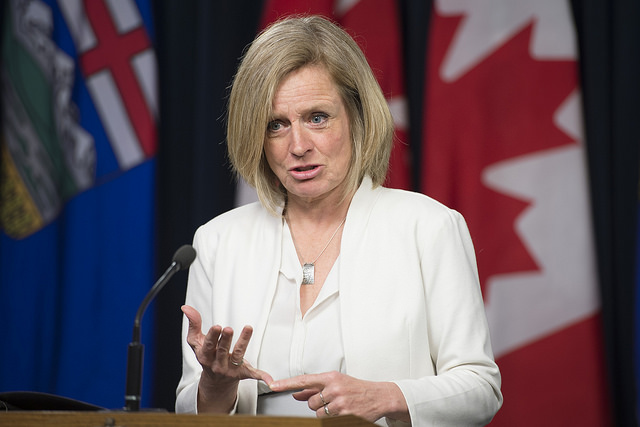
Premier Rachel Notley. Image credit: Premier of Alberta/ flickr
An Open Letter to the NDP Premier of Alberta from Prof. Tony Hall | February 17, 2018
Dear Premier Rachel Notley;
I am writing you this open letter to defend myself against your attack on me personally and professionally. What is the evidentiary basis behind your characterization of my academic work as “repulsive, offensive and not reflective of Alberta”? Why have you decided to set yourself up, Premier Notley, as some sort of arbitrator of what scholarly work in Alberta universities meets the criteria of being “reflective of Alberta”?
Is your opinion about what is or is not reflective of Alberta to become a new test of how curriculum will be created and how faculty members will be chosen in this province? What lies behind your decision to disseminate a caricature of me “standing at the head of the class” in order to “spread lies and conspiracy theories”? [1]
Since I began teaching in the Department of Native American Studies at the University of Lethbridge in 1990, I have never once seen in a student evaluation that reflects the kind of accusations you are pressing publicly on me. How is it you think you know more about me, including and what goes on in my classroom, than my own students?
After a year and a half of being subject to a ruthless trial-by-media, a new process is only now being initiated that from my perspective allows me to come forward for the first time to tell my side of the story before an investigating tribunal operating within the terms of our collective agreement. The process is going forward because of a court contestation that the U of L Board of Governors lost due to its unwillingness to adhere to the laws of labour relations in Alberta. Whose advice was the Board depending on when its members put themselves in such an untenable position?
Before we have even started the process that has come about because of the determined stand of the University of Lethbridge Faculty Association (ULFA) and the Canadian Association of University Teachers (CAUT), you, Premier Notley, chose to inject a politicized salvo into the onslaught of vituperation against me that began on Aug. 26 of 2016.
Here is how the University of Lethbridge Faculty Association described your ill-advised political intervention:
15 Jan., 2018
Re: Premier’s statement re Anthony HallThe Faculty Association wishes to express its disappointment in the Premier’s words. As the union that represents Professor Hall in his employment relationship with the University of Lethbridge, the Faculty Association has endeavoured to have a fair and objective process employed for adjudicating Professor Hall’s academic scholarship and accountability through procedures in the collective agreement. We finally achieved this following significant effort and cost on our part and have a great deal of confidence in the appropriate academic procedures to which Professor Hall is now subject.
Having the Premier draw conclusions about the acceptability of Professor Hall’s academic work prior to any decision rendered by an expert panel of qualified academics has the potential to undermine this very process we have fought to achieve. At worse, though, these words have the real potential to bias the outcome of any such fair and objective process.
The Faculty Association has greatly appreciated the hard work the Premier and her government have done to advance the rights of post-secondary labour. We believe it is a dangerous precedent, however, for elected officials to intervene so directly in a complex labour matter such as this one.Sincerely,
Andrea Amelinckx,
ULFA PresidentCc Honourable Minister M Schmidt
One of the core points I intend to bring forward in my self- defense in the forthcoming process, is to describe the mounting of a negative media campaign against me based on the atrocious contents of a maliciously-engineered Facebook post. According to B’nai Brith Canada, the core agency in orchestrating this media deception, the post appeared on, and then disappeared from, my Facebook wall during an interval of a few hours on Aug. 26, 2016. I did not invite this digital item onto my Facebook wall. I did not sanction its abhorrent contents. In fact I condemned the post’s contents publicly in mid-Sept. when I first became aware of the digital item and the way that it was being deployed to destroy my reputation.
You, Premier Notley, were presented with a deceptive account of my relationship to the Facebook post long before I even knew about the B’nai Brith Canada operation. Recently I learned from the results of a FOIP investigation of the Alberta Ministry of Justice that on Aug. 27, 2016 you and other Alberta cabinet ministers were sent a slanderous account of the Facebook post as if it “came from my lips.” People in the inner circle of your office reported you had seen the communication that slanderously misrepresented me as an “advocate for the murder of Jews.”
If you would actually take a genuine interest in my academic work, Premier Notley, you would realize I have a record of studying all sorts of genocide and condemning this crime against humanity in all its manifestations, including the Jewish Shoah. [2]
Perhaps the people who lied to you about me in late August of 2016 are still holding you captive in terms of filtering the information that has caused you to think whatever it is you believe you know about me. The President of the University of Lethbridge, Dr. Michael J. Mahon, went along with the Facebook deception to suspend this tenured full professor on Oct. 3 and 4, 2016. I was pulled from the classroom in mid-term and banned from stepping foot on campus. This purge took place entirely outside the terms of the collective agreement between the university’s faculty and administration.
This suspension initially without pay essentially declared me guilty until proven innocent. Severe punitive measures were imposed on me all without even an ounce of adjudication by a neutral third-party. From the correspondence I have been receiving from all over the world, I can say my suspension quickly became a shot heard throughout the global academic realm, a shot signaling that an Albertan university is leading an attack on the institutions of tenure, peer review and academic freedom.
Now you have joined in that attack too Premier Notley. You have allied yourself with the position of B’nai Brith Canada, the organization that recently interfered in the leadership race for the new leader of the federal NDP. The same people that set in motion the trial-by-media aimed at me attacked the NDP leadership candidate, Niki Ashton. According to B’nai Brith’s CEO Michael Mostyn, Ms. Ashton’s concern for the violated human rights of Palestinians people made her “an advocate for vile terrorists” and “convicted murders.” It revealed Ms. Ashton’s “defective moral compass.” [3]
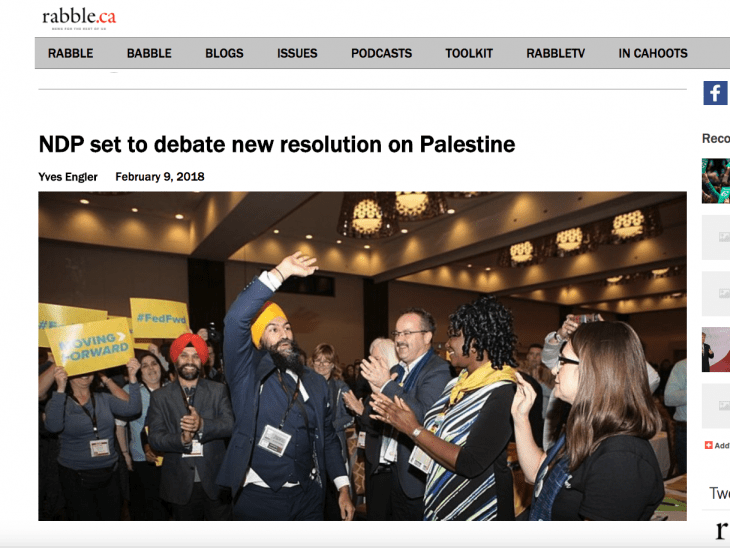
What is your view, Premier Notley, of the condemnation directed at the new NDP federal leader, Jagmeet Singh, when B’nai Brith Canada took aim at him for intervening to provide a venue at the Ontario provincial legislature for a presentation by academic advocates of the rights of educator Nadia Shoufani. The condemnation came in late Augusts of 2016 when Mr. Singh was MLA for the riding of Bramalea-Gore-Malton and Deputy Leader of the Ontario NDP.
At the same time as it was attacking Jagmeet Singh, B’nai Brith Canada was leading the effort to have Ms. Shofani, a Canadian of Palestinian and Christian background, criminalized by police and fired from her teaching job in the Dufferin-Peel Catholic School Board. The criticisms directed at Ms. Shoufani are similar to those directed at Ms. Ashton. Similarly, the effort to criminalize Ms. Shoufani and bar her from the classroom anticipated the similar treatment to which I was about to be subjected. The attack on Ms. Shoufani’s job and her reputation was based on allegations about her supposed “terror-supporting remarks” made in a Quds Day speech in Toronto in July of 2016. [4]
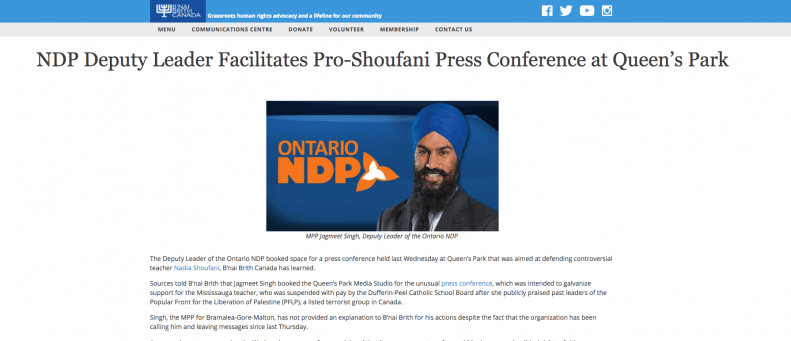
It seems, Premier Notley, your political intervention on the wrong side of the University of Lethbridge case reflects your reactionary alliance with the thought police and speech police at B’nai Brith Canada. Your reactionary stance identifies you with the backward policies of former NDP leader, Tom Mulcair, when he purged pro-Palestinian candidates from the federal election of 2015. This atrocious move was in all probably a significant factor in the disappointing electoral showing of the NDP as it lost its position of Canada’s Official Opposition Party. [5]
Now in Feb. of 2018 B’nai Brith Canada has resumed its efforts to quarterback the NDP, lobbying aggressively to stop a resolution from being put on the floor of the recent NDP convention. The vote, neverthess, was close, 189 for putting the resolution forward and 200 for sidelining it. The resolution included provisions on a Canadian boycott against products produced in the illegal Israeli settlements in the Occupied West Bank.
Those supporting the boycott resolution included the unanimous support of the Young New Democrats, 28 electoral riding associations covering six provinces and many current and former MPs. Geneviève Nevin, a supporter of the resolution from Victoria, observed, “There’s a generational divide on this issue.” In his account of this divide within the NDP, journalist Derrick O’Keefe suggested Jagmeet Singh would be wise to look to the example of Jeremy Corbyn in the UK. Mr. Corbyn has mobilized on behalf of the Labour Party considerable electoral support from his attentiveness to the plight of Palestinian people under Israeli occupation. [6]
By siding so strongly, Premier Notley, with the U of L administration’s collaboration with the Isreal lobby including B’nai Brith Canada and the Centre for Israel and Jewish Affairs, you have identified yourself and your government with agencies that condemned Hassan Diab wrongly as a terrorist. B’nai Brith Canada played a major role in calling for pulling the sociology teacher from his Carleton University classroom in Ottawa. This intervention helped set in notion a miscarriage of justice that saw the Lebanese Canadian academic incarcerated for a decade in Canada and France for a crime he didn’t commit. [7]
You have identified yourself and your government, Premier Notley, with notorious enemies of academic freedom who brought forward during the 50th anniversary of York University all sorts of false allegations much like those I am facing now. This fiasco unfolded when B’nai Brith Canada, the CIJA, the Canadian Jewish Congress and the Jewish Defence League tried to shut down an academic conference on Israel/ Palestine at York University in 2009.
The effort to sabotage this academic initiative was foiled because the York University President, Mamdou Shoukiri, and the York University Board of Governors stood up for the imperatives of academic freedom. [8]
In 2018 in Alberta the equation is very different. The President and Board of University of Lethbridge have adopted the position of the Israel lobby. Now Premier Notley, you have intervened to strengthen this political coalition favouring the stifling of fee and open at Alberta universities. Please consider revisiting you provocative and intellectually bankrupt position on this matter.
Yours Sincerely,
Anthony J. Hall
Professor of Globalization Studies,
University of Lethbridge
Endnotes
[1] Chuck Millar’s Letter to the Alberta Premier—11 January, 2018 at
https://academicfreedomanthonyhall.ca/chuck-millars-letter-to-the-premier-january-11-2018/
Premier Notley indicated on November 24, 2017
There is no question that the views of this individual are repulsive, offensive and not reflective of Alberta. Our classrooms are a place for freedom of speech and expression but that does not mean individuals get to stand at the head of the class and spread lies and conspiracy theories. I am terribly disappointed to learn that this individual has been reinstated, but let me be clear that legislation that our government introduced did not give him his job back. I can confirm that this individual is now under investigation by a committee at the University.”
[2] See, for instance Hall, Earth into Property” Colonization, Decolonization, and Capitalism (Montreal: McGill-Queen’s University Press, 2010), Chapter 14, “Genocide and Global Capitalism,” pp. 655-711
[3] Tony Hall, “Palestinians, B’nai Brith and Canada’s New Democratic Party, Canadian Dimension, 30 July, 2017 at
https://canadiandimension.com/articles/view/palestinians-bnai-brith-and-canadas-new-democratic-party
[4] B’nai Brith Canada, “NDP Deputy Leader Facilitates Pro-Shoufani Press Conference at Queen’s Park,” 24 Aug., 2016 at
http://www.bnaibrith.ca/ndp_deputy_leader_facilitates_pro_shoufani_press_conference_at_queen_s_park
[5] Marion Kawas, “New Democratic Party Purges Candidates over pro-Palestinian positions in lead up to Canadian elections, Mondoweiss, 24 Aug., 2015 at
http://mondoweiss.net/2015/08/democratic-candidates-positions/
[6] Derick O’Keefe, “Palestinian Resolution Narrowly Stopped from Hitting NDP Convention Floor, Richochet, 16 Feb. 2018 at
[7] Judy Haven, “After 10 Years Hassan Diab is Finally Free,” Independent Jewish Voices Canada, at
http://ijvcanada.org/2018/diab-is-finally-free/
[8] Susan G. Drummong, Unthinkable Thoughts, Academic Freedom and the One-State Solution for Israel and Palestine (Vancouver: UBC Press, 2014); Jon Thompson, No Debate: The Israel lobby and free speech in Canadian universities (Toronto: Lorimer, 2011)
***
Dr. Hall is editor in chief of American Herald Tribune. He is currently Professor of Globalization Studies at University of Lethbridge in Alberta Canada. He has been a teacher in the Canadian university system since 1982. Dr. Hall, has recently finished a big two-volume publishing project at McGill-Queen’s University Press entitled “The Bowl with One Spoon”.
Mueller’s Investigation A Farce: Files Joke Indictment Against Russian Trolls
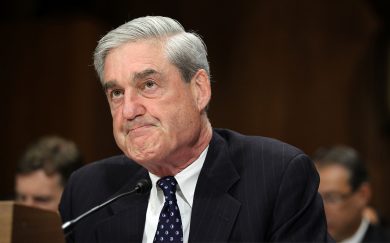
Photo by Alex Wong/Getty Images
By Elizabeth Vos | Disobedient Media | February 16, 2018
If one needed proof that Mueller’s investigation was an utter farce, they were in for a treat this morning when the Deputy Attorney General announced the indictment of indicted 13 “Russian trolls,” for allegedly interfering in the 2016 Presidential election by posting on social media accounts.
Laying Mueller’s disregard of the First Amendment aside, the indictment is blatantly hypocritical in light of active social media intervention by pro-Clinton David Brock and his multi-million dollar efforts to ‘Correct The Record.’
The indictment alleges that: “Beginning in or around June 2014, the ORGANIZATION obscured its conduct by operating through a number of Russian entities, including Internet Research LLC, MediaSintez LLC, GlavSet LLC, MixInfo LLC, Azimut LLC, and NovInfo LLC.”
The indictment further alleges that: “The ORGANIZATION sought, in part, to conduct what it called information warfare against the United States of America through fictitious U.S. personas on social media platforms and other Internet-based media.”
According to the indictment, the co-conspirators “engaged in operations primarily intended to communicate derogatory information about Hillary Clinton, to denigrate other candidates such as Ted Cruz and Marco Rubio, and to support Bernie Sanders and then-candidate Donald Trump.”
The indictment represents the latest mutation of Russian interference allegations that have dragged on for over a year. As this author previously noted, the definition of Russian interference has mutated from unsubstantiated claims of Russian hacking, to Russian collusion, and finally to Russian social media trolling.
The Washington Post reported in 2015 that David Brock’s Correct The Record would work directly with the Clinton Campaign, “testing the legal limits” of campaign finance in the process. How did Correct The Record skirt campaign finance law? The Washington Post tells us: “by relying on a 2006 Federal Election Commission regulation that declared that content posted online for free, such as blogs, is off-limits from regulation.” And post online, Brock’s PAC did: “disseminating information about Clinton on its Web site and through its Facebook and Twitter accounts, officials said.”
Time reported the opinion of a lawyer at the Campaign Legal Center who characterized Correct The Record as: “creating new ways to undermine campaign regulation.” Meanwhile, The New York Times detailed the “outrage machine” that Brock and fellow Clinton supporter Peter Daou had created:
“Peter Daou sat with his team at a long wooden table last week, pushing the buttons that activate Mrs. Clinton’s outrage machine. Mr. Daou’s operation, called Shareblue, had published the article on Mr. Trump’s comment on its website and created the accompanying hashtag.“They will put that pressure right on the media outlets in a very intense way,” Mr. Daou, the chief executive of Shareblue, said of the Twitter army he had galvanized. “By the thousands.”
Going further, the New York Times details fervently the $2 million budget of Daou’s Shareblue and admits that the intent of the entire operation is interference in the outcome of the 2016 Presidential election in favor of Hillary Clinton: “Beyond creating a boisterous echo chamber, the real metric of success for Shareblue, which Mr. Brock said has a budget of $2 million supplied by his political donors, is getting Mrs. Clinton elected. Mr. Daou’s role is deploying a band of committed, outraged followers to harangue Mrs. Clinton’s opponents.”
The New York Daily News put the matter most bluntly: “Hillary Clinton camp now paying online trolls to attack anyone who disparages her online.” The LA Times described the active election interference: “It is meant to appear to be coming organically from people and their social media networks in a groundswell of activism, when in fact it is highly paid and highly tactical.”
Despite the millions of dollars poured into a pro-Clinton ‘outrage machine’ bent on her support, Clinton inexplicably lost the election to Donald Trump, a fact which still seems not to have sunk in for the former First Lady and Secretary of State.
But why bring up this apparently old news, in the face of Mueller’s latest mockery of the American judicial process and the First Amendment? Because it reveals in the words of the legacy press that by definition Mueller’s circus has zero interest in campaign or election integrity and is solely interested in getting scalps for Clinton and for the unelected powers she represented.
Despite obvious hypocrisy given the actions of Shareblue and David Brock’s Correct The Record, corporate media ignored all double standards and attempted to report on “Russian twitter trolling” with a straight face. Business Insider wrote: “Russian Twitter Trolls Tried To Bury Or Spin Negative Trump News Just Before Election,” as if that wasn’t what Correct The Record spent millions on doing for the benefit of Clinton.
The double standards applied to Clinton for her benefit goes beyond hypocrisy. Many have claimed that constantly metamorphosing allegations of Russian interference represents an insidious effort to silence dissent and anti-establishment political discourse: for example, by turning third-party, anti-establishment or conservative voices into “Russians” by proxy of their opposition to Clinton.
By converting legitimate American free speech into insidious “Russian bots,” a pretext is created to silence dissent across the board. Without the Russian interference circus, the efforts to breach the First Amendment would be overtly authoritarian and would be inexcusable even by the most corrupt establishment media standards.
The results of such a clamp-down on free and effective speech have manifested in censorship crackdowns across large social media platforms including Twitter, Youtube, and Facebook, with Twitter admitting to actively censoring roughly 48% of tweets that included the “#DNCEmails” hashtag. It seems anyone with an opinion the establishment doesn’t like is liable to be memory-holed.
Journalist, activist Bushra al-Tawil ordered to another four months in prison without charge or trial

Samidoun Palestinian Prisoner Solidarity Network – February 14, 2108
An Israeli occupation military court issued a renewed four-month administrative detention order against Palestinian journalist and prisoners’ rights advocate Bushra al-Tawil on 12 February 2017. Al-Tawil, 26, from el-Bireh, has been jailed by the Israeli occupation without charge or trial since 1 November 2017. Originally ordered to six months in administrative detention, her detention was reduced on appeal to four months; now, an additonal four-month order has been imposed upon her.
Al-Tawil has been detained on several occasions in the past; she is an active defender of Palestinian rights and works with Aneen al-Qaid, an organization that defends Palestinian prisoners. The new order was issued as a “final” order, which ostensibly means it will not be renewed. Administrative detention orders are usually indefinitely renewable, and Palestinians can spend years at a time in jail with no charge or trial under repeatedly renewed orders.
Al-Tawil’s mother said on Tuesday, 13 February, that local and international silence on the prisoners must end, urging unity in action to free the prisoners. Al-Tawil is one of approximately 450 Palestinians currently jailed without charge or trial under administrative detention, among a total of approximately 6,200 Palestinian political prisoners. Administrative detainees have announced that they will boycott Israeli military courts and administrative detention hearings beginning on 15 February.
Lifting of US Propaganda Ban Gives New Meaning to Old Song
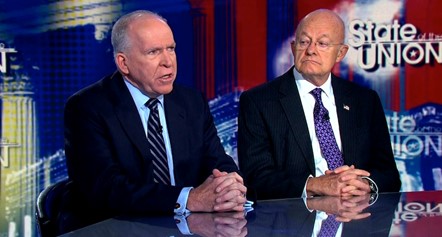
Former Director of National Intelligence James Clapper and former CIA Director John Brennan discuss allegations of Russian influence in presidential elections (CNN Screenshot)
By Whitney Webb – Mint Press News – February 12, 2018
Though its ostensible purpose is to fund the US military over a one year period, the National Defense Authorization Act, better known as the NDAA, has had numerous provisions tucked into it over the years that have targeted American civil liberties. The most well-known of these include allowing the government to wiretap American citizens without a warrant and, even more disturbingly, indefinitely imprison an American citizen without charge in the name of “national security.”
One of the lesser-known provisions that have snuck their way into the NDAA over the years was a small piece of legislation tacked onto the NDAA for fiscal year 2013, signed into law in that same year by then-President Barack Obama. Named “The Smith-Mundt Modernization Act of 2012,” it completely lifted the long-existing ban on the domestic dissemination of US government-produced propaganda.
For decades, the US government had been allowed to produce and disseminate propaganda abroad in order to drum up support for its foreign wars but had been banned from distributing it domestically after the passage of the Smith-Mundt Act of 1948. However, the Modernization Act’s co-authors, Reps. Mac Thornberry (R-TX) and Adam Smith (D-WA, no relation to the Smith of the 1948 act), asserted that removing the domestic ban was necessary in order to combat “al-Qaeda’s and other violent extremists’ influence among populations.”
Thornberry stated that removing the ban was necessary because it had tied “the hands of America’s diplomatic officials, military, and others, by inhibiting our ability to effectively communicate in a credible way.” Yet, given that Thornberry is one of the greatest beneficiaries of weapon manufacturers’ campaign contributions, the real intent — to skeptics at least — seemed more likely related to an effort to ramp up domestic support for US military adventurism abroad following the disastrous invasions of Iraq and Libya.
Five years later, the effects of the lifting of the ban have turned what was once covert manipulation of the media by the government into a transparent “revolving door” between the media and the government. Robbie Martin — documentary filmmaker and media analyst whose documentary series, “A Very Heavy Agenda,” explores the relationships between neoconservative think tanks and media — told MintPress, that this revolving door “has never been more clear than it is right now” as a result of the ban’s absence.
In the age of legal, weaponized propaganda directed at the American people, false narratives have become so commonplace in the mainstream and even alternative media that these falsehoods have essentially become normalized, leading to the era of “fake news” and “alternative facts.”
Those who create such news, regardless of the damage it causes or the demonstrably false nature of its claims, face little to no accountability, as long as those lies are of service to US interests. Meanwhile, media outlets that provide dissenting perspectives are being silenced at an alarming rate.
The effects of lifting the ban examined
Since 2013, newsrooms across the country, of both the mainstream and “alternative” variety, have been notably skewed towards the official government narrative, with few outside a handful of independently-funded media outlets bothering to question those narratives’ veracity. While this has long been a reality for the Western media (see John Pilger’s 2011 documentary “The War You Don’t See”), the use of government-approved narratives and sources from government-funded groups have become much more overt than in years past.
From Syria to Ukraine, US-backed coups and US-driven conflicts have been painted as locally driven movements that desperately need US support in order to “help” the citizens of those countries — even though that “help” has led to the near destruction of those countries and, in the case of Ukraine, an attempted genocide. In these cases, many of the sources were organizations funded directly by the US government or allied governments, such as the White Helmets and Aleppo Media Centre (largely funded by the US and U.K. governments) in the case of Syria, and pro-Kiev journalists with Nazi ties (including Bogdan Boutkevitch, who called for the “extermination” of Ukrainians of Russian descent on live TV) in the case of Ukraine, among other examples. Such glaring conflicts of interests are, however, rarely — if ever — disclosed when referenced in these reports.
More recently, North Korea has been painted as presenting an imminent threat to the United States. Recent reports on this “threat” have been based on classified intelligence reports that claim that North Korea can produce a new nuclear bomb every six or seven weeks, including a recent article from the New York Times. However, those same reports have admitted that this claim is purely speculative, as it is “impossible to verify until experts get beyond the limited access to North Korean facilities that ended years ago.” In other words, the article was based entirely on unverified claims from the US intelligence community that were treated as compelling.
As Martin told MintPress, many of these government-friendly narratives first began at US-funded media organizations overseen by the Broadcasting Board of Governors (BBG) — an extension of the US state department.
Martin noted that US-funded media, like Voice of America (VOA) and Radio Free Europe (RFE), were among the first to use a State Department-influenced narrative aimed at “inflaming hostilities with Russia before it soaked into mainstream reporting.” Of course, now, this narrative — with its origins in the US State Department and US intelligence community — has come to dominate headlines in the corporate media and even some “alternative” media outlets in the wake of the 2016 US election.
This is no coincidence. As Martin noted, “after the ban was lifted, things changed drastically here in the United States,” resulting in what was tantamount to a “propaganda media coup” where the State Department, and other government agencies that had earlier shaped the narrative at the BBG, used their influence on mainstream media outlets to shape those narratives as well.
A key example of this, as Martin pointed out, was the influence of the new think-tank “The Alliance for Securing Democracy,” whose advisory council and staff are loaded with neocons, such as the National Review’s Bill Kristol, and former US intelligence and State Department officials like former CIA Director Michael Morell. The Alliance for Securing Democracy’s Russia-focused offshoot, “Hamilton 68,” is frequently cited by media outlets — mainstream and alternative — as an impartial, reliable tracker of Russian “meddling” efforts on social media.
Martin remarked that he had “never seen a think tank before have such a great influence over the media so quickly,” noting that it “would have been hard to see [such influence on reporters] without the lifting of the ban,” especially given the fact that media organizations that cite Hamilton 68 do not mention its ties to former government officials and neoconservatives.
In addition, using VOA or other BBG-funded media has become much more common than it was prior to the ban, an indication that state-crafted information originally intended for a foreign audience is now being used domestically. Martin noted that this has become particularly common at some “pseudo-alternative” media organizations — i.e., formerly independent media outlets that now enjoy corporate funding. Among these, Martin made the case that VICE News stands out.
After the propaganda ban was lifted, Martin noticed that VICE’s citations of BBG sources “spiked.” He continued:
One of the things I immediately noticed was that they [VICE news ] were so quick to call out other countries’ media outlets, but yet — in every instance I looked up of them citing BBG sources — they never mentioned where the funding came from or what it was and they would very briefly mention it [information from BBG sources] like these were any other media outlets.”
He added that, in many of these cases, journalists at VICE were unaware that references to VOA or other BBG sources appeared in their articles. This was an indication that “there is some editorial staff [at VICE News ] that is putting this in from the top down.”
Furthermore, Martin noted that, soon after the ban was lifted, “VICE’s coverage mirrored the type of coverage that BBG was doing across the world in general,” which in Martin’s view indicated “there was definitely some coordination between the State Department and VICE.” This coordination was also intimated by BBG’s overwhelmingly positive opinion of VICE in their auditing reports, in which the BBG “seemed more excited about VICE than any other media outlet” — especially since VICE was able to use BBG organizations as sources while maintaining its reputation as a “rebel” media outlet.
Martin notes that these troubling trends have been greatly enabled by the lifting of the ban. He opined that the ban was likely lifted “in case someone’s cover [in spreading government propaganda disguised as journalism] was blown,” in which case “it wouldn’t be seen as illegal.” He continued:
For example, if a CIA agent at the Washington Post is directly piping in US government propaganda or a reporter is working the US government to pipe in propaganda, it wouldn’t be seen as a violation of the law. Even though it could have happened before the ban, it’s under more legal protection now.
Under normal circumstances, failing to disclose conflicts of interests of key sources and failing to question government narratives would be considered acts of journalistic malpractice. However, in the age of legal propaganda, this dereliction matters much less. Propaganda is not intended to be factual or impartial — it is intended to serve a specific purpose, namely influencing public opinion in a way that serves US government interests. As Karl Rove, the former advisor and deputy chief of staff to George W. Bush, once said, the US “is an empire now, and when we act, we create our own reality.” This “reality” is defined not by facts but by its service to empire.
Meanwhile, counter-narratives, however fact-based they may be, are simultaneously derided as conspiracy theories or “fake news,” especially if they question or go against government narratives.
The revolving door
Another major consequence of the ban being lifted goes a step further than merely influencing narratives. In recent years, there has been the growing trend of hiring former government officials, including former US intelligence directors and other psyops veterans, in positions once reserved for journalists. In their new capacity as talking heads on mainstream media reports, they repeat the stance of the US intelligence community to millions of Americans, with their statements and views unchallenged.
For instance, last year, CNN hired former Director of National Intelligence James Clapper. Clapper, a key architect of RussiaGate, has committed perjury by lying to Congress and more recently lied about the Trump campaign being wiretapped through a FISA request. He has also made racist, Russophobic comments on national television. Now, however, he is an expert analyst for “the most trusted name in news.” CNN last year also hired Michael Hayden, who is a former Director of both the CIA and the NSA, and former Principal Deputy Director of National Intelligence.
CNN isn’t alone. NBC/MSNBC recently hired former CIA director John Brennan — another key architect of RussiaGate and the man who greenlighted (and lied about) CIA spying on Congress — as a contributor and “senior national security and intelligence analyst.” NBC also employs Jeremy Bash, former CIA and DoD Chief of Staff, as a national security analyst, as well as reporter Ken Dilanian, who is known for his “collaborative relationship” with the CIA.
This “revolving door” doesn’t stop there. After the BBG was restructured by the 2016 NDAA, the “board” for which the organization was named was dissolved, making BBG’s CEO — a presidential appointee — all powerful. BBG’s current CEO is John Lansing, who – prior to taking the top post at the BBG – was the President and Chief Executive Officer of the Cable & Telecommunications Association for Marketing (CTAM), a marketing association comprised of 90 of the top US and Canadian cable companies and television programmers. Lansing’s connection to US cable news companies is just one example of how this revolving door opens both ways.
Media-government coordination out of the shadows
Such collusion between mainstream media and the US government is hardly new. It has only become more overt since the Smith-Mundt ban was lifted.
For instance, the CIA, through Operation Mockingbird, started recruiting mainstream journalists and media outlets as far back as the 1960s in order to covertly influence the American public by disguising propaganda as news. The CIA even worked with top journalism schools to change their curricula in order to produce a new generation of journalists that would better suit the US government’s interests. Yet the CIA effort to manipulate the media was born out of the longstanding view in government that influencing the American public through propaganda was not only useful, but necessary.
Indeed, Edward Bernays, the father of public relations, who also worked closely with the government in the creation and dissemination of propaganda, once wrote:
The conscious and intelligent manipulation of the organized habits and opinions of the masses is an important element in democratic society. Those who manipulate this unseen mechanism of society constitute an invisible government which is the true ruling power of our country.
While this was once an “invisible” phenomenon, it is quickly becoming more obvious. Now, Silicon Valley oligarchs with ties to the US government have bought mainstream and pseudo-alternative media outlets and former CIA directors are given prominent analyst positions on cable news programs. The goal is to manufacture support at home for the US’ numerous conflicts around the world, which are only likely to grow as the Pentagon takes aim at “competing states” like Russia and China in an increasingly desperate protection of American hegemony.
With the propaganda ban now a relic, the once-covert propaganda machine long used to justify war after war is now operating out in the open and out of control.
Virgin pulls Palestinian salad name from in-flight menu after complaints from Israel supporters
RT | February 13, 2018
Virgin Atlantic faces an ongoing backlash over a salad on its in-flight menu after the meal’s ‘Palestinian’ name was shared on a pro-Israel Facebook page.
The ‘Palestinian couscous salad’ – which includes a mix of Maftoul and other couscous, along with tomatoes, cucumber, parsley, mint and lemon vinaigrette – sparked a backlash after passengers posted it on social media.
An image of the in-flight menu was posted on the Israel Advocacy Movement Facebook page by passenger David Garnelas, who said: “I thought this was an Israeli salad… obviously [airline founder Richard] Branson showing his true colours… Israelis must boycott Virgin and Israel must ask for an explanation. When I complained the stewardess tried to take back the menu from me.”
The negative reaction to the meal’s name saw it changed on the airline’s menu.
“We were aware that Maftoul is not a widely known ingredient – so the dish was listed as a ‘Palestinian couscous salad’, and later as a ‘Couscous salad’,” the airline said in a statement to RT.com.
“We’d like to reassure all customers that our sole intention was to bring new flavors onboard, and never to cause offense through the naming or renaming of the dish.”
However, despite the effort to appease passengers, changing the name of the meal sparked a counter backlash from pro-Palestine groups.
“After an orchestrated campaign by Zionist groups, Virgin Atlantic airlines decides that Palestinian food is offensive. Removes the word ‘Palestinian’, but keeps the food. Shameful,” the Ireland Palestine Solidarity Campaign said of the change.
Twitter user Bassam Mansour said that maftoul is the national dish of Palestine and Virgin should not have caved to the demands of “twisted and hate-filled passengers.”
Israel to boycott film festival in France
MEMO | February 12, 2018
The Israeli government is to boycott the Paris Film Festival over the organiser’s decision to air a movie that is said to “hurt the reputation of Israel’s military”.
Culture Minister, Miri Regev, is said to be on a mission to stop the film “Foxtrot” gaining wide recognition. The Israeli movie has a controversial scene in which the Israeli military covers up the deaths of a carload of Palestinian teenagers.
The movie focuses on the life of a family: two parents and their daughter who all reside in Tel Aviv, while their son – who is a soldier – serves far away from them. The movie won the Silver Lion award at the Venice Film Festival and was shortlisted for Best Foreign Language Film at the Oscars.
Regev has not only denounced the movie for “defaming the IDF and its values” she is also putting pressure on the foreign ministry to withdraw its support from the Israeli Film Festival in Paris later in the year.
It seems Regev was unaware that “Foxtrot” was going to open the festival until she visited Paris recently and met with Israeli Ambassador to France Aliza Ben-Nun and her team to discuss a project promoting cultural connections between Israel and France. During the conversation, Haaretz reported that Regev became aware that “Foxtrot” was going to be shown, which according to Regev “contradicts earlier agreements”.
Regev told Haaretz that Israel should not “support a festival that showcases films that slander us throughout the world and contains false content about IDF soldiers and its citizens.” According to Regev, she instructed her ministry’s director general to “make clear to the Foreign Ministry, which is allocating money to the festival, that it is inconceivable for the Foreign Ministry to conduct a policy independent from the government’s policy.”
Regev also complained that the movie was used by the Boycott, Divestment and Sanctions campaign (BDS) to highlight the Israeli military in a poor light.
The Israeli Film Festival in Paris is run by the French film association Kolnoah (the Hebrew word for “cinema”). In addition to a stipend from the Israeli foreign ministry, it receives backing from the Israeli Film Fund, the Israeli Film Council and a handful of French-Jewish organisations.
Read also:
Israeli Culture Minister wants to fine Nakba Film Festival venue
US Lawmakers Pushing to Cancel Lorde’s Upcoming Florida Shows
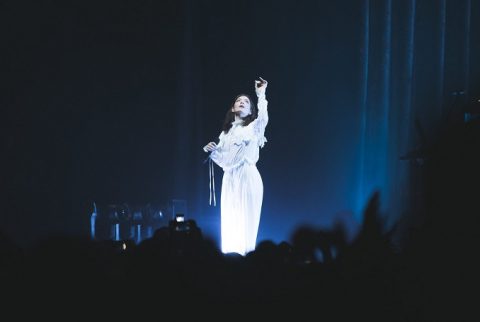
Lorde in concert. (Photo: Lorde’s twitter account)
Palestine Chronicle | February 11, 2018
American Lawmakers in Florida are trying to cancel Lorde’s upcoming shows in the state after the Kiwi songstress and superstar called off her performance in Israel.
Lorde cancelled her Tel Aviv concert in December, following pressure from fans and activists in the Boycott, Divestment, Sanctions (BDS) movement, which is making a stand against Israel’s oppression of Palestinians.
The decision has seen Republican state Rep. Randy Fine this week pushing for Miami and Tampa to cancel Lorde’s April shows, the Orlando Weekly reported.
Fine based his actions on a Florida law which barred companies that received state funds from doing business over $1 million with organisations associated with BDS.
“When Lorde joined the boycott in December, she and her companies became subject to that statute,” Fine told Orlando Weekly.
“The taxpayers of Miami and Tampa should not have to facilitate bigotry and anti-Semitism, and I look forward to the Miami Sports and Exhibition Authority and the Tampa Sports Authority complying with the law and cancelling these concerts.
“Florida has no tolerance for anti-Semitism and boycotts intended to destroy the State of Israel.”
Florida is one of 20 states with a law in place to deal with businesses that boycott Israel.
In a statement released in December last year Lorde said that “the right decision at this time” was to cancel her June 2018 concert in Tel Aviv.
The Grammy-award winner said that after having “lots of discussions” about the matter, she was “not too proud to admit I didn’t make the right call on this one,” referring to her initial decision to hold the concert.
The cancellation was welcomed by members of the BDS movement.
The Palestinian Campaign for the Academic and Cultural Boycott of Israel posted a statement on Twitter thanking the artist for “heeding appeals from your fans against Israel’s art-washing of its brutal oppression of Palestinians.”
Other artists to have boycotted Israel over its treatment of the Palestinians included Roger Waters, Lauryn Hill and Elvis Costello.
Featured Video
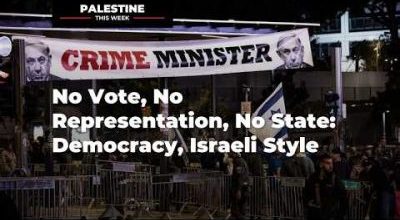
No Vote, No Representation, No State: Democracy, Israeli Style
or go to
Aletho News Archives – Video-Images
From the Archives
Sanctions, War and the Policy of Dual Containment
By SASAN FAYAZMANESH | March 17, 2008
It is now nearly three decades since the Unites States adopted the policy of dual containment of Iran and Iraq. While much has been written about the containment of Iraq, there has been very little in-depth analysis of this policy when it comes to Iran. In a book that is going to be released on March 31, 2008, entitled The United States and Iran: Sanctions, Wars and the Policy of Dual Containment (Routledge), I attempt to address this shortcoming by investigating when and why the US policy of containment of Iran came about, how it evolved, and where it stands today.[1] To the extent that Israel has been involved in US policy making, the study will also include the role that Israel has played in the containment of Iran. Also, since the fate of Iran has been inextricably linked to that of Iraq, occasionally the investigation will overlap with the containment of Iraq.
The policy of dual containment of Iran and Iraq originated during the Carter Administration, but it was not until the Clinton Administration that the expression “dual containment” became popular. … continue
Blog Roll
 Aletho News
- No Vote, No Representation, No State: Democracy, Israeli Style
- Zionist Bought Senate Blocks Information About American Citizens Killed By Israel
- While Gaza dominates the UN, these are the people keeping it alive
- New Report: “Scholasticide and Genocide in Gaza: Assessment, Testimonies and Legal Analysis”
- ‘THAAD Delusion’: Iran war exposes US missile shield limits – The Atlantic
- Moscow issues warning to NATO over Russian exclave
- Yes, the Iran war has destroyed Trump’s presidency
- The fallacy of US delusions about Iran’s economic collapse
- Hezbollah denies Syria cell link, warns of Israeli plan to sow discord
- The legacy of US sanctions, war, and occupation in Iraq
- If Americans Knew
- An error has occurred; the feed is probably down. Try again later.
- No Tricks Zone
- Green Energy Debacle: German Expert Professor Fritz Vahrenholt Warns Of Severe Economic And Social Consequences
- Two More Paleo Reconstructions Affirm Meters-Higher Sea Levels Across Ireland, Brazil 7000-6000 Years Ago
- New Study: Earth And Venus Surface Warmth Largely Explained By Convection And Lapse Rate, Not CO2 Or Radiation
- 2025 Nature Paper Claiming Worsening Global Drought Gets RETRACTED …Heavily Flawed
- New Study: ‘Global Drought Shows No Detectable Recent Acceleration Under Climate Warming’
- Economic Masterminds: German Socialists Suggest Taxing Productivity Gains Stemming From Using AI
- The South China Sea Has Not Been Cooperating With The Climate Change Narrative
- Energy Crisis: Germany Enters Heating Season With Historically Low Gas Reserve Fill Levels
- New Study: The Antarctic Ice Sheet Gained Mass From 2020-2024 Due To Staggering Snow And Ice Accumulation
- Study: Ocean Heating Rates From Thousands Of Years Ago ‘Dwarf’ Modern Ocean Heating Rates

