‘Don’t demonize Israel’: Canada passes anti-boycott motion
RT | February 23, 2016
Canada has passed a motion to condemn “any and all attempts” to promote the Boycott, Divestment and Sanctions (BDS) movement against Israel both at home and abroad.
The motion passed on Monday by a 229-51 vote, CIJ News reports. The bill was introduced by members of the Conservative Party and won support from Liberal Party members. The motion calls on the government to condemn attempts by Canadian organizations, groups, and individuals to promote the BDS movement, claiming it “promotes the demonization and delegitimization” of Israel.
BDS is a global grassroots movement that is trying to pressure Israel to “comply with international law and Palestinian rights” through the boycott of products and companies that profit from violating Palestinian rights. It also includes Israeli cultural and academic institutions.
Inspired by the successful BDS movement that aided in ending South African apartheid, its supporters believe the movement is the only way to push for a solution to the Palestinian-Israeli conflict.
Speaking after the vote, the National Council of Canada Arab Relations said, “At its core, the vote on the anti-BDS motion would go against the spirit of Freedom of Speech, a right enshrined in Canada’s Charter of Rights and Freedoms. Democratic governments do not ordinarily attempt to dictate the political views of their citizens. NCCAR Chair, Gabriel Fahel, reminds us that ‘freedom of speech and conscientious objections to buying products from countries that contravene international law are core values of a free and democratic society.’”
The CEO of the Center for Israel and Jewish Affairs, Shimon Fogel, however insisted that the boycott movement “does not contribute to peace and is not pro-Palestinian.”
“It is discrimination based on nationality, and it harms both Israelis and Palestinians alike by driving the two sides further apart. The BDS movement is a fringe movement and is outside genuine peace efforts,” Fogel said, as quoted by The Times of Israel.
Liberal Prime Minister Justin Trudeau is likely to continue former Prime Minister Stephen Harper’s close ties with Israel. He is against the BDS movement, and tweeted his opinion in March of last year.
Students at McGill University in Montreal passed a pro-BDS motion on Tuesday.
In 2014, Trudeau spoke out in favor of Israel’s right to defend itself during Operation Protective Edge, acknowledging the suffering of Israelis, but not that of the Palestinians, 2,200 of whom were killed during the 50 day conflict.
Israel has pushed back against BDS efforts, accusing its promoters of “anti-semitism.” AP recently revealed that the Israeli government had allotted $26 million for a covert cyberattack on the BDS movement, which would include “flooding the internet” with pro-Israel content and monitoring Muslim activists online.
Read more:
The deeper truths journalists are blind to
By Jonathon Cook | The Bog From Nazareth | February 21, 2016
As I have found out myself, there is nothing media outlets like less than criticising other media publications or the “profession” of journalism. It’s not really surprising. The credibility of a corporate media depends precisely on their not breaking ranks and not highlighting the structural constraints a “free press” operates under.
So one has to commend the Boston Globe for publishing this piece by Stephen Kinzer, a former foreign correspondent, warning that the media is not telling us the truth about what is going on in Syria.
But those constraints are also why Kinzer glosses over deeper problems with the coverage of Syria.
This [most western reporting of Syria] is convoluted nonsense, but Americans cannot be blamed for believing it. We have almost no real information about the combatants, their goals, or their tactics. Much blame for this lies with our media.
Under intense financial pressure, most American newspapers, magazines, and broadcast networks have drastically reduced their corps of foreign correspondents. Much important news about the world now comes from reporters based in Washington. In that environment, access and credibility depend on acceptance of official paradigms. Reporters who cover Syria check with the Pentagon, the State Department, the White House, and think tank ‘experts.’ After a spin on that soiled carousel, they feel they have covered all sides of the story. This form of stenography produces the pabulum that passes for news about Syria.
This is more of the “cock-up, not conspiracy” justification for skewed reporting. If only there was more money, more space, more time, more reporters, the media would not simply spew the government’s official line. Guardian journalist Nick Davies wrote a whole book, Flat Earth News, making much the same claim – what he called “churnalism”. I reviewed it at length here. Journalists like this kind of argument because it shifts responsibility for their failure to report honestly on to faceless penny-pinchers in the accounting department.
And yet, there are journalists reporting from the ground in Syria – for example, Martin Chulov of the Guardian – who have been just as unreliable as those based in Washington. In fact, many of the points Kinzer raises about the reality in Syria echo recent articles by Seymour Hersh, who is writing from the US, not Damascus. But he, of course, has been shunted to the outer margins of media discourse, publishing in the London Review of Books.
Media coverage of Iraq was just as woefully misleading during the sanctions period in the 1990s, when I worked in the foreign department at the Guardian, and later in the build-up of the US-led attack on Iraq. In those days, when there was no shortage of resources being directed at foreign reporting, the coverage also closely hewed to the official view of the US and UK governments.
The problem is not just that foreign reporting is being stripped of financial resources as the media find it harder to make a profit from their core activities. It is, as Ed Herman and Noam Chomsky pointed out long ago in their book Manufacturing Consent, that the corporate media is designed to reflect the interests of power – and the corporations that control our media are power. They select journalists through a long filtering process (school, university, journalism training, apprenticeships) precisely designed to weed out dissidents and those who think too critically. Only journalists whose worldview aligns closely with those in power reach the top.
None of this is in Kinzer’s piece. It is doubtful that he, a member of the media elite himself, would recognise such an analysis of the journalist’s role. As Chomsky once told British journalist Andrew Marr, when Marr reacted with indignation at what he inferred to be an accusation from Chomsky that he was self-censoring:
I don’t say you’re self-censoring. I’m sure you believe everything you’re saying. But what I’m saying is, if you believed something different you wouldn’t be sitting where you’re sitting.
That understanding of journalism does not depend on conspiracy, but nor does it accept that it is all about cock-up. It posits a much more interesting, and plausible, scenario that journalists get into positions of influence to the extent that they are unlikely to rock the boat for elite interests. The closer they get to power, the more likely they are to reflect its values. Much like politicians, in fact.
‘Angola Three’: US’ Longest-Held Solitary Confinement Inmate Released
Sputnik – 20.02.2016
Albert Woodfox, the last imprisoned “Angola Three” inmate, who has spent over four decades in solitary confinement, was released from a Louisiana prison Friday, on his 69th birthday.
As he was released, he was asked by a reporter, if he could go back in time to April 1972, would he change anything. He responded, “There’s forces beyond your control, there’s not a lot you can do.”
Woodfox pleaded no contest, while not admitting guilt, on Friday to lesser charges of manslaughter and aggravated burglary. He was previously indicted for a decades-old murder for the third time last year after it had been overturned twice.
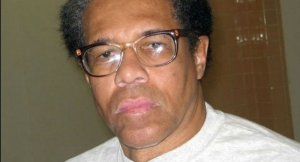 Woodfox spent the better part of 44 years in solitary confinement, a period believed to be the longest of any US inmate, and his attorney explained that Woodfox has earned enough credit for time served to be released.
His imprisonment is from two convictions, both of which were previously overturned, for the stabbing murder of Angola’s Louisiana State Penitentiary prison guard Brent Miller in 1972. Woodfox has consistently maintained that he is innocent and was set up due to his activism and connection to the Black Panther Party while in prison.
Miller’s wife has long called for Woodfox to be released, stating that she does not believe that he was her husband’s killer.
“I think it’s time the state stop acting like there is any evidence that Albert Woodfox killed Brent,” Miller’s wife, Teenie Rogers, said in a statement.
“After a lot of years looking at the evidence and soul-searching and praying, I realized I could no longer just believe what I was told to believe by a state that did not take care for Brent when he was working at Angola and did not take care of me when he was killed.”
The Angola Three refers to Woodfox, Herman Wallace, and Robert King. In the 1970s the trio held protests and hunger strikes inside the prison in opposition to inhumane conditions, including prison rape, racial segregation, and general corruption. The three also worked to form a chapter of the Black Panther Party within the prison walls, and helped to teach other inmates how to read, write, get their high school degrees and prepare legal documents.
Wallace was released in October 2013 when his conviction for Miller’s death was overturned, but he died two days later from cancer complications. Among his last words were, “I am free. I am free,” the New Orleans Times reported, following his death.
King was convicted of killing another inmate, and was exonerated and released in 2001 after spending 29 years in solitary.
Woodfox was originally sent to the Angola prison on charges of armed robbery, a sentence that would have allowed him to be released decades ago.
China to Ban Online Foreign Media After March 10 – Statement
No Chinese Spring
Sputnik – 19.02.2016
BEIJING – Foreign companies will be banned from publishing online in China from March 10, the Ministry of Industry and Information Technology and the State Administration of Press, Publication, Radio, Film and Television said in a joint statement Friday.
“Sino-foreign joint ventures and foreign businesses shall not engage in online publishing services,” the regulations state.
The rules apply to “informative, ideological content text, pictures, maps, games, animation, audio and video digitizing books and other original works of literature, art, science and other fields.”
Joint projects are required to apply for special permission to carry out such activities from the State Administration of Press, Publication, Radio, Film and Television, according to the new rules.
Domestic online media are required to inform the relevant authorities about their sources of funding, expenditure, personnel, domain name registration as well as being required to keep all servers and equipment in China.
Online outlets are prohibited from publishing information that may cause “harm to national unity, sovereignty and territorial integrity,” “spread rumors, disturb social order or undermine social stability,” and harm “social morality or endanger national cultural tradition,” among others.
Foreign websites, including Google, Facebook, Twitter, and a number of Western publications remain inaccessible in China. Beijing has adopted a series of normative and ideological directives in recent years requiring national internet providers and media to closely monitor the quality of information disseminated online.
Sit-in in solidarity with Muhammad Al-Qiq at Birzeit University
Birzeit University | February 19, 2016
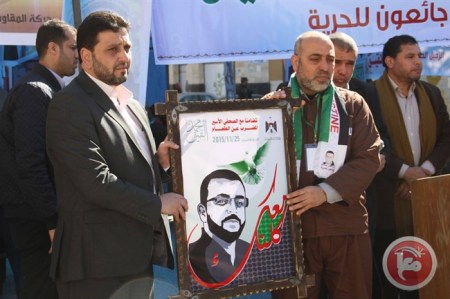 Birzeit, Ramallah, Occupied Palestine – Birzeit University administration, Workers’ Union, and students organized a sit-in in solidarity with its former student and head of students council, Journalist Muhammad Al-Qiq, who has been on hunger strike since November 25 against his imprisonment without charges or trial.
Protestors called for immediate and unconditional release for Al-Qiq and all prisoners as key to the realization of justice and comprehensive peace. They demand all academic institutions and international organizations work together to promote and implement campaigns of boycott and sanctions against Israel and its illegal measures against Palestinians.
“Palestinian journalists have always been on the frontline, and Al-Qiq is now experiencing forceful and abusive measures from the Israeli occupation because he practiced his normal right of speech and freedom of expression”, Abu Hijleh added.
On behalf of the Workers’ Union, Salem Thawaba demanded that officials should urgently interfere to end Al-Qiq’s torture. He stressed the importance of unity and reconciliation for Al-Qiq whose health has deteriorated to the point of facing imminent death.
Representatives from the student council assured the student movements will never stop their solidarity events in support for Al-Qiq and all prisoners who are going through a legal struggle on behalf of the whole nation for the sake of the Palestinian cause.
Harvard loses $250,000 after Palestine event
MEMO | February 19, 2016
A discussion sponsored by Harvard Law School’s Justice for Palestine student group has caused Milibank, Tweed, Hadely & McCloy Law firm to reportedly pull $250,000 of funding from the university.
The panel discussion, “The Palestine Exception to Free Speech: A Movement Under Attack”, which took place in October last year, featured Staff Attorney at Palestine Legal Radhika Sainath, Omar Shakir, a Bertha Fellow at the Centre for Constitutional Rights (CCR), and Northeastern undergraduate Kendall Bousquet.
The event focused on how lecturers and students were repeatedly punished or falsely accused of anti-Semitism for advocating Palestinian rights. Reports were read out detailing how Israeli advocacy groups repeatedly attempted to silence events and speeches supporting Palestinian rights and first-hand accounts of such treatment were relayed by Students for Justice in Palestine at Northeastern University.
Law firm Milbank, which normally funds the activities of student-run groups at Harvard Law School, demanded the university immediately withdraw from receiving any Milbank funding for Justice for Palestine events.
Milbank was under pressure from Israeli advocacy groups including NGO-Monitor demanding information in advance on the event. When Harvard Law declined, the $250,000 annual grant was halted immediately and any recognition by the Justice for Palestine Student group thanking Milbank for its contribution was asked to be deleted.
Students thanked Dean Minow and the law school for “refusing to buckle under intense anti-Palestinian pressure”, and stated how unsurprising it was that the exception to free speech extended to discussions on Palestine.
UK Israeli boycott ban contradicts official govt business guidelines

RT | February 18, 2016
Britain’s ban on the public boycott of goods from Israel’s occupied territories contradicts its own official business guidelines, documents have revealed.
The controversial new law, which would ban local councils, student unions and other public bodies from boycotting goods for political reasons, was announced by the government on Monday and has been implemented without parliamentary debate or vote.
However, documents first seen by the Independent show the Foreign Office’s Overseas Business Risk assessment for Israel states that the government does “not encourage or offer support” to business with the occupied territories, apparently contradicting the new regulation.
“Settlements are illegal under international law, constitute an obstacle to peace and threaten to make a two-state solution to the Israeli-Palestinian conflict impossible,” the document reads.
“There are therefore clear risks related to economic and financial activities in the settlements, and we do not encourage or offer support to such activity.”
The new rules do not apply exclusively to Israel, but would ban institutions that receive the majority of their funding from the government from participating in procurement political campaigns, choosing not to buy products from companies on political grounds. The only exception would be nationwide boycotts mandated by the government.
The Palestinian Liberation Organization (PLO) has attacked the new law, saying it undermines the democratic rights and freedoms of public bodies.
PLO Executive Committee Members Dr Hanan Ashrawi and Dr Saeb Erekat released a joint statement after meeting with Middle East Minister Tobias Ellwood on Wednesday.
“This represents a serious regression in British policy and it would empower the Israeli occupation by sending a message of impunity,” said Ashrawi and Erekat.
“In order to accommodate the Israeli occupation, the British government is undermining British democracy and their own people’s rights.”
The Labour Party has panned the new measures as an “attack on democracy.”
“This government’s ban would have outlawed council action against apartheid South Africa. Ministers talk about devolution, but in practice they’re imposing Conservative Party policies on elected local councils across the board,” Labour Party leader Jeremy Corbyn said.
The government, however, has defended the anti-boycott measures, saying they are necessary for “community cohesion” and national security.
“There are wider national and international consequences from imposing such local level boycotts. They can damage integration and community cohesion within the United Kingdom, hinder Britain’s export trade, and harm foreign relations to the detriment of Britain’s economic and international security,” ministers said in a procurement policy note sent out to public authorities.
Coinciding with the law’s announcement, Cabinet Minister Matthew Hancock, who has recently come under fire for accepting a £4,000 donation from a right wing think tank, weeks before announcing a crackdown on lobbying by charities, is currently in Israel promoting business and trade links with the UK.
Read more:
Like Thatcher with apartheid: UK to ban public bodies from boycotting Israeli West Bank goods
Combating BDS Act of 2016
Congress Moves against BDS
By Lawrence Davidson | To The Point Analyses | February 17, 2014
It was bound to happen – an attempt by the U.S. Congress to sanction the attacks on the Boycott, Divestment and Sanctions movement already taking place in some states and municipalities. The strategy is to legitimize an increasingly standard approach to undermining the boycott of Israel, an approach wherein the investment of any state funds, including pension funds, in any business or organization that boycotts the Zionist state is forbidden.
Bipartisan pairs of senators – Mark Kirk (R-IL) and Joe Manchin (D-WV) – and Congressional Representatives – Robert Dold (R-IL) and Juan Vargas (D-CA) – introduced into both houses the “Combating BDS Act of 2016” (S.2531 and H.R.4514). We can be sure that all four of them are doing this at the coordinated behest of Zionist special interests to which they are financially tied. In other words, acting in their official capacity, their behavior on things that touch on Israel-Palestine is a payback for money and other forms of assistance offered by the Zionists to facilitate the politicians’ elections and reelections. Sadly, this is the way the U.S. campaign system works. Unless you are very wealthy, you are constantly scrounging for money. Under such circumstances one’s pathway to success is made easier if you don’t know the difference between ethics and your elbow.
Our four sponsors of the “Combating BDS Act” would, of course, deny any such tainted motives. Rather, they would insist that theirs is an effort to weigh in against anti-Semitism and defend the integrity the “only democracy in the Middle East.” If they really believe this is so, the kindest thing that can be said for these legislators is that they are profoundly ignorant about Israel and its true character. It is also possible that they know the truth about their patron, but really don’t care. It is all about the money.
Intimations of the Real Israel
For instance, are Senators Kirk and Manchin and Representatives Dold and Vargas aware that the Israeli legislature, the Knesset, recently voted down a bill to include the principle of equality among citizens in the wording of the country’s “Basic Law” on Human Dignity and Liberty? Basic Laws stand in for a constitution in Israel. The bill was introduced by one of the few Arab-Israeli MKs (members of the Knesset) , Jamal Zahalka, who noted that “All constitutions in modern countries begin with stressing the principle of equality amongst their citizens.” That did not matter to a majority of the Knesset who, following inherently discriminatory Zionist ideals, do not believe in equality between Jewish and non-Jewish citizens. Yet to Israel’s supporters in Washington the Zionist state remains a “democracy” much like the United States. Such an unquestioning assumption, so wide of the mark, displays a level of closed-mindedness that ought to require intensive remedial critical-thinking training before allowing someone to stand for office.
Are Senators Kirk and Manchin and Representatives Dold and Vargas aware that the Knesset “Ethics Committee” has suspended three Arab-Israeli MKs, including Mr. Zahalka, from participating in legislative sessions because they met with families whose members had been killed while violently resisting Israeli occupation? The aim of the meeting was to assist the families in recovering from Israeli authorities the bodies of their slain relatives. The Israelis refuse to recognize the truism that the violence of the oppressed will eventually reach the level of the violence of the oppressor. Instead, any violent blowback occurring in response to their own violence is conveniently characterized as “terrorism.”
In order for the action of the Arab MKs to make sense to most Israeli Jews and their Zionist supporters abroad, there has to be recognition of the historically established fact that the occupation of Palestinian land is real. This the Zionists will not do, and apparently, part of their deal with the U.S. politicians in Congress is that they too must echo that same denial.
Are Senators Kirk and Manchin and Representatives Dold and Vargas aware that the respected human rights organization Amnesty International has recently released a report accusing Israeli forces of using “intentional lethal force” against Palestinians in situations where such force was “completely unjustified”? Amnesty spokesman Philip Luther asserted that the Israelis had “ripped up the rulebook” by “flouting international standards” when it came to the use of force. For the politicians in Washington who have made their pact with the Zionists, such behavior, if noted at all, is rationalized as self-defense on the part of the Israelis. However, suppression of resistance to illegal occupation cannot not be judged self-defense either legally or logically. Who in Congress is aware of the Fourth Geneva Convention?
There are many other practices and policies of the State of Israel that must be ignored (including Israel’s support of al-Qaeda in Syria) if Senators Kirk and Manchin and Representatives Dold and Vargas are to carry on with clear consciences. But this might be based on a false assumption that these politicians have a conscience to which they pay attention. After all, our system of politics, which all but demands submission to special interests, may well select for amoral personalities.
Ignoring the Question of Constitutionality
The apparent indifference of Senators Kirk and Manchin and Representatives Dold and Vargas goes beyond Israel’s flouting of international law. It carries over to these politicians’ own disregard for the U.S. Constitution, which each gentleman has sworn to uphold.
Ever since the early 1980s the Supreme Court has regarded domestically initiated boycotts as a legitimate form of political speech. There is little excuse for our four defenders of Israel not to know this. And what are we to say of them if they do in fact know? Only that they, like their patrons, are willing to “rip up the rulebook.” They are willing to act as if what is unconstitutional is, after all, acceptable when it protects the interests of a foreign rogue state on whose payroll they happen to be. Just how long can they get away with this? Is the answer really just as long as the Zionist money keeps coming?
Congressmen and senators tied to Zionist special interests will eventually have to rethink these alliances. Their connection with a state that has no compunction about violating international law has led them to become accomplices in the undermining of U.S. law. Thus, the actions of politicians such Kirk, Manchin, Dold and Vargas act as a barometer indicating the degree to which under-regulated special interests have corrupted the U.S. government. Those involved are walking a path that can lead only to on-going ethical decline and policy failures.
British schoolboy questioned for wearing ‘Free Palestine’ badge
MEMO | February 15, 2016
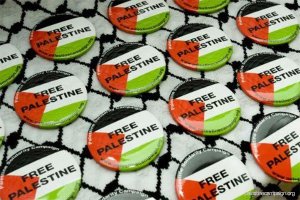 A schoolboy has been questioned by anti-terrorism police because he wore a “Free Palestine” badge to school, The Independent newspaper reported.
Rahmaan Mohammadi’s teachers at Challney High School for Boys in Luton referred him to police under Prevent – the controversial government anti-radicalisation programme.
The pupil was also wearing pro-Palestine badges and wristbands. He had previously requested permission to fundraise for children affected by the Israeli occupation.
Mohammadi said he had previously been warned by police not to talk about Palestine in school, and claimed that staff members approached his 14-year-old brother and pressured him to tell him to “stop being radical”.
Counter-terror laws hampering Islamic charities’ work – former ministers
RT | February 12, 2016
Former cabinet ministers have urged the government to set up an inquiry into the way UK counter-terror laws are affecting the humanitarian work of Islamic charities, many of which operate in Syria.
Two former international development secretaries have discussed the issue with parliamentary officials and have written to the Commons International Development Select Committee to call for an inquiry into complaints that Islamic charities are being treated unfairly.
Clare Short, who was international development secretary from 1997 to 2003, and Andrew Mitchell, who served in the same job from 2010 to 2012, have responded to concerns that Muslim charities are being discriminated against by banks or members of the authorities who worry funding could make its way to extremist organizations.
Almost one-fifth of government development aid goes to charities, and Islamic charities are some of the few British aid organizations that can operate in Syria.
Short wrote that the issue needed examining.
“This is an issue that needs clarifying and sorting out. It has been around as a problem for some time, but it has been getting worse and worse. We have got this enormous capacity in the UK of these Muslim humanitarian charities, yet they are struggling with one hand behind their back. We need a proper scrutiny and examination bringing all this out. It is preventing efficiency.”
Mitchell said: “These are some of the few charities that can get into Syria and help the benighted people of that country, yet they are being held back due to misunderstandings and banking bureaucracy.”
Commons International Development Committee chair Stephen Twigg said he would examine the request “very sympathetically.”
One charity which has complained of discrimination is Islamic Relief, one of the largest Muslim charities, who say their work is being hampered. The charity is funded by the Department for International Development, yet has had one of its bank accounts closed by HSBC.
Other charities have reported the closure of bank accounts, Pay Pal accounts and the blocking of financial transactions.
The government set up a working party to examine any issues after the complaints were made.
Short and Mitchell also travelled to Turkey to see some of the charity work by the Muslim Charities Forum, an umbrella organization for nine charities, being done to get aid into Syria. They returned with praise for the organization and its work.
Omayma El Ella, the operations manager of the Muslim Charities Forum, explained that there was no one to hold to account for the problem.
“No one is accountable for what is going on right now. Every time we speak to the government about this, they say it is a private sector issue and they cannot get involved. That is not good enough anymore. We are told no one will be prosecuted for ‘benign engagement’, but what is ‘benign engagement’? That has not been clarified.”
Obama regime seeks to roll back human rights conditions on aid to Egypt
RT | February 11, 2016
Despite reports that state repression in Egypt is taking place on a greater scale than it has been for generations, the Obama administration is seeking to roll back human rights conditions Congress had placed on foreign aid to Egypt’s military.
The request, which was tucked into the Obama administration’s 182-page budget proposal, seeks foreign aid to Egypt’s military regime and “the sale of crowd control weapons to ‘emerging democracies.’” The discovery was made by The Intercept.
If the new proposal, which was released on Tuesday, is adopted, it would end a Congressional restriction stipulating “that 15 percent of aid to Egypt is subject to being withheld based on human rights conditions.”
Interestingly, Congress was able to temporarily waive those restrictions in a foreign aid bill in June of 2015, arguing it was in the national security interest of the United Station, according to Al-Monitor. The conditions were that Egypt would have to hold “free and fair” parliamentary elections and take steps to foster democracy and protect human rights for an additional $1.3 billion in military aid to be released.
The US State Department issued a scathing report in May of 2015, arguing that “while Egypt had implemented parts of its ‘democracy roadmap’ the overall trajectory of rights and democracy had been negative.”
It pinpointed restrictions on freedom of expression, the press, and freedom of association, as well as lack of due process. It further said that “impunity remains a serious problem in Egypt.”
It was well known at the time the Egyptians were “infuriated” by the report.
Cole Bockenfeld, deputy director for policy at the Project on Middle East Democracy, told The Intercept that the White House probably didn’t want to explain why it had to waive restrictions this year.
“They had to basically do an assessment. … Here’s how they’re doing on political prisoners, here’s how they’re doing on freedom of assembly, and so on,” Bockenfeld said.
The Guardian reported in January that Egypt has jailed more journalists than any other country on earth except China under President Abdel Fattah al-Sisi. Three reporters were imprisoned, one forcibly “disappeared” and was later charged with being a member of a banned organization, and six were referred to judicial hearings because of their work.
Also in January, Italian academic Giulio Regeni, who was researching labor unrest and independent trade unions in Egypt, went missing during a security crackdown on the fifth anniversary of the beginning of Egypt’s revolution. His body was discovered nine days later by the side of the road marked with cigarette burns, bruising, and multiple stab wounds. The Guardian reported more than 4,600 academics worldwide have signed an open letter protesting his death and demanding an investigation into the growing number of forced disappearances. Egyptian officials appear to be cooperating with the investigation, according to the Italian foreign minister.
The budget also contains a request that would remove a provision from a law passed in 2012 in reaction to the Arab Spring protests that prohibits the transfer of tear gas and other crowd control weapons to countries that are “undergoing democratic transition.”
“It’s basically going to be free for all,” Husain Abdulla, executive director of Americans for Democracy and Human Rights in Bahrain, told the Intercept when speculating on the results of the administration rolling back that provision.
Among the Middle Eastern countries seeking this equipment are Egypt, Saudi Arabia, and Bahrain – all of which are simmering with pro-democracy challenges.
Featured Video

Dan Dicks with James Corbett on Solutions Watch
or go to
Aletho News Archives – Video-Images
From the Archives
$1.5bn up in smoke: US THAAD missile stockpile dries up defending Israel against Iran
By Ivan Kesic | Press TV | July 2, 2025
According to American media, defense news outlets, and independent analysts, the 12-day Israeli military aggression against Iran significantly depleted the US stockpile of THAAD (Terminal High Altitude Area Defense) interceptor missiles.
Citing official sources, American magazine Newsweek reported on Friday that the US transferred a substantial portion of its advanced missile defense capabilities to support the Israeli regime, an effort with questionable results and a critical impact on US strategic reserves.
THAAD, developed by Lockheed Martin arms manufacturing company, is a key component of Israel’s multi-layered air defense architecture. It is designed to intercept medium-range ballistic missiles, including those launched from Iran and Yemen.
The US-made system is capable of targeting short-, medium-, and intermediate-range ballistic missiles during their terminal phase, whether inside or outside Earth’s atmosphere.
THAAD uses a “hit-to-kill” method, relying on kinetic energy rather than explosive warheads to destroy incoming threats, intercepting at altitudes of up to 150 km and ranges between 150-200 km.
Operated exclusively by American personnel, the US military maintains eight THAAD batteries with an estimated 350–400 interceptors in total. The eighth battery was activated during the June 20 Israeli aggression against Iran and is capable of intercepting hypersonic missiles. … continue
Blog Roll
 Aletho News
- ‘THAAD Delusion’: Iran war exposes US missile shield limits – The Atlantic
- Moscow issues warning to NATO over Russian exclave
- Yes, the Iran war has destroyed Trump’s presidency
- The fallacy of US delusions about Iran’s economic collapse
- Hezbollah denies Syria cell link, warns of Israeli plan to sow discord
- The legacy of US sanctions, war, and occupation in Iraq
- Iraqi resistance group rejects disarmament, vows to maintain support for Lebanon
- Sheikh al-Asadi warns of Iraqi government compliance with US demands
- How to MAKE THE CONSPIRATORS PAY for their crimes! Dan Dicks with James Corbett on Solutions Watch
- There’s a drought in academia: A drought in honest research on the subject of drought and other weather extremes
- If Americans Knew
- Iran’s Revolutionary Guards Publish Letter to the American People
- DMFI launches $1 million ad campaign supporting Virginia’s Elaine Luria
- US Senate blocks resolution seeking report on Americans killed by Israel
- Israeli Attacks Kill Ten Palestinians in Gaza
- Massacre at Minab: The School That Became a Grave
- Israeli media: The IDF Shows It Doesn’t Turn a Blind Eye; It Actively Emboldens Settler Havoc
- As settlers ravage West Bank, Israeli forces kill 10 in Gaza – Daily Update
- New Report: “Scholasticide and Genocide in Gaza: Assessment, Testimonies and Legal Analysis”
- Ex-Biden officials are desperate for a Gaza scapegoat
- Israeli “settlers” Invade Al-Aqsa; Pour Boiling Water on 75-Year-Old
- No Tricks Zone
- Green Energy Debacle: German Expert Professor Fritz Vahrenholt Warns Of Severe Economic And Social Consequences
- Two More Paleo Reconstructions Affirm Meters-Higher Sea Levels Across Ireland, Brazil 7000-6000 Years Ago
- New Study: Earth And Venus Surface Warmth Largely Explained By Convection And Lapse Rate, Not CO2 Or Radiation
- 2025 Nature Paper Claiming Worsening Global Drought Gets RETRACTED …Heavily Flawed
- New Study: ‘Global Drought Shows No Detectable Recent Acceleration Under Climate Warming’
- Economic Masterminds: German Socialists Suggest Taxing Productivity Gains Stemming From Using AI
- The South China Sea Has Not Been Cooperating With The Climate Change Narrative
- Energy Crisis: Germany Enters Heating Season With Historically Low Gas Reserve Fill Levels
- New Study: The Antarctic Ice Sheet Gained Mass From 2020-2024 Due To Staggering Snow And Ice Accumulation
- Study: Ocean Heating Rates From Thousands Of Years Ago ‘Dwarf’ Modern Ocean Heating Rates

