Anti-Defamation League creates blacklist of groups that link Ferguson to Palestine
By Cecilie Surasky | MuzzleWatch | December 1, 2014
Wow. The ADL below considers the photo below a hateful message.

File this under “You can’t make this up.”
Abe Foxman, whose $688,000 annual salary makes him one of the most over-paid pro-Israel lobbyists in the country, recently embarrassed himself (again) by actually releasing a press statement lecturing NFL star Reggie Bush on his Twitter feed— Bush had dared compared Ferguson and Gaza.
But it gets worse.
The Anti-Defamation League, which leverages its reputation as a fighter of bigotry to silence human rights critics of the Israeli government (thereby actually perpetuating bigotry and worse), has published a defacto blacklist of groups that dared to link Ferguson with Palestine.
I mean, what could the militarization of U.S. police forces and repeated, unaccountable killing of unarmed people of color possibly have to do with Palestine? According to the ADL—daring to make the connection is purely cynical at best, and a form of hate at worst.
But here is where the ADL gets the chutzpah award: singled out for particular opprobrium are those who link what’s happening in Ferguson to the training of police in Israel. The ADL, for example, calls out the inimitable Trita Parsi, head of the National Iranian American Council (NIAC). for this Tweet:
“Wondering why the excessive police violence? Here’s a guess: #Ferguson police chief got training in Israel…#Gaza.”
 They also call out someone for holding a sign at a protest that says “Google It!!! Israel trains the NYPD.”
So, who do you think is responsible for an awful lot of those free police trainings in Israel? The Anti-Defamation League, natch. Which I guess is why they are condemning people as opportunists and bigots for saying, well, the obvious.
As Kristian Davis Bailey wrote in Ebony Magazine in August:
The St. Louis County Police Department that killed Michael Brown and initially placed Ferguson on siege has trained with the Israeli military. Former County Police Chief Timothy Fitch was one of 15 American officials to participate in a weeklong training in Israel three years ago.
The April 2011 National Counter-Terrorism Seminar (NCTS) was sponsored by the Anti-Defamation League (ADL). It brought together leaders from the largest American police departments, the FBI and Immigration and Customs Enforcement (ICE) with members of the Israeli National Police, Israel Defense Forces and other intelligence organizations.
Oddly, the quick-to-issue-a-statement ADL was too busy to respond to Bailey’s requests for comment. Bailey went on:
Over 9,000 American officials have trained with Israeli police and military units on responding to civilian protests and terrorism. These operations reflect failure to distinguish between the apparent duty of police to protect civilians and military responses to war. This fusion has had life-costing implications for Americans, specifically black, Muslim and Arab people.
Normally, the ADL boasts about training lots and lots and lots of police officers , which includes special trips for US police officials to Israel for training in counter-terrorism tactics (which are then deployed against American citizens.)
I guess that in this case, they have decided that the best defense is a good offense. Reggie Bush, a running back, probably knows all about that.
Texas State Board Of Education Votes To Approve Biased Textbooks
By Sarah Jones | Wall of Separation | November 24, 2014
On Friday, the Texas State Board of Education (SBOE) voted 10-5 to approve 89 new social studies textbooks for use in public classrooms. The vote, which split cleanly on party lines, ends public hearings on the subject. But controversy over the books’ content is likely to linger: Critics allege the books contain multiple errors and exaggerations designed to portray the United States as a fundamentally Christian nation.
As reported previously in Church & State, the textbooks as proposed overplayed the influence of Mosaic law on the Founding Fathers, cast doubt on the constitutionality of separation of church and state and skewed discussions of existing legal precedent on prayer in schools. Although publishers did make many corrections to the books – such was watering down inflammatory and inaccurate information about Islam – “Christian nation” myths unfortunately remain in the material.
And that’s thanks to the SBOE, which in 2010 passed a series of curriculum standards that mandated instruction that emphasized the country’s Christian heritage. Those standards, and the flawed review process itself, finally proved too much for one publisher. According to the Texas Tribune, Houghton Mifflin Harcourt pulled its government textbook from consideration after being asked to “add greater coverage of Judeo-Christian influence – including Moses – on America’s founding fathers.”
The SBOE also rejected curriculum from WorldView Software, and there’s evidence the decision was politically motivated. Prior to the final vote, WorldView issued a strongly worded statement in response to public testimony from Barbara Lamontagne, who informed the SBOE last week that the material called the late General Douglas MacArthur “racist” and lionized communist figures at the expense of President Ronald Reagan.
WorldView slammed the comments as “very serious and patently false allegations” and noted that Lamontagne admitted in her testimony that she had not read the material before preparing her remarks. Despite this, the SBOE ruled that WorldView had not done enough to address her criticisms, and rejected the company’s curriculum.
Even without the Houghton Mifflin Harcout and WorldView materials, the SBOE had hundreds of pages of edits to review in less than a week. As a few members noted, the vote’s timing made it impossible for the SBOE to read all edits under consideration. But a motion to delay the final vote failed, rejected by the fundamentalist Christian officials who dominate the board.
Kathy Miller, president of the Texas Freedom Network (TFN), slammed the review process in a press statement. “And once again the state’s process for approving textbooks was revealed to be a sham, as state board members voted for last-minute changes that they had never even read,” she said. “Those changes were approved without any input whatsoever from historians and experts.”
TFN had appointed its own review panel to identify errors and suggest corrections in the books. Scholars expressed serious concern over the books’ slant, only for those concerns to be largely dismissed by the SBOE.
Americans United also opposed the books. We launched a petition in partnership with TFN and People For the American Way; our organizations combined collected over 30,000 signatures to demand that publishers produce accurate textbooks for Texas students.
Activist Zack Kopplin testified on our behalf before the SBOE earlier this month to reiterate our concerns that the books presented a flawed, fundamentalist version of American history with little to no basis in evidence.
The SBOE didn’t respond kindly to Kopplin’s testimony, with one member asking him if he’d been paid to testify (the answer, of course, is no).
With the board’s vote, the textbooks are set to enter public classrooms in 2015, where they will be used for the next decade. Local school districts do have the option to reject the books and use alternative curriculum, a move recommended on Friday by moderate members of the SBOE. Based on the evidence, it’s a move we recommend as well.
It’s clear that the SBOE has carefully constructed curriculum standards and a shoddy review process designed to erode the separation of church and state. Unfortunately, their latest victory means that thousands of students will receive biased and inaccurate information about the development of our democracy. And that, of course, has been the SBOE’s goal all along: Indoctrinating “culture warriors” has officially taken precedence over preparing students for higher education and work.
Live Streamer gets Camera Stolen Covering Ferguson Protests
By Carlos Miller | PINAC | November 25, 2014
A live streamer named BassemMasri vowed to his viewers that he would continue covering the protests in St. Louis County, “24/7 … unless I’m in jail.”
Or unless he gets his camera stolen, which is what happened less than ten seconds after he made that promise.
The person who stole the camera continued running for almost two minutes for several blocks while the camera continued recording.
BassemMasri took to twitter to say he believes it was a police agitator who stole his phone, which is something he should easily be able to determine if he had any sort of tracking app on the phone.
Despite the setback, BassemMasri continued tweeting and posting photos of fires from his back-up phone.
Sophisticated ‘state-sponsored’ spying tool targeted govts, infrastructure for years
RT | November 24, 2014
A sophisticated malware dubbed Regin has been used to spy on governments, infrastructure operators and other high-profile targets, security company Symantec has revealed. It also targeted private individuals and businesses, particularly in Russia.
A back door-type Trojan displays a “degree of technical competence rarely seen,” Symantec said in a press release. The complexity of the virus enabled the intruder to create a framework for mass surveillance. Targets include private companies, government entities and research think tanks. Attacks on telecoms companies were allegedly carried out to gain access to calls being routed through their infrastructure.

The company believes that the Trojan was likely developed by a nation state as it took months, if not years to develop such a piece of software and cover up its tracks. Analyzing its further capabilities the company has drawn a conclusion that Regin could be one of the main cyber espionage tools used by the implicated nation state.
Almost a third of the confirmed infections were discovered in Russia with a further 24 percent in Saudi Arabia. Mexico, Ireland, India, Afghanistan, Iran, Belgium, Austria and Pakistan are also on the list.
“Regin is a highly complex threat which has been used in systematic data collection or intelligence gathering campaigns. The development and operation of this malware would have required a significant investment of time and resources,” Symantec said.
Symantec found that the virus has been used between 2008 and 2011, before being suddenly withdrawn until a new version of the malware resurfaced from 2013 onwards.

Regin uses a modular approach allowing it to load features that exactly fit the target, enabling a customized spying.“Its design makes it highly suited for persistent, long-term surveillance operations against targets,” the security company says.
And it’s five-stage loading architecture with special and hidden encryption at each stage makes it similar to Duqu/Stuxnet threats, Symantec said. “Executing the first stage starts a domino chain of decryption and loading of each subsequent stage for a total of five stages. Each individual stage provides little information on the complete package. Only by acquiring all five stages is it possible to analyze and understand the threat,” the press release reads. Furthermore Regin is equipped with a number of stealth features so that even after Trojan’s presence is detected, it is “very difficult to ascertain what it is doing.”
Researchers say many components of the virus remain undiscovered while the threat of additional functionality and versions may still exist.

Pro-Israel activists ask MPs to halt non-violent BDS protests
MEMO | November 24, 2014
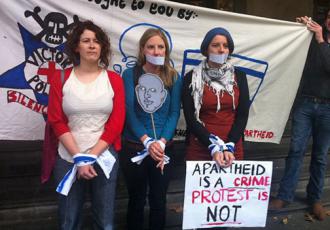 Zionist activists have urged British MPs to implement new legislation that police could use to stop non-violent, pro-BDS protests.
Manchester-based group North-West Friends of Israel have urged politicians to give police more power to stop boycotts of businesses by pro-Palestine solidarity activists.
As cited in a report by The Jewish Chronicle, the group’s co-chair Anthony Dennison wants the Public Order Act amended “to allow police to halt non-violent protests, if they disrupted ‘the lawful right of customers and shops to trade’.”
Dennison commented: “Peaceful protest can be intimidating, if demonstrators are stood outside a shop, holding placards with horrible images, are customers really going into that shop?”
“Security” In the West’s Client States
By ANDRE VLTCHEK | CounterPunch | November 21, 2014
Perhaps you thought that the security at the Atlanta or Newark, or Dallas airports is bad, obnoxious, the worst in the world… Think twice… Of course it all began there, in the United States, from the first glory days of that hypocritical and deranged “War On Terror”: the humiliation of people, especially Arabs, especially Muslims, especially all those who are not white, but eventually everybody, at least to some degree.

But it did not just stay there. The allies joined in almost immediately, and then the ‘client’ states jumped on the bandwagon, competing in tactics and strategies of how most to humiliate those confused and helpless passengers, by censoring internet sites, digging into emails, monitoring mobile phone communications, and relentlessly spying on both citizens and foreigners.
I have travelled all over the world, to some of the most imaginable and unimaginable places. All the while being monitored and harassed, threatened and periodically attacked, even physically, I have also spread many counter-punches: I have observed, recorded, and published, who does what to whom, who is the most diligent, methodical, and ruthless bully?
Unsurprisingly, the toughest surveillance comes from Western allies and ‘client’ states, all over the world – from places that Washington, London and Paris routinely call ‘thriving democracies’.
Countries that have collapsed socially strive to impress their Western neo-colonial masters, by imposing increasingly harsh security and surveillance measures against their own people. At the same time, they are full-heartedly and enthusiastically signing up to the bizarre, ‘War on Terror’. It gives the local rulers many privileges. If they play it right, their gross human rights violations, and even their killing of the opposition, is not scrutinized.
***
When I recently worked in South Africa, I was told that the country is now one of the freest on earth. It has nothing to hide and it is not particularly afraid of scrutiny.
“You can photograph here, whatever you want, and nobody will tell you anything”, many of my South African friends explained to me, in Cape Town, Pretoria, Johannesburg, as well as by those living abroad.
It is true. In fact, after few days there, you can easily forget that there are any restrictions, like a ban on filming or photographing police stations or navy ships. Nobody would ever stop you from taping, for instance, battleships at the Simon’s Town base.
South Africa is a proud BRICS country, a left-wing beacon on the African continent and, together with neighboring Zimbabwe, a target of an aggressive negative Western propaganda campaign.
Just as in South Africa, not once was I stopped from filming or photographing in Zimbabwe. And not once was I intimidated, harassed or humiliated by their immigration or customs at the airports.
That is in stark contrast with the West’s allies on the continent – Rwanda, Uganda, Djibouti, Kenya, Ivory Coast or Senegal, to name just a few.
It is not just that ‘everything is forbidden’ there, but ‘violators’ can easily be arrested, harassed, even ‘disappeared’.
When making my film, “Rwanda Gambit”, about Paul Kagame’s monstrous regime, and about the genocide it had been committing (on behalf of the Western powers) in the Democratic Republic of Congo, I tried to film with a small Leica, at the border between Rwanda and DR Congo, at the Gisenyi/Goma crossing. Within a few seconds later, an enormous Congolese soldier grabbed me and began pulling me towards the border post. I have been arrested in Goma once before, and I knew what it amounts to – what it is to rot in the underground intelligence bunker cut off from the outside world.
I was almost certain that, that time, I would not make it out alive. And so I screamed for help in the direction of the Rwandese soldiers who were watching the scene from the other side of the borderline. It is not that they were really eager to help, but the disappearance of a US citizen, an investigative journalist at that, would be an extra, and unnecessary ‘annoyance’. And so they went to work, grabbing my free hand and pulling me back towards Rwanda. The enormous Congolese man in the end lost, and I survived.
All of this over just a few shots! Nobody would ever even think about preventing me from filming on, say the border between Argentina and Chile, or Vietnam and China!
In Rwanda itself, absolutely everything is forbidden, and everybody snitches on everybody. It is forbidden to photograph the streets, the hospitals, and museums, even the genocide memorial! It is strictly banned to photograph or to film their villages, In order to film military installations or prisons, I had to attach a Drift camera to the undercarriage of my car.
In Rwanda and Uganda, everything is under the surveillance. Walls have ears and eyes, so to speak. It is not like surveillance in London, done with high-tech cameras (although these are also beginning to appear); people simply spy on each other, at an unimaginable rate, and the security apparatus appears to be present absolutely everywhere, omnipresent.
But for the West, that is all fine. Both Rwanda and Uganda are plundering DR Congo of Coltan and uranium. The 10 million lives lost there, appears to be just a token price, and the horrors that are occurring in these countries are just some tiny inconvenient episodes not even worth mentioning in the mainstream press.
Security is ‘needed’, in order to maintain ‘order’ – our order.
The humiliation of travellers at Kigali, Kampala or Nairobi airports is indescribable. It is not about security at all, but about a power game, and plain sadism. In Kigali, there are at least 8 ‘security checks’, in Nairobi 6 to 7, depending on the ‘mood’ at the airport.
Three years ago, on behalf of the West (mainly US, UK and Israel), Kenya attacked the oil-rich part of Somalia, where it is now committing atrocities. Its state apparatus also perpetrated several attacks against its own civilian targets, blaming all of them on the al-Qaida linked movement, al-Shabaab. It was done in order to justify the ‘security measures’.
Now there are metal detectors in front of every department store, hotel or office-building in Nairobi. When I, earlier this year, photographed the entrance to a prison, I was literally kidnapped, thrown into the jail and informed: “We will treat you as a terrorist, as an al-Shabaab member, unless you prove that you are not.”
The slightest argument with the Kenyan military forces, or with the corrupt and outrageously arrogant police, leads to detention. And there are cases of people being harassed, sexually molested, even tortured and killed in detention.
The security forces in East Africa cooperate, as the security forces cooperated in the dark years of the fascist military dictatorships in South America.
As I was walking with my friends through Kampala, a huge lone figure slowly walked towards us.
“That is one of the butchers and he comes from Kenya”, I was told. “He tortures and kills people that pose a danger to this regime… He does things no local person would dare to do. Our countries exchange the most sadistic interrogators; ours go to Kenya, Kenyans come here.”
I recalled that even Paul Kagame, now the President of Rwanda, used to serve as the Chief of the Military Intelligence in Uganda.
Yes, the Newark and Houston airport security is bad, and the surveillance in the West is outrageous, but it is being taken to insane extremes in the ‘colonies’.
In Djibouti, which is basically a military enclave of the French Legionnaires, the US air force and other European armed forces (Somalia, Yemen, Eritrea and Ethiopia are all just a stone-throw away), I once complained at the airport that my passport was being checked twice within a distance of 10 feet. As a result, a huge soldier grabbed me, tore my shirt, threw me against the wall, and then smashed my professional camera against a concrete wall. All this happened in front of the horrified passengers of Kenya Airways. That, I found somehow intolerable. It pissed me off so much that I got up, ready to confront the soldier, no matter what. But the horrified voice of a Kenya Airways’ manager stopped me: “Sir, please leave it at this… They can just kill you, and nothing will happen to them. They can do anything they want!”
In Ivory Coast (Côte d’Ivoire), which is yet another French military dependency, and generally a loyal servant to Western interests in West Africa, ‘security’ is the main excuse for keeping undesirable elements, like myself, away from the country. Earlier this year I embarked on a journey there to investigate the chocolate empire activities of the Ukrainian President Poroshenko. Ivory Coast is the biggest producer of cocoa in the world, and ‘the Chocolate King’ is apparently involved in many unsavory practices there.
The authorities were tipped off in advance that I was coming, and the charade began from the moment I landed. I was ordered to produce my yellow fever certificate, which was inside my bag. As I began searching for it, I was roughly ushered into a small room full of sick people quarantine – and informed that I was to be vaccinated again. I found the certificate just a few seconds later, and went out to present it to the authorities. “Back!” they shouted at me. Wait inside for your turn, and tell the doctor that you have found it. The wait turned out to be 2 hours long. Later, I was told that a visa on arrival is no longer available. For days I had to go to the immigration office, from morning to the evening. For days I was fingerprinted and photographed. I clearly saw that wires were disconnected from their computer, every time my turn came round. “Your fingers are not good for fingerprinting! Go to the hospital and bring a certificate that they are not good!” Going there costs US$100 a time, and another wasted day in Abidjan. The hospital said that my fingers were just fine. I had to bribe them to write that they were not.

The US embassy was clearly aware of what was happening. They even sent an officer to ‘assist me’. I showed him that the wires had been pulled out from the computer. “We cannot interfere in other country’s internal affairs”, he explained.
Then, on the last day, when my visa was finally issued, a lady from the US embassy whispered into the phone: “Well, if you write what you do, you must be ready for the consequences”. ‘Honest person’, I thought.
I am almost ‘embarrassed’ to write this, but I have driven on many occasions, all over China (PRC), around at least 8,000 kilometers, but have never been prevented from photographing or filming anything. I have hours and hours of footage and thousands of photographs from many corners of the nation.
A stark, almost grotesque contrast is India, the ‘largest democracy on earth’, according to the Western assessment.
There, nothing is allowed. Forget about filming the battleships near Mumbai (even the Soviet Union does not care – they would put their battleships on the Neva river in Leningrad during celebrations, for everyone to admire and to photograph them, which I did, as a child, when visiting my grandmother). You cannot even photograph that idiot Clive, inside the Victoria Monument in Calcutta.
In India, surveillance is everywhere. It is the perfect police state.
You need a local SIM card in Beijing? Even in the middle of the night, you just go to any kiosk and buy one, no questions asked, no paperwork.
In India, to get a SIM card is one tremendous saga, monstrous bureaucracy, spiced by demands for all sorts of documents and information.
You want to use the internet at New Delhi airport? You have to provide your name, your telephone number, and your email address! I invent names, like Antonio Mierdez or Amorsita Lopez; sometimes it works, sometimes not. In China, you just stick the front page of a passport onto a scanner, and get password within ten seconds. In South Africa, there is not even need for that – the internet is open and free.
And then, those legendary, those epic security checks in India!
The Indian state appears to be thoroughly paranoid, scared of anyone trying to document the reality.
It has developed an allergy to writers, investigative journalists, film-makers and photographers, especially those that happen to be ‘independent’, therefore ‘unpredictable’ and potentially capable of challenging the clichés fabricated in Washington, London and New Delhi, that depict the country as the ‘largest democracy on earth’.
To fight against such threatening elements, the Indian regime, which consists of the moneyed elites, feudal lords, religious fanatics and the military brass, have become pathologically obsessed with security, with surveillance, with relentless checking on things, and people. I have never witnessed such security zeal, even in countries that are under a direct threat from the West: such as Cuba or China.
Even domestic flights in India, from smaller cities like Varanasi or Jaipur, require an entire chain of security steps. Your passport or ID is checked on at least 10 occasions. As you enter the airport, a few steps later, before you are allowed to check in, when you are checking in, as you are entering the departure area, when you are in the departure area (that one is grand – you are forced to step on a platform and everything is checked), when you are entering the departure gate and when you are leaving it for the plane door. Sometimes there are additional checks. It is all, mostly, very rude.

In Turkey, everything is censored. From my official website to ‘Sitemeter’, even the Hong Kong MTR and Beijing and Shenzhen subway maps (maybe just in case someone wants to compare those pathetic subway developments in Istanbul and Ankara, to those in China).
When I called the guest relations supervisor at the four star ‘Kalyon Hotel’ in Istanbul, where I was staying in November 2014, I was told that she “does not know what internet provider is used by the hotel”, but that censorship is actually part of a “security program”, which in turn is part of “the hotel policy”, or vice versa.
How honest!
She actually kindly suggested that I bring my Mac ‘downstairs’, so the IT manager could “do something with it”. I very politely, declined, remembering an experience two years earlier, at the Sheraton in Istanbul, where the ‘IT manager’ actually installed some spy wear, which totally and immediately corrupted my computer, my email addresses, turning my operating system into something that has since been insisting on functioning almost exclusively in the Turkish language. When I complained over the phone, he, the IT manager, went upstairs, kicked my door, rolled up his sleeves and he let me know that this matter could be settled most effectively, outside the hotel, most likely in the street.
***
It may sound bizarre, but in the countries literally besieged by hostility from the Empire, like Cuba or even North Korea, security appears to be much more lax than in the nations where the elites are terrified of their own poor majority.
I don’t remember going through any security, in order to enter a theatre or a hotel in Havana. In Pyongyang, North Korea, there are no metal detectors at entrances to shopping centers, or subway stations.
It goes without saying that one is monitored more closely by the security cameras and armies of cops in London or New York, than in Hanoi or Beijing.
The most common mode of modern communication – the mobile phone – is regulated much less or monitored in Vietnam, China or Venezuela, than in India, Japan, or Europe. In fact, Japan recently even discontinued the sale of pre-paid SIM cards; every number has to be meticulously registered and issued only after signing an elaborate contract.
As I keep reporting, the world is full of stereotypes and clichés. Countries are not judged by rational analyses and comparisons, but by chimeras created by commercial mass media, especially those in the West.
Three countries in Latin America are still living the nightmare of the ‘Monroe Doctrine’: Honduras, Paraguay and Colombia. In Paraguay and Honduras, the West basically managed to overthrow progressive governments and installed fascist regimes, not unlike those that reigned all over the continent during Ronald Reagan and Otto Reich’s days. Colombia has been, for decades, a US ‘client’ state.

Surveillance in all three countries is monstrous, and so are gangs and death-squads.
But you would not guess it. If you read Western reports, including those produced by Reporters Without Borders, you would think that the true villains are actually countries like Venezuela and Cuba. But then, you look closely, and see who organizations like Reporters Without Borders are playing with… And surprise-surprise: you will discover names like Otto Reich among them!
When Thailand, another staunch ally of the West and a shamelessly servile state, began photographing people at the airports and borders, I asked an immigration officer in Bangkok, where all the data goes. She answered, without any hesitation: “To your country!” That is, to the United States.

Malaysia and its immigration used to be quite different – relaxed and easy. But then, earlier this year, Obama came aboard his diplomatic tank. I landed in Kuala Lumpur just an hour after his Air Force One had touched town. What did I encounter? A fingerprinting machine at KLIA! Obama left, but the machines are still there. To spy on people, to fingerprint and photograph them, is apparently one of the conditions of being a good friend of the West. That would never have happened in the era of Dr. M!
Even Japan now photographs and fingerprints people arriving from abroad! Japan where one can even easily and freely photograph combat air force bases (some of them, including those in Okinawa, have viewing terraces for tourists, all around them) is now also spying on people! That is, obviously, one of the rules laid down by the gang that is ruling the world.
Of course the Western allies of the United States are not much better.
Do you still remember how Europeans were bitching about having to take of their shoes at US airports? What has happened now? They do it, without protesting, at their own airports, in London, Paris, Munich, everywhere.
In fact, the most repulsive security I have ever encountered in the West was at CDG, in Paris. I was taking a night flight on Asiana Airlines, from Paris to Seoul. The flight was full of Korean tourists in their seventies and eighties. The tables were set up, sadistically, far away from the X-ray machines, so the poor old people had to carry their bags and belongings quite a long distance. Security personnel were yelling at them, insulting them. I protested, on behalf of the Koreans. A tough French dude came up to me and began insulting me. I asked for his name. He turned around and mooned me, in public. He took down his pants and showed me his hairy ass. “My name is Nicolas Sarkozy”, he said. In a way he was right…
Once I arrived very early in the morning, in Darwin, Australia, after working in East Timor. My electronic travel authorization was for ‘tourism’. The unfriendly immigration officer was clearly on her power trip: “What are you going to do in Australia?” I told her I would be meeting some of my academic friends in Sydney.” “That is work, academic exchange!” she barked at me. “You requested a tourist permit.” I explained that we would just have dinner together, perhaps get pissed”. That was the typical Aussie-type of tourism, I thought. The interrogation began and went on for 2 hours. As the sun was rising, I had had enough: “Then deport me!” Of course she did not. Humiliating people was simply a form of entertainment, or how to kill a couple of boring hours. Or how to show people where they really belong!
How free and proud one should feel entering that great world of Western democracies!
One has to lie, of course. Once I was held for 4 hours by the Canadian immigration services, entering from the US by car. Why? I told the truth, that I was coming to interview Roma (Gypsy) people fleeing from persecution in the Czech Republic (a staunch ally of the West).
Leaving Israel is beyond anything that I have ever experienced elsewhere in the world. Especially once Mossad realized that I had come to trash Israel for its treatment of Palestinian people, and for its foreign policy.
We commonly end up discussing my grandparents, my books, and my films. I have already commented: no woman in my life, not even my own mother, wanted to know so much about all the details of my existence, as Mossad agents at the airport! And none of them has ever listened so attentively!

I am totally exhausted from all that freedom given to me by the West and its allies.
My email addresses are corrupted and I don’t even know which publication or television network is actually receiving my stuff. There is absolutely no way to tell. I have no idea which immigration service will screw me next, and how.
I have already got buggered about by the security in Colombia, Canada, Indonesia, Kenya, Djibouti, Ivory Coast, DR Congo, Kenya, the US (entering from Mexico), Bahrain and Australia… I can hardly remember, there is much more…
It is all turning into a game of Russian roulette.
My African, Indian, Arab and Latin American friends and colleagues are, of course, going through much deeper shit.
The question that I keep asking myself is very simple: “What are they all so afraid of?” I don’t mean the US and Europe – those are control freaks and they simply don’t want to lose their control of the world… There, it is all transparent and clear.
But it is not as clear elsewhere: what about those regimes in India and Turkey, in Honduras and Kenya, in Indonesia (you have to show your passport or the national ID, even to board a long distance train!) and Bahrain?
What are they fighting for or against? Who is their enemy?

They are fighting against their own people, aren’t they?
Their ‘War on Terror’ is their war against the majority. The majority are the terror. The West is the guarantee of the status quo.
They – the elites and their masters in the West – watch in panic that in many parts of the world, the people are actually winning.
That is why the security in the West’s ‘client’ states is on the increase. The war against the people goes on. This war is one of the last and brutal spasms of feudalism and imperialism.
Check everything and spy on everybody, so nothing changes, nothing moves. But things are moving, and fast! And all those lies, and surveillance cameras, fingerprints and the ‘disappearing’ of people will not be able to prevent progress. They will never manage to smash the people’s dreams of living in societies free of fear!
Rapper may face 25 years in prison over ‘gangsta rap’ album
By Robert Bridge | RT | November 22, 2014
Brandon Duncan has no criminal record, but could face a life sentence of 25 years in prison as prosecutors say his latest album lent artistic motivation for a recent string of gang-related shootings.
San Diego County prosecutors have charged Duncan, 33, with nine felonies connected to a wave of gang-related shootings in the California city. Although the musician has not been charged with discharging or providing firearms in the recent shootings, prosecutors say his musical lyrics encourage gang behavior.
Duncan’s latest album, entitled “No Safety,” features a photograph of a revolver with bullets on the cover.
The gangsta rapper, who is being held on $1 million bail, is scheduled to head to court in December. If found guilty of felony charges, Duncan could serve a life sentence of 25 years in prison, his lawyer said.
San Diego police say Duncan is a gang member, who goes by the name TD.
In 2000, California, faced with an increase in gang-related violence, passed Proposition 21, which takes aim at any individual “who actively participates in any criminal street gang with knowledge that its members engage in or have engaged in a pattern of criminal gang activity.”
Prosecutors, citing a section of the law, argued that Duncan, through his music and gang affiliations “willfully promotes, furthers, or assists in any felonious criminal conduct by members of that gang.”
“We’re not just talking about a CD of anything, of love songs. We’re talking about a CD (cover)… There is a revolver with bullets,” said Deputy District Attorney Anthony Campagna, as quoted by the Los Angeles Times.
Duncan’s lawyer, Brian Watkins, disputes the claim, saying the prosecution’s use of an obscure California law is “absolutely unconstitutional” and impedes his client’s First Amendment right to the freedom of speech.
“It’s no different than Snoop Dogg or Tupac,” Watkins, naming other rappers known for their controversial lyrics, said. “It’s telling the story of street life.”
“If we are trying to criminalize artistic expression, what’s next, Brian De Palma and Al Pacino?” said Watkins, in reference to the 1983 movie “Scarface” directed by De Palma and starring Pacino.
UK journalists take legal action against police spying
Press TV – November 21, 2014
Six British journalists have filed a lawsuit against the Scotland Yard after documents showed that the police in London were spying on them for more than a decade.
The lawsuit, which was filed by the National Union of Journalists against London’s Metropolitan Police and the Home Office, was announced late Thursday.
The group of journalists, including three photographers, an investigative journalist, a newspaper reporter and a freelance video journalist, took legal action after they discovered the Metropolitan Police had been recording their professional activities on a secret database.
The database was reportedly designed to monitor so-called domestic extremists.
The records included the movements of the journalists while working, their appearance and how they used a camera to record the events they were covering.
Freelance photographer David Hoffman questioned why he had been labeled as an extremist in the files kept by the police, saying he has “never contemplated any sort of extreme action of a political or criminal nature.”
The journalists said the lawsuit is aimed at exposing the persistent pattern of journalists being assaulted, monitored and stopped and searched by police during their work.
The group is also seeking to force the police to destroy the files containing records of their activities, saying the surveillance violates the liberty of the press and their privacy.
Both the Metropolitan police and the Home Office have declined to comment on the legal action.
The lawsuit comes as recent public disclosures of police records have revealed that Scotland Yard secretly seized journalists’ telephone records.
Several senior police officers have acknowledged keeping an eye on journalists by using powers granted under anti-terrorism measures.
A previous lawsuit by five journalists resulted in the police apologizing or paying damages for wrongdoing, including assault and unjustifiable searches while they were working.
Interview with Serena Shim’s Sister
See also, Press TV Reporter Killed in Car Accident Following Threats by Turkish Intelligence, which includes videos of Shim, including one of her last reports before her death.
Do Wars Really Defend “America’s Freedom”?
By Lawrence Wittner | CounterPunch | November 17, 2014
U.S. politicians and pundits are fond of saying that America’s wars have defended America’s freedom. But the historical record doesn’t bear out this contention. In fact, over the past century, U.S. wars have triggered major encroachments upon civil liberties.
Shortly after the United States entered World War I, seven states passed laws abridging freedom of speech and freedom of the press. In June 1917, they were joined by Congress, which passed the Espionage Act. This law granted the federal government the power to censor publications and ban them from the mail, and made the obstruction of the draft or of enlistment in the armed forces punishable by a hefty fine and up to 20 years’ imprisonment. Thereafter, the U.S. government censored newspapers and magazines while conducting prosecutions of the war’s critics, sending over 1,500 to prison with lengthy sentences. This included the prominent labor leader and Socialist Party presidential candidate, Eugene V. Debs. Meanwhile, teachers were fired from the public schools and universities, elected state and federal legislators critical of the war were prevented from taking office, and religious pacifists who refused to carry weapons after they were drafted into the armed forces were forcibly clad in uniform, beaten, stabbed with bayonets, dragged by ropes around their necks, tortured, and killed. It was the worst outbreak of government repression in U.S. history, and sparked the formation of the American Civil Liberties Union.
Although America’s civil liberties record was much better during World War II, the nation’s participation in that conflict did lead to serious infringements upon American freedoms. Probably the best-known was the federal government’s incarceration of 110,000 people of Japanese heritage in internment camps. Two-thirds of them were U.S. citizens, most of whom had been born (and many of whose parents had been born) in the United States. In 1988, recognizing the blatant unconstitutionality of the wartime internment, Congress passed the Civil Liberties Act, which apologized for the action and paid reparations to the survivors and their families. But the war led to other violations of rights, as well, including the imprisonment of roughly 6,000 conscientious objectors and the confinement of some 12,000 others in Civilian Public Service camps. Congress also passed the Smith Act, which made the advocacy of the overthrow of the government a crime punishable by 20 years’ imprisonment. As this legislation was used to prosecute and imprison members of groups that merely talked abstractly of revolution, the U.S. Supreme Court ultimately narrowed its scope considerably.
The civil liberties situation worsened considerably with the advent of the Cold War. In Congress, the House Un-American Activities Committee gathered files on over a million Americans whose loyalty it questioned and held contentious hearings designed to expose alleged subversives. Jumping into the act, Senator Joseph McCarthy began reckless, demagogic accusations of Communism and treason, using his political power and, later, a Senate investigations subcommittee, to defame and intimidate. The president, for his part, established the Attorney General’s List of “subversive” organizations, as well as a federal Loyalty Program, which dismissed thousands of U.S. public servants from their jobs. The compulsory signing of loyalty oaths became standard practice on the federal, state, and local level. By 1952, 30 states required some sort of loyalty oath for teachers. Although this effort to root out “un-Americans” never resulted in the discovery of a single spy or saboteur, it did play havoc with people’s lives and cast a pall of fear over the nation.
When citizen activism bubbled up in the form of protest against the Vietnam War, the federal government responded with a stepped-up program of repression. J. Edgar Hoover, the FBI director, had been expanding his agency’s power ever since World War I, and swung into action with his COINTELPRO program. Designed to expose, disrupt, and neutralize the new wave of activism by any means necessary, COINTELPRO spread false, derogatory information about dissident leaders and organizations, created conflicts among their leaders and members, and resorted to burglary and violence. It targeted nearly all social change movements, including the peace movement, the civil rights movement, the women’s movement, and the environmental movement. The FBI’s files bulged with information on millions of Americans it viewed as national enemies or potential enemies, and it placed many of them under surveillance, including writers, teachers, activists, and U.S. senators Convinced that Martin Luther King, Jr. was a dangerous subversive, Hoover made numerous efforts to destroy him, including encouraging him to commit suicide.
Although revelations about the unsavory activities of U.S. intelligence agencies led to curbs on them in the 1970s, subsequent wars encouraged a new surge of police state measures. In 1981, the FBI opened an investigation of individuals and groups opposing President Reagan’s military intervention in Central America. It utilized informers at political meetings, break-ins at churches, members’ homes, and organizational offices, and surveillance of hundreds of peace demonstrations. Among the targeted groups were the National Council of Churches, the United Auto Workers, and the Maryknoll Sisters of the Roman Catholic Church. After the beginning of the Global War on Terror, the remaining checks on U.S. intelligence agencies were swept aside. The Patriot Act provided the government with sweeping power to spy on individuals, in some cases without any suspicion of wrongdoing, while the National Security Agency collected all Americans’ phone and internet communications.
The problem here lies not in some unique flaw of the United States but, rather, in the fact that warfare is not conducive to freedom. Amid the heightened fear and inflamed nationalism that accompany war, governments and many of their citizens regard dissent as akin to treason. In these circumstances, “national security” usually trumps liberty. As the journalist Randolph Bourne remarked during World War I: “War is the health of the state.” Americans who cherish freedom should keep this in mind.
Dr. Lawrence Wittner is Professor of History emeritus at SUNY/Albany. His latest book is a satirical novel about university corporatization and rebellion, What’s Going On at UAardvark?
Muslim scholars’ union slams UAE ‘terrorist’ label
Yusuf Al-Qaradawi
MEMO | November 17, 2014
The International Union of Muslim Scholars (IUMS) expressed its surprise on Monday over the decision by the United Arab Emirates (UAE) to include the bloc on the country’s list of designated terrorist organisations.
In its statement, the union urged the UAE to “reconsider its unjustified position”.
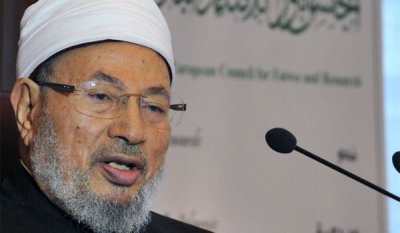
The IUMS, established in 2004 and headed by Islamic scholar Yusuf Al-Qaradawi, was among 83 movements and organisations that were labelled terrorist groups by the UAE on Saturday.
Also included in the list were the Muslim Brotherhood, the Islamic State (ISIS), Yemen’s Shiite Houthi movement and the Egypt-based Ansar Beit Al-Maqdis militant group.
In its statement, the group said it rejects this labelling, asserting that since its establishment ten years ago, the IUMS “has promoted a moderate approach and discouraged extremism, terror and violence using cultural and educational means”.
“The IUMS has issued dozens of statements against terrorist and extremist groups,” it added.
On its website, the IUMS identifies itself as “an institution concerned with the call (Da’wah) to Islam by tongue, pen, and every contemporary legitimate medium; be it recorded, audio, or visual”.
“IUMS is not a local or a regional union, neither an Arab nor a national one, neither an eastern, nor a western union; rather, it represents all Muslims in the entire Islamic world, as well as all the Muslim [minority populations] and Islamic groups outside of the Islamic world.”
It also asserts that it “does not slant towards exaggerations and excesses, nor does it tilt towards default and negligence, but rather it adopts the centremost approach of the centremost Ummah (Islamic nation), an approach of mediation and moderation.”
The Egyptian-born Al-Qaradawi has been under fire by Egypt’s post-coup authorities for his vocal criticism of the military’s ouster – and subsequent imprisonment – of elected president Mohamed Morsi, a Muslim Brotherhood leader, last year.
Egypt branded the Brotherhood a “terrorist” movement late last year following the bombing of a security headquarters in the Nile Delta.
The label was attached to the movement amid a massive crackdown on its members, supporters and leaders on the streets of Cairo and other Egyptian cities and provinces.
Saudi Arabia also designated the Muslim Brotherhood a “terrorist” movement in March of this year, following in Egypt’s footsteps.
The UAE and Saudi Arabia were amongst the first countries to welcome Morsi’s ouster. Both countries – along with Bahrain – withdrew their ambassadors from Doha last March, accusing Qatar of interfering in their affairs.
Many observers, however, linked the rift to Doha’s perceived support for Morsi and the Muslim Brotherhood.
Yet, the three countries agreed on Sunday to return their ambassadors to the Qatari capital following a surprise Gulf summit in Saudi Arabia.
Featured Video
Anthrax War – CBC The Passionate Eye
or go to
Aletho News Archives – Video-Images
Book Review
Shattered Dreams: The HPV Vaccine Exposed (2019)
By Christina England – 30 Q&As – Book Review & Summary
Lies are Unbekoming | September 4, 2026
… Gardasil received FDA fast-track approval in 2006, Cervarix followed in 2009, and Gardasil 9 was approved in December 2014 with more than double the aluminium adjuvant content of the original. The commercial context is specific. Merck was about to lose patent protection on Zocor and faced $18 billion in Vioxx injury claims from a cardiovascular drug the company had marketed while suppressing its own data showing a five-times increase in heart attacks. Analysts projected the global HPV vaccine market at $4 billion by 2011, contingent on government-funded national programs for teenage girls. The 1986 National Childhood Vaccine Injury Act had already granted manufacturers complete liability immunity. By 2013, Japan had withdrawn its HPV vaccine recommendation after cataloguing severe adverse reactions in hundreds of girls. No Western government followed. The establishment position across the UK, US, Australia, and most of Europe held, and still holds, that the vaccines are safe and effective, that reported injuries are coincidental, and that cervical cancer prevention justifies the program. The book was published into this position, not against a vacuum.
Shattered Dreams sits alongside Mary Holland’s The HPV Vaccine On Trial and Viera Scheibner’s foundational vaccination work as part of the documented record on what has been done to a generation of teenage girls under the banner of cancer prevention. The full summary unpacks three specific findings: that Merck used the aluminium adjuvant itself as the “placebo” control in 92.5% of trial subjects, making it structurally impossible to detect excess reactions from the adjuvant; that Dr. Sin Hang Lee found HPV DNA fragments bound to aluminium in every one of sixteen Gardasil samples tested, and in the blood and spleen of a New Zealand girl six months after her third dose; and that in every country with high vaccination coverage, including Australia, the UK, Norway, and Sweden, cervical cancer rates have stopped declining and started rising specifically in the vaccinated cohort. Martínez-Lavín’s 2017 calculation puts the number needed to seriously harm with Gardasil 9 at 140, and the number needed to vaccinate to prevent one case at 1,757. Thirteen young women are seriously harmed for every one who benefits. The vaccine was approved on the basis of trials that could not detect what the trials were supposed to detect, and it is still being given to twelve-year-olds today. … Read full review
Blog Roll
 Aletho News
- Georgia’s Largest Healthcare System Will Fire Employees Who Refuse Flu Vaccine
- The Five-Year Fuel Crisis: Why the World Economy Is Paying for a War It Thinks Is Ending
- Trump’s Big Bluff on Iran
- Swiss scammed out of millions by Ukraine-linked call centers – media
- Germany facing potential ‘violent conflict’ with Russia – spy chief
- Ukraine’s EU neighbors reject new plea from Kiev – Politico
- British Transport Police Facial Recognition Trial Scanned 926,912 People With Zero Arrests
- House Bill Would Ban Federal Use of Flock ALPR Data
- Can a Spice Rival a Drug? 10 Head-to-Head Trials Put It to the Test.
- The oil routes around Hormuz face their own chokepoints
- If Americans Knew
- “We See Our Homes Now From A Satellite, Like Strangers”
- Watch “Gaza: Doctors Under Attack”, originally censored by BBC
- NAZA: Israeli embassies in UK and US promote rival documentary to challenge Gaza genocide allegations
- David Ellison appoints Israeli to lead merged Paramount-Warner studios
- Turkish Red Crescent helps elderly Gaza man walk again after Israel confiscates his prosthetic limb
- Four Palestinians Killed in Israeli Attacks in Gaza
- Two Palestinian youths killed and village razed as Israeli attacks on West Bank continue
- Two more Christian women victims of Israeli raids on Gaza
- Cruelty, Deprivation, Indignity: A Journalist’s 22 Months in Israeli Prison
- New IDF Website Frames Slain Gaza Journalists as Terrorists
- No Tricks Zone
- Latest European Green Energy Debacle; Portugal’s Largest Flagship Solar Park Insolvent!
- Green Energy Debacle: German Expert Professor Fritz Vahrenholt Warns Of Severe Economic And Social Consequences
- Two More Paleo Reconstructions Affirm Meters-Higher Sea Levels Across Ireland, Brazil 7000-6000 Years Ago
- New Study: Earth And Venus Surface Warmth Largely Explained By Convection And Lapse Rate, Not CO2 Or Radiation
- 2025 Nature Paper Claiming Worsening Global Drought Gets RETRACTED …Heavily Flawed
- New Study: ‘Global Drought Shows No Detectable Recent Acceleration Under Climate Warming’
- Economic Masterminds: German Socialists Suggest Taxing Productivity Gains Stemming From Using AI
- The South China Sea Has Not Been Cooperating With The Climate Change Narrative
- Energy Crisis: Germany Enters Heating Season With Historically Low Gas Reserve Fill Levels
- New Study: The Antarctic Ice Sheet Gained Mass From 2020-2024 Due To Staggering Snow And Ice Accumulation

