US-Led Coalition Shoots Down Syrian Army Aircraft – Reports
Sputnik – 18.06.2017
The US-led anti-terrorist coalition has reportedly shot down a Syrian government forces’ aircraft.
Syrian Arab Army announced that the US-led anti-terrorist coalition had brought down its aircraft in southern Raqqa countryside, Syrian media reported citing a statement by the Syrian Defence Ministry.
According to the report, the Syrian jet fighter was carrying out military tasks fighting Daesh terrorist organization.
“Our aircraft was downed at lunch time today near the [Syrian] city of Raqqa, when it was fulfilling its mission against the IS,” the ministry said in a statement, adding that the US-led coalition was responsible for downing the aircraft.
The ministry noted that the coalition’s “actions are aimed at halting the Syrian army and its allies in the fight against terrorism, whereas our army and allies make great progress.”
According to the ministry, the pilot of the aircraft has not been found to date.
This is not the first time the US-led coalition’s activities in Raqqa cause casualties. Syrian media reported earlier that at least 43 civilians were killed as a result of the US-led coalition airstrike in the region. The Syrian Foreign Ministry condemned the airstrikes and sent two letters the UN secretary general and the head of the UN Security Council, in which the coalition’s actions were compared to Daesh crimes. Just a few days later, the Lebanese media reported that the coalition’s airstrikes killed more than 30 civilians more near Raqqa.
Raqqa has been under the control of Daesh since 2013, and is the de-facto capital of the self-proclaimed Daesh caliphate. The operation to retake Raqqa, conducted by a coalition consisting of almost 70 countries, has been on-going since November 2016. The strikes in Syria are not authorized by the UN Security Council or the government of Syrian President Bashar Assad.
US, allies sponsor Daesh: Adviser to Syria’s Assad
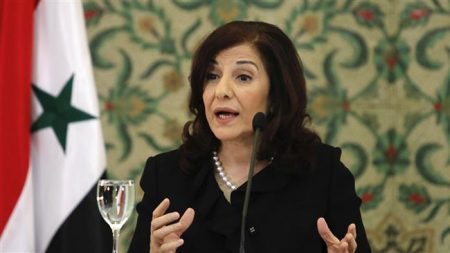
Bouthaina Shaaban, political and media adviser to Syrian President Bashar al-Assad
Press TV – June 18, 2017
A political and media adviser to Syrian President Bashar al-Assad has accused the US and its allies of financing and arming the Daesh Takfiri terrorist group in a bid to tear the region apart and deplete its resources.
Bouthaina Shaaban made the remarks in a statement to journalists after meeting with visiting China’s Special Envoy for Syria Xie Xiaoyan and the accompanying delegation in Damascus on Saturday.
While the US and its allies sponsor Daesh, the alliance supported by Russia and China stands against the expansion of terrorism in the Arab country, Shaaban said.
Russian and China, two of the five veto-wielding permanent members of the United Nations Security Council, have vetoed resolutions against the Syrian government that is battling foreign-sponsored terrorists since 2011.
There are UNSC resolutions, under which those responsible for committing, organizing and supporting terror acts as well as facilitating the movement of terrorists must be held accountable, but these motions have not been implemented at all, the Syrian official noted.
UNSC Resolution 2253, adopted unanimously in December 2015, covers asset freeze, travel ban, arms embargo and listing criteria for Daesh, al-Qaeda militants and “associated individuals, groups, undertaking and entities.”
Elsewhere in her remarks, Shaaban said that the Syrian army and its allies had recently managed to reach the Syria-Iraq border and “dealt a severe blow to the terrorists” through unified efforts, underlining the importance of strengthening communication between the two neighbors in that regard.
Washington’s agenda intersects with that of Daesh, which serves the interests of Israel, she added.
The Syrian official also denounced as unjustified the US deployment of rocket launchers to southern Syria and its attacks on the army positions.
Earlier this week, Russia said the US had deployed the M142 High Mobility Artillery Rocket System (HIMARS) launchers from Jordan to its base in the Syrian town of At-Tanf, warning that the equipment could be used against Syrian government forces.
Additionally, on two occasions in June and May, US warplanes attacked a Syrian military position near At-Tanf, killing an unspecified number of people and causing some material damage.
The US claimed that the Syrian forces who came under the attack posed a threat to its forces in Syria.
The Syrian army denounced the assaults, saying they demonstrated US support for terrorism, at a time when the Syrian army and its allies were making gains against Daesh militants.
UNSC liable for consequences of Saudi war on Yemen: Ansarullah
Press TV – June 17, 2017
Yemen’s Houthi Ansarullah movement has held the United Nations Security Council (UNSC) accountable for the consequences of the deadly Saudi aggression, stressing that the nation reserves the right to defend itself.
Mohammed Abdulsalam, the movement’s spokesman, said on Saturday that the UNSC issues statements that encourage the invader to continue its attacks and sieges, increasing the suffering of millions of Yemenis and dashing hope for a political resolution of the conflict, the al-Masirah television network reported.
The Yemeni army and allied popular forces would use all means to respond to Saudi assaults as Yemen, like other nations, reserves the right to defend itself against any invasion, Abdulsalam said.
The UNSC, which is in charge of preserving global peace, should know that the Saudi war supported by the US arms and financial aid, threatens international security, he added.
The Houthi official also stressed that the deterioration of the health situation in Yemen with the outbreak of Cholera is “a source of shame” for the body that claims to be promoting human rights.
He further held Saudi Arabia responsible for the stalemate in talks between Yemen’s warring sides, the siege on Yemen and Sana’a Airport activities.
In a lengthy statement on Thursday, the UNSC called on the Houthis and allies to cease all attacks at Saudi Arabia.
It also urged Yemen’s warring sides to reach a UN brokered deal on management of the strategic port city of Hudaydah at a time that the country slides closer to famine.
Saudi Arabia has been leading a brutal military campaign against Yemen for more than two years to eliminate the Houthi movement and reinstall a Riyadh-friendly former president, Abd Rabbuh Mansur Hadi.
The military campaign, however, has failed to achieve its goals and left over 12,000 Yemenis dead.
The country is also grappling with a Cholera epidemic.
Earlier this week, Save the Children charity said at least 942 people have been killed since the outbreak began in Yemen in April.
It further warned that the rate of infection is increasing and that one child is contracting the disease every 35 seconds.
“Disease, starvation and war are causing a perfect storm of disaster for Yemen’s people. The region’s poorest country is on the verge of total collapse, and children are dying because they’re not able to access basic healthcare,” said Grant Pritchard, Save the Children’s Yemen director.
Cholera is an acute diarrheal infection that is spread through contaminated food or water. It can be effectively treated with the immediate replacement of lost fluids and salts, but without treatment it can be fatal.
Daesh Absent in Area of US’ HIMARS Artillery Deployment in Syria – Lavrov
Sputnik – June 16, 2017
Russian Foreign Minister Sergei Lavrov, commenting on the US military moves, pointed to the near absence of Daesh or other terrorist groups in the vicinity of the HIMARS’ staging area.
The United States transferred on Wednesday two High Mobility Artillery Rocket System (HIMARS) multiple-launch rocket systems from Jordan. The systems were deployed at the US special operations forces base near al-Tanf located 11 miles from the Jordanian border.The Russian military is analyzing the US deployment of artillery systems in southern Syria where terrorist groups are said to be virtually absent, Lavrov said Friday.
“The Russian military is naturally analyzing everything that is happening in this country, including taking into account the channel that we have with the US to prevent unintentional incidents,” Lavrov said at a briefing.
“In this area, there are practically no Daesh units and the deployment there of such serious weapons, which are not particularly suitable to combat Daesh… will not ensure the stability of communication channels between government and pro-government forces in Syria and their partners in neighboring Iraq,” he said.
Newly-deployed US rocket launchers may target Syrian army: Russia
Press TV – June 15, 2017
Russia says the US has deployed the M142 High Mobility Artillery Rocket System (HIMARS) launchers from Jordan to its base in southern Syria, warning that the equipment could be used against Syrian government forces.
“The United States has moved two HIMARS multiple rocket launchers from Jordan to the At-Tanf US special forces base,” the Russian Defense Ministry said in a statement released on Thursday.
It also accused the US, which is purportedly fighting terrorists, of having “repeatedly issued strikes on Syrian government forces fighting Daesh near the Jordanian border.”
Thus, the ministry said, “it’s not hard to guess that similar strikes will be continued against contingents of the Syrian army in the future using HIMARS.”
The deployment of any type of foreign weaponry on Syrian soil “must be approved by the government of the sovereign country,” it pointed out.
The statement further said Moscow is closely monitoring the situation on the Syrian-Jordanian border.
On Wednesday, an intelligence source first reported the US relocation of the HIMARS from Jordan to Syria.
The town of At-Tanf, home to a US base, is located in Syria’s Homs Province near a Syria-Iraq border crossing on the main Baghdad-Damascus highway.
On June 6, US warplanes attacked a Syrian military position on the road to At-Tanf, killing an unspecified number of people and causing some material damage.
The US claimed that the Syrian forces who came under the attack posed a threat to its forces and their terrorist allies in Syria.
On May 18, the US carried out a similar strike on a Syrian military convoy near At-Tanf.
The Syrian army has denounced the attacks, saying they demonstrate US support for terrorism, at a time when the Syrian army and its allies are making gains against Daesh militants.
The US and its allies have been bombarding what they call Daesh positions inside Syria since September 2014 without any authorization from the Damascus government or a UN mandate.
They have been accused of targeting and killing civilians, while failing to fulfill their pronounced goal of destroying Daesh.
Major Chilean Universities Heed BDS Call, Cancel Events Sponsored by Israeli Embassy
IMEMC | June 10, 2017
 Student-led BDS campaigns resulted in two major Chilean universities canceling events co-sponsored by the Israeli embassy and featuring Joe Uziel, a director of the Israel Antiquities Authority (IAA). On Monday, Alberto Hurtado of the University’s Anthropology Department announced the event’s cancellation, and yesterday the University of Chile’s Social Sciences Faculty did the same.
BDS Chile highlighted the reasons behind the campaign to cancel the event:
Universities cannot be passive accomplices in grave human rights violations. The State of Israel maintains an illegal occupation, colonization and apartheid regime against the Palestinian people, and the Israeli Embassy is this regime’s representative in Chile. In addition, the Israel Antiquities Authority is a government entity illegally based in occupied East Jerusalem that carries out illegal excavations in the occupied Palestinian West Bank. Some of these illegal excavations are directed by the invited speaker, Joe Uziel.
The confiscation and theft of Palestinian cultural heritage are part of Israel’s attempts to erase Palestinian memory and cultural identity. Since 1967, the IAA has been deeply involved in cultural crimes and serious violations of international law, such as illegally removing and plundering hundreds of thousands of precious artifacts from the Occupied Palestinian Territory (OPT), including East Jerusalem. Fearing BDS campaigns, Israel has been trying to prevent information about archeological work in the OPT from being made public and to whitewash these violations by promoting events like these abroad.
Sharaf Qutaifan, from the Palestinian Campaign for the Academic and Cultural Boycott of Israel (PACBI) said:
Through the Israel Antiquities Authority, Israel attempts to bury the history of the indigenous people of Palestine, which was always home to groups with diverse cultures and religions. This is an extension of Israel’s policies of expulsion and cultural theft that it has carried out against Palestinians since its establishment. Israel has a troubling record of systematically looting Palestinian lands and properties, cultural treasures and even books and artworks, which continues until today.
We salute the Chilean students for pressuring the Anthropology Department of Alberto Hurtado University and the Social Sciences Faculty of University of Chile to take principled positions. Academic institutions should not lend their good names to Israel’s denial of Palestinian rights. We hope to see all Chilean universities fully free of Israeli apartheid.
BDS Chile celebrated the victory:
We welcome the decisions of Alberto Hurtado University and the University of Chile. The Palestinian people expect principled acts of solidarity in support of their human rights and the respect of international law. These cancellations demonstrate Chilean students’ determination to denounce Israel’s oppression and to work towards interrupting our universities’ ties with institutions complicit in Israeli apartheid.
This latest news is another stride in the growing academic boycott of Israel in Chile. Last year, law faculty students at the University of Chile overwhelmingly voted in support of BDS, as did more than 90% of the social sciences students. At the Catholic University of Chile, the Student Council also passed a BDS resolution by a large majority.
The cancellations are also another strike against the Israel Antiquities Authority. At the end of 2016, the 8th World Archaeological Congress published a resolution condemning Israel’s excavations in the Occupied Palestinian Territory and called on international academic publishers to refuse publishing works related to archaeological research in those areas.
The Palestinian Campaign for the Academic and Cultural Boycott of Israel (PACBI) was initiated in 2004 to contribute to the struggle for Palestinian freedom, justice and equality. PACBI advocates for the boycott of Israeli academic and cultural institutions, given their deep and persistent complicity in Israel’s denial of Palestinian rights as stipulated in international law. Visit PACBI at https://bdsmovement.net/pacbi and follow us on Twitter @PACBI
Syrian Arab Army takes control of Jordanian border
By Adam Garrie | The Duran | June 9, 2017
Fierce fighting with ISIS and US backed jihadists in southern Syria has been ongoing for months. In June, two convoys of Syrian and allied soldiers came under fire from US forces illegally operating in the desert areas of southern Syria near the borders with Iraq and Jordan.
Today, the Russian General Staff announced that Syrian forces are now in full control of 105 kilometres of the border with Jordan. Jordan which for decades has been hostile to Syria has been an important passage for terrorists and illegal armed forces entering Syria.
The Russian General Staff who work closely with the Syrian Arab Army as part of the anti-terrorist coalition in the country issued the following statement as offered by Russian Col. Gen. Sergei Surovikin,
“As part of the advance of the Syrian army and militia on Daesh’s (ISIS) positions, the control over 105 kilometres of the Syrian-Jordanian border has been restored
The efforts of the government forces on establishing full control over the Syrian-Jordanian border and the border with Iraq continue”.
This not only will help seal off areas where militants can enter Syria but crucially it will send a clear message to the Jordanian armed forces that their presence will not be allowed nor tolerated in Syria.
US Congress and Knesset celebrate ‘reunification’ of Jerusalem in joint event
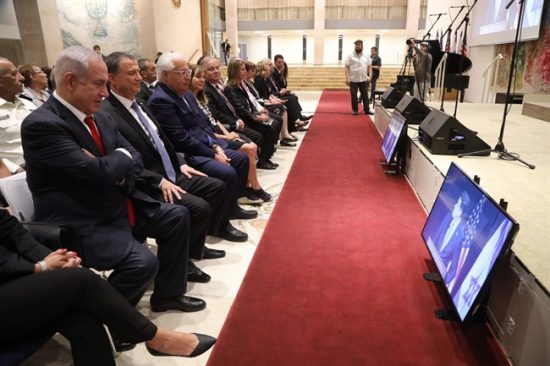
Joint US Congress-Knesset event celebrating “reunification” of Jerusalem (Credit: Knesset)
Ma’an – June 8, 2017
BETHLEHEM – In the latest event celebrating the “reunification” of Jerusalem in Israel, the Knesset, Israel’s parliament, and the US Congress held a joint live broadcast event marking the occasion on Wednesday, in which leaders from both countries celebrated their shared colonial histories and applauded Israel’s control over occupied East Jerusalem.
During each year that Israelis celebrate the “reunification” of Jerusalem to mark the Israeli military takeover of the territory decades ago, Palestinians, in contrast, have commemorated the Naksa, meaning “setback,” marking the Israeli invasion and occupation of the West Bank — including East Jerusalem — Gaza, Sinai, and the Golan Heights that began on June 5, 1967 during the Six-Day War, displacing some 300,000 Palestinians, as well as thousands of Syrians, from their homes.
Since 1967, Israel has stood accused of committing major violations of human rights and humanitarian law in the occupied Palestinian territory, including excessive and deadly use of violence; forced displacement; the blockade of the Gaza Strip; unjustified restrictions on movement; and the expansion of illegal settlements.
“For the sake of Jerusalem, let us not remain silent. Let us promise that support for unified Jerusalem remains high on both sides of the aisle, across the political spectrum, and throughout the United States,” Speaker of the Knesset Yuli-Yoel Edelstein said during the event.
“Looking around the world, and especially at this region, one thing becomes crystal clear: Only Israeli sovereignty will ensure that the city’s holy sites remain open, free, and safe for members of every religion,” he added.
However, while Israelis are permitted freedom of movement in Jerusalem and even in the majority of the occupied West Bank, most Palestinians are not permitted to enter Jerusalem without Israeli-issued permits, which means that the city is a rare sight and far from being “open and free.”
Edelstein also applauded the US’ own colonial history, saying that “your country was settled by pilgrims building a city upon the hill,” and developed a “just society based on the values that the Hebrew Prophets preached right here thousands of years ago,” without mentioning the mass killings and displacement of the indigenous peoples of that land; some academics have noted that some 20 million indigenous peoples died as a result of the European invasion and subsequent colonization of the Americas.
US Speaker of the House Paul Ryan also reiterated a similar point of equal rights at the holy sites, before saying that ”without Jerusalem, the Israel we know today would simply not exist” and called members of the Popular Front of the Liberation of Palestine (PFLP) “terrorists” for taking Israeli hostages in exchange for the release of Palestinians imprisoned by Israel in 1976.
Prime Minister Benjamin Netanyahu greeted the leaders by once again stating that Jerusalem is “the eternal, undivided capital of the Jewish state,” in contravention of international law, which, according to the Fourth Geneva Convention, prohibits Israel from transferring any of its population to occupied East Jerusalem.
Meanwhile, while Israel officially annexed East Jerusalem in 1980, in a move never recognized by the international community, according to Palestinians and the international community the city has remained an intricate part of the occupied Palestinian territory and would be considered the capital of any future Palestinian state.
Netanyahu also said that Israel had “made sure that the holy sites for Judaism, Christianity and Islam were available to all,” again failing to mention the millions of Palestinians who do not have free access to these sights in Jerusalem.
“In this great convulsion that is taking place around us, there is one free city, where Christians, Jews and Muslims are free to worship undisturbed, and that’s in the free, united city of Jerusalem, and that’s how it will stay,” Netanyahu added.
In response to the event, Palestine Liberation Organization (PLO) Executive Committee Member Hanan Ashrawi said in a statement last week that the move was “unprecedented” and “provocative” and that the US Congress was “singularly contravening longstanding American policy and becoming party to Israel’s egregious violation of international law and international humanitarian law.”
“If the US wants to play a constructive role as a peacemaker rather than as a supporter of an illegal occupation, it must demonstrate respect for the law and recognition of equal rights for all peoples, foremost the Palestinian right to self-determination and freedom,” Ashrawi concluded.
Meanwhile, the US Senate passed a resolution on Monday declaring Jerusalem the “undivided” capital of Israel.
The Senate reportedly passed the nonbinding resolution in order to express its support for the Jerusalem Embassy Act of 1995, which would move the US embassy to Jerusalem. US President Donald Trump signed a presidential waiver to prevent the act’s implementation last week, following on the footsteps of every US president since the act’s introduction.
However, on the issue of Palestine, Trump has remained largely elusive, saying in February that when it came to a solution for the decades-long Israeli-Palestinian conflict he could “live with either” a one- or two-state solution, in a significant departure from the US’ publicly held position in favor of a two-state solution to the conflict.
Nevertheless, his elusiveness has not belied the fact that Trump and his administration have maintained their pro-Israel stance, despite stated efforts to renew the Israeli-Palestinian peace process, which he said in the past was “not as difficult as people have thought over the years.”
Lavrov: Deconfliction zones in Syria announced without Damascus’ consent illegitimate
RT | June 7, 2017
Russia considers the US-led coalition airstrike against pro-Damascus fighters in Syria an act of aggression and rejects the justification for the attack issued by the Pentagon, Russian Foreign Minister Sergey Lavrov said.
The Tuesday airstrike near the town of At Tanf in eastern Syria “was an aggressive act, that violated the sovereignty and territorial integrity of the Syrian Arab Republic and – deliberately or not – targeted the forces which are most effective in fighting terrorists on the ground,” the minister said on Wednesday.
The Pentagon justified the attack by saying that the pro-government forces “advanced inside the well-established deconfliction [sic] zone in southern Syria.”
The US claimed that it attacked the pro-Damascus convoy because it posed threat to “partner forces” based in At Tanf. The US military earlier stated that an area within 55km from the town was a designated “deconfliction zone,” where forces not allied with the US are apparently not allowed to enter.
Lavrov rejected that reasoning, saying that he is not familiar with the term.
“I don’t know anything about such zones. This must be some territory, which the coalition unilaterally declared [deconfliction zones] and where it probably believes to have a sole right to take action. We cannot recognize such zones,” he said.
Lavrov said Russia, Turkey and Iran have signed a deal, which has been endorsed by the UN Security Council, to establish so-called “de-escalation zones” in several parts of Syria. Damascus agreed to this approach and the exact borders and mechanisms for observing a truce inside those zones are currently being negotiated.
“This approach was agreed to by Syria. We consider illegitimate any unilateral declaration of ‘deconfliction zones’ not endorsed by Damascus. We hope the coalition will adhere to the agreement it has reached with us, which states that the de-escalation zones must be agreed to in detail by all stakeholders,” he said.
He added that, according to some reports, the force attacked by the coalition was being deployed to prevent Islamic State (IS, formerly ISIS) fighters from destroying two bridges and a road connecting Syria with Iraq, and that the intervention had allowed the terrorists to carry out their plan.
Remembering the Naksa

Image of Israeli soldiers interrogating Palestinians during the 1967 Gaza war [Miren Edurne/facebook]
By Nasim Ahmed | MEMO | June 5, 2017
Fifty years ago this month, Israel launched a war against its neighbours and took control of the parts of Palestine which it had failed to capture during its 1948 “War of Independence”.
What: The Palestinian Naksa (“Setback”)
When: 5 June 1967
Where: Palestine
What Happened?
On 5 June 1967, Israel launched a pre-emptive strike against Egypt, Jordan, Iraq and Syria. After knocking out the air defences of these countries, it occupied East Jerusalem, the West Bank and the Gaza Strip, as well as the Syrian Golan Heights and Egypt’s Sinai Peninsula. Thus, it had taken control of the final 22 per cent of historic Palestine that it wasn’t able to occupy in 1948.
Nearly 400,000 Palestinians were added to the hundreds of thousands of refugees displaced in 1948 and their homes and villages were razed to the ground by the Israelis. Around half were being displaced for the second time in less than 20 years. Israel’s ethnic cleansing of Palestine was ongoing (as it is to this day).
The number of Palestinian refugees in the camps operated by the UN Relief and Works Agency (UNRWA) in the West Bank, Gaza Strip, Jordan, Syria and Lebanon grew.
The Naksa commemorates this tragic setback in the Palestinian struggle for freedom and self-determination.
What Happened Next?
The outcome of the war launched by Israel was, for many of its citizens and supporters, the fulfilment of God’s promise. Adding 44 per cent of the territory allocated by the 1947 UN Partition Plan for a Palestinian state, to the 56 per cent set aside for a Jewish state, marked a new beginning for both Israel and stateless Palestinians.
Within 20 years of being recognised as an independent state, Israel began an occupation that would become the longest in modern history, at 50 years and counting. Palestinians in the “occupied Palestinian territories” were subjected to a brutal Israeli military occupation as well as the activities of armed, right-wing Jewish settlers, for whom Israel’s victory was God’s handiwork and a licence to colonise the land which they believed was promised to them and them alone.
Israel’s already repressive military rule over Palestinians living within its undeclared borders was transferred to the West Bank and Gaza. Very soon, a matrix of control and domination, that included checkpoints, permits and home demolitions, was imposed on the lives of millions of Palestinians under Israeli occupation.
For the Palestinians, the combination of the Arab defeat during the “Six-Day War”, the repeated failure of the international community to protect their human rights, and Israel’s total colonisation of Palestine, prompted a serious re-evaluation of their situation. Having witnessed the futility of relying on others to end the indignity from which they had suffered for decades, they began to organise politically in an attempt to reverse the losses of 1948 and end their misery and statelessness.
In the years following the Naksa, Palestinian communities in the refugee camps and diaspora began to organise themselves politically and socially. A number of setbacks against the Palestine Liberation Organisation (PLO) did not deter them. Such civil society activities led to the formation of the Islamic Resistance Movement (Hamas) in the late eighties; the popular uprising now known as the First Intifada; and the PLO under the control of the secular Fatah movement gaining recognition by Israel and its allies as the “sole representative of the Palestinian people”. This phase of the political process ended with the signing of the Oslo Accords in 1994, providing the Palestinians in the West Bank and Gaza Strip with “interim self-governing arrangements”.
Featured Video

The Truth About the Trump Shootings with Ken Silva
or go to
Aletho News Archives – Video-Images
From the Archives
Trans ‘milk’ as good as the real thing – NHS
RT | February 18, 2024
The drug-induced nipple secretions of trans women are as good as mothers’ breast milk for babies, the University of Sussex Hospitals NHS Trust claimed in a letter to campaigners made public in a report by British think tank the Policy Exchange on Sunday.
The healthcare trust’s medical director, Rachel James, argued that the off-label prescription drug cocktail men transitioning to female take in order to produce milk was “similar to the natural hormones which encourage lactation to develop when the baby is newly born.”
“The evidence which is available demonstrates that the milk is comparable to that produced following the birth of a baby,” James wrote in the letter, sent to Children of Transitioners last August.
Biological men who wish to lactate must first take hormones to grow milk glands and then take high doses of either domperidone or metoclopramide to stimulate milk production. Neither drug is approved for this use, though they are occasionally prescribed off-label to biological women who have trouble lactating.
However, domperidone’s own manufacturer, Janssen, warns patients the drug “may cause unwanted side effects affecting the heart in a breastfed baby” and “should be used during breastfeeding only if your physician considers this clearly necessary.” … continue
Blog Roll
 Aletho News
- Seyed M. Marandi: U.S. Strike Imminent – Toward Total War in the Middle East
- Russia Voted Under Fire. Washington Is Loading the Tankers.
- 12 Things Your Oncologist Was Trained Not to Tell You
- Anthrax Attacks Paved Way for COVID-Era ‘Junk Drugs and Vaccines’
- How Real Is the Impact of Western Sanctions on Israel?
- France, You Are Guilty: How Paris Turned Western Sahara into the Maghreb’s Powder Keg
- 2025 Nature Paper Claiming Worsening Global Drought Gets RETRACTED …Heavily Flawed
- Your Milk Is Not the Problem
- The Truth About the Trump Shootings with Ken Silva
- ARE PATIENTS BEING PROPERLY INFORMED ABOUT OZEMPIC?
- If Americans Knew
- An error has occurred; the feed is probably down. Try again later.
- No Tricks Zone
- 2025 Nature Paper Claiming Worsening Global Drought Gets RETRACTED …Heavily Flawed
- New Study: ‘Global Drought Shows No Detectable Recent Acceleration Under Climate Warming’
- Economic Masterminds: German Socialists Suggest Taxing Productivity Gains Stemming From Using AI
- The South China Sea Has Not Been Cooperating With The Climate Change Narrative
- Energy Crisis: Germany Enters Heating Season With Historically Low Gas Reserve Fill Levels
- New Study: The Antarctic Ice Sheet Gained Mass From 2020-2024 Due To Staggering Snow And Ice Accumulation
- Study: Ocean Heating Rates From Thousands Of Years Ago ‘Dwarf’ Modern Ocean Heating Rates
- Climate Extremists Target, Attack Large-Scale Power Grid Infrastructure In Germany!
- New Study: Antarctic Ice Melt Has Contributed Less Than 1 Centimeter To Sea Level Rise In The Last 30 Years
- Fear Of Debate: Alarmist German Climate Scientist Calls On Mainstream Media To Discredit Skeptic Voices
 Aletho News