The scramble for control of Syrian-Iraqi border
By M K Bhadrakumar | Indian Punchline | June 4, 2017
The remark by the Syrian Kurdish militia spokesman Saturday that their final assault on the ISIS “capital” city of Raqqa will start “in the coming few days” highlights the keen struggle for control of eastern Syria bordering Iraq that is playing out. The ISIS is staring at defeat and the issue now is what follows thereafter.
The big question is whether Syria survives or will get balkanized. The Russian President Vladimir Putin flagged this stark reality when he said on Friday,
- Does the possible dismemberment of Syria arouse concern? It certainly does. We are establishing de-escalation zones now and we are afraid that these de-escalation zones may turn into a blueprint for future borders. Russia hopes these safety zones would serve to interact with the Assad government, to start at least some kind of a dialogue, some interaction, as this would help future political cooperation in order to restore Syria’s control over its entire territory and preserve the country’s territorial integrity.
Of course, there is the danger that Syrian war may become a “frozen conflict”. The key, therefore, lies in gaining control of Iraq’s border crossings with Syria across vast desert lands through which Iran renders vital help to the government forces and the Hezbollah and the Shi’ite fighters battling the insurgents and the ISIS.
As the map, here, shows, the Syrian-Iraqi border regions are largely under the control of either US-supported Kurdish and other insurgent fighters or the ISIS and other extremist groups. The Syrian government aspires to regain control of those regions.
Essentially, the struggle is for control of the border crossings that are depicted in the map. Clearly, the border crossing way up in the north is under the control of the Kurdish militia and it remains to be seen (a) whether the US would allow the Kurds to reach an understanding with Damascus; (b) whether Turkey will allow Kurds to consolidate their grip in that area; (c) whether the over-stretched government forces will take on the Kurds or, alternatively, will regard it to be tactically prudent to avoid a shooting match at this point and instead keep options open to eventually negotiate a power-sharing deal with the Kurds.
Unlike the northern front, the central and southern fronts are hotly contested. As the map shows, there is one border crossing in the central front at Al-Bukamal (where the Euphrates flows into Iraq) and another key border crossing is at Al-Tanf in the southern front.
In the central front, Bashar Al-Assad’s forces are in Palmyra and are making their way toward Deir Ezzor where a Syrian garrison is desperately holding out against a siege by the jihadi groups. The US appears to be encouraging the ISIS fighters in Raqqa to evacuate toward Deir Ezzor. But Russian cruise missile strikes recently targeted these ISIS convoys. (Sputnik) The US apparently prefers that somehow Assad’s forces must be prevented from reaching Deir Ezzor, because from there they could take control of the highway leading to the border crossing at Al-Bukamal. (See the map.)
Similarly in the southern front, the US is impeding the advance of the government forces to al-Tanf (which is connected to Damascus), another border crossing into Iraq. The US would hope that the rebel groups in al-Tanf will also seize control of the Al-Bukamal border crossing up north so that US proxies will be in control of the entire Syrian-Iraqi border as well as the southern Syrian region straddling the border with Jordan and the Golan Heights. The game here is essentially about cutting off Iran’s access to Lebanon (Hezbollah).
Why is it so important for the US to prevent Assad’s forces from taking control of the Al-Bukamal and Al-Tanf border crossings? Simply put, the spectre of a Damascus-Baghdad-Tehran land route reopening is what is haunting the US (and Israel), because such a solid land route will have a multiplier effect on Iran’s capacity to influence the future developments in Syria (and Lebanon).
The US has not directly jumped into the fray so far to take control of the Syria-Iraq border. It maintains the pretence that it is narrowly focused on fighting the ISIS. However, when it seemed that Assad’s forces were lunging toward Al-Tanf recently (May 18), the US forced them to turn back by launching an air strike.
The overall balance of forces does favour the Syrian government and in a conceivable future it should take control of Deir Ezzor, Al-Bukamal and Al-Tanf. Thus, the US will have to find a way to work around Assad (and Iran) than work against him. The other option will be to bear the heavy costs of a long-term, open-ended strategy of military intervention and occupation, which doesn’t figure in President Donald Trump’s foreign-policy calculus. The US’s best bet will be to seek some sort of understanding with Russia based on the premise that Moscow may not be fully sharing the agenda of Assad and his Iranian ally. But then, Moscow has no reason to bet on any other horse than the one it has been so far, which also happens to be a winning horse.
After US Bombs Syrian Government for Third Time in 8 Months, Media Ask Few Questions
By Ben Norton | FAIR | June 2, 2017
The United States has bombed Syrian government–allied forces three times in just eight months. Major media outlets have overwhelmingly failed to ask critical questions about these incidents, preferring instead to echo the Pentagon.
For years, media have consistently downplayed the extent of US military intervention in Syria, and repeatedly propagated the long-debunked myth that Washington never pursued regime change there in the first place. The distorted reporting on these US attacks reflects this longer trend.
On May 18, the US military launched an air raid against forces allied with the Syrian government, killing several soldiers. The Trump administration claimed Syrian- and Iranian-backed militias had entered a 55-kilometer (34-mile) “deconfliction zone” around a base in southern Syria, near the borders of Iraq and Jordan, where the US trains opposition fighters.
Yet US officials also later admitted that they do not themselves recognize the legitimacy of these de-escalation zones—even while using them to justify carrying out such attacks.
No major media outlets questioned the government narrative, or the notion that the Syrian-allied forces were a “threat.” (For context, 34 miles is the distance between Aleppo and Idlib, considered two separate theaters in the Syrian civil war. It is also roughly the distance between Baghdad and Fallujah, or between Washington, DC, and Baltimore.)
In its report on the attack, Reuters‘ cartoonish headline (5/18/17) was “US Strikes Syria Militia Threatening US-Backed Forces: Officials.” The article uncritically repeated that an unnamed pro-government militia “posed a threat to US and US-backed Syrian fighters in the country’s south.”
Reuters added that, when those “threatening” government-allied forces were hit, they were allegedly still a distant 27 kilometers (17 miles) from the US-led coalition’s al-Tanf base.
USA Today (5/18/17) simply noted that the “forces came within a 34-mile defensive zone around the al-Tanf base,” and unskeptically claimed the US airstrike “targeted pro-regime forces who were threatening a coalition base.”
Fox News (5/18/17) triumphantly declared, “US Airstrikes Pound Pro-Assad Forces in Syria.” Obediently echoing the US government, Fox claimed the Syrian forces “were near the Jordanian border and deemed a threat to coalition partners on the ground.”
The New York Times‘ report was similarly deferential (5/18/17), echoing Pentagon officials who insisted the pro-government convoy “ignored warnings.”
Unquestioned Double Standards
Later follow-up statements added a wrinkle to the US government narrative the media had parroted.
In peace talks in early May, Russia, Iran and Turkey signed an agreement to create four deconfliction zones in Syria. This deal was supposed to apply to the US as well, but the Trump administration has refused to recognize the legitimacy of these de-escalation zones—even while using them to justify attacks on Syrian government-allied forces.
The US military official who is leading the air war against ISIS, Air Force Lt. Gen. Jeffrey Harrigian, insisted at a May 24 press conference (The Hill, 5/24/17), “We don’t recognize any specific zone in itself that we preclude ourselves from operating in.”
Harrigian stressed that the US carries out whatever air strikes it wants in Syria. “We do not have specific zones that we are deconflicting with them,” the general said. “When we’ve talked to the Russians, we do not talk about those deescalation zones.”
Yet media reports still went along with the narrative that US forces were “threatened” by Syrian government-allied forces miles away in a zone that the US does not even accept as legitimate.
An anonymous CENTCOM official quoted two weeks after the attack by Military Times (5/30/17) complained, “These patrols and the continued armed and hostile presence of pro-regime forces inside the deconfliction zone are unacceptable and threatening to coalition forces.”
Meanwhile, Syrian rebels applauded the US attack and called for more strikes against the government.
‘First Time’ for a Third Time
Immediately after the May 18 airstrike, media portrayed the attack as something completely new. The Associated Press published a newswire headlined “US Airstrike Hits Pro-Syria Government Forces for First Time,” which was reprinted by the Washington Post and Yahoo News. Foreign Policy (5/18/17) similarly claimed “US Bombs Syrian Regime Forces for First Time.”
In reality, this was the third time in eight months that the US bombed Syrian government and allied forces. Some of these reports, strangely, even acknowledged the Trump administration’s April strike on a Syrian airfield, but acted as though this somehow did not constitute an attack.
In September 17, 2016, the Syrian military was leading a fight against the genocidal extremist group ISIS near the airport of Deir al-Zor, in eastern Syria. Suddenly, the US launched an hour of sustained airstrikes on the Syrian military, killing 106 soldiers in the attack, according to the Syrian government.
The US insisted the air raid was an accident and that it had meant to target ISIS militants. This has been called into question, however. A senior officer in the Syrian Arab Army said the US-led coalition had sent drones above the Syrian troops’ positions before the attack, so it knew where they were situated. The officer also recalled that the majority of the US airstrikes were not targeted at the frontline, where the Syrian soldiers were fighting ISIS.
Ultimately, it was the self-declared Islamic State that benefited from the US attack. The extremist group seized important areas around the Deir al-Zor airport. The US air raid also led to a breakdown in the ceasefire in Syria that had been agreed to just six days before.
Since President Donald Trump entered office, the US has launched two more intentional attacks on pro-government forces. In April, the US launched 59 Tomahawk missiles at Syria’s Shayrat airbase, in an attack that the Pentagon said destroyed 20 percent of Syria’s war planes. Trump claimed the strike was done in retaliation for a chemical attack in Khan Sheikhoun, a village in the Al Qaeda–dominated province of Idlib, although this accusation has been called into question by some arms experts.
This incident, the US’s first officially intentional attack on the Syrian government, also in effect aided ISIS, which launched an offensive near the city of Homs immediately afterward.
Unasked Questions
Many questions remain unanswered. Why can the US use deconfliction zones it does not even itself recognize to justify attacking Syrian government-allied forces? Do the US and UK have the right to tell Syria where its forces can go in its own country? How is 34, or 17, miles “close”? How can the US attack Syrian government forces without benefiting ISIS, a group that routinely threatens Western civilians?
A strong independent media should be asking these important questions. Instead, news outlets are effectively recycling government press releases.
For their part, Syria and Russia were furious after the May 18 strike. “This brazen attack by the so-called international coalition exposes the falseness of its claims to be fighting terrorism,” declared a Syrian military official on state media. The Syrian government said “a number of people” were killed, and equipment including a tank and a bulldozer were struck.
Syrian President Bashar al-Assad called the attack “a breach of Syrian sovereignty,” and Russia’s deputy foreign minister said it was “completely unacceptable.”
Yet the apparent presupposition shared and spread by corporate media is that Syria now belongs to the US, and the US can do whatever it wants in the country without anyone questioning it—especially not media outlets, which have been bending over backward to defend US actions.
Escalating US Military Intervention
The May 18 US air raid at the town of al-Tanf is only the latest in a string of attacks that have steadily been growing under Trump. The US has not officially declared war in Syria, although for more than 1,000 days it has waged thousands of airstrikes in the country, most of which have targeted ISIS.
Thousands of civilians have been killed in the US air campaign, which began in September 2014.
Even the Syrian Observatory for Human Rights—which is frequently cited by media as an impartial observer, even though it until recently had the Syrian opposition flag openly at the top of its website and consists essentially of one man in England—has acknowledged the massive civilian casualties.
In the month from mid-April to mid-May alone, at least 225 civilians were killed in US-led air strikes in Syria, including 44 children and 36 women, according to the Observatory. From February to March, another 220 civilians were killed.
The bombing campaign against ISIS has killed many civilians in Iraq as well as Syria. FAIR has previously detailed how media outlets have whitewashed and downplayed US complicity in the deaths of hundreds of civilians in Mosul, Iraq.
Media should be asking critical questions about US military intervention in Syria and beyond. Instead, they are downplaying US involvement and relaying Pentagon press releases.
Missing the Real Noriega Story
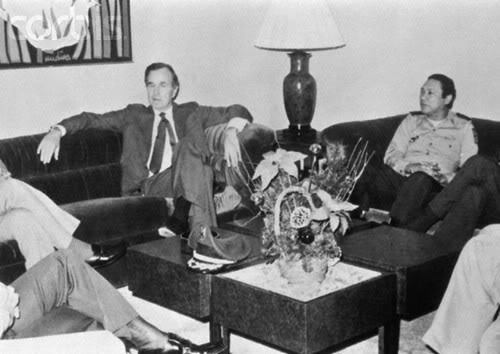
Vice President George H.W. Bush meeting with Panamanian Gen. Manuel Noriega in the mid-1980s when Noriega was considered a key ally in helping the Nicaraguan Contras wage a brutal guerrilla war to overthrow the leftist Sandinista government.
By Jonathan Marshall | Consortium News | June 1, 2017
The death of former Panamanian strongman Manuel Noriega on May 29 elicited few if any tears. But it should have sparked more reflection in the United States on his ugly history of service to the CIA, the hypocrisy of Washington’s sudden discovery of his abuses once Noriega became an unreliable ally against the Nicaraguan Sandinistas, and the George H.W. Bush administration’s bloody and illegal invasion of Panama in December 1989.
In fairness, many progressives and mainstream journalists have called attention to this troublesome history over the years. But few have dared to question the nearly universal condemnation of Noriega as a protector of international drug traffickers. That incendiary claim — first broadcast loudly by the unlikely trio of right-wing Sen. Jesse Helms, R-North Carolina; liberal Sen. John Kerry, D-Massachusetts; and investigative journalist Seymour Hersh — galvanized the American public to support his ouster.
After the U.S. invasion, which killed hundreds of Panamanians and 23 U.S. soldiers, Noriega was arrested on Jan. 3, 1990 by armed U.S. drug agents.
President George H. W. Bush declared that Noriega’s “apprehension and return to the United States should send a clear signal that the United States is serious in its determination that those charged with promoting the distribution of drugs cannot escape the scrutiny of justice.” U.S. Ambassador Deane Hinton called the invasion “the biggest drug bust in history.”
Convicted in 1992 on eight felony counts following what officials called the “trial of the century,” Noriega was sentenced to 40 years in jail. Although released early from U.S. incarceration, he spent the rest of his life in French and Panamanian prisons.
The resulting publicity created lasting myths about Noriega and drugs. Journalists who should know better have described Noriega as “one of the world’s biggest drug kingpins,” to quote Time magazine. In fact, Louis Kellner, the U.S. attorney who oversaw his Miami indictment and trial admitted, “Noriega was never a major player in the drug war.”
Indeed, at worst, he was a small fry compared to the military rulers of Honduras, whose epic protection of the cocaine trade was tolerated by Washington in return for using that country as a staging base for Contra operations against the Sandinista-led government of Nicaragua in the 1980s.
Deeply Flawed Trial
A few close observers of the long, expensive, and controversial trial believe it failed to prove Noriega’s guilt at all.
David Adams, who covered it extensively for the London Independent, said the government’s case was “marred by incompetent witnesses, false testimony, and poor presentation.”
Newsday’s Peter Eisner quoted Judge William Hoeveler, who presided over the trial, as saying “the outcome could have been different” if Noriega had been better represented.
Although the government put more than two dozen people on the stand, their testimony was not always relevant or credible.
Paul Rothstein, Georgetown University law professor and former chairman of the American Bar Association’s criminal evidence committee, said of the government’s witnesses, “What promised to be the trumpeting of elephants turned out to be the whimperings of mice.”
Big-time drug bosses enjoyed great rewards for telling the jury what the government wanted. Observed reporter Glenn Garvin, “To convict Noriega, the strike force had to make a flurry of deals with other accused narcotraffickers, bargaining a collective 1,435 years in prison down to 81.”
The fierce Noriega critic R. M. Kostner declared, “The prosecution was shameless in its bribery of witnesses. What co-defendants got for flipping made me sometimes wish that I had been indicted. The proceedings were almost totally politicized. It was clear long before they opened that, regardless of evidence, Noriega could not possibly be acquitted – a very sad thing for the United States.”
Other witnesses who never took the stand contradicted the government’s case years later. Retired Medellin cocaine lord Juan David Ochoa claimed in an interview with Frontline that “at no moment did [Noriega] protect us. . . . As far as I know he had nothing to do with the drug trade.”
Greg Passic, former head of financial operations for the DEA, said, “The Colombians I talked to in the drug transportation business said they didn’t deal with Noriega at all. To deal with him you would just have to pay him more money. They didn’t need it. It would be expensive.”
In fact, DEA officials repeatedly lauded Noriega’s cooperation with their anti-drug investigations, both in public letters of support and in private. Recalled Duane Clarridge, former head of Latin America operations for the CIA, “The DEA had told us that they were getting great support in Panama, and from Noriega in particular, in interdicting drugs.”
More than a year after the U.S. invasion, when it was absolutely impolitic to voice such sentiments, one “federal drug enforcement source” told a reporter, “Noriega was helping us, not ten percent, not twenty percent of the time, but in every instance we asked him to do so, one-hundred percent of the time. . . . These were key operations . . . that struck at both the Cali and Medellin cartels.”
Even the U.S. ambassador to Panama in the final years of Noriega’s rule, Arthur H. Davis Jr., said in an oral history interview, “all I know is that, all the time I was there, Noriega . . . cooperated one hundred percent with our people. Anytime we had a ship that we wanted to be interdicted on the high seas and we asked permission, they gave permission. . . . Anytime there was some prominent drug man coming up and we knew about it, Noriega would help us with it. And when we found out about things, the [Panamanian Defense Forces] would go over there and round them up and turn them over to us.”
Turning Against Noriega
One of the high points of Noriega’s cooperation was Operation Pisces, a three-year undercover probe that culminated in 1987. Attorney General Edwin Meese called it “nothing less than the largest and most successful undercover investigation in federal drug law enforcement history.”
Among those indicted were Medellin Cartel kingpins Pablo Escobar and Fabio Ochoa. Panama made 40 arrests and seized $12 million from accounts in 18 local banks. Said one U.S. prosecutor who helped direct the case, “The Panamanian officials we were dealing with were sincerely cooperative. . . . They could have breached security, and they didn’t.”
The operation may have pleased the DEA, but it angered the country’s financial elite, who directly profited from money laundering. One local banker warned, “this could end the Panamanian banking system, because people will no longer believe they can count on bank secrecy.”
Within two months, spooked investors withdrew up to $4 billion of the country’s $39 billion in bank deposits, triggering the most serious banking crisis in Panama’s history.
A Western diplomat said of Noriega, “The bankers can bring him down. They are complaining in Washington and they’ve got a lot of clout.” The demonstrations organized that summer by Panama’s business elite — and Noriega’s heavy-handed response to them — triggered his eventual slide from power
The bankers were joined by angry cartel leaders, who viewed Noriega as an “obstacle to the functioning” of their money laundering operations in Panama, in the words of drug policy expert Rensellaer Lee.
A lawyer for the bosses of the Cali Cartel complained that his clients were “frustrated by the problems” Noriega created for them in Panama.
Cali leaders later got their revenge when they paid $1.25 million to bribe a drug trafficker to become a key witness against Noriega in his Miami trial. In exchange for the testimony, eager U.S. prosecutors agreed to cut nine years off the sentence of an unrelated Cali trafficker — brother of one of that cartel’s senior leaders.
When Noriega’s defense team cried foul, a federal appeals court declined to order a new trial, but criticized the government for appearing “to have treaded close to the line of willful blindness” in its eagerness to win a conviction.
Medellin leaders were just as unhappy with Noriega as those in Cali. A pilot for one of the biggest Medellin smugglers described Pablo Escobar’s reaction after Noriega approved a raid on one of his cocaine labs in May 1984: “He was just really out of whack with Noriega. He was like, ‘This guy is dead. No matter what, he is dead.”’
It would be foolish to assert that Noriega, alone among all leaders in Central America, kept his hands clean of drugs. But much of his personal fortune is easily accounted for from other sources, such as the sale of Panamanian passports on the black market.
Whatever Noriega’s involvement with drug traffickers, as I have shown elsewhere, the Bush administration displayed unbelievable cynicism when, even before his capture, it swore in a new president of Panama who had sat on the board of one of the most notorious drug-money-laundering banks in the country. His attorney general, who unfroze the bank accounts of Cali traffickers, later became legal counsel for the Cali Cartel’s top smuggler in Panama.
Following Noriega’s ouster, not surprisingly, cocaine trafficking began surging in the country. A year and a half after his arrest, unnamed “U.S. experts” told Time magazine that “the unexpected result . . . is that the rival Cali cartel established a base in Panama and has since inundated the country, along with Mexico, Guatemala and the Caribbean, with vast quantities of cocaine destined for the U.S. and Europe.”
Today, though, all that is forgotten, along with the questionable course of justice during Noriega’s trial. Noriega, even in death, deserves no eulogies, but he does deserve a more balanced judgment of history.
South Korea military brass deliberately kept president in dark about THAAD: Probe
Press TV – May 31, 2017
A South Korean presidential probe into the “unauthorized” US deployment of additional missile launchers in South Korea has found that the Asian country’s own military authorities had deliberately withheld the information from the new president.
The office of the newly-elected President Moon Jae-in announced on Wednesday that documents submitted to the chief executive shortly after he was sworn into office earlier this month were intentionally censored to conceal information on the installment of four new rocket launchers of the Terminal High Altitude Area Defense (THAAD) system.
Moon’s spokesman, Yoon Young-chan, said the country’s top military brass who briefed the president’s national security adviser last week deliberately excised references to any new launchers, or to the total number installed in the country.
“These parts… were included in the original briefing report written by a working-level official but later deleted by his supervisors,” Yoon added in a press briefing.
He said all military officials involved in generating the report admitted that these key parts had been removed from the text in the editing process.
Seoul agreed last year to install the US-built missile system to guard against potential threats from nuclear-armed North Korea.Two missile launchers were already deployed in South Korea’s southern county of Seongju, and the existence of four more had been widely suspected but never declared.
Yoon said Defense Minister Han Min-koo finally admitted to the presence of the new missile launchers when pressed by Moon in a telephone conversation on Tuesday.
Moon expressed “shock” on Tuesday after hearing about the existence of the additional launchers and directed his senior secretary for civil affair and the head of National Security Office “to find the truth behind the unauthorized entry of the four rocket launchers,” according to Yoon.
Han was appointed by former president Park Geun-hye, who was ousted for her alleged involvement in a massive corruption scandal.
The new launchers arrived in South Korea before Moon took office on May 10 and are currently stored at a US military base in the country, Moon’s office added, without further explanation.
No specific reason was offered as to why the information had been withheld from the South Korean president by the country’s military chiefs. The new president had previously expressed reservations about THAAD’s hasty deployment.
The conservative government of Park approved the installation of the US missile system despite strong objections nationally and internationally — mainly from Russia, China, and North Korea.
Moon, meanwhile, reportedly intends to put the deployment on hold, saying that it should be discussed and approved by lawmakers before being fully rolled out.
The US maintains nearly 29,000 military servicemen stationed in South Korea.
Israel has already Judaised 95% of Jerusalem
MEMO | May 30, 2017
The head of the Islamic and Christian Committee in Jerusalem has stressed the importance of international watchdog reports which condemn Israeli policies in the city, Qudsnet News reported on Monday. Hanna Naser noted that Israel’s occupation authorities have already Judaised 95 per cent of Jerusalem.
“Crimes are not subject to a statute of limitations based on UN treaties,” he pointed out. Israel’s crimes are intended to eradicate the presence of indigenous Jerusalemites in their own city. Although Israel is colonising East Jerusalem with Jewish settlers, said Naser, the demographic balance is in favour of the Palestinians.
He gave details of a number of the Israeli Judaisation projects, including a railway and subway that connect Jewish areas to Al-Buraq (the “Western”) Wall adjoining Al-Aqsa Mosque. He also pointed out that almost $10 million has been allocated to Judaising infrastructure in the Old City.
Commenting on Human Rights Watch’s report that there are 90,000 Palestinians in East Jerusalem living in unlicensed homes, Naser told Qudsnet that this proves that the organisation is angry with the fake Israeli pretext used to justify the refusals of licence applications made by Palestinians. At least 12 international laws and conventions, he pointed out, ban the policy of home demolitions as adopted by Israel, including the Declaration of Human Rights.
On a related issue, Naser revealed that the Israeli foreign ministry has issued a statement to Israeli embassies worldwide claiming that its settlements across the occupied Palestinian territories, including East Jerusalem, are “legitimate and legal”. He also revealed that there is a Jewish tourist attraction being built beneath Al-Aqsa Mosque which is due to open in 2020 with the aim of attracting 6 million visitors a year. A number of fake tombs — almost 10,000 — have been created around the mosque area, he added.
Yemen descending into total collapse as world watches: UN
Press TV – May 30, 2017
The United Nations says impoverished Yemen is on the brink of total collapse, as the country is facing an ongoing bloody military aggression by Saudi Arabia, an emerging famine, and an outbreak of cholera.
“Crisis is not coming, it is not looming, it is here today, on our watch and ordinary people are paying the price,” said UN Under-Secretary-General for Humanitarian Affairs and Emergency Relief Coordinator Stephen O’Brien in a speech on Tuesday, addressing the UN Security Council.
“The people of Yemen are being subjected to deprivation, disease and death as the world watches,” he said, adding that the crisis is triggering “total social, economic and institutional collapse” in the Arab country.
O’Brien told the council that “the time is now” to finish the world’s largest food emergency and to put Yemen on the path of survival.
His alarming remarks come as the UN Security Council has so far failed to turn off the Saudi war machine and prevent it from inflicting more damage to the kingdom’s poor southern neighbor.
Since March 2015, Yemen has been heavily bombarded by Saudi warplanes as part of a brutal campaign against the impoverished country in an attempt to crush the popular Houthi Ansarullah movement and reinstall Abd Rabbuh Mansur Hadi, the president who has resigned and is a staunch ally of Riyadh.
Latest tallies show that the war has so far killed over 12,000 Yemenis and wounded thousands more. Indiscriminate Saudi bombardments have also taken a heavy toll on the Yemeni infrastructure, schools and hospitals, with prominent rights groups censuring Riyadh’s military for the use of internationally-banned weapons against Yemeni civilians.
The relentless airstrikes have put more than half of all health facilities in Yemen in a state of complete or partial shutdown. Nearly 3.3 million Yemeni people, including 2.1 million children, are currently suffering from acute malnutrition.
Some 19 million out of the country’s 28 million population are in dire need of humanitarian aid and many of them are reported to be on the brink of famine. The relentless airstrikes have also put more than half of all health facilities in Yemen in a state of complete or partial shutdown.
Furthermore, the war-torn nation has been grappling with a deadly cholera outbreak since last October. Over 55,200 Yemenis, one third of them children, are infected by the disease. The UN figures show that since late April nearly 500 Yemeni have lost their lives due to cholera infection. It is estimated that some 150,000 new cases of cholera are surfaced in the next six months.
The chaos in Yemen, caused by the Saudi campaign, has also given the Takfiri al-Qaeda and Daesh terror groups room to operate in the country, further complicating the situation on the ground there.
Syrian army ‘will ignore’ US air force border fight threat
Morning Star | May 30, 2017
SYRIA’S armed forces made clear yesterday that they will not obey US air force instructions to halt military operations near the Tanf border crossing with Iraq.
An army officer told Al-Masdar News that, despite the US air force dropping leaflets over Syrian army positions in south-east Homs at the weekend, army units will continue fighting against Free Syrian Army (FSA) and Isis militants until the entire Iraqi border with south-east Syria is sealed.
“Any movements toward Tanf will be considered hostile and we will defend our forces,” the US-led coalition leaflet read.
The officer added that the Russian military is deeply embedded with the Syrian army and their allies in southeast Homs and is backing continued operations.
Government forces greatly outnumber the Western-backed FSA in the region and the US allies also do not have the backing of the Iraqi government or the Shi’ite Popular Mobilisation Units that operate both in Iraqi desert areas west of Mosul and alongside Syrian government forces in south-east Homs.
US warplanes hit pro-Syrian government Palestinian fighters on May 18 on the pretext that they posed a threat to US troops and allied rebels near the border with Jordan.
Syrian army and allied paramilitary forces continued their successful campaign in the eastern Aleppo countryside yesterday afternoon, breaking through Isis defences and capturing the Ras al-Ayn village and its surroundings, heightening the pressure on the Isis stronghold of Maskanah.
The last batch of jihadist insurgents and their family members were transported in government-provided buses from the Barzeh suburb of east Damascus to Idlib province yesterday.
Their departure means that the Syrian government has full control of this suburb for the first time since late 2011.
Several rebels opted to remain in Barzeh and will have six months to resolve their status with the government.
Four members of the pro-Syrian government Harakat al-Nujaba militia, together with two Syrian army soldiers, were freed from year-long captivity in jihadi-controlled province Idlib on Sunday night after Nujaba fighters launched a behind-the-enemy-lines raid.
South Korea’s new leader orders probe into ‘unauthorized’ US deployment
Press TV – May 30, 2017
South Korea’s new President Moon Jae-in has ordered an investigation into the “unauthorized” deployment of four additional THAAD missile launchers by the United States to the country’s soil.
Presidential spokesman Yoon Young-chan said Moon was “shocked” to hear that the four additional launchers of the so-called Terminal High Altitude Area Defense (THAAD) missile system were installed without being reported to the new government or to the public.
“President Moon was briefed on such facts by National Security Office (NSO) chief Chung Eui-yong and said it was very shocking,” the spokesman told a news briefing on Tuesday.
The system was initially deployed to South Korea in March with just two of its maximum load of six launchers with the declared aim of countering North Korean threats.
The South Korean official further said the president had “ordered his senior secretary for civil affairs and the NSO chief to find the truth behind the unauthorized entry of the four rocket launchers.”
The deployment of THAAD, which came amid tensions with North Korea, was met with strong opposition from people in South Korea, including the residents of Seongju County, where the missile system is installed.
The installation was agreed by the government of Moon’s predecessor Park Geun-hye, who was impeached and ousted over a corruption scandal.
During his election campaign prior to the May 9 election, Moon had urged a parliamentary review of the controversial deployment, which has angered Pyongyang.
Russia and China have also expressed deep concern over the controversial deployment of the American missile system on the Korean Peninsula.
Chinese officials argue that the US system would interfere with their radars and could pose a threat to Chinese security.
Moscow has also warned that the deployment would only fuel tensions in the region.
Japan wants US parachute drills grounded amid Okinawa anger
RT | May 30, 2017
Japan is opposed to a two-day parachuting drill that the US plans to conduct near the Kadena Air Base in Okinawa. Local residents have protested such drills in the past, and this would be the third in two months.
Japanese Defense Minister Tomomi Inada said the US military failed to notify the Japanese authorities seven days ahead of the exercise, as they are supposed to. In fact, Japan learned of the Americans’ plans from a Notice to Airmen (NOTAM) filed with the aviation authorities, which is meant to keep civilian aircraft out of airspace where US military planes are flying during the exercise, NHK reported.
“We asked [the Americans] not to conduct the training and to delete the NOTAM. So far we have not received a response from the US site,” Inada told reporters on Tuesday after a cabinet meeting.
The parachuting exercises, which are planned for Wednesday and Thursday, would be conducted off the coast of the city of Uruma. Similar drills were conducted off the Kadena Airbase on the night of May 10 and on April 24.
The previous two drills sparked protest among Okinawans, who have not seen such exercises since 2011. After the second training, Deputy Okinawa Governor Moritake Tomikawa filed a protest with Japan’s Defense Ministry, expressing outrage and saying that such exercises cannot become routine.
Defense Minister Inada called the US move “regrettable,” saying the US should observe a 1996 bilateral agreement under which parachuting exercises should be conducted on the remote island of Iejima, off Okinawa’s main island, with the Kadena base used only as an exception.
“The United States did not offer sufficient explanation on why the exercise conducted (Wednesday) amounted to an exceptional case,” Inada said at a regular news conference. “It is extremely deplorable that it took place at Kadena Air Base without Japan and the United States able to share the same perception in advance,” she stressed.
The Kadena Airbase is one of several US military installations on Okinawa, a southern Japanese island that hosts some 70 percent of the US troops in Japan and is home to some 20,000 US service members, contractors, and their families.
During a parachuting drill in 1965, a trailer airdropped into a local village inadvertently landed on a schoolgirl, killing her.
The protest over the latest planned drill comes a day after Okinawa police arrested a US airman assigned to the Kadena base following a drunk hit-and-run. Staff Sergeant Miguel Angel Garza allegedly hit a car on Monday and fled the scene. The female driver of the second vehicle sustained minor injuries, Japanese authorities said.
Featured Video

The Truth About the Trump Shootings with Ken Silva
or go to
Aletho News Archives – Video-Images
From the Archives
Trans ‘milk’ as good as the real thing – NHS
RT | February 18, 2024
The drug-induced nipple secretions of trans women are as good as mothers’ breast milk for babies, the University of Sussex Hospitals NHS Trust claimed in a letter to campaigners made public in a report by British think tank the Policy Exchange on Sunday.
The healthcare trust’s medical director, Rachel James, argued that the off-label prescription drug cocktail men transitioning to female take in order to produce milk was “similar to the natural hormones which encourage lactation to develop when the baby is newly born.”
“The evidence which is available demonstrates that the milk is comparable to that produced following the birth of a baby,” James wrote in the letter, sent to Children of Transitioners last August.
Biological men who wish to lactate must first take hormones to grow milk glands and then take high doses of either domperidone or metoclopramide to stimulate milk production. Neither drug is approved for this use, though they are occasionally prescribed off-label to biological women who have trouble lactating.
However, domperidone’s own manufacturer, Janssen, warns patients the drug “may cause unwanted side effects affecting the heart in a breastfed baby” and “should be used during breastfeeding only if your physician considers this clearly necessary.” … continue
Blog Roll
 Aletho News
- Seyed M. Marandi: U.S. Strike Imminent – Toward Total War in the Middle East
- Russia Voted Under Fire. Washington Is Loading the Tankers.
- 12 Things Your Oncologist Was Trained Not to Tell You
- Anthrax Attacks Paved Way for COVID-Era ‘Junk Drugs and Vaccines’
- How Real Is the Impact of Western Sanctions on Israel?
- France, You Are Guilty: How Paris Turned Western Sahara into the Maghreb’s Powder Keg
- 2025 Nature Paper Claiming Worsening Global Drought Gets RETRACTED …Heavily Flawed
- Your Milk Is Not the Problem
- The Truth About the Trump Shootings with Ken Silva
- ARE PATIENTS BEING PROPERLY INFORMED ABOUT OZEMPIC?
- If Americans Knew
- An error has occurred; the feed is probably down. Try again later.
- No Tricks Zone
- 2025 Nature Paper Claiming Worsening Global Drought Gets RETRACTED …Heavily Flawed
- New Study: ‘Global Drought Shows No Detectable Recent Acceleration Under Climate Warming’
- Economic Masterminds: German Socialists Suggest Taxing Productivity Gains Stemming From Using AI
- The South China Sea Has Not Been Cooperating With The Climate Change Narrative
- Energy Crisis: Germany Enters Heating Season With Historically Low Gas Reserve Fill Levels
- New Study: The Antarctic Ice Sheet Gained Mass From 2020-2024 Due To Staggering Snow And Ice Accumulation
- Study: Ocean Heating Rates From Thousands Of Years Ago ‘Dwarf’ Modern Ocean Heating Rates
- Climate Extremists Target, Attack Large-Scale Power Grid Infrastructure In Germany!
- New Study: Antarctic Ice Melt Has Contributed Less Than 1 Centimeter To Sea Level Rise In The Last 30 Years
- Fear Of Debate: Alarmist German Climate Scientist Calls On Mainstream Media To Discredit Skeptic Voices
 Aletho News