15 civilians killed in Saudi strikes against Yemen
Press TV – December 18, 2015
More than a dozen civilians have lost their lives in a string of new Saudi airstrikes against various areas across Yemen.
Saudi warplanes on Friday struck a residential neighborhood in the al-Kitaf district of Sa’ada some 240 kilometers (150 miles) north of Sana’a, leaving 15 people dead, the al-Masirah satellite television reported.
Two people were injured when Saudi military aircraft dropped cluster bombs on the Maran district of the same arid and mountainous province.
Meanwhile, militiamen loyal to fugitive former Yemeni President Abd Rabbuh Mansur Hadi have reportedly wrested control over the Harad district of Yemen’s northwestern province of Hajjah.
The militiamen, who were trained and equipped in Saudi Arabia, crossed the border from the kingdom on Friday following fierce clashes with Yemeni army and allied forces and attacked the district.
Saudi warplanes also carried out four aerial assaults against the Baqim district in Sa’ada Province, but there were no immediate reports of casualties and the extent of damage. Additionally, Saudi jets fired a number of missiles into the Zahir district of the northwestern Yemeni province, with no reports of possible casualties.
Separately, Yemeni army soldiers backed by allied fighters from Popular Committees fired a Qaher-1 (Conqueror-1) ballistic missile at a military base in Saudi Arabia’s southwestern border region of Najran.
Yemeni forces also launched an OTR-21 Tochka ballistic missile at the Tadawil camp, housing Saudi-led military forces, in Yemen’s central province of Ma’rib.
Also on Friday, two Saudi soldiers were killed when Yemeni army soldiers and fighters from Popular Committees launched an operation in the Harad district. An M1 Abrams battle tank was also destroyed in the process.
Elsewhere in Yemen’s southwestern province of Ta’izz, Yemeni forces killed four members of the US Blackwater Worldwide security services company. The slain mercenaries were reportedly of Italian, South African, Rwandan and Pakistani nationalities.
Yemen has been under military attack by Saudi Arabia since late March. The Saudi military strikes were launched to supposedly undermine the Ansarullah movement and bring Hadi back to power.
More than 7,500 people have been killed and over 14,000 others injured since March. The strikes have also taken a heavy toll on the impoverished country’s facilities and infrastructure, destroying many hospitals, schools, and factories.
Turkey says to ‘reorganize’ troops in Iraq
Press TV – December 11, 2015
Turkey says it has decided to “reorganize” its troops in a camp in northern Iraq after holding talks with officials in Baghdad, who strongly criticized Ankara for the deployment.
In a statement on Friday, the office of Turkish Prime Minister Ahmet Davutoglu said after holding talks with Iraqi officials, Ankara has decided to change the way it has been deploying soldiers at the Bashiqa camp near the northern Iraqi city of Mosul.
It said the two sides have reached an agreement to start work on creating mechanisms aimed at deepening cooperation on security issues.
The statement did not specify the details of the proposed mechanisms and how the troops would be reorganized. However, other officials in Turkey said Baghdad and Ankara have decided to work together on the issue.
“We’ll decide together if we’ll increase or decrease the number of Turkish troops,” Foreign Minister Mevlut Cavusoglu said, adding, “It is our duty to address the Baghdad government’s concerns.”
Turkey’s apparent change of tone over the last Friday deployment of hundreds of troops comes two days after it missed an ultimatum to pull out the fight from Bashiqa, prompting Baghdad to threaten to follow up the case in the United Nations Security Council.
However, Turkey’s latest move seemed to be insufficient for Baghdad, as Iraq’s Prime Minister Haidar al-Abadi on Friday asked his foreign ministry to lodge formal complaint with the UN Security Council over the Turkish incursion.
Abadi, in a statement on his website, asked that the Security Council order Turkey to withdraw its troops from Iraq immediately.
Turkish President Recep Tayyip Erdogan again said on Friday that he will resist Baghdad’s call for pulling out troops. Erdogan had said on Thursday that “withdrawal is out of the question for the time being.”
Turkey had said that the deployment was in line with previous agreements with the Iraqi government. Iraq, however, denied any such deal, branding the presence of troops as a violation of its national sovereignty.
Reports said that Turkey’s powerful intelligence chief Hakan Fidan and foreign ministry undersecretary Feridun Sinirlioglu were in Baghdad on Thursday to discuss the deployment.
Cavusoglu also said that Turkish Defense Minister Ismet Yilmaz will also pay a visit to Iraq to follow up the reorganization plan.
Iraqis Fear US Backs Turkish Land Grab in Mosul Region
Sputnik – 11.12.2015
Iraqi parliamentarians worry the US government has given Turkey a free hand to grab territory in the country’s oil-rich Mosul region, experts told Sputnik.
The Iraqi Parliament’s Security and Defense Committee recently called on Prime Minister Haider Abadi to reassess and, if necessary, cancel the country’s security treaty with the United States following Turkish occupation of Iraqi territory near Mosul.
“My impression is that the Iraqi government has observed that the Russians are more effective in combatting ISIS [Islamic State] than the United States,” University of Louvain Professor Jean Bricmont in Belgium, author of “Humanitarian Imperialism,” told Sputnik.
Iraqi politicians recognize that Turkey continues to be favored by Washington as a major military ally in the Middle East, and Ankara also remains a member in good standing of the US-led NATO alliance despite its aggression toward Iraq, Bricmont pointed out.
“The Iraqis can see that NATO is supporting Turkey, and the latter is invading part of Iraq. Certainly this cannot happen without US approval.”
Genuine concern about Washington’s long-term policies toward Iraq was growing among policymakers in Baghdad and the parliamentary committee’s statement was an expression of this, Bricmont explained.
“I don’t know what is going on in the minds of the members of the Iraqi government, but I don’t see why that would only be pure posturing.”
Bricmont added that Turkey’s and Saudi Arabia’s support for the Islamic State, also known as Daesh, and the continued US support for Ankara and Riyadh was driving all forces in the Middle East to look to Russia for protection.
“Turkey’s support for the Islamic State and the recent events in the region are a game changer, since all the forces that are opposed to ISIS — Iran, Iraq, Syria and Lebanon — see that their only real ally is Russia.”
However, would the United States allow Iraqi Prime Minister Abadi to escape from his security obligations to Washington?
“Abadi is a US puppet. Obama put him in power and keeps him in power. Nothing more than the Mayor of Baghdad,” University of Illinois Professor of International Law Francis Boyle told Sputnik.
The Iraq-US Strategic Framework Agreement of 2008 contains a provision that allows either party to terminate it at one year’s notice.
Kurds Protest Erdogan’s Invasion, Bombings of Iraq
Sputnik – 10.12.2015
Kurds in Iraq protested Turkey’s invasion of Iraq, which is a threat to both the independence of Iraq and the Kurds living in the northern part of the country.
Although Turkey found a friend in Iraqi Kurdistan’s most dominant clan leader and current president Massoud Barzani, many Iraqi Kurds have opposed the measure.
On Wednesday, Turkish jets bombed Iraq, hitting the mountainous Qandil region, on the border with Iran, AP reported. According to Turkey, the mountains are home to camps of the Kurdistan Workers’ Party, banned in Turkey.
“Yesterday, in multiple provinces of Iraqi Kurdistan there were popular manifestations, which local politicians also took part in. The protest expressed a harsh condemnation of the invasion and quartering of Turkish troops on the territory of a foreign state,” head of Kurdish News Network (KNN) Sohayeb Ahmad Kakeh Mahmoud told Sputnik Persian.
Mahmoud added that protesters chanted nationalist slogans, expressing their disapproval of the Kurdistan Regional Government’s silence in regards to the Turkish military’s actions. At the same time, Barzani left Iraq to hold talks with Turkey’s President Recep Tayyip Erdogan in Ankara.
Syrian Kurds also reportedly condemned Erdogan’s actions.
“[Democratic Union Party head Salih Muslim] emphasized that Turkey is violating the territorial integrity of another state. Muslim also made an important statement: Turkey, which is ready to defend its territorial integrity at all costs, even shooting down Russian planes on its border for so-called airspace violations, yet itself invades an independent state,” Mahmoud added.
Is Iran Next on Erdogan’s Hit List?
Turkey has also continued to attack Kurdistan Workers’ Party positions in the Qandil Mountains, which border Iran.
“Despite the Turkish air force now attacking Qandil, the mountainous region bordering Iran, I still believe that Ankara is not ready to open yet another front by starting a war with Iran,” Mahmoud said.
Turkey has also managed to turn nearly all of its friends in the region into enemies, as Iranian Ettelaat newspaper’s Abulkasem Kasemzade recently noted, breaking the relationships it once had with Russia, Syria and Iran.
“Turkey has now simply surrounded itself with a circle of confrontation. On one hand, there is cooled Russia, from another, scrapes associated with the exposure of its collaboration with Daesh terrorists, lastly the simply insufficiently considered military operation against Kurds,” Mahmoud added.
According to Mahmoud, Syria and Iraq must cooperate to drive Turkish troops out of Iraq, as the invasion, and Turkey’s attacks on Kurdish groups in the region, is dangerous for Kurds living in Iraqi Kurdistan.
Extremist Jewish group calls for demolition of Dome of the Rock
Ma’an – December 10, 2015
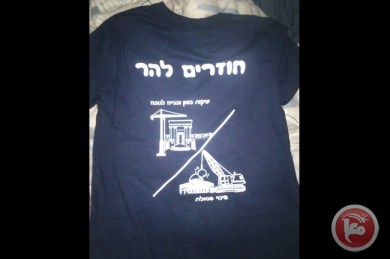 BETHLEHEM – An extremist Jewish organization on Thursday invited Israeli right-wing activists to participate in a rally calling for the destruction of the Dome of the Rock, Hebrew-language Israeli news sites reported.
The Temple Institute — dedicated to building the Third Jewish Temple in the place of the Dome of the Rock — organized the rally in an effort to place pressure on the Israeli government to demolish Muslim facilities in the Al-Aqsa Mosque compound, according to the reports.
The rally is expected to start at Zion Square in West Jerusalem before heading to the Al-Aqsa compound where the right-wingers plan to light candles to commemorate the fifth night of Hanukah.
The Temple Institute reportedly distributed dozens of t-shirts calling for the destruction of the Dome of the Rock prior to the rally.
One of the t-shirts handed out displayed an image of a lift carrying the Dome of the Rock with a caption reading “waste removal.”
The Dome of the Rock — located in the Al-Aqsa Mosque compound — is the third holiest site in Islam, and is venerated as Judaism’s most holy place, as it sits where Jews believe the First and Second Temples once stood.
The Temple Institute is one of a handful of extremist Israeli organizations who critics say are gaining traction in Israeli Prime Minister Benjamin Netanyahu’s right-wing government.
Controversial Israeli right-winger Yehuda Glick is a major figure in the Temple Institute, which has reportedly received $600,000 shekels ($155,300) in monetary support over the past five years from Israel’s Ministry of Education.
The figure was released Thursday in an investigation conducted by Israeli daily Haaretz. The report also revealed that Netanyahu’s defense minister, Eli Ben-Dahan, personally donated thousands of dollars to the Temple Institute.
Such extremist groups have created a rift within Israeli society while triggering frustration from Palestinian groups.
Increased numbers of Jewish worshipers touring the compound in September — accompanied by restrictions on Palestinian worshipers — played a major role in triggering a wave of violence across occupied Palestinian territory at the beginning of October.
Many Palestinians fear that Israel is seeking to renege on a longstanding agreement preventing non-Muslim prayer in the compound, although Israeli leadership has denied that this is the case.
On Wednesday evening, a former member of the Jewish Underground — a right-wing group that also plotted for the destruction of the Dome of the Rock — was injured in a drive-by shooting in the occupied West Bank.
Israeli soldiers occupy Palestinian house to set up military base
International Solidarity Movement | December 10, 2015
al Khalil, occupied Palestine – For the last 15 days the family of Abu Shykri Al-Atrarshi have had no access to the top two floors of their house, which was illegally taken over by the Israeli occupation forces and where they set up a military base.

Ten Israeli soldiers suddenly showed up at the house in the neighbourhood of Abu Sheineh, Al Khalil; they broke in by smashing a window in the door, took the key and demanded that the family vacate the third floor. The soldiers did not have any documentation to explain or justify the incursion nor did they give an explanation to the family why their house was being taken over. Any questions are ignored and the third floor as well as the roof top are now off limits.
Since the soldiers arrived they have broken the windows, and shot holes in the water tank which supplies clean water to the household. They then took all the blankets on the premises and used them to dry the water leaking from the tanks. The family also reported that once the water supply was fixed the soldiers contaminated the water and used the apartment and roof as a toilet.
The soldiers never leave the apartment empty, but a few times per day there is a shift change. This happens at different times every day so there is no knowing when, and the soldiers move in and out as they please anyway. This means there can be soldiers moving throughout the building at any time, terrifying the family- especially the young children who no longer dare to leave the house on their own. The soldiers use the roof as a lookout and also frequently fire weapons such as teargas, from there into the surrounding neighbourhood.
The three story house is home to 13 people, now crowded into two small floors- including a young disabled child. They have no idea how long the soldiers will stay, or if the family will get their house back at all. They contacted the local DCO (District coordination office) who advised them to get a lawyer, which they did. The lawyer has now started the process to take the case to an Israeli court in Haifa, Israel. However Abu Shykri Al-Atrarsh has had no information on when the case will be heard or when a judgement can be expected. This, as in many cases, can take months if not years and in the meanwhile the family is trapped. Abu Shakri believes the army is trying to make the family leave the building altogether, but they are resolutely staying put.
This family now has to try to live their life underneath the very people who have broken into, stolen and disrespected their home. The daily struggle of living under the occupation is hardship enough but having your own home taken from under your eyes, and not being able to do anything about it is absolutely heartbreaking.
ISM today took pictures of the soldiers in the building to help the family evidence their presence there, which is needed for the court case. Every time the family has tried to take pictures themselves the soldiers have taken their phones and deleted the pictures.
Turkish Tanks, Troops Uninvited ‘Occupants’ in Increasingly Irate Iraq
Sputnik – 10.12.2015
There are no security treaties between Iraq and Turkey, which is why the presence of Turkish troops in Iraq is nothing but an act of occupation, according to Razzak Muhaibis, an MP from the Iraqi political bloc Badr Organisation.
In an interview with Sputnik, Razzak Muhaibis, an MP from the Iraqi political bloc Badr Organisation, said that Turkish forces are essentially occupiers because there are no security treaties between Ankara and Baghdad.
According to him, legislators from Iraq’s special parliamentary panels contacted the country’s Foreign Ministry after discussing the topic earlier on Thursday.
Muhaibis said that after analyzing the archives on relations between Iraq and Turkey, it turned out that bilateral security treaties haven’t existed between the countries since 1946.
“So the Turkish troops in Mosul can be called occupational forces because they entered Iraq without the Iraqi government’ s request or the parliament’s permission,” Muhaibis said.
Earlier on Thursday, Russian Foreign Ministry spokeswoman Maria Zakharova stated that Moscow considers Turkey’s move to deploy troops to Iraq a flagrant violation of international law.
On December 4, Turkey deployed hundreds of personnel to a camp in northern Iraq’s Bashiqa region, located near the city of Mosul, currently controlled by Daesh, (ISIL/ISIS). Ankara has called it a routine rotation to train Iraqis to retake Mosul.
Earlier this week, Iraqi Prime Minister Haider Abadi gave Turkey 24 hours to withdraw its troops from Iraq, and threatened to approach the UN Security Council to have the matter reviewed. Turkey refused to do so.
100,000 foreign troops incl. Americans to be deployed in Iraq, MP claims
RT | December 10, 2015
The US is to send some 10,000 troops to Iraq to provide support for a 90,000-strong force from the Gulf states, a leading Iraqi opposition MP has warned. The politician said the plan was announced to the Iraqi government during a visit by US Senator John McCain.
During a meeting in Baghdad on November 27, McCain told Prime Minister Haider Abadi and a number of senior Iraqi cabinet and military officials that the decision was ‘non-negotiable’, claimed Hanan Fatlawi, the head of the opposition Irada Movement.
“A hundred thousand foreign troops, including 90,000 from Saudi Arabia, the UAE, Qatar and Jordan, and 10,000 troops from America will be deployed in western regions of Iraq,” she wrote on her Facebook page.
She added that the Iraqi prime minister protested the plan, but was told that “the decision has already been taken.”
McCain and fellow hawk Senator Lindsey Graham have both been calling for a tripling in the current number of US troops deployed in Iraq to 10,000, and also advocate sending an equal number of troops to Syria to fight against the terrorist group Islamic State (IS, formerly ISIS/ISIL) and the government of Syrian President Bashar Assad. The Americans would prop up a 90,000-strong international ground force provided by Sunni Arab countries like Egypt, Turkey and Saudi Arabia.
“The region is ready to fight. The region hates ISIL – they are coming for Sunni Arab nations. Turkey hates ISIL. The entire region wants Assad gone. So there is an opportunity here with some American leadership to do two things: to hit ISIL before we get hit at home and to push Assad out,” Graham argued during the joint visit to Baghdad in November.
“Saudi Arabia, Egypt, Turkey – they have regional armies and they would go into the fight if we put [the removal of] Assad on the table. Most of the fight will be done by the region. They will pay for this war,” he added.
The US currently has about 3,600 troops in Iraq, including 100 special operations troops deployed last month to take part in combat missions involving hostage rescue and the assassination of IS leaders. The White House is reluctant to commit a large ground force, citing the cost in human lives and money and the possible political ramifications of what will be portrayed by America’s opponents as yet another Western invasion of the Arab world.
The McCain-Graham plan also poses the risk of direct confrontation between the proposed coalition force and Russia and Iraq, which are both militarily assisting the Assad government and may not stay out of the fight – something which the hawkish duo have not factored into their plan.
This is especially true after Turkey’s downing of a Russian bomber plane on the Turkish-Syrian border, which Moscow considered a stab in the back and which sent relations with Ankara to a low not seen for decades.
Baghdad has its own concerns about a Turkish presence on its territory after Ankara sent troops into western Iraq and refused to withdraw them, despite Iraqi protests. Ankara claimed the incursion was made under a 2014 invitation from Iraqi Prime Minister Abadi.
‘Blackwater troops replacing Emirati forces in Yemen’
Press TV – December 10, 2015
A new report says mercenaries and military advisers from the infamous US security firm, formerly known as Blackwater, are replacing UAE troops in the Saudi war in Yemen.
The Beirut-based al-Akhbar newspaper said on Thursday UAE forces are being gradually replaced by recruits from the US-based private military contractor, which now goes by the name, Acamedi.
The move came after the UAE evacuated some of its military sites in Yemen following its failures in several operations, the Lebanese daily added.
According to al-Akhbar, UAE’s move to involve the private military contractor in the Yemen conflict has raised objections among some members of the Saudi-led coalition.
On Wednesday, Yemen’s Arabic-language al-Masirah news website said the commander-in-chief of Blackwater mercenaries in the country was killed in the al-Omari district of Ta’izz Province.
Some Australian, British and French advisers and commanders, plus half a dozen Colombian soldiers, were reportedly among the dead. The mercenaries are part of the Emirati forces that help Saudi Arabia in its war against the impoverished nation.
Blackwater has had to change its name several times due to its ill fame around the world. The company which went by the alias Xe Services before its current name is one of the most notorious private security firms in the world for killing scores of civilians in Iraq, Afghanistan, and Yemen.
Yemen has been under military attack by Saudi Arabia since March 26. The Saudi strikes were launched to undermine Yemen’s Ansarullah movement and bring fugitive former president Abd Rabbuh Mansour Hadi, a staunch ally of Riyadh, back to power.
Turkish jets strike Kurdish positions in Iraq amid rising tension between Ankara & Baghdad
RT | December 9, 2015
Ankara carried out airstrikes targeting Kurdistan Workers’ Party (PKK) forces in northern Iraq, the Turkish army said on Wednesday. The action comes in the wake of rising tensions between Ankara and Baghdad over the deployment of Turkish troops in Iraq.
Ten F-16 fighter jets launched an attack between 10pm and 10:50pm on Tuesday, targeting PKK positions in the Kandil, Hakurk, Zap and Avasin-Baysan regions in northern Iraq, the Turkish General Staff said in a statement. It added that the targets were “destroyed in an aerial campaign.”
Tensions have been rising between Ankara and Baghdad after Turkey deployed hundreds of troops equipped with tanks and artillery to Iraq’s northern Nineveh Governorate last Thursday, saying they will train forces battling Islamic State (IS, formerly ISIS/ISIL).
Baghdad said it had not asked for the help of Turkish forces, and demanded their withdrawal after it said Turkey had “illegally” sent the troops into Iraq. Describing the move as a violation of sovereignty, the Iraqi government also asked NATO to intervene.
Meanwhile, Shiite paramilitary groups have threatened to use force against Turkey unless it pulls its forces out of Iraq. Likening the Turkish incursion to the occupation of Iraq by IS militants, Badr Brigade spokesman Karim al-Nuri said “all options” were available.
“We have the right to respond and we do not exclude any type of response until the Turks have learned their lesson,” Nuri said on Wednesday. “Do they have a dream of restoring Ottoman greatness? This is a great delusion and they will pay dearly because of Turkish arrogance.”
Also on Wednesday, the Iraqi parliament unanimously approved a motion condemning the Turkish intervention, supporting the government in taking whatever measures it viewed as appropriate.
Russia raised the issue at a meeting of the UN Security Council on Tuesday, expressing hope that Ankara will avoid escalating the situation in the region with any further reckless actions. Following the meeting, Russia’s UN envoy Vitaly Churkin said that Moscow expects Ankara to “settle the situation in Iraq in a way that would satisfy the Iraqi government.”
“Now the situation is within the focus of the attention of the Security Council, so we hope it will help resolve [it] to the satisfaction of the Iraqi government, whose sovereignty, territorial integrity and independence will be respected,” he said.
Russian Foreign Minister Sergey Lavrov slammed Ankara’s actions while speaking to Italian media on Wednesday.
Lavrov proposed a thorough examination of how Turkey performs goals set by the coalition in Syria. “We need to examine how a member of the US-led coalition – the Republic of Turkey – performs goals set by the coalition,” the minister said. “Why is it not bombing terrorists as such, but the Kurds instead?”
On Wednesday, Ankara argued that Turkish soldiers were sent to northern Iraq after a threat from IS to Turkish military trainers in the area. Prime Minister Ahmet Davutoglu said that the deployment was an act of solidarity, not aggression.
“The [military] trainers in the Bashiqa camp were threatened by Daesh (Islamic State) because it is 15-20 kilometers from Mosul and they have only light arms,” he told media in Istanbul. “So when these threats increased… we sent some troops to protect the camp, not as an act of aggression but as an act of solidarity.”
Iraq calls on NATO to pressure Turkey into withdrawing troops
Press TV – December 8, 2015
Iraqi Prime Minister Haider al-Abadi has called on NATO to pressure Turkey into recalling its troops from the northern Iraqi province of Nineveh.
According to a statement released by the Iraqi government on Tuesday, Abadi made the request during a phone call with NATO Secretary General Jens Stoltenberg.
“NATO must use its authority to urge Turkey to withdraw immediately from Iraqi territory,” read the statement issued after a 48-hour deadline for the troops’ removal expired.
Despite Iraq’s ultimatum, Ankara still has some 150 heavily-armed soldiers stationed on the outskirts of the city of Mosul, the capital of Nineveh province.
Turkey refuses to recall its troops claiming they are stationed there to train Iraqi forces battling the Daesh Takfiri militants.
During a press conference in the Ankara on Tuesday, Turkish Foreign Minister Mevlut Cavusoglu announced that further troops deployment will be halted but those already stationed will not be withdrawn.
Meanwhile, the UN Security Council is set to hold closed-door talks, called by Russia, on Ankara’s military activities in Iraq and Syria.
“We want the secretariat to tell us what is happening in the region,” said Russia’s representative to the council, Peter Iliichev. “We want the secretariat to tell us what is happening in the region.”
Ties between Moscow and Ankara have been strained after Turkish jets shot down a Russian fighter plane on November 24.
Moscow has imposed a number of economic sanctions against Ankara following the incident.
Featured Video
Seyed M. Marandi: Toward Total War in the Middle East
or go to
Aletho News Archives – Video-Images
From the Archives
The Geopolitics behind the War in Yemen (I)
By Mahdi Darius NAZEMROAYA | Strategic Culture Foundation | 30.03.2015
The United States and the Kingdom of Saudi Arabia became very uneasy when the Yemenese or Yemenite movement of the Houthi or Ansarallah (meaning the supporters of God in Arabic) gained control of Yemen’s capital, Sanaa/Sana, in September 2014. The US-supported Yemenite President Abd-Rabbuh Manṣour Al-Hadi was humiliatingly forced to share power with the Houthis and the coalition of northern Yemenese tribes that had helped them enter Sana. Al-Hadi declared that negotiations for a Yemeni national unity government would take place and his allies the US and Saudi Arabia tried to use a new national dialogue and mediated talks to co-opt and pacify the Houthis.
The truth has been turned on its head about the war in Yemen. The war and ousting of President Abd-Rabbuh Manṣour Al-Hadi in Yemen are not the results of «Houthi coup» in Yemen. It is the opposite. Al-Hadi was ousted, because with Saudi and US support he tried to backtrack on the power sharing agreements he had made and return Yemen to authoritarian rule. The ousting of President Al-Hadi by the Houthis and their political allies was an unexpected reaction to the takeover Al-Hadi was planning with Washington and the House of Saudi. … continue
Blog Roll
 Aletho News
- Defeating Russia on battlefield impossible – Fico
- Finland’s Gender Clinic Reversal
- Massachusetts Wants Mental Health Visits, Why Does Government Use ‘Health’ to Enter Our Homes & Families?
- US lawmaker admits American people footing bill for Trump’s failed aggression against Iran
- Pfizer Gave $500,000 to Groups That Lobbied to End Religious Exemption in Massachusetts
- HE SAVED LIVES. NOW HE FACES PRISON.
- Israeli lobby seeks to bind US fate to ‘Israel’: Araghchi
- Pakistan-Iran talks secure LNG shipment to Islamabad through Hormuz
- Black Sea grain crisis puts global wheat supplies under pressure
- IRGC air defenses destroy another US MQ-1 drone over Strait of Hormuz
- If Americans Knew
- Israeli Attacks in Gaza Kill at Least Seven Palestinians Over Three Days, including Woman and Child
- Trump’s militarization of Washington DC as he pursues Israel’s war against Iran
- Why Israel Fears This Searing New Documentary
- Huckabee aide solicited cash gifts from Israelis
- This isn’t sci-fi, AI is already killing people
- ‘The Most Brutal Thing’: Investigation Reveals Execution of Elderly Woman in Rafah
- Inside Israel’s ‘soft’ ethnic cleansing plan for Gaza through the eyes of its victims
- New online database tracks pro-Israel political donations in the United States
- Israeli president pardons soldier convicted for killing wounded Palestinian
- Singer Ed Sheeran says his ‘heart broken’ by Gaza devastation, addresses Macklemore controversy
- No Tricks Zone
- 2025 Nature Paper Claiming Worsening Global Drought Gets RETRACTED …Heavily Flawed
- New Study: ‘Global Drought Shows No Detectable Recent Acceleration Under Climate Warming’
- Economic Masterminds: German Socialists Suggest Taxing Productivity Gains Stemming From Using AI
- The South China Sea Has Not Been Cooperating With The Climate Change Narrative
- Energy Crisis: Germany Enters Heating Season With Historically Low Gas Reserve Fill Levels
- New Study: The Antarctic Ice Sheet Gained Mass From 2020-2024 Due To Staggering Snow And Ice Accumulation
- Study: Ocean Heating Rates From Thousands Of Years Ago ‘Dwarf’ Modern Ocean Heating Rates
- Climate Extremists Target, Attack Large-Scale Power Grid Infrastructure In Germany!
- New Study: Antarctic Ice Melt Has Contributed Less Than 1 Centimeter To Sea Level Rise In The Last 30 Years
- Fear Of Debate: Alarmist German Climate Scientist Calls On Mainstream Media To Discredit Skeptic Voices
 Aletho News