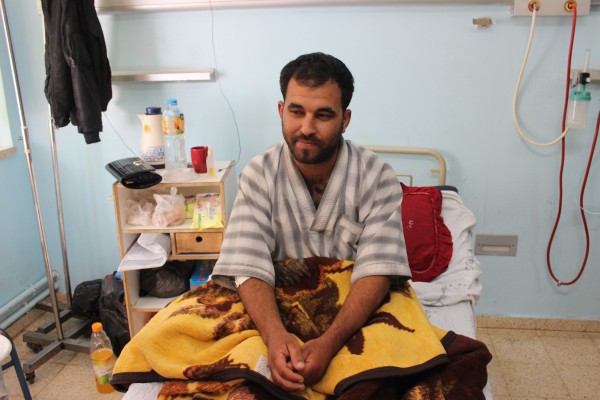
Mohamed Abu Taima, 29, had to undergo two surgeries
Khan Younis, Gaza strip, Occupied Palestine – A week ago Mohamed Abu Taima, 29 years-old and father of a small girl, was working his land 450m from the separation fence when an Israeli sniper shot him. At 4pm, he had arrived to his land in Al Faraheen, Khan Younees, South of the Gaza Strip. He was shot a few minutes after he started to work. The bullet passed through one of his legs and exploded inside the other one.
A few minutes after arriving in the hospital Mohamed underwent a first surgery, and days after a second one. Until now, the doctors don’t know if Mohamed will ever be able to walk properly again.
These kind of attacks have been frequent during the past two weeks. Several farmers were expelled from their lands by the Israeli snipers when they were working or intended to work their lands between 400 and 500m from the fence, meaning outside of the “buffer zone” imposed by the occupation.
December 8, 2015
Posted by aletho |
Ethnic Cleansing, Racism, Zionism, Illegal Occupation, Subjugation - Torture | Gaza, Palestine, Zionism |
Leave a comment
In his novel 1984 George Orwell introduced the lexicon of Big Brother’s Doublespeak in which “War is peace, freedom is slavery, and ignorance is strength.” In today’s Western political circles and mainstream media coverage of Palestine/Israel and political Zionism, one may add a host of other phrases to this Orwellian Newspeak. Expressions that would fittingly describe this coverage might include “racism is democracy, resistance is terrorism, and occupation is bliss.”
If individuals were to rely solely on Western media outlets as their source of information regarding the increasingly volatile situation in the occupied Palestinian territories, especially Jerusalem, they would not only be perplexed by the portrayals of victims and oppressors, but also confused about the history and nature of the conflict itself. For instance, in the past few weeks, in their coverage of the latest Palestinian uprising, most Western mainstream media outlets, such as the New York Times, CNN, FOX, and BBC, virtually omit the words “Israeli occupation,” or “illegal Israeli settlements.” Seldom if ever do they mention the fact that Jerusalem has been under illegal Israeli control for the past 48 years, or that the latest confrontations were set off as a result of Israeli attempts to change the status quo and force a joint jurisdiction of the Islamic holy sites within the walls of old Jerusalem.
Oftentimes Israel and its enablers in the political and media arenas try to obfuscate basic facts about the nature and history of the conflict. Despite these attempts, however, the conflict is neither complicated nor has it existed for centuries. It is a century-old modern phenomenon that emerged as a direct result of political Zionism. This movement, founded by secular journalist Theodore Herzl in the late 19th century, has incessantly attempted to transform Judaism from one of the world’s great religious traditions into a nationalistic ethnic movement with the aim of transferring Jews around the world to Palestine, while ethnically cleansing the indigenous Palestinian population from the land of their ancestors. This is the essence of the conflict, and thus all of Israel’s policies and actions can only be understood by acknowledging this reality.
It might be understandable, if detestable, for Israel and its Zionist defenders to circulate false characterizations of history and events to advance their political agenda. But it is incomprehensible for those who claim to advocate the rule of law, believe in the principle of self-determination, and call for freedom and justice to fall for this propaganda or to become its willing accomplices. In following much of the media coverage or political analyses of the conflict, one is struck by the lack of historical context, the deliberate disregard of empirical facts, and the contempt for established legal constructs and precedents. Are the Palestinian territories disputed or occupied? Do Palestinians have a legal right, embedded in international law, to resist their occupiers, including the use of armed struggle, or is every means of resistance considered terrorism? Does Israel have any right to old Jerusalem and its historical and religious environs? Is the protraction of the so-called “cycle of violence” really coming proportionally from both sides of the conflict? Is Israel a true democracy? Should political Zionism be treated as a legitimate national liberation movement (from whom?) while ignoring its overwhelmingly racist manifestations? Is Israel genuine about seeking a peaceful resolution to the conflict? Can the U.S. really be an honest peace-broker between the two sides as it has persistently promoted itself in the region? The factual answers to these questions would undoubtedly clear the fog and lead objective observers not only to a full understanding of the conflict, but also to a deep appreciation of the policies and actions needed to bring it to an end.
Occupation, Self-Determination, and International Law
There should be no disputing that the territories seized by Israel in June 1967, including east Jerusalem, are occupied. Dozens of UN resolutions have passed since November 1967, including binding Security Council resolutions calling on Israel to withdraw from the occupied territories, which the Zionist State has stubbornly refused to comply with. In fact, if there were any “disputed” territories, they should be those Palestinian territories that Israel took in 1948, through a campaign of terror, massacres, and military conquests, which resulted in forcefully and illegally expelling over 800,000 Palestinians from their homes, villages, and towns, in order to make room for thousands of Jews coming from Europe and other parts of the world. Consequently, UN Resolution 194 mandated that these Palestinian “refugees wishing to return to their homes … should be permitted to do so.” This resolution has now remained unfulfilled for 67 years. There is also no dispute in international law that Israel has been a belligerent occupier triggering the application of all the relevant Geneva Conventions as the Palestinian people have been under occupation since their “territory is actually placed under the authority of the hostile army.”
Furthermore, the right to self-determination for the Palestinian people and their right to resist their occupiers by all means are well established in international law. In 1960, UN resolution 1514 adopted the “Declaration on the Granting of Independence to Colonial Countries and Peoples.” It stated that, “All peoples have the right to self-determination”, and that, “the subjection of peoples to alien subjugation, domination and exploitation constitutes a denial of fundamental human rights and is contrary to the Charter of the United Nations.” Ten years later the UN adopted Resolution 2625 which called on its members to support colonized people or people under occupation against their colonizers and occupiers. In fact, UN Resolution 3246 reaffirmed in 1974 “the legitimacy of the peoples’ struggle for liberation form colonial and foreign domination and alien subjugation by all available means, including armed struggle.” Four years later UN Resolution 33/24 also strongly confirmed “the legitimacy of the struggle of peoples for independence, territorial integrity, national unity and liberation from colonial and foreign domination and foreign occupation by all available means, particularly armed struggle,” and “strongly condemned all governments” that did not recognize “the right to self-determination to the Palestinian people.”
As for occupied Jerusalem, the UN Security Council adopted in 1980 two binding resolutions (476 and 478) by a vote of 14-0 (the US abstained and did not veto either resolution.) Both resolutions condemned Israel’s attempt to change “the physical character, demographic composition, institutional structure, (and) the status of the Holy City of Jerusalem.” It also reaffirmed “the overriding necessity to end the prolonged occupation of Arab territories occupied by Israel since 1967, including Jerusalem,” and called out Israel as “the occupying power.” It further considered any changes to the city of Jerusalem as “a violation of international law.”
The Use of Violence, Resistance, and the Deceptive Peace Process
Living under brutal occupation for almost half a century without any prospect for its end, the Palestinian people, particularly in Jerusalem, have, since late September, embarked on new mass protests against the latest Israeli incursions on their holy sites and revolted once again against the ceaseless occupation. As a consequence, the Israeli army, aided by thousands of armed settlers roaming the West Bank, have intensified their use of violence, which resulted in over 100 deaths, 2,200 injuries, and 4,000 arrests in less than two months. The Israeli army and the settlements-based armed gangs, though forbidden under international law and the Geneva conventions, have regularly employed various violent means in order to force Palestinian exile or compel submission to the occupation. The Israeli harsh tactics include: settler violence and provocation under full army protection, targeting children, including kidnapping, killing, as well as arresting children as young as 5 , burning infants alive, the constant use of collective punishment and house demolitions, the use of excessive prison sentences for any act of defiance including throwing rocks, storming revered religious sites, and the deliberate targeting of journalists who dare to challenge Israeli hegemony.
The Palestinian people, whether under occupation or under siege, in exile and blocked by Israel from returning to their homes, or denied their right to self-determination, have the legitimate right to resist the military occupation and its manifestations such as the denial of their freedom and human rights, the confiscation of their lands, or the building and expansion of Israeli colonies on their lands. Although most Palestinians opt for the use of nonviolent resistance as a prudent tactic against the brutality of the occupation, international law does not, however, limit their resistance only to the use of peaceful means. In essence, the right to legitimate armed resistance, subject to international humanitarian law, is enshrined in international law and cannot be denied to any people including the Palestinians in their struggle to gain their freedom and exercise their right to self-determination. Furthermore, international law does not confer any right on the occupying power to use any force against their occupied subjects, in order to maintain and sustain their occupation, including in self-defense. In short, aggressors and land usurpers are by definition denied the use of force to subjugate their victims. Consequently, as a matter of principle embedded in international law and regardless of any political viability, strikes against military targets including soldiers, armed settlers, or other tools and institutions of the occupation are legitimate and any action against them, non-violent or otherwise, cannot be condemned or deemed terrorism.
Furthermore, the argument regarding the validity of using armed struggle against oppression and denial of political rights by tyrannical and colonial regimes is well established in its favor. Patriot Patrick Henry rallied his countrymen prior to the American Revolution in 1775 in his famous call “give liberty or give me death.” Civil rights icon Martin Luther King, Jr. even rejected pacifism in the face of aggression. He only questioned its tactical significance when he stated “I contended that the debate over the question of self-defense was unnecessary since few people suggested that Negroes should not defend themselves as individuals when attacked. The question was not whether one should use his gun when his home was attacked, but whether it was tactically wise to use a gun while participating in an organized demonstration.” Mahatma Gandhi saw active resistance as more honorable than pacifism when he said “I would rather have India resort to arms in order to defence her honour than that she would, in a cowardly manner, become or remain a helpless witness to her own dishonour.” Nelson Mandela reflected on this debate when he asserted that he resorted to armed struggle only when “all other forms of resistance were no longer open”, and demanded that the Apartheid regime “guarantee free political activity” to blacks before he would call on his compatriots to suspend armed struggle. Accordingly, the debate over whether the use of armed resistance against Israeli occupation advances the cause of justice for Palestinians is not a question of legitimacy, but rather of sound political strategy in light of the skewed balance of military power and massive public support from peoples around the globe for their just struggle.
Yet, the reality of the conflict actually reveals that the Palestinian people have overwhelmingly been at the receiving end of the use of ruthless Israeli violence and aggression since 1948. With the exception of the 1973 war (initiated by Egypt and Syria to regain the lands they lost in the 1967 war) every Arab-Israeli war in the past seven decades (‘48, ’56, ‘67, ’78, ’82, ’02, etc.) was initiated by Israel and resulted in more uprooting and misery to the Palestinians. Still, since 2008 Israel launched three brutal wars against Gaza with devastating consequences. In the 2008/2009 war, Israel killed 1,417 Palestinians and lost 13 people including 9 soldiers. In the 2012 war, Israel killed 167 Palestinians and lost 6 including 2 soldiers. And in the 2014 war, Israel killed 2104 Palestinians, including 539 children, with 475,000 people made homeless, 17,500 homes destroyed, while 244 schools and scores of hospitals and mosques damaged. In that war Israel lost 72 including 66 soldiers. In short, since late 2008 Israel killed 3,688 Palestinians in its three declared wars and lost 91 including 77 soldiers. Shamefully the deliberate targeting of Palestinian children has been amply documented as over two thousand have been killed by Israel since 2000. This massive Israeli intentional use of violence against the Palestinians, especially in Gaza (which has been under a crippling siege since 2007) was investigated, determined to constitute war crimes, and condemned by the UN in the Goldstone Report, as well as by other human rights groups such as Amnesty International and Human Rights Watch.
The 1993 Oslo process gave rise to the promise of ending decades of Israeli occupation. But the process was rigged from the start as many of its participants have recently admitted. It was an Israeli ploy to halt the first Palestinian uprising and give Israel the breathing room it needed to aggressively and permanently colonize the West Bank including East Jerusalem. It was an accord with a lopsided balance of power, as one side held all the cards and gave no real concessions, and a much weaker side stripped of all its bargaining chips. During this period the number of settlements in the West Bank more than doubled and the number of settlers increased by more than seven fold to over 600 thousand including in East Jerusalem.
The world has none other than Benjamin Netanyahu to acknowledge that Israel has no intention of withdrawing or ending its occupation. After serving his first stint as a prime minister, Netanyahu (shown here in a leaked video) while visiting a settlement in 2001, admitted to his true intention of grabbing as much as 98 percent of Palestinian territories in the West Bank and halting the fraudulent Oslo process. Believing that the camera was off, he spoke candidly to a group of settlers about his strategic vision, plans, and tactics.
On his vision he assured them that “The settlements are here. They are everywhere.” He stated, “I halted the fulfillment of the Oslo agreements. It’s better to give two percent than 100 percent. You gave two percent but you stopped the withdrawal.” He later added, “I gave my own interpretation to the agreements in such a way that will allow me to stop the race back towards the 1967 borders.” As for the tactics, Netanyahu freely confessed his strategy of causing so much pain to the Palestinians that they would submit to the occupation rather than resist. He said, “The main thing is to strike them not once but several times so painfully that the price they pay will be unbearable causing them to fear that everything is about to collapse.” When he was challenged that such a strategy might cause the world to consider Israel as the aggressor, he dismissively said, “They can say whatever they want.” He also implied how he was not concerned about American pressure. To the contrary he asserted that he could easily manipulate Israel’s main benefactor when he stated “America is something you can easily maneuver and move in the right direction. I wasn’t afraid to confront Clinton. I wasn’t afraid to go against the UN.” Even though world leaders consider Netanyahu a “liar” and they “can’t stand him” as shown in this exchange between former French president Nicolas Sarkozy and Barak Obama, no Western leader has stood up to Israel, even though a British parliamentarian stated that 70 percent of Europeans consider it a “danger to world’s peace.” But the obstructionist posture and expansionist policies of Israeli leaders are not restricted to the Israeli right. Former Labor leader Ehud Barak was as much determined in 2000 at Camp David not to withdraw from the West Bank, Jerusalem, or dismantle the settlements.
For decades the world waited for Israel to decide its destiny by choosing two out of three defining elements: its Jewish character, its claim to democracy, and the lands of so-called “greater Israel.” If it chose to retain its Jewish majority and claim to be democratic, it had to withdraw from the lands it occupied in 1967. If it insists on incorporating the lands and have a democracy it would have to integrate its Arab populations while forsaking its Jewish exceptionalism in a secular state. Yet sadly but true to its Zionist nature, Israel chose to maintain its Jewish exclusiveness over all of historical Palestine to transform itself into a manifestly Apartheid state.
Political Zionism and the True Nature of the Israeli State
For over a century political Zionism has evoked intense passions and emotions on both sides of the Israeli-Palestinian conflict: its ardent supporters as well as its critics and hapless victims. Zionists hail their enterprise as a national liberation movement for the Jewish people while its opponents condemn it as a racist ideology that practiced ethnic cleansing, instituted racial and religious discrimination, and committed war crimes to realize its goals.
On November 10, 1975 the United Nations General Assembly adopted resolution 3379 that determined Zionism as a “form of racism and racial discrimination.” However, it was revoked 16 years later under tremendous pressure from the U.S. and other Western countries in the aftermath of the first Gulf war in 1991. Oftentimes, the public is denied unfiltered information about the true nature of political Zionism and its declared state. And unfortunately the media conglomerates rarely cover that aspect of the conflict, which contributes to the public’s confusion and exasperation.
Since its creation in 1948, Israel has passed laws and implemented policies that institutionalized discrimination against its Arab Palestinian minority. In the aftermath of its 1967 invasion, it instituted a military occupation regime that has denied basic human and civil rights to millions of Palestinians whose population now exceeds the number of Israeli Jews in the land within historical Palestine. In addition, in defiance of international law, Israel has obstinately refused to allow the descendants of the Palestinian people that it expelled in 1948 and 1967 to return to their homes, while allowing millions of people of other nationalities the right to become citizens of the Israeli state upon arrival simply because they are Jewish.
Zionist leaders from Ben-Gurion to Netanyahu have always claimed that Israel was a democracy similar to other Western liberal democracies. But perhaps the best way to examine this claim and illustrate the nature of the modern Zionist state is through a comparative analogy (a similar example could also be found in Israeli historian Shlomo Sand’s book).
What if a Western country claiming to be a democracy, such as the U.S. or the U.K., were officially to change its constitution and system to become the state of the White Anglo-Saxon Protestants (WASPs)? Even though its African, Hispanic, Asian, Catholic, Jewish, and Muslim citizens as well as other minorities would still have the right to vote, hold political offices, and enjoy some civil and social rights, they would have to submit to the new nature and exclusive character of the WASP state. Moreover, with the exception of the WASP class of citizens, no other citizen would be allowed to buy or sell any land, and there would be permanent constitutional laws that would forbid any WASP from selling any property to any members of other ethnicities or religions in the country. Its Congress or parliament would pass laws that would also forbid any WASP from marrying outside his or her social class, and if any such “illegal” marriage were to take place, it would not be recognized by the state. As for immigration, only WASPs from around the world would be welcome. In fact, there would be no restrictions on their category as any WASP worldwide could claim immediate citizenship upon arrival in the country with full economic and social benefits granted by the state, while all other ethnicities are denied. Furthermore, most of the existing minorities in the country would be subjected to certain “security” policies in order to allow room for the WASPs coming from outside. So in many parts of the country, there would be settlements and colonies constructed only for the new WASP settlers and consequently some of the non-WASP populations would have to be restricted or relocated. In these new settlements the state would designate WASP-only roads, WASP-only schools, WASP-only health clinics, WASP-only shopping malls, WASP-only parks or swimming pools. There would also be a two-tier health care system, educational system, criminal justice system, and social welfare system. In this dual system for example, if a WASP assaults or kills a non-WASP he would receive a small fine or a light sentence that would not exceed a few years, while if a non-WASP murders a WASP, even accidentally, he would receive a harsh or mandatory life sentence. In this system, where the police force is exclusively staffed by WASPs, the Supreme Court would routinely sanction the use of torture against any non-WASP, subject to the judgment of the security officers. Such a system would clearly be so manifestly racist, patently criminal, and globally abhorred that no one would stand by it or defend it. But could such a regime even exist or be accepted in today’s world? (I realize that some people may argue that many of these practices had actually occurred in the past against certain segments of the population in some Western societies. But no government today would dare to embrace this model or defend its policies.)
Yet, because of the Zionist nature of the Israeli state, this absurd example is actually a reality with varying degrees for the daily lives of the Palestinian people, whether they are nominal citizens of the state, live under occupation or under siege, or have been blocked for decades from returning back to their homes, towns, and villages. Such a system would not only be condemned but no decent human being or country that respects the rule of law would associate with it or tolerate it.
From its early days, prominent Jewish intellectuals have condemned the racist nature of the Zionist state. Albert Einstein and Hannah Arendt wrote in 1948 condemning Zionist leaders of Israel who “openly preached the doctrine of the Fascist state.” Israeli scientist and thinker Israel Shahak considered Israel as “a racist state in the full meaning of this term, where the Palestinians are discriminated against, in the most permanent and legal way and in the most important areas of life, only because of their origin.” Renowned American intellectual Noam Chomsky considers Israel’s actions in Palestine as even “much worse than Apartheid” ever was in South Africa. Israeli historian Ilan Pappé argues that “The Zionist goal from the very beginning was to have as much of Palestine as possible with as few Palestinians in it as possible,” while American historian Howard Zinn thought that “Zionism is a mistake.” American academic and author Norman Finkelstein has often spoken out against the racist nature of the Zionist state and condemned its manipulation of the Nazi Holocaust to justify its colonization of Palestine. British historian Tony Judt described Israel as “an anachronism” because of its exclusive nature in comparison to its “non-Jewish citizens.” Former UN Special Rapporteur for Occupied Palestine Professor Richard Falk called Israeli policies in the Occupied Territories “a crime against humanity” and compared Israel’s treatment of the Palestinians to the Nazi treatment of the Jews and has said, “I think the Palestinians stand out as the most victimized people in the world.” Very recently, prominent American Jewish academics posed the question: “Can we continue to embrace a state that permanently denies basic rights to another people?” Their answer was an emphatic call for a complete boycott against the Zionist state.
Furthermore, Israeli politicians and religious leaders regularly use racist rhetoric to appeal to their constituents and articulate their policies. In the last Israeli elections in March, Prime Minister Netanyahu tweeted to the Israeli public, “The right-wing government is in danger. Arab voters are coming out in droves to the polls.” Former foreign minister Avigdor Lieberman advocated new ethnic cleansing through “the transfer” of Palestinian citizens from the state. One prominent Rabbi considered “killing Palestinians a religious duty,” while another declared that “It is not only desirable to do so, but it is a religious duty that you hold his head down to the ground and hit him until his last breath.” Former Sephardic Chief Rabbi Mordechai Eliyahu, one of the most senior religious leaders in Israel ruled that “there was absolutely no moral prohibition against the indiscriminate killing of civilians during a potential massive military offensive on Gaza.” Racism in Israel is so pervasive that a Jewish settler stabbed another Jew, and another settler killed a fellow Jewish settler not because the perpetrators were threatened, but because the victims looked Arab. Israeli racism is so widespread among its population that noted journalist Max Blumenthal, who investigated the Israeli society’s attitudes towards the Palestinians, was himself surprised to “the extent to which groups and figures, remarkably similar ideologically and psychologically to the radical right in the US and to neo-fascist movements across Europe, controlled the heart of Israeli society and the Israeli government.”
In short, the ideology of political Zionism, as it has amply been demonstrated within the state of Israel, with its exclusionary vision and persistent policies of occupying the land and subjugating its people, has proven without any doubt that it represents a relic of a bygone era that utterly lacks civilized behavior or claims to a democratic system. Therefore, any discussion, coverage, analysis, or debate of the Palestinian-Israeli conflict that sidesteps the nature and ideology of the Israeli state is not only disingenuous and lacks credibility, but also contributes to the deepening of the conflict, the continuous suffering of its victims, and the illusion of finding a potential just and peaceful outcome.
Dr. Sami Al-Arian is a Palestinian academic and intellectual. He lived for four decades in the U.S. before relocating to Turkey in 2015. Because of his long activism for the Palestinian cause and defending human and civil rights, he was a political prisoner in the U.S. and spent over a decade in prison and under house arrest until the charges were dropped in 2014. He can be contacted at nolandsman1948@gmail.com.
December 8, 2015
Posted by aletho |
Ethnic Cleansing, Racism, Zionism, Illegal Occupation, Subjugation - Torture, Timeless or most popular, War Crimes | Benjamin Netanyahu, Gaza, Human rights, Israel, Middle East, Palestine, Zionism |
Leave a comment
Within the past two weeks Turkish F-16s have shot down a Russian SU-24 bomber and a US-led coalition airstrike has hit a military base controlled by the Syrian Arab Army. It begs the question: are these people actually insane?
ISIS could not have had a better two weeks than these past two if it had its own air force. But with the US and Turkey among its ‘enemies’ it appears they don’t need one, for those countries have been doing its job for them.
How else are we to explain the strikes carried out by both countries, not against ISIS but against Russia and Syria, who are fighting ISIS?
Never in the annals of military conflict has such a dangerous and absurd scenario been played out as the one being played out in Syria today. Two entirely separate multi-nation coalitions are engaged in combat operations against one enemy, thus dictating they coordinate and combine their efforts. Yet such is the lack of leadership and statesmanship within one of those coalitions – led by Washington – that the prospect remains a distant dream even after a recent spate of atrocities resulted in the mass murder of citizens and civilians belonging to both.
This at least is one narrative, which holds that incompetence, stupidity and hubris is the root of the problem, impairing the judgment and clarity of the West when it comes to Syria and the wider region, responsible for allowing a terrorist menace in the shape of ISIS and other extremist groups to grow and enjoy the kind of success they should never have enjoyed.
There is a second narrative to be explored, however, one far more insidious. It is that these attacks are evidence of the real objective of the West and its allies when it comes to Syria, despite the rise of ISIS, which remains regime change in Damascus.
Turkey’s president, Recip Erdogan, has long harbored this objective. In fact, more than harbor the man has been utterly obsessed with it. He has taken every opportunity to rail against Syria’s president, attributing the entire blame for the Syrian crisis and conflict to him, even though the majority of Syrians support their president and have done so throughout.
Never in the annals of military conflict has such a dangerous and absurd scenario been played out as the one being played out in Syria today.
With Russian airstrikes bearing down on the illicit oil trade between ISIS and Turkey, the strong suspicion is that Turkey’s desperate action in shooting down the Russian bomber was directly related to it being unmasked as a key actor in facilitating the terrorist group, rather than an ally in the struggle against it.
This has now been followed by Turkey’s military incursion into northern Iraq, where its troops have occupied territory around Mosul, slap bang in the middle of the oil smuggling route from the oilfields located there up into Turkey.
The Turks claim they are there to train Kurdish Peshmerga forces they are supporting, at the request of the Kurdistan Regional Government, led by Massoud Barzani, which administers a de facto independent Kurdish state in northern Iraq in defiance of central government authority in Baghdad. The equally independent oil trade controlled by he Barzani administration has come under attack from the PKK over the past few months, which has managed to destroy pipelines transporting oil from the Mosul region to Turkey.
By now the penny should be starting to drop.
Erdogan is a man who many consider to be engaged in a neo Ottoman policy of re-establishing Turkey’s hegemonic influence in the region, exploiting the chaos and turmoil across its southern border in both Iraq and Syria to establish Turkey as a regional power broker and architect of a Sunni state comprising eastern Syria across into northern Iraq.
The collapse of US leadership in the region, measured in the rise of ISIS, has left a vacuum that its regional allies – Turkey, Saudi Arabia and Israel – are exploiting with an aggressive pursuit of their own national and sectarian agendas. Those agendas are contrary to the interests of stability and security, and unless reined in can only lead to more chaos and conflict rather than less.
The point is that the aforementioned states are leading the wider Western strategy towards the region at this point, the primary aim of which, as mentioned, is the toppling of the Assad government in Syria and the weakening of Iranian influence in Iraq and Lebanon.
The US airstrike, despite Washington’s denial of responsibility for it, should be seen with the aforementioned in mind. It also helps explain the recent entry of British airstrikes into the Syrian conflict.
Less than the official justification of helping to crush ISIS, Britain is intent on establishing an overt military presence in Syria with its eyes not on the ISIS stronghold of Raqqa but on Damascus in advance of the upcoming peace talks in Vienna. We know this because no sooner had the British Government received the vote required to press ahead with airstrikes from the House of Commons than British foreign secretary Phillip Hammond was talking up the need for a transitional government in Damascus, making it clear that President Assad cannot remain in power.
Overall it is becoming increasingly apparent that for the West and its regional allies, such as Turkey, ISIS is but a sideshow and that the real priority is the removal of the Assad government. They want a pliant alternative in its place, one willing to be their place man in a region that has long been the focus of their geopolitical, strategic, and economic priorities.
In the process they are willing to court the risk of a major conflagration, evidence of their failure to learn the lessons of history and playing with fire as a consequence.
The First World War was the last major conflict into which the major powers sleepwalked. It resulted in a level of carnage that undermined the very foundations of civilization and led inexorably to the collapse of the Austro-Hungarian and Ottoman empires. The response to the Western powers of the collapse of the latter in the Middle East, in moving in to carve up the spoils between them regardless of the wishes and interests of the people living there, has brought us a century of turmoil and conflict from then to now.
In a very real sense, the world of today is paying the price of the crimes of the past. As a consequence, committing more crimes is more than folly it is tantamount to dragging us back in time to a hell of our own creation.
Follow John Wight on Twitter @JohnWight1
December 8, 2015
Posted by aletho |
Deception, Illegal Occupation, Militarism | Iraq, ISIS, Russia, Syria, Turkiye, UK, United States |
Leave a comment
A previous article explained Syria’s Foreign Ministry reported US-led warplanes bombed its army camp in Deir ez Zor province – killing three soldiers, injuring 13 others, as well as destroying three armored vehicles, four military vehicles, an arms and ammunition depot, along with 23mm and 14.5mm machine guns.
The Pentagon denied being caught red-handed in its latest attempt to push back on Russia’s effective intervention against ISIS and other terrorists groups in Syria.
It blamed Moscow for its provocative aggression. An unnamed Pentagon spokesman lied, claiming it’s “certain” a Russian warplane carried out the attack. “We’ve got a radar track showing a Backfire bomber flying directly over the town that the Syrians named a few minutes before the first claims that we killed some Syrian troops.”
Who knows what Washington has or doesn’t have. It’s “certain” it bore full responsibility for the incident. Russian airstrikes are directed solely against ISIS and other terrorist groups with pinpoint accuracy, shown by photographic evidence each time.
A US-led anti-Assad coalition statement claiming attacks were conducted “against oil well heads” about 35 miles from the Syrian base was a bald-faced lie – compounded by saying its warplanes struck no “personnel targets…We have no indication any Syrian soldiers were near our strikes.”
The dead, injured and destruction tell another tale. Even the pro-Western, London-based, Syrian Observatory for Human Rights surprisingly reported US-led airstrikes attacked a Syrian military post near Ayyash in western Deir al-Zour on Sunday.
It bears repeating, the Pentagon was caught red-handed. Russia so far hasn’t commented on the incident or false accusations claiming its warplanes were responsible.
US, UK, French and other coalition partners continue bombing Syrian infrastructure and government targets. Sunday’s attack was the first known attack directed at Assad’s military – suggesting more provocative actions to come.
So far, they’ve included a Turkish warplane downing a Russia Su-24 bomber in Syrian airspace – OK’d by Washington, Ankara obstructing Russian sea traffic through the Bosphorus Strait and Dardanelles in either direction, international waterways in northwest Turkey connecting the Black Sea to the Mediterranean.
Erdogan is involved in stealing, smuggling, transporting, refining and black market selling industrial scale quantities of Iraqi and Syrian oil.
He’s illegally bombing Kurdish fighters in northern Syria and Iraq – on the phony pretext of combating ISIS. His troops operate illegally in northern Iraq, violating its sovereign territory – perhaps to keep oil smuggling routes open and aiming to expand Turkish borders, incorporating parts of northern Iraq and Syria.
Washington is sending more specials forces to Syria on top of thousands already there, along with additional numbers illegally to Syria, perhaps many more to follow.
Fars News reported “US experts” intend turning a “desolate airport… controlled by Kurdish forces in Syria’s Hasaka region… into a (US) military base.”
Runways are being constructed to accommodate US warplanes – the operation entirely illegal, uninvited on foreign soil.
Washington is upping the stakes, escalating things dangerously toward direct confrontation with Russia, a reckless act – complicit with Turkey, Britain and other coalition partners.
Obama earlier promising he’ll “not put American boots on the ground” proved false – one of his many Big Lies. Will full-scale US invasion follow – with thousands of US special forces and perhaps other combat troops, protected by US warplanes?
War winds are blowing dangerously toward gale force. Possible US instigated nuclear war is humanity’s greatest threat.
Stephen Lendman lives in Chicago. He can be reached at lendmanstephen@sbcglobal.net.
His new book as editor and contributor is titled “Flashpoint in Ukraine: US Drive for Hegemony Risks WW III.”
http://www.claritypress.com/LendmanIII.html
December 8, 2015
Posted by aletho |
Deception, Illegal Occupation, Progressive Hypocrite, War Crimes | Obama, Russia, Syria, Turkiye, United States |
Leave a comment
As a Baghdad-issued ultimatum for Turkish troops to leave the area is nearing its deadline, Russia intends to bring up Ankara’s invasion of northern Iraq without the country’s request at the UN Security Council on Thursday.
“The issue will be raised at a closed-door meeting,” TASS cited a diplomatic source within the organization as saying. The source also dismissed earlier reports that Moscow was going to call a separate UNSC meeting.
According to Iraqi media, Prime Minister Haider Al-Abadi has put the Iraqi Air Force on high alert and the ruling National Iraqi Alliance has given the prime minister the go-ahead to take “any measures” to ensure territorial integrity and protect its borders, including addressing the UN and the Arab League.
Turkish Foreign Ministry announced on Tuesday that the country is suspending further deployment of troops to Iraq, but refuses to withdraw servicemen and hardware already on Iraqi soil.
Baghdad was informed of Ankara’s decision in a phone conversation between the Turkish and Iraqi foreign ministers late on Monday.
Turkish Foreign Minister Mevlut Cavusoglu reiterated Ankara’s respect for Iraq’s territorial integrity, Foreign Ministry spokesman Tanju Bilgic told reporters.
In a separate statement, Turkish PM Davutoglu expressed readiness to visit Baghdad as soon as possible to discuss the current troop deployment crisis between Ankara and Baghdad.
Iraqi media reported earlier that on December 4 Iraq’s PM said: “Turkish troops numbering around one regiment armored with tanks and artillery entered Iraqi territory,” labeling the incident as a “serious breach of Iraqi sovereignty.” He added that the move “does not conform with good neighborly relations,” and called on to Ankara to “withdraw immediately from Iraqi territory.”
Ankara’s reaction has been offhand. It claimed up to 150 of its troops had crossed into Iraq to train forces battling Islamic State (IS, formerly ISIS/ISIL).
Although the US-led anti-IS coalition was aware of Turkey’s move, it emerged later that Ankara’s deployment is not part of the efforts of the US-led coalition battling Islamic State.
Turkish troops did not simply cross the Iraqi border into the Nineveh province, but penetrated 100 kilometer into Iraq, according to Reuters. They reached the Bashiqa region, about 10 kilometers northeast of Mosul, Iraq’s second largest city, which has been occupied by IS terrorists since June 2014.
Turkey is lying when it says it received Baghdad’s blessing to invade part of its territory, according to the Iraqi PM.
On Monday, the governor of the Iraqi province of Nineveh told Sputnik that the number of Turkish servicemen there has reached 900.
On December 6, Baghdad warned that “Iraq has the right to use all available options, including resorting to the UN Security Council if these forces are not withdrawn within 48 hours,” reiterating the same ultimatum on Monday giving Ankara 24 hours to leave the area.
Iraqi Defense Minister Khaled Obeidi turned down his Turkish counterpart’s invitation to visit Ankara. A spokesman for the Iraqi Defense Ministry said the visit will take place only after Turkey sends “positive signals” regarding the withdrawal of its troops from northern Iraq.
Ankara refused to extract its military, claiming that heavily armed troops deployed to a camp near Mosul are needed to protect an Iraqi Kurd training mission, which is taking place near the frontline with Islamic State.
“It is our duty to provide security for our soldiers providing training there,” the Guardian cited the Turkish Foreign Minister Mevlüt Çavuşoğlu as saying in an interview with Kanal 24 television. “Everybody is present in Iraq … The goal of all of them is clear. Train-and-equip advisory support is being provided. Our presence there is not a secret.”
December 8, 2015
Posted by aletho |
Deception, Illegal Occupation, Militarism | Iraq, NATO, Russia, Turkiye |
Leave a comment
Syria has called on the UN Security Council to take immediate action against recent US-led airstrikes that killed three Syrian soldiers.
The Syrian Foreign Ministry sent a letter to the UN Security Council and Secretary General Ban Ki-moon on Monday, condemning the airstrikes that killed the Syrian government soldiers on Sunday.
Damascus said four US-led coalition warplanes fired nine missiles at one of the Syrian army’s posts in the central-east of the country in Deir Ezzor Province, killing three soldiers and injuring 13 others.
“The Syrian Arab Republic strongly condemns this flagrant aggression by the US-led coalition forces, which blatantly violates the objectives of the UN charter,” the letter read.
The Syrian Foreign Ministry urged the Security Council to “act immediately in the face of this aggression and take appropriate measures to prevent its recurrence.”
The Syrian government has repeatedly condemned the US-led airstrikes in the Arab country as illegal and ineffective with the letter saying the recent attack once again showed the failings of the coalition’s operations.
“The US coalition lacks the seriousness and credibility to effectively combat terrorism,” the letter added.
The so-called Syrian Observatory for Human Rights, which is based in Britain, earlier said the US-led attacks killed four Syrian soldiers near Ayyash town.
A spokesman for the US-led coalition denied responsibility for the attacks and said the coalition hit an area 55 kilometers away from a Syrian army camp.
“There were no human beings in the area that we struck yesterday, all we struck was a wellhead,” the spokesman also said.
The air raids in Syria are an extension of the US-led aerial campaign against alleged Daesh positions in Iraq, which started in August last year. Many have criticized the ineffectiveness of the raids.
This is while the US and some of its regional allies, including Turkey, Saudi Arabia and Qatar, have lent staunch support to the Takfiri groups there.
Syria has been gripped by foreign-backed militancy for four and a half years. More than 250,000 have lost their lives and millions displaced as a result of the crisis in the war-torn Arab country.
December 7, 2015
Posted by aletho |
Illegal Occupation, Militarism | Syria, United States |
Leave a comment
Saudi Arabia’s aggression against Yemen is strengthening terrorist groups such as the Daesh Takfiri militants, says Yemeni Ansarullah Houthi movement.
According to a statement released by the movement on Saturday, Riyadh and its supporters are also responsible for the recent execution of 25 Ansarullah fighters, recently carried out by Takfiri terrorists of Daesh in southwestern Yemen.
Saudi Arabia and its allies in Yemen have taken measures to sabotage attempts to release the Houthi fighters before their grisly executions, the statement further read.
The terrorist group released a video on Friday, showing the brutal execution of the fighters in different ways.
Houthi fighters, along with allied army units, are fighting the Takfiris and resisting against the unabated Saudi aggression against Yemen, which began on March 26 in a bid to undermine the Houthi Ansarullah movement and restore power to fugitive former President Abd Rabbuh Mansour Hadi, a staunch ally of Riyadh.
Exploiting the chaos in Yemen, Daesh, which is mainly operating in Syria and Iraq, has been able to infiltrate the country.
Meanwhile, Yemeni forces carried out a retaliatory attack against a Saudi warship in waters close to the southwestern province of Ta’izz. The ship was tasked with carrying out multiple attacks against residential areas in the province.
The ships’ destruction makes it the sixth naval ship belonging to Riyadh and its allies that have been destroyed over the past months.
December 5, 2015
Posted by aletho |
Illegal Occupation, Militarism, War Crimes | Saudi Arabia, Yemen |
Leave a comment
COLUMBIA UNIVERSITY
IN THE CITY OF NEW YORK
INSTITUTE FOR THE STUDY OF HUMAN RIGHTS
Research Paper: ISIS-Turkey Links
By David L. Phillips
Introduction
Is Turkey collaborating with the Islamic State (ISIS)? Allegations range from military cooperation and weapons transfers to logistical support, financial assistance, and the provision of medical services. It is also alleged that Turkey turned a blind eye to ISIS attacks against Kobani.
President Recep Tayyip Erdogan and Prime Minister Ahmet Davutoglu strongly deny complicity with ISIS. Erdogan visited the Council on Foreign Relations on September 22, 2014. He criticized “smear campaigns [and] attempts to distort perception about us.” Erdogan decried, “A systematic attack on Turkey’s international reputation, “complaining that “Turkey has been subject to very unjust and ill-intentioned news items from media organizations.” Erdogan posited: “My request from our friends in the United States is to make your assessment about Turkey by basing your information on objective sources.”
Columbia University’s Program on Peace-building and Rights assigned a team of researchers in the United States, Europe, and Turkey to examine Turkish and international media, assessing the credibility of allegations. This report draws on a variety of international sources — The New York Times, The Washington Post, The Guardian, The Daily Mail, BBC, Sky News, as well as Turkish sources, CNN Turk, Hurriyet Daily News, Taraf, Cumhuriyet, and Radikal among others.
Allegations
Turkey Provides Military Equipment to ISIS• An ISIS commander told The Washington Post on August 12, 2014: “Most of the fighters who joined us in the beginning of the war came via Turkey, and so did our equipment and supplies.”
• Kemal Kiliçdaroglu, head of the Republican People’s Party (CHP), produced a statement from the Adana Office of the Prosecutor on October 14, 2014 maintaining that Turkey supplied weapons to terror groups. He also produced interview transcripts from truck drivers who delivered weapons to the groups. According to Kiliçdaroglu, the Turkish government claims the trucks were for humanitarian aid to the Turkmen, but the Turkmen said no humanitarian aid was delivered.
• According to CHP Vice President Bulent Tezcan, three trucks were stopped in Adana for inspection on January 19, 2014. The trucks were loaded with weapons in Esenboga Airport in Ankara. The drivers drove the trucks to the border, where a MIT agent was supposed to take over and drive the trucks to Syria to deliver materials to ISIS and groups in Syria. This happened many times. When the trucks were stopped, MIT agents tried to keep the inspectors from looking inside the crates. The inspectors found rockets, arms, and ammunition.
• Cumhuriyet reports that Fuat Avni, a preeminent Twitter user who reported on the December 17th corruption probe, that audio tapes confirm that Turkey provided financial and military aid to terrorist groups associated with Al Qaeda on October 12, 2014. On the tapes, Erdogan pressured the Turkish Armed Forces to go to war with Syria. Erdogan demanded that Hakan Fidan, the head of Turkey’s National Intelligence Agency (MIT), come up with a justification for attacking Syria.
• Hakan Fidan told Prime Minister Ahmet Davutoglu, Yasar Guler, a senior defense official, and Feridun Sinirlioglu, a senior foreign affairs official: “If need be, I’ll send 4 men into Syria. I’ll formulate a reason to go to war by shooting 8 rockets into Turkey; I’ll have them attack the Tomb of Suleiman Shah.”
• Documents surfaced on September 19th, 2014 showing that the Saudi Emir Bender Bin Sultan financed the transportation of arms to ISIS through Turkey. A flight leaving Germany dropped off arms in the Etimesgut airport in Turkey, which was then split into three containers, two of which were given to ISIS and one to Gaza.
Turkey Provided Transport and Logistical Assistance to ISIS Fighters
• According to Radikal on June 13, 2014, Interior Minister Muammar Guler signed a directive: “According to our regional gains, we will help al-Nusra militants against the branch of PKK terrorist organization, the PYD, within our borders… Hatay is a strategic location for the mujahideen crossing from within our borders to Syria. Logistical support for Islamist groups will be increased, and their training, hospital care, and safe passage will mostly take place in Hatay… MIT and the Religious Affairs Directorate will coordinate the placement of fighters in public accommodations.”
• The Daily Mail reported on August 25, 2014 that many foreign militants joined ISIS in Syria and Iraq after traveling through Turkey, but Turkey did not try to stop them. This article describes how foreign militants, especially from the UK, go to Syria and Iraq through the Turkish border. They call the border the “Gateway to Jihad.” Turkish army soldiers either turn a blind eye and let them pass, or the jihadists pay the border guards as little as $10 to facilitate their crossing.
• Britain’s Sky News obtained documents showing that the Turkish government has stamped passports of foreign militants seeking to cross the Turkey border into Syria to join ISIS.
• The BBC interviewed villagers, who claim that buses travel at night, carrying jihadists to fight Kurdish forces in Syria and Iraq, not the Syrian Armed Forces.
• A senior Egyptian official indicated on October 9, 2014 that Turkish intelligence is passing satellite imagery and other data to ISIS.
Turkey Provided Training to ISIS Fighters
• CNN Turk reported on July 29, 2014 that in the heart of Istanbul, places like Duzce and Adapazari, have become gathering spots for terrorists. There are religious orders where ISIS militants are trained. Some of these training videos are posted on the Turkish ISIS propaganda website takvahaber.net. According to CNN Turk, Turkish security forces could have stopped these developments if they had wanted to.
• Turks who joined an affiliate of ISIS were recorded at a public gathering in Istanbul, which took place on July 28, 2014.
• A video shows an ISIS affiliate holding a prayer/gathering in Omerli, a district of Istanbul. In response to the video, CHP Vice President, MP Tanrikulu submitted parliamentary questions to the Minister of the Interior, Efkan Ala, asking questions such as, “Is it true that a camp or camps have been allocated to an affiliate of ISIS in Istanbul? What is this affiliate? Who is it made up of? Is the rumor true that the same area allocated for the camp is also used for military exercises?”
• Kemal Kiliçdaroglu warned the AKP government not to provide money and training to terror groups on October 14, 2014. He said, “It isn’t right for armed groups to be trained on Turkish soil. You bring foreign fighters to Turkey, put money in their pockets, guns in their hands, and you ask them to kill Muslims in Syria. We told them to stop helping ISIS. Ahmet Davutoglu asked us to show proof. Everyone knows that they’re helping ISIS.” (See HERE and HERE.)
• According to Jordanian intelligence, Turkey trained ISIS militants for special operations.
Turkey Offers Medical Care to ISIS Fighters
• An ISIS commander told the Washington Post on August 12, 2014, “We used to have some fighters — even high-level members of the Islamic State — getting treated in Turkish hospitals.”
• Taraf reported on October 12, 2014 that Dengir Mir Mehmet Fırat, a founder of the AKP, said that Turkey supported terrorist groups and still supports them and treats them in hospitals. “In order to weaken the developments in Rojova (Syrian Kurdistan), the government gave concessions and arms to extreme religious groups… the government was helping the wounded. The Minister of Health said something such as, it’s a human obligation to care for the ISIS wounded.”
• According to Taraf, Ahmet El H, one of the top commanders at ISIS and Al Baghdadi’s right hand man, was treated at a hospital in Sanliurfa, Turkey, along with other ISIS militants. The Turkish state paid for their treatment. According to Taraf’s sources, ISIS militants are being treated in hospitals all across southeastern Turkey. More and more militants have been coming in to be treated since the start of airstrikes in August. To be more specific, eight ISIS militants were transported through the Sanliurfa border crossing; these are their names: “Mustafa A., Yusuf El R., Mustafa H., Halil El M., Muhammet El H., Ahmet El S., Hasan H., [and] Salim El D.”
Turkey Supports ISIS Financially Through Purchase of Oil
• On September 13, 2014, The New York Times reported on the Obama administration’s efforts to pressure Turkey to crack down on ISIS extensive sales network for oil. James Phillips, a senior fellow at the Heritage Foundation, argues that Turkey has not fully cracked down on ISIS’s sales network because it benefits from a lower price for oil, and that there might even be Turks and government officials who benefit from the trade.
• Fehim Taştekin wrote in Radikal on September 13, 2014 about illegal pipelines transporting oil from Syria to nearby border towns in Turkey. The oil is sold for as little as 1.25 liras per liter. Taştekin indicated that many of these illegal pipelines were dismantled after operating for 3 years, once his article was published.
• According to Diken and OdaTV, David Cohen, a Justice Department official, says that there are Turkish individuals acting as middlemen to help sell ISIS’s oil through Turkey.
• On October 14, 2014, a German Parliamentarian from the Green Party accused Turkey of allowing the transportation of arms to ISIS over its territory, as well as the sale of oil.
Turkey Assists ISIS Recruitment
• Kemal Kiliçdaroğlu claimed on October 14, 2014 that ISIS offices in Istanbul and Gaziantep are used to recruit fighters. On October 10, 2014, the mufti of Konya said that 100 people from Konya joined ISIS 4 days ago. (See HERE and HERE.)
• OdaTV reports that Takva Haber serves as a propaganda outlet for ISIS to recruit Turkish-speaking individuals in Turkey and Germany. The address where this propaganda website is registered corresponds to the address of a school called Irfan Koleji, which was established by Ilim Yayma Vakfi, a foundation that was created by Erdogan and Davutoglu, among others. It is thus claimed that the propaganda site is operated from the school of the foundation started by AKP members.
• Minister of Sports, Suat Kilic, an AKP member, visited Salafi jihadists who are ISIS supporters in Germany. The group is known for reaching out to supporters via free Quran distributions and raising funds to sponsor suicide attacks in Syria and Iraq by raising money.
• OdaTV released a video allegedly showing ISIS militants riding a bus in Istanbul.
Turkish Forces Are Fighting Alongside ISIS
• On October 7, 2014, IBDA-C, a militant Islamic organization in Turkey, pledged support to ISIS. A Turkish friend who is a commander in ISIS suggests that Turkey is “involved in all of this” and that “10,000 ISIS members will come to Turkey.” A Huda-Par member at the meeting claims that officials criticize ISIS but in fact sympathize with the group (Huda-Par, the “Free Cause Party”, is a Kurdish Sunni fundamentalist political party). BBP member claims that National Action Party (MHP) officials are close to embracing ISIS. In the meeting, it is asserted that ISIS militants come to Turkey frequently to rest, as though they are taking a break from military service. They claim that Turkey will experience an Islamic revolution, and Turks should be ready for jihad. (See HERE and HERE.)
• Seymour Hersh maintains in the London Review of Books that ISIS conducted sarin attacks in Syria, and that Turkey was informed. “For months there had been acute concern among senior military leaders and the intelligence community about the role in the war of Syria’s neighbors, especially Turkey. Prime Minister Recep Erdogan was known to be supporting the al-Nusra Front, a jihadist faction among the rebel opposition, as well as other Islamist rebel groups. ‘We knew there were some in the Turkish government,’ a former senior US intelligence official, who has access to current intelligence, told me, ‘who believed they could get Assad’s nuts in a vice by dabbling with a sarin attack inside Syria – and forcing Obama to make good on his red line threat.”
• On September 20, 2014, Demir Celik, a Member of Parliament with the people’s democratic party (HDP) claimed that Turkish Special Forces fight with ISIS.
Turkey Helped ISIS in Battle for Kobani
• Anwar Moslem, Mayor of Kobani, said on September 19, 2014: “Based on the intelligence we got two days before the breakout of the current war, trains full of forces and ammunition, which were passing by north of Kobane, had an-hour-and-ten-to-twenty-minute-long stops in these villages: Salib Qaran, Gire Sor, Moshrefat Ezzo. There are evidences, witnesses, and videos about this. Why is ISIS strong only in Kobane’s east? Why is it not strong either in its south or west? Since these trains stopped in villages located in the east of Kobane, we guess they had brought ammunition and additional force for the ISIS.” In the second article on September 30, 2014, a CHP delegation visited Kobani, where locals claimed that everything from the clothes ISIS militants wear to their guns comes from Turkey. (See HERE and HERE.)
• Released by Nuhaber, a video shows Turkish military convoys carrying tanks and ammunition moving freely under ISIS flags in the Cerablus region and Karkamis border crossing (September 25, 2014). There are writings in Turkish on the trucks.
• Salih Muslim, PYD head, claims that 120 militants crossed into Syria from Turkey between October 20th and 24th, 2014.
• According to an op-ed written by a YPG commander in The New York Times on October 29, 2014, Turkey allows ISIS militants and their equipment to pass freely over the border.
• Diken reported, “ISIS fighters crossed the border from Turkey into Syria, over the Turkish train tracks that delineate the border, in full view of Turkish soldiers. They were met there by PYD fighters and stopped.”
• A Kurdish commander in Kobani claims that ISIS militants have Turkish entry stamps on their passports.
• Kurds trying to join the battle in Kobani are turned away by Turkish police at the Turkey-Syrian border.
• OdaTV released a photograph of a Turkish soldier befriending ISIS militants.
Turkey and ISIS Share a Worldview
• RT reports on Vice President Joe Biden’s remarks detailing Turkish support to ISIS.
• According to the Hurriyet Daily News on September 26, 2014, “The feelings of the AKP’s heavyweights are not limited to Ankara. I was shocked to hear words of admiration for ISIL from some high-level civil servants even in Şanliurfa. ‘They are like us, fighting against seven great powers in the War of Independence,’ one said.” “Rather than the [Kurdistan Workers’ Party] PKK on the other side, I would rather have ISIL as a neighbor,” said another.”
• Cengiz Candar, a well-respected Turkish journalist, maintained that MIT helped “midwife” the Islamic state in Iraq and Syria, as well as other Jihadi groups.
• An AKP council member posted on his Facebook page: “Thankfully ISIS exists… May you never run out of ammunition…”
• A Turkish Social Security Institution supervisor uses the ISIS logo in internal correspondences.
• Bilal Erdogan and Turkish officials meet alleged ISIS fighters.
Mr. Phillips is Director of the Program on Peace-building and Rights at Columbia University’s Institute for the Study of Human Rights. He served as a Senior Adviser and Foreign Affairs Expert for the U.S. Department of State.
December 5, 2015
Posted by aletho |
Corruption, Deception, False Flag Terrorism, Illegal Occupation, Timeless or most popular, War Crimes | al-Qaeda, Erdogan, Iraq, ISIS, Syria, Turkiye |
Leave a comment
The German government yesterday refused to issue the findings of its intelligence agencies regarding Saudi Arabia’s plans to rule the Arab world, reiterating that Saudi is an “essential partner” in the Middle East, Arabi21 reported.
Spokesman Steffen Seibert said that it is “important” that the country has a “united” stance towards Saudi Arabia’s role in the region. “Evaluations of the German intelligence do not reflect this united stance,” Seibert added.
He said that does not mean there must not be any “differences of opinion” in our political ruling systems, but Saudi Arabia “is a very very important factor in the region,” citing Saudi’s partnership in the Syrian talks in Vienna, Austria, and its plans to hold a meeting for the Syrian opposition groups.
Foreign Ministry spokesman Martin Schaefer said that it is good that our relations with the intelligence services are “good and credible” regarding the Middle East, noting that the information it issued is just for the government not for journalists.
The German intelligence agency said Deputy Crown Prince of Saudi Arabia Mohamed Bin Salman and his father King Salman, who acceded to power in January, are planning to be the “leaders of the Arab world” by advancing a foreign policy agenda.
It said that they are working to achieve their aims “with a strong military component as well as new regional alliances.” The report mentions Saudi’s involvement in the war on Houthi rebels in Yemen.
December 5, 2015
Posted by aletho |
Illegal Occupation, Militarism, War Crimes | Germany, Middle East, Saudi Arabia, Yemen |
Leave a comment
The German parliament (Bundestag) has approved launching a military campaign against the Daesh terrorist organization in Syria in a decision some analysts believe was made under strong pressure from Washington.
The German campaign against Daesh is initially planned through December 31, 2016, and will cost the Germans approximately 134 million euros and include up to 1,200 servicemen.
Germany plans to send up to six Tornado surveillance aircraft to Syria and a frigate to support the French Charles de Gaulle aircraft carrier deployed in the eastern Mediterranean Sea.
Defense Minister Ursula von der Leyen warned that the operation would be “complicated and risky” and that Germany would not share Syrian flight plans with Russia.
Being a member of the US-led coalition against Daesh, Berlin has so far provided only logistical and technical assistance to the international alliance, refraining from participation in the coalition’s airstrikes.
Nikolai Dimlevich, a Moscow-based political analyst, told Sputnik Radio that the decision came under strong pressure from the US.
“Russia, together with Iraq, Iran and Syria, has built a coalition against Daesh and is fighting the terrorists fully in line with international law. Trying the win back the initiative, the Americans are actually forcing their Western European allies to join their coalition [which, unlike Russia, never received any official invitation by the Syrian government.]”
“This is a serious violation of international law and the UN Security Council should do something about it because this creates a very dangerous precedent for others to follow,” Dimlevich said, adding that the German participation was intended to serve as a smokescreen for America’s true intentions in Syria and elsewhere in the Middle East.
“This gives Washington a chance to tell the world that all leading European powers are taking part in the ‘US-led war on terror’ and that breaking international law is a normal thing,” the analyst told Sputnik Radio.
“America is thus assuming the role of a global policeman who feels free to change governments all across the Middle East,” Nikolai Dimlevich said in conclusion.
December 5, 2015
Posted by aletho |
Illegal Occupation, Militarism, War Crimes | European Union, Germany, Syria, United States |
Leave a comment
Baghdad expects Ankara to explain the deployment of Turkish troops in Iraqi territory, Iraqi Defense Ministry spokesman Nasir Nouri told Sputnik Saturday.
On Friday, various media reports said that about 130 Turkish military personnel had been deployed to the Mosul area in Iraq allegedly to provide training to Kurdish Peshmerga militia fighting against the Islamic State jihadist group (IS, or Daesh in the Arab world).
“Iraq is waiting for an explanation from Turkey. Even if the troops were deployed to help and support the forces fighting against Daesh, why was it done without prior coordination with Iraq?” he said.
The spokesman added that Iraq adheres to the principles of peaceful co-operation and good neighborly relations, so its answer to the Turkish move would follow only through diplomatic channels.
“Iraqi measures will follow through the diplomatic channel. I do not think that Iraq will opt for escalation of the situation,” Nuri said.
December 5, 2015
Posted by aletho |
Illegal Occupation, Militarism | Iraq, Turkiye |
Leave a comment
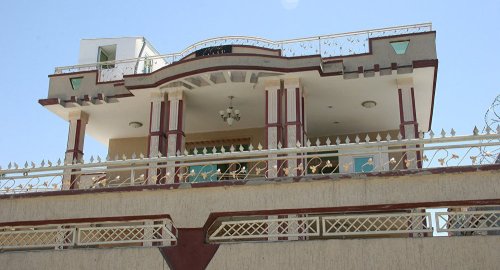
The Pentagon has wasted millions of dollars of taxpayer money on luxurious private villas for US government staff in Afghanistan, a congressional watchdog reveals.
John Sopko, Special Inspector General for Afghanistan Reconstruction (SIGAR), wrote a five-page letter to Defense Secretary Ashton Carter on November 25, saying that the Pentagon Task Force for Business and Stability Operations (TFBSO) blew as much as $150 million on lavish villas in Afghanistan, the watchdog revealed Thursday.
“Based on allegations we have received from former TFBSO employees and others, today I am writing to request information concerning TFBSO’s decision to spend nearly $150 million, amounting to nearly 20 percent of its budget, on private housing and private security guards for its US government employees in Afghanistan, rather than live on US military bases,” read the letter.
The Pentagon also kept an “investor villa” that, according to the letter, had “upgraded furniture” and “Western-style hotel accommodations.”
“It is unclear what benefit the US received as the result of TFBSO’s decision to rent private housing and hire private security contractors, rather than living on DOD [Department of Defense] military bases,” Sopko wrote.
SIGAR “is asking good questions about whether these funds were used to achieve their development goals in Afghanistan, and whether expenditures on villas and guards were actually justified.”
The inspector general called on the Pentagon to reveal more information on who stayed at the villas and approved the expenditures. The Pentagon has until December 11 to respond.
The Department of Defense confirmed it has received “the recent letter from SIGAR and will respond.”
Last month, TFBSO was denounced by members of Congress, after SIGAR found that it had spent $43 million for a gas station there that should have cost only $500,000.
Congress appropriated more than $820 million for TFBSO between 2010 and 2014.
The US and its allies invaded Afghanistan on October 7, 2001 as part of Washington’s so-called war on terror. The offensive removed the Taliban from power, but after 14 years, the foreign troops have still not been able to establish security in the country.
Despite a previous pledge to withdraw all US troops from Afghanistan by the end of next year, US President Barack Obama has announced plans to keep 5,500 of the remaining troops in the country when he leaves office in 2017.
December 3, 2015
Posted by aletho |
Corruption, Deception, Illegal Occupation | Afghanistan, United States |
Leave a comment
 Aletho News
 Aletho News