Leading Israel Lobby Senators call for Massive US troop Deployment in Syria, Iraq
Press TV – November 30, 2015
Two US senators are demanding that Washington deploy some 20,000 troops to Syria and Iraq.
Republicans John McCain and Lindsey Graham called on Sunday for Washington to nearly triple the US military force levels in Iraq to 10,000, and send an equal number of troops to Syria to ‘counter’ Daesh (ISIL) terrorists in both countries.
McCain and Graham also criticized President Barack Obama’s Daesh strategy, which relies on airstrikes and modest support to what Washington deems as ‘moderate’ militants in Syria, stressing the need for greater US [intervention] in the Middle East conflicts.
“The only way you can destroy the caliphate (Daesh) is with a ground component,” said Graham who is seeking his party’s presidential nomination. “The aerial campaign is not turning the tide of battle,” Reuters reported.
McCain, chairman of the Senate Armed Services Committee, recently proposed intervention in Syria by a European and Arab ground force backed by 10,000 US military advisers and trainers.
On Sunday, both senators told reporters during a visit to Baghdad, the Iraqi capital, that US personnel could provide logistical and intelligence support to a proposed 100,000-strong force from countries like Egypt, Turkey and Saudi Arabia.
Last month, the US president ordered the deployment of dozens of special operations troops to northern Syria to “advise” what it calls ‘opposition forces’ in their fight against ISIL.
US counter-terrorism experts have warned that deploying ground troops risks backfiring.
The so-called US-led coalition, which has been bombing purported militant targets in Syria and Iraq for more than a year now, relies heavily on American resources despite including some 60 nations, according to Reuters.
The senators met earlier with Iraqi Prime Minister Haider al-Abadi who they said had welcomed the idea of more US troops.
However, Iraqi government spokesman Saad Hadithi denied the claim, saying that the PM had not requested US combat troops on the ground but rather asked for more arms and advisers to increase air support for Iraqi forces.
Leading Iraqi politicians have repeatedly voiced opposition to a greater role for US forces, which withdrew in 2011 after a nearly nine-year war that left massive casualties.
Turkey stopped violating Greek airspace after Russian Su-24 downing – Athens source
RT – November 29, 2015
Turkish warplanes abruptly ceased violating Greek airspace after downing a Russian Sukhoi Su-24 bomber on November 24. Previously, air intrusions made by Turkish fighter jets took place on a daily basis and amounted to thousands a year.
The data comes from a diplomatic source in Athens, cited by RIA Novosti.
The last time Turkish warplanes were spotted in Greek airspace was on November 25, when six jets, two of them carrying weapons, entered the neighbor’s aerial domain.
Intrusions of Turkish jets into Greek national airspace remain a constant headache for Athens. Turkey and Greece, while partners in NATO, have been adversaries for centuries. The two nations have warred with each other before and still have territorial disputes.
In particular 2014 was marked with a sharp increase of Greek airspace violations by the Turkish Air Force, which amounted to 2,244 incidents. From January to October 2015, Greece’s airspace was violated by Turkish warplanes 1,233 times, including 31 flights over Greek territory itself, according to the Greek Air Force’s headquarters. In November, before the downing of the Russian bomber, there were at least 50 registered airspace violations.
Turkish jets habitually intrude into Greek airspace over disputed islands in the Aegean Sea, provoking the Greek Air Force to scramble fighter jets to intercept. Such airborne rendezvous often end with mock dogfights, with pilots performing real lock-ons of their air-to-air missiles onto their NATO partner’s aircraft.
Athens has repeatedly raised the matter at NATO meetings. Greece’s representative to NATO last reported Turkish violations of their national airspace on November 24. The reaction of other NATO member states has been usually to sit on the fence, and Ankara continued to test Athen’s patience.
When Turkey shot down the Russian bomber on Tuesday, Greek Foreign Minister Nikas Kotzias expressed solidarity with Russia in a phone conversation with his Russian counterpart Sergey Lavrov.
“Athens agrees with the Russian president’s assessment on Ankara’s hostile actions, which are contrary to the goals of the anti-ISIS coalition,” the Russian Foreign Ministry said, as reported by RIA Novosti.
Greece, according to its Foreign Ministry, “especially comprehends provocative moves by Turkey given regular multiple violations of Greek air space by Ankara lasting for years.”
According to Greece’s General Staff, on November 24, the day a Turkish F-16 fighter jet fired an air-to-air missile at Russia’s bomber, the Turkish Air Force made no violations of Greek airspace for the first time in a long period.
Once the Russian warplane went down in flames, “there was zero activity of Turkish aviation in Greek FIR in the Aegean Sea, and it is understandable why,” RIA Novosti cited a diplomatic source in Athens.
The Turkish Air Force also halted strikes on Syrian territory after Russia deployed S-400 long-range air defense complexes at the Khmeimim airbase in Syria’s Latakia, from where the Russian Air Force strikes Islamic State (IS, formerly ISIS/ISIL).
Turkey’s True Goals in Syria are Much More Than Just Oil and Money
Sputnik – 28.11.2015
Turkey playing dirty in Syria is no secret. The true goal Ankara is pursuing in Syria is becoming a regional power and the country that rules the Sunni Muslim world, journalist Riccardo Peliliccetti wrote for his article in Il Giornale.
Over the course of his 20 years of ruling Turkey, Recep Tayyip Erdogan has Islamized the country and launched a policy of expansionism. It is obvious that Erdogan’s goal is to turn northern Syria – between Aleppo and Latakia – into the 82nd Turkish province, the article read, and now he is playing the card of Turkmen living in the region.
Erdogan insists on military intervention in Syria which would help him neutralize the so-called “Shiite axis” comprising Iran, Syria and Hezbollah.
“This may be the very beginning of a conflict between Turkey and Iran. Tehran is responsible for [Syrian President Bashar] Assad’s strategy. Assad as well as Hezbollah is very important to Iran. This is the Shiite axis. Russia came to Syria to support Assad, and then Turkey shot down a Russian jet. It may lead to a war between Turkey and Iran,” political analyst Edward Luttwack was quoted as saying in the article.
For the last four years, Turkey has been making efforts to topple Assad, including financing terrorists and the guerilla war against Damascus. Turkish airports are filled with foreign troops ready to be deployed to Syria. Turkey has attacked the Kurds who fight against the Islamic State (ISIL) terrorist group instead of fighting its militants, the author wrote. What is more, Turkey buys smuggled oil from ISIL for $15-20 a barrel, and then re-sells it at a double the price.
Nevertheless, the strong Shiite axis and particularly the Russian offensive in Syria have shattered Erdogan’s dreams of an empire and kept Assad in power.
After the Russian Su-24 bomber was downed, Erdogan said that Turkey did it to protect itself and its “brothers” in Syria.
He meant Turkmen, of course, but also terrorist groups sponsored by Ankara, many of which have pledged allegiance to ISIL, the author pointed out.
At the Vienna conference in late-October Russia asked the Sunni axis – Turkey, Saudi Arabia and Qatar – to make up a list of moderate opposition figures for talks with Assad. As a result, Ankara removed their protégés from the list of terrorists to let them participate in the talks.
However, Russian President Vladimir Putin will not allow the breakdown of Syria, an ally to Russia, the article read.
Now, it looks like Turkey is looking for a reason to start a war, using NATO for its own interests, according to the article.
The author cited words by German General Harald Kujat who warned of such a scenario a year ago.
“Turkey wants to drag NATO into this war since its goal is to topple Assad. ISIL and the Kurds are not that important. An ally which acts this way should not be respected in the alliance,” Kujat said.
Luttwak confirmed the assumption, saying: “Turkey betrayed NATO when it refused to cooperate and bought oil from ISIL. Ankara made ISIL powerful. While the US is sending weapons to Kurds who fight ISIL Turkey is bombing them. For NATO, having Turkey as an ally is worse than having it as an enemy,” he concluded.
5 Acts of Latin American Solidarity with Palestine
teleSUR – November 27, 2015
 As the world commemorates the United Nations’ International Day for Solidarity with Palestinians, it is important to remember that many countries in Latin America have been some of the most vocal supporters of Palestine and its people.
On several occasions Palestinian officials have expressed their gratitude to Latin American countries for their support, which at times is larger than support from neighboring Arab nations.
This support is translated through opening borders for Palestinian refugees and students, hosting high-level officials from Palestine as well as continually condemning the harsh treatment of Israel towards the Palestinian people through occupation, human rights violations, settlement construction and open discrimination against Palestinian citizens of Israel.
Last year, Palestinian Ambassador to Caracas Linda Sobeh Ali speaking to Venezuela’s President Nicolas Maduro said: “You and the people of Latin America have shown us more support than some of our Arab brothers. Thank you.”
1 – Syrian and Palestinian refugees welcomed by Argentina
In September 2015, Argentina government announced that Syrian and Palestinian refugees were welcome into the country at a time when European nations were militarizing its borders to deter entry to thousands of people fleeing the war-torn country. Refugees would receive a two-year residence permit as soon as they arrive into the country.
2 – Latin America united in support for Palestinians during Israel’s war on Gaza
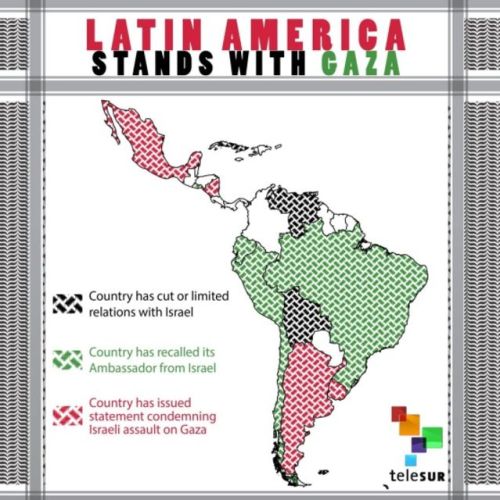
In August, Latin American leaders harshly condemned the Israeli government over its 50-day war against Gaza in summer 2014, including Rafael Correa of Ecuador, Nicolas Maduro of Venezuela, and Evo Morales of Bolivia. Several countries in the region downgraded relations with Israel, while others recalled ambassadors.
3 – Venezuela hosts congress on Palestinian Right of Return April 2015
In April 2015 Venezuela hosted the first Latin American Congress of the Global Campaign to Return to Palestine, being held until Friday in the capital of Caracas. The campaign was founded two years ago as an effort to coordinate the work of Palestinian solidarity activists at a global level. It gives particular attention to demand for the right-of-return of Palestinians who were forcibly displaced by militant Zionists during the foundation of the state of Israel.
4 – Chile hosts PLO official in a 5-day visit to strengthen ties with Palestine
In August 2015, Palestinian Liberation Organization official Saeb Erekat took a five-day visit to Chile where he visited the Arab School in Santiago, met with Chilean President Michelle Bachelet, the foreign minister, as well as representatives of the Jewish community in Chile. Chile is home to more than 400,000 Palestinians and Palestinian descendants.
5 – A ‘Song for Palestine’ solidarity event in Ecuador
In July 2014, social organizations of Ecuador convened on to present “A song for Palestine”, an expression of solidarity with the Palestinian people in the face of attacks by the Israeli Defense Force against the Palestinian people in Gaza.

Europe-based Forum calls for international pro-Palestine efforts

Palestine Information Center – November 27, 2015
BRUSSELS – The Palestinian Forum in Europe—Tawasol—on Thursday called on the world’s states and the European Union to take serious steps to put an end to Israel’s terrorism against the Palestinian people.
A statement issued by the Palestinian Forum in Europe on the occasion of the International Day of Solidarity with the Palestinian People condemned the dramatic surge in the Israeli crimes and violations of Palestinians’ human rights.
The group said a serious pro-Palestine standpoint should be opted for by the world’s governments to urge the Israeli occupation to abide by international legitimacy and withdraw from the occupied territories.
Head of the Tawasol Forum, Zaher Birawi, said a campaign is expected to kick off sometime soon to reach out to the world’s governments, parliaments and European MPs in order to mobilize support for the Palestinian cause.
The International Day of Solidarity with the Palestinian People is observed by the United Nations on or around 29 November each year, in accordance with General Assembly mandates contained in resolutions 32/40 B of 2 December 1977, 34/65 D of 12 December 1979, and subsequent resolutions adopted under agenda item “Question of Palestine.”
Greece’s center-left government seeks stronger ties with Israel, calls Jerusalem “historic capital” of Israel
teleSUR – November 26, 2015
Greece is looking to work with Israel on developing the latter’s energy industry and transporting natural gas across Europe, Prime Minister Alexis Tsipras told reporters after a meeting with his Israeli counterpart, Benjamin Netanyahu.
“One of the main issues in our talks were the opportunities arising in the fields of energy, the fields of energy in the East Mediterranean,” said Tsipras. “We are considering ways on cooperation in research, drilling and transportation of gas from Israel to Europe,.”
The recent discovery of a large offshore gas reserves close to the city of Haifa could turn Israel from a consumer into a supplier of natural energy.
Tsipras also met with President Reuven Rivlin during his first trip to Israel, with the two discussing the threat of terrorism.
“ISIS is not only in Syria and Iraq, but spreading to the whole western world, who must take responsibility and say that we cannot live in a world in which ISIS exists,” Rivlin said at a joint press conference.
While in Jerusalem for the meeting with Rivlin, Tsipras wrote in the president’s guest book that it was a “great honor to be in your historic capital and to meet your excellencies.” The comment was significant given that most countries do not recognize Jerusalem as Israel’s capital. A former Israeli diplomat called the move “unprecedented, especially for a European leader.”
Cameron in Crisis Over Syria After Labour Leader Splits Party
Sputnik – 27.11.2015
UK Prime Minister David Cameron is facing a political crisis after calling for support for airstrikes against ISIL in Syria, but failing to gain the support of Labour leader Jeremy Corbyn who has now caused a major rift in the opposition.
Cameron told lawmakers in London Thursday that Britain should join a coalition of forces in airstrikes against ISIL in Syria. The country is already bombing ISIL in neighboring Iraq, but Cameron needs a mandate from parliament to extend the operations into Syria.
The issue is politically sensitive as Cameron lost a vote to launch airstrikes against Syrian President Bashar al-Assad in 2013, with cost him political value. This time around — in a vote on bombing Assad’s enemies — he cannot afford to lose political face again.
However, the Scottish National Party (SNP) has indicated that it will vote against action in Syria and Cameron needs the support of the Labour opposition to confirm his policy. Labour leader Jeremy Corbyn — who has long been an anti-war campaigner — has written to his party lawmakers telling them he cannot support airstrikes in Syria.
The move has caused chaos within his party, with many members supporting airstrikes against ISIL. If Corbyn exercises his leadership right to demand all his lawmakers follow his lead — in what is known as a three-line whip — he stands to face a mass revolt in his party, which could force a leadership challenge, which would throw the party into chaos.
If — on the other hand — he allows his lawmakers a free vote, then he would remain leader of his party, and lawmakers would be allowed to vote whichever way they wish. Either way, Corbyn’s leadership will have been damaged.
Lesson Not Learned From Iraq
Cameron has other headaches too. Public opinion was strongly against the invasion of Iraq in 2003 and there are many who believe the decision to go to war against Saddam Hussein was based on flawed intelligence, with some — including Corbyn — believing the invasion was illegal.
The Chilcot Inquiry into the reasons for going to war, and its aftermath, has yet to be published and there are many lawmakers who believe its findings will be critical of the invasion because it lacked any exit strategy for Iraq, which has been plunged into civil war ever since. Few want to repeat the mistakes in Syria and are calling for an exit strategy and a strong commitment to support a rebuilding of the country following any invasion to erase ISIL.
If Cameron fails to gain a parliamentary majority on a vote — due next week — over bombing in Syria, he will be politically damaged among his NATO allies, leaving him out in the cold on the global stage. He is also facing calls for the UK not to put itself further at risk than it already is from reprisal terrorist attacks.
Others believe bombing in Syria will play into the hands of ISIL. Jürgen Todenhöfer, the German politician and journalist who, in 2014, spent time with ISIL in both Iraq and Syria, wrote in the Guardian :
“A bombing strategy will above all hit Syria’s population. This will fill ISIL fighters with joy.”
With Corbyn’s party in disarray, the SNP set to vote against bombing and his political worth on the line, Cameron is facing a difficult time in the week ahead and can only hope public opinion in the wake of the Paris attacks on November 13 can save him.
Leaving an ashtray inside a store results in a 5,000 NIS fine
SILWANIC | November 25, 2015
Silwan, Jerusalem — The occupation municipality issued a ticket to s Jerusalemite merchant under the pretext of finding an ashtray inside his store in the neighborhood of Ras Al-Amoud in Silwan.
Wadi Hilweh Information Center was informed that the occupation municipality raided several commercial stores in Silwan especially in the neighborhoods of Ras Al-Amoud, Bi’er Ayoub and Ein Al-Lozeh and checked stores’ and establishments’’ permits and asked the owners to follow-up with the competent departments.
The center added that municipality crews raided a fruits’ store in Ras Al-Amoud owned by Izz Eddin Abdelrahim Barbar and issued him a 5-thousand NIS ticket under the pretext of the presence of an ashtray on the stores’ table. They also issued another person a 1,000-NIS fine for smoking inside the store.
Barbar explained that he tax authority crew raided his store on Tuesday while he was buying merchandise for his store and issued a 5-thousand NIS ticket under his name and a 1,000-NIS fine for another man for smoking.
Barbar said: “The daily harassment against Jerusalemite merchants including raiding stores and randomly issuing tickets falls within the “strict” policy practiced against merchants”.
The center also added that the occupation forces raided several residential houses in the neighborhood of Ein Al-Lozeh under the pretext of looking for stone-throwers. They ascended some roofs and randomly fired rubber bullets in the area; they also took pictures of several houses.
Locals of Silwan complained about the police deployment in the streets of the village, random establishments of checkpoints, searching vehicles and checking young men’s IDs which create heavy traffic jams.
‘Human error’ behind Kunduz hospital attack, US General claims
Press TV – November 25, 2015
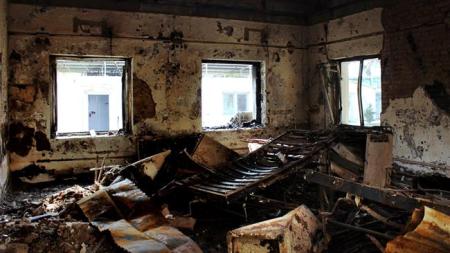
The United States says the deadly airstrike that recently destroyed an Afghan hospital in the northern city of Kunduz was the result of a “human error, compounded by process and equipment failures.”
General John Francis Campbell, the US commander in Afghanistan, made the remarks at a press conference in the capital Kabul on Wednesday, further admitting that the US forces took 17 minutes to act after being warned by Médecins Sans Frontières, or Doctors Without Borders, which was running the hospital in the country.
Campbell described the October 3 air raid on the hospital, packed with patients and medical staff, a “tragic and avoidable accident, caused by human error.”
“At 2.20am an SOF [special operations forces] officer at Bagram [airbase] received a call from MSF advising that their facility was under attack. It took the headquarters and the US special operations commander until 2.37am to realize the fatal mistake. At that time the AC-130 had already ceased firing. The strike lasted for approximately 29 minutes. This is an example of human process error.”
The general was announcing the results of an internal investigation into the incident, which left at least 30 dead.
US forces “did not know the compound was an MSF medical centre,” said Campbell. “They executed from air and did not take appropriate measures to verify the facility was a military target,” he said, adding that “fatigue” and “high operational tempo contributed to this tragedy.”
More questions after US explanation
MSF General Director Christopher Stokes responded to Campbell’s remarks that were accompanied by a 3,000-page US military report.
“The US version of events presented today leaves MSF with more questions than answers. It is shocking that an attack can be carried out when US forces have neither eyes on a target nor access to a no-strike list, and have malfunctioning communications systems,” Stokes said, adding, “It appears that 30 people were killed and hundreds of thousands of people are denied life-saving care in Kunduz simply because the MSF hospital was the closest large building to an open field and ‘roughly matched’ a description of an intended target.”
The MSF official accused the US forces of violation of the rules of war, further reiterating calls for an independent probe into the incident.
“The frightening catalogue of errors outlined today illustrates gross negligence on the part of US forces and violations of the rules of war. The destruction of a protected facility without verifying the target – in this case a functioning hospital full of medical staff and patients – cannot only be dismissed as individual human error or breaches of the US rules of engagement,” Stokes said.“MSF reiterates its call for an independent and impartial investigation into the attack on our hospital in Kunduz. Investigations of this incident cannot be left solely to parties to the conflict in Afghanistan.”
Breaking international law in Syria
By Sharmine Narwani | RT | November 25, 2015
The war drums are getting louder in the aftermath of ISIS attacks in Paris, as Western countries gear up to launch further airstrikes in Syria. But obscured in the fine print of countless resolutions and media headlines is this: the West has no legal basis for military intervention. Their strikes are illegal.
“It is always preferable in these circumstances to have the full backing of the United Nations Security Council (UNSC) but I have to say what matters most of all is that any actions we would take would… be legal,” explained UK Prime Minister David Cameron to the House of Commons last Wednesday.
Legal? No, there’s not a scrap of evidence that UK airstrikes would be lawful in their current incarnation.
Then just two days later, on Friday, the UN Security Council unanimously adopted Resolution 2249, aimed at rallying the world behind the fairly obvious notion that ISIS is an “unprecedented threat to international peace and security.”
“It’s a call to action to member states that have the capacity to do so to take all necessary measures against (ISIS) and other terrorist groups,” British UN Ambassador Matthew Rycroft told reporters.
The phrase “all necessary measures” was broadly interpreted – if not explicitly sanctioning the “use of force” in Syria, then as a wink to it.
Let’s examine the pertinent language of UNSCR 2249:
The resolution “calls upon Member States that have the capacity to do so to take all necessary measures, in compliance with international law, in particular with the United Nations Charter…on the territory under the control of ISIL also known as Da’esh, in Syria and Iraq.”
Note that the resolution demands “compliance with international law, in particular with the UN Charter.” This is probably the most significant explainer to the “all necessary measures” phrase. Use of force is one of the most difficult things for the UNSC to sanction – it is a last resort measure, and a rare one. The lack of Chapter 7 language in the resolution pretty much means that ‘use of force’ is not on the menu unless states have other means to wrangle “compliance with international law.”
What you need to know about international law
It is important to understand that the United Nations was set up in the aftermath of World War 2 expressly to prevent war and to regulate and inhibit the use of force in settling disputes among its member states. This is the UN’s big function – to “maintain international peace and security,” as enshrined in the UN Charter’s very first article.
There are a lot of laws that seek to govern and prevent wars, but the Western nations looking to launch airstrikes in Syria have made things easy for us – they have cited the law that they believe justifies their military intervention: specifically, Article 51 of the UN Charter. It reads, in part:
“Nothing in the present Charter shall impair the inherent right of individual or collective self-defense if an armed attack occurs against a Member of the United Nations, until the Security Council has taken measures necessary to maintain international peace and security.”
So doesn’t France, for instance, enjoy the inherent right to bomb ISIS targets in Syria as an act of self-defense – in order to prevent further attacks?
And don’t members of the US-led coalition, who cite the “collective self-defense” of Iraq (the Iraqi government has formally made this request), have the right to prevent further ISIS attacks from Syrian territory into Iraqi areas?
Well, no. Article 51, as conceived in the UN Charter, refers to attacks between territorial states, not with non-state actors like ISIS or Al-Qaeda. Syria, after all, did not attack France or Iraq – or Turkey, Australia, Jordan or Saudi Arabia.
And here’s where it gets interesting.
Western leaders are employing two distinct strategies to obfuscate the lack of legal justification for intervention in Syria. The first is the use of propaganda to build narratives about Syria that support their legal argumentation. The second is a shrewd effort to cite legal “theory” as a means to ‘stretch’ existing law into a shape that supports their objectives.
The “Unwilling and Unable” Theory – the “Unable” argument
The unwilling and unable theory – as related to the Syria/ISIS situation – essentially argues that the Syrian state is both unwilling and unable to target the non-state actor based within its territory (ISIS, in this case) that poses a threat to another state.
Let’s break this down further.
Ostensibly, Syria is ‘unable’ to sufficiently degrade or destroy ISIS because, as we can clearly see, ISIS controls a significant amount of territory within Syria’s borders that its national army has not been able to reclaim.
This made some sense – until September 30 when Russia entered the Syrian military theater and began to launch widespread airstrikes against terrorist targets inside Syria.
As a major global military power, Russia is clearly ‘able’ to thwart ISIS –certainly just as well as most of the Western NATO states participating in airstrikes already. Moreover, as Russia is operating there due to a direct Syrian government appeal for assistance, the Russian military role in Syria is perfectly legal.
This development struck a blow at the US-led coalition’s legal justification for strikes in Syria. Not that the coalition’s actions were ever legal – “unwilling and unable” is merely a theory and has no basis in customary international law.
About this new Russian role, Major Patrick Walsh, associate professor in the International and Operational Law Department at the US Army’s Judge Advocate General’s Legal Center and School in Virginia, says:
“The United States and others who are acting in collective defense of Iraq and Turkey are in a precarious position. The international community is calling on Russia to stop attacking rebel groups and start attacking ISIS. But if Russia does, and if the Assad government commits to preventing ISIS from attacking Syria’s neighbors and delivers on that commitment, then the unwilling or unable theory for intervention in Syria would no longer apply. Nations would be unable to legally intervene inside Syria against ISIS without the Assad government’s consent.”
In recent weeks, the Russians have made ISIS the target of many of its airstrikes, and are day by day improving coordination efficiency with the ground troops and air force of the Syrian Arab Army (SAA) and its allies -Iran, Hezbollah and other foreign groups who are also in Syria legally, at the invitation of the Syrian state.
Certainly, the balance of power on the ground in Syria has started to shift away from militants and terrorist groups since Russia launched its campaign seven weeks ago – much more than we have seen in a year of coalition strikes.
The “Unwilling and Unable” Theory – the “Unwilling” argument
Now for the ‘unwilling’ part of the theory. And this is where the role of Western governments in seeding ‘propaganda’ comes into play.
The US and its allies have been arguing for the past few years that the Syrian government is either in cahoots with ISIS, benefits from ISIS’ existence, or is a major recruiting magnet for the terror group.
Western media, in particular, has made a point of underplaying the SAA’s military confrontations with ISIS, often suggesting that the government actively avoids ISIS-controlled areas.
The net result of this narrative has been to convey the message that the Syrian government has been ‘unwilling’ to diminish the terror group’s base within the country.
But is this true?
ISIS was born from the Islamic State of Iraq (ISI) in April, 2013 when the group’s leader Abu Bakr al-Baghdadi declared a short-lived union of ISI and Syria’s Al-Qaeda branch, Jabhat al-Nusra. Armed militants in Syria have switched around their militia allegiances many times throughout this conflict, so it would be disingenuous to suggest the Syrian army has not fought each and every one of these groups at some point since early 2011.
If ISIS was viewed as a ‘neglected’ target at any juncture, it has been mainly because the terror group was focused on land grabs for its “Caliphate” in the largely barren north-east areas of the country – away from the congested urban centers and infrastructure hubs that have defined the SAA’s military priorities.
But ISIS has always remained a fixture in the SAA’s sights. The Syrian army has fought or targeted ISIS, specifically, in dozens of battlefields since the organization’s inception, and continues to do so. In Deir Hafer Plains, Mennagh, Kuweires, Tal Arn, al-Safira, Tal Hasel and the Aleppo Industrial District. In the suburbs and countryside of Damascus – most famously in Yarmouk this year – where the SAA and its allies thwarted ISIS’ advance into the capital city. In the Qalamun mountains, in Christian Qara and Faleeta. In Deir Ezzor, where ISIS would join forces with the US-backed Free Syrian Army (FSA): al-Husseiniyeh, Hatla, Sakr Island, al-Hamadiyah, al-Rashidiyah, al-Jubeileh, Sheikh Yasseen, Mohassan, al-Kanamat, al-Sina’a, al-Amal, al-Haweeqa, al-Ayyash, the Ghassan Aboud neighborhood, al-Tayyim Oil Fields and the Deir ez-Zor military airport. In Hasakah Province – Hasakah city itself, al-Qamishli, Regiment 121 and its environs, the Kawkab and Abdel-Aziz Mountains. In Raqqa, the Islamic State’s capital in Syria, the SAA combatted ISIS in Division 17, Brigade 93 and Tabaqa Airbase. In Hama Province, the entire al-Salamiyah District – Ithriyah, Sheikh Hajar, Khanasser. In the province of Homs, the eastern countryside: Palmyra, Sukaneh, Quraytayn, Mahin, Sadad, Jubb al-Ahmar, the T-4 Airbase and the Iraqi border crossing. In Suweida, the northern countryside.
If anything, the Russian intervention has assisted the Syrian state in going on the offensive against ISIS and other like-minded terror groups. Before Russia moved in, the SAA was hunkering down in and around key strategic areas to protect these hubs. Today, Syria and its allies are hitting targets by land and air in the kinds of coordinated offensives we have not seen before.
Seeding ‘propaganda’
The role of propaganda and carefully manipulated narratives should not be underestimated in laying the groundwork for foreign military intervention in Syria.
From “the dictator is killing his own people” to the “regime is using chemical weapons” to the need to establish “No Fly Zones” to safeguard “refugees fleeing Assad”… propaganda has been liberally used to build the justification for foreign military intervention.
Article 2 of the UN Charter states, in part:
“All Members shall refrain in their international relations from the threat or use of force against the territorial integrity or political independence of any state, or in any other manner inconsistent with the purposes of the United Nations.”
It’s hard to see how Syria’s sovereignty and territorial integrity has not been systematically violated throughout the nearly five years of this conflict, by the very states that make up the US-led coalition. The US, UK, France, Saudi Arabia, Turkey, Qatar, the UAE and other nations have poured weapons, funds, troops and assistance into undermining a UN member state at every turn.
“Legitimacy” is the essential foundation upon which governance rests. Vilify a sitting government, shut down multiple embassies, isolate a regime in international forums, and you can destroy the fragile veneer of legitimacy of a king, president or prime minister.
But efforts to delegitimize the government of Syrian President Bashar al-Assad have also served to lay the groundwork for coalition airstrikes in Syria.
If Assad is viewed to lack “legitimacy,” the coalition creates the impression that there is no real government from which it can gain the necessary authority to launch its airstrikes.
This mere ‘impression’ provided the pretext for Washington to announce it was sending 50 Special Forces troops into Syria, as though the US wasn’t violating every tenet of international law in doing so. “It’s okay – there’s no real government there,” we are convinced.
Media reports repeatedly highlight the ‘percentages’ of territory outside the grasp of Syrian government forces – this too serves a purpose. One of the essentials of a state is that it consists of territory over which it governs.
If only 50 percent of Syria is under government control, the argument goes, “then surely we can just walk into the other ‘ungoverned’ parts” – as when US Ambassador to Syria Robert Ford and US Senator John McCain just strolled illegally across the border of the sovereign Syrian state.
Sweep aside these ‘impressions’ and bury them well. The Syrian government of Bashar al-Assad is viewed by the United Nations as the only legitimate government in Syria. Every official UN interaction with the state is directed at this government. The Syrian seat at the UN is occupied by Ambassador Bashar al-Jaafari, a representative of Assad’s government. It doesn’t matter how many Syrian embassies in how many capitals are shut down – or how many governments-in-exile are established. The UN only recognizes one.
As one UN official told me in private: “Control of surface territory doesn’t count. The government of Kuwait when its entire territory was occupied by Iraq – and it was in exile – was still the legitimate government of Kuwait. The Syrian government could have 10 percent of its surface left – the decision of the UN Security Council is all that matters from the perspective of international law, even if other governments recognize a new Syrian government.”
Countdown to more illegal airstrikes?
If there was any lingering doubt about the illegality of coalition activities in Syria, the Syrian government put these to rest in September, in two letters to the UNSC that denounced foreign airstrikes as unlawful:
“If any State invokes the excuse of counter-terrorism in order to be present on Syrian territory without the consent of the Syrian Government whether on the country’s land or in its airspace or territorial waters, its action shall be considered a violation of Syrian sovereignty.”
Yet still, upon the adoption of UNSC Resolution 2249 last Friday, US Deputy Representative to the United Nations Michele Sison insisted that “in accordance with the UN Charter and its recognition of the inherent right of individual and collective self-defense,” the US would use “necessary and proportionate military action” in Syria.
The website for the European Journal of International Law (EJIL) promptly pointed out the obvious:
“The resolution is worded so as to suggest there is Security Council support for the use of force against IS. However, though the resolution, and the unanimity with which it was adopted, might confer a degree of legitimacy on actions against IS, the resolution does not actually authorize any actions against IS, nor does it provide a legal basis for the use of force against IS either in Syria or in Iraq.”
On Thursday, UK Prime Minister David Cameron plans to unveil his new “comprehensive strategy” to tackle ISIS, which we are told will include launching airstrikes in Syria.
We already know the legal pretext he will spin – “unwilling and unable,” Article 51, UN Charter, individual and collective self-defense, and so forth.
But if Cameron’s September 7 comments at the House of Commons are any indication, he will use the following logic to argue that the UK has no other choice than to resort to ‘use of force’ in Syria. In response to questions about two illegal drone attacks targeting British nationals in Syria, the prime minister emphasized:
“These people were in a part of Syria where there was no government, no one to work with, and no other way of addressing this threat… When we are dealing with people in ISIL-dominated Syria—there is no government, there are no troops on the ground—there is no other way of dealing with them than the route that we took.”
But Cameron does have another route available to him – and it is the only ‘legal’ option for military involvement in Syria.
If the UK’s intention is solely to degrade and destroy ISIS, then it must request authorization from the Syrian government to participate in a coordinated military campaign that could help speed up the task.
If Western (and allied Arab) leaders can’t stomach dealing with the Assad government on this issue, then by all means work through an intermediary – like the Russians – who can coordinate and authorize military operations on behalf of their Syrian ally.
The Syrian government has said on multiple occasions that it welcomes sincere international efforts to fight terrorism inside its territory. But these efforts must come under the direction of a central legal authority that can lead a broad campaign on the ground and in the air.
The West argues that, unlike in Iraq, it seeks to maintain the institutions of the Syrian state if Assad were to step down. The SAA is one of these ‘institutions’ – why not coordinate with it now?
But after seven weeks of Russian airstrikes coordinated with extensive ground troops (which the coalition lacks), none of these scenarios may even be warranted. ISIS and other extremist groups have lost ground in recent weeks, and if this trend continues, coalition states should fall back and focus on other key ISIS-busting activities referenced in UNSCR 2249 – squeezing terror financing, locking down key borders, sharing intelligence…”all necessary measures” to destroy this group.
If the ‘international community’ wants to return ‘peace and stability’ to the Syrian state, it seems prudent to point out that its very first course of action should be to stop breaking international law in Syria.
Sharmine Narwani is a commentator and analyst of Middle East geopolitics. She is a former senior associate at St. Antony’s College, Oxford University and has a master’s degree in International Relations from Columbia University. Sharmine has written commentary for a wide array of publications, including Al Akhbar English, the New York Times, the Guardian, Asia Times Online, Salon.com, USA Today, the Huffington Post, Al Jazeera English, BRICS Post and others. You can follow her on Twitter at @snarwani
Guam, Marianas brace for massive US military redeployment
RT | November 23, 2015
Thousands of American military personnel are expected to arrive in the Mariana Islands over the next several years, as part of the US strategic “pivot” to East Asia. Many will come from Okinawa, Japan, where many local residents want US bases closed.
Military facilities in Guam, the archipelago’s largest island and a US possession since 1898, have been reinforced and updated in anticipation of almost 5,000 Marines, as well as new aircraft, submarines and patrol boats. The infrastructure upgrades will “elevate the tiny Pacific island into a maritime strategic hub, a key element laid out by the Pentagon in the Asia-Pacific Maritime Security Strategy,” according to the US military newspaper Stars and Stripes.
“We have two 11,000-foot concrete runways, both rebuilt within the last 10 years,” Steven Wolborsky, director of plans, program and readiness at the Andersen Air Force Base told Stars and Stripes, adding that roughly 19 million pounds of explosives are now stored across the facility’s 4,400 acres.
“We have enough parking for more than 155 aircraft, with a robust in-ground refueling infrastructure,” Wolborsky added. “We have the largest capacity of jet fuel in the Air Force at 66 million gallons ‒ coupled with an equal amount down south with the Navy.”
The construction has been driven primarily by the plan to move thousands of Marines to Guam from Okinawa, Captain Alfred Anderson, the base commander, said. The redeployment is expected by 2023 or so.
More than a third of the estimated $8.7 billion cost of building the new facilities for the Marines is being funded by Japan, according to McClatchy reporter Adam Ashton. The Japanese residents of Okinawa have complained for years about the impact of US military presence, ranging from drugs, alcoholism, and sexual abuse to environmental damage.
Originally the Pentagon envisioned a shift of 8,600 Marines and some 9,000 dependents from Okinawa, raising alarm among some residents of Guam that their island, with an area of only 212 square miles (549 km sq.) and a population of 160,000, would be overwhelmed.
Pressure from the activists representing the native Chamorro people, organized in a group called We Are Guahan, compelled the Pentagon to trim that number down to 4,800. Two thirds of that number would be there on rotation, without their families, reducing the pressure on the island even further.
The activists are not resting on their laurels, however, and are pressing on against the Pentagon’s plans to install firing ranges on the islands of Tinian and Pagan. The new facilities are supposed to integrate with the US Navy’s underwater training range in the nearby Mariana Trench.
While Guam is an unincorporated US territory, Pagan and Tinian belong to the Northern Mariana Islands Commonwealth, a US possession with the same status as Puerto Rico.
The island of Pagan is uninhabited at the moment, although the island’s inhabitants still make claims to the land after they were forced to evacuate due to volcanic eruptions in 1981. Tinian has an area of 39 square miles (101 km sq.) and just over 3,000 residents. US Marines seized the island from a Japanese garrison after a weeklong battle in July 1944. A year later, the massive airbase built on the island was used to launch the nuclear attacks on Hiroshima and Nagasaki.
Joining the residents in opposition to the Marine firing range plan is Alter City Group, a Chinese company based in Macau that wanted to invest $500 million to build a casino complex on Tinian. The firing range would “significantly alter the island as we know it in dramatically irreparable ways,” and impose burdens on the island both “significant and unsustainable,” the ACG said in a statement, as quoted by McClatchy.
Some political and business leaders in Guam, however, fear the military may drop its plans altogether if the Marines are barred from using Tinian and Pagan for live-fire exercises. They have established the Guam-US Security Alliance to push for the military buildup.
“This is so big that people are going to have to learn to get along,” John Thomas Brown, director of the Alliance, told McClatchy. “It can be done. It should be done. Time is wasting.”
Most of Guam’s income comes from Japanese tourism, followed by US military spending.
Featured Video
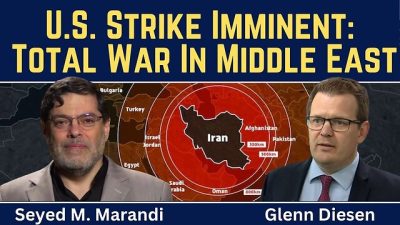
Seyed M. Marandi: Toward Total War in the Middle East
or go to
Aletho News Archives – Video-Images
From the Archives
The Geopolitics behind the War in Yemen (I)
By Mahdi Darius NAZEMROAYA | Strategic Culture Foundation | 30.03.2015
The United States and the Kingdom of Saudi Arabia became very uneasy when the Yemenese or Yemenite movement of the Houthi or Ansarallah (meaning the supporters of God in Arabic) gained control of Yemen’s capital, Sanaa/Sana, in September 2014. The US-supported Yemenite President Abd-Rabbuh Manṣour Al-Hadi was humiliatingly forced to share power with the Houthis and the coalition of northern Yemenese tribes that had helped them enter Sana. Al-Hadi declared that negotiations for a Yemeni national unity government would take place and his allies the US and Saudi Arabia tried to use a new national dialogue and mediated talks to co-opt and pacify the Houthis.
The truth has been turned on its head about the war in Yemen. The war and ousting of President Abd-Rabbuh Manṣour Al-Hadi in Yemen are not the results of «Houthi coup» in Yemen. It is the opposite. Al-Hadi was ousted, because with Saudi and US support he tried to backtrack on the power sharing agreements he had made and return Yemen to authoritarian rule. The ousting of President Al-Hadi by the Houthis and their political allies was an unexpected reaction to the takeover Al-Hadi was planning with Washington and the House of Saudi. … continue
Blog Roll
 Aletho News
- Finland’s Stubb tells European leaders to calm down
- Defeating Russia on battlefield impossible – Fico
- Finland’s Gender Clinic Reversal
- Massachusetts Wants Mental Health Visits, Why Does Government Use ‘Health’ to Enter Our Homes & Families?
- US lawmaker admits American people footing bill for Trump’s failed aggression against Iran
- Pfizer Gave $500,000 to Groups That Lobbied to End Religious Exemption in Massachusetts
- HE SAVED LIVES. NOW HE FACES PRISON.
- Israeli lobby seeks to bind US fate to ‘Israel’: Araghchi
- Pakistan-Iran talks secure LNG shipment to Islamabad through Hormuz
- Black Sea grain crisis puts global wheat supplies under pressure
- If Americans Knew
- Israeli Attacks in Gaza Kill at Least Seven Palestinians Over Three Days, including Woman and Child
- Trump’s militarization of Washington DC as he pursues Israel’s war against Iran
- Why Israel Fears This Searing New Documentary
- Huckabee aide solicited cash gifts from Israelis
- This isn’t sci-fi, AI is already killing people
- ‘The Most Brutal Thing’: Investigation Reveals Execution of Elderly Woman in Rafah
- Inside Israel’s ‘soft’ ethnic cleansing plan for Gaza through the eyes of its victims
- New online database tracks pro-Israel political donations in the United States
- Israeli president pardons soldier convicted for killing wounded Palestinian
- Singer Ed Sheeran says his ‘heart broken’ by Gaza devastation, addresses Macklemore controversy
- No Tricks Zone
- 2025 Nature Paper Claiming Worsening Global Drought Gets RETRACTED …Heavily Flawed
- New Study: ‘Global Drought Shows No Detectable Recent Acceleration Under Climate Warming’
- Economic Masterminds: German Socialists Suggest Taxing Productivity Gains Stemming From Using AI
- The South China Sea Has Not Been Cooperating With The Climate Change Narrative
- Energy Crisis: Germany Enters Heating Season With Historically Low Gas Reserve Fill Levels
- New Study: The Antarctic Ice Sheet Gained Mass From 2020-2024 Due To Staggering Snow And Ice Accumulation
- Study: Ocean Heating Rates From Thousands Of Years Ago ‘Dwarf’ Modern Ocean Heating Rates
- Climate Extremists Target, Attack Large-Scale Power Grid Infrastructure In Germany!
- New Study: Antarctic Ice Melt Has Contributed Less Than 1 Centimeter To Sea Level Rise In The Last 30 Years
- Fear Of Debate: Alarmist German Climate Scientist Calls On Mainstream Media To Discredit Skeptic Voices
 Aletho News