Israel admits: Just 0.7% of West Bank allocated to Palestinians
By Saed Bannoura | IMEMC & Agencies | March 28, 2013
In documents released on Thursday to the High Court of Justice, the Israeli government has admitted what Palestinians have been saying for decades: that the Israeli government has taken over 99.3% of the West Bank, allocating most of the land to illegal Israeli ‘Jewish only’ settlements.
The Israeli designation of 1.3 million acres of Palestinian land in the West Bank as ‘Israeli state land’ flies in the face of past Israeli claims that they are willing to negotiate in good faith with the Palestinians on the status of land in the West Bank.
The documents were released as part of a lawsuit filed by Israeli human rights group Yesh Din that challenged the construction of the illegal settlement of Hayovel on stolen Palestinian land. The Israeli government argues that the settlement and the road leading to it are on ‘uncultivated land’, and have declared that such lands are subject to takeover by the Israeli government.
After 1979, the Israeli government began wide scale takeovers of Palestinian land using a law that passed in the Israeli Knesset authorizing the Israeli government to take over any Palestinian land that had not been cultivated in ten years.
A study by Israeli researcher Dror Etkes found that the Israeli government has used land surveys that are meant to determine which land is cultivated and which is not as a political tool to take over nearly all of the land in the West Bank.
His report stated that his findings “prove the claims that Palestinian landowners have been consistently presenting over the past few decades: Under the aegis of the broad declaration of lands as state lands, which includes almost a million dunams, Israel has taken over extensive cultivated areas, which were stolen from their owners through administrative decisions over which public and legal oversight is minimal, because they were supposedly not cultivated.”
In the recent case of the outpost of Derech Ha’avot, the largest Israeli outpost colony in the West Bank, the Israeli High Court ruled that the takeover of private Palestinian land by the Israeli settlers was acceptable, leading the lawyers for Yesh Din (the Israeli human rights group representing the Palestinian landowners) to declare;
“Not only is the state reconciling itself to the breaking of the law, but it is also ultimately granting the usurped land to the lawbreakers. It is particularly outrageous that all the state authorities joined forces to accept the breaking of the law and are now attempting to provide an umbrella of state support, rather than combating organized ideological crime that violates human rights on a daily and hourly basis.”
Related articles
- Obama’s Peace Antics in Israel – Four More Years of This? (alethonews.wordpress.com)
- Israeli security officer brutally beats unarmed Palestinian shepherd (alethonews.wordpress.com)
- Israel confiscates private Palestinian land to enlarge checkpoint (maannews.net)
Obama’s Peace Antics in Israel – Four More Years of This?
By Ramzy Baroud | Palestine Chronicle | March 26, 2013
At the precise moment US President Barack Obama’s Air Force One touched down at Ben Gurion Airport on March 20, persisting illusions quickly began to shatter. And as he walked on the red carpet, showered with accolades and warm embraces of top Israeli government and military officials, a new/old reality began to sink in: Obama was no different than his predecessors. He never had been.
On the day of Obama’s arrival, Israeli rights group B’Tselem, released a disturbing video. It was of Israeli soldiers carrying out a ‘mass arrest’ of nearly 30 Palestinian children on their way to school in the Palestinian city of al-Khalil (Hebron). The children plead and cried to no avail. Their terrified shrieks echoed throughout the Palestinian neighborhood as they tried to summon the help of passersby. “‘Amo’ – Uncle,” one begged, “for God sake don’t let them take me.” Nonetheless, several military vehicles were filled with crying children and their school bags. But what made the release of the video truly apt is the fact that it was released on the day president Obama was meeting Israeli children at a welcoming ceremony at the home of Israeli President Shimon Peres.
“Their dreams are much the same as children everywhere,” he said, referring to Israeli children, of course. “In another sense though their lives reflect the difficult reality that Israelis face every single day. They want to be safe, they want to be free from rockets that hit their homes or their schools.”
Many Palestinians immediately pointed out the moral discrepancies in most of Obama’s statements throughout his stay in Israel. Still, his visit was ‘historic’ declared numerous headlines in the US and Israeli media.
However, aside from the fact that it was his first trip to Israel as a president, it was barely momentous. His unconditional support for Israel has been tedious and redundant, predictable even. Those who have followed his unswerving pro-Israel legacy – including his visit to Israel as a presidential candidate in 2008, his talks before the Israeli lobby group AIPAC and many other examples – could barely discern a shift, except perhaps, in the total disinterest in political sensibility and balance.
He truly delivered in Israel. This was to the total satisfaction of the Israeli Prime Minister and his pro-settler government which was assembled shortly before Obama’s arrival. Obama spoke as if he were entirely oblivious to the political shift to the extreme right underway in Israel. Indeed, the new Israeli government is more right-wing than ever before. The extremist Jewish Home party has three important ministries, including Jerusalem and Housing and the ultra-nationalists of Yisraeli Beiteinu have been awarded the tourism ministry. It means that the next few years will be a settlement construction bonanza, ‘ethnic cleaning’ and greater Apartheid.
“It’s good to be back in The Land (Israel),” Obama said in Hebrew, at the Tel Aviv airport. “The United States is proud to stand with you as your strongest ally and your greatest friend.”
It is believed that for four years, Obama has failed to live up to the nearly impossible expectations of Israel. Israel requires a president with good oratory skills – for example, to emphasize the ‘eternal’ bond between his country and Israel, as Obama did – who is able to sign big checks and ask few questions. Obama has of course done that and more. Aside from the 3.1 billion dollars in financial support, he has rerouted hundreds of millions of US funds to bankroll Israel’s air defense system, the Iron Dome, whose efficiency is questionable at best.
Obama’s past transgression, as far as Israel is concerned, is that he dared ask the right-wing government of Netanyahu to temporarily freeze settlement construction as a pre-condition to restart the stalled – if not dead – peace process. Of course, there is the widely reported matter of Obama’s lack of fondness of Netanyahu, his antics and renowned arrogance. But that matters little, since Israel’s illegal settlements continued to thrive during Obama’s first term in office.
Expectedly, Netanyahu was gloating. He has managed to assemble a government that will cater mostly to extremist Jewish settlers in the West Bank and also masterfully managed to humble the US president, or at least quash his ambitions that the US is capable of operating independently in the Middle East, without Israeli consent or interests in mind.
Now that Jewish colonies are flourishing – with occupied East Jerusalem area EI being another major exploit – Netanyahu is once more aspiring for a war against Iran, one that would not be possible without US funding, support and likely direct involvement. “Thank you for standing by Israel at this time of historic change in the Middle East,” Netanyahu said while standing near the mostly US-funded Iron Dome. “Thank you for unequivocally affirming Israel’s sovereign right to defend itself, by itself against any threat.”
Obama did in fact spare a few, although, spurious thoughts for Palestinians. “Put yourself in their shoes — look at the world through their eyes,” he said to an Israeli audience. “It is not fair that a Palestinian child cannot grow up in a state of her own, and lives with the presence of a foreign army that controls the movements of her parents every single day.”
One would even applaud the seeming moral fortitude if it were not for the pesky matter that the US had voted against a Palestinian state at the United Nations last November and tried to intimidate those who did. And of course, much of the horror that Palestinian ‘eyes’ have seen throughout the years was funded and defended by US money and action. If Obama is trying to resurrect the myth that the US is a well-intentioned bystander or an ‘honest broker’ in some distant conflict, then he has utterly failed. His country is fully embroiled in the conflict, and directly so. Many Palestinian children would still be alive today if the US government had conditioned its massive support of Israel on ending the occupation and ceasing the brutality against Palestinians.
In a joint press conference in Ramallah, alongside Palestinian Authority President Mahmoud Abbas, Obama even demanded Palestinians drop their condition (proposed by Obama himself) of a settlement freeze in order to return to the so-called peace talks. “That’s not to say settlements aren’t important, that’s to say if we resolve the (main) problems, then settlements will be resolved,” he said. “If to begin the conversation we have to get everything right from the outset … then we’re never going to get to the broader issue,” Obama added. The broader issue, according to the US president is “how do you structure a state of Palestine,” which again, Obama voted against last year, and passionately so.
Aside from resounding rhetoric about peace, Obama is finally towing the Israeli line exactly as Netanyahu and the lobby would expect of him, or of any other US president. He has little to offer Palestinians, or Arab nations, but much to expect from them. Arab states must seek normalized relations with Israel, and Palestinians must “recognize that Israel will be a Jewish state, and that Israelis have the right to insist upon their security,” he lectured in Jerusalem on the second day of his trip, reported CNN online. The obvious danger here lies in the fact that Israel oftentimes conflates ‘security’ and its ‘right to defend itself’ by mass arresting children on their way to school in Hebron, or by inflicting or supporting wars against other nations – Lebanon, Iraq and now Iran.
Obama will eventually get back to his Oval Office desk, ready to resume work as usual. This will include the signing of many papers concerning additional funds, loans, military technology transfers and much more for Israel. Palestinians meanwhile will carry on with their long fight for freedom, without his noted oratory skills.
Meanwhile, the families of the 30 children kidnapped by the Israeli army in Hebron will have many days ahead of them in Israeli military court. But that, of course, is a different matter, of no concern to Obama and his many quotable peace antics.
– Ramzy Baroud (www.ramzybaroud.net) is an internationally-syndicated columnist and the editor of PalestineChronicle.com. His latest book is: My Father was A Freedom Fighter: Gaza’s Untold Story.
Related article
- Obama Gives Up on Peace (nationalinterest.org)
Journalists detained in Hebron, leading to two arrests and threats to restrict Palestinian movement
International Solidarity Movement | March 24, 2013
Hebron, Occupied Palestine – In the afternoon of the 24th March, two Palestinian Al Jazeera journalists arrived into Hebron to interview a Palestinian family living near the illegal Israeli settlement in the area of Tel Rumeida. When they arrived, settlers called the Israeli military and police, who arrived and confiscated the journalists’ ID cards, despite having seen their press credentials. The Al Jazeera reporters had their ID cards returned after around an hour, but two Hebron Palestinians who attempted to intervene on their behalf with police were arrested and removed in a police car. Their status is currently unknown and no reason was given for their arrest.
After the journalists were apprehended, police and settlers arrived into the area with rolls of barbed wire, informing another Palestinian resident that his primary access to the main road would be closed. Hashem Azzeh and his family live underneath the Tel Rumeida settlement, with their access to the main road running directly next to the settlement. This path has been repeatedly closed by the Israeli authorities since 2000, and was only opened most recently in late 2012 after extensive legal battles in the Israeli courts.
The police and settlers claimed today that the path would be closed because unapproved people had been walking along it. According to the Israeli authorities, only Hashem, his family and guests walking with them have permission to use the path. Hashem states that he has no knowledge of strangers using this route to access his house.
Without the path, Hashem and his family have to travel a much longer, rock-strewn and hazardous route to leave their home. Hashem said today, “I think they will close my access now, they will say it is for security reasons.” He thinks that the settlers used the arrival of the journalists and the subsequent confusion as a pretext to close his path and restrict his family’s movement, in further attempts to drive them from their home – they already face regular hassle from Israeli authorities and attacks from the settlers, including on Hashem’s young children.
Related articles
- 9 Year old Palestinian boy attacked by settlers (alethonews.wordpress.com)
- Stranded in Shuhada: Hebron’s Qurtuba school (alethonews.wordpress.com)
Mass arrest of schoolchildren
CPTnet | March 24, 2013
Twenty-seven Palestinian children, age seven to 15, were arrested while on their way to school in the West Bank city of Hebron. Three were detained for two days; twenty-four others were held for almost twelve hours.
The principal of the Hebron Public School reported that he was standing at the gate to his school at 7:30 a.m. when about 22 soldiers arrived and immediately began taking children from the street without speaking with the principal, teachers or the children. The street was full of children on their way to five area schools. Several adults arrived and tried to prevent the soldiers from taking the students but soldiers pulled the children away.
Israeli soldiers arrested 29 students, age seven to 15. They made them walk to checkpoint 29 and violently forced them into the jeeps. Some of the children reported injuries. The soldiers drove them to the police station near the Ibrahimi Mosque, brought 27 children inside and released two on a nearby road. They questioned the students without parents, a lawyer or teachers present and without permission from parents or other adults. Eight of the children were in grades one through four.
Obaida Babyeh, age 15, a student at the Ibrahimi School, was one of the two released near the station. He said, “We were passing to go to our school and they arrested us. The soldiers pushed us into the jeep, then they took us away from the school checkpoint. They hit me on my knee. Then the commander came and talked with them in Hebrew. The commander slapped me and my friend on the face and let us go.”
Teachers from the school came to the police station but were not allowed in. Soldiers told the teachers that they were checking the children against photographs and would release children whose photos they did not have.
At 2:00 p.m. soldiers released the eight youngest children and transported the remaining 19 to the Jabarah and Junaid military stations where they continued to question them. Some were questioned at both locations. The students were fingerprinted, photographed and questioned multiple times without the presence or consent of family, lawyers or teachers. Throughout the incident the children were held together with adult detainees.
Ahmad Abed Al Ra’aoof Sudky Burqan, age 14 and a student at Hebron public elementary school, said, “I was in a small store with my friend on our way to school. When we came out of the market to go to our school the soldiers grabbed us from behind. They took us to checkpoint 29, and then pushed us into the jeep. They took us to the first police station [Ja’abra], then to another one [Junied]. They questioned us, and took our finger prints. I was there from 7:30 a.m. until 7:00 p.m.”
At 7:00 p.m. soldiers released twelve of the students and transported seven to Ofer military prison. Soldiers released four of them from the prison late on the night of 20 March. Three of the children remain in Ofer. Israel is currently detaining 195 Palestinian children, 93 of them in Ofer prison.
For several weeks prior to the incident, members of Christian Peacemaker Teams and other internationals monitoring checkpoints near the schools observed soldiers asking children about photos on a camera before allowing them to pass through to their schools. Students attending school near the Old City must pass through military checkpoints each day as they walk to and from school.
On 20 March, Israeli officials committed at least four clear violations of rights guaranteed to these children under international law:
Parents or legal guardians should be informed of the arrest of children within the shortest possible time thereafter, in a language understood by the child and the parents or legal guardians. (The International Covenant on Civil and Political Rights (ICCPR), article 9 (1) and (2); Beijing Rules, Rule 10.1)
All children should be free from compulsory self-incrimination, which includes the right to silence. ‘Compulsory’ should be interpreted broadly and not limited to physical force. The age of the child and the length of the interrogation, the child’s lack of understanding and the fear of unknown consequences may all lead a child to give a confession that is not true. (Convention on the Rights of the Child (CRC) article 40(2)(b) (iv); CRC General Comment No. 10, paragraphs 56-58; Convention against Torture, article 15; ICCPR, article 14(3)(g) and (4); Geneva IV, article 31)
There must be independent scrutiny of the methods of interrogation of children. This should include the presence of a lawyer and relative or legal guardian and audio-visual recording of all interrogations involving children (CRC, art 40(2)(b0(ii) and (iv); CRC General Comment no. 10, para 58; ICCPT, art. 14(3)(b); HRC General Comment no. 20, para 11; HRC Concluding Observations, Israel (29 July 2010), ICCPR/C/ISR/CO/3, para 22; Convention against Torture, art. 2; UN Committee against Torture, General Comment No. 2, para 14, and Concluding Observations, Israel (14 May 2009), CAT/C/ISR/CO/4, paras 15, 16, 27 and 28)
Children should not be held with an adult population while in custody. Under the Convention on the Rights of the Child, parties should establish separate facilities for children deprived of their liberty, including distinct, child-centered staff, personnel, policies and practices.
According to UNICEF (Children in Israeli Military Detention; Observations and Recommendations, February 2012), approximately 700 Palestinian children aged 12 to 17 are arrested, interrogated and detained by the Israeli army, police and security agents each year. In the past ten years approximately 7,000 children have been detained, interrogated, prosecuted and/or imprisoned within the Israeli military justice system. This is an average of two children each day.
Related article
- Stranded in Shuhada: Hebron’s Qurtuba school (alethonews.wordpress.com)
We want to live in dignity
Alhaqhr | March 23, 2013
Since 1967, the Israeli authorities have demolished approximately 25,000 Palestinian homes in the West Bank, including East Jerusalem, and the Gaza Strip. This includes demolitions to allow for the expansion of Israeli settlements and settlement farms, the construction of the Annexation Wall and settler-only roads, closed military zones, military training areas, nature reserves, and punitive demolitions that amount to collective punishment, which is considered a war crime under international law. Widespread destruction of property not justified by absolute military necessity also amounts to a war crime and entails the breach of a number of human rights provisions, including the right to adequate housing and family.
According to Al-Haq documentation, Israel demolished 368 Palestinian-owned structures in the West Bank in 2012, including 44 in East Jerusalem. Demolitions in the first month of 2013 increased by almost 30 per cent compared to the same period last year (from 34 in January 2012 to 44 in January 2013).
Countless Palestinian homes are demolished by the Israeli military under the spurious justification of lack of building permit. Given that such demolitions are neither carried out in the name of strict military necessity or for the benefit of the occupied population, they constitute a clear violation of international humanitarian law. In this regard, the United Nations Committee on the Elimination of all forms of Racial Discrimination last year harshly criticised Israel’s “discriminatory planning policy” which rarely, if ever, grants construction permits to Palestinian communities.
There is no such restriction placed upon Israeli settlement construction across the West Bank, including East Jerusalem. At least 6,676 new settlement housing units in the West Bank were approved for construction in 2012 by the Israeli authorities, who have already granted approval to hundreds more units this year.
This short video produced by Al-Haq’s Monitoring and Documentation Department gives voice to Muhammad Usamah Taha, whose workshop and house were demolished by the Israeli authorities without prior warning, destroying his only source of livelihood and many of his possessions. Unfortunately, Muhammad’s experience is one shared by thousands of Palestinian families across the Occupied Palestinian Territory.
Related articles
- Peace Fraud: Obama Fails to Demand Halt to Illegal Settlements (alethonews.wordpress.com)
- Briefing: Beyond the E-1 Israeli settlement (alethonews.wordpress.com)
Obama
By Mazin Qumsiyeh | Popular Resistance | March 23, 2013
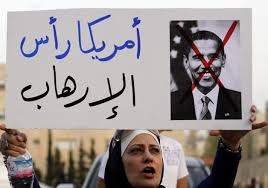
Sign: US leads terrorism (Raad Adayleh)
I am a Palestinian from the Bethlehem area but who also happens to hold a US passport. The latter does not allow me to enter Jerusalem and the US government will not protect this or other rights I have (including family reunification). Meanwhile, any Jewish American can come and get automatic citizenship and live on stolen Palestinian land in our city. It is hard to describe the level of frustration that I had watching the theater of media frenzy (devoid of any real substance) about Obama’s visit.
Obama gave a new lifeline to war and conflict by avoiding human rights and international law. It is the missing ingredient that for the past 65 years precluded peaceful resolution. It is the twisted logic that says the insecurity of the thief must be the only thing to be dealt with by ensuring the victims first recognize the legitimacy of the theft and the legitimacy of the need for the thief to first have full security and immunity from accountability for the theft before the victim is put in the room with the armed thief so that they can work out something (vague and without reference to International law). That formula has been shown to be a disaster and has kept Apartheid and colonization going. Israel has no incentive to allow a Palestinian sovereign state let alone redress the injustice (e.g. refugees, theft of land and resources etc) as long as it continues to get an unconditional check from our tax monies and guaranteed vetoes by the US at the UN protecting it from International law. This plus over $12 billion in profits from the occupation of the West Bank and Gaza (captive market, natural resources etc.) ensures the occupation continues. But the Israeli and American governments are thinking short term. Long term, the changing reality (in the Arab world) and demographics in Palestine will ensure change. Obama alluded to this when he told the Israelis that no wall will be tall enough and no iron dome will be strong enough and that peace is imperative. The problem is he failed to follow his own logic and press Israel to change and instead repeated the same failed logic that “bilateral” negotiations between a strong occupier/colonizer and a weak leadership of colonized/occupied people is the way to go.
Below are some of the things that happened during Obama’s short visit. You be the judge of their value or relevance to bringing peace.
Palestinian and American security coordinate to clean streets of any thing that might allude to Palestinain rights (refugee signs, maps of historic Palestine etc). They change all manholes in targeted areas spending millions for excessive “security” for the unwanted visitor to Bethlehem and Ramallah. Palestinian security preemptively arrest dozens and suppress peaceful demonstrations succeeding in isolating Obama from seeing Palestinian anger.
Massive traffic jams, and on the days of visits, an essential siege and curfew on Ramallah area (Thursday) near Al-Muqata and Bethlehem (Friday). The preparations create significant damage to economy and livelihood of tens of thousands of Palestinians.
Selected choreographed visits by Obama to Hertzl’s and Rabin’s tombs (the former who called for ethnic cleansing, the latter who executed it) but not to Yasser Arafat’s tomb.
American flags placed by the Palestinian Authority (PA) along the streets removed by Palestinian activists. PA security officials suppress demonstrations and prevent activists from getting near Obama. At a Ramallah demonstration, PA security dressed in civilian cloths attack demonstrators.
Obama calls on Palestinian officials to resume bilateral negotiations that led to nowhere in the past 20 years, to accept Israel as a “Jewish state”, and not to seek implementation of International law via International bodies like the UN or the International Court of Justice. Perhaps not coincidentally, the Palestinian mission in Geneva has put out mild drafts that do not take advantage of the strong findings of the UN Human Rights Council (see item link below).
Obama brokers a deal by pressuring Turkey to accept a tepid Israeli statement of regret for the deaths of Turkish citizens with some compensation for families and restoring Turkish-Israeli strategic relations (presumably including military cooperation). Turkish demands for lifting the siege on Gaza are dropped.
Obama, like his predecessors, identified Hizballah, Syria, and Iran as a dark axis of evil while Israel as a perfect model of democracy and beauty.
Obama in his speeches adopts the Zionist myths that Apartheid Israel is redemptive and that it is the guarantee against another holocaust (it is actually the reverse). Obama fails to mention that this “great and technologically advanced country” is actually built on top of Palestine and by destroying 530 villages and towns and by looting property and patrimony of millions of Palestinians.
Obama will send John Kerry to try and restart the “Palestinian-Israeli negotiations.”
Obama defines what we Palestinians want (supposedly a vague “viable state”) even though for most of us, we want to return to our homes and lands and freedom from racism and apartheid.
Obama will give Jordan $200 million to help Syrian Refugees.
Obama reminds the Israelis that his administration developed unprecedented support to the apartheid state of Israel especially in the field of security.
Obama highlighted the Iron Dome system and praised it, but now documented data show that they are less than 30% effective as opposed to the government insistence that they had 90% success).
Obama claimed the West Bank is in good shape because of Abbas and Fayyad and compared to Gaza which he claimed is miserable under rejectionist Hamas.
What Obama and his large entourage fail to mention during this supposed “historic visit”: human rights, international law, the tenth anniversary of the murder of US Citizen Rachel Corrie, Palestinian rights and security, justice, land confiscation, apartheid laws, illegality of settlements, US opposition to Palestine joining the UN, applicability of the Fourth Geneva Convention, how much taxpayer money is given to Israel, the siege on Gaza, the freedom of movement, the attack on US citizens’ rights by Israel….
Related article
- Peace Fraud: Obama Fails to Demand Halt to Illegal Settlements (alethonews.wordpress.com)
Peace Fraud: Obama Fails to Demand Halt to Illegal Settlements
By Stuart Littlewood | Palestine Chronicle | March 22, 2013
Miko Peled doesn’t mince words: “The Israeli-Palestinian issue is, politically, a toxic wasteland that no US president in his right mind would want to clean up. It has become a vicious cycle of deceit and double standards, and it will contaminate any US politician who tries to clean it up.”
And one after another, they run away from the challenge.
And so it has been with Obama. This week the world’s greatest peace fraud came to the Holy Land and funked it. Frankly, if that’s the best he can do after four years in the job he has no business calling himself a world leader.
But I don’t necessarily agree with Peled’s remark. Any US president who fails to drain the stinking swamp in his backyard – i.e. the AIPAC breeding ground – deserves to be consigned to the wastepaper basket of history as a political pansy.
The president who ruthlessly cleans up, however, would be revered big-time.
Take the Hagel confirmation fiasco. Here in the UK we watched with bewilderment and disbelief. Of course, it’s easy to criticize from this distance, but remember that we too have a Zio-infestation at the heart of government.
At the hearing Hagel appeared flat-footed and unprepared for obvious questions. Even if it was expedient to play the Zionist lackey he needn’t have come across quite so wimpish. The public don’t necessarily understand such chicanery. Even if they did, the spectacle of belly-crawling is disgusting. Who could blame them for wondering what sort of impression Hagel was likely to create in the diplomatic drawing rooms of the world?
A more robust plan would have sent in a stalking-horse, specially trained by George Galloway (and suitably compensated) to swat the Inquisitorial bar-flies for the threat to US interests that they are. This sacrificial candidate’s fate would be crucifixion and rejection, but the process would have electrified the media, American voters and world audiences… and inflicted serious damage on the Zio-lobby’s hirelings. With their fangs drawn and venom spent, Obama could then have put forward his ‘real’ candidate with dignity.
As it was, the lack of steel is now indelibly etched on everyone’s memory in the US and abroad.
Miko Peled is a remarkable Israeli Jew, the son of an Israeli general and himself a former soldier in the Israeli army. He calls the IDF “one of the best trained and best equipped and best fed terrorist organization in the world”. In this fascinating talk he explains: “The name of the game: erasing Palestine, getting rid of the people and de-Arabizing the country… When people talk about the possibility of Israel somehow giving up the West Bank for a Palestinian state, if it wasn’t so sad it would be funny. It shows a complete misunderstanding of the objective of Zionism and the Zionist state.”
You couldn’t find a more authentic insider source. He confirms what many have known and been saying for years.
And in this excellent Crosstalk program, ‘Obama’s Israel Trip’, Norman Finkelstein and Mouin Rabbani strip away the arrant nonsense politicians use to conceal the truth of what’s happening in the Holy Land . Answering the question “Why is Obama going to the Middle East now and what does he want to achieve?”, here are some of their comments…
Rabbani begins by saying the peace process is not on the agenda. The Israeli government, post-election, is too new to have any serious discussion. In the past the Palestinian leadership has favored talks simply as a distraction from the awful situation on the ground. But now things are so dire that renewed talks might pose more of a threat that an opportunity to the leadership.
Finkelstein maintains there is no reason why Obama would wish to talk about a peace process that interferes with “the serious work” of annexing the West Bank. In any case the Palestinian people have been “pacified” and the Palestinian Authority can’t do anything without US permission.
There never was a peace process, he says, it has always been an annexation process and right now there are no restraints, no inhibitions on Israel’s pursuit of this.
“Internationalize” the Palestine Question
Finkelstein points to the shift in public opinion against Israel in recent years. But two inhibiting factors remain – (1) the US government and its vetoes at the UN, and (2) the Palestinians themselves, who are in no frame of mind to organize mass disobedience and resistance, which in Finkelstein’s view is “the only thing that can possibly force Israel to withdraw”. It is up to the Palestinians, he suggests, to mobilize these forces and to trigger the worldwide support movements. A combination of mass resistance by the Palestinian people in concert with support from the United Nations, the international community and public opinion, is the only likely solution. It would isolate the US and force an Israeli withdrawal. This prospect becomes more real as Israel’s credibility dwindles.
Finkelstein is of the opinion that the sham peace process – “political theatre” as he calls it – has poisoned and confused the minds of normally intelligent people.
Rabbani feels that the Palestinian leadership should disengage from the meaningless diplomacy sponsored by the US and move towards an “internationalization” of the question and solve it on the basis of international consensus.
The video ought to be compulsory viewing for those who still harp on about restarting ‘peace talks’.
On the ground the Palestinians’ President Abbas was reported to have signaled a willingness to return to peace talks if Israel agreed to an “unannounced ” (i.e. secret) settlement freeze during the period of negotiations. At the same time the democratically elected prime minister of Gaza, Ismail Haniyeh, who perversely is not invited to meet Obama because he’s the wrong flavor (Hamas), declared: “We believe American policies perpetuate the Israeli occupation and settlements in Palestine under a slogan of peace.”
Another Hamas spokesman, Dr. Sami Zuhri, said that Obama’s renewed commitment to Israel’s security while ignoring the Palestinians’ sufferings affirmed his country’s blind support for Israel. This exposed as nonsense any idea that America could play a positive role in the region. He urged an end to security co-ordination between the Palestinian Authority in Ramallah and the Israeli occupation.
Respected Palestinian writer Khalid Amayreh remarked that Obama was expected to cajole the weak and pliant Palestinian leadership of Mahmoud Abbas to give “peace” another chance by returning to futile negotiations with Israel while the latter continued to steal more Palestinian land and build more Jewish colonies for fanatical Jewish settlers.
What Actually Happened When Obama Arrived?
As soon as he touched down, Obama was gushing. “Why does the United States stand so strongly, so firmly with the State of Israel?” he asked. “The answer is simple. We stand together because we share a common story — patriots determined to be a free people in our land, pioneers who forged a nation.”
Somehow, I doubt if ordinary Americans would wish to be compared to the invading Zionist thugs who drove the Palestinians off their lands, bulldozed their homes and cruelly imprisoned those that have remained in the shredded remnants of their territory for the last 65 years – and did it with $billions squeezed from taxpaying Americans.
According to Ma’an News earlier today, Obama did finally say something about Israel’s settlements. “One of the challenges has been continued settlement activity in the West Bank area, and I’ve been clear with Prime Minister Netanyahu and other Israeli leadership that it has been United States policy not just in my administration but all preceding administrations that we do not consider continued settlement activity to be constructive, to be appropriate, to be something that can advance the cause of peace. So I don’t think there’s been any confusion about what our position is.”
Settlements are illegal, nothing less, and Obama needs to remind Netanyahu (and himself) of that fact. There remains considerable confusion over the US position especially since Reuters reported that Obama stopped short of calling for a halt to settlement expansion and offered no new ideas on how to get the two sides negotiating again. “If the expectation is we can only have direct negotiations when everything is settled ahead of time, then there’s no point in the negotiations,” he said.
No point at all, Mr. Obama. Most of it was settled long ago by international law and a raft of UN resolutions. Upholding those rulings is, of course, a precondition to any negotiation.
Why insist on more ‘negotiations without preconditions’ unless it’s to buy Israel time to complete its illegal annexation?
– Stuart Littlewood’s book Radio Free Palestine, with Foreword by Jeff Halper, can now be read on the internet by visiting http://www.radiofreepalestine.org.uk.
The Road to Bethlehem: Obama’s Commute and the Palestinians’
By Fadi Abu Saada | Al Akhbar | March 22, 2013
Bethlehem – On Thursday, 21 March 2013, US President Barack Obama traveled from Jerusalem to the occupied West Bank town of Bethlehem. He entered the city through its northern entrance along the road Israelis call Route 300.
After all checkpoints had been opened and the roads were cleared of people, Obama’s trip took only a few minutes. However, the Palestinians do not enjoy such luxuries; this route is off-limits and access would necessitate a special permit from the occupation authorities.
If Obama wanted to arrive in Bethlehem via Ramallah, then his journey would not have taken him longer than 25 minutes, if not less. But what do Palestinians’ trips to Bethlehem from Ramallah look like?
Atef Louwais works in Ramallah and lives in Bethlehem. He told Al-Akhbar that he leaves his home every day at 6:30 am to catch a taxi to Ramallah, in the hope that he can get to work by 8 am.
After getting a taxi downtown, he makes his first mandatory stop at the Israeli “Container” military checkpoint at the southeastern entrance to the city.
If Israeli soldiers are in a good mood, they do not hold Louwais for very long, and let him continue his journey through the dangerous road known as Wadi al-Nar, which means valley of fire in Arabic. From there, he arrives at the town of Azarieh (Bethany) on the outskirts of occupied Jerusalem.
This takes him close to the Israeli settlement of Ma’ale Adumim, where Israeli border police vehicles often patrol the adjoining area. Louwais said that these patrols, which the Palestinians call “flying checkpoints,” are the real nightmare for commuters. The occupation soldiers habitually detain passengers, sometimes under the pretext of an ID or car registration check.
Next, according to Saed Abdallah, Atef’s commuting companion, “We head along the route known as the quarry road until we reach the Palestinian village of Hazma. We then take a bypass road around occupied Jerusalem. During that leg of the trip, we get to see the progression of the settlements devouring the lands in and around Jerusalem.”
“If we manage to cross the Jabba checkpoint, we walk a few minutes before reaching the Qalandiya crossing. But there, we will meet with another disaster: the massive traffic jam that comes with the arrival of thousands of commuters every morning and evening, all under the eyes of the occupation soldiers who enjoy torturing and humiliating the Palestinians.”
This is the arduous journey that Palestinian commuters must make every day. The return trip is even more difficult, and might take up to two hours, if not more. Perhaps Obama, who was met with red carpets and empty roads on his arrival, does not know these details. But even if he did, would he care?
A Zionist Friendly, Right-wing Texan Islamist to Lead Syria?
By Franklin Lamb | Al-Manar | March 22, 2013
A draft-dodging, Zionist friendly, right-wing Texan Islamist to lead Syria? Could the White House have dreamt for more?
Damascus – For the past year, a plan C or D, depending on how one numbers the failed “sure-fire” US-Israel projects in Syria was badly needed. And this week, according to Congressional staffers, both Tel Aviv and the White House are pinching themselves in disbelief over their good luck with installing republican leaning conservative Dixie businessman, the congenial, Ghassan Hitto, as Syria’s new interim Prime Minister.
Ghassan HittoSecuring the key position for Mr. Hitto, a decision made last year, was not easy and had to be approached gingerly. But finally, after weeks of sometimes intense debate within Syrian opposition circles, Washington, Ankara, Doha and Tel Aviv among others managed to appoint their preferred guy. “Hitto was the best of a bad lot”, one Congressional committee source, whose work load includes Syria, explained. “Bottom line, he’s an American, nearly thirty years here makes Ghassan one of us. And who cares if he came here as a teenage to dodge military service in Syria. We can count of him!”
And just as some Americans were beginning to believe that our government may be afflicted with a congenital incapacity to learn from our past mistakes, installing Hitto, “should keep hope alive and we should not give up”, according to our Ambassador in Beirut, Maury Connelly. “Look what we achieved in Libya” she lectured a visiting delegation recently. After the meeting, one participant deadpanned, “Good lord! If that woman had not been Jeff Feltman’s office favorite for whatever reason, she might still be serving coffee to State Department visitors at 2201 C St NW, Washington, DC!” Having quoted that snide comment, Maury is reputed to be a lovely lady. Just ask her frequent visitor, Samir Geagea of the Lebanese Forces, who is reputed to be her special confidant these days.
One recalls how Washington installed nearly one dozen Libyan ex-pats during the uprising just as the NATO no-fly zone was being launched. Most of them knew foreign countries better than their birth country and some needed to get their hands on a US supplied “non-lethal weapon” i.e. a GPS and a National Geographic map to find the places in west Libya which they were meant to govern.
Mr. Hitto solves a few immediate Syria problems for the White House. Or so they are hoping.
At minimum Hitto will be an American ‘potted plant’ who can be recognized and around whom NATO can corral and implant some of the desperate factions. He appears willing to take orders and is now involved in a crash-course to learn what he needs to know about Syria and the unfolding game plan. One congressional aide who helped vet Mr. Hitto claims he has “spunk and can be tough. And we think he will play ball.”
One proposal that Hitto has reportedly agreed to is the Dennis Ross/AIPAC proposal for a “political isolation law.” If adopted by the Hitto provisional government, this decree would ban nearly the whole ruling class in Syria from having any role in government. Its intention is to eliminate anyone who worked with either the Hafez or Bashar Assad regime from 1970 until today. “We need a clean break in Syria”, Ross reportedly told fellow conferees at the recent AIPAC convention.
Washington also encouraged Hitto to reject dialogue with the Government of Syria because neocons in Congress are insisting that “negotiations” with the Assad government will drag on interminably and allow the current regime to eradicate pockets of resistance and bring in more help from Russia and Iran.” Citing negotiations with Iran, Arizona Senator John McCain recently told Fox News that “if you try to negotiate with these people (Iran’s government) you will lose. And we did. We need action!” Some in Congress are telling the White House that the same is true with the Syrian government and it appears Mr. Hitto agrees.
The staffer also pointed out that “there has been a misreading of John Kerry’s recent position and that it does not reflect a notable change in the American position nor does it represent a step back from the statements that Barack Obama had made concerning the need for Al-Assad to step down. Obama and Hitto are on the same page.”
No sooner than Grassan Hitto was delegated than two insatiable US Senate war-mongers, Sen. John McCain (R-Ariz.) and Sen. Lindsey Graham (R-S.C.) used the occasion of conflicting and unconfirmed reports of chemical weapons being used in Syria by increasing pressure on President Barack Obama to approve U.S. military involvement in Syria.
“That should include the provision of arms to vetted Syrian opposition groups, targeted strikes against Assad’s aircraft and Scud missile batteries on the ground, and the establishment of safe zones inside Syria to protect civilians and opposition groups,” the senators continued in their statement. “If today’s reports are substantiated, the tragic irony will be that these are the exact same actions that could have prevented the use of weapons of mass destruction in Syria.” Graham went even further and seemed to endorse a plan to put the label “U.S.” on the group in Syria during an interview recently with Foreign Policy. Graham said “We need a real partner in Syria.” In Ghassan Hitto, he and John McClain just may have one.
Washington and Tel Aviv see in their choice of Mr. Hitto, as a likely solution to numerous barriers to their goals in Syria for the following reasons.
They believe that Mr. Hitto can help end the infighting among the opposition to the current regime that has caused a stalemate. While Hitto is no Mohammad Morsi he does lean toward the Muslim Brotherhood and they supported him while knowing he was Washington’s choice. Hitto, some in Washington believe, can help neutralize them. The White House has reportedly told the EU that “the CIA recommended Hitto in order to preempt the crazies in this circus and Hitto can, as much as other prospects help with the formation of a US backed international bloc to get rid of Salafist groups in Syria.”
The in-depth US training of Ghassan has begun. An ‘advisory team’ is already appointed to indoctrinate him with the ‘message’ and he is being given an intensive cram course of what to do and what pitfalls to avoid. He will be expected to learn from missteps in Libya, Egypt and Iraq.
Ghassan has already been clued that if he wants to achieve more than to be Syria’s First “Interim” Prime Minister he will need to be a quick learner, able to adapt fast to the “manual”, mindful student, and above all, a team player. “We aren’t looking for another Hugo Chavez around here”, Ghassan was told recently in Istanbul, shortly before announcing his candidacy.
Hitto’s CIA handlers gave him the script and he read it well. In his first public address he deadpanned that he recognized the very difficult task that lies ahead for his administration. He has pledged to provide the services that many Syrians are lacking. He has also promised free and fair elections in a post-Assad regime Syria.
John Kerry says he is ready to work with Hitto. Kerry told members of Congress two years ago that he connected with and respects Bahar al-Assad and that “we can deal with him like we deal with the Canadians” he once told ultra Zionist Congressman Barney Frank. In private Kerry told staff members on the Senate Foreign Relations Committee, “I like this guy Bashar and we can trust him much more than the Israelis. He’s good.” Having changed his tune, some are wondering how firm his support is for Mr. Hitto.
And he is reportedly eager for both and ready to get started. Earlier this week while giving a speech in Istanbul, he insisted that his priority was to utilize “all conceivable means” to topple President Bashar al-Assad and provide desperately-needed aid to the beleaguered people of Syria.” Washington understands that providing “desperately-needed aid” will soon include weapons.
Still, the White House and Tel Aviv know that it will be a daunting task building legitimacy for Hitto’s fledgling administration, because he is lacking the support of many high-profile members of his own coalition. He was voted in by 35 of the 49 coalition members who cast ballots, but another 15 members were not present, some bought off with cash and with several walking out in protest at Mr Hitto’s perceived links to the Muslim Brotherhood and its backers in Qatar.
“I have backed the idea of an alternative government for a long time,” said veteran opposition figure Haitham al-Maleh. “But I put my ballot in without a name because there were no candidates from inside Syria. I want a prime minister from inside Syria.” “The proposed government is controlled by the Muslim Brotherhood and the Qatar government,” one coalition member, Mr al-Labwani said. “We will be against this government and will not give it legality. Democracy is from the land and from the people not from a council that is composed by the governments of America and Qatar.”
According to a staffer in Kerry’s former Senate Foreign Relations Committee “Many Syrians, regard our appointment of Hitto with suspicion. Since the announcement, I have heard both Syrian nationalist figures and those from some minority communities criticize our move.”
It appears Washington, Doha and Tel Aviv have got their man in place.
What the Syrian people will think of their selection will likely be known soon.
Franklin Lamb is doing research in Syria and can be reached c/o fplamb@gmail.com
Featured Video

EUROPE FEARS RUSSIA’S NEXT MOVE / Ian Proud
or go to
Aletho News Archives – Video-Images
New Book
New Book: No Autoimmunity The Body Doesn’t Attack Itself
Lies are Unbekoming | September 24, 2026
 The label for Humira, once the best-selling drug in the world, lists its risks in plain print. One of them, in the label’s own words, is new “autoimmune” disease.
A drug prescribed for a condition labelled autoimmune carries a warning that it can cause a condition labelled autoimmune. That contradiction sits in every box, on a folded paper almost nobody reads.
My new book starts there.
No Autoimmunity: The Body Doesn’t Attack Itself
For seventy years, “your body is attacking itself, and we don’t know why” has ended the conversation for people diagnosed with multiple sclerosis, lupus, rheumatoid arthritis, Hashimoto’s, Type 1 diabetes, Crohn’s and psoriasis. More than eighty conditions now carry the autoimmune label. The diagnosis comes with a prescription for life. It almost never comes with a question about cause.
This book asks the question and answers it from the framework’s own records: its drug labels, its journals, its regulatory filings, and its own experiments. … continue
Blog Roll
 Aletho News
- Britain’s elites want you ready to die for a war they keep imagining
- Inside Ukraine’s propaganda operation targeting Americans
- Hackers From US, France, Singapore Tried to Disrupt Russian Elections – Internet Provider
- New Book: No Autoimmunity The Body Doesn’t Attack Itself
- EUROPE FEARS RUSSIA’S NEXT MOVE / Ian Proud
- Big tech hands in its DSA censorship reports to the EU
- ‘A Big Victory’ – Palestine Chronicle Wins Two-Year Legal Battle
- IAEA inspectors cannot return to Iran amid US threats: Russia
- Senate Rejects Iran War Powers Resolution Passed By House
- ‘We did not attack Pakistan with drones’: Afghan sources
- If Americans Knew
- ‘This is where I live now, the back of a truck’: a day in the life of a grandmother in Gaza
- In UN Speech, Iran’s President Displays Pictures of Children Killed by US, Brings Attention to Israel’s Nuclear Arsenal
- Israel displaces hundreds of Palestinians amid wave of demolitions in West Bank
- Aid, reconstruction, and Israel’s history of obstruction in Gaza
- Trump administration digs an ever-deeper hole of complicity in genocide – Daily Update
- US-Israel $2.8 Billion Arms Deal, 40,000-Bomb Supply Faces New Gaza Complicity Accusations
- Caught on Tape: AIPAC CEO Boasted of Controlling Trump’s National Security Officials
- Why Hamas Attacked Israel in October 2023 – Israeli professor Ilan Pappé
- They see them, then kill them: Israeli quadcopters track, deliberately target civilians in Gaza
- Winter could turn Gaza’s treacherous, war-damaged buildings into deathtraps
- No Tricks Zone
- New Study: Earth And Venus Surface Warmth Largely Explained By Convection And Lapse Rate, Not CO2 Or Radiation
- 2025 Nature Paper Claiming Worsening Global Drought Gets RETRACTED …Heavily Flawed
- New Study: ‘Global Drought Shows No Detectable Recent Acceleration Under Climate Warming’
- Economic Masterminds: German Socialists Suggest Taxing Productivity Gains Stemming From Using AI
- The South China Sea Has Not Been Cooperating With The Climate Change Narrative
- Energy Crisis: Germany Enters Heating Season With Historically Low Gas Reserve Fill Levels
- New Study: The Antarctic Ice Sheet Gained Mass From 2020-2024 Due To Staggering Snow And Ice Accumulation
- Study: Ocean Heating Rates From Thousands Of Years Ago ‘Dwarf’ Modern Ocean Heating Rates
- Climate Extremists Target, Attack Large-Scale Power Grid Infrastructure In Germany!
- New Study: Antarctic Ice Melt Has Contributed Less Than 1 Centimeter To Sea Level Rise In The Last 30 Years

