Israeli forces surround new ‘village’
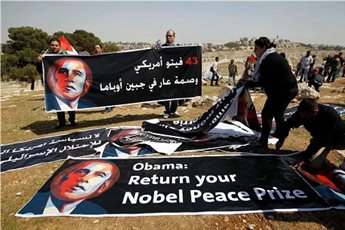
Ma’an – 21/03/2013
BETHLEHEM – Israeli forces on Wednesday surrounded a new tent village erected by Palestinian activists in Eizariya east of Jerusalem.
An Israeli military spokeswoman said hundreds of Palestinians established “an illegal settlement” and that security forces were in the area “to maintain order.”
She said soldiers arrested the driver of a truck loaded with equipment including tents.
Mohammad Khatib, a spokesman for the activists, said soldiers handed protesters a document declaring the area a closed military zone.
“We are staying. We are Palestinians, and we will stay here. They will have to evacuate us. They will have to use their power to do it, but we will not do it by ourselves,” Khatib told Ma’an.
“We are staying here because this is Palestinian land. This is our land, and no one has a right to evacuate us.”
As US President Barack Obama arrived in Israel, activists set up 15 tents on a hillside near the site of the Bab al-Shams protest village that Israeli forces tore down in January.
They have named the new neighborhood Ahfad Younis, after the main character in the novel Bab al-Shams.
In a statement, the activists described the initiative as “first, to claim our right as Palestinians to return to our lands and villages, second, to claim our sovereignty over our lands without permission from anyone.”
The activists said it aimed to highlight their opposition to the Obama administration’s policies in the region, saying that it has been “complicit in Israeli occupation and colonialism.”
“An administration that used the veto 43 times … in support of Israel and against Palestinian rights, an administration that grants military aid to Israel of over three billion dollars annually, can’t have any positive contribution to achieve justice,” the statement said.
Related article
- Palestinians erect new ‘village’ as Obama lands in Israel (alethonews.wordpress.com)
British anti-war activists blockade weapons manufacturing company

Press TV – March 20, 2013
British anti-war activists have sealed off a weapons manufacturing company in Brighton to mark 10 years after the UK government joined the U.S.-led invasion on Iraq on March 2003.
The protesters, who had gathered in front of the EDO MBM weapons manufacturing plant from dawn, fastened themselves to the front gates with superglue and bicycle locks.
Two arrests were made by police forces during the six-hour standoff, but the whole gathering continued without violence, according to British media reports.
The anti-war activists from Smash EDO lashed out at engineers of the factory for churning out millions of pounds worth of bomb racks, arming units and parts for aircraft weapon systems every year.
EDO MBM is one of several companies supplying Paveway missiles used in Iraq and Afghanistan, as well as a component for U.S. planes carrying cluster bombs banned under an international treaty signed by Britain in 2008.
Smash EDO’s Chloe Marsh described the day’s protest as a memorial to Iraq’s dead as well as a direct action.
“The case for war was put to people in the UK on the basis of an immediate threat from Iraqi ‘weapons of mass destruction.’
“This turned out, as expected, to be a lie. As a result, according to the Lancet, over a million Iraqi citizens have died.”
Fellow protester Andrew Beckett said: “We are here to commemorate those who died in the aerial bombardment of Iraq and to resist EDO MBM’s continued supply of components to the US/UK military.”
Related article
- Iraq: Decade of war ‘based on lies’ (morningstaronline.co.uk)
Palestinians erect new ‘village’ as Obama lands in Israel
Ma’an – 20/03/2013
BETHLEHEM – Palestinians on Wednesday erected a new “village” encampment in Eizariya to stake their sovereignty and claims to return to their towns and villages.
Activists said they set up 15 tents on a hillside near the original “Bab al-Shams” village that Israeli forces tore down two months earlier.
In a statement, the activists described the initiative as “first, to claim our right as Palestinians to return to our lands and villages, second, to claim our sovereignty over our lands without permission from anyone.”
The action coincided with US President Barack Obama’s arrival at Ben Gurion International Airport.
The activists said it aimed to highlight their opposition to the Obama administration’s policies in the region, saying in the statement that it has been “complicit in Israeli occupation and colonialism.”
“An administration that used the veto 43 times … in support of Israel and against Palestinian rights, an administration that grants military aid to Israel of over three billion dollars annually, can’t have any positive contribution to achieve justice,” the statement said.
Related article
- PressTV: Palestinians trample on Obama banner ahead of visit (jhaines6.wordpress.com)
Briefing: Beyond the E-1 Israeli settlement
IRIN | March 18, 2013
JERUSALEM – Last month, an international fact-finding mission on Israeli settlements in the Occupied Palestinian Territory (OPT) commissioned by the UN Human Rights Council found that settlements constituted a violation of international human rights and humanitarian law and called on Israel to stop all expansions immediately and withdraw from settlements.
A controversial Israeli plan, known as E-1, to build thousands of housing units and hotel rooms near the Ma’ale Adummim settlement, has garnered much attention in the media because it would sever Palestinian East Jerusalem from the rest of the West Bank. (See IRIN’s briefing on E-1 here.)
But at the same time, Israel has been moving forward with equally controversial settlement plans under less scrutiny and with unusual speed.
As US President Barack Obama prepares to visit the region this week, IRIN takes a look at some of the details that have been overlooked in the discussion.
What’s the Giv’at HaMatos plan?
According to Israeli NGO Ir Amim (“City of Nations”), which works to preserve Jerusalem as a home for both Jews and Palestinians, one settlement plan of “critical importance” is Giv’at HaMatos.
In a sense, Giv’at HaMatos does in the south what E-1 does in the east. The planned large housing and hotel complex at the southern perimeter of Jerusalem would further disrupt the contiguity of land between East Jerusalem and the rest of the West Bank required for a future Palestinian state, seriously impeding a two-state solution, research and rights groups say. It would also mark the first new settlement construction in Jerusalem since 1997.
“All construction is problematic but there are several plans that are, in our view, more dangerous if implemented,” Hagit Ofran, director of the Settlement Watch project at the Israeli NGO Peace Now, told IRIN. “Giv’at HaMatos is the most dangerous plan that is now approved.”
Part of the plan – to build 2,612 units – was approved by the Jerusalem Regional Planning Committee on 19 December.
Most of Giv’at HaMatos is currently uninhabited, but according to the International Crisis Group (ICG), which recently released a two-part report on the future of East Jerusalem, its build-up would cut off Arab neighbourhoods in southern Jerusalem, like Beit Safafa and Sharafat, rendering them “Palestinian enclaves”.
Giv’at HaMatos would connect the dots of several other planned or expanding settlements along southern Jerusalem – including Giv’at Yael in the southwest; and Har Homa and East Talpiyot in the southeast – forming “a long Jewish continuum severing Bethlehem’s urban continuum from Palestinian Jerusalem”, ICG said. Last year, the Israeli government also approved more than 2,000 new units in neighbouring Gilo.
This kind of attachment to Jewish expansions could make peace negotiations even harder.
“From an Israeli public opinion perspective, Giv’at HaMatos is in the municipal border of Jerusalem,” Ofran said. “It’s considered a legitimate part of Israel.”
Barak Cohen, the Jerusalem Municipality’s adviser for foreign affairs and media, told IRIN Giv’at HaMatos is part of Jerusalem’s “natural and much-needed growth”, allowing both Arab and Jewish landowners to develop their properties.
Indeed, part of the Giv’at HaMatos plan, approved on 18 December, allows for the building of 549 units for Palestinians – though Betty Herschman, director of international relations and advocacy at Ir Amim, points out much of it retroactively legalizes building that has already been completed. The figures, she added, amount to just over one-fifth of the Jewish expansion.
“For many Arab East Jerusalemites, the battle for their city is all but lost.”
Still, Cohen insisted, the development would benefit Jerusalem as a whole: “Not planning and developing Jerusalem neighbourhoods ultimately harms all residents and landowners – Arabs and Jews alike.”
Last year, Israel also issued tenders for the construction of 606 new housing units north of East Jerusalem, in the Ramot settlement, just north of the Green Line marking the border between Israel and the West Bank, and approved another 1,500 units in the neighbouring settlement of Ramot Shlomo, according to Ir Amim.
What other settlements are planned?
Beyond Jerusalem, there was movement on a number of other settlements projects in disputed areas, according to Settlement Watch.
In June 2012, the Israeli government announced it would build 851 new units in the West Bank, including more than 230 in the controversial settlements of Ariel and Efrat. Like Giv’at HaMatos, these two settlements make a contiguous Palestinian territory impossible, Settlement Watch says.
Overall, settlements expanded much faster than usual last year.
In 2012 the Israeli government approved the construction of 6,676 settler housing units in the West Bank, compared with 1,607 in 2011 and several hundred in 2010, according to Peace Now.
For plans that were already approved, it issued more than 3,000 tenders to construction contractors – more than any other year in the last decade, Peace Now said. Construction has actually begun on 1,747 homes.
Regardless of the settlements, Palestinians, especially in Area C, are under immense pressure. Recent weeks have seen a considerable upswing in demolitions of Palestinian structures. According to the Displacement Working Group, a grouping of aid agencies helping displaced families, Israeli forces destroyed 139 Palestinian structures, including 59 homes, in January – almost triple 2012’s monthly average. The demolitions occurred in East Jerusalem and the West Bank – with a majority taking place in Area C – and left 251 Palestinians, including over 150 children, displaced.
The office of the Coordinator of Government Activities in the (Palestinian) Territories (COGAT) told IRIN there was no connection between the removal of unauthorized buildings and the construction of Israeli settlements. “All construction in the West Bank is subject to building codes and planning laws and unauthorized constructions are dealt with accordingly,” the office said in an email.
What are the knock-on effects?
Settlements are often discussed through the lens of their illegality under international law or as obstacles to a peace agreement between Israel and the Palestinians. But everything associated with the settlements – including Israeli-only infrastructure, the separation barrier, military checkpoints, restrictions on Palestinian freedom of movement, suppression of freedom of expression and political life, and control of Palestinian natural resources – causes a ripple effect through Palestinian society, adversely impacting the people.
The UN estimates there are now 520,000 Israeli settlers in East Jerusalem and the West Bank, with 43 percent of the land there allocated to local and regional settlement councils. According to the UN Secretary-General, Israel has transferred roughly 8 percent of its citizens into OPT since the 1970s, altering the demographic composition of the territory and furthering the Palestinian people from their right to self-determination.
Baker, of the Israeli Prime Minister’s Office, said a future Palestinian state should include a Jewish minority. “The assumption behind this… is that Jews have no right to live in the West Bank, an assumption that we reject. In fact we see ourselves as the true indigenous people of this land.”
But Israeli settlements have violated Palestinian rights to equality under the law, to religious freedom and to freedom of movement, according to the UN fact-finding mission. They have also eroded Palestinian access to water and to agricultural assets, and the ability to develop economically, it said.
 Photo: OCHA – View larger version of map here
For example, Bedouins from the Palestinian village of Khan Al Ahmar, northeast of E-1, cannot sell their dairy products at their traditional Souq Al Ahmar market any more. Because of movement restrictions (they hold West Bank IDs and lack the proper permits to enter East Jerusalem), they cannot get there.
The UN secretary-general has said that Palestinians “have virtually no control” over the water resources in the West Bank, with 86 percent of the Jordan Valley and the Dead Sea under the de facto jurisdiction of the settlement regional councils.
There is a statistical correlation between Palestinians’ proximity to settlements and their rates of food insecurity, according to a UN and government survey, which found that one quarter of Palestinians who live in Area C, home to the largest number of settlements in the West Bank, are food insecure. In Areas A and B, the average rate of food insecurity is 17 percent.
In addition, “all spheres of Palestinian life are being significantly affected by a minority of settlers who are engaged in violence and intimidation with the aim of forcing Palestinians off their land,” the mission said.
Operation Dove, an international organization working in the Palestinian village of At-Tuwani and the South Hebron Hills, reported that Palestinian children have a very hard time going to school due to settler attacks.
The UN and rights groups say radical settlers use violence against Palestinians with impunity and their illegal outposts are often recognized and retroactively legalized by the government.
Since the occupation began, Israel has detained hundreds of thousands of Palestinians, some of them without charge, and some of them children. Most of the minors are arrested “at friction points, such as a village near a settlement or a road used by the army or settlers”, the fact-finding mission said.
Israel uses what they term “administrative detention” when it considers the detainee a threat to the security of the state.
Ir Amim’s Herschman says Israel is also attempting to create a “greater Jerusalem” through additional means, for example: the Israeli separation barrier, planned national parks, and the construction of highways dividing villages, dispossessing Palestinians of their land and making it harder for them to access services like schools and mosques.
In recent weeks, residents of the Palestinian village of Beit Safafa have been protesting against the planned extension of the Begin Highway that would divide their village in order to connect major Israeli settlement blocks outside the city to Jerusalem.
The planned root of the separation barrier, in addition to a potential national park around the perimeter of the barrier would also close off nearby Palestinian village al-Wallajeh.
The planned route of the barrier extends all the way around and far beyond Muale Adummim and in other areas south and north of Jerusalem. “These lines are a unilateral declaration of a much greater Jerusalem, a unilateral expanding of the boundaries, an exponential increase,” she told IRIN.
Or as the ICG put it, “for many Arab East Jerusalemites, the battle for their city is all but lost.”
Israel releases hunger striker Sharawneh, arrests his brother
Al-Akhbar | March 18, 2013
Israel arrested the brother of former-Palestinian prisoner Ayman Sharawneh in the West Bank early Monday just hours after the long-term hunger striker was released from Israeli prison and deported to the Gaza Strip, Ma’an News Agency reported.
Israeli forces raided the home of Jihad Sharawneh, 24, at dawn Monday in Deir Samir, southwest of Hebron.
An Israeli military spokesman told Ma’an that Jihad Sharawneh was arrested and taken in for security questioning.
Amjad Najjar, head of the Hebron branch of the Palestinian Prisoners Society, denounced the arrest as an act of revenge to punish the Sharawneh family.
Ayman Sharawneh signed an agreement with Israeli authorities to be deported to Gaza for 10 years, bringing an end to his eight-month-long hunger strike, Qadura Fares, head of the Palestinian Prisoners Society, said in a statement.
He arrived at the Erez crossing Sunday night, where a Palestinian ambulance was waiting to take him into Gaza. Hundreds of people crowded at the Palestinian side of the checkpoint to greet him.
Fares said that Israel had previously proposed to deport Sharawneh outside of Palestine, but then offered to exile him to Gaza after he refused to leave his homeland.
Sharawneh agreed to be deported after months of hunger striking to protest his detention, and after numerous warnings by doctors regarding the severe deterioration in his health, Fares added.
The 36-year-old father of nine had previously demanded that authorities allow him to return to Hebron to be with his family.
The under secretary of the PA Ministry of Detainee Affairs, Ziad Abu Ein, told Ma’an that Sharawneh’s agreement was signed without notifying the ministry.
Earlier Sunday, the Minister of Detainee Affairs Issa Qaraqe said the Palestinian Authority rejected the deportation of prisoners as political blackmail.
Sharawneh was released in the October 2011 prisoner swap deal between Israel and Hamas but was rearrested in January 2012 and accused of violating the terms of his release.
Israeli authorities refused to reveal how Sharawneh violated his release terms, even to his lawyers, and he was jailed without charge or trial.
Israeli prosecutors sought to cancel Sharawneh’s amnesty and jail him for 28 years, the remainder of his previous sentence. He went on hunger strike to demand his release.
Abu Ein said Israeli authorities were pressuring Samer Issawi, who has been on hunger strike for 228 days, to make a similar deal.
(Ma’an, WAFA, Al-Akhbar)
US drones violate Pakistan sovereignty: UN
Press TV | March 15, 2013
A UN team investigating civilian casualties from US assassination drone attacks in Pakistan has stated that the terror airstrikes violate sovereignty of Pakistan.
Ben Emmerson, head of the UN team, said in a statement on Friday that Pakistani government told him at least 400 civilians have been killed in US drone strikes.
The team paid a three-day research trip to Pakistan that ended on Wednesday. The trip was kept secret until the team left the country.
“The position of the government of Pakistan is quite clear. It does not consent to the use of drones by the United States on its territory and it considers this to be a violation of Pakistan’s sovereignty and territorial integrity,” Emmerson said.
The attacks “involve the use of force on the territory of another state without its consent and is therefore a violation of Pakistan’s sovereignty,” he added.
The UN launched an investigation into civilian casualties from drone attacks and other targeted killings in Pakistan in January 2013 and will publish the final report in October.
Pakistani officials have condemned the attacks as violation of the country’s sovereignty.
The London-based Bureau of Investigative Journalism said in a report in February that the United States has carried out more than 360 drone attacks in Pakistan since 2004, killing nearly 3,500 people.
Over the past few months, demonstrations have been held across Pakistan to condemn the United States for violating Pakistan’s sovereignty.
On February 13, hundreds of Pakistani tribesmen held an anti-US demonstration in Islamabad to protest against the killing of innocent civilians by the US drones.
Funding and Denouncing Israeli Occupation: Hypocritical EU Must Make a Stand
By Ramzy Baroud | Palestine Chronicle | March 12 2013
More bad news emerged from Israel in recent weeks. Indeed, good news is seldom associated with Israel and its military occupation and institutionalized discrimination and mistreatment of Palestinians.
But now even those international organizations that are often supportive of Israel’s militancy seem to be joining the consensus that Tel Aviv is on an irrevocably perilous course.
Few international law experts would defend Israel’s fervent settlement-building on occupied Palestinian land.
Yet the Western powers, led by the United States, have brought little pressure to bear on Israel to cease its illegal activities.
In fact, without US and European funding it would have been nearly impossible for Israel to build settlements and transfer over half a million Israelis over the years to live on stolen Palestinian land, in violation of numerous international laws including the Fourth Geneva Convention.
Worse still, trade with European and other countries sustained these illegal settlements, allowing them to flourish at the expense of Palestinians who have suffered massive ethnic cleansing campaigns since 1967.
But at last EU diplomats in east Jerusalem and the West Bank are speaking out in unequivocal terms.
In a report released at the end of last month, the diplomats declared that “settlement construction remains the biggest single threat to the two-state solution. It is systematic, deliberate and provocative.”
The report called on EU states “not to support … research, education and technological co-operation” with settlements and to “discourage” investing in Israeli companies that operate in the occupied territories.
Expectedly, the report is non-binding. And even if such recommendations are considered, Israel and its EU friends and lobbyists are likely to find loopholes that would deprive any EU action of substance and vigor.
Without civil society action focused on turning up the heat on European governments, especially die-hard supporters of Israel such as the British government, business with Israel is most likely to carry on as usual.
Not only is Israel flouting international law but the supposed guardians of international law are the very ones that are empowering Israel in carrying out its illegal acts, disempowering and bankrupting Palestinians.
Last January an Oxfam report said that the Palestinian economy, which is currently in utter disarray, could generate urgently needed income – $1.5 billion to be exact – if Israel eased its restrictions in the Jordan Valley alone.
But without suitable access to their own land and to water sources, Palestinians in the valley continue to struggle while the settlers are thriving.
Although the US government is well known to have done everything in its power to defend Israel at any cost and ensure Israel’s superiority and military edge over all of its neighbors, the EU has falsely acquired a more balanced reputation. Nothing could be further from the truth.
In a recent report the Palestinian rights group al-Haq emphasized that trading in produce grown in settlements had “directly contributed to the growth and viability of settlements by providing an essential source of revenue that allows them to thrive.”
The reported value of total EU trade with illegal Israeli settlements amounts to approximately $300 million a year. This may appear small compared with the $39bn of total trade between the EU and Israel reported in 2011, for example, but it does mean that “the EU has some room for leverage given it is Israel’s largest trade partner, and it receives some 20 per cent of total Israeli exports,” as pointed out by Dalia Hatuqa writing for al-Monitor.
The fact is that Europe is ultimately taking part in the subjugation of the Palestinians by funding Israel’s illegal occupation and its massively growing settler population. And no amount of diplomatic “recommendations” or newspeak can alter that fact.
But settlement growth cannot be considered in a vacuum. It makes no sense to talk about boycotting settlements while supporting the main organs that ordered or sanctioned the illegal settlements in the first place.
So differentiating between products made in Israel or those made in the settlements is absurd at best.
The settlers are not self-sustaining autonomous outposts. They are considered part and parcel of the so-called Israel proper.
In the eyes of the Israeli government there is little distinction between settlers from Ma’ale Adumim or residents of Tel Aviv.
Yigal Palmore of the Israeli Foreign Ministry responded to the EU report in withering terms.
“A diplomat’s mission is to build bridges and bring people together, not to foster confrontation. The EU consuls have clearly failed in their mission,” he said.
Nothing is random in Israeli planning. As is already the case in various parts of the occupied territories, Palestinians are becoming an unwanted presence on their own land.
Prime Minister Benjamin Netanyahu’s has decided to develop more settlements in an area known as E1, which is set to cut off east Jerusalem from the rest of the West Bank.
There is unlikely to be a turning back from the construction plans, which include the building of 3,000 settler homes in the land corridor near Jerusalem.
Israel is unrelenting and seems to have no regard for international law. It is emboldened in its actions by the weakness of its neighbors, the unhindered backing of its friends, and the gutlessness of its critics, who all too often are consumed in intellectual tussles over the boundaries of language and proper ways to frame the discourse.
None of this wrangling is of any concern to Israel, which is merely winning time to achieve its own harrowingly ugly version of apartheid.
For those who still feel uneasy with this provocative term, consider the latest Israeli transport ministry’s initiative. It has designated bus line No 210, which shuttles cheap Palestinian laborers to and from the West Bank, to be “Palestinian only.”
Of course this is not an isolated policy but a continuation of a dreadful track record.
Bad news from Israel is likely to continue.
Almost every day there is a new disturbing development in Israeli practices against Palestinians.
All too often this is merely met with feeble international criticism without any substantial action.
Civil society organizations and groups must tell their governments that enough is enough.
While Israel should be held responsible for its own behavior, the EU and other countries should not finance the occupation while decrying the settlements. This hypocrisy can no longer be tolerated.
– Ramzy Baroud (www.ramzybaroud.net) is an internationally-syndicated columnist and the editor of PalestineChronicle.com. His latest book is: My Father was A Freedom Fighter: Gaza’s Untold Story (Pluto Press).
Related article
- Stop EU funding of Israeli military companies and illegal settlements (alethonews.wordpress.com)
Illegal Israeli bullet claims a Palestinian life
 Mahmoud At-Teety – Facebook

Al-Akhbar | March 13, 2013
Israeli forces shot dead a young Palestinian protester Tuesday night using bullets prohibited by international law.
Mahmoud Adel Faris al-Teiti, 25, was hit in the head by expanding “dum dum” bullets during clashes at the al-Fawwar refugee camp near Hebron, according to local media.
“Dum dum” bullets, first made by British colonial forces in India’s Calcutta, expand on impact to limit penetration and produce a larger diameter wound. The use of expanding bullets is prohibited by the 1899 Hague Declaration and is listed as a war crime in the Statute of the International Criminal Court (Article 8(2)(b)(xix)).
Witnesses said Israeli soldiers raided Fuwar and opened fire after coming under a barrage of rocks from local Palestinians. Hospital officials said a 25-year-old man died after being shot in the head and two others were wounded by the Israelis.
Two other young men were shot and injured by live ammunition. Another six were hit by rubber-coated bullets.
Israeli forces say they only shoot live fire in ‘life-threatening situations’, but reports of their use in recent weeks have been abundant.
According to Palestinian officials, al-Teiti was the sixth Palestinian killed by Israeli fire in the Israeli-occupied West Bank since the beginning of this year. A seventh was killed on the Gaza border on January 11.
Palestinians have also taken to the streets to protest against Israel’s extrajudicial jailing of thousands of their countrymen. The resulting confrontations, often bloody, have drawn warnings on both sides that a full Palestinian revolt could be brewing.
(Al-Akhbar, Ma’an, Reuters)
Related article
- Israeli security officer brutally beats unarmed Palestinian shepherd (alethonews.wordpress.com)
Featured Video

EUROPE FEARS RUSSIA’S NEXT MOVE / Ian Proud
or go to
Aletho News Archives – Video-Images
New Book
New Book: No Autoimmunity The Body Doesn’t Attack Itself
Lies are Unbekoming | September 24, 2026
 The label for Humira, once the best-selling drug in the world, lists its risks in plain print. One of them, in the label’s own words, is new “autoimmune” disease.
A drug prescribed for a condition labelled autoimmune carries a warning that it can cause a condition labelled autoimmune. That contradiction sits in every box, on a folded paper almost nobody reads.
My new book starts there.
No Autoimmunity: The Body Doesn’t Attack Itself
For seventy years, “your body is attacking itself, and we don’t know why” has ended the conversation for people diagnosed with multiple sclerosis, lupus, rheumatoid arthritis, Hashimoto’s, Type 1 diabetes, Crohn’s and psoriasis. More than eighty conditions now carry the autoimmune label. The diagnosis comes with a prescription for life. It almost never comes with a question about cause.
This book asks the question and answers it from the framework’s own records: its drug labels, its journals, its regulatory filings, and its own experiments. … continue
Blog Roll
 Aletho News
- Britain’s elites want you ready to die for a war they keep imagining
- Inside Ukraine’s propaganda operation targeting Americans
- Hackers From US, France, Singapore Tried to Disrupt Russian Elections – Internet Provider
- New Book: No Autoimmunity The Body Doesn’t Attack Itself
- EUROPE FEARS RUSSIA’S NEXT MOVE / Ian Proud
- Big tech hands in its DSA censorship reports to the EU
- ‘A Big Victory’ – Palestine Chronicle Wins Two-Year Legal Battle
- IAEA inspectors cannot return to Iran amid US threats: Russia
- Senate Rejects Iran War Powers Resolution Passed By House
- ‘We did not attack Pakistan with drones’: Afghan sources
- If Americans Knew
- ‘This is where I live now, the back of a truck’: a day in the life of a grandmother in Gaza
- In UN Speech, Iran’s President Displays Pictures of Children Killed by US, Brings Attention to Israel’s Nuclear Arsenal
- Israel displaces hundreds of Palestinians amid wave of demolitions in West Bank
- Aid, reconstruction, and Israel’s history of obstruction in Gaza
- Trump administration digs an ever-deeper hole of complicity in genocide – Daily Update
- US-Israel $2.8 Billion Arms Deal, 40,000-Bomb Supply Faces New Gaza Complicity Accusations
- Caught on Tape: AIPAC CEO Boasted of Controlling Trump’s National Security Officials
- Why Hamas Attacked Israel in October 2023 – Israeli professor Ilan Pappé
- They see them, then kill them: Israeli quadcopters track, deliberately target civilians in Gaza
- Winter could turn Gaza’s treacherous, war-damaged buildings into deathtraps
- No Tricks Zone
- New Study: Earth And Venus Surface Warmth Largely Explained By Convection And Lapse Rate, Not CO2 Or Radiation
- 2025 Nature Paper Claiming Worsening Global Drought Gets RETRACTED …Heavily Flawed
- New Study: ‘Global Drought Shows No Detectable Recent Acceleration Under Climate Warming’
- Economic Masterminds: German Socialists Suggest Taxing Productivity Gains Stemming From Using AI
- The South China Sea Has Not Been Cooperating With The Climate Change Narrative
- Energy Crisis: Germany Enters Heating Season With Historically Low Gas Reserve Fill Levels
- New Study: The Antarctic Ice Sheet Gained Mass From 2020-2024 Due To Staggering Snow And Ice Accumulation
- Study: Ocean Heating Rates From Thousands Of Years Ago ‘Dwarf’ Modern Ocean Heating Rates
- Climate Extremists Target, Attack Large-Scale Power Grid Infrastructure In Germany!
- New Study: Antarctic Ice Melt Has Contributed Less Than 1 Centimeter To Sea Level Rise In The Last 30 Years

