Jewish settlers burn mosque in Nablus village
25th attack on Muslim or Christian places of worship in West Bank since 2010

Palestinian Authority officials say settlers were responsible for torching a mosque
near Nablus and spraying “Mohammad is a pig” in Hebrew on Monday morning.
[MaanImages]

Palestine Information Center – 05/09/2011
NABLUS — Jewish settlers torched the first floor of Nurain mosque in Qasrin village, south of Nablus city, at dawn Monday, local sources said.
They said that the villagers on Monday morning woke up to the scene of the first floor of their mosque burnt with anti-Arab and anti-Palestinian racist slurs written in Hebrew on its walls.
Hundreds of village inhabitants rushed to the mosque in a show of rage at the act and demanded international condemnation of the repeated Israeli attacks on the Palestinian people, land, and holy shrines.
Several other mosques in southern Nablus were targeted by Jewish settlers over the past few months.
Legal interpretation of the demolition of homes in the Occupied Palestinian Territories
Mahmoud Al-Mubarak | MEMO | 01 September 2011
Observers of the systematic Israeli abuses in the Occupied Palestinian Territories (OPTs), especially the demolition of houses and the resultant forced expulsion of the Palestinian population, may be surprised at the absence of any international legal action by Palestinian officials against Israel. They would probably conclude that the Palestinians have a “successful case in the hands of an unsuccessful lawyer”.
The demolition of houses and confiscation of Palestinian land is now well-documented in United Nations reports and by many human rights organizations around the world, and even in Israel. The Palestinian Authority (PA), however, has not fulfilled its duty by initiating legal action internationally against these serious violations by the Zionist state.
In fact, the PA’s official position on Israel’s criminal demolition of Palestinian homes has been limited to mere condemnation; this does not live up to the level of required legal responsibility. Expressions of concern about Israel’s Judaisation policies are made even by pro-Israel states, so it is totally inadequate for the PA to make such statements and little else.
That the PA is loath to take the matter further was confirmed two years ago by Hatem Abdul Qader, the former Minister of Jerusalem Affairs, who revealed that Ramallah pursues a policy of “tolerance” towards Israel and the Judaisation of Jerusalem. This tolerance extends to the absence of any legal challenges in Israeli courts against decisions to demolish homes and confiscate Palestinian land.
In this brief study, the issue of house demolitions in the Palestinian territories occupied by Israel since 1967 will be assessed from an international legal point of view. I will try to identify the legal avenues that can be followed to prosecute the Israeli government and the parties involved in these violations of international law.
Before delving into the legal details of violations related to the demolition of Palestinian homes, I will determine the international legal status of the Palestinian territories which have been occupied by Israel since the Six-Day War of June 1967.
The international legal status of the Palestinian territories
When talking about the Palestinian territories captured by Israel during the 1967 war, we often refer to the famous Security Council resolutions 242 (1967) and 338 (1973). These resolutions establish the legal basis of determining that Israel is an occupying power in the Gaza Strip and the West Bank, including East Jerusalem, and demand that it withdraws from territories so occupied. However, the reality is that there are many Security Council resolutions which confirm that the territories occupied by Israel since the war of June 1967 are considered to be occupied territory under international law and which call on Israel to withdraw from them.
For example, Security Council resolutions 237 (1967), 248 (1968), 252 (1968), 258 (1968), 259 (1968), 267 (1969), 271 (1969 ), 298 (1971), 339 (1973), 368 (1975), 446 (1979), 452 (1979), 465 (1980), 468 (1980), 469 (1980), 471 (1980), 476 (1980), 478 (1980), 484 (1980), 497 (1981), 500 (1982), 592 (1986), 605 (1987), 608 (1988), 636 (1989), 641 (1989), 672 (1990), 673 (1990), 681 (1990), 694 (1991), 726 (1992), 1073 (1996), 1322 (2000), 1397 (2002), 1515 (2003), 1850 (2008) and 1860 (2009). The resolutions confirmed that the Arab territories seized by Israel during the 1967 war, are all occupied territory.
Formal resolutions aside, similar statements have been issued by the presidency of the Security Council, including, but not limited to, statements by the incumbent Presidents of the Council on 26 January 1984, 26 August 1988, 19 June 1990, 4 January 1991, 27 March 1991 and 4 April 1992. All these statements called on Israel to abide by international legal obligations towards this land, as stipulated in the Fourth Geneva Convention of 1949 as occupied territory.
In the same vein, several resolutions have been issued by the UN General Assembly confirming that the Palestinian lands seized by Israel after the 1967 war are considered in international law to be occupied territories and to which the provisions of the Fourth Geneva Convention of 1949 apply. For example, General Assembly resolutions 2253 (ES-V) (1967) and 2254 (ES-V) (1967), 3236 (XXIX) (1974), 3237 (XXIX) (1974), 32/5 (1977) and 33/113 (1978), ES-7/2 (1980), ES-9/1 (1982), 37/135 (1982), 38/144 (1983), 4/47 (1991), 46/76 (1991), 46/82 (1991), 50/84 (1995) and 50/129 (1995).
In the advisory opinion given by the International Court of Justice on the legality of Israel’s construction of the separation wall inside the Palestinian territories occupied in 1967, the Court emphasized that the status of these territories in international law is that they are under Israeli occupation.
In addition to these international resolutions and documents, there are many legal documents and international legal and Human Rights Council resolutions, including the report of the UN fact-finding mission on the conflict in Gaza, known as the Goldstone Report. All emphasize the status of the Israeli occupation of Palestinian territories, which include Gaza and the West Bank, including East Jerusalem.
Based on “international legitimacy”, therefore, the territories occupied by Israel since the Six Day War of June 1967, are under an “illegal occupation”. Accordingly, the related provisions of international law are applicable, including the Hague Convention of 1907, the Fourth Geneva Convention of 1949 and the two additional Protocols to the four Geneva Conventions of 1949,signed in 1977. Israeli claims to the contrary mean that it is rejecting its obligations towards the occupied territories and the population therein.
Israel’s policy of demolishing Palestinian homes
The long-standing Israeli policy and practice of demolishing Palestinian homes serves as a tool of the ethnic cleansing pursued by successive Israeli governments. It is perhaps useful to recall that ethnic cleansing is one of the main pillars of the policies upon which the Jewish state was built, something that has been documented not only by international jurists, but also by Israeli historians. In his book “The Ethnic Cleansing of Palestine”, the Israeli historian Ilan Pappe presented evidence of the crime of ethnic cleansing carried out by Israeli forces in 1948; Dr. Pappe concluded that Israel’s crime resulted in the expulsion of more than 800,000 Palestinians from their country.
Three years ago, the Israeli occupying forces demolished all the houses in the village of Taweel Abu Jarwal in the Negev Desert and confiscated property belonging to the Palestinian population, including their livestock and their tents. In an example of what could be classified as the worst, most prolonged example of ethnic cleansing in human history, the people were left without shelter under a harsh sun; even their water tanks were destroyed by the Israelis.
In keeping with the illegal historical acts of the Zionist state, Israel’s current government has continued the policy of house demolition and confiscation of Palestinian land. According to the Palestinian Strategic Report 2010, the Israeli army and the Israeli-led Jerusalem Municipality demolished 194 Palestinian homes in 2010 alone. Of these, 44 houses in the Jerusalem Governorate were knocked down mostly on the pretext of having no building permit. The Israeli occupation forces also warned the owners of 1,393 Palestinian homes, including 119 homes in Jerusalem, of evacuation and the “need” for demolition. The Israeli authorities often resort to the argument of construction without a permit to give a fig-leaf of legitimacy to the demolition process.
Similarly, in 2010 the Israeli government confiscated and destroyed 13,149 dunums (1 dunum = 1,000 sq.m) of Palestinian land in the occupied West Bank, uprooting 10,364 trees. This brought the number of trees uprooted by Israeli occupation forces to 2.5 million since 1967.
It is apparent that the Israeli authorities choose the Palestinian land deliberately for its so-called development projects. Arab member of the Knesset Jamal Zahalka, head of the parliamentary National Democratic Gathering, revealed recently the Israel intention to confiscate more than 700 dunums of Palestinian land in the next few weeks to build a centre for the maintenance and repair of trains.
All of this appears to pass without any international legal accountability even though every single one of these cases falls under the provisions of the Fourth Geneva Convention of 1949, which prohibits and criminalises all acts of the confiscation of Palestinian land and the forced expulsion of the population to change the country’s demographics. Every such case is worthy of independent legal pursuit.
Demolition of houses in international law
If international laws were designed originally to protect human life and dignity, regardless of colour, gender or race, then the first thing to honour someone is not to deprive them of a decent place to live with their family.
The preamble to the Charter of the United Nations includes an indication that the objectives of the establishment of the United Nations is to maintain “fundamental human rights and the dignity and worth of the individual… And creating conditions under which justice can prevail… pushing towards promoting social progress, and the quality of life…”
Needless to say that these noble goals cannot be achieved by those deprived of their homes, or who have had their property confiscated unlawfully and had themselves and their children put on the streets by the state of Israel when it destroys Palestinian homes and confiscates land from its owners.
Israel’s policy of confiscating houses is a violation of the Universal Declaration of Human Rights of 1948, in which Article 21 stipulates that no one shall be subjected to “arbitrary interference in his private life or home…” This also violates Article 8 (1) of the European Charter of Human Rights, which affirmed the sanctity of the private residence of individuals. Article 11 (1) of the International Covenant on Economic, Social and Cultural Rights stressed on the “decent life” and having “adequate housing” for all individuals in all societies. How does someone get a “good life” when he has been pushed out of his home into the open, without shelter, with no acceptable legal reason?
Article 33 of the Fourth Geneva Convention of 1949 prohibits collective punishment, which is committed frequently by Israel against the Palestinians; family homes are often destroyed as a punishment for one family member. The same Article 33 also stipulates the “Prohibition of Reprisals against protected persons and their property”.
Article 49 of the Fourth Geneva Convention of 1949, meanwhile, banned forcible transfer of people, individually or collectively. Article 8/2/a/7 of the Statute of the International Criminal Court also prohibits illegal deportation or transfer, which is inherent in Israel’s policy of demolition and confiscation of Palestinian property.
In is clear, therefore, that the Israeli policy of house demolitions and land confiscation represents two grave crimes, a “crime against humanity” under the Statute of the International Criminal Court, and a “war crime” under the Fourth Geneva Convention of 1949.
The Israeli authorities seek to justify their violations of the law on the grounds of “self-defence”, even though the advisory opinion of the International Court of Justice on building the separation wall inside the occupied Palestinian territories, and the resultant confiscation of property, rejected the Israeli argument The Court emphasized that Israel, as an occupier, may not invoke Article 51 of the Charter of the United Nations relating to the principle of self-defence for any attack coming from the land it occupies, and said:
“And so Article 51 of the Charter of the United Nations acknowledges that there is a natural right to self-defence in the case of a state launching an armed attack on another country, however, Israel does not claim that the attacks against it can be attributed to a foreign country. The Court also notes that Israel exercises control in the Occupied Palestinian Territory and the threat which Israel considers as a justification for the construction of the wall originates within the land and not outside and thus Israel cannot in any way, claim to exercise the right to self-defence. And therefore the Court concludes that Article 51 of the Charter has no relevance to this case.”
Despite all of this, Israel persists in what it claims to be one of its rights represented in the demolition and confiscation of Palestinian property. Adding insult to injury, the Israeli parliament (Knesset) approved a while back to force the house owner to pay for the demolition costs. This is unprecedented.
Legal steps that can be taken
There are six international legal remedies which can be taken to address Israel’s violations of international law regarding house demolitions:
1. A request can be made for a special session of the UN Security Council after each case of a house being demolished or land confiscated. This is well-known to experienced politicians. The negative impact on the people under occupation must be stressed, as the demolition represents a grave breach of the Fourth Geneva Convention of 1949.
2. The UN General Assembly carries major political and international weight, and approaches can be worked through the resolution “Uniting for Peace” and the establishment of a special court for war crimes under Article 22 of the Charter to look into these serious legal violations carried out by Israel.
3. The Human Rights Council of the United Nations can be requested to form an independent commission to study the demolition of Palestinian homes in the occupied territories, such as the UN mission tasked with examining the Israeli attack on Gaza in late 2008 and early 2009, which produced the Goldstone Report.
4. A request can be made for an advisory opinion of the ICJ on the legitimacy of demolishing Palestinian homes in the occupied Palestinian territories, based on article 65 (1) of the Statute of the International Court of Justice. Such an opinion of the court, similar to the advisory opinion on the separation wall, would be a valuable legal document for use in international bodies or national courts in Western countries against the Israeli government and parties involved in such violations. The legal value gained by the Palestinians from the opinion of the Court regarding the separation wall in the occupied territories is priceless, as that judicial opinion became a source of reference and a basis on which to respond to Israeli claims in international legal forums.
5. Construction companies and parties involved in the demolition of Palestinian homes can be sued under the principle of “universal jurisdiction” as per Article 146 of the Fourth Geneva Convention 1949, in the courts of states which are signatories as demolition of homes in these circumstances is a grave breach of the Convention.
It is perhaps useful to note in this regard that in autumn 2007, the French courts agreed to look into two cases against two French companies which had agreed to build a railway in Israel, part of which passed through the occupied Palestinian territories. The railway would change the landscape it passed through and lead to the forced displacement of the local population. French legislation allows the consideration of cases in which individuals or companies are involved in violations of international law. It is unfortunate that there was no involvement by the Palestinian government in this significant legal effort.
6. Member States of the International Criminal Court can be requested to file a case in the court against Israel and to investigate the demolition of Palestinian homes and the forced expulsion of the Palestinian population. Both acts represent a “crime against humanity” under Article 7/1/d of the Statute of the Court, and a “war crime” under Article 49 of the Fourth Geneva Convention of 1949.
In this regard, Jordan, which is a member of the International Criminal Court, has arguably a special legal responsibility, as the damage inflicted on Palestinians is often deflected onto the kingdom’s territory because of the links between Palestinians and Jordanians.
It is important to stress that all of these options are important; one cannot take the place of another. The mere threat of using international law as a weapon frightens the Israeli government – which coined the term “lawfare” to describe legal action against it because criminals fear nothing as much as the sword of justice.
If the Goldstone Report gave the Israeli authorities a legal jolt, unprecedented in the history of the Zionist state, it should have encouraged the Arabs to follow the path of international law to seek justice for the Palestinians. This is especially important as the law is often the weapon of choice of our adversaries.
The level of official Palestinian indifference to the crime of ethnic cleansing in the Occupied Palestinian Territories has to cause us to question the Palestinian Authority’s lack of legal action against what is, after all, one of the most serious of crimes. This, despite the fact that the legal options cited above would be obvious to any first-year Law student.
Perhaps that old adage of the “successful case in the hands of an unsuccessful lawyer” is beginning to look more like a “successful case in the hands of a conspiring lawyer”.
The author is a professor of international law at King Faisal University, Saudi Arabia
The soldier is a human being, isn’t he?
By Aya Kaniuk and Tamar Goldschmidt | Mahsanmilim | August 27, 2011
 Ali Khalifa
  Mu’tasem Udwan
On Monday, August 1st, 2011, at dawn, the Occupation soldiers murdered Mu’tasem Udwan and Ali Khalifa and seriously wounded Ma’amun Awad.
It was the first morning of Ramadan.
Murder is always shocking. And because afterwards there is nothing. But what shocked me in particular was how Mu’tasem’s mother saw him very soon after he was murdered, lying on the ground by his house door, his brain splashed on the asphalt. This is how she saw him, her son, and somehow this is what shocks me most of all. Because as soon as he is dead, he is already gone and my thoughts go to the holes that he has left behind. But this particular hole, of Mu’tasem’s mother, is what turns off all the lights for me.
On the one hand, what happened that dawn in Qalandiya refugee camp is not extraordinary. Such things happen all the time. The Occupation soldiers invade one Palestinian locality or another, especially at night, under this or that pretext, and then they break doors, and after breaking in they smash things inside the house, closets and plate glass and television sets, and usually pick up one or another youth, about whom this or that has been said, some truth or some falsehood, usually taken as testimony from another boy under some pressure or other, whereby it is reasonable to assume that he would say anything he was told to say and confess anything he was ordered to confess, and usually there are also stones hurled at the Occupation soldiers and mostly the Occupation soldiers shoot at the stone throwers who are usually mere children, and they also fire rubber or teargas ammunition and even live bullets into homes and on the streets just like that, and here and there at the end of all of this people are wounded or killed, and all this is not that extraordinary. Not in the Qalandiya refugee camp, not throughout the Occupied West Bank.
Still, the murders of Ali Khalifa and Mu’tasem Udwan were cast in the camp as a unique event and different from all the other events that have become routine with the dripping of the years.
Again and again people have been saying, “how could they possibly do this”, and “why of all days on the first day of Ramadan”, the religious and the secular ask alike.
And not because the blood of a person murdered during Ramadan is more precious than that of a victim on any other day. But perhaps it is only that people cannot complain to the same extent at any given moment and shout ‘No!’ and that it is unbearable, unacceptable. For if they did that, no joy would be left, no endurance and the ability to exert oneself and bring up one’s children properly in spite of it all, and live in spite of everything, and also it is normally too dangerous to revolt, and involves tremendous effort.
But there are such moments when the truth, always present, emerges and is heard, and time stops.
Ramadan is such a symbolic moment. Perhaps because in Ramadan the shops remain open at night, too, and one has the duty of doing good deeds, and because people need such moments of shift away from the everyday, and this is provided by religion and tradition, and not only for Palestinians under Occupation.
“This is what happened that night”, says Haitham Hamed, our friend. A gentle, special man from Qalandiya refugee camp. “This is what I heard happened”.
“They came for Wajih. Wajih Haitham Khatib. He is a 15-year old boy. More than 200 soldiers came. 200 soldiers to catch a 15-year old boy. 200 soldiers came for one kid and killed two adults. That’s what happened. They always come, all the Israeli soldiers, to the camp. They bring with them all those forces just to pick up a kid or two… And the Border Patrol and… They keep coming from a thousand ways. From down here, from outside, from the settlement above. They come down, or up, and around the camp where the airplanes were (what used to be the Atarot airfield) and from the main road, from lots of roads. This time, too. They came from near the settlement.
And he’s accused – this I heard in the camp – do you know of what? Are you familiar with the settlement next to the camp? Not Psagot, what’s it called? Kochav Hashachar. He’s accused of having burnt the mountain. Burnt the mountain? With all those soldiers and Border Patrol and the guys with the guns and jeeps and fence and guards and cameras all around. He came to them and burnt a mountain there?
What a story. Just doesn’t enter one’s head. But that’s what his parents told me. That this is what he is accused of. That this 15-year old kid went near the settlement and burnt the mountain. The soldiers didn’t know his real address. So they entered more than one house. And in every house they broke stuff. That’s what I heard. And it’s normal for them to break stuff. They don’t know any other way. First they break the doors with their special machines that they bring. They don’t knock. Only this way, without saying a word, they place the device on the door and press a button and – pow – it opens the door. Always. Not once or twice. Like they did at our home, remember? People replace doors a lot in our camp.
In short, they came to the camp, and didn’t find the boy. They didn’t find the boy. So if you don’t find the boy, you raise such hell? Right, Tammi? You don’t find the boy so you go ahead and kill two people? And then what did they do? What they did was to pick up his cousin. 22-years old. They didn’t find Wajih so they took his cousin, and said that they were taking him until the kid’s father would turn him in.”
And Tamar said: “It’s shocking, Haitham. Shocking. Not only do they kill them, they take in his nephew… kidnap…”
“Yes,” said Haitham. “And his dad brought him to Ofer prison the next day, I think. So his nephew would be released… Under what kind of law do they do this? Taking his cousin, telling his dad if you bring your own son, you can take back your nephew… What law has such words… For the father to hand in his own child. In his own hands he takes his child to prison. And the child knows he’s going… I can’t lie to you, stones have been thrown at them. They left Wajih’s house on the way to another one, and stones were thrown at them. But often they entered the camp and picked the people up, and every time stones were thrown at them. But they didn’t always do this. So why did you come this time, in Ramadan? For a boy no older than 15 or 16? And you knew there were people in the street because of Ramadan. And you knew stones would be thrown at you. And I want to say something about the stone-throwing thing. Throwing stones, that’s the maximum. For who in the camp would have the heart to pick up a gun and shoot at soldiers? So maximum they throw stones. Say a Molotov cocktail, right, Tammi? At most, a Molotov cocktail or stones. So a stone was thrown, so what. They don’t kill you with a stone, right? A stone doesn’t kill, only wounds you. So for this you came and killed two?”
“Mu’tasem, Mu’tasem Udwan, the first fellow they killed. He is my neighbor,” says Majdi from the camp, whom we have just recently met. “He lives just 10 meters away. We were all woken up by the shooting… it was war… I went up to the roof. And there was this soldier down in the street. His rifle placed on a tripod… And Mu’tasem opened his door to take a look outside because of the shooting and the noise. Terrible noise… and teargas and lots of shooting. Mu’tasem who looked down didn’t notice the soldier. The soldier shot him in the head, and he fell to the floor. He opened the door of his home and the soldier shot him with a live bullet to the head… and his brain spilt on the ground. And he didn’t have a head anymore. He didn’t have a head…I saw all that from my roof. I’ll never forget this as long as I live. He had no more head… and his brain spilt on the floor. Abu Ali, Ali Khalifa the second one, he lives down hill. But that night he was at the camp. With his friends. That’s how it is during Ramadan. A bit like your Thursday and Friday nights. People hanging out together. All night. And guys beating traditional drums to wake people up before dawn so they might still get bread or other things for the house before the fast……. And then it all began…. When the shooting got really heavy he wanted to go back home. To get away. His car was parked near my house. He may have come there because he wasn’t as familiar with the camp as we are, so he came back for his car. And he saw Mu’tasem lying on the ground. All alone. It was just 6 minutes after he was shot. And he went over, to Mu’tasem, he may have thought he was wounded, and wanted to help him. He didn’t notice the soldier… and the soldier shot him too. Two bullets. One came out the other side. And a hole opened up in his abdomen. And then he fell, right by Mu’tasem.”
“That’s how he went… How Abu Ali went…”
“Haitham, did you call him Abu Ali?”
“His name was Ali Khalifa. But he was called this way. Abu Ali, because his name is Ali. So you add the Abu. Like that.”
“Everyone knows these guys”, says Haitham. “The camp is small, but everyone knows Abu Ali most. I knew him well, the day before I saw him at the gas station, washing his car. But earlier too. He was with me in prison. As a boy. At the Russian Compound. He was a good person… He used to help people, the elderly, all of us cannot believe he’s dead, I swear to you. That he’s gone. Unbelievable. And he is a Jerusalemite. A Jerusalemite. He lives down the hill. Not in the camp… His parents pay municipal taxes. I knew Mu’tasem, too, but not well. He’s a nice guy. Really nice. Studied at the university. He was about to graduate in a year’s time. And he didn’t do anything. Doesn’t throw stones. He was at home. Looking out through his own door and was shot in the head.”
“And the one who was wounded, Ma’amun Awad, he was shot inside his car”, says Majdi. “He was trying to get away, and the soldiers wouldn’t let him pass, and he pleaded, and finally they threw a gas canister into his car, and smoke broke out, and he opened the car door to escape the smoke, and they shot him, they had an M-16, and he is wounded now. Badly wounded.”
“Maybe you know him”, says Haitham, “this is Ma’amun Awad, whose father owns a gas station at Semiramis, where the army camp used to be and the soldiers would throw stones at the taxis, remember? Poor guy. Got two bullets. Two bullets sitting in his backbone, and the doctors fear that if they’re removed, he will become paralyzed. They say if the bullets are taken out, he’ll end up paralyzed.”
And we fell silent again. Time passed. Then I asked: “Haitham, after that happened to Mu’tasem, did his family see?” Because I kept thinking of it the whole time.
“Sure they saw. He was shot at the entrance to his house. In the beginning his mother was upstairs, watching everything. She saw someone on the ground, his brain spilt… she didn’t realize at first that it was her own son she was seeing. Poor guy, she said, poor wounded child, crying for him not knowing it was her son. But shortly afterwards she knew. And rushed out. She couldn’t recognize him. his head was blasted, the brain was spilt on the ground. That’s what they say. And from the eyes up there’s nothing… And his mother went mad, poor woman. We all cried for her. Pulling at her hair. She’s ill. She’s ill now…”
“The thing that hurts you about Mu’tasem is that the fellow was inside his own home. Standing inside his home. You know what that means, at home? Where the heart is. That’s the worst. The most painful. Right?”
“I couldn’t eat for 4, 5 days after all of this”, says Majdi, “nor sleep properly… not after seeing his brain splashed on the ground.. his flesh hot. His and Abu Ali’s, hot… Abu Ali’s abdomen on the floor… all the flesh, the meat… After the soldiers left I went down where they lay, Mu’tasem and Abu Ali. I thought I’d pick all that up from the ground and put it away, on the side. But I was told not to. That they will take it too, to later sew it back into their bodies… So we collected all of this and put it in plastic bags, and it was hot, hot, their flesh was hot.”
“I think they do it on purpose”, Haitham added. “It’s on purpose. Tammi…. People are sitting like this anyway, and have nothing, and their life is hard. Such a hard life… So why pack in Ramadan like this? Why do this and leave people with no illusions? That’s the reason, I say. To take away their illusions. Their… How do you say this in Hebrew, I’ve forgotten. To take away their hope, Aya. That’s the word. That’s the point and I’m not racist. I look at things from many angles. This will happen and that will happen and I’ll think again and again. And I don’t see everyone the same way. But they did this out of racism. That’s what I think. Not because of the stones, and not because of Wajih. Because of racism. Otherwise they wouldn’t kill two people. It’s their racism that got Mu’tasem. And Abu Ali. Their racism…”
“The camp is very heavy now. Our heart is heavy” says Haitham, after we sat quietly for some more moments. “And fear. People are walking around afraid of soldiers, that if they go out at night, they’d be killed. From far away. And it’s quiet at night. People don’t open their windows out of fear. This is the story of what happened that night of Ramadan in our camp… This is what happened.”
And this is what our friend A., another friend from Qalandiya, told us (A. is a very close friend of ours, and he is always asking us to keep him anonymous because he is afraid that if the soldiers find out that he is talking about what happens at the camp, they would hurt his family). He is the one who first told us about this all, right after it happened. He called us twenty minutes after the murder in the camp, to tell, while the calls for the first prayer of Ramadan were still heard in the background, and Mu’tasem was already dead, and Ali not yet, and Ma’amun unconscious, and it all sounded unreal, like a film or a book or a nightmare:
“Mu’tasem, you know, is such a cute guy. He heard a noise… We say “this guy’s clock is through”. Now he stepped out of the door, the soldiers standing outside, saw a guy look out, so they shot him. I don’t know, I say this, you know, he’s dead, but someone shot him. The guy who shot, I mean what is he saying in his own home now? He’s sitting alone, I think he has kids, he too has a family, or a mother, brothers, his father… And he’s sitting at home, and saying I killed a child today. Why? He can’t say why. Because, why? What did the kid do? What did he do to me? Was he armed? No, he carried no weapon. Was he, how do you say this, was he one of the Arab fighters? No, he was not one of those. And I know he had nothing on him. He didn’t throw stones. He just stepped out of his home, and suddenly I killed him – the soldier would say and I say, this soldier, what can he say? If he has a heart, what does he end up saying? He’d say, wow, why did I kill him? That’s what I think. Just like that. Because, why? What did he do?”
And Tamar said, “I think he’s sitting at home and making this… screen… making up some story for himself.”
“No, no, listen”, A. interrupts her. “He did this and he knows. He could have aimed at the leg, no? He could shoot at the leg and wound him. If he’d want to. But he aimed at the head. And Tammi, on their rifle they have this… he sees through his sights… he looks, he knows. You understand… So I don’t know, I don’t know what he… how he sits at home, knowing, knowing he killed. Say, the soldier is a human being, right? He has a heart, doesn’t he? So what does he tell himself. That I killed a boy today. What does he tell himself…”
French giant Veolia cut down to size for abusing Palestinian rights
Maren Mantovani and Michael Deas – The Electronic Intifada – 26 August 2011
The French corporation Veolia once appeared unassailable; today it is ailing. It is faced not only with the global economic crisis but also the growing impact of the boycott, divestment and sanctions (BDS) campaign against its involvement with Israeli apartheid infrastructure and transport projects. A recent merger between Veolia’s transport division and a subsidiary of the main French state investment fund indicates French industry and government have united to find a simple solution to Veolia’s problems: let the taxpayers finance Veolia’s income losses — and its complicity with Israeli war crimes and human rights abuses against the Palestinian people.
On 4 August, Veolia management held a conference call with major financial analysts to defend the company’s latest figures. It wasn’t an easy task. Veolia’s management was forced to gloss over the terrible financial situation of the group that has forced it to draw up sharp cost reduction plans, initiate a complete restructuring of management, plan the pullout from more than forty countries and search for more investors to cover a high debt.
Veolia has lost more than 50 percent of its share value since March 2011, according to tear sheet data from The Financial Times (“Marketdata: Veolia Environnement Ve SA,” accessed 25 August 2011).
However, among the underlying financial data discussed — €67 million ($96 million) in net loss during the first half of this year; €15 billion ($21.6 billion) net debts; €250 million ($360 million) yearly cost reduction — one number did not come up: the massive financial damage the company has faced at the hands of the BDS movement. Since the beginning of the Palestinian-led campaign in 2005, Veolia has lost contracts worth more than €10 billion ($14 billion) following high profile campaigns.
Veolia’s chief financial officer Pierre-Antoine Riolacci had to admit that its municipal services are suffering a downturn in some countries “in particular with pressure on the downside, namely in the UK where things are rather difficult.”
Ignoring London loss
Surely the CFO had heard the news from across the English Channel the day before the conference call, where Veolia had failed to be selected for a £300 million ($493 million) contract by Ealing Council in London following a determined campaign by the local branch of the Palestine Solidarity Campaign.
The worldwide campaign against Veolia was initiated in response to the company’s five percent stake in the consortium that is constructing the light rail project that links West Jerusalem with illegal Israeli settlements in occupied East Jerusalem and the surrounding West Bank, thereby cementing Israeli colonization and creating the necessary infrastructure for its further expansion. Moreover, Veolia holds a thirty-year contract for the operation of its first line, due to open later this month. Veolia and its subsidiaries also operate bus services, waste management and a landfill all deep within the occupied West Bank, and all for the use of Israeli settlers. All of these projects contribute to war crimes, as defined by the Fourth Geneva Convention and the Rome Statute of the International Criminal Court.
Refusal to withdraw from Israel
Despite its apparent desperation to reduce costs, Veolia has yet to implement the most effective cost reduction strategy it could: including Israel in the list of countries it plans to withdraw from. Rather than divesting from Israeli colonization of Palestinian land, Veolia is turning to the French state for financial assistance, involving public money in operations abetting Israeli war crimes.
This spring Veolia Transport merged with Transdev into a newly created company Veolia Transdev (“Veolia Transdev: Creation of the world’s leading private-sector company in sustainable mobility,” press statement, 3 March 2011).
Transdev was a subsidiary of the French Caisse des Dépôts (CDC), a public investment authority that manages public funds and is overseen by the French parliament. The CDC is now a 50 percent partner in the newly created Veolia Transdev transport company. According to Veolia’s Pierre-Antoine Riolacci, the entrance of Transdev intp the group has allowed Veolia to “cut back our debt by €159 million [$229 million].” The degree to which Veolia Transdev has come under the protection of the French state is evident in the fact that during the conference call, Veolia Transdev issues were directly dealt with by the CDC’s chief executive Jerome Gallot.
On its website, CDC boasts that it exists to “serve the general interest and the economic development” of France. But pumping French tax money into Veolia to make up for its financial troubles, thus allowing it to push forward projects that serve illegal Israeli population transfers into occupied Palestinian territory, is unlikely to help attain either goal. Moreover, the Jerusalem light rail project contradicts French government policy that East Jerusalem should be the capital of a future Palestinian state. Promoting the project in 2005, then Israeli Prime Minister Ariel Sharon stated, “This [light rail] should be done … to strengthen Jerusalem, construct it, expand it and sustain it for eternity as the capital of the Jewish people and the united capital of the state of Israel.”
Even before its partial ownership of Veolia Transdev, CDC was involved in the light rail project through its subsidiary Egis Rail, which won a contract in 2008 to assist with managing the project. The current role of Egis Rail is unclear.
Private companies have long been heavily involved in Israeli violations of Palestinian human rights, such as building and maintaining the illegal settlement infrastructure, and the wall built on Israeli-occupied Palestinian land in the West Bank. But by investing in Veolia, the French government is bucking a recent European trend of governments to start ensuring public enterprises and institutions are not complicit with Israeli violations of international law.
The German government recently responded to public pressure by taking steps to end the state-owned company Deutsche Bahn’s involvement in the construction of a train line from Jerusalem to Tel Aviv passing through the occupied West Bank. Explaining its intervention, the German transport ministry pointed to the “potentially illegal” nature of the project and the fact that it is inconsistent with government policy toward Israel and the Palestinians (“Letter from German government to Die Linke parliamentarian concerning A1 train project,” 10 May 2011). The German foreign ministry has admirably published an alert on its website warning German companies about the potential legal consequences of Israeli projects in the occupied West Bank (“West Bank, Economy”).
Precedents set by other European capitals
The Norwegian government took a precedent-setting step when it excluded Elbit Systems from its investment portfolio. Elbit is an Israeli arms company involved in the construction of Israel’s illegal wall in the West Bank. It subsequently also excluded Africa Israel and Danya Cebus, two companies which build illegal Israeli-only settlements in the West Bank (“Norwegian government pension fund excludes more Israeli companies,” 23 August 2010).
The British government also took a stand on the issue when, in 2009, the foreign ministry pulled out of a deal to rent office space for its embassy in a building owned by Lev Leviev, the Israeli diamond tycoon who owns Africa Israel and finances development of illegal settlements in the West Bank. The British government also withdrew export licenses to Israel from UK arms companies that provided the Israeli military with weapons or components that have been used during the winter 2008-09 attacks on the Gaza Strip (“Israel arms licenses revoked by Britain,” The Huffington Post, 13 July 2009).
In September 2009, the Spanish government excluded Ariel university from a state-sponsored architecture competition after having become aware that it was located in an illegal settlement.
The French government, however, has so far failed to take action to end such complicity. By doing so, France is not only undermining important precedents set by its allies. It also violates its obligations under international law and the voluntary commitments it has made regarding good governance and corporate social responsibility.
France must honor obligations
When the International Court of Justice ruled on the illegality of Israel’s apartheid wall and related infrastructure in the occupied West Bank, it also ruled that third party states are obliged not to aid or assist the maintenance of the unlawful situation created by Israel or infringements of the right to Palestinian self-determination. Two companies owned by the French state fund CDC — Veolia and Egis Rail — are involved with and profit from such unlawful acts. This calls France’s commitment to international law into question.
In June, the United Nations Human Rights Council approved its new Guiding Principles for the implementation of the Protect, Respect and Remedy Framework, designed to help states and businesses understand their duty to prevent corporate abuse of human rights and their obligations under international law (“Guiding Principles on Business and Human Rights: Implementing the United Nations ‘Protect, Respect and Remedy’ Framework,” 21 March 2011).
According to these principles, “states should take additional steps to protect against human rights abuses by business enterprises that are owned or controlled by the state … [including by] denying access to public support and services for a business enterprise that is involved with gross human rights abuses and refuses to cooperate in addressing the situation.”
Involvement in the light rail project also violates the Organization for Economic Cooperation and Development’s guidelines on multinational companies. Considering that Paris is the seat of the OECD, this is particularly ironic (“OECD Guidelines for Multinational Enterprises,” 2008 [PDF]).
The OECD guidelines call for companies to “respect the human rights of those affected by their activities consistent with the host government’s international obligations and commitments.” Israel’s settlements and associated infrastructure violate several key international law treaties, including the Fourth Geneva Convention, the International Covenant on Economic, Social and Cultural Rights and the International Covenant on Civil and Political Rights, all of which have been ratified by Israel and France.
The French government has become a shareholder in Veolia in full knowledge of that company’s role in supporting Israeli occupation and colonization of Palestinian land. The principal victims of this French policy are the Palestinian people. However, this development should also be of concern to all those who believe in the importance of a functioning system of international law and the implementation of human rights standards. The French people, whose taxes have financed the Veolia Transdev merger, should be especially concerned.
It will be up to campaigners in France and all around the globe to stop governmental buy-ins to illegal operations of private or state enterprises. It will be their task to ensure that the Transdev deal will not be enough to shield Veolia from the impact of the BDS movement’s demand for accountability. The group is in financial trouble and its CFO has admitted that Veoila is losing municipal service contracts in cities and regions that have seen meticulous grassroots campaigning. In December, Veolia will present the full list of countries which it is leaving (“Veolia to leave 37 countries as loss spurs quicker revamp,” Bloomberg, 4 August 2011).
This might be another chance for the company to show that it has learned that failure to respect human rights and the Palestinians’ right to self-determination comes with a price.
Maren Mantovani is coordinator for international relations with Stop the Wall, the Palestinian Grassroots Anti-Apartheid Wall Campaign.
Michael Deas is Europe coordinator for the Palestinian Boycott, Divestment and Sanctions National Committee (BNC).
UN bid ‘endangers Palestinian rights’
Ma’an – 24/08/2011
BETHLEHEM — The Palestinian team responsible for preparing the United Nations initiative in September has been given an independent legal opinion that reveals a high risk involved with its plan to join the UN.
An initiative to transfer the Palestinians’ representation from the PLO to a state will terminate the legal status held by the PLO in the UN since 1975 that it is the sole legitimate representative of the Palestinian people, according to the document.
Crucially, there will no longer be an institution that can represent the inalienable rights of the entire Palestinian people in the UN and related international institutions, according to the brief.
Representation for the right to self-determination will be gravely affected, as it is a right of all Palestinians, both inside and outside the homeland, the legal opinion says. This change in status will severely disenfranchise the right of refugees to return to their homes and properties from which they were displaced.
The seven-page legal opinion, obtained by Ma’an, was submitted to the Palestinian side by Guy Goodwin-Gill, a professor of public international law at Oxford University and a member of the team that won the 2004 non-binding judgement by the International Court of Justice that the route of Israel’s wall was illegal.
The Palestinian team, headed by Saeb Erekat, has been preparing an initiative that involves the replacement of the PLO at the UN, substituting it with the State of Palestine as the representative of the Palestinian people.
As an actual state will not be created in September, as Israel’s occupation continues, the debate is focused on whether membership should be requested from the Security Council or if the General Assembly should be asked to grant recognition of the state as “observer,” a status that conveys less than full UN membership.
Yet, no consideration of the dramatic legal implications for Palestinian rights have been discussed, which this legal brief says will occur if the PLO loses its status.
The brief is to “flag the matters requiring attention” so that a substantial amount of people who have interests in the right of return, for example, are not “accidentally disenfranchised.”
Also, the prospect of substituting the PLO with the State of Palestine raises “constitutional” problems in that they engage the Palestinian National Charter and the organization and entities which make up the PLO, he writes. Secondly, “the question of the ‘capacity’ of the State of Palestine effectively to take on the role and responsibilities of the PLO in the UN; and thirdly, the question of popular representation,” the opinion says.
Due to the constitutional structure of the PLO and the history of the Palestinian Authority, which was established by the PLO as a short-term, administrative entity, the PA “has limited legislative and executive competence, limited territorial jurisdiction, and limited personal jurisdiction over Palestinians not present in the areas for which it has been accorded responsibility,” it says.
The brief says the PA “is a subsidiary body, competent only to exercise those powers conferred on it by the Palestinian National Council. By definition, it does not have the capacity to assume greater powers.”
It cannot “‘dissolve’ its parent body, or otherwise to establish itself independently of the Palestinian National Council and the PLO. Moreover, it is the PLO and the Palestinian National Council which derive their legitimacy from the fact that they represent all sectors of the displaced Palestinian people, no matter where they presently live or have refuge.”
Particularly crucial are the scholar’s conclusions about the implications of the plan to substitute PLO representation in the UN with the Palestinian state for the Palestinians in the Diaspora. The majority of the Palestinian people are refugees, and all of them are represented by the PLO through Palestinian National Council.
“They constitute more than half of the people of Palestine, and if they are ‘disenfranchised’ and lose their representation in the UN, it will not only prejudice their entitlement to equal representation, contrary to the will of the General Assembly, but also their ability to vocalise their views, to participate in matters of national governance, including the formation and political identity of the State, and to exercise the right of return,” the legal briefing says.
Karma Nabulsi, a former PLO representative and now a professor at Oxford University, says she is familiar with the document. Palestinian officials have also seen the legal opinion, she says.
“Without question, no Palestinian will accept losing such core rights for such a limited diplomatic initiative in September,” she says. “First, we will not have liberated territory upon which to establish a State. But in losing the PLO as the sole legitimate representative at the UN, our people immediately lose our claims as refugees to be part of our official representation, recognized by the world.
“This is an urgent and critical issue for our whole people. We must ensure our representatives advance our rights in international forum, not weaken or endanger them. Of course now that the legal dangers have been raised so fully, I am confident the initiative will protect the status of the PLO as sole legitimate representative in the UN in order to advance the rights” of the Palestinian people.
She says Goodwin-Gill has defined and clarified the “red lines” in legal terms.
“The PLO is the representative of the people, not just a part of the people; the PLO is the architect and creator of the Palestinian Authority; that any change in who represents the people or a part of the people requires an expression of the popular will and international recognition,” she explained.
“Neither the Palestinian Authority nor the PLO can alter the role and structure of the PLO without the agreement of the entire Palestinian people. In any case, the PLO and the Palestinian people were not aware that by losing the PLO as representative at the UN, it would create such legal dangers. Now they are.”
She concluded: “Obviously, we need clarity from the PLO on this critical issue, and it is important that the Palestinian public everywhere, especially the refugees in the shatat, are given concrete reassurances that representation of their core rights — on both representation and right of return — will remain untouched in September.”
The Olive Revolution – Friday, August 26th
PRESS RELEASE
Olive Revolution – August 23, 2011
We from the Olive Revolution (popular revolution and national humanitarian non-armed revolution against the Israeli occupation) start the campaign ‘Knocking on Jerusalem’s Doors’ Part of Jerusalem week activities as a response to all the Israeli policies of Judaizing Jerusalem. We state that Jerusalem will remain the jewel of the Arabs and capital of our future country. Jerusalem is the symbol of our pride and our national dignity that’s why we are going to knock on its doors by popular demonstrations and non-violent activities which start with the Friday prayers on the 26th of August 2011. We are planning to knock on four doors:
1. The Northern section Qalandia.
2. The Western section of the Apartheid Wall in the village of Biddu, northwest of Jerusalem.
3. The Eastern door in Shufat.
4. The Southern door at Rachel’s Tomb in Bethlehem.
Members of the Legislative Council, Ministers, Members of the Central Committees & offices of political parties and factions will be present at the four doors.
We are also keen to organize a demonstration at Beit Hanoun set to take place simultaneously with ‘the people knocking on the doors’ of our beloved Jerusalem demonstrations.
Olive Revolution in coordination with the Central Committee for the right of return march declares that this event will take place within the week celebrating Jerusalem day/youm AlQuds in Palestine.
We would be honored by your participation; we welcome your ideas and suggestions for any further activities which express our appreciation and importance of the city of Jerusalem.
It’s an ongoing revolution until we achieve freedom, justice and peace for all.
Globalist Richard Haas Calls for NATO Occupation of Libya
Tony Cartalucci | Black Listed News | August 22, 2011
The Financial Times has featured an editorial penned by Council on Foreign Relations president Richard Haas titled, “Libya Now Needs Boots on the Ground,” where the arch globalist states that Libya’s rebels are in no way capable of rebuilding Libya properly and will require an “international force” to maintain order. Haas breathtakingly admits that the NATO intervention to “protect civilians” was in fact a political intervention designed to bring about regime change. With NATO leading the offensive against Tripoli, a relatively calm city until now, the alleged cause of “protecting civilians” rings hollower than ever.
Haas goes on to explain that NATO’s “success” is what requires this international assistance in the predictable form of an occupation force to deal with looting, “die-hard regime supporters,” and tribal war. Haas also implores Obama to reconsider his decision to rule out American boots on the ground and to do so quickly.
Of course, NATO didn’t just spend the last 5 months conducting 7,000+ airstrikes on Libya to “protect civilians” and then ride off into the sunset. This was a war of conquest from the very beginning, with globalists openly declaring it would determine the “primacy of international law” over the nation-state. In fact, the initial uprising itself was gestated in Washington and London where opposition leaders were provided resources and safe-havens to conduct their sedition, with globalist stooges like Ibrahim Sahad literally sitting in front of the White House calling for NATO to bomb his homeland. NATO, its members, particularly the US, UK, and France, and the globalist corporate-financiers behind them, fully intend to rebuild Libya according to their own aspirations shoehorned into a national consensus imposed upon the Libyan people under the guise of “democracy” and “civil society.” We are watching a modern empire expand its boundaries into yet another sovereign nation. […]
And indeed, as NATO rushes through to the finish line with a spectacular display of mass-murder and mayhem in Libya, and with the rebels dancing in the streets as NATO warplanes roar overhead, the time is soon approaching for Benghazi to pay back the West for their “help.”
As pundits in the duplicitous corporate media feign ignorance over the future of Libya, as if it is truly in the hands of the Libyan people as Obama cartoonishly portrayed in his latest teleprompter reading, the self-proclaimed “Transitional National Council” leader Gibril Elqarfally gave us cyrstal clear picture of Libya’s future – one inspired by globalization. In a May 12, 2011 talk before the Brookings Institution, he claimed “what’s taking place is a natural product of the globalizational process that started in the mid-80s.”
Elwarfally talks about a “new global cultural paradigm,” “new global values,” common values, shared by many “young people.” These young people, he says, are calling for human dignity, democracy, and inclusion at all levels of national government, repeating verbatim statements coming from geopolitical meddler Zbigniew Brzezinski and the myriad of US-funded NGOs that promote these “new global values.”
While Qaddafi’s comments are dismissed out of hand, a recent message sent to his followers amidst fighting in Tripoli declared, “the traitors are paving the way for the occupation forces to be deployed in Tripoli.” It seems no truer words have ever been spoken and the Libyan people, including the rebels, will have no one but themselves to blame if they allow such a way to be paved. – Full article
Many injured in Hebron house demolition
22 August 2011 | International Solidarity Movement, West Bank
At 10pm Sunday August 21st the Hasan Ali Darwish Al-Qawasmi house in the Abo Ktelah district was raided and later destroyed by Israeli Occupation Forces (IOF). Around eight armoured vehicles surrounded the house and at least 40 soldiers were blocking every entrance. The IOF had arrived at the house at 8 pm. They told family members that it would take 20 minutes but three and a half hours later they remained in occupation of the house. A row of 14 soldiers blocked the main entrance to the house. Female family members stood in front of them and demanded that they be allowed back into their home.
A family member accounted that Israeli soldiers had already arrested their husbands and were also guilty of the imprisonment of seven brothers and the death of two other brothers of one particular woman. This woman arrived at the house with her baby in her arms to defy and stand up to the Israeli soldiers. After a while the army emerged from the house with a blindfolded and handcuffed man who looked as though he had been beaten.
The soldiers took him away in a jeep. The IOF informed the family and other bystanders that a suspected “suspicious object” was in the home that needed to be disposed of, which coincidentally meant exploding a section of the house. Everyone was pushed aside in preparation for the explosion, which took place in the yard of the house. The massive explosion smashed all the windows and damaged a neighbor’s home.
During the raid clashes between Palestinians and the army started, leaving at least 30 injured with the possible rumor that of the injured, one was killed. Details have yet to be confirmed.
The army was shooting a large amount of tear gas directly at protesters and according to witnesses they probably also used rubber coated steel bullets. The IOF fled at around midnight and the protestors went to inspect the damaged house. Once being allowed back into the home the family members found their home torn apart. Sofa chairs had been ripped open, picture frames had been smashed and glass lay everywhere. Their home had been destroyed.
Witnesses said that 10 days ago another member of the Al-Qawasmi family had been arrested. On the night of August 20th IOF arrested 10 other people in this same neighborhood. This frightful scene concluded with an elderly female relative, who had been trapped in the house during the raid, being carried out on a stretcher by Palestinian ambulances. The ambulances also tended to severely injured protestors.
Night of Israeli violence: Al Aqsa Mosque barricade, house demolition, gang beating, arrests
22 August 2011 | International Solidarity Movement, West Bank
Just after midnight on Monday, August 22 the Israeli Occupation Forces (IOF) took the opportunity to trap 1500 Palestinian youth inside al-Aqsa mosque in Jerusalem, blow up a house in Hebron (injuring 30 people in the ensuing riots), and arrested a member of the Freedom Theatre in Jenin.
In Jerusalem, thousands of Palestinians gathered to protest the Israeli escalation of violence in the Gaza Strip. Starting from the Bab Al `Amoud (Damscus Gate) area and marching toward Salah El Deen Street, the protesters suddenly found themselves under attack by IOF soldiers after the latter claimed that a soldier had been stabbed. IOF soldiers and border police closed off the Bab Al Amoud area and Salah El Deen Street and kidnapped several Palestinian youth who were taken to the Al Maskobiyya interrogation center, west of Jerusalem. They also attacked Palestinian medics and ambulances in the area.
The protesters continued their march into the Old City, prompting hundreds of policemen to break into several homes and cause damage in the area. The protesters ended up inside al-Aqsa mosque, where policemen trapped them inside, closed off the mosque, placed ladders on walls surrounding the mosque, and provoked protesters and those who were simply there to pray and worship during the last ten holy days of Ramadan.
In another incident in Jenin, IOF soldiers surrounded the Freedom Theater at 2 am, closed off the area, and arrested Mohammed Naghnaghiye, the security guard and technician of the theater. On the way out, they fired live ammunition to disperse the crowd of Palestinians who had gathered.
This is the third attack on the Freedom Theater by the IOF this month.
55 Palestinians injured as Israeli army invades Hebron
By Saed Bannoura | IMEMC & Agencies | August 22, 2011
Palestinian medical sources in Hebron, in the southern part of the West Bank, reported that 55 residents were injured following clashes that took place between local residents and Israeli soldiers who invaded the city.
The sources stated that some of the wounded residents were hit by rubber-coated metal bullets fired by the soldiers; others were treated for the effects of teargas inhalation, while the rest were violently attacked and beaten by the soldiers.
Also, soldiers broke into the home of detainee Mahmoud Al Qawasmi of the Hamas movement, in Wadi Abu Kteila area, north west of Hebron, and detonated some of its walls. Al Qawasmi has been imprisoned by Israel for the past seven years.
The soldiers detained dozens of residents and interrogated them in the streets, and broke into several homes that belong to members of Al Qawasmi family, Karama, and Al Joulani.
Sporadic clashes took place in Bab Al Zawiya area, in the center of Hebron, as local residents hurled stones and bottles at the invading military forces. The soldiers fired gas bombs and rubber-coated metal bullets.
Other clashes took place at the Tareq Bin Ziad junction, south of the city, while the army placed more forces in the area and chased the residents; no arrests were reported.
Soldiers also invaded several nearby villages and town, and conducted military searches of homes.
On Sunday at dawn, troops invaded Hebron, broke into and searched dozens of homes, and kidnapped dozens of Hamas members and supporters, including elected legislator Mohammad Abu Jheisha, and a number of Hamas political leaders.
Israel arrests over 50 Hamas supporters in Al-Khalil
Palestine Information Center – 21/08/2011
 AL-KHALIL — Israeli occupation forces arrested Sunday morning more than 50 Hamas supporters in one of the largest raids on the West Bank city of Al-Khalil since 2003.
IOF troops accompanied by more than a hundred military vehicles in addition to undercover forces began raiding the city midnight Sunday and deployed throughout its neighborhoods, local and security sources said.
A number of arrests have also been made in towns outside of the city, as the operation, one of the largest since 2003, continues.
Violent clashes broke out in several areas and civilians have been left injured.
Among those taken into custody was Palestinian MP Mohammed Mutlaq Abu Juheisha.
Also on Sunday morning, Israeli forces arrested Palestinian reporter Oseid Abdul-Majid Amarina, 26, after a violent raid on his home in Dheisha refugee camp east of Bethlehem.
13 year old boy old dead and 18 injured in Gaza
19 August 2011 | International Solidarity Movement, Gaza
Israel’s price tag campaign is not waged only by the settlers in the West Bank; it is also waged against the people of Gaza. It isn’t exactly clear what the Gaza Strip is paying the price for. In contrast to Israeli propaganda, people are killed in Gaza all the time. This has been a bloody week. An 18 year old mentally disabled man was shot to death on Tuesday, another young man was shot in the leg on Tuesday. Perhaps the price must be paid simply for existing.
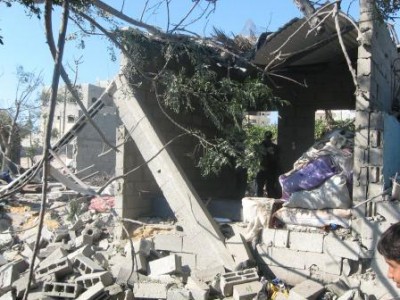 Overnight Israeli warplanes pounded Gaza. Nine people have been murdered in Gaza since yesterday. 13-year-old Mahmoud Abu Samra was one of the killed, he and 18 others were injured in one bombing attack in Gaza. The Abu Samra family lives near the former intelligence services headquarters in Gaza City. Their house was destroyed by an Israeli bomb last night at 12:30 A.M. Their house was completely destroyed, one of their neighbors houses was also destroyed, one more, heavily damaged. Thirteen people from three families live in these houses. All of these families are refugees, expelled from their homes in 1948, and now, in a repeat of history, once again their houses are destroyed. When we arrived family members were picking through the rubble, trying to salvage what could be salvaged.
The Abu Samra house was completely destroyed. All that is left standing is a bathroom with the door torn off, a sink, and a broken mirror in it. Mahmoud is dead, the latest causality in the Israeli assault on Gaza. Neighbors and relatives pick through the remains. A shattered computer monitor sits on a pile of rubble. Israel bans the import of concrete into Gaza, so the house will probably live on in another house after the rubble is recycled. Mahmoud is dead, he was buried today.
Next to the Abu Samra house is the Al Helal Sporting club. It is one of the few places for young men to hang out in the neighborhood. When the bomb hit it was packed with young men trying to escape the heat, entertaining themselves playing football and watching TV. Many of the injured were young people from the neighborhood at the club.
We spoke to Seham Awad, a forty five year old mother of two. She and her nephew were picking through the rubble. Thankfully, her son is away at university studying, her daughter is married and no longer lives with her. Her ex-husband is in an Israeli prison, seven years into a twelve year sentence. She is unemployed and lives on charity and help from her neighbors. She is a resourceful woman though, her backyard, maybe 25 square meters, has been turned into a garden. It is overhung by a shattered trellis for passion fruit vines. She grows vegetables on the rest of her land, in old tires that have been turned into planters, on every square meter of land vegetables grow. Her house is small, only two rooms, now both destroyed.
Her house was also destroyed during Cast Lead, she received no help rebuilding, only some mattresses and household supplies. She lives without windows; only sheets cover the holes in the walls that would be windows. Perhaps, this was lucky last night, there was no shattered glass to cut her. After the attack, she slept in the garden, on mattresses placed in the back corner. She is undefeated, after her house was destroyed in Cast Lead she rebuilt as best she could, concrete blocks, an asbestos and tin roof, and no windows. She expected that her house would be destroyed again, she was right. As she said, “I expect little from life, I planted this tree, now it is big, it provides shade, that is enough.” When asked what she would do now, where she would go, she said, “I will stay here, I will rebuild again as best I can, where else can I go?”
Her neighbors, the Abbas family was not so lucky. Their father, Abu Akmed was injured in the bombing. This family too is picking through the rubble, praying for their father. Their home, heavily damaged was all that they had. In the back a horse still lives in a small shed. Abu Ahmed, like most men in Gaza, had no job–they’re just simple refugees trying to rebuild their lives. Nine people crammed into a small concrete block house, now, mostly destroyed. Out their front door you can see the old security headquarters in Gaza, heavily bombed during Cast Lead and now abandoned.
Behind the Abbas family lives Hajjer Abu Duwani. She is a fifty five year old mother of twelve. She is a small woman; she looks older than her years. She doesn’t really have a house, just two tin sheds that she lives in. A chicken coop takes up one end of her land; on the rest of it she tries to grow vegetables. She has no job; she depends on the help of her children to live. Shrapnel from the bombing hit her. She has an ugly hand sized bruise on her leg, another bruise on her arm, and her head was cut with shrapnel. She is happy, at least she is alive, Mahmoud, her thirteen year old neighbor is dead, the houses of her other neighbors destroyed.
Featured Video

Death Spikes & Rising Cancer In Our Youth Explained
or go to
Aletho News Archives – Video-Images
From the Archives
Politicians lie
By Mazin Qumsiyeh | Popular Resistance | August 18, 2013
There is no way to say this truth nicely: Politicians lie. That includes Japanese, American, Egyptian, Israeli, and Palestinian politicians! Is there something more common sense than that? Yet, so many citizens around the world believe their own politicians or wistfully acknowledge lies but think it is part of the job needed to run things. They believe even when politicians contradict themselves blatantly. This phenomenon is rather remarkable. It is a dissonance and disconnect from reality that many seem oblivious to. It is very dangerous because it can lead to accepting rationales for going to war. These can be deadly wars that lead to millions of lives lost as happened in what was called World War 1 and WW2. Even when incredible and declassified evidence abound, politicians continue to lie and old mythologies refuse to die. Here are just a few of the countless lies told to us over the past few decades… continue
Blog Roll
 Aletho News
- Turkish parliament to review Saudi-Pakistan defense pact next month
- DEATH SPIKES & RISING CANCER IN OUR YOUTH EXPLAINED
- Iran offers Trump deal before US election
- Merz regime wants ‘secret police’ – opposition
- Israeli settlers terrorize West Bank Palestinians with state-provided drones: Report
- They see them, then kill them: Israeli quadcopters track, deliberately target civilians in Gaza
- Debunked: Trump’s egregious UNGA claims on war against Iran crumble under scrutiny
- Europe was part of the infrastructure of US aggression against Iran: Deputy FM
- New evidence on the Bucha Massacre
- Italy and France debunk reports CIA issued ‘Russian drone threat’ warning
- If Americans Knew
- An error has occurred; the feed is probably down. Try again later.
- No Tricks Zone
- New Study: Earth And Venus Surface Warmth Largely Explained By Convection And Lapse Rate, Not CO2 Or Radiation
- 2025 Nature Paper Claiming Worsening Global Drought Gets RETRACTED …Heavily Flawed
- New Study: ‘Global Drought Shows No Detectable Recent Acceleration Under Climate Warming’
- Economic Masterminds: German Socialists Suggest Taxing Productivity Gains Stemming From Using AI
- The South China Sea Has Not Been Cooperating With The Climate Change Narrative
- Energy Crisis: Germany Enters Heating Season With Historically Low Gas Reserve Fill Levels
- New Study: The Antarctic Ice Sheet Gained Mass From 2020-2024 Due To Staggering Snow And Ice Accumulation
- Study: Ocean Heating Rates From Thousands Of Years Ago ‘Dwarf’ Modern Ocean Heating Rates
- Climate Extremists Target, Attack Large-Scale Power Grid Infrastructure In Germany!
- New Study: Antarctic Ice Melt Has Contributed Less Than 1 Centimeter To Sea Level Rise In The Last 30 Years

