Israel, a New Decade
By Ran HaCohen | April 10, 2010
I turn on the television just before dinner. Prime-time. An Israeli series: “The Pilots’ Wives” (“Meet the Women behind Our Heroes”, said the promo), interrupted occasionally by a commercial depicting a soldier missing his mother’s soup (“disclaimer: the actor is not a soldier”). After the series, a short public service broadcast showing a group of young men, each in turn boasting his military service, until they notice one of them – a violent zoom-in – keeps quiet; the message is clear. Then the news, with at least one public relations item pushed by the military: “teen-age girls eager to become fighters”, “a remote-control watch-and-shoot system on the Gaza fence”, “a unique glimpse into a top-secret air-force base” or the like. Not to mention the real news, be it about the Palestinian territories, Lebanon, Iran, or even the billions of terrorists disguised as miserable African refugees allegedly waiting on the Egyptian border to inundate Israel: all these issues, and many more, are predominantly managed and framed by the military.
The military service has been made a major issue in Israeli public discourse. Not that the army is short of soldiers: on the contrary, the number of recruits requesting “to serve their country” in combat units is at record level. Nevertheless, uniting the nation around the military as the ultimate good is a goal in itself, especially when it implicitly excludes the Israeli-Palestinians, who are not conscripted. Thus the stage and screen actor Itay Tiran was removed from Israel’s official propaganda website when someone noticed he had not served; And, following the Zeitgeist, “national left-wing” playwright Shmuel Hasfari said he would refuse to work with Tiran “just like with any murderer or rapist.”
Most Israeli artists are careful not to express themselves critically about Israel’s policies, definitely not to say a word against the country’s deep militarism and racism; Scander Kobti, co-director of Ajami, nominated for an Academy Award in Best Foreign Language Film, caused a scandal just for saying he didn’t “represent Israel” in Hollywood (“I cannot represent a state that doesn’t represent me”, the Israeli-Palestinian claimed) – even that is more than the selectively sensitive Israeli ear can bear. Every Israeli is expected to be an ambassador abroad – no wonder that in a highly popular Israeli reality show just a few years ago, candidates competed on who would best represent Israeli propaganda abroad (a former Israeli army spokesman was among the judges). Remember it next time you talk to an Israeli: especially outside Israel, you might hear not the truth, but the official state propaganda. Though many Israelis sincerely believe the two are identical.
The deep racism of the Israeli psyche is on the rise. The 1990s, at least in hindsight, marked some liberalization of the public discourse; the first decade of this century crushed it, and now the mildly critical, left-liberal discourse hardly exists in the mainstream. No wonder the liberal left has just 3 seats out of 120 in the Knesset; all the other parties are various shades of right-wing, far right, or fascism (except the small outcast “Arab” parties). The racist mindset can be observed in the most trivial daily situations, like my elderly neighbor, when told I saw someone peeping at my window the other night, instinctively reacting with a single question: “Have you seen whether it was a Jew or an Arab?”
Ever more often, when I mention the Netherlands, I am told that all the Dutch were anti-Semitic and collaborated with the Nazis; my already ritualized reaction – that my grandparents and my mother owe their lives to Dutch Christians who risked their own lives to save them – is met with a shrug, expressing something like “don’t challenge my precious prejudice” or “don’t be so naïve, we all know everybody hates us.” And this is not just the case of Holland: from Sweden to Ethiopia, from Turkey to Argentina, no matter how Jewish-friendly (and Israel-friendly) a nation has been historically, Israelis are encouraged to view all non-Jews (“Goyim” is the pejorative term used uncritically by most Hebrew speakers) as inherently anti-Semitic and therefore anti-Israeli. Every criticism of Israel’s policy is automatically dismissed as yet another incarnation of an endemic, incurable hatred of Jews. Just like anti-communism was the national religion of the USA during the Cold War, the fanatic belief in an eternal world-wide anti-Semitic conspiracy is the true national cult of Israel. The voices portraying even President Obama as anti-Semitic are just one undertone in an ear-deafening choir of incitement against every dissenting voice, within or without.
The younger generation knows little else. How could it? As the Jerusalem Prof. Nurit Peled-Elhanan shows, Israeli schoolbooks – their text, maps, and pictures – are inherently racist, especially against Arabs; but whereas the racism was sophisticatedly disguised in the 1990s schoolbooks, in the last decade it’s overt and explicit. Arabs are consistently represented as primitive, threatening, and untrustworthy; the Palestinian narrative is either distorted and denied, or simply ignored. The Occupation, says Peled-Elhanan, is never mentioned, the Green Line does not exist; many Israelis no longer know what it means, let alone where it is.
Even the language retreats: if the term “occupied territories” sounded rather neutral just a few years ago, when even Ariel Sharon used the term “occupation”, now the sickening euphemism “liberated territories” has made a comeback. At the same time, hypocrisy and double-standards are cultivated: right-wing parties outside Israel are regularly termed “extremist”, “xenophobic” or “racist”, terms never applied to much more extreme Israeli parties. Official Israel is shocked and outraged by naming a street in Ramallah after a Palestinian terrorist Ayyash (assassinated by Israel in 1996); At the same time, the Israeli far-right leader Ze’evi (assassinated by Palestinians in 2001), whose main political platform was ethnic cleansing (“transfer”) of all Palestinians, has several streets, three promenades, two settlements, a highway, a bridge, and an army base named after him, and a law to commemorate him and even educate future generations with his “legacy.”
Is It Too Late?
This is the present atmosphere in Israel – one of a rising, violent nationalist self-righteousness, especially among the younger generation. A recent poll shows that while 35% of Israelis over the age of 30 said they would vote for right-wing parties, this number almost doubled for youths up to the age of 29, and stood at 61%.
Does this mean there is no chance for peace? A difficult question. Despite all of the above, polls also show 60% support among the general public for removing the majority of settlements. As always, this 60% majority of Israeli Jews overwhelmingly believes it is a minority – only a third of respondents said such an evacuation had the support of the Israeli majority. This last figure – the majority being persuaded it is actually a minority – is one of the greatest achievements of the official Israeli brain-wash, and has been consistent for many years.
One can therefore understand Zeev Sternhell’s call on Obama’s Washington to implement an imposed solution: “Were Israeli society prepared to pay the price for peace, its government would not be fanning the flames of conflict […] The conclusion is that […] the only solution is an imposed one”, writes the prominent Israeli political scientist. This is no rosy scenario either, needless to say. In clear imitation of Nazi calls to try the German politicians who signed the “humiliating” Treaty of Versailles (1919), the Israeli right-wing has already demanded to “put Oslo criminals on trial” for signing the Oslo Accords. One can recall European history and imagine how Israeli fascists would react to an “imposed peace.” Luckily, they are just a minority; but given the current atmosphere in Israel, as well as the demographic advantage of the right-wing (Orthodox Jews have much more children), it might not remain a minority for long. Time, if there still is any, is running out.
Scotland’s First Minister calls for Israel trade rethink
By Robyn Rosen | JEWISH CHRONICLE | April 8, 2010
Scotland’s First Minister, Alex Salmond, has called for legal action and a review of trading relationships with Israel after David Miliband announced that Britain formally blamed the country for cloning UK passports during the Dubai operation.
Mr Salmond replied to a question on BBC’s Question Time last week, about the decision by the Foreign Secretary to expel an Israeli diplomat. The expulsion followed an investigation into the cloning of up to 15 British passports, in the operation leading to the killing of a Hamas leader in Dubai in January.
Mr Salmond said that Mr Miliband’s actions were “not enough”.
He said: “Friendly countries don’t steal the passports of other countries’ citizens and use that as part of an arrangement to assassinate their political enemies. And therefore it has to be treated in the context of the seriousness of what the Foreign Secretary believes that Israel have been doing.
“Stealing peoples’ passports – and indeed the assassination – must be a criminal offence. Surely, if the Foreign Secretary has now identified to his satisfaction that Israel is responsible, then he should be thinking of legal action.
“In terms of the relationship with the Israeli government, it should be more than expelling a diplomat, there should be implications, for example in trading relationships.
“You can’t have normal relationships if you believe another country has been involved in what Israel has been involved in, according to the Foreign Secretary.
“But certainly, whatever measures you take, it cannot just be a diplomatic dance.”
The Scottish Palestine Solidarity Campaign (SPSC) have welcomed the comments and hope they will lead to the cancellation of an exhibition due to be held in the Scottish Parliament later this month.
The exhibition, highlighting Israel’s contribution to medicine, science and technology, is organised by the Scottish Friends of Israel and sponsored by MSP Ken McIntosh.
A petition by Sofiah Macleod of the SPSC has already been lodged with the Scottish Parliament, denouncing the exhibition as a “shameless PR exercise” and calling for its cancellation.
She said: “Hosting this exhibition in the Scottish Parliament potentially implicates all of us in a whitewashing of Israeli crimes.”
But a Scottish Parliament spokeswoman said: “Members are fully entitled to sponsor exhibitions in the parliament which have relevance to their parliamentary or constituency roles.”
Myer Green of the Scottish Friends of Israel said: “Alex Salmond’s comments are a very serious condemnation of Israel which leave me feeling somewhat uncomfortable.
“The exhibition may well trigger certain motions in parliament which will attract anti-Israel commentary. But the appropriate people have approved the exhibition. We simply want to make people aware of Israel’s exceptional contribution to society.”
Witnesses: Soldiers look on as settlers beat 2
Ma’an – 09/04/2010
 Hebron – Two 19-year-old men were transferred to a Hebron hospital for treatment Wednesday after being harshly beaten by Israeli settlers near the Ibrahimi Mosque, locals said.
Witnesses identified the two as Muhammad Abdul Raouf Al-Muhtaseb and Rushdi Al-Muhtaseb, both 19, and said soldiers looked on as settlers attacked the men and did nothing to interfere.
On 31 March a similar incident was reported, with A’teiyah Yousef Maswada, 31, transferred to hospital following an attack by some 10 settlers outside of the mosque.
Palestinian police reported the attack, and eyewitnesses including Christian Peacemaker Teams corroborated the account, with Israeli police unavailable for comment by phone.
Shopkeepers in the area said the man was en route to the Ibrahimi Mosque when he was assaulted, and was described as having a bloody face, CPT reported, noting that witnesses said the man did not go to the hospital. By the time Israeli police arrived on the scene, the CPT observer noted, shopkeepers said the settlers had fled.
How Brainy Is Obama?
By Alan Bock | April 09, 2010
Most of the other hypotheses don’t seem to make much sense, so I’m starting to approach the tentative conclusion that Barack Obama is just not that smart. It should hardly come as a surprise. He undoubtedly has an IQ slightly higher than normal or he wouldn’t have made it through college and law school (though it might be interesting to see his transcripts, which to my knowledge he hasn’t released yet). But in retrospect what he seems to have displayed throughout his career is cunning rather than anything resembling real learning.
This would hardly be unique among American presidents, and in fact there are some who argue that high intellect and/or book-learnin’ are not only seldom to be seen in the presidency but perhaps not especially desirable. President Clinton was obviously an engaged policy wonk with what one suspects is a pretty high IQ and a degree of intellectual curiosity. George W. Bush was not quite the dunce some made him out to be, but one would be hard pressed to find evidence of intellectual curiosity, a philosophy of governance formed by much deep thinking, a willingness to dig into policy details, or a capacity to learn much from either study or experience.
Barack Obama has obviously been extremely ambitious for a long time; perhaps he has had the presidency in mind since early college days. So he has been alert to the main chance, aware of the kinds of alliances he ought to make, aware that a sensitive autobiography would make him look special in the eyes of the easily duped intellectuals of our fading empire, aware of how to present himself as a multicultural black man. But his reputation for being really smart is belied by so many of his actions.
What has me going this time is not health care, though there’s plenty of evidence there, but Afghanistan. His recent visit there cemented this war as “his” war. But the war makes so little sense that you would think almost any reasonably intelligent person – I suspect he didn’t take any international relations classes in college, and he certainly has not shown any special interest in that field heretofore, so maybe that’s a mitigating factor – would have been able to figure it out.
The official line about keeping al-Qaeda out of Afghanistan is obviously absurd; al-Qaeda hasn’t been there since 2002. He has to know – doesn’t he? – that the Taliban is an indigenous Afghan outfit without international ambitions, so while a takeover would be sad for many Afghans, it would have few if any international repercussions. He is obviously aware enough that Karzai is a corrupt tool, and uncooperative to boot, that it annoys him. So why does he insist on maintaining a U.S. presence in the Graveyard of Empires?
What are the possibilities? Does he really want to preside over the fall of the American Empire? Is he so deluded as to think we can bring a semblance of democracy, stability, or semi-decent governance in the next 15 months or so? Is he just cunning enough to realize that historians tend to rank American presidents who have presided over wars as “greater” than those who presided over peaceful periods?
I’m coming to think that maybe he’s just not that smart… Full article
###
Link for more in depth coverage of Obama’s academic background
Christian leaders call for ‘permits’ boycott
Ma’an – 07/04/2010
Bethlehem – Leaders of the Christian community in Palestine called on church officials to begin a boycott of the Israeli permission system, requiring leaders to request permits for their faithful to access the holy city of Jerusalem.
Speaking on the radio Mawwal show Juthurna (Our Roots) on Tuesday, Fatah official of religious affairs Mike Salman said the entire Israeli system of forcing Palestinians to request permissions to access Palestinian territory illegally annexed by Israel is “an offense to human dignity.”
Under international law and conventions, he added, “Jerusalem is part of the 1967 lands and we Muslims and Christians should be able to reach it without permits,” and called on Christians to support their church leaders in a campaign to halt the permit system.
“We should have one clear and consistent position about permits, for permits offend the dignity of humanity, we must not give in to the occupation’s policy,” Salman said.
Jack Khozmo, the editor-in-chief of Jerusalem’s political magazine Al-Bayader said boycotts by Christians should be backed up by resistance from the Jerusalem community. Already, he said, popular resistance forced Israeli forces to back off restrictions rumored for the Easter celebrations at the Church of the Holy Sepulchre, with tens of Palestinian Christians gaining entry to the building.
The editor agreed that Christian patriarchs should take a firm position on the permissions policy, saying “freedom of worship is a sacred right and people should not have to request this right from anyone.”
President of Global Movement for Defense of Children and coordinator of the Kairos Palestine initiative, Rif’at Qassis, further backed up the position, calling on church leaders to shut the doors of churches and forbid all pilgrims from entering if Palestinians are not granted free access to the religious sites.
“The Kairos Palestine document assures the rights of worship and freedom for all the religions in the holy places and demands that individuals should not struggle in order to pray in a church,” Qassis said of an initiative by Christian Palestinians to end the occupation of Palestine.
According to organizers of the initiative, “Palestinian Christians declare that the military occupation of our land is a sin against God and humanity, and that any theology that legitimizes the occupation is far from Christian teachings because true Christian theology is a theology of love and solidarity with the oppressed, a call to justice and equality among peoples.”
Qassis said that the world and the heads of churches should refuse the idea of permits and that everyone should go to the military checkpoints and demand for their natural right to enter Jerusalem to pray in Al-Aqsa mosque and the Church of the Holy Sepulchre.
US military aid to Israel violates domestic, international law
Nahida H Gordon, The Electronic Intifada, 7 April 2010
 |
Should the US government, based on international and domestic law, cut military aid and cease the transfer of weapons to Israel? (Luay Sababa/MaanImages) |
The Middle East Study Committee of the Presbyterian Church (USA) has published “Breaking Down the Walls“, a report to be submitted to the church’s 219th General Assembly this July.
Some of the report’s 39 recommendations have drawn harsh criticism. The Simon Wiesenthal Center declared in a 22 February action alert that “adoption of this poisonous document by the Presbyterian Church will be nothing short of a declaration of war on Israel and her supporters” (“Presbyterian Church USA Ready to Declare War Against Israel: Take Action Now“).
Such attacks make exaggerated claims and misrepresent the recommendations. The Committee’s intent is not to make war but rather peace.
One factually misleading claim is the Simon Wiesenthal Center’s assertion that “the report calls for the US to withhold financial and military aid to Israel.” In fact, the report “calls on the US government to exercise strategically its international influence, including the possible withholding of military aid as a means of bringing Israel to compliance with international law and peacemaking efforts” (p.53).
As one can easily see, the Committee’s recommendation is nuanced and calls on withholding military aid as a last resort.
Within this context it is appropriate to consider whether the US government, based on international and domestic law, should cut military aid and cease the transfer of weapons to Israel.
According to the International Law Commission (ILC), the official UN body that codifies customary international law, “A State which aids or assists another State in the commission of an internationally wrongful act by the latter is internationally responsible for doing so if: (a) that State does so with knowledge of the circumstances of the internationally wrongful act; and (b) the act would be internationally wrongful if committed by that State” (Article 16 of the International Law Commission, “Articles on Responsibility of States for Internationally Wrongful Acts,” (2001) which were commended by the General Assembly, A/RES/56/83).
In other words, if you knowingly help someone commit a crime, you are also liable for that crime. The ILC states that international law also “prohibits conduct that involves patterns of blatant abuse and complicity in such a pattern of blatant abuse.”
According to Amnesty International, since 2001, the US has been by far the major supplier of conventional arms to Israel. Also since 2001, Israel launched military invasions of Lebanon and Gaza, causing extensive loss of civilian human life and destruction of property, including homes (“Fueling conflict: foreign arms supplies to Israel/Gaza,” Amnesty International, February 2009, p.21).
Section 502B of the US Foreign Assistance Act stipulates that “no security assistance may be provided to any country the government of which engages in a consistent pattern of gross violations of internationally recognized human rights” and section 4 of the Arms Export Control Act authorizes the supply of US military equipment and training only for lawful purposes of internal security, “legitimate self-defense,” or participation in United Nations peacekeeping operations or other operations consistent with the UN Charter.
Since the US government gives no military assistance to any of the Palestinian resistance groups, the question with regard to US military aid and transfer of weapons applies only to Israel.
And with regard to Israel, the UN-commissioned Goldstone report found that the Israeli forces in Gaza committed grave breaches of the Fourth Geneva Convention which included willful killing, torture or inhuman treatment, willfully causing great suffering or serious injury to body or health, extensive destruction of property and use of human shields. Other findings were that the Israeli forces committed a series of acts that deprive Palestinians of their means of subsistence, employment, housing and water, that deny their freedom of movement and their right to leave and enter their own country, that limit their rights to access a court of law and an effective remedy and that these findings could lead a competent court to find that the crime against humanity were committed.
A particularly abhorrent use by Israel of weapons provided to it by the US government is the use of white phosphorous which when it comes into contact with skin burns deeply through muscle and bone, continuing to burn until deprived of oxygen. It can contaminate other parts of the victim’s body or even those treating the injuries, as documented by Amnesty International. Moreover its use in civilian areas is prohibited under international law.
Based on international and domestic US laws, and the Goldstone report’s finding that Israel committed grave breaches of the Fourth Geneva Convention, the US government, in providing military aid and the transfer of arms to Israel, has violated its responsibility not to participate in the internationally wrongful acts of another state.
With these observations in mind, I personally believe that the recommendation of the Presbyterian Church (USA) Middle East Study Committee to withhold military aid to Israel as a last resort — in attempting to enforce international law vis-a-vis the occupation of Palestinian territories and the human rights violations against the Palestinians — is a mild statement, indeed. Particularly so in light of Amnesty International’s “calling on the UN, notably the Security Council, to impose an immediate, comprehensive arms embargo on all parties to the conflict, and on all states to take action individually to impose national embargoes on any arms or weapons transfers to the parties to the conflict until there is no longer a substantial risk that such arms or weapons could be used to commit serious violations of international law.”
As the Middle East Study Committee states, “We deeply value our relationships with Jews and Muslims in the United States, Israel and the predominantly Muslim countries of the Middle East. Yet the bonds of friendship must neither prevent us from speaking nor limit our empathy for the suffering of others. Inaction and silence on our part enable actions we oppose and consequences we grieve.”
N H Gordon is a professor of statistics and member of the Presbyterian Church (USA) Middle East Study Committee. Professor Gordon, a life-long Presbyterian and currently a church Elder, is a Palestinian-American who experienced, first hand, the 1948 Palestinian Nakba as a child.
Sheikh Jarrah evictions based on forgeries
Ma’an – 07/04/2010
Jerusalem – The court-ordered eviction warrants handed down by the settler organization Nahalat Shimon International to two Palestinian families in Sheikh Jarrah on Tuesday were based on forged documents, Fatah official in charge of Jerusalem Affairs Hatem Abdul Qader said.
“The Israeli High Court of Justice previously accredited forged documents issued by this [Nahalat Shimon International] society and approved its ownership of the lands the homes are built on,” Abdul Qader told Ma’an.
“The society’s lawyer is sending out circular warrants to residents, ordering them to evacuate their homes,” he added, alleging that all the land ownership documents previously used by the organizations to evict other families in the neighborhood are counterfeit.
The Fatah official said the latest families faced with eviction, the Dajani and Daoudi families, will file a petition at the High Court of Justice to overturn the eviction warrants on the basis that they were approved on forged documents.
“The Nahalat Shimon society is supported by the Israeli government in its work toward building a settlement neighborhood in the area,” Abdul Qader said.
Israeli NGO Ir Amin said in a 2009 report that the settler-related real estate organization “plan[s] to demolish the existing residential structures [in Sheikh Jarrah] and evict hundreds of Palestinian residents in order to clear the way for a new Israeli settlement: Shimon HaTzadik [Simon the Just].”
The structures in question are 28 Palestinian homes, currently housing descendants of 27 Palestinian families, who were offered housing by UNWRA and the Jordanian Ministry of Development in 1956, in exchange for their refugee baskets. The Jordanian government had told the families that within three years, the deeds would be transferred into their names if the owners did not reclaim the land, pursuant to Jordan’s Enemy Property Law. Despite no claims within the stipulated period, the deeds were not passed on to the current tenants.
Nahalat Shimon, in conjunction with a number of other organizations, began filing lawsuits in the 1970s to evict the families in question, based on land sale deeds allegedly acquired during the Ottoman rule and the British Mandate. Many of these owners had fled the neighborhood before the creation of the state of Israel in 1948.
“The struggle for the area highlights an additional issue: the ongoing attempt of Israeli settlers, backed by the Israel Lands Administration (ILA), to ‘reclaim’ plots of land in East Jerusalem that were owned by Jews under British or Ottoman rule. These efforts continue throughout East Jerusalem, despite Israeli courts’ ongoing refusal to recognize similar claims by Palestinian owners in West Jerusalem,” Ir Amin wrote.
Israel bars Gandhi’s grandson from entering Gaza
Palestine Information Center – 06/04/2010

GAZA — The Israeli occupation forces (IOF) on Tuesday barred Rajmohan Gandhi, the grandson of Indian independence leader Mahatma Gandhi, from entering Gaza Strip.
Gandhi expressed absolute sorrow for not being able to visit Gaza, adding that he was deeply depressed over the scenes of repression he witnessed in the Palestinian lands.
He said that the Israeli talk about a Palestinian state in light of those de facto conditions was “meaningless”, adding that the separation wall, settlements and bypass roads were more horrific than what he imagined before visiting Palestine.
Gandhi said that the Israeli government was treating Palestinians as second class citizens and was robbing their land.
He said he was deeply touched over the story of prisoner Fakhri Al-Barghouthi who had been held in jail for 33 years and could not meet his two sons, whom he left as little children, until they were detained by the IOF soldiers.
Gandhi said that he would publicize the Palestinian suffering in India, the USA and any place he visits, adding that he would also exert efforts for the release of Palestinian prisoners.
US-led raid kills 4 civilians in Afghanistan
Press TV – April 6, 2010

A US-led air strike has killed at least four civilians including two women and a child in an incident the US military described as an attack against suspected militants in southern Helmand province.
“Insurgents were using the compound as a firing position when combined forces, unaware of the possible presence of civilians, directed air assets against it,” the NATO-led International Security Assistance Force (ISAF) said in a
statement.
The statement went on to say that once the US-led forces were able to enter the compound, they found four dead civilians, two women, an elderly man and a child inside.
The Monday botched attack in the Nahr-e-Saraj district of the southern province of Helmand is the latest incident the alliance has described as a mistaken strike and threatens to further strain relations between the NATO powers and President Hamid Karzai’s administration.
Karzai has previously tearfully denounced The US for killing civilians and the issue has provoked deep resentment among Afghans.
Gandhi’s grandson in Al-Khalil supports Palestinian just struggle
Palestine Information Center – 05/04/2010

AL-KHALIL — Israeli occupation forces (IOF) have tried to obstruct the tour of Rajmohan Gandhi, the grandson of Indian independence leader Mahatma Gandhi, and his wife Usha in Al-Khalil city on Sunday.
Local sources said that the IOF soldiers tried to prevent the couple, who were accompanied by Palestinian MP Mustafa Al-Barghouthi, from reaching the settlement outposts erected in the vicinity of the Ibrahimi Mosque and detained a number of journalists who were covering the visit.
Gandhi, after touring the Old City and the Ibrahimi Mosque, told a press conference that the Palestinian people were entitled to freedom and independence.
He said that the electronic gates installed in front of the Ibrahimi Mosque were an insult to humanity, and a humiliation that the Israeli occupation should stop.
The Israeli repression in the city of Al-Khalil was obvious including the confiscation of civilian homes and attacking citizens, he said, expressing absolute support for the Palestinians’ popular struggle.
Gandhi said that the world community was fast asleep and was not moving to amend the situation, promising to convey what he saw to the world so that it would wake up and act.
NATO Admits Killing Civilians in February Afghan Raid
By Jason Ditz | April 04, 2010
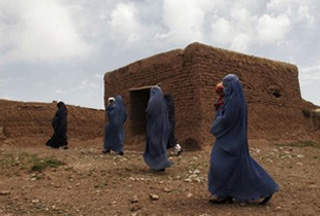
Nearly two months after the high profile night raid in Afghanistan’s Paktia Province and after several official denials, NATO has finally admitted to killing all five civilians, including two Afghan government employees.
NATO’s first official acknowledgement of the raid claimed they engaged in a “fire fight” with insurgents known to be hiding at the house and made a “gruesome” discovery of three slain women bound and gagged in an adjacent room of the house. Two of the women were later revealed to be pregnant at the time.
Though the family initially disputed the claims, the real holes in the official story began to develop a month later, when Rear Admiral Greg Smith admitted they had no evidence the “firefight” involved a single shot fired by anyone but the NATO forces, and all the arrested “insurgents” were released. NATO also attempted to pay them “compensation” for the slain civilians, but were rebuffed.
But all of this still leaves an enormous loose string to tie up. If there was no “gruesome discovery” as claimed, then the US special forces responsible for the raid not only killed those pregnant women, but bound and gagged their corpses to try to cover it up (which is what the family claimed the day after it happened, to the dismissal of everyone).
Incredibly, however, NATO is still insisting that they have no evidence that the soldiers acted “inappropriately” in the slaughter, and even though Afghan government officials confirmed that the troops were removing evidence from the scene for seven hours before letting the Afghan security forces in to inspect it they maintain that nothing resembling a cover-up has occurred.
The Palestinians are winning the legitimacy war: will it matter?
Richard Falk | 5 April 2010
Ever since the Balfour Declaration in 1917 gave the formal approval of the British government to the establishment of “a Jewish homeland”, profound issues of legitimacy were present in the conflict recently known as the Israel-Palestine conflict.
This original colonialist endorsement of the Zionist project has produced a steady erosion of the position of the Palestinian people on historic Palestine, which dramatically worsened over the course of the past 43 years of occupation of the West Bank, East Jerusalem, and the Gaza Strip. It has worsened due to an oppressive military occupation by Israel that involves fundamental denials of rights and pervasive violations of international humanitarian law, and because Israel has been allowed to establish “facts on the ground”, which are more properly viewed as violations of Palestinian rights, especially the establishment of extensive settlements and a separation wall constructed on occupied Palestinian territories in violation of the Fourth Geneva Convention. These developments have been flagrantly unlawful, and made the whole treatment of the Palestinian people illegitimate, as well as the occasion of continuous intense and pervasive suffering.
For decades, Palestinian political forces have exercised their right of resistance in various ways, including the extraordinary non-violent Intifada of 1987, but also engaging in armed resistance in defence of their territory. The Palestinians definitely enjoy a right of resistance, although subject to the limits of international humanitarian law, which rules out deliberate targeting of civilians and non-military targets. Such tactics of resistance challenge Israel at its point of maximum comparative advantage due both to its total military dominance, achieved in part by large subsidies from the United States, and to its ruthless disregard for civilian innocence.
In recent years, especially beginning with the brutal experience of the Lebanon war of 2006 and even more dramatically in the aftermath of the Israeli invasion of Gaza in 2008-09 (27 December 2008-18 January 2009), there has been a notable change of emphasis in Palestinian strategy. The new strategy has been to initiate what might be described as a second war, “a legitimacy war” that is essentially based on the reliance on a variety of non-violent tactics of resistance. Armed resistance has not been renounced by the Palestinians, but it has been displaced by this emphasis on non-violent tactics.
The essence of this legitimacy war is to cast doubt on several dimensions of Israeli legitimacy: its status as a moral and law abiding actor, as an occupying power in relation to the Palestinian people, and with respect to its willingness to respect the United Nations and abide by international law. Those that wage such a legitimacy war seek to seize the high moral ground in relation to the underlying conflict, and on this basis, gain support for a variety of coercive, but non-violent initiatives designed to put pressure on Israel, on governments throughout the world and on the United Nations to deny normal participatory rights to Israel as a member of international society.
These tactics also aim to mobilize global civil society to exhibit solidarity with the Palestinian struggle to achieve legitimate rights, taking the principal form of the Boycott, Divestment and Sanctions Campaign (BDS) that operates throughout the entire world, which serves as a symbolic battlefield.
But there are other forms of action as well, including the Free Gaza Movement and Viva Palestina that aim specifically at symbolically breaking the blockade of food, medecine and fuel imposed in mid-2007, a form of collective punishment that has caused great suffering for the entire 1.5 million population of the Gaza Strip, damaging the physical and mental health of all those living under occupation.
Although the UN has been a failure so far as offering protection (beyond its essential role in providing humanitarian relief in Gaza) to the Palestinians under occupations or even in relation to the implementation of Palestinian rights under international law, it is a vital site of struggle in the legitimacy war. The whole storm unleashed by the Goldstone report involves challenging the UN to impose accountability on the Israeli political and military leadership for their alleged war crimes and crimes against humanity associated with the Gaza attacks at the end of 2008. Even if the United States shields Israelis from accountability pursuant to the procedures of the UN, including the International Criminal Court, the confirmation by the Goldstone report of allegations of criminality is a major victory for the Palestinians in the legitimacy war, and lends credibility to calls for non-violent initiatives throughout the world.
The Goldstone Report also endorses “universal jurisdiction” as a means to gain accountability, encouraging national criminal courts of any country to make use of their legal authority to hold Israeli political and military leaders criminally responsible for war crimes and crimes against humanity.
Tzipi Livni, the current Kadima opposition leader in Israel, who had been foreign minister during the Gaza attacks, cancelled a visit to Britain after she received word that a warrant for her arrest upon arrival had been issued. Even if Israeli impunity is not overcome, the authoritativeness of the Goldstone report lends weight to calls around the world to disrupt normal relations with Israel by boycotting cultural and academic activities, by disrupting trade relations through divestment moves or through refusals to load and unload ships and planes carrying cargo to or from Israel, and by pressuring governments to impose economic sanctions.
The historic inspiration for this legitimacy war is the anti-apartheid campaign waged with such success against the racist regime in South Africa. Undoubtedly, the Palestinian political motivation to focus their energies on waging a legitimacy war came from a variety of sources: disillusionment with efforts by the UN and the United States to find a just solution for the conflict; realization that armed resistance could not produce a Palestinian victory and played into the hands of Israeli diversionary tactics by making “terrorism” the issue; recognizing that the events in Lebanon and Gaza generated throughout the world widespread anger against Israel and sympathy for the Palestinians, which is gradually weakening earlier European and North American deference to Israel due to Jewish victimization in the Holocaust; and a growing sense that the worldwide Palestinian diaspora communities and their allies could be enlisted to join in the struggle if its essential nature was that of a legitimacy war.
Israeli official and unofficial support groups have recently recognized the threat posed to their expansionist settler colonial grand strategy by this recourse by Palestinians to a legitimacy war. Israeli think tanks have described “the global justice movement” associated with these tactics as a greater threat to Israel than Palestinian violence, and have even castigated reliance on international law as a dangerous form of “lawfare”. The Israeli government and Zionist organizations around the world have joined in the battle through a massive investment in public relations activities that include propaganda efforts to discredit what is sometimes called “the Durban approach”. As with other Israeli tactics, in their defensive approach to the legitimacy war, there is an absence of self-criticism involving an assessment of Palestinian substantive claims under international law. For Israel a legitimacy war is a public relations issue pure and simple, a matter of discrediting the adversary and proclaiming national innocence and virtue. Despite its huge advantage in resources devoted to this campaign, Israel is definitely losing the legitimacy war.
Even if the Palestinians win the legitimacy war there is no guarantee that this victory will produce the desired political results. It requires Palestinian patience, resolve, leadership and vision, as well as sufficient pressure to force a change of heart in Israel, and probably in Washington as well. In this instance, it would seem to require an Israeli willingness to abandon the core Zionist project to establish a Jewish state, and that does not appear likely from the vantage point of the present. But always the goals of a legitimacy war appear to be beyond reach until mysteriously attained by the abrupt and totally unexpected surrender by the losing side.
Until it collapses the losing side pretends to be unmovable and invincible, a claim that is usually reinforced by police and military dominance. This is what happened in the Soviet Union and South Africa, earlier to French colonial rule in Indochina and Algeria, and to the United States in Vietnam.
It is up to all of us dedicated to peace and justice to do all we can to help the Palestinians prevail in the legitimacy war and bring their long ordeal to an end.
Richard Falk is Professor Emeritus of International Law at Princeton University and author of Crimes of War: Iraq and The Costs of War: International Law, the UN and World Order after Iraq”. He is also current UN Rapporteur for Palestine.
Featured Video

New positive ivermectin evidence
or go to
Aletho News Archives – Video-Images
From the Archives
Fanatical Followers of the Covid Regime: A Jim Jones-Style Cult?
By Professor Roger Watson and Dr. Niall McCrae | The Daily Sceptic | November 15, 2021
As scholars at leading British universities over recent decades, we witnessed the replacement of critical thinking and debate by narrative: facts are discrimination and scientific method is imperialism; truth, instead, is derived from ‘progressive’ values. This educational trend may be a major contributory factor to the ease in which society has been inculcated to the Covid ‘new normal’ of masking, testing, and repeated doses of vaccines for a disease of similar risk to severe influenza.
One doesn’t need much critical reasoning to observe the flawed logic of some vaccination enthusiasts, such as people who respond to experiencing any side effects, however debilitating, by saying “at least I know it’s working”, or, after contracting the disease despite their promised inoculation (over 90% effective, according to initial drug company claims), “I’d have been worse off without the jab.” … continue
Blog Roll
 Aletho News
- EU Council Advances Chat Control 2.0 Scanning Proposal
- Ex-Greek MEP files complaint against Israeli spyware firm over alleged Pegasus surveillance
- Troubling ideas throughout the Torah, Talmud, Mishneh Torah and Tanya
- ‘Grave, alarming’: Iran mission on Trump’s UNGA ‘annihilation’ threats
- Najaf airport to reopen to Iranian flights within 24 hours: Ambassador
- From ‘How Will This End For Iran’ to ‘When America Walks Away’: A tale of two Economist covers
- Tehran blasts ‘baseless’ speculation linking Iran to alleged bomb plot at UK air base
- The Rise And… Rise Of ‘Color Revolutions’
- The Coming GOP Bloodbath?
- Arctic Scare Stories Melt Away
- If Americans Knew
- Netanyahu Asked UAE Leader to Deny Report on Oct. 7 Warning in Secret Visit, Sources Say
- CNN Chief Int’l Correspondent Clarissa Ward on Journalists in Gaza
- Democratic Party Consultants Surround Troy Jackson with Pro-Israel Donors
- Christian Leader Responds To Netanyahu’s Claims Regarding Palestinian Christians
- In Gaza, ‘Whoever Survives the Bombing Won’t Survive the Rubble’
- Israel kills more Palestinians, amid push to resettle Gaza – Daily Update
- Israel forces Gazans to live in constant peril – Daily Update
- Deconstructing Netanyahu’s pants-on-fire UN rant – Daily Update
- Trump betrayed voters with his campaign lies and prioritized a foreign country once he took office
- Netanyahu calls Israel’s war in Gaza ‘opposite of genocide’ in UN speech to near-empty hall
- No Tricks Zone
- New Study: Earth And Venus Surface Warmth Largely Explained By Convection And Lapse Rate, Not CO2 Or Radiation
- 2025 Nature Paper Claiming Worsening Global Drought Gets RETRACTED …Heavily Flawed
- New Study: ‘Global Drought Shows No Detectable Recent Acceleration Under Climate Warming’
- Economic Masterminds: German Socialists Suggest Taxing Productivity Gains Stemming From Using AI
- The South China Sea Has Not Been Cooperating With The Climate Change Narrative
- Energy Crisis: Germany Enters Heating Season With Historically Low Gas Reserve Fill Levels
- New Study: The Antarctic Ice Sheet Gained Mass From 2020-2024 Due To Staggering Snow And Ice Accumulation
- Study: Ocean Heating Rates From Thousands Of Years Ago ‘Dwarf’ Modern Ocean Heating Rates
- Climate Extremists Target, Attack Large-Scale Power Grid Infrastructure In Germany!
- New Study: Antarctic Ice Melt Has Contributed Less Than 1 Centimeter To Sea Level Rise In The Last 30 Years

