Afghan anti-US protest turns violent
Press TV – April 25, 2010
A crowd of hundreds block a highway in central Afghanistan and have torched five NATO fuel tankers to protest the killing of three people by US-led forces.
US and Afghan troops raided a house in Puli Alam, capital of Lugar Province south of Kabul, killing three men and arresting two others on Saturday. This is while the Afghans assert the occupants of the house were innocent civilians.
Early Sunday, hundreds of local residents blocked the main highway linking the capital city to the southeastern provinces, Din Mohammad Darwish, spokesman for the provincial governor, told a Press TV correspondent.
“The protestors burned five tankers that were transporting fuel to NATO forces in the province,” he said, adding that they were dispersed by police. Demonstrators chanted anti-US and anti-government slogans, asking for an independent investigation into the killings.
“Most of the protesters are relatives of the three dead men,” Darwish said, adding that the provincial governor had assigned a team to investigate the incident. The protest came two days after another demonstration in the same area by residents slamming the US forces for killing five civilians during a raid on Thursday.
Erekat: Israel incites settler violence
Press TV – April 22, 2010

Chief Palestinian negotiator Saeb Erekat has blasted Tel Aviv for inciting a new wave of Israeli settler violence as part of a culture of vandalism and extremism.
“Settler violence and the wanton destruction of Palestinian property replicate what is being done on a much larger scale by Israel as it pushes ahead with illegal settlement construction across the West Bank, including East Jerusalem (al-Quds),” Erekat said in a statement on Wednesday.
“They bring into full view the violence that underpins Israel’s policy of illegal settlement construction and the cost to Palestinians,” he added.
The Palestinian official described Israeli settlers as the direct beneficiaries of Tel Aviv’s policy which encourages occupying Palestinians’ land and demolishing their houses to further expand its “apartheid system that promotes settlements by stripping Palestinians of their basic rights and freedoms.”
“The result is a culture of violence, hatred and extremism in which Israeli settlers, often accompanied by Israeli soldiers, run riot across the West Bank,” Erekat noted.
The remarks come a day after a group of residents from the Israeli settlement of Givat Hayovel uprooted 250 olive tree seedlings planted by Palestinian farmers in the village of Qaryut to mark Earth Day.
On Monday, settlers attacked the General Union of Palestinian Workers’ housing complex in Ein Sinyia, north of Ramallah, destroying water tanks and nearby property.
Israeli settlers also vandalized a mosque in the village of Huwwara last week and painted racist slogans on its walls. They also torched two cars and damaged more than 300 olive trees.
Erekat charged Israeli officials with encouraging extremists “to intimidate and destroy at will, armed with the absurd notion that they have a divine right to steal, to vandalize and to persecute another people.”
He reiterated his criticism of Israel’s refusal to halt expansion of illegal West Bank settlements as “the major obstacle to peace and the greatest threat to the two-state solution.”
The settlements “are a black hole in which hopes of peace are fast disappearing,” he warned.
Israeli settlers set fire to historic Petra hotel in Occupied Jerusalem
Palestine Information Center – 21/04/2010

OCCUPIED JERUSALEM — The Petra hotel caught fire after Israeli settlers celebrating the occasion of the occupation of Palestine fired fireworks that fell on the roof.
Eyewitnesses said that the settlers, whose motives are still unknown, were in the “castle of David” inside the old city of occupied Jerusalem when they were firing their fireworks.
They added that one piece of the festival rockets fell on the hotel’s roof leading to the burning of all rooms of the third floor of the hotel.
Hazim Saeed, the hotel director, said that the Israeli fire brigade was sent half an hour after the fire started and their delay led to the destruction of the roof, all rooms in the third floor, the electric and water networks, and the telephone service.
The Petra hotel is one of the oldest Palestinian hotels dating back to 1830. it also consists of 26 luxury classic rooms and is located in a sensitive site in front of the “castle of David.”
In separate incidents, Israeli settlers from Ariel settlement on Tuesday evening attacked Palestinian cars passing at the road junction of Kafel Hares village, northwest of Salfit city and threw stones at them without any reported injuries.
Palestinian press sources also reported that hundreds of students of a religious school in Kiryat Arba settlement attacked last Sunday at noon the house of an elderly woman called Zainab Raheel in Yaffa city and cursed her threatening that they would expel the Arabs from Yaffa.
The students then performed Talmudic rituals in front of the house chanting racial slogans against the Palestinians.
Meanwile, Israeli minister of transport Yisrael Katz promised the settlers in Kiryat Arba settlement in Al-Khalil city to earmark 2.5 million dollars of his ministry’s budget in order to build a new road connecting their settlement with highway 60 and extending to the Ibrahimi Mosque.
The Hebrew radio quoted Katz as saying that the new road will help ensure the safety of more than half a million Israeli visitors to Al-Khalil city and will enhance the Jewish people’s relationship with the city… Full article
How Obama Must Deal With Israeli Avoidance Methods
By NADIA HIJAB | April 16, 2010
As Barack Obama seeks leadership of the nuclear nonproliferation cause this week, the long shadow cast by the Arab-Israeli conflict is close by. And a proliferation of peace plan advice is coming his way, inspired by reports that his administration may be planning to issue its own plan.
So far, the heaviest hitters’ advice is that from former national security adviser Zbigniew Brzezinski and former Congressman Stephen Solarz, in their jointly written editorial in The Washington Post. They call on Obama to make a dramatic gesture: To travel to Jerusalem with world leaders and declare a four-point plan. This would, they argue, make it possible for Israeli and Palestinian leaders to deal with their recalcitrant elements.
I hope the president doesn’t listen to them. On the face of it, the Brzezinski-Solarz plan-for-Obama’s-plan looks eminently reasonable and even-handed, with bitter pills dished out to “both sides.” But it puts the United States in a needlessly exposed position.
It is one thing for former government representatives to airily dismiss international law as regards Palestinian refugee rights in exchange for an Israeli agreement to share Jerusalem, which is not legally Israel’s to share. It is quite another for the highest American official to do so.
The United States should indeed have a clear idea of its bottom line because it simply cannot leave the matter to be negotiated by the two sides, given the vast imbalance of power. But it should not publicly announce a peace plan. What it should publicly announce is that it will not recognize any changes Israel has made beyond the Green Line, and that it will encourage its partners to do the same.
For starters, Obama could dust off that 1979 State Department ruling that Israeli settlements are “inconsistent with international law.” Never revoked, it peeps through the verbiage every now and then. Now it needs to be rearticulated forcefully.
Further, the Administration should begin public investigations of how much of its own aid — and that of U.S. non-profits — supports settlement activity, with a view to stemming that flow.
This will send the clearest message yet to the Israeli government — and to the settlers — to stop settlements and begin to pull back. Buying property there will become unattractive while supporting settlements would be a risky enterprise for law-abiding Americans.
Concurrently, the Obama administration should continue the steady if unglamorous task of pushing for a final and comprehensive agreement, albeit at a much, much faster pace and backed by clear costs for Israel for not ending its occupation. And it should call on Europe — Israel’s largest trading partner — to help make the costs of occupation clear. This will lessen the heat on the Administration and present Israel with a determined united front that says: Yes, to security for the citizens of Israel, No to occupation, injustice, and inequality.
There is a pressing reason to go public with such a stand. The Israeli government and settlers are rapidly changing the nature of the West Bank and East Jerusalem by expanding settlements, roads, and barriers, according to the people impacted by them. And it is becoming increasingly untenable for Palestinians to hang on to their lands and homes or to a decent living, in spite of the happy spin sometimes spun about the occupied territories. Only U.S. pressure can put a stop to this, and it needs to be done now: Post-November’s midterm elections may be too late.
Any attempt to cajole Israel into better behavior and to seek incremental improvements will be met with well-honed Israeli avoidance methods, as the Administration discovered over the past year. Here are just three examples of such methods.
First, they keep everyone on the run. For example, as Ha’aretz just revealed, a new Israeli military order will enable the deportation of thousands of West Bank and East Jerusalem Palestinians. Israel benefits even if the order is never implemented: Attention will undoubtedly shift to this new emergency, sucking up time and energy now spent on Jerusalem and settlements.
Second, they dig in their heels for as long as possible, and only offer minor concessions while carrying on business as usual — as with the unconscionable siege of Gaza.
And third, they use diversionary tactics — lately, it is the Iranian ‘nuclear threat’, which even defense minister Ehud Barak said is not an existential threat to Israel.
So, as Obama sifts through the peace plan advice coming his way, he would do well to keep his intentions tucked up his sleeve, go public on what America will not support, and in other ways put a brake on Israel’s fast creation of facts on the ground — while remorselessly pushing the process to a conclusion. This approach won’t be easy. But it is more likely to succeed.
Israeli shelling kills Palestinian in Shujaiyah area
Palestine information center – 16/04/2010

GAZA, (PIC)– A Palestinian citizen was killed Friday morning during Israeli artillery and aerial attacks on the eastern part of Al-Shujaiyah neighborhood to the east of Gaza city.
Dr. Muawiya Hassanein, the director of emergency unit in the health ministry told the Palestinian information center (PIC) soon after the shelling stopped that the medical crews were trying to evacuate the victim from the bombed area.
Israeli tanks and warplanes bombed the east of the neighborhood at the pretext of targeting resistance fighters who tried to plant an explosive device in the area.
Eyewitnesses told the PIC that the Israeli tanks stationed near the security fence east of Al-Shujaiya neighborhood and the surveillance towers surrounding the area opened intensive gunfire at the Palestinian homes before warplanes participated in the indiscriminate shelling.
Settlers uproot WB olive orchards
Press TV – April 15, 2010

Israeli settlers have attacked Palestinian orchards in central West Bank, damaging a vast area of olive stands by uprooting hundreds of trees.
The assault came Monday night in groves near the village of Mukhmas, a few kilometers northeast of Jerusalem (al-Quds), close to the illegal outpost of Migron, Haaretz reported.
Locals said this was the third time the settlers had attacked their gardens in the relatively quiet area, seldom a scene of confrontations with Israelis.
The extent of the destruction and the damage done to the trees across a wide swathe suggested the raid had been well-organized and carried out by a group of people.
The deputy mayor of the village, Mohammed al-Haj, said the village had seen similar attacks once in May 2008 and again in October 2009, where more damage was done to local olive orchards.
The villagers filed complaints with the police and the Civil Administration, while rights groups regret very few investigations into the uprooting cases have resulted in indictments.
Palestinian villagers complain that if Israeli forces guarded them as they guard the settlers, “none of it would have happened.”
Some of the villagers that own groves close to Migron accused Israeli settlers of sparking clashes every time Palestinians go there to take care of their trees, inflicting immense financial losses on the grove owners.
Palestinian olive orchards have long been a target of attacks by Israeli forces and settlers, something the Palestinians have described as a systematic move aimed at mounting financial pressure on Palestinian families and further undermine the territory’s crashing economy.
Earlier this month, Palestinian sources accused the Israeli regime of destroying some 400,000 trees during their incursions into territories under the Palestinian Authority’s rule in the last two years.
Settlers vandalize mosque, burn cars, uproot olive trees in Huwwara
Ma’an – 14/04/2010

File Photo
Nablus – Israeli citizens living in an illegal West Bank settlement vandalized a mosque the village of Huwwara, after storming the Nablus village early Wednesday morning.
Settlers from the nearby Yitzhar settlement ascended upon the village at 2am and sprayed graffiti, including a Star of David and racist slogans across the the Bilal Ben Rab Mosque in the Qoza area of the village, said Ghassan Doughlas, Palestinian Authority official in charge of the settlement portfolio in the northern West Bank.
Two cars were further set on fire in the village, belonging to Ziad Abdullah Theeb and Sameer Ibrhaim Zahar respectively. The official added that settlers crashed into another vehicle belonging to Zaher’s brother.
According to Israeli media,more than 300 olive trees were uprooted and the racist graffiti was sprayed across the village.
In response to the incident, Itamar Ben-Gvir, a spokesman for the right-wing Jewish National Front party, said: “We are talking about a hostile village that has been the source of a large number of violent attacks against the residents of Yitzhar,” the Israeli daily Haaretz reported.
“The time has come for the Arabs to understand that Jews are not suckers and that Jewish blood will not be shed without consequence,” Ben-Gvir said, according to the daily.
A statement issued by the Israeli army confirmed the incident and said “the Commander of the IDF Judea and Samaria division [the West Bank], Brig. Gen. Nitzan Alon ordered an immediate investigation into the incident, condemned the acts and said that those responsible should be brought to justice.”
The Israeli army added that it “conveyed a message to the Palestinians through the Civil Administration,” reassuring them that it “takes the matter of harming holy sites very seriously.” The Civil Administration erased the graffiti following the incident, the statement said. In December 2009, Israeli settlers set fire to a mosque in the West Bank village of Yasuf.
Japan islanders reject US base
Press TV – April 14, 2010
Three mayors from a Japanese island, slated to host a US military base, are to write a letter to President Barack Obama expressing their refusal to the plan. The move is to protest against the Japanese government’s decision to relocate the Futenma US Marine Corps Air Station in Okinawa to the Tokunoshima Island.
“We, all the islanders, protest against the Futenma air base relocation to Tokunoshima,” a draft written by the three mayors says.
The mayors have also said they are preparing to stage another protest rally next Sunday, which they say will involve about 10,000 residents of the island’s 27,000-strong population. Thousands have already rallied against the relocation of US troops to the island last month.
The Futenma base is currently situated on the southern island of Okinawa. The presence of the US base which is in proximity of residential areas has caused various troubles for local Okinwans, who have expressed their dissatisfaction through repeated demonstrations.
Prime Minister Yukio Hatoyama has struggled for months to find a solution that will satisfy the people of Okinawa Island and the security demands of the United States, its key ally. He has promised to resolve the row by the end of May, despite the fact that Okinawa’s residents have long resented the heavy US military presence.
Okinawans consider the American forces there as a source of crime, pollution and noise.
Richard Falk: “I believe that Hamas should be treated as a political actor”
By Dr. Hanan Chehata | April 9, 2010
INTERVIEW – With Prof. Richard Falk *
HC: Following your appointment as UN Rapporteur to the Occupied Palestinian Territories in 2008 you traveled to Israel in order to begin your investigations. Can you tell us a little more about how you were received by Israel?
RF: I was denied entry and expelled at Ben Gurion Airport when I tried to enter Israel for the purpose of carrying out my duties as UN Special Rapporteur. These duties consist mainly of reporting on Israeli compliance with human rights obligations in the Occupied Palestinian Territories, and include duties of compliance with respect to international humanitarian law. Israeli authorities confined me for more than 15 hours in a detention cell with five other detainees before putting me on a plane. I was given no explanation beyond that my expulsion order came from the Israeli Foreign Ministry that had objected to my appointment from the outset. As my itinerary on the West Bank had been previously submitted to the Israeli embassy in Geneva, and as visas had been granted to the two UN employees assisting me on the mission, it seems clear that Israel wanted to have the incident at the airport rather than tell me in advance that I would be denied entry. The UN High Commissioner for Human Rights and other UN officials did object to the Israeli refusal to allow me to do my job as Special Rapporteur. It should be pointed out that the UN Charter in Article 2(2) requires Members to cooperate with the UN in carrying out its functions, and that this duty is reinforced by an international treaty outlining this duty of cooperation.
HC: You were denied entry into the OPT. Have you been allowed at any point to enter the territory? If not, how have you been able to do your job?
RF: I have tried repeatedly through formal requests to Israeli authorities to gain entry to the OPT, and these requests have been ignored rather than denied. There may be a possibility of visiting Gaza on an official basis based on Egyptian cooperation. This has so far been difficult to arrange. As far as doing my job is concerned, it is certainly a major disadvantage to be denied entry, but my reporting job can be done without any handicap due to the abundance of open and diverse sources of information and documentation on the critical dimensions of the occupation. I would have to rely on such sources in any event even if access was possible.
HC: In light of the way that Israel has reacted to you and your reports and more recently to the Goldstone report it seems that Israel’s regard for the UN, if anything, has become more hostile. Why do you think Israel seems to hold the UN in such contempt and is there any way for the UN to compel Israel to cooperate with their investigations and abide by UN recommendations?
RF: Israel has a rather opportunistic approach to the UN. It is hostile when it is the object of criticism, and it rejects the authority of the UN in relation to its duties as the Occupying Power of the Palestinian Territories. It consistently complains about the bias of the UN, especially the Human Rights Council, and attacks those that serve the UN as civil servants or appointed officials. Most recently it has mounted a series of vicious attacks on Richard Goldstone who headed a fact-finding mission to assess allegations of Israeli and Hamas war crimes associated with the Gaza War (Operation Cast Lead) that took place between 27 December 2008 and 18 January 2009.
At the same time, Israel participates fully in the General Assembly, and uses its relationship with the United States to block adverse decisions in the Security Council. What was unusual about its response to the Goldstone Report was the extremely high profile repudiation of the findings and recommendations. Normally, as with the 14-1 Advisory Opinion of the International Court of Justice on the unlawfulness of the separation wall built on occupied Palestine, Israel merely rejects the external criticism of its policies, and moves on with very little commentary, especially by its top political leaders. We must assume that the Goldstone Report touched a raw nerve in the Israeli political sensibility that explains its almost hysterical reaction, including vindictive attacks on the person of Justice Goldstone, himself a devoted Zionist and distinguished international jurist. It would seem that the conclusion that Israel had deliberately targeted civilians and the civilian infrastructure of Gaza in violation of the international criminal law was too authoritative a repudiation of Israeli policies toward the occupation to be ignored. The fact that the Goldstone Report also recommended that steps be taken to implement these conclusions by holding those responsible for the behavior to be criminally responsible was a further challenge to the legitimacy of Israel’s claims to be upholding its security by launching Operation Cast Lead.
HC: Why have the UN taken no measures against Israel for their breaches of international law?
RF: The quick answer is that the geopolitical impunity enjoyed by Israel is a consequence of unconditional U.S. support, and a reluctance in most European countries to be critical of Israel given the lingering sense of guilt about the Holocaust. A more thoughtful response is that there have been periodic attempts within the UN to hold Israel accountable for violations of international law. The General Assembly and Human Rights Council have frequently condemned Israeli policies in the OPT. The ICJ found that the separation wall was unlawful as constructed on Palestinian territory, and the General Assembly accepted these conclusions overwhelmingly. The Goldstone Report is itself a gesture in the direction of holding Israel accountable for war crimes and crimes against humanity as perpetrated in Gaza. In this sense there have been a variety of efforts to condemn Israeli policies and practices from the perspective of international law, but an insufficient will to implement these efforts, and so the end result is a sense of the virtual irrelevance of international law as a behavioral constraint on Israel.
HC: Is the USA the biggest factor impeding the UN in coming to the aid of Palestinians?
RF: I think that in the absence of US support, the UN would be acting vigorously on behalf of the Palestinian struggle for self-determination, including the imposition of an embargo on arms sales and support for economic sanctions. The European countries would in this altered setting in all likelihood stand aside, neither being strong supporters of UN actions on behalf of the Palestinians, nor defenders of Israel.
HC: Israel opposed your appointment from the very beginning making allegations that you were biased against their state. Is there any justification whatsoever to these claims?
RF: As I have responded, by now many times, I am not biased, but dedicated to being truthful and accurate, as well as interpreting the relevance of international law and human rights standards as objectively as possible. It is true that I have been critical of Israel in the past, but again on the basis of a widely shared consensus as to the facts and their most reasonable legal implications. The test of bias should be distorted treatment of facts or strained interpretations of law. To be critical of official Israeli policies is not to be anti-Israeli any more than to be critical of American foreign policy, which I have been over the years, means that I am anti-American. To be a citizen in a democracy, or to be a world citizen, means to follow the guidance of your conscience wherever that might lead.
HC: You have been depicted as a supporter of Hamas, how do you respond to such claims?
RF: Again, my effort has been to describe the actuality of Hamas’s positions on contested issues and to report upon its actual role in the OPT, especially Gaza. I have been impressed by the Hamas effort to negotiate a ceasefire with Israel from the time of its election in January 2006, and its consistent effort to reestablish a ceasefire, including one for a long duration. I have also taken note of the refusal of Israel to take advantage of such diplomatic opportunities, and its insistence on treating Hamas as a terrorist organization with whom no negotiations can occur. I have also criticized Israel for punishing the population of Gaza by imposing a blockade that restricts the flow of food, medicine, and fuel to subsistence levels, or worse. Such a blockade is a flagrant form of collective punishment prohibited by Article 33 of the Fourth Geneva Convention. I believe that Hamas should be treated as a political actor, that the blockade should be terminated immediately, and that the UN should insist on the end to the blockade as a condition of Israel’s normal participation in the activities of the Organization.
HC: It seems that supporters of Israel try to equate the words anti-Semitic with anti-Zionist which are of course two different things. They have accused people such as Judge Goldstone, Prof. Ilan Pappe, Prof. Avi Shlaim and you of being “self-hating” Jews. How do you feel about this?
RF: It seems more extreme even than this. Justice Goldstone, for instance, is pro-Zionist, and yet stands viciously accused of being a self-hating Jew, apparently because he dared to be critical of Israel. This means that any defection from either the official policies of the state of Israel or from the Zionist project will be occasion for a Jew to be branded as ’self-hating.’ It is my view that the Jewish tradition considered biblically and over the course of time would require a Jew to honor conscience and truthfulness above tribal identities should these conflict.
HC: As a Jewish gentleman yourself how do you feel about the fact that Zionists and the Israeli government claim to speak in the name of all Jews?
RF: As my prior answer suggests, no government has the authority to speak in the name of others, and certainly Zionism, a movement I have never supported, and Israel, a state to which I owe no special allegiance, is not entitled to represent me because I happen to be Jewish. I have real problems with any coerced allegiance to a political or religious entity, and believe that the crime of treason sets up an unacceptable potential tension between the dictates of conscience and subservience to the will of the state.
HC: In 2007 you described the Israeli policies towards Palestine as a “holocaust-in-the-making“. Given the tightening of the siege on Gaza, which has now lasted over 1000 days, Operation Cast Lead etc.. would you now say that the situation has developed into a full blown holocaust?
RF: This is a delicate issue of language. Genocide is a word with a great emotional resonance, and special historic associations for the people of Israel. I wrote these words before I was appointed as Special Rapporteur, and although I would not retract them, I have refrained from using the word genocide since accepting the UN job. There is an ambiguity in the word genocide: it has legal, moral, and political connotations. It would be difficult to establish a genocidal intent on Israel’s part, given the way in which the ICJ approached the issue in the Bosnia Case. At the same time, I lament the continuation of the siege of Gaza, consider it a crime against humanity, and feel that the UN and many states are complicit to varying degrees.
HC: Your predecessor Prof. John Dugard compared the situation in the Occupied Palestinian Territories to that of apartheid South Africa. Is this a view that you concur with after your own experiences there?
RF: Comparisons of this sort can be illuminating, although misleading at the same time. There are many indications of rigid separation, especially on the West Bank, as well as discriminatory regulations that make the situation for Palestinians resemble that of the black Africans suffering under apartheid, and deserving of comparable opprobrium. At the same time there are differences: the South African leadership defended apartheid as a preferable policy for race relations, whereas the Israelis do not offer an ideological justification for their separate treatment of the two peoples, claiming either the security rigors of occupation or the inevitable consequences of being ‘a Jewish state.’ Prolonged occupation of the West Bank, East Jerusalem, and the Gaza Strip, along with the second class citizenship imposed on the Palestinian minority living behind the green line, are humanly abusive, but distinctive in their character, and it is important to understand these realities on their own terms.
HC: The world is watching as genocide unfolds in Palestine and yet nothing is being done to stop it. What can be done, and what should be done by the international community at this stage to ensure that the rights of the Palestinian people are protected?
RF: It is a scandalous refusal to take seriously the pledge after World War II of ‘never again.’ The liberal democracies in Europe and North America have allowed their hatred of Hamas to be a justification for inflicting and sustaining a humanitarian catastrophe on an entire civilian population denied even the option to become refugees. Even neighboring Arab governments have done far too little by way of opposition. And the UN has been largely mute. If ever there was a case where the imposition of sanctions was justified it would be in relation to Israel so long as it maintains the Gaza blockade. Civil society initiatives have challenged the Israeli policies most effectively, including such dramatic efforts as those associated with the Free Gaza Movement and Viva Palestina. These symbolic challenges expose the failures of the international community as constituted by the government of sovereign states to do uphold international law and international morality even in extreme situations of the sort that exists in Gaza, and add political weight to the BDS movement that is gathering strength in various parts of the world. The Palestinian solidarity movement has become the successor to the Anti-Apartheid Campaign as the most important popular struggle on behalf of global justice in the early 21st century. Of course, there are two time horizons that must be taken into account: the emergency horizon in Gaza that requires with utmost urgency the ending of the blockade; the justice horizon throughout occupied Palestine that requires a just peace at the earliest possible time.
HC: Israel has stated that it launched Operation Cast Lead as an act of “self-defence”. However you, and many others, have said that this is not an honest depiction of how events unfolded and that there are other “unacknowledged reasons“ as to why Israel launched its mass assault on the citizens of Gaza. Could you tell us what you think those “unacknowledged reasons” might be?
RF: Of course, unacknowledged reasons are kept secret because their admission would be awkward. As the question suggests, Israel had a diplomatic option by way of a ceasefire if security and self-defense were its concerns. The more plausible explanations for the timing and undertaking of Operation Cast Lead are the following: to redeem the reputation of the Israeli Defense Forces, which had been damaged by their operational failures in the Lebanon War of 2006; to send Iran a message that the IDF was ready to inflict major damage on an adversary without concern for the limitations of international law or world public opinion; to show Israeli domestic public opinion that the Kadima leadership was determined to use whatever force required to uphold Israeli state interests; to destroy Hamas, and reestablish Fatah control in Gaza, and unified Palestinian representation under the auspices of the Palestine Authority; striking Gaza aggressively while the supportive George W. Bush was still in the White House, and prior to the arrival of the untested Barrack Obama; obtaining the release of the single IDF soldier held captive, Gilad Shalit, which would have been hailed in Israel as a sentimental victory.
HC: Colonel Desmond Travers (a co-author of the Goldstone report) has recently called for certain weapons that Israel has used, or has been suspected of using, to be banned internationally, including white phosphorus, Dense Inert Metal Explosives (DIME), flechettes and Tungsten. Would you support him in this call?
RF: Yes, definitely. All of these weapons inflict cruel injuries, and are already considered unlawful if used in proximity to civilians, which was done throughout Operation Cast Lead.
HC: You have pointed out that Hamas were democratically elected in a free and fair election, that it had proposed a 10 year truce with Israel and has, over the years, expressed readiness to work with other Palestinian groups and yet it is still regarded by Israel and its allies as a terrorist organisation. Isn’t it about time for Israel, the Quartet and others to sit down and talk with Hamas?
RF: It was a mistake from the outset not to take Hamas at their word as turning away from violence and toward political action. When initially elected Hamas established a one-year ceasefire unilaterally, which they kept despite a series of Israeli provocations, including the assassination of Hamas leaders by missile attack. It would seem that Israel, and the United States, were comfortable with the situation of divided Palestinian leadership, and with the accompanying argument that there was no Palestinian partner with whom Israel could negotiate. Hamas has basically displayed a willingness to establish a ceasefire, including one of long duration, along its border with Israel. International actors should even now, however belatedly, treat Hamas as the de facto governmental authority in the Gaza Strip and treat it diplomatically as a normal political entity. To attach the label ‘terrorist organization’ is to signal an unwillingness to substitute diplomacy for violence and a refusal to lift the cruel and criminal siege that is now causing such damage to the physical and mental health of the entire civilian population of Gaza.
HC: You have said that “the American public in particular gets 99% of its information filtered through an exceedingly pro-Israeli media lens.” What is your take on the coverage of the situation by the media in Europe?
RF: I am less familiar with the European coverage, but my strong impression is that although it is generally favorable to Israel, it is less unbalanced in its reportage, and more objective. Also, there is greater access to sources sympathetic to the Palestinian struggle, including Al Jazeera.
HC: The Palestinian Authority recently called for the deferral of your last report on the OPT, why have you not insisted on its immediate debate in the Human Rights Council?
RF: I do not possess the authority to challenge what takes place in the Human Rights Council. I have conveyed my disappointment to the High Commissioner for Human Rights, and I hope that the report will be discussed at the June meeting of the HRC, and that these difficulties will not recur in the future. The report is a comprehensive attempt to depict the unlawful dimensions of the Israeli occupation of the Palestinian territories.
HC: Is there any hope that Israel will be held accountable for its war crimes against the Palestinian people?
RF: I am not optimistic about accountability being achieved by way of the appropriate international procedures, especially referral to the International Criminal Court for further investigation and possible indictment. The geopolitical veto exercised by the United States on behalf of Israel, possibly reinforced by the EU, will block the implementation of the recommendations in the Goldstone Report probably without ever coming to a formal vote. Perhaps, if public pressure is heightened the geopolitical protection of Israel will become visible rather than, as at present, provided behind closed doors and in the deep recesses of the UN bureaucracy.
But there are two other ways in which some degree of accountability might be achieved: first, as recommended in the Goldstone Report, reliance on universal jurisdiction, which potentially empowers national criminal courts to investigate charges of war crimes and crimes against humanity with respect to Israeli military or political leaders who could be detained or extradited to face charges if entering a country that has introduced universal jurisdiction provisions into its law; second, as undertaken already by the Russell Foundation in Brussels, the formation of a citizens’ tribunal with a panel of jurors made up of respected moral authority figures, and passing upon the allegations against named Israeli officials. This kind of initiative would be symbolic in nature, but it would provide a documentary record, encourage support for BDS forms of nonviolent coercion, and represent an expression of condemnation of those accused and found guilty by world public opinion and by parts of the world media.
HC: You have the unenviable task of being an academic in an American university and a UN human rights Rapporteur in Palestine, how difficult has it been for you to function in both environments after your criticism of Israeli human rights policies?
RF: The tension is present, but so far has not been too serious. There is a shift in mood throughout the United States, making criticism of Israeli policies less controversial than had been the case in the past. The long arm of AIPAC and the Israeli Lobby remains dominant in Washington, D.C., but there is less impact than in the past on the country as a whole.
* UN Special Rapporteur on the situation of human rights in the Palestinian territories occupied (OPT), since 1967. In 2001 Falk served on a United Nations High Commissioner for Human Rights (OHCHR) Inquiry Commission for the Palestinian territories with John Duggard. He is also an American Professor Emeritus of International Law at Princeton University with a long and distinguished career in academics, politics and law.
Gaza: Clash with Israeli force kills 2 fighters
Ma’an – 13/04/2010
Gaza – Two fighters were killed and two others injured in clashes with Israeli forces near the Al-Bureij refugee camp following an Israeli military incursion into the Strip early Tuesday.
Medical sources at the Al-Aqsa Martyrs Hospital in Deir Al-Balah initially confirmed one dead and two injured, as eyewitnesses said Israeli artillery vehicles shelled the area while helicopters opened machine gun fire.
Until late in the morning, ambulances were unable to access the area to evacuate the injured, medics confirmed. By 2:30pm, however, medics reached the area and identified two slain fighters.
Islamic Jihad’s militant wing the Al-Quds Brigades said fighters with the units were involved in fierce clashes with an Israeli military force which attempted to cross the border. The group said its combatants hit their targets directly.
Israeli media said there were no soldiers injured in the attack, and said the incident was precipitated when Israeli forces saw a group of Palestinians planting an explosive device near the border, where Israel enforces a 150-300 meter no-go zone used for continued military control of the area.
An Israeli military spokeswoman confirmed the media report, noting a vehicle on a regular patrol in the border area identified the fighters, calling in armored vehicles and the Israeli airforce to assist in the attack.
They’ve Stolen Our Road!
By Peter Balaam | Palestine Monitor | 8 April 2010
We sat with Jamal and Susan and in their home in Shufa. Their seven children peeped in from time to time, daring each other to go and speak to the foreigners. Jamal explained how the road to their village has literally been stolen by some Israelis who live in a nearby illegal settlement.
We already knew about this, because our taxi-ride to Shufa had been interrupted by a huge earth mound and some concrete blocks in the road. We had to get out and walk the last mile up a steep hill.
This stretch of road is now solely for the use of the settlers, who use it to get to their settlement from the main road. The Israeli army will not allow Palestinians to use the road except on foot or on a donkey.

Photo: Peter Balaam
The road was built in 1950 by the Palestinians. In 1987, the Israelis built 40 houses on Palestinian land and started to share the road with the local villagers. The settlement expanded for some years, and then in 1995, the Israeli army suddenly built the earth mound and forbade the Palestinians to use the road. Now Jamal has to drive home from the school where he is the headteacher, park his car by the earth mound and walk the last mile uphill to his home. And he does this every day, in any weather, including temperatures in the 40s in summer.
“Why?” I asked Jamal. “Why can’t they share the road with you?” Jamal had no answer. For years they had shared the road with no problem. The Israeli answer is just “Security”, but they refuse to explain what they mean by this.
The only explanation that Jamal can think of is that the Israelis simply want to cause the Palestinians to suffer. Another explanation I have heard is that if someone wished to attack people in the settlement, the road would have provided an easy way of escape. But there has been no such attack in 23 years. Perhaps it’s just that the settlers feel nervous about sharing a road with people whose land they appropriated in order to build their settlement.

Photo: Peter Balaam
The stolen road has all sorts of other consequences. Jamal and Susan cannot drive to see their family in Lower Shufa, which is the other side of the earth mound. Farmers’ profits are reduced because each time they take their produce to market in Tulkarem, they need fuel for a 25 km journey instead of 6 km.
The villagers of Shufa have learnt to live with the settlers. In the past, they have been attacked by settlers during the olive harvest and settlers have destroyed hundreds of their olive trees. But they do not face the daily threat of settler violence that other Palestinians face. Life is merely uncomfortable. And nothing changes the fact that their road has been stolen. They live with this reality every day – just one more quiet, unchanging injustice.
The article was written by Peter Balaam. He works for Quaker Peace and Social Witness as an Ecumenical Accompanier serving on the World Council of Churches’ Ecumenical Accompaniment Programme in Palestine and Israel (EAPPI). The views contained in this article are personal and do not necessarily reflect those of QPSW or the WCC.
Israeli occupation forces surround school
Ma’an – 2/04/2010
 File Photo
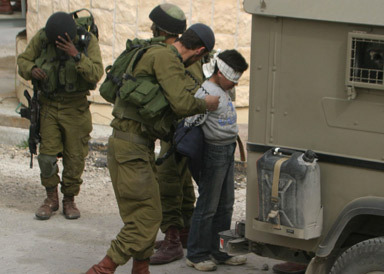
Qalqiliya – Israeli forces surrounded the Yasser Arafat School in the west end of Azzun, a town east of Qalqiliya on Monday. Troops demanded children evacuate the school so boys accused of rock throwing could be detained.
The school’s principal, Majid Odwan, said three military vehicles were stationed outside the gates of the building. Soldiers started by calling out the the children with loudspeakers demanding that they empty the school so several boys could be detained, he said.
Odwan shouted back that he refused the request and would keep children inside the school compound for the duration of their lessons, he said.
Responding to the principal’s remarks, soldiers declared that they would remain stationed outside the school until classes finished and take the children then. Soldiers remained outside the school for more than an hour, reports said.
An Israeli military spokeswoman confirmed the incident, but said a boy threw a “firebomb at an Israeli vehicle” and proceeded to “escape to a nearby school to hide out.”
Soldiers arrived to detain the child, she said, but did not in the end make an arrest.
Featured Video

New positive ivermectin evidence
or go to
Aletho News Archives – Video-Images
From the Archives
Fanatical Followers of the Covid Regime: A Jim Jones-Style Cult?
By Professor Roger Watson and Dr. Niall McCrae | The Daily Sceptic | November 15, 2021
As scholars at leading British universities over recent decades, we witnessed the replacement of critical thinking and debate by narrative: facts are discrimination and scientific method is imperialism; truth, instead, is derived from ‘progressive’ values. This educational trend may be a major contributory factor to the ease in which society has been inculcated to the Covid ‘new normal’ of masking, testing, and repeated doses of vaccines for a disease of similar risk to severe influenza.
One doesn’t need much critical reasoning to observe the flawed logic of some vaccination enthusiasts, such as people who respond to experiencing any side effects, however debilitating, by saying “at least I know it’s working”, or, after contracting the disease despite their promised inoculation (over 90% effective, according to initial drug company claims), “I’d have been worse off without the jab.” … continue
Blog Roll
 Aletho News
- Ex-Greek MEP files complaint against Israeli spyware firm over alleged Pegasus surveillance
- Troubling ideas throughout the Torah, Talmud, Mishneh Torah and Tanya
- ‘Grave, alarming’: Iran mission on Trump’s UNGA ‘annihilation’ threats
- Najaf airport to reopen to Iranian flights within 24 hours: Ambassador
- From ‘How Will This End For Iran’ to ‘When America Walks Away’: A tale of two Economist covers
- Tehran blasts ‘baseless’ speculation linking Iran to alleged bomb plot at UK air base
- The Rise And… Rise Of ‘Color Revolutions’
- The Coming GOP Bloodbath?
- Arctic Scare Stories Melt Away
- Wrong, Euronews: Climate Change Has Not Created a Food, Energy, and Economic “Meta-Crisis”
- If Americans Knew
- Netanyahu Asked UAE Leader to Deny Report on Oct. 7 Warning in Secret Visit, Sources Say
- CNN Chief Int’l Correspondent Clarissa Ward on Journalists in Gaza
- Democratic Party Consultants Surround Troy Jackson with Pro-Israel Donors
- Christian Leader Responds To Netanyahu’s Claims Regarding Palestinian Christians
- In Gaza, ‘Whoever Survives the Bombing Won’t Survive the Rubble’
- Israel kills more Palestinians, amid push to resettle Gaza – Daily Update
- Israel forces Gazans to live in constant peril – Daily Update
- Deconstructing Netanyahu’s pants-on-fire UN rant – Daily Update
- Trump betrayed voters with his campaign lies and prioritized a foreign country once he took office
- Netanyahu calls Israel’s war in Gaza ‘opposite of genocide’ in UN speech to near-empty hall
- No Tricks Zone
- New Study: Earth And Venus Surface Warmth Largely Explained By Convection And Lapse Rate, Not CO2 Or Radiation
- 2025 Nature Paper Claiming Worsening Global Drought Gets RETRACTED …Heavily Flawed
- New Study: ‘Global Drought Shows No Detectable Recent Acceleration Under Climate Warming’
- Economic Masterminds: German Socialists Suggest Taxing Productivity Gains Stemming From Using AI
- The South China Sea Has Not Been Cooperating With The Climate Change Narrative
- Energy Crisis: Germany Enters Heating Season With Historically Low Gas Reserve Fill Levels
- New Study: The Antarctic Ice Sheet Gained Mass From 2020-2024 Due To Staggering Snow And Ice Accumulation
- Study: Ocean Heating Rates From Thousands Of Years Ago ‘Dwarf’ Modern Ocean Heating Rates
- Climate Extremists Target, Attack Large-Scale Power Grid Infrastructure In Germany!
- New Study: Antarctic Ice Melt Has Contributed Less Than 1 Centimeter To Sea Level Rise In The Last 30 Years

