Former Yale professor among 4 detained by Israeli occupation forces
Ma’an – 6 May 2010
Bethlehem – A former Yale professor was among the four detained by Israeli forces during protests against the construction of the separation wall in Al-Walaja on Thursday morning.
Witnesses said three others were lightly injured by border police, who used clubs and mace against protesters, in what witnesses said was a violent removal of the protesters from their positions around Israeli military bulldozers.
A border police spokesman confirmed that four were detained at the rally, adding that all were released a few hours after their detention.
At 2pm, sources confirmed to Ma’an that at least one of the three, former Yale professor Dr Mazen Qumsiyeh, remained in custody. Family members confirmed that he was being held at the Russian Compound in Jerusalem, and may be let out on bail later in the afternoon.
The group of protesters marched to the site of construction and sat amidst the bulldozers, refusing to leave when officers demanded they disperse. The spokesman said that 20 “left-wing” Israelis were among the protesters, but did not confirm whether any were among those detained.
Those injured were identified by witnesses as Mahmud Al-Araj, 27, and brothers Ahmad and Mahmud Mustafa Al-Araj, 23 and 25. All three were taken to the Beit Jala Hospital for treatment, where medics described their injuries as mild. The others detained were identified as brothers Diya and Hasan Hamdan.
“Almost every day they attempt to halt construction,” the Israeli border police spokesman said, commenting on the conditions of the Al-Walaha protests. “They come close to the border police,” he said, “and they throw stones.”
Photojournalists and reporters at the scene said they did not witnesses stone throwing, noting protesters gather in the village center, and march toward the construction site. The gathering stops around the bulldozers digging up land in preparation for the wall, witnesses explained, and sit around the machines refusing to let them pass.
“That’s where the detentions took place today,” one organizer said, adding “I’ve been to the protests several times and never witnessed stone throwing.”
A reliable observer was quoted as saying “no stones were thrown whatsoever, not a single one,” regarding Thursday’s protest.
“If protesters act violently we have the right to use the spray,” the border police spokesman said, “the contact is very close.”
He said border police, a separate unit from the Israeli military operating at the anti-wall protests in Bil’in and Ni’lin, “have a few measures of crowd dispersal, one is the sticks, a second is the spray. There are four or five mechanisms at their disposal.”
Explaining the different tactics, the spokesman said, “here there is no fence between the protesters and the soldiers,” referencing the geographical set-up at the anti-wall rallies in Bil’in and Ni’lin, where Israeli military forces use an arsenal of riot dispersal mechanisms, including tear-gas and sound bombs, rubber coated bullets and occasionally skunk water. When pressed, however, the spokesman declined to identify the remaining tactics available to officers, saying only, “they know exactly when to use these measures.”
Turkish Relief Foundation Demands That Israel Release Its West Bank Representative
By Saed Bannoura – IMEMC & Agencies – May 06, 2010
The Turkish Relief Foundation demanded Israel to unconditionally release its representative in the West Bank, Mohammad Shahin, who was kidnapped on Wednesday April 27.
Head of the Foundation, Bülent Yıldırım, stated during a press conference in Istanbul attending by several civil society institution and the wife of Shahin, called for the unconditional release of Shahin who will appear in court Thursday.
Shahin arrived recently in the West Bank, opened the representative office of the foundation and registered for Hebrew courses at the Hebrew University. He was kidnapped at a roadblock near Bethlehem and was moved to Petah Tikva detention and interrogation facility. The army also broke into his home and searched it before confiscating his personal laptop and several files. His wife said she is concerned for the life of her husband who has been under interrogation since one week, and demanded his release.
Bülent Yıldırım stated that it is likely that Shahin was arrested for the Foundations’ activities in organizing and aiding the popular campaign to break the siege on Gaza, and added that such arrests and violations will not stop the foundation especially its upcoming humanitarian trip to the Gaza Strip in the middle of this month. He added that should Israel keep Shahin behind bars, it would expose all of Israel’s illegal activities in Turkey.
Bülent Yıldırım said that the Foundation attempted to send three lawyers to represent Shahin but the Israeli embassy did not respond.
Israel claims that Shahin endangers its security and that he has connections with “terrorist organizations”.
International solidarity activists accuse Israeli military of break-in
By Saed Bannoura – IMEMC News – May 04, 2010
When their apartment in Hebron was broken into on Saturday May 1st, the international solidarity activists stationed there said they have strong evidence that it was the Israeli military that carried out the illegal robbery.
They say that they were suspicious that this was not a regular robbery because laptops, video cameras, and flash drives were stolen – but not cash and credit cards that were left in the apartment. Similar items were taken by the Israeli military when they twice raided the International Solidarity Movement (ISM)’s office in Ramallah in February of this year.
ISM activist Beatrice Smith said, “It seems likely that this was Shin Bet [the Israeli Intelligence Service]. Our neighbours have told us twice in the past week or so that soldiers have been coming up to our apartment when we’re out and they’ve been looking through the windows. If it was a normal robber, why would they have left cash and credit cards, but taken USB sticks and memory cards? This person wanted information, not money”.
The robbery follows a recently released affidavit from Shin Bet to the Israeli High Court of Justice. In it, they admit that they have been keeping close surveillance on ISM activist Bridget Chappell, seemingly for the past several months.
Smith says, “It is clear from the surveillance and arrest of our activists, from the previous raids on our office in Ramallah, and now from the break-in here in Hebron that the Israeli authorities are determined to do all they can to stop us working here. They know that we’re non-violent, but they are scared because they don’t want the outside world to know what they are doing here. Anybody who comes here to bear witness to the occupation is a threat to them”.
Settlers take over Beit Safafa home
Ma’an – 03/05/2010
 A Jewish settler squatting in a Palestinian home in Hebron in 2006 [MaanImages/Mamoun Wazwaz]
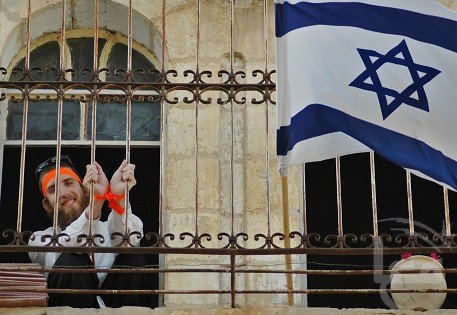
Jerusalem – East Jerusalem residents of the Beit Safafa neighborhood said Israeli police accompanied a group of settlers into the area Sunday night, where they took over a family home and set up dozens of flags overnight.
Witnesses described a moderate police presence entering the neighborhood south of the Old City. Officers reportedly entered the home and forced the two elderly residents to evacuate the building, after which at least a dozen settlers moved in.
Upon the eviction of the family, one man described, “the settlers started dancing in the yard,” and immediately began installing strings of Israeli flags around the building.
Muhammad Ibrahim Salah, resident of a nearby building and son of the man evicted on Sunday, said the eviction threatens the lives and livelihoods of at least 40 men, women and children who live on family land around the targeted building. He said the home is in the center of the family lands, where other buildings belonging to the family also stand. Sahal explained that he was worried about the fate of other buildings.
An Israeli police spokesman said he would look into the report.
On 28 April, residents said settlers evicted two elderly Palestinians from the Salah family, with an order issued by the Israeli High Court. It was not immediately clear whether the couple had moved back into the home, or if a second family was targeted.
Hajj Ali Ibrahim Salah, 99, and his wife Sheha Hassan Ali, 90, said they had lived in the home for their entire married lives, noting settler court action “started in 1993, when settlers first alleged that they bought the land where our house is built.”
The elderly man insisted that his late father bought the home with valid legal papers.
Ongoing antagonism
In October 2009, the Salah family reported being attacked by 12 settlers, though Israeli media reports at the time said the number was six while police said three.
Witnesses said the settler group pulled up to the home in a car, carrying an eviction order for the family home of Ali Ibrahim Salah and his children – the same home of the on Sunday night eviction.
At the time, Salah said the buildings sheltered 55 residents, 30 of whom were under the age of 12 and include his children, Ismail, Mohammad, Mahmoud, Ahmad. He said the settlers claimed they bought the homes from their Armenian owners.
An argument erupted as the settlers demanded the family get out of their home. One of the settlers, reportedly all in their 50s, was armed with a gun, and fired on the family members. Sources said between one and four Palestinians were injured.
The Israeli online news site Ynet said the middle-aged extremists fled the scene after the shooting, but were later found and arrested.
An Israeli police spokesman had a different version of the incident, saying, “Three Jewish people came to the home in Beit Safafa to deliver the eviction order to the family then fighting erupted. It seems one of the Jewish people opened fire with his personal weapon and injured one of the Arab residents in the hand… then the Jewish people fled the scene driving their car.”
Undercover Forces Kidnap Six Children in Raid on Village
By Saed Bannoura – IMEMC & Agencies – May 03, 2010
The Palestine Solidarity Project reported that undercover forces of the Israeli army kidnapped six children in Beit Ummar town, near the southern West Bank city of Hebron, and handed them to the army on Sunday evening.
The undercover forces, dressed as Palestinians, drove into the town in a White Ford Transit carrying a Palestinian license plate, and kidnapped six children, aged between 13 and 16. The forces then hurled several stun grenades and fired tear gas bombs into the narrow streets of the town and drove away.
One undercover soldier was hit in the head by a stone hurled by one of the protesters during clashes with the invading forces. Mohammad Awad, spokesperson for the Palestine Solidarity Project, stated that clashes took place near the Karmie Tzur illegal settlement, installed on Palestinian lands. Awad stated that it is believed that the kidnapped six youth were taken to the Karmie Tzur settlement.
Four of the six kidnapped children were identified as Hussein Shihda Sleiby, 16, Rashid Mohammad Awad, 15, Ali Said Sabarna, 16, and Odai Saady Ikhlayyil, 13.
On Sunday evening, a number of fundamentalist settlers of the Karmie Tzur settlement held a demonstration at Highway 60 and attacked several Palestinian villagers of Beit Ummar. The police arrived at the scene and used loud speakers to order the villagers back to their homes and fired tear gas and stun grenades at them instead of removing the settlers.
The army used excessive force against the villagers who were protesting the illegal settler-takeover of their land and the destruction of dozens of trees.
The Palestine Solidarity Project reported that Israeli soldiers were filmed in recent weeks while attacking and beating journalists. Also, a 10-year-old child was shot with a rubber coated bullet by soldiers from Karmie Tzur.
Video: Settler shoots at Palestinian demonstrators with soldiers present
Video: Qassem Saleh, resident of Asira al-Qibliya, volunteer with BTselems camera distribution project
On Friday, 26.2.2010, residents of the village of Asira al-Qibliya in Nablus District held a joint demonstration with Israeli activists from Combatants for Peace and Rabbis for Human Rights, protesting takeover of their lands by settlers. During the demonstration, youths from the village went over to a guard tent that settlers had erected near the outpost and took it down. Following their action, soldiers and armed settlers arrived at the scene. The soldiers fired tear gas and rubber-coated metal bullets at the demonstrators, and a settler standing near them opened fire from an M-16 rifle at the demonstrators, who posed no danger as they were running away from the spot.
Volvo equipment: Israel’s weapons to destroy al-Walaja homes
Adri Nieuwhof, The Electronic Intifada, 29 April 2010
On 16 April, approximately 100 Palestinian villagers and internationals walked towards the construction site of Israel’s wall in the occupied West Bank village of al-Walaja, four kilometers northwest of Bethlehem. When the protesters were leaving the village, four Israeli army jeeps and one police vehicle entered and surrounded a Palestinian home. At least 40 persons, including women and children, were trapped for two hours.
Meanwhile, Israeli forces raided several other homes, detaining three young men for allegedly throwing stones at Israeli forces. During the raids al-Walaja was closed off, and soldiers prevented the media from entering the area.
Six days later, Israeli bulldozers were working full speed deeper inside the village’s lands, leaving destruction in their wake. Ma’an news agency reported that border guards and soldiers had imposed a curfew early in the morning. A cameraman was denied entry to the village by the army, according to representatives of the village’s Popular Committee.
The following day approximately 200 villagers, together with a few internationals, came together for yet another demonstration. They walked from the mosque, which has an Israeli-imposed demolition order against it, to the lands which were bulldozed the previous day. Standing on the bulldozed lands, representatives of the village held speeches calling for more demonstrations. Youths used boulders to block the road used by the Israeli bulldozer operators.
A day later, approximately 50 Palestinians and internationals managed to stop the work of the bulldozers for several hours. The Israeli soldiers had to violently drag the villagers away one by one.
 |
| An uprooted olive tree in al-Walaja with the Har Gilo settlement seen in the background. |
History of injustices
The residents of al-Walaja have protested the confiscation and demolition of their property for many years. The Israeli settlements of Har Gilo and Gilo, established in the 1970s, are built on land confiscated from the village. While Israeli forces try to silence the protesters with harsh measures, Volvo and Caterpillar equipment is used by the Israeli forces in the illegal construction of the wall on the village’s land.
The old village of al-Walaja was occupied and destroyed by Zionist forces in October 1948 and its 1,200 Palestinian residents expelled. The 1948 Armistice line passed through the southern lands of the village and while most of the villagers fled to Jordan and Bethlehem, some villagers stayed on the lands of the village that were unoccupied at the time and eventually rebuilt a new town.
The remains of the old village of al-Walaja are two kilometers outside the new town, on the western side of the armistice line between Israel and the West Bank. According to Palestinian historian Walid Khalidi, a few stone houses still stand on the old village site. Today the old village of al-Walaja is used by Israeli settlers for picnicking and bathing.
Following the June 1967 war, Israel annexed the rest of al-Walaja’s lands, bringing them under the authority of the Israeli-controlled Jerusalem municipality. The villagers did not receive the right to live in Jerusalem, however, and they live under constant threat of expulsion. And while the villagers of al-Walaja are not allowed to build on their own lands, the settlement of Har Gilo is expanding.
After the Oslo accords of 1993, al-Walaja was designated “Area C,” giving Israel full military and administrative control. As a consequence, villagers who want to build a house on their own land have to ask permission from Israel. Israel denied 94 percent of the building permit requests of Palestinians in Area C of the West Bank from 2000 to 2007, according to Peace Now.
Villagers are facing increased pressure from the Israeli occupation forces to leave their land. The wall which is currently under construction will surround the village from all sides, isolating the villagers completely from their land, East Jerusalem and the old village.
 |
| Israel uses Volvo equipment to destroy homes and farmland in al-Walaja. |
Volvo equipment destroying homes
At the end of the 1980s Israel started to demolish Palestinian homes in al-Walaja and residents had to pay fines for their “illegally”-built homes. Since the outbreak of the second Palestinian intifada, Israeli forces demolished more than 24 houses in the village, according to the Applied Research Institute of Jerusalem.
On 18 March two house owners in al-Walaja found military orders in Hebrew on the front doors of their homes. The orders concern the demolition of the two houses because they are located too close to the path along which the wall will be built. The following day, volunteers from the Stop the Wall Campaign, the YMCA and other international volunteers gathered with the owners of the houses under demolition in order to show their solidarity.
ActiveStills photographer Anne Paq witnessed Volvo equipment being used to destroy a home in the nearby village of al-Khader. Two days earlier she had taken pictures of Volvo and Caterpillar equipment working between the road and the fence of Har Gilo settlement, just a few meters away from Palestinian houses in al-Walaja. There was an Israeli police car parked next to the works. When Paq asked what they were building, they refused to answer.
Two years ago The Electronic Intifada first reported the use of Volvo equipment in Israel’s violations of international law in the occupied West Bank. So far the company has taken no action to investigate the use of its equipment in Israeli violations of Palestinian rights.
Volvo Group’s vice president of media relations and corporate news, Marten Wikforss, wrote in response to The Electronic Intifada’s report: “we do not have any control over the use of our products, other than to affirm in our business activities a Code of Conduct that decries unethical behavior.”
While the villagers of al-Walaja steadfastly continue their protest against the construction of the wall, the confiscation of their land and the destruction of their property, Israeli forces are increasing the oppression. Some houses have been rebuilt three or four times. Director of the Joint Advocacy Initiative of the East Jerusalem YMCA and YWCA, Nidal Abu Zuluf, explained: “Israel’s current repressive policies aim to prevent acts of popular resistance. They don’t want the media and internationals to be around.”
Perhaps neither does Volvo, as its equipment continues to be photographed destroying Palestinian homes and violating Palestinian rights.
Walled Horizons
OCHAoPt — November 11, 2009 — Walled Horizons is narrated by and features Roger Waters (founding member of the rock band Pink Floyd), who visits the Wall in the Palestinian territories and comments on his observations as a musician and a songwriter who has written on walls. The film explores how Palestinians in urban and rural areas have been impacted by the Walls construction since the International Court of Justices Advisory Opinion in 2004, which declared the Wall’s route in the West Bank illegal. Several senior Israeli security officials are interviewed in the film, two of whom were directly responsible for planning the Wall route and who explain the Israeli position for constructing it. The film was made by the United Nations Jerusalem. http://www.ochaopt.org
“Egypt Responsible For The Death Of Four, Gassed In Tunnel”
By Saed Bannoura – IMEMC & Agencies – April 29, 2010
 Dr. Sami Abu Zuhri, media spokesperson of the Hamas movement, held the Egyptian Authorities responsible for the death of four Palestinians who died in a tunnel after Egypt’s Border Police gassed it.
Abu Zuhri demanded Egypt to conduct an immediate probe into the issue, and to prosecute those in charge.
Speaking at a press conference in Gaza, Abu Zuhri said that Hamas is following the developments, and strongly denounced Egypt for using gas against the residents. Besides the four who were gassed to death, two residents are currently in serious conditions. He added that this is not the first time Egypt uses gas in the tunnels as 45 residents previously died after being gassed in different tunnels, and a total of 145 residents were killed in different accidents and incidents.
The Hamas spokesperson said that the Palestinians need the tunnels, and resorted to them due to the urgent necessity due to the ongoing siege on the Gaza Strip. He further stated that the solution is not killing the residents, and added that the solution is opening all border terminals.
Abu Zuhri demanded the Arab League to act immediately and end the siege.
Photo credit – Ma’an Images
Defending their land
ActiveStills — April 26, 2010
Report from the Popular Struggle Coordination Committee:
Palestinian, Israeli and international demonstrators managed to stop the construction of the Wall in the village of al Walaja, south of Jerusalem for the second time this week. If completed, the path of the Wall in the area will surround the village completely, isolating it from all its lands, the cities of Bethlehem and Jerusalem and essentially the rest of the world.
Demonstrators managed to block the bulldozers in the early morning, and even climb and take over one of the machines. A Border Police force at the scene arrested on of the demonstrators – 15 year old Nabil Hajajla – who was beaten and pepper-sprayed. Following Hajajla’s arrest, Border Police officers managed to drag the demonstrators away from the bulldosers and construction was resumed.
Al-Walaja is an agrarian village of about 2,000 people, located south of Jerusalem and West of Bethlehem. Following the 1967 Occupation of the West Bank and the redrawing of the Jerusalem municipal boundaries, roughly half the village was annexed by Israel and included in the Jerusalem municipal area. The village’s residents, however did not receive Israeli residency or citizenship, and are considered illegal in their own homes.
Once completed, the path of the Wall is designed to encircle the village’s built-up area entirely, separating the residents from both Bethlehem, Jerusalem, and almost all their lands – roughly 5,000 dunams. Previously, Israeli authorities have already confiscated approximately half of the village’s lands for the building of the Har Gilo and Gilo settlements, and closed off areas to the south and west of it. The town’s inhabitants have also experienced the cutting down of fruit orchards and house demolition due to the absence of building permits in Area C.
According to a military confiscation order handed to the villagers, the path of the Wall will stretch over 4890 meters between Beit Jala and alWallaja, affecting 35 families, whose homes may be slated for demolition.
Beit Jala is a predominantly Christian town located 10 km south of Jerusalem, on the western side of the Hebron road, opposite Bethlehem. Once completed, he Wall will Isolate 3,200 Dunams of the town’s lands, including almost 3,000 Dunams of olive groves and the only recreational forest in the area, the Cremisan monastery and the Cremisan Cellars winery.
Settler Sewage Ruins Palestinian Crops, Drinking Water
By Mel Frykberg | IPS | April 28, 2010

BEIT UMMAR, West Bank – Residents of this Palestinian village refuse to buy the idea that the flood of raw sewage from the adjacent Israeli settlement of Kfar Etzion, that destroyed vineyards and contaminated their drinking water, was an accident.
The Israeli Civil Administration, which administers the occupied West Bank, claims the spillage was the result of an accidental power malfunction which caused excess settlement sewage to overflow onto Palestinian land.
“This was no mistake,” says a British activist who has been documenting life in the village for several months. “The pipe was deliberately unscrewed by hand so that the sewage would spill over into Beit Ummar. That has nothing to do with an electricity cut,” he told IPS.
Villagers standing near a completely destroyed 70,000 sq m vineyard belonging to the Sabarneh family said they believe it was a deliberate act of sabotage and part of a concerted campaign by the settlers to harass their Palestinian neighbours and vandalise their property.
Beit Ummar has been the target of a number of Israeli military raids at night last month. Activists who have been organising non-violent protests against the expropriation of their land for the settlements have been arrested and the village blockaded.
In a similar incident last week the Palestinian village of Bruqin, in the northern West Bank, was flooded with sewage from the nearby Ariel settlement, causing contamination of underground water and springs and damaging crops.
These incidents are part of a larger problem of scarce water resources where a Palestinian population of 2.5 million survives on 17 percent of the West Bank’s main underground aquifer.
The remaining water is channelled towards the West Bank’s (including East Jerusalem) 500,000 Israeli settlers, and into Israel proper.
The water shortage is compounded by the lack of wastewater treatment plants and inefficient treatment of waste and sewage in the Palestinian territory which fouls its water sources.
Israeli rights group B’tselem released a study last year called ‘Foul Play: Neglect of wastewater treatment in the West Bank’.
According to the organisation, more than 90 percent of Palestinian wastewater is not treated while only 20 percent of Palestinian homes, primarily in towns and cities, are connected to sewerage systems.
Furthermore, only 81 of 121 illegal Israeli settlements are connected to wastewater treatment facilities. Over half of the settlements’ treatment plants are too small to treat waste effectively and are ill-equipped to handle the burgeoning settler population.
The result is continual technical breakdowns and sewage overflow. Most of the settlements are situated on ridges and hilltops so sewage flows down towards the Palestinian villages and towns in the valleys below, contaminating their drinking water supplies and destroying their crops.
The Israeli settlers are not affected by this as they are connected to Israel’s water supply.
The planning and building authorities in the settlements and Israeli industrial areas also ignore Jordanian building and planning laws which govern how wastewater is to be treated in the West Bank.
The B’tselem report further outlines the neglect of the territory’s water treatment plants by the Israeli Civil Administration during the decades of occupation and the current difficulties faced by Palestinian Authority (PA) water officials in trying to build new wastewater treatment plants or repair the old ones.
There is currently only one wastewater treatment plant operating in the West Bank in Ramallah. Three others have ceased to function and the PA has been unable to repair them or build new ones.
The West Bank is divided into Area A, which is under Palestinian control, Area B under joint Palestinian and Israeli control, and Area C which is under full Israeli control.
Area C comprises 60 percent of the West Bank. Areas A and B are mostly built up with little free land available.
However, in order to move around or build new wastewater treatment plants in Area C Palestinian officials from the PA Environment Authority require building permits from the Israeli Civil Administration.
B’tselem and PA officials complain of the delays these officials face in getting building approval if they get them at all.
“There is an enormous amount of red tape and bureaucracy that Palestinian officials have to overcome before they get the permits,” says Eyal Hareuveni, the author of the B’tselem report.
“The Israeli Civil Administration says that the Palestinians don’t provide the necessary detailed building plans as they have been instructed but I think the administration is being deliberately difficult,” Hareuveni told IPS.
Issa Moussa from the PA’s Environmental Authority denied that the PA provided insufficient details.
“We have the case of wanting to build a new wastewater treatment plant in Tulkarem in the northern West Bank. We provided absolutely everything requested but we were still waiting for a permit,” Moussa told IPS.xxxxx
Other difficulties facing the more efficient handling of wastewater are the restrictions placed on Palestinian movement in the West Bank by the Israeli military. This has led to increased costs for donors who support wastewater projects and who in turn have cut down on their expenditure.
A Joint Water Committee between Israel and the PA was established following the Oslo Peace Accord of 1993, to address water issues.
One of the disputes between the sides is the Israeli insistence that settlement sewage be connected to future Palestinian wastewater treatment plants.
The Palestinians reject this as this implies that the settlements are permanent and say their refusal to approve this condition is one of the reasons for approval being withheld on the construction of wastewater plants.
With no higher authority to settle the disagreement the situation will only worsen in the future.
“Neither side seems to be making the urgent issue of water and waste treatment a priority,” Hareuveni told IPS.
Japan premier approval rating drops
Press TV – April 26, 2010
Japanese Prime Minister Yukio Hatoyama’s approval rating has dropped sharply as a row over the US military presence heats up in the country. More than two-thirds of the respondents to an opinion poll published by the Nikkei newspaper have disapproved of Hatoyama’s policies. The survey shows that public disapproval of Hatoyama’s performance has jumped by more than ten percent in just a month.
The survey comes a day after tens of thousands of protesters rallied on the southern island of Okinawa. They gathered to call on Tokyo to move an unpopular US airbase off the island. The protesters lambasted the primier for failing to keep his campaign promise of moving the base to another location or even outside the country.
Hatoyama is facing growing criticism over his failure to settle the row over the base. The Japanese premier has promised to resolve the matter before the end of May. Fifty-seven percent say Hatoyama should resign if he does not meet his deadline to resolve the dispute.
Some 47,000 US troops are based in Japan, with more than half of the soldiers stationed in Okinawa. The issue has threatened the political future of Hatoyama with both Washington and his political allies putting him under pressure to find a solution to the deadlock.
Featured Video

New positive ivermectin evidence
or go to
Aletho News Archives – Video-Images
From the Archives
Fanatical Followers of the Covid Regime: A Jim Jones-Style Cult?
By Professor Roger Watson and Dr. Niall McCrae | The Daily Sceptic | November 15, 2021
As scholars at leading British universities over recent decades, we witnessed the replacement of critical thinking and debate by narrative: facts are discrimination and scientific method is imperialism; truth, instead, is derived from ‘progressive’ values. This educational trend may be a major contributory factor to the ease in which society has been inculcated to the Covid ‘new normal’ of masking, testing, and repeated doses of vaccines for a disease of similar risk to severe influenza.
One doesn’t need much critical reasoning to observe the flawed logic of some vaccination enthusiasts, such as people who respond to experiencing any side effects, however debilitating, by saying “at least I know it’s working”, or, after contracting the disease despite their promised inoculation (over 90% effective, according to initial drug company claims), “I’d have been worse off without the jab.” … continue
Blog Roll
 Aletho News
- ‘Grave, alarming’: Iran mission on Trump’s UNGA ‘annihilation’ threats
- Najaf airport to reopen to Iranian flights within 24 hours: Ambassador
- From ‘How Will This End For Iran’ to ‘When America Walks Away’: A tale of two Economist covers
- Tehran blasts ‘baseless’ speculation linking Iran to alleged bomb plot at UK air base
- The Rise And… Rise Of ‘Color Revolutions’
- The Coming GOP Bloodbath?
- Arctic Scare Stories Melt Away
- Wrong, Euronews: Climate Change Has Not Created a Food, Energy, and Economic “Meta-Crisis”
- New positive ivermectin evidence
- Met Office Caught Fabricating Daily Temperature Record Claims
- If Americans Knew
- Netanyahu Asked UAE Leader to Deny Report on Oct. 7 Warning in Secret Visit, Sources Say
- CNN Chief Int’l Correspondent Clarissa Ward on Journalists in Gaza
- Democratic Party Consultants Surround Troy Jackson with Pro-Israel Donors
- Christian Leader Responds To Netanyahu’s Claims Regarding Palestinian Christians
- In Gaza, ‘Whoever Survives the Bombing Won’t Survive the Rubble’
- Israel kills more Palestinians, amid push to resettle Gaza – Daily Update
- Israel forces Gazans to live in constant peril – Daily Update
- Deconstructing Netanyahu’s pants-on-fire UN rant – Daily Update
- Trump betrayed voters with his campaign lies and prioritized a foreign country once he took office
- Netanyahu calls Israel’s war in Gaza ‘opposite of genocide’ in UN speech to near-empty hall
- No Tricks Zone
- New Study: Earth And Venus Surface Warmth Largely Explained By Convection And Lapse Rate, Not CO2 Or Radiation
- 2025 Nature Paper Claiming Worsening Global Drought Gets RETRACTED …Heavily Flawed
- New Study: ‘Global Drought Shows No Detectable Recent Acceleration Under Climate Warming’
- Economic Masterminds: German Socialists Suggest Taxing Productivity Gains Stemming From Using AI
- The South China Sea Has Not Been Cooperating With The Climate Change Narrative
- Energy Crisis: Germany Enters Heating Season With Historically Low Gas Reserve Fill Levels
- New Study: The Antarctic Ice Sheet Gained Mass From 2020-2024 Due To Staggering Snow And Ice Accumulation
- Study: Ocean Heating Rates From Thousands Of Years Ago ‘Dwarf’ Modern Ocean Heating Rates
- Climate Extremists Target, Attack Large-Scale Power Grid Infrastructure In Germany!
- New Study: Antarctic Ice Melt Has Contributed Less Than 1 Centimeter To Sea Level Rise In The Last 30 Years

