At D.C. conference, Goldstone has a defender at the top of his game
By Chase Madar on March 31, 2010
The panel on the Goldstone Report was, as expected, one of the highlights of the 104th conference of the American Society of International Law held last week in the basement of the Ritz-Carlton in Washington DC.
(The other highlights? Harold Koh, the State Department’s top lawyer, unveiled the legal rationale for targeted killings via drone aircraft in Afghanistan and Pakistan; Professor Antony Anghie’s showcased lecture on the centrality of imperialism to the history of international law; Anne-Marie Slaughter, Director of Policy Planning at State, informed us that the age of power wielded over others is nearly gone; what the youngsters now talk about is wielding power with others. Callooh callay!)
But the Goldstone Report. It may be too much to call it the most controversial international legal document of the year, as the report went down quite smoothly in most of the world. But not in Israel or the United States, whose governments have condemned the inquiry as irredeemably biased against the Israeli Defense Forces. The ASIL panel would deal with this issue of alleged bias.
The panel was really a debate, ably moderated by Lucy F. Reed, president of ASIL. Defense of the report was mounted by Omar Dajani, a former legal advisor to Palestian peace talk team, corporate litigator at Sidley & Austin, and now a professor at McGeorge School of Law in Sacramento. The report was attacked by Abraham Bell, former clerk at the Supreme Court of Israel and a law and economics scholar University of San Diego. Dajani argued that the report is a very conservative document, upholding strictly construed norms and categories of international law, “toeing the line” against those who would rewrite the laws of war to the advantage of the IDF. Bell argued that the report is a “radical” document, bending international law past the breaking point.
Bell did the best he could, but I think Dajani carried the day. He was lucid, calm and argued with the appropriate degree of passion. Bell could really only nitpick, cast vague aspersions on the report’s “tone,” and talk about how tough it is to wage asymmetric war against a weaker, worse-armed enemy. (Dajani however evinced no such self-pity.) Bell denied, weirdly, that Gaza is under occupation.
Questioners were pretty evenly divided between supporters and critics of the report.
One questioner, a ponytailed gentleman from University of Tennessee, found it horribly unfair that Israel should be the target of so many General Assembly resolutions. Is there a double standard operating at the UN? Yes there certainly is, Dajani quickly responded, and this double standard is at the Security Council, where the US automatically vetoes any resolution against Israel. This leaves the General Assembly as the only forum for motions against Israeli violations of international norms. And these General Assembly motions are not much of a consolation prize, as the real power resides in the Security Council—a fact lost on most of the general public, and on many lawyers too.
Another questioner, Daniel Joyner of University of Alabama, asked Bell what Gaza’s status was, if it is indeed “unoccupied territory”—is it sovereign territory like Switzerland? Is it terra nullius like Antarctica? For it can only be one or the other. Bell’s response was curt and legalistically absurd: “Gaza’s status is… not occupied.”
“Right, except for its airspace and its borders and often its land,” Dajani quickly chimed in.
For his part, Dajani made no such auto-goals. It was nice to see that the Goldstone report had a defender on the top of his game.
Was this ASIL conference panel a new departure into real fairness and evenhandedness? Not really. Joyner, who has been to seven or eight of these ASIL confabs, told me that this crowd—highly educated, many of them non-American—has generally, but by no means unanimously, been open to international law arguments against Israel’s colonial domination of Palestine.
As for the related question of “lawfare,” it popped up throughout the conference. Not the neocon condemnations all legal challenges to Israel and America’s uses of force, but rather lawfare advocacy on the other side: folks eager to bend, rewrite and “update” the laws of war to the benefit of the American imperial project and its client states. There was Harold Koh justifying targeted killings via UAVs (drones) in Afghanistan and Pakistan. There was young Ganesh Sitaraman, of Harvard lamenting that international lawyers are not sufficiently “engaging” with this marvelous new technique of counterinsurgency warfare.
All to be expected, for the waging of lawfare is as old as international law itself; one could even argue that lawfare is the beating heart of international law. Let us not forget that the great Grotius, august 17th century father of international law, was also Huig de Groot, a picaresque shyster whose first legal treatise was a fast-talking apologia for Dutch privateers. The ASIL conference reaffirmed again and again the inherent two-facedness of international law. Yes it is quite true that international law has at times stood tall against overweening power. But at least as often international law lubes and legitimates the actions of the strong against the weak.
Chase Madar is a lawyer in New York.
IOF assaults on Land Day demos: 4 youths shot at close range
Eva Bartlett | In Gaza | March 31, 2010

Four non-violent demonstrators were shot at close range with live ammunition by Israeli soldiers during six simultaneous protests throughout the Gaza Strip commemorating “Land Day”.
Three of those injured come from Khoza’a, a village east of Khan Younis in Gaza’s south. The fourth, from Deir al Balah, was participating in a peaceful demonstration east of Meghazi, central Gaza.
The Khoza’a demonstration neared the border shortly after 12 noon. Israeli jeeps stopped along the Green Line border, their number increasing quickly. Israeli soldiers exited their jeeps and assumed sniper positions on a raised dirt mound and along the border fence.
Jemah Najjar, 22, was the first to fasten a Palestinian flag to the border fence in today’s demonstration. He was also the first injured in the Khoza’a region, roughly 10 minutes after he had placed the flag on the fence, he estimates.
Israeli soldiers repeatedly opened fire on the very visibly unarmed demonstrators, without any verbal warning, nor without warning shots in the air.
Pieces of the IOF bullet which struck Jemah Najjar are still lodged in his head. He will require an operation to remove them, if it is possible.


Walla’a Najjar, 18, was shot just above the kneecap by an IOF soldier at close range.
“I saw the soldier who shot me. He didn’t give any warning, just shot me right away.”
Walla’a Najjar is fortunate that the bullet did not hit an artery, although as it was he was bleeding heavily. Doctors say his leg has been fractured by the bullet. Palestinian medics confirm that in their experience Israeli soldiers routinely aim for the upper thigh area where an artery lies. If not treated quickly, victims can bleed to death from an artery injury.

Hani Najjar, 17, also has bullet shrapnel in his body. “The Israeli soldier was lying on a dirt mound across from us. He fired at me without warning.”
The bullet, fired from a distance of roughly less than 50 metres, hit below Hani Najjar’s knee. He will need an operation to remove the multiple pieces of shrapnel deeply embedded in his flesh. He had planned on attending the demonstration and continuing on to his nearby high school.
Fellow protestors carried the injured roughly half a kilometer to a place which ambulances could access. The border region is notoriously dangerous for all, including medics who under international law should have unheeded access to the injured. But through experience, medics in Gaza know they cannot reach victims in the border regions.

Mohammed Ot’ti, 21, from Deir al Balah, was in a demonstration further north along the border, east of Meghazi camp, central Gaza.
Ot’ti was the first to place a flag on the fence in his demonstration and was shot immediately after by an Israeli soldier, at close range.
“Last time they shouted at us and mostly fired in the air,” Ot’ti said, referring to last week’s demo in Waddi Salqqa. “This time, they didn’t say anything or give any warning. They just shot me.”
Like the others, Ot’ti says when he is healed, he’ll resume going to the demonstrations.


Mahmoud Az Zaq, co-coordinator of the Committee Against the Buffer Zone, said: “The Israelis should have fired warning shots, but instead they just shot directly at the youths”
Ma’an news reports that an Israeli military spokesman said an investigation showed “soldiers operated in accordance with accepted dispersal procedures,” in regards to the IOF violence against unarmed protestors.
To commemorate Land day, the Committee Against the Buffer Zone and the Local Initiative from Beit Hanoun organized 6 protests, in Rafah, Khoza’a, Meghazi, Karni, Beit Hanoun and Beit Lahiya.
Land Day remembers the murder of six Palestinians 34 years ago who were themselves protesting the Israeli annexation of Palestinian land.
Today’s protests are the latest in demonstrations growing in frequency and numbers, protesting the Israeli-imposed “buffer zone” and calling for the rights of Palestinians to work and live on their land, without threat of being shot or abducted by Israeli soldiers.
In May 2009, Israeli planes leafleted “buffer zone” areas re-iterating the Israeli imposition of a 300 metre off-limits area, within which anyone is subject to Israeli fire. In reality, Israeli soldiers shoot up to 2 km on farmers and civilians on their land, including children and women.
In Land Day commemorations yesterday and today, Palestinians throughout occupied Palestine tended olive and fruit trees, dressed in traditional Palestinian clothing, danced Dabke and showed the Palestinian spirit which until now has not been quashed by Israeli brutality.
CPT report corroborates family account of child arrest
Ma’an – 31/03/2010
 A photo of Suhad provided by her father [MaanImages]

Bethlehem – A report from Christian Peacemaker Teams in Hebron confirmed reports of the detention of a 13-year-old girl by Israeli forces last week.
At the time, an Israeli military spokesman said he had no knowledge of the incident, which was left uncorroborated until a CPT report was released on Thursday.
According to the report, “At about 5:45pm , CPTers followed four soldiers as they entered the girl’s home and ordered the entire family to the roof. Once on the roof, a fifth soldier from a permanent post on a neighboring Israeli settler home ordered the family’s three teenage daughters to one side of the roof.
“The soldier singled out the 13-year-old and accused her of throwing a stone. The girl’s mother protested saying that minutes before she had notified this soldier of settlers throwing stones at her as she hung her laundry and that he had seen settlers throwing stones. She was dumbfounded that the soldier’s response was to call another unit of soldiers to detain her daughter.
“Two more units of soldiers arrived at the house before escorting the girl out of her home. The girl’s aunt attempted to prevent the soldiers from taking the girl by linking arms with her and refusing to let go. After a five-minute stand off, soldiers stated that the aunt could accompany the girl and the group of eighteen soldiers escorted them both away to a military jeep. Israeli police arrived, arrested the girl and took her and her aunt to a police station for questioning and fingerprints.”
Ma’an had identified the child as Suhad Al-Ewaiwi, whose father contacted the Palestinian Prisoners Society shortly after his daughter was taken from their home. Lawyer with the society, Muhammad Shahin, said he called Israeli police, who told him settlers accused the girl of throwing stones at them.
Report: British MPs call for review of arms export to Israel
Ma’an/Agencies – 30/03/2010
Bethlehem – A group of British lawmakers will call on Tuesday for a review of the way arms deals to Israel are approved, after the government admitted British equipment was “almost certainly” used during Israel’s Operation Cast Lead, British media reported.
The British daily The Guardian quoted a House of Commons report on strategic exports controls, which stated, “it is regrettable that arms exports to Israel were almost certainly used in Operation Cast Lead [the attack on Gaza].
“This is in direct contravention to the UK government’s policy that UK arms exports to Israel should not be used in the occupied territories,” the report read.
Those MPs making the call for a review said they welcomed the British government’s decision to revoke five export licenses for equipment “destined to the Israeli navy,” the daily wrote, with lawmakers adding that “broader lessons” must be learned from such a review to “ensure British arms exports to Israel are not used in the occupied territories in the future.”
British Foreign Secretary David Miliband told the House of Commons following Israel’s devastating assault on the Gaza Strip between December 2008 and January 2009 that left some 1,400 Palestinians dead, that all future arms exports to Israel “will be assessed taking into account the recent conflict,” adding that Israeli equipment used during its war on the coastal enclave likely used British-supplied parts such as cockpit displays in US F16 combat aircraft, fire control and radar systems, navigation and engine assemblies for US Apache helicopters, the daily reported.
Additionally, arms sold to Israel included parts for guns and radar in Israeli Sa’ar-class corvettes which took part in the operation, and armored personnel carriers adapted from Centurion tanks sold to Israel in the 1950s.
The government-approved exports to Israel are estimated to be over 27.5 million British pounds for 2008, the House of Common’s report said, with various governmental departments approving nearly 4 million British pounds worth of export licenses for weapons and equipments with both military and civil use in the nine months following the attack on Gaza, The Guardian reported.
“Though this suggests a significant drop, the figures show Britain was continuing to sell Israel a wide range of military equipment, including small-arms ammunition and parts for sniper rifles,” the daily added.
Approved exports include remote ground-sensors, electronic warfare equipment “components for snipers,” “small arms ammunition” and “test equipment for recognition/identification equipment,” the report said.
The report further revealed that the British government decided to revoke a number of arms sales’ licenses to Sri Lanka, saying it regreted that British arms were sold during the ceasefire periods in the conflict with the Tamil Tiger rebels.
The call for a review on the way the British government approves arms deals with Israel follows their decision to expel an Israeli diplomat over the use of forged UK passports in an alleged Israeli hit of a Hamas leader in Dubai in January.
Stuck between a wall and an occupation
Nora Barrows-Friedman writing from Aida Refugee Camp, Bethlehem, Live from Palestine, 29 March 2010
 |
Bilal Jadou standing atop a home in the Aida refugee camp. His house, on the other side of the wall, can be seen off in the distance. |
When Bilal Jadou’s grandmother was sick last year, and in need of immediate medical care, the family called the Jerusalem emergency service and requested an ambulance — only to hear on the other end of the line that no Israeli ambulances would be permitted to reach the house without permission from the Israeli military. “Try the Bethlehem ambulance service,” the emergency dispatcher told Jadou. When he called the Bethlehem ambulance, they told him to have his grandmother meet them at the other side of the main Bethlehem-Jerusalem checkpoint because they weren’t allowed to cross. Jadou’s house is on the other side of the sprawling apartheid wall, separated from his community and the West Bank, and in a permanent state of oppressive bureaucratic and administrative limbo as nearby settlements are intended to spread onto his land.
The Electronic Intifada correspondent Nora Barrows-Friedman interviewed Jadou, 26 years old, about his situation. They spoke inside Aida refugee camp, in Bethlehem.
Nora Barrows-Friedman: Tell us about your situation and why this story is so important in the context of what’s happening here in the Bethlehem area, especially in Aida camp, which is right up against the wall, cutting the land of families here in half.
Bilal Jadou: My family is separated from each other. We used to live in the refugee camp here and in our other house that used to be within five minutes walking distance from here. Since the wall was built, we can’t communicate as a family. Some of us live in this house in Aida, and the others live in our other house on the other side of the wall.
I have six brothers and three sisters. Two of the brothers, including me, and one of our sisters, are allowed by Israel to live in the house on the other side of the wall. No one else is allowed to be there. Now it sometimes takes two hours to cross the checkpoint in Bethlehem to see our family in Aida camp. Other times, the Israelis close the checkpoint entirely and we can’t see each other at all.
NBF: How did the Israelis choose who was able to live in the house on the other side of the wall?
BJ: They said it was purely because of “security reasons,” and we still don’t know why some got permission and some didn’t. Also, we can’t add anything to the house; we can’t build onto the house. At any time, they can come and take my permission and say it’s for “security reasons.”
NBF: Do you have a special ID card now? Such as a Jerusalem residency card? How are you identified as someone who lives on the other side of the wall?
BJ: I still have a West Bank Palestinian ID, with a special permission slip for just the Tantur area [where the house is]. If Israeli police catch me anywhere else other than at my house, or if they catch me working inside Jerusalem, they will take my permission away. I can just be inside the house, and nothing more.
 |
The Israeli wall runs along the Aida refugee camp |
NBF: So, if you want to buy groceries, or go to the bank, or get gasoline for your car, or get to the hospital, what do you do?
BJ: We can’t do any of these things. I can’t even drive a car inside the area near the house. We’re not allowed. We can’t even take a taxi to the checkpoint. We have to walk. If we want to buy groceries, we can only buy them inside the Palestinian territories. But we are not allowed to bring anything from inside the Palestinian territories to my house. So the only way I can get food and supplies to my house is to have friends inside Jerusalem buy our groceries, or whatever we need, and bring them to us.
We have no services except water and electricity, which come from the Palestinian side of the wall. Israel won’t allow us to have anything else. It’s a way to push us to leave this area and go to the other side of the wall. This is the only reason they’re doing this to us.
My grandmother got sick and we called the Israeli ambulance. They told us to coordinate with the Israeli soldiers, who then refused to allow the ambulance to reach us. The Palestinian ambulance told us that since they couldn’t cross the checkpoint, we had to bring my grandmother to the checkpoint and they would take her to the hospital in Bethlehem. Since we couldn’t use a car to bring her to the checkpoint, we put her on a donkey and walked her over there. But before we reached the checkpoint, my grandmother died.
NBF: On the other side of the wall, there is a lot of land that was cultivated by families in Beit Jala and Aida camp until the wall was completed in 2004. And then you have Gilo and Har Gilo settlements, right next to your house on the other side. Talk more about this policy of taking land, using the wall to separate communities, and forcing Palestinians to stay inside these ghettos in the West Bank.
BJ: There is a lot of land near our house owned by Palestinians. But we’re the last family who are allowed to stay there. Just a few months ago, we tried to expand our house a little bit; we built a shed that was only two meters squared. The Israeli police came and told us that we had to stop building. If we want to fix the house, the police come. If we paint our house, the police ask us to remove the paint. But then you look across the street, and you see Gilo settlement with their cranes and bulldozers and construction teams building all the time, expanding all day long.
NBF: The police come often to check to see if you have put paint on the walls. But what about the treatment you receive by settlers?
BJ: The settlers attacked us once. They built a fence around our house and told us to leave. But we went to the court to prove that this was our house, with deeds and documents since the Ottoman period. The court gave us back our land and the permission to stay on our land. Most of the time, though, we get the most terrible treatment from the Israeli soldiers. They come and attack us. Once, they came and took all of our furniture from inside the house and threw it outside. They told us, “find another place to live!” They sometimes come at 2:00 in the morning, taking us outside of the house, and searching to make sure we haven’t built anything or fixed anything inside the house.
I was once told by a soldier, after he took my ID card one night, to go to the checkpoint to retrieve it. I got to the checkpoint, and the soldier called me on my mobile phone, telling me that he was outside of the house, and I should come back to get it. I went back to the house, and then he called and said that he was at the checkpoint. This went on until 6:00 in the morning. Sometimes they take my ID card to other checkpoints so I’m forced to travel a long distance to retrieve it. They’re trying to put a lot of pressure on us so that we leave the area and they can expand the settlement.
NBF: Tell me about your family’s history. We’re sitting inside your home in the refugee camp. Where was your family from, originally, before they were expelled in 1948?
BJ: Originally, we’re refugees from al-Malha. It’s just one kilometer away, five minutes away by car. Some of my family fled in 1948 and came here. Even part of the refugee camp is on al-Malha land, inside the West Bank borders. When the Israelis invaded and occupied the West Bank in 1967, some of the family decided to go back to the house in al-Malha, inside the so-called Israeli area. So now we’re separated into three parts — my family in Aida camp, my brothers and sisters inside the house on the other side of the wall, and the rest in al-Malha. We haven’t been together as a family — we haven’t all sat down to dinner together — for six years.
Sometimes, if something is happening inside the camp, like a wedding for a friend or neighbor, we have to leave our house at nine in the morning to be sure we’re at the wedding by three in the afternoon. We’re affected a lot by the separation.
NBF: It used to take you five minutes to get to the camp from the house before the wall was built.
BJ: Yes, five minutes, not more. Sometimes, if I walk quickly, it used to take three minutes. Now, it’s half an hour just to walk to the checkpoint. Then I spend sometimes two, three hours inside the checkpoint.
NBF: What do you think about the next generation of Palestinians who are facing similar situations? When you get married and have children, what do you want for them?
BJ: I hope everything changes. The situation is extremely difficult, and I hope that the new generation can live in peace without any conflicts. Actually, when you mentioned marriage, this is a very depressing issue for me. I tried to get married recently. But I can’t, because I’m living in this area. If I marry a girl from Bethlehem, I can’t live with her in Bethlehem because then I’d have to move to the city and lose my land and my house. If I want to marry a girl from Jerusalem, she’d refuse. I don’t have an Israeli ID and I can’t go anywhere inside Jerusalem. This is no way to make a family. So I’m stuck.
I think I’ll never get married, because I need to protect my house. Maybe there’ll be a solution soon, and things will change.
All images by Nora Barrows-Friedman.
Nora Barrows-Friedman is the co-host and Senior Producer of Flashpoints, a daily investigative newsmagazine on Pacifica Radio. She is also a correspondent for Inter Press Service. She regularly reports from Palestine, where she also runs media workshops for youth in the Dheisheh refugee camp in the occupied West Bank.
Obama Declares Afghan War ‘Absolutely Essential’
Insists America Will Never Abandon Conflict
By Jason Ditz | March 28, 2010
 Underscoring his administration’s commitment to continue the already eight and a half year long occupation of Afghanistan, President Barack Obama made a surprise visit today and delivered a speech declaring the war ‘absolutely essential.’
Citing 9/11, President Obama insisted that continuing the conflict makes all Americans safer, and assured the troops that “everyone” knows the importance of the continued occupation of the landlocked nation.
He also threw water on the notion that the war might come to an end any time soon, saying “the United States of America does not quit once we start on something.” He reiterated his confidence that the US would ultimately prevail.
But despite pledging to give the troops a clear mission and a clear goal, and insisting that they would “get the job done,” he didn’t make it at all clear what exactly this job was. His only hint at any mission beyond endless conflict was a reference to al-Qaeda in the region, though administration officials have repeatedly conceded that there are virtually no al-Qaeda members left in Afghanistan, and have not been in some time. Yet momentum and a sufficiently hawkish administration suggests the conflict will continue to find enemies wherever it can and continue indefinitely.
.
Hamas: We have the right to retaliate against Israel’s incursions and crimes
Palestine Information Center – 27/03/2010
GAZA — Senior Hamas official Ismail Radwan stated Friday that the Palestinian resistance has the right to respond to Israel’s incursions into the Gaza Strip, and its daily violations and crimes against the Palestinian people and their holy sites.
In a press statement to the Palestinian information center (PIC), Radwan stressed that the operation of Khan Younis confirmed that the resistance is still alive and the Gaza Strip is not easy to invade.
He warned that the Israeli occupation has to think a thousand times before making foolish steps against the Islamic holy shrines in Palestine, adding the Palestinian resistance is able to retaliate to Israel’s crimes in the manner it deems appropriate.
For his part, Hamas spokesman Sami Abu Zuhri said that the commando operation of Khan Younis proved his Movement’s adherence to the resistance option and its keenness on the protection of the Palestinian people.
In the same context, the Israeli occupation forces (IOF) admitted that two of their troops were killed and five others were wounded during an incursion into the eastern area of Khan Younis.
The IOF spokesman said on Friday that a deputy commander in the Golani brigade and another officer of low rank were killed and five other soldiers were injured, one of them in a serious condition, when a big explosive device was detonated near Kissufim crossing, east of Khan Younis.
The spokesman acknowledged that the soldiers were killed and wounded after they carried out an incursion east of Khan Younis.
For his part, commander of the IOF in the southern region Yoav Galant said few hours after the Khan Younis operation that one of the officers was killed when one of the Palestinians (resistance fighters) shot at a grenade in his flack jacket, while the other one was killed during the clashes.
Galant’s remarks authenticated the communiqué issued by Al-Qassam Brigades, the armed wing of Hamas, that its sniper unit was responsible for killing two Israeli officers on Friday evening.
Al-Qassam spokesman Abu Obeida told a news conference on Friday that the attack unit of the Brigades supported by the sniper unit attacked an Israeli military force that attempted to infiltrate into Khan Younis.
Israel’s latest provocation at al-Aqsa
By Jonathan Cook, The Electronic Intifada, 25 March 2010

The Israeli government has indicated that it will press ahead with a plan to enlarge the Jewish prayer plaza at the Western Wall in Jerusalem’s Old City, despite warnings that the move risks triggering a third intifada.
Israeli officials rejected this week a Jerusalem court’s proposal to shelve the plan after the judge accepted that the plaza’s expansion would violate the “status quo” arrangement covering the Old City’s holy places. Islamic authorities agreed to the arrangement after Israel occupied East Jerusalem in 1967.
The site eyed by Israeli officials is located at the Mughrabi Gate, an entrance to the mosque compound known as the Haram al-Sharif, the most sensitive site in the conflict between Israel and the Palestinians. Inside are al-Aqsa Mosque and the golden-topped Dome of the Rock.
Earlier encroachments by Israel on Islamic authority at the site have triggered clashes between Israeli police and Palestinians. A heavily armed visit to the compound by Ariel Sharon in 2000, shortly before he became prime minister, to declare Israeli rights there sparked the second intifada.
In recent weeks, analysts have grown increasingly concerned that a third intifada is imminent as Benjamin Netanyahu’s government has advanced settlement building in East Jerusalem and declared several places deep in the occupied West Bank as Jewish heritage sites.
Another assault on Muslim control so close to al-Aqsa Mosque risked “pouring fuel on the fire,” said Hanna Sweid, an Arab member of the Israeli parliament who filed the original planning objections to the Israeli scheme.
According to evidence presented to the Jerusalem court, Israeli officials used minor storm damage to a stone ramp leading to the Mughrabi Gate as a pretext to tear it down six years ago. The intention is to replace the ramp with a permanent metal bridge and then extend the Jewish prayer plaza into the area where the ramp was.
The scheme is the brainchild of Shmuel Rabinowitz, the rabbi in charge of the Western Wall, who declared the damage to the ramp in 2004 a “miracle” that had offered Israel the chance to take control of more land from Islamic authorities in the Old City.
The rabbi’s plan was approved in late 2007 by a special ministerial committee headed by Ehud Olmert, then the prime minister. The project has also won backing from Netanyahu, though he froze construction work in July under orders from the Jerusalem court.
The judge, Moussia Arad, proposed in January that the ramp be reinstated, or at the very least that the bridge follow the exact route of the ramp, and that all prayer at the site be banned. That position won the backing of United Nations officials monitoring Israel’s work at the Mughrabi Gate.
The Jordanian, Turkish and Palestinian Islamic authorities have all expressed deep concern at Israeli excavations at the Mughrabi Gate that are seen as a prelude to the plaza’s expansion.
Observers had hoped that, faced with the danger of another row with the United States so soon after the diplomatic crisis sparked by Israeli settlement building in East Jerusalem, Netanyahu might agree to the court’s compromise.
They have been proved wrong.
“Netanyahu has a history of trampling on Palestinian rights in the Old City,” Sweid said. “There is every reason to be worried about what he plans to get up to this time.”
In 1996, during his previous stint as prime minister, Netanyahu opened the Western Wall tunnel, another excavation close to the mosque compound, resulting in clashes in which 75 Palestinians and 15 Israeli soldiers were killed.
Israel, which says the mosques sit on the ruins of two ancient Jewish temples, built by Solomon and Herod, refers to the site as Temple Mount and has staked a claim to a degree of sovereignty over the area in recent peace negotiations.
Last week, in a sign of the explosive consequences of tampering with the status quo concerning Jerusalem’s holy places, riots broke out in a “day of rage” in East Jerusalem following Israel’s announcement that it had rebuilt an old synagogue, the Hurva, close to the mosques.
“The Haram al-Sharif is a site of unrivaled Muslim sensitivity and the Israeli government is playing with fire here,” said Mohammed Masalha, a lecturer who heads a coalition of Islamic groups inside Israel that brought the court case.
In evidence presented to the court, Meir Ben Dov, an Israeli archaeologist and the excavations director at the Western Wall for nearly four decades, produced photographic evidence showing that the storm had caused only a minor landslide.
“I was asked by the government to inspect the damage two days after it occurred and I found maybe a dozen stones had been dislodged,” he said. “The ramp could have been repaired in less than a week but instead they decided to demolish it.”
Judge Arad, Ben Dov said, had been “shocked” when she saw the photographs.
Ben Dov said his recommendation that the walkway be repaired for $14,000 was ignored by Israeli officials, including the then-tourism minister, Benny Elon, a settler rabbi who heads a far-right party. Instead the government tore down the ramp and built a temporary wooden bridge to the Mughrabi Gate while excavations were carried out in the area exposed by the ramp’s destruction.
The Jerusalem comptroller, Shulamit Rubin, the city’s watchdog official, criticized the excavations at the time, saying they were illegal because the necessary authorizations had not been sought.
The secretive nature of the excavations was widely assumed by Islamic groups to be evidence of an Israeli intention to search for parts of the destroyed temples. With such evidence, Israel would have a stronger claim to extend its control.
The unscientific approach to the excavations was highlighted in early 2007 when it emerged that three years earlier Israeli archaeologists had unearthed at the site a Muslim prayer room from the time of the Saladin, dating to the 11th century, but had kept the discovery quiet.
In February 2007, when Israel brought heavy machinery to the Mughrabi Gate excavations, hundreds of Palestinians clashed with police while the Islamic Movements within Israel staged large demonstrations. Islamic Jihad said it had fired two Qassam rockets from Gaza in response, and al-Aqsa Martyrs’ Brigade threatened to carry out attacks if the work was not halted.
Islamic authorities also expressed fears that the compound of mosques might be damaged by the bulldozers, and that the heavy machinery might also destroy the as-yet-undiscovered al-Buraq mosque, believed to be located close to the Mughrabi Gate and marking the site where the Prophet Mohammed tethered his horse on his Night Journey between Mecca and Jerusalem.
To calm the situation, Israel allowed Turkish experts to examine the excavations a short time later. They reported that Israel was trying to sideline Jerusalem’s Islamic history so that its Jewish aspects could be emphasized.
Israel had another reason for pushing ahead with the illegal excavations, said Kais Nasser, the lawyer representing the Islamic groups. “They needed to unearth something, anything, that could be claimed as an antiquity to nullify Muslim demands for the ramp to be reinstated. Rebuilding the ramp would then be impossible because it would risk damaging an archaeological site.”
Nasser said Israel hopes that if it can present the bridge as the only feasible option, then there will be no obstacles to expanding the prayer plaza.
Ben Dov said he shared such suspicions about Israel’s activities at the site, adding that the goal of Israeli officials seemed to be to gain control over the whole 480-meter length of the Western Wall.
He and other observers have said this is just one more example of a long-standing policy to gradually encroach on Muslim control of the mosque compound.
Among the most significant has been the creation of the City of David, an Israeli archaeological park, directly south of al-Aqsa Mosque in the Palestinian neighborhood of Silwan. The site is run by Elad, an extremist settler group, that has taken over neighboring Palestinian homes and, along with the Jerusalem municipality and government officials, is pushing for dozens more to be demolished. It eventually wants to link up the park with the Temple Mount.
Jewish settlers have also been concentrating their efforts on taking over Palestinian homes in the Muslim quarter, close to the Haram al-Sharif, and have been supported by right-wing politicians, including in the past by Netanyahu.
One settler organization, Ateret Cohanim, has been especially active, and is known to be excavating under Palestinian homes around the compound in the hope of discovering traces of the temples.
“What we see here is an unholy alliance of government ministers, Jerusalem municipality officials and settler organizations trying to revive a supposed golden era of Jewish sovereignty from thousands of years ago,” Sweid said.
In addition, he said, Israel believed that a more significant Israeli presence close to the mosques would strengthen its hand in any final peace talks over the division of Jerusalem with the Palestinians, with Israel able to stake a bigger claim to sovereignty over the site.
At the Camp David talks in 2000, Bill Clinton, then US president, proposed dividing sovereignty so that Israel would have control over both the “subterranean spaces” of the mosque compound and the Western Wall. During the talks Ehud Barak, the Israeli prime minister of the day, alarmed observers by calling the whole compound the Jewish “holy of holies,” a term previously used in referring only to the inner sanctum of the destroyed temples.
There are additional fears among Palestinians, and the wider Muslim world, of darker plots being hatched by even more extreme groups.
Although Jewish religious purity laws have traditionally forbidden Jews from entering the Temple Mount, a growing number of rabbis are demanding that Jews be allowed to pray in the compound. Even more fanatical groups are known to favor blowing up the mosques and building a third temple in their place.
The recent rebuilding of the Hurva synagogue has added to such concerns. The Israeli media reported that, according to a 300-year-old rabbinical prophecy, the synagogue’s rebuilding would herald the construction of the third temple.
A sordid affair: The Mughrabi quarter’s ethnic cleansing
Israel’s ethnic cleansing of the Mughrabi, or Moroccan, quarter of Jerusalem’s Old City after its capture in 1967 is one of the more sordid episodes of the 1967 war.
Until it was destroyed by Israel in 2004, the stone ramp that led to the Mughrabi Gate — one of the main entrances to the elevated compound of mosques known as the Haram al-Sharif — was the only visible reminder that the quarter, once home to 1,000 Palestinians, had ever existed.
At the end of the June 1967 war, as Israeli troops poured into the Old City, the Israeli government was presented with an opportunity not only to restore a Jewish presence to the walled city but to create a newly expanded Jewish quarter that would have the Western Wall at its center.
Before 1948, prayer at the Wall had been possible only at several points along a narrow alley at the margins of the densely populated Moroccan quarter, an area bequeathed in the twelfth century to Saladin’s followers by his son Malik al-Afdal.
But in the immediate wake of the “miraculous” victory in 1967, the Israeli government saw the chance to create a wide prayer plaza in front of the Wall, making it the symbolic heart of an expanded Jewish state that could unite religious and secular Jews.
All that stood in their way were the quarter’s 135 homes.
On the night of 10 June, Uzi Narkiss, head of the army’s central command, authorized 15 private demolition crews to raze the quarter under cover of dark. He, like the politicians, knew that neither the international community nor the Israeli courts would consent to such a brazen violation of international law.
When Teddy Kollek, the mayor of West Jerusalem, had consulted the justice minister, he had been told: “I don’t know what the legal status is. Do it quickly and may the God of Israel be with you.”
Uzi Benziman, an Israeli journalist, described the “near-mystic” compulsion that drove those behind the act of ethnic cleansing: “The officers and the contractors considered themselves emissaries, come to renew Jewish statehood as it had been 1,897 years earlier.”
An officer went from house to house ordering the residents to evacuate. According to observers, those who refused finally fled when the walls of their homes came down. One old woman, found amid the rubble, died a short time later.
As the ruins were cleared and the ground leveled to create an expansive plaza in front of the Western Wall, the contractors were told to use the rubble from the homes to build a ramp up to the Mughrabi Gate. The gate is the only entrance to the compound for which Israel kept the key. Today it is the access point for all non-Muslim visitors, including the Israeli police.
The Western Wall and the plaza, on land that had previously fallen under the control of the Islamic authorities, was placed under the jurisdiction of the Israeli religious affairs ministry. A few days later, on the Jewish holy day of Shavuot, an estimated 200,000 Israeli Jews — one in 10 of the population — came to visit the Wall.
Although Israel had effectively annexed East Jerusalem, its leaders were still troubled by the possible international repercussions of being seen to seize control of the Old City’s holy places, especially the compound of mosques. Under a so-called “status quo” agreement, Muslim officials were supposed to continue controlling the mosque compound, with Israeli oversight.
But that did not stop the rapid emergence of a movement in Israel seeking control of the compound too. Many Jews believe the ruins of the temples of Solomon and Herod can be found under the mosques.
From the early 1970s, extremist rabbis — led by the Shlomo Goren, then the chief rabbi of Israel — began lobbying for Jews to be allowed into the compound to pray, despite traditional rabbinical rulings against such a practice.
Jewish groups soon sprang up demanding more: that the mosques be blown up to make way for a third temple that would bring nearer the arrival of the Messiah.
Since the outbreak of the second intifada, little of the status quo agreement remains. Israeli movement restrictions affecting both Gaza and the West Bank mean that today only a tiny number of Palestinians can reach the mosques. Palestinian institutions are also barred from operating inside Jerusalem.
Meanwhile, settlers and Israeli officials have encroached on more and more land around the mosque compound. At the Camp David talks with the Palestinians in 2000, Israel proposed for the first time that Jews be allowed to pray in the compound and that Israel have a degree of sovereignty over the site.
In recent years Jews have started to be escorted by Israeli police inside the compound through the Mughrabi Gate, though praying so far has not been sanctioned.
Jonathan Cook is a writer and journalist based in Nazareth, Israel. His latest books are Israel and the Clash of Civilisations: Iraq, Iran and the Plan to Remake the Middle East (Pluto Press) and Disappearing Palestine: Israel’s Experiments in Human Despair (Zed Books). His website is www.jkcook.net
47 Residents Wounded In Hebron
By Saed Bannoura – IMEMC & Agencies – March 20, 2010
Palestinian medical sources in the southern West Bank city of Hebron reported Friday evening that 47 residents were wounded during clashes with Israeli soldiers in the city and the nearby Beit Ummar town.
21 residents received treatment after inhaling gas fired at them in Hebron, and nine others were wounded by rubber-coated bullets. The clashes took place near the Ibrahim Mosque.
Similar clashes took place in Al Zahed area in the city while the army fired gas bombs and rubber-coated bullets.
Sources at the Red Crescent in the Hebron reported that some of the wounded residents were moved to the local governmental hospital, and the Muhammad Al Muhtasib Hospital, while the rest received treatment by field medics.
The sources added that the army fired a gas bombs at one of the ambulances while transporting some wounded residents. The gas bombs hit the windshield of the ambulance and shattered it.
Soldiers also occupied rooftops of several homes and used them as military posts and monitoring towers.
Twenty residents received treatment after inhaling gas fired by the army while six others were wounded by rubber-coated bullets in Beit Ummar town.
Several youths hurled stones at settler vehicles causing damage to three cars; the army invaded the town and prevented local ambulances from reaching the wounded residents.
Nablus: Four dead in 24 hours
Ma’an – March 21, 2010
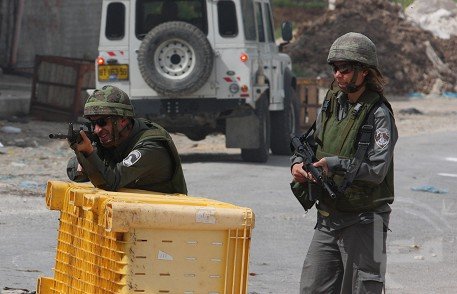
Bethlehem – Israeli soldiers shot dead two Palestinians near Nablus in the northern West Bank on Sunday.
Palestinian security sources identified the victims as 19-year-old farmers Muhammad Faysal and Salah Muhammad Qawariq.
Both were from the Awarta village, southeast of Nablus, and were en route to farmland carrying agricultural tools and herbicide, the same sources said.
Israel’s army said the two attempted to stab a soldier who was on a “routine patrol” near the Awarta military checkpoint. “In response, forces opened fire and identified a direct hit,” an army spokeswoman told Ma’an.
Eyewitnesses said Israeli forces declared the area a “closed military zone” and deployed in neighboring Palestinian villages. Soldiers closed the main entrance to the village of Madama, south of Nablus, they said.
Red Crescent officials told Ma’an that the army informed them that two Palestinians were killed near the illegal Itamar settlement southeast of Nablus, asking them to come and evacuate the victims.
They were the third and fourth killed in 24 hours in the northern West Bank. A teenager died early Sunday from injuries sustained at a protest a day earlier, when another boy was shot dead. Useid Qadus, 16, was shot in the head by Israeli forces, medics said, and Muhammad Qadus, also 16, died of a wound to the chest shortly after the a protest in Iraq Burin, another village south of Nablus.
The Israeli military said its forces opened fire with riot-control means to disperse a violent riot, denying allegations its soldiers used live ammunition against the two teenagers.
Medical officials and human rights advocates have disputed the army’s version of events, pointing to photographic evidence and an X-ray they say proves the army used live fire.
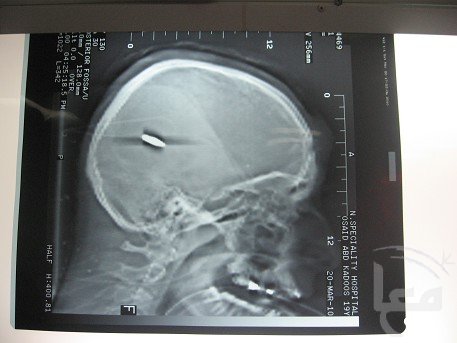 In this photo released by the Popular Struggle Coordination Committee, an
X-ray of Useid Qadus`s head, taken by the Israeli human rights group
B`Tselem`s Nablus field worker, appears to show a live bullet lodged in his
skull, 20 March 2010. [MaanImages/Salma Ad-Deb`i, HO]
‘US knows construction in al-Quds is as in Tel Aviv’
Press TV – March 21, 2010

Israeli Prime Minister Benjamin Netanyahu says construction policies in Jerusalem al-Quds are the same as in Tel Aviv and that the regime has informed Washington of that in writing.
“Construction in Jerusalem (al Quds) is like construction in Tel Aviv and we have clarified that for the American government,” Haaretz quoted Netanyahu as saying on Sunday at the start of the weekly cabinet meeting.
The Israeli prime minister also said that Israeli policy regarding construction in Jerusalem (al-Quds) has remained unchanged for different Israeli administrations.
Netanyahu has repeated his refusal to freeze settlement expansions in al-Quds. Just over a week ago, the premier approved the construction of another 1,600 settler units on occupied Palestinian land.
The remarks comes as there have been reports of an alleged row between the two allies [sic] over Israel’s settlement activity and US officials criticized Tel Aviv over the issue.
The Israeli prime minister is scheduled to leave for Washington Sunday night with Defense Minister Ehud Barak to attend the AIPAC Policy Conference in Washington. Opposition leader MK Tzipi Livni and Infrastructure Minister Uzi Landau will also accompany him.
An open letter to Ban Ki Moon, Secretary General of the United Nations
Gaza – March 21, 2010
Your Excellency:
You are already well aware of the worsening humanitarian situation in Gaza consequent on Israel’s devastating military attacks and its siege. As recently as December 27of 2009, you called the blockade of Gaza “unacceptable.” While this statement is certainly valid, it constitutes a gross understatement of the actual situation which amounts to slow genocide. Such understatement suggests that you are trimming your language to accommodate US pro-Israeli policy. We live an ongoing, illegal, crippling Israeli siege that has shattered all spheres of life, prompting the UN Special Rapporteur for Human Rights, Richard Falk, to describe it as “a prelude to genocide”. Your own UN Fact-Finding Mission on the Gaza Conflict, headed by the highly respected South African judge, Richard Goldstone, found Israel guilty of “war crimes and possible crimes against humanity,” as did major international human rights organizations, such as Amnesty International and Human Rights Watch. The Goldstone report concludes that Israel’s war on Gaza was “designed to punish, humiliate and terrorize a civilian population, radically diminish its local economic capacity both to work and to provide for itself, and to force upon it an ever increasing sense of dependency and vulnerability.”
Mr. Ban,
The 1948 Genocide Convention clearly says that one instance of genocide is “the deliberate infliction of conditions of life calculated to bring about the physical destruction of a people in whole or in part.” That is what has been done to Gaza since the imposition of the blockade by a UN member state, namely Israel, and the massacre of 1434 Palestinians, 90 per cent of whom were civilians, including 434 children.
On your second short visit to Gaza since the end of the Israeli onslaught in 2008-09, you will find what Professor Sara Roy, an expert on Gaza, describes as “a land ripped apart and scarred, the lives of its people blighted. Gaza is decaying under the weight of continued devastation, unable to function normally…” Professor Roy concludes that “[T]he decline and disablement of Gaza’s economy and society have been deliberate, the result of state policy–consciously planned, implemented and enforced… And just as Gaza’s demise has been consciously orchestrated, so have the obstacles preventing its recovery.” Israel is intent on destroying Gaza e because World official bodies and leaders choose to say and do nothing.
As civil society organizations based in Gaza, we call on you to use your position as Secretary General of the UN, the world body responsible for holding all governments accountable for the safeguarding of the human rights of all peoples under International Law to bring to bear on Israel the full force of your mandate to open the borders of Gaza to allow the import of building materials as well as all the other requirements for decent living conditions for us, the besieged Palestinians of Gaza.
We understand you are coming to Khan Younis to inspect an UNRWA housing project designed to provide housing for Palestinians whose homes were demolished by Israel’s war machine and who have been waiting for over five years for replacement. Of course the building project will not have been completed because of the blockade, even though it is an UNRWA project. The brazen refusal of Israel to cooperate with the decision of the International Community to re-construct Gaza, for which several billions of Euros were pledged, should not be tolerated. Israel’s attacks have damaged or completely destroyed many public buildings and have according to the UN’s own OCHA report as of April 30, 2009, severely damaged or completely destroyed some 21,000 family dwellings. Many other Palestinians who have spent the past several winters in flimsy tents have also been promised the means to rebuild homes and schools, though to date nothing has been done to alleviate their suffering.
In addition to the very visible lack of shelter, we, in Gaza, also suffer from the contamination of water, air and soil, since the sewage system is unable to function due to power cuts necessitated by lack of fuel to the main generators of the Gaza power grid. Medical conditions due to injuries from phosphorous bombs and other illegal Israeli weapons as well as from water contamination cannot be treated because of the siege. In addition to the ban on building materials, Israel also prevents many other necessities from being imported: lights bulbs, candles, matches, books, refrigerators, shoes, clothing, mattresses, sheets, blankets, tea, coffee, sausages, flour, cows, pasta, cigarettes, fuel, pencils, pens, paper… etc.
Mr. Secretary General,
When you visit Khan Younis, keep in mind that a huge UN storage depot was directly targeted by Israeli phosphorus bombs only last year destroying tons of badly needed food and other essentials. At that time your UNRWA chief John Ging spoke of massive obstacles preventing humanitarian aid from reaching the civilian population of Gaza: those obstacles must be removed. The Red Cross called the Israeli assault “completely and utterly unacceptable based on every known standard of international humanitarian law and universal humanitarian principles and values.”
We sincerely hope you will live up to your responsibility and speak for the suffering people of Gaza to those who hold the keys that could easily end the barbaric blockade, as the first step towards the implementation of all UN resolutions in Palestine.
Gaza,
2010-03-21
Signed by:
University Teachers’ Association in Palestine
General Union for Health Services Workers
General Union for Public Services Workers
General Union for Petrochemical and Gas Workers
General Union for Agricultural Workers
Union of Women’s Work Committees
Union of Synergies—Women Unit
Union of Palestinian Women Committees
Women’s Studies Society
Working Woman’s Society
Arab Cultural Forum
Palestinian Students’ Campaign for the Academic Boycott of Israel
One Democratic State Group
Al-Quds Bank for Culture and Information Society
Featured Video

New positive ivermectin evidence
or go to
Aletho News Archives – Video-Images
From the Archives
Fanatical Followers of the Covid Regime: A Jim Jones-Style Cult?
By Professor Roger Watson and Dr. Niall McCrae | The Daily Sceptic | November 15, 2021
As scholars at leading British universities over recent decades, we witnessed the replacement of critical thinking and debate by narrative: facts are discrimination and scientific method is imperialism; truth, instead, is derived from ‘progressive’ values. This educational trend may be a major contributory factor to the ease in which society has been inculcated to the Covid ‘new normal’ of masking, testing, and repeated doses of vaccines for a disease of similar risk to severe influenza.
One doesn’t need much critical reasoning to observe the flawed logic of some vaccination enthusiasts, such as people who respond to experiencing any side effects, however debilitating, by saying “at least I know it’s working”, or, after contracting the disease despite their promised inoculation (over 90% effective, according to initial drug company claims), “I’d have been worse off without the jab.” … continue
Blog Roll
 Aletho News
- EU Council Advances Chat Control 2.0 Scanning Proposal
- Ex-Greek MEP files complaint against Israeli spyware firm over alleged Pegasus surveillance
- Troubling ideas throughout the Torah, Talmud, Mishneh Torah and Tanya
- ‘Grave, alarming’: Iran mission on Trump’s UNGA ‘annihilation’ threats
- Najaf airport to reopen to Iranian flights within 24 hours: Ambassador
- From ‘How Will This End For Iran’ to ‘When America Walks Away’: A tale of two Economist covers
- Tehran blasts ‘baseless’ speculation linking Iran to alleged bomb plot at UK air base
- The Rise And… Rise Of ‘Color Revolutions’
- The Coming GOP Bloodbath?
- Arctic Scare Stories Melt Away
- If Americans Knew
- Netanyahu Asked UAE Leader to Deny Report on Oct. 7 Warning in Secret Visit, Sources Say
- CNN Chief Int’l Correspondent Clarissa Ward on Journalists in Gaza
- Democratic Party Consultants Surround Troy Jackson with Pro-Israel Donors
- Christian Leader Responds To Netanyahu’s Claims Regarding Palestinian Christians
- In Gaza, ‘Whoever Survives the Bombing Won’t Survive the Rubble’
- Israel kills more Palestinians, amid push to resettle Gaza – Daily Update
- Israel forces Gazans to live in constant peril – Daily Update
- Deconstructing Netanyahu’s pants-on-fire UN rant – Daily Update
- Trump betrayed voters with his campaign lies and prioritized a foreign country once he took office
- Netanyahu calls Israel’s war in Gaza ‘opposite of genocide’ in UN speech to near-empty hall
- No Tricks Zone
- New Study: Earth And Venus Surface Warmth Largely Explained By Convection And Lapse Rate, Not CO2 Or Radiation
- 2025 Nature Paper Claiming Worsening Global Drought Gets RETRACTED …Heavily Flawed
- New Study: ‘Global Drought Shows No Detectable Recent Acceleration Under Climate Warming’
- Economic Masterminds: German Socialists Suggest Taxing Productivity Gains Stemming From Using AI
- The South China Sea Has Not Been Cooperating With The Climate Change Narrative
- Energy Crisis: Germany Enters Heating Season With Historically Low Gas Reserve Fill Levels
- New Study: The Antarctic Ice Sheet Gained Mass From 2020-2024 Due To Staggering Snow And Ice Accumulation
- Study: Ocean Heating Rates From Thousands Of Years Ago ‘Dwarf’ Modern Ocean Heating Rates
- Climate Extremists Target, Attack Large-Scale Power Grid Infrastructure In Germany!
- New Study: Antarctic Ice Melt Has Contributed Less Than 1 Centimeter To Sea Level Rise In The Last 30 Years

