ISM volunteer shot, hospitalized; ISM co-founder arrested
International Solidarity Movement |19 March 2010

X-ray image of the large rubber bullet lodged into Ellen Stark’s arm when she was shot by an Israeli military barrage of tear gas and rubber bullets. The soldiers shot at her as she stood, un-armed, not engaged in the demonstration, from just three meters away. 19 March 2010, An Nabi Saleh
Friday’s demonstration in An Nabi Saleh saw an increase in violence and collective punishment from the Israeli military, as twenty-five demonstrators were injured, windows of cars and homes were intentionally shattered, and three were arrested. ISM volunteer Ellen Stark was shot at point blank range (4 meters) with a rubber bullet as she stood with medics, Popular Committee members and other internationals. ISM co-founder Huwaida Arraf was arrested while negotiating with the IOF to allow Ellen through the military line to get to the hospital. According to Ellen, “we were standing on Palestinian land, in support of the village who’s land has been confiscated but we weren’t even demonstrating yet. We were standing with medics who were also shot with tear gas.”
Ellen had to undergo surgery to remove the bullet, which was lodged between her ulna and radius of her right arm. Her wrist is broken as a result of the bullet impact. As of 12:00 pm Saturday, Palestine time, Huwaida has yet to be located in the Israeli prison system.
Over an hour before the demonstration began, soldiers took position on a hilltop near the house of an An Nabi Saleh Popular Committee member signaling to activists that the peaceful march would likely be cut short yet again by soldiers using crowd dispersal tactics such as tear gas and sound grenades. The demonstration was able to take it’s usual course, as IOF soldiers blocked the path of the activists, and began to surround them from multiple sides. Only ten minutes into the demonstration, the army began firing tear gas and rubber bullets at a small group of international, Israeli, and Palestinian activists only four meters away, injuring International Solidarity Movement volunteer, Ellen Stark. Omar Saleh Tamimi, Amjad Abed Alkhafeez Tamimi and International Solidarity Movement co-founder Huwaida Arraf were arrested as they asked Israeli military personnel to stop firing tear gas canisters and rubber bullets at Stark as she was helped to safety.
Israeli forces then entered the center of the village where they continued firing tear gas, sound grenades, and rubber bullets for several hours. Over twenty five were injured, including an 84-year old woman who suffered from tear gas inhalation after tear gas canisters were fired into her house, and three others who were shot with rubber bullets, including an Israeli activist; four remain hospitalized.
Later in the demonstration, soldiers began shooting rubber bullets through the windows of houses, shops, and cars, shattering homes and livelihoods, as they used collective punishment to attempt to suppress these weekly demonstrations.
These incidents come as the Israeli government intensifies repression of the unarmed, popular resistance to the occupation of the West Bank, illegal land confiscation by settlements such as Halamish, and construction of the illegal apartheid wall. Two weeks ago in An Nabi Saleh, 14-year-old Ehab Fadel Beir Ghouthi’s skull was fractured as a rubber bullet shot by the Israeli military, leaving him in a coma for several days. He remains in a hospital in Ramallah where he is recovering; his condition is stable and improving.
Today and every Friday since January, around 100 un-armed demonstrators leave the village center in an attempt to reach a spring which boarders land confiscated by Jewish settlers. The District Coordination Office has confirmed the spring is on Palestinian land but nearly a kilometer before reaching the spring, the demonstration is routinely met with dozens of soldiers armed with M16 assault rifles, tear gas, rubber bullets and stun grenades.
The Halamish Settlement has confiscated nearly half of An Nabi Saleh’s orchard and farmland since it was founded in 1977. According to village residents the settlement confiscates more land each year without consent or compensation of the landowners.
East Jerusalem isn’t ‘disputed,’ it’s ‘occupied’
By Henry Norr | March 19, 2010
On CNN, Jack Cafferty called East Jerusalem “disputed.” The other day the Washington Post referred to East Jerusalem as “disputed.” As Susie Kneedler reminds us often, it’s not “disputed.” Henry Norr is on the case, in this letter to National Public Radio:
During the “Week in Review” segment of this morning’s “Weekend Edition Saturday” show, Ron Elving referred at least twice to East Jerusalem as a “disputed” area. “Disputed” is the term the Israeli government and its advocates use and actively promote as an alternative to “occupied,” in hopes they can get out of the legal implications of occupation.
But the U.S. government, the United Nations, the International Court of Justice, the European Union, the UK, and the International Committee of the Red Cross, among other entities, all reject the Israeli usage and consistently use the term “occupied” in reference to East Jerusalem, as well as the West Bank, Gaza, and the Golan Heights. (As it happens, the U.S. Department of State issued its annual report on human rights in “Israel and the occupied territories,” including East Jerusalem in the latter category, just two days ago).
Because these terms have clear, well established, and important legal and political meanings, choosing between them is not an innocent stylistic question. Why does NPR’s Senior Washington Editor adopt Israeli usage, rather than that of our own government, the UN, and most of the rest of the world? I think you owe your listeners a correction on this matter.
Also from Rannie Amiri:
… New York Times columnist Thomas Friedman, in a March 13 op-ed column titled “Driving Drunk in Jerusalem,” feigned indignation at Biden’s treatment when he wrote that he [Biden] should have “… snapped his notebook shut, gotten right back on Air Force Two, flown home and left the following scribbled note behind: ‘Message from America to the Israeli government: Friends don’t let friends drive drunk. And right now, you’re driving drunk. You think you can embarrass your only true ally in the world, to satisfy some domestic political need, with no consequences?’”
He continues, “… Israel needs a wake-up call. Continuing to build settlements in the West Bank, and even housing in disputed East Jerusalem is sheer madness.”
Disputed East Jerusalem?
By all international standards—the U.N. Charter, the Fourth Geneva Convention, the rulings of the International Court of Justice—East Jerusalem has been indisputably recognized as occupied territory since the 1967 Six-Day War.
Furthermore, U.N. Resolution 252 “considers that all legislative and administrative measures and actions taken by Israel, including expropriation of land and properties thereon, which tend to change the legal status of Jerusalem are invalid and cannot change that status.” It also reaffirms “… that acquisition of territory by military conquest is inadmissible.”
Like Friedman, the mainstream U.S. media eschews the correct designation of East Jerusalem, preferring to mindlessly label it “predominantly Arab” instead.
Boys disappearing from Hebron Old City
By Paulette Schroeder | March 18, 2010
I am most concerned these recent weeks in Hebron. Young teens and even smaller children are disappearing from our neighbourhood in the Old City of Hebron. It’s not by kidnapping. It’s not by trafficking. It’s not an unknown person with a criminal record perpetrating the crimes. Rather, the Israeli military is again pressing its boots down harder on the heads of the Palestinian people. If restrictions on travel and commerce, land confiscations, home invasions, and forced business closures have not succeeded in convincing Palestinian families to leave their land, then MAYBE taking their children will.
Our Palestinian neighbor sent her 15 year old son to buy bread. Fifteen minutes later, Israeli soldiers blindfolded and handcuffed him, accusing him of throwing stones. The boy insisted he did not throw stone/s at the soldiers. Nevertheless, he is now spending time in the Israeli prison system. Having spent the first 17 days in Ofir Prison among men who may/ may not have committed serious crimes, he continues to insist on his innocence. He will spend four or five months in another Israeli prison until his court case is completed. All for the “crime” of supposedly throwing a stone at soldiers!
Mohammed, and Eissa too, were walking with the 15 year old. Mohammed is 14 and Eissa is 19. The Israeli authorities held Mohammed in Ofir Prison until a donor contributed 2000 shekels. (This amounts to $500 approximately.) Eissa is also serving time in Ofir. Both these boys insist they did not throw a stone.
Near our CPT apartment soldiers accused a 12 year old boy of throwing stones. He too spent one week in Ofir prison.
Soldiers recently blindfolded and handcuffed an eight year old boy for stone throwing. They forced him to spend eight hours with a dog behind a military gate.
A 14 year old neighbor boy was helping his dad in his store, cutting cardboard boxes filled with wares. The soldiers saw him with a knife, blindfolded him, whisked him away behind the military gate, holding him for two hours while the father pleaded at the gate.
A 15 year old boy in the neighbourhood ran an errand for his father. The soldiers saw him running, grabbed him, and likewise detained him behind the military gate for 2 hrs. as his father also insisted his son did no wrong.
Besides the issue of the boys’ ages, and the severity of the sentences imposed, there is also the persistent need of the parents to travel two hours to the prison, their consequent loss of work, and their travel expenses involved. (Approximately $15 each trip) Sometimes before a child’s case is settled, the parents must travel four or five times to the courtroom.
I have only begun to enumerate the stories of children recently taken from our midst. Though the people’s patience has been great and their will to resist persists; yet anyone who witnesses these actions firsthand will call them insanity, dehumanization, oppression, collective profiling. From my point of view, this problem in Hebron and throughout the West Bank is a matter of conscience, an embarrassment to humanity, and a horrid usage of tax dollars. It is urgent that the international community pressure the state of Israel and each one’s own government to put a stop to this madness.
Paulette is with Christian Peacemaker Teams – an ecumenical initiative to support violence reduction efforts around the world. To learn more about CPT’s peacemaking work, see: http://www.cpt.org
The War on Afghan Civilians
Expecting Gen. McChrystal to Protect Afghan Civilians is Like Hiring Ted Bundy to Combat Sexual Harassment in the Workplace
By DAVE LINDORFF | March 17, 2010
Three months after it initially lied about the murder by US forces of eight high school students and a 12-year-old shepherd boy in Afghanistan, and a month after it lied about the slaughter by US forces of an Afghan police commander, a government prosecutor, two of their pregnant wives and a teenage daughter, the US military has been forced to admit (thanks in no small part to the excellent investigative reporting of Jerome Starkey of the London Times), that these and other atrocities were the work of American Special Forces, working in conjunction with “specially trained” (by the US) units of the Afghan Army.
Gen. Stanley McChrystal, the commander of the US war effort in Afghanistan, says he is taking over “direct charge” of Special Forces operations because of “concern” that they were not following his orders to make limiting civilian casualties a “paramount” objective. McChrystal is quoted as saying the US military “carries the burden of the guilt” for the “mistakes” made by those Special Forces.
This has to be a sick joke. These incidents were not mistakes; they were planned actions. It’s all the sicker because we know that the US is busy training the Afghan Army to take over this kind of dirty work. And besides, even if McChrystal does assume direct command over Special Forces, that would leave unaccounted for the tens of thousands of private mercenary units hired by the US who are working completely in the shadows for the CIA or other organizations. (One such group hired buy the Defense Department, which posed as an intelligence-gathering operation, was recently exposed as actually being a privately run death squad.)
McChrystal, recall, was in charge of a huge and brutal death squad operation in Iraq before he was given his new assignment in Afghanistan, and at the time he was put in charge of the Afghanistan War, it was reported that he was planning to put in place a similar operation in Afghanistan, designed to take out the Taliban leadership in the country.
What we have been seeing in Afghanistan–and this goes way back to before the appointment of McChrystal, or even the election of President Barack Obama, and his subsequent escalation of the war–has been a vicious campaign of terror against the Afghan people.
It should be no surprise that this is so. It is the way the US has always done counterinsurgency. In a war in which the insurgents (or patriots, if you will–the people fighting against foreign occupiers, or in out case, the US) are a part of the people, and American forces are the invaders, the goal is to drive a wedge between those fighters and the rest of the population.
In Pentagon propaganda, this is referred to as “winning the hearts and minds” of the people, but in reality, the US military doesn’t give a damn about hearts and minds. It simply wants the people to become unwilling to hide or support the enemy fighters it is facing. If it can accomplish that by making people afraid, then that is what it will do, and making people afraid is much easier than “winning hearts and minds.”
How do you make people afraid of supporting or hiding and protecting enemy fighters like the Taliban? You terrorize them. You bomb their homes. You conduct night raids on their homes. You bomb their weddings and their excursions to neighboring towns or markets. You shoot them when they get too close to your vehicles.
Statistics show that the US has, in both Iraq and now Afghanistan, routinely killed more civilians than actual enemy fighters. That tells us all we need to know about what is really going on. America is fighting a war of terror against the people of Afghanistan.
No amount of feigned public hand-wringing by the blood-stained Gen. McChrystal, or of assertions that he is going to assume direct control (from whom? are we to assume that they were operating without direction before?) of the Special Operations troops in the country, will alter that fact. Civilians–including especially women and children–in Afghanistan will continue to die in prodigious numbers because that is how the US fights its wars these days.
The people of Afghanistan know this. That’s why the majority of them want the US out of their country.
It’s Americans who don’t know the truth, and it’s Americans who are really the target of statements from the Pentagon and from Gen. McChrystal claiming that the US is taking steps, nine years into this war, to “reduce civilian casualties” in Afghanistan. It doesn’t help that news organizations like the New York Times propagate that propaganda, as the paper did today in a lead headline that said: “US is Reining in Special Forces in Afghanistan. General Takes Control. McChrystal has Raised Civilian Casualties as a Concern.” It simply wouldn’t do to tell Americans that their country is conducting a war of terror. We are supposed to be the good guys who are bringing peace and democracy to a benighted land.
So let’s just face the facts squarely. The US is not the good guy in Afghanistan. It is an agent of death and destruction. Just check out the town of Marjah, largely destroyed over the last few months in order to “save” it from a handful of Taliban fighters. Over 30 civilians died in that American show of force, and the message of those deaths was clear: allow the Taliban to operate in your town, and we’ll kill you–not just your men, but your wives and your children, too.
Rachel Corrie’s sister: U.S. encouraged family to sue Israel
By Akiva Eldar | Haaretz | March 12, 2010
This is Sarah Corrie Simpson’s first visit to Israel. Her younger sister, Rachel Corrie, was killed by an Israel Defense Forces bulldozer in Gaza in 2003, at the age of 23. Now, the family is suing the state in the Haifa District Court.
“I’m glad the day is finally here, that the eyewitnesses are having a chance to talk in a court of law,” she said in an interview with Haaretz on Thursday. “It’s been seven long years.”
The witnesses, who include Rachel’s colleagues in the left-wing International Solidarity Movement, say Rachel climbed atop a mount of dirt to be sure the driver could see her, Simpson said. When he nevertheless kept coming at her, she tried to flee, but tripped and fell. “The bulldozer driver kept driving with the blade down, pushing the dirt over Rachel, and stopped when her body was under the cab.”
“My father served in the military in Vietnam and was responsible for bulldozer operations,” Simpson added. “He said there is no way that what happened to Rachel would have happened on his watch.”
She rejects the IDF’s claim that the area was an active combat zone. The witnesses claim no shots were being fired, she said, so the army could have stopped the operation and removed the demonstrators. But in any case, she added, international law requires soldiers to try to protect civilians even in a war zone.
What brought Rachel, a girl from a good family in Washington state, to the town of Rafah, on the Gaza-Egypt border?
According to Simpson, the September 11, 2001 terror attacks pushed Rachel into political activism. She wanted “to find out what was going on in the world, especially in the Middle East.” She studied Arabic and began meeting with peace activists, including former Israeli soldiers. She wanted to understand America’s role in the Middle East.
Rachel was a pacifist and a pluralist, Simpson added, her views informed by growing up in a Christian family with Jewish, Sikh, Hindu and Muslim in-laws.
After Rachel’s death, Simpson said, “our lives changed instantly.” Her father quit his job, and she herself has devoted herself fully to the political and legal effort to force the IDF to take responsibility for Rachel’s death. Her goal, she said, is to ensure “that something like this will never happen again to any civilian … whether Israeli, Palestinian or internationals.”
Though the Military Police investigated Rachel’s death, neither the family nor the American authorities consider the probe credible.
“There are pieces of evidence we have never been given,” Simpson said. For instance, out of about six hours of video, in color, with complete audio, the family received “14 minutes of tape, a grainy black copy, with incomplete audio.”
Would you want to meet the bulldozer driver?
“Yes, I would. Ultimately, in order to have any kind of restorative healing process occur, I need to be able to hear directly from him what happened that day and how he feels about it. As well, I hope he would be able to hear and somehow understand the impact this has had on my life and the life of my family. A credible investigation is important … but in the end, it is also important that my family and the man who killed Rachel look each other in the eyes. This would be the most difficult and painful thing I can imagine doing, but it’s something I feel is extremely important. But I have no control over this, the Israeli government won’t release his name.”
Asked whether the family was getting support from the U.S. government, Simpson said it was a U.S. government official who first encouraged them to sue the Israeli government.
The family has met with many senior American officials, she added, and more than 70 congressmen signed a letter demanding a serious investigation.
EU found guilty at first session of Russell Tribunal
Ewa Jasiewicz and Frank Barat, The Electronic Intifada, 15 March 2010
 |
The Russell Tribunal on Palestine aims to translate the language and expertise of law into everyday activism. (David Vilaplana/imagenenaccion.org |
The first session of the Russell Tribunal on Palestine (RTP) was heard in Barcelona, Spain earlier this month. The RTP is a peoples’ legal initiative designed to systematically try key actors responsible for the perpetuation of human rights violations in Palestine.
In the frame this time was the European Union (EU). Two days and 21 expert witness testimonies later, the RTP found individual states and the EU as a whole guilty of persistent violations and misconduct with regards to international and internal EU law. These included: assistance in perpetrating the crime of apartheid — deepened in definition as applicable to the violation of the inalienable right of return for refugees and the collective punishment and ghettoization of Gaza; aiding the procurement of war crimes and crimes against humanity particularly with regards to Gaza; and violating the Palestinian right to self-determination, aiding illegal colonization, the annexation of East Jerusalem and theft of natural resources.
We may all know this, but knowing exactly how and through which laws and mechanisms allows for a water-tight case for justice for Palestine and the denormalization of Israel’s occupation.
The RTP’s endorsement of boycott, divestment and sanctions (BDS) as a means to hold Israel and its collaborator states accountable under international law was also a boost to European civil society groups and prominent figures sitting on the fence about the tactic.
The RTP aims to reenergize and popularize the necessary delegitimization of Israeli apartheid, occupation and human rights violations. It’s not just about preventing the crime of silence but also about providing a forum for speaking out, active witnessing and active listening, and to tool up civil society on how to publicize and pressure their governments to abide by the law.
The reason the EU and violation-abetting or non-compliant states have continued to treat the observance of international law and Palestinian rights as a policy issue rather than a legal obligation is because civil society has given them this choice through a lack of pressure in these areas. These states should not have a choice; these legal frameworks are not voluntary or optional once signed, they are obligatory.
The language of international human rights law is dense, inert and dispassionate despite the fact that it has been generated through global anti-colonial, anti-occupation struggle and sacrifice. Nevertheless, it’s a language movements should strategically learn and connect to the real-time, felt-on-the-body, resistance and endurance of the Palestinian people and the policy-makers in our parliaments.
Contextualizing the violence of policies of violation in the small print of complicated contracts and treaties, or in casual conversations in presidential dining rooms in Tel Aviv, was enabled by the RTP.
At the RTP, Veronique De Keyser, a European Member of Parliament from Belgium, testified that during a trip to Israel as part of a delegation of European MPs, she was told by then Israeli Prime Minister Ehud Olmert and Foreign Minister Tzipi Livni that the Israeli government was intent on instrumentalizing Fatah to undermine Hamas. According to her testimony, Olmert and Livni added that Israel had no interest in recognizing a unity government.
Meir Margalit, a former member of the Jerusalem city council, spoke of soldiers demolishing a Palestinian home in the presence of an EU Commissar. When this fact was brought to the attention of the mayor of Jerusalem at the time, Ehud Olmert, it resulted in a delay in the destruction of the home until no MPs were present to witness.
Charles Shamas, a Palestinian legal consultant and founder of the MATTIN group, a voluntary human rights-based partnership in Palestine which focuses on international human rights and international humanitarian law enforcement and third-party state responsibility, mapped the mechanisms by which international law obligations can be triggered in the EU. He explained this could be achieved by targeting obscure internal regulations within EU legal frameworks, deciphering obscure clauses and regulations within EU treaties and targeting them at the appropriate bodies.
Shamas demystified the means by which laws are effectively changed when the EU collaborates in contracts and treaties with Israel. By accepting Israeli definitions of international law rather than its own, the EU is in fact violating its own internal and international laws. For example, a new agreement on civil aviation between the EU and Israel could legitimize the occupation of the Palestinian territories through recognition of airspace and the airports in occupied territory as part of Israel. Shamas cited a challenge to a draft agreement between Europol and the Israeli police authorities which was regarded as unlawful as the police were headquartered in occupied East Jerusalem.
Phil Shiner of Public Interest Lawyers in the UK presented his own experiences to the RTP of attempting to use the British domestic courts to challenge the UK’s failure to fulfill its obligations under international humanitarian law with respect to Israeli activities during its invasion of Gaza last winter. A British court found his claim, which was coordinated with the Palestinian legal organization Al-Haq, to be a matter for “high foreign policy” and denied it. Shiner suggested seeking more compliant alternative EU member state courts to file similar cases.
The applicability of existing international law on conventional weapons was dissected in the context of Israel’s invasion of Gaza by Colonel Desmond Travers, a member of the UN-sponsored Goldstone commission. In his testimony, Travers provided forensic analysis of the flight-path of a flechette dart within the human body. He also discussed Israel’s suspected use of Dense Inert Metal Explosive (DIME) weapons and depleted uranium. Travers also scrutinized Israel’s use of white phosphorous as a weapon rather than an obscurant. Aside for the need for political action to stop Israeli impunity, Travers explained that a ban on certain weaponry altogether including white phosphorous, urgent environmental clean-up and the need for new laws were necessary and should be advocated.
Expert researcher and Middle East specialist Agnes Bertrand detailed the EU’s passive complicity with Israeli violations. Israel has caused an estimated 56.35 million euros worth of infrastructural damage to works funded by the European Community since 2000, with damage suffered during last year’s Gaza invasion amounting to around 12.35 million euros. The EU Commission has no intention of filing for damages or compensation, instead passing the buck to the Palestinian Authority, stating that as the construction aid was given to the PA, it would have to make the claim for it. Yet no legal advice has been forthcoming on how the PA is supposed to do this. The EU’s Association Agreement with Israel, in particular Article 2 and the framing of the dialogue between the EU and Israel were found to be in breach of articles of the International Law Commission and the 1966 covenant on Civil and Political Rights in their exclusion of the observance and inclusion of international law and any references to occupation.
Translating the language and expertise of law into everyday activism as a tool against the attack on the legitimacy of our movement and Palestinian rights is the challenge ahead that the RTP can play a part in. The Barcelona session is only the beginning. The next RTP session will take place in London at the end 2010 and will focus on international corporations profiting from the occupation as well as labor rights in Israel-Palestine. It will be followed by sessions in South Africa focusing on apartheid, and in the United States focusing on the American and UN role in the conflict.
Full findings/conclusions of Barcelona session of Russell Tribunal on Palestine are available at http://www.russelltribunalonpalestine.net/.
Ewa Jasiewicz is a freelance journalist, union organizer and coordinator for the Free Gaza Movement. She was one of the witness for the Russell Tribunal on Palestine.
Frank Barat is coordinator of the Russell Tribunal on Palestine. He can be reached at russelltribunaluk A T googlemail D O T com.
Press TV:
This Time It’s Pregnant Women: Another US Atrocity in Afghanistan
By David Lindorff – 03/14/2010
Another night-time raid on a housing compound in Afghanistan. Another bunch of innocent Afghans killed. Another round of lies by the US-led forces of the so-called International Security Assistance Force (ISAF). Only this time, among the dead are two pregnant mothers and a teenage girl.
And once again the US media remain mute, accepting the official story, which was of ISAF forces responding to an attack which in reality appears never to have happened.
Before I started to write this piece, which once again was broken by the intrepid Jerome Starkey, a reporter in Afghanistan who works for the Times of London, I thought maybe I should read the Sunday edition of the New York Times, to see whether America’s “paper of record” had reported on this latest atrocity. But the night before we had suffered a heavy storm that knocked down three large trees in my front yard, and there was currently a thunderstorm underway, with rain pouring down, so I decided, what the hell, I’ll just write it. There’s no way the Times would cover this story.
I was right, of course. When the rain let up, and I went out and got the paper, and scoured it for word of this latest obscene slaughter by US forces, I found nothing. The Times’ reporters in Afghanistan and the reporters in the paper’s Washington bureau who cover the Pentagon had ignored it. So, a Google search discloses, did the rest of the servile US media.
So what actually happened?
According to Starkey, US and Afghan Army forces on February 12 launched a pre-dawn assault on the home of a prominent and popular policeman’s home just outside of Gardez, the capital of Paktia province in eastern Afghanistan. The first person to die was reportedly the policeman himself, Commander Dawood, who had stood in his doorway protesting the innocence of his family. In the volley of fire directed against him by the brave US-led team, his pregnant wife, another pregnant woman and an 18-year-old girl were also slaughtered.
Commander Dawood had been hosting a party to celebrate the naming of a newborn baby boy, Starkey reported. As he writes:
Sitting together along the walls of a guest room, the men had taken turns dancing while musicians played. Mohammed Sediq Mahmoudi, 24, the singer, said that at some time after 3am one of the musicians, Dur Mohammed, went outside to go to the toilet. “Someone shone a light on his face and he ran back inside and said the Taliban were outside,” Mr Sediq said.
Also killed was Dawood’s brother, Saranwal Zahir, a local prosecutor, who had been shouting for soldiers not to shoot as women had run outside to tend to the wounded.
A younger brother of the two men, Mohammed Sabir, was arrested by the invading forces and brought to a US base, where he was held for several days and interrogated by “ an American in civilian clothes,” before being released. Sabir said he was shown photos of a man who had been at the party, a certain Shamsuddin. Sabir says he told the interrogatyor, “Yes, he was at the party. Why didn’t you arrest him?” The man in question, Shamsuddin, later turned himself in and was, after questioning, reportedly also released.
Raising the question, what was this raid, and all the pointless killing, about in the first place?
As Starkey writes, the US and the ISAF initially, following what appears to be standard operating procedure, concocted a lie about the incident In a release immediately afterward, under the headline, “Joint force operating in Gardez makes gruesome discovery,” the NATO release claimed that the US-led team had found the women’s bodies “tied up, gagged and killed” in a room. That statement went on to say: “Several insurgents engaged the joint force in a firefight and were killed.”
As Starkey, who charges NATO with a “coverup,” reports: “The family, however, insists that no one threw so much as a stone.”
He goes on:
Rear Admiral Greg Smith, NATO’s director of communications in Kabul, denied that there had been any attempt at a cover-up. He said that both the men who were killed were armed and showing “hostile intent” but admitted “they were not the targets of this particular raid.”
“I don’t know if they fired any rounds,” he said. “If you have got an individual stepping out of a compound, and if your assault force is there, that is often the trigger to neutralise the individual. You don’t have to be fired upon to fire back.”
He admitted that the original statement had been “poorly worded” but said “to people who see a lot of dead bodies” the women had appeared at the time to have been dead for several hours.
Starkey reports that the Americans offered the distraught family $2000 per victim of the botched raid. But as the mother of the slain brothers, Bibi Sabsparie, told him bitterly, “There’s no value on human life. They killed our family, then they came and brought us money. Money won’t bring our family back.”
So once again, we have a massacre (in a night-time raid that occurred two weeks after the US commander in Afghanistan, Gen. Stanley McChrystal, ordered an end to the practice because of the number of errors and civilian deaths, and the bad public relations such raids cause among Afghans), with no coverage by the US media.
Meanwhile, Starkey says that even in the UK, his stories have been ignored by the rest of the British media, and that his own efforts to get at the truth have begun causing problems with the US-led military command in Afghanistan.
As he told one reader who had written him to congratulate him on his work:
Word in Kabul is that NATO are turning their wrath on me, personally, and about to release a rebuttal. All of a sudden it’s a daunting prospect and more than ever I feel what it must be like to be churned through the military machine. It’s good to know people appreciate it. I’ve also had emails from the victims’ family, which is heartening.
It is not easy to be an honest reporter in wartime, where sycophancy and blind patriotism are what is demanded. Sadly, the US media are taking the easy way out, accepting the rules of being embedded, which require them to submit articles for censorship, to avoid being critical and to play the game, in return for getting easy human interest stories to send back to the readers and viewers back home.
That’s not journalism. It’s PR. It ought to be labeled as such.
Extra! Also ignored by the Times and most of the rest of the US corporate media was a historic decision by a federal judge in Chicago on March 4 to compel former Defense Secretary Donald Rumsfeld to respond to charges by to US torture victims that Rumsfeld authorized their torture by US forces at Camp Cropper in Iraq. The two men, David Vance and Nathan Ertel, were whistleblowers against the private security (mercenary) firm that had hired them, claiming it was secretly providing arms to insurgents. Instead of getting the firm investigated, they were arrested by US troops and held–and tortured, they claim–for three months, before being released without charge and sent home to the US.
Their attorney, Mike Kanovitz of Chicago’s Loevy & Loevy, correctly calls the quashing of Rumsfeld’s effort to have the suit against him thrown out, “pretty historic”–a former secretary of defense is being accused of authorizing the torture of American citizens and will have to answer the charge in a federal court–but you wouldn’t know it from the response of the US mainstream media, which has been…nothing.
Masked soldiers post closed zone signs in Bil’in, Ni’lin
Ma’an – 15/03/2010
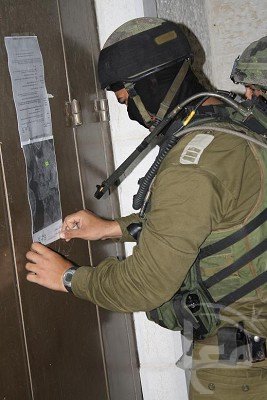 Bethlehem – Dozens of masked soldiers raided the West Bank villages of Bil’in and Ni’ilin Monday morning to post decrees designating the village’s lands closed military zones on Fridays for a period of six months, residents said.
The areas between the wall and built up villages will be declared closed military zones every Friday between 8am and 8pm for six months, the military decrees read.
According to a statement issued by Bil’in’s Popular Committee, the move comes one week after the head of the Israeli Shin Bet threatened to step-up action against the Palestinian popular struggle in the two villages that see weekly protests against the separation wall’s construction.
The Popular Committee said the decrees went into effect on 17 February, before their distribution, and were signed by Commander of the Israeli Central Command Avi Mizrahi.
According to the Israeli army spokesperson’s unit, “The closed military zone order in the area between the security fence and the villages of Naalin [sic] and Bilin was signed three weeks ago in hopes of preventing the arrival of inciting elements,” the Israeli daily Yedioth Aharanoth wrote.
“The order does not apply to the residents of the villages and they will be allowed to move freely.”
Israeli citizens and international passport holders will not be allowed access to the area according to the decree, which includes the area where weekly protests are held.
Lawyer Gaby Lasky, who represents residents of the villages, told the Popular Committee, that “this is yet another illegal measure taken by the Army, which makes ill use of its authority in order to suppress dissent and infringe on the already volatile freedom of speech in the Territories. Closed military zone orders are not meant to deal with demonstrations, which are clearly in the civic rather than the military realm.”
The statement said the issuing of the decrees happens amidst an ongoing persecution campaign against Palestinian activists in an attempt to suppress “the rising tide of West Bank popular resistance to the Occupation,” which include the detention of 17 Israeli activists in Sheikh Jarrah, a Palestinian neighborhood in East Jerusalem, on Friday as they protested home evictions in the area.
Photo from the Popular Committee
dated 15 March 2010 shows
an Israeli soldier posting the notices
[MaanImages/Popular Committee, HO]
Israel extends West Bank closure until Tuesday
By Saed Bannoura – IMEMC News – March 14, 2010
Israeli security forces announced that a full closure on the Israeli-occupied Palestinian West Bank would be extended until Tuesday, supposedly to protect a group of Israeli settlers as they begin construction of a Jewish synagogue on stolen Palestinian land in the Old City of Jerusalem.
The announcement was made Saturday night by Israeli Defense Minister Ehud Barak, in the midst of a number of violent attacks by Israeli soldiers and police against unarmed Palestinians. A non-violent demonstration in Sheikh Jarrah neighborhood in Jerusalem was met by a violent response from Israeli troops, including tear gas and concussion grenades. Israeli troops also fired tear gas and concussion grenades at Palestinians waiting at a checkpoint into Jerusalem on Saturday.
While Barak termed these incidents ‘riots’, witnesses at each of the events confirmed that Israeli troops fired unprovoked at unarmed Palestinian civilians.
The Israeli security forces have also banned Palestinian men and boys under the age of 50 from attending services at the Al Aqsa mosque in Jerusalem. These age restrictions are common occurrences, which Palestinian Muslims say violate their freedom of religion and freedom to worship.
Non-violent protests have sprung up in various places in the West Bank over the last several days, following the Israeli government’s announcement that they had approved over 1600 new units to be constructed in Jewish-only settlements on stolen Palestinian land in East Jerusalem.
Israel tortures Jerusalem minors
Pal Telegraph, March 13, 2010
 Loai Rujby and Mahmoud Dweik

Occupied Jerusalem – Jerusalem Center for Social and Economic Rights revealed Saturday that Israeli police tortured Jerusalemite children, who were arrested before by Israelis.
The Center published two statements made by Loai Rujby, 14, and Mahmoud Dweik,12, both residents of Al-Yemen area of the Silwan neighborhood, who were arrested on January 10, 2010 and in November, last year. Both statements provide accounts of how Israeli soldiers tortured the two children.
The center said that the children’s accounts were clear-cut evidence of the torture policy adopted by Israeli occupation against the Palestinian minors, which increased by recent arrest campaigns that target children and minors.
In his testimony submitted to the Research and Documentation Center in Jerusalem, the 14-year-old Rujby confirmed that he was beaten harshly, tied up and denied access to food or bathroom.
Loai Rujby is a seventh grade student at the orphanage school in Al-Thoury area. He has been arrested 7 times, twice of which while being in the classroom, and every time he is accused of “throwing stones at the settlers’ house.”
Child Dweik, who was arrested in November 2009, his testimony was congruous with what Rujby said, that he was beaten and threatened during his detention.
Israel bars Palestinians under 50 from Al-Aqsa
Press TV – March 14, 2010

Israeli police enter the Al-Aqsa Mosque compound.
Israeli police have barred men under 50 from attending prayers at the Al-Aqsa Mosque in East Jerusalem Al-Quds on Sunday due to fear of another round of clashes.
On Friday, Israeli forces clashed with Palestinian worshipers after Friday prayers at the Al-Aqsa Mosque, injuring one Palestinian and arresting three others.
In a measure meant to prevent more violence, on Saturday the Israeli police issued an order stating that no male under the age of 50 and no visitors from other religions will be allowed to enter Islam’s third holiest site for prayers on Sunday. Women will not be affected by the order.
Tension has risen since March 5, when Israeli police attacked Muslim worshipers after Friday prayers at the Al-Aqsa Mosque and imposed indefinite restrictions.
And the situation took a turn for the worse following Israel’s announcement last Tuesday that it plans to build another 1,600 homes for settlers in mostly Arab East Jerusalem Al-Quds, which Palestinians say should be the capital of their future state.
Israel’s illegal settlement construction continues despite international calls for a complete freeze on building on occupied Palestinian territories.
Israeli officials have insisted that they will not accept a ‘complete freeze’ on settlement construction and that the plan to build homes for settlers in East Jerusalem Al-Quds will not be canceled.
Evidence Mounts NATO Report Lied on Afghan Civilian Killings
Rear Admiral Smith Admits No Evidence of Claimed ‘Firefight’
By Jason Ditz | March 12, 2010
The February 12 night raid against a house party in Afghanistan’s Paktia Province remains shrouded in mystery, but NATO’s official story appears to be crumbling as even NATO officials concede that the claims made were not strictly true.
NATO’s official statement claimed at the time that the raid on the home led to a “fire fight” against “several insurgents” who were killed, before NATO made a “gruesome discovery” of bound and gagged bodies in a nearby room.
NATO is conceding now that all of the slain people were civilians killed in the raid. NATO communications direct Rear Admiral Greg Smith also admitted that they had no real evidence that the men slain at the home had ever fired a shot against the NATO forces.
Witnesses at the site reported that one of the people in the compound, a local policeman, shouted “don’t fire, we work for the government” before being gunned down by the invading forces.
Rear Admiral Smith defended the killing of the policeman, however, saying “if you have got an individual stepping out of a compound, and if your assault force is there, that is often the trigger to neutralise (read: kill) the individual. You don’t have to be fired upon to fire back.
Since the incident, all those detained by NATO have been released without charges. In addition, the US has reportedly paid $2,000 to the family for each of the civilians killed in the attack.
Featured Video
New positive ivermectin evidence
or go to
Aletho News Archives – Video-Images
From the Archives
Fanatical Followers of the Covid Regime: A Jim Jones-Style Cult?
By Professor Roger Watson and Dr. Niall McCrae | The Daily Sceptic | November 15, 2021
As scholars at leading British universities over recent decades, we witnessed the replacement of critical thinking and debate by narrative: facts are discrimination and scientific method is imperialism; truth, instead, is derived from ‘progressive’ values. This educational trend may be a major contributory factor to the ease in which society has been inculcated to the Covid ‘new normal’ of masking, testing, and repeated doses of vaccines for a disease of similar risk to severe influenza.
One doesn’t need much critical reasoning to observe the flawed logic of some vaccination enthusiasts, such as people who respond to experiencing any side effects, however debilitating, by saying “at least I know it’s working”, or, after contracting the disease despite their promised inoculation (over 90% effective, according to initial drug company claims), “I’d have been worse off without the jab.” … continue
Blog Roll
 Aletho News
- EU Council Advances Chat Control 2.0 Scanning Proposal
- Ex-Greek MEP files complaint against Israeli spyware firm over alleged Pegasus surveillance
- Troubling ideas throughout the Torah, Talmud, Mishneh Torah and Tanya
- ‘Grave, alarming’: Iran mission on Trump’s UNGA ‘annihilation’ threats
- Najaf airport to reopen to Iranian flights within 24 hours: Ambassador
- From ‘How Will This End For Iran’ to ‘When America Walks Away’: A tale of two Economist covers
- Tehran blasts ‘baseless’ speculation linking Iran to alleged bomb plot at UK air base
- The Rise And… Rise Of ‘Color Revolutions’
- The Coming GOP Bloodbath?
- Arctic Scare Stories Melt Away
- If Americans Knew
- Netanyahu Asked UAE Leader to Deny Report on Oct. 7 Warning in Secret Visit, Sources Say
- CNN Chief Int’l Correspondent Clarissa Ward on Journalists in Gaza
- Democratic Party Consultants Surround Troy Jackson with Pro-Israel Donors
- Christian Leader Responds To Netanyahu’s Claims Regarding Palestinian Christians
- In Gaza, ‘Whoever Survives the Bombing Won’t Survive the Rubble’
- Israel kills more Palestinians, amid push to resettle Gaza – Daily Update
- Israel forces Gazans to live in constant peril – Daily Update
- Deconstructing Netanyahu’s pants-on-fire UN rant – Daily Update
- Trump betrayed voters with his campaign lies and prioritized a foreign country once he took office
- Netanyahu calls Israel’s war in Gaza ‘opposite of genocide’ in UN speech to near-empty hall
- No Tricks Zone
- New Study: Earth And Venus Surface Warmth Largely Explained By Convection And Lapse Rate, Not CO2 Or Radiation
- 2025 Nature Paper Claiming Worsening Global Drought Gets RETRACTED …Heavily Flawed
- New Study: ‘Global Drought Shows No Detectable Recent Acceleration Under Climate Warming’
- Economic Masterminds: German Socialists Suggest Taxing Productivity Gains Stemming From Using AI
- The South China Sea Has Not Been Cooperating With The Climate Change Narrative
- Energy Crisis: Germany Enters Heating Season With Historically Low Gas Reserve Fill Levels
- New Study: The Antarctic Ice Sheet Gained Mass From 2020-2024 Due To Staggering Snow And Ice Accumulation
- Study: Ocean Heating Rates From Thousands Of Years Ago ‘Dwarf’ Modern Ocean Heating Rates
- Climate Extremists Target, Attack Large-Scale Power Grid Infrastructure In Germany!
- New Study: Antarctic Ice Melt Has Contributed Less Than 1 Centimeter To Sea Level Rise In The Last 30 Years

