Ceasefire ends, talks on Syria between Erdogan and Putin begin
By Sarah Abed | October 21, 2019
Monday marks the thirteenth day since Turkey began its third cross border military operation in Syria ironically named “Operation Peace Spring”. In the past two weeks civilian and militant lives on both sides have been lost, a large exodus has taken place, the House of Representatives overwhelmingly approved a resolution that opposes US troop withdrawal, a five-day ceasefire was brokered between Turkey and the United States, and Kurdish militias have withdrawn from the “safe-zone”.
On Wednesday, there was overwhelming bipartisan approval for a measure that opposes President Trump’s U.S. forces withdrawal from Syria. The resolution was introduced by Reps. Michael McCaul, Republican from Texas and Eliot Engel, Democrat from NY and it calls on the White House to put forth a plan for the “enduring defeat” of Daesh and demand that Turkey cease its military operations in Syria.
The measure which passed 354-60 with four members voting present and all sixty of the nays coming from Republican’s stated, “An abrupt withdrawal of United States military personnel from certain parts of Northeast Syria is beneficial to adversaries of the United States government, including Syria, Iran and Russia.”
It’s absurd that there’s outrage about ending a war and allowing Syria to handle its own domestic affairs. However, nothing of the sort happened when Nobel Peace Prize winner and former US President Barack Obama was bombing seven countries and creating some of the wars that President Trump has inherited including Syria. Bipartisan support for carrying on with endless wars is mindboggling.
On Thursday, a ceasefire was brokered between the United States and Turkey. This pause was meant to for the Kurdish militias to dismantle their posts and retreat from the 32km “safe zone” and in response the US would not impose any new sanctions on Turkey. However, there’s a lesser mentioned point that prompted the ceasefire and that’s the entrapment of US/UK Coalition Joint Special Operations Task forces in northern Syria. It was necessary for hostilities to cease long enough for them to withdrawal out of harm’s way.
Washington and Turkey do not want the Kurdish militias to work in conjunction with the Syrian Arab Army, but for different reasons. The US would rather see them stay independent from the SAA and keep them as an ally in case US troops return. Remember northeast Syria is advantageous to the US because they can keep an eye on Iran and protect Israel plus there’s oil. Turkey would like to see the Kurdish militias dissolved along with any separatist Kurdish hopes and dreams of establishing an independent Kurdistan on its border.
Ankara has made it clear that if the Syrian Arab Army (SAA) plans on protecting the YPG/SDF that this will be considered an “act of war”. The Turkish administration is worried that the SAA will enter Manbij, Ayn al-Arab, and Qamishli to protect the Kurdish militias, but that wouldn’t be in the Syrian governments best interest.
There’s been some disagreement among the Kurdish militias as to where they need to be withdrawing from, Turkey is demanding that they entirely vacate the 32km border, and not just some of their posts. If the Kurdish militias withdraw entirely from Turkey’s “safe zone” by the ceasefire deadline, what excuse will Ankara have to continue their military operation? None.
In the past week or so Syrian troops have made significant progress in regaining territory previously occupied by Kurdish militias in northern Syria, and Russia tried to broker negotiations between the Kurdish militias and the Syrian government.
Turkey’s stated goals are to fight the terrorist organizations on their southern border, create a safe-zone, and a “peace corridor” for the resettlement of 1-2 million Syrian refugees. They have stated that they are not looking to land grab or encroach but if we know anything about Turkey’s politics it’s that surprises lie behind every corner, much like the United States.
It’s no coincidence that the 120-hour ceasefire ends on Tuesday, and that’s precisely when President Erdogan will be going to Russia to meet with President Vladimir Putin. President Putin has taken on the role of negotiator and is usually the most level-headed adult in the room when it comes to the Syria conflict and dealing with Turkey, Syria, the Kurdish militias, and yes even the United States, Israel and Saudi Arabia along with other players.
I assume the seasoned politician serving his fourth term in office will handle the Sochi meeting on Tuesday with Turkey, in the same polite and diplomatic manner we’ve grown accustomed to.
There were some questions as to whether the ceasefire will continue till then, due to violations on both sides. Turkey’s defense ministry stated on Sunday that one of their soldiers was killed and that the Kurdish militias violated the ceasefire over 20 times in the past three days. The SDF is stating that 16 of their fighters have been killed. Also, as part of the agreement between the US and Turkey, an 86- vehicle Kurdish convoy left Ras al-Ayn toward the town of Tal Tamr this weekend.
On Sunday, hundreds of trucks carrying almost 500 US personnel were seen withdrawing troops near Al Hasakah to Iraq’s border. It’s also been noted that US troops are destroying their own airfields and equipment before fleeing.
It appears that out of the supposed 1,000 US troops that about 500-700 will be sent to Iraq and about 200-300 will remain in Syria to perform what a senior US official referred to as a “counter Daesh mission”. Back in December President Trump had said he wanted to bring all 2,000 troops back home, and now it doesn’t seem like any of them will be coming back home anytime soon.
Turkish Army Surrounded by Syrian One in Ras al-Ain, Soon to Leave – Syrian Lawmaker
Sputnik – 21.10.2019
DAMASCUS – The Syrian Army has surrounded the Turkish one in the border town of Ras al-Ain in north Syria, where Ankara has launched a military operation, and the Turkish forces are soon to withdraw from that area, member of the Syrian parliament, Jansit Kazan, said on Sunday.
Earlier in the day, the Syrian state-run broadcaster said that the Turkish troops entered Ras al-Ain after the Kurdish-led Syrian Democratic Forces (SDF) had left it. Shortly after, the SDF and Ankara confirmed the report.
“The Turkish Army might possibly be inside Ras al-Ain, but it will not last for long, it [the army] will retreat … the Turkish Army is already surrounded by the Syrian one. So we are not afraid,” Kazan said when asked whether the towns of Ras al-Ain and Tal Abyad had completely gone under the Turkish control.
The lawmaker stressed that even though the priority is now given to the diplomatic front of settling the conflict in Syria, Damascus will not tolerate any foreign occupation of the Syrian territory.
“There will be no Turks. Even if there are Kurds, they will be within the Syrian state and under the protection of the Syrian Army. Under no circumstance we accept occupation of any kind – neither by Turkey, nor by anybody else after nine years of war,” Kazan said.
She claimed that Syria’s north would be subject to “certain agreements in the interests of the Syrian government,” and added that Damascus highly appreciated the help of its allies, especially Moscow, in countering the terrorist threat.
On October 9, Turkish President Recep Tayyip Erdogan announced the launch of Operation Peace Spring in north Syria. The offensive is part of Ankara’s goal to clear its Syria-facing border area of terrorists and Kurdish militia, which Ankara sees interchangeable, and create a safe zone where Turkey could relocate part of some 3.6 million Syrian refugees it currently hosts. Ras al-Ain was the town where the air component of the operation began.
Operation Peace Spring is currently on hold for 120 hours as per the agreement between Ankara and Washington.
Last Sunday, the administration of the Kurdish authority in north Syria announced striking a deal with the Syrian government under which the latter committed to send troops to the border with Turkey to help the Kurds repel Ankara’s offensive.
US forces transferring Daesh terrorists from Syria to Iraq: Report
Press TV – October 20, 2019
US military forces are transporting to safe sanctuaries hundreds of members of the Daesh Takfiri terrorist group from the desert region of al-Jazirah in Syria’s northeastern province of Hasakah to neighboring Iraq, a report says.
Syria’s official news agency SANA, citing media and local sources, reported that American forces had recently transported the terrorists to an unknown location. The Daesh members were being kept at al-Hol refugee camp, which lies close to the Syria-Iraq border and is run by the Kurdish-dominated Syrian Democratic Forces (SDF).
The report said that less than a day before, 230 foreign terrorists from Daesh were transferred from al-Malikiyah prison to a detention center in al-Shaddadi town in southern Hasakah.
Since October 9, SANA said, US forces have transported hundreds of Daesh extremists and their relatives from Syrian territories to Iraq in six batches. The date is when Turkey and its allied militants launched a ground offensive against Kurdish forces in northeastern Syria.
American forces have also turned their illegal base in Shaddadi into a place of accommodation for Daesh terrorists and their families, who are being brought from al-Hol camp and prisons across Syria to the base in order to be transported on board military helicopters to Iraq.
US forces have until recently been airlifting Daesh terrorists from one place in Syria to another, under the cover of darkness, in order to save them in the face of advancement and territorial gains by Syrian government forces, and prevent revelation of their alliance with the Takfiri extremists.
Syrians celebrate army deployment in border towns amid Turkish incursion
In Syria’s eastern province of Dayr al-Zawr, dozens of people gathered to express support for the deployment of government forces in the Kurdish-populated border towns in the wake of Turkey’s offensive.
On Sunday, the residents of the provincial capital city of Dayr al-Zawr gathered at al-Intisar roundabout to denounce the Turkish aggression, and demand the full withdrawal of US troops from Syrian territories, SANA reported.
The participants waved the national Syrian flag and lifted pictures of President Bashar al-Assad. They described the Turkish aggression on Syrian soil a criminal act, vowing that the sons of Syria will all confront the offensive, dubbed Peace Spring Operation.
They also called for the complete withdrawal of illegal foreign forces, whether Turkish or American, from Syrian soil.
“All Syrians reject the Turkish operation, because it constitutes an act of aggression against a sovereign state. This is contrary to international law and regulations. We are here today to tell (Turkey’s President Recep Tayyip) Erdogan, his American masters and their proxies that Syria is strong with its army, its people, its leader. History has shown that this land is insurmountable to aggressors,” said Mudhi al-Muhaimid, a member of the executive office of Dayr al-Zawr provincial council.
Director of Education in Dayr al-Zawr Khalil Haj Ubaid said, “Syria’s civilization, history and originality will remain impervious to the greediness of enemies. The Syrian government and the Syrian Arab Army are the only forces that can protect Syrian people. The entire world is now witnessing how President Assad has triumphed over all forces of injustice and tyranny.”
Turkish military forces and Ankara-backed militants launched the long-threatened cross-border invasion of northeast Syria in a declared attempt to push Kurdish fighters from the People’s Protection Units (YPG) away from border areas.
Ankara views the US-backed YPG as a terrorist organization tied to the homegrown Kurdistan Workers’ Party (PKK), which has been seeking an autonomous Kurdish region in Turkey since 1984. The YPG constitutes the backbone of the SDF.
The Kurdish-led administration in northeastern Syria says the Turkish offensive has killed 218 civilians, including 18 children, since its outset. The fighting has also wounded more than 650 people.
Turkish authorities say 20 people have been killed in Turkey by bombardment from Syria, including eight people who were killed in a mortar attack on the town of Nusaybin by YPG militants on October 11.
SANA tours US base in al-Saidiyah area southwest of Manbij
In another development, SANA journalists entered the abandoned US base in the al-Saidiyah area southwest of Manbij, only a few days after American forces evacuated the site.
The heavily fortified base contains a big open field, service stations for the maintenance of vehicles, training fields, communication towers and a number of military posts. US forces burned documents, communication devices, laptops, computers, monitors and medical supplies just before their withdrawal from the base.
‘Iranian threat’ gives Israel ‘fundamental right, even obligation’ to bomb Syria, Iraq or whomever it wants – Pompeo
RT | October 20, 2019
Israel should not be constrained by international borders or laws if it feels under threat – and can always rely on US support – US State Secretary Mike Pompeo said following his meeting with Israeli PM and the chief of Mossad.
The US administration has always been “very clear” that is gives Israel a free rein in hunting down any sprouts of purported ‘Iranian threat’ across the region, using the national security threat as an ultimate excuse, Pompeo said in an interview with Jerusalem Post.
“Israel has the fundamental right to engage in activity that ensures the security of its people. It’s at the very core of what nation-states not only have the right to do, but an obligation to do.”
The withdrawal of American troops from Syria raised some concerns in Tel Aviv, but Pompeo rushed to emphasize that the US remains committed to “continuing that activity that the US has been engaged in now for a couple of years.”
“We know this is a corner where Iran has attempted to move weapon systems across into Syria, into Lebanon, that threatens Israel, and we are going to do everything we can to make sure we have the capacity to identify those so that we can, collectively, respond appropriately.”
Pompeo visited Israel following his urgent trip to Turkey, where he convinced President Recep Tayyip Erdogan to temporarily halt the cross-border operation in Syria, somewhat allowing the Trump administration to save its face after the ‘betrayal’ of its Kurdish allies.
In Tel Aviv, Pompeo held a meeting with the Israeli PM Benjamin Netanyahu and Mossad chief Yossi Cohen, apparently reassuring them that the US withdrawal wasn’t a sign of weakness or intentions to reduce its pressure on Tehran.
US stokes the fires of Turkish revanchism
By M. K. BHADRAKUMAR | Indian Punchline | October 19, 2019
The extraordinary US overture to Turkey regarding northern Syria resulted in a joint statement on Thursday, whose ramifications can be rated only in the fulness of time, as several intersecting tracks are running.
The US objectives range from Trump’s compulsions in domestic politics to the future trajectory of the US policies toward Syria and the impact of any US-Turkish rapprochement on the geopolitics of the Syrian conflict.
Meanwhile, the US-Turkish joint statement creates new uncertainties. The two countries have agreed on a set of principles — Turkey’s crucial status as a NATO power; security of Christian minorities in Syria; prevention of an ISIS surge; creation of a “safe zone” on Turkish-Syrian border; a 120-hour ceasefire (“pause”) in Turkish military operations leading to a permanent halt, hopefully.
The devil lies in the details. Principally, there is no transparency regarding the future US role in Syria. The Kurds and the US military will withdraw from the 30-kilometre broad buffer zone. What thereafter? In the words of the US Vice-President Mike Pence at the press conference in Ankara on Thursday,
“Kurdish population in Syria, with which we have a strong relationship, will continue to endure. The United States will always be grateful for our partnership with SDF in defeating ISIS, but we recognise the importance and the value of a safe zone to create a buffer between Syria proper and the Kurdish population and — and the Turkish border. And we’re going to be working very closely.”
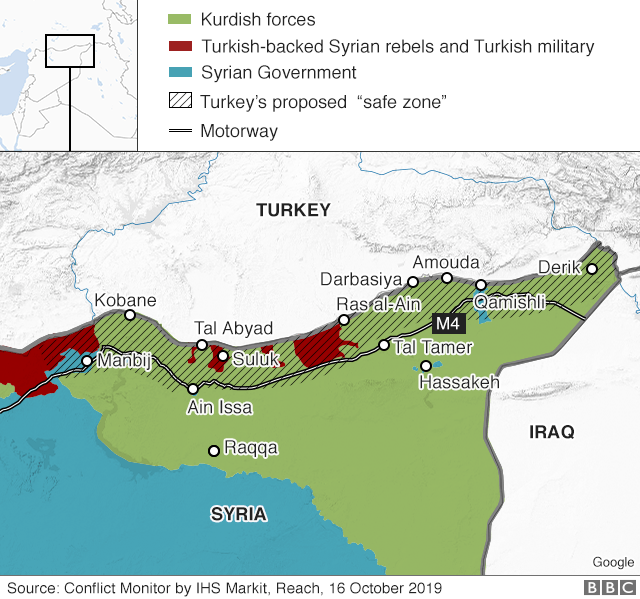
To be sure, everything devolves upon the creation of the safe zone. Turkey envisages a zone stretching across the entire 440 kilometre border with Syria up to the Iraqi border, while the US special envoy James Jeffrey remains non-committal, saying it is up to the “Russians and the Syrians in other areas of the northeast and in Manbij to the west of the Euphrates” to agree to Turkey’s maximalist stance.
Herein lies the rub. Jeffrey would know Ankara will never get its way with Moscow and Damascus. In fact, President Bashar al-Assad told, in unequivocal terms, a high-level Russian delegation visiting Damascus on Friday, “At the current phase it is necessary to focus on putting an end to aggression and on the pullout of all Turkish, US and other forces illegally present in Syrian territories.”
Is there daylight between Moscow and Damascus on this highly sensitive issue? Turkish President Recep Erdogan’s forthcoming meeting with Russian President Vladimir Putin in Sochi on October 22 may provide an answer.
Clearly, the US hopes wrench Turkey from the Russian embrace. Moscow’s studied indifference toward the US-Turkish cogitations betrays its uneasiness. Conceivably, Erdogan will expect Putin to take a holistic view, considering Russia’s flourishing and highly lucrative economic and military ties with Turkey and the imperative to preserve the momentum of the Russia-Turkey relationship.
But Trump has accommodated Erdogan’s top priority to create a safe zone and run it under Turkish supervision, which implies an open-ended Turkish military presence in a swathe of Syrian territory as big as Greece or Nepal. Erdogan’s tone has already changed in regard to his expectations from Putin.
In a meaningful remark on Saturday, he said, “In the area of the operation are forces of the (Syrian) regime under Russia’s protection. We will be tackling the issue with Mr. Putin.” Erdogan then added that in case he fails to “reach agreements on that issue (with Putin), Turkey will be implementing its own plans.”
If the US policy in Syria in recent years promoted the Kurdish identity, it has now swung to the other extreme of stoking the fires of Turkish revanchism. This is potentially catastrophic for regional stability. The heart of the matter is that while Turkey’s concerns over terrorism and the refugee problem are legitimate, Operation Peace Spring has deeper moorings: Turkey’s ambitions as regional power and its will to correct the perceived injustice of territorial losses incurred during the disintegration of the Ottoman Empire. The ultra-nationalistic Turkish commentator (and staunch supporter of Erdogan) wrote this week in the pro-government daily Yeni Safak :
“Turkey once again revived the millennium-old political history on Anatolian territory. It took action with a mission that will carry the legacy of the Seljuks, the Ottomans, the Republic of Turkey to the next stage… It is not possible to set an equation in this region by excluding Turkey – it will not happen. A map cannot be drawn that excludes Turkey – it will not happen. A power cannot be established without Turkey – it will not happen. Throughout history, both the rise and fall of this country has altered the region… the mind in Turkey is now a regional mind, a regional conscience, a regional identity. President Erdoğan is the pioneer, the bearer of that political legacy from the Seljuks, the Ottomans, and the Turkish Republic to the future.”
Trump is unlikely to pay attention to the irredentist instincts in Turkish regional policies. Trump’s immediate concerns are to please the evangelical Christian constituency in the US and silence his critics who allege that he threw the Kurds under the bus or that an ISIS resurgence is imminent. But there is no way the US can deliver on the tall promises made in the joint statement. The Kurds have influential friends in the Pentagon. (See the article by Gen. Joseph Votel, former chief of the US Central Command, titled The Danger of Abandoning our Partners.) Nonetheless, the main outcome will be that Turkey feels it has western support for its long-term occupation of Syrian territory.
All in all, it’s a “win-win” for Erdogan insofar as he got what he wanted — US’ political and diplomatic support for “the kind of long-term buffer zone that will ensure peace and stability in the region”, to borrow the words of Vice President Pence. A Turkish withdrawal from Syrian territory can now be virtually ruled out. State secretary Mike Pompeo added at the press conference in Ankara on Thursday that there is “a great deal of work to do in the region. There’s lots of challenges that remain.”
Pompeo said Erdogan’s “decision to work alongside President Trump… will be one that I think will benefit Turkey a great deal.” Arguably, the US expects Turkey’s cooperation to strengthen its strategy in Syria (and Iraq) where it seeks to contain Iran’s influence. From Ankara, Pompeo travelled to Jerusalem to brief Israeli PM Benjamin Netanyahu.
Seoul police ramp up security after protesters break into US ambassador’s residence
RT | October 19, 2019
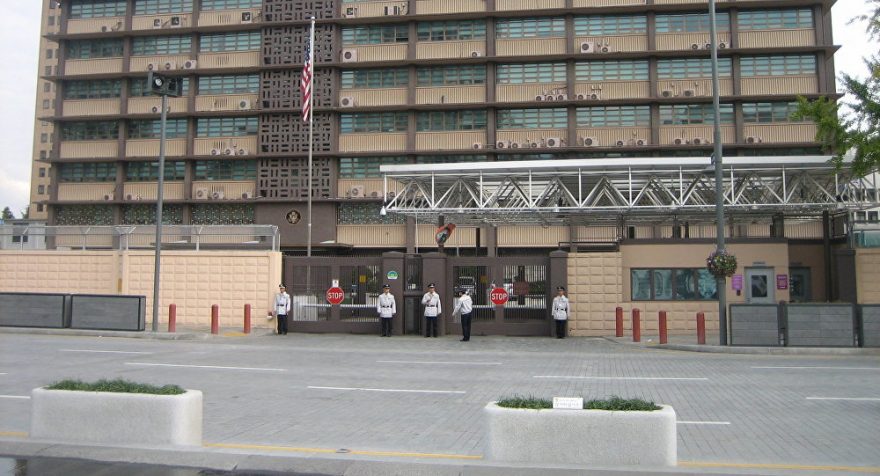
South Korean police have increased security at the US ambassador’s residence in Seoul after a group of students demonstrating against American troops in the country were able to infiltrate the diplomatic compound.
The Seoul Metropolitan Police agency said Saturday that the number of officers guarding the estate was more than tripled to 110. The beefed-up security comes a day after a group of protesters used ladders to gain entry to the walled-off grounds around Ambassador Harry Harris’ residence. Nineteen students were detained after unfurling banners saying “Leave this soil, Harris.”
“Stop interfering with our domestic affairs,” they shouted, followed by other chants – “Get out,” and “We don’t need US troops” – before being escorted off the property by police.
The group said they were motivated by Washington’s insistence that Seoul should pay [more] to keep US troops on its soil.
A spokesman for the US Embassy in Seoul said that the diplomatic mission was “seriously concerned about the illegal breach” and urged Korean authorities to do more to protect the compound.
American diplomatic and military outposts in the region are regularly targeted by protesters.
Last year, tens of thousands of protesters in Okinawa, Japan marched to stop the planned relocation of a US military base, demanding that the facility be removed from the island entirely.
Tulsi Nails it on National TV… US Regime-Change Wars
By Finian Cunningham | Strategic Culture Foundation | October 18, 2019
No wonder Democratic Party bosses and mainstream media are trying to bury presidential contender Tulsi Gabbard. She is the only candidate, perhaps the only politician in the US, who is telling the American public exactly what they need to know about what their government and military are really up to: fighting illegal regime-change wars, and to boot, sponsoring terrorists for that purpose.
It didn’t come much clearer nor more explicit than when Gabbard fired up the Democratic TV debate this week. It was billed as the biggest televised presidential debate ever, and the Hawaii Representative told some prime-time home-truths to the nation:
“Donald Trump has blood of the Kurds on his hands, but so do many of the politicians in our country from both parties who have supported this ongoing regime-change war in Syria that started in 2011… along with many in the mainstream media who have been championing and cheer-leading this regime-change war.”
The 38-year-old military veteran went on to denounce how the US has sponsored Al Qaeda terrorists for its objective of overthrowing the government in Damascus.
It was a remarkably damning assessment of US policy in Syria and elsewhere in the Middle East. And it was by no means the first time that Gabbard has leveled with the American people on the brutality and criminality of Washington’s so-called “interventions”.
The other 11 Democratic candidates on the stage during the TV debate looked agog after Gabbard’s devastating and calmly delivered statement. All the others have proffered the false narrative that US forces are in Syria to “fight terrorism”. They deplore Trump’s announcement last week to pull back US troops from northeast Syria because, they say, it will undermine the fight against Islamic State (IS or ISIS) and other Al Qaeda affiliates. They also condemn Trump for “betraying Kurdish allies” by his partial troop withdrawal.
President Donald Trump talks about “ending endless wars” and “bringing our troops home”. But he still premises his views on a credulous belief that the US under his watch “defeated ISIS 100 per cent”. In that way, he essentially shares the same corny view as the Democrats and media that America is a force for good, that it is the “good guys wearing white hats riding into the sunset”.
On the other hand, Gabbard stands alone in telling the American people the plain and awful truth. US policy is the fundamental problem. Ending its regime-change war in Syria and elsewhere and ending its diabolical collusion with terror groups is the way to bring peace to the Middle East and to spare ordinary Americans from the economic disaster of spiraling war debts. American citizens need to know the truth about the horror their government, military, media and politicians have inflicted not just on countries in the Middle East, but also from the horrendous boomerang consequences of this criminal policy on the lives and livelihoods of ordinary Americans, including millions of veterans destroyed by injuries, trauma, suicide, and drug abuse.
Following the TV debate this week, it seems that Gabbard won the popular vote with her truth-telling. A major online poll by the Drudge Report found that she stole a march on all the other candidates, winning approval from nearly 40 per cent of voters. Top ticket candidates Elizabeth Warren, Bernie Sanders and Joe Biden were trailing behind with 7 per cent or less.
Gabbard has clearly struck a deep chord with the US public in her honest depiction of American wars.
Despite her shattering exposé and seeming appreciation by the public, most mainstream media tried to bury her after the TV debate. Outlets like Vox and CNN declared that Warren was the winner of the debate, whose talking points were mainly about domestic policy issues. Like the other candidates, Warren plies the propaganda narrative of US forces “fighting terrorism”. Vox even slated Gabbard as “a loser” in the debate and claimed she had made “blatantly false” statements about the US’ role in Syria.
Other mainstream news outlets chose to ignore reporting on Gabbard’s demolishing of the official propaganda about American wars. Earlier this week, CNN and the New York Times smeared her as a “Russian asset” and an “apologist for Assad”, referencing a visit she made to Syria in 2017 when she held talks with President Assad.
The Democratic National Committee is claiming that Gabbard does not have sufficient support in polls it deems worthy for her to qualify for appearing in the next TV debate in November.
International events, however, are proving the Hawaii Representative right. US troops, as with other NATO forces, have been occupying Syrian territory illegally. They have no mandate from the United Nations Security Council. The pullback of US troops by Trump has created a vacuum in northeast Syria into which the Syrian Arab Army is quickly moving to reclaim the territory which US-backed Kurdish fighters had de facto annexed for the past five years. Several reports show the local people are joyfully welcoming the arrival of the Syrian army. The scenes are reminiscent of when Syrian and Russian forces liberated Aleppo and other cities previously besieged by terror groups.
America’s war machine must get out of Syria for the sake of restoring peace to that war-torn country. Not because “they have defeated ISIS 100 per cent”, as Trump would conceitedly claim, nor because “we are betraying Kurds in the fight against terrorism”, as most Democrats and US media preposterously claim.
Peace will come to Syria and the Middle East when Washington finally ends its criminal regime-change wars and its support for terrorist proxies. Tulsi Gabbard seems to be the only politician with the intelligence and integrity to tell Americans the truth.
Condemning Trump on Syria? It’s “buffet outrage”
By Stephen Kinzer – Boston Globe – October 17, 2019
Several years ago, the United States hired Kurdish fighters to be our mercenaries in Syria. This month we decided we don’t need them anymore, and abandoned them to their fate. Turkey, which considers Kurdish militancy a mortal threat, quickly began bombing them. This set off a veritable orgy of indignation in Washington. It is a classic example of “buffet outrage,” in which one picks and chooses which horrors to condemn.
Among those shedding crocodile tears, often accompanied by vivid threats against Turkey, are politicians and pundits who have never uttered a peep about American bombs laying waste to Yemen or American sanctions devastating lives in Iran. The United States deserves condemnation for abandoning its promise to the Kurds. Much of it, however, is a hypocritical blend of anti-Trump fanaticism and frustration over the emerging reality that we have lost the Syrian war.
Abandoning the Kurds is not a policy that materialized out of thin air. It is the product of two long chains of American error, one dating to the beginning of the Syrian war and the other even further back. The deeper history of our Middle East tragedy begins in 1980, when President Carter declared that any challenge to American power in the Persian Gulf region would be repelled “by any means necessary, including military force.”
A generation later, President George W. Bush recklessly ordered the invasion of Iraq, which set the region afire and led to the creation of ISIS.
The more recent set of causes for our Kurdish misadventure began in 2011, when President Obama ordered President Bashar Assad of Syria to “step aside.” Beyond the arrogance that leads American presidents to think they can and should decide who may rule other countries lay the utter impossibility of achieving that goal.
The head-chopping death cults that fought alongside our partners in Syria, including Jabhat al-Nusra, the local al-Qaeda franchise, and Ahrar al-Sham, which seeks to “build an Islamic State” based on “Allah’s Almighty Sharia,” have as part of their agenda the murder of every Shia Muslim. Since the population of nearby Iran is 90 percent Shia, it should have been obvious from the beginning that Iran would use every ounce of its considerable power to assure Assad’s survival. If Obama had looked at Syria realistically rather than succumbing to fantasy, he would have understood that Assad and his Iranian backers would do whatever necessary to defeat the American project. Instead he plunged ignorantly into a conflict that we had no prospect of winning.
Following the example his predecessor set when invading Afghanistan, Obama looked for “partners” who would fight the anti-Assad war for us. Many of the militias we hired and armed were connected to jihadist terror gangs. That made sense, because the Assad government is resolutely secular and those fanatics hate secularism. We also hired Syrian Kurds. They agreed to fight not because they wanted to commit genocide against Shia Muslims and other infidels, but for a completely different reason. They had watched their Kurdish cousins in northern Iraq establish a mini-state, and dreamed of doing the same in northern Syria. If they supported the American war against Assad, they reasoned, the United States might reward them by helping them turn their piece of Syria into an autonomous region or quasi-independent state.
This was never a realistic possibility. The country that Syrian Kurds wanted to carve out for themselves, which they called “Rojava,” did not have nearly the size, population, or military strength to survive in the unforgiving Middle East. Kurdish leaders understood this, but believed they would thrive anyway because their American friends would defend them. That was a pitifully naive miscalculation. The United States has repeatedly made lavish promises to the Kurds and then betrayed them — most notably in the 1970s, when we encouraged Iraqi Kurds to rebel against Saddam Hussein’s government and then abandoned them when Saddam made an accommodation with our ally, the Shah of Iran.
Yet Kurds never seem to learn. Their childlike trust in American promises brings to mind the cartoon character Charlie Brown, whose so-called friend Lucy pulls the football away at the last moment every time he tries to kick, but who nonetheless keeps believing this time will be different.
Although the Kurds did not foresee this betrayal, Assad did. “We say to those groups who are betting on the Americans, the Americans will not protect you,” he warned in a speech nine months ago. The Kurds should have listened. In fact, seeking Assad’s protection was always their Plan B. Now, very late in the game and after taking thousands of casualties fighting for their alluring but unfaithful American “friends,” they are doing it. They have effectively surrendered to the Syrian army and asked for its help in defense against Turkey, which thought it had a chance to crush them and establish itself as the de facto ruler of “Rojava.” The Kurds’ alliance with the United States was doomed from the start. Alliance with Assad makes more sense. He may not be the world’s most reliable ally, but he is more trustworthy than the feckless United States.
Although the Kurds’ decision to ask pardon from Assad and join him in rebuilding a secular state is years overdue, it is welcome and wise. It brings Syrians a step closer to the only solution that can end their suffering: reunification. This war will only end when the government re-establishes its authority over all of Syrian territory and hostile foreign forces withdraw. Syria Kurds have belatedly recognized this truth. We should do the same.
Stephen Kinzer is a senior fellow at the Watson Institute for International and Public Affairs at Brown University.
Why Withdrawing US Troops from Northern Syria is GOOD
By Rick Sterling | Dissident Voice | October 17, 2019
The foreign policy elite is in an uproar. They claim “we have abandoned our allies”. They question “how can America be trusted?” They say the decision to withdraw from northern Syria was a “gift” to Russia, Iran, and Assad, even ISIS. It is true that the policy of US/NATO interventionism is failing. But that has been true since the invasion of Iraq or earlier. After the disastrous invasions and attacks on Afghanistan, Iraq and Libya, and the 8 year undeclared war on Syria, isn’t it time to question the foreign policy elite?
If one believes in restoring international law and the UN Charter, it is GOOD that US military forces have been withdrawn from northern Syria. Here are some facts and history which explain why.
Basic fact: It’s not our country and US troops were never authorized by the sovereign government. Whether or not Washington likes Damascus is irrelevant. Under international law those troops have no right to be there. Even the overflights of Syria by the US air coalition violate international agreements. It’s up to Syrians to defend their country against invading Turkey. If they choose to get support from another country, that is their right.
Another fact: President Obama was correct when he said that “putting boots on the ground” in Syria would be a “profound mistake”. Later he said, “We have a very specific objective, one that will not lead into boots on the ground or anything like that.” But the hawks prevailed. There were not only “boots on the ground”, there was a shifting rationale why they had to be there.
The US and allies have done all they could, short of direct invasion, to overthrow the Syrian government. They have spent tens of BILLIONS of dollars in weapons, training, equipment, recruitment, etc. This is in violation of international law. More than one hundred thousand Syrians have died defending their country against a foreign sponsored army of mercenaries and foreign fighters.
An astonishing fact: The US encouraged the emergence of the Islamic State. Why? Because it put pressure on Damascus and because it justified the entry of the US. While the US carpet bombed Raqqa, it looked the other way as hundreds of trucks conveyed oil from eastern Syria into Turkey to fund the Islamic State. The US air coalition attacked the Syrian Arab Army in the midst of a critical battle against ISIS near Deir Ezzor. In a secretly recorded conversation in New York with Syrian “activists”, John Kerry admitted they were watching ISIS and hoping to use it to pressure Damascus. In other words, US foreign policy was duplicitous and used terrorism as a tool. This is well documented in the book The Management of Savagery.
After the US-backed “Free Syrian Army” failed, the US looked for another means to destabilize Syria. They started to fund the Syrian Kurdish militias known as the Peoples Protection Unit (YPG /YPJ). They gave the militias a new name, Syrian Democratic Forces (SDF), and encouraged the secessionist tendency. Meanwhile in Turkey, which has the largest Kurdish community, most Kurds want to have their rights within Turkey and have formed a political party (Peoples Democratic Party – HDP) which unites progressives of all ethnicities. In the 2015 Turkish election this party emerged as the third most popular party and stopped Erdogan’s election domination. Currently the HDP is campaigning against Turkey’s invasion of Syria. As of 13 October the Syrian Kurdish militias have come to an agreement to work with Damascus to combat the Turkish invasion. The agreement specifies that the Syrian Arab Army will control and defend the entire area from Jarablus on the Euphrates River to the far eastern border with Iraq.
Advocates of US intervention claim that the Kurds were fighting and dying “for us.” That is not true. They were defending their own community. To the extent that they accepted and welcomed US air support, equipment, weaponry, etc. it was for their own benefit. There were two parties trying to use each other.
Whenever the US attacks or occupies a country it needs a rationalization. In 1991 there were false claims about incubators being stolen by Iraqi troops in Kuwait. In 2003 there were false claims about weapons of mass destruction in Iraq. In 2011 there were false claims of civilians being threatened by Libyan troops in Benghazi. All these claims were subsequently found to be exaggerated or entirely false.
One of the main justifications for continuing US presence in Syria is “keeping our word” and not “abandoning” the Kurdish forces. This is a favorite rationalization for war. In Cuba, the CIA trained Cuban exiles that attacked Playa Giron “were counting on us.” Fortunately, JFK resisted the pressure and said “No”. In Vietnam, the US continued the war for a decade because we could not let down our “ally”, the government of Saigon. Millions of Vietnamese were killed plus 55,000 US troops because we could not “abandon” a government that in reality was a proxy.
In the Democratic Debates (15 October) Joe Biden said that the withdrawal of US troops from northern Syria was “the most shameful thing any president has done in modern history in terms of foreign policy.” This is absurd. Over one million died in Iraq including 4500 and at least 100,000 severely injured US soldiers. Joe Biden was an influential supporter of the 2003 Iraq invasion. Later, as Vice President, he supported the overthrow of the Libyan government. The country is still in chaos with tens of thousands dead. These two countries were devastated by US actions. It is evidence of shameless unaccountability in media and politics that Joe Biden is a serious candidate for President after he destroyed so many lives at a cost of trillions. In the same Democratic debates Tulsi Gabbard was honest and accurate as she said that the plight of the Kurds in northern Syria is “yet another consequence of the regime change war we’ve been waging in Syria”.
Despite the howls of indignation and disinformation, withdrawing US troops from northern Syria is a step in the right direction.
Rick Sterling is an investigative journalist who has visited Syria several times since 2014. He lives in the SF Bay Area and can be reached at rsterling1@gmail.com.
Trump unchained: How the ‘God-Emperor’ is ending American Empire with Syria gambit
By Nebojsa Malic | RT | October 16, 2019
US President Donald Trump’s decision to pull US troops out of Syria is drawing fire from Democrats, media and some in his own party as well. He doesn’t seem to care, insisting on his 2016 campaign promise to end the endless wars.
At a press conference on Wednesday, Trump batted away every attempt at criticism – calling out the media for faking footage from Syria; describing the Kurdish militias that worked with US troops against Islamic State (IS, formerly ISIS) as “no angels”; and demanding one good reason why the US should be involved in a centuries-long dispute between Syrians, Kurds and Turks when they could work that out themselves. None was forthcoming.
He even chided the US military-industrial complex that wants to “fight forever,” while making sure to note that he authorized a $2 trillion spending spree to rebuild the “depleted” US military. When reporters brought up the outspoken opposition by some Senate Republicans, Trump shot back that they ought to do their jobs, and he would do his. This was not a president worried about getting impeached, but someone confident in his position after 1,000 days in office.
While 2016 may seem like a long time ago, Candidate Trump did run on the platform of ending endless wars and entangling alliances. His daring to question the sacred cow of NATO, or the US presence in Afghanistan, Syria and Iraq caused apoplexies across Washington.
After becoming president – and facing a coordinated effort from every quarter to block, sabotage and “resist” his agenda – he chose to go along with the military and political establishment. So the US did not withdraw from Afghanistan, and sent more troops to Iraq and Syria to fight IS. Trump even launched strikes against the Syrian government on two occasions – both prompted by alleged “chemical attacks” – in 2017 and 2018. Having hired neocon warmongers, he embraced their agenda for regime change in Cuba and Venezuela.
If this was done to appease his domestic critics, it obviously did not work. Neocons and establishment Republicans continued to denounce him and ally with the Democrats seeking Trump’s impeachment. So at some point recently – perhaps when he fired the hawkish adviser John Bolton? – Trump appears to have decided he might as well do what he wanted all along.
Declaring IS defeated, he ordered the pullout of US troops from northern Syria, setting in motion a chain of events that have transformed the situation in the region practically overnight, while his critics could only wail and gnash their teeth in impotent rage.
Trump has always had the uncanny ability to force his foes to defend the indefensible – see the curious case of Democrats and open borders, to name just one example. Now that talent has been leveraged in the area where US presidents have the most influence, and where his critics appear the weakest: foreign policy.
Turns out that getting the US out of Syria was easy, so long as Trump let others do all the hard work. Mainstream media said Trump gave Turkey the “green light” to invade Syria, when he clearly didn’t. They gleefully took up the cause of the “betrayed Kurds” until they got caught faking footage of the Turkish invasion. When it emerged that the “Turkish” troops involved were the very same “moderate rebels” they cheered on, back during the Obama administration – now denounced as “thugs and pirates” – the contortions they had to put themselves through were a sight to behold.
What if Barack Obama had called out the military-industrial complex, told off politicians who wanted to fight “endless wars,” or declared that American soldiers should not be injured or killed in centuries-old sectarian conflicts? It is no stretch to say that he would have been applauded by the same people that now vilify Trump.
Yet Obama didn’t do any of those things, even though he had the “hope and change” mandate. Instead, he allowed himself to be seduced by the promises of glory coming from his ambitious advisers. The result was the rise of IS, as Washington sponsored jihadists in Syria; the destruction of Libya and its transformation into a slave-market anarchy; the coup in Ukraine and the war in Donbass. The “geniuses” behind these fiascos are now shrieking that Trump’s cleanup of their mess is somehow hurting America!
During the 2016 campaign, some of his supporters jokingly referred to Trump as their “God-Emperor,” a science fiction reference that spawned a thousand memes. Yet here he is, single-handedly dismantling the American Empire because he believes it runs counter to the notion of the American Republic its founders had envisioned over two centuries ago.
Meanwhile, his critics are once again forced to defend the indefensible, and the only “argument” they have left is that all of this is somehow “helping Russia.” Trump is either lucky beyond all probability, or truly a “stable genius,” as he once put it himself. In the end, it doesn’t matter.
House of Representatives votes 354-60 against Trump’s withdrawal of US troops from Syria
RT | October 16, 2019
Democrats and 129 of the Republicans in the House of Representatives voted to pass a non-binding resolution disapproving of President Donald Trump’s pullout of US troops from Syria – never authorized by Congress to be there.
The House Joint Resolution 77 describes the presence of US troops in northeastern Syria as “certain… efforts to prevent Turkish military operations against Syrian Kurdish forces,” and formally voices opposition to their withdrawal, but does not offer an alternative. Instead, it demands the White House present a “clear and specific plan for the enduring defeat” of Islamic State (IS, formerly ISIS).
The IS “capital” of Raqqa was liberated by US-allied Kurdish militias in October 2017, and the last IS enclave was declared secured in December 2018, but traces of the presence of the self-declared “caliphate” remain in both Syria and Iraq, weakened by years of war and sanctions.
The House resolution asks the White House to continue providing “humanitarian support” to the Kurds and ensure that Turkey “acts with restraint,” while also demanding of Ankara to stop its “unilateral military action” in Syria.
Trump has maintained he never gave the “green light” to Turkey to invade Syria, and defended the withdrawal as protecting the lives of American soldiers in a region where they had no business being anymore. He has also threatened to “destroy” Turkey’s economy with sanctions and tariffs over the invasion.
Congress has never voted to authorize the US troop presence in Syria, which is not sanctioned under international law and is based only tenuously on old resolutions allowing military action against Al-Qaeda terrorists following the 9/11 attacks. Damascus considers the US presence a violation of its sovereignty, unlike the Russian force that was invited back in 2015.
While the resolution does little to change the situation in Syria, the fact that so many Republicans chose to back Democrats against the sitting president from their party is being held up as a possible barometer for the Democrat-led impeachment process, even though House Speaker Nancy Pelosi has repeatedly refused to hold an actual floor vote on the matter.
Media and politicians didn’t care about chaos the US caused in Syria for years, but now that Trump can be blamed, they’re outraged
By Danielle Ryan | RT | October 16, 2019
Mainstream US media has been the biggest cheerleader for Washington’s chaos production in Syria for years, but now, as Donald Trump pulls troops out of the northeast, they’re suddenly outraged. Spare us the crocodile tears.
“Plenty of reason here for the US possibly to become involved,” pleaded a horrified MSNBC correspondent this week, chastising Trump for ignoring “war crimes” and “human rights abuses” by Turkish forces.
Yet, while he and others cloak their demands for continued US military action in humanitarian concern for the Kurds in the face of Ankara’s onslaught, there is a more selfish reason for the media outrage. They are profoundly addicted to the bogus narrative of the US as the world’s savior, and worse, they crave the kind of dramatic TV footage and tales of military heroism that US forever wars offer. If that sounds a bit too cynical, recall MSNBC anchor Brian Williams close to weeping as he shared the “beautiful pictures” of American missiles raining down on Syria two years ago.
The pleas for fresh US intervention also reveal a hyper-focus on Washington’s “image” in the eyes of the world. The media has been bleating for days about how Trump’s actions will be perceived by its allies and enemies, but who is going to break it to them that their “image” is not quite what they think it is?
Successive US administrations have pursued policies of chaos and disarray in Syria for years; first covertly attempting to sow social discontent to spur and exploit a popular uprising, then by funding, training, and backing jihadist militias (Al Qaeda, included) against Bashar Assad’s army, and prioritizing the fall of his secular government over peace for the better part of a decade.
Couple that with Washington’s continued facilitation of slaughter in Yemen, its penchant for economically choking uncooperative nations with punitive and deadly sanctions and its psychological warfare of constant threats of violence against Iran, and one wonders exactly what kind of benevolent do-gooder image there is left to salvage.
This uniquely American obsession with image on the world stage was on display during CNN’s Tuesday night Democratic presidential debate, too. The perpetually grandstanding Cory Booker claimed Trump had turned America’s “moral leadership” into a “dumpster fire,” while Pete Buttigieg lamented the president’s betrayal of American “values” that left the country’s reputation and credibility “in tatters.”
Joe Biden, who as Obama’s former VP, shares plenty of the blame for the state of Syria today, called Trump’s pullout from northern Syria “the most shameful thing that any president has done in modern history” in terms of foreign policy. Iraqis might disagree with that statement, but remember, all pre-Trump foreign policy disasters have been conveniently flushed down the memory hole and their perpetrators rehabilitated for the purposes of comparison with the evil Orange Man.
The hand-wringing over America’s image betrays a deeply delusional but long-ingrained belief that the world at large sees the US military as a force for good. In reality, worldwide polls have shown that the US is actually regarded as the greatest threat to world peace, not — as news anchors and Washington politicians would have you believe — a facilitator of world peace.
Tulsi Gabbard was the only candidate on the Ohio debate stage willing to call a spade a spade, describing the chaos in northeast Syria as “another negative consequence” of US involvement in the region.
“Donald Trump has the blood of the Kurds on his hands, but so do many of the politicians in our country, from both parties, who have supported this ongoing regime change war in Syria, along with many in the mainstream media, who have been championing and cheerleading” it, she continued.
She slammed the US’s “draconian sanctions” on Syria, describing them as “a modern-day siege the likes of which we are seeing Saudi Arabia wage against Yemen” and promised that if she was the president, she would end support for Al Qaeda in Syria, which she said had been the US’s “groundforce” in the war.
Cue the gasps all around.
Gabbard’s insistence on forcing a reckoning with the reality of US policy in Syria makes her presence on the debate stage so necessary, but predictably her input, while entirely truthful, was met with spineless attacks in the same vein as those she has been subjected to from mainstream media for months, culminating recently with a McCarthyist hit-piece published by the New York Times implying that she is a Russian asset.
Reaction to Gabbard from journalists watching on social media was just as fierce. MSNBC’s Clint Watts called the notion of US support for Al Qaeda a “falsehood” that needed challenging. Watts, it turns out, part-authored a 2014 piece for Foreign Affairs about Ahrar al-Sham, an Al Qaeda-linked group “worth befriending.” Another reporter called Gabbard’s claims about the US arming Al Qaeda a “Russian talking point.” Investigative journalist Max Blumenthal quickly responded with a photograph of Al Qaeda firing a US-supplied TOW missile in Aleppo.
But to the regime change fanatics and war cheerleaders, these facts don’t seem to carry much weight. Narrative has always been more important.
Danielle Ryan is an Irish freelance writer based in Dublin. Her work has appeared in Salon, The Nation, Rethinking Russia, teleSUR, RBTH, The Calvert Journal and others. Follow her on Twitter @DanielleRyanJ
Featured Video
Trita Parsi: Israel Set a Trap for Total War in the Region
or go to
Aletho News Archives – Video-Images
From the Archive
Zionism’s Violent Legacy
By Donald Neff | Washington Report On Middle East Affairs | January 1996
On January 4, 1948, Jewish terrorists drove a truck loaded with explosives into the center of the all Arab city of Jaffa and detonated it, killing 26 and wounding around 100 Palestinian men, women and children.[1] The attack was the work of the Irgun Zvai Leumi – the “National Military Organization,” also known by the Hebrew letters Etzel – the largest Jewish terrorist group in Palestine. The Irgun was headed by Revisionist Zionist Menachem Begin and had been killing and maiming Arabs, Britons and even Jews for the previous ten years in its efforts to establish a Jewish state.
This terror campaign meant that at the core of Revisionist Zionism there existed a philosophical embrace of violence. … continue
Blog Roll
 Aletho News
- Trita Parsi: Israel Set a Trap for Total War in the Region
- Trump’s Iran war is on an Israeli leash
- Saudi oil boss issues global supply warning
- Riyadh Says Its Oil System Is Intact. The Numbers Say Otherwise.
- Trump and Netanyahu Want to “Finish the Job” on Iran
- US ‘one-sided dictation’ not Iran’s beliefs makes rational talks impossible: Baghaei
- Iran’s Next Strike May Not Explode. It Could Shut You Down /Col Doug Macgregor
- Iran: US political targets legitimate if assassinations return
- Iraq shuts key border crossing with Iran under US pressure: Report
- Undersea Internet cables could be targeted in retaliation for attacks on Iran: IRGC deputy chief
- If Americans Knew
- The Israel Lobby’s Changing Fortunes
- AIPAC has become such a political liability that it’s shifting to a more “nimble” approach to buying politicians
- At least 160 Israeli settler attacks in 2 weeks
- Will Gaza’s Ancient Christian Community Disappear Forever?
- Israel’s vision of regional security rests on keeping Arab states weak
- Heidi Levine recounts how Palestinian youths helped save her in settler attack
- DAILY UPDATE: Latest essential news on Palestine, Israel, & region
- Trump’s Intensifying Sabotage of the ICC, for Israel’s Sake
- Israeli military detain US and UK volunteers in West Bank including Democratic NY politician Brad Lander
- Americans at National Conservatism Conference held in Israel this year criticize Israel
- No Tricks Zone
- E-Cars Reduce CO2 Emissions By Only 41% Compared To Internal Combustion Engine Vehicles
- Predictions Made By Renowned Climate Professor Over Past Decades Have Been Proven To Be Poor
- New Study Suggests Large Regions Of The Pacific Ocean Have Been Cooling For The Last 80 Years
- Germany’s Green Energy Debacle: High Energy Costs Force Kahla Porzellan to Close After 182 Years!
- New Study: 50 Years Of The Most Aggressive ‘Net Zero’ Policies Can Only Affect The Global Climate By 0.03°C
- US September “Heat” Was No Record…Many Records Set Decades Ago
- Latest European Green Energy Debacle; Portugal’s Largest Flagship Solar Park Insolvent!
- Green Energy Debacle: German Expert Professor Fritz Vahrenholt Warns Of Severe Economic And Social Consequences
- Two More Paleo Reconstructions Affirm Meters-Higher Sea Levels Across Ireland, Brazil 7000-6000 Years Ago
- New Study: Earth And Venus Surface Warmth Largely Explained By Convection And Lapse Rate, Not CO2 Or Radiation

